Two people have been found dead at a home in Los Angeles identified by authorities as the residence of director and actor Rob Reiner, authorities say.
Firefighters were called to a house in Brentwood on Sunday afternoon, where they found the bodies of a 78-year-old man and 68-year-old woman who were pronounced dead at the scene, the LA Fire Department said.
Authorities did not immediately identify them or the circumstances surrounding their deaths.
Rob Reiner is 78 and his wife, Michele, is 68.
Reiner is a storied Hollywood filmmaker whose movies include classics such as The Princess Bride, When Harry Met Sally, and This is Spinal Tap.
This breaking news story is being updated and more details will be published shortly. Please refresh the page for the fullest version.
You can receive Breaking News on a smartphone or tablet via the BBC News App. You can also follow @BBCBreaking on X to get the latest alerts.
The chief executive of Oxfam GB has been forced out by the charity's board after an independent review found "serious issues" with her behaviour and decision making.
The organisation's trustees decided Dr Halima Begum's position was "untenable" because of an "irretrievable breakdown in its trust and confidence" in her ability to do the job.
About 70 members of staff had signed a letter calling for Oxfam to investigate Dr Begum's conduct, with several employees said to have resigned after falling out with her, the Times reported.
Dr Begum had been in the role for almost two years. The BBC has contacted her for comment.
In a statement, Oxfam confirmed the review was commissioned by its board of trustees to examine "concerns raised about the leadership, conduct and approach" of Dr Begum.
It said the review was carried out by legal firm Howlett Brown between November and December 2025.
The investigation drew on testimony from 32 current and former Oxfam colleagues, as well as documentary evidence, the charity said.
Findings showed "serious issues in the CEO's leadership behaviour and her decision making, including breaches of organisational processes and values, and inappropriate interference into safeguarding and integrity investigations", it added.
The decision to discharge Dr Begum from her role was passed last week and she has already left the organisation, Oxfam said.
The role of acting chief executive will be taken up by Jan Oldfield, Oxfam's chief supporter officer for more than four years, it added.
Acting co-chairs of Oxfam GB, Nana Afadzinu and Dame Annie Hudson, said their priority going forward was to provide "stability" for staff and "rebuild confidence" across the organisation".
"The Board has taken immediate steps to strengthen oversight and reinforce organisational processes, and work is already underwayto address the recommendations in the report," they added.
Dr Begum's departure comes after a difficult year for Oxfam.
The Oxford-based charity also made 250 of its 2,100 UK staff redundant earlier this year to save £10.2m from its wage bill.
At the time, Dr Begum said the decline was due to the charity's work taking place "against a backdrop of deep uncertainty, rising inflation and a cost-of-living crisis".
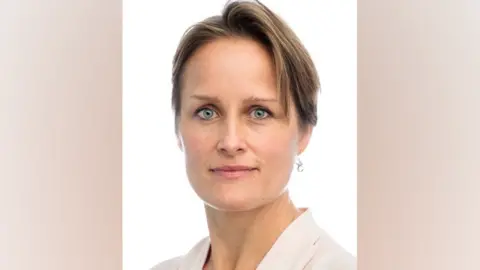
Blaise Metreweli is the first woman to head Britain's overseas spy agency
The new chief of MI6, Blaise Metreweli, will warn of "the acute threat posed by Russia" when she makes her first public speech later.
She will highlight so-called hybrid warfare, which includes incidents such as cyber attacks and drones suspected of being launched near critical infrastructure by Russian proxies.
Ms Metreweli will describe this as "an acute threat posed by an aggressive, expansionist and revisionist Russia".
Referring to the war in Ukraine, she will insist that Britain will be keeping up the pressure on President Vladimir Putin on Ukraine's behalf.
Ms Metreweli, who took over as head of the Secret Intelligence Service in the autumn, is the first woman to head Britain's overseas spy agency. She took over from Sir Richard Moore on 1 October.
Monday's speech will point to the recent sanctioning of Russian entities accused of conducting information warfare, as well as two China-based companies sanctioned for their "indiscriminate cyber activities against the UK and its allies".
Western sanctions have certainly damaged Russia's economy, driving its exports eastwards towards China and India. But they have singularly failed to change President Putin's determination to wage war on Ukraine until it gives in to his demands for territory and ultimately, loyalty to Moscow.
It is also clear from Ms Metreweli's speech that a special area of interest for the new spy chief is technology.
Having joined MI6 in 1999, she has arrived at the top job via Q Branch. Named after the fictional MI6 division in Ian Fleming's spy books, this is the real life, in-house, top secret part of the Secret Intelligence Service that designs the sorts of gadgets and gizmos that enable agents to communicate with their handlers, without being detected and caught.
In her speech later she is expected to call on all her intelligence officers to master technology, "not just in our labs, but in the field, in our tradecraft.. We must be as comfortable with lines of [computer] code as we are with human sources, as fluent in Python as we are in multiple languages".
Python, a programming language, may surprise some as an example to pick, since it has been around for more than three decades. But her point will not be lost on the men and women who have chosen to work in the shadowy world of espionage.
In an age where data is key, where spies can no longer rely on false identities when biometric scanning can unmask them in seconds at borders and checkpoints, MI6 needs to prove that it can still be relevant.
Elsewhere, the Chief of the Defence Staff, Sir Richard Knighton, will on Monday call for a "whole of society approach" to building national resilience, in the face of growing threats and uncertainty.
In a speech to the Royal United Services Institute in London, Sir Richard is expected to say that defence and resilience need to be a higher priority for everyone, not just those in the military.
It is the latest in a string of warnings that the UK needs to be more ready than it is now to meet a growing volume of threats.
Sir Richard is expected to say that the situation is more dangerous than he has known during his entire career.
Russia has made it clear that it wishes to challenge, limit, divide and ultimately destroy Nato, he will say.
Britain's response needs to be about more than simply strengthening the armed forces. Deterrence, he will say, involves harnessing the UK's power, from its universities to industry, the rail network and the NHS.
"A new era for defence doesn't just mean our military and government stepping up - as we are - it means our whole nation stepping up," he will say.
Addressing a skills gap highlighted in a recent report by the Royal Academy of Engineering, Sir Richard will talk about the need to work with industry and young people and will announce £50m for new defence technical excellence colleges.
In recent weeks, both France and Germany have outlined plans for voluntary national service.
Last year, the then-Conservative government set out its own compulsory proposals, which Labour dismissed as a gimmick.
But the debate about how Britain as a whole should respond to an increasingly uncertain world is gathering pace.
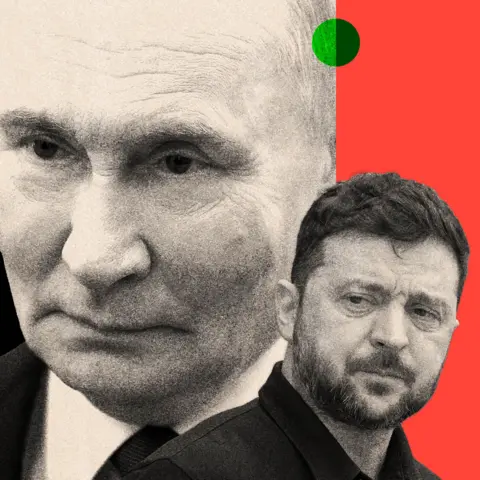
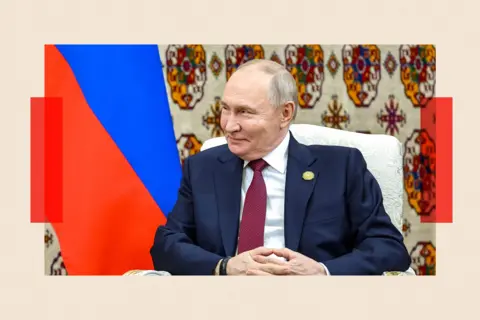
Vladimir Putin may have a reputation among some as a ruthless autocrat, a master manipulator of the international scene. But one thing Russia's president does not have is a poker face.
The late US Senator John McCain used to joke that when he looked into Putin's eyes, he saw three things, "a K and a G and a B", a reference to his past life as a Soviet intelligence officer.
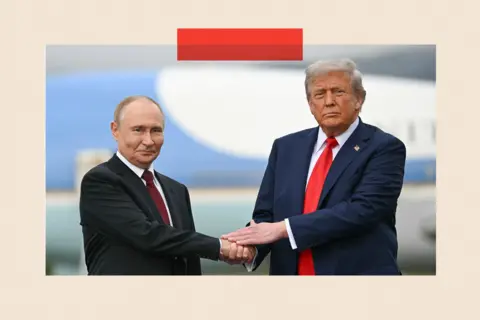
I thought of this as I watched footage of Russia's leader sitting opposite American envoys in the Kremlin. He could not hide his emotions; he exuded an air of supreme confidence.
For President Putin reckons the diplomatic tide has turned in his favour, with an improved relationship with America and gains on the battlefield.
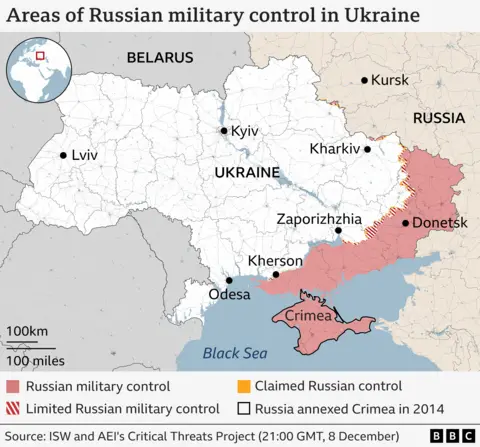
Some analysts say Putin has no incentive to retreat from his demands: that Ukraine gives up the last 20% of Donetsk it still controls; that all occupied territory is recognised internationally as Russian; that Ukraine's army is curtailed to a point of impotence; and Nato membership is ruled out forever.
As things stand, there are a few possible scenarios. The first is that US President Donald Trump may try to force Ukraine into a ceasefire on terms unwelcome to its people, one that cedes territory and lacks sufficient security guarantees to deter future Russian aggression.
If Ukraine demurs or Russia vetoes, President Trump has hinted he could wash his hands of the war; last week, he said "sometimes you have to let people fight it out".
AFP via Getty Images
The Trump administration's new national security strategy urged the US to 're-establish strategic stability' with Russia
He could remove the vital US intelligence Ukraine needs to detect incoming Russian drones and target Russian energy facilities.
Another possibility is that the war could just stumble on with Russia's forces continuing to make slow advances in the east.
The Trump administration's new national security strategy implied that Russia is no longer an "existential threat" to the US, and urged the US to "re-establish strategic stability" with Russia.
So, with American support for Ukraine in serious question, what - if anything - could potentially change Putin's mind? And what else could Ukraine, Europe and even China, do differently?
Could Europe do more?
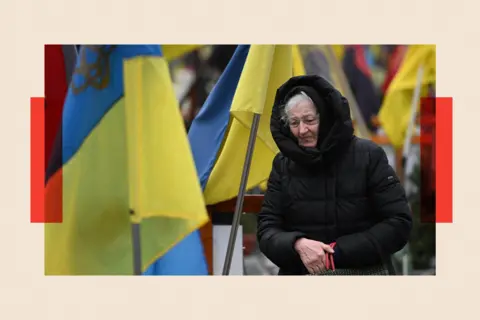
At the moment, the continent is preparing for a ceasefire. Under the banner of the "coalition of the willing", it is preparing an international military force to help Ukraine deter future Russian invasion, alongside a financial effort to help reconstruct the war-ravaged country.
But some officials suggest that Europe should instead prepare for the war to muddle on.
They want to help Ukraine not only "win the fight tonight", with more drones and cash; but also provide longer term support and prepare for a 15 to 20 year war with Russia.
Europe could also do more to help protect Ukrainian skies from drones and missiles. There is already a plan – called the European Sky Shield Initiative – which could be expanded to allow European air defences to protect western Ukraine.
Others argue European troops could be deployed to western Ukraine to help patrol borders, freeing up Ukrainian soldiers to fight on the front line. Most proposals such as this have been rejected for fear of provoking Russia or escalating the conflict.
Keir Giles, senior consulting fellow at the Russia and Eurasia programme at Chatham House think tank, said these fears were based on "nonsense" because Western troops were already present on the ground and Sky Shield could be deployed in western Ukraine with little chance of any clash with Russian aircraft.
European leaders, in his view, had to "insert themselves into the conflict in a manner that will actually make a difference".
WPA Pool/Getty Images
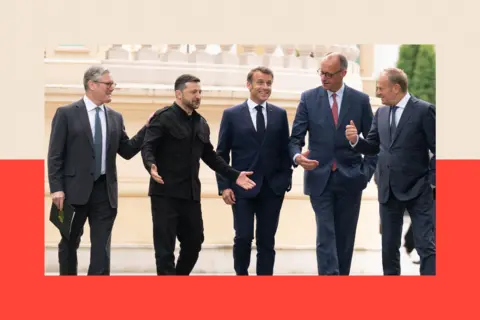
Zelensky has offered to drop Ukraine's aspirations to join the NATO military alliance, according to some reports on Sunday. (Pictured: Starmer with Zelensky, Emmanuel Macron, Friedrich Merz and Donald Tusk)
Mr Giles said: "The only thing that will unarguably, undeniably stop Russian aggression is the presence of sufficiently strong western forces where Russia wants to attack, and the demonstrated will and resolve that they will be used to defend."
This strategy would of course come with huge political difficulty - with some voters in western Europe unwilling to risk a confrontation with Russia.
Few analysts expect Ukraine to reverse the tide and make actual territorial gains of its own.
Having spent several weeks in Ukraine recently, I heard no mention of any Spring offensive, only the need to slow Russia's advance and increase the price it pays in blood and treasure.
Some western diplomats claim Russia's generals are lying to the Russian president, pretending the situation on the ground is better than it is - adding to what they see as a deliberate strategy to exaggerate Russian gains, designed to suggest Ukraine is on the back foot and should thus sue for peace.
According to Thomas Graham in Foreign Affairs, in this year, Russia has seized only 1% of Ukrainian territory at a cost of more than 200,000 dead and wounded.
AFP via Getty Images
'It is remarkable they [Ukraine] have held off for so long, not least fighting with one hand behind their back,' says Fiona Hill
Fiona Hill, senior fellow at the Center on the United States and Europe at the Brookings Institution, who served on Trump's national security council during his first term, says the biggest thing Putin has in his favour is that many people believe Ukraine is losing.
"Everyone is talking of Ukraine as the loser when it now has the most potent military in Europe," she says.
"Just think what they have done to Russia. It is remarkable they have held off for so long not least fighting with one hand behind their back."
Trade, sanctions and Russia's economy
Then there's the lever of sanctions. Certainly, Russia's economy is suffering. Inflation at 8%, interest rates 16%, growth slowed, budget deficits soaring, real incomes plunging, consumer taxes rising.
A report for the Peace and Conflict Resolution Evidence Platform says Russia's war economy is running out of time. "The Russian economy is substantially less able to finance the war than it was at the beginning of it in 2022," the authors say.
But so far none of this appears to have changed much Kremlin thinking, not least because businesses have found ways of evading restrictions, such as transporting oil on unregistered ghost ships.
Sputnik/Alexander Kazakov/Pool via Reuters
In this year alone, Russia has seized 1% of Ukrainian territory at a cost of more than 200,000 dead and wounded, according to Thomas Graham in Foreign Affairs
Tom Keatinge, director of the Centre for Finance and Security at Rusi, said western messaging about sanctions was convoluted and there were too many loopholes.
Russia would, he said, work around recent US sanctions on two Russian oil giants, Lukoil and Rosneft, just by re-labelling the exported oil as coming from non-sanctioned companies.
Mr Keatinge said if the West really wanted to hurt Russia's war economy, it would embargo all Russian oil and fully implement secondary sanctions on countries that still buy it. "We need to stop being cute and go full embargo," he said.
"We need to take our implementation of sanctions as seriously as the Kremlin takes circumvention."
In theory, sanctions could also affect Russian public opinion. In October, a survey by the state-run Public Opinion Research Centre (VCIOM) said 56% of respondents said they felt "very tired" of the conflict, up from 47% last year.
But the consensus among Kremlinologists is that much of the Russian public remains supportive of Putin's strategy.
Reuters
The Ukrainian president arrived in Berlin on Sunday for peace talks with Witkoff and Friedrich Merz (Trump and Zelensky pictured on a previous occasion)
The European Union could agree to use about €200bn (£176bn) of frozen Russian assets to generate a so-called "reparation loan" for Ukraine. The latest European Commission proposal is to raise €90bn (£79bn) over two years.
In Kyiv, officials are already banking on getting the cash. But still the EU hesitates.
Belgium, where the bulk of the Russian assets are held, has long feared being sued by Russia - and on Friday, the Russian Central Bank announced legal action against Belgian bank Euroclear in a Moscow court.
Belgium says it will not agree the loan unless legal and financial risks are shared more explicitly with other EU members. France has concerns, such is its own vast debts, and fears exploiting the frozen assets could undermine the stability of the eurozone.
EU leaders will make a further attempt to agree a deal when they meet in Brussels on 18 December for their final summit before Christmas. But diplomats say there is no guarantee of success.
There is also disagreement over what the cash should be used for: keeping Ukraine's state solvent now or paying for its reconstruction after the war.
Ukraine's conscription question
As for Ukraine, it could mobilise more of its armed forces.
It remains the second-biggest army in Europe (behind Russia), and the most technically advanced - but it is nonetheless struggling to defend an 800-mile frontline.
After almost four years of war, many soldiers are exhausted and desertion rates are rising.
Getty Images
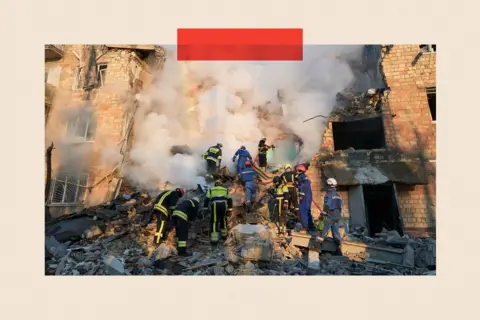
Ukraine is defending itself against repeated Russian air attacks
Army recruiters are finding it harder to fill gaps as some younger men hide from press gangs or flee the country. But Ukraine could widen its conscription laws.
Currently only men aged 25 to 60 must be available to fight. This is a deliberate strategy by Kyiv to manage Ukraine's demographic challenges; a country with a low birth rate and millions living abroad cannot afford to lose what have been dubbed "the fathers of the future".
This puzzles outsiders. "I find it incredible that Ukraine has not mobilised its young people," one senior UK military figure told me.
"I think Ukraine must be one of the only countries in history facing an existential threat that has not thrown its mad 20-year-olds into the fight."
Fiona Hill said Ukraine had simply learned the lesson of history and the devastating impact World War One had on 20th Century European empires, which declined after failing to rediscover the population growth that had fuelled their economic rise.
"Ukraine is just thinking of their demographic [future]."
Strikes, diplomacy and Trump
If Ukraine could import and manufacture more long-range missiles, it could hit Russia harder and deeper.
This year it stepped up its air strikes on targets both in occupied territory and the Russian Federation. Earlier this month Ukraine's military commanders told Radio Liberty they had hit more than 50 fuel and military-industrial infrastructure facilities in Russia during the autumn.
Alexander Gabuev, director of the Carnegie Russia Eurasia Center, says some Russians experienced fuel shortages earlier this year. "By late October, Ukrainian drones had hit more than half of Russia's thirty-eight major refineries at least once.
"Production outages spread across multiple regions, and some Russian gas stations began rationing fuel."
But would more deep strikes on Russia make an impact, when both the Kremlin and public opinion in Russia seem indifferent?
AFP via Getty Images
As well as defending its territory, Ukraine has stepped up air strikes in the Russian federation
Mick Ryan, former Australian major general and now fellow of the Center for Strategic and International Studies, says deep strikes are not a magic bullet.
"They are an extraordinarily important military endeavour, but insufficient by themselves to force Putin to the negotiating table or to win the war."
Dr Sidharth Kaushal, senior research fellow in military sciences at the Royal United Services Institute (Rusi) think tank, said more deep strikes would certainly damage Russia's energy and military infrastructure, as well as using up its air defence missiles. But he warned the tactic could be counterproductive.
"It could reinforce the argument the Russian leadership makes that an independent Ukraine poses a massive military threat," he said.
Some analysts argue that if Putin is offered a way out of the war, he may choose it.
The theory goes like this: a deal is agreed that allows both sides to claim victory. Say, a ceasefire along the line of contact; some areas demilitarised; no formal territorial recognition. Compromises all round.
But the deal would require the US to engage hard with Russia, setting up negotiating teams, using its power to drive through agreement.
"The United States… needs to deploy its formidable psychological leverage it possesses over Russia,"
Thomas Graham argues. "One cannot overstate the role the United States – and Trump personally – plays in validating Russia as a great power and Putin as a global leader."
China's leverage
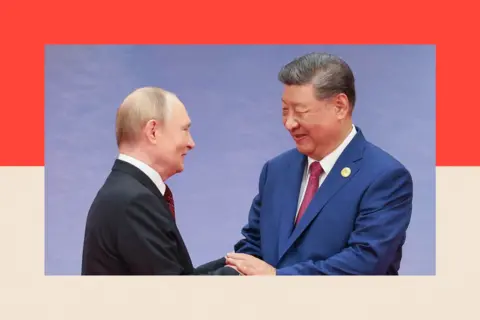
The wild card is China. President Xi Jinping is one of the few world leaders Putin listens to. When Xi warned earlier in the conflict against Russian threats of nuclear weapon use, the Kremlin fell swiftly in line.
Russia's war machine is also huge dependent on China's supply of dual use goods – such as electronics or machinery that can be used for civilian and military purposes.
So if Beijing decided it was no longer in China's interests for the war to continue, then it would have substantial leverage over Kremlin thinking.
For now, the US shows no sign of trying to encourage – or force – China to put pressure on Moscow. So the question is whether President Xi would be willing to apply any leverage off his own bat.
Shutterstock
President Xi Jinping is one of the few world leaders Putin listens to
At the moment China seems happy for the US to be distracted, for transatlantic allies to be divided, and for the rest of the world to view China as a source of stability. But if Russia's invasion escalated, if global markets were disrupted, if the US applied secondary sanctions on China in punishment for its consumption of cheap Russian energy, then the thinking in Beijing might change.
For now though, Putin believes he is sitting pretty, with time on his side. The longer this conflict goes on, analysts say, the more Ukrainian morale will fall, the more divided its allies will become, and the more territory Russia will gain in Donetsk.
"Either we liberate these territories by force of arms or Ukrainian troops leave these territories," Putin said last week.
"Nothing will change his position," Fiona Hill told me. "Unless he exits stage left. Putin is betting right now that he can keep this going for long enough that circumstances play out to his advantage."
Top picture credit: Reuters
BBC InDepth is the home on the website and app for the best analysis, with fresh perspectives that challenge assumptions and deep reporting on the biggest issues of the day. You can now sign up for notifications that will alert you whenever an InDepth story is published - click here to find out how.
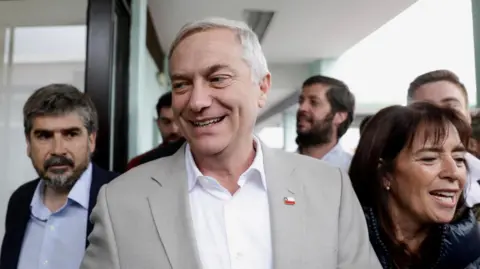
José Antonio Kast will be inaugurated as Chile's president in March next year
Chile has elected the far-right wing José Antonio Kast to be its next president, after an election campaign that was dominated by themes of security, immigration and crime.
Kast won decisively with more than 58% of the vote in his third attempt at running for president.
It marks the biggest shift to the right since the end of Chile's military dictatorship in 1990. Kast has openly praised Chile's former right-wing dictator, Augusto Pinochet.
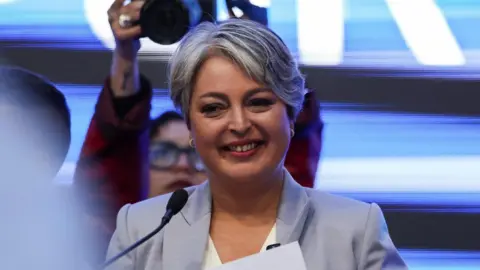
He beat the governing left-wing coalition's candidate, Jeannette Jara, from the Communist Party.
At a gathering of his supporters in the capital Santiago, many draped in Chilean flags, chanting and taking selfies, there was jubilation as the results came through.
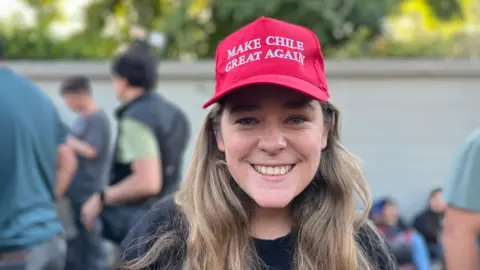
"I'm happy we can recover the country's security and patriotism," said Augustina Trancoso, donning a red "Make Chile Great Again" cap.
"We've been trying to win an election for years," said Belem Valdivieso. "In Chile, you used to be able to walk the streets peacefully, lately we've experienced problems with insecurity. I'm hoping his promises will be kept and he'll focus on security."
Throughout the campaign, Kast portrayed Chile as a country that was descending into chaos and insecurity. He pledged to restore order and crack down on irregular immigration, as well as implementing sharp spending cuts.
Kast is an admirer of Donald Trump, who is likely to become a close ally, and his policies echo those of the US president. He has pledged a border wall on Chile's porous frontier with Peru and Bolivia, maximum-security prisons, and mass deportations of irregular migrants, many of whom are from Venezuela.
Augustina Trancoso voted for Kast in Sunday's presidential election
Chile is one of the safest and more stable countries in South America, but a rise in immigration and organised crime in recent years has concerned many voters. Kast regularly drew links between the two.
His critics, though, say the problem is being exaggerated.
One voter in Santiago, Javiera Carrasco, liked some of Kast's policies but ended up voting for Jara. She said she felt "like a false sense of insecurity is becoming widespread."
"In other countries, there are much worse things happening than here. It just doesn't add up for me."
Chile's murder rate is now falling, and some studies suggest those born abroad commit fewer crimes on average. But the perception of growing insecurity was the motivation for many of Kast's voters.
"We are transforming into Colombia, a lot of terrorism, thieves, robbery, society is very unsafe," one voter Max Struber said.
"It may sound harsh to say it, but we need the government to continue Pinochet's work. Human rights abuses existed, that's true. But as a government it was good, we used to have peace and tranquility."
Kast's brother was a minister during Pinochet's dictatorship, and his father was a member of the Nazi party. Pinochet was an army general who led a US-backed military coup in 1973 and established a 17-year-long military dictatorship that was marked by brutal human rights abuses, forced disappearances and free-market economic policies.
Reuters
Communist Party member Jeannette Jara was the left-wing coalition candidate
Chile's current left-wing President Gabriel Boric, who could not run again, had suffered from low approval ratings. Kast's rival Jeannette Jara may have suffered by being seen as a "continuity vote".
A supporter at his victory party, Francisco Otero, said neither candidate represented everybody perfectly, but that a continuation of the government was seen as "much worse".
After the result Jara posted that "democracy has spoken loud and clear" and wished Kast "success for the good of Chile."
"We will continue working to advance a better life in our country," she added.
Her supporters fear Kast's election marks a return to Chile's far-right past.
"Kast's family helped the dictator Augusto Pinochet," Ricardo Herrera said, adding that he lived through Pinochet's dictatorship and it was "brutal".
Some are sceptical, though, that Kast will actually do what he's pledged.
"Kast says he wants to expel 360,000 undocumented migrants. He won't be able to do that. It's physically impossible," one voter Hector Lunes said.
Ricardo Herrera, who lived through Pinochet's rule, voted for Jeannette Jara
Kast has also been firmly against abortion, even in cases of rape, and environmental protection policies.
His victory will likely be welcomed by investors as he has pledged a free-market approach to economics to shrink the state and deregulate certain industries.
This was the first presidential election in Chile where voting was mandatory and registration was automatic for those eligible.
This left some voters feeling like they had to pick whichever they say was the "least-worst" option.
"I don't know if I'd say the lesser of two evils, but I think Chile needs a change," Claudio Sanjuez said, "and I clearly think Kast could be that alternative".
"Both candidates were like opposite extremes," Cintia Urrutia said, but added she'd hoped for Jeannette Jara who she perceived as more "centrist".
Kast's victory in Chile follows a string of elections in Latin America that have shifted the region to the Right in recent years – including in Argentina, Ecuador, Costa Rica, and El Salvador.
He will be inaugurated on 11 March 2026. At rallies, he regularly counted down the days until this date warning undocumented immigrants that they should leave before then if they ever want the chance to return.
At first glance, my emails are polite and warm, after all "I'm just checking" in on a deadline but "no worries either way".
However, a closer look reveals my messages are punctuated by unnecessary apologies, smiley faces, exclamation marks and even kisses.
I like to think I'm being friendly and approachable, but according to experts, these linguistic habits may be quietly undermining how seriously I'm taken at work.
Careers coach Hannah Salton and etiquette coach William Hanson explain why so many of us write like this and the impact it could be having on how we're perceived, and even promoted at work.
Is your punctuation extra?
"Thanks very much!" I've replied to many an email - my punctuation may be extra but a full stop feels blunt.
People use exclamation marks to show "positivity and enthusiasm," says Hannah.
She thinks that’s likely down to the idea that "women are often judged more harshly than men when they are direct and are called bossy and other gendered negative words".
And while a single exclamation mark isn't the problem the cumulative effect can be, warns Hannah.
“If it looks fake or like it's covering up insecurity it could impact credibility,” she explains.
Would you kiss them in real life?
Written communication is notoriously easy to misread, which is why many of us insert an emoji as a picture of our warmth or humour.
But etiquette coach William Hanson warns this can backfire.
"One emoji can mean different things to different people or something entirely unintended," he says.
"It would be better if people used words and a good command of English," he advises.
Emojis can have an "infantile connotation" which could lead to people perceiving you as younger, less senior, capable or responsible, he says.
"I would not put an emoji in an email," he says. "You can be friendly in your writing and remain professional at the same time."
And when it comes to signing off with a kiss, he says: "I would never put a kiss on the end of an email unless I would kiss them on the cheek in real life."
Softening language can dilute authority
"Just checking that you're following me and this all makes sense?"
Emails containing reassurance checkers can be self-depreciating," Hannah says, adding that over time, that tone can subtly shape how someone is perceived.
"As a manager, it's a difficult balance of being liked and respected and if you're not direct, there's a risk of creating an impression of being less capable," she says.
"There are definitely times where communicating in an overly apologetic or overly measured way can make you come across as less impactful."
"A lot of it is unconscious," Hannah says. "No one reads an email and thinks 'oh, they don't back themselves', it's more subtle than that.
"But if you're consistently communicating in a people-pleasing way, that can build up an impression of someone who doesn't back themselves, or who is potentially less competent."
What to cut out of your emails
Here are some of the things you might want to consider losing to appear more professional, our experts suggest:
Qualifying words such as "just" ("just checking", "just wondering")
Pre-emptive apologies like "sorry to bother you" or "I'm sure you're really busy but…"
Reassurance checkers such as "does that make sense?", "hope that's ok" or "no worries either way"
Exclamation marks
Emojis
Kisses or overly warm sign-offs
Hannah and William stress it's not about stripping all warmth or personality from professional communication.
"Personal style is important," Hannah says. "Showcasing personality at work is not a bad thing. You don't want to feel like you have to filter everything you write and remove any personality from it."
But at the same time you shouldn't use certain words and symbols "as a tool to be liked".
A practical way to spot and reduce these habits without losing personality is to pay attention to the emails you receive and notice how different styles make you feel - what sounds clear, confident or reassuring, and what feels excessive, she says.
Salton says AI tools can also be useful for reviewing drafts and removing excess filler or qualifier words.
James Vernon picked himself up of the ground and rushed to the aid of the injured
A paramedic "sent flying" by a two tonne car as it ploughed into a dense crowd at Liverpool's Premier League victory parade has described how the "adrenaline took over".
James Vernon did not even hear the Ford Galaxy Titanium, driven by 54-year-old Paul Doyle, coming before he was struck from behind on 26 May.
Mr Vernon, deployed as a cycle paramedic with the North West Ambulance Service (NWAS) during the parade, was on his way to help a patient having a heart attack when he was struck.
Despite being knocked down, he was able to shelter children in the back of an ambulance and rush to the aid of many of Doyle's 134 victims.
'Almighty force'
Doyle, of Burghill Road in Croxteth, Liverpool, is due to be sentenced on Monday after pleading guilty to 31 charges including causing GBH with intent, dangerous driving and affray.
Mr Vernon had been walking with his bicycle ahead of an ambulance to help it get to where the man had collapsed outside Hooters bar on Water Street, which was packed with tens of thousands of people.
He said: "There was a lot of people singing, a lot of people chanting, and I had the sirens at the back of me in close proximity, so very, very loud.
"I would say we were making good progress, and then all of a sudden I was struck with almighty force from behind, which has sent me flying over to the right-hand side."
CPS
Paul Doyle pleaded guilty to 31 charges including causing GBH with intent on what was supposed to be the first day of his trial
Mr Vernon said he landed in a gutter and saw the car passing to his left.
"For me, instantly I thought I was in the middle of a terrorist incident," he said.
After Doyle passed the ambulance, he stopped and reversed straight into it, before richocheting back into the middle of the road.
He said it then lurched forward in a "sweeping" motion "throwing members of the public left and right."
Mr Vernon activated the emergency function on his radio and shouted that he and other pedestrians had been "run over" on Water Street.
He and his colleague jumped in the back of the ambulance to take a "10 second breather" before deciding they needed to join the rescue effort.
"We both looked at each other and said 'we need to help here, let's get out, and let's do our jobs'," Mr Vernon said.
Footage of the incident was circulated on social media
Describing the scene as they opened the door, he said: "There were patients lying on the floor, there were push-chairs on their sides, scarves on the floor, empty beer bottles, there was just everything all over the floor.
"There were piercing screams and people running in any direction you can imagine but just not towards the car."
Fearing that a terrorist could still emerge from the vehicle, the paramedics ushered six or seven children into the back of the ambulance.
"I wasn't sure what the incident was outside," he said.
"I knew there was a car. I knew the car ran over a significant amount of people, but I didn't know what was then coming."
Stopping at the "twisted" frame of his bike to grab some medical supplies, Mr Vernon began triaging the stricken fans in the road, including some still trapped under the Ford Galaxy.
EPA
Paul Doyle's car ploughed into a dense crowd on Water Street just after 18:00
He said his while "extensive" training, including in mass casuality events, kicked in, he had never before been caught up in the same incident he was responding to.
"The adrenaline massively took over," he said.
"I'm going to be honest, the next day I woke up very stiff, you know, and that's very suggestive of that force, that whiplash kind of force."
Mr Vernon said after more medics and police officers arrived on scene he was able to go into a makeshift casualty area in the Mowgli restaurant, where he was able to message his family and friends to tell them he was ok.
Asked his reaction to Doyle's guilty pleas, he said: "I think the relief was immeasurable.
"It was like a weight had lifted off my shoulders because I knew that then negated me from having to go to Crown Court [as a witness], and having to go through that process, and ultimately it's him admitting his guilt for what happened that day."
Listen to the best of BBC Radio Merseyside on BBC Sounds and follow BBC Merseyside on Facebook, X, and Instagram, and watch BBC North West Tonight on BBC iPlayer.
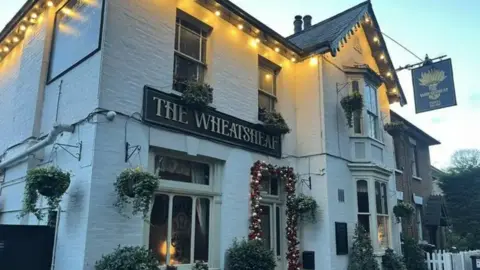
The man was found beside the Wheatsheaf pub in Ewell
A 15-year-old boy has been charged with murder following the death of a man in an alleyway near a pub in Surrey.
Police were called to the scene near the Wheatsheaf pub, on Kingston Road, Ewell, at about 15:30 GMT on Tuesday where, they said, the victim, a man in his 20s, was found with "injuries consistent with a stabbing". He was pronounced dead at the scene.
The boy, who cannot be named for legal reasons, was arrested on Thursday and is due to appear at Guildford Magistrates Court on Monday.
A second 15-year-old boy, a 17-year-old boy and a 20-year-old man also arrested have since been released on police bail.
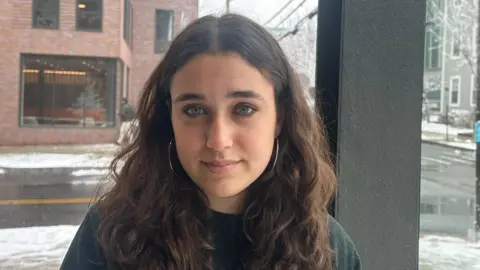
Mia Tretta, a student at Brown University, survived a US school shooting in 2019
With the holiday break just around the corner, 21-year-old Mia Tretta was in her dorm with a friend studying for their final exams.
Just like other students at Brown University, she was distraught after receiving an active shooter alert from the university's department of public safety.
But the difference for her is she has lived through this once before.
She told the BBC it shattered her sense of safety and innocence.
"Everyone always tells themselves it'll never be me," she said.
Mia Tretta
Mia spent more than a week in the hospital recovering after the 2019 shooting
A 16-year-old boy shot her in the stomach and four others; two of them died including her best friend.
A junior in high school at the time, Mia spent more than a week in the hospital recovering.
She still has bullet fragments in her stomach, and has had multiple surgeries for nerve pain and to fix a hole in her eardrum.
Attending Brown University, on the other side of the country, in Rhode Island, was meant to get her far away from what happened, in order to feel safe again.
She told herself at least it wouldn't happen again, until it did.
"Gun violence doesn't care if you've already been shot before, and it doesn't care what community you're in," she said.
"It's an epidemic that touches every single community."
Mia now feels a mixture of fear, confusion and anger. Americans, she says, shouldn't accept mass shootings as a fact of life.
Bloomberg via Getty Images
Mia spoke about gun violence during a visit to the White House in 2022
Her generation has grown up practising active shooter drills in schools, and she is not the only student at Brown University who has now lived through their second school shooting.
At a press conference on Sunday, the mayor of Providence, Brett Smiley, was asked what could be done to stop the "uniquely American experience" of mass shootings on campuses.
He was reluctant to weigh in with the investigation ongoing and the victims still recovering, but he shared a conversation he had had with one of the injured students.
"When I was at the hospital today - one of students that showed tremendous courage literally said to me, 'you know that active shooter drill they made me do in high school it actually helped me in the moment'," he said.
"Which at the same time provided me hope, and was so sad. They shouldn't have to do active shooter drills but it helped, and the reason it helped and the reason we do these drills is because it's so damn frequent."
Driving around campus, there is still a heavy police presence even though the lockdown has been lifted.
One student, who was leaving for the holidays, said: "Our perfect bubble, that we've been in for so long, just shattered."
The three finalists for this year's Strictly Come Dancing have been confirmed, after one couple was eliminated from the competition in Sunday night's results show.
In the bottom two this week were EastEnders actor Balvinder Sopal and her partner Julian Caillon - for a record sixth time this series - and reality TV star Amber Davies and her partner Nikita Kuzmin.
After a dance-off, the judges voted to send Sopal home.
Davies, who survived the dance-off for the second week running, will join social media star George Clarke and former England footballer Karen Carney in next week's final.
BBC/Guy Levy
The EastEnders star, who performed a Salsa and a Waltz as her two semi-final dances, said she had "absolutely adored every single minute".
Speaking on Sunday night's results show after her elimination, Sopal said: "All the dance-offs, all the challenges, but just more than anything, just being in this building and dancing on this floor with such an amazing human being.
"It was my 'Yes Year', and I said yes to Strictly. My family, we've had some hard times, but they've been here."
She also paid tribute to her dance partner Caillon, saying: "You've been brilliant in every sense of the word.
"When I wobbled, and when I felt really brilliant about the dance and got the steps right, you've just held me in your hands and you've gone, 'Bal, we've got this.'
"I've never felt alone on this floor, and I just want you to remember me. Don't replace me too soon!"
Caillon said Sopal "embodies" what Strictly Come Dancing is about.
"Her spirit is unbreakable, and you have shown me that I'm actually dreaming too small, and Bal can inspire us that whatever any of us want in life, all you have to have is the desire to go after it."
BBC/Guy Levy
The celebrities performed two dances each on Saturday.
Carney and her partner Carlos Gu topped the leader board for their performance, after receiving a near perfect score of 78 out of a possible 80.
The results show also featured a surprise for departing presenters Tess Daly and Claudia Winkleman.
Following a highlights package of their best moments working on the show, the pair were each awarded their own unique golden Glitterball Trophy.
BBC/Guy Levy
There was also a festive performance from Kylie Minogue of her new single XMAS accompanied by 16 Strictly professional dancers, plus a special performance of the 90s classic Sit Down from the band James.
The remaining three couples will perform during next weekend's final.
It will air on BBC One and BBC iPlayer at 19:00 GMT on Saturday 20 December, with the winner crowned that evening.
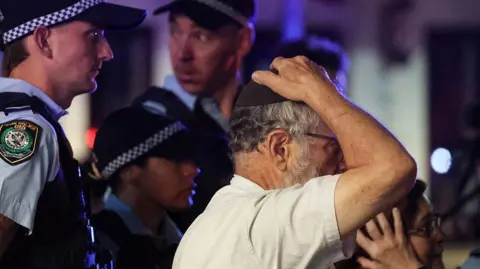
The shooting at Bondi beach targeted a Jewish Hanukkah event where many families were present
The first day of Hanukkah was a sweltering one in Sydney - a perfect afternoon to spend at Australia's most iconic beach.
More than 1,000 people were enjoying a festival marking the occasion at a grassy stretch in Bondi: kids careened around in facepaint, crowds snaked between food trucks, and many enjoyed live entertainment as they soaked up the last rays of sunshine.
Then, just before 7pm local time, shots rang out.
From a small footbridge - just metres from a children's playground - gunmen fired upon the fenced-in crowds. A car full of improvised bombs was parked nearby, though they never went off.
One attendee, who identified himself only as Barry, described watching people around him get shot as hundreds of beach-goers began screaming and running through the park to get away from the attack.
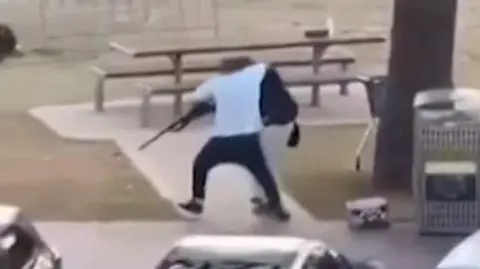
One video showed a man - dubbed a "genuine hero" by state officials - leaping out from behind a parked car to wrestle a gun from one of the attackers and push him away.
"It was simply an unbelievable scene… in today's day and age, that families and kids on Bondi could be completely mowed down for being Jewish," Barry said.
Getty
More than 1,000 people had gathered at the Hanukkah event.
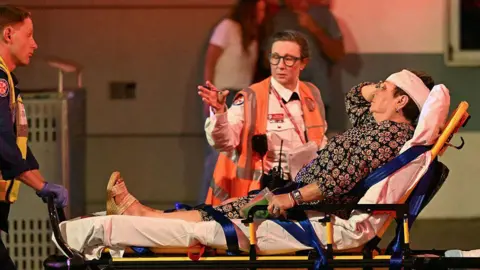
At least 11 people have died and more than two dozen are injured, including a child. One gunman was also killed by police, another is in hospital in a critical condition, and police say they're investigating whether a third person helped stage the attack.
This is an unfamiliar, and devastating, shock for Australia - the deadliest shooting in this country since the Port Arthur massacre in 1996.
That attack, which killed 35 people, was a turning point, famously prompting the government to introduce some of the world's strictest gun control measures.
We've only had a handful of mass shootings since then, most of them horrific acts of domestic violence - not public attacks like today.
Swiftly declared a terrorist attack by police, it comes amid a rise in antisemitic attacks in Australia since the 7 October Hamas attack on Israel and Israel's subsequent offensive on Gaza.
Getty
An injured woman is treated by emergency workers at Bondi beach
Getty Images
Prime Minister Anthony Albanese called it an "act of evil antisemitism" and a "vile act of violence and hate".
But he's been accused by some - including Israel's Prime Minister Benjamin Netanyahu - of failing to address the upward trend of antisemitism here.
"The Australian government, which received countless warning signs, must come to its senses!" Israel's Foreign Minister Gideon Sa'ar wrote on X.
Alex Ryvchin, co-CEO of the Executive Council of Australian Jewry, told Sky News Sunday night that the "worst fears" of the Jewish community had been realised.
"It's been bubbling under the surface for a long time, and now it's actually happened."
In a statement, the Australia Jewish Association's Robert Gregory said many Jews would tonight be pondering whether they have a future in Australia.
"To be confronted with this horrific act of antisemitic violence during the Jewish festival of light and hope is shattering. In moments like this, we hold each other close," the Jewish Council of Australia said in a statement.
Getty
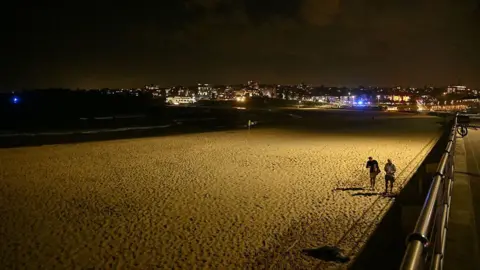
Bondi beach is one of the world's most famous beaches
There's a lot police can't - or won't - say yet. But they have declared this was a terrorist attack.
Who the gunmen are - how many of them even - and their motive is still unclear. They said one of the attackers was known to police, but wasn't on their radar for anything like this.
Officials wouldn't answer any questions about those who died either, out of respect for families who are still being notified.
"It's too early to give that information," was the most frequent refrain uttered at a press conference late on Sunday night.
But where NSW Police Commissioner Mal Lanyon couldn't offer answers, he tried instead to offer reassurance. Police are throwing everything at this investigation, he said.
He urged the community to remain calm, and avoid spreading misinformation online - including speculating on the victims and perpetrators of the attack.
"I want to make sure that there is no retribution," Commissioner Lanyon said.
Local politicians have also asked people not to share graphic footage from the attack on social media.
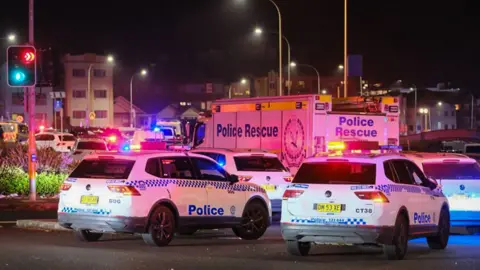
In the aftermath of the shooting, sirens were ringing through the city and the area surrounding Bondi swarmed with police cars, helicopters circling above.
There we found Fin Green, who was on FaceTime with his family in the UK when he saw the shooting unfolding outside his window. Unsure what was happening, he hid in his wardrobe for an hour and a half, until he felt it was safe to go out.
Danny Clayton, a broadcast journalist who was at the beach and witnessed the events from the Bondi Pavilion, said some people crashed their cars as they attempted to flee.
Many others in the area had similar stories. Restaurant worker William Doliente Petty said he was serving someone when he heard the gunshots. "The whole shop just stood up and we ran into the back exit."
Australia prides itself on being a merry, safe country and Bondi Beach has long been a symbol of that. But that image has been shattered and residents are in disbelief.
Sunday's attack also came less than two years after another nearby tragedy. In April last year, a deadly mass stabbing attack took place at nearby Bondi Junction. Shocked, many then uttered the same words we've heard over and over today too: "This sort of thing just doesn't happen here".
Additional reporting by Katy Watson and Tabby Wilson.
Mr Ahmed managed to wrestle the gun from the attacker in the struggle
A "hero" bystander who was filmed wrestling a gun from one of the Bondi Beach attackers has been named as 43-year-old Ahmed al Ahmed.
Video verified by the BBC showed Mr Ahmed run at the gunman and seize his weapon, before turning the gun round on him, forcing his retreat.
Mr Ahmed, a fruit shop owner and father of two, remains in hospital, where he has undergone surgery for bullet wounds to his arm and hand, his family told 7News Australia.
Eleven people were killed in the shooting on Sunday night, as more than 1,000 people attended an event to celebrate Hanukkah. The attack has since been declared by police as a terrorist incident targeting the Jewish community.
Mr Ahmed's cousin, Mustafa, told 7News Australia: "Still he is in hospital and we don't know exactly what is going on, the doctor says he is OK.
"We hope he is OK, he is a hero, 100% he is a hero. He has two shots, one in his arm and one in his hand, he has had to have an operation."
Watch: Eyewitness captures moment man tackles and disarms Bondi shooter
Two gunmen are believed to have carried out the attack, with police investigating whether others were involved. One of the gunmen was killed, with a second in "critical condition," police say.
The footage of Mr Ahmed's intervention has been shared widely online.
It shows one of the gunmen standing behind a palm tree near a small pedestrian bridge, aiming and shooting his gun towards a target out of shot.
Mr Ahmed, who was hiding behind a parked car, is seen leaping out at the attacker, who he tackles.
He manages to wrestle the gun from the attacker, pushes him to the ground and points the gun towards him. The attacker retreats.
He then lowers the weapon and raises one hand in the air, appearing to show police he was not one of the shooters.
Nearby on the bridge, another gunman continues firing. It's unclear who or what he is aiming at.
At a news conference late on Sunday, New South Wales Premier Chris Minns paid tribute to the bravery of Mr Ahmed, who was unnamed at the time.
"That man is a genuine hero, and I've got no doubt there are many, many people alive tonight as a result of his bravery."
Australian Prime Minister Anthony Albanese said: "We have seen Australians today run towards danger in order to help others.
"These Australians are heroes, and their bravery has saved lives."
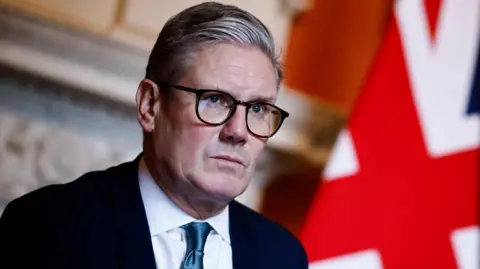
The attack targeting the Jewish community at a Hanukkah event in Australia is "sickening", Sir Keir Starmer has said.
At least 11 people were killed in the shooting at Bondi Beach on Sunday and a further 29 taken to hospital, according to police.
In a statement on X, the UK prime minister said: "The United Kingdom will always stand with Australia and the Jewish community." He added that the government was working with Community Security Trust, a Jewish security organisation, on the policing of Hanukkah events in the UK.
The Metropolitan Police said it was increasing its "police presence, carrying out additional community patrols and engaging with the Jewish community to understand what more we can do".
"It is an awful reality that Jewish communities across the world continue to face a higher level of threat," the force said in a statement.
"At a time when London's Jewish communities are coming together to begin the celebration of Hanukkah, we know this attack will be the cause of not just terrible upset but also significant heightened concern about safety."
In October, two people were killed in an attack at a synagogue in Manchester on Yom Kippur, the holiest day in the Jewish religious calendar.
On Sunday, the UK's Jewish Leadership Council (JLC) called on the police and government to protect events celebrating Hanukkah which begins this evening and lasts for eight days.
Hanukkah, also known as Chanukah, is a festival of light usually observed in December.
"We are devastated and angered that in Sydney, Jews appear to have been targeted once again for being Jewish," the JLC said in a statement.
"We know that such hatred also exists in this country, as we are still reeling from the attack on a synagogue in Manchester on Yom Kippur.
"As we prepare to celebrate Chanukah over the next eight nights, we call on government and law enforcement to work with our community to protect Jewish life in the UK and ensure that events this week can go ahead safely. We must not let hatred extinguish the festival of light."
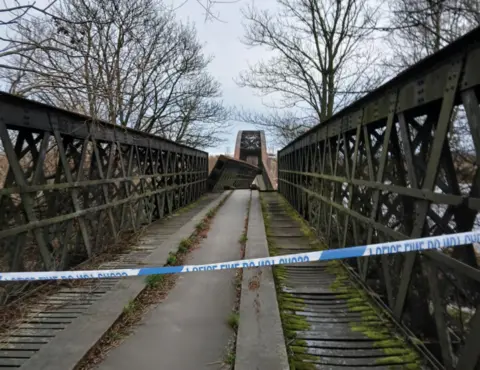
A historic former railway bridge has been cordoned off by police after a section of it collapsed into the River Spey in Moray.
The Spey Viaduct, an iron girder structure near Garmouth, was built in 1886 and while no longer used for trains, was popular with cyclists and walkers.
Images on social media showed one of its supporting stone piers was leaning at an angle and part of the metalwork had twisted and fallen into the river.
Local SNP MSP Richard Lochhead said people in the area would be devastated and questioned whether the structure has been adequately maintained.
He said: "The local community will be heartbroken by the collapse of the much-loved Spey viaduct, which is not only an iconic structure but also incredibly popular with walkers, cyclists, and tourists.
"I'm now in touch with Moray Council seeking answers around when and by whom the structure was last checked, and what happens next with regards to the future of the bridge."
Roddy Robertson
One of the supporting stone piers could be seen at an angle in the river
The bridge spans 350ft (107m) over the River Spey, regarded as the fastest flowing river in Scotland
The railway line closed in the 1960s but the bridge, also known as the Garmouth Viaduct, was later paved.
The Speyside Way, a long-distance trail which traces the River Spey from the Moray Firth to the Cairngorms National Park, passes the east end of the bridge.
It is also part of the National Cycle Network.
Moray Council, which manages the trail, said the bridge would remain closed until further notice.
Roddy Robertson
The bridge has been cordoned off and Moray Council says it is closed until further notice
A council statement said: "Our engineers are aware and will assess the situation before further detail can be provided.
"Members of the public and media are asked to keep their distance from the rest of the bridge structure.
"Do not pass the police cordon in place and do not climb on any part of the bridge - thank you for your co-operation."
Local councillor Shona Morrison said she was "incredibly saddened by the news".
"The viaduct holds such a special place in my family's heart, it is devastating to see the collapse of such a well-loved and iconic landmark."
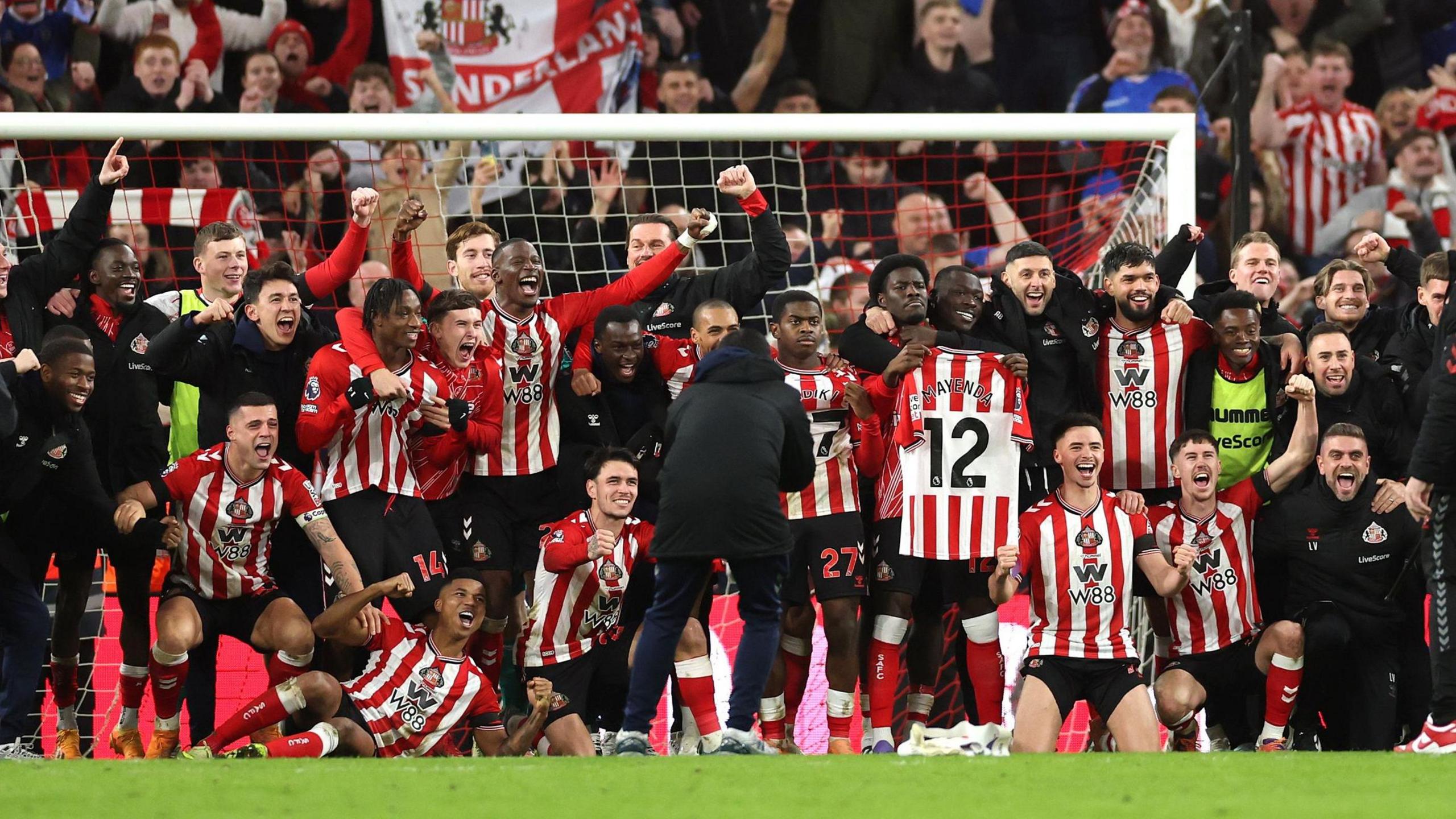
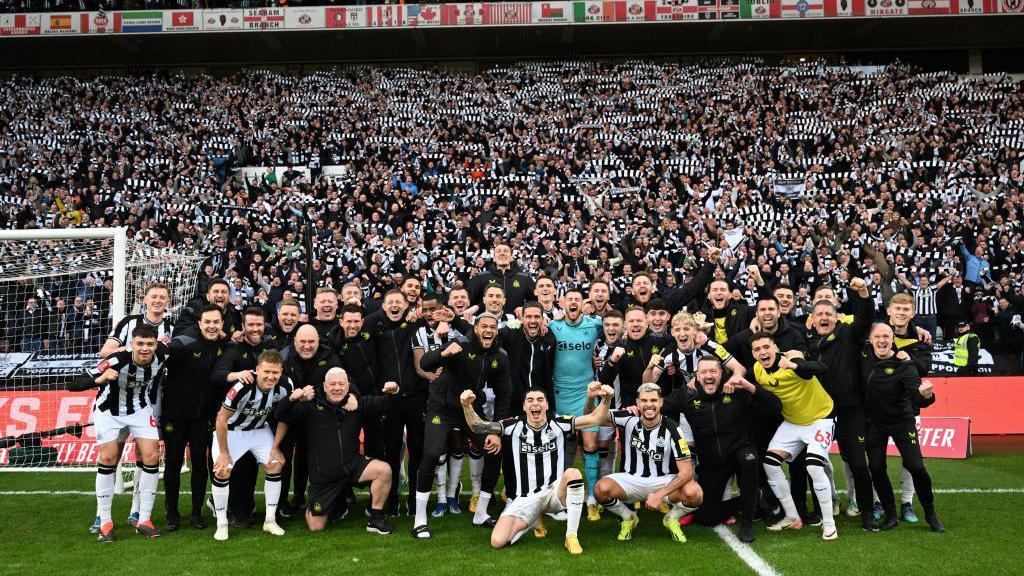
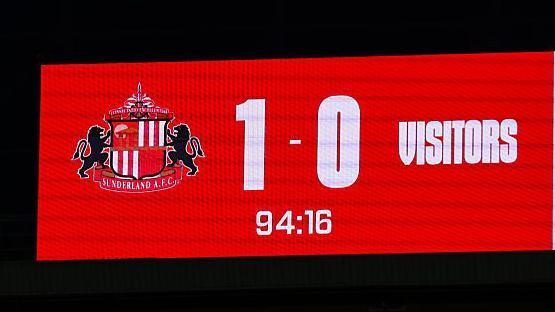
Nick Woltemade's own goal was enough to give Sunderland a memorable win over their rivals in the first Premier League Tyne-Wear derby since 2016 - and the hosts celebrated at full-time by recreating Newcastle's snap shot.
When asked who suggested the idea, Black Cats manager Regis le Bris smiled and simply said: "Always unpredictable, creative, adaptive."
Defender Dan Ballard, who scored an own goal in that 2024 FA Cup tie, was the only Sunderland player to start in both games.
He revealed how he desperately wanted to avenge the loss, telling Sky Sports: "You cannot describe [the feeling]. It was so painful [losing to Newcastle] for the players and for the fans so we felt we had let them down so we're delighted with this win.
"It prepared us more for today. We came in with more quality in this team, real leaders, we stuck in there, fought really hard and I thought we deserved the win."
Image source, Getty Images
Image caption,
Sunderland recreated this picture from Newcastle's 2024 FA Cup victory over the Black Cats
Seventh-placed Sunderland are enjoying a superb return to the top flight following promotion via the play-offs last season.
The Black Cats have 26 points in 16 games, their most at this stage of a Premier League campaign since 2000-01 (also 26), when they went on to finish seventh.
They are yet to lose in the league at the Stadium Light, which had an electric atmosphere for most of Sunday afternoon.
"Derbies, you have to win, it does not matter how," said captain Granit Xhaka to Sky Sports.
"This team deserves much more - and more respect as where we are in the league is amazing and we're working really hard."
Sunderland are also unbeaten in their last 10 league games against Newcastle (seven wins and three draws), their longest such run against the Magpies.
Newcastle's last league win over Sunderland was back in August 2011.
Le Bris told Sky Sports he was "proud and happy" with the result.
"It was a derby and we were expected [to win] by our fans," he added. "This win is well deserved, we were mature and the lads were incredible.
"It's good for the region, the club, the fans. We knew before it was a special game, but we have to reset quickly as we have another tough challenge in Brighton in one week so let's go again."
Image source, Getty Images
Image caption,
The Sunderland scoreboard at Stadium of Light did not display Newcastle's name
Watch: Eyewitness captures moment man tackles and disarms Bondi shooter
Twelve people have died - including one gunman - following a shooting at Australia's Bondi Beach which targeted the Jewish community on the first day of Hanukkah.
According to police, at least 12 others have been injured and two officers were shot during the event, which has since been declared a terror attack by officials. The surviving gunman is in a critical condition.
More than 1,000 people were attending an event on the beach celebrating Hanukkah.
Chris Minns, the premier of New South Wales, said: "Our heart bleeds for Australia's Jewish community tonight.
"I can only imagine the pain that they're feeling right now to see their loved ones killed as they celebrate this ancient holiday".
Mass shootings in Australia are very rare, and the attack at Bondi is the deadliest incident in Australia since the Port Arthur massacre in 1996.
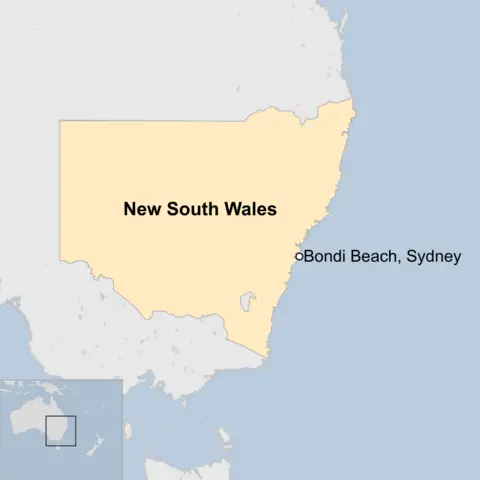
Bondi Beach is located in eastern Sydney in the state of New South Wales, on Australia's east coast.
It is one of Australia's most popular beaches, attracting millions of visitors each year. The area is a significant attraction for tourists.
What happened?
New South Wales (NSW) police responded to reports of gunfire at around 18:47 local time (07:47 GMT), with video showing hundreds of people fleeing from the coastline.
In their initial statement posted on X, NSW Police urged people at the scene to take shelter and other members of the public to avoid the area.
Around the same time, local media began reporting people "on the ground" in the vicinity of Campbell Parade.
A video verified by the BBC appears to shows two gunmen firing from a small bridge which crosses from the car park on Campbell Parade towards the beach itself.
An event to mark the first day of the Jewish celebration Hanukkah was taking place on Bondi Beach, very close to the bridge where the men were firing from. More than 1,000 were in attendance.
Premier Minns also paid tribute to a man filmed wrestling a gun from one of the attackers.
"That man is a genuine hero, and I've got no doubt there are many, many people alive tonight as a result of his bravery," Minns said at a press conference.
In the video, the man is seen sneaking up on the attacker, before grabbing him in a bear hug.
The now-disarmed man then retreats back towards the bridge, where the other attacker is still firing from.
As the video continues, another man appears to be injured and flees the scene, as a policeman arrives behind the attackers and opens fire at them.
A separate video, also verified, shows several policemen on the same bridge. One appears to be administering CPR to a motionless man as someone shouts "he's dead, he's dead".
How many people were killed and injured?
Getty Images
The attack targeted a Hanukkah celebration on the beach, police say
Apart from police confirming one gunman as dead, details on who has been killed and injured are sparse.
Twelve people including one of the armed men have been confirmed dead by police. Another gunman is said to be in a critical condition.
Officials say 29 other people were taken to hospital, and two officers were also shot during the incident.
One eyewitness, Barry, was attending the Hanukkah event on Bondi when with his children when he heard gunshots.
He told the BBC he saw two men on a bridge shooting towards the crowd.
He said there were bodies on the ground. He and his children were able to escape with a friend in a car, he added.
What is the latest?
Getty Images
Police have urged for calm as they carry out their investigation
Police have declared Saturday's shooting a terror attack.
An exclusion zone has been set up around the scene as police use specialist equipment to check improvised explosive devices (IEDs) found in a car linked to the dead gunman, and police are still urging the public to avoid the area."
"No stone will be left unturned" in the investigation, New South Wales Police Commissioner Mal Lanyon said.
He said police would not release any information about the gunmen at this time, and urged for calm while police carry out their duties, adding that this was "not a time for retribution".
Police said they cannot confirm if there was a third gunman involved or if there was anyone else involved in the attack, but enquires are ongoing.
During a televised address, Australian Prime Minister Anthony Albanese called the Bondi Beach shooting "an act of evil antisemitism, terrorism that has struck the heart of our nation".
"We have seen Australians today run towards dangers in order to help others. These Australians are heroes and their bravery has saved lives", he added.
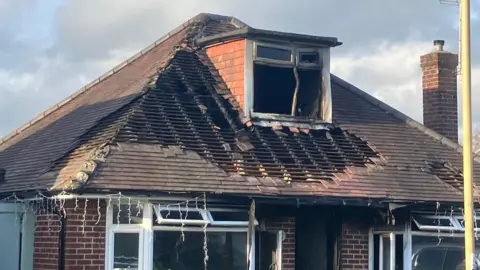
Police and fire officers are investigating the cause of the blaze
A 25-year-old woman has been found dead after a house fire which has left a man, aged in his 60s, critically ill.
The blaze was reported at about 23:00 GMT on Saturday at an address in Northlands Road in Totton, Hampshire.
The roof and an upstairs dormer window of the property were severely damaged by fire.
An investigation has been launched by police and fire officers.
In a statement, Hampshire and Isle of Wight Constabulary said: "Sadly, despite the very best efforts of the emergency services, a 25-year-old woman was pronounced deceased at the scene. Her next of kin have been notified.
"A man in his 60s, who was also inside the property at the time, has been taken to hospital and is in a life-threatening condition.
"We would ask that people respect the family's privacy at this unimaginably difficult time and refrain from any speculation."
Police said officers would remain at the scene for the rest of Sunday.
The shooting at Bondi beach targeted a Jewish Hanukkah event where many families were present
The first day of Hanukkah was a sweltering one in Sydney - a perfect afternoon to spend at Australia's most iconic beach.
More than 1,000 people were enjoying a festival marking the occasion at a grassy stretch in Bondi: kids careened around in facepaint, crowds snaked between food trucks, and many enjoyed live entertainment as they soaked up the last rays of sunshine.
Then, just before 7pm local time, shots rang out.
From a small footbridge - just metres from a children's playground - gunmen fired upon the fenced-in crowds. A car full of improvised bombs was parked nearby, though they never went off.
One attendee, who identified himself only as Barry, described watching people around him get shot as hundreds of beach-goers began screaming and running through the park to get away from the attack.
One video showed a man - dubbed a "genuine hero" by state officials - leaping out from behind a parked car to wrestle a gun from one of the attackers and push him away.
"It was simply an unbelievable scene… in today's day and age, that families and kids on Bondi could be completely mowed down for being Jewish," Barry said.
Getty
More than 1,000 people had gathered at the Hanukkah event.
At least 11 people have died and more than two dozen are injured, including a child. One gunman was also killed by police, another is in hospital in a critical condition, and police say they're investigating whether a third person helped stage the attack.
This is an unfamiliar, and devastating, shock for Australia - the deadliest shooting in this country since the Port Arthur massacre in 1996.
That attack, which killed 35 people, was a turning point, famously prompting the government to introduce some of the world's strictest gun control measures.
We've only had a handful of mass shootings since then, most of them horrific acts of domestic violence - not public attacks like today.
Swiftly declared a terrorist attack by police, it comes amid a rise in antisemitic attacks in Australia since the 7 October Hamas attack on Israel and Israel's subsequent offensive on Gaza.
Getty
An injured woman is treated by emergency workers at Bondi beach
Getty Images
Prime Minister Anthony Albanese called it an "act of evil antisemitism" and a "vile act of violence and hate".
But he's been accused by some - including Israel's Prime Minister Benjamin Netanyahu - of failing to address the upward trend of antisemitism here.
"The Australian government, which received countless warning signs, must come to its senses!" Israel's Foreign Minister Gideon Sa'ar wrote on X.
Alex Ryvchin, co-CEO of the Executive Council of Australian Jewry, told Sky News Sunday night that the "worst fears" of the Jewish community had been realised.
"It's been bubbling under the surface for a long time, and now it's actually happened."
In a statement, the Australia Jewish Association's Robert Gregory said many Jews would tonight be pondering whether they have a future in Australia.
"To be confronted with this horrific act of antisemitic violence during the Jewish festival of light and hope is shattering. In moments like this, we hold each other close," the Jewish Council of Australia said in a statement.
Getty
Bondi beach is one of the world's most famous beaches
There's a lot police can't - or won't - say yet. But they have declared this was a terrorist attack.
Who the gunmen are - how many of them even - and their motive is still unclear. They said one of the attackers was known to police, but wasn't on their radar for anything like this.
Officials wouldn't answer any questions about those who died either, out of respect for families who are still being notified.
"It's too early to give that information," was the most frequent refrain uttered at a press conference late on Sunday night.
But where NSW Police Commissioner Mal Lanyon couldn't offer answers, he tried instead to offer reassurance. Police are throwing everything at this investigation, he said.
He urged the community to remain calm, and avoid spreading misinformation online - including speculating on the victims and perpetrators of the attack.
"I want to make sure that there is no retribution," Commissioner Lanyon said.
Local politicians have also asked people not to share graphic footage from the attack on social media.
In the aftermath of the shooting, sirens were ringing through the city and the area surrounding Bondi swarmed with police cars, helicopters circling above.
There we found Fin Green, who was on FaceTime with his family in the UK when he saw the shooting unfolding outside his window. Unsure what was happening, he hid in his wardrobe for an hour and a half, until he felt it was safe to go out.
Danny Clayton, a broadcast journalist who was at the beach and witnessed the events from the Bondi Pavilion, said some people crashed their cars as they attempted to flee.
Many others in the area had similar stories. Restaurant worker William Doliente Petty said he was serving someone when he heard the gunshots. "The whole shop just stood up and we ran into the back exit."
Australia prides itself on being a merry, safe country and Bondi Beach has long been a symbol of that. But that image has been shattered and residents are in disbelief.
Sunday's attack also came less than two years after another nearby tragedy. In April last year, a deadly mass stabbing attack took place at nearby Bondi Junction. Shocked, many then uttered the same words we've heard over and over today too: "This sort of thing just doesn't happen here".
Additional reporting by Katy Watson and Tabby Wilson.
The attack targeting the Jewish community at a Hanukkah event in Australia is "sickening", Sir Keir Starmer has said.
At least 11 people were killed in the shooting at Bondi Beach on Sunday and a further 29 taken to hospital, according to police.
In a statement on X, the UK prime minister said: "The United Kingdom will always stand with Australia and the Jewish community." He added that the government was working with Community Security Trust, a Jewish security organisation, on the policing of Hanukkah events in the UK.
The Metropolitan Police said it was increasing its "police presence, carrying out additional community patrols and engaging with the Jewish community to understand what more we can do".
"It is an awful reality that Jewish communities across the world continue to face a higher level of threat," the force said in a statement.
"At a time when London's Jewish communities are coming together to begin the celebration of Hanukkah, we know this attack will be the cause of not just terrible upset but also significant heightened concern about safety."
In October, two people were killed in an attack at a synagogue in Manchester on Yom Kippur, the holiest day in the Jewish religious calendar.
On Sunday, the UK's Jewish Leadership Council (JLC) called on the police and government to protect events celebrating Hanukkah which begins this evening and lasts for eight days.
Hanukkah, also known as Chanukah, is a festival of light usually observed in December.
"We are devastated and angered that in Sydney, Jews appear to have been targeted once again for being Jewish," the JLC said in a statement.
"We know that such hatred also exists in this country, as we are still reeling from the attack on a synagogue in Manchester on Yom Kippur.
"As we prepare to celebrate Chanukah over the next eight nights, we call on government and law enforcement to work with our community to protect Jewish life in the UK and ensure that events this week can go ahead safely. We must not let hatred extinguish the festival of light."
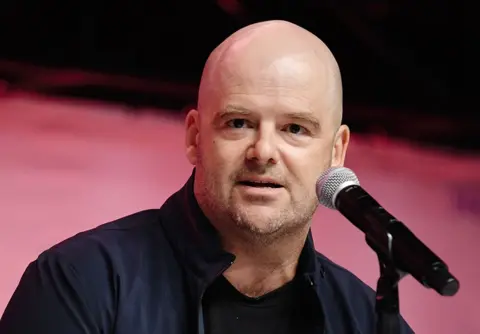
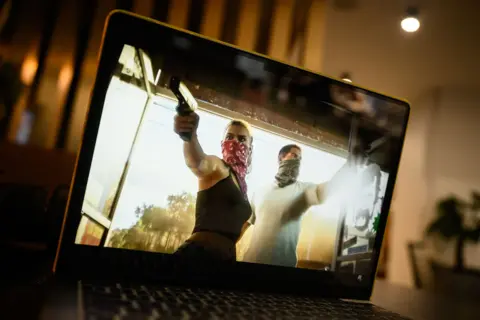
Dan Houser was one of the masterminds behind revolutionary video game series Grand Theft Auto.
Now, after leaving Rockstar Games and launching his own company, he's released a debut novel about a very different type of game.
A Better Paradise is a dystopian vision of the near future in which an AI-led computer game goes rogue.
Set in a polarised world, it finds Mark Tyburn attempting to create a virtual haven for people to find sanctuary and reconnect within themselves against an all-consuming social media hellscape.
But it all goes wrong when it ends up unleashing a mysterious, sentient AI bot named NigelDave into society - "a hyper-intelligence built by humans" - flaws included.
Readers get to see his thought processes as he struggles with "infinite knowledge and zero wisdom".
"What would an incredibly precocious child, who remembers everything he ever thought - because computers don't forget things - feel like when he started talking?" Houser says.
Getty Images
Written before ChatGPT
It feels a bit like A Better Paradise predicted the future.
First released as a podcast, the book comes as AI's continued boom means the sector's big seven companies are now collectively worth more than China's economy.
But Houser says he began writing the book "a good year" before OpenAI's ChatGPT went live to the masses in 2022, complete with a logo eerily similar to his fictional creation.
Instead, it was humanity's technological dependency during Covid - at a scale he'd underestimated - that inspired his thinking.
In his novel - which sometimes feels monologue-heavy - Houser envisions a hyper-digital, alienating world where people retreat from deepening political problems into a spiral of social media and generative AI.
Enter CEO of Tyburn Industria, Mark, who dreams of building the Ark, an immersive gaming experience users can enter in order to reconnect with themselves. It generates a world and mission tailored to each player's innermost wants and needs.
But during testing, the Ark becomes a Pandora's box of addiction. Some players find joy; others encounter terror. One even reconnects with his dead sister.
Meanwhile, a rogue AI bot named NigelDave slips into the real world, controlling minds and engineering realities no one can control.
Mined for advertising, people are left wondering if their thoughts are genuine. Everything is tracked, and nothing is secure. As climate emergencies intensify, society falls to pockets of civil war.
The only way to escape is to "drift"- which means hiding from a thousand algorithms by living off-grid, constantly moving and suppressing maddening paranoia that your thoughts are not your own.
Mirroring our world
To the reader, NigelDave feels like a nightmare ChatGPT gone wrong.
The AI tool recently reached 800 million weekly active users, according to boss Sam Altman, and Houser believes some people are becoming dependent on the technology's affirming "human veneer".
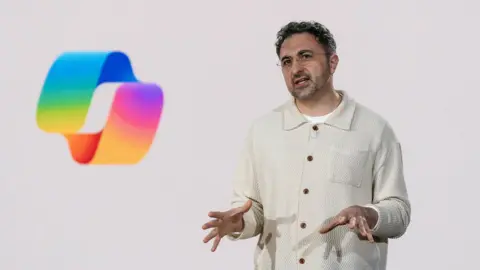
Microsoft's head of AI Mustafa Suleyman has warned of a rise in AI psychosis - a non-clinical term describing incidents where people increasingly rely on chatbots like Claude, Grok and ChatGPT and become convinced that something imaginary has become real.
In response to the increased scrutiny, ChatGPT creator OpenAI recently tightened its welfare protocols, with updates designed to ensure its chatbot responds "safely and empathetically to potential signs of delusion or mania".
Bloomberg via Getty Images
Mustafa Suleyman, chief executive officer of of Microsoft AI
The dizzying algorithm-fuelled society in which NigelDave is unleashed mirrors ours too.
Parents worry about exposing their children to false information or harmful content. Last year national police chiefs described the "quite terrifying" misogynistic radicalisation of boys and young men. And in 2014 Facebook admitted manipulating the news feeds of nearly 700,000 users without their consent to manage the emotions they were exposed to.
"As a parent, you always worry about anything that you expose your kids to that is going to either give them false information or simply bombard them with too much information," Houser says.
But is it bold for a video game creator to be warning of these dangers - given the long history of video games themselves being accused of making young people violent?
Houser insists there's a difference.
"We always had the data about game violence, and it was very clear: as people played more video games, youth violence went down.
"Whatever people were claiming, we knew the opposite was true."
Getty Images
Psychology professor and game violence researcher Pete Etchells says numerous studies have shown "no meaningful effect of playing violent games on aggression".
AI models and social media are another matter - a "new paradigm" in altering behaviour that gaming never threatened, according to Matt Navarra, social media consultant and author of the Geekout Newsletter.
He says dismissing concerns as a GTA-style moral panic "understates what is changing".
"We're talking about external systems that can potentially shape people's beliefs or manipulate attention, personalised experiences, nudge behaviour or even influence identity and emotional states."
Rockstar freedom
Could Houser have pushed forward with A Better Paradise at Rockstar? "I don't know if I would have had the bandwidth to think about it," he tells me.
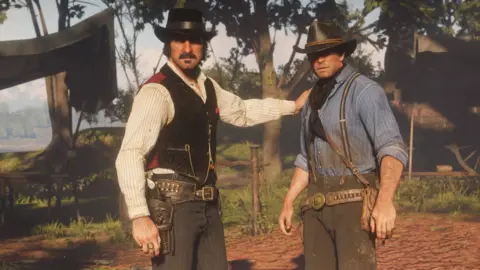
He's previously described the fatigue of managing vast open-world sandbox games like Red Dead Redemption and GTA as playing a role in his departure.
The goal with his book was to create "something truly different in this era of crazy media saturation".
Rockstar Games
So where next? He's already writing the second instalment of the series, and plans are under way to develop a video game, for which he promises the visuals are ground-breaking.
A key message, he says, is to not let your device - or AI - "tell you what to think". Otherwise, Houser argues, "you're giving up control to your phone".
His biggest fear, as creator of worlds, is losing imagination because of the endless torrent of algorithms. Sometimes after scrolling for hours, he realises: "I've not had an idea all day".
"If you go offline for a bit - sometimes I make myself go for a walk with no phone, you start to have ideas.
"A human is better thinking than not," he says. "Thinking is a privilege."
Watch: Eyewitness captures moment man tackles and disarms Bondi shooter
Twelve people have died - including one gunman - following a shooting at Australia's Bondi Beach which targeted the Jewish community on the first day of Hanukkah.
According to police, at least 12 others have been injured and two officers were shot during the event, which has since been declared a terror attack by officials. The surviving gunman is in a critical condition.
More than 1,000 people were attending an event on the beach celebrating Hanukkah.
Chris Minns, the premier of New South Wales, said: "Our heart bleeds for Australia's Jewish community tonight.
"I can only imagine the pain that they're feeling right now to see their loved ones killed as they celebrate this ancient holiday".
Mass shootings in Australia are very rare, and the attack at Bondi is the deadliest incident in Australia since the Port Arthur massacre in 1996.
Bondi Beach is located in eastern Sydney in the state of New South Wales, on Australia's east coast.
It is one of Australia's most popular beaches, attracting millions of visitors each year. The area is a significant attraction for tourists.
What happened?
New South Wales (NSW) police responded to reports of gunfire at around 18:47 local time (07:47 GMT), with video showing hundreds of people fleeing from the coastline.
In their initial statement posted on X, NSW Police urged people at the scene to take shelter and other members of the public to avoid the area.
Around the same time, local media began reporting people "on the ground" in the vicinity of Campbell Parade.
A video verified by the BBC appears to shows two gunmen firing from a small bridge which crosses from the car park on Campbell Parade towards the beach itself.
An event to mark the first day of the Jewish celebration Hanukkah was taking place on Bondi Beach, very close to the bridge where the men were firing from. More than 1,000 were in attendance.
Premier Minns also paid tribute to a man filmed wrestling a gun from one of the attackers.
"That man is a genuine hero, and I've got no doubt there are many, many people alive tonight as a result of his bravery," Minns said at a press conference.
In the video, the man is seen sneaking up on the attacker, before grabbing him in a bear hug.
The now-disarmed man then retreats back towards the bridge, where the other attacker is still firing from.
As the video continues, another man appears to be injured and flees the scene, as a policeman arrives behind the attackers and opens fire at them.
A separate video, also verified, shows several policemen on the same bridge. One appears to be administering CPR to a motionless man as someone shouts "he's dead, he's dead".
How many people were killed and injured?
Getty Images
The attack targeted a Hanukkah celebration on the beach, police say
Apart from police confirming one gunman as dead, details on who has been killed and injured are sparse.
Twelve people including one of the armed men have been confirmed dead by police. Another gunman is said to be in a critical condition.
Officials say 29 other people were taken to hospital, and two officers were also shot during the incident.
One eyewitness, Barry, was attending the Hanukkah event on Bondi when with his children when he heard gunshots.
He told the BBC he saw two men on a bridge shooting towards the crowd.
He said there were bodies on the ground. He and his children were able to escape with a friend in a car, he added.
What is the latest?
Getty Images
Police have urged for calm as they carry out their investigation
Police have declared Saturday's shooting a terror attack.
An exclusion zone has been set up around the scene as police use specialist equipment to check improvised explosive devices (IEDs) found in a car linked to the dead gunman, and police are still urging the public to avoid the area."
"No stone will be left unturned" in the investigation, New South Wales Police Commissioner Mal Lanyon said.
He said police would not release any information about the gunmen at this time, and urged for calm while police carry out their duties, adding that this was "not a time for retribution".
Police said they cannot confirm if there was a third gunman involved or if there was anyone else involved in the attack, but enquires are ongoing.
During a televised address, Australian Prime Minister Anthony Albanese called the Bondi Beach shooting "an act of evil antisemitism, terrorism that has struck the heart of our nation".
"We have seen Australians today run towards dangers in order to help others. These Australians are heroes and their bravery has saved lives", he added.
The attack targeting the Jewish community at a Hanukkah event in Australia is "sickening", Sir Keir Starmer has said.
At least 11 people were killed in the shooting at Bondi Beach on Sunday and a further 29 taken to hospital, according to police.
In a statement on X, the UK prime minister said: "The United Kingdom will always stand with Australia and the Jewish community." He added that the government was working with Community Security Trust, a Jewish security organisation, on the policing of Hanukkah events in the UK.
The Metropolitan Police said it was increasing its "police presence, carrying out additional community patrols and engaging with the Jewish community to understand what more we can do".
"It is an awful reality that Jewish communities across the world continue to face a higher level of threat," the force said in a statement.
"At a time when London's Jewish communities are coming together to begin the celebration of Hanukkah, we know this attack will be the cause of not just terrible upset but also significant heightened concern about safety."
In October, two people were killed in an attack at a synagogue in Manchester on Yom Kippur, the holiest day in the Jewish religious calendar.
On Sunday, the UK's Jewish Leadership Council (JLC) called on the police and government to protect events celebrating Hanukkah which begins this evening and lasts for eight days.
Hanukkah, also known as Chanukah, is a festival of light usually observed in December.
"We are devastated and angered that in Sydney, Jews appear to have been targeted once again for being Jewish," the JLC said in a statement.
"We know that such hatred also exists in this country, as we are still reeling from the attack on a synagogue in Manchester on Yom Kippur.
"As we prepare to celebrate Chanukah over the next eight nights, we call on government and law enforcement to work with our community to protect Jewish life in the UK and ensure that events this week can go ahead safely. We must not let hatred extinguish the festival of light."
Specialist rape and sexual offence investigation teams will be introduced to every police force in England and Wales by 2029, the government has pledged.
It is part of a long-delayed plan aimed at halving violence against women and girls within a decade.
The strategy - which will include funding for undercover units operating online, and a roll out of domestic abuse protection orders - is due to be unveiled on Thursday, after being pushed back three times this year.
Home Secretary Shabana Mahmood said the measures will help to "bear down on abusers, stopping them in their tracks. Rapists, sex offenders and abusers will have nowhere to hide."
The government says the new teams will have officers with specialist investigation skills for working on rape and sexual offence cases.
More than 50% of police forces already have these teams in place, but the government says every force will have dedicated officers by 2029.
It says staff will have the right training to understand the mindset of abusers and victims.
Announcing the move, the home secretary said: "This government has declared violence against women and girls a national emergency.
"For too long, these crimes have been considered a fact of life. That's not good enough. We will halve it in a decade."
Also announced is a roll out of domestic abuse protection orders, which have been trialled over the last year, across England and Wales.
They can ban individuals from contacting a victim, visiting their home or posting harmful content online, and can also be used in cases involving coercive or controlling behaviour. Breaching an order is a criminal offence.
There will also be almost £2m in investment for special undercover units of police officers operating online - to target those harassing women and girls on the internet.
It said sexually-motivated crimes against women in public remained widespread, criticised the limited nature of data on them, and called for urgent action to prevent predators from offending.
The publishing of the government's strategy has been long delayed. It was initially expected to be announced in the spring.
In Labour's general election manifesto last year the party pledged to use "every government tool available to target perpetrators and address the root causes of abuse and violence".
A person of interest has been detained in connection with a US shooting at Brown University that left two people dead, police said.
Nine others were injured when a gunman opened fire at the university in Providence on Saturday.
Police confirmed on Sunday a person had been detained, and an earlier order for people on the Brown campus and surrounding areas to shelter had been lifted.
Of those injured, medics said one person was in a critical condition, six were "critical but stable" and two others were less severely hurt.
The gunman opened fire in a classroom at around 16:00 local time (21:00 GMT) on Saturday at the Holley engineering building at the eastern end of Brown's campus, according to officials.
The identities of those killed or injured have not yet been released, but Brown University President Christina Paxson told reporters in a press briefing on Saturday that all the victims, including those killed and wounded, were students.
Police had earlier released CCTV footage of a male suspect walking away from the scene wearing all black clothing. Officers said a firearm was not found in a sweep of the building.
The post box will replace a handmade one currently used at the remote station
A shiny new red post box has been given as a gift from King Charles III to staff at a remote Antarctic research station.
The Royal Mail red lamp post box was sent to staff at the Cambridge-based British Antarctic Survey station at Rothera.
The box, featuring the King Charles III cypher, was delivered after Kirsten Shaw, a station support assistant who runs the British Antarctic Territory Post Office for staff, requested an upgrade to their handmade box.
"Being in Antarctica is incredible, but it's full of extremes, so I think it's a special thing to send post back home, to communicate your experiences. It's a moment of your life that you put down on paper and give to someone else," she said.
The Rothera research station, which opened in 1975, is the largest British Antarctic Survey (BAS) facility, and a renowned global hub for climatic research.
It is situated 1,860km (1,155 miles) south of the Falkland Islands.
Staff work and live at the station for months at a time.
Ms Shaw said: "Getting post is really special for the team at Rothera.
"If you're doing fieldwork for many months, the feeling of receiving a letter — an actual tangible, piece of paper with handwriting from friends and family — is such a lift.
"It's a wonderful way to connect people that goes beyond what an email or text message can do."
BAS/Jake Martin
Kirsten Shaw and Aurelia Reichardt, station leader at Rothera, are pictured with the new post box
The box will replace the handmade and painted one currently used at the station.
The BAS said "the Royal Household worked with Royal Mail to arrange this particularly special delivery".
It was delivered to Rothera by the UK's polar research vessel RRS Sir David Attenborough, along with the first major drop of supplies to the station following the long Antarctic winter.
The post box will be installed in the Discovery Building, a new scientific support and operations hub.
BAS/Aurelia Reichardt
The handmade box will now be replaced by the official one from the Royal Mail
Postal logistics in such a remote area are understandably not straightforward.
Ms Shaw's job is to oversee the formal Post Office logistics of getting mail in and out of Antarctica from Rothera, as well as getting post out to staff to other BAS stations and science field camps.
Post has to be gathered and put on board the RRS Sir David Attenborough or on BAS aircraft to the Falkland Islands, where BAS maintains an office in Stanley.
The final leg involves transport to RAF Brize Norton in Oxfordshire, where letters enter the Royal Mail postal network for onward delivery.
BAS/Jake Martin
The box will be placed in a new building at the station
Jane Rumble, HM Commissioner for the British Antarctic Territory said: "Maintaining a postal service in the British Antarctic Territory is far more than a symbolic gesture.
"It reinforces Britain's presence and heritage in Antarctica and provides a vital link to the wider world."
Specialist rape and sexual offence investigation teams will be introduced to every police force in England and Wales by 2029, the government has pledged.
It is part of a long-delayed plan aimed at halving violence against women and girls within a decade.
The strategy - which will include funding for undercover units operating online, and a roll out of domestic abuse protection orders - is due to be unveiled on Thursday, after being pushed back three times this year.
Home Secretary Shabana Mahmood said the measures will help to "bear down on abusers, stopping them in their tracks. Rapists, sex offenders and abusers will have nowhere to hide."
The government says the new teams will have officers with specialist investigation skills for working on rape and sexual offence cases.
More than 50% of police forces already have these teams in place, but the government says every force will have dedicated officers by 2029.
It says staff will have the right training to understand the mindset of abusers and victims.
Announcing the move, the home secretary said: "This government has declared violence against women and girls a national emergency.
"For too long, these crimes have been considered a fact of life. That's not good enough. We will halve it in a decade."
Also announced is a roll out of domestic abuse protection orders, which have been trialled over the last year, across England and Wales.
They can ban individuals from contacting a victim, visiting their home or posting harmful content online, and can also be used in cases involving coercive or controlling behaviour. Breaching an order is a criminal offence.
There will also be almost £2m in investment for special undercover units of police officers operating online - to target those harassing women and girls on the internet.
It said sexually-motivated crimes against women in public remained widespread, criticised the limited nature of data on them, and called for urgent action to prevent predators from offending.
The publishing of the government's strategy has been long delayed. It was initially expected to be announced in the spring.
In Labour's general election manifesto last year the party pledged to use "every government tool available to target perpetrators and address the root causes of abuse and violence".
A revamp of train timetables has come into effect across the country, involving some of the most significant changes for nearly a decade.
Rail operators are promising more services across the network and faster journeys on some routes as a result of the changes, with the East Coast Main Line to benefit the most.
Passengers are being advised to check the new timetables before travelling.
The level of change has not been seen since May 2018 when an update sparked major disruption and cancellations on some routes.
Rail timetables are changed every May and December, but rarely to this degree.
Network Rail is promising quicker journeys and thousands of extra seats every day, following a £4bn investment over the past decade.
The changes promise a cut of 15 minutes to journey times between London King's Cross and Edinburgh and 10 minutes between Edinburgh and York.
Network Rail says the rail line, which is used by several operators, will have improved connectivity between Scotland, North East, England, Yorkshire and London.
One of the companies using the line, LNER, called the changes "transformational" and said it expected to run 10,000 additional services per year.
Ellie Burrows, Eastern regional managing director for Network Rail, said: "The industry has been preparing for many years for the new timetable.
"Our priority now is to continue working together to deliver the long-term benefits of this timetable change, the biggest in over a decade, for our passengers and the communities we serve."
The changes will also see Northern launch a new hourly fast service between Leeds and Sheffield.
Another operator, Avanti, says there will be more trains between London and Liverpool.
Meanwhile Transport for Wales is introducing more services for Chester, Wrexham and Swansea.
The changes are the biggest since May 2018 when a timetable update triggered major disruption and cancellations on some services.
That led to a full review and eventually the Labour government's decision to create Great British Railways and bring the industry under state control.
Travel expert Simon Calder said he was "pretty confident we won't see the complete collapse of a network, as we did when the Thameslink line had its timetable completely reconfigured in 2018 - that was an absolute shambles".
"There has been an awful lot of thought and time that has gone into this and the whole idea is to extract the maximum possible capacity from Britain's Victorian rail network without jeopardising reliability."
The post box will replace a handmade one currently used at the remote station
A shiny new red post box has been given as a gift from King Charles III to staff at a remote Antarctic research station.
The Royal Mail red lamp post box was sent to staff at the Cambridge-based British Antarctic Survey station at Rothera.
The box, featuring the King Charles III cypher, was delivered after Kirsten Shaw, a station support assistant who runs the British Antarctic Territory Post Office for staff, requested an upgrade to their handmade box.
"Being in Antarctica is incredible, but it's full of extremes, so I think it's a special thing to send post back home, to communicate your experiences. It's a moment of your life that you put down on paper and give to someone else," she said.
The Rothera research station, which opened in 1975, is the largest British Antarctic Survey (BAS) facility, and a renowned global hub for climatic research.
It is situated 1,860km (1,155 miles) south of the Falkland Islands.
Staff work and live at the station for months at a time.
Ms Shaw said: "Getting post is really special for the team at Rothera.
"If you're doing fieldwork for many months, the feeling of receiving a letter — an actual tangible, piece of paper with handwriting from friends and family — is such a lift.
"It's a wonderful way to connect people that goes beyond what an email or text message can do."
BAS/Jake Martin
Kirsten Shaw and Aurelia Reichardt, station leader at Rothera, are pictured with the new post box
The box will replace the handmade and painted one currently used at the station.
The BAS said "the Royal Household worked with Royal Mail to arrange this particularly special delivery".
It was delivered to Rothera by the UK's polar research vessel RRS Sir David Attenborough, along with the first major drop of supplies to the station following the long Antarctic winter.
The post box will be installed in the Discovery Building, a new scientific support and operations hub.
BAS/Aurelia Reichardt
The handmade box will now be replaced by the official one from the Royal Mail
Postal logistics in such a remote area are understandably not straightforward.
Ms Shaw's job is to oversee the formal Post Office logistics of getting mail in and out of Antarctica from Rothera, as well as getting post out to staff to other BAS stations and science field camps.
Post has to be gathered and put on board the RRS Sir David Attenborough or on BAS aircraft to the Falkland Islands, where BAS maintains an office in Stanley.
The final leg involves transport to RAF Brize Norton in Oxfordshire, where letters enter the Royal Mail postal network for onward delivery.
BAS/Jake Martin
The box will be placed in a new building at the station
Jane Rumble, HM Commissioner for the British Antarctic Territory said: "Maintaining a postal service in the British Antarctic Territory is far more than a symbolic gesture.
"It reinforces Britain's presence and heritage in Antarctica and provides a vital link to the wider world."
Watch: Nobody expecting "toilet police", says UK equality chief
Everyone should "follow the rules" when guidance on single-sex spaces is released, the new head of the equality watchdog has told the BBC.
Dr Mary-Ann Stephenson, chair of the Equality and Human Rights Commission (EHRC), said "things could be sorted out if there is goodwill and recognition that everybody has rights", and that "nobody is expecting there to be a toilet police".
The guidance, for businesses and services, was drawn up after a unanimous Supreme Court ruling in April that legally a woman should be defined by biological sex for the purposes of the Equality Act 2010.
The BBC interview, to be broadcast on Sunday with Laura Kuenssberg, is Dr Stephenson's first in her new role.
The EHRC's guidance was passed to the government three months ago, but it has yet to publish it formally, which would give the code of practice legal force.
It aims to provide advice to businesses and services - such as women's refuges, gyms, hospitals or shopping centres - about how the Supreme Court ruling should work.
Seen by the BBC after it was leaked, the 300-page document says single-sex spaces should only be open to people of the same biological sex, otherwise they cease to be single-sex areas.
That would mean, for instance, that a trans woman – a biological male who identifies as a woman - would not be able to use women's toilets and changing rooms.
The guidance says it may be legitimate for businesses or services to ask people to provide confirmation they are of the eligible sex "by proportionate means".
This has all caused controversy and anger among some transgender campaigners.
Dr Stephenson told the BBC: "Nobody is expecting there to be a toilet police.
"But equally if there are situations where there are complaints about regular problems, then people might need to... improve signage, improve explanations, or make sure they have got alternative provision."
She said she expected both service providers and people using these services to "follow the rules".
Dr Stephenson was challenged on what facilities trans people should use if there were no alternatives, or what businesses should do if they did not have the space or resources to make extra provision.
She said: "There's often unisex provision and where there isn't, as I say, we need to think more broadly about how we make sure those that those facilities are available…
"If you've got, you know, two self-contained cubicles, one of which is labelled men and one of which is labelled women, then the most sensible thing in those circumstances for a service provider to do is to make both of those unisex."
Dr Stephenson was appointed to the role in July and she started earlier this month.
It was greeted with hostility by some trans campaigners, in part because she had donated money to the case of lawyer Allison Bailey, who won part of a tribunal claim that she was discriminated against because of her gender-critical views.
In our interview, Dr Stephenson was adamant she could still be objective when considering trans issues.
She said she donated to the case because she was frustrated by situations where "women were being harassed and losing their jobs on the basis of lawfully held beliefs".
She said she had been concerned by the experiences of some women "when trying to have meetings to discuss proposed changes in the law".
"I thought it was important that actually in a democracy, if there is a proposed change to the law, people should be able to meet and discuss those changes without violence or intimidation," she said.
"If that's taking a side, it's taking a side on the side of kind of democratic norms and open discussion and dialogue."
The full interview will be on Sunday with Laura Kuenssberg.

 Login
Login
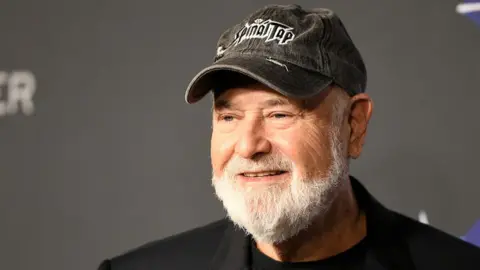 Getty Images