Reading view

There are new articles available, click to refresh the page.

Driving Home for Christmas singer Chris Rea dies aged 74

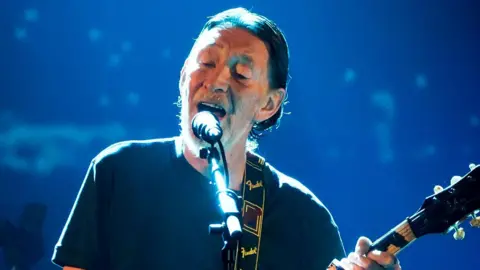
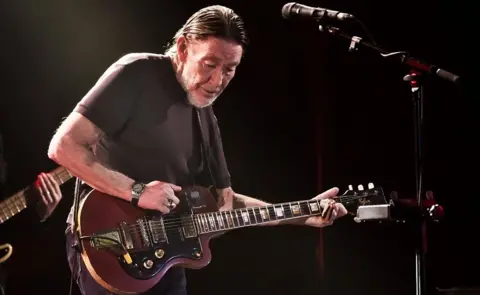
Getty Images Chris Rea singing on stage and playing the guitar in 2017Getty Images

Chris Rea, the musician behind the festive classic Driving Home for Christmas, has died at the age of 74.

The singer died on Monday in hospital following a short illness, a spokesperson for his family said.

A statement on behalf of his wife and two children read: "It is with immense sadness that we announce the death of our beloved Chris.

"He passed away peacefully in hospital earlier today following a short illness, surrounded by his family."

The blues-influenced star had a string of hits included Auberge, On the Beach and Road to Hell.

Paying tribute on X, Middlesborough FC said: "We're deeply saddened to learn of the passing of Chris Rea. A Teesside icon. Rest in peace, Chris."

Rea's 1980s smash Driving Home for Christmas tells the story of a weary traveller making his way home in heavy traffic.

This year, it has been brought to new audiences as the backdrop to the M&S Food Christmas advert.
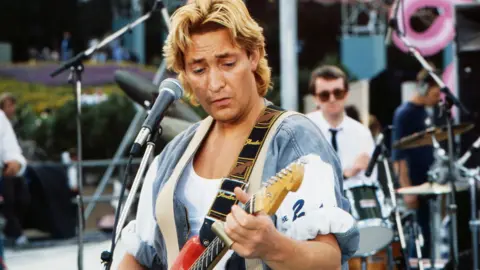
Getty Images Chris Rea performing in Germany in 1983Getty Images

In 2020, the singer's social media platforms posted a chat between the singer with fellow Middlesbrough native Bob Mortimer, explaining how he came to write the track.

Rea said he was on the dole at the time, his manager had just left him and he had been banned from driving.

His then-girlfriend Joan (who he met when they were both 16 and went on to marry) had to pick him up in London in her mini and drive him home. And that's what inspired the song, which was written in 1978, 10 years before it was released released as a single in 1998.

The singer-songwriter had suffered with various bouts of ill-health over the years.

He had his pancreas removed a few years after being diagnosed with pancreatic cancer at the age of just 33 in 1994 and then had a stroke in 2016.
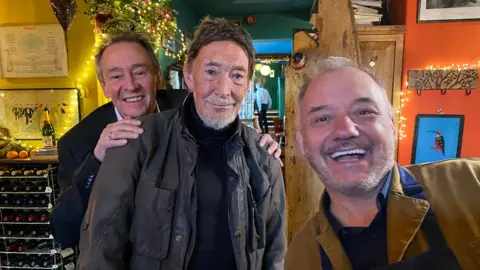
Paul Whitehouse, Chris Rea and Bob Mortimer on Mortimer & Whitehouse: Gone Christmas Fishing
Rea (centre) appeared on Mortimer & Whitehouse: Gone Christmas Fishing in 2020

The star never forgot his roots, telling Saga magazine last year: "I've always had a difficult relationship with fame, even before my first illness.

"None of my heroes were rock stars. I arrived in Hollywood for the Grammy Awards once and thought I was going to bump in to people who mattered, like Ry Cooder or Randy Newman. But I was surrounded by pop stars.

"The celeb thing has gone totally wrong in the sense that everyone has tried to top each other. They don't put the work in."#

Speaking of his wife in the same interview, he said: "Our golden moment is each morning when there is an elbow fight over whose turn it is to make the coffee.

"Then there are the large mugs of fresh coffee, BBC Breakfast news or Sky and we gaze out of the window over the countryside for an hour and we are still 16. We are lucky to still have that feeling."

Rea first began helping out with his family's ice-cream business - his dad was Italian, while his mum was Irish.

Once he found the guitar, he soon began playing in various bands and released his debut album Whatever Happened To Benny Santini? in 1978.

His commercial breakthrough came in the 1980s, as two of his studio albums - The Road To Hell (1989) and Auberge (1991) - went to number one in the UK.

He returned to his blues roots in his later years while facing his health challenges.

After his stroke nine years ago, he recovered to launch a new album, Road Songs For Lovers, in 2017.

He took the album on the road at the end of that year but had to cancel a number of shows after he collapsed mid-song while performing at the New Theatre in Oxford.

Two men jailed for Grindr targeted thefts

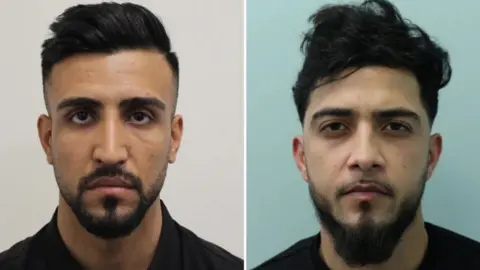
Met Police Two men feature in this police mugshot, on the left is a man with a groomed appearance with a quiff in his hair and a neat, trimmed beard and moustache. His face is solemn and serious. On the right is a man with a more dishevelled appearance, his hair is more windswept and his beard is not as neatly groomed. He has the same solemn facial expression. Both are Afghans.Met Police
Mohammed Hotak, left, and Rahmat Mohammadi were convicted at an earlier hearing in November 2025

Two men who were part of what police have called "London's most prolific Grindr gang" have been jailed for a combined eight-and-a-half years after using the gay dating app to target men in the capital.

Rahmad Khan Mohammadi, 23 and Mohammed Bilal Hotak, 21 stole phones, passports and wallets in 35 burglaries and 20 related frauds, totalling £68,000 over six months, the Met said.

One victim was left hospitalised with stress after their finances were "destroyed" when loans, credit agreements and overdrafts were taken out using their name.

Sentencing the pair at Iselworth Crown Court on Monday, Judge Adenike Bologun said the gang were relying on victims "being too embarrassed to report the crime".

But she said she wasn't persuaded that the offences demonstrated hostility to the victims based on their sexual orientation, adding that "this was an opportunistic offence."

Multiple men targeted

The court had heard how Mohammadi, from Harrow, and Hotak, from Hackney, both Afghan nationals, tricked their way into the homes of unsuspecting men by arranging to meet up with them on the dating app.

Met Police officers told BBC News that multiple men were targeted per week by repeatedly making new profiles on the app.

Once inside their homes, the duo distracted the men and persuaded them to unlock their phones by requesting to use them to play music, sometimes asking the victim to take a shower before sex, and then escaping with the device or other valuable items.

The gang would then use debit and credit cards stored on the phones and on one occassion accessed a victim's bank account and stole money by transferring cash.

On another occasion, they convinced a man to meet them in a nearby park.

Getty Images A close-up of a mobile phone showing the Grindr app logo against a black background. The logo is a yellow mask with holes for eyes but none for mouth or nose, and it sits on a black background. The word Grindr appears beneath it in white text.Getty Images
Grindr has about 15 million active users globally each month

Proescuting, David Patience, read statements by the victims to the court describing the damage done to their confidence and finances.

One described how he felt his 'vulnerability was used against me, because of my sexuality and body size'.

'I was manipulated and led into a park late at night, my phone was taken from me, I was humiliated and unable to protect myself.'

Another described how he was hospitalised due to the stress, and another recounted how his studies and finances were wrecked.

Mr Patience claimed the pair held "contemptuous ill will" towards the victims based on their sexuality and use of the app, which is predominantly used by gay and bisexual men.

"They did not target women, heterosexual men - they targeted gay men. They thought they would be easier to commit offences against", he told the court.

But barrister for Hotak, John Kearney, claimed the "victims will have learned a lesson" and strongly denied the suggestion that this was in some way "ill will towards the gay community".

"Women would not have been as foolish and reckless to place themselves in a position of vulnerability with strange men coming into their home" he said.

Defending Mohammadi, Nathan Toms, claimed his client had left Afghanistan after he was stabbed at the age of 15 by his then girlfriend's brother.

"His own family forced him to flee," he told the court.

"His father was going to murder him because he was linked to the government and he believed it would 'reset relations' with his employer. He arrived in this country via a lorry."

Mohammadi was sentenced to five years in prison and Hotak to three and a half.

Listen to the best of BBC Radio London on Sounds and follow BBC London on Facebook, X and Instagram. Send your story ideas to hello.bbclondon@bbc.co.uk

Third Palestine Action hunger striker on remand ends protest

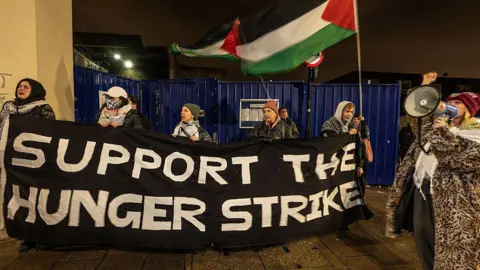
Getty Images Protesters hold up a sign reading 'Support the hunger strike' and wave Palestine flagsGetty Images
Supporters of Palestine Action hunger strikers protested outside Pentonville prison last Thursday

A third remand detainee awaiting trial for alleged offences relating to the Palestine Action group has stopped a lengthy hunger strike, according to a letter sent to the government.

The letter confirms that Qesser Zuhrah, the joint-first of eight to begin the hunger strike on 2 November, had ended her protest after 48 days.

Lawyers for the group have given ministers until Tuesday afternoon to respond to a threat to go to the High Court over a refusal to hold talks.

A Ministry of Justice (MoJ) spokesperson said: "We want these prisoners to accept support and get better, and we will not create perverse incentives that would encourage more people to put themselves at risk through hunger strikes."

Three of the eight individuals participating in the protest have stopped while four are said to be still taking part.

The eighth member of the group is now described by supporters as intermittently refusing to eat because of an underlying health condition.

Ms Zuhrah was taken to hospital last week amid protests outside HMP Bronzefield claiming that she was being denied full medical assistance.

MoJ officials have previously disputed claims of mistreatment. The Ministry does not comment publicly on the specific management of individuals.

Amy Gardiner-Gibson, who also goes by the name Amu Gib and began a hunger strike on the same day as Ms Zuhrah, was reportedly transferred to hospital on Sunday on the 50th day of the protest.

The other remaining hunger strikers are Heba Muraisi, Teuta Hoxha and Kamran Ahmad. They are said to have been refusing food for 49 days, 43 days and 42 days respectively - accounts that have not been disputed by officials.

Prison and NHS guidelines make clear that clinicians must oversee treatment decisions for hunger strikers. They can only be given food-related treatments if they consent or it is clear they lack the mental capacity to choose.

In a detailed legal warning letter, lawyers for the group say they will ask the High Court to review Justice Secretary David Lammy's refusal to meet with their representatives if they do not receive a reply by 14:00 GMT on Tuesday.

The group's lawyers say that prison service policies make clear that staff "must make every effort" to understand why a prisoner is refusing food and address the reasons.

The group has called for the ban on Palestine Action to be lifted.

The High Court has been reviewing the home secretary's decision to proscribe the group and a judgment is expected in the New Year.

The protesters allege they have been treated unfairly and not bailed ahead of trials in 2026 and 2027.

Some of these cases cannot be reported at this stage under standard laws designed to ensure a fair trial of all criminal suspects.

"Our clients' food refusal constitutes the largest co-ordinated hunger strike in British history since 1981," says the letter in a reference to the IRA hunger strikes.

"As of today's date, their strike has lasted up to 51 days, nearly two months, and poses a significant risk to their life with each passing day."

The Care Quality Commission, which oversees prison healthcare, has told the BBC that it has been in contact with HMP Bronzefield, one of the jails where the protests have been taking place, for assurance that appropriate processes are in place after it had received "information of concern".

It has not clarified what it was told in response.

If ministers do not respond to the letter sent on behalf of the group by Tuesday afternoon, the group's lawyers could then ask the High Court to intervene on human rights grounds - although there is no certainty a judge would hold a hearing.

Minister of State for Prisons, Probation and Reducing Reoffending Lord Timpson said: "While very concerning, hunger strikes are not a new issue for our prisons. Over the last five years, we've averaged over 200 a year and we have longstanding procedures in place to ensure prisoner safety.

"Prison healthcare teams provide NHS care and continuously monitor the situation. HMPPS are clear that claims that hospital care is being refused are entirely misleading – they will always be taken when needed and a number of these prisoners have already been treated in hospital.

"These prisoners are charged with serious offences including aggravated burglary and criminal damage. Remand decisions are for independent judges, and lawyers can make representations to the court on behalf of their clients.

"Ministers will not meet with them - we have a justice system that is based on the separation of powers, and the independent judiciary is the cornerstone of our system. It would be entirely unconstitutional and inappropriate for ministers to intervene in ongoing legal cases."

Husband and five other men charged with sex offences against ex-wife

Getty A stock image of the back of a police officer in uniform. Getty
All six men are due to appear in court on Tuesday

A husband and five other men have been charged with a string of sexual offences against his ex-wife over a 13-year period.

Philip Young, formerly of Swindon but now living in Enfield, has been charged with 56 sexual offences, including rape and administering a substance with intent to stupefy/overpower to allow sexual activity.

The 49-year-old has also been charged with voyeurism, possession of indecent images of children and possession of extreme images.

Five other men have also been charged with offences against his ex-wife, 48-year-old Joanne Young, who has waived her right to anonymity.

All six men are due to appear at Swindon Magistrates' Court on Tuesday.

Mr Young, who police described as a white British national, has been remanded in custody.

The five other men are on bail.

Their names and charges are:

  • Norman Macksoni, 47, of Wood End Close, Sharnbrook. Police described him as a black British national. He has been charged with one count of rape and possession of extreme images
  • Dean Hamilton, 47, of no fixed abode. Police said he was a white British national. He has been charged with one count of rape and sexual assault by penetration and two counts of sexual touching
  • Conner Sanderson Doyle, 31, of Crofton Road, Swindon. Police said he was a white British national who had been charged with sexual assault by penetration and sexual touching
  • Richard Wilkins, 61, of Tattershall, Toothill, Swindon. He was described by police as a white British national and he has been charged with one count of rape and sexual touching
  • Mohammed Hassan, 37, of Torun Way, Swindon. Police described him as a British Asian male. He has been charged with sexual touching

Det Supt Geoff Smith, of Wiltshire Police, described the charges as a significant update in a "complex and extensive" investigation.

He added that Ms Young was being supported by specially trained officers.

Follow BBC Wiltshire on Facebook, X and Instagram. Send your story ideas to us on email or via WhatsApp on 0800 313 4630.

Post Office had deal with Fujitsu to fix Horizon errors 19 years ago

Getty Images A man in a dark coat walks by a Post Office branch Getty Images

The Post Office and Fujitsu agreed a deal 19 years ago to fix transaction errors in sub-postmasters' accounts caused by bugs in the Horizon IT system, a document has revealed.

An agreement was in place in 2006 for errors caused by bugs in the software to be corrected, or for Fujitsu to pay the Post Office up to £150 per transaction if it failed to do so.

The revelation directly contradicts the Post Office's claims during criminal prosecutions - which led to hundreds of wrongful convictions and civil cases that destroyed livelihoods - that no bugs existed capable of causing accounting shortfalls.

It also shows the Post Office knew almost two decades ago that Horizon could not always be relied upon to record transactions accurately.

Between 1999 and 2015, more than 900 sub-postmasters were wrongly prosecuted after the faulty Horizon IT system made it look like money was missing from branch accounts.

Some sub-postmasters went to prison, while many more were financially ruined and lost their livelihoods. Others died.

It has been described as the biggest miscarriage of justice in British legal history and has led to a long-running public inquiry into the scandal.

Countless evidence and testimonies have been heard, examined and reported during the inquiry, but a document which emerged in material published this month contained new, previously unknown, information.

The document shows that unbeknown to sub-postmasters, the two parties had a financial framework in place to manage discrepancies and for Fujitsu to fix problems or pay for them.

The Post Office denied throughout the criminal trials of sub-postmasters that errors or bugs could cause transaction shortfalls in branch accounts. It also denied in court that branch accounts could be remotely altered without the knowledge of sub-postmasters.

The document indicates the formal commercial arrangement was drawn up to deal with potential mismatches or "discrepancies" and where Fujitsu's system was responsible, it was expected to correct false transactions or pay "liquidation damages".

The disclosure also undermines the Post Office's claim to the media and before Parliament in 2015 that it was not possible for Fujitsu to alter sub-postmasters's transactions without their knowledge.

"The Post Office conducted both the criminal trials of postmasters and the group litigation of 2019 on the basis that it knew of no substantial problems with the Horizon system," said Paul Marshall, senior barrister for sub-postmasters.

"Yet this shows that in 2006 there was a very big, recognised problem with Horizon maintaining data integrity between Post Office branch offices and Fujitsu," he added.

"The Post Office, for 20 years, was saying the only explanation for shortfalls in branch accounts was postmaster incompetence or dishonesty.

"But the maintenance of data integrity was fundamental to the Post Office-Fujitsu contract - Fujitsu were unable to provide or assure this."

The document implicitly acknowledges that data held on Horizon's servers at Fujitsu's headquarters could fail to match the transactions sub-postmasters had carried out at their branches.

It also adds to evidence that the Post Office was aware that the branch accounts of sub-postmasters could be remotely accessed. In the landmark Alan Bates vs Post Office case, for example, the organisation insisted that the software could not be accessed remotely by any other party.

Under the arrangements set out in the document, Fujitsu agreed to carry out a "reconciliation service" with the Post Office's approval, where it was required to correct errors caused by bugs or defects or pay up to £150 per transaction in penalties known as "liquidated damages".

The document is dated four months before the Post Office started legal action against sub-postmaster Lee Castleton OBE pursuing him to recover £25,000 of cash it alleged was missing from his branch in East Yorkshire.

He represented himself in court, arguing that problems with Horizon were to blame, but lost and was landed with £321,000 in legal costs and ended up bankrupt as a result.

Mr Castleton is now suing the Post Office and Fujitsu for damages and said the document would help his battle.

"It's a disgusting document. It's another example of the truth being hidden for two decades. All the pain and punishment the victims have taken all these years and it was buried," he told the BBC.

"It makes me feel physically ill to think they were doing that and not telling anyone...it's time they were held accountable for all those actions."

The document, first discovered by Post Office scandal campaigner Stuart Goodwillie, supports what whistleblower Richard Roll told BBC Panorama in 2015.

The former Fujitsu worker said the team working on Horizon would sometimes correct thousands of transactions per night because the firm could be forced to pay cash to the Post Office if it failed to do so.

The agreement also notes that Fujitsu can and will amend transactional data, with the need for the Post Office to approve the entries. A later version of the contract has been found where this stipulation has been changed to "where this is possible".

The document is listed in an annexe in two corporate witness statements provided by Fujitsu's current European chief executive, Paul Patterson, in 2024 but has only recently been published.

Mr Patterson will face questions by MPs on the Business and Trade Committee on 6 January about the Horizon scandal. Post Office chair Nigel Railton will also appear.

The material document has shocked experts on the scandal such as Second Sight forensic accountant Ron Warmington, who described the document's implications as "dynamite".

A Fujitsu spokesperson said: "These matters are the subject of forensic investigation by the Post Office Horizon IT Inquiry and it's not appropriate for us to comment while that process is ongoing."

A Post Office spokesperson said: "We apologise unequivocally for the hurt and suffering which Post Office caused to so many people during the Horizon IT Scandal.

"Today, our organisation is focused on working transparently with the ongoing public inquiry, paying full and fair financial redress to those impacted, and establishing a meaningful restorative justice programme, all of which are important elements of the ongoing transformation of Post Office."

Baby followed by BBC back in Gaza hospital after treatment abroad

BBC Siwar AshourBBC
Siwar Ashour spent six months in hospital in Jordan after being evacuated from Gaza

A one-year-old Palestinian girl evacuated from Gaza with severe nutritional problems is back in hospital in the territory after being returned there from Jordan. Siwar Ashour, whose story the BBC has followed for several months, was repatriated to Gaza on 3 December after completing her medical treatment in Amman.

She'd spent six months in hospital there under a medical evacuation programme run by the Kingdom of Jordan. Her grandmother, Sahar Ashour, said she became ill three days after coming back.

"She started having diarrhoea and vomiting and her situation keeps getting worse. The diarrhoea won't go away," she told a freelance journalist working for the BBC in Gaza. International journalists have been banned by Israel from entering Gaza independently since the start of the war nearly two years ago.

Siwar is being treated at al-Aqsa Martyrs Hospital in the central Gaza Strip where Dr Khalil al-Daqran told the BBC she is "receiving the necessary treatment, but the situation is still bad for her". The doctor said Siwar was suffering from a gastro-intestinal infection. She has an immune system deficiency which makes it hard for her to fight bacteria. She also struggles to absorb nutrition, meaning she requires specialised baby formula.

Dr Khalil al-Daqran
Dr Khalil al-Daqran said poor hygiene conditions had disease to spread

Dr Daqran said that hospitals in Gaza - many of which were badly damaged by Israeli bombing and fighting nearby with Hamas before a ceasefire took effect in October - were seeing an increase in child admissions. Poor hygiene conditions caused by the destruction of vital infrastructure have led to the spread of infections and disease.

"Since the ceasefire was announced, the number of child patients arriving at Gaza Strip hospitals is three times the capacity… The situation at al-Aqsa Martyrs Hospital is no different from other hospitals in the Gaza Strip.

"It suffers from a severe shortage of medicines and medical supplies, and a major shortage regarding electric generators, which are the main artery to keep a hospital going."

The World Health Organization (WHO) described humanitarian needs in Gaza as "staggering, with current assistance addressing only the most basic survival requirements".

Siwar was evacuated to Jordan in June after the BBC reported on her case and raised it directly with the Jordanian authorities.

Jordan's Minister of Communications, Dr Mohammed al-Momani, told us that Siwar was among 45 children returned to Gaza after completing their treatment. Under the evacuation scheme all patients are sent back after medical attention.

I put it to Dr al-Momani that people might find it hard to accept that a child in such a vulnerable condition could be sent back to Gaza in the current conditions.

"No patient is sent back before they finish their medical treatment… the first reason [why they are returned] is that this will allow us to bring more patients from Gaza. We cannot take all of them at once. We have to take them in batches. So far we have taken 18 batches.

"The second reason is that we don't want to contribute in any shape or form to the displacement of Palestinians from their land and all patients are told… after treatment you are sent back so other patients and other children can be brought in for treatment."

Dr Mohammed al-Momani
Dr Mohammed al-Momani says patients are sent back from Jordan after medical treatment to allow authorities to bring in new patients from Gaza

Jordan also treats war wounded at its field hospital in Gaza and has supplied aid via air drops and road convoys. The kingdom hosts more than 2 million Palestinian refugees, who fled conflicts with Israel since 1948, and 500,000 refugees from other countries, mostly Syrians.

Since last March some 300 sick and wounded children and 730 parents and guardians have been brought to Jordan out of 2000 scheduled for treatment. Other countries in the region like the United Arab Emirates and Turkey have treated thousands of sick civilians from Gaza.

The specialised formula milk Siwar needs was either not available or in very short supply during the ongoing conflict. In March, Israel imposed a total blockade on aid into Gaza that was lifted partially after 11 weeks. Since the ceasefire there has been a surge in aid deliveries, although the UN and aid agencies say not enough humanitarian supplies are flowing.

Siwar Ashour pictured in her bed
Siwar's family are trying to get her evacuated once more due to her condition

The Jordanian authorities gave Siwar's family a supply of 12 cans of the hypoallergenic Neocate formula on their departure for Gaza. However her mother Najwa told us that Israeli officials confiscated much of what they'd been given - nine of their 12 cans were taken.

"They told us, 'It is forbidden to take more than these cans,'" said Siwar's mother, Najwa Ashour. "Even though it is therapeutic milk and they said that treatment is allowed, yet they took them."

She also said that extra clothing the family had been given in Jordan was taken. "They searched us from top to bottom. When they saw us wearing clothes over each other [layered] they refused to let us out, and told us, 'You must take off all the clothes, down to one outfit.'"

I asked the Israeli government why the milk formula and clothing were confiscated? They replied that limits were placed on what could be taken back for "security considerations."

They said only minimal luggage was allowed and this had been conveyed to the Jordanian authorities and the returning families. "In cases where the luggage exceeded the approved scope, its entry was denied."

The WHO has appealed for more countries to offer medical evacuation to patients who cannot get the necessary treatment in Gaza.

It has also called on the Israeli government to allow patients to be treated in occupied East Jerusalem and the West Bank "which is the most time and cost effective route." Israel stopped allowing such evacuations after the Hamas-led 7 October attacks on Israel in which about 1,200 people were killed and 251 abducted into Gaza.

Siwar's family has been given Neocate milk formula since returning to Gaza. There have also been donations of money, including funds raised from online appeals. Jordanian representatives in Gaza have also visited the family to provide assistance.

The Ashours are trying to have Siwar evacuated once more - a process that has begun with the issuing of a permit by Palestinian health officials. It will be managed by the WHO which deals with all evacuation requests from a place the UN calls "a wasteland".

With additional reporting by Malak Hassouneh, Suha Kawar and Alice Doyard.

US pauses offshore wind projects over security concerns

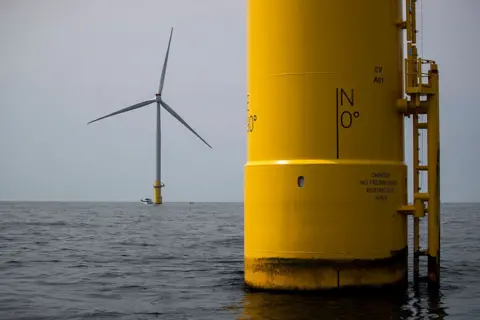
Getty Images Dominion Energy's wind towers in the sea off the coast of Virginia. Getty Images
Dominion Energy's offshore project in Virginia is among those paused under the Department of Interior's new order.

The US is immediately pausing leases for offshore wind energy projects currently being built near the Atlantic coastline, citing security concerns.

In a statement, the Department of the Interior said it was pausing five large-sale projects to look into how windmills could interfere with radar and create other risks to east coast cities.

President Donald Trump has long opposed wind energy, saying it is unreliable and drives up costs, and attempted to stop all projects when he returned to office. Interior Secretary Doug Burgum has said wind farms have no future in the US energy grid.

Renewable energy companies, as well as state leaders, have expressed alarm over the administration's stance.

In its statement, the Department of the Interior said the pause "addresses emerging national security risks, including the rapid evolution of the relevant adversary technologies, and the vulnerabilities created by large-scale offshore wind projects with proximity near our east coast population centres".

The five wind farms now on pause are being constructed off the coast of New York, Virginia, Massachusetts, Rhode Island, and Connecticut.

Specifically, the announcement noted that officials are concerned about radar interference "clutter" that can obscure real moving targets or, conversely, create false ones. It added that a radar's threshold for false-alarm detection could be increased to reduce some clutter, but only at the risk of missing actual targets.

The wind projects could make it difficult to "determine what's friend and foe in our airspace", Burgum said in an interview with Fox Business on Monday, where he cited drone strikes between Russia and Ukraine and between Iran and Israel as examples.

Dominion Energy, the company behind the Virginia wind farm, said its project is far offshore and "does not raise visual impact concerns."

"The project's two pilot turbines have been operating for five years without causing any impacts to national security," it said in a statement.

Connecticut Governor Ned Lamont, a Democrat, described the pause as an "erratic" move that "will drive up the price of electricity in Connecticut and throughout the region".

"This project is nearing completion and providing good-paying clean energy jobs," he added. "Businesses and residents deserve economic predictability, yet with the administration's constant starts and stops they're left with the opposite."

Earlier in December, a federal judge struck down an attempt by President Trump to ban new wind power projects in the US, calling it "arbitrary and capricious and contrary to law".

On the first day of his administration in January, Trump issued a memorandum halting permits and new leases until a federal review could be undertaken.

Five months later, 17 US states led by New York sued the administration, calling the ban an "existential" threat to the US wind industry.

New Trump envoy says he will serve to make Greenland part of US

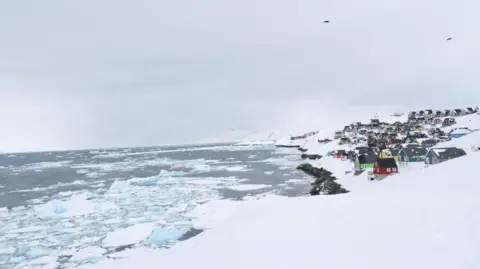
Reuters A view of the old city of Nuuk, Greenland, with coloured wooden houses surrounded by snow and iceReuters

Donald Trump has sparked a renewed disagreement with Denmark after appointing a special envoy to Greenland, the Arctic island he has said he would like to annex.

Trump announced on Sunday that Jeff Landry, the Republican governor of Louisiana, would become the US's special envoy to Greenland, a semi-autonomous part of the Kingdom of Denmark.

Writing on social media, the US president said Landry understood how "essential Greenland is to our national security" and would advance US interests.

Greenland's prime minister said the island must "decide our own future" and its "territorial integrity must be respected".

The move angered Copenhagen, which will call the US ambassador for "an explanation".

Governor Landry said in a post on X it was an honour to serve in a "volunteer position to make Greenland a part of the United States", saying the role would not affect his duties as Louisiana governor.

Denmark's foreign minister, Lars Lokke Rasmussen, described the appointment as "deeply upsetting" and warned Washington to respect Danish sovereignty.

He told Danish broadcaster TV2: "As long as we have a kingdom consisting of Denmark, the Faroe Islands and Greenland, we cannot accept actions that undermine our territorial integrity."

Greenland's Prime Minister, Jens-Frederik Nielsen, said the territory was willing to cooperate with the United States and other countries, but only on the basis of mutual respect.

He said: "The appointment of a special envoy does not change anything for us. We decide our own future. Greenland belongs to Greenlanders, and territorial integrity must be respected."

Since returning to the White House in January, Trump has revived his long-standing interest with Greenland, citing its strategic location and mineral wealth.

He has refused to rule out using force to secure control of the island, a stance that has shocked Denmark, a Nato ally that has traditionally enjoyed close relations with Washington.

Greenland, home to about 57,000 people, has had extensive self-government since 1979, though defence and foreign policy remain in Danish hands. While most Greenlanders favour eventual independence from Denmark, opinion polls show overwhelming opposition to becoming part of the US.

The dispute comes as strategic competition in the Arctic grows, with melting ice opening new shipping routes and increasing access to valuable mineral resources.

Greenland's location between North America and Europe also makes it central to US and Nato security planning and puts it on the shortest route for missiles between Russia and the United States.

Two identical Banksy murals appear in London

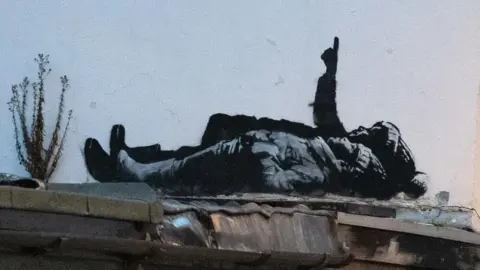
Banksy The black and white street art depicts two children lying on their backs and pointing upwards. The child nearest the camera is wearing a wooly hat with hands tucked into their jacket pockets. Behind them a larger person is pointing upwards in a bobbly hat (possibly a Santa type hat) also wearing boots.Banksy
Banksy's latest mural was first spotted on Queen's Mews, Bayswater, on Monday

Elusive street artist Banksy has confirmed he is behind a new mural that has appeared in Bayswater, west London.

The image depicts two children lying on the ground dressed in wellington boots, coats and winter bobble hats, one of them pointing upwards towards the sky.

It has been painted on to a wall above a row of garages on Queen's Mews and was first spotted on Monday.

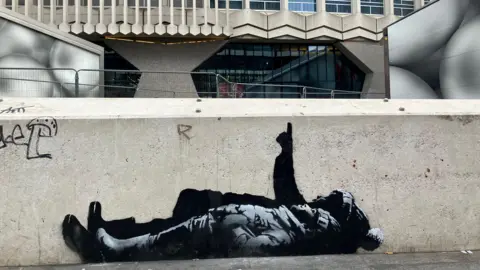
The BBC understands Banksy is also responsible for an identical mural that appeared outside the Centre Point tower in central London on Friday, although his representatives have only confirmed the Bayswater work as his.

The artist, whose identity is not publicly known, announced his new work by posting an image to his Instagram account on Monday afternoon.

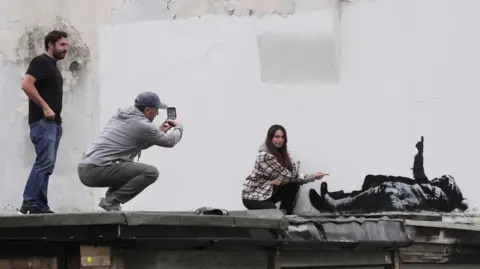
PA Media Two men and a woman on the roof of some garages. A woman in a chequered shirt with long brown hair is crouched down next to the mural and pointing towards it. 
PA Media
People have been posing for photographs next to the Bayswater artwork
The black and white street art depicts two children lying on their backs and pointing upwards. The child nearest the camera is wearing a wooly hat with hands tucked into their jacket pockets. Behind them a larger person is pointing upwards in a bobbly hat (possibly a Santa type hat) also wearing boots.
This mural outside the Centre Point building appears to be identical to the west London artwork

Speaking about the Centre Point mural, artist Daniel Lloyd-Morgan told the BBC he believed the location was chosen to make a point about child homelessness.

"Everybody is having a good time but there are a lot of children who are not having a good time at Christmas," he said.

Mr Lloyd-Morgan said that people walking past the artwork were "ignoring it", adding: "It's a busy area. Quite poignant that people aren't stopping. They walk past homeless people and they don't see them lying on the street.

"It's kind of like they're stargazing," he said. "It's quite fitting that the kids are pointing up like they're looking at the North Star."

Banksy enthusiast Jason Tomkins, said he also believed it was a "clear statement on homelessness".

The Centre Point tower, at 101-103 New Oxford Street, has been a historic focal point for housing protests.

Originally built as an office block in 1963, the Centre Point tower next to Tottenham Court Road underground station, remained unoccupied for over a decade, angering social justice campaigners.

The homelessness charity Centrepoint was named as a response to the building by founder Rev Ken Leech, who described the tower as "an affront to the homeless".

The block has since been converted into multimillion-pound luxury flats.

Banksy has not commented on the relevance of the location for either of the new works.

Banksy A lack and white mural of a small boy wearing a woolly hat, looking up with his mouth open, catching snowflakesBanksy
Banksy's "Season's greetings" appeared in Port Talbot in 2018

Mr Tomkins said he believed the artwork depicted the same character as one of Banksy's previous works.

"In 2018 he painted in Port Talbot, and the little boy is identical to child that has been painted here," he said.

"This is quite unusual for him to use the same little boy again, because he has never done that."

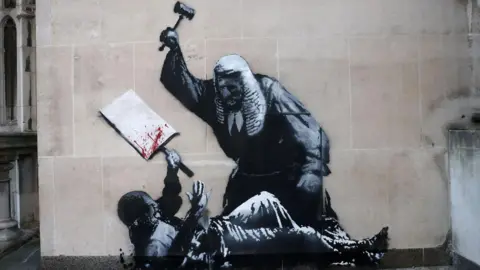
PA Media Mural of a judge attacking an apparent protestor lying on the ground holding a blood splattered placard, with a gavel.PA Media
Artwork appeared on a wall by the Royal Courts of Justice building in September showing a protester holding a blank blood-spattered sign

The Centre Point piece follows Banksy's September mural in London, which showed a protester lying on the ground holding a blood-spattered placard while a judge, in a wig and gown, loomed over him, wielding a gavel.

It was scrubbed off the Queen's Building, in the Royal Courts of Justice complex days after it appeared.

In 2024, the graffiti artist created an animal trail around the capital with pieces featuring a goat, elephants, a gorilla, monkeys, piranhas, a rhino and pelicans among other animals.

Listen to the best of BBC Radio London on Sounds and follow BBC London on Facebook, X and Instagram. Send your story ideas to hello.bbclondon@bbc.co.uk

British woman detained in Iran shares pain in poem

Listen to Lindsay Foreman's poem for her son, recorded in prison

A British woman jailed in Iran for almost a year has spoken of the pain of separation from her family in a poignant Christmas message written in her cell.

"At a time when we should be connected, we find ourselves alone, down, dejected," Lindsay Foreman wrote in a poem entitled A Sad Voice From Evin Prison - A Christmas Poem.

A recording of her reading the message to her son on the phone from a noisy prison corridor has been shared with the BBC. It is the first time her voice has been heard publicly since her arrest.

She spoke of a "family torn apart" and said that grief "has made a home from the hole in our heart".

Ms Foreman, 53, said she wrote the poem for her family "and for anyone who has lost someone and when Christmas may not be such a happy time".

She and her husband Craig were on the trip of a lifetime, by motorbike, from Spain to Australia when they were arrested by Iranian authorities in January and accused of espionage – charges the family say are "ludicrous".

They had visas for Iran, a tour guide and a pre-approved itinerary.

Ms Foreman had been asking people along the route what constitutes a good life, and those questions appear to form the basis of the regime's accusations against the couple.

They are currently being held separately in Iran's notorious Evin jail in Tehran, where Nazanin Zaghari-Ratcliffe was previously imprisoned.

Their family say the cells are overcrowded, unsanitary and vermin-infested, with inadequate washing facilities and hygiene supplies.

"They are in unimaginable conditions," Ms Foreman's son Joe Bennett told the BBC, describing rats running around as they cooked.

He said the couple were not receiving enough food and were losing weight.

Mr Bennett's stepfather, Craig Foreman, is said to be suffering constant dental pain but has not been allowed to see a dentist.

After going on hunger strike last month, the couple are now being allowed almost daily phone calls with their family.

But Mr Bennett says that, despite her attempts to put a brave face on for him, he has heard his mother crying and begging to get home.

Both his mother and step-father are being "slowly broken" and in "growing distress", he says.

He has called on the UK government to "come out and defend them" and say publicly that they are not spies.

A spokesperson for the Foreign Office said in response: "We are deeply concerned by reports that Craig and Lindsay Foreman have been charged with espionage in Iran.

"We continue to raise this case directly with the Iranian authorities."

Foreign Secretary Yvette Cooper is understood to have raised the case when she spoke to her Iranian counterpart, Abbas Araqchi, last Friday.

The UK government advises against all travel to Iran.

"Having a British passport or connections to the UK can be reason enough for the Iranian authorities to detain you," it warns.

Lindsay and Craig Foreman have appeared in court several times but have not been officially convicted or tried.

Ms Foreman wrote in her poem to her family: "We wish that we could be together. To hug and hold each other forever."

For Joe Bennett, it is hard to contemplate the next few days without them.

"It's horrendous," he said. "They were the life and soul of Christmas."

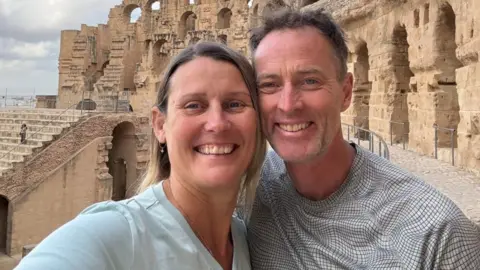
PA Media Lindsay and Craig Foreman take a selfie in front of an ancient ruinPA Media
Lindsay and Craig Foreman have been detained in Iran since January

Zendaya and Tom Holland in surprise curry house stop

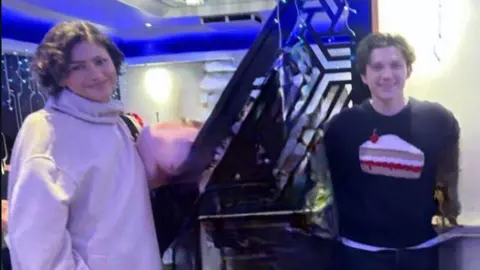
Everest Lounge Market Harborough Zendaya and Tom Holland in a restaurantEverest Lounge Market Harborough
Tom Holland and Zendaya visited Everest Lounge in Market Harborough

A restaurant owner said his staff were "absolutely starstruck" after a surprise visit by two Hollywood A-listers.

Pradip Karanjit said Tom Holland and Zendaya came in to dine with friends at his restaurant in St Mary's Road in Market Harborough on Saturday.

Mr Karanjit, who runs Everest Lounge, said they were happy to accommodate the couple even though the restaurant was fully booked.

He added the pair - who star in the most recent Spider-Man film - did not come across as "Hollywood royalty", but were just a "normal young couple" going to a restaurant for a meal.

He said Tom Holland tucked into a chicken tikka masala, pilau rice and a garlic naan, while Zendaya enjoyed a chana saag bengan, paneer shaslik starter with a side of saag aloo.

"We were fully booked for Saturday so we were exceptionally pleased that we were able to accommodate them for the evening and that's where everything started," Mr Karanjit said.

"My staff were absolutely starstruck and we were, in a way, in panic mode but throughout the service they remained really professional."

Mr Karanjit told the BBC he was not in the restaurant when the couple visited, but said his phone went "really hot" with calls asking about their visit - and he had to phone the restaurant to confirm the news.

"I missed the whole experience, but it was something for Harborough itself and our restaurant as well," he added.

Follow BBC Leicester on Facebook, on X, or on Instagram. Send your story ideas to eastmidsnews@bbc.co.uk or via WhatsApp on 0808 100 2210.

'I like being woke': Lush's outspoken co-founder who puts activism at heart of business

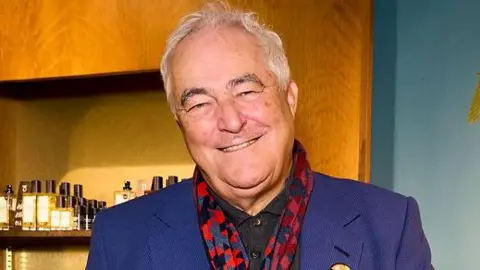
Lush Mark wearing a bright blue suit, patterned red-and-blue scarf. He is standing in a shop and behind him are wooden shelves displaying perfume bottles.Lush

Most companies and bosses would squirm at the idea of being called "woke" and may even regard it as an insult. But not Mark Constantine.

Lush's outspoken co-founder and chief executive wears it like a badge of honour and is not ashamed of turning it into a business philosophy.

The firm is renowned for putting activism at the heart of its bright bath bombs business, tackling a range of issues from trans rights to police accountability.

The 73-year-old is still steering the empire with the same principles that have defined its three decades on the High Street, which has seen it expand from a small Dorset store into a global brand with 869 outlets and an annual turnover of £690m.

Lush has taken some of the boldest stances in British retail including shutting down some of its social media accounts over concerns about the impact on young people, and more recently closing stores for a day to protest against starvation in Gaza.

"I like being woke," admits Constantine.

A self-confessed "over-achiever and a nerd" who loves learning, he is up before the crack of dawn for his main passion - writing about birdsong - in between his meditation and Alexander technique, a therapy for good posture and movement.

But his message is crystal clear to those who openly resent his values: "You shouldn't come in my shop."

It's a strong statement in an era when many businesses avoid political or cultural debates for fear of alienating customers and risking profits.

Ben & Jerry's has long worn its social activism on its sleeve, which has caused tension with its parent company.

Where Lush has remained an independent firm, Constantine believes selling out means sacrificing the business's values.

"If you've sold your business to someone else, I think you're asking a lot for them to do everything you want. What should Ben and Jerry have done? They should never have sold."

Ben & Jerry's co-founder Ben Cohen maintains they were opposed to selling but as a publicly-traded company, says US regulations forced their hand and the brand's social mission was written into the contract with the parent company.

"I have a huge appreciation for Lush, their values, and how they use their most powerful tool - their voice - to advocate for those values," Cohen told the BBC, following Constantine's Big Boss interview, adding, "I'm not 'asking' for anything."

Speaking to the BBC's Big Boss Interview podcast in the busy run-up to Christmas, Lush's Constantine says preparing for the festive period is "very like war".

"You have your troops, you have your supplies. Everything's organised and ready. And then it's just a question of when will the onslaught occur?"

He suggests that men may be more likely to be out buying last-minute presents, saying with a laugh the company sees a lot of men "who come in on Christmas Eve and tell us they're regulars".

But the key to attracting shoppers in the first place is by making retail "fun", says Constantine.

Lush has turned shopping into more of an experience with offerings such as spa treatments and parties for customers.

And it's experiences such as these that could help reverse the High Street's declining prospects, he believes.

While some business leaders have suggested that a rise in employers' National Insurance contributions and in the minimum wage could result in hiring freezes, Constantine views it differently.

"It's good news for everyone and it's good for the economy because you've got more money coming into the economy at the biggest point.

"The people who are getting these raises are at the bottom.

"I'm delighted to pay the extra money to get the staff up to a proper level, and I think we should celebrate that."

However Lush's pay record is not without blemish. In 2020, it admitted to underpaying its Australian workers more than $4m over nearly a decade. A company spokesperson told the BBC after the Big Boss interview: "We made mistakes, we found those mistakes and have paid the money we owed, and we are ensuring those errors cannot happen again."

In the same year Lush faced claims of poor working conditions at its Australian factory. The spokesperson added: "Since these concerns were raised we swiftly developed an action plan to address the areas of concern."

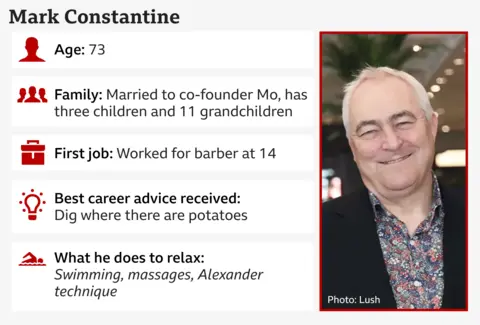
An infographic featuring personal and career details about an individual named Mark Constantine. The left side lists the following information:
Age: 73
Family: Married to co-founder Mo, has three children and 11 grandchildren 
First job: Worked for barber at 14
Best career advice received: “Dig where there are potatoes” 
What he does to relax: Swimming, massages, Alexander technique 
On the right side, there is a photo of Mark wearing a dark jacket over a patterned shirt. The background appears to be an indoor setting with plants and lights.

Lush is privately owned by all six co-founders – Constantine and his wife Mo, Rowena Bird, Helen Ambrosen, Liz Bennett and Paul Greeves – all of whom started the business in 1995 and have remained active since.

Two of Constantine's three children also work for the company, which is particularly pleasing for a man who believes family is at the heart of a successful business and is key to longevity.

"Family businesses give better returns on investment at every level," he says, claiming they last longer because they ride out the good times and the bad.

It's a lesson he learned from the late Dame Anita Roddick, founder of The Body Shop where it all began for Constantine in 1977 – manufacturing and supplying products to Roddick's stores.

However, he says the government does not understand "the strength of family businesses" after it announced that from April 2026 family business assets of more than £1m will face inheritance tax when passed on to relatives.

He believes this tax will force many owners to sell up, which is the "real worry on succession".

A spokesperson for the Treasury said the government was "pro-business", pointing out that it had capped corporation tax at 25% and was reforming business rates.

"Right now, 53% of Business Property Relief – worth £533m – goes to just 158 estates. Our reforms will channel that funding into vital public services," the spokesperson said.

Nevertheless, Constantine remains bullish about the future of bricks-and-mortar shopping.

But he thinks modern retailing would benefit from a return to the old-fashioned values that once defined British retail, in particular innovation and kindness.

"I like to serve. I like the Jeeves kind of feeling," he says with a grin.

Chris Rea: The car enthusiast whose love of driving inspired his songs

Getty Images Chris Rea pictured in 1979Getty Images
Chris Rea: "Most of the songs are different people's love stories inside cars"

The rock and blues singer, Chris Rea spent countless hours on the road, and his love of cars and driving was the inspiration behind many of his songs.

He recorded 25 solo albums, two of which topped the UK albums chart. His distinctive gravelly voice and slide guitar-playing are preserved in songs such as Road to Hell, Auberge, On the Beach and Driving Home for Christmas.

Christopher Anton Rea was born in Middlesbrough, North Yorkshire in 1951 to an Italian father and Irish mother and was one of seven children. The family was known locally for Camillo's Ice cream factory and cafes, owned by his father Camillo Rea.

Chris worked in the cafes as a teenager and took his driving test in one of his dad's ice cream vans. When he was asked to do an emergency stop, the examiner fell off the box he was sitting on and cut his leg.

Rea said: "I had to take him to the hospital but he still passed me."

He was still working for his father when he bought his first guitar, a 1961 Hofner V3 in his early 20s.

Rea said that at the time he was "meant to be developing my father's ice cream cafe into a global concern, but I spent all my time in the stockroom playing slide guitar".

Getty Images Chris ReaGetty Images
Chris Rea: "The road always becomes a metaphor for where we are going in life."

He played with local groups The Elastic Band, and Magdalene, but it was The Beautiful Losers which shone the spotlight on Rea, and he secured a solo recording deal with Magnet Records.

His first studio album was Whatever Happened to Benny Santini?, released in 1978.

The lead single, Fool (If You Think It's Over), was a big hit in the US, reaching number one on the (adult) contemporary singles Billboard chart, earning him a best new artist nomination at the Grammy Awards.

Michael Levey, co-founder of Magnet records, remembers him as "more of a thoughtful, introspective poet than a natural pop performer".

One of Rea's childhood dreams had been to write and compose music for films.

He achieved both with his movie La Passione in 1996. Rea also wrote the score and title track for the Soft Top Hard Shoulder film and starred in the comedy Parting Shots in 1999.

Getty Images Chris ReaGetty Images
"Music and cars fit together very well" Rea explained

Rea was building a reputation for his slide guitar playing when his record company insisted on releasing Driving Home for Christmas in 1986.

He said: "I didn't need a Christmas song hanging around at that point. I did everything I could to get them not to release that record. Thankfully they did!"

The song's inspiration dates back to a difficult year for him personally.

In 1978 Rea had come to the end of his record contract and had parted ways with his manager.

The record company wouldn't pay for a train ticket for him to get from London to his home to Middlesbrough so his wife drove down to pick him up in her old Austin Mini.

On the way back up, it started snowing and they kept getting stuck in traffic and Rea said: "I'd look across at the other drivers, who all looked so miserable.

"Jokingly, I started singing - We're driving home for Christmas... then, whenever the street lights shone inside the car, I started writing down the lyrics."

Getty Images Chris Rea playing his guitarGetty Images
Rea began learning to play guitar at the age of 21

"It's one of those moments that songwriters get - sometimes you can spend years and years writing. That one was five to 10 minutes. When you have a successful song, you don't remember thinking about it - it just comes out."

He didn't sing the song live until December 2014 after his crew badgered him to do it. He hired 12 snow cannons and let them off during the song.

"We put three feet of artificial snow in the stalls. The venue charged me £12,000 to clean it up!"

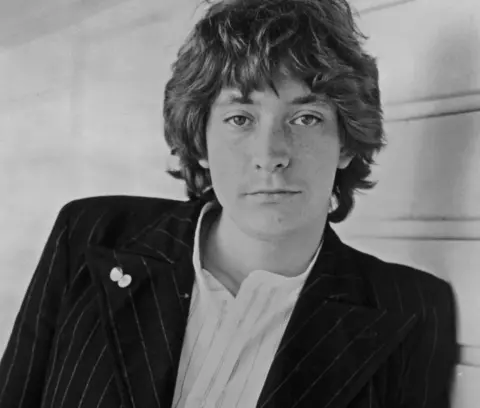
Getty Images Chris Rea in a black and white phote in a white shirt and black jacketGetty Images
Rea released his first solo album in 1978

Bad traffic on the intersection between the M4 and the M25 was also the inspiration for Road to Hell.

Rea's musical journey was brought to a temporary stop when he was diagnosed with pancreatic cancer aged 33.

He had a procedure which resulted in the removal of part of his pancreas, the duodenum, the gall bladder and part of his liver. He was also a type 1 diabetic and had problems with his kidney.

His health problems made him reassess his career - he never toured America despite his popularity.

"I was never a rock star or pop star and all the illness has been my chance to do what I'd always wanted to do with music," he said.
In 1997, that included recording Let's Dance with his good friend Bob Mortimer for Middlesbrough Football Cub's FA Cup Final.
In one of Mortimer's appearances on the BBC's comedy series Would I Lie to You, Mortimer claimed that Rea cracked an egg into a bath for him after they'd finished recording it at his studio. The clip about whether that was a truth or lie went viral.

Rea was happy to admit that he was a vehicle addict with a huge love of cars, and travelling in them helped inspire some of his music.

He owned and raced various vintage cars including a 1957 Morris Minor 1000 police car.

He was friends with Eddie Jordan, owner of the Jordan Formula 1 team, and once helped out in the pit lane.

"I had the whole uniform. He put me in charge of the tyre-warmer for the rear right tyre of Eddie Irvine's car".

Getty Images Chris ReaGetty Images
Rea on his European tour of Road Songs For Lovers in 2017

In 2016 he suffered a stroke, but still recovered enough to record and tour his 24th album: Road Songs for Lovers.

Rea said he spent an awful lot of time on the road travelling to London.

"I see couples in cars - are they married, workmates, having an affair?" he mused.

The musician liked to write about the simple things in life: "You get ideas for songs and you're actually on a road - the road always becomes a metaphor for where we're going in life," he once said.

From Netflix hit to GCSEs - Adolescence star reflects on remarkable year

PA Media Owen Cooper smiles during Graham Norton interview. He has a mop of dark curly hair and wears a dark shirt. The backdrop is an orange wall decorated with purple lozenge shapes. It is a head shot of him. PA Media
Owen Cooper says "it has been a good year" after winning praise for his performance in Adolescence

Adolescence star Owen Cooper has said he was "nervous" about what the reaction to the drama would be after reading the script for the Netflix serial, which sparked a national discussion on online safety and misogyny.

In September, the Warrington-born teenager became the youngest male actor to win an Emmy award for his portrayal of a schoolboy accused of murdering a classmate.

Speaking on BBC's Graham Norton Show, the 16-year-old said: "Straight away I thought it was going to be more than a TV show - I read the script and then heard the word 'Netflix'.

"I was nervous about what the reaction to it would be, but a week after it went out everything blew up."

The four-part serial was created by writer Jack Thorne and Merseyside-born actor Stephen Graham, who said they came up with the storyline after two real-life cases that happened within a year.

The series analyses incel culture and how it has promoted misogyny online and bullying on social media.

Shortly after its debut in March, the prime minister hosted a Downing Street meeting with the programme-makers, telling them it was "a torch that shines intensely brightly on a combination of issues that many people don't know how to respond to".

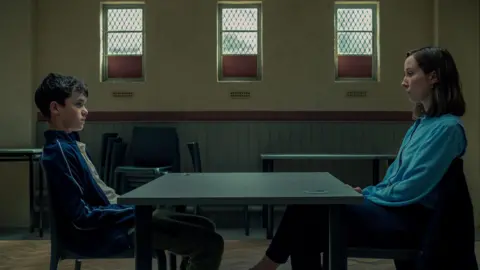
Ben Blackall/Netflix Still of Owen Cooper as Jamie Miller and Erin Doherty as Briony Ariston in the Adolescence drama. They sit opposite each other with a table in between in a school room with chairs and tables stacked against a wall with three windows.Ben Blackall/Netflix
The episodes were filmed in one shot, including the third episode showing the conversations between Cooper's character and a counsellor

Cooper was selected for the pivotal role after years spent at weekly drama classes in Manchester, where teachers said their "eyes were just drawn to him".

Speaking about the Emmy ceremony, where the cast and crew memorably celebrated their eight awards, he said: "It was crazy and all a bit of a blur. The amount of people I met there was insane.

"It really was the best day of my life."

He added "it has been a good year" and returning to school after the round of Adolescence promotions and award ceremonies "wasn't too bad".

"The first day back was a bit weird, but I've still got my GCSEs to do.

"I've only got about six months left and then I am gone - and then hopefully I am going to be an actor," he joked.

EPA Owen Cooper, who wears a black tie over a white and a black jacket, poses with the Emmy award, which shows a golden figure holding aloft a massive globe shape. His dad, who wears a black bow tie and suit, is on the left and mum, in a red evening gown, is on the right. They pose in front of the Emmy Awards backdrop at a photocall.EPA
Owen Cooper, pictured with his parents, was 15 when he won an Emmy award in September

Cooper broke Scott Jacoby's long-held record for the youngest male Emmy winner. Jacoby was 16 when he won best actor for That Certain Summer in 1973.

The youngest Emmy winner remains Roxana Zal, who was 14 when she won a supporting actress award for Something About Amelia in 1984.

Cooper has also been nominated as best supporting male actor for a television Golden Globe, alongside his co-star Ashley Walters.

He also appears with White Lotus star Aimee Lou Wood in BBC drama Film Club, which was filmed in Cheshire and Greater Manchester, and is also due to appear on the big screen as a young Heathcliff in Emerald Fennell's Wuthering Heights adaptation, with Australian stars Margot Robbie and Jacob Elordi.

The full interview will air on The Graham Norton Show on New Year's Eve at 22:30 GMT on BBC One and BBC iPlayer.

Read more stories from Cheshire on the BBC, watch BBC North West Tonight on BBC iPlayer and follow BBC North West on X. You can also send story ideas via Whatsapp to 0808 100 2230.

Trump sparks fresh row with Denmark over Greenland envoy appointment

Reuters A view of the old city of Nuuk, Greenland, with coloured wooden houses surrounded by snow and iceReuters

Donald Trump has sparked a renewed disagreement with Denmark after appointing a special envoy to Greenland, the Arctic island he has said he would like to annex.

Trump announced on Sunday that Jeff Landry, the Republican governor of Louisiana, would become the US's special envoy to Greenland, a semi-autonomous part of the Kingdom of Denmark.

Writing on social media, the US president said Landry understood how "essential Greenland is to our national security" and would advance US interests.

Greenland's prime minister said the island must "decide our own future" and its "territorial integrity must be respected".

The move angered Copenhagen, which will call the US ambassador for "an explanation".

Governor Landry said in a post on X it was an honour to serve in a "volunteer position to make Greenland a part of the United States", saying the role would not affect his duties as Louisiana governor.

Denmark's foreign minister, Lars Lokke Rasmussen, described the appointment as "deeply upsetting" and warned Washington to respect Danish sovereignty.

He told Danish broadcaster TV2: "As long as we have a kingdom consisting of Denmark, the Faroe Islands and Greenland, we cannot accept actions that undermine our territorial integrity."

Greenland's Prime Minister, Jens-Frederik Nielsen, said the territory was willing to cooperate with the United States and other countries, but only on the basis of mutual respect.

He said: "The appointment of a special envoy does not change anything for us. We decide our own future. Greenland belongs to Greenlanders, and territorial integrity must be respected."

Since returning to the White House in January, Trump has revived his long-standing interest with Greenland, citing its strategic location and mineral wealth.

He has refused to rule out using force to secure control of the island, a stance that has shocked Denmark, a Nato ally that has traditionally enjoyed close relations with Washington.

Greenland, home to about 57,000 people, has had extensive self-government since 1979, though defence and foreign policy remain in Danish hands. While most Greenlanders favour eventual independence from Denmark, opinion polls show overwhelming opposition to becoming part of the US.

The dispute comes as strategic competition in the Arctic grows, with melting ice opening new shipping routes and increasing access to valuable mineral resources.

Greenland's location between North America and Europe also makes it central to US and Nato security planning and puts it on the shortest route for missiles between Russia and the United States.

Canal boats swallowed by giant hole as major incident declared

Shropshire Fire and Rescue Service Two canal barges at the scene of a sinkhole.Shropshire Fire and Rescue Service
Shropshire Fire and Rescue Service said it was responding to a landslip affecting a canal

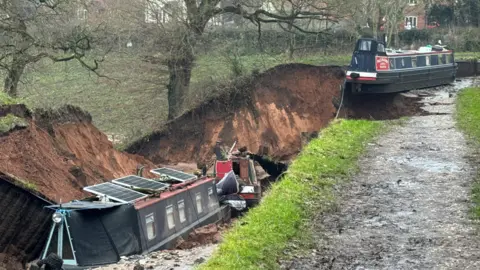
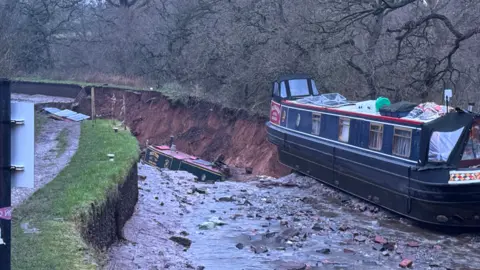
A major incident has been declared over what police have called a sinkhole at a canal in Shropshire, leaving boats either stricken in a gaping cavity or teetering on the edge of a steep drop.

Pictures appear to show that the structural integrity of a stretch of waterway in the Chemistry area of Whitchurch has completely given way.

Two narrowboats are said to have sunk into the hole, into which water looks to have drained completely.

Shropshire Fire and Rescue Service said it was responding to a landslip and confirmed a canal was affected. There are no reports of casualties, and people nearby are being supported by fire crews, according to West Mercia Police.

The force asked people to avoid the area and seek alternate routes.

Shropshire Fire and Rescue Service Two barges at the scene of a canal sinkhole. Trees are on one side of the canal.Shropshire Fire and Rescue Service
There were no reports of any casualties, West Mercia Police said
Andy Hall Barges at the scene of a sinkhole at a canal. Trees are on both sides of the canal.Andy Hall
Police have asked people to avoid the area

Follow BBC Shropshire on BBC Sounds, Facebook, X and Instagram.

Stone Roses star Mani's coffin carried by Liam Gallagher as hundreds attend funeral

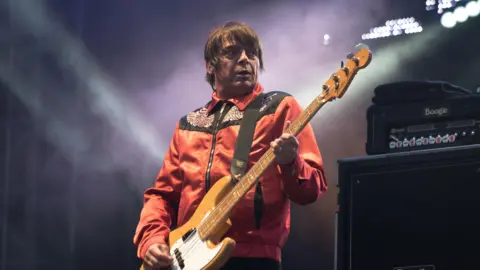
Getty Images Mani playing bass on stage, wearing a red jacketGetty Images

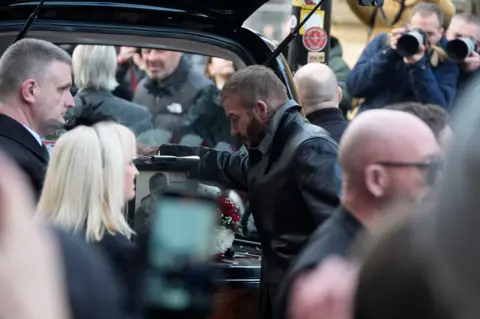
Family, friends and fans of Gary "Mani" Mounfield have turned out in force in Manchester to bid farewell to the much-loved bass player of The Stone Roses and Primal Scream.

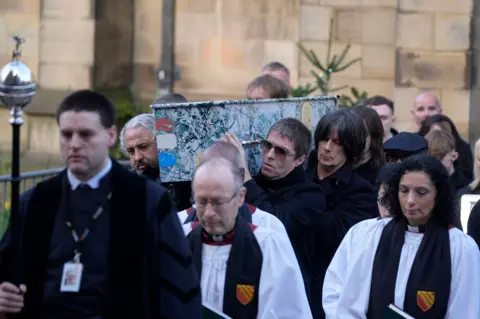
Some of the biggest names of British 80s and 90s music, including his former bandmates Ian Brown and Bobby Gillespie, as well as Oasis frontman Liam Gallagher, were all in attendance for the service at Manchester Cathedral.

Former Manchester United footballers Sir David Beckham and Gary Neville also attended.

Fans lined the streets as the funeral cortege went from the star's home in Heaton Moor in Stockport to Manchester city centre.

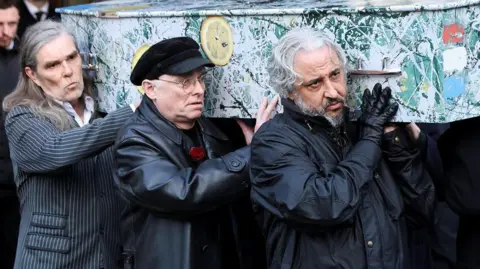
PA Mani's former Stone Roses and Primal Scream bandmates, along with Oasis star Liam Gallagher, carrying his coffin out of the cathedral. The coffin was painted like the cover of the Stone Roses first album.PA
Mani's former Stone Roses and Primal Scream bandmates, along with Oasis star Liam Gallagher, carried his coffin out of the cathedral
Reuters Another picture of Mani's former Stone Roses and Primal Scream bandmates carrying his coffin out of the cathedral.Reuters

'Beautiful soul and spirit'

The Stone Roses singer Brown led the tributes with a eulogy, saying his bandmate was like "a brother to me" and a "beautiful human being".

Pausing briefly as he went into church, Brown said he was there to celebrate "what a beautiful human being that he was".

Asked what Mounfield meant to him, the singer said: "Everything. He's a brother to me, a musical comrade... a beautiful soul and spirit."

He added that the bass player "was able to laugh his way through any darkness" and was "the life and soul of any room he was in".

Brown, whose speech was played to the gathered masses outside - many of whom wearing bucket hats and Stone Roses T-shirts - was applauded after suggesting he should start a campaign for a lasting statue for his old bandmate.

"A fifty foot gold statue of Mani in the city," he said.

'R kid'

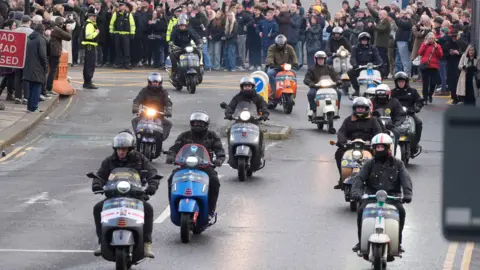
Hundreds of fans gathered outside the cathedral and applauded as the cortege arrived, preceded by a guard of scooter riders as The Stone Roses track I Wanna Be Adored played on speakers.

Mounfield's coffin - decorated with the classic paint splashed artwork from The Stone Roses first album - was carried into the cathedral as family and friends followed, with more applause from the crowd.

A Manchester United scarf also adorned his coffin, which was next to a wreath bearing the affectionate Mancunian term: "R kid".

PA A wreath of flowers reading "R Kid" inside the hearsePA
PA David Beckham, seen touching Mani's coffin, bids farewell to one of his musical heroesPA
PA Fans on scooters lead the cortege following the funeral service of former Stone Roses and Primal Scream bass player Gary Mounfield, who was known as Mani, at Manchester Cathedral, following his death at the age of 63.PA

Mounfield's bass playing was an integral part of The Stone Roses' "baggy" sound - as heard on tracks like Fools Gold.

He joined another seminal group, Primal Scream, in 1996 and played with them for 15 years, before rejoining his old band for a series of reunion gigs.

Primal Scream frontman Gillespie followed Brown in giving his eulogy.

He recalled having first met Mani at the legendary Hacienda nightclub in Manchester.

"He made me feel a million dollars. His enthusiasm and positivity was contagious."

Other Manchester musicians at the service included Paul "Bonehead" Arthurs from Oasis, Mike Joyce from The Smiths and Peter Hook of New Order, who played in a band called Freebass with Mani and the late Andy Rourke.

Bez from the Happy Mondays was also in attendance at the funeral, which was a veritable Who's Who of legendary music figures from the city.

Speaking to BBC Radio Manchester, music journalist John Robb described Mani as being "very much the heart and soul of Manchester".

"He was something that's very typically Mancunian, very typically northern as well, you know, beyond the borders of Manchester," he said.

"The overarching trend is how many people say what a brilliant bloke he was to bump into."

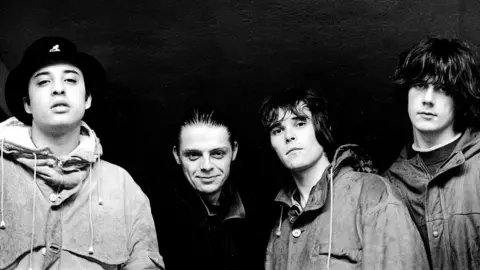
Getty Images (Left to right) Alan "Reni" Wren, Gary "Mani" Mounfield, Ian Brown and John Squire of the Stone Roses pictured in black and white, in 1992Getty Images
'Mani' (second left) with the rext of The Stone Roses in 1992

With Mani on bass, Brown on vocals, John Squire on guitar and Alan "Reni" Wren on drums, The Stone Roses were at the forefront of the "Madchester" indie scene of the late 1980s and early 90s, which peaked with a famous gig at Spike Island in Widnes.

They released their beloved eponymous debut album in 1989.

The LP featured such classic songs as I Wanna Be Adored, She Bangs The Drums and I Am The Resurrection, all underpinned by the grooves of Mani's basslines.

It was named the greatest British album of all time by the Observer in 2004 and by the NME two years later.

Its harder-rocking follow-up Second Coming came out in 1994. Both albums reached the top five in the UK.

After the group disbanded in 1996, Mani joined Scottish rock band Primal Scream, first playing on their album Vanishing Point, released a year later, where his bass playing was a key part of krautrock-influenced lead single Kowalski.

Mounfield would go on to record four more albums with Primal Scream before leaving in 2011 to reform The Stone Roses.

The band released two further singles in 2016, but no full-length album followed and the group disbanded once more in 2017 after some old tensions resurfaced.

The Stone Roses played a number of UK gigs over 2016 and 2017 before their split, including a concert at Glasgow's Hampden Park, which would end up being the classic line-up's final concert.

Brown told the crowd: "Don't be sad that it's over, be happy that it happened."

'Beautiful person'

Mounfield died peacefully in his sleep of "respiratory issues" linked to the long-standing lung condition, emphysema, coroners confirmed to the Manchester Evening News.

His wife Imelda died in November 2023, three years after she was diagnosed with bowel cancer. The couple have twin boys, who were born in 2013.

Only last month, the bassist attended the funeral of another Manchester icon, Ricky Hatton, at the same cathedral.

His death came after he announced an in-conversation tour of UK venues, which would have seen him recount his experiences and memories in The Stone Roses and Primal Scream from September next year.

Squire last week shared a new piece of artwork in honour of his friend; while another band associated with the city, Doves, paid their own tribute during a weekend gig at Manchester Apollo, calling Mani a "beautiful person".

Drivers could be paying more for petrol and diesel than they should be, watchdog warns

Getty Images A person filling up their car at a petrol station.Getty Images
The CMA said competition between fuel retailers was poor

Petrol and diesel profit margins remain at "persistently high levels" despite prices at the pump having fallen, according to the UK's competition watchdog.

The Competition and Markets Authority (CMA) also challenged retailers' claims that this was a result of higher operating costs.

In its first annual road fuel monitoring report, the CMA said competition in the sector was "weak".

It said if there was more competition, drivers would see better fuel prices at the pump.

Petrol was 136.8p per litre last week, according to government tracking, while diesel was 146.1p per litre.

The CMA report was published as the government prepares to launch its "fuel finder" scheme, which will allow drivers to compare real-time fuel prices.

Retailers will have to sign up to the scheme and report price changes within 30 minutes of them being implemented.

Dan Turnbull, senior director of markets at the CMA, said: "Fuel margins remain at persistently high levels – and our new analysis shows operating costs do not explain this.

"We know fuel costs are a big issue for drivers, especially at this time of year with millions making journeys across the country."

Gold price climbs to new record high

Getty Images A solid gold bar is held in white-gloved hands above a stack of other gold barsGetty Images

The gold price has hit another record high, trading above $4,400 an ounce for the first time.

The price of the precious metal has risen on expectations the US central bank will cut interest rates further next year, analysts said.

Gold started the year worth $2,600 an ounce, but geopolitical tensions, the Trump tariffs and expectations of rate cuts have added to investor demand for safe haven assets, such as gold and other commodities.

The prices of other precious metals, such as silver and platinum, have also risen.

The spot price of gold hit a high of $4,420 on Monday before slipping back.

The gold price has risen more than 68% this year, the highest increase since 1979, according to Adrian Ash, director of research at gold bullion marketplace BullionVault.

2025 has seen "slow-burning trends around interest rates, around war and trade tensions", Mr Ash said, which have helped to push up the price of gold.

"The precious metals market says that President Trump has really triggered something – and gold has gone crazy this year.

"You've got the trade war, the attacks on the US Federal Reserve and you've got geopolitical tensions, all of those provocations come from Trump," he said.

Lower interest rate expectations typically mean lower returns for investments such as bonds, so investors look to commodities such as gold and silver to get a return, but also diversify their portfolios.

A weaker US dollar has also helped push gold prices higher by making the metal cheaper for overseas buyers,

Other precious metals have also had record years. The price of silver also hit a record of $69.44 an ounce on Monday.

For 2025 so far, silver is up 138% year-to-date and platinum is at a 17-year high, vastly outperforming gold, underpinned by strong and supply constraints, according to analysts.

Unlike gold, the other precious metals are also used widely in industrial manufacturing which helps stoke demand.

'Year of octopus' declared after warmer seas leads to record numbers in UK

Watch: Octopuses filmed by divers off the coast of Cornwall this year

A wildlife charity has declared 2025 "the Year of the Blooming Octopus" after record numbers were spotted off the south-west coast of England.

In its annual marine review the Wildlife Trusts says octopus numbers were this summer at their highest level since 1950.

Warmer winters, which are linked to climate change, are thought to be responsible for the population spike, which is known as a "bloom".

The charity's findings are backed up by official figures which show that more than 1,200 tonnes of octopus was caught by fishermen in UK waters in the summer of 2025.

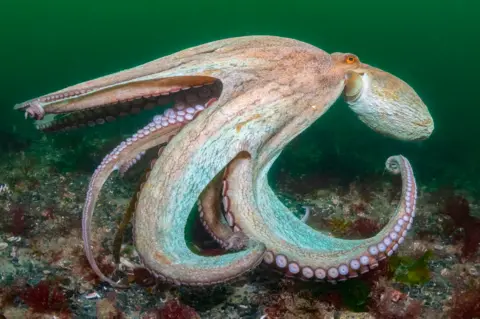
The Wildlife Trusts/Kirsty Andrews An octopus propels itself through the deep green sea. The Wildlife Trusts/Kirsty Andrews
The Wildlife Trusts says the highest number of octopuses has been seen off the south coast of Devon and Cornwall since 1950.

It's a dramatic increase on previous years. Only once since 2021 has more than 200 tonnes of octopus been landed.

Experts say most of those spotted are Octopus vulgaris a species commonly seen in the warmer Mediterranean Sea. Wildlife Trusts volunteers in Cornwall and Devon reported an increase in sightings of more than 1,500 percent on 2023 figures along one stretch of the south coast.

"It really has been exceptional," says Matt Slater from the Cornwall Wildlife Trust. "We've seen octopuses jet-propelling themselves along. We've seen octopuses camouflaging themselves, they look just like seaweeds.

"We've seen them cleaning themselves. And we've even seen them walking, using two legs just to nonchalantly cruise away from the diver underwater."

It's unclear at this point whether the rise in numbers is permanent or cyclical, which would mean octopus numbers returning to more typical levels after this year's bloom.

The eight-armed cephalopods eat shellfish such as lobster, crabs and scallops so the Wildlife Trusts warn that if population numbers remain high, both fishing and eating habits may have to change.

"They are having an impact on those (shellfish) species around our shores. And as a consequence, they will be having an impact on our fishing industry who target those species as well," Ruth Williams the head of marine for The Wildlife Trusts told the BBC's Today programmme.

"But there are opportunities and our fishing industry are doing some research into that at the moment to try and evolve with the changing fisheries that we're seeing as a result of climate change."

Government data shows crab landings down on previous years but catches of lobster, crawfish and scallops stable.

Wildlife Trusts of South and West Wales/Lynne Newton A puffin sits on a rock. Wildlife Trusts of South and West Wales/Lynne Newton
A record number of puffins were recorded on Skomer Island in Pembrokeshire this year.

Alongside good news for octopus lovers, the Wildlife Trusts' marine review contains more sobering news.

The Trusts say this year was bookended by environmental disasters, with a collision between an oil tanker and a container ship in the North Sea in March spilling huge quantities of plastic resin pellets, and nearly 4.5 tonnes of bio-beads released from a water treatment plant in Sussex in November.

There was some better news for wildlife elsewhere, with a record 46,000 puffins recorded on Skomer, Pembrokeshire, while the charismatic black and white bird has made a comeback on the Isle of Muck following conservation efforts by Ulster Wildlife Trust to remove invasive brown rats.

Jimmy Kimmel to say 'fascism has had a great year' in Channel 4 Christmas message

Channel 4 Jimmy Kimmel sitting in front of a Christmas tree as he delivers Channel 4's alternative Christmas messageChannel 4
Channel 4 said Kimmel would deliver a "deeply personal and characteristically jovial address"

US chat show host Jimmy Kimmel will say 2025 has been "a really great year for fascism", when he delivers this year's Alternative Christmas Message on Channel 4.

The presenter's ABC talk show was briefly taken off air in September after comments he made about the shooting of Charlie Kirk.

The host's suspension led to a debate in the US about freedom of speech and freedom of the press. Kimmel was reinstated a week after his removal.

The full quote from his address will say: "From a fascism perspective, this has been a really great year."

In a statement, Channel 4 said his address "comes at the end of a year when US politics has featured heavily in news and current affairs programming".

The presenter has been one of President Trump's most high-profile and vocal critics for the last decade.

The British network said Kimmel will "reflect on the past few months in a deeply personal and characteristically jovial address", following his "return to air and his much-publicised criticism of the US administration".

Channel 4 has broadcast an "alternative" holiday address to the monarch's message, which airs on BBC One and ITV, since 1993.

Stars to have previously delivered the alternative message include Sir Stephen Fry, Danny Dyer, Katie Piper, Sharon Osbourne and Jamie Oliver.

But it has also often been fronted by political personalities or figures who have been in the news, such as the President of Iran, Mahmoud Ahmadinejad; whistle-blower Edward Snowden; and Afghan war veteran Major Andrew Stockton.

Channel 4 has not released any further quotes from Kimmel's address other than his line about fascism, but he is expected to strike a similar tone as he did last week when presenting the last episode of his talk show for the year.

He told viewers: "This has been a strange year. It's been a hard year. We've had some lows, we've had some highs. For me, maybe more than any year in my life."

"But on behalf of all of us at the show, I just want to say that we appreciate your support, your enthusiasm.

"And not just for watching. This year you literally pulled us out of a hole, and we cannot thank you enough, personally, professionally."

The comic's abrupt suspension came after threats by the federal TV regulator, the Federal Communications Commission (FCC) to revoke ABC's broadcast licence. The body is chaired by President Trump appointee, Brendan Carr.

The US President had welcomed Kimmel's suspension and suggested that some TV networks should have their licences "taken away".

President Trump and his supporters praised the decision to take Kimmel's show off air, which came after pressure on ABC and its owner Disney from the White House and the president's supporters.

Jimmy Kimmel's Alternative Christmas Message will air on Channel 4 at 17:45 GMT on Christmas Day, two hours after the King's Christmas Message on ITV and BBC One.

'We've spent so much money already' - England fans head Down Under, but Ashes already over

'Everyone's giving me grief about Ashes being over before I get there'

A video call with all four Ryding siblings from Penwortham, Lancashire
  • Published

Sunshine, meat pies and world-famous cricket grounds - what more could an England cricket fan possibly want?

Well, perhaps an Ashes series in Australia where they still have a chance to reclaim the urn after the first three Tests.

That will not be happening this time, though, after Australia's crushing 82-run win in Adelaide put the hosts 3-0 up for the fourth successive Ashes series on home turf.

The Barmy Army, England's supporters' group, have 3,000 fans flying out for the final two Tests in Sydney and Melbourne.

There are also other tour groups who will spend the Christmas period down under, as well as families and friends heading for a once-in-a-lifetime trip.

The Ryding siblings are four such fans.

Alex, Sam, Rory and Katie had their flights and tickets booked for the fourth and fifth Tests "12 months ago", hoping to witness a rare England series success.

Instead, they have watched Australia dismantle the tourists in just 11 days from their family home in Penwortham, Lancashire.

"Everyone at work has been giving me grief about it being over for the last two weeks," said Sam.

"The hope was always that we would have something to play for still when we got there."

Get in touch

Share your Ashes story

There was plenty of positivity about England's chances of ending their 15-year wait for a series win in Australia before it began.

But they are now staring down the barrel of extending their winless run in the country to 19 matches when the fourth Test gets under way in Melbourne on Thursday, 25 December (23:30 GMT).

Ben Stokes' side - and their supporters - will be desperate to avoid a dreaded 5-0 scoreline.

Alex said the "excitement and fun" of head coach Brendon McCullum's 'Bazball' in recent years had "reinvigorated" Test cricket for England fans.

But the Ryding siblings said they had low expectations for the fourth and fifth Tests - and all they are asking for from the players is "a bit of fight".

"Every pundit alludes to it, but it all comes down to mental resilience. 'Bazball' has been elevated to a term now that is just, like, nonsense cricket," added Rory.

"In a five-day Test match, you should hunker down. Wafting outside 'sixth stump' areas has never been in the textbooks, and that is mainly the fault of the top order."

Asked whether he believed England will win a match in this Ashes series, Sam said: "It looks like the Aussies are just too good at the moment.

"There is going to have to be more than one player that stands up for England and makes a big impact."

Despite the scoreline, the siblings are still looking forward to the trip.

"We are going to have a great time anyway," said Katie. "We have to go with that attitude.

"Obviously it is disappointing we aren't fighting for more, but we have spent so much money already.

"We will make the most of having Christmas and New Year out there. It is also mine and Rory's first time away from home at this time of year."

A schoolteacher, Katie is determined to make the most of the 21,000-mile round-trip as part of her Christmas holidays.

"If all else fails, I've got golf to fall back on," she added.

More on this story

Canal boats swallowed by suspected sinkhole as major incident declared

Shropshire Fire and Rescue Service Two canal barges at the scene of a sinkhole.Shropshire Fire and Rescue Service
Shropshire Fire and Rescue Service said it was responding to a landslip affecting a canal

A major incident has been declared over what police have called a sinkhole at a canal in Shropshire, leaving boats either stricken in a gaping cavity or teetering on the edge of a steep drop.

Pictures appear to show that the structural integrity of a stretch of waterway in the Chemistry area of Whitchurch has completely given way.

Two narrowboats are said to have sunk into the hole, into which water looks to have drained completely.

Shropshire Fire and Rescue Service said it was responding to a landslip and confirmed a canal was affected. There are no reports of casualties, and people nearby are being supported by fire crews, according to West Mercia Police.

The force asked people to avoid the area and seek alternate routes.

Shropshire Fire and Rescue Service Two barges at the scene of a canal sinkhole. Trees are on one side of the canal.Shropshire Fire and Rescue Service
There were no reports of any casualties, West Mercia Police said
Andy Hall Barges at the scene of a sinkhole at a canal. Trees are on both sides of the canal.Andy Hall
Police have asked people to avoid the area

Follow BBC Shropshire on BBC Sounds, Facebook, X and Instagram.

US lawmakers threaten legal action against Pam Bondi over unreleased Epstein material

Watch: Images, cassettes and high-profile figures - What's in the latest Epstein files?

A pair of US lawmakers have threatened legal action against US Attorney General Pam Bondi, after her deadline to release all government files related to the late convicted sex offender Jeffrey Epstein was met only in part.

The release of the Department of Justice (DoJ) documents was highly anticipated but in the end, only a portion of the available material was made public.

A leading campaigner on the issue, Republican congressman Thomas Massie, said he could try to bring contempt proceedings against the attorney general as a result.

The DoJ insists it is complying with its legal obligations, and Bondi herself has said she is part of "the most transparent administration in American history".

The phrase "Epstein files" refer to the trove of information that was amassed by the US justice department during its two criminal investigations into Epstein.

A law that compelled the release of the full trove was signed by US President Donald Trump in November, after pressure from his supporters and members of his own Republican Party. Friday was the deadline for the release of the material.

Although some material was released, there were many redactions and other information was withheld - which angered Massie and his allies, as well as survivors of Epstein's abuse. Trump himself is yet to comment.

The DoJ has said that more material will follow in the coming weeks.

But speaking to CBS programme Face the Nation on Sunday, Massie suggested that the justice department was "flouting the spirit and the letter of the law".

He went on to say: "The quickest way, and I think most expeditious way, to get justice for these victims is to bring inherent contempt against Pam Bondi, and that doesn't require going through the courts."

Inherent contempt is a little-used legal recourse that can be used by either the Senate or House - the upper and lower chambers of Congress respectively - which has not been invoked for nearly a century, according to the American Bar Association.

Massie added that "Ro Khanna and I are talking about and drafting that right now", referring to a Democratic congressman who has also been prominent in the campaign for the release of the full Epstein files.

Speaking to the same programme, Khanna gave further detail on how the contempt proceedings could work. "We're building a bipartisan coalition, and it would fine Pam Bondi for every day that she's not releasing these documents," he said.

Unlike an impeachment effort - another option that would be theoretically available to critics of Bondi - the contempt move would only require support from the House of Representatives, Massie pointed out.

Bondi's deputy Todd Blanche was defiant during an interview with another broadcaster on Sunday.

Asked by the Meet the Press programme on NBC News whether he took threats from Congress members seriously, the deputy attorney general said: "Not even a little bit. Bring it on. We are doing everything we're supposed to be doing to comply with the statute."

Blanche pointed to the magnitude of the task. "You're talking about a million or so pages of documents," he said. "Virtually all of them contain victim information."

He continued: "And if by complying with the statute we don't produce everything on Friday, we produce things next week and the week after, that's still compliance with the statute."

Speaking to the same programme, another member of Khanna's party, Democratic Senator Tim Kaine, said contempt or impeachment efforts would be "premature".

"We have tools in appropriations bills and other tools to force compliance if somebody is dragging their feet and I'd rather focus on those tools," Kaine said.

Blanche said elsewhere on Sunday that certain Epstein-related files that were originally released on Friday were later removed by the DoJ from its website because of concerns raised by victims.

One of those files - an image featuring Trump - was later reinstated after review, said Blanche.

Petrol and diesel profit margins still persistently high, says watchdog

Getty Images A person filling up their car at a petrol station.Getty Images
The CMA said competition between fuel retailers was poor

Petrol and diesel profit margins remain at "persistently high levels" despite prices at the pump having fallen, according to the UK's competition watchdog.

The Competition and Markets Authority (CMA) also challenged retailers' claims that this was a result of higher operating costs.

In its first annual road fuel monitoring report, the CMA said competition in the sector was "weak".

It said if there was more competition, drivers would see better fuel prices at the pump.

Petrol was 136.8p per litre last week, according to government tracking, while diesel was 146.1p per litre.

The CMA report was published as the government prepares to launch its "fuel finder" scheme, which will allow drivers to compare real-time fuel prices.

Retailers will have to sign up to the scheme and report price changes within 30 minutes of them being implemented.

Dan Turnbull, senior director of markets at the CMA, said: "Fuel margins remain at persistently high levels – and our new analysis shows operating costs do not explain this.

"We know fuel costs are a big issue for drivers, especially at this time of year with millions making journeys across the country."

Plans to end use of hen cages and pig farrowing crates

Getty Images A close-up shot of puppies in a cage. One has its paw on the wire and is biting the cage.Getty Images
The government has vowed to end puppy farming as part of a wide-ranging animal welfare strategy

An end to puppy farming and a possible ban on the use of electric shock dog collars are promised as part of a new animal welfare strategy being launched by the government on Monday.

The strategy - which packages together new laws with legislative reforms and proposals - will also progress Labour's manifesto pledge to ban trail hunting in the countryside.

The RSPCA has welcomed the plans to outlaw puppy farming but the Countryside Alliance has condemned the ban on trail hunting as "another attack on the countryside".

Environment Secretary Emma Reynolds told the BBC there would be consultation on the trail-hunting ban, which was "sometimes used as a smokescreen" for illegal fox hunting.

Getty Images A huntsman in a red tunic is on horseback following a pack of hounds walking down a country laneGetty Images
The Countryside Alliance said a ban on trail hunting was "completely unnecessary"

Puppy farming is the term used when breeders prioritise profit over animal health and welfare, often keeping large numbers of dogs in small pens and using them to produce multiple litters a year.

Current dog breeding practices will be reformed to tackle puppy farming as part of what the government calls "the biggest animal welfare reforms in a generation".

However, the whole strategy will not be delivered until the end of 2030.

David Bowles, head of public affairs at the RSPCA, said the animal welfare charity was "delighted" at the strategy and added that the plans to ban puppy farming "could be a real game-changer".

"Puppy farming is one of the most insidious problems that the RSPCA faces.

"The government will need to write the legislation on that in this coming year and the RSPCA will work with them to make sure that there are no loopholes," he said.

The government is also looking to ban the use of snare traps in the countryside and on Sunday confirmed it is to carry out a consultation on the proposed ban on trail hunting in the New Year.

Trail hunting involves using a rag with a natural scent on to lay a trail ahead of a hunt, which is then followed by the hounds but live animal scents could be picked up by the pack instead.

The secretary of state told the BBC that while Labour had previously banned fox hunting in 2004 "we have seen that people are trying to get around that ban by using trail hunting in some cases".

"Obviously that's also a problem of enforcement, it's not just the legislation, but we are determined to go further, which is why banning trail hunting is in the animal welfare strategy," she said.

"We know sometimes it is used as a smokescreen for fox hunting."

'Divisive issue'

But Tim Bonner, chief executive of the Countryside Alliance, said it was "unbelievable" that the government would be spending more parliamentary time on hunting.

He said: "Revisiting this pointless and divisive issue is completely unnecessary.

"People across the countryside will be shocked that after Labour's attack on family farms and its neglect of rural communities it thinks banning trail hunting and snares used for fox control are a political priority."

Conservative chairman Kevin Hollinrake called the ban an "attack on rural Britain and British culture", accusing the government of "punishing the law-abiding majority who support legal trail hunting".

The government is also looking at ending the use of "confinement systems" in farming including caged hens and pig farrowing crates, which are used to contain sows during birth and nursing.

The use of slow-growing chickens will be promoted over the use of controversial so-called "Frankenchickens", a term used by animal welfare campaigners to describe fast-growing breeds.

Anthony Field, head of Compassion in World Farming UK, said the government was "raising the bar for farmed animal welfare".

The National Pig Association said it would be "following the next steps closely" on farrowing crates and was itself looking towards more flexible systems.

The British Poultry Council have been approached by the BBC for comment.

Why do we stop singing when we reach secondary school?

Dan Nelson / BBC Students at Mersey Drive Community Primary School sing in their school hall. It's a close-up shot of three singing primary age children, two boys centre and right, and one girl on the left, all in red school uniform tops. More children stand behind them in rows in the choir. Dan Nelson / BBC

Many children find themselves singing at school in the run up to Christmas - at a nativity play or carol concert, often with parents watching proudly on.

But new data suggests singing is a much less common occurrence throughout the rest of the school year, especially after pupils leave primary school.

Now, an association of music teachers says every school should have a choir, to help pupils embrace music after a years-long decline in its popularity as a GCSE subject.

The government says it is investing in high quality music teaching and that a "renewed curriculum" will encourage more people to study it.

In a recent survey, Teacher Tapp asked just under 10,000 teachers in England how often their whole school sang together in assembly.

Over half of state secondary school teachers (57%) said their pupils never sang together in assembly, while just 13% of private secondary school teachers and only 4% of primary teachers said the same.

Teachers were separately asked whether their schools had a choir. Just over a third (36%) of teachers at state secondaries reported having no choir at their school, compared to just 8% of private school secondary teachers.

Having access to multiple school choirs was much more common at private schools, with three quarters (77%) of private secondary teachers saying their school had more than one choir, compared to 27% of state secondary teachers.

Jackie Bowen, head teacher at The East Manchester Academy, says secondary school pupils can feel "embarrassed - or that maybe it's not cool to sing like it was in primary school".

But she says singing and music are priorities at the school.

Dan Nelson / BBC A woman with blue eyes and shoulder length blonde hair is smiling at the camera. She's wearing a staff lanyard and a black jacket. She's standing in the middle of a school office. Dan Nelson / BBC
Jackie Bowen says music is part of the fabric of school life for her pupils

"We know the intrinsic value of music, but also what it does for students' development, mental health, its impact on academic achievements," she says.

"So we've run lots of initiatives to try and break down barriers to music."

The school offers a music hub at the school once a week, offering pupils time with specialist teachers from the Royal Northern College of Music.

At lesson changeover, students hear classical music instead of the traditional bell.

The school has also established its first gospel choir.

Year 11 student Mercy, who's part of the choir, says she always wanted to continue singing at secondary school.

"In primary they say you have to sing, but when you come to secondary it's a choice, so most people don't do it," she says.

"I feel like we should all release our voices to the world. Whether you're good or not, just sing."

Kate McGough / BBC A teenage girl with long red hair is smiling at the camera. She's wearing a blue school tie, white shirt and blue jacket and sitting on a school stage. Kate McGough / BBC
Mercy is part of her school's gospel choir and says she enjoys singing

There has been a 25% drop in pupils studying GCSE music at schools in England over the last fifteen years, despite an uptick in the most recent stats.

That is partly down to the introduction of a progress measure for schools called the English Baccalaureate in 2010, which assessed schools based on how many pupils took English, maths, sciences, geography or history and a language - and how well they performed.

The government recently announced that it would be changing the school curriculum in England to make it easier for more schools to offer arts subjects like music.

There has been some improvement in recruiting new music teachers this year, but the levels still fall 35% short of government's target for trainee music teachers in the most recent stats.

James Manwaring, president of the Music Teachers Association - which represents music teachers across both state and private schools - says every school should have a choir.

"All you need is a room and you need someone to lead it and you need students," says James, who is also the director of music at Windsor Learning Partnership - a multi-academy trust of six state schools.

"It's a shame to think some state schools aren't capitalising on that."

He says changes to the school curriculum in England are "very exciting" for boosting music in schools, but says more funding and resources will be needed - "as well as retaining the wonderful music teachers we have out there".

Dan Nelson / BBC A male music teacher sits at a piano in a school hall, surrounded by 12 Year 11 pupils in a circle around him. The pupils are singing. Dan Nelson / BBC
Music teacher Rob Hatton set up the gospel choir for students at The East Manchester Academy

A Department for Education spokesperson said the government was committed to ensuring art, music and drama "are no longer the preserve of a privileged few".

Ministers are "investing millions" to help schools invest in musical instruments and equipment, and "supporting high quality music teaching through our Music Hubs", they said.

"Our renewed curriculum will also give every young person the skills, knowledge and experiences needed to achieve and thrive, including encouraging more people to study music and other creative subjects."

Bondi gunmen 'meticulously' planned attack for months, police allege

Supplied A man dressed in black and standing in a field of lush grass aims a shotgunSupplied
A screenshot from a video found on Naveed Akram's phone shows his father conducting firearms training, police allege

The gunmen who allegedly carried out a deadly attack on a Jewish festival at Bondi Beach last week threw four undetonated explosives at the start of the attack, including a "tennis ball bomb", according to newly released documents.

Naveed Akram, 24, has been charged with dozens of offences including 15 counts of murder over the attack at a Hanukkah celebration on 14 December. Akram, who was shot by police during the attack, was released from hospital on Monday and transferred to a prison.

The second alleged gunman, his father Sajid Akram, was shot dead.

The pair recorded a video manifesto in October in which they sit in front of the Islamic State group flag, according to police documents.

Supplied Grainy footage shows two men coming out of a doorway carrying big unidentifiable objects in their arms.Supplied
A screenshot from CCTV shows the Akrams carrying 'bulky items' hours before the attacks, police allege

The Akrams "meticulously planned this terrorist attack for many months", police alleged. Videos found on Naveed's phone showed the pair were motivated by "violent extremist ideology" linked to the Islamic State group.

They include one video in which the pair sit in front of an Islamic State flag and detail their motivation for the Bondi attack and condemn "the acts of 'Zionists'", police alleged. Naveed also appears to recite a passage from the Quran in Arabic in the video, police alleged.

Another video allegedly showed the pair conducting firearms training in what police believe to be rural New South Wales in October. "The Accused and his father are seen throughout the video firing shotguns and moving in a tactical manner," police alleged.

A temporary suppression order had been made on the fact sheet last week to protect the identities of the survivors of the attack. The order was revoked on Monday after an application to the New South Wales Local Court by media companies although the names of most survivors were redacted.

Supplied Grainy CCTV footage shows a darkened road with cars and two deckchairs on a balcony in the foregroundSupplied
CCTV shows the Akrams carrying out reconnaissance two days ahead of the Bondi Beach attack, police allege

CCTV recorded at Bondi beach two days ahead of the attack also showed the Akrams driving to the area and carrying out reconnaissance, police alleged.

"The Accused and his father, S Akram, are seen to exit the vehicle and walk along the footbridge, being the same position where they attended two days later and shot at members of the public," police wrote.

CCTV also captured the pair leaving rented accommodation in the Sydney suburb of Campsie hours before the attack "carrying long and bulky items wrapped in blankets", police alleged.

Police said the items, which were placed in a car, were three firearms, home-made improvised explosive devices including the "tennis ball bomb" and two Islamic State flags.

They later drove to Bondi where they parked and placed the flags on the inside of the front and rear windows, police alleged. After removing the firearms and homemade bombs from the car, they walked towards the footbridge from where they carried out their attack, police alleged.

Three homemade pipe bombs and the tennis ball bomb were thrown as they approached the bridge, police alleged, but did not explode although they were assessed as "viable". A fifth explosive device was later found in their vehicle, police had previously said.

Naveed Akram, who was shot in the abdomen and critically injured by police, did not appear at Monday's court appearing.

Supplied A grainy image shows a white package with red wires coming out of it in the boot of a carSupplied
Police allege a homemade bomb was found in the boot of the Akrams' vehicle

Hen cages and pig farrowing crates to be banned under new plans

Getty Images A close-up shot of puppies in a cage. One has its paw on the wire and is biting the cage.Getty Images
The government has vowed to end puppy farming as part of a wide-ranging animal welfare strategy

An end to puppy farming and a possible ban on the use of electric shock dog collars are promised as part of a new animal welfare strategy being launched by the government on Monday.

The strategy - which packages together new laws with legislative reforms and proposals - will also progress Labour's manifesto pledge to ban trail hunting in the countryside.

The RSPCA has welcomed the plans to outlaw puppy farming but the Countryside Alliance has condemned the ban on trail hunting as "another attack on the countryside".

Environment Secretary Emma Reynolds told the BBC there would be consultation on the trail-hunting ban, which was "sometimes used as a smokescreen" for illegal fox hunting.

Getty Images A huntsman in a red tunic is on horseback following a pack of hounds walking down a country laneGetty Images
The Countryside Alliance said a ban on trail hunting was "completely unnecessary"

Puppy farming is the term used when breeders prioritise profit over animal health and welfare, often keeping large numbers of dogs in small pens and using them to produce multiple litters a year.

Current dog breeding practices will be reformed to tackle puppy farming as part of what the government calls "the biggest animal welfare reforms in a generation".

However, the whole strategy will not be delivered until the end of 2030.

David Bowles, head of public affairs at the RSPCA, said the animal welfare charity was "delighted" at the strategy and added that the plans to ban puppy farming "could be a real game-changer".

"Puppy farming is one of the most insidious problems that the RSPCA faces.

"The government will need to write the legislation on that in this coming year and the RSPCA will work with them to make sure that there are no loopholes," he said.

The government is also looking to ban the use of snare traps in the countryside and on Sunday confirmed it is to carry out a consultation on the proposed ban on trail hunting in the New Year.

Trail hunting involves using a rag with a natural scent on to lay a trail ahead of a hunt, which is then followed by the hounds but live animal scents could be picked up by the pack instead.

The secretary of state told the BBC that while Labour had previously banned fox hunting in 2004 "we have seen that people are trying to get around that ban by using trail hunting in some cases".

"Obviously that's also a problem of enforcement, it's not just the legislation, but we are determined to go further, which is why banning trail hunting is in the animal welfare strategy," she said.

"We know sometimes it is used as a smokescreen for fox hunting."

'Divisive issue'

But Tim Bonner, chief executive of the Countryside Alliance, said it was "unbelievable" that the government would be spending more parliamentary time on hunting.

He said: "Revisiting this pointless and divisive issue is completely unnecessary.

"People across the countryside will be shocked that after Labour's attack on family farms and its neglect of rural communities it thinks banning trail hunting and snares used for fox control are a political priority."

Conservative chairman Kevin Hollinrake called the ban an "attack on rural Britain and British culture", accusing the government of "punishing the law-abiding majority who support legal trail hunting".

The government is also looking at ending the use of "confinement systems" in farming including caged hens and pig farrowing crates, which are used to contain sows during birth and nursing.

The use of slow-growing chickens will be promoted over the use of controversial so-called "Frankenchickens", a term used by animal welfare campaigners to describe fast-growing breeds.

Anthony Field, head of Compassion in World Farming UK, said the government was "raising the bar for farmed animal welfare".

The National Pig Association said it would be "following the next steps closely" on farrowing crates and was itself looking towards more flexible systems.

The British Poultry Council have been approached by the BBC for comment.

❌