Reading view

There are new articles available, click to refresh the page.

'We go for all humanity' - emotional moment as Artemis II blasts off

Watch the moment Artemis II blasts into space on historic mission

Nasa's Artemis II mission thundered away from Florida's coast, taking its four crew members on their historic journey to circle the Moon.

There was a deep rumbling as a sheet of brilliant white flame suddenly erupted, momentarily engulfing the whole launch pad as the mightiest rocket Nasa has ever built rose into the sky.

Nasa's Space Launch System (SLS) majestically crept upwards - slow at first, then gathering pace, riding on two blinding pillars of flame that crackled and roared with increasing volume until the rumbling was almost deafening, a sound we could feel in our bodies as we watched on in amazement, three miles (4.8km) away from the launch pad.

There were small cheers from those in the know as the rocket past the moment of maximum danger - one minute and 10 seconds into the launch. This is where the pressure hits the rocket the hardest, and when engineers know that even a small structural weakness can be disastrous.

There was no weakness, and SLS arced out over the Atlantic like a fiery white angel, leaving a white smoky trail as the sound subsided and the spacecraft disappeared from view, shrinking to a single bright star as it chased the Moon.

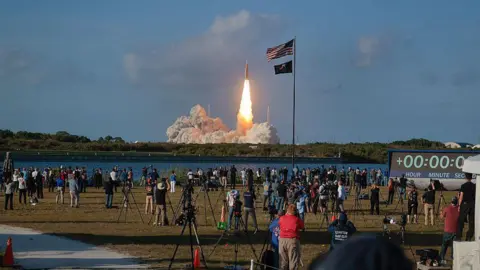
Chip Somodevilla/Getty Images Artemis is taking off in the distant background, and people watch, many with tripods. The US flag flutters above them on a flag pole.Chip Somodevilla/Getty Images
Spectators are kept at a safe distance, but the deep rumbling of the rocket launch can still be physically felt

Afterwards, there was a giddy euphoria among staff at the Kennedy Space Center.

One person told me they felt quite emotional and another said they wanted to cry – no doubt a release of tension built up over the past few months when Artemis II came close to launch, but ended up being scrubbed for various reasons.

Tonight, though, Nasa employees were laughing and clapping - this is the moment that they have spent years working towards. There is still work to do, but for now they are bathing in the moment of triumph.

In the hour before take-off there were issues which threatened the launch.

They concerned the launch abort system, which enables Nasa engineers to eject the astronauts and blow up the rocket if there is a malfunction.

The countdown clock was held at 10 minutes while engineers resolved the problem. They worked quickly, but it was an agonising wait to see if the launch could still go ahead.

Then came the staccato rhythm of the calls by each engineer responsible for the rocket's critical systems: "booster, go", "GNC, go", "range, go" – each reply, a tiny release of tension and a build-up of expectation.

"Artemis II, this is launch director," said Charlie Blackwell-Thompson, the first woman to hold the position at Nasa.

"You are go for launch," she told the crew. "We go for all humanity", Commander Reid Wiseman responded.

Cheesy words in normal circumstances, but that was the moment our spines began to tingle and we knew we were about to witness history.
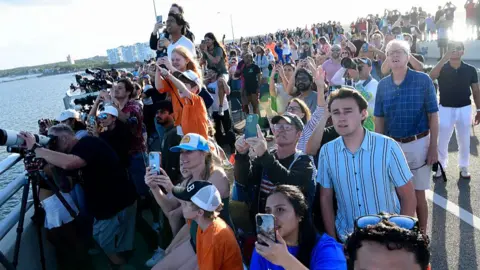
Gerardo Mora/Getty Images A group of people watches the launch, most holding phones or cameras up to the sky.Gerardo Mora/Getty Images
Many thousands of people gathered at viewing locations around the Kennedy Space Center in Florida to watch the launch

The Kennedy Space Center was built to send astronauts to the Moon, but that hasn't happened since 1972 when Apollo 17 blasted off. Today, the centre was back in business, doing what it was made for.

The press corps headed outside, where clouds that had threatened to cancel the launch had evaporated.

As the countdown clock restarted, the atmosphere turned to electric anticipation.

The four RS 25 engines and twin solid rocket boosters lit up, driving more than 8.8 million pounds of thrust into the Florida evening sky.

"God Speed Artemis II" Blackwell-Thompson said in another echo from the past. The same words were used in a launch from here in 1962 to send John Glenn, the first American to orbit the Earth, on his way.
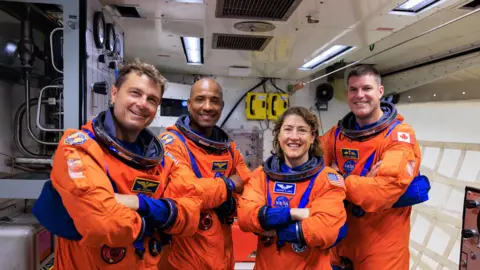
NASA Four astronauts stand side by side inside a cramped white spacecraft or support module, wearing bright orange launch and entry suits with blue trim and mission patches. Their arms are folded confidently across their chests.NASA
On their way to the Moon: Commander Reid Wiseman, pilot Victor J Glover, and mission specialists Christina Koch and Jeremy Hansen

I have been lucky enough to see launches of the Space Shuttle to the International Space Station from the Kennedy Space Center. Those launches are almost as impressive in flight, surging into space with an enormous bang and rising at the speed of a bullet.

But the SLS launch was not only more beautiful, it meant much more: a moment full of emotion for all those who saw it, perhaps because it reminded us of what humanity can do when it comes together, or perhaps because we may be entering a new era of space travel.

In the 1990s, I had the opportunity to speak to Neil Armstrong, who, in 1969, became the first person to ever walk on the moon.

Our discussion came at a time when the dream of human space travel seemed to be over. I asked him whatever happened to that dream? He smiled and said "the reality may have faded but the dream is still there and it will come back in time".

Today was the day the dream returned.
'We look at life differently' - the over-70s making their comedy debut

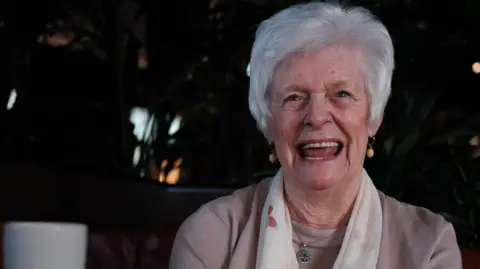
BBC Marie McLaren smiles for the camera. She has short grey hair and is wearing a white scarf.BBC
Marie McLaren says age is just a number

Marie McLaren is a latecomer to the stage - but she's in good company at her comedy class in Glasgow.

The 88-year-old has been learning the ropes of stand-up comedy from professional comedian Viv Gee over the last four weeks.

She is part of a group of over-50s who took part in the sessions, which will end with them taking the stage for live shows at The Social Hub Glasgow.

"The danger of doing comedy as an older person is that people might think you have lost it," Marie says.

"But in my opinion age is only a number."

Marie, from East Kilbride, was nominated for the class by her daughter.

'Age is just a number' in this comedy class

"I've always liked jokes and laughs and make a joke out of anything," she says.

"Nobody's interested in moaners, so it's quite nice to just make people laugh and enjoy life."

Retired journalism lecturer Ronnie Bergman says the class is an opportunity to try something new.

"You kind of disappear when you get older. You get on the bus and people ignore you," says the 74-year-old.

"I was getting too comfortable and in too much of a rut, but this is out of my comfort zone.

"I hate getting my photo taken and I'm disappointed by the sound of my own voice so this is uncomfortable - but I enjoy it."

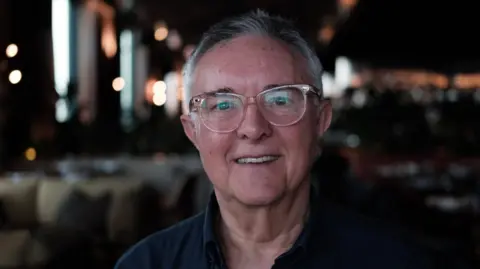
Ronnie Bergman looking directly at the camera and smiling. He has short grey hair and glasses, and is wearing a black shirt.
Ronnie Bergman says Billy Connolly is his comedy hero

Ronnie says the benefit of being an older comedian is that he has heard a lot more jokes.

As the class wraps up, he says he will be drawing on Billy Connolly as his comedy hero.

"He's an older comedian and he's still funny," Ronnie says.

Seventy-year-old Christine MacCormack believes her age helps to give her a difference perspective on comedy.

"We look at life differently because we born in a different time," she says.

"I'm just living my best life and I just want to enjoy the experience and my five minutes in the spotlight."

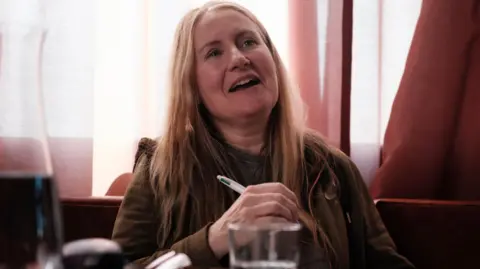
Viv Gee sitting at a table with a pen in her hand. She has long, light brown hair and is wearing a khaki hoodie.
Viv Gee is a Scottish Comedy Awards winner

The group took to the stage at the Social Hub for the first time on Wednesday in a show entitled The Old Ones are the Best, which has been organised in partnership with Age Scotland.

We watched as they ran through their material ahead of their debut performance.

With decades of life experience, the jokes run from the cradle to the grave - including a one-liner about being too old to buy a bag for life.

Health problems, family life and the habits of the younger generation have also provided a wealth of material.

But these are not your typical granddad jokes.

In one routine, 65-year-old Mitch Milmore buzzes around the stage wearing a pair of homemade bug-eyed goggles.

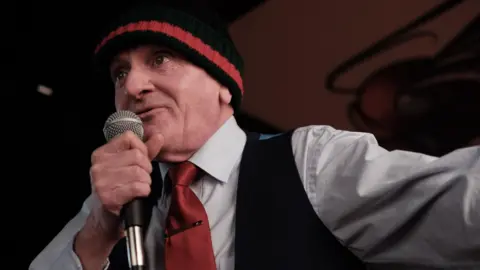
Andy Burke
Andy Burke finds his humour in his hometown

Meanwhile, 67-year-old Andy Burke finds his humour in his hometown.

"I come from a wee fishing village in Glasgow called Springburn," he tells the audience.

"It's got some lovely pubs up there - you go in laughing and come out in stitches."

He then launches into an expletive-laden set for the next five minutes before turning to tutor Viv for feedback.

"The great thing about comedy is anyone can do it," says the Scottish Comedy Awards winner.

"I can't teach them to be funny but I can teach them to be funnier."

Carol Kirkwood: Why the time is right for me to retire - and what's next

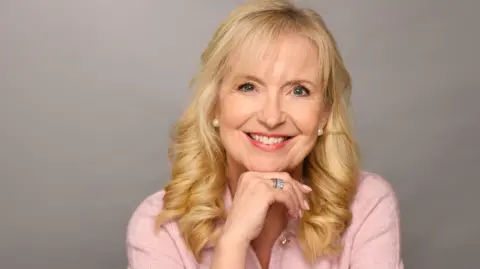
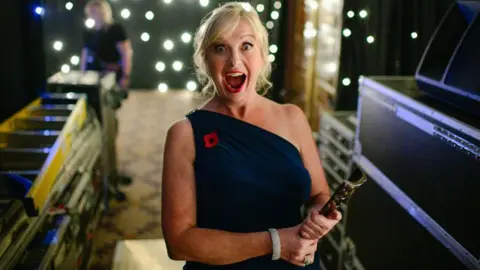
BBC Outgoing BBC Weather presenter Carol Kirkwood smiles in a portrait taken to mark her departure from the BBC. She is wearing a light pink top.BBC
Kirkwood joined the BBC 28 years ago, when the weather was done very differently

At 2:45am, much of the country is fast asleep - but for nearly three decades that's when Carol Kirkwood's day has begun.

Now, after leaving the BBC this week, the early alarm is the first thing she's ready to leave behind - it's "well and truly going in the bin".

It marks the end of an era, not just for Kirkwood, but for millions of viewers who have watched her present the weather forecast.

She has been the main weather presenter on BBC Breakfast since 2010, having started her BBC presenting career on the news channel.

Reflecting on her 28 years at the corporation, she tells us the biggest privilege was presenting the weather out in the field because "you meet members of the public who are always so lovely and kind to me".

Although it's "impossible to pinpoint one standout moment", reporting from events such as the Wimbledon tennis championships and Chelsea Flower Show were some of her highlights.

"I've reported from so many beautiful places and visited a lot of the country that I might not otherwise have seen," she adds.

Getty Images Carol Kirkwood, British Academy Scotland Awards at the DoubleTree by Hilton Hotel Glasgow Central.Date: Sunday 3 November 2019.Venue: DoubleTree by Hilton Hotel Glasgow Central.Getty Images
Kirkwood has been a familar face for millions across the country

Kirkwood announced she would be retiring back in February, but now her final few days at the BBC have arrived it's been "really surreal and emotional" to say goodbye.

Last week, while she was reporting on the weather at the Tower of London, she was given a special gold poppy that "is incredibly rare and hardly anyone has one".

"I was so surprised by the kindness they showed me," she says. Earlier this week she was "left in tears" after RHS Garden Wisley renamed its weather station in honour of her.

"The thing is you just go to work to do your job - you don't realise how appreciated you are," she says.

"You don't expect people to come and tell you how good you are because you're just doing your job.

"It's fabulous but it makes it even harder to leave."

But the 63-year-old, from Morar on Scotland's west coast, will miss her colleagues above all else.

"I love the weather and I'm fascinated by it but it's undoubtedly the people that make a job and it's so sad saying goodbye to them because I've known so many of them for decades. I know we'll stay in touch but it won't be the same."

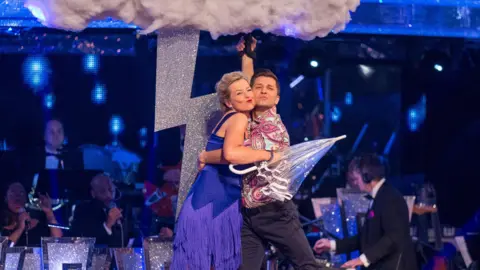
Carol Kirkwood and Pasha Kovalev on Strictly Come Dancing.
Kirkwood says competing on Strictly Come Dancing was one of the most enjoyable experiences of her career

On the flip side, without the 2:45am alarm, she "cannot wait to sit in the garden in the summer in the evening or go to the theatre without worrying about the lack of sleep I would get".

In a glittering career, Kirkwood has also reported for The One Show and competed on Strictly Come Dancing in 2015, reaching week eight with her partner Pasha Kovalev.

She has repeatedly been named best TV weather presenter at the TV and Radio Industries Club Awards.

'I should get on with my retirement'

In 2023, Kirkwood married police officer Steve Randall and one of the main reasons she chose to retire was to spend more time with him.

She'd been considering it for about six months and discussing it regularly with Steve and she explains that they kept coming back to the simple question: what are we waiting for?

"I'm not getting any younger, I'm newly married and we've had some losses in our lives recently."

She didn't elaborate on what losses she had experienced but says it helped her realise "I should get on with my retirement and that's what I'm going to do".

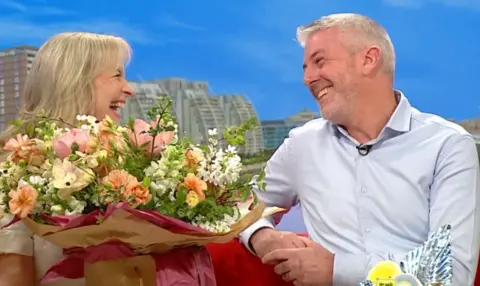
Carol Kirkwood sits on the red BBC Breakfast sofa with a bouqet of flowers next to her husband Steve. They both look at each other and smile.
Kirkwood was surprised by her husband Steve on the BBC Breakfast sofa on her last day

She's most excited to go travelling and has already planned trips to France and Italy.

"The freedom of being able to get in the car, drive and go anywhere we want for as long as we want is really appealing," she adds.

She and Steve love walking and she feels acutely aware she'll be "turning 64 in May and we want to do this while we're fit and healthy".

As for her other hobbies, her sixth romance novel is out in October and she has committed to writing at least two more books after that. She also says she'd love to learn the guitar and get a couple of cats.

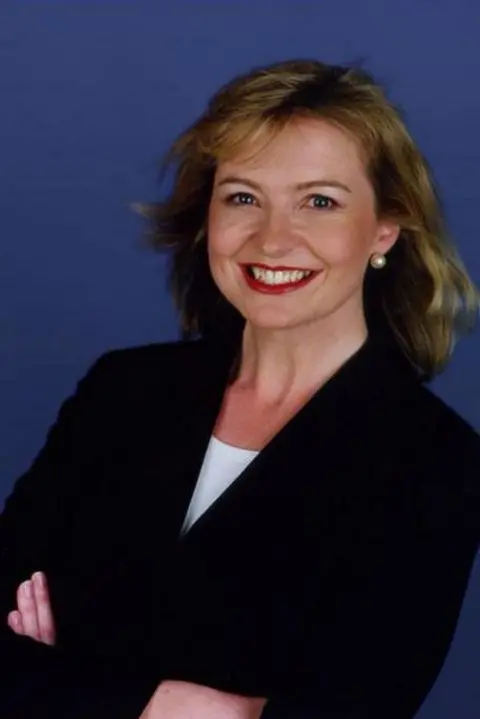
Carol Kirkwood in 2002, smiling with her arms crossed.
Kirkwood joined BBC News in the late 1990s as a weather presenter

When Kirkwood began forecasting in the 1990s, the job looked very different.

"We had little symbols of a sun and a cloud that would cover a whole area and that would be it," she explains. "Now we have 3D graphics that move across the area which is a lot clearer and easier to understand."

The weather has changed in almost three decades, too. "We used to have four definitive seasons and now they are such a muddle because of climate change."

She might be a pro at presenting the weather but it wasn't quite her dream job growing up, as she admits: "Not in a million years did I think I'd be doing this."

"When I was a child I wrote to Blue Peter producer Biddy Baxter because I wanted to be a presenter on the show as they always looked like they were having such good fun."

Her advice to anyone looking to pursue a similar career to her is to "always follow your dreams and put yourself out there".

"If you followed your dreams and they don't come true then at least you know you would have tried," she says.

Kirkwood's dreams did come true and now her dream retirement "can finally begin".

'We entered Race Across the World to honour dying wish'

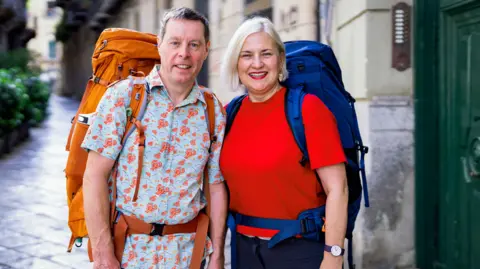
BBC Mark Blythen, in his 60s, who has short grey hair and is wearing a short sleeved blue shirt with a lobster pattern and a large orange backpack, stands next to Margo Oakley, who has short blonde hair, a red t-shirt and a large blue backpack. BBC
Mark Blythen and Margo Oakley had a "fractious" relationship for more than 40 years

When Margo Oakley, now 59, was introduced to her older sister's new boyfriend her first impressions of the "po-faced" and "judgey" young man were not great.

And for Mark Blythen, 67, his feelings about his girlfriend's "loud and wild" younger sibling were mutual.

But more than 40 years later the pair became the first set of in-laws to compete on Race Across the World - the BBC show that offers a £20,000 cash prize to the first of five duos to reach the finish line without the aid of phones, internet or air travel and with a limited budget.

They told the BBC the decision to enter the intense TV contest together followed the "last wishes" of Mark's wife and Margo's sister Julia, who died from the rare blood cancer myelofibrosis in 2022.

Mark, from London, met Julia, from Liverpool, while they were both students at Huddersfield Polytechnic, even though initially she was dating one of his flatmates.

"She hit him over the head with a brolly and then about three weeks later I went out with her," he said.

Mark revealed the one thing he and Margo agreed on in those early days was that Julia was "out of my league".

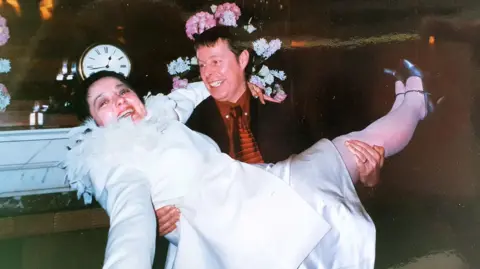
Handout A smiling woman in a white dress, white blazer and black shoes is being physically carried by a grinning man with dark brown hair.Handout
Julia and Mark were together for about 40 years

"It took us 23 years to get married but as soon as I met Julia, she was the person I knew I wanted to be with," Mark said.

"She was gregarious, she was funny and she was just everything I wanted in someone, a partner."

His first introduction to Margo came during a weekend visit to Liverpool.

"He wasn't what I imagined her going out with," Margo said.

"He was quite po-faced about me and my friends. We were young, we were having fun. He seemed judgey."

"I was very judgey," Mark agreed.

The pair said they "rubbed along" over the years since then, with occasional "eruptions".

But Julia was "the glue that held us together", they said.

And one thing Margo never doubted was Mark's commitment to her sister.

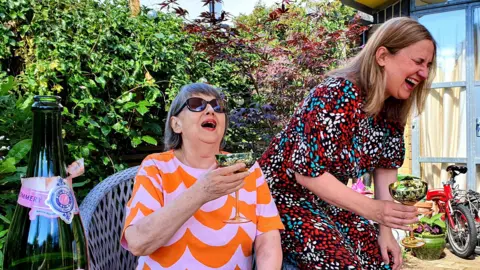
Handout A woman with short grey hair, an orange and purple print top and sunglasses sits in a garden chair and grins while holding a glass of champagne. Perched on the arm of the chair is another woman, with longer light brown hair and wearing a red, black and blue print dress, she is laughing and has her eyes closed.Handout
Mark said Margo (pictured right) would provide Julia (left) with fun and joy during her illness

"I have to say, he was a good husband. He was very, very devoted to her. He couldn't have been more," she said.

"I mean, in a way, and that's part of really the story of the race, in a way he put a lot of who he was aside just because he worshipped her so much."

After decades of not seeing eye-to-eye, Mark and Margo's relationship developed a new dimension in 2019 when Julia became ill.

She had a particularly aggressive form of the disease, and despite undergoing a stem-cell transplant, her condition deteriorated.

As Mark cared for his wife, he said he came to value Margo's visits for the impact they had on her mood.

"One of the things about caring for somebody is that it's very easy to just get lost and focus on caring for someone," he said.

"People that are being cared for, they need to have fun and Margo provided that fun. I think that's what kept Julia going for so long, that Margo would come down and raise her spirits."

Margo said she noticed the toll Julia's illness was taking on Mark.

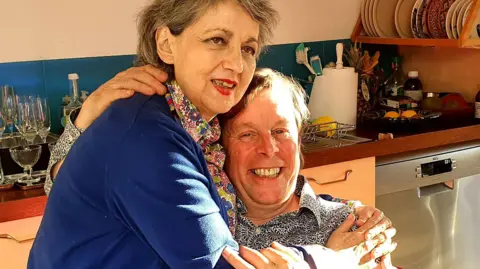
Handout A woman with short grey hair and a blue jumper embraces a man, wearing a black and white patterned shirt, as he sits on a kitchen chair. Handout
Mark said he did not realise how much of a toll caring for Julia during her illness had taken

"When he was caring for Julia, he didn't even know, realise how much it was taking from him," she said.

"We had different roles, but also as well, I knew Mark, like every carer, needed support."

While their relationship had been strengthening anyway, Julia explicitly told them she wanted them to remain close after she was gone.

"It was Julia's last wishes, and it was literally last wishes, that the friendship that Margo and myself had formed continued and we strengthened and we didn't lose it."

Margo said that while her sister had wanted their relationship to continue, how they went about it was an open question.

"You don't really have any blueprint for it, you know, it's an unusual relationship for all those years of friction," she said.

Both Mark and Margo said Julia was a big fan of Race Across the World, but "would never have gone on it" herself.

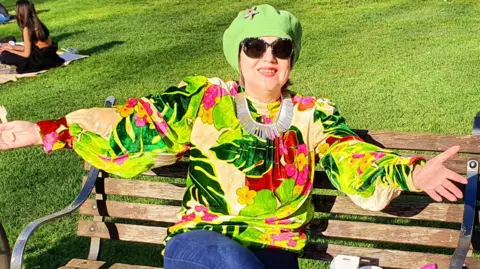
Handout A woman with a green hair covering, a bright green, red and yellow floral print blouse and jeans, wearing large sunglasses sits on a park bench in front of a grassy field smiling with her arms outstretched.Handout
Julia wanted Mark and Margo to maintain their newly forged bond after she died

The inspiration to apply hit Margo suddenly.

"I saw the race advertised and I just thought 'that really speaks to me'. I was looking for adventure because I have a lot on in my life in Liverpool because I care for my mum.

"As soon as I saw the race advertised, just something, I have no idea, spoke to me and said, ask Mark. A voice kind of told me, ask Mark...

"I didn't think twice. And very quickly I asked him and immediately he said 'yes'."

The pair did not want to reveal too much about what went on during filming to avoid spoilers - but said the "magical" journey towards the final destination - Mongolia - featured "real highs and really big lows".

"I don't think that's a spoiler to say, that's the nature of the race. Even the lows, there was absolute magic and alchemy in them," she said.

"Some of the lows, that's where the absolute gold is wasn't it?"

"You find the treasure at the bottom", Mark agreed.

Margo said she believed the excitement and joy in taking part in the race and the sadness of losing Julia would be relatable for people who have experienced loss.

"There's beauty in holding both those things, of sadness and joy of life and honouring her," she said.

The new series of Race Across the World begins at 21:00 BST on Thursday 2 April on BBC One and BBC iPlayer.

Listen to the best of BBC Radio Merseyside on Sounds and follow BBC Merseyside on Facebook, X, and Instagram. You can also send story ideas via Whatsapp to 0808 100 2230.

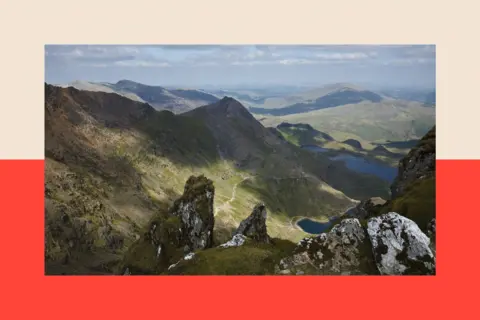
The delicate question of where responsibility lies for safety on our mountains

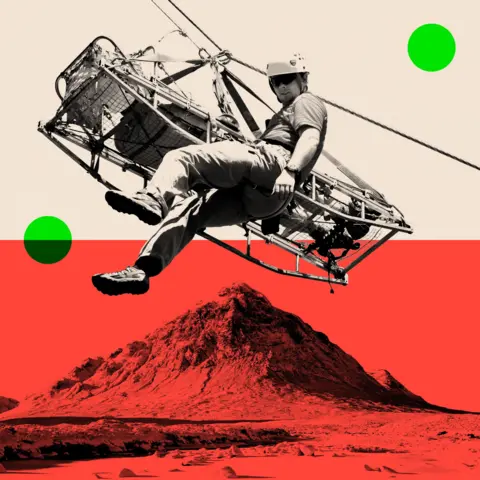
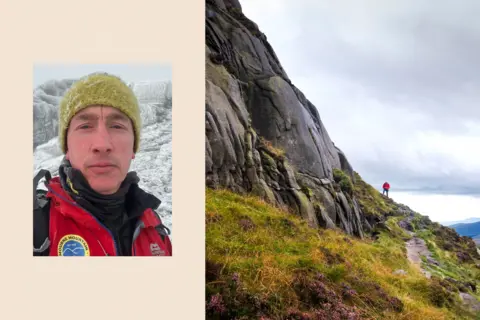
BBC A montage image showing a person from the Langdale Ambleside Mountain Rescue Team bringing a stretcher down and an image from Scotland, Argyll and Bute, Glencoe, Buachaille Etive Mor, frozen mountainous regionBBC

Two walkers find themselves stranded on a remote hillside as night closes in, hundreds of miles from home, after being inspired out into the wilderness by a TikTok video. It might sound like an unusual emergency - but for Mike Park, CEO of Mountain Rescue England and Wales, it's become a familiar story.

"We had two people stuck on a hill at 8pm, no torches. One was in their early 20s and the other was late 30s. It was their first time on a hill. They'd travelled a long way because they'd seen a TikTok route. They set off on their walk at 2pm - too late - wearing shorts, T‑shirts and carrying only a picnic," he recalls.

"They got off‑route, found themselves in unfamiliar ground – but they did the right thing by calling for help."

Park says this recent rescue, just a few days ago in the Lake District, is typical of the kind of callouts many colleagues now see.

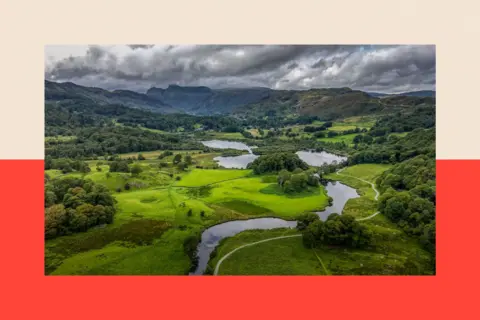
Getty Images A view of the Lake District and the River Brathay 

Getty Images
Mike Park has spent the past 40 years rescuing people on the hills of the Lake District

His rescue team were able to safely find the pair and walk them off the hill – but the incident perfectly captures some changing behaviours. Their situation was self-inflicted; they weren't prepared and got into trouble, extra layers and some good torches could have seen them rescue themselves - but they were also quick to call for help when they knew something was wrong - a decision Park says saved them from far more severe consequences.

"If we hadn't reached them, they'd have been stuck all night in the dark. By morning, I'm confident they'd be suffering hypothermia - possibly unable to walk."

Over the past few years, mountain rescue teams say there's been a stark rise in the number of people needing to be rescued.

This has ignited a delicate but important debate. Who is responsible for safety on our mountains? And, are increased warning signs and even barriers the answer to saving lives in our most dangerous landscapes, or is risk the price we pay for true adventure?

The rise in callouts

Mountain rescue callouts have been steadily rising for decades. Sport England figures suggest there's been a particular boom in recent years, with the number of us regularly climbing a hill or mountain rising from 2.8m people in 2018 to 3.6m in 2024.

Living an active lifestyle is something the public body estimates could be saving the NHS billions each year, by reducing the number of people developing chronic conditions.

However, it's also contributed to sharp rises in the number of rescues required by the volunteers who make up the UK's so-called "fourth emergency service".

In England and Wales, the number of callouts rescue teams attend has doubled in the past decade, reaching well over 3,000 a year by 2024, according to Mountain Rescue England and Wales.

So what's changed?

One of the key themes rescue teams pick up on is how incidents featuring younger adventurers, aged 18 to 24, have soared in recent years. Callouts for the age group almost doubled in England and Wales between 2019 and 2024, from 166 to 314.

It now makes them the most rescued age group, overtaking walkers in their 50s who had previously needed the most help.

Mike Park has spent the past 40 years on the hills of the Lake District, rescuing those in danger. He has observed a significant shift among younger people in embracing the outdoors - but says he believes better technology and wider social changes in the past few decades have also fed into the overall rise.

"It doesn't matter what age you are - society is more adventurous, more reliant on help, less outdoor‑aware, and less prepared," he says.

"When I first started our team did 10-15 callouts a year. We average around 100 now. The rise hasn't been steady - it's steepened sharply, especially in the last 10 years and after Covid-19."

Park believes part of what makes the mountains of the UK so attractive is that most can be easily accessed for a day-trip - at worst a short weekend break. They are on our doorstep, via the same motorways and service stations we might stop at on our way to a theme park or music gig.

This can breed a sense of overfamiliarity - with some misjudging just how alien and dangerous these environments can be, he suggests.

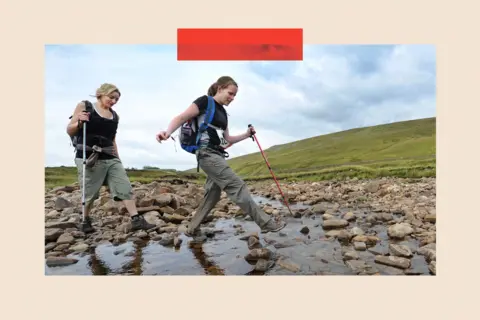
Corbis via Getty Images Participants crossing stepping stones in YorkshireCorbis via Getty Images
Park believes part of what makes the mountains of the UK so attractive is that most can be easily accessed for a day-trip

Park says decades ago, many people who went into the UK's mountains would have it as their sole major pastime, they were "hillwalkers or mountaineers, that was it". Now, outdoor adventures are easy to pick up alongside the many other work and leisure activities people juggle.

"There's so much to do now, we don't concentrate on any one thing. People might do the outdoor environment one week, swimming the next, holiday the week after," he says.

Rescuers say it should be seen as only good news that millions of people are now inspired each year to venture into the outdoors themselves, encouraged by stories of the physical and mental health benefits - and beautiful images spread across social media.

But the reality of having so many novices is also starting to take its toll on some of the UK's busiest rescue teams, who are increasingly grappling with exhaustion and stretched staffing.

It's important to note that no rescue team we spoke to begrudge doing these kinds of rescues - they are grateful they can help those who need it and avoid the situation getting any worse. It doesn't matter how you got there, just that they can help you get down safely.

But according to Park, the fact people are seemingly more willing to take risks in the first place - and then more willing to pick up the phone when things go wrong - has fundamentally changed what kind of rescues his teams do.

"Ten years ago, 70% of callouts were because someone physically couldn't get off a hill," he says.

"Now, most people haven't physically injured themselves - it's that they're mentally unable to get down, because they weren't prepared for the environment."

In other words, people's bodies are capable of getting them off the mountains, but they lack the experience, confidence or equipment to do it safely.

Online influencers

Many mountain rescuers believe the increase in online influencers is playing a role. There are pictures and videos across sites like TikTok and Instagram encouraging people to venture out to beautiful plateaus and waterfalls.

Seeing people influenced by social media "used to be rare, but now it's constant," explains Martin McMullan, from the Mourne Mountain Rescue Team in Northern Ireland.

"People search out iconic locations made popular by influencers. Some go just to experience it - others are trying to create their own content for their platforms."

BBC/ Getty Images Martin McMullan on the left and on the right is an image of a man walking in the Mourne mountains in Northern Ireland
BBC/ Getty Images
Martin McMullan says: "People search out iconic locations made popular by influencers"

In some rare cases, McMullan says influencers may even be attempting to get rescued - to create more interesting content for their channels. He became suspicious of one case a few years ago, when his team was called to Northern Ireland's highest peak in "very serious" sub-zero winter conditions.

At the summit McMullan says they found a group of young people who they escorted part of the way down, before calling in a helicopter to evacuate them to safety. It was only days later, when a friend alerted him to it, that McMullan realised the whole thing had been filmed by the group, clutching onto their phones as they were rescued.

"They'd been livestreaming parts of it - even when things became dangerous. We were oblivious to it at the time. They probably thought it made great social media content."

McMullen says although being far from the first time he'd had a rescue filmed by members of the public keen to capture the drama of the job, it was the first time his team suspected a group had gone out with the idea of getting rescued, something they denied.

Hotspots

The vast majority of mountain rescue teams, thankfully, rarely find themselves called out to a death. But the spread is far from even and there are certainly hotspots.

The rescue team covering Yr Wydffa, Snowdon, is far and away the busiest in the UK. The team is often called to fatal incidents and has seen a rise in deaths. Across north Wales, there were 14 fatalities in the mountains back in 2015. Last year there were 23.

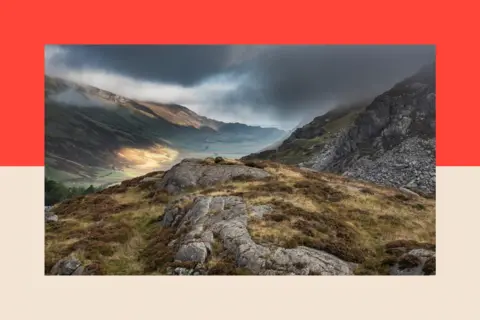
Getty Images Autumn landscape image of view along Nant Fracon valley in Yr Wydffa, Snowdonia National Park, with dramatic evening sky 
Getty Images
The rescue team covering Yr Wydffa, Snowdon, is the busiest in the UK

So-called body recovery callouts can have a significant impact on the rescuers, with a growing importance being placed on welfare checks and support for the teams who regularly battle the elements to retrieve bodies so they can be returned to their loved ones.

There have been suggestions that putting up physical warning signs, or even fencing, on some of the UK's most dangerous ridges and waterfalls could potentially save lives. The National Trust and conservation project, Fix the Fells, recently decided signs were needed to prevent accidents on England's highest mountain, Scafell Pike.

Over eight years, four people died and more than 40 were rescued from the treacherous ravine known as Piers Gill, before a sign and large rocks were placed on the nearby route to encourage people away from the area.

In mid-Wales, one assistant coroner has recommended multiple times that signs be put up around some of the region's impressive waterfalls. Five people have died at the beauty spots in the past few years, which has prompted the assistant coroner for south Wales central, Rachel Knight, to write three Prevention of Future Death Reports - recommending improvements.

In the most recent one, she argued clearer warning signs were needed for walkers who risked falling from the paths above the waterfalls – suggesting without them, many would fail to understand "the significant risks they face" in the area and more people were likely to die.

So could putting up signs work in other remote areas?

Andy Buchan is due to take over Mike Park's role at Mountain Rescue England and Wales in May.

In some of the most extreme areas, like Crib Goch, a notorious knife edge ridge in north Wales with annual fatalities, Buchan says some ideas should be considered.

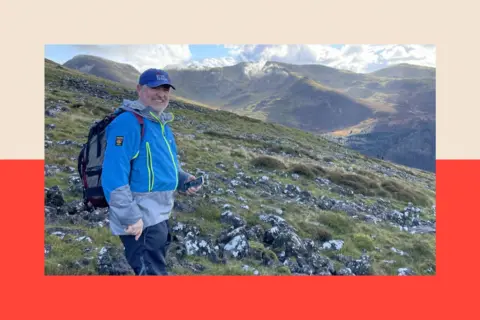
Andy Buchan in walking gear on a mountainside
Andy Buchan, the incoming CEO of England and Wales Mountain Rescue

"I won't call it signposting in terms of actually putting signs up on the mountain, but certainly signposting towards more information could really help."

Buchan suggests that in rescue hotspots such as Crib Goch, which does already have some warnings placed on the route, more could be done to help walkers access weather forecasts and safety information before they get to an area - potentially by placing additional signs or QR codes in car parks hikers are likely to use before heading out.

However, what Buchan and others I speak to really don't want to see - despite some potential benefits - is the same widespread canvassing of signs and fencing witnessed in other countries.

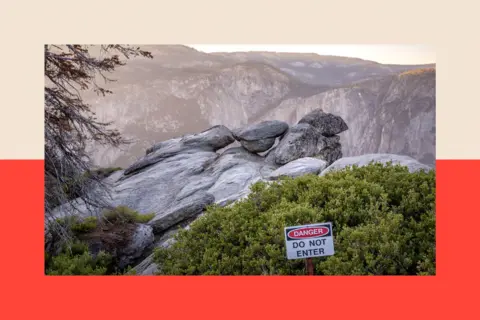
Danger do not enter signal at Yosemite national park at Glacier point with its famous overhanging rock
Buchan does not want to see the same widespread canvassing of signs and fencing witnessed in other countries

"There are other parts of the world that I've travelled, like the US, where you can get to remote places and then all of a sudden, when you want to go and have a look at the view over the cliff, there's a big metal barrier around and there's concrete being put in place and it kind of destroys the remoteness of the location that you're in," Buchan explains.

'The mountain isn't going anywhere'

In preparing for the role, Buchan has had plenty of time to think about the current challenges, but is overwhelmingly positive about seeing more people out on the hills.

"We encourage people to get outside for their physical and mental wellbeing," he says. "People recognise the countryside is a cost‑effective way to have great experiences. It's great - but it does come with risk."

Universal Images Group via Getty Images View to Crib Goch and the Pyg Track with Llyn Glaslyn and Llyn Llydaw from Snowdon summit, Gwynedd, Wales, United Kingdom
Universal Images Group via Getty Images
Buchan suggests that in rescue hotspots more could be done to help walkers access weather forecasts and safety information

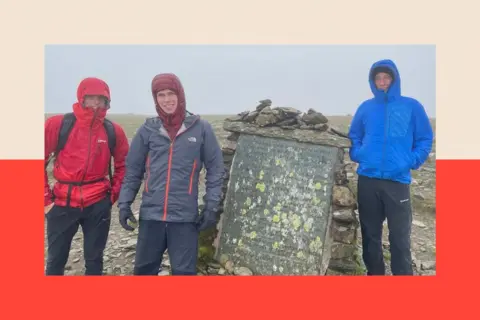
The story of Jack Carne is testament to that. Jack and his two best friends had travelled a few hours from their hometown of Barnsley to reach the mountains of Eryri, also known as Snowdonia, in north Wales. Inspired, after the Covid-19 lockdowns, by the freedom the mountains offered them, the trio in their 20s had been out hiking at every possible opportunity. They were committed, fit and experienced - but on this occasion, just "10 metres from the top" of Glyder Fawr, a peak thousands of feet up, everything went wrong.

A rock Jack had grabbed hold of broke away in his hands. His friends could do nothing as they watched him fall. In just an instant he was gone - disappearing out of sight beneath them. Three friends went up the mountain that day. Only two came back.

It was the starkest reminder possible about the unpredictability and the dangers lurking just beneath the surface of the UK's most picturesque landscapes – even for those who come prepared.

Left to right - Jack, Matty and Brandan on one of their trips
Jack Carne (left) and his two best friends Matty and Brandan

At the inquest into Jack's death, the coroner remarked how the young men were all well-equipped and experienced enough for the route they'd chosen.

"It was a scramble - nothing harder than anything we'd done before," Matty Belcher, one of those three friends, told me. "In fact it was easier than a lot of stuff we'd done," added the 27-year-old.

"Mountain Rescue said the boulder that actually took Jack was a freak accident," adds Brandan Smith, 25, the group's third member.

"That rock could have gone in a week's time, a year's time."

One week after Jack's death, Brandan and Matty were back at the same peak - this time making it the additional 10m to the summit, where they had time to reflect alongside Jack's dad, who they'd brought with them.

"Jack's dad wanted to see it - put his mind at ease, instead of guessing what happened," explains Matty.

For Brandan and Matty, it was a key moment - that inspired them to keep adventuring and not give up on the beauty of our landscape, despite the risks.

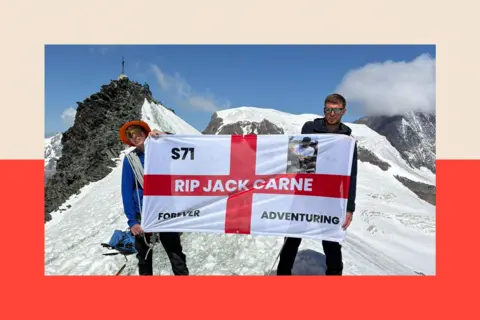
Brandan unfurls a flag to remember Jack at a summit
Brandan says Jack "was probably the best of us at climbing – he was brilliant"

"Jack was the one who absolutely loved it the most out of us," says Brandan. "He was probably the best of us at climbing - he was brilliant - he always pushed me, believed I could do it even when I didn't.

"If we'd stopped going out after he died, Jack would've kicked us for it."

The key thing, both men say, is for those looking to adventure, to always be aware of the risks.

"For us, if someone isn't feeling safe, we turn back. No question. There's always another day," says Brandan. "It's always going to be there - the mountain isn't going anywhere."

Top picture credit: Getty Images

Thin, lobster red banner with white text saying ‘InDepth newsletter’. To the right are black and white portrait images of Emma Barnett and John Simpson. Emma has dark-rimmed glasses, long fair hair and a striped shirt. John has short white hair with a white shirt and dark blazer. They are set on an oatmeal, curved background with a green overlapping circle.

BBC InDepth is the home on the website and app for the best analysis, with fresh perspectives that challenge assumptions and deep reporting on the biggest issues of the day. Emma Barnett and John Simpson bring their pick of the most thought-provoking deep reads and analysis, every Saturday. Sign up for the newsletter here

Doctors lose new jobs package as strike to go ahead

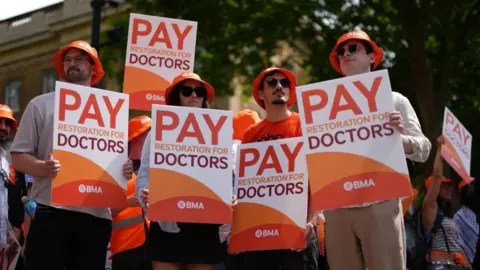
PA Media Junior doctors protest outside Downing Street, LondonPA Media

The government has withdrawn an offer of creating 1,000 more doctor training posts in England after the British Medical Association (BMA) refused to call off a six-day strike next week.

The extra posts were part of a wider package of measures put forward by ministers earlier this year to resolve the long-running dispute with resident doctors, previously known as junior doctors.

Prime Minister Sir Keir Starmer set a 48-hour deadline on Tuesday evening for the walkout to be cancelled if the union wanted to keep them.

The strike was called last week when talks between the two sides over pay and job shortages broke down.

A Department of Health and Social Care spokesman said doctors had been offered a "generous deal", but said it was now not possible to give the go-ahead on the training posts.

"These posts would have gone live this month, but as systems now need to prepare for strikes and more uncertainty, it simply won't be operationally or financially possible to launch these posts in time to recruit for this year."

The government said the move would not impact the overall number of doctors in the NHS as the posts were going to be created from existing short-term posts. Resident doctors fill these when they cannot get official training posts.

Dr Jack Fletcher, BMA resident doctor committee chair, said the announcement was "extremely disappointing".

"It is genuinely disheartening to be at this point after what had been constructive talks up until a few weeks ago when the government moved the goalposts.

"It is simply wrong that the development of the doctors of the future is being used as a pawn like this.

"We have consistently maintained that we are willing to postpone industrial action should a genuinely credible offer be provided."

Alongside the extra training posts, the government had offered to cover some out-of-pocket expenses such as exam fees as well as ensuring faster pay progression.

But the BMA ended the talks saying the deal - and in particular its pay progression element - had been watered-down at the last minute.

It also coincided with the government accepting the recommendations of the independent pay review body that all doctors, including resident doctors, should get a 3.5% pay rise from this month.

The BMA called it a "crushing blow", pointing out that inflation was set to rise because of the Iran war.

While the pay rise means resident doctor pay has risen by a third over the past four years, the BMA argues it is still a fifth lower than it was in 2008 once inflation is taken into account.

The union uses a measure of inflation - RPI - that is higher than others. It says it does this because the government uses that measure of inflation when adding interest to student loans.

The training posts that were offered are the ones doctors move into after the first two years of training. This is the point at which they specialise in areas such as general practice or surgery.

Last summer there were 30,000 applicants for around 10,000 jobs, although some of those were doctors applying from abroad.

Next week's walkout, which begins at 07:00 BST on Tuesday, will be the joint longest since the dispute began - only once before have resident doctors taken part in a six-day walkout.

It's the 15th walkout since the long-running dispute started in March 2023.

Resident doctors make up nearly half of medics working in the NHS - two thirds of them are BMA members.

New laws to make it easier to cancel subscriptions

Getty Images Close up of a person holding a TV remote, pointing at a smart TVGetty Images
The laws will enable people to cancel subscriptions "with the click of a button".

New laws will make it easier to cancel subscriptions and get refunds for unwanted auto-renewals, the government has said.

A crackdown on "subscription traps" could save the average person nearly £170 a year, according to the Department for Business and Trade (DBT).

Consumers will no longer have to make "endless phone calls" to cancel a subscription, and they will be given a 14-day cooling off period after the end of a trial period, or when an annual subscription automatically renews.

The changes are expected to come in to force in spring 2027.

The laws will enable people to cancel subscriptions "with the click of a button", the DBT said.

Companies will be forced to give clear information upfront to prevent consumers from being "silently rolled onto expensive contracts", it added.

Firms will also have to give customers reminders when a free or discounted trial is about to end, or when contracts that are a year or longer are about to be renewed.

The 14-day cooling off period will allow people to get a "full or proportionate refund" if they forget to cancel after a free trial, or the subscription auto-renews.

The changes could save the public a total of £400m a year, the DBT said.

Kim Biggs from Lincolnshire told BBC News she has been "caught out" by annual subscription fees that renew automatically.

Kim was notified that her free trial of AVG, the anti-virus software was about to end..she said trying to cancel the subscription was "exasperating".

"It took quite a lot of time to wade through all the pages, all the information that was presented when you first clicked onto the 'unsubscribe' part on the website.

"Eventually I clicked on the right options to get an online form to request a refund. I completed this but did not receive my refund."

Kim said the phone number for AVG 's support centre was not easy to find online.

When she did speak to a support agent Kim said she was told "the form that I'd sent in is basically disregarded by them, that you have to speak to them through the support centre to get your refund, which was really annoying".

"I had to keep repeating that I just wanted a refund, as she was very persistent in pushing the products available, trying to get me to change my mind."

The BBC has asked AVG for a comment.

'Nothing more frustrating'

Sue Davies, the head of consumer rights policy at Which?, said subscription traps can "wreak havoc on finances".

"These new rules will help put consumers in the driving seat with proper transparency and protection," she said.

Certain memberships for charitable, cultural and heritage organisations will be excluded from the new rules.

The DBT estimates that there are 10 million unwanted, active subscriptions across the UK.

It said that more than 3.5 million people are being "quietly rolled from free or discounted trials into fully costed contracts", while another 1.3 million are caught out by unexpected auto-renewals.

Motability drivers 'horrified' by compulsory black-box trackers

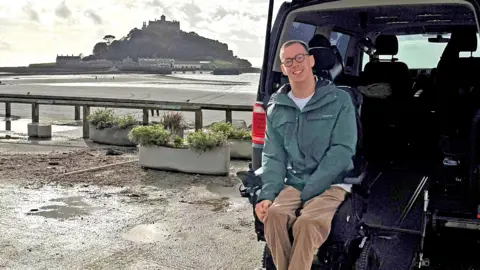
Keron Day Keron Day at the back of his Wheelchair Accessible Vehicle with St Michael's Mount in the backgroundKeron Day
Sex Education actor Keron Day, who has cerebral palsy, says he is angry at having to have a black box fitted in his wheelchair accessible vehicle

Motability drivers under the age of 30 say they are "horrified" by rule changes that mean their vehicles will be fitted with compulsory black boxes.

The boxes will monitor driving habits, such as speed and braking, and will provide a weekly rating.

More than four red ratings over a 12-month period could see drivers removed from the Motability scheme, which allows eligible disabled people to lease a new car using part of their benefit payments.

Critics say the change will affect disabled people's freedom and ability to work, but Motability says it is about "keeping prices down and keeping people safe". It says it has removed 300 drivers since its September launch in Northern Ireland.

'Disabled people need to have the choice'

Actor Keron Day, 25, who starred in the hit Netflix show Sex Education, has cerebral palsy and uses a specially adapted wheelchair accessible vehicle (WAV). The car has a steering aid and indicators on the floor, as well as buttons for lights, wipers, gears and the handbrake.

Day says the car is an "amazing piece of technology", but feels angry at having to have a black box fitted and his driving assessed when his access requirements mean he "can't simply jump into another vehicle" or use public transport easily.

"Disabled people need to have the choice, just like everybody else," he says.

"If I passed [my driving test] aged 17, I would have 13 years of a mandatory black box. None of my non-disabled peers would have that.

"We all have to pass the exact same driving tests that everybody else does, so it's not a point about our safety."

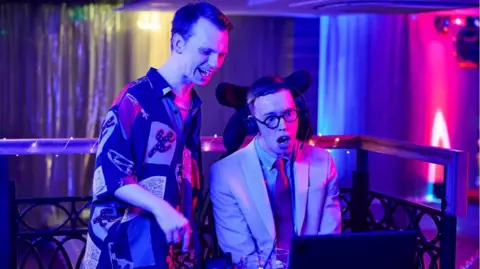
A screenshot from Kirkmoore. A man in a jazzy shirt stands behind Keron's character who is sitting in front of his a computer screen and wears a headseat and a suit. They are are in a bar or club.
Day, who played the lead in BBC Three's Kirkmoore, says he needs his vehicle to get to acting jobs

Black box car insurance has become a popular option for young drivers, who are often deemed to be more high-risk, as it offers lower insurance premiums.

Motability enables disabled people who have issues getting around to exchange their higher-rate mobility allowance for a new car. Although "premium" vehicles such as BMWs and Mercedes were removed from the scheme at the end of last year.

During last year's Budget, the government removed its tax break on insurance and it must now cover 12% on each insurance premium. It must also now pay VAT on some vehicles meaning the scheme will need to pay out an additional £300m from 1 July.

Nigel Fletcher, CEO of the Motability Foundation, said that would be the equivalent of a price rise of £1,100 for every driver on the scheme.

"A lot of disabled people won't be able to afford that, so we're now having to try and work out how can we make changes to the scheme that protects pricing as much as we possibly can," said Fletcher.

He added that black box was about "keeping prices down and keeping people safe" and its data had also found younger drivers to be the highest risk.

He said, of the 300 drivers removed from the scheme, one had driven 117mph in a 30mph zone.

"This a serious safety issue, not just for that individual, but everyone else in that community.

"They will get lots of warnings before they get taken off the scheme. And then if they are taken off the scheme, we will need to start looking at what our policies are around allowing them back onto the scheme in the future."

Motability has also decided that every vehicle with a named driver aged 30 or under will have the device fitted - which could include family, friends and personal assistants (PAs) who drive the vehicle.

"As a disabled person, my independence could be taken away as a result of a non-disabled person's actions," Day says.

"I'm experienced enough with PAs to know that not all PAs are amazing drivers. And that's just a reality of life. I find the consequences horrifying."

Motability will start to bring in the changes on new leases from 13 April for the first 15% of its 930,000 customer base. Then it will "review and analyse" whether to introduce it across the board.

'There is a difference whenever I drive'

Eva Hanna, 21, has a car with hand controls and says she is happy to have a black box, but feels the amber and red reports she has received for jerky driving is a direct result of her adaptations and thinks the scheme needs to be looked at.

"The braking and acceleration can be a bit more sensitive, because obviously it's not the same as using your feet," she says.

"You have to pull on the brake a little, or you have to pull on the accelerator to get it going. So I've found that during my journey I might have braked too hard or accelerated too harshly."

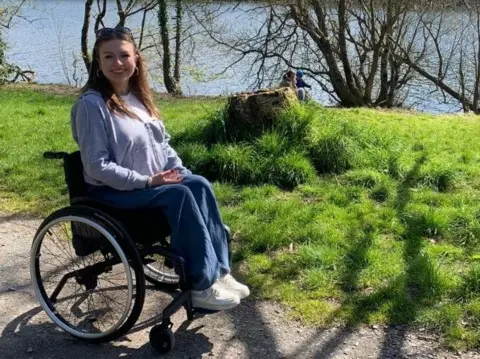
Eva Hanna Eva Hanna sits in her wheelchair in front of grass and some water with bare trees in the background and the sun shiningEva Hanna
Eva Hanna says her commute often takes her more than an hour, which could lead to getting red reports

She says she has received amber ratings when commuting to Belfast for work and a red score when she had to brake sharply on a country road.

In comparison, when her parents have driven the vehicle manually, they received green scores.

"I know I'm not a dangerous driver, but there is a difference whenever I drive. I'll always get knocked down a bit on the smoothness," she says.

"I worry because the scheme is so great. For people to be kicked off just because of small things that aren't their fault, it would be such a big let-down to a lot of disabled people."

Fletcher says this was not something Motability was aware of, but it would look into and would continue to gather information over the coming months.

As well as the black box, Motability has introduced recommendations that drivers take a break every hour and aim not to do more than six journeys a day. If that is exceeded, the driver will receive a red score, but it will not impact their lease.

It has also halved the number of miles drivers can make each year before they pay an excess.

Drivers will now be able to drive 10,000 miles before paying 25p on any miles travelled over that limit. Previously, the mileage was 20,000 with an excess of 5p a mile.

Motability says its average drives clock up 7,500 miles a year and Scotland's version of the scheme was still considering the cap.

But for Day, the recommendations are frustrating and impede his independence.

"I live in rural Cornwall, everything is an hour away," he says.

"If I wanted to go to London, which is where the majority of my work is, and I had to stop every hour, I couldn't get to work. It's just madness."

Even so, he is excited for the "freedom and access to the world" his new vehicle on the scheme will give him.

"I wouldn't be able to go to work without mine," he says. "I wouldn't be able to have a social life."

Record monthly rise in petrol and diesel prices, says RAC

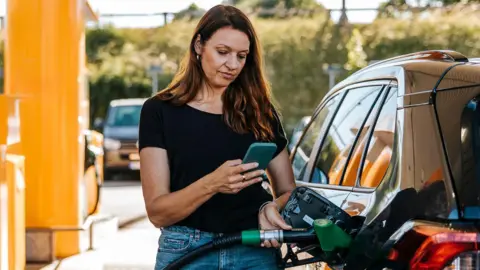
Getty Images A woman looking at her mobile phone while filling up her car at a petrol stationGetty Images

The jump in the price of oil triggered by the conflict in the Middle East has raised the possibility of higher fuel costs for motorists.

Following the attacks by the US and Israel on Iran, the price of oil leapt by 10% and gas prices also surged.

The reason for the jump is that Iran has warned vessels not to pass through the Strait of Hormuz, a crucial waterway in the south of the country through which about 20% of the world's oil and gas is shipped.

If these restrictions persist and oil prices remain high for some time, the worry is this will have knock-on effects on prices of a number of goods.

However, there remains a huge amount of uncertainty at this stage as to whether the conflict will have a lasting effect on the price of oil, gas and wider energy costs.

How quickly will rising oil prices show in fuel prices?

Crude oil is a key ingredient in petrol and diesel, meaning higher oil prices could eventually drive up prices at the pumps.

The AA motoring group says that over the next few weeks fuel costs could return to where they were at the start of the year.

That would be a change to the general trajectory of fuel prices, which have been falling on UK forecourts over the past few weeks.

Further rises will depend on the magnitude and duration of the conflict, the AA said.

Currently, the average price for petrol is 132.6p a litre and 142.3p for diesel, according to AA data.

Simon Williams, from rival motoring group the RAC, said: "If oil were to climb to and stay at the $80 a barrel mark, then drivers could expect to pay an average of 136p for petrol.

"At $90, we'd be looking at over 140p a litre and $100 would take us nearer to 150p, but it's all too soon to know."

What could the impact be on food prices?

As well as affecting prices at the pump, if higher fuel costs persist they could have further knock-on effects on the prices of goods on the shelf.

More expensive petrol and diesel will increase the transport costs of those businesses moving food and other goods around the country.

These increased costs might then be passed on by shops and supermarkets to the consumer. As a result, the cost of living goes up.

There might also be a more direct impact on food. "Some elements of crude oil are used in fertiliser, and so there could be a cost implication in terms of food prices," Benjamin Goodwin, partner at banking advisory firm PRISM Strategic Intelligence told the BBC.

However, if the disruption is short lived then it is unlikely to result in an immediate increase in food prices, he said.

Will my energy bills rise?

In the short-term, millions of UK householders' domestic gas and electricity bills are shielded from any impact on wholesale costs paid by suppliers.

People whose energy bills are governed by the price cap already know what their unit prices are now, and will be for the three months from April. They have already been set.

However, the impacts of the conflict could potentially be seen on domestic variable energy tariffs from the subsequent price cap, for the three months from July.

How will this affect UK inflation and interest rates?

UK inflation, which measures the pace of price rises, has eased relative to the heights reached immediately after Russia launched its full-scale invasion of Ukraine four years ago.

It has meant that the Bank of England has been able to cut interest six times since August 2024 to 3.75%.

The Bank recently said further cuts to borrowing costs are likely this year with another cut widely expected later this month, but if the oil price continues to rise is this now less likely?

Much depends on how long crude prices remain elevated, according to Subitha Subramaniam, chief economist and head of investment strategy at Sarasin & Partners.

If they do, she said: "It will start to cascade into other prices such as food, agriculture, industrial commodities and that's just going to really bleed into inflation."

The Bank's rate-setting committee next meets in a couple of weeks' time which really isn't enough time to assess the impact of higher oil prices on inflation.

So, in the short-term, Subramaniam said: "I would say the prudent course for the Bank of England would be to remain on hold."

BBC sacked Scott Mills after learning alleged victim in police investigation was under 16

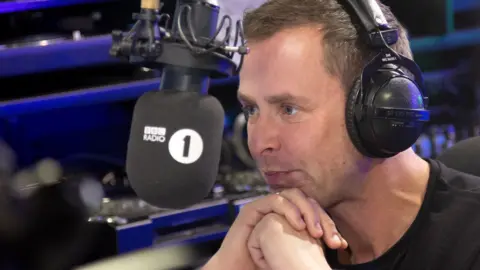
BBC Scott Mills leaning into the microphone in the Radio 1 studio with headphones on. BBC

Presenter Scott Mills has confirmed he was investigated over a sexual offence, in his first statement since he was sacked from the BBC over allegations relating to his personal conduct.

In a statement, Mills said the announcement of his sacking had led "to the publication of rumour and speculation".

It comes after it emerged the police launched an investigation into Mills in 2016 before closing it in 2019 after prosecutors decided there was insufficient evidence to bring charges.

Mills said he had "fully cooperated and responded" to the investigation at the time, and thanked "from the bottom of my heart all those who have reached out to me with kindness" including his listeners and former colleagues.

The allegations, first published in the Mirror, are reported to have happened between 1997 and 2000, police said, when Mills would have been in his mid-20s.

On Tuesday, the Metropolitan Police told BBC News that they had investigated Mills for serious sexual offences against a teenage boy who was under the age of 16.

In a statement on Wednesday afternoon, the 53-year-old said: "The recent announcement that I am no longer contracted to the BBC has led to the publication of rumour and speculation.

"In response to this the Metropolitan Police has made a statement, which I confirm relates to me.

An allegation was made against me in 2016 of a historic sexual offence which was the subject of a police investigation in which I fully cooperated and responded to in 2018.

"As the police have stated, a file of evidence was submitted to the Crown Prosecution Service, which determined that the evidential threshold had not been met to bring charges.

"Since the investigation related to an allegation that dates back nearly 30 years and the police investigation was closed 7 years ago, I hope that the public and the media will understand and respect my wish not to make any further public comment on this matter."

He added: "I wish to thank from the bottom of my heart all those who have reached out to me with kindness, my former colleagues, and my beloved listeners, who I greatly miss."

The announcement that the former presenter had been sacked by the BBC caused shock among listeners, and led to mounting pressure on the broadcaster to explain what led to his sudden departure.

Earlier on Wednesday, the BBC confirmed it knew about the sexual offences investigation in 2017.

But in a statement, a spokesperson added that the Radio 2 presenter was sacked after "new information" about his conduct came to light in recent weeks.

It said it was "doing more work to understand the detail of what was known by the BBC" at the time.

World's oldest known tortoise, Jonathan, dies aged 193

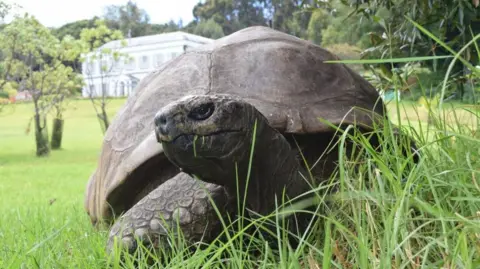
PA Media Jonathan, a large tortoise in grassPA Media
Jonathan is thought to have hatched almost 200 years ago and lived through the reigns of eight British monarchs

The world's oldest known tortoise, Jonathan, has died at an estimated age of 193, the vet who cared for him has said.

"Heartbroken to share that our beloved Jonathan, the world's oldest living land animal, has passed away today peacefully on St Helena", Joe Hollins wrote on social media late on Wednesday.

"This gentle giant outlived empires, wars, and generations of humans," Hollins said of his long-time charge, who is thought to have hatched around the year 1832.

He spent most of his life on the remote South Atlantic island of St Helena, where he met Queen Elizabeth II, as well the Duke of Edinburgh and House of Commons Speaker Sir Lindsay Hoyle.

Hollins said in his statement: "As his vet for many years, it was an honour to care for him - hand-feeding bananas, watching him bask in the sun, and marvelling at his quiet wisdom.

"He leaves behind a legacy of resilience and longevity that inspired millions. Rest easy, old friend. You'll be missed more than words can say."

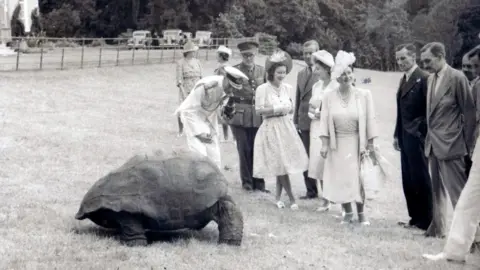
PA Media A black-and-white image of Jonathan surrounded by a group of people in formal attire, including Queen Elizabeth IIPA Media
Jonathan met the future Queen Elizabeth II in 1947 on St Helena, a British overseas territory

Jonathan's exact age is unknown, but a photograph taken in 1882 shows that he was fully grown when he was first brought to the island - where he lived on the grounds of Plantation House, the official residence of the Governor of St Helena.

Experts say this suggests he was about 50 years old by that time.

Jonathan lived through the reigns of eight British monarchs and met both George VI and the future Elizabeth II during their visit to the island in 1947.

The giant tortoise met Sir Lindsay in 2024, when he was presented with a Guinness World Record certificate recognising him as the oldest known land animal in the world.

At the time, Hollins said that although Jonathan had lost his sense of smell and his sight, he still appeared to be very happy and healthy.

Joe Hollins Joe Hollins, in a blue t-shirt, with the massive tortoise.Joe Hollins
Joe Hollins with Jonathan, whom he described as "a 450lb (200kg) crusty old reptile that I'm very fond of", in a 2016 BBC interview

Rescuers abandon hope for whale stranded off German island

EPA/Greenpeace A whale in the sea, lying above a shallow seabed with its body visible through the water's surfaceEPA/Greenpeace
Rescuers have given up trying to save the whale, which has become stranded for a fourth time

After spending more than a week trying to save a humpback whale stranded off Germany's northern coast, rescue officials have conceded their hopes have run out.

The whale became stuck on a sandbank on 23 March before being rescued days later - only to swim into shallow waters on Poel Island, further down the Baltic Sea coast.

"We're of the firm opinion the animal will die there," Burkard Baschek, head of the German Oceanographic Museum, said on Wednesday.

During an emotional press briefing, local environment minister Till Backhaus said rescuers had "tried everything to give him a chance" and called the situation "an exceptional tragedy".

Greenpeace marine biologist Thilo Maack said they had tried to stop the whale entering a shallow bay on Poel Island, but it had done so anyway.

First spotted in German coastal waters in early March, the whale is thought to have become entangled in netting before eventually becoming stranded on a sandbank on Timmendorfer Strand, near the town of Travemünde.

The humpback is also thought to have been suffering from a skin condition brought on by the lower salt levels of the Baltic Sea.

Late last week, hopes had been high that the whale might move to deeper waters after excavators dug a channel enabling him to swim off.

Attempts to guide the humpback towards the saltier waters of the North Sea proved unsuccessful, and he swam some distance east along the coast before becoming stuck again in a coastal bay in the city of Wismar.

Reuters Rescuers in red uniforms stand near the stranded whale Reuters
Rescuers were seen attempting to help the humpback whale swim off from waters near Travemünde late last week

Rescuers coaxed him away but only as far as nearby Poel Island, where he is now lying on the seabed. With the water level set to drop, they believe he is too weak to swim any further.

Baschek said the whale's breathing and reaction to rescuers had deteriorated, and that the chances of coaxing him out of the bay were so slim it would be cruel to try.

It is thought his hopes of survival ran out early on Wednesday.

Backhaus, a leading rescue official in the northern state of Mecklenburg-Western Pomerania, told reporters that a 500m (1,640ft) exclusion zone had been set up around the whale so it could die with dignity.

US Supreme Court appears sceptical of US birthright citizenship challenge

Protesters rally outside Supreme Court as justices hear birthright citizenship case

The Supreme Court appeared sceptical of President Donald Trump's executive order limiting birthright citizenship, a sign the high court could strike down a key element of his immigration agenda.

A majority of the court's justices on Wednesday seemed unconvinced that the US should stop granting citizenship to children of undocumented immigrants and some temporary US visitors.

The administration has argued that its effort to limit birthright citizenship is necessary to help rein in illegal immigration. Opponents argue it would upend more than a century of precedent and unravel a cornerstone of US immigration law enshrined by the 14th Amendment.

Trump attended the oral arguments in person on Wednesday, a rare move by a sitting president that underscored the high stakes of the case.

A defeat for Trump would mark a second straight setback at the high court, following the decision last month that invalidated the president's global tariffs. A win would help Trump deliver on his pledge to reshape America's immigration policies.

During more than two hours of arguments, U.S. Solicitor General John Sauer sought to convince the justices that the 14th Amendment - which establishes the concept of birthright citizenship and was extended formerly to enslaved people - and subsequent court rulings and laws passed by Congress all mistakenly expanded birthright citizenship.

Chief Justice John Roberts, a key swing vote on the court, questioned Trump's authority to exclude the children of undocumented immigrants from receiving US citizenship.

"I'm not quite sure how you can get to that big group," Roberts said.

The oral arguments turned on a key clause in the 14th Amendment, which grants citizenship to all people born or naturalized in the US who are "subject to the jurisdiction thereof."

Bauer argued that the clause should only apply to the children of foreign diplomats and a few other limited groups. Parents who are in the country illegally when their children are born have "allegiance" to their home countries and therefore don't fall under the jurisdiction of US law, he said.

"Jurisdiction means allegiance," Sauer said. Citing a previous court opinion, he later argued that "permanent residence and domicile decides [citizenship]. That's what the court should be bound by."

But several justices said that interpretation would fundamentally reshape how Americans and people living around the world understand the US birthright citizenship process.

Justice Elena Kagan said the administration was seeking to undo a legal tradition of birthright citizenship that dates back to English common law. "What the 14th Amendment did was accept that tradition and not attempt to put any limitations on it. That was the clear rationale," Kagan said.

REUTERS/Kylie Cooper TPX IMAGES OF THE DAY Demonstrators hold letters making up the slogan "Born in the USA = citizen!" outside the U.S. Supreme Court building  REUTERS/Kylie Cooper TPX IMAGES OF THE DAY

Several justices also pointed to the 1898 Supreme Court ruling, United States v. Wong Kim Ark, the landmark decision that upheld birthright citizenship in the case of a child born to Chinese immigrants living in the US.

Cecillia Wang, an ACLU attorney representing the plaintiffs in court on Wednesday, used the decision to argue that Trump's executive order should be overturned.
"If we agree with you how to read Wong Kim Ark, then you win," Justice Brett Kavanaugh said. "That could be just a short opinion."

Whether the court ultimately issues a broad or narrow opinion remains to be seen. The difference between a sweeping ruling on constitutional grounds versus a more tailored opinion on statutory grounds is a critical one, legal experts said.

The justices could choose to focus on a 1952 law passed by Congress that codified birthright citizenship and not wade into the larger constitutional debate, said Stephen Yale-Loehr, an immigration law expert.

"The court does not like to rule on constitutional issues if it doesn't have to," Yale-Loehr said. "The court could argue that the Trump executive order is invalid on statutory grounds."

The court is expected to issue its decision in June. It would be the first major immigration case decided by the court on its merits since Trump started his second term. The court has taken up other immigration cases, but has so far sent them back to lower courts for further review.

Trump's push to end birthright citizenship is one part of his larger immigration crackdown. But it's nevertheless a longtime goal of many on the right, and something Trump has supported since his first term in office. A victory in this case would help Trump make the case that he is delivering on his campaign pledge to limit illegal immigration.

A loss would be a setback to Trump's immigration agenda. But it would also represent a larger blow to his efforts to aggressively expand executive power since returning to office. The ruling in February overturning Trump's sweeping global tariffs showed the justices are not willing to give Trump a blank check to bypass Congress and the courts.

Trump signaled his interest in the case by attending the oral arguments on Wednesday. Critics said his appearance was an improper effort to influence the court ahead of a decision that will have major repercussions for his domestic policy agenda.

"We are the only Country in the World STUPID enough to allow 'Birthright' Citizenship!" Trump said incorrectly on social media after leaving the court.

Two migrants die in Channel crossing attempt

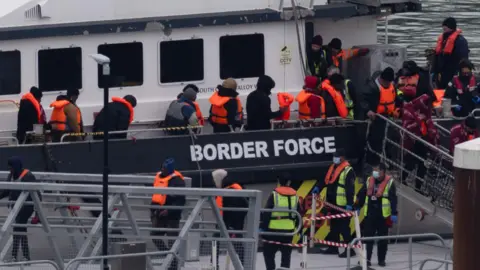
PA Media A group of people thought to be migrants are brought in to the Border Force compound in Dover, Kent, from a Border Force vessel following a small boat incident in the Channel. PA Media
Just over 41,000 people arrived in the UK by small boat in 2025

Two migrants have died attempting to cross the English Channel, French authorities have said.

Six others were rescued, with one of them taken to hospital requiring urgent care, after migrants got into difficulty boarding a boat near Calais on Wednesday morning.

The French maritime prefecture said the small boat was seen heading towards the beach at Gravelines at around 09:30 local time, where 30 migrants were waiting to board.

It comes a day after the UK and France extended talks over renewing a deal to try and stop small boats trying to the cross the Channel.

Responders pulled eight people onto a rescue boat when they got into difficulty, but two of them died.

A French naval helicopter was also deployed to carry out a search of the area to make sure no one was left in the water, the French authority said.

At least 12 French police officers were present in the beach area at the time.

Steve Smith, chief executive of refugee charity Care4Calais, said the two people who died had been "lost to our deadly border".

On Tuesday, the UK signed a two-month extension on a £476m deal made with France by the previous government for extra patrols to disrupt migrant smuggling gangs.

The agreement had been due to expire, but talks on renewing the deal were extended by two months to thrash out an agreement.

It means operational contracts will continue to be funded, costing the UK £16.2m.

A Home Office spokesperson claimed Home Secretary Shabana Mahmood was "driving a hard bargain".

The home secretary is understood to be pushing for the new arrangement to include performance-related clauses that would link funding to the proportion of boats intercepted by the French.

Under the current deal, nearly 700 law enforcement officers are on the ground patrolling beaches, using drones and buggies to stop people getting on boats.

The UK government claims the deal has prevented 42,000 illegal migrants getting on boats, although the overall number making the journey across the Channel has continued to increase.

Over the past three years, crossings in the Channel have increased, with 41,472 people arriving in the UK by small boat in 2025.

Between 1 January and 26 March 2026, a total of 4,441 people crossed the English Channel by small boat from France.

This is 33% lower than the number who had reached the UK by this point in 2025, which was 6,642, although weather conditions may have played a part in this, with rougher conditions in the Channel compared with the same period in 2025.

Scott Mills confirms he was investigated by police in first statement since sacking

BBC Scott Mills leaning into the microphone in the Radio 1 studio with headphones on. BBC

Presenter Scott Mills has confirmed he was investigated over a sexual offence, in his first statement since he was sacked from the BBC over allegations relating to his personal conduct.

In a statement, Mills said the announcement of his sacking had led "to the publication of rumour and speculation".

It comes after it emerged the police launched an investigation into Mills in 2016 before closing it in 2019 after prosecutors decided there was insufficient evidence to bring charges.

Mills said he had "fully cooperated and responded" to the investigation at the time, and thanked "from the bottom of my heart all those who have reached out to me with kindness" including his listeners and former colleagues.

The allegations, first published in the Mirror, are reported to have happened between 1997 and 2000, police said, when Mills would have been in his mid-20s.

On Tuesday, the Metropolitan Police told BBC News that they had investigated Mills for serious sexual offences against a teenage boy who was under the age of 16.

In a statement on Wednesday afternoon, the 53-year-old said: "The recent announcement that I am no longer contracted to the BBC has led to the publication of rumour and speculation.

"In response to this the Metropolitan Police has made a statement, which I confirm relates to me.

An allegation was made against me in 2016 of a historic sexual offence which was the subject of a police investigation in which I fully cooperated and responded to in 2018.

"As the police have stated, a file of evidence was submitted to the Crown Prosecution Service, which determined that the evidential threshold had not been met to bring charges.

"Since the investigation related to an allegation that dates back nearly 30 years and the police investigation was closed 7 years ago, I hope that the public and the media will understand and respect my wish not to make any further public comment on this matter."

He added: "I wish to thank from the bottom of my heart all those who have reached out to me with kindness, my former colleagues, and my beloved listeners, who I greatly miss."

The announcement that the former presenter had been sacked by the BBC caused shock among listeners, and led to mounting pressure on the broadcaster to explain what led to his sudden departure.

Earlier on Wednesday, the BBC confirmed it knew about the sexual offences investigation in 2017.

But in a statement, a spokesperson added that the Radio 2 presenter was sacked after "new information" about his conduct came to light in recent weeks.

It said it was "doing more work to understand the detail of what was known by the BBC" at the time.

Travelodge boss was sent email by sex assault victim

In Sunday's interview with the BBC, Travelodge chief executive Jo Boydell says she only became aware of the assault during the court case almost three years later

Travelodge's chief executive was sent a "serious complaint" on email by the victim of a sexual assault in one of its hotels - carried out by a man given the key card to her room - soon after the attack, despite the boss saying she only found out years later.

Kyran Smith entered the woman's room at a hotel in Maidenhead, Berkshire, in December 2022 and was jailed in February this year.

On Sunday, Jo Boydell said she had only become aware of the attack during Smith's trial, which began in November 2025.

When the BBC asked Travelodge about the victim's email, sent in January 2023 one month after the assault, Boydell said it had been "handled on my behalf" and there had been "serious failures".

Smith, from Staines, Surrey, gained access to the woman's hotel room after lying to hotel staff that he was her boyfriend, and was jailed for seven-and-a-half years.

In the email sent to Boydell's Travelodge email address, and seen by the BBC, the victim wrote in detail in January 2023 about what had happened and the conversations that she had had with reception staff minutes after she woke up to Smith sexually assaulting her in her bed.

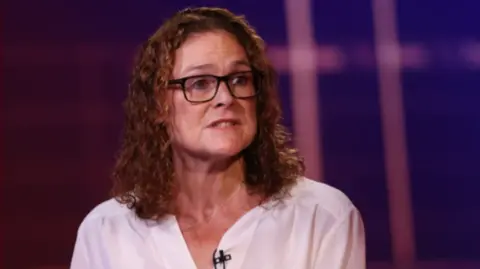
Getty A woman with curly hair and glasses wearing a white top speaking Getty
Travelodge chief executive Jo Boydell (pictured in 2023) says the company has since made changes to its security policies

'In tears'

"I was in tears, shock and absolutely appalled this happened," she wrote in the email, marked "serious complaint" and which Travelodge does not deny it received.

During Sunday's interview, Boydell told the BBC: "The first time I became aware of this was after the court reported the incident, which is completely unacceptable and also shows there are issues with the way we handled the case."

She also apologised, as she has done in previous statements, to the victim, both for the incident and how it was handled.

In the weeks following the attack, staff from the chief executive's office offered the victim a £30 refund, an offer that the victim said was "insulting".

Following the victim speaking with the BBC, Travelodge has committed to an independent review of their room security policies and has also made immediate changes to their door key policies, so that now the company will check with someone in the room before a new keycard is issued.

In a statement, Boydell said on Wednesday: "I am deeply sorry for the distress experienced by the survivor and I apologise for our handling of what happened to her.

"I have been very clear there were serious failures in our handling of every aspect of our response to her.

"The email sent by the survivor in January 2023 was handled on my behalf and I am clear this should never have happened."

She added: "Our response was deeply inappropriate and our processes did not work as they should have done in this instance because what happened was not escalated to me.

"We have conducted an internal review and made immediate changes to both our room security processes for additional key cards and our review and escalation processes since I became aware of what happened."

"I have commissioned an independent review led by a leading KC which is looking at every aspect of our handling of this case."

Thames Valley Police Kyran Smith mugshot. He has dark hair and dark stubble.Thames Valley Police
Kyran Smith was given the key card after lying to staff that he was the woman's boyfriend

Nearly 100 MPs signed a letter calling for Boydell to meet with MPs to discuss the incident and safety at the company.

The prime minister also wrote directly to her calling for her to meet with MPs.

Related internet links

Hunt for gunman who fled on e-bike after Bristol shooting

BBC Armed officers can be seen stood next to a black car on a residential road. Another police car is parked to the left and has its boot door open. There is a temporary traffic light in the foreground.BBC
Police officers are looking for a gunman who fired at a car, injuring a man in his 20s, before fleeing the scene

A search is under way for a gunman after a shooting left a man with potentially life-changing injuries.

Police said they were called to reports a gun had been fired at a car in Speedwell Road, Bristol, at 13:47 BST. A man in his 20s suffered serious injuries and was taken to hospital.

Avon and Somerset Police said the suspect fled the scene on a black and grey electric bike in the direction of Soundwell.

Four schools in the area were placed into precautionary lockdowns while the incident unfolded but have since begun to allow pupils to return home.

Police described the gunman as white, in his late teens or early 20s, of slim build, and about 1.8m (6ft) tall.

He was wearing a grey hoodie, black trousers, and a balaclava.

Neighbourhood Ch Insp James Clements gave an update to reporters

Ch Insp James Clements acknowledged the incident was "incredibly concerning" for people in the area and said police had deployed "significant resources" to find the gunman.

"We're doing everything we can to identify this person and arrest him," he added.

A police car is parked across a road and a police tape can be seen in the distance.
The shooting happened on Speedwell Road at about 13:47

Clements said there would be a significant police presence in the area over the coming days.

"Our neighbourhood officers fully recognise how concerning this incident is and if you have any concerns I would urge you to speak to them," he added.

Police have also appealed for any witnesses to come forward.

Schools locked down

The incident saw Bristol Brunel Academy, Two Mile Hill Primary and Chester Park Infant and Junior schools placed on precutionary lockdowns.

In a statement, Two Mile Hill Primary said: "We understand that this is very close to the end of the school day and may cause inconvenience, however, the safety and security of our pupils and wider community is our highest priority."

The father of a Year 6 pupil at Two Mile Hill said while it was a "pain" waiting outside, the school had kept parents updated and the children were "happy inside playing".

"It's not a nice situation for anyone," he added.

Follow BBC Bristol on Facebook, X and Instagram. Send your story ideas to us on email or via WhatsApp on 0800 313 4630.

Related internet links

CPS giving 'investigative advice' to police over Andrew and Mandelson probes

BBC Breaking NewsBBC

Prosecutors are providing "early investigative advice" to police forces as they carry out inquiries into Andrew Mountbatten-Windsor and Lord Peter Mandelson's links to sex offender Jeffrey Epstein.

A spokesperson for the Crown Prosecution Service (CPS) said: "We can confirm that we are now providing early investigative advice to the Metropolitan Police Service regarding the force's investigation into a 72-year-old man and will continue to liaise as requested.

"We can now also confirm that we are providing early investigative advice to Thames Valley Police in relation to a 66-year-old man."

Mountbatten-Windsor and Lord Mandelson have separately been arrested on suspicion of misconduct in public office over their connections to the paedophile and have both since been released under investigation.

Mountbatten-Windsor has repeatedly denied any wrongdoing in relation to Epstein.

Lord Mandelson has repeatedly let it be known that he believes he has not acted criminally.

This breaking news story is being updated and more details will be published shortly. Please refresh the page for the fullest version.

You can receive Breaking News on a smartphone or tablet via the BBC News App. You can also follow @BBCBreaking on X to get the latest alerts.

Stella McCartney's clifftop 'forever home' gets planning consent

Getty Images Alasdhair Willis and Stella McCartney pose for a picture while attending a British Fashion Awards event.Getty Images
Stella McCartney and Alasdhair Willis' plans were considered by Highland councillors

Councillors have approved plans by fashion designer Stella McCartney and her husband Alasdhair Willis for a clifftop home in the Highlands.

The proposals for a site on Loch Ailort, a sea loch west of Fort William, had received more than 65 objections.

Opponents raised concerns about the property's size, design and impacts on the landscape and wildlife.

A spokesperson for the couple said the stone walls and turfed roof would make it barely visible, and that the energy efficient house would be used as a "family, forever home".

McCartney and Willis' proposed site is in an area at Roshven on a rocky headland called Commando Rock which historically was used for military training.

A previous owner of the land had started work on a house in the early 2000s, but later abandoned the project leaving some low walls.

The couple's project overlaps some of the previous site, and avoids removing pine trees, which had been a cause of some objections.

Renewable energy would provide power to the new house.

McCartney, daughter of former Beatle Sir Paul McCartney, has established herself as one of the world's leading fashion designers.

She was awarded a CBE in recognition of her services to fashion and sustainability in 2022.

Willis is a creative director at clothing brand Adidas.

Brown & Brown Architects The property is single storey with stone walls and a turf roof.Brown & Brown Architects
Brown & Brown Architects A drone view of the site, a rocky shoreline on the loch with hills in the background.Brown & Brown Architects

Highland councillors were asked to consider amended plans for the property.
The site is in an area called Commando Rock.

Highland Council's south planning applications committee approved the plans on Wednesday, subject to a number of conditions.

They included measures to mitigate the impact of external lighting on the landscape due to the site's elevated position.

There was also a requirement that sewage and surface water drainage be handled away from the site's cliff edge.

A licence is also required from Scotland's nature body, NatureScot, due to the presence of otters in the area.

'Sympathetically designed'

Fort William and Ardnamurchan Green Party councillor Kate Willis asked that "strong" conditions be placed on the project.

But her request for a decision on the application to be deferred to allow for a site visit was not supported by other councillors.

Highland Independent councillor Thomas MacLennan said the property would sit "more comfortably" in the landscape than the previously consented property.

A spokesperson said the couple had sought to deliver a "highly sustainable home that has been sympathetically designed".

They said the property would use natural Scottish stone and have a turfed roof.

The spokesperson added: "It will be secluded and barely visible due to the site's contours, including views from the water.

"Unlike many of the homes in the area, this is not a holiday home; it is a house that the family will live in, our forever home.

"We look forward to continuing to engage with the local community as we progress our development and when we move into our new home."

Girls arrested as 'online trends' fuel disturbance

BBC An aerial view of a large group of people on Clapham High Street. A red bus is pulling away while an unmarked police car and a police van are on the road in front of it.BBC
Officers put a dispersal order in place on Clapham High Street on Tuesday

Two teenage girls have been arrested after a large crowd of young people caused anti-social behaviour in south-west London, the Met Police has said.

Officers were called to Clapham High Street on Tuesday evening and put a dispersal order in place to move the young people out of the area.

Two teenage girls were arrested on suspicion of assaulting an emergency worker and were taken to custody, the force said.

It added that officers would respond to any concerns from local residents and businesses.

Christine said she was walking with her husband and baby in Clapham High Street when she saw hundreds of young people, adding: "I think it took everyone by surprise."

She continued: "We weren't sure what was going on initially. There were a lot of police and police cars. You don't see that very often, even having such a heavy police presence was very unusual.

"It was clearly people up to no good. It was quite intimidating, especially with a new baby."

She added: "It's a great neighbourhood, I'm sure it's just a one off. The police were very good yesterday, it was reassuring to have so many around."

Giulia Marchetti A group of people, mostly in black clothing, standing together on Clapham High Street.Giulia Marchetti
One resident described the arrival of "hundreds" of people in the area as "intimidating"

Clapham resident Aisling said it was scary but added that any number of people in a big group was scary, no matter the age.

"Nobody wants to see violence in this area. I hope everyone in the shops and everyone passing by is okay."

She said the closure of shops was a "massive shame", adding: "They might have lost quite a lot of money from that. A lot of the staff are very frightened."

The force was contacted for further details.

Listen to the best of BBC Radio London on Sounds and follow BBC London on Facebook, X and Instagram. Send your story ideas to hello.bbclondon@bbc.co.uk

Related internet links

Officers investigated after black child suffers broken knee in police search

Getty Images a close up stock image of the back of a uniformed Metropolitan Police officerGetty Images
The investigation follows a complaint which was referred by the Met to the IOPC

Six Metropolitan Police officers are being investigated after a black child suffered a broken knee during a stop and search in north London, the police watchdog has said.

The boy, who was aged 16 at the time, was forced off his electric bike by an officer over concerns about his behaviour as he rode along Northumberland Park in Tottenham in April 2025, the Independent Office for Police Conduct (IOPC) said.

The IOPC launched an investigation in November, looking at the level of force used, whether race or the child's age was a factor in their treatment of him, and the aftercare provided to him.

The Met, which has been contacted for comment, made a mandatory referral to the IOPC of a complaint made on behalf of the boy about his treatment by officers.

Nothing was found in the search before officers removed the battery from his electric bike and told him he could leave.

But they returned a short time later and arrested him on suspicion of a racially aggravated public order offence, threats to kill and dangerous driving.

The officers attempted to take him into custody but this was refused and they were told to take him to hospital, where he was diagnosed with a fractured knee, according to the IOPC.

Since January, three police constables are being criminally investigated - one officer for potential offences of assault occasioning grievous bodily harm or actual bodily harm and the other two officers for intentionally encouraging or assisting an offence, contrary to section 44 of the Serious Crime Act 2007. They are also being investigated for potential gross misconduct.

A further three police constables are being investigated for potential misconduct in relation to alleged failures to challenge the conduct of the other officers and their treatment of the boy.

Body-cam footage

IOPC director Amanda Rowe said: "The use of stop and search is an important policing tool, however it must be used proportionately.

"This is a serious case where a child has been injured as a result of force being used and we are investigating the officers' actions in this case and their treatment of the child, who was not provided with immediate first aid.

"We have been in contact with the boy's family and obtained further evidence to assist our investigation. We will continue to keep all parties updated as the investigation progresses.

"As part of our investigation, we have viewed officers' body-worn video, obtained accounts from some of the officers involved, a statement from the boy and reviewed medical evidence.

"The officers will be interviewed under caution, and we are currently obtaining further witness statements."

Listen to the best of BBC Radio London on Sounds and follow BBC London on Facebook, X and Instagram. Send your story ideas to hello.bbclondon@bbc.co.uk

Over 100 driverless cars stop mid-traffic in Wuhan in 'system malfunction'

Reuters Two white driverless cars with black hoods are stationary on the road, one behind the otherReuters
Apollo Go is Baidu's robotaxi service operating in China

A mass robotaxi outage in the Chinese city of Wuhan caused at least a hundred self-driving cars to stop mid-traffic, sparking renewed debate around the safety of driverless vehicles.

Local police said initial findings suggested a "system malfunction" caused multiple vehicles to stop in the middle of the road on Tuesday.

Videos on social media have documented the outage, with one appearing to show it resulting in a highway collision, although police said no injuries had been reported and passengers exited their vehicles safely.

Baidu did not immediately respond to a request for comment.

According to the police statement, posted on social media site Weibo, the cause of the incident is still under further investigation.

Baidu operates its Apollo Go driverless taxi service in dozens of cities across the world, mostly in China.

In December 2025, ride-sharing apps Uber and Lyft announced partnerships with the Chinese technology giant to test its Apollo Go cars on UK roads, aiming to start trials in 2026.

However, both still need approval from regulators before they can begin the pilot programmes.

Reuters A view of a road at night time with a white and black car stopped in the middle of it - traffic continues further up the road.Reuters
Social media users posted photos and videos of Apollo Go cars stranded in the middle of the roads due to the outage

While driverless tech may be safer on average than human drivers, this incident showed it could "still go wrong in completely new ways," said Jack Stilgoe, professor of science and technology policy at University College London.

"If we're going to make good choices about this technology, we need to understand entirely new types of risk," he told BBC News.

The outage is not the first time self-driving cars have faced technical difficulties.

In December 2025, a large power outage in San Francisco led Waymo taxis to stop working around the city, causing huge traffic jams.

Meanwhile in August 2025, an Apollo Go robotaxi carrying a passenger in Chongqing fell into ​a construction pit.

A green promotional banner with black squares and rectangles forming pixels, moving in from the right. The text says: “Tech Decoded: The world’s biggest tech news in your inbox every Monday.”

Sign up for our Tech Decoded newsletter to follow the world's top tech stories and trends. Outside the UK? Sign up here.

Starmer holds off from emergency measures but warns storm is coming

Reuters Sir Keir Starmer looking reflective, as he prepares to address a Downing Street news conferenceReuters

Even if the US and Israel had not struck Iran just over a month ago, Sir Keir Starmer probably would have been giving a press conference today - and it would have contained much of the same content.

April has long been earmarked in government as a crucial moment for the prime minister to advertise various decisions made previously which take effect either today or next week, for example increases in minimum wage rates and the abolition of the two-child benefit cap.

As the prime minister acknowledged, these are not new announcements. And some of them will continue to be criticised by his political opponents as the wrong priority for limited government resources.

Still, it was striking to see the prime minister today redeploy these announcements as part of an argument for why the UK was well-placed to handle whatever the economic impacts of this conflict turn out to be.

Otherwise, though, this was a prime ministerial address peppered with gloomy language. Sir Keir spoke of a coming "storm", which may well be "fierce".

If the prime minister's message could be summarised in just one sentence, it was his admission that "this will not be easy".

Sir Keir was using that phrase to describe both the general economic impact of the Iran conflict and the particular difficulties in getting the Strait of Hormuz open again.

Indeed, at one point he warned that even if the conflict ends that does not necessarily mean the strait will reopen.

"This will not be easy" would also serve perfectly well as a description of the political impact of this conflict for the prime minister.

It is a simple statement of political fact that no government welcomes an economic shock. Historically - both in the 1970s and over the past few years - incumbent governments across the world have been punished by voters in such moments.

In that political context, the prime minister has made three big calls, all of them on display at today's press conference.

First, while talking up the gravity of the moment, he has decided not to respond with emergency measures.

Other than a package of support for those who use heating oil, the government is warning that any support for household energy bills will not come until the autumn.

The prime minister argues that households are protected, first, by the energy price cap for the next three months, and then by the fact that when the current cap elapses it will be the summer, when energy use is lower.

This is one of the areas where Sir Keir is coming under most criticism from other parties.

To his left, the Greens say he should commit billions to subsidise energy bills from July, while to his right the Conservatives and Reform UK say VAT should be removed from household energy bills now.

The Liberal Democrats want to change how renewable energy projects are funded to reduce bills. Plaid Cymru is calling for more support for households and businesses, while the SNP argues independence would allow Scottish minister to cut bills by reducing energy costs.

But household bills are just one element of this.

The prime minister has also resisted pressure, including from the Conservatives, Reform, the SNP and the Lib Dems, to introduce emergency measures to reduce fuel prices at the pump.

He insisted again today that the proposed increase in fuel duty in September was under review, but it is hard to find anybody in Westminster who believes this will go ahead. Some Labour MPs privately question why Starmer does not just say so now.

In holding off before taking action, the prime minister is putting himself out of step with some of his allies.

To take just one example, Australia - led by a Labour government from which this government often takes inspiration - has halved its fuel taxes.

On Tuesday, a member of the European Commission urged people to work from home, drive less, drive more slowly and fly less.

The UK government's messaging, while gloomy about the overall situation, is in starkly different place.

Reuters Australian Prime Minister Anthony Albanese reacts after delivering a pre-recorded address to the nation in his office at Parliament House, CanberraReuters
Prime Minister Anthony Albanese warns Australians the coming months 'may not be easy'

The second big call from Sir Keir is to embrace his disagreements with US President Donald Trump.

It's only a couple of months ago that the prime minister was still prioritising sticking close to the president as much as possible in order to protect the UK-US relationship.

That personal relationship has clearly ruptured in a serious way over Sir Keir's decision to resist US demands to play a bigger role in the war.

While insisting that the transatlantic alliance remains strong in terms of security and intelligence cooperation, the prime minister today emphasised, as he has done several times in recent days, that "this is not our war".

The third big call is related and formed a surprisingly prominent part of today's press conference: to use this moment to seek closer ties with the EU.

We already knew that there was going to be a second annual UK-EU summit in a month or two's time, and we already knew that the UK government hoped to use it not only to complete existing negotiations on areas of cooperation but also to seek deeper ties in other areas.

But Sir Keir's decision to emphasise it in today's press conference, called in the context of a spiralling conflict about which the UK and the US profoundly disagree, was deliberate and meaningful.

Having stressed the economic impact of the Iran conflict, the prime minister then stressed the economic dividends he hopes to secure from a closer post-Brexit relationship.

Notably, he said that Labour's 2024 general election manifesto still stood, which is to say the commitments that the UK would neither rejoin the EU's customs union or its single market.

But it feels increasingly like the government wants to get as close as possible to single market membership as it can from outside the bloc.

Of course, former Conservative prime minister Theresa May wanted that once too, but the EU resisted "cherrypicking" - the idea that the UK could have what it saw as the benefits of the single market (economic cooperation through shared regulations) without what it saw as the drawbacks (the free movement of people).

Those questions about economic support, the UK-US relationship and post-Brexit ties with Europe will now be at the heart of British politics as this storm gathers pace.

Thin, red banner promoting the Politics Essential newsletter with text saying, “Top political analysis in your inbox every day”. There is also an image of the Houses of Parliament.

Sign up for our Politics Essential newsletter to keep up with the inner workings of Westminster and beyond.

Bland or fan love letter? The Super Mario Galaxy Movie draws mixed reaction

Universal Pictures Cartoon characters Mario, Luigi, Princess Peach and Yoshi are flying through the sky towards the camera. Luigi is wearing a green cap with a white L and green long sleeved top and overalls, he has a mustache and blue eyes. Mario is wearing the same but in red, with an M on his cap. He is riding Yoshi; a cartoon green dinosaur with a red shell and large round nose. Peach is blond and is wearing a gold crown with a pink gown on. Universal Pictures
The Super Mario Galaxy Movie is the sequel to 2023's Super Mario Brothers Movie

He's-a back!

The most famous plumber in the world returns to cinemas this week with a sequel to the mega-successful Super Mario Brothers Movie.

It has been three years since Nintendo's mustachioed mascot appeared alongside brother Luigi, Princess Peach and their nemesis Bowser, making more than $1.3bn (almost £1bn) worldwide.

The Super Mario Galaxy movie, named after the Wii game of the same name, moves the action to space and adds beloved characters Yoshi and Rosalina to the cast.

Reviews of the new release are mixed, with some critics praising its imagination and pace, but others are saying it falls flat compared to the first film.

What is Super Mario Galaxy about?

Super Mario Galaxy picks up where the first film left off, with Bowser (voiced by Jack Black) imprisoned by brothers Mario and Luigi after being shrunk to pocket-sized.

When his son Bowser Jr., voiced by filmmaker and actor Benny Safdie, stages a breakout, it sparks an intergalactic chase.

Along the way, Mario and Luigi befriend dinosaur Yoshi, voiced by actor and musician Donald Glover (aka Childish Gambino), and Rosalina, a princess voiced by Captain Marvel star Brie Larson.

Anya Taylor-Joy reprises her role as Princess Peach, and Wednesday star Luis Guzmán plays Wart - the main enemy from 1988 NES game Super Mario Bros 2.

Other characters from Super Mario Galaxy, widely considered one of the greatest video games ever released, also feature in promotional material for the film.

They include Lumas - glowing star-shaped characters that players encounter throughout the game.

Universal Pictures Mario is wearing a red cap with a red M and red long sleeved top and blue overalls, he has a mustache and blue eyes. Luigi is wearing the same but in green, with an L on his capUniversal Pictures
Mario and Luigi are back - and trying to save the day

What do reviews say?

The first Mario movie didn't get much love from critics, with a score of just 59%, based on 288 reviews, on film and TV review website Rotten Tomatoes.

But audiences loved it, helping to make it the second-biggest film of 2023, just behind the Barbie movie.

This time, the critical reaction has been around the plot and how it struggles to stay connected throughout the film.

The Guardian called the film a "bland screensaver of a movie" and gave it a one star rating, while The Independent gave it a slightly higher two stars but also lamented its "blandness".

One of the biggest complaints about the original movie from fans was the inclusion of various pop and rock songs on the game's soundtrack.

Many felt hits from the likes of Beastie Boys, AC/DC and Bonnie Tyler didn't fit well with the Mario Universe.

However, entertainment reporter Jonathan Sim says Galaxy pulls things back, which allows composer Brian Tyler's "excellent musical score" to take centre stage.

Sim adds that the cosmic film is a "gorgeously animated love letter to Mario fans".

Gaming content creator Sophie Keen, known online as Cadaea, told BBC Newsbeat that she feels The Super Mario Galaxy Movie is a good additional storyline for fans to enjoy.

"I see it as a nice extra", says Keen.

Keen says she actually preferred Galaxy to the first film as it has "loads of funny moments" alongside "cute, wholesome moments".

"If you like the first film, you probably will like the second," she explains.

"The only thing I really want people to know is that it's not a perfect 100% adaptation of the game.

"Don't expect the exact same plot to come out, just take it as a nice addition to Mario lore."

Universal Pictures Cartoon character Toad; a human mushroom, he has a red and while hat, he is looking at Yoshi; a cartoon green dinosaur with orange shoes and Luigi; a cartoon man wearing a green cap with a white L and green long sleeved top and overalls, he has a mustache and blue eyes. Universal Pictures
The film sees characters embark on an intergalactic chase

Nintendo's future

Nintendo is arguably the world's most famous video game company, but in recent years it's been moving into other forms of entertainment.

After both Mario movies, a film based on the Legend of Zelda is due to be released next year, and there appear to be plans for an animation based on Donkey Kong.

The company has also opened Mario-themed attractions at several Universal Studios resorts, as well as a string of Nintendo-branded merchandise stores in Japan and the USA.

It still makes most of its money from video games, but some fans have been upset at the lack of a brand new 3D Mario game this year.

For Keen, she thinks the movie is a "nice way to keep the fans happy" whilst they wait for the next game release.

Additional reporting by Tom Richardson and Peter Gillibrand

A footer logo for BBC Newsbeat. It has the BBC logo and the word Newsbeat in white over a colorful background of violet, purple and orange shapes. At the bottom a black square reading "Listen on Sounds" is visible.

Listen to Newsbeat live at 12:45 and 17:45 weekdays - or listen back here.

BBC knew about Scott Mills sexual offences investigation in 2017

BBC Radio presenter Scott Mills in a green shirt against an orange backdropBBC

The BBC knew about a police investigation into DJ Scott Mills in 2017, the corporation has confirmed.

But the Radio 2 presenter was sacked after "new information" about his conduct came to light in recent weeks, the BBC said.

Mills was previously questioned by police over historical allegations of serious sexual offences, but no charges were brought after prosecutors decided in 2019 there was insufficient evidence to proceed with the case.

Mills has not yet responded to repeated requests for comment.

BBC News understands that the director general at the time of the police investigation, Tony Hall, did not know about the allegations.

The BBC's statement on Wednesday came after mounting pressure on the broadcaster to explain what led to the Radio 2 DJ's sudden departure.

In a statement, a BBC spokesperson said: "Scott Mills had a long career across the BBC, he was hugely popular and we know the news this week has come as a shock and surprise to many.

"We also recognise there's been much speculation in the media and online since Monday. We hope people understand that there is a limit to what we can say because we have to be mindful of the rights of those involved.

"What we can confirm is that in recent weeks, we obtained new information relating to Scott and we spoke directly with him. As a result, the BBC acted decisively in line with our culture and values and terminated his contracts on Friday 27 March."

The spokesperson added: "Separately, we can confirm the BBC was made aware in 2017 of the existence of an ongoing police investigation, which was subsequently closed in 2019 with no arrest or charge being made. We are doing more work to understand the detail of what was known by the BBC at this time."

The statement concluded that the BBC has made "a significant commitment to improve its culture, processes and standards".

"Last year, following an independent culture review, we set out the behavioural expectations for everyone who works with or for the BBC and we were clear action would be taken if these were not met."

On Monday, it was announced that the former Radio 1 presenter had been sacked by the BBC over allegations related to his personal conduct.

The allegations, first published on Monday by the Mirror, relate to the period between 1997 and 2000, police said, when Mills would have been in his mid-twenties.

On Tuesday, the BBC apologised for not looking into a separate allegation of "inappropriate communications" involving Mills, first reported in the Telegraph, raised by a freelance journalist last year.

UK will seek closer ties with EU in light of Iran war, Starmer says

Reuters Sir Keir Starmer gives a news conference from a wood panelled room in front of a Union Jack.Reuters

The UK will pursue closer economic ties with the European Union in light of the war in Iran, Sir Keir Starmer has said.

The prime minister told a news conference he would use a summit with the EU later this year to seek more cooperation with the bloc on the economy and security.

It comes as relations between the US and the UK have been increasingly strained by the PM's refusal to be drawn further into the war with Iran.

In his speech, Sir Keir warned the conflict would impact the UK but sought to reassure the public the government was taking action to ease the cost of living.

The PM is facing calls from opposition parties to set out now how the government plans to protect people from rising energy costs.

The Conservatives and Reform UK are both calling for VAT to be taken off household energy bills, while arguing the hike in fuel duty scheduled for September should be cancelled.

The Liberal Democrats are also calling for the increase not to go ahead, while the Greens say the government should commit billions of pounds now to subsidise energy bills from July, when the price cap is recalculated.

Plaid Cymru said the government should set out now what support would be available if energy bills rise, while the SNP argues Holyrood should control energy policy.

Sir Keir said: "No matter how fierce this storm we are well-placed to weather it and we have a long-term plan to emerge from it a stronger and more secure nation."

He highlighted a number of measures coming into force from this month aimed at easing the cost of living, including removing some green levies from energy bills and increasing the national living wage.

The PM insisted the government had been "ahead of the game" in its focus on the cost-of-living.

However, the Organisation of Economic Co-operation and Development has warned the UK is facing the biggest hit to economic growth from the war out of major economies.

Asked if he would reassure motorists that the increase in fuel duty would not go ahead, Sir Keir said the rate remained set until September.

He added that support for households would be kept under review but "a lot will depend on how long the conflict goes on" and how quickly the Strait of Hormuz can be reopened.
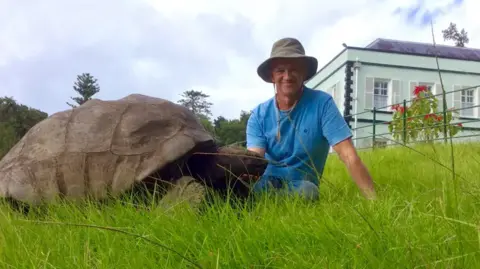
Meanwhile, the foreign secretary is hosting 35 nations - including European and Gulf counties - on Thursday.

The PM said the meeting would discuss possible measures to make the Strait of Hormuz "accessible and safe after the fighting has stopped".

He added that "this will not be easy" but said it was in the UK's national interest for the strait to reopen.

Iran has effectively blocked the strait - one of the world's busiest oil shipping channels - leading to soaring wholesale oil and gas prices.

A sustained rise in the price of oil is likely to lead to a jump in household energy bills in the UK, when the current cap is reset in July.

The PM and Chancellor Rachel Reeves have made a number of interventions in recent months arguing for a closer trading relationship with the EU.

However, Sir Keir argued that this was more urgent because of the impact of the US-Israel conflict with Iran.

"It is increasingly clear that as the world continues down this volatile path, our long-term national interest requires closer partnership with our allies in Europe and with the European Union," he said.

He added that Brexit "did deep damage to our economy" and "the opportunities to strengthen our security and cut the cost of living.... are simply too big to ignore".

A UK-EU summit is expected this summer, after the two sides struck a deal last May on areas including fishing rights, trade, defence and energy.

Sir Keir said this year's summit "will not just ratify existing commitments made at last year's summit" but would be "more ambitious".

The PM was asked if the UK was heading towards rejoining the EU single market, which enables goods, service and people to move freely between member states, with countries applying many common rules and standards.

"I do think that we should strengthen our cooperation on defence, security, energy, emissions and the economy," he replied.
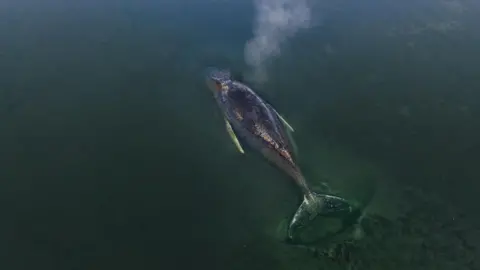
"I'm ambitious that we can do more in relation to the single market, because I think that's hugely in our economic interests."

However, he said Labour's election manifesto commitment that there would be no return to the single market, the customs union or freedom of movement remained.
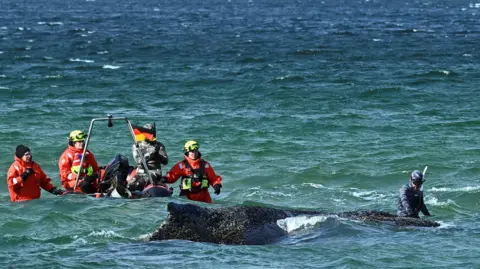
Pressed over whether he was choosing Europe over the US, Sir Keir insisted: "I'm not going to choose because I think it's in our interest to have a strong relationship with the US and with Europe."

He argued that closer ties with Europe would strengthen the UK's relationship with the US as well, since successive US presidents had been pushing for Europe to do more on defence and security.
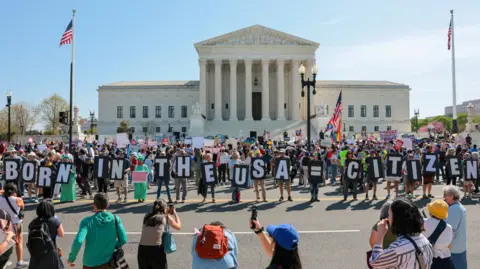
President Donald Trump has repeatedly criticised Sir Keir in recent weeks, following his refusal to allow the US to use UK bases for its initial offensive strikes against Iran.

The UK has since given permission for its bases to be used for defensive action against Iranian missile strikes.

Asked about the remarks, Sir Keir said the UK was "fully committed to Nato", which he described as "the single most effective military alliance the world has ever seen".

He added: "Whatever the pressure on me and others, whatever the noise, I'm going to act in the British national interest in the decisions that I make.

"That's why I've been absolutely clear that this is not our war and we're not going to get dragged into it."

Thin, red banner promoting the Politics Essential newsletter with text saying, “Top political analysis in your inbox every day”. There is also an image of the Houses of Parliament.

Sign up for our Politics Essential newsletter to keep up with the inner workings of Westminster and beyond.

Mass robotaxi malfunction halts traffic in Chinese city

Reuters Two white driverless cars with black hoods are stationary on the road, one behind the otherReuters
Apollo Go is Baidu's robotaxi service operating in China

A mass robotaxi outage in the Chinese city of Wuhan caused at least a hundred self-driving cars to stop mid-traffic, sparking renewed debate around the safety of driverless vehicles.

Local police said initial findings suggested a "system malfunction" caused multiple vehicles to stop in the middle of the road on Tuesday.

Videos on social media have documented the outage, with one appearing to show it resulting in a highway collision, although police said no injuries had been reported and passengers exited their vehicles safely.

Baidu did not immediately respond to a request for comment.

According to the police statement, posted on social media site Weibo, the cause of the incident is still under further investigation.

Baidu operates its Apollo Go driverless taxi service in dozens of cities across the world, mostly in China.

In December 2025, ride-sharing apps Uber and Lyft announced partnerships with the Chinese technology giant to test its Apollo Go cars on UK roads, aiming to start trials in 2026.

However, both still need approval from regulators before they can begin the pilot programmes.

Reuters A view of a road at night time with a white and black car stopped in the middle of it - traffic continues further up the road.Reuters
Social media users posted photos and videos of Apollo Go cars stranded in the middle of the roads due to the outage

While driverless tech may be safer on average than human drivers, this incident showed it could "still go wrong in completely new ways," said Jack Stilgoe, professor of science and technology policy at University College London.

"If we're going to make good choices about this technology, we need to understand entirely new types of risk," he told BBC News.

The outage is not the first time self-driving cars have faced technical difficulties.

In December 2025, a large power outage in San Francisco led Waymo taxis to stop working around the city, causing huge traffic jams.

Meanwhile in August 2025, an Apollo Go robotaxi carrying a passenger in Chongqing fell into ​a construction pit.

A green promotional banner with black squares and rectangles forming pixels, moving in from the right. The text says: “Tech Decoded: The world’s biggest tech news in your inbox every Monday.”

Sign up for our Tech Decoded newsletter to follow the world's top tech stories and trends. Outside the UK? Sign up here.

Devastated Italians reckon with 'third apocalypse' of World Cup failure

Getty Images A defeated Pio Esposito Getty Images
Pio Esposito missed the first penalty in Italy's shootout defeat in Bosnia

Leaning against a wall near a news-stand in central Rome, Tommaso Silvestri, 65, scans the morning's front pages, their headlines swinging between "apocalypse," "scandal" and "disaster" after Italy's latest footballing collapse.

"We've made a real mess of it," he says, shaking his head. "We had players who couldn't even find the target."

"The golden days of Italian football are well and truly gone."

On Tuesday night in Zenica, four-time World Cup winners Italy failed to qualify for the tournament for a third consecutive time, losing 4-1 on penalties to Bosnia and Herzegovina after being reduced to 10 men before halftime.

Since winning the World Cup in 2006, the Azzurri have largely disappointed in international tournaments - with the exception of their surprise victory at the Euros in 2021 against England at Wembley.

"We are what our results say we are," Silvestri said. "When you shoot and can't even hit the goal, you're not going to go far. When it comes to taking the game home, Italy just doesn't get there anymore."

Last night's defeat drew swift and emotional reactions across Italian politics and society.

"Everything has a limit," lamented Ignazio La Russa, president of the Senate and a senior figure in Prime Minister Giorgia Meloni's far-right Brothers of Italy party.

In a post on X, he wrote: "We're not going to the World Cup. We supported them, we hoped, we even railed against a couple of questionable refereeing decisions... but deep down we feared it. In fact, we knew it."

Gomorrah author and anti-mafia writer Roberto Saviano also weighed in, pointing to deeper structural failures in Italian football, from governance to youth development.

"Clubs are corrupt and at the mercy of criminal organisations. True laundering vaults. No investment in young players, no care for second-generation talent. It's easier to buy foreign players than to develop new athletes," he said in a post on Instagram.

Getty Images Italian players celebrating the 2021 winGetty Images
Italy won the Euros at Wembley in 2021

Across Italy, a legendary football nation with a rich history of producing world-class talent, many are wondering what went wrong. Giovanni Colli, 71, rolling his eyes while sipping an espresso at a café near the Pantheon, says he feels "betrayed."

"Not going to the World Cup three times in a row, how on earth did it happen? What a huge disappointment. Everyone should resign. Give the young players a chance," he says.

Italy's World Cup heartbreak was crystallised in the tear-streaked face of coach Rino Gattuso, who struggled to hold back his emotions after the national team's defeat.

"We don't deserve this, it's not fair. I'm sorry I couldn't make it happen," Gattuso said, eyes glistening, before retreating to the dressing room.

The legendary 2006 World Cup-winning midfielder was only given the job of coach last June.

Despite the disappointment, Gattuso expressed pride in his players: "I'm proud of my boys and what they gave on the pitch."

The match, decided on penalties after Italy were reduced to 10 men following Alessandro Bastoni's early red card, gave a brief moment of hope to Italians with Moise Kean's goal, only for it to end in dismay.

Getty Images Rino Gattuso with grey hair and a beardGetty Images
"I'm sorry I couldn't make it happen," coach Gattuso said after Tuesday's defeat

Gattuso admitted the team's shortcomings: "When you have chances and don't take them, football punishes you."

Reflecting on their elimination, he added: "This hurts. We gave everything we could. It's a real shock."

Sport journalist Elisabetta Esposito of La Gazzetta dello Sport told the BBC that Italian football was facing a difficult period - one that would take time to overcome, during which loyalty to individual clubs was outweighing support for the national team.

"The risk is that this third consecutive failure to qualify will deepen young people's disengagement from the Azzurri," she said.

"The disappointment is profound, but the country is not only disappointed but almost disillusioned. It's as if a new generation no longer knows what it means to cheer for their country."

Reflecting on Tuesday's match, Esposito added: "From a technical standpoint, everything went wrong. The team hasn't worked together enough. Rebuilding will require a long-term strategy, chasing immediate wins with rushed decisions won't succeed."

On a busy street in central Rome, 56-year-old Teresa is walking her dog among tourists and commuters rushing to work.

"Oh, we are not going to the World Cup?" she asks. "I don't know much about football, but that's a bit of disaster, isn't it?"

Brazil judge blocks Sugarloaf Mountain zipline

Emin Sansar/Anadolu via Getty Images A view of Sugar Loaf cable car at Guanabara Bay in November 2024. The steep rocky mountain can be seen against the blue of the bay. At the top of the mountain, the cable car station is visible. 
Cables connect it with Morro da Urca, from which the photo is taken. A cable car can be seen suspended halfway between the two. Emin Sansar/Anadolu via Getty Images
A cable car has been linking Morro da Urca and Sugarloaf Mountain since 1912. The zipwire was planned to run parallel to it.

A judge in Brazil has blocked a project to build a zipline connecting the famous Sugarloaf Mountain in Rio de Janeiro to a nearby hill, Morro da Urca.

The attraction's developer said it would allow visitors to descend from Sugarloaf Mountain at speeds of almost 100km/h (62mph) via four ziplines covering a distance of 755m (0.47 miles).

The project - which started four years ago - had triggered protests from locals and environmentalists, who argued that the construction work was causing irreparable damage to the Unesco World Heritage Site.

The developer is expected to appeal against the decision.

CARL DE SOUZA/AFP via Getty Images A number of people of different ages, some of them holding placards and signs, clap during a protest held at the foot of Sugarloaf Mountain in Rio de Janeiro in March 2023. One sign reads in Portuguese "No to the zipwire" while another reads "A paradise which can't become a private enterprise".CARL DE SOUZA/AFP via Getty Images
Locals and environmentalists organised protests against the project

Gricel Osorio Hor-Meyll, one of the activists who had led the campaign against the zipline told AFP news agency that the ruling was "a huge victory".

Those opposed to the attraction argued that in order to build the platforms needed to access the zipline, the rock on top of Sugarloaf Mountain would have to be excavated.

The company which manages the site said that excavation would be kept to a minimum by using areas with existing construction.

The project had the approval of both Rio City Council and the National Historical and Artistic Heritage Institute (IPHAN).

As part of Tuesday's ruling, the judge ordered that IPHAN and the project's developer pay 30m reals ($5.77m, £4.35m) in damages, stressing the "inestimable value of Sugarloaf Mountain, not only for Brazilians but for people worldwide".

The project has been at the centre of a legal battle for years and construction had been halted on a number of occasions as the company argued its case in court.

In January, construction work restarted after the high court had ruled that stopping would cause more damage than finishing the project at this late stage.

It added that the project was 95% completed.

That decision has now been overturned by Tuesday's ruling.

However, the legal saga is likely to continue with the company behind the project expected to lodge an appeal.

❌