Reading view

There are new articles available, click to refresh the page.

Lawn mowing and power washing: Why millions are playing cathartic video games

FuturLab An in-game screenshot of the game PowerWash Simulator 2. It shows a first-person perspective of someone cleaning the red and white sign of a gas station outside that reads "Lone Station" and "Open 24/7" with a large green cactus as the pole. They are using a grey and blue power washer and have orange gloves. The sign is next to a gas station which is covered in dirt. FuturLab
PowerWash Simulator 2 has been nominated for two Bafta Games Awards

PowerWash Simulator sees players don their cleaning gear and hose down a variety of filthy in-game locations until they're sparkling and spotless.

While it may seem like an unusual premise, the original game from 2021 has sold more than 17 million copies. The sequel, released in 2025, has just been nominated for two Bafta Games Awards.

Both fall under the category of "mundane job simulations", an ever-growing gaming genre in which people carry out routine and - on the face of it - not very exciting tasks.

"We want to make the Graham Norton of video games," says Kirsty Rigden, the chief executive of Brighton-based FuturLab, which makes PowerWash Simulator.

Aspiring to emulate a talkshow host who has a reputation for being affable rather than for setting pulses racing is perhaps an unusual ambition for a gaming studio.

But she says there is a big market for lower-octane entertainment.

"Graham Norton doesn't make you feel stupid, but you also don't have to think too hard," Rigden told BBC News.

"It engages the right amount of brain and at the end of it you go, 'Oh, that was really pleasant'."
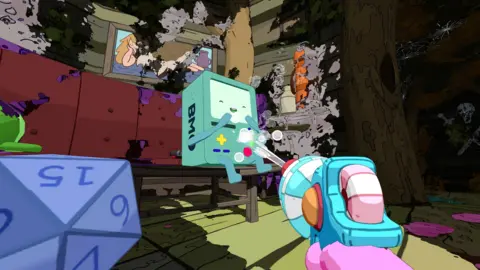
Futurlab An in-game screenshot from the game PowerWash Simulator 2. We see a first-person perspective of the player using a blue and white pressure washer to spray the robot console character BMO from Adventure Time, who is laughing. The rest of the room is covered in dirt on the walls.Futurlab
PowerWash Simulator 2's added content sees players get to clean up the cartoon world of Adventure Time

One of the core characteristics of the simulation genre is its soothingly repetitive jobs.

In PowerWash Simulator's case that means cleaning through one mucky area - say, a fun house or a roller disco - after another; quite literally rinse and repeat.

"I think it's really struck a chord with how people are feeling in the world right now - the world is in quite a stressy place," Rigden said. "With the game you are able to focus in on one thing, which kind of blocks all the other distractions out - it's a pure form of meditation."

The initial idea came from a personal interest Rigden had in watching YouTube videos of people power washing and the "simplicity of seeing dirt turn to cleanliness".

Kirsty Rigden A headshot of the CEO of FuturLab, Kirsty Rigden. She is smiling looking off the camera with her mouth open and has grey hair with purple strands. She is wearing a grey top.Kirsty Rigden
Kirsty Rigden is the CEO of FuturLab, which makes the PowerWash Simulator series

Social media is awash with influencers - some with hundreds of thousands of followers - making content about cleaning or clearing up, and FuturLab's series is not the only simulator to have tapped into the trend.

In Lawn Mowing Simulator players "experience the beauty and detail of mowing the Great British countryside" by running a lawn care business, using "real-world licensed lawnmowers".

A sequel, promising to take players to the "trailer parks and town hall gardens" of America, is currently in the works.

David Harper, managing director and founder of Liverpool-based developers Skyhook Games said players often use the game as an "escape" from the pressures of everyday life.

"It's basically about the satisfaction of starting with something untidy, learning the skills to bring order to the scene, then looking back at a job well done," he said.

Skyhook Games An in-game screenshot from the game Lawn Mowing Simulator 2. It shows an organe American lawn mower on a pathway next to a lawn of green grass. The American flag flies from a straight grey pole on the lawn and behind it is a grey house, surrounded by trees with orange and yellow leaves.Skyhook Games
Lawn Mowing Simulator 2 will take players to the "trailer parks and town hall gardens" of America.

The relaxed nature of mundane job simulators has made them a particular hit with YouTubers and Twitch streamers, who can strike up a conversation with viewers without needing to pay too much attention to the game.

A video of US creator Markiplier playing PowerWash Simulator from 2021 now has more than nine million views.

Comedian and games journalist Ellie Gibson started streaming the game to her Twitch community after a friend recommended she try it.

She also holds the Guinness World Record for the longest time playing PowerWash Simulator - an impressive 24 hours, six minutes and 33 seconds.

The attempt went relatively smoothly, she explains, apart from a "nightmarish" section when cleaning a kid's playground at four in the morning where the game's bright primary colours affected her in "a very psychedelic way".

But she added the "calming and soothing" nature of the game is similar to what she imagined "people get from colouring books or knitting".

The only difference?

"You get the finished result of a clean monster truck, rather than a scarf."
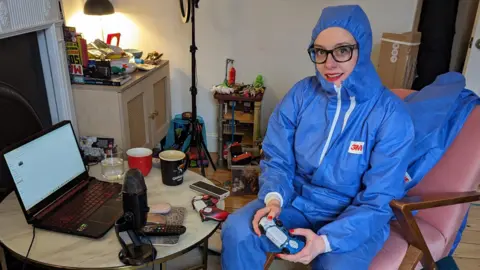
Helen Thorn The comedian Ellie Gibson, who is sitting down inside her flat and wearing glasses and is dressed up from head to toe in a light blue cleaning suit. She is holding a PlayStation controller and next to her on a desk is a small round table with a black microphone and open laptop as well as mugs of tea.Helen Thorn
Comedian Ellie Gibson holds the Guinness World Record for the longest time playing PowerWash Simulator

Both Rigden and Harper say they have had a number of people get in touch to tell them their games have helped them through difficult times.

"Hearing how our game has helped our players with their anxiety and mental health has been really rewarding to us," said Harper.

Meanwhile, Rigden said they had "lots of people writing in and saying how we've helped them get through things like cancer treatments."

"It's really lovely and uplifting."

PowerWash Simulator has even been the subject of an Oxford University study, which looked at whether video games affected players' wellbeing.

In March 2023, more than 8,600 players tracked their mood every 10 minutes with pop-up prompts while playing a custom build of the game.

The study found 72% of players experienced an uplift in mood while playing the game.

FuturLab An in-game screenshot from the video game PowerWash Simulator 2. We see a first-person perspective of the player using a pressure washer to spray water on a wooden house front which is very dirty. Another character dressed in blue cleaning gear is also spraying the house.FuturLab

While Nick Ballou, one of the researchers behind the study, said it was unlikely mundane job simulators would ever be comparable to something like therapy, he believed they still had a couple of "unique benefits".

"These games are particularly suitable for people with low energy, and they're really effective in absorbing attention," he said.

"I do think playing them can be more mindful than other games that require lots of cognitive engagement to coordinate with teammates or react in a split second."

As for Rigden and the team, there is a plan to make a game separate to the soapy empire they've currently worked up into a lather - as they continue their goal to become "the market leader in cathartic games".

Whatever the team work on next, there's one unique element which will undoubtedly remain - their unusual, yet perhaps fitting, Graham Norton ethos.

A green promotional banner with black squares and rectangles forming pixels, moving in from the right. The text says: “Tech Decoded: The world’s biggest tech news in your inbox every Monday.”

Sign up for our Tech Decoded newsletter to follow the world's top tech stories and trends. Outside the UK? Sign up here.
UN watchdog voices 'deep concern' as Iran reports new attacks on nuclear plant

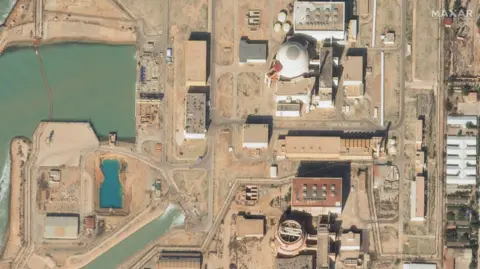
Reuters Satellite image from April 2025 shows various buildings from the Bushehr nuclear plantReuters
Satellite image of the Bushehr plant from before the start of the conflict

The area around Iran's Bushehr nuclear power plant has been attacked for the fourth time during the current war, Iranian officials say, as the US and Israel continue to target energy and other industrial sites.

One of the plant's employees was killed in the attack, Iran's Atomic Energy Organisation said. It blamed the US and Israel for the attack, but neither country has confirmed carrying it out.

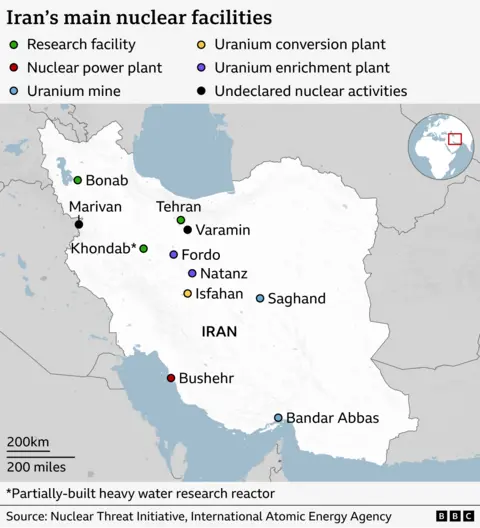
Bushehr is Iran's only operational nuclear power plant and was completed with Russia's help.

The International Atomic Energy Agency - the UN's nuclear watchdog - said it had been informed of the strike and had expressed "deep concern".

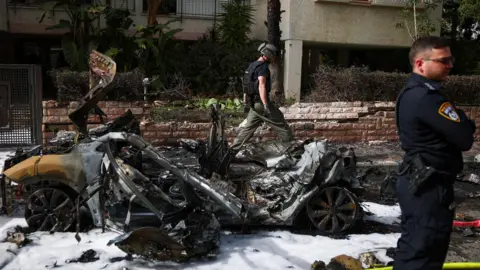
Reuters Uniformed member of Israeli security services stands in the right of the picture looking right. Beside him is the wreckage of a vehicle and behind it another man is walking.Reuters
Iran launched a barrage of missiles at central Israel on Saturday

"No increase in radiation levels was reported," it wrote on X.

It said nuclear power plant sites and nearby areas "must never be attacked" and called for "maximum military restraint" to avoid a nuclear accident.

On 27 March US President Donald Trump announced he was pausing attacks on energy plants for 10 days for Iran to "make a deal", and on Saturday he reiterated his threat on Truth Social that "all Hell will reign down on them" if they failed to do this, or to reopen the Strait of Hormuz, within 48 hours.

Meanwhile, Iran has continued to fire missiles at the Gulf States, Iraq and Israel, with falling debris from intercepted missiles causing damage.

And both Iranian and US forces are continuing to search for a missing American crew member after an F-15 fighter jet was shot down on Friday.

A pilot who was on board has been rescued, according to US media.

Map showing Iran's main nuclear sites

The Iranian statement on the Bushehr attack said the main parts of the plant did not appear to be damaged and its operation was "not affected".

Moscow has evacuated many of its staff from the plant. The head of Russia's state nuclear corporation, Rosatom, Alexei Likhachev, said on Saturday that the evacuation of 198 people remaining in the plant had started that morning.

Iran's nuclear programme has long been a point of contention, leading to extensive international sanctions. The US-Israeli war with Iran began on 28 February, two days after a third round of indirect US-Iran nuclear talks in Geneva.

Iran's Foreign Minister Abbas Araghchi warned against precipitating a major accident, which would "end life" in Gulf Arab states allied to the US.

He wrote on social media: "Remember the Western outrage about hostilities near Zaporizhzhia Nuclear Power Plant in Ukraine? Israel-U.S. have bombed our Bushehr plant four times now."

EPA A woman in a red top carrying a microphone walks through debris in front of a damaged building at the Shahid Beheshti University, in Tehran.EPA
Tehran's Shahid Beheshti University was attacked on Friday, Iran said

Meanwhile a local Iranian official said that the Mahshahr petrochemical complex and the Bandar Imam petrochemical company in south-western Iran had also been targeted. Five people were injured in the attacks.

And Iranian Science Minister Hossein Simai Sarraf said that more than 30 universities across Iran had been hit by strikes since war broke out.

Visiting Tehran's Shahid Beheshti University - which was attacked on Friday - he said the US and Israel belonged to the "stone age".

"A civilised country, a civilised government never targets institutions of knowledge, laboratories or research centres," he said.

Oxford women and Cambridge men win Boat Races

Oxford women and Cambridge men win Boat Races

Oxford's Kyra Delray and Esther Briz Zamorano celebrate after victory in the women's Boat RaceImage source, Getty Images
Image caption,

Kyra Delray and Esther Briz Zamorano helped Oxford's women to their first win in a decade

ByElizabeth Hudson
BBC Sport journalist
  • Published

Oxford claimed their first victory in the women's Boat Race since 2016 as Cambridge won their fourth consecutive men's race.

Oxford made a blistering start to the 80th edition of the women's race on the Thames in tricky and blustery conditions along the 4.3-mile course from Putney to Chiswick.

Cambridge were unable to respond as the Dark Blues stayed strong to win by 9.4 seconds and celebrate their 31st overall success.

"I'm overwhelmed and so happy and proud," Olympic bronze medallist Heidi Long, who was leading the Oxford crew in her second Boat Race, told Channel 4.

"It was absolutely incredible and amazing."

It was a particularly sweet victory for Annie Anezakis and Sarah Marshall who had been part of three losing boats, and for Lilli Freischem whose younger sister Mia was part of the Cambridge boat.

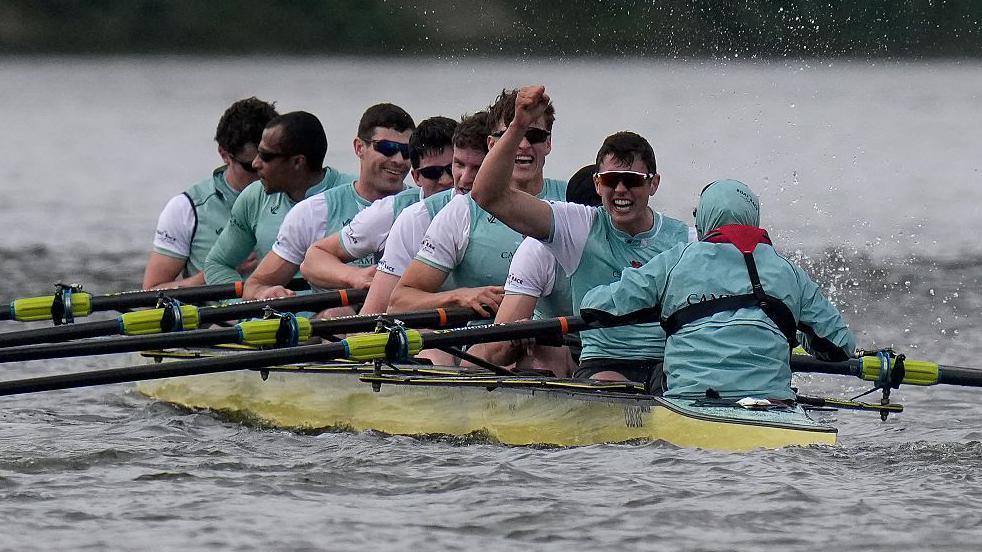
Cambridge celebrate victory in the men's Boat RaceImage source, Getty Images
Image caption,

Cambridge made the better start and then pulled well clear in the final third of the race

The Cambridge men came in as strong favourites for the 171st men's event and Oxford did well to stay with them for much of the race.

But the class of the Light Blues came through in the final third as they pulled clear to triumph by 11.02 seconds for a seventh win in eight years.

"That feels amazing," said Cambridge president Noam Mouelle, who was also part of the 2023, 24 and 25 crews.

"It was a super-hard race. Everyone was blowing by halfway but we did the job early and our job was to get the job done."

Related topics

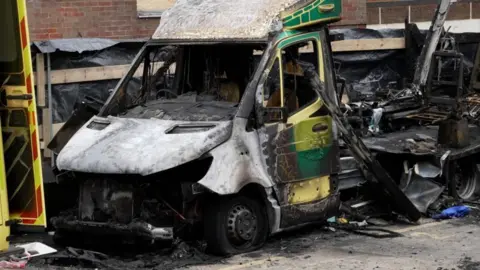
Fourth suspect arrested over Jewish charity ambulance arson attack

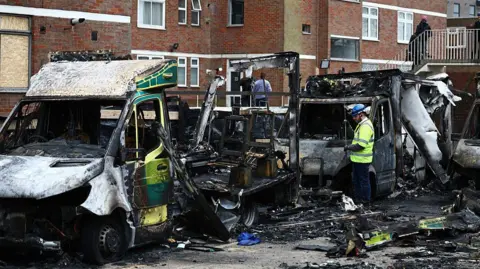
AFP via Getty Images An official works among the burnt out ambulances at the scene of an antisemitic arson attack in the Golders Green neighbourhood of north LondonAFP via Getty Images
The attack took place on 23 March in Golders Green, north London

A fourth suspect has been arrested in connection with the arson attack on Jewish charity-owned ambulances in north London last week, the Crown Prosecution Service (CPS) has said.

The prosecution told Westminster Magistrates' Court the individual had been arrested on Saturday morning at the court. A man was seen being taken out of the building by police. The court was told four suspects took part in the attack.

Three individuals charged following the attack appeared at the court this morning, and have since been remanded in custody.

They are two British men - Hamza Iqbal, 20, and Rehan Khan, 19 - and a 17-year-old boy who is a dual British-Pakistani national.

All three have been charged with arson with intent to damage property and being reckless as to whether life would be endangered.

The court heard there was strong evidence the attack was a "premeditated and targeted attack against the Jewish community".

Last week, two men aged 45 and 47 were arrested in connection with the case and released on bail until late April.

Russian attack on Ukraine market kills five

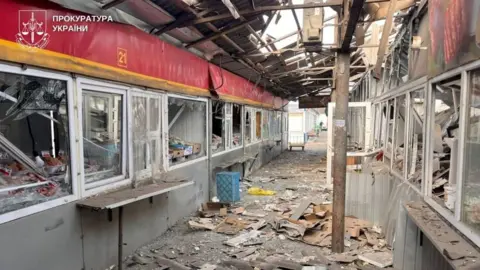
Reuters Photo provided by the Ukrainian prosecutor's office showing badly damaged indoor market area - a corridor with kiosks on either side with broken windows, and metal and glass strewn across the floor.Reuters
The attack also caused serious damage to market kiosks

A Russian drone attack on a market in southern Ukraine has killed five people and injured 21, including a 14-year-old girl, the prosecutor general's office says.

The attack took place at 09:50 local time (06.50 GMT) in the town of Nikopol, just across the Dnipro river from land occupied by Russia since their full-scale invasion.

Pictures published by the regional prosecutor show smashed market kiosks strewn with metal, glass and food.

It comes after at least 15 civilians were killed in drone and missile strikes across the country on Friday.

A drone and missile attack by Ukraine on the southern Russian city of Taganrog overnight killed at least one person and seriously injured four, Russia said.

The regional governor Yuri Slyusar said the attack caused a fire to break out in the premises of a logistics company in the city.

A Ukrainian Defence Ministry official blamed the casualties on "Russian air defence operations".

Kyiv also reported hitting a factory in another city, Togliatti, that it said produced parts used by Russia's military.

Ukraine's Nikopol frequently comes under fire, and almost half of the town's 100,000 residents left long ago for safety.

But these drones hit in the middle of Saturday morning – in a busy spot – and the number of casualties is high.

Two men were injured in a second strike on the same location, the prosecutor said, adding that the attacks were being investigated as a war crime.

President Zelensky has offered Russia a truce for the Easter holidays. But so far, Moscow is ignoring that.

Russia launched almost 300 drones against Ukraine again overnight, the Ukrainian air force said, and casualties were also reported in the northeastern city of Kharkiv and the northern Sumy region.

Meanwhile Moscow said it had shot down 85 Ukrainian drones.

Major daytime attacks by Russia, which were once rare, have been increasing.

They are happening as efforts to end the war, led by the US, have stalled since US President Donald Trump and his team shifted focus to the conflict in the Middle East.

Teachers' union warns of 'masculinity crisis brewing' in schools

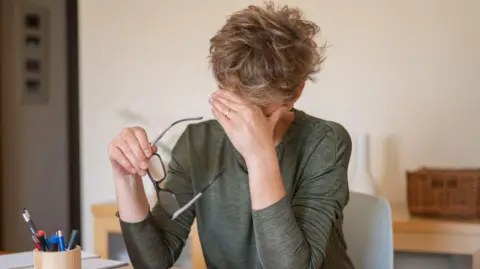
Getty Images A woman sat at a desk rubbing her forehead holding a pair of glasses. Getty Images

A teaching union has warned that a "masculinity crisis is brewing" in UK schools after almost a quarter of female teachers it surveyed reported that they have been subject to misogynistic abuse from a pupil in the last year.

It is the fourth year in a row that NASUWT has surveyed a rise in teachers reporting misogyny from pupils - up to 23.4% from 17.4% in 2023.

One teacher described the misogyny as "traumatising", while others said it leaves them feeling "humiliated" and "violated".

Matt Wrack, NASUWT's general secretary, said if female teachers are struggling to contain gender-based aggression, it is a "ticking time bomb" and male students need to be helped before "it is too late".

Wrack said: "We have a masculinity crisis brewing in our schools. Teachers desperately need increased support to deal with this new frontier of behaviour management."

Responding to the survey, one of the female teachers said a student made AI naked images of her and other girls, which she labelled "horrifying".

Another respondent said: "Boys have confronted me, shouted at me. Have had boys joke about raping girls in front of me and laughed about it when challenged."

Teachers reported being faced with misogynistic responses from pupils after trying to address concerns over their behaviours, with some reporting that they are ignored by male pupils due to being female.

Of the 5,087 teachers surveyed across the UK, more than one in five said they have been subject to sexist, racist or homophobic language from a pupil in the past year.

Speaking to BBC Radio 4's Today programme, Professor Lee Elliot Major said teachers are acting as "de facto parents" in the classroom, explaining that a lot of "societal challenges" come out in this setting.

Major, a professor of social mobility at the University of Exeter, added: "The reality is that a teacher these days is a counsellor, a social worker, a poverty alleviator and a guardian of respectful values."

"Teachers are incredibly stretched because you need training for this sort of challenge. I think the balancing act that teachers now face is more challenging than it's ever been before."

Wrack said teachers need professional training to help them "identify, challenge, and safely de-escalate behaviour rooted in online radicalisation, sexism, and hate."

The union is calling for a ban on social media for under-16s and a ban on phones in schools.

A spokesperson for the Department of Education said misogynistic views are "learned" and the government is "committed to using every possible tool to achieve our mission of halving violence against women and girls".

The statement added that the department has updated guidance, is providing teachers with resources to recognise the signs of incel ideologies and is strengthening guidance for mobile phones in schools.

Amber wind warning issued as Storm Dave set to hit parts of UK

BBC Breaking NewsBBC

An amber wind warning has been issued for Saturday evening as Storm Dave is expected to bring "disruptive and potentially damaging winds" to parts of the UK.

The warning, covering northern England, north-west Wales and southern Scotland, will begin at 19:00 BST and is due to expire at 03:00 on Sunday.

The Met Office said injuries or danger to life could occur as a result of flying debris, with potential travel disruption and a "good chance" of power cuts.

A series of yellow wind and snow warnings are set to take effect on Saturday afternoon as the country braces for a blustery Easter weekend.

Gusts of 60-70mph are possible in some parts of the UK, with some coastal and exposed locations predicted to reach 80mph, the Met Office added.

People are being advised to stay indoors as much as possible, and check for loose items outside that need securing ahead of the warnings coming into effect.

RAC spokesperson Rod Dennis said: "We recommend taking extra care on exposed, higher routes and being especially cautious when overtaking high‑sided vehicles, as the buffeting effect can catch some people out."

This breaking news story is being updated and more details will be published shortly. Please refresh the page for the fullest version.

You can receive Breaking News on a smartphone or tablet via the BBC News App. You can also follow @BBCBreaking on X to get the latest alerts.

17m people are obsessed with a power-washing video game

FuturLab An in-game screenshot of the game PowerWash Simulator 2. It shows a first-person perspective of someone cleaning the red and white sign of a gas station outside that reads "Lone Station" and "Open 24/7" with a large green cactus as the pole. They are using a grey and blue power washer and have orange gloves. The sign is next to a gas station which is covered in dirt. FuturLab
PowerWash Simulator 2 has been nominated for two Bafta Games Awards

PowerWash Simulator sees players don their cleaning gear and hose down a variety of filthy in-game locations until they're sparkling and spotless.

While it may seem like an unusual premise, the original game from 2021 has sold more than 17 million copies. The sequel, released in 2025, has just been nominated for two Bafta Games Awards.

Both fall under the category of "mundane job simulations", an ever-growing gaming genre in which people carry out routine and - on the face of it - not very exciting tasks.

"We want to make the Graham Norton of video games," says Kirsty Rigden, the chief executive of Brighton-based FuturLab, which makes PowerWash Simulator.

Aspiring to emulate a talkshow host who has a reputation for being affable rather than for setting pulses racing is perhaps an unusual ambition for a gaming studio.

But she says there is a big market for lower-octane entertainment.

"Graham Norton doesn't make you feel stupid, but you also don't have to think too hard," Rigden told BBC News.

"It engages the right amount of brain and at the end of it you go, 'Oh, that was really pleasant'."

Futurlab An in-game screenshot from the game PowerWash Simulator 2. We see a first-person perspective of the player using a blue and white pressure washer to spray the robot console character BMO from Adventure Time, who is laughing. The rest of the room is covered in dirt on the walls.Futurlab
PowerWash Simulator 2's added content sees players get to clean up the cartoon world of Adventure Time

One of the core characteristics of the simulation genre is its soothingly repetitive jobs.

In PowerWash Simulator's case that means cleaning through one mucky area - say, a fun house or a roller disco - after another; quite literally rinse and repeat.

"I think it's really struck a chord with how people are feeling in the world right now - the world is in quite a stressy place," Rigden said. "With the game you are able to focus in on one thing, which kind of blocks all the other distractions out - it's a pure form of meditation."

The initial idea came from a personal interest Rigden had in watching YouTube videos of people power washing and the "simplicity of seeing dirt turn to cleanliness".

Kirsty Rigden A headshot of the CEO of FuturLab, Kirsty Rigden. She is smiling looking off the camera with her mouth open and has grey hair with purple strands. She is wearing a grey top.Kirsty Rigden
Kirsty Rigden is the CEO of FuturLab, which makes the PowerWash Simulator series

Social media is awash with influencers - some with hundreds of thousands of followers - making content about cleaning or clearing up, and FuturLab's series is not the only simulator to have tapped into the trend.

In Lawn Mowing Simulator players "experience the beauty and detail of mowing the Great British countryside" by running a lawn care business, using "real-world licensed lawnmowers".

A sequel, promising to take players to the "trailer parks and town hall gardens" of America, is currently in the works.

David Harper, managing director and founder of Liverpool-based developers Skyhook Games said players often use the game as an "escape" from the pressures of everyday life.

"It's basically about the satisfaction of starting with something untidy, learning the skills to bring order to the scene, then looking back at a job well done," he said.

Skyhook Games An in-game screenshot from the game Lawn Mowing Simulator 2. It shows an organe American lawn mower on a pathway next to a lawn of green grass. The American flag flies from a straight grey pole on the lawn and behind it is a grey house, surrounded by trees with orange and yellow leaves.Skyhook Games
Lawn Mowing Simulator 2 will take players to the "trailer parks and town hall gardens" of America.

The relaxed nature of mundane job simulators has made them a particular hit with YouTubers and Twitch streamers, who can strike up a conversation with viewers without needing to pay too much attention to the game.

A video of US creator Markiplier playing PowerWash Simulator from 2021 now has more than nine million views.

Comedian and games journalist Ellie Gibson started streaming the game to her Twitch community after a friend recommended she try it.

She also holds the Guinness World Record for the longest time playing PowerWash Simulator - an impressive 24 hours, six minutes and 33 seconds.

The attempt went relatively smoothly, she explains, apart from a "nightmarish" section when cleaning a kid's playground at four in the morning where the game's bright primary colours affected her in "a very psychedelic way".

But she added the "calming and soothing" nature of the game is similar to what she imagined "people get from colouring books or knitting".

The only difference?

"You get the finished result of a clean monster truck, rather than a scarf."

Helen Thorn The comedian Ellie Gibson, who is sitting down inside her flat and wearing glasses and is dressed up from head to toe in a light blue cleaning suit. She is holding a PlayStation controller and next to her on a desk is a small round table with a black microphone and open laptop as well as mugs of tea.Helen Thorn
Comedian Ellie Gibson holds the Guinness World Record for the longest time playing PowerWash Simulator

Both Rigden and Harper say they have had a number of people get in touch to tell them their games have helped them through difficult times.

"Hearing how our game has helped our players with their anxiety and mental health has been really rewarding to us," said Harper.

Meanwhile, Rigden said they had "lots of people writing in and saying how we've helped them get through things like cancer treatments."

"It's really lovely and uplifting."

PowerWash Simulator has even been the subject of an Oxford University study, which looked at whether video games affected players' wellbeing.

In March 2023, more than 8,600 players tracked their mood every 10 minutes with pop-up prompts while playing a custom build of the game.

The study found 72% of players experienced an uplift in mood while playing the game.

FuturLab An in-game screenshot from the video game PowerWash Simulator 2. We see a first-person perspective of the player using a pressure washer to spray water on a wooden house front which is very dirty. Another character dressed in blue cleaning gear is also spraying the house.FuturLab

While Nick Ballou, one of the researchers behind the study, said it was unlikely mundane job simulators would ever be comparable to something like therapy, he believed they still had a couple of "unique benefits".

"These games are particularly suitable for people with low energy, and they're really effective in absorbing attention," he said.

"I do think playing them can be more mindful than other games that require lots of cognitive engagement to coordinate with teammates or react in a split second."

As for Rigden and the team, there is a plan to make a game separate to the soapy empire they've currently worked up into a lather - as they continue their goal to become "the market leader in cathartic games".

Whatever the team work on next, there's one unique element which will undoubtedly remain - their unusual, yet perhaps fitting, Graham Norton ethos.

A green promotional banner with black squares and rectangles forming pixels, moving in from the right. The text says: “Tech Decoded: The world’s biggest tech news in your inbox every Monday.”

Sign up for our Tech Decoded newsletter to follow the world's top tech stories and trends. Outside the UK? Sign up here.
Trump seeks $152m to reopen notorious Alcatraz prison

Getty Images A stock image of Alcatraz prison, showing a building sitting on an island Getty Images

US President Donald Trump is seeking $152m (£115m) to reopen the infamous Alcatraz prison as part of his proposed budget for the 2027 fiscal year.

Located near San Francisco's Golden Gate Bridge, the site, also known as The Rock, was once regarded as one of America's most notorious prisons, but has served as a tourist attraction in recent years.

The budget request is seeking money "to rebuild Alcatraz as a state-of-the-art secure prison facility", with funds covering the first year of costs.

The plan has been met with scepticism by a number of politicians in California, with questions raised about the final cost of the project and the challenges of running Alcatraz as an active prison.

The maximum security facility was closed in 1963. As a tourist site, it is currently run by the National Park Service.

Former speaker for the US House of Representatives, Nancy Pelosi, said the budget proposal from the Trump administration was "absurd on its face and should be rejected outright".

"Rebuilding Alcatraz into a modern prison is a stupid notion that would be nothing more than a waste of taxpayer dollars and an insult to the intelligence of the American people."

The request will need to be approved by the US Congress.

Previous criticism of Trump's plan has pointed to the lack of running water and sewage on the island, and the fact all supplies are required to be brought in by boat.

By the time Alcatraz closed, it was three times more expensive to operate than any other federal prison, according to the US Bureau of Prisons.

Pelosi also raised a concern echoed by other San Francisco politicians, that turning Alcatraz back into a functioning prison would mean the loss of an iconic landmark.

According to the National Park Service, the facility currently brings in $60m (£45m) in revenue as an attraction.

Money being sought to reopen the prison as an active facility is part of a $1.7bn (£1.3bn) investment into the Bureau of Prisons.

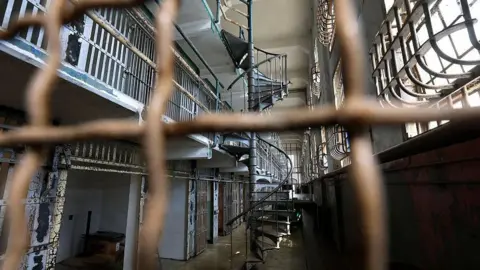
Getty Images A view of a cellblock on Alcatraz Island.Getty Images
There is no running water or sewage system on the island

Announcing his plans on Truth Social last year, Trump said was directing "the Bureau of Prisons, together with the Department of Justice, FBI, and Homeland Security, to reopen a substantially enlarged and rebuilt ALCATRAZ".

The prison would "house America's most ruthless and violent offenders".

Alcatraz was originally a naval defence fort, before being converted first to a military prison and then to a federal prison in the 1930s after being taken over by the Department of Justice.

Some of its most notable inmates have included notorious gangsters Al Capone, Mickey Cohen and George "Machine Gun" Kelly.

Alcatraz has served as a location in a number of films, notably 1962's Birdman of Alcatraz, starring Burt Lancaster, 1979's Escape from Alcatraz, starring Clint Eastwood, and 1996 film The Rock, starring Sean Connery and Nicolas Cage.

After 16 years in power, could Viktor Orban finally be unseated?

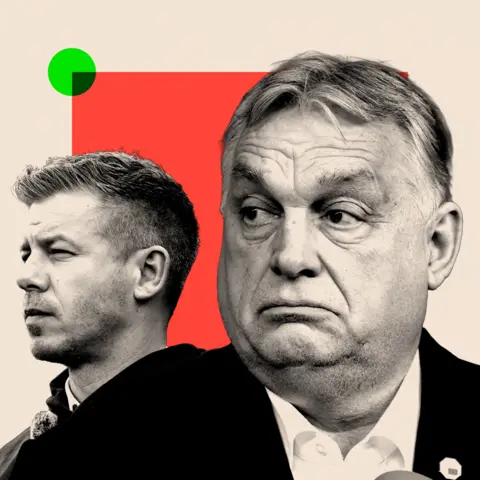
BBC Peter Magyar (left) and Vikor Orban (right) in black and white photographs against a red backdrop with a green dotBBC

"All they stand for is anger, hatred, and destruction," roared a hoarse Viktor Orban. The Hungarian prime minister was speaking at a mass election rally in Györ in western Hungary on 27 March, referring to opposition protesters who chanted "Filthy Fidesz" during his speech. For just a moment, his carefully cultivated image as the voice of calm navigating his country through stormy seas was shattered. His bad-tempered outburst showed a different side of a man used to cracking jokes and charming even his critics.

Most opinion polls put the opposition Tisza party and its leader Peter Magyar far ahead of Orban's Fidesz - the latest by 58% to Orban's 35%. And he is doing everything he can to close the gap. After 16 years of virtually unchallenged rule, Orban has been forced to take to the road again. In the past three elections, he gave few rallies. Now Europe's longest-serving leader is trying to mobilise his supporters and reach the undecided. He has just a week left to rescue his government, and the international populist movement he embodies, from a crushing defeat.

In power since 2010, Orban has had the support of both US President Donald Trump and Russian President Vladimir Putin. He has long been a thorn in the side of the EU - and one of the few EU leaders not supportive on Ukraine. For Europe's growing band of nationalist parties, in power or on the brink of it, he is the model. The 12 April Hungarian parliamentary election is being watched closely all over the world.

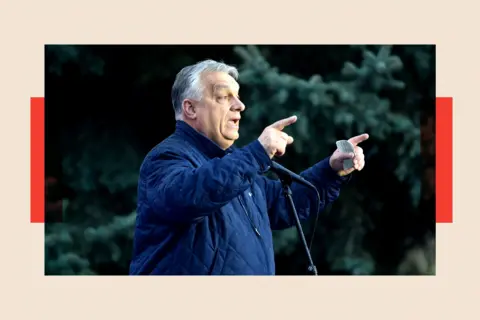
NurPhoto via Getty Images Orban points while standing in front of a microphone. He wears a dark blue casual jacket NurPhoto via Getty Images
Orban has a rough, rural style

"We can notice a big change in public perception," said Endre Hann of the Median agency, a public-opinion research firm. In January, 44% of those asked said they thought Fidesz would win, compared with 37% for Tisza. By March, 47% believed Tisza would win, while 35% believed Fidesz would. "This reflects a huge change of trust. People believe that it can be changed," he says.

An intriguing dynamic is playing out in this election - the same voter anger against those seen as "corrupt ruling elites" across Europe, is now working against him. In Hungary, it is now Orban and his Fidesz party who are seen by many, especially the young, as the "corrupt ruling elite".

Getty Images Donald Trump wears a dark blue suit and a yellow tie as he points at Viktor Orban, who is smiling. Orban is wearing a dark blue suit and a red tieGetty Images
Trump has lent Orban his support over the years

The Orban government has been repeatedly accused of draining state coffers and giving state tenders for projects to companies owned by close associates. The government explains this concentration of wealth as an attempt to put wealth in national, instead of foreign hands.

The projects included bridges, football stadiums and motorways. His son-in-law, Istvan Tiborcz, owns a string of prominent hotels. His childhood friend Lörinc Meszaros, a former gas fitter, has become the wealthiest man in the country. Orban refuses to answer questions about the personal wealth of his friends and family. All deny wrongdoing.

Can Orban save himself by blaming Ukraine - and its EU backers - for his country's woes? And can the smooth-talking lawyer who hopes to unseat him convince Hungarians, particularly those in rural areas which make up the Fidesz heartlands, that he can deliver the "more humane, better functioning country" that he promises?

Under pressure

Each day brings a new indication that Orban is in trouble, from alleged voter-intimidation schemes to a dramatic Russian proposal to stage a fake assassination attempt on Orban.

But Fidesz claims the sense that it's in trouble has been cooked up by the opposition. "All these scandals are just the usual suspects trying to build a narrative," says Zoltan Kiszelly, a political analyst from the government think tank Szazadveg. "When the opposition lose the election, this gives them an excuse to allege 'fraud'."

Political analyst Gabor Török - one of the few analysts in this extremely polarised society respected by both sides - wrote recently on his blog: "This is not the 'calm strength' or the 'strategic calm,' image, nor the one carefully cultivated for years and displayed on 'Prime Minister of Hungary' posters.

"If the remaining two weeks unfold like this, it does not bode well for the government side."

Global referendum

The shockwaves of an Orban defeat would reverberate far beyond Hungary's borders.

"Budapest is the headquarters of illiberal democracy in the world," argues Michael Ignatieff, former rector of the Central European University, which was forced out of the Hungarian capital in 2019. "This is not just an election. This is a referendum on that whole model of authoritarian rule that Orban represents."

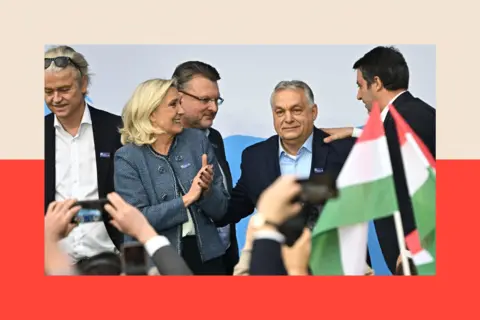
AFP via Getty Images Viktor Orban (2nd R) is flanked by Deputy Prime Minister of Italy Matteo Salvini (R), former leader of the French far-right National Rally party Marine Le Pen (2nd L), former Deputy Prime Minister of Latvia Ainars Slesers (3rd L) and Leader of the Party for Freedom Dutch Geert Wilders (L) AFP via Getty Images
Orban is backed by other right-wing politicians in Europe

He's referring to the network of think tanks, fellowships, and gatherings of right-wing influencers who zig-zag across the Atlantic to support one another. On consecutive days last month, the American Conservative Political Action Conference (CPAC), a platform for people across the political right to discuss ideas, and Patriots for Europe, the right-wing European Parliament group, held major events in Budapest.

The fact that no leading US politician attended the Hungarian CPAC event this year raised eyebrows within Fidesz, but the Republicans are not leaving Orban in the lurch. US secretary of state Marco Rubio was here in February, and vice president JD Vance is expected in Budapest a few days before the vote.

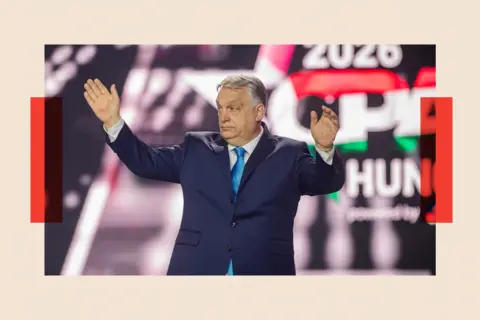
AFP via Getty Images Orban stands on a stage in front of the CPAC logo. He is wearing a dark blue suit and a light blue tie AFP via Getty Images
Orban transformed Hungary into an international destination for the political right

A victory for Fidesz in this election would add momentum to the chances of far-right parties in France, Germany, Poland, Spain and Portugal. Defeat for Fidesz would take some of the wind out of their sails. "While the rest of Europe is being sucked into the radical nationalist tunnel, we can show the way out," a senior Tisza official told me.

Getting the vote out

Despite a poor showing in the polls, Orban's allies deny that there is panic in the Fidesz camp.

According to Zoltan Kiszelly, the crucial factor will be whether Fidesz can persuade their supporters to get out on polling day.

"We are very optimistic. Nobody believes in the opinion polls, neither our own, nor the opposition ones," he says.

"The majority of the voters are for Fidesz. Of pensioners, of women, of the Gypsies [Roma], of the poor, of the blue collar workers, of the rural people. The question is, will they cast their vote?"

To make sure they do, Fidesz has worked hard to update its database of supporters. Around 4.5 million of the 8.2 million-strong Hungarian electorate live in small towns and villages - the Fidesz heartlands. Since 2002, Fidesz has built a strong system of local patronage in the villages - the mayor decides who receives work, and who gets firewood in winter.

According to an investigative documentary released last week, mayors have been told how many votes each village needs to produce for Fidesz. Those interviewed in the film claim the incentives include cash payments of €120 (£104) per vote, food coupons, prescription medicines and even illegal drugs in exchange for voting for Fidesz. Those who refuse say they are denied the chance to participate in public works schemes, often the only local work available.

Cars and minibuses are organised on election day. "Companions" stand by to accompany voters, who feign illiteracy or illness, into the voting booth, to make sure they vote for Fidesz and get their money, people interviewed in the film claim. There has been no official government reaction to these allegations. One minister told the BBC that any wrongdoing should be dealt with by the appropriate authorities.

Rival parties at previous elections offered potatoes and even small sums for votes, but nothing on the scale of this election, we were told by people who have been involved in elections over the decades.

"Everyone here votes Fidesz," said Nikki, 32, in Tiszabö, a village of 2,000 inhabitants, with a large Roma majority, in the northern Great Plain region of Hungary.

She praises the Fidesz mayor for rebuilding the roads, the kindergarten, and the sports centre. She claims votes won't need to be bought on 12 April, as Fidesz will win "because of the war".

The Russian connection

Orban has told voters that this election is a simple choice between peace and war.

According to Fidesz, only Orban can prevent the "warmongers" in Brussels from dragging the EU, and with it Hungary, into the war in Ukraine against Russia.

Peter Magyar, leader of the opposition Tisza party, is painted as a puppet of Brussels. The Fidesz message is that a vote for the opposition would mean that Hungary, as a Nato member, will be forced to send Hungarian troops either in a future Nato peacekeeping operation, or a full-scale war with Russia, and young Hungarian men will die again on the eastern front. That's a message designed to resonate deeply in a country on the losing side of both World Wars. Since 2022, Orban has argued that Russia cannot be defeated, and that instead of supporting Ukraine militarily and economically, the West should pressure Kyiv to seek peace with Moscow - on Russia's terms, if needed.

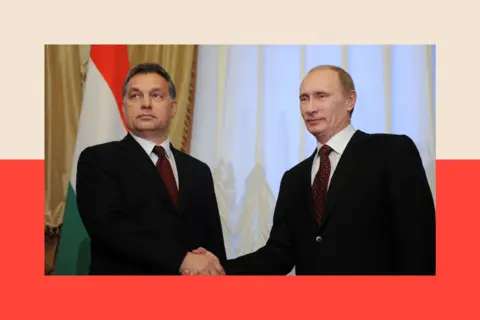
AFP via Getty Images Viktor Orban and Vladimir Putin shake hands in front of the Hungarian flag. They both wear dark suitsAFP via Getty Images
Orban and Putin have long had a good relationship

"The Fidesz anti-Ukraine, pro-Russian message is flagging," veteran pollster Endre Hann of the Median agency told me. His latest figures suggest a growing 52% of those asked agreed that "Russia committed a serious and unprovoked act of aggression against Ukraine" with its 2022 full-scale invasion. Just 33% agreed with the Fidesz narrative that "Russia acted legally, to defend its interests and security."

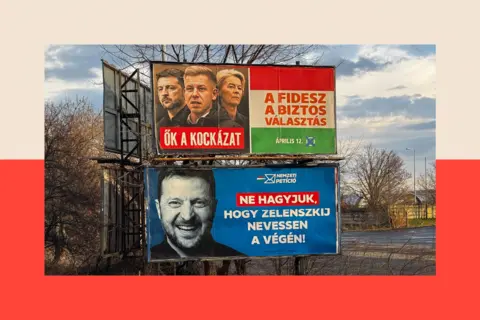
Orban is the most pro-Russian leader in the EU. His government has refused to follow German, Czech and Polish efforts to wean themselves off Russian oil. In this campaign, Fidesz has painted Ukraine and its leader, Volodymyr Zelensky, as the enemy. Giant billboards show a grinning Ukrainian president with the slogan: "Don't let Zelensky have the last laugh!"

NurPhoto via Getty Images Two posters are displayed on a street: the top one shows Zelensky, Magyar and Ursula von der Leyed, and the bottom one shows Zelensky smiling NurPhoto via Getty Images
Fidesz has leant into bashing the EU and the Ukrainian president

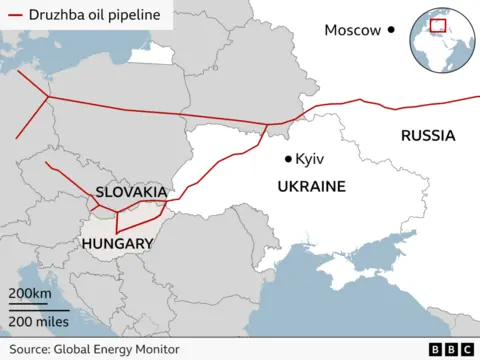
Since 27 January, no crude oil from Russia has reached Hungary via Ukraine through the Druzhba pipeline, which translates as the "Friendship pipeline". A major hub and pumping station at Brody in western Ukraine was damaged that day in a Russian attack. Hungarian refineries depend on the pipeline, and Orban accuses Zelensky of deliberately failing to restore the flow of oil in order to harm his election chances.

A map showing two strands of the Druzhba oil pipeline from Russia into Europe in red. One strand goes through Hungary into Ukraine before connecting to another strand going into Russia.

The "peace or war" message, argues Zoltan Kiszelly, the Fidesz analyst, is more sophisticated than it sounds.

"The government aims to connect the current situation, the threat of no oil, with practical issues like the cap on utility bills," he explains. Since 2013, all household and electricity costs have been capped by the government, resulting in the lowest prices for consumers in the EU. That is only possible, the government argues, thanks to cheap oil and gas from Russia.

An unlikely challenger

Magyar, 45, is a former Fidesz insider who joined the party as an enthusiastic student, married the former Fidesz justice minister, and worked as a Hungarian diplomat in Brussels. In February 2024 he suddenly quit the party and all his posts in state companies, and gave an interview which garnered two million views within days, accusing the government of cowardice and corruption. He then founded the Tisza party, named after a tributary of the Danube.

A slight figure in neat shirts and jackets, Magyar seemed too slick and urbane to reach the hearts of the rural electorate, but has proven himself a strong challenger. Orban, 62, is a village boy who speaks village Hungarian, Magyar is a Budapest lawyer by training. Conscious that his status as a member of the metropolitan elite may make him less likely to appeal to rural voters, Magyar has toured the countryside indefatigably for the past two years, drawing large crowds. Unlike Orban, who waxes lyrical on global politics, Magyar focusses on domestic issues such as healthcare, education, transport and rural depopulation in his speeches.

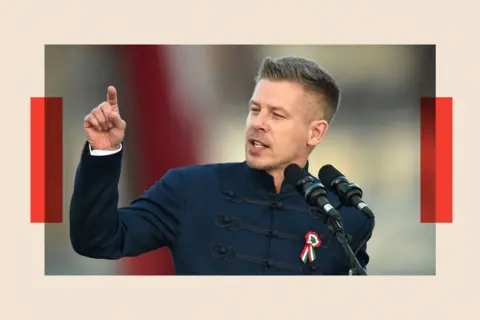
NurPhoto via Getty Images Peter Magyar gesticulates from behind a podium. He wears a high-necked blue suit jacket with brocading on the front, and has a rosette pinned to his chestNurPhoto via Getty Images
Peter Magyar cuts a distinctly metropolitan figure next to Orban

His relationship with Russia is also different. He has pledged that if he wins, "we will study and where needed change the existing contracts with Russia, [and] diversify our energy resources in every possible way". He has also promised to "restore Hungary's seat at the EU and Nato tables."

Magyar says he learnt quickly on his six nationwide tours. He quickly abandoned his notes after being criticised for sounding stilted, and started speaking "from the heart", he told me in an interview earlier this year. "After the first days, I read the criticism and learnt… to go closer to the people, to let them ask questions and reply openly and honestly, which is rare in Hungarian politics."

He has gone from a rank outsider to the man who is widely expected to unseat Orban. While Orban usually visits one city a day on the campaign trail, Magyar visits from three to six, in an effort to reach all 106 individual constituencies by voting day.

He is no stranger to controversy himself. After becoming a politician, his ex-wife depicted him as an unstable figure, prone to bursts of anger and domestic violence. Anti-Tisza protesters once held banners featuring a shoe, which he allegedly once threw at her. More recent attempts by Fidesz to discredit him include convincing a former girlfriend to secretly tape his conversations, and taking him to a party where cocaine was being used. Magyar denies any domestic abuse, and speaks fondly of his ex-wife in public. He denies ever taking drugs, and last week published the negative results of a drug test. He challenges certain Fidesz politicians to do the same.

A poll published by the 21 Research Agency, a pro-democracy think tank, earlier this week showed the Tisza candidate pulling ahead in most of its 20 swing districts. Magyar has spoken of a "tipping point" in the countryside, and if this poll proves right, he has already reached it.

Orban and Fidesz have a media empire to amplify their message, but Magyar instead relies heavily on broadcasting each rally live on Facebook. While previous opposition leaders mustered crowds of a few dozen if they ventured out of Budapest, Magyar attracts hundreds in villages, and thousands or tens of thousands in provincial urban Fidesz strongholds.

A top Fidesz official grudgingly admitted that Magyar has "a brutal energy", which his own camp often lacks. Magyar's promise to build "a more humane, efficient country" resonates with all those fed up with the governing party, especially the young.

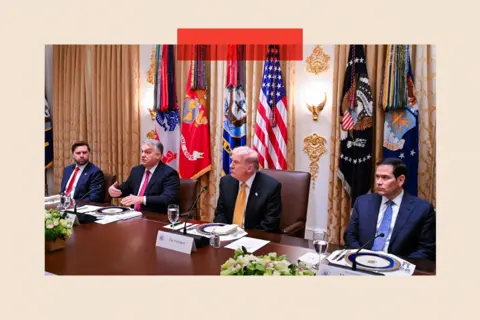
Getty Images The table is set for a formal dinner in the White House, with JD Vance, Orban, Trump and Marco Rubio sitting down. They all wear suits. Getty Images
Vance, Trump and Rubio have all gone out to bat for Orban - but will it help this election?

What would a Fidesz victory or defeat mean for Hungary? "What we have now is a state that has been fully captured by a single party," Andras Baka, former president of Hungary's supreme court, told me. If Fidesz wins "we have an ever more rigid autocracy."

If Tisza wins, there will be a big laundry list to tackle, including restoring the independence of the courts, the state prosecution service, the state audit office, the public media, and the intelligence services from the government of the day. Whether a Tisza government can do that, and how quickly, would depend on the margin of victory.

Top image credit: NurPhoto/AFP via Getty Images

Thin, lobster red banner with white text saying ‘InDepth newsletter’. To the right are black and white portrait images of Emma Barnett and John Simpson. Emma has dark-rimmed glasses, long fair hair and a striped shirt. John has short white hair with a white shirt and dark blazer. They are set on an oatmeal, curved background with a green overlapping circle.

BBC InDepth is the home on the website and app for the best analysis, with fresh perspectives that challenge assumptions and deep reporting on the biggest issues of the day. Emma Barnett and John Simpson bring their pick of the most thought-provoking deep reads and analysis, every Saturday. Sign up for the newsletter here

Five Met Police officers taken off duty after bag of weapons is left in the street

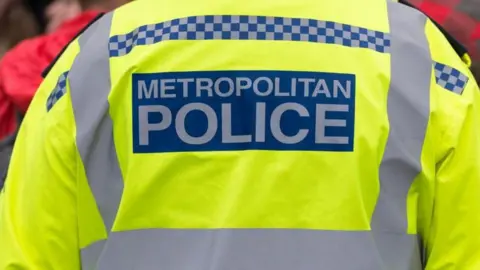
Getty Images a close up stock image of the back of a uniformed Metropolitan Police officerGetty Images

Five Metropolitan Police officers have been removed from front-line duties after a bag containing firearms and a Taser was found on a London street, the force has said.

The bag, which was discovered by a member of the public on Tuesday evening, was found outside London Mayor Sir Sadiq Khan's home, The Sun reports.

"At this stage it is believed the bag was misplaced by on-duty officers a short time before the member of the public located it," the police said in a statement.

The Met's Directorate of Professional Standards has said it is reviewing the incident.

Inside the bag was a sub-machine gun, a pistol, Taser and some ammunition, according to reports.

The force said: "At around 9.40pm, a member of the public called police after finding a bag containing Met-issued firearms and a Taser on a street in south London.

"Within seven minutes of the call to police, officers arrived at the scene and safely recovered the items.

"We are urgently reviewing the circumstances of this incident and recognise the concern it may cause."

Speaking to the Sun, a passerby saw the bag on the side of a road and alerted her partner after becoming suspicious.

Jordan Griffiths told the newspaper that after looking inside the bag, he took pictures of the contents, then called the police who turned up shortly after.

"When they arrived they were really shocked. They looked through the bag carefully and hurriedly took them away," he told the newspaper.

"I was told they had been left there by one of Sadiq Khan's security officers, which made sense as he lives here."

A spokesperson for Sir Sadiq described the incident as serious, adding: "The Met must now take all steps to ensure an incident like this never occurs again."

In 2017, Sir Sadiq said he agreed to a full-time police presence, meaning 24-hour police protection, when the risks to those around him had persuaded him to change his mind.

As oil and gas prices spiral, Europe asks if reviving nuclear is the answer

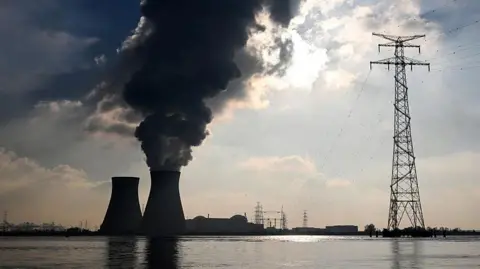
AFP via Getty Images A photograph taken on November 21, 2025 shows the nuclear plant of Doel, in AntwerpAFP via Getty Images
Belgium is one of a number of European countries revising their nuclear strategy

With a pit in their stomach, families and industries across Europe are watching gas prices and the cost of filling vehicles with petrol spiral.

While the UK government has told voters pretty much to keep calm and carry on, the European Commission - the EU's executive arm - has called on people to work more from home and to travel a lot less.

Policymakers warn things could get much worse - depending on what happens next in the Middle East. Yet it feels like only yesterday that Europeans faced a cost-of-living crisis on the back of spiralling energy costs and inflation following Russia's full-scale invasion of Ukraine.

This means conversations in Europe are turning (again) to the issue of energy independence.

And nuclear energy seems to be back in fashion as part of a home-grown European energy mix - in the UK as well as the EU. But how quick a fix can nuclear be - and how safe and reliable is it really?

AFP A woman in an orange jacket speaks at a lecternAFP
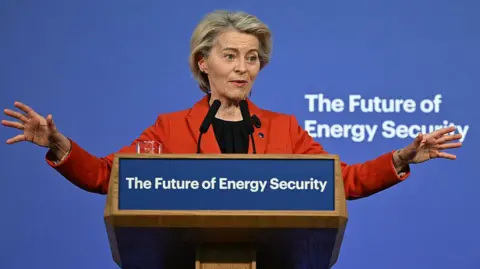
European Commission President Ursula von der Leyen said the war had exposed the continent's fossil-fuel "vulnerability"

At the recent European Nuclear Energy Summit in Paris, European Commission chief Ursula von der Leyen, who perhaps forgot she was a minister in the German government when it took the decision to phase out nuclear power plants in 2011, described Europe broadly turning its back on nuclear as a "strategic mistake".

In 1990, Europe produced around a third of its electricity from nuclear power. That has now fallen to an average of 15%, leaving the continent "completely dependent on expensive and volatile imports" of fossil fuels, she said, putting Europe at a disadvantage compared with other regions of the world.

Europe imports more than 50% of its energy. Mainly oil and gas.

This leaves the continent vulnerable to unexpected reductions in supply, as was the case with Russia after Europe imposed energy export sanctions, or price increases on the global market, as we are now seeing because of Iran's strangling of energy exports via the Strait of Hormuz.

Gas prices rise at a similar rate across Europe but the impact on electricity prices varies depending on each country's energy mix.

In Spain - which has invested heavily in wind and solar power - the average electricity price for the rest of 2026 is forecast at around half of Italy's, where gas sets the electricity price 90% of the time.

France is Europe's largest nuclear producer. It generates about 65% of its electricity from nuclear power. Based on futures contracts, German electricity prices for next month are five times those of France - an eye-watering contrast.

Germany phased out nuclear power following the 2011 Fukushima nuclear disaster in Japan. This left the energy-hungry industries that traditionally power the German economy - cars and chemicals - hugely gas-dependent.

This week, Berlin's top economic research institutes more than halved their growth forecasts for 2026 to a predicted 0.6% of GDP because of global price hikes for gas.

A renewed enthusiasm for nuclear power is palpable in Europe:

  • Italy is preparing draft laws to repeal its longstanding ban
  • Belgium seems to be making a complete U-turn after years of reluctance about investing in nuclear energy
  • Greece, historically cautious because of seismic concerns, has opened a public debate on advanced reactor designs
  • Sweden reversed a four-decade old decision to abandon nuclear technology
  • In the UK, Chancellor Rachel Reeves recently announced streamlining regulation to help advance nuclear projects.

"To build national resilience, drive energy security and deliver economic growth, we need nuclear," said Reeves.

New polling from YouGov suggests growing support for nuclear energy in Scotland, with the majority of people now backing it as part of the country's energy supply.

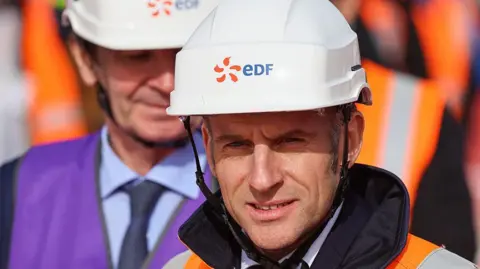
No prizes for guessing that France is the loudest nuclear cheerleader. President Emmanuel Macron is ever eager to point to the industry's credentials as a low carbon-emitter, potentially helping the EU towards its net zero goals.

He told Europe's nuclear summit that "nuclear power is key to reconciling both independence, and thus energy sovereignty, with decarbonisation, and thus carbon neutrality".

AFP A man in a hard hat and orange jacketAFP
France's Emmanuel Macron has long backed his country's nuclear energy industry

He also emphasised the increased energy demand from AI and his belief that nuclear power could give Europe a competitive edge or "the ability to open data centres, to build computing capacity and to be at the heart of the artificial intelligence challenge."

Until last year, Germany blocked efforts to treat nuclear energy on a par with renewables in EU legislation. That caused a lot of friction with Berlin's supposed closest EU friend, France.

But Berlin has since agreed to the removal of anti-nuclear bias. A cynic might say that could have something to do with defence and security concerns, provoked by deteriorating relations with the Trump administration.

Germany has asked France to extend its independent nuclear deterrent to European partners, something France agreed to this month.

But beware of viewing nuclear as an energy panacea.

Nuclear development is a long-term project, not a short-term fix to current energy insecurity.

Building nuclear reactors can be subject to extremely long delays, as recent examples in France and the UK have illustrated, at Flamanville-3 and Hinkley Point C.

Waste management and public concerns regarding the safety of nuclear energy persist.

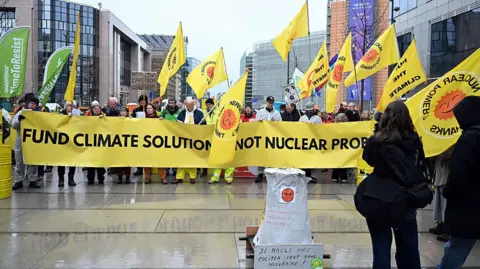
Anadolu via Getty Images Members of the anti-nuclear movement hold a demonstration marking the 15th anniversary of the Fukushima nuclear disaster as they gather in Schuman Square next to the European Commission building in Brussels, Belgium on March 11, 2026Anadolu via Getty Images
Anti-nuclear demonstrators last month marked the 15th anniversary of the Fukushima nuclear disaster

Environmental groups warn investment in nuclear energy can divert funds and political attention from speeding up the development of renewables, and an added layer of strategic risk is that a number of Central European countries, especially Hungary and Slovakia, still depend on Russian nuclear technology and uranium.

"You're ignoring the history of nuclear in Europe if you think it can just slot in [as an easy energy crisis solution]," Chris Aylett told me. He's a Research Fellow at the Environment and Society Centre, Chatham House.

Nuclear energy is part of the solution, he believes, but many European nuclear reactors are old and governments need to invest considerably just to maintain or extend their working life.

"The main challenge is maintaining existing share [of nuclear power]. If governments really want to increase the share, they need a lot of time and a lot of money."

But many of Europe's governments are indebted, cash-strapped and faced with numerous, competing priorities - such as how to maintain welfare and boost defence spending to the levels promised to US President Donald Trump.

Nuclear is also being beaten on price as the costs of wind and solar have gone down, Aylett points out.

So, with price and practicality in mind, the European Commission has rushed to embrace the concept of small modular reactors (SMRs).

SMRs are viewed as more cost-effective sources of nuclear power. They can be mass factory-produced and are particularly well-suited to meeting the energy demands of AI data centres, the production of hydrogen and local heating networks.

A €330m (£288m; $381m) EU nuclear energy investment package has just been unveiled, with strong support for SMRs. Brussels hopes to bring the up and coming technology online by the early 2030s.

The focus on SMRs is international. Last week, the US and Japan announced a $40bn project to develop SMRs in Tennessee and Alabama, while last month Emma Reynolds, the environment secretary, published the regulatory justification for Rolls-Royce's plan to become the first company to try to build SMRs in the UK.

But as attractive as they sound, SMRs are viewed as unproven at commercial scale. As of early 2026, no construction licences had been granted anywhere in the EU.

Nuclear fusion research is also benefiting from EU attention, though. The EU aims to develop the first commercial fusion power plant online.

But for now, most in Europe still rely on fossil fuel imports.

It is plainly in the continent's interest to be more energy independent, Aylett argues, so as not to be exposed to the whims of exporters including erratic authoritarians, or algorithms in oil and gas commodity markets.

European governments clearly see nuclear as part of the medium to long-term solution. But what of the here and now?

How elite US teams tackle combat rescue missions

Getty Images US Air Force Pararescueman during a training exercise. Getty Images
US Air Force pararescue units train extensively to recover downed aircrew behind enemy lines

Early reports indicate that the pilot of a US F-15 fighter aircraft downed over Iran was rescued - which, if confirmed, would be the latest in the long history of US combat search-and-rescue missions over decades.

The search operation is ongoing deep inside Iran for a second crew member, according to CBS, the BBC's US partner.

Combat search and rescue, or CSAR, missions are considered among the most complex, time-sensitive operations that US and allied militaries prepare for.

In the US, elite units of the air force are specially trained for CSAR missions and are often pre-emptively deployed near conflict areas where aircraft could be lost.

What is Combat Search and Rescue?

Put simply, CSAR missions are military operations aimed at finding, aiding and potentially rescuing personnel in need, including downed pilots and isolated troops.

In contrast to conventional search-and-rescue efforts - which could take place during humanitarian operations or after disasters - CSAR missions occur in hostile or contested environments.

In some cases - as in Friday's reported recovery effort in Iran - the operations may happen deep in enemy territory.

The missions are extremely time-sensitive, as enemy forces would likely be deployed in the same area to try and locate the same US personnel the CSAR teams are trying to rescue.

In modern times, CSAR missions are often conducted by helicopters, with refuelling aircraft in support and other military aircraft on hand to conduct strikes and patrol the area.

Notably, verified video that emerged from Iran on Friday appeared to show US military helicopters and at least one refuelling aircraft operating over Iran's Khuzestan province.

Video appears to show a US plane and helicopters over southern Iran

The history of CSAR missions

Airborne, wartime rescue missions have a long history, dating back to World War One pilots conducting impromptu landings in France to rescue downed colleagues.

The US military's pararescue units trace their lineage back to a 1943 mission in which two combat surgeons parachuted into then-Burma - now Myanmar - to help wounded soldiers.

The world's first helicopter rescue took place a year later, when a US lieutenant rescued four soldiers from behind Japanese lines, according to Smithsonians Air & Space Magazine. The incident also marked the first operational use of a helicopter in combat.

Formal search-and rescue units were first established in the US in the immediate aftermath of the conflict. But modern CSAR began during the Vietnam War.

One mission, known as Bat 21, led to the loss of several aircraft and multiple US casualties while attempting to recover the pilot of an aircraft shot down behind North Vietnamese lines.

The war required a vast expansion of CSAR missions with increased scope and complexity. The experience helped the military refine tactics and procedures that have helped form the foundation of rescue operations since.

Getty Images US Pararescue team running to a helicopter in Cambodia in 1975. Getty Images
Thousands of rescue missions in Southeast Asia helped shape modern combat search and rescue operations

The US Air Force's pararescue teams

While each US military branch has their own limited CSAR capabilities, the US Air Force has the primary responsibility for finding and rescuing military personnel.

This work is primarily conducted by what are known as pararescuemen, part of the military's broader special-operations community.

The official pararescue motto is "These Things We Do, That Others May Live", and their work is considered part of a broader promise to US service members that they will not be left behind.

These personnel are highly trained as both combatants and paramedics, and go through what is widely considered one of the hardest selection and training pipelines in the US military.

The selection-and-training process - which takes approximately two years from start to finish - includes parachute and dive training, as well as basic underwater demolition, survival, resistance and escape training, and a full civilian paramedic course.

They also received specialised courses in battlefield medicine, complex recovery operations and weapons.

Historically, about 80% of potential pararescuemen wash out of the course, although it is often more, according to military news site Sofrep.

On the ground, these teams are led by specialised Combat Rescue Officers, who are fully trained pararescue operators responsible for planning, co-ordinating and executing the recovery missions.

Recent US rescue missions

Pararescue teams deployed extensively throughout the wars in Iraq and Afghanistan, conducting thousands of missions to rescue US and allied troops that were wounded or required extraction.

In 2005, for example, air force pararescue teams were involved to recover a US Navy Seal who was wounded and seeking shelter in an Afghan village after his team was ambushed and its other three members killed - an incident later made into the film Lone Survivor.

Missions to recover downed US pilots have been rare in recent decades.

In 1999, the pilot of an F-117 stealth fighter shot down over Serbia was found and recovered by parescuemen.

In an highly publicised incident in Bosnia in 1995, US pilot Scott O'Grady was rescued in a joint air force and Marine Corps CSAR mission after being shot down and evading capture for six days.

Unanswered questions remain after Australia's most wanted fugitive killed in standoff

Watch: How Australia’s seven-month-long manhunt came to an end

Just weeks ago, from the foothills of the mountains Dezi Freeman had disappeared into months before, police told the world they "strongly" believed Australia's most wanted man was dead.

The well-known conspiracy theorist and self-described "sovereign citizen" had escaped into dense bushland near the small Victorian town of Porepunkah in August, immediately after shooting and killing two police officers who had come to search his home in relation to historical child sex abuse offences.

But on Monday morning, Australia woke to the news that Freeman had been found alive after one of the largest manhunts in Australian history - only to have been killed in a standoff at a remote farm where he had set up camp.

His death has brought a semblance of closure to some of those affected, surfaced complicated feelings in others, and raised many questions.

Not least among them: where had Freeman spent the past seven months - and did he have help?

Pre-dawn raid shocks town

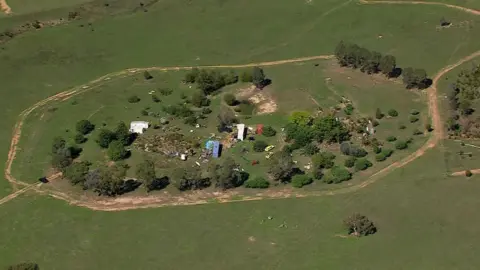
Police had spent at least 24 hours staking out the ramshackle campsite on a property in Thologolong, a town near the Victorian/New South Wales border, before calling on Freeman - real name Desmond Filby - to surrender.

Australian Broadcasting Corporation An aerial view of a grassy area with containers in the middle surrounded by trees and a mud trackAustralian Broadcasting Corporation
An aerial view of the rural property where Freeman was shot dead on Monday

"We gave him every opportunity to come out peacefully and safely. He didn't take that option," Victoria Chief Commissioner of Police Mike Bush said.

After three hours, Freeman came out of one of the three old shipping containers at the camp at around 8:30 local time (22:30 Sunday BST), bearing a gun stolen from the slain officers. He was shot by multiple police snipers simultaneously, local media have reported, citing police sources.

It was a shock for locals – including the elderly farmer who owns the land, according to his family.

Richard Sutherland has been in Tasmania for months, his brother and neighbour Neil Sutherland has said, and he certainly did not know Freeman or sympathise with his beliefs.

Appearing in Thologolong and its surrounds recently, however, were a handful of road signs graffitied with Freeman's name – something Janice Newnham told the BBC she'd thought was "somebody's April Fool's Day joke".

She is still sceptical that locals in the town of 22 could have known where Freeman was hiding.

"The main form of social activity is going to the pub or going to the shop or going to the local football - everyone seems to know what everyone else is doing," she says.

How did police find Freeman?

When Freeman first vanished, there was huge focus on his skills as a bushman. Friends and locals said he knew the mountains like the back of his hand and was capable of surviving off grid.

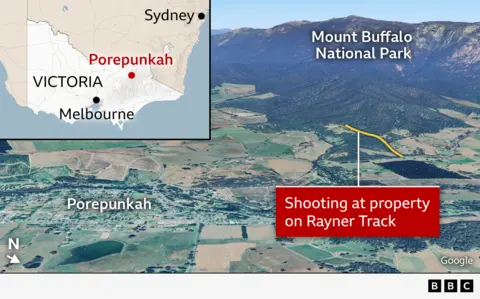
A map of Australia highlighting Porepunkah, Melbourne, Sydney and the state of Victoria is superimposed on a 3D map of the Porepunkah area. This highlights Rayner Track where the shooting took place.

This was one of the reasons police struggled to find him after the shooting, says Dr Vincent Hurley, a former police hostage negotiator who now lectures on policing at Macquarie University.

"If that crime was to occur in the city, he would leave his electronic footprint all over," Hurley explains, because mobile phones, car and bus journeys, and ATMs can all be easily tracked, including by using newer technologies such as facial recognition.

But "there was no easy way to actually try and track him down because they literally just had to go searching through the bush", says Hurley.

"And that's pretty, pretty rare."

The most recent similar case, he says, was Malcolm Naden, who was captured in New South Wales in 2012 after nearly seven years on the run.

But while Naden left in his wake a string of burgled properties and makeshift camps – including at a zoo – there was no trace of Freeman.

Police are convinced he had help staying off their radar.

"We're keen to learn who, if any - but we suspect some - assisted him in getting away from Porepunkah… if anyone was complicit, they will be held accountable," Bush told reporters.

Watch: Australian police say man, believed to be Dezi Freeman, shot dead

While it is theoretically possible to walk the 150km (93 miles) from Porepunkah to Thologolong, police think it unlikely. The mountainous terrain is rugged and covered by thick bush. With temperatures ranging from below freezing in August to 40C in the summer months, it would also have been tough without shelter.

Police sources have told local media Freeman's arrival appears to have been recent.

Fierce bushfires swept through the area in January, coming within a kilometre of the property where Freeman was hiding.

The whole area had been evacuated and was swarming with emergency services while helicopters were flying overhead, Newman says.

"They were 40 degree days in the bushfire as well," she adds, "so it would have been very hot inside the container."

And pictures from the camp, published by local media, held signs that he hadn't spent his time there alone.

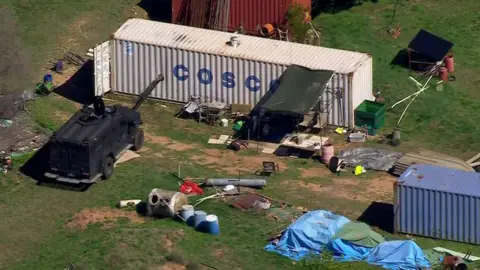
According to the Sydney Morning Herald, which cited unidentified police sources in its reporting, there were spinning air ducts recently fitted to the shipping container, a job likely to require more than one person. There were also three camp chairs pictured beside an open box of beer.

Australian Broadcasting Corporation A container on a grassy area surrounded by empty barrels, tarps and a black police vehicleAustralian Broadcasting Corporation
The container where Dezi Freeman had been hiding on the rural property in Thologolong

Freeman's family have condemned his actions and have been closely watched by police during the manhunt; his wife was reportedly shocked by Monday's news, having thought he was already dead.

Hurley is convinced that whoever helped him shared his sovereign citizen beliefs, including that they are not subject to government authority.

"No reasonable person down there [in Porepunkah] would have supported him, only because of the horrendous nature of the crime. And... he's a bit of a loner. So it would have been someone who shared his sympathies."

He is also convinced that the tip-off which led police to the hideout would not have come from his peers in the sovereign citizen movement. "They hate the police and they're not going to assist them."

Ultimately, Hurley says he believe Freeman was never going to surrender: "Being captured alive, that would be the ultimate humiliation and betrayal to him as a person. For the duration of the time he was at large, he was symbolically giving the middle finger to the police all over Australia."

In an interview with Nova radio this week, Bush hinted some of these questions may long go unanswered.

It's still early days in terms of the investigation into who may have aided Freeman, he said.

He admitted police had "obtained information" about where Freeman was hiding, but emphasised that "we can't go into how".

No one had claimed the A$1m (£525,000; $709,000) reward for information about the fugitive, Bush said, before stressing that anything in relation to the money and how police had found Freeman was "absolutely confidential".

He added: "I'm quite sure we'll never be sharing those details."

Artemis II crew now halfway to Moon as they take 'spectacular' image of Earth

Nasa/Reid Wiseman A picture of the Earth from space, which centres the planet against the dark background of space. It's a round blue planet. Clouds can be seen and a thin green aurora at the top.Nasa/Reid Wiseman
The image, titled Hello, World, shows the Earth and Venus as seen from the Orion capsule

Nasa has shared the first high-resolution images of the Earth taken by the Artemis II crew as they head on their trip around the Moon.

The mission's commander, Reid Wiseman, took the "spectacular" images, Nasa says, after the crew completed a final engine burn that set them on a trajectory towards our closest celestial neighbour.

The first image, called Hello, World, shows the vast expanse of blue that is the Atlantic Ocean, framed by a thin glow of the atmosphere as the Earth eclipses the Sun and green auroras at either pole.

The Earth appears to us as upside down, with the western Sahara and Iberian peninsula visible to the left and the eastern portion of South America to the right.

Nasa identified the bright planet to the bottom right as Venus.

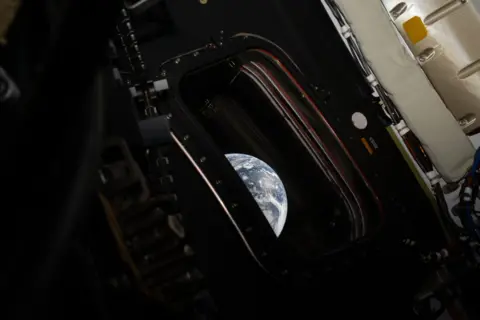
Nasa/Reid Wiseman An image from inside of the Orion capsule, which shows a small window and part of the Earth outsideNasa/Reid Wiseman
Wiseman also took this picture, titled Artemis II Looking Back at Earth, from one of the Orion spacecraft's four main windows

The images were taken after the crew successfully completed a trans-lunar injection burn in the early hours of Friday.

The burn took the Orion spacecraft out of Earth's orbit as the four astronauts aboard aim to travel the more than 200,000 miles to the Moon.

Artemis II is now on a looping path that will carry the crew around the far side of the Moon and back again. It is the first time since 1972 that humans have travelled outside of the Earth's orbit.

The crew should pass around the far side of the Moon on 6 April and return to Earth on 10 April.

NASA Half of the Earth NASA
Another image taken by the crew shows the divide between night and day, known as the terminator, cutting across Earth

After the burn was completed, the crew were "glued to the windows" taking pictures, mission specialist Jeremy Hansen told mission control in Houston.

"We are getting a beautiful view of the dark side of the Earth, lit by the Moon," he said.

Wiseman later called back down to mission control in Houston to ask how to clean the windows, as the astronauts' enthusiasm to see into space had left them dirty.

Another view captured by Wiseman shows the Earth divided by night and day. That frontier between light and darkness is known as the terminator.

Five Met officers taken off duty after weapons find

Getty Images a close up stock image of the back of a uniformed Metropolitan Police officerGetty Images

Five Metropolitan Police officers have been removed from front-line duties after a bag containing firearms and a Taser was found on a London street, the force has said.

The bag, which was discovered by a member of the public on Tuesday evening, was found outside London Mayor Sir Sadiq Khan's home, The Sun reports.

"At this stage it is believed the bag was misplaced by on-duty officers a short time before the member of the public located it," the police said in a statement.

The Met's Directorate of Professional Standards has said it is reviewing the incident.

Inside the bag was a sub-machine gun, a pistol, Taser and some ammunition, according to reports.

The force said: "At around 9.40pm, a member of the public called police after finding a bag containing Met-issued firearms and a Taser on a street in south London.

"Within seven minutes of the call to police, officers arrived at the scene and safely recovered the items.

"We are urgently reviewing the circumstances of this incident and recognise the concern it may cause."

Speaking to the Sun, a passerby saw the bag on the side of a road and alerted her partner after becoming suspicious.

Jordan Griffiths told the newspaper that after looking inside the bag, he took pictures of the contents, then called the police who turned up shortly after.

"When they arrived they were really shocked. They looked through the bag carefully and hurriedly took them away," he told the newspaper.

"I was told they had been left there by one of Sadiq Khan's security officers, which made sense as he lives here."

A spokesperson for Sir Sadiq described the incident as serious, adding: "The Met must now take all steps to ensure an incident like this never occurs again."

In 2017, Sir Sadiq said he agreed to a full-time police presence, meaning 24-hour police protection, when the risks to those around him had persuaded him to change his mind.

Football rally in Peru leaves one dead and dozens injured

Getty Images Crowds of people gathering near an ambulance at one of the entrances of the Alejandro Villanueva Stadium in Lima, Peru. It's night time and some of the fans are hugging, others looked shocked.Getty Images
Fans and an ambulance outside Alejandro Villanueva Stadium in Lima, Peru.

An incident ahead of a local football derby in the Peruvian capital Lima has left one fan dead and dozens injured.

Officials are investigating the cause. Initial reports suggested parts of the stadium's wall and structure had collapsed, which has since been disputed.

Confirming the death, Peruvian Health Minister Juan Carlos Velasco Guerrero told media at a Lima hospital that 47 people were hurt - three of which are in a critical condition.

Hundreds had gathered around Alejandro Villanueva Stadium wearing football shirts and waving flags of the home team, Alianza Lima, ahead of a match against local rivals Universitario de Deportes.

Fire Chief Marcos Pajuelo told reporters that the structure of the southern stands appeared to be in good condition.

"There are no collapsed walls or sections fallen into the pit," Pajuelo said.

Saturday night's match will still go ahead as planned, the football league said.

Earlier, the interior ministry published on X that 40 firefighters responded to an emergency at the stadium "involving people trapped in a structure".

However, Alianza Lima later published a statement, also on X, that said: "According to the preliminary information available, the incident is not related to the collapse of walls or structural facilities of the sports complex".

The Peruvian Professional Football League's said in a statement that authorities are investigating the circumstances of the rally and highlighted its "commitment to the safety and well-being of all attendees at sporting events."

Rescue team in Iran face 'harrowing and dangerous' search for US crew member

Getty Images US Air Force Pararescueman during a training exercise. Getty Images
US Air Force pararescue units train extensively to recover downed aircrew behind enemy lines

Early reports indicate that the pilot of a US F-15 fighter aircraft downed over Iran was rescued - which, if confirmed, would be the latest in the long history of US combat search-and-rescue missions over decades.

The search operation is ongoing deep inside Iran for a second crew member, according to CBS, the BBC's US partner.

Combat search and rescue, or CSAR, missions are considered among the most complex, time-sensitive operations that US and allied militaries prepare for.

In the US, elite units of the air force are specially trained for CSAR missions and are often pre-emptively deployed near conflict areas where aircraft could be lost.

What is Combat Search and Rescue?

Put simply, CSAR missions are military operations aimed at finding, aiding and potentially rescuing personnel in need, including downed pilots and isolated troops.

In contrast to conventional search-and-rescue efforts - which could take place during humanitarian operations or after disasters - CSAR missions occur in hostile or contested environments.

In some cases - as in Friday's reported recovery effort in Iran - the operations may happen deep in enemy territory.

The missions are extremely time-sensitive, as enemy forces would likely be deployed in the same area to try and locate the same US personnel the CSAR teams are trying to rescue.

In modern times, CSAR missions are often conducted by helicopters, with refuelling aircraft in support and other military aircraft on hand to conduct strikes and patrol the area.

Notably, verified video that emerged from Iran on Friday appeared to show US military helicopters and at least one refuelling aircraft operating over Iran's Khuzestan province.

Video appears to show a US plane and helicopters over southern Iran

The history of CSAR missions

Airborne, wartime rescue missions have a long history, dating back to World War One pilots conducting impromptu landings in France to rescue downed colleagues.

The US military's pararescue units trace their lineage back to a 1943 mission in which two combat surgeons parachuted into then-Burma - now Myanmar - to help wounded soldiers.

The world's first helicopter rescue took place a year later, when a US lieutenant rescued four soldiers from behind Japanese lines, according to Smithsonians Air & Space Magazine. The incident also marked the first operational use of a helicopter in combat.

Formal search-and rescue units were first established in the US in the immediate aftermath of the conflict. But modern CSAR began during the Vietnam War.

One mission, known as Bat 21, led to the loss of several aircraft and multiple US casualties while attempting to recover the pilot of an aircraft shot down behind North Vietnamese lines.

The war required a vast expansion of CSAR missions with increased scope and complexity. The experience helped the military refine tactics and procedures that have helped form the foundation of rescue operations since.

Getty Images US Pararescue team running to a helicopter in Cambodia in 1975. Getty Images
Thousands of rescue missions in Southeast Asia helped shape modern combat search and rescue operations

The US Air Force's pararescue teams

While each US military branch has their own limited CSAR capabilities, the US Air Force has the primary responsibility for finding and rescuing military personnel.

This work is primarily conducted by what are known as pararescuemen, part of the military's broader special-operations community.

The official pararescue motto is "These Things We Do, That Others May Live", and their work is considered part of a broader promise to US service members that they will not be left behind.

These personnel are highly trained as both combatants and paramedics, and go through what is widely considered one of the hardest selection and training pipelines in the US military.

The selection-and-training process - which takes approximately two years from start to finish - includes parachute and dive training, as well as basic underwater demolition, survival, resistance and escape training, and a full civilian paramedic course.

They also received specialised courses in battlefield medicine, complex recovery operations and weapons.

Historically, about 80% of potential pararescuemen wash out of the course, although it is often more, according to military news site Sofrep.

On the ground, these teams are led by specialised Combat Rescue Officers, who are fully trained pararescue operators responsible for planning, co-ordinating and executing the recovery missions.

Recent US rescue missions

Pararescue teams deployed extensively throughout the wars in Iraq and Afghanistan, conducting thousands of missions to rescue US and allied troops that were wounded or required extraction.

In 2005, for example, air force pararescue teams were involved to recover a US Navy Seal who was wounded and seeking shelter in an Afghan village after his team was ambushed and its other three members killed - an incident later made into the film Lone Survivor.

Missions to recover downed US pilots have been rare in recent decades.

In 1999, the pilot of an F-117 stealth fighter shot down over Serbia was found and recovered by parescuemen.

In an highly publicised incident in Bosnia in 1995, US pilot Scott O'Grady was rescued in a joint air force and Marine Corps CSAR mission after being shot down and evading capture for six days.

Bus or Lime bike? New subscription heats up the race for a cheaper commute

In Pictures/Getty Images Two Lime bikers ride in front of a London bus on a city centre street.In Pictures/Getty Images
New pricing means it might be cheaper to e-cycle or e-scooter than get the bus - but would you?

Suited and booted, James is on his 15-minute commute home from work. But he's not on a bus, a train or a tram - he's on an e-scooter.

"I get to avoid the rush hour and being packed in like a sardine," says the 23-year-old in Salford, Greater Manchester.

James is also saving money, something he's keen to do as a recent university graduate. "In terms of raw affordability, £4 on your commute a day is not bad - especially in the cost of living crisis."

He's one of a legion of often young people seen zipping around some of Britain's cities on bright green hired e-scooters and e-bikes operated by US company Lime. Other companies, including Forest and Bolt, and other councils run similar schemes.

And Lime's latest move appears to be an attempt to help change habits for commuters - not just those already scooting or pedalling for leisure.

It launched LimePrime at the end of February - a monthly subscription giving riders in Salford, Nottingham, London, Oxford and Milton Keynes a fixed price for the first 20 minutes of their journey. After that, riders are charged per minute at a discounted rate.

While Lime has arguably been perceived by some in the past as relatively expensive, the new subscription appears to try to undercut the cost of single journeys using buses and other forms of public transport.

In Salford, the LimePrime costs £1.50 for the first 20 minutes in return for a £2.99 monthly fee. By comparison, a single ticket from Salford to Manchester costs £2 by bus and £2.80 by tram - though season tickets for buses and trams can be cheaper.

It raises the question: will more companies and councils bring the pricing of e-scooters and e-bikes in line with buses and other traditional public transport - and can that change how we travel to work in cities?

A composite image of James and Paige stood on street pavements next to bright green Lime scooters.
James and Paige scoot to work in Greater Manchester rather than taking the bus

Paige, 22, a student at the University of Salford, is considering buying LimePrime for her twice weekly commute into Manchester city centre to her weekend hospitality job, which she often finishes late at night.

"It's basically the same price as a bus - it's £2, at most," Paige says of her 15-minute route, "but it takes me from my door to town straightaway, no traffic.

"I also don't have to sit with other people on public transport."

The motive behind the company's new scheme is simple according to Hal Stevenson, director of policy at Lime.

"The idea here is that we're trying to reward our most regular riders and also incentivise increasing [use]."

He says many commuters, particularly in London, use hire e-scooters or e-bikes to reach a railway or Tube station and then hop onto a train into the city. He thinks these people in particular would benefit from the subscription.

"It's fixed basically at the same price as a bus, but it's much faster and it's more convenient because you can just pick up an individual e-bike or [e-scooter] and go."

Both Paige and James - who isn't currently a Lime subscriber either - say e-scooters are quicker than buses for their commutes.

A graphic showing the cost of buses, trams and Lime bikes or scooters in Nottingham, London, Milton Keynes and Oxford.

Lime's e-scooters and e-bikes can be parked on the pavement, though riders are required to do so neatly and in approved zones.

In contrast, many council-run bike hire schemes must be parked at fixed docking stations.

We saw Lime e-scooters dotted around Salford this week - but they can't be used in neighbouring Manchester city centre. There, Transport for Greater Manchester (TfGM) runs its own pedal and e-bike scheme, Starling Bank Bikes, part of its Bee Network of public transport.

It means those commuting by Lime from Salford walk the rest of the way into Manchester city centre after parking up by the river dividing the two areas.

Such patchwork schemes are typical in UK cities. Without clear continuity, some commuters may be put off switching from buses, trams, trains or tubes.

Rows of Starling Bank Bikes at a docking station in front of Manchester cathedral.
Starling Bank Bikes must be parked in docking stations and operate in both Manchester and Salford - but Lime only runs in the latter

Parking rows - and a balance to strike

Still, usage of Starling bikes - which run in both Salford and Manchester - is up 32% over the last year, according to TfGM. The pedal versions cost 50p to unlock and 5p per minute after that, while e-bikes are £1 to unlock and 10p per minute.

There is no subscription model currently, but, as with Lime, you can buy bundles of minutes.

Other companies like Dott and Voi also offer subscription services in parts of the country. Dott costs about £35 per month and gives users two free 30 minute e-bike rides per day in cities including Bath, Bristol and Glasgow.

But Lime and other operators have faced significant, ongoing challenges in UK cities.

A common complaint among residents where hire e-bikes and e-scooters operate, such as Lime, is they are used irresponsibly by some riders, whether that be zooming along pavements or being parked badly.

The London borough of Hounslow ended its two-year trial of Lime bikes last summer after complaints from residents about parking impeding pedestrians.

Transport for London has also begun issuing fixed penalty notices to Lime and Forest for abandoned e-bikes on the capital's roads.

Meanwhile, the Canal and River Trust has warned there is a national problem with hundreds of Lime e-bikes being dumped in rivers and canals.

Jack, 30, commutes daily by e-scooter - often in the early hours of the morning before public transport is up and running. While he's "saving a fortune" using Lime e-scooters rather than taxis to travel into Manchester from Salford for his job in recruitment, he feels it would be "carnage" if e-scooters were allowed onto Manchester's busy streets.

"Running around on these things in densely packed metropolitan areas? It would be mental."

It demonstrates how city authorities across the country are having to strike a balance between offering hassle-free e-bike and e-scooter hire, while keeping all other road users on board.

Jack stands on an e-bike on a pavement in Salford.
Jack is wary about the idea of Lime e-scooters expanding from Salford into Manchester

Dr Khashayar Kazemzadeh, a lecturer in transport planning at The University of Manchester, thinks governments around the world are still in a trial and error phase here.

LimePrime has already launched in other countries - the US, Italy, Germany, Australia and New Zealand - but some major global cities have banned rental e-scooters over safety concerns, including Paris and Melbourne.

Kazemzadeh believes hire e-scooters and e-bikes have a role to play.

"About a quarter of trips in the UK are less than one mile," he says, citing UK government data from 2024, "so these could be done by more active modes of transport, like e-scooters or cycling."

In his view, e-scooter and e-bike subscriptions are particularly attractive to people making these kinds of journeys and younger workers, but buses, trains and the like will remain the "more inclusive" option for many others.

Back in Salford, James acknowledges that although not everyone is in favour of e-bikes and e-scooters in urban centres, more choice can only be a plus.

"If there are more options for people, especially in terms of affordability, then I feel that's the right direction to go in."

But what about when it rains - isn't his crisp suit going to get wet?

"Bring a coat," James says. "You're in Manchester, you're in the north."

Power-washing, pool-cleaning and mowing: Why millions are playing games about mundane jobs

FuturLab An in-game screenshot of the game PowerWash Simulator 2. It shows a first-person perspective of someone cleaning the red and white sign of a gas station outside that reads "Lone Station" and "Open 24/7" with a large green cactus as the pole. They are using a grey and blue power washer and have orange gloves. The sign is next to a gas station which is covered in dirt. FuturLab
PowerWash Simulator 2 has been nominated for two Bafta Games Awards

PowerWash Simulator sees players don their cleaning gear and hose down a variety of filthy in-game locations until they're sparkling and spotless.

While it may seem like an unusual premise, the original game from 2021 has sold more than 17 million copies. The sequel, released in 2025, has just been nominated for two Bafta Games Awards.

Both fall under the category of "mundane job simulations", an ever-growing gaming genre in which people carry out routine and - on the face of it - not very exciting tasks.

"We want to make the Graham Norton of video games," says Kirsty Rigden, the chief executive of Brighton-based FuturLab, which makes PowerWash Simulator.

Aspiring to emulate a talkshow host who has a reputation for being affable rather than for setting pulses racing is perhaps an unusual ambition for a gaming studio.

But she says there is a big market for lower-octane entertainment.

"Graham Norton doesn't make you feel stupid, but you also don't have to think too hard," Rigden told BBC News.

"It engages the right amount of brain and at the end of it you go, 'Oh, that was really pleasant'."

Futurlab An in-game screenshot from the game PowerWash Simulator 2. We see a first-person perspective of the player using a blue and white pressure washer to spray the robot console character BMO from Adventure Time, who is laughing. The rest of the room is covered in dirt on the walls.Futurlab
PowerWash Simulator 2's added content sees players get to clean up the cartoon world of Adventure Time

One of the core characteristics of the simulation genre is its soothingly repetitive jobs.

In PowerWash Simulator's case that means cleaning through one mucky area - say, a fun house or a roller disco - after another; quite literally rinse and repeat.

"I think it's really struck a chord with how people are feeling in the world right now - the world is in quite a stressy place," Rigden said. "With the game you are able to focus in on one thing, which kind of blocks all the other distractions out - it's a pure form of meditation."

The initial idea came from a personal interest Rigden had in watching YouTube videos of people power washing and the "simplicity of seeing dirt turn to cleanliness".

Kirsty Rigden A headshot of the CEO of FuturLab, Kirsty Rigden. She is smiling looking off the camera with her mouth open and has grey hair with purple strands. She is wearing a grey top.Kirsty Rigden
Kirsty Rigden is the CEO of FuturLab, which makes the PowerWash Simulator series

Social media is awash with influencers - some with hundreds of thousands of followers - making content about cleaning or clearing up, and FuturLab's series is not the only simulator to have tapped into the trend.

In Lawn Mowing Simulator players "experience the beauty and detail of mowing the Great British countryside" by running a lawn care business, using "real-world licensed lawnmowers".

A sequel, promising to take players to the "trailer parks and town hall gardens" of America, is currently in the works.

David Harper, managing director and founder of Liverpool-based developers Skyhook Games said players often use the game as an "escape" from the pressures of everyday life.

"It's basically about the satisfaction of starting with something untidy, learning the skills to bring order to the scene, then looking back at a job well done," he said.

Skyhook Games An in-game screenshot from the game Lawn Mowing Simulator 2. It shows an organe American lawn mower on a pathway next to a lawn of green grass. The American flag flies from a straight grey pole on the lawn and behind it is a grey house, surrounded by trees with orange and yellow leaves.Skyhook Games
Lawn Mowing Simulator 2 will take players to the "trailer parks and town hall gardens" of America.

The relaxed nature of mundane job simulators has made them a particular hit with YouTubers and Twitch streamers, who can strike up a conversation with viewers without needing to pay too much attention to the game.

A video of US creator Markiplier playing PowerWash Simulator from 2021 now has more than nine million views.

Comedian and games journalist Ellie Gibson started streaming the game to her Twitch community after a friend recommended she try it.

She also holds the Guinness World Record for the longest time playing PowerWash Simulator - an impressive 24 hours, six minutes and 33 seconds.

The attempt went relatively smoothly, she explains, apart from a "nightmarish" section when cleaning a kid's playground at four in the morning where the game's bright primary colours affected her in "a very psychedelic way".

But she added the "calming and soothing" nature of the game is similar to what she imagined "people get from colouring books or knitting".

The only difference?

"You get the finished result of a clean monster truck, rather than a scarf."

Helen Thorn The comedian Ellie Gibson, who is sitting down inside her flat and wearing glasses and is dressed up from head to toe in a light blue cleaning suit. She is holding a PlayStation controller and next to her on a desk is a small round table with a black microphone and open laptop as well as mugs of tea.Helen Thorn
Comedian Ellie Gibson holds the Guinness World Record for the longest time playing PowerWash Simulator

Both Rigden and Harper say they have had a number of people get in touch to tell them their games have helped them through difficult times.

"Hearing how our game has helped our players with their anxiety and mental health has been really rewarding to us," said Harper.

Meanwhile, Rigden said they had "lots of people writing in and saying how we've helped them get through things like cancer treatments."

"It's really lovely and uplifting."

PowerWash Simulator has even been the subject of an Oxford University study, which looked at whether video games affected players' wellbeing.

In March 2023, more than 8,600 players tracked their mood every 10 minutes with pop-up prompts while playing a custom build of the game.

The study found 72% of players experienced an uplift in mood while playing the game.

FuturLab An in-game screenshot from the video game PowerWash Simulator 2. We see a first-person perspective of the player using a pressure washer to spray water on a wooden house front which is very dirty. Another character dressed in blue cleaning gear is also spraying the house.FuturLab

While Nick Ballou, one of the researchers behind the study, said it was unlikely mundane job simulators would ever be comparable to something like therapy, he believed they still had a couple of "unique benefits".

"These games are particularly suitable for people with low energy, and they're really effective in absorbing attention," he said.

"I do think playing them can be more mindful than other games that require lots of cognitive engagement to coordinate with teammates or react in a split second."

As for Rigden and the team, there is a plan to make a game separate to the soapy empire they've currently worked up into a lather - as they continue their goal to become "the market leader in cathartic games".

Whatever the team work on next, there's one unique element which will undoubtedly remain - their unusual, yet perhaps fitting, Graham Norton ethos.

A green promotional banner with black squares and rectangles forming pixels, moving in from the right. The text says: “Tech Decoded: The world’s biggest tech news in your inbox every Monday.”

Sign up for our Tech Decoded newsletter to follow the world's top tech stories and trends. Outside the UK? Sign up here.
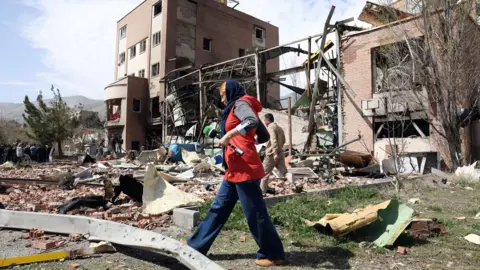
What not to say to a friend who is struggling to conceive

Getty Images A sad woman sitting on a sofa, a person behind them has placed their hand on her shoulder in empathy. Getty Images

The day after Vicky Levens had her third miscarriage, she returned to her job as a receptionist.

Back at work, two managers, whom she says knew about what she'd been through, made comments she found hurtful.

"At least" Vicky was early on in her pregnancy when she miscarried a female manager told her, while a male manager said she didn't look presentable enough to work at the reception desk.

"I was in shock," says Vicky, 29, from Belfast. She handed in her notice on her next shift.

Vicky Levens Vicky LevensVicky Levens
Vicky says misplaced advice about her fertility and future can be hurtful

Over the years, friends and family have made misguided but well-meaning comments to Vicky about her struggle to conceive, telling her "it'll be your turn soon", "just hold on to hope", or even offering her advice.

"I know they're trying to bring comfort," says Vicky, who started trying for a baby in 2020. "But, in the moment, when you're going through the motions, I wish people wouldn't say that, because it hurts."

Uncomfortable comments

Vicky is not alone in facing uncomfortable comments about miscarriage and fertility struggles.

"You are met with really poor words from people," Kay, 33, from Manchester, told Woman's Hour's Guide to Life in an episode about navigating conversations around infertility. The vast majority of ill-judged comments aren't intentional, she says, but they can come across as insensitive.

"Someone really close to me sat me down just before I started IVF and said to me 'a lot of women have miscarriages, so you just need to get ready and not be dramatic about it'," Kay recalls.

A woman with blonde hair in a black top sits on a chair in front of a red curtain
Kay says people have unintentionally made hurtful comments about her infertility

According to the NHS, around one in seven couples have difficulty conceiving. In the UK, in 2023, more than 50,000 patients had IVF cycles - where eggs are fertilised in a lab and the embryo is then placed in the woman's uterus.

But people who've experienced infertility say it can be a difficult subject to discuss with friends, family and colleagues.

"I think it's quite a taboo subject," says Chloe Cavanagh, 26, from Glasgow, who is on the NHS waiting list for IVF.

Initially Chloe was hesitant to tell friends and family that she was being affected by infertility.

"There's a sense of embarrassment," she says, "because that is what your body's meant to do so you feel like you're failing yourself."

'You're questioned about being womanly enough'

Asiya Dawood, 42, who's British-Pakistani and lives in West London, says in some South Asian communities, women who don't conceive quickly after marriage "get so many comments".

"You're questioned about being womanly enough," Asiya says, adding that relatives can be quick to blame the wife for focusing on her career or not getting married young enough.

When she was struggling to conceive, Asiya withdrew from friends and family because she was tired of the relentless comments. "I didn't go out, I didn't have a social life," she says.

Asking for help is "taboo" and might be perceived as a "sign of weakness", she adds.

Asiya Dawood A woman with long brown hair and glasses smiles in a black top and blazer, in front of a grey backgroundAsiya Dawood
Asiya Dawood launched the first South Asian Baby Loss Awareness Week last year

But it's important to open up to people about your experiences because infertility and the treatment for it can have a big effect on emotions, says Joyce Harper, Prof of reproductive science at University College London (UCL).

"The treatment itself is a roller coaster, and then the days when you get that period or you've had your embryo transfer back; there are so many times when it becomes really difficult," she told Woman's Hour.

ikat photography / Sam Chandler Two close-up images next to each other: One of a woman with blonde hair and glasses, smiling; one of a woman with black hair and a red top, smilingikat photography / Sam Chandler
Marie Prince and Joyce Harper spoke to Woman's Hour about the importance of having a support network when you're experiencing infertility

The people you confide in don't necessarily need to be family or the friends you'd usually share things with, says Dr Marie Prince, a clinical psychologist who specialises in fertility.

"It might be that your IVF support team are different to the people who would normally support you," she says.

People going through fertility treatment at a UK clinic (including NHS clinics) have access to counsellors, Prince says, and she encourages everyone to use that service.

The women BBC News spoke to say friends and family should ask the person experiencing infertility what kind of support they need, as this varies from person to person.

Random check-ins, remembering dates of appointments and educating yourself on treatments can show that you're thinking of the person, Chloe says.

'Incredible' support from friends and family

Elena Morris, 29, from South Wales, says she's had "incredible" support from friends and family throughout her fertility journey.

After having miscarriages, people visited Elena, brought her food and flowers, and gifted her and her husband vouchers for restaurants "to just have a break". Her parents and husband bought her flowers for Mother's Day, too.

But it's not just the big gestures. Elena says small signs of support also mean a lot, such as people texting her saying they're thinking of her.

"It's just nice to know that you haven't been forgotten."

Chloe Cavanagh / Elena Morris Two photos of women next to each other - one blonde with a white top, one brunette with a white top, both smiling at the cameraChloe Cavanagh / Elena Morris
Chloe Cavanagh and Elena Morris say small gestures like check-in texts can show people you're thinking about them

When a friend or relative becomes pregnant, this can stir strong emotions for someone experiencing infertility. Prince says she's spoken to people who feel "really distressed" over loved ones' pregnancy announcements.

Elena has told her friends and family she wants them to share their pregnancy announcements with her via text, so that it's "easier to digest and you can respond when you're ready".

She says being told in person can make some people feel like they've "got to be really really happy" even though "actually, all you might want to do in that moment is burst into tears".

When one of Chloe's closest friends became pregnant, she appreciated being told one-to-one, rather than finding out in a group setting or through another person.

"I would hate for people not to tell me because they think I'm going to be sad," Chloe adds.

Within South Asian communities, Asiya says younger people are keen to break the stigma associated with infertility and miscarriages.

To encourage people to share their experiences, she launched the first South Asian Baby Loss Awareness Week last year, with talks from women, GPs and charities.

For Elena speaking to friends and family about her experience with infertility "felt like a relief".

"When people don't know what you are going through, things can be said or done unintentionally that may trigger you," Elena says. "We are absolutely glad we opened up and wouldn't change it."

If you have been affected by the issues raised in this story, organisations that can offer help and support are available on the BBC's Action Line

After 16 years in power, can Viktor Orban finally be unseated?

BBC Peter Magyar (left) and Vikor Orban (right) in black and white photographs against a red backdrop with a green dotBBC

"All they stand for is anger, hatred, and destruction," roared a hoarse Viktor Orban. The Hungarian prime minister was speaking at a mass election rally in Györ in western Hungary on 27 March, referring to opposition protesters who chanted "Filthy Fidesz" during his speech. For just a moment, his carefully cultivated image as the voice of calm navigating his country through stormy seas was shattered. His bad-tempered outburst showed a different side of a man used to cracking jokes and charming even his critics.

Most opinion polls put the opposition Tisza party and its leader Peter Magyar far ahead of Orban's Fidesz - the latest by 58% to Orban's 35%. And he is doing everything he can to close the gap. After 16 years of virtually unchallenged rule, Orban has been forced to take to the road again. In the past three elections, he gave few rallies. Now Europe's longest-serving leader is trying to mobilise his supporters and reach the undecided. He has just a week left to rescue his government, and the international populist movement he embodies, from a crushing defeat.

In power since 2010, Orban has had the support of both US President Donald Trump and Russian President Vladimir Putin. He has long been a thorn in the side of the EU - and one of the few EU leaders not supportive on Ukraine. For Europe's growing band of nationalist parties, in power or on the brink of it, he is the model. The 12 April Hungarian parliamentary election is being watched closely all over the world.

NurPhoto via Getty Images Orban points while standing in front of a microphone. He wears a dark blue casual jacket NurPhoto via Getty Images
Orban has a rough, rural style

"We can notice a big change in public perception," said Endre Hann of the Median agency, a public-opinion research firm. In January, 44% of those asked said they thought Fidesz would win, compared with 37% for Tisza. By March, 47% believed Tisza would win, while 35% believed Fidesz would. "This reflects a huge change of trust. People believe that it can be changed," he says.

An intriguing dynamic is playing out in this election - the same voter anger against those seen as "corrupt ruling elites" across Europe, is now working against him. In Hungary, it is now Orban and his Fidesz party who are seen by many, especially the young, as the "corrupt ruling elite".

Getty Images Donald Trump wears a dark blue suit and a yellow tie as he points at Viktor Orban, who is smiling. Orban is wearing a dark blue suit and a red tieGetty Images
Trump has lent Orban his support over the years

The Orban government has been repeatedly accused of draining state coffers and giving state tenders for projects to companies owned by close associates. The government explains this concentration of wealth as an attempt to put wealth in national, instead of foreign hands.

The projects included bridges, football stadiums and motorways. His son-in-law, Istvan Tiborcz, owns a string of prominent hotels. His childhood friend Lörinc Meszaros, a former gas fitter, has become the wealthiest man in the country. Orban refuses to answer questions about the personal wealth of his friends and family. All deny wrongdoing.

Can Orban save himself by blaming Ukraine - and its EU backers - for his country's woes? And can the smooth-talking lawyer who hopes to unseat him convince Hungarians, particularly those in rural areas which make up the Fidesz heartlands, that he can deliver the "more humane, better functioning country" that he promises?

Under pressure

Each day brings a new indication that Orban is in trouble, from alleged voter-intimidation schemes to a dramatic Russian proposal to stage a fake assassination attempt on Orban.

But Fidesz claims the sense that it's in trouble has been cooked up by the opposition. "All these scandals are just the usual suspects trying to build a narrative," says Zoltan Kiszelly, a political analyst from the government think tank Szazadveg. "When the opposition lose the election, this gives them an excuse to allege 'fraud'."

Political analyst Gabor Török - one of the few analysts in this extremely polarised society respected by both sides - wrote recently on his blog: "This is not the 'calm strength' or the 'strategic calm,' image, nor the one carefully cultivated for years and displayed on 'Prime Minister of Hungary' posters.

"If the remaining two weeks unfold like this, it does not bode well for the government side."

Global referendum

The shockwaves of an Orban defeat would reverberate far beyond Hungary's borders.

"Budapest is the headquarters of illiberal democracy in the world," argues Michael Ignatieff, former rector of the Central European University, which was forced out of the Hungarian capital in 2019. "This is not just an election. This is a referendum on that whole model of authoritarian rule that Orban represents."

AFP via Getty Images Viktor Orban (2nd R) is flanked by Deputy Prime Minister of Italy Matteo Salvini (R), former leader of the French far-right National Rally party Marine Le Pen (2nd L), former Deputy Prime Minister of Latvia Ainars Slesers (3rd L) and Leader of the Party for Freedom Dutch Geert Wilders (L) AFP via Getty Images
Orban is backed by other right-wing politicians in Europe

He's referring to the network of think tanks, fellowships, and gatherings of right-wing influencers who zig-zag across the Atlantic to support one another. On consecutive days last month, the American Conservative Political Action Conference (CPAC), a platform for people across the political right to discuss ideas, and Patriots for Europe, the right-wing European Parliament group, held major events in Budapest.

The fact that no leading US politician attended the Hungarian CPAC event this year raised eyebrows within Fidesz, but the Republicans are not leaving Orban in the lurch. US secretary of state Marco Rubio was here in February, and vice president JD Vance is expected in Budapest a few days before the vote.

AFP via Getty Images Orban stands on a stage in front of the CPAC logo. He is wearing a dark blue suit and a light blue tie AFP via Getty Images
Orban transformed Hungary into an international destination for the political right

A victory for Fidesz in this election would add momentum to the chances of far-right parties in France, Germany, Poland, Spain and Portugal. Defeat for Fidesz would take some of the wind out of their sails. "While the rest of Europe is being sucked into the radical nationalist tunnel, we can show the way out," a senior Tisza official told me.

Getting the vote out

Despite a poor showing in the polls, Orban's allies deny that there is panic in the Fidesz camp.

According to Zoltan Kiszelly, the crucial factor will be whether Fidesz can persuade their supporters to get out on polling day.

"We are very optimistic. Nobody believes in the opinion polls, neither our own, nor the opposition ones," he says.

"The majority of the voters are for Fidesz. Of pensioners, of women, of the Gypsies [Roma], of the poor, of the blue collar workers, of the rural people. The question is, will they cast their vote?"

To make sure they do, Fidesz has worked hard to update its database of supporters. Around 4.5 million of the 8.2 million-strong Hungarian electorate live in small towns and villages - the Fidesz heartlands. Since 2002, Fidesz has built a strong system of local patronage in the villages - the mayor decides who receives work, and who gets firewood in winter.

According to an investigative documentary released last week, mayors have been told how many votes each village needs to produce for Fidesz. Those interviewed in the film claim the incentives include cash payments of €120 (£104) per vote, food coupons, prescription medicines and even illegal drugs in exchange for voting for Fidesz. Those who refuse say they are denied the chance to participate in public works schemes, often the only local work available.

Cars and minibuses are organised on election day. "Companions" stand by to accompany voters, who feign illiteracy or illness, into the voting booth, to make sure they vote for Fidesz and get their money, people interviewed in the film claim. There has been no official government reaction to these allegations. One minister told the BBC that any wrongdoing should be dealt with by the appropriate authorities.

Rival parties at previous elections offered potatoes and even small sums for votes, but nothing on the scale of this election, we were told by people who have been involved in elections over the decades.

"Everyone here votes Fidesz," said Nikki, 32, in Tiszabö, a village of 2,000 inhabitants, with a large Roma majority, in the northern Great Plain region of Hungary.

She praises the Fidesz mayor for rebuilding the roads, the kindergarten, and the sports centre. She claims votes won't need to be bought on 12 April, as Fidesz will win "because of the war".
The Russian connection

Orban has told voters that this election is a simple choice between peace and war.

According to Fidesz, only Orban can prevent the "warmongers" in Brussels from dragging the EU, and with it Hungary, into the war in Ukraine against Russia.

Peter Magyar, leader of the opposition Tisza party, is painted as a puppet of Brussels. The Fidesz message is that a vote for the opposition would mean that Hungary, as a Nato member, will be forced to send Hungarian troops either in a future Nato peacekeeping operation, or a full-scale war with Russia, and young Hungarian men will die again on the eastern front. That's a message designed to resonate deeply in a country on the losing side of both World Wars. Since 2022, Orban has argued that Russia cannot be defeated, and that instead of supporting Ukraine militarily and economically, the West should pressure Kyiv to seek peace with Moscow - on Russia's terms, if needed.

AFP via Getty Images Viktor Orban and Vladimir Putin shake hands in front of the Hungarian flag. They both wear dark suitsAFP via Getty Images
Orban and Putin have long had a good relationship

"The Fidesz anti-Ukraine, pro-Russian message is flagging," veteran pollster Endre Hann of the Median agency told me. His latest figures suggest a growing 52% of those asked agreed that "Russia committed a serious and unprovoked act of aggression against Ukraine" with its 2022 full-scale invasion. Just 33% agreed with the Fidesz narrative that "Russia acted legally, to defend its interests and security."
Orban is the most pro-Russian leader in the EU. His government has refused to follow German, Czech and Polish efforts to wean themselves off Russian oil. In this campaign, Fidesz has painted Ukraine and its leader, Volodymyr Zelensky, as the enemy. Giant billboards show a grinning Ukrainian president with the slogan: "Don't let Zelensky have the last laugh!"

NurPhoto via Getty Images Two posters are displayed on a street: the top one shows Zelensky, Magyar and Ursula von der Leyed, and the bottom one shows Zelensky smiling NurPhoto via Getty Images
Fidesz has leant into bashing the EU and the Ukrainian president

Since 27 January, no crude oil from Russia has reached Hungary via Ukraine through the Druzhba pipeline, which translates as the "Friendship pipeline". A major hub and pumping station at Brody in western Ukraine was damaged that day in a Russian attack. Hungarian refineries depend on the pipeline, and Orban accuses Zelensky of deliberately failing to restore the flow of oil in order to harm his election chances.

A map showing two strands of the Druzhba oil pipeline from Russia into Europe in red. One strand goes through Hungary into Ukraine before connecting to another strand going into Russia.

The "peace or war" message, argues Zoltan Kiszelly, the Fidesz analyst, is more sophisticated than it sounds.

"The government aims to connect the current situation, the threat of no oil, with practical issues like the cap on utility bills," he explains. Since 2013, all household and electricity costs have been capped by the government, resulting in the lowest prices for consumers in the EU. That is only possible, the government argues, thanks to cheap oil and gas from Russia.

An unlikely challenger

Magyar, 45, is a former Fidesz insider who joined the party as an enthusiastic student, married the former Fidesz justice minister, and worked as a Hungarian diplomat in Brussels. In February 2024 he suddenly quit the party and all his posts in state companies, and gave an interview which garnered two million views within days, accusing the government of cowardice and corruption. He then founded the Tisza party, named after a tributary of the Danube.

A slight figure in neat shirts and jackets, Magyar seemed too slick and urbane to reach the hearts of the rural electorate, but has proven himself a strong challenger. Orban, 62, is a village boy who speaks village Hungarian, Magyar is a Budapest lawyer by training. Conscious that his status as a member of the metropolitan elite may make him less likely to appeal to rural voters, Magyar has toured the countryside indefatigably for the past two years, drawing large crowds. Unlike Orban, who waxes lyrical on global politics, Magyar focusses on domestic issues such as healthcare, education, transport and rural depopulation in his speeches.

NurPhoto via Getty Images Peter Magyar gesticulates from behind a podium. He wears a high-necked blue suit jacket with brocading on the front, and has a rosette pinned to his chestNurPhoto via Getty Images
Peter Magyar cuts a distinctly metropolitan figure next to Orban

His relationship with Russia is also different. He has pledged that if he wins, "we will study and where needed change the existing contracts with Russia, [and] diversify our energy resources in every possible way". He has also promised to "restore Hungary's seat at the EU and Nato tables."

Magyar says he learnt quickly on his six nationwide tours. He quickly abandoned his notes after being criticised for sounding stilted, and started speaking "from the heart", he told me in an interview earlier this year. "After the first days, I read the criticism and learnt… to go closer to the people, to let them ask questions and reply openly and honestly, which is rare in Hungarian politics."

He has gone from a rank outsider to the man who is widely expected to unseat Orban. While Orban usually visits one city a day on the campaign trail, Magyar visits from three to six, in an effort to reach all 106 individual constituencies by voting day.

He is no stranger to controversy himself. After becoming a politician, his ex-wife depicted him as an unstable figure, prone to bursts of anger and domestic violence. Anti-Tisza protesters once held banners featuring a shoe, which he allegedly once threw at her. More recent attempts by Fidesz to discredit him include convincing a former girlfriend to secretly tape his conversations, and taking him to a party where cocaine was being used. Magyar denies any domestic abuse, and speaks fondly of his ex-wife in public. He denies ever taking drugs, and last week published the negative results of a drug test. He challenges certain Fidesz politicians to do the same.

A poll published by the 21 Research Agency, a pro-democracy think tank, earlier this week showed the Tisza candidate pulling ahead in most of its 20 swing districts. Magyar has spoken of a "tipping point" in the countryside, and if this poll proves right, he has already reached it.

Orban and Fidesz have a media empire to amplify their message, but Magyar instead relies heavily on broadcasting each rally live on Facebook. While previous opposition leaders mustered crowds of a few dozen if they ventured out of Budapest, Magyar attracts hundreds in villages, and thousands or tens of thousands in provincial urban Fidesz strongholds.

A top Fidesz official grudgingly admitted that Magyar has "a brutal energy", which his own camp often lacks. Magyar's promise to build "a more humane, efficient country" resonates with all those fed up with the governing party, especially the young.

Getty Images The table is set for a formal dinner in the White House, with JD Vance, Orban, Trump and Marco Rubio sitting down. They all wear suits. Getty Images
Vance, Trump and Rubio have all gone out to bat for Orban - but will it help this election?

What would a Fidesz victory or defeat mean for Hungary? "What we have now is a state that has been fully captured by a single party," Andras Baka, former president of Hungary's supreme court, told me. If Fidesz wins "we have an ever more rigid autocracy."

If Tisza wins, there will be a big laundry list to tackle, including restoring the independence of the courts, the state prosecution service, the state audit office, the public media, and the intelligence services from the government of the day. Whether a Tisza government can do that, and how quickly, would depend on the margin of victory.

Top image credit: NurPhoto/AFP via Getty Images

Thin, lobster red banner with white text saying ‘InDepth newsletter’. To the right are black and white portrait images of Emma Barnett and John Simpson. Emma has dark-rimmed glasses, long fair hair and a striped shirt. John has short white hair with a white shirt and dark blazer. They are set on an oatmeal, curved background with a green overlapping circle.

BBC InDepth is the home on the website and app for the best analysis, with fresh perspectives that challenge assumptions and deep reporting on the biggest issues of the day. Emma Barnett and John Simpson bring their pick of the most thought-provoking deep reads and analysis, every Saturday. Sign up for the newsletter here

Faced with new energy shock, Europe asks if reviving nuclear is the answer

AFP via Getty Images A photograph taken on November 21, 2025 shows the nuclear plant of Doel, in AntwerpAFP via Getty Images
Belgium is one of a number of European countries revising their nuclear strategy

With a pit in their stomach, families and industries across Europe are watching gas prices and the cost of filling vehicles with petrol spiral.

While the UK government has told voters pretty much to keep calm and carry on, the European Commission - the EU's executive arm - has called on people to work more from home and to travel a lot less.

Policymakers warn things could get much worse - depending on what happens next in the Middle East. Yet it feels like only yesterday that Europeans faced a cost-of-living crisis on the back of spiralling energy costs and inflation following Russia's full-scale invasion of Ukraine.

This means conversations in Europe are turning (again) to the issue of energy independence.

And nuclear energy seems to be back in fashion as part of a home-grown European energy mix - in the UK as well as the EU. But how quick a fix can nuclear be - and how safe and reliable is it really?

AFP A woman in an orange jacket speaks at a lecternAFP
European Commission President Ursula von der Leyen said the war had exposed the continent's fossil-fuel "vulnerability"

At the recent European Nuclear Energy Summit in Paris, European Commission chief Ursula von der Leyen, who perhaps forgot she was a minister in the German government when it took the decision to phase out nuclear power plants in 2011, described Europe broadly turning its back on nuclear as a "strategic mistake".

In 1990, Europe produced around a third of its electricity from nuclear power. That has now fallen to an average of 15%, leaving the continent "completely dependent on expensive and volatile imports" of fossil fuels, she said, putting Europe at a disadvantage compared with other regions of the world.

Europe imports more than 50% of its energy. Mainly oil and gas.

This leaves the continent vulnerable to unexpected reductions in supply, as was the case with Russia after Europe imposed energy export sanctions, or price increases on the global market, as we are now seeing because of Iran's strangling of energy exports via the Strait of Hormuz.

Gas prices rise at a similar rate across Europe but the impact on electricity prices varies depending on each country's energy mix.

In Spain - which has invested heavily in wind and solar power - the average electricity price for the rest of 2026 is forecast at around half of Italy's, where gas sets the electricity price 90% of the time.

France is Europe's largest nuclear producer. It generates about 65% of its electricity from nuclear power. Based on futures contracts, German electricity prices for next month are five times those of France - an eye-watering contrast.

Germany phased out nuclear power following the 2011 Fukushima nuclear disaster in Japan. This left the energy-hungry industries that traditionally power the German economy - cars and chemicals - hugely gas-dependent.

This week, Berlin's top economic research institutes more than halved their growth forecasts for 2026 to a predicted 0.6% of GDP because of global price hikes for gas.

A renewed enthusiasm for nuclear power is palpable in Europe:

  • Italy is preparing draft laws to repeal its longstanding ban
  • Belgium seems to be making a complete U-turn after years of reluctance about investing in nuclear energy
  • Greece, historically cautious because of seismic concerns, has opened a public debate on advanced reactor designs
  • Sweden reversed a four-decade old decision to abandon nuclear technology
  • In the UK, Chancellor Rachel Reeves recently announced streamlining regulation to help advance nuclear projects.

"To build national resilience, drive energy security and deliver economic growth, we need nuclear," said Reeves.

New polling from YouGov suggests growing support for nuclear energy in Scotland, with the majority of people now backing it as part of the country's energy supply.

No prizes for guessing that France is the loudest nuclear cheerleader. President Emmanuel Macron is ever eager to point to the industry's credentials as a low carbon-emitter, potentially helping the EU towards its net zero goals.

He told Europe's nuclear summit that "nuclear power is key to reconciling both independence, and thus energy sovereignty, with decarbonisation, and thus carbon neutrality".

AFP A man in a hard hat and orange jacketAFP
France's Emmanuel Macron has long backed his country's nuclear energy industry

He also emphasised the increased energy demand from AI and his belief that nuclear power could give Europe a competitive edge or "the ability to open data centres, to build computing capacity and to be at the heart of the artificial intelligence challenge."

Until last year, Germany blocked efforts to treat nuclear energy on a par with renewables in EU legislation. That caused a lot of friction with Berlin's supposed closest EU friend, France.

But Berlin has since agreed to the removal of anti-nuclear bias. A cynic might say that could have something to do with defence and security concerns, provoked by deteriorating relations with the Trump administration.

Germany has asked France to extend its independent nuclear deterrent to European partners, something France agreed to this month.

But beware of viewing nuclear as an energy panacea.

Nuclear development is a long-term project, not a short-term fix to current energy insecurity.

Building nuclear reactors can be subject to extremely long delays, as recent examples in France and the UK have illustrated, at Flamanville-3 and Hinkley Point C.

Waste management and public concerns regarding the safety of nuclear energy persist.

Anadolu via Getty Images Members of the anti-nuclear movement hold a demonstration marking the 15th anniversary of the Fukushima nuclear disaster as they gather in Schuman Square next to the European Commission building in Brussels, Belgium on March 11, 2026Anadolu via Getty Images
Anti-nuclear demonstrators last month marked the 15th anniversary of the Fukushima nuclear disaster

Environmental groups warn investment in nuclear energy can divert funds and political attention from speeding up the development of renewables, and an added layer of strategic risk is that a number of Central European countries, especially Hungary and Slovakia, still depend on Russian nuclear technology and uranium.

"You're ignoring the history of nuclear in Europe if you think it can just slot in [as an easy energy crisis solution]," Chris Aylett told me. He's a Research Fellow at the Environment and Society Centre, Chatham House.

Nuclear energy is part of the solution, he believes, but many European nuclear reactors are old and governments need to invest considerably just to maintain or extend their working life.

"The main challenge is maintaining existing share [of nuclear power]. If governments really want to increase the share, they need a lot of time and a lot of money."

But many of Europe's governments are indebted, cash-strapped and faced with numerous, competing priorities - such as how to maintain welfare and boost defence spending to the levels promised to US President Donald Trump.

Nuclear is also being beaten on price as the costs of wind and solar have gone down, Aylett points out.

So, with price and practicality in mind, the European Commission has rushed to embrace the concept of small modular reactors (SMRs).

SMRs are viewed as more cost-effective sources of nuclear power. They can be mass factory-produced and are particularly well-suited to meeting the energy demands of AI data centres, the production of hydrogen and local heating networks.

A €330m (£288m; $381m) EU nuclear energy investment package has just been unveiled, with strong support for SMRs. Brussels hopes to bring the up and coming technology online by the early 2030s.

The focus on SMRs is international. Last week, the US and Japan announced a $40bn project to develop SMRs in Tennessee and Alabama, while last month Emma Reynolds, the environment secretary, published the regulatory justification for Rolls-Royce's plan to become the first company to try to build SMRs in the UK.

But as attractive as they sound, SMRs are viewed as unproven at commercial scale. As of early 2026, no construction licences had been granted anywhere in the EU.

Nuclear fusion research is also benefiting from EU attention, though. The EU aims to develop the first commercial fusion power plant online.

But for now, most in Europe still rely on fossil fuel imports.

It is plainly in the continent's interest to be more energy independent, Aylett argues, so as not to be exposed to the whims of exporters including erratic authoritarians, or algorithms in oil and gas commodity markets.

European governments clearly see nuclear as part of the medium to long-term solution. But what of the here and now?

State pension age starts rising to 67 - here's how much you get and when

Getty Images Woman looks at a rack of clothes in a market.Getty Images

The age at which millions of people can claim their state pension is starting to rise to 67 from Monday, when the monthly payments also go up.

The current state pension age is 66 but this will increase in stages over the next two years until it reaches 67.

The first people to feel the impact will be those born between 6 April and 5 May, 1960, who will have to wait an extra month before they are paid a pension.

The move is designed to reflect longer life expectancy with many younger people anticipating working into their 70s, although the government is still reviewing any further pension age rises.

Peter Bradbury, from Preston, will be entitled to his state pension when he is aged 66 and eight months.

"It is annoying," he told BBC Radio 4's Money Box, having thought as a young man that he would have eventually got his pension at 65. "I'll do some other work and I can't travel as much as I wanted to.

"In terms of day-to-day expenditure it doesn't affect it that much, but all those little extras you would expect have gone."

At a guitar group at the Florrie in Liverpool, some younger attendees told the BBC they believe the pension age will rise in years to come.

Laura Williams Laura Williams in her kitchen at homeLaura Williams
Laura expects the pension age to continue to rise

Laura Williams, 38, from Netherley, who works in a school, said: "By the time I get to [pension] age I will probably be around 70, I reckon."

She was worried about the quality of life she would have by then.

"The things you might put off doing until you have got the freedom, and maybe the finances, to do it, your body might not be able to do by then," she said.

The rise from 66 to 67 is expected to save the Treasury about £10bn a year by 2030.

In general, people need 35 years of qualifying national insurance contributions to get a full state pension.

The amount paid will rise within days by 4.8% in line with average wages, owing to the triple lock policy. It means:

  • the new flat-rate state pension - for those who reached state pension age after April 2016 - will increase to £241.30 a week, or £12,547.60 a year, a rise of £574.60
  • the old basic state pension - for those who reached state pension age before April 2016 - will go up to £184.90 a week, or £9,614.80 a year, a rise of £439.40

Some people may have gaps in their national insurance record if, for example, they have lived abroad or taken time off to care for children.

Charities have said the pension age increase will have a far greater impact in areas where forecasts for a healthy older age are much shorter, and will hit those on lower incomes harder.

Official statistics suggest men in Wokingham, Berkshire, can expect to be in good health until the age of nearly 70, and nearly 71 for women. That compares with nearly 52 for men in Blackpool and nearly 53 for women in Barnsley.

"The people most affected are often those least able to adjust through staying in work or drawing on other savings, for example those already out of work or in poor health," said Laurence O'Brien, senior research economist at the Institute for Fiscal Studies, an independent think tank.

"There is a good case for future increases to the state pension age to come alongside targeted financial support for most affected groups."

An ensemble of guitarists of all ages sit in two lines at a club with music stands in front of some of them.
Members of a guitar club in Liverpool expect the pension age to keep rising

Previous increases in the pension age have proved controversial, particularly those leading to the Waspi campaign among women who say they were not given adequate notice of the changes.

Some people affected by pension age rises have needed to rely on private pension savings to bridge the gap, according to the IFS, but increases also led to lower life satisfaction among those who were impacted.

A rising pension age also led to employment rates among affected age groups increasing by 10 percentage points, driven primarily by workers staying in their jobs for longer.

The increase in the state pension age to 68 is currently legislated for 2044–46, although a review will consider whether to change those dates.

Elaine Smith, head of employment and skills at the Centre for Ageing Better, said that the rationale for repeatedly raising the state pension age was based on people living for longer.

"But life expectancy nationally is lower now than it was before the pandemic," she said.

A spokesman for the Department for Work and Pensions, said: "We're committed to providing financial support for people at any age who need it.

"Those that have not reached state pension age can access a range of support such as universal credit and other means-tested and disability-related benefits."

Listen to more on Money Box at 12:00 BST on Radio 4 or later on BBC Sounds.

Three charged over Jewish charity ambulance fires

PA Media The burnt out shell of one of the ambulancesPA Media

Three people have been charged after four Jewish charity-owned ambulances were set on fire in north London last week.

The Hatzola ambulances were set alight in the car park of a synagogue in Golders Green in the early hours of 23 March.

Two British men - Hamza Iqbal, 20, and Rehan Khan, 19 - and a 17-year-old boy who is a dual British-Pakistani national, have all been charged with arson with intent to damage property and being reckless as to whether life would be endangered.

They were arrested on Wednesday at three different east London properties in connection with an investigation into the suspected attack, the Metropolitan Police said in a statement.

Iqbal and Khan, both from Leyton, and the 17-year-old from Walthamstow, who cannot be named for legal reasons, are due to appear at Westminster Magistrates' Court on Saturday.

Counter-terror police are leading the investigation, but the incident "has not been declared as terrorism" at this stage, the Met said.

Frank Ferguson, head of the Crown Prosecution Service's special crime and counter terrorism division, issued a reminder that the "criminal proceedings against these defendants are active" and that they have the right to a fair trial.

Last week, two men aged 45 and 47 were arrested in connection with the case and released on bail until late April.

Cdr Helen Flanagan, head of Counter Terrorism Policing London, said: "Since this appalling attack last week, we have been working continuously to investigate and identify those responsible."

She said the support from the local community since the attack took place had been "incredible".

The ambulances were run by Hatzola, a Jewish volunteer-led group which treats patients regardless of faith.

Police patrols have been stepped up in areas with large Jewish populations since the attack.

"We know that local community concerns continue to remain high – particularly for our Jewish communities in the Passover festival period," Det Ch Sup Luke Williams, who is in charge of North West London policing, said.

He emphasised that the presence of additional officers were "precautionary measures and not in response to any specific threat".

Starmer's cost-of-living adviser calls for fuel duty cut extension

EPA A close up of someone's hand on the pump while they fill their blue car with petrolEPA

The prime minister's cost-of-living adviser has said the government should consider extending the fuel duty cut, after a rise in petrol prices caused by the US and Israel's war with Iran.

Lord Walker joined calls for Sir Keir Starmer to keep the 5p cut in place past September, when it is scheduled to expire after more than four years.

"I think given where we are, we do need to be thinking and talking about extending it or enlarging it," the Labour peer told BBC Radio 4's Today programme on Friday.

Sir Keir has previously said the planned rise would be kept "under review in light of what is happening in Iran".

The reduced tax rate for petrol and diesel was introduced by the previous Conservative government after Russia's full-scale invasion of Ukraine pushed prices up in 2022.

Fuel costs have spiked again after Iran effectively blocked the Strait of Hormuz in response to attacks from the US and Israel. About one fifth of the world's oil and gas passes through the vital shipping lane.

Lord Walker, who is also the executive chairman of Iceland supermarkets, noted that the Australian government had recently "taken a 14p per litre cut to their fuel tax".

He also suggested there might be a case to be made for bringing down the rate of fuel tax in the UK to reduce costs for businesses and consumers.

Countries are responding to the energy crisis caused by war in the Middle East in a variety of ways.

Ireland has cut taxes on petrol and diesel, Australia has halved fuel duty for three months and Slovenia has become the first EU member state to introduce fuel rationing.

On Wednesday, Sir Keir said that dealing with the economic consequences of the Iran war would "not be easy".

So far, the Labour government has announced extra money to help people who use heating oil.

A new energy cap - the highest a provider can charge customers for each unit of gas and electricity - also took effect on 1 April.

But bills are forecast to rise sharply when the next energy cap takes effect in July due to the jump in oil prices since the beginning of Middle East conflict.

Chancellor Rachel Reeves said any additional support would be targeted at "those who need it most".

A Treasury spokesperson said: "We have the right economic plan for a more volatile world, taking a responsible approach to supporting working people in the national interest.

"Fuel duty is frozen until September and we're enabling targeted support for those facing higher heating oil costs. We're also acting to protect people from unfair price rises if they occur and to bring down food prices at the till."

Lord Walker is the latest politician to suggest the fuel duty cut should remain past September.

Some Labour MPs have privately questioned why Sir Keir has not committed to ditching the increase, and opposition parties have called for further cost-of-living support to offset the spike in oil prices.

The Conservatives, Reform UK and the Lib Dems have all argued that the war in Iran means the chancellor should keep the cut in place.

Conservative leader Kemi Badenoch has said she is predicting Sir Keir will be forced to announce "another humiliating U-turn". She has also called for cuts to taxes on energy bills.

Instead of waiting until September, Liberal Democrat leader Sir Ed Davey said the government should introduce an emergency 10p cut to fuel duty immediately.

Reform's Treasury spokesman Robert Jenrick has also urged the government to halve VAT on petrol for three months.

The Green Party of England and Wales said the government should make plans to cover potential energy bill rises of up to £300 per household.

The SNP wants energy policy to be devolved to the Scottish Parliament in Holyrood, and has argued that Scottish independence would help reduce bills.

Plaid Cymru has said long-term investment in renewable energy would help protect people from price hikes.

Russia chose 'Easter escalation' over ceasefire, says Zelensky

EPA Six Ukrainian experts wearing helmets, and some of them wearing dark blue uniforms, work at the site of a drone attack in the Ukrainian city of Kharkiv. Behind them stands a wrecked car. EPA
Kharkiv's mayor described the day of strikes on the city as "one of the biggest"

Ukrainian President Volodymyr Zelensky has accused Moscow of choosing "Easter escalation" over an Easter ceasefire after Russia carried out another deadly large-scale drone and missile attack on Ukraine.

Six civilians were killed and 40 others injured as Russia launched hundreds of drones and missiles across the country.

Major daytime attacks, which were once rare, have been increasing.

It's happening as efforts to end the war, led by the US, have stalled since US President Donald Trump and his team shifted focus to the conflict in the Middle East.

Meanwhile, Zelensky agreed with a British intelligence assessment that the situation on the frontline in the east was the "most favourable" for Ukraine in 10 months, as the advance of Russian troops appears to have slowed.

But there has been no let-up in the air raids.

In the Zhytomyr region, west of Ukraine's capital, Kyiv, rescuers had to search for survivors beneath the rubble of their homes as a whole line of houses was destroyed.

In the Kyiv region, a drone was filmed careering towards a block of flats, then slamming into its side, starting a fire.

In Kharkiv, in north-eastern Ukraine, a woman was killed and other people were critically injured in a day of strikes the mayor called "one of the biggest" on the city so far.

Reuters View of the town of Korosten in Zhytomyr region shows several rows of houses damaged in a missile strikeReuters
Several houses were destroyed in the town of Korosten, in the Zhytomyr region

Zelensky described the barrage as Russia's response to his proposal of a temporary truce for the holidays: Orthodox Christians celebrate Easter next weekend both in Ukraine and in Russia.

"The Russians have only intensified their strikes, turning what should have been silence in the skies into an Easter escalation," he wrote on X.

In recent days, Ukraine has launched multiple deep strikes of its own, targeting energy facilities on the northern coast of Russia in particular. One port, in Ust-Luga, has been hit by drones multiple times, forcing Russia to suspend exports.

Zelensky said the offer of a holiday truce was still on the table if Moscow agreed, and that message had been passed on in a call to Trump's envoys, Steve Witkoff and Jared Kushner.

Plans for further in-person talks with Russia, mediated by the US, have now been postponed twice. Moscow says they are "on hold".

Zelensky said Trump's team were welcome to come to Kyiv, then shuttle to Moscow, to keep the peace process alive.

But there are doubts over whether Moscow is really looking for a deal as the global context has shifted in its favour.

For Ukraine, the potential scarcity of fuel and surge in prices caused by the war on Iran is a worry: its own frontline troops need large amounts of diesel for their tanks and vehicles.

Conversely, it's good news for Russia, which can make more money on energy exports to fund its weapons production and pay for soldiers.

There are also concerns here about a potential shortage of US defensive missiles to shoot down the ballistic missiles that Russia keeps firing at Ukraine, since so many US Patriot systems are now being used in the war with Iran.

"The longer the war in the Middle East continues, the greater the risk that we will receive less weaponry," Zelensky told journalists in Kyiv in recorded messages. "This is extremely difficult – perhaps one of the most challenging tasks."

He did describe the situation on the frontline as "stable", with small territorial gains in places and losses elsewhere, and suggested the threat of a major Russian breakthrough had receded.

Even so, Ukraine's focus appears to be on holding the line now, not major advances of its own.

Unanswered questions remain after death of Australia's most wanted fugitive

Watch: How Australia’s seven-month-long manhunt came to an end

Just weeks ago, from the foothills of the mountains Dezi Freeman had disappeared into months before, police told the world they "strongly" believed Australia's most wanted man was dead.

The well-known conspiracy theorist and self-described "sovereign citizen" had escaped into dense bushland near the small Victorian town of Porepunkah in August, immediately after shooting and killing two police officers who had come to search his home in relation to historical child sex abuse offences.

But on Monday morning, Australia woke to the news that Freeman had been found alive after one of the largest manhunts in Australian history - only to have been killed in a standoff at a remote farm where he had set up camp.

His death has brought a semblance of closure to some of those affected, surfaced complicated feelings in others, and raised many questions.

Not least among them: where had Freeman spent the past seven months - and did he have help?

Pre-dawn raid shocks town

Police had spent at least 24 hours staking out the ramshackle campsite on a property in Thologolong, a town near the Victorian/New South Wales border, before calling on Freeman - real name Desmond Filby - to surrender.

Australian Broadcasting Corporation An aerial view of a grassy area with containers in the middle surrounded by trees and a mud trackAustralian Broadcasting Corporation
An aerial view of the rural property where Freeman was shot dead on Monday

"We gave him every opportunity to come out peacefully and safely. He didn't take that option," Victoria Chief Commissioner of Police Mike Bush said.

After three hours, Freeman came out of one of the three old shipping containers at the camp at around 8:30 local time (22:30 Sunday BST), bearing a gun stolen from the slain officers. He was shot by multiple police snipers simultaneously, local media have reported, citing police sources.

It was a shock for locals – including the elderly farmer who owns the land, according to his family.

Richard Sutherland has been in Tasmania for months, his brother and neighbour Neil Sutherland has said, and he certainly did not know Freeman or sympathise with his beliefs.

Appearing in Thologolong and its surrounds recently, however, were a handful of road signs graffitied with Freeman's name – something Janice Newnham told the BBC she'd thought was "somebody's April Fool's Day joke".

She is still sceptical that locals in the town of 22 could have known where Freeman was hiding.

"The main form of social activity is going to the pub or going to the shop or going to the local football - everyone seems to know what everyone else is doing," she says.

How did police find Freeman?

When Freeman first vanished, there was huge focus on his skills as a bushman. Friends and locals said he knew the mountains like the back of his hand and was capable of surviving off grid.

A map of Australia highlighting Porepunkah, Melbourne, Sydney and the state of Victoria is superimposed on a 3D map of the Porepunkah area. This highlights Rayner Track where the shooting took place.

This was one of the reasons police struggled to find him after the shooting, says Dr Vincent Hurley, a former police hostage negotiator who now lectures on policing at Macquarie University.

"If that crime was to occur in the city, he would leave his electronic footprint all over," Hurley explains, because mobile phones, car and bus journeys, and ATMs can all be easily tracked, including by using newer technologies such as facial recognition.

But "there was no easy way to actually try and track him down because they literally just had to go searching through the bush", says Hurley.

"And that's pretty, pretty rare."

The most recent similar case, he says, was Malcolm Naden, who was captured in New South Wales in 2012 after nearly seven years on the run.

But while Naden left in his wake a string of burgled properties and makeshift camps – including at a zoo – there was no trace of Freeman.

Police are convinced he had help staying off their radar.

"We're keen to learn who, if any - but we suspect some - assisted him in getting away from Porepunkah… if anyone was complicit, they will be held accountable," Bush told reporters.

Watch: Australian police say man, believed to be Dezi Freeman, shot dead

While it is theoretically possible to walk the 150km (93 miles) from Porepunkah to Thologolong, police think it unlikely. The mountainous terrain is rugged and covered by thick bush. With temperatures ranging from below freezing in August to 40C in the summer months, it would also have been tough without shelter.

Police sources have told local media Freeman's arrival appears to have been recent.

Fierce bushfires swept through the area in January, coming within a kilometre of the property where Freeman was hiding.

The whole area had been evacuated and was swarming with emergency services while helicopters were flying overhead, Newman says.

"They were 40 degree days in the bushfire as well," she adds, "so it would have been very hot inside the container."

And pictures from the camp, published by local media, held signs that he hadn't spent his time there alone.

According to the Sydney Morning Herald, which cited unidentified police sources in its reporting, there were spinning air ducts recently fitted to the shipping container, a job likely to require more than one person. There were also three camp chairs pictured beside an open box of beer.

Australian Broadcasting Corporation A container on a grassy area surrounded by empty barrels, tarps and a black police vehicleAustralian Broadcasting Corporation
The container where Dezi Freeman had been hiding on the rural property in Thologolong

Freeman's family have condemned his actions and have been closely watched by police during the manhunt; his wife was reportedly shocked by Monday's news, having thought he was already dead.

Hurley is convinced that whoever helped him shared his sovereign citizen beliefs, including that they are not subject to government authority.

"No reasonable person down there [in Porepunkah] would have supported him, only because of the horrendous nature of the crime. And... he's a bit of a loner. So it would have been someone who shared his sympathies."

He is also convinced that the tip-off which led police to the hideout would not have come from his peers in the sovereign citizen movement. "They hate the police and they're not going to assist them."

Ultimately, Hurley says he believe Freeman was never going to surrender: "Being captured alive, that would be the ultimate humiliation and betrayal to him as a person. For the duration of the time he was at large, he was symbolically giving the middle finger to the police all over Australia."

In an interview with Nova radio this week, Bush hinted some of these questions may long go unanswered.

It's still early days in terms of the investigation into who may have aided Freeman, he said.

He admitted police had "obtained information" about where Freeman was hiding, but emphasised that "we can't go into how".

No one had claimed the A$1m (£525,000; $709,000) reward for information about the fugitive, Bush said, before stressing that anything in relation to the money and how police had found Freeman was "absolutely confidential".

He added: "I'm quite sure we'll never be sharing those details."

Amputee's home burgled during bus-pass challenge from John O' Groats to Land's End

Barry Mackleston Barry takes a selfie wearing dark sunglasses in front of a yellow stagecoach busBarry Mackleston
Barry Mackleston, 72, from Wythenshawe, is travelling the length of the UK in his wheelchair by bus to raise money for his local rugby club

An amputee travelling across the UK using his bus pass says he is determined to complete a charity challenge, after his home was broken into mid-route.

Barry Mackleston, from Wythenshawe, Greater Manchester, began the seven-day journey from John O' Groats in Scotland to Land's End in Cornwall on Tuesday.

The former transport worker plans to raise money for his local rugby club that brought him "back into the world" after a life-changing accident.

However, the 72-year-old was forced to take a detour after he was told about the burglary. He is due to restart on Saturday, adding: "The challenge cannot fail - we have got to get to Land's End."

Barry said his plans had been put on hold for a day after his cleaner and family informed him of the break-in when he was four days into the 1,200-mile (1,931km) challenge.

Barry Mackleston Barry in a three piece suit and clear glasses. Barry Mackleston
Of the journey ahead, Barry said: "It's just me, my rucksack and my wheelchair - and about 50 buses"

He told the BBC he had returned home to assess the damage and see what had been stolen, which included £450 in cash and several other items, adding that he was grateful for the support of Greater Manchester Police and his friends.

He said he was "devastated" but was carrying on with the challenge and fundraising for the club was "paramount in my mind".

The intrepid fundraiser said he planned to pick up where he left off on Saturday.

Handout A broken window pane is boarded up with wood. A radio is on a window sill and a chair can be seen nearby.Handout
Barry said he was left "speechless" after hearing about the break-in while he was travelling through Leicestershire on a bus

Barry raised more than £1,500 in 2025 when he undertook his first bus pass challenge - completing a bus-only journey from from Manchester to London in a bid to improve run down facilities at Wythenshawe Community Rugby Club.

As was the case in his previous challenge, Barry said all money raised this time would go towards the rugby club, where he has been a volunteer since losing his leg in an accident five years ago.

Barry said the club's positive impact on his mental health was "beyond words". He added: "I was in a coma for a huge length of time, and you wake up, and your whole life is changed. Rugby kind of brought me back into the world again."

Barry Mackleston Barry takes a selfie wearing varifocal glasses and a striped polo shirt with long sleeves. He is in a kitchen with light green walls.Barry Mackleston
Barry said he hoped his challenge would encourage other wheelchair users to use the accessible features in place on public transport

Speaking to Radio Manchester from the first bus stop in Orkney on Tuesday, Barry said: "I can't see the club die and that's where we're going with this if we don't if we don't get the work done that we need to get done.

"We've been struggling now for two years to get sort of connected with the council and get a move on with moving into premises.

"The premises we have are not good - the floor's falling out, things don't work, we've been rebuffed all the time, and we still need to keep collecting money to try and get the club into a position where it is.

"This whole challenge is about raising money really for the kids - because we haven't been able to do the work we wanted to do last year to make the hub better for them.

"It's just making sure that the club has enough money to function and make sure that we actually get the job done."

Barry Mackleston White sign reading 'John O Groats'. In the background is a large body of water.Barry Mackleston
Barry is set to finish the challenge on Tuesday and hopes to raise a target on £700 through his fundraiser

Listen to the best of BBC Radio Manchester on Sounds and follow BBC Manchester on Facebook, X, and Instagram. You can also send story ideas via Whatsapp to 0808 100 2230.

❌