Reading view

There are new articles available, click to refresh the page.

All In On Fusion

Caleb Harding is a Mandarin-speaking BYU CS graduate. He previously interned at the US Embassy in Jakarta and Doublethink Lab in Taiwan. He is currently based in D.C. Today,

At its inception in July 2025, China Fusion Energy Co. (CFEC, 中国聚变能源有限公司) was the biggest nuclear fusion company in the world by registered capital.1 Major state-owned enterprises pledged a total of US$2.1 billion in funding, reflecting a serious commitment on the part of these companies — and by extension, the CCP — to making nuclear fusion happen.

This is one of a series of connected announcements and breakthroughs coming out of China in the nuclear fusion space. In January 2025, China’s “Artificial Sun” set a record for maintaining steady-state plasma for over 17 minutes. In March 2025, Shanghai-based startup Energy Singularity announced that their new high-temperature superconducting magnet (necessary for confining the fusion reaction) had generated a magnetic field of 21.7 teslas, breaking a previous record from the US. In May of 2025, researchers at the Chinese Academy of Science Institute of Plasma Physics published the results of their successful 12-year project to develop a new type of steel to use in the reactor core, which can handle magnetic fields almost twice as strong as the steel to be used in the International Thermonuclear Experimental Reactor (ITER) currently under construction. These announcements certainly create the feeling that nuclear fusion is progressing rapidly in China.

The History of Fusion in China

In December 2022, the National Ignition Facility (NIF) at the US Lawrence-Livermore National Laboratory made history by achieving net energy gain on a nuclear fusion reaction. This was a significant step in demonstrating the feasibility of fusion power generation, and led to significant investment in fusion startups in the US. However, for both the US and China, nuclear fusion research began much earlier.

Fusion was first achieved in bombs, marking the shift from “atomic bombs” that relied on fission, to “thermonuclear bombs” that used fission to drive a fusion reaction, releasing significantly more energy. However, controlled fusion has been much more elusive.

The two main “general approaches” (pdf, page 10) currently employed by most labs and companies are magnetic confinement (MCF) and inertial confinement (ICF). MCF uses magnetic fields to contain continuously burning plasma for long periods, while ICF uses intense lasers and small fuel targets to create short fusion bursts. The ICF approach is what the NIF used to achieve their net-energy breakthrough.
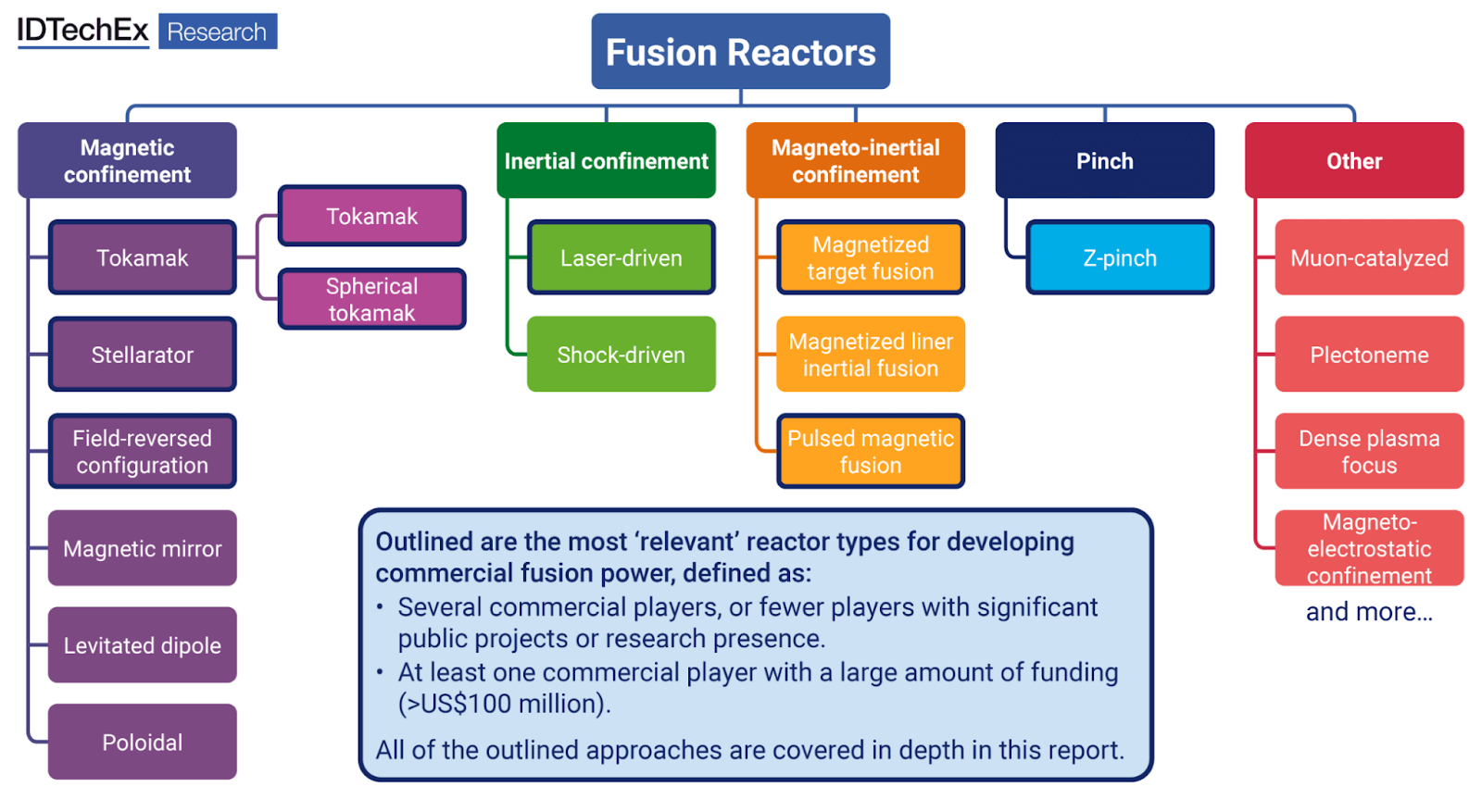
Main categories and subcategories of fusion reactors. Source.

Historically, most fusion experiments have focused on tokamaks, stellarators, and laser-driven inertial confinement. Tokamaks have been particularly significant — the International Thermonuclear Experimental Reactor currently under construction in France utilizes this design, as do China’s main research reactors.
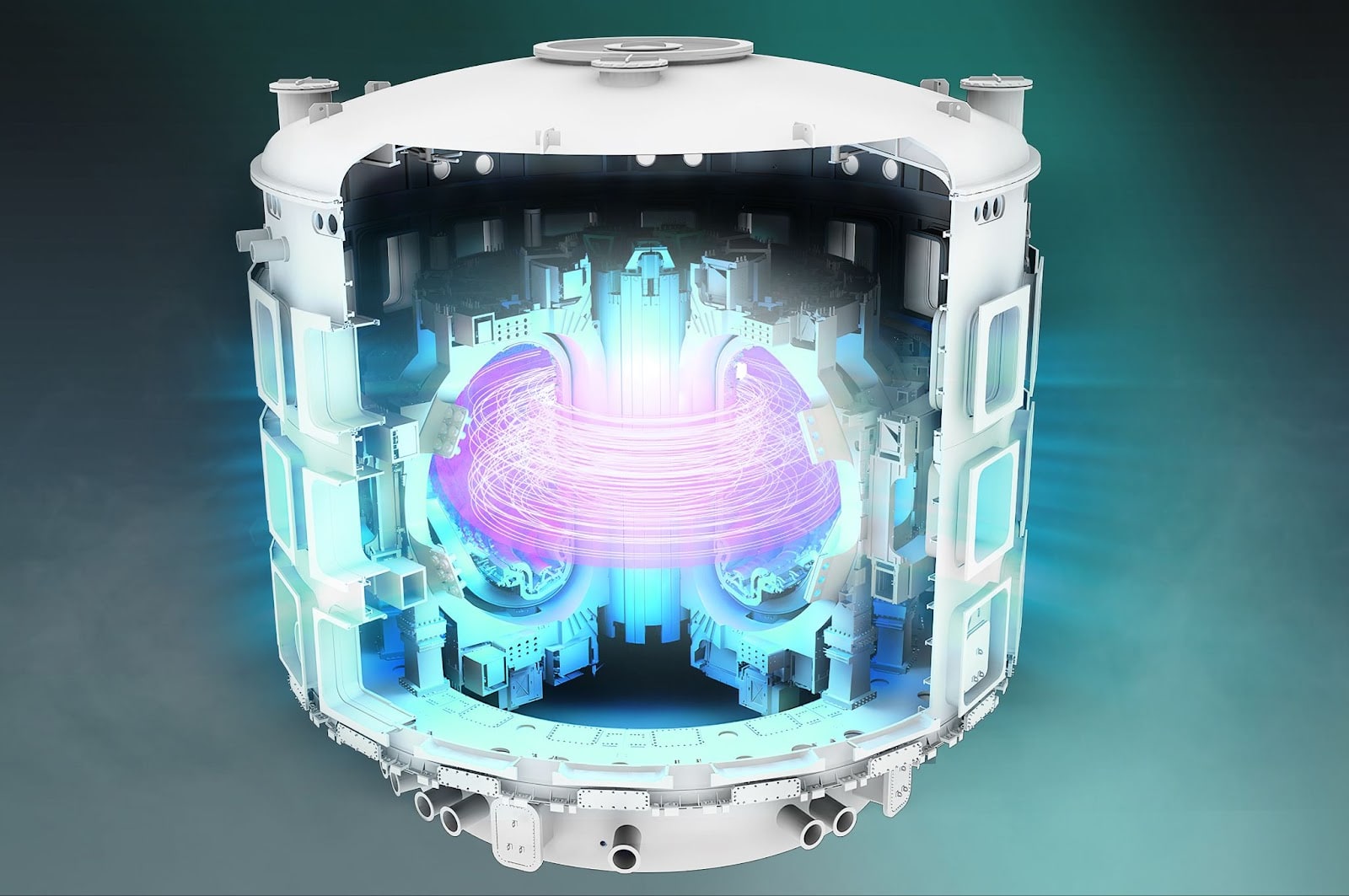
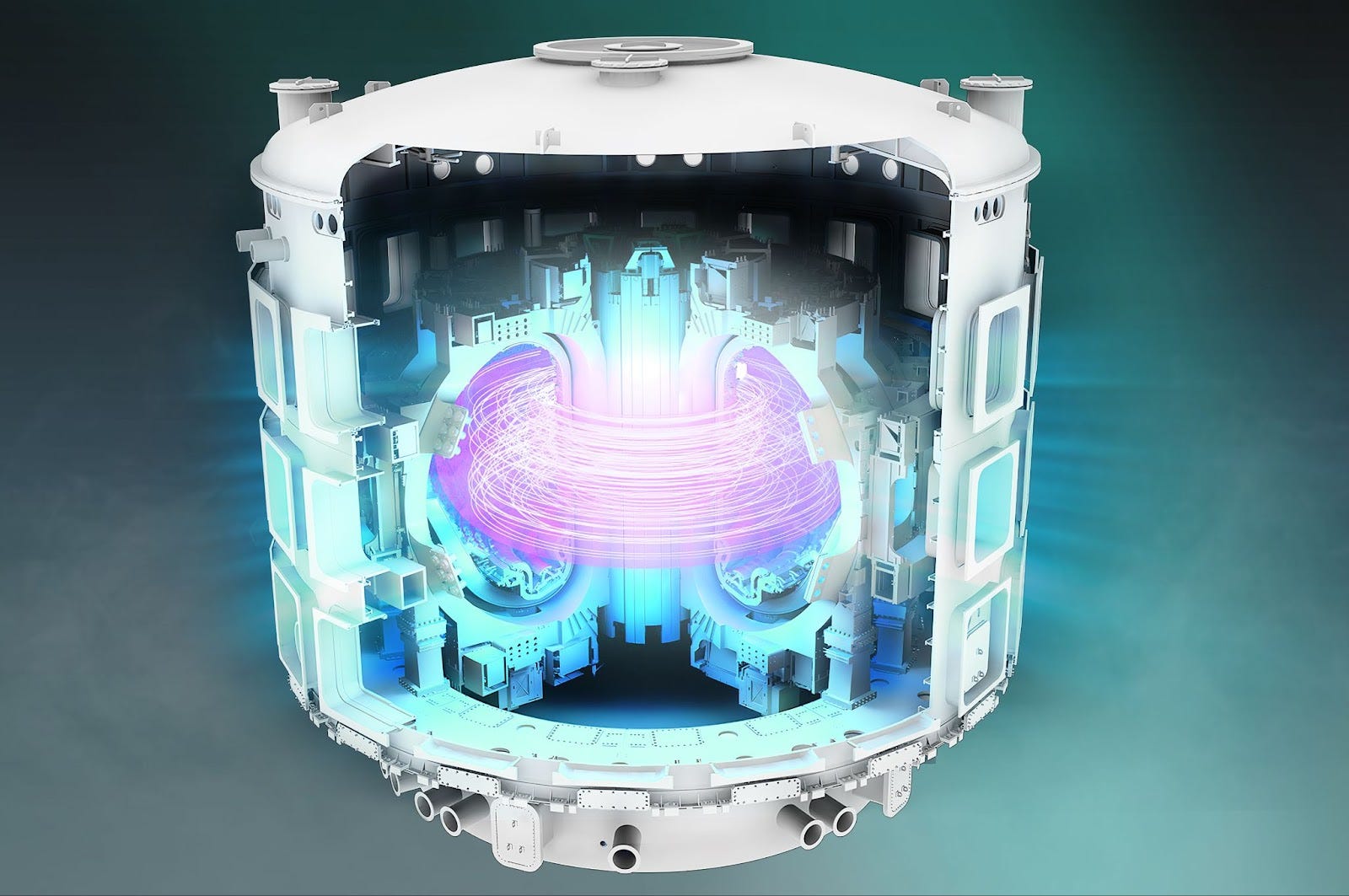
Depiction of a tokamak. Fusion takes place in high-temperature plasma (over 100 million degrees Celcius) that is contained in the central toroid. Source

The Soviets were the first to operate a tokamak starting in 1958. The US started research with stellarators in 1953, and didn’t operate a tokamak until 1970, after Soviet scientists made promising breakthroughs, and the tokamak came to be viewed as the most likely route to commercial fusion. China’s first large-scale tokamak, HL-1, started operating in the early 1980s at the Southwestern Institute of Physics (SWIP) in Chengdu. (SWIP is affiliated with CNNC, China’s main nuclear energy SOE).

SWIP now operates the HL-2A(M), a more advanced tokamak, one of the three major domestic tokamaks currently operating in China. The two others are the Experimental Advanced Superconducting Tokamak (EAST — aka the “artificial sun”) and J-TEXT. Operational since 2006, EAST is located at the Institute for Plasma Physics, Chinese Academy of Sciences (ASIPP) in Hefei. ASIPP and SWIP are the two main research institutions driving China’s fusion progress. J-TEXT is affiliated with the Huazhong University of Science and Technology (HUST). A number of other universities and institutes also contribute, albeit in a less substantial way.

Despite all the press that these reactors have generated in China, they are not generally considered to be the most advanced within the industry. The “triple product” is a metric that gives a single value for how close a fusion experiment is to net power, found by multiplying the density of ions in the plasma by their temperature and the energy confinement time in seconds. As the annotated graph below illustrates, China’s current tokamaks fall behind global leaders.
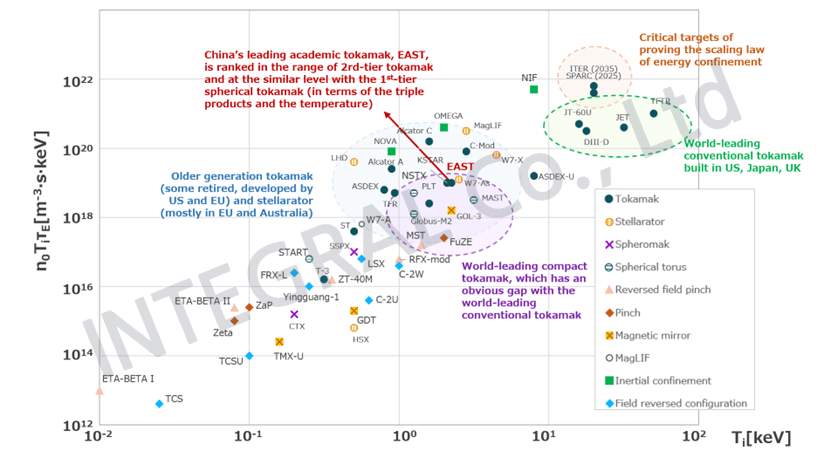
Graph of “triple products” of fusion reactors, created by a business analytics firm in China. Source

The Master Plan

Route 1: Research Institutions

Chinese research institutions have a clear plan and conservative timeline that will get them to a commercial fusion reactor. The foundation of this plan is the three aforementioned tokamaks. With the results of their experiments, China is contributing to developing ITER, and simultaneously planning the China Fusion Engineering Test Reactor (CFETR). CFETR will serve as a bridge between ITER and a full-scale commercial reactor. According to this 2022 timeline, they will have an operational commercial plant by 2060.
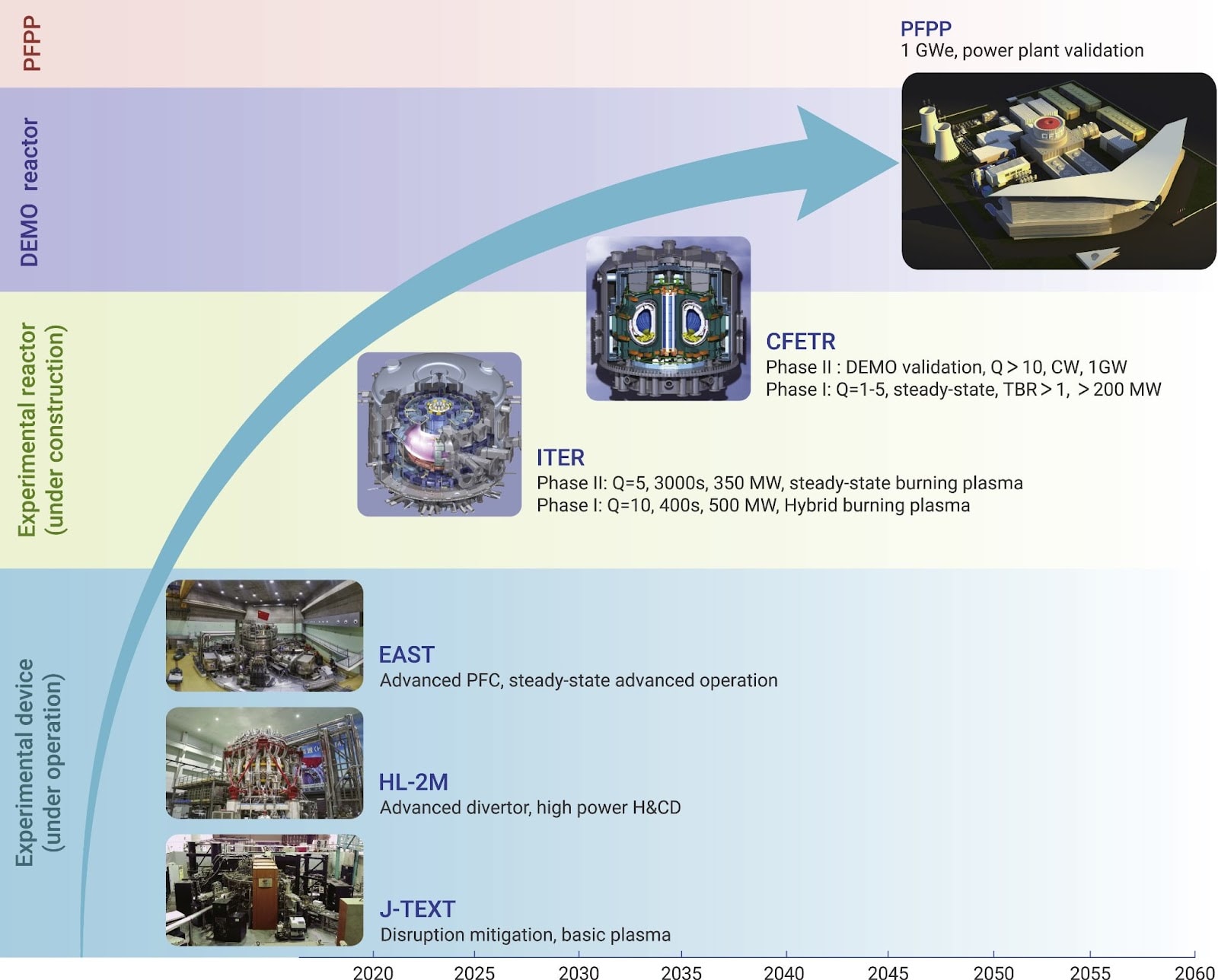
Timeline for China’s nuclear fusion development, as reported in a journal article written by 17 scientists from China’s two main fusion research centers (SWIP and ASIPP) in 2022. Source

However, they are not in a holding pattern while they wait for ITER to come online (which likely won’t be until 2035 or later). The Chinese government has a host of projects planned or currently underway that will continue to fill in fusion knowledge gaps. The following is an overview of some of the key projects:

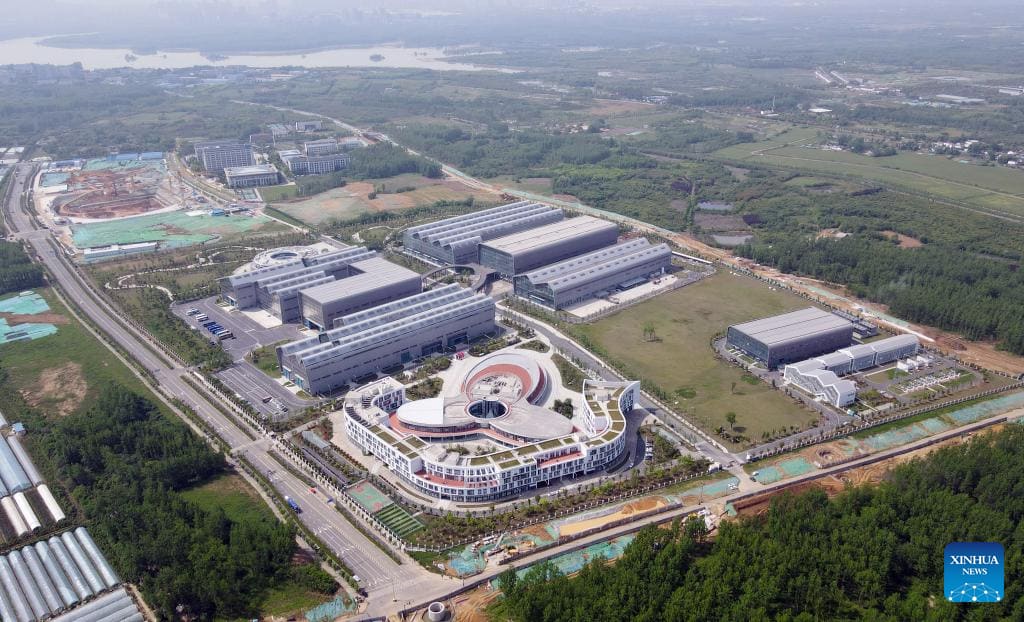
  • Comprehensive Research Facility for Fusion Technology (CRAFT).

    • A 40-hectare, 20-facility, US$570 million research center intended to solve additional obstacles on the way to building CFETR. It does not include a new large-scale tokamak. Construction started in 2019 and should finish this year. It is located in Hefei, near ASIPP.
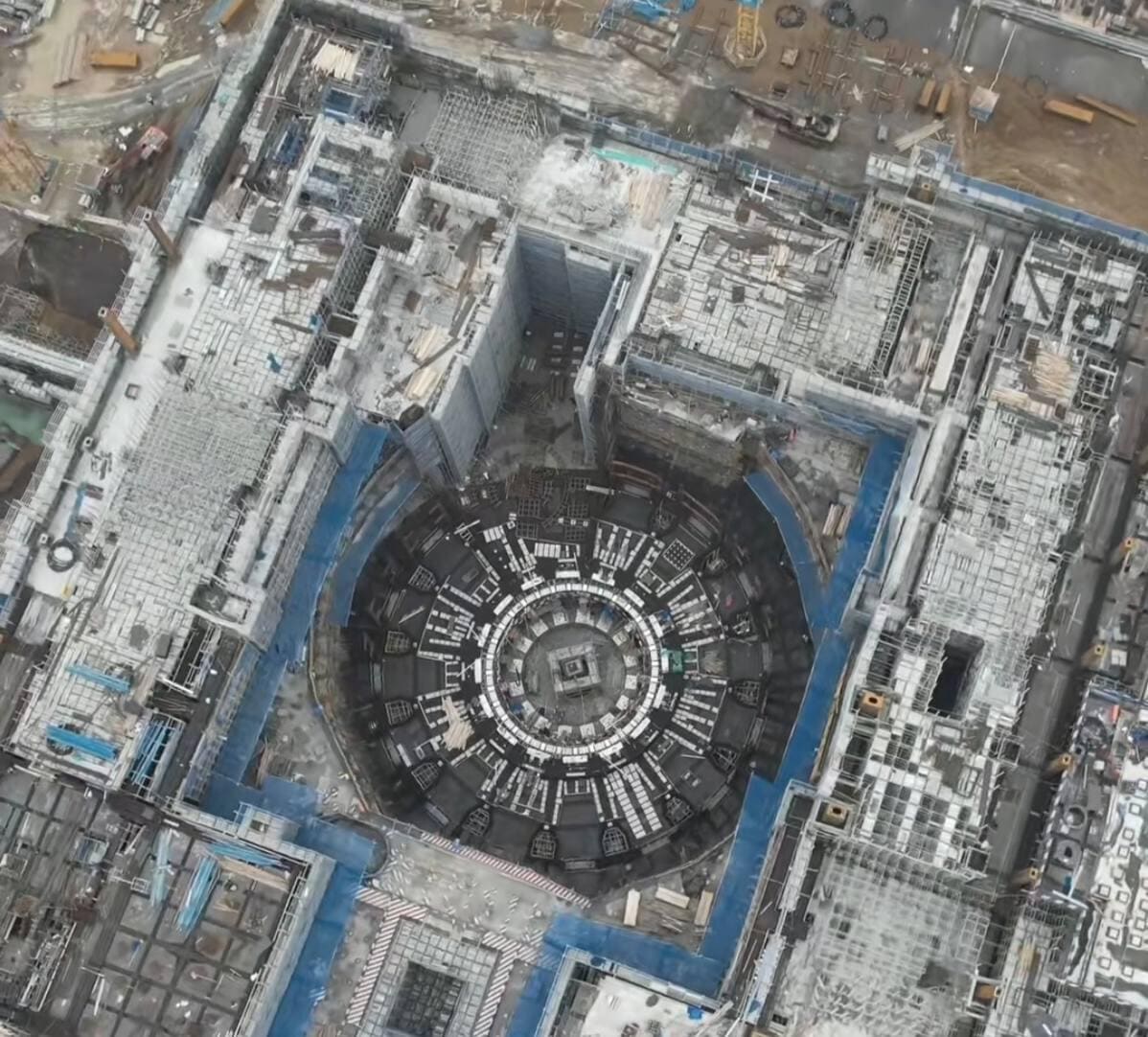
  • Burning Plasma Experimental Superconducting Tokamak (BEST).

    • BEST is an intermediate-step tokamak between EAST and CFETR, designed to achieve real-world energy production. Construction began in 2023 and is expected to conclude in 2027. It has been described as a copy of one designed by US-based Commonwealth Fusion Systems. It is also located in Hefei. I was unable to find an official cost estimate, and unofficial sources varied. One user on Zhihu (Chinese equivalent to Quora) had the cost at $8.5B RMB, ~US$1.2 billion.
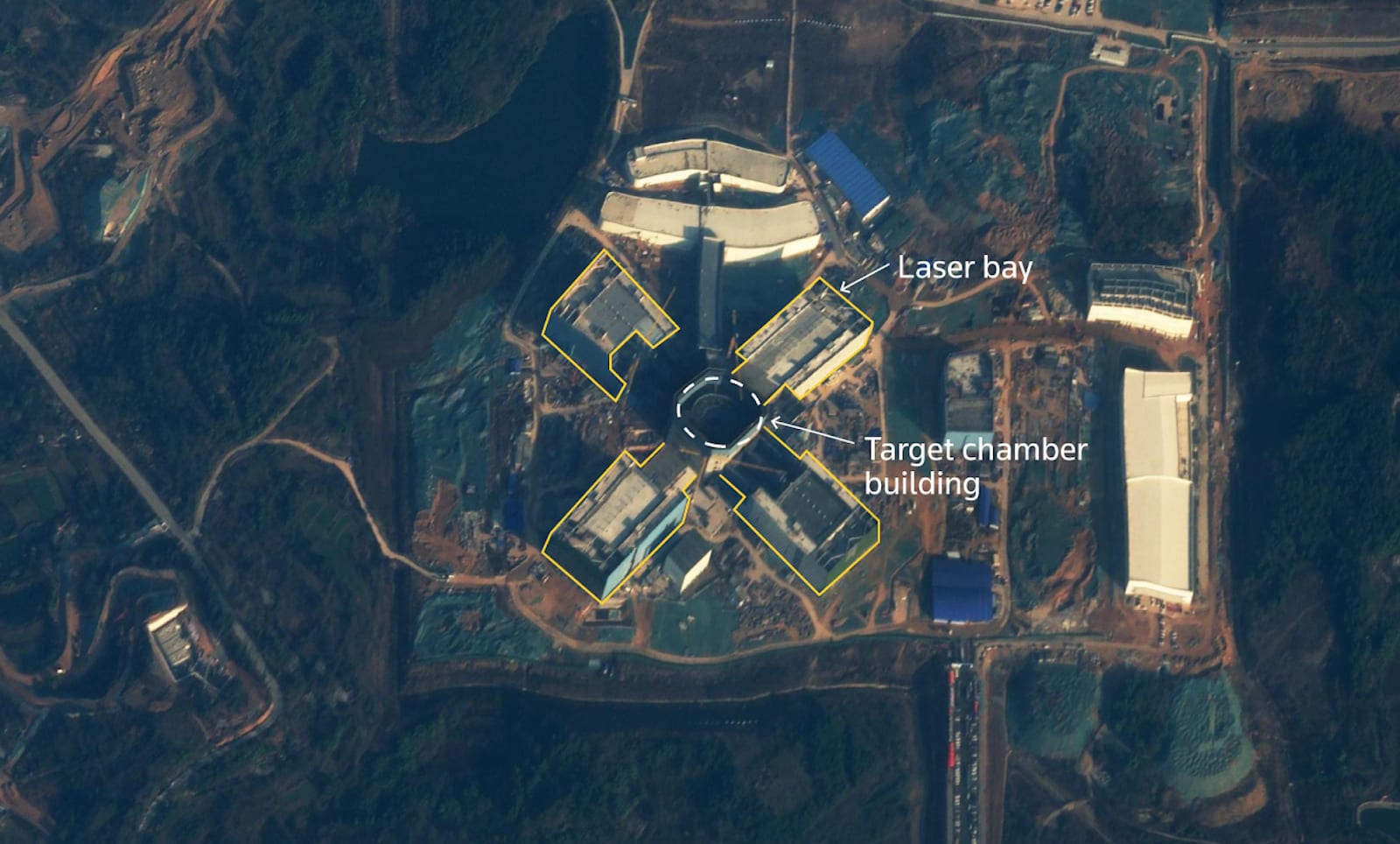
  • Shenguang-IV (神光-IV (literally “God Light-IV”) or SG4)

    • China is building a massive, mysterious X-shaped facility in Mianyang 绵阳, Sichuan province. Western news outlets don’t even have a name for it. However, China-focused analysts and Chinese media have identified it as Shenguang-IV (SG4), the fourth iteration of laser facilities operated by the China Academy of Engineering Physics (CAEP). CAEP is also China’s principal weapons design lab, and hence, there has been little said about the facility (the NIF plays a similar role in the US). Analysts estimate that SG4 will be similar to the NIF, but 50% larger. Official budget figures are not available, but as a reference point, the NIF cost the US $3.5 billion to construct.

    • Some Chinese sources state that the energy output of SG4’s lasers will be 2 MJ, which is similar to NIF, which has done experiments with 2.2 MJ bursts. It will have 288 lasers, in contrast to NIF’s 192 lasers. According to Chinese forums, construction for SG4 began in 2017, and one article states that it was supposed to be completed in 2020 or shortly thereafter. However, none of this information could be verified.
  • Xinghuo 1 (星火一号)

    • World’s first fusion-fission power plant, with Z-FFR design (Z-Pinch Driven Fusion-Fission Reactor). It has the aim of generating 100 MW of continuous electricity for the national grid by 2030. It is being built in Nanchang, and is expected to cost $2.76 billion. The environmental impact assessment began in March 2025, with initial orders of superconducting material for the plant being made in December of 2024.

  • China Fusion Engineering Test Reactor (CFETR)

    • A demonstration power plant (DEMO)-scale fusion reactor expected to enter construction by the late 2020s. It is seen as a bridge between ITER and a commercial plant. Preliminary conceptual design for CFETR was finished in 2015, and the engineering design was completed in 2020.

Results from all these projects will be used to continue refining the design of CFETR, before finally being rolled out into wide-scale energy production a few decades from now.

Route 2: Private Sector

Within the global fusion startup space, there are a host of conventional and unconventional methods being tried to realize fusion much sooner than SWIP and ASIPP’s 2060 timeline. That being said, Chinese companies still have a high degree of alignment with state research institutions. While there are 24 different approaches listed in the Fusion Industry Association’s report, the main Chinese players are sticking to the tokamak and the spherical tokamak, a more compact variant which has lower engineering costs.

Different fusion approaches pursued by 45 global fusion companies, based on reporting by the Fusion Industry Association in 2024. Source (pdf)

These players include NeoFusion (聚变新能), Startorus Fusion (星环聚能), Energy Singularity (能量奇点), and ENN (新奥).

  • NeoFusion

    • Founded in 2023, Neo Fusion is a private enterprise backed by the Anhui provincial government. It has over $2 billion dollars in funding, just short of SOE China Fusion Energy Co.’s capital.

  • Startorus Fusion

  • Energy Singularity

    • Founded in 2021, with $120 million in funding. They are operating HH70, the world’s first successful fully high-temperature superconducting (HTS) spherical tokamak. The company overall is pursuing an approach similar to Commonwealth Fusion Systems. They aim to build the next iteration of their HTS design, HH170, by 2027, targeting a 10-fold energy gain.

  • ENN

    • ENN is an established gas company that is also pursuing fusion projects. They have raised $400 million thus far, and also intend to use a spherical tokamak.

China Fusion Energy Co.: The Bridge?

The creation of China Fusion Energy Co. this year is intended to coordinate the various parts of the nuclear fusion endeavor, and help it make the important jump from experiment to commercial reality.

In Chinese media, CFEC is referred to as the “national team.” Although it may look like a cash-strapped investment vehicle, its significance goes beyond that. Wang Zhigang (王志刚), a professor at Tsinghua University’s Institute of Nuclear and New Energy Technology, described its significance this way:

“This is not a simple financial investment, but rather part of the national energy strategy layout. The seven major shareholders cover the entire chain of technology R&D, engineering construction, capital operations, and industrial applications, forming an ecosystem of deep integration among ‘industry, academia, research, application, and finance.’”2

Once one of China’s private companies or research institutes makes the final breakthrough, CFEC will be ready to take the baton and sprint with it.

Race Outlook

So, in this race between the US and China, who is in the lead now, and who is likely to win long term?

It’s hard to determine who has the momentary lead. Especially when insiders and experts seem to disagree. The “Artificial Sun’s” record certainly seems impressive. A report from the MIT Technology Review suggests that China commands in 3/6 of the key industries and technologies that will go into fusion reactors (assuming the conventional tokamak is the eventual victor). After leading annual patent submissions on fusion technology for years, China has now surpassed the U.S.

But others suggest that the Artificial Sun’s records are “unremarkable,” and the real indicator of progress is net positive reactions, which China has yet to achieve in the nearly three years since the US first crossed that milestone (and crossed seven more times since). IAEA’s annual Nuclear Fusion Award, given to the most impactful paper published in the Nuclear Fusion journal, has never been given to a Chinese scientist.

Most seem to think that the U.S. and China are roughly tied at the moment. The US is leading China in investment, but only slightly, and the nature of the investment varies substantially. Nimble private funding is dominant in the US, which lacks the kind of national modern fusion facilities that China has, while China’s investment is almost entirely public. Annual public funding between China and the US is roughly 2:1, US$1.5 billion to US$800 million. Which investment model is more effective remains to be seen.

Fusion in the “Engineering State”

Breakneck by Dan Wang has sparked a great deal of discussion and scholarly disagreement about what has made China a building and manufacturing powerhouse, and what holds the US back. Whether it is an “engineering state” vs. a “lawyerly society” (Dan Wang’s theory), a “Leninist developmental state with Chinese characteristics” vs. “lawyerly society” (Jonathan Sine), or “developmental state” vs. “regulatory state” (JS Tan), the fact remains that, at least at the present, China is much better at building stuff.

EVs, solar panels, and high speed rail are often held as examples of America (or Japan, in the case of HSR) winning “0-1” innovation and China winning “1-2” innovation. While it isn’t as widely discussed, another striking example is conventional nuclear fission energy. The US was the world leader in fission technologies, and has the largest fleet of nuclear fission reactors in the world. But China has been on a prolific building spree, and analysts now say that “China likely stands 10 to 15 years ahead of the United States in its ability to deploy fourth-generation nuclear reactors at scale.”

In the case of nuclear fission, perhaps the most succinct explanation of this was offered by Kenneth Luongo, who said that China doesn’t “have any secret sauce other than state financing, state supported supply chain, and a state commitment to build the technology.” More broadly, another author described how private companies in state-supported industries gain access to the “standard triple package of cheap financing, cheap land, and cheap regulatory cost.” Fusion will have all these benefits.

China also has significant “process knowledge” for large infrastructure projects (with their nuclear reactor building spree particularly relevant). They are also developing a deep bench of scientists who will be able to work on fusion projects. Experts estimate that China has thousands of PhD students in fusion, compared with hundreds in the US. Even if the US makes the breakthrough first, China is likely to imitate quickly and roll it out much faster than the US can, gaining additional insights along the way to then pull ahead.

The US Moonshot

Simultaneously comforting and concerning is the knowledge that this isn’t news to US officials and lawmakers, and… little is being done. A Feb 2025 congressional commission report called for a one-time, $10 billion investment to build critical research infrastructure. They argue, and I agree, that “American ingenuity has proven time and again that, particularly when catalyzed by a long-term strategy and public-private partnerships, it can solve seemingly insurmountable problems.” But whether or not the US can really unite the full force of public and private efforts behind anything in these polarized times remains to be seen.

ChinaTalk is a reader-supported publication. To receive new posts and support my work, consider becoming a free or paid subscriber.

1

Although no longer, since Commonwealth Fusion Systems completed their Series B2 funding round in August 2025, which brought their total investments to $2.9 billion.

2

The chairman of CFEC’s board, Liu Ye 刘叶, is a great example of this fusion (pun not intended). Before he was named chairman of CFEC (an SOE), he was the Party Secretary of SWIP (1 of 2 main research labs), a post he now holds concurrently.
Fusion's DeepSeek Moment?

Caleb Harding is a Mandarin-speaking BYU CS graduate. He previously interned at the US Embassy in Jakarta and Doublethink Lab in Taiwan. He is currently based in D.C.

When you think of the biggest technologies of today, the most promising fields for the future, what comes to mind? If your first two thoughts were AI and quantum tech, congratulations — the Chinese Communist Party agrees with you. But what they listed third on the list of “Cutting-edge S&T breakthrough efforts” (前沿科技攻关) in their 15th Five-Year Plan might surprise you: nuclear fusion.

The detailed table entry for nuclear fusion indicates that the CCP is paying close attention to nuclear fusion and is invested in its success. Their goals for the next five years are described as follows:

“Achieve breakthroughs in key fusion technologies including tritium fuel preparation and recycling, materials irradiation testing, high-performance lasers, and superconducting magnet manufacturing; conduct plasma operation experiments on deuterium-tritium fusion and feasibility verification across multiple technical approaches; advance the engineering development process for nuclear fusion R&D.”

Who will execute on this? A whole network of researchers, national labs, and SOEs is driving ahead on the necessary research and manufacturing developments. But China’s most promising assets may lie outside of that system: a handful of startups that are iterating aggressively to take fusion commercial.

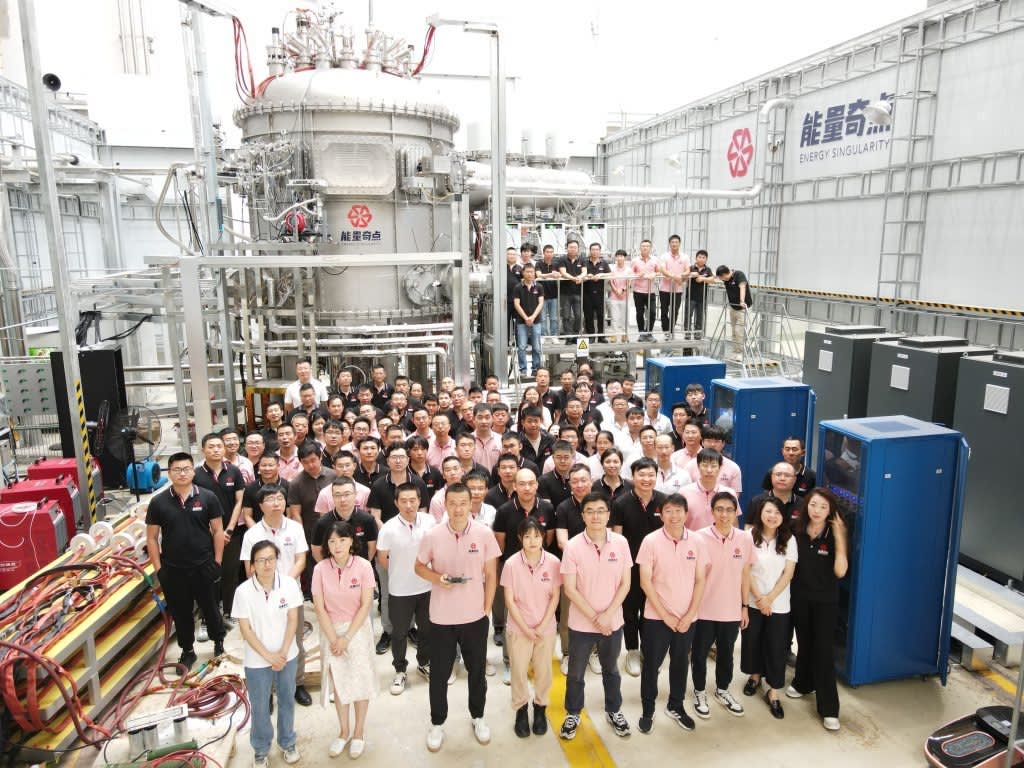
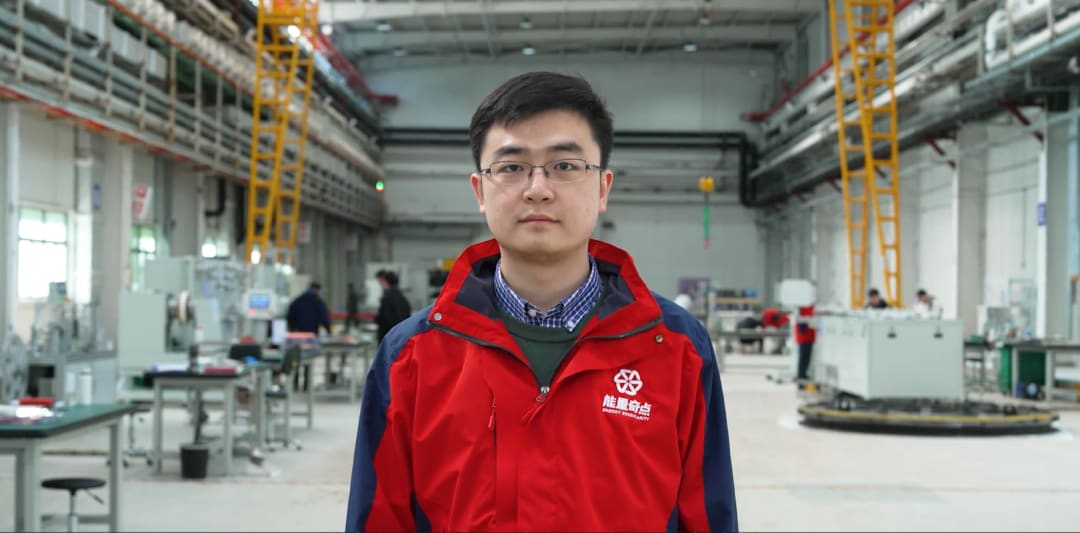
Yang Zhao 杨钊 is the CEO and cofounder of China-based Energy Singularity (能量奇点), one of the key players in this space. After graduating with a PhD in theoretical physics1 from Stanford in 2017, Yang spent a year drifting before deciding on his mission in life: to accelerate the timeline for commercial fusion.

After getting a grasp of start-up operations at an AI education firm, Yang Zhao and three other friends2 founded Energy Singularity in Shanghai in 2021. Their approach is similar to that taken by Commonwealth Fusion Systems (CFS), one of the most well-known US companies in the US. With a new kind of more powerful magnet, both companies intend to make fusion viable by shrinking the scale of reactors and, by extension, their cost.

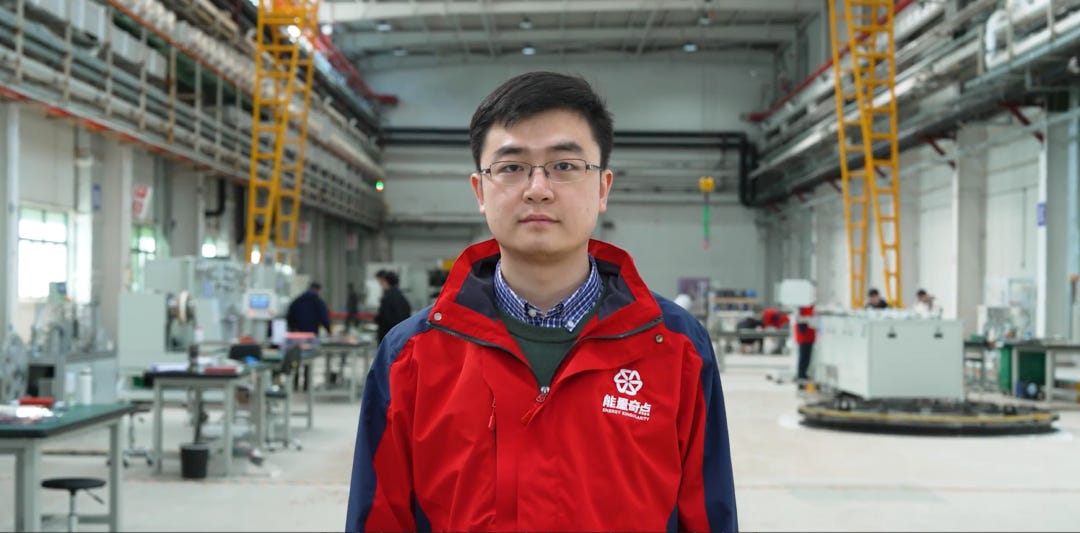
Yang Zhao, CEO and cofounder of Energy Singularity. Source

Energy Singularity has had some significant breakthroughs since then. Last year, they achieved first plasma on Honghuang 70 (HH-70, 洪荒70), the world’s first functioning high-temperature superconducting (HTS) tokamak. Design and construction of that experimental reactor was completed in just two years, at record speed. This year, they created a magnet capable of producing a magnetic field of 21.7 teslas, passing CFS’s previous record of 20 teslas.

CFS may yet beat them to the punch. Energy Singularity built HH70 as a proof-of-concept device for HTS tokamaks — an impressive feat. But it doesn’t achieve a Q value greater than 1. The Q-value is a ratio of energy output to input; Q = 1 is break-even, and achieving Q >= 10 is considered the key milestone to prove the commercial viability of fusion. With significant funding and a few years’ head start, CFS is skipping the proof-of-concept device and already working on their Q >= 10 device, SPARC.

First plasma (systems operational) for SPARC is expected in 2026, with net energy production aimed for 2027. Construction on HH170, Energy Singularity’s Q >= 10 device, is expected to finish by the end of 2027, with first plasma and energy production to follow.

But Energy Singularity has some advantages. With their stronger magnets, design experience, and domestic supply chain, they believe their reactors will be the most cost-effective in the world. They report that HH70 cost them USD$16 million (120 million RMB) to build, and project HH170 will cost $420 million. Having already built a first-in-class HTS tokamak under budget and on time, I trust their estimate.

When SPARC was announced in 2018, the budget was $400 million, and it was supposed to achieve net power in 2025. Currently at 65% complete, the new estimate is around $500 million, and the timeline has already been pushed back two years. That being said, both Energy Singularity and CFS’ cost estimates are on the order of 50 times cheaper than the International Thermonuclear Experimental Reactor (ITER) currently under construction in France, which also has Q > 10 as a key goal.

The US may be in for another DeepSeek moment, and China may be poised for explosive growth in fusion come 2035.

The interview has many fascinating tidbits. But at 2.5 hours long, the full transcript might be a bit much for most. Below I’ve provided some extended snippets with occasional commentary. Or if you want to put your nuclear fusion Mandarin vocabulary to the test (惯性约束 is definitely not a term you hear everyday), you can listen to the podcast or watch the video.

Topics Included:

  • What’s in a Name?

  • When Cost is Key, Build a Startup

  • How to Compare Reactors

  • How to Design a Novel Reactor

  • Build Your Own Supply Chain

  • Science Risk vs. Engineering Risk

  • Why Not to Invest in Helion

  • China and the US: Independent Fusion Ecosystems

  • AI Can Accelerate Fusion

  • Fusion => Interstellar?

  • Contribute Where You Have Leverage

What’s in a Name?

Zhang Xiaojun: How did you come up with [the name for] your first-generation device, Honghuang 70? Why call it Honghuang?

Yang Zhao: Honghuang is from Chinese mythology — a very primordial, abundant state [Note: before the formation of the universe]. It’s chaotic but full of energy. Fusion is similar: you take a lot of originally disordered energy and convert it into electricity. So we named this series Honghuang. The “70” is a key design parameter — the major radius. It’s 70 centimeters, so we call it “70.”

The Oxford Chinese-English dictionary definition for 洪荒 is “primeval chaos.” If we were picking a fusion winner based on the coolest name, Energy Singularity has got it, hands down.

Honghuang 70. Source

When Cost is Key, Build a Startup

The idea of ITER (the International Thermonuclear Experimental Reactor) was first conceived in the 80’s, and the groundbreaking for the massive reactor took place in 2007. 18 years later… it still has 10+ years to go, with massive cost and time overruns (more on that later). In Yang Zhao’s mind, the science is there, it is simply a matter of building it cheap enough.

Yang Zhao: So in 2021 I set the goal: reduce fusion’s cost per kWh to coal levels or lower. The value our company offers is to continuously improve cost-performance and lower fusion kWh cost through every possible means. That’s why we insisted on designing the entire device ourselves. From magnet design, manufacturing to final testing and operation, we had to do it ourselves because those are the things that most significantly affect device cost. Subsequently, we developed most core subsystems in-house.

From the perspective of cost-effectiveness, small design changes can lead to huge cost differences. Your core subsystems affect interfaces with every other system; even minor design changes can drastically change the entire device. If I can push my costs to be mostly raw-material costs, meaning the team discovers and owns the knowledge, then we can lower the costs, and the higher upstream you go in production the cheaper the raw materials can be.

So we decided in design to do everything ourselves: core subsystems, in-house manufacturing, design, production, final commissioning and operation. Only when the device is not a black box and everything is transparent can you set new targets and know which systems to adjust to optimize cost at higher parameters. We figured this out in 2021. At the beginning I had only four people; for example, Dong was responsible for the overall work, the physics design, and later the experimental operation. Our most critical initial system was the magnet, which we fully manufactured ourselves. That was beneficial. Of course, this approach requires high demands on team operations and funding. New team members joined; initially about four people were doing this work.

Zhang Xiaojun: Why do it in the form of a startup? Why not use more efficient paths, like existing institutions?

Yang Zhao: That’s exactly the point. What we need to do is achieve, in the shortest time and with the least cost, a rapid, order-of-magnitude improvement in fusion cost-performance. That is essentially what a startup is suited for. From the industrial perspective, what we’re doing is similar to what SpaceX did.

Organizationally, the shortest decision pipelines and most efficient execution to take something from the lab to low-cost, large-scale use is what a commercial company does best. That’s not what universities or research institutes are best at.

So once the problem of fusion shifted from proving scientific and engineering feasibility to proving commercial feasibility, the best vehicle to do that turned out to be a startup. Once we knew our goal and what kind of team and organizational form we needed, we started doing this around 2021.

Zhang Xiaojun: You claim your cost will be half of comparable US efforts and the device will be smaller. How do you achieve that? Chinese teams tend to be more economical, with today’s AI being one example.

Yang Zhao: That’s our team goal and reflects our values: extreme efficiency combined with pragmatism. Our target is the “170” device: the world’s lowest-cost, highest cost-performance machine that achieves Q ≥ 10. From the start of design, everything — overall device layout, raw material choices, supplier selection, and manufacturing routes — has been done with that target in mind.

So within the limits of our understanding and design constraints, we aimed for the lowest-cost when designing the 170. Based on the entire construction process of the 70, we have a very clear and detailed BOM model for the cost of each subsystem, which we use to optimize the whole device. The final design resulted in a device costing roughly 3 billion RMB (USD$420 million). We’re not really sure why in the US this would require 1 billion USD — they haven’t publicly shared their cost breakdown. But having optimized to this extent, we feel further cost optimization would be quite difficult.

Achieving such low cost requires that the overall design is cost-minimal. We use suppliers available on the market with high competition and, frankly, overcapacity. Otherwise, if it were relatively monopolistic, or only one or two suppliers could do it, they would have strong bargaining power. If it’s a piece of equipment that we are going to need to use long-term, we develop it ourselves. Then we only need to buy the materials.

So through this approach — from design to manufacturing, to processes, to experimental operation — we optimize with the lowest-cost mindset. The final design may well be the lowest-cost device in the world capable of achieving this level of performance.

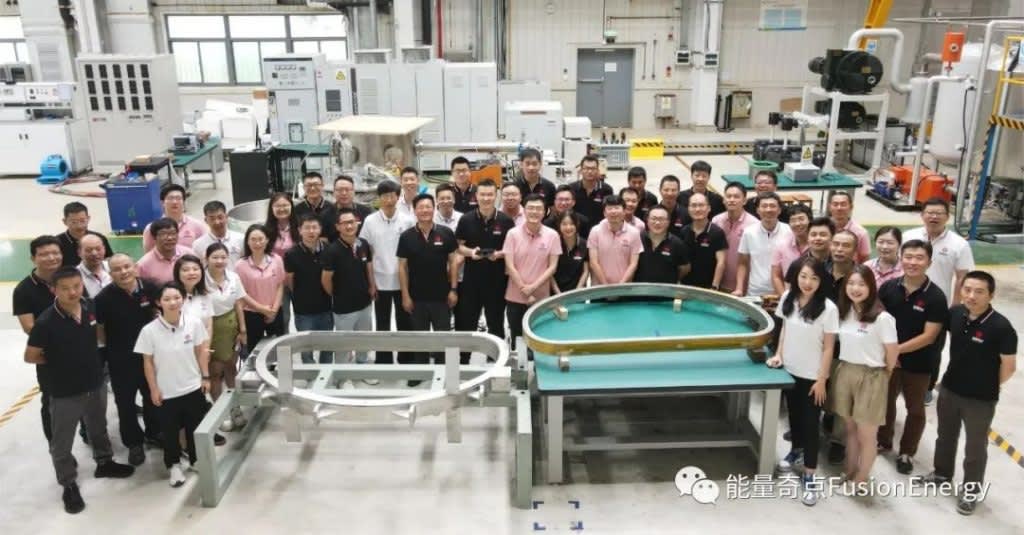
Construction completed on the first toroidal field (TF) coil of the Honghuang-70 Tokamak in Mar 2024. Source

How to Compare Reactors

As of 2024, there were 45 different fusion startups pursuing 23 different reactor designs. How can you compare them, and tell who is up to snuff? One of the key things to look at is the “triple product” values that they have published. Yang Zhao explains what that is all about.

Yang Zhao: This comes from the past sixty or seventy years of fusion research, summarized from hundreds of devices and thousands of experiments. To achieve a sufficiently high energy gain — the so-called energy gain is your output power divided by input power, that is, the energy you produce divided by the energy you consume — that’s called energy gain.

Zhang Xiaojun: That’s the key break-even value, right?

Yang Zhao: Right. If it equals one, that’s break-even. For a power plant, it has to be much greater than one. For example, if it equals ten, your output energy is ten times your input. After all, in real operation there are losses, right?

So energy gain is actually determined by a physical parameter called the triple product. Simply put, it’s the plasma density multiplied by the temperature multiplied by the confinement time — these three numbers multiplied together, hence “triple product.” When this product reaches roughly 10^21 in a certain, relatively complex set of units, physics from first principles tells you that no matter what method you use, if you take deuterium and tritium as fuel, that triple product corresponds to Q≈1. If it’s slightly higher, in the range of 10^21 to 10^22, the energy gain Q can grow from one to very large values, almost like an avalanche. Once you pass this break-even line, even a small increase in parameters can yield a very large energy gain.

So if a startup’s intended reactor design has only published triple product values of 10^10 or even 10^17… it might be best to stay away for the time being. Read more on that in the “Why Not to Invest in Helion” section.

So what does this logic tell us? To increase energy gain, you need to increase the triple product, because it determines the energy gain. Over the past sixty or seventy years of research, engineers have found that the most effective ways to increase the triple product are either to make the device large enough or to make the magnetic field strong enough. These are the two main approaches.

This is exactly the difference between ITER and CFS/Energy Singularity. Production for HTS magnets didn’t really reach the required scale until 2018 - long after plans had been made and construction begun on ITER, which consequently had to take the “go big” approach — at great expense. With HTS magnets, the second route is now an option, and promises to be much more cost-effective.

How to Design a Novel Reactor

I have never had to approach this complicated a problem before. However, after hearing him describe the process in detail, it isn’t quite as formidable as I imagined it. Extremely hard - yes. But even an elephant can be eaten, one bite at a time.

Yang Zhao: A device’s design goes through several stages.

First is the physics design: what is the core goal you want the device to achieve? Based on that goal, you determine the plasma state — the core physical parameters the plasma must reach.

From the physics design you move to conceptual design: what must each subsystem achieve in terms of parameters to meet your overall physics goals? For example, how strong and what shape must the magnetic field be? What does the vacuum vessel look like? What are the operating temperatures of each subsystem? When do you add fuel, when do you run diagnostics to observe its current state, and when do you apply control? Based on the physics targets, you define each subsystem’s core objectives, its operating conditions, and its interfaces with other subsystems. If you don’t do that, subsystems will conflict and you won’t be able to assemble the machine.

After finishing the conceptual design and converting it into physical targets, every system has a design concept that shows feasibility — basically whether the thing can be built.

Once you reach that stage, the next step is the engineering design. For example, if I need a low-temperature system with a certain flow rate, temperature, and flow speed, engineering design answers how to actually implement it: what distribution valves and boxes are needed, what liquid helium tanks, what refrigerants, etc. All those engineering devices are fully designed. At that point, after having the concept for each system, you make an engineering design package that can be used for manufacturing, machining, or equipment procurement — you produce drawings and technical specifications. That’s the third step: engineering design.

After completing engineering design, you enter the manufacturing stage. For some components, we give drawings to external machining or manufacturing suppliers, such as vendors who do welding and fabricate tanks or vacuum pressure vessels, and have them manufactured and returned to us. For some items, like magnets, we manufacture them ourselves in another workshop.

After subsystems are manufactured, they go through acceptance: does each subsystem, at the subsystem level, meet your design specifications? If yes, you accept it; if not, you fix what needs to be fixed or send it back to the manufacturer. Once subsystem acceptance is complete, you begin overall assembly: you install different subsystems and turn them into a complete tokamak, like the device you see downstairs.

During assembly there are of course tests. After installation you do system integration and commissioning to see whether the whole system can operate according to design and within the design parameters. Then you reach the final experimental operation stage where you test whether you can accomplish the original design goals, like achieving first plasma. Or, for our goal this year, can you maintain a thousand second steady operation?

From initial design, step-by-step detailed design, manufacturing, assembly, to final operation, it’s basically an acceptance process: does the completed machine meet your originally defined design goals? That completes the whole cycle. Each stage requires different capabilities.

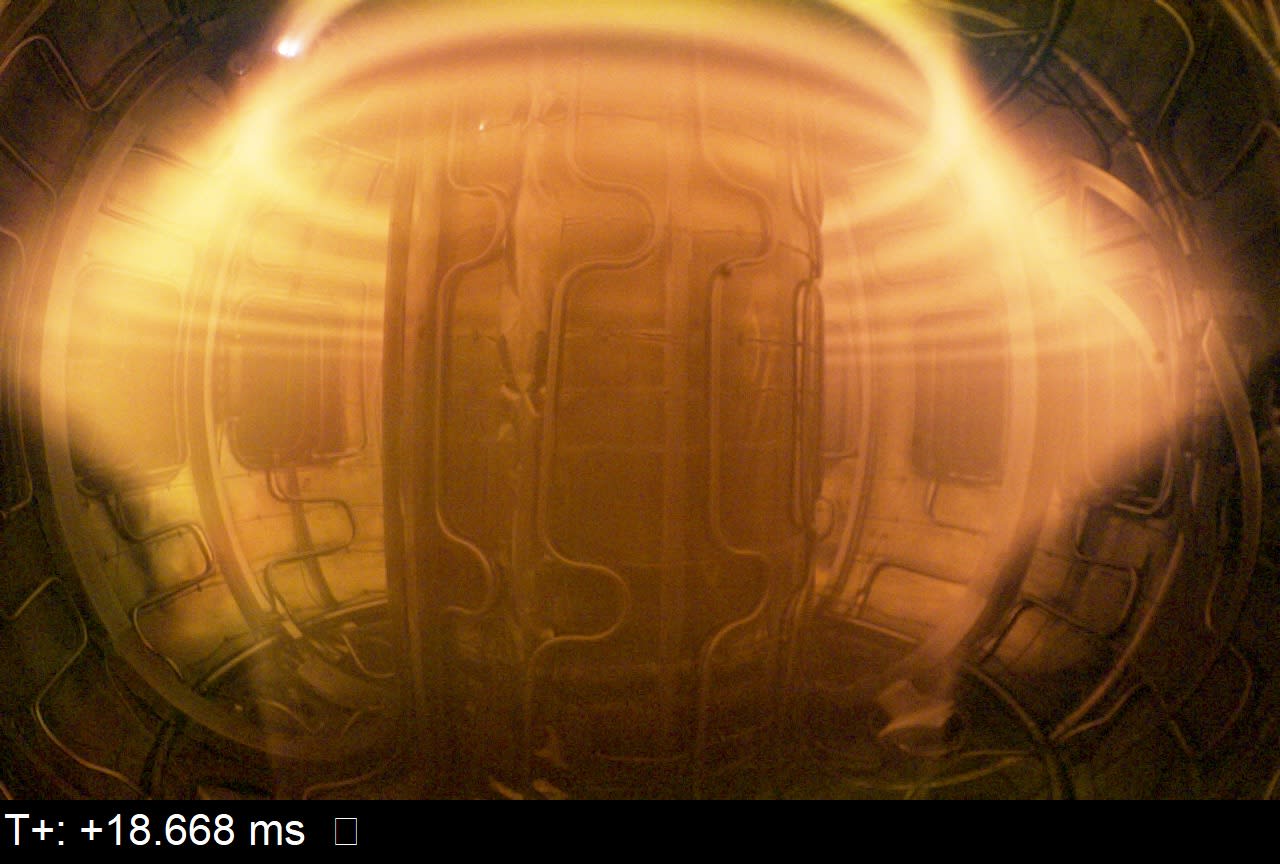
First plasma in Honghuang 70. Source

Build Your Own Supply Chain

The approach they have taken to cutting costs (discussed in the “When Cost is Key” section) and basically building things from scratch is indeed reminiscent of researchers at DeepSeek, who in the face of compute constraints dramatically increased the efficiency of their training.

Zhang Xiaojun: What does the industry supply chain look like?

Yang Zhao: The supply chain is still at a very early stage. Different groups build devices differently. Many universities and research institutions build small experimental devices, and these are often outsourced or assembled by other research units or groups that can piece a device together. Partial subsystems are sometimes handed to other research units to finish and return, so the supplier might itself be another research institute.

Our approach was different: we didn’t want black boxes in device design and construction. We do full in-house design and make the core systems ourselves. That means we directly contact raw material suppliers and, once we have drawings, we send them to competitive machining, welding, and manufacturing vendors to produce parts.

Upstream for us is mostly raw materials, plus highly competitive machining, welding, manufacturing suppliers, and common electronic components and mass-produced parts. The industry chain hasn’t really formed yet, so under our working model a lot of things have to be self-developed.

Science Risk vs. Engineering Risk

You’d think that a company designing a nuclear fusion reactor would be chock full of nuclear physicists. Not so. The core of Energy Singularity’s approach is to avoid anything that is a “scientific risk” - they want “engineering risks.”

Zhang Xiaojun: What backgrounds did they [the early design team] have? Physics?

Yang Zhao: Not many pure physicists. Early on there were a few theorists and experimentalists, but most were engineers: structural engineers, cryogenics engineers, vacuum engineers. We had to develop our own magnets, so we had magnet process engineers as well — lots of engineering staff. Even now, people doing pure physics research are not that many — maybe around twenty. The engineering team is much larger.

Yang Zhao: The basic logic is this. From design to delivery of a device, you have a physics design, conceptual design, and engineering design. We’re following the HTS tokamak route, and in the physics-design stage we chose a relatively conservative approach, the same design path that ITER used 30 years ago. We don’t want to take on physics or scientific risk; we base our design on physics that already has a lot of experimental evidence.

In other words, if you use those well-established formulas and parameters for the physics design, then as long as your engineering parameters meet the design targets, the probability of achieving the intended plasma performance is very high. Because our physics assumptions are very conservative and traditional, the only thing you need is that the engineering input parameters meet the design requirements. So we transformed the risk that the final device might not reach, say, Q > 10 — a system-level physics risk — into engineering risk.

Engineering risk itself splits into two parts. First: since my device requires very high engineering parameters, can I actually build subsystems with those high parameters? ... The other point is integration. Even if you can build all these subsystems, can you assemble them and still get the expected performance?

Why Not to Invest in Helion

Basically, Helion has gone the opposite route of Energy Singularity and CFS in assuming a lot of scientific risk.

Zhang Xiaojun: Is your technical route different from Helion Energy, which Sam Altman invested in?

Yang Zhao:

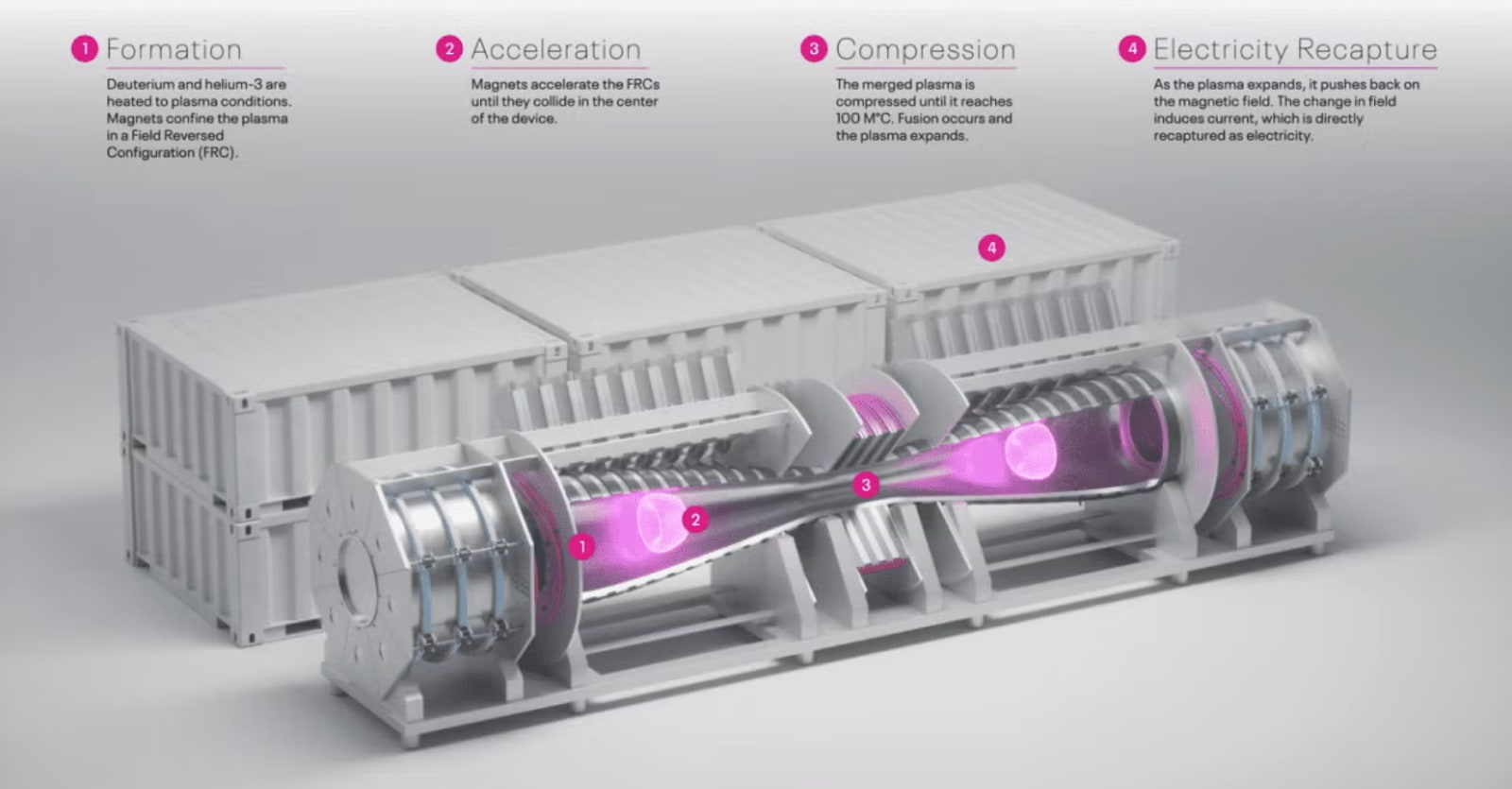
It’s not quite the same. Helion also uses magnetic confinement, but the configuration of its magnetic field is linear, unlike ours, which is shaped like a torus — a doughnut. Their setup is called a “field-reversed configuration,” or FRC for short. Based on publicly available academic data, the highest-performing FRC device so far has achieved a triple product of around 10¹⁷ [see the “How to Compare Reactors” section to understand this value], maybe not quite reaching 10¹⁸. So there’s still a gap of about four orders of magnitude from 10²¹. That’s why we feel this is a technological path with very high scientific risk.

Let me give an example. Suppose I want to build an airplane, and right now I only have experimental flight data for altitudes between 0 and 10 meters. Then I take that data and try to extrapolate it to design a plane that can fly at 10,000 meters. In the process of extrapolating, I might not even realize that the air gets thinner and the temperature gets lower at higher altitudes. So if I use aerodynamic data from 0 to 10 meters and extrapolate it to 10,000 meters — about a difference of three orders of magnitude — then the aircraft I design might simply not be able to fly at that altitude.

Similarly, if you only have experimental data up to about 10¹⁷ and you extrapolate to 10²¹, you face the same problem. You don’t know whether new, emergent physical processes will appear in the range from 10¹⁷ to 10²¹ that would change the equations — processes that weren’t there before. If such processes exist, your extrapolated design could fail.

If you’re very lucky and no new physics appears, or the new physics even helps you, that’s great. But in my view these are scientific risks — it’s even uncertain whether the answer exists. So, in principle, these kinds of high-scientific-risk problems are more suitable for research institutes or universities to pursue.

Helion’s plane may fly. Maybe. Thankfully for him, even if Sam Altman loses his investment, his finances are secure.

Zhang Xiaojun: Helion claims to build the world’s first fusion power plant in 2028. You’re targeting 2035.

Yang Zhao: Right, building a fusion power plant by 2028 is indeed extremely ambitious. Even within our team, we don’t fully understand from a theoretical standpoint why their approach would work. Of course, that company has released very little information, and there’s hardly any academic material available. So it’s actually quite difficult for us to judge; it’s possible that there are some physical principles we haven’t taken into account and that they have some very unique understanding of the physics. But based on all the publicly available information and on what is generally known in the field of physics, we don’t fully understand how their technical approach will ultimately achieve energy breakeven.

Conceptual Design of Helion Energy’s fusion device. Source

China and the US: Independent Fusion Ecosystems

Zhang Xiaojun: How do you see the China-US fusion landscape and progress — are there differences?

Yang Zhao: The basic situation is that both China and the US are developing very quickly. Most of the investment and progress is concentrated in these two places. The markets are also naturally separate: it’s unlikely China’s fusion tech will rely on the US to realize it, so China needs domestic teams to do it. Likewise, the US probably won’t import fusion technology from China; they will have domestic teams. From demand, funding capacity, talent pool, supply chain and technical reserves, these two regions are the most likely earliest achievers of fusion. Each will have its own teams.

At present, most commercial investment is in the US and Western countries. Total funding in the fusion field is approaching about $6 billion. There are roughly 40 startups in the US/West. In China there are probably fewer than ten startups, just a handful. In China the total funding scale is on the order of ten billion RMB, which corresponds to around one to two billion US dollars. I haven’t audited exact details, but that’s the rough scale.

Our judgment is that China and the US are the most likely earliest places for commercial fusion, and both regions will have relatively independent technical efforts — you don’t really know what others are doing and vice versa; everyone works independently.

Zhang Xiaojun: The technical routes might also differ.

Yang Zhao: The routes are actually similar in many cases. For example, many US startups follow a tokamak + high-temperature-superconductor route similar to CFS. Some domestic startups follow approaches similar to Helion. It’s likely that some leading companies in the US will have comparable counterparts in China.

With cross-border tech sharing, capital investments, and reactor construction totally off the table, it seems likely that the US and China will develop a sort of mirror ecosystem, with their own champions pursuing each of the same families of tech.

How AI Can Accelerate Fusion

Here’s Yang Zhao’s thoughts on how AI can continue to drive down the costs of fusion:

Yang Zhao: AI is also a very effective way to cut costs and improve efficiency for fusion. Broadly speaking, AI has several major roles for fusion. First, during device operation it can rapidly and precisely provide real-time AI-driven control.

The real-time demands for control are very high. Traditional physics models are computationally heavy and too complex for real-time control. But with AI acceleration and AI-based surrogate models for very complex physical processes, you can get algorithms that are both precise and fast enough to use in real-time control. That’s a huge help for device control.

A year or two ago, DeepMind used AI to control a tokamak in Europe; with very few iterations and in a short time they achieved experimental configurations that previously required a lot of trial and error to reach. So the first contribution is strong help for real-time control.

Second, AI can help substitute for diagnostic hardware. Many high-end diagnostics are costly and difficult to develop. This is similar to applying AI in imaging or medicine to enhance diagnostic capability: you don’t necessarily need an expensive new hardware device — AI algorithms can give you higher precision or better resolution in diagnosis. Using AI in diagnostics is a major direction people are researching now. It’s another way to reduce cost and improve efficiency.

Third, for plasma simulation: if our simulations were accurate enough in principle we wouldn’t need experiments. But reality and simulation diverge. For example, you may design an ideal device, but manufacturing and assembly have offsets — tenths of a millimeter, a millimeter, a few millimeters — and those gaps can create effects that the first-principles ideal model did not capture.

If we build AI models trained on real experimental data for a specific, already-built machine, and our predictive ability for that machine becomes strong, we can greatly reduce the number of experiments needed to find desired parameters. Where you might originally need 100 experiments, you might only need two, because your simulation environment already gives good predictions. That means many intermediate experiments aren’t necessary and you can move on to the next stage faster.

So by providing faster and more accurate plasma predictions, AI shortens experimental iteration cycles. Overall, AI’s effect on fusion is to cut costs and increase efficiency — saving time and capital. The main application areas are control, diagnostics, and experiment operations; these can all receive substantial help from AI.

Fusion → Interstellar?

Zhang Xiaojun: If D–D fusion[3] becomes possible and energy becomes effectively unlimited, what would the world become like?

Yang Zhao: If energy becomes extremely cheap, civilization would change dramatically. Many issues would be different. For example, whether food needs to be grown naturally or could be industrially synthesized — energy cost is the key factor. If energy is very cheap, many products that currently rely on natural processes could be produced synthetically.

Thinking about leaving Earth: spaceflight consumes enormous energy. If energy is cheap, you wouldn’t worry about that as much; you could provide the energy needed for interstellar colonization. That’s the basic idea.

Contribute Where You Have Leverage

Xiaojun probed Zhao on his choice to go all-in on fusion, and I was impressed with his response.

Zhang Xiaojun: When did you decide to work on controlled nuclear fusion?

Yang Zhao: I first thought about it back in undergrad. As physics students we get exposure to various subfields, and I asked myself: which research areas will have the biggest impact on humanity’s future? I concluded early on that fusion could be one of the most consequential developments. I’m talking about a relatively near-term future — say on the scale of decades rather than a century. For me, fusion felt like a historical inevitability that would have a massive impact on civilization. That kind of project attracts me: things that history will eventually accomplish, where participating means contributing to an inevitable development.

Other major trends include quantum computing — that’s clearly a big direction — and artificial intelligence, which is certainly going to happen as well. But some of those areas, like AI, might not be where I’m best able to contribute. There are historically inevitable developments where your participation can accelerate timelines, turning a ten-year progress into five years, for example. But there are also things where your involvement doesn’t change much, so you might choose not to get involved. For AI, it’s an inevitable direction, but it isn’t necessarily the field where my background gives me the greatest leverage.

Before graduating I was thinking I might either start a company or become a scientist. I wanted to do things that are hard to do unless you really focus on them, things that take a long time and aren’t easily replicated by just swapping people. For me, whether it’s producing a new theoretical result in research or creating something in the real world through a company that didn’t exist before, both bring strong personal satisfaction.

ChinaTalk is a reader-supported publication. To receive new posts and support our work, consider becoming a free or paid subscriber.

1

With a focus on quantum gravity and string theory

2

You can read their equally impressive bios here.

3

D-D fusion uses only Deuterium as a fuel source. Deuterium is an isotope of hydrogen (one proton and one electron) that is plentifully available in seawater. D-T fusion, which is the main type now, uses tritium (one proton and two neutrons). Tritium is rare, unstable, and a controlled substance since it is used to make nuclear warheads.

❌