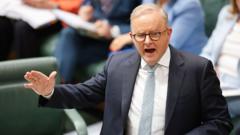
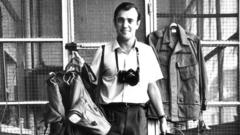
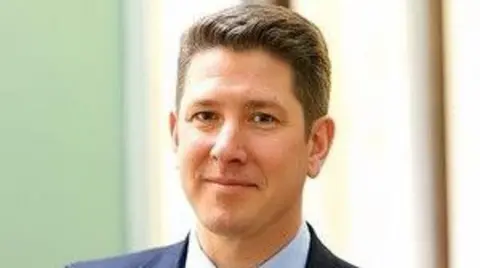
The UK has named Christian Turner as its new ambassador to the US, Downing Street has confirmed.
Turner has spent a nearly 30-year career working across Whitehall and the Foreign Office.
He will now become the man tasked by Prime Minister Sir Keir Starmer with building links to the Trump administration.
The previous ambassador Peter Mandelson was sacked by Starmer after evidence, including emails and photos emerged, showing his continued association with the paedophile Jeffery Epstein.
Lord Mandelson has repeatedly said he regrets his relationship with Epstein, who died in jail in 2019 while awaiting trial on sex trafficking offences.
Turner said he was "honoured" to be nominated for the role.
"At a pivotal time for the transatlantic relationship, I look forward to working with President Trump's administration, and leaders in Congress, business and society to strengthen that bond in the years ahead," he added.
In a statement released by the Foreign Office, Starmer said: "The United Kingdom and United States have a very special relationship, and Christian's extensive experience as an outstanding diplomat will support this uniquely close bond and ensure it continues to flourish."
Turner's previous roles include political director at the Foreign Office, and British High Commissioner to Pakistan. He also previously worked in 10 Downing Street as Private Secretary to the Prime Minister.
Before entering government, he worked in television documentaries.
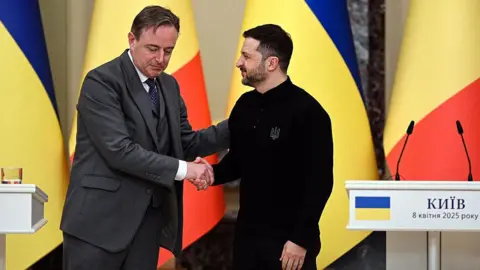
Belgian Prime Minister Bart De Wever is yet to be convinced that the money held in Belgium should be loaned to Ukraine (file pic)
European Union leaders begin two days of talks in Brussels with a momentous decision to be taken on whether to loan tens of billions of euros in frozen Russian assets to Ukraine to fund its military and economic needs.
Most of Russia's €210bn (£185bn; $245bn) worth of assets in the EU are held by Belgium-based organisation Euroclear, and so far Belgium and some other members of the bloc have said they are opposed to using the cash.
Without a boost in funding, Ukraine's finances are set to run dry in a matter of months.
One European government official described being "cautiously optimistic, not overly optimistic" that a deal would be agreed. Russia has warned the EU against using its money.
It has filed a lawsuit against Euroclear in a Moscow court in a bid to get its money back.
The Brussels summit comes at a pivotal moment.
US President Donald Trump has said a deal to end the war - which began with Russia's full-scale invasion of Ukraine in February 2022 - is "closer now than we have been ever".
Although Russia has not responded to the latest peace proposals, the Kremlin has stressed that plans for a European-led multinational force for Ukraine supported by the US would not be acceptable.
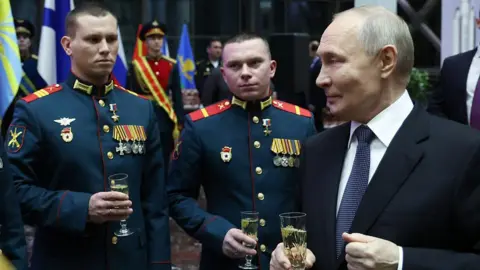
President Vladimir Putin made his feelings towards Europe clear on Wednesday, when he said the continent was in a state of "total degradation" and "European piglets" - a derogatory description of Ukraine's European allies - were hoping to profit from Russia's collapse.
Alexander KAZAKOV/POOL/AFP
Those in favour of loaning Ukraine the money believe it will help deter Putin from continuing the war
The European Commission - the EU's executive arm - has proposed loaning Kyiv about €90bn (£79bn) over the next two years - out of the €210bn of Russian assets sitting in Europe.
That is about two-thirds of the €137bn that Kyiv is thought to need to get through 2026 and 2027.
Until now the EU has handed Ukraine the interest generated by the cash but not the cash itself.
"This is a crunch time for Ukraine to keep fighting for the next year," a Finnish government official told the BBC. "There are of course peace negotiations but this gives Ukraine leverage to say 'we're not desperate and we have the funds to continue fighting'."
Commission chief Ursula von der Leyen says it will also ramp up the cost of war for Russia.
Russia's frozen assets are not the only option on the table for EU leaders. Another idea, backed by Belgium, is based on the EU borrowing the money on the international markets.
However, that would require a unanimous vote and Hungary's Viktor Orban has made it clear he will not allow any more EU money to help Ukraine.
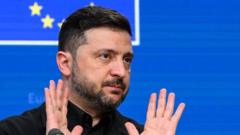
For Ukraine, the hours ahead are significant and President Volodymyr Zelensky is expected to attend the EU summit.
Ahead of the Brussels meeting, EU leaders were keen to stress the momentous nature of the decision.
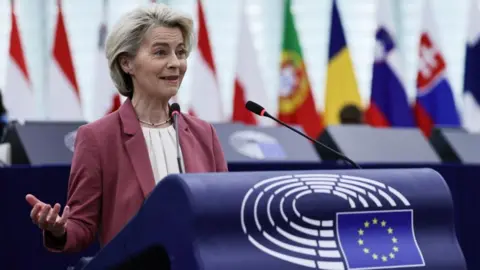
"We know the urgency. It is acute. We all feel it. We all see it," von der Leyen told the European Parliament.
EPA
Ursula von der Leyen told the European Parliament that two choices were on the table for EU leaders
German Chancellor Friedrich Merz has played a leading role in pushing for the Russian assets to be used, telling the Bundestag on the eve of the summit it was about sending a "clear signal" to Moscow that continuing the war was pointless.
EU officials are confident they have a sound legal basis to use the frozen Russian assets, but so far Belgian Prime Minister Bart De Wever remains unconvinced.
His Defence Minister Theo Francken warned ahead of the talks that it would be a big mistake to loan the Euroclear cash.
Hungary is seen as the biggest opponent of the move and, ahead of the summit, Prime Minister Orban and his entourage even suggested that the frozen assets plan had been removed from the summit agenda. A European Commission official stressed that was not the case and it would be a matter for the 27 member states at the summit.
Slovakia's Robert Fico has also opposed using the Russian assets, if it means the money being used to procure weapons rather than for reconstruction needs.
When the pivotal vote does finally take place, it will require a majority of about two-thirds of member states to go through. Whatever happens, European Council President António Costa has promised not to go over the heads of the Belgians.
"We're not going to vote against Belgium," he told Belgian public broadcaster RTBF. "We'll continue to work very intensively with the Belgian government because we don't want to approve something that might not be acceptable for Belgium."
Belgium will also be aware that ratings agency Fitch has placed Euroclear on a negative watch, partly because of "low" legal risks to its balance sheet from the European Commission's plans to use the Russian assets. Euroclear's chief executive has also warned against the plan.
"There are many hiccups and obstacles of course still on the way. We have to find a way to respond to Belgium's worries," the Finnish official added. "We are on the same side as Belgium. We will find a solution together to make sure all the risks are checked as much as they can be checked."
However, Belgium is not the only country to have doubts, and a majority is not guaranteed.
Italian Prime Minister Giorgia Meloni has told Italian MPs she will endorse the deal "if the legal basis is solid".
"If the legal basis for this initiative were not solid, we would be handing Russia its first real victory since the beginning of this conflict."
Malta, Bulgaria and the Czech Republic are also said to be unconvinced by the controversial proposals.
If the deal is passed and the Russian assets are given to Ukraine, the worst-case scenario for Belgium would be one in which a court would order it to hand the money back to Russia.
Some countries have said they would be prepared to provide billions of euros in financial guarantees, but Belgium will want to see the numbers add up.
At any rate, Commission officials are confident that the only way for Russia to get it back would be by paying reparations to Ukraine - at which point Ukraine would hand its "reparations loan" back to the EU.
Bank of England governor 'encouraged' by falling inflation
The future of the economy can sometimes be seen in minor gestures of a Bank of England governor, such as the arch of his eyebrows. So what to make of Andrew Bailey sporting a rather exuberant festive tie full of Christmas trees at the moment he delivered his so-called "Santa cut"?
It probably means nothing. Just maybe it is a sign that the timing and messaging behind this cut is designed to pump life into a "subdued" economy.
It was a narrow decision, with the governor as the swing voter after he said the UK had "passed the peak of inflation", and the target of 2% now in sight in April rather than early 2027.
Mr Bailey was at pains to say the direction of travel next year remained cuts, but that decisions would now be a closer call.
"We're going to come back to target sooner than we thought. So that's encouraging. All of this is very encouraging, and for me certainly, you know, it was a strong basis to cut today," he said.
"Looking forwards, I do think we'll continue to have something of a gradual downward path... the calls do get closer."
There has been a debate on the Monetary Policy Committee about what a normal level of interest would be, with some members seeing that as low as 3%. Markets interpreted the deliberations of the committee as meaning just two further cuts next year.
Much is up in the air, however, about what the committee said was a "lacklustre" economy, that they forecast is not growing in the current quarter.
The uncertainty around the Budget has now lifted, but businesses told the Bank there had been no rebound yet. The Leader of the Opposition, Kemi Badenoch, said that the cuts showed the economy was on "life support" and rate cuts were "CPR".
Governor Bailey said the Budget measures aimed at containing inflation had helped the Bank's decision to lower interest rates.
"It's part of the reason I can be more confident inflation is going to come down sooner," he said.
The governor has also identified an unusually high rate of savings as holding back the economy, driven by a lack of consumer confidence among older savers in particular. Rate cuts mechanically lower the incentive to save, and help spending.
He said he didn't want to be "judgemental" about how much people save, but that it was true "how confident and cautious" people feel about the global and local economy does affect savings.
More economic policy stability, lower inflation and lower interest rates should help the economy gain some new momentum in the new year. It certainly needs it.
But it might take a lot more for the much-needed jolt of confidence and festive spirit to spread across the economy.
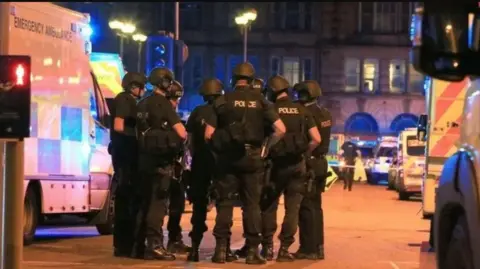
A public inquiry into the bombing found chances to stop the attack had been missed
Almost £20m is to be paid out to children injured in the Manchester Arena bombing, a judge has ruled.
Amounts ranging from £11.4m to £2,770 were agreed at a hearing at the Manchester Civil Courts of Justice for 16 people, who were all aged under 16 at the time of the attack.
Some suffered "catastrophic" and life changing injuries while others suffered severe psychological damage after suicide bomber Salman Abedi detonated a homemade bomb after a concert at the venue on 22 May 2017, the court heard.
The damages will be paid by venue manager SMG Europe Holdings, Showsec International Ltd, who provided crowd management, Greater Manchester Police (GMP) and British Transport Police (BTP).
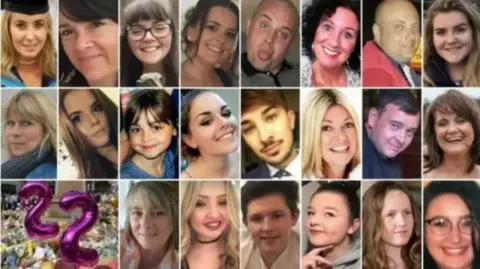
Twenty two people died and hundreds more were injured in the blast after an Ariana Grande concert.
A public inquiry into the bombing, led by Sir John Saunders, later found that chances to stop the attack had been missed along with "serious shortcomings" in security and individual failings.
Judge Nigel Bird approved the 16 claims, agreed between their lawyers and the defendants, as they all involved children or those without mental capacity. A court order bans identifying any of the 16 or their families.
It is understood following the hearing, claims by another 352 people, all adults deemed to have capacity, including the families of the 22 who lost loved ones, will now be agreed between lawyers for the defendants and the claimants.
As those agreements have been made out-of-court, no details of any public money to be paid out by the public bodies - BTP and GMP - will be made public.
Each of the four organisations has apologised to the bereaved families and to the survivors, lawyers for the claimants said, and have acknowledged their failures.
PA Media
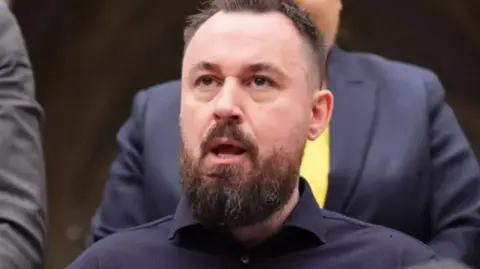
Survivor Martin Hibbert has been a prominent advocate for the victims of the attack
Judge Bird told the hearing: "Each of these cases has a common link, that is injuries and loss suffered, arising out of a single and unimaginable act of terrorism committed on the evening of May 22 2017 at the end of a concert attended by very many young people and their families.
"Twenty-two innocent lives were lost and and the lives of countless others impacted.
"The love and care a parent gives to an injured child is beyond monetary value."
The judge paid tribute to the "courage, dedication and fortitude" of the families involved in each case.
He added: "Each, through their quiet determination, has brought about promises of change in the hope that in the future, other families need not go through what they have been through."
After the hearing, a joint statement was issued from the legal teams at Hudgell Solicitors, Slater & Gordon and Broudie Jackson Canter, the three lead firms representing the claimants.
Family handouts
Twenty-two people were killed in the 2017 bombing
The statement said: "This is not a day of celebration. It is a moment to acknowledge the mistakes that were made and the unimaginable suffering our clients have endured over the past eight-and-a-half years.
"Their strength and resilience have been extraordinary, and without that, we would not have reached this settlement.
"We now expect all parties to honour their commitment to do what they can to prevent those same mistakes from happening again.
"It has been a privilege to work on behalf of our courageous clients. We wish them only peace and strength as they look to the future."
Family handout
Martyn's Law is named after Martyn Hett, who was among 22 people killed
Martyn's Law, named in memory of victim Martyn Hett, 29, has since been brought in to better protect public place from terror attacks - stipulating a range of extra safety measures large venues must undertake.
The public inquiry found a series of "missed opportunities" to spot and stop Abedi.
It heard he should have been identified as a threat and action taken sooner after he was reported as suspicious by a member of the public, who was "fobbed off".
The arena area also had a CCTV "blind spot", patrols of the area by security staff were not adequate and BTP officers took a two-hour lunch break to get a kebab before the attack.
The new offences would build on existing rules around sexually explicit deepfakes and intimate image abuse, the government said.
"Women and girls deserve to be safe online as well as offline," said Technology Secretary Liz Kendall.
"We will not stand by while technology is weaponised to abuse, humiliate and exploit them through the creation of non-consensual sexually explicit deepfakes."
Creating deepfake explicit images of someone without their consent is already a criminal offence under the Online Safety Act.
Ms Kendall said the new offence - which makes it illegal to create or distribute nudifying apps - would mean "those who profit from them or enable their use will feel the full force of the law".
Nudification or "de-clothing" apps use generative AI to realistically make it look like a person has been stripped of their clothing in an image or video.
Experts have issued warnings about the rise of such apps and the potential for fake nude imagery to inflict serious harm on victims - particularly when used to create child sexual abuse material (CSAM).
"The act of making such an image is rightly illegal – the technology enabling it should also be," she said in a report.
The government said on Thursday it would "join forces with tech companies" to develop methods to combat intimate image abuse.
This would include continuing its work with UK safety tech firm SafeToNet, it said.
The UK company developed AI software it claimed could identify and block sexual content, as well as block cameras when they detect sexual content is being captured.
Such tech builds on existing filters implemented by platforms such as Meta to detect and flag potential nudity in imagery, often with the aim of stopping children taking or sharing intimate images of themselves.
'No reason to exist'
Plans to ban nudifying apps come after previous calls from child protection charities for the government to crack down on the tech.
The Internet Watch Foundation (IWF) - whose Report Remove helpline allows under-18s to confidentially report explicit images of themselves online - said 19% of confirmed reporters had said some or all of their imagery had been manipulated.
Its chief executive Kerry Smith welcomed the measures.
"We are also glad to see concrete steps to ban these so-called nudification apps which have no reason to exist as a product," she said.
"Apps like this put real children at even greater risk of harm, and we see the imagery produced being harvested in some of the darkest corners of the internet."
However while children's charity the NSPCC welcomed the news, its director of strategy Dr Maria Neophytou said it was "disappointed" to not see similar "ambition" to introduce mandatory device-level protections.
The charity is among organisations calling on the government to make tech firms find easier ways to identify and prevent spread of CSAM on their services, such as in private messages.
The government said on Thursday it would make it "impossible" for children to take, share or view a nude image on their phones.
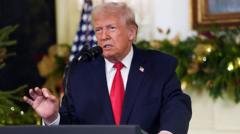
The board of the Kennedy Center has voted to rename the performing arts centre the Trump-Kennedy Center, according to the White House.
Press secretary Karoline Leavitt said on social media the board's vote was unanimous and due to "the unbelievable work President Trump has done over the last year in saving the building".
Leavitt also congratulated President John F. Kennedy and said "this will be a truly great team long into the future! The building will no doubt attain new levels of success and grandeur".
The move would be highly controversial, particularly in Washington DC where the centre has been an iconic landmark since constructed and named for Kennedy.
Shorty after taking office, President Donald Trump fired all the centre's board members, and replaced them with allies, who then voted to make Trump chairman of the board.
The president secured about $257 million in congressional funding to pay for major renovations and other costs at the venue.
The idea for a national performing arts centre began in the 1950s and when Kennedy, the 35th president, was assassinated in 1963, the venue was named in his honour.
This breaking news story is being updated and more details will be published shortly. Please refresh the page for the fullest version.
You can receive Breaking News on a smartphone or tablet via the BBC News App. You can also follow @BBCBreaking on X to get the latest alerts.
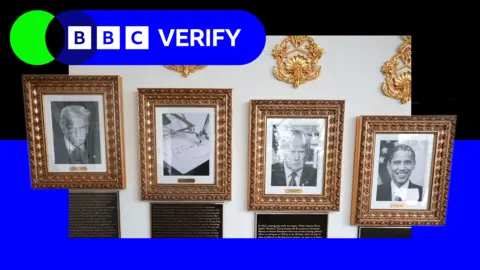
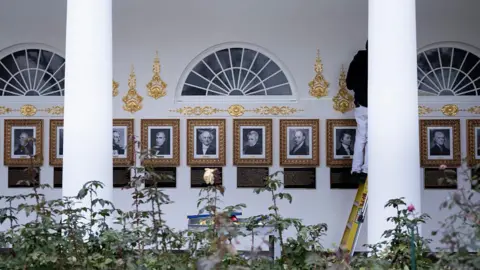
New plaques have appeared under the portraits of former US presidents at the White House.
Unlike Donald Trump's previous statements about his predecessors, which have been delivered through speeches, interviews and social media posts, these plaques - installed outside the West Wing - represent a more permanent attempt to shape the long-term view of past presidents.
The text includes a series of claims and criticisms about past leaders, including Donald Trump's immediate predecessors Joe Biden and Barack Obama.
The descriptions also underscore Trump's willingness to get involved in details especially when it comes to how he and his political opponents are portrayed.
White House Press Secretary Karoline Leavitt said the plaques "are eloquently written descriptions of each president and the legacy they left behind".
BBC Verify has taken a closer look at some of the claims on the so-called "Presidential Walk of Fame".
We investigated claims of "unexplained" surges in Democrat votes, voting machines that flipped votes from Trump to Biden, and even that thousands of "dead" people had voted in Michigan - none were true.
Getty Images
The portraits and plaques are displayed outside the West Wing
Biden plaque: 21 million people poured into the US
The plaque also claims that Biden "let 21 million people from all over the World pour into the US".
The plaque does not say how these people allegedly entered the country under Biden, but Trump has used variations of the 21 million figure several times when talking about the previous administration's record on the US border.
The number of migrant crossings at the US border did reach record highs under Biden but not to the level Trump - who has never provided a source for these claims - states.
US border officials record "encounters" with migrants - these include people who attempted to cross illegally and people who tried to enter legally but did not meet entry rules.
The plaque was very critical of President Biden's achievements in office
Biden plaque: Highest inflation ever recorded
Biden's economic record also came under attack, with the plaque claiming his policies: "caused the highest inflation ever recorded".
It is correct that inflation - the increase in the cost of living over time - rose significantly during Biden's first two years in office, peaking at 9.1% in June 2022 shortly after Russia's full-scale invasion of Ukraine.
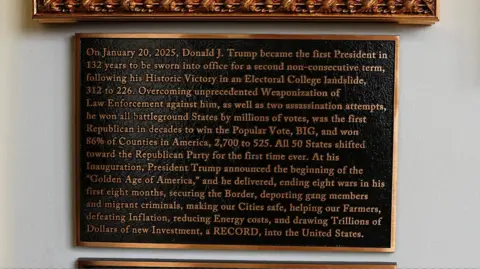
As well as former presidents, Trump also added a plaque for his current term.
It includes some bold claims about his record in office since January. For example, it claims Trump has delivered on "defeating inflation".
While inflation is down from the 9.1% peak under Biden in 2022 - a time when many countries around the world experienced high inflation following the Covid-19 pandemic and Russia's invasion of Ukraine - it has not been "defeated" altogether.
Inflation was still at 2.7% year-on-year in November 2025, according to the latest official figures. That's down from 3% in September, when the last inflation update was published.
Average grocery prices in the US rose by 1.9% since the time of the election in November 2024.
Reuters
Among his achievements, Trump's plaque claims the president defeated inflation and ended eight wars.
Trump plaque: 'Ended eight wars'
Listing Trump's achievements, the plaque also claims Trump ended "eight wars in his first eight months".
However, some of the conflicts lasted just days and the level of influence Trump played in ending them is disputed.
At least one of the "wars" simply wasn't a war. Egypt and Ethiopia have had some diplomatic tensions, particularly around a dam on the Nile, but there has in no sense been a war between them.
It is true that Trump has successfully helped broker some peace agreements for some long-standing conflicts, such as between Armenia and Azerbaijan. But it is also unclear whether some of the peace agreements will last, given fighting has broken out on the Thailand-Cambodia border and between Rwanda and the DRC again since.
The plaques do not attack Democrats alone. Former Republican president George W Bush, for example, is criticised over the wars in Iraq and Afghanistan, whereas former Democrat president Jimmy Carter is praised for some of his achievements.
Neither former presidents Biden or Obama have commented on the installation of their plaques.

 Login
Login
 FCDO
FCDO