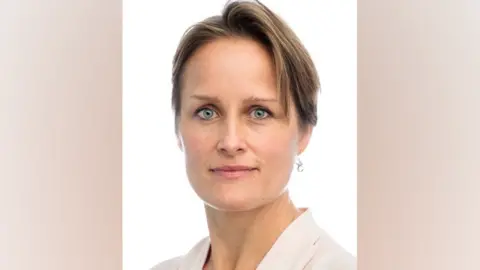
The chief executive of Oxfam GB has been forced out by the charity's board after an independent review found "serious issues" with her behaviour and decision making.
The organisation's trustees decided Dr Halima Begum's position was "untenable" because of an "irretrievable breakdown in its trust and confidence" in her ability to do the job.
About 70 members of staff had signed a letter calling for Oxfam to investigate Dr Begum's conduct, with several employees said to have resigned after falling out with her, the Times reported.
Dr Begum had been in the role for almost two years. The BBC has contacted her for comment.
In a statement, Oxfam confirmed the review was commissioned by its board of trustees to examine "concerns raised about the leadership, conduct and approach" of Dr Begum.
It said the review was carried out by legal firm Howlett Brown between November and December 2025.
The investigation drew on testimony from 32 current and former Oxfam colleagues, as well as documentary evidence, the charity said.
Findings showed "serious issues in the CEO's leadership behaviour and her decision making, including breaches of organisational processes and values, and inappropriate interference into safeguarding and integrity investigations", it added.
The decision to discharge Dr Begum from her role was passed last week and she has already left the organisation, Oxfam said.
The role of acting chief executive will be taken up by Jan Oldfield, Oxfam's chief supporter officer for more than four years, it added.
Acting co-chairs of Oxfam GB, Nana Afadzinu and Dame Annie Hudson, said their priority going forward was to provide "stability" for staff and "rebuild confidence" across the organisation".
"The Board has taken immediate steps to strengthen oversight and reinforce organisational processes, and work is already underwayto address the recommendations in the report," they added.
Dr Begum's departure comes after a difficult year for Oxfam.
The Oxford-based charity also made 250 of its 2,100 UK staff redundant earlier this year to save £10.2m from its wage bill.
At the time, Dr Begum said the decline was due to the charity's work taking place "against a backdrop of deep uncertainty, rising inflation and a cost-of-living crisis".
这段记录路人英勇行为的视频迅速在社交媒体上传播开来,许多人称赞该男子的勇气。据路透社报导,该名男子的身分是43岁的艾哈迈德(Ahmed al Ahmed),当天身中两枪后已接受治疗。新南威尔士州州长克里斯·明斯(Chris Minns)表示,这是他“见过最令人难以置信的场面”。他说:“一名男子走向一名刚刚向民众开枪的枪手,独自一人将其缴械,冒着生命危险,拯救了无数人的生命。
Blaise Metreweli is the first woman to head Britain's overseas spy agency
The new chief of MI6, Blaise Metreweli, will warn of "the acute threat posed by Russia" when she makes her first public speech later.
She will highlight so-called hybrid warfare, which includes incidents such as cyber attacks and drones suspected of being launched near critical infrastructure by Russian proxies.
Ms Metreweli will describe this as "an acute threat posed by an aggressive, expansionist and revisionist Russia".
Referring to the war in Ukraine, she will insist that Britain will be keeping up the pressure on President Vladimir Putin on Ukraine's behalf.
Ms Metreweli, who took over as head of the Secret Intelligence Service in the autumn, is the first woman to head Britain's overseas spy agency. She took over from Sir Richard Moore on 1 October.
Monday's speech will point to the recent sanctioning of Russian entities accused of conducting information warfare, as well as two China-based companies sanctioned for their "indiscriminate cyber activities against the UK and its allies".
Western sanctions have certainly damaged Russia's economy, driving its exports eastwards towards China and India. But they have singularly failed to change President Putin's determination to wage war on Ukraine until it gives in to his demands for territory and ultimately, loyalty to Moscow.
It is also clear from Ms Metreweli's speech that a special area of interest for the new spy chief is technology.
Having joined MI6 in 1999, she has arrived at the top job via Q Branch. Named after the fictional MI6 division in Ian Fleming's spy books, this is the real life, in-house, top secret part of the Secret Intelligence Service that designs the sorts of gadgets and gizmos that enable agents to communicate with their handlers, without being detected and caught.
In her speech later she is expected to call on all her intelligence officers to master technology, "not just in our labs, but in the field, in our tradecraft.. We must be as comfortable with lines of [computer] code as we are with human sources, as fluent in Python as we are in multiple languages".
Python, a programming language, may surprise some as an example to pick, since it has been around for more than three decades. But her point will not be lost on the men and women who have chosen to work in the shadowy world of espionage.
In an age where data is key, where spies can no longer rely on false identities when biometric scanning can unmask them in seconds at borders and checkpoints, MI6 needs to prove that it can still be relevant.
Elsewhere, the Chief of the Defence Staff, Sir Richard Knighton, will on Monday call for a "whole of society approach" to building national resilience, in the face of growing threats and uncertainty.
In a speech to the Royal United Services Institute in London, Sir Richard is expected to say that defence and resilience need to be a higher priority for everyone, not just those in the military.
It is the latest in a string of warnings that the UK needs to be more ready than it is now to meet a growing volume of threats.
Sir Richard is expected to say that the situation is more dangerous than he has known during his entire career.
Russia has made it clear that it wishes to challenge, limit, divide and ultimately destroy Nato, he will say.
Britain's response needs to be about more than simply strengthening the armed forces. Deterrence, he will say, involves harnessing the UK's power, from its universities to industry, the rail network and the NHS.
"A new era for defence doesn't just mean our military and government stepping up - as we are - it means our whole nation stepping up," he will say.
Addressing a skills gap highlighted in a recent report by the Royal Academy of Engineering, Sir Richard will talk about the need to work with industry and young people and will announce £50m for new defence technical excellence colleges.
In recent weeks, both France and Germany have outlined plans for voluntary national service.
Last year, the then-Conservative government set out its own compulsory proposals, which Labour dismissed as a gimmick.
But the debate about how Britain as a whole should respond to an increasingly uncertain world is gathering pace.
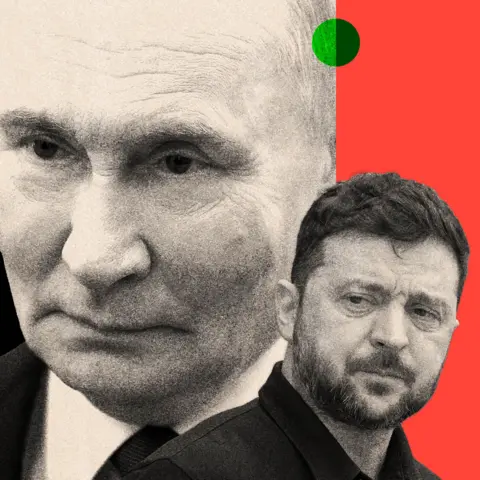
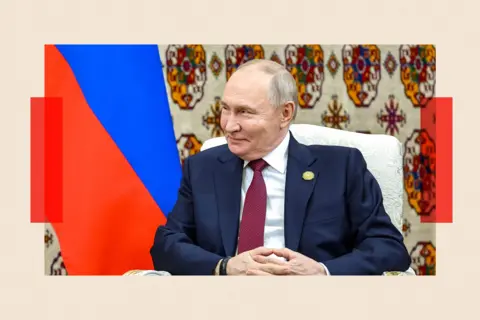
Vladimir Putin may have a reputation among some as a ruthless autocrat, a master manipulator of the international scene. But one thing Russia's president does not have is a poker face.
The late US Senator John McCain used to joke that when he looked into Putin's eyes, he saw three things, "a K and a G and a B", a reference to his past life as a Soviet intelligence officer.
I thought of this as I watched footage of Russia's leader sitting opposite American envoys in the Kremlin. He could not hide his emotions; he exuded an air of supreme confidence.
For President Putin reckons the diplomatic tide has turned in his favour, with an improved relationship with America and gains on the battlefield.
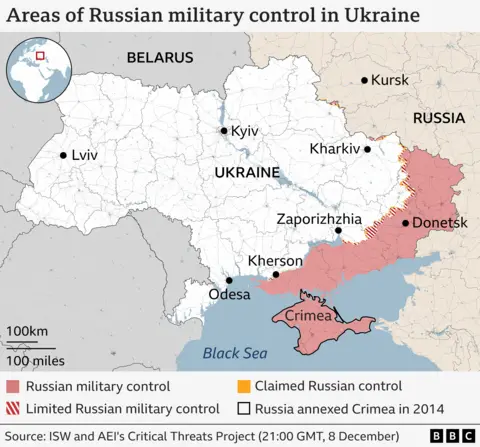
Some analysts say Putin has no incentive to retreat from his demands: that Ukraine gives up the last 20% of Donetsk it still controls; that all occupied territory is recognised internationally as Russian; that Ukraine's army is curtailed to a point of impotence; and Nato membership is ruled out forever.
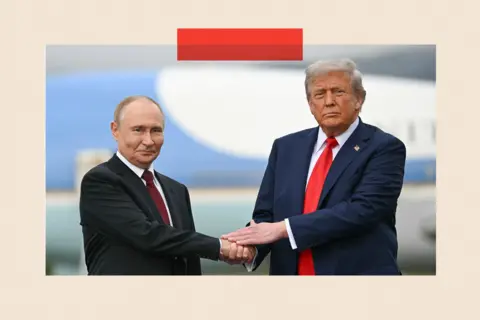
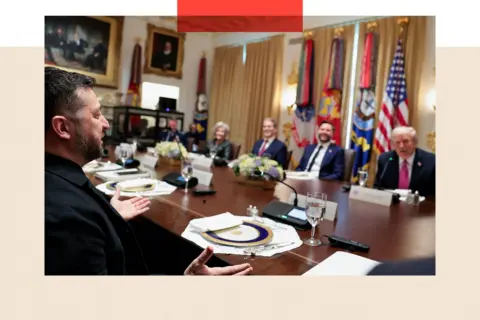
As things stand, there are a few possible scenarios. The first is that US President Donald Trump may try to force Ukraine into a ceasefire on terms unwelcome to its people, one that cedes territory and lacks sufficient security guarantees to deter future Russian aggression.
If Ukraine demurs or Russia vetoes, President Trump has hinted he could wash his hands of the war; last week, he said "sometimes you have to let people fight it out".
AFP via Getty Images
The Trump administration's new national security strategy urged the US to 're-establish strategic stability' with Russia
He could remove the vital US intelligence Ukraine needs to detect incoming Russian drones and target Russian energy facilities.
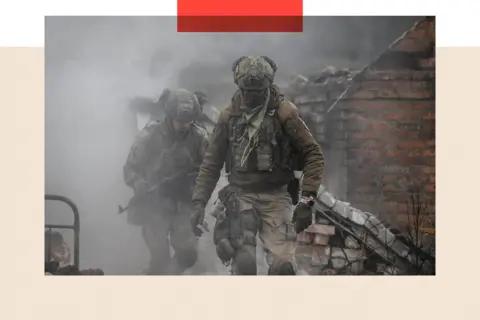
Another possibility is that the war could just stumble on with Russia's forces continuing to make slow advances in the east.
The Trump administration's new national security strategy implied that Russia is no longer an "existential threat" to the US, and urged the US to "re-establish strategic stability" with Russia.
So, with American support for Ukraine in serious question, what - if anything - could potentially change Putin's mind? And what else could Ukraine, Europe and even China, do differently?
Could Europe do more?
At the moment, the continent is preparing for a ceasefire. Under the banner of the "coalition of the willing", it is preparing an international military force to help Ukraine deter future Russian invasion, alongside a financial effort to help reconstruct the war-ravaged country.
But some officials suggest that Europe should instead prepare for the war to muddle on.
They want to help Ukraine not only "win the fight tonight", with more drones and cash; but also provide longer term support and prepare for a 15 to 20 year war with Russia.
Europe could also do more to help protect Ukrainian skies from drones and missiles. There is already a plan – called the European Sky Shield Initiative – which could be expanded to allow European air defences to protect western Ukraine.
Others argue European troops could be deployed to western Ukraine to help patrol borders, freeing up Ukrainian soldiers to fight on the front line. Most proposals such as this have been rejected for fear of provoking Russia or escalating the conflict.
Keir Giles, senior consulting fellow at the Russia and Eurasia programme at Chatham House think tank, said these fears were based on "nonsense" because Western troops were already present on the ground and Sky Shield could be deployed in western Ukraine with little chance of any clash with Russian aircraft.
European leaders, in his view, had to "insert themselves into the conflict in a manner that will actually make a difference".
WPA Pool/Getty Images
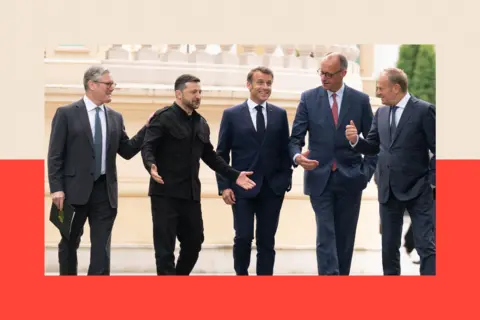
Zelensky has offered to drop Ukraine's aspirations to join the NATO military alliance, according to some reports on Sunday. (Pictured: Starmer with Zelensky, Emmanuel Macron, Friedrich Merz and Donald Tusk)
Mr Giles said: "The only thing that will unarguably, undeniably stop Russian aggression is the presence of sufficiently strong western forces where Russia wants to attack, and the demonstrated will and resolve that they will be used to defend."
This strategy would of course come with huge political difficulty - with some voters in western Europe unwilling to risk a confrontation with Russia.
Few analysts expect Ukraine to reverse the tide and make actual territorial gains of its own.
Having spent several weeks in Ukraine recently, I heard no mention of any Spring offensive, only the need to slow Russia's advance and increase the price it pays in blood and treasure.
Some western diplomats claim Russia's generals are lying to the Russian president, pretending the situation on the ground is better than it is - adding to what they see as a deliberate strategy to exaggerate Russian gains, designed to suggest Ukraine is on the back foot and should thus sue for peace.
According to Thomas Graham in Foreign Affairs, in this year, Russia has seized only 1% of Ukrainian territory at a cost of more than 200,000 dead and wounded.
AFP via Getty Images
'It is remarkable they [Ukraine] have held off for so long, not least fighting with one hand behind their back,' says Fiona Hill
Fiona Hill, senior fellow at the Center on the United States and Europe at the Brookings Institution, who served on Trump's national security council during his first term, says the biggest thing Putin has in his favour is that many people believe Ukraine is losing.
"Everyone is talking of Ukraine as the loser when it now has the most potent military in Europe," she says.
"Just think what they have done to Russia. It is remarkable they have held off for so long not least fighting with one hand behind their back."
Trade, sanctions and Russia's economy
Then there's the lever of sanctions. Certainly, Russia's economy is suffering. Inflation at 8%, interest rates 16%, growth slowed, budget deficits soaring, real incomes plunging, consumer taxes rising.
A report for the Peace and Conflict Resolution Evidence Platform says Russia's war economy is running out of time. "The Russian economy is substantially less able to finance the war than it was at the beginning of it in 2022," the authors say.
But so far none of this appears to have changed much Kremlin thinking, not least because businesses have found ways of evading restrictions, such as transporting oil on unregistered ghost ships.
Sputnik/Alexander Kazakov/Pool via Reuters
In this year alone, Russia has seized 1% of Ukrainian territory at a cost of more than 200,000 dead and wounded, according to Thomas Graham in Foreign Affairs
Tom Keatinge, director of the Centre for Finance and Security at Rusi, said western messaging about sanctions was convoluted and there were too many loopholes.
Russia would, he said, work around recent US sanctions on two Russian oil giants, Lukoil and Rosneft, just by re-labelling the exported oil as coming from non-sanctioned companies.
Mr Keatinge said if the West really wanted to hurt Russia's war economy, it would embargo all Russian oil and fully implement secondary sanctions on countries that still buy it. "We need to stop being cute and go full embargo," he said.
"We need to take our implementation of sanctions as seriously as the Kremlin takes circumvention."
In theory, sanctions could also affect Russian public opinion. In October, a survey by the state-run Public Opinion Research Centre (VCIOM) said 56% of respondents said they felt "very tired" of the conflict, up from 47% last year.
But the consensus among Kremlinologists is that much of the Russian public remains supportive of Putin's strategy.
Reuters
The Ukrainian president arrived in Berlin on Sunday for peace talks with Witkoff and Friedrich Merz (Trump and Zelensky pictured on a previous occasion)
The European Union could agree to use about €200bn (£176bn) of frozen Russian assets to generate a so-called "reparation loan" for Ukraine. The latest European Commission proposal is to raise €90bn (£79bn) over two years.
In Kyiv, officials are already banking on getting the cash. But still the EU hesitates.
Belgium, where the bulk of the Russian assets are held, has long feared being sued by Russia - and on Friday, the Russian Central Bank announced legal action against Belgian bank Euroclear in a Moscow court.
Belgium says it will not agree the loan unless legal and financial risks are shared more explicitly with other EU members. France has concerns, such is its own vast debts, and fears exploiting the frozen assets could undermine the stability of the eurozone.
EU leaders will make a further attempt to agree a deal when they meet in Brussels on 18 December for their final summit before Christmas. But diplomats say there is no guarantee of success.
There is also disagreement over what the cash should be used for: keeping Ukraine's state solvent now or paying for its reconstruction after the war.
Ukraine's conscription question
As for Ukraine, it could mobilise more of its armed forces.
It remains the second-biggest army in Europe (behind Russia), and the most technically advanced - but it is nonetheless struggling to defend an 800-mile frontline.
After almost four years of war, many soldiers are exhausted and desertion rates are rising.
Getty Images
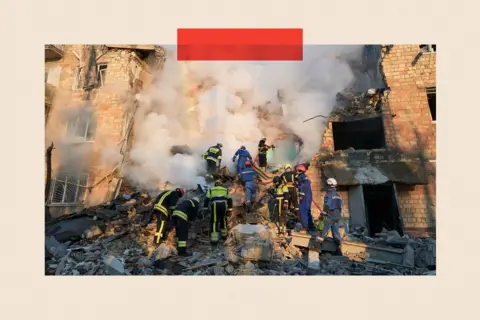
Ukraine is defending itself against repeated Russian air attacks
Army recruiters are finding it harder to fill gaps as some younger men hide from press gangs or flee the country. But Ukraine could widen its conscription laws.
Currently only men aged 25 to 60 must be available to fight. This is a deliberate strategy by Kyiv to manage Ukraine's demographic challenges; a country with a low birth rate and millions living abroad cannot afford to lose what have been dubbed "the fathers of the future".
This puzzles outsiders. "I find it incredible that Ukraine has not mobilised its young people," one senior UK military figure told me.
"I think Ukraine must be one of the only countries in history facing an existential threat that has not thrown its mad 20-year-olds into the fight."
Fiona Hill said Ukraine had simply learned the lesson of history and the devastating impact World War One had on 20th Century European empires, which declined after failing to rediscover the population growth that had fuelled their economic rise.
"Ukraine is just thinking of their demographic [future]."
Strikes, diplomacy and Trump
If Ukraine could import and manufacture more long-range missiles, it could hit Russia harder and deeper.
This year it stepped up its air strikes on targets both in occupied territory and the Russian Federation. Earlier this month Ukraine's military commanders told Radio Liberty they had hit more than 50 fuel and military-industrial infrastructure facilities in Russia during the autumn.
Alexander Gabuev, director of the Carnegie Russia Eurasia Center, says some Russians experienced fuel shortages earlier this year. "By late October, Ukrainian drones had hit more than half of Russia's thirty-eight major refineries at least once.
"Production outages spread across multiple regions, and some Russian gas stations began rationing fuel."
But would more deep strikes on Russia make an impact, when both the Kremlin and public opinion in Russia seem indifferent?
AFP via Getty Images
As well as defending its territory, Ukraine has stepped up air strikes in the Russian federation
Mick Ryan, former Australian major general and now fellow of the Center for Strategic and International Studies, says deep strikes are not a magic bullet.
"They are an extraordinarily important military endeavour, but insufficient by themselves to force Putin to the negotiating table or to win the war."
Dr Sidharth Kaushal, senior research fellow in military sciences at the Royal United Services Institute (Rusi) think tank, said more deep strikes would certainly damage Russia's energy and military infrastructure, as well as using up its air defence missiles. But he warned the tactic could be counterproductive.
"It could reinforce the argument the Russian leadership makes that an independent Ukraine poses a massive military threat," he said.
Some analysts argue that if Putin is offered a way out of the war, he may choose it.
The theory goes like this: a deal is agreed that allows both sides to claim victory. Say, a ceasefire along the line of contact; some areas demilitarised; no formal territorial recognition. Compromises all round.
But the deal would require the US to engage hard with Russia, setting up negotiating teams, using its power to drive through agreement.
"The United States… needs to deploy its formidable psychological leverage it possesses over Russia,"
Thomas Graham argues. "One cannot overstate the role the United States – and Trump personally – plays in validating Russia as a great power and Putin as a global leader."
China's leverage
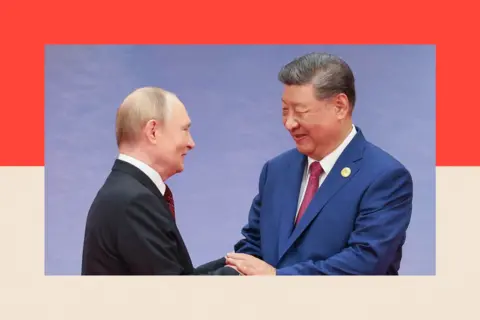
The wild card is China. President Xi Jinping is one of the few world leaders Putin listens to. When Xi warned earlier in the conflict against Russian threats of nuclear weapon use, the Kremlin fell swiftly in line.
Russia's war machine is also huge dependent on China's supply of dual use goods – such as electronics or machinery that can be used for civilian and military purposes.
So if Beijing decided it was no longer in China's interests for the war to continue, then it would have substantial leverage over Kremlin thinking.
For now, the US shows no sign of trying to encourage – or force – China to put pressure on Moscow. So the question is whether President Xi would be willing to apply any leverage off his own bat.
Shutterstock
President Xi Jinping is one of the few world leaders Putin listens to
At the moment China seems happy for the US to be distracted, for transatlantic allies to be divided, and for the rest of the world to view China as a source of stability. But if Russia's invasion escalated, if global markets were disrupted, if the US applied secondary sanctions on China in punishment for its consumption of cheap Russian energy, then the thinking in Beijing might change.
For now though, Putin believes he is sitting pretty, with time on his side. The longer this conflict goes on, analysts say, the more Ukrainian morale will fall, the more divided its allies will become, and the more territory Russia will gain in Donetsk.
"Either we liberate these territories by force of arms or Ukrainian troops leave these territories," Putin said last week.
"Nothing will change his position," Fiona Hill told me. "Unless he exits stage left. Putin is betting right now that he can keep this going for long enough that circumstances play out to his advantage."
Top picture credit: Reuters
BBC InDepth is the home on the website and app for the best analysis, with fresh perspectives that challenge assumptions and deep reporting on the biggest issues of the day. You can now sign up for notifications that will alert you whenever an InDepth story is published - click here to find out how.

 Login
Login