
Reading view

There are new articles available, click to refresh the page.

Medium and Message: Oil on paper

Centuries of experience with painting using oil paints have proved the importance of a robust support and a ground that isolates the paint layer from its support. Older use of wood panels with a gesso ground consisting largely of gypsum or chalk ensured the paint layer wouldn’t be subjected to mechanical stress, and would remain isolated from the underlying wood. Canvases became popular because of their relative lightness particularly in larger sizes, but still require an isolating ground layer both to protect the canvas from damage by the paint, and to prevent discolouration of the paint.

When sketching in oils in front of the motif became increasingly popular in the late eighteenth century, those paintings weren’t intended for public view, but as an aid for the artist when composing finished paintings in the studio. Rather than gather hundreds of small oil sketched on canvas or panels, the first plein air painters usually used paper or cardboard as support and ground. Subsequently, when their studios were sold off following their death, surviving oil sketches were usually laid on canvas for preservation and display.

Pierre-Henri de Valenciennes, (Title not known) (c 1783), oil on paper laid on canvas, c 18 x 28 cm, Musée du Louvre, Paris. © 2015 EHN & DIJ Oakley.
Pierre-Henri de Valenciennes (1750-1819), (Title not known) (c 1783), oil on paper laid on canvas, c 18 x 28 cm, Musée du Louvre, Paris. © 2015 EHN & DIJ Oakley.

Although he probably wasn’t the first to compile a library of oil sketches, those gathered by Pierre-Henri de Valenciennes when he was painting in the Roman Campagna in the 1780s are among the most brilliant. This untitled view of the countryside near Rome is thought to have been painted in about 1783.
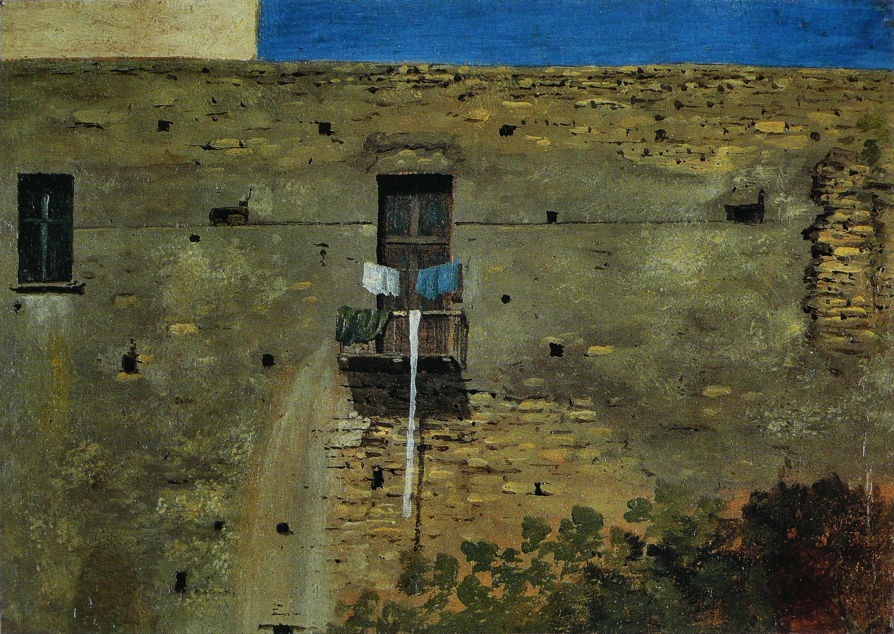
Thomas Jones, A Wall in Naples (c 1782), oil on paper laid on canvas, 11.4 x 16 cm, National Gallery, London. Wikimedia Commons.
Thomas Jones (1742-1803), A Wall in Naples (c 1782), oil on paper laid on canvas, 11.4 x 16 cm, National Gallery, London. Wikimedia Commons.

At about the same time, the Welsh painter Thomas Jones was doing the same thing in and around Naples as well. This tiny view of A Wall in Naples was painted in about 1782, and is now one of the gems in London’s National Gallery. Below is a detail.

Thomas Jones, A Wall in Naples (detail) (c 1782), oil on paper laid on canvas, 11.4 x 16 cm, National Gallery, London. Wikimedia Commons.
Thomas Jones (1742-1803), A Wall in Naples (detail) (c 1782), oil on paper laid on canvas, 11.4 x 16 cm, National Gallery, London. Wikimedia Commons.
Thomas Jones, The Capella Nuova outside the Porta di Chiaja, Naples (1782), oil on paper, 20 x 23.2 cm, Tate Britain, London. Wikimedia Commons.
Thomas Jones (1742-1803), The Capella Nuova outside the Porta di Chiaja, Naples (1782), oil on paper, 20 x 23.2 cm, Tate Britain, London. Wikimedia Commons.

Jones was taught by the Welsh artist Richard Wilson, but none of his oil sketches have survived. Jones’ Capella Nuova outside the Porta di Chiaja, Naples is another example that’s significantly larger, and now in the Tate Gallery.

Pierre-Henri de Valenciennes, (Title not known) (c 1783), oil on paper laid on canvas, c 18 x 25 cm, Musée du Louvre, Paris. © 2015 EHN & DIJ Oakley.
Pierre-Henri de Valenciennes (1750-1819), (Title not known) (c 1783), oil on paper laid on canvas, c 18 x 25 cm, Musée du Louvre, Paris. © 2015 EHN & DIJ Oakley.

Valenciennes went on to assemble a large library of his oil sketches that he used for his studio paintings following his return to Paris. He was admitted to the Academy in 1787, published an influential manual of perspective and painting in 1799, and became Professor of Perspective at l’École des Beaux-Arts in Paris in 1812.

Among the aspiring young landscape painters who followed in the footsteps of Valenciennes was Camille Corot, who was taught by Achille Etna Michallon, who in turn had been taught by Valenciennes. Corot painted in the Roman Campagna between 1825-28, using the same techniques of applying his oil paint direct to sheets of paper.

Jean-Baptiste-Camille Corot, View of Rome: The Bridge and Castel Sant'Angelo with the Cupola of St. Peter's (1826-7), oil on paper on canvas, 26.7 x 43.2 cm, Fine Arts Museums of San Francisco. WikiArt.
Jean-Baptiste-Camille Corot (1796-1875), View of Rome: The Bridge and Castel Sant’Angelo with the Cupola of St. Peter’s (1826-7), oil on paper on canvas, 26.7 x 43.2 cm, Fine Arts Museums of San Francisco. WikiArt.

Corot painted this View of Rome: The Bridge and Castel Sant’Angelo with the Cupola of St. Peter’s in 1826-27. This is one of the best-known bridges over the River Tiber, and not far from the centre of the city. The view is taken from the north-east of the bridge, on the ‘left’ bank, probably close to the Piazza di Ponte Umberto I, looking towards the south-west (‘right’ bank). The painting is sketchy rather than finely finished, and appears to have been painted en plein air onto a sheet of paper that has subsequently been laid on canvas.

Jean-Baptiste-Camille Corot, View of the Convent of S. Onofrio on the Janiculum, Rome (1826), oil on paper mounted on canvas, 22 x 33 cm, Fitzwilliam Museum, Cambridge, England. WikiArt.
Jean-Baptiste-Camille Corot (1796-1875), View of the Convent of S. Onofrio on the Janiculum, Rome (1826), oil on paper mounted on canvas, 22 x 33 cm, Fitzwilliam Museum, Cambridge, England. WikiArt.

This View of the Convent of S. Onofrio on the Janiculum, Rome is another from Corot’s first campaign in Rome.
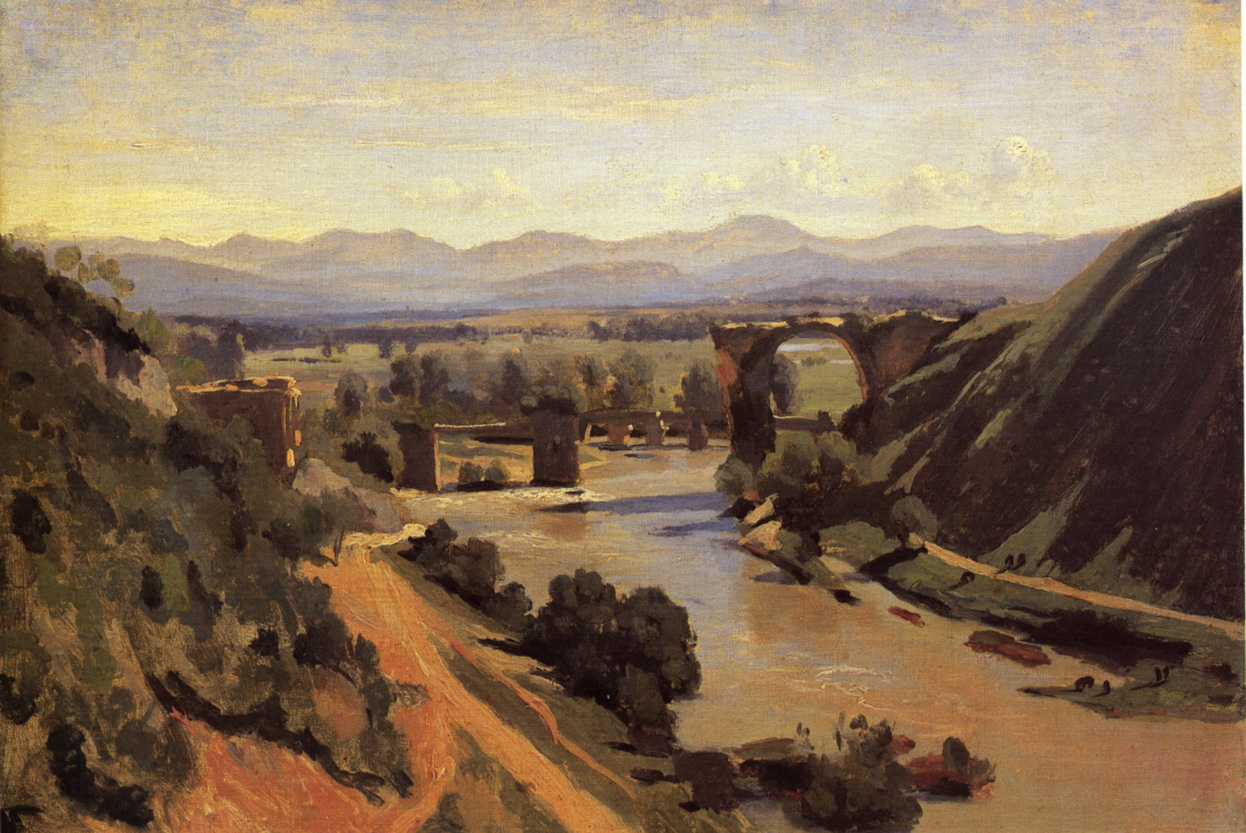
Jean-Baptiste-Camille Corot, The Bridge at Narni (1826), oil on paper, 34 x 48 cm, Musée du Louvre, Paris. WikiArt.
Jean-Baptiste-Camille Corot (1796-1875), The Bridge at Narni (1826), oil on paper, 34 x 48 cm, Musée du Louvre, Paris. WikiArt.

Corot’s years in Italy were formative in his own development, and one of the key elements he put in place to hand on to Camille Pissarro and other Impressionists. The Bridge at Narni is one of his finest oil sketches.
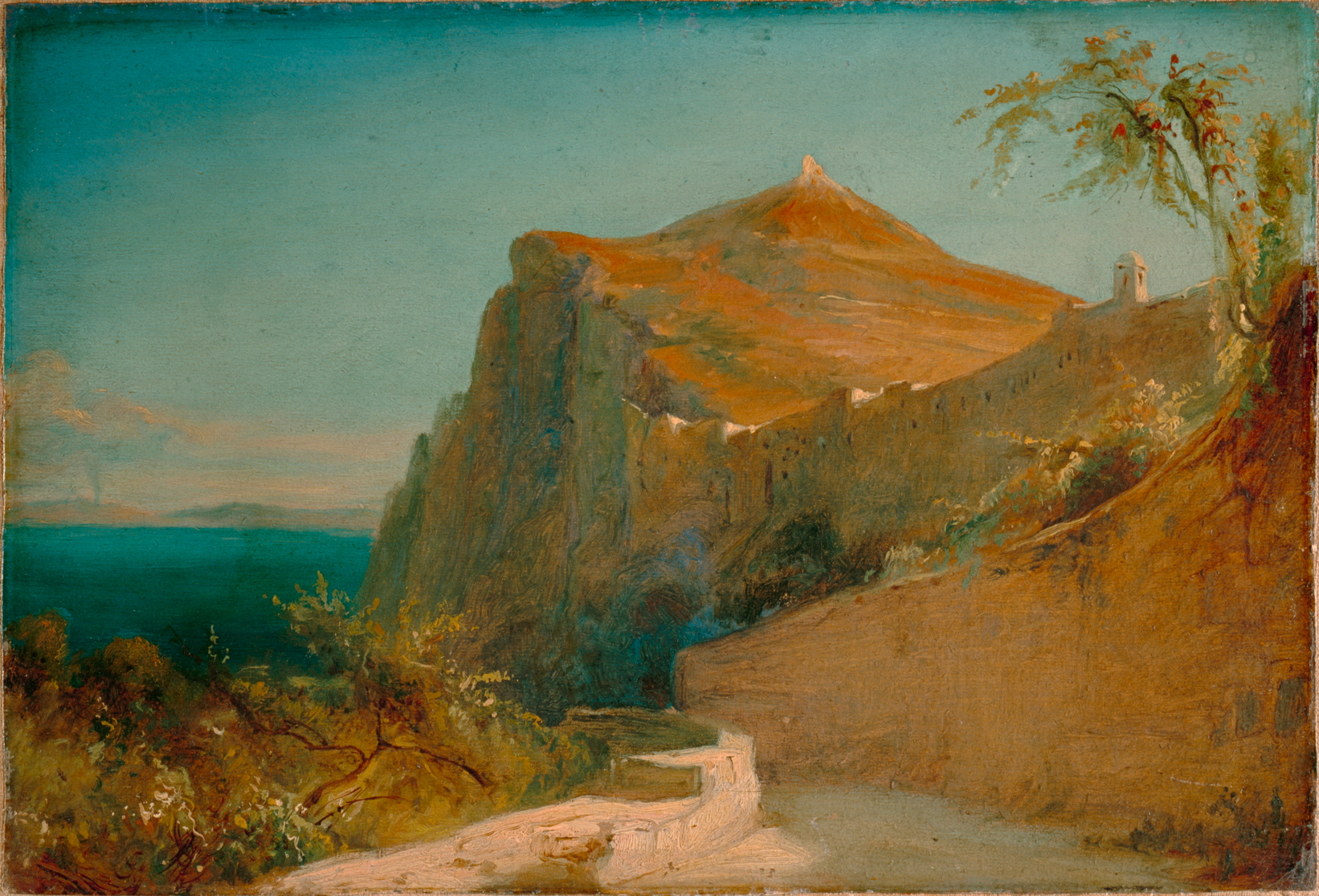
Carl Eduard Ferdinand Blechen, Tiberiusfelsen auf Capri (Tiberius Rocks, Capri) (1828-9), oil on paper mounted on canvas, 20.5 x 30 cm, Lower Saxony State Museum, Hanover. Wikimedia Commons.
Carl Eduard Ferdinand Blechen (1798-1840), Tiberiusfelsen auf Capri (Tiberius Rocks, Capri) (1828-9), oil on paper mounted on canvas, 20.5 x 30 cm, Lower Saxony State Museum, Hanover. Wikimedia Commons.

Others followed Valenciennes’ instructions, among them Carl Blechen, a brilliant German landscape painter who sketched the Tiberius Rocks, Capri during a visit in 1828-29, again on paper.

Carl Eduard Ferdinand Blechen, Galgenberg bei Gewitterstimmung (A Scaffold in a Storm) (c 1835), oil on paper mounted on board, 29.5 x 46 cm, New Masters Gallery, Dresden. Wikimedia Commons.
Carl Eduard Ferdinand Blechen, (1798-1840) Galgenberg bei Gewitterstimmung (A Scaffold in a Storm) (c 1835), oil on paper mounted on board, 29.5 x 46 cm, New Masters Gallery, Dresden. Wikimedia Commons.

Blechen’s late oil sketch of A Scaffold in a Storm was painted in about 1835, shortly before he succumbed to severe depression. This anticipates many elements of Impressionism: it appears to have been executed rapidly in front of the motif (although a view from his studio over Berlin and Brandenburg), with many brush-strokes plainly visible; details are composed of stylised marks; it is an everyday if not banal subject, with an informal composition.

However, the French Impressionists seldom if ever sketched in oils on paper, as their paintings made in front of the motif were intended to be sold to and viewed by the public, for which paper wasn’t considered suitable. Times had changed.

Medium and Message: Surface texture

We’re remarkably good at perceiving different surface textures, but find it harder to imagine them in two-dimensional images. While the overwhelming majority of paintings, at least until the twentieth century, consist of a paint layer on a flat ground, there’s nothing that requires the surface of the paint layer to be flat and smooth. But if all you look at are images of paintings, you generally won’t see their surface texture, where the artist has applied and shaped paint in thick layers of impasto, or incised into some of the layer in sgraffito. This article looks in detail at four examples where surface texture in the paint layer is important.

boecklinsirens
Arnold Böcklin (1827–1901), Sirens (1875), tempera on canvas, 46 × 31 cm, Alte Nationalgalerie, Berlin. Wikimedia Commons.

Arnold Böcklin’s unusual painting of Sirens from 1875 was made in tempera on canvas, with the ground and paint layers thin enough to let the texture of the canvas weave show through. This image was fortuitously taken with lighting that allows the texture to show.

Another famous tempera painting wasn’t painted on a textured ground, but is one of the earlier paintings to feature impasto as a technique.

Anonymous, The Wilton Diptych (c 1395-9), egg tempera on panel, each panel 53 x 37 cm, The National Gallery, London. Wikimedia Commons.
Artist not known, The Wilton Diptych (c 1395-9), egg tempera on panel, each panel 53 x 37 cm, The National Gallery, London. Wikimedia Commons.

The Wilton Diptych was painted on two small panels of oak wood in the final years of the fourteenth century. That wood was first assembled into the panels, then carved down from a thickness of about 2.5 cm (1 inch) to form an integral frame with a recessed painting surface. A smooth gesso ground was then laid on the wood before the gilded areas were laid onto it using thin sheets of gold leaf, and patterned using a range of punches.

wiltondiptychd2
Artist not known, The Wilton Diptych (detail) (c 1395-9), egg tempera on panel, each panel 53 x 37 cm, The National Gallery, London. Image by Sailko, via Wikimedia Commons.

Details of jewels and similar objects such as the white hart brooches were raised using thicker areas of lead white paint, to give the impression of enamelling. Coupled with mordant gilding, they mimic the three-dimensional form of jewels and act as point reflectors of light, sparkling as if they really were gems in the paint layer, as shown in the details above and below.

wiltondiptychd3
Artist not known, The Wilton Diptych (detail) (c 1395-9), egg tempera on panel, each panel 53 x 37 cm, The National Gallery, London. Image by Sailko, via Wikimedia Commons.

The finest strokes of paint seen here are less than 0.5 mm (1/50th of an inch) across.

From those early days of modern painting until the decline of ‘academic’ painting in the late nineteenth century, patrons, Salon juries and critics expected paint surfaces to be smooth and flat. But there were rebels.

Many of Rembrandt’s paintings from before 1650 have fairly conventional ‘finished’ surfaces, his monumental Night Watch being a good example. By about 1660, though, many of his paintings had quite rough surfaces that significantly alter their optical properties.

Rembrandt Harmenszoon van Rijn, The Jewish Bride (c 1667), oil on canvas, 121.5 x 166.5 cm, Rijksmuseum, Amsterdam. Wikimedia Commons.
Rembrandt Harmenszoon van Rijn (1606–1669), The Jewish Bride (c 1667), oil on canvas, 121.5 x 166.5 cm, Rijksmuseum, Amsterdam. Wikimedia Commons.

One of the best examples of Rembrandt’s use of texture in the paint layer is The Jewish Bride from about 1667, just a couple of years before his death. This is among his works studied by the Rembrandt Research Project.

rembrandtjewishbridedet
Rembrandt Harmenszoon van Rijn (1606–1669), The Jewish Bride (detail) (c 1667), oil on canvas, 121.5 x 166.5 cm, Rijksmuseum Amsterdam. Wikimedia Commons.

In this detail, highlights on the sleeve and jewellery have been applied roughly, although it’s still a matter for speculation as to exactly how he achieved that. Lower down, on the red dress of the bride, the duller top layer of paint has been scraped through to reveal lighter lower layers. The end result is a painting that creates its visual effects as much by its surface textures, as by form or colour.

One of Rembrandt’s secrets that have been sought by so many since lies in how he was able to exploit surface texture in his paint. That is the ‘secret recipe’ which Maroger, Redelius, and others claimed to have discovered. Systematic analyses of Rembrandt’s paint layers by White at the National Gallery in London and the Research Project soundly rebutted the ‘secrets’ claimed. In the main, Rembrandt used linseed oil as his binder, occasionally using walnut oil as well, and just once poppy seed oil.

In some passages the oil had been thickened by heat treatment, but this was by no means widespread. Traces of pine resin found in some samples may have been introduced during retouching, and don’t appear to be a feature of Rembrandt’s impasto work; neither is there any evidence that he added wax to his oil paint to give it body, as some had asserted.

As you might expect, JMW Turner was another such rebel.

turnerseapiecefishingboats
Joseph Mallord William Turner (1775–1851), Seapiece with Fishing Boats off a Wooden Pier, a Gale Coming In (date not known, possibly c 1801), oil on panel, 31.8 x 44.5 cm, Private collection. Wikimedia Commons.

For example, in his Seapiece with Fishing Boats off a Wooden Pier, a Gale Coming In, possibly from as early as 1801, Turner made extensive use of sgraffito, made using a knife, brush handle, or even his fingernails for all we know.

Later that century, Vincent van Gogh developed a more radical approach, in his initial version of Wheat Field with Cypresses from 1889, the year before his death.

vangoghwheatfieldcypresses
Vincent van Gogh (1853–1890), Wheat Field with Cypresses (1889), oil on canvas, 73.2 × 93.4 cm, Metropolitan Museum of Art, New York, NY. Wikimedia Commons.

It’s possible that he completed this painting in a single sitting, as this seems to have been intended as an oil sketch for a more finished version which he painted later that summer.

1993.132
Vincent van Gogh (1853–1890), Wheat Field with Cypresses (detail) (1889), oil on canvas, 73.2 × 93.4 cm, Metropolitan Museum of Art, New York, NY. Wikimedia Commons.

The detail above shows the tops of the wheat towards the lower left of the field, in the foreground. Over his initial thin layers of paint, van Gogh laid thick gestural strokes of highly chromatic paint, orientating those strokes according to the object they show. In the golden yellow of the wheat there are blues and greens, mostly showing through from his underpainting, with superimposed impasto of pale straw, ochre, and pale greens.

1993.132
Vincent van Gogh (1853–1890), Wheat Field with Cypresses (detail) (1889), oil on canvas, 73.2 × 93.4 cm, Metropolitan Museum of Art, New York, NY. Wikimedia Commons.

This detail, taken from the edge of the wheatfield at the lower right corner of the painting, shows three distinct areas of brushwork: the diagonal strokes forming the standing wheat, swirling loops to form the grasses and weeds below, and shorter marks forming a more random pattern for the heads of the wheat in the upper section.

1993.132
Vincent van Gogh (1853–1890), Wheat Field with Cypresses (detail) (1889), oil on canvas, 73.2 × 93.4 cm, Metropolitan Museum of Art, New York, NY. Wikimedia Commons.

At the centre of the canvas, from where this detail is taken, impasto blue and white have mixed with the green and yellow of the fields below. This shows that much of the painting was painted wet on wet, either in the same session or on consecutive days. Some of the darker green at the right may have been painted later, onto paint that had by then become touch dry.

1993.132
Vincent van Gogh (1853–1890), Wheat Field with Cypresses (X-ray) (1889), oil on canvas, 73.2 × 93.4 cm, Metropolitan Museum of Art, New York, NY. Wikimedia Commons.

An X-ray image of the whole painting shows in white those passages likely to contain the most lead white, and some other pigments which are most radio-opaque. This also reveals the pattern of brushstrokes well.

With the introduction of acrylic paints in the latter half of the twentieth century, painters have been able to apply even heavier impasto, and some have used this to paint what are in effect reliefs.

This is why so many paintings have to be seen in the flesh, up close, and in the right light for their full appreciation.

❌