Centuries of experience with painting using oil paints have proved the importance of a robust support and a ground that isolates the paint layer from its support. Older use of wood panels with a gesso ground consisting largely of gypsum or chalk ensured the paint layer wouldn’t be subjected to mechanical stress, and would remain isolated from the underlying wood. Canvases became popular because of their relative lightness particularly in larger sizes, but still require an isolating ground layer both to protect the canvas from damage by the paint, and to prevent discolouration of the paint.
When sketching in oils in front of the motif became increasingly popular in the late eighteenth century, those paintings weren’t intended for public view, but as an aid for the artist when composing finished paintings in the studio. Rather than gather hundreds of small oil sketched on canvas or panels, the first plein air painters usually used paper or cardboard as support and ground. Subsequently, when their studios were sold off following their death, surviving oil sketches were usually laid on canvas for preservation and display.
Although he probably wasn’t the first to compile a library of oil sketches, those gathered by Pierre-Henri de Valenciennes when he was painting in the Roman Campagna in the 1780s are among the most brilliant. This untitled view of the countryside near Rome is thought to have been painted in about 1783.
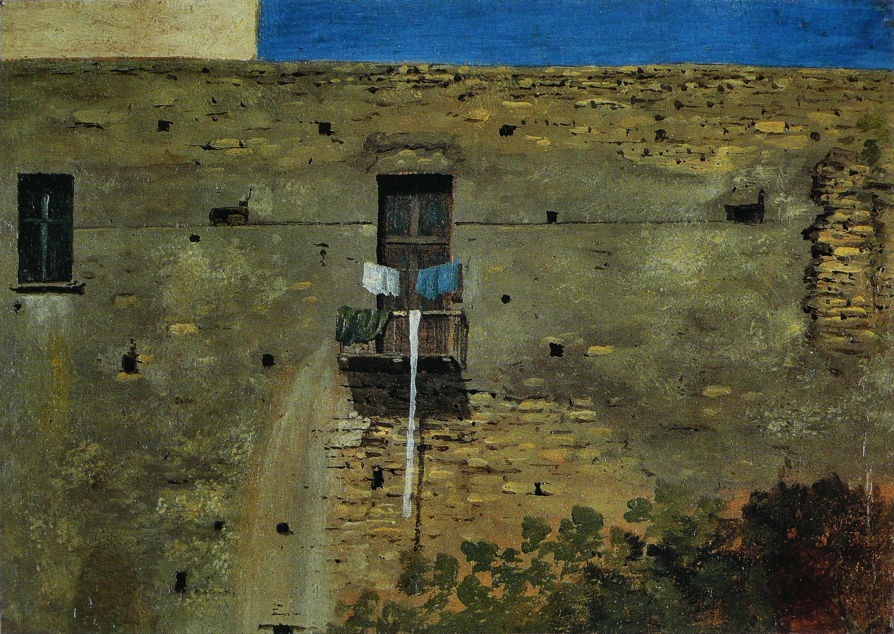
Thomas Jones (1742-1803), A Wall in Naples (c 1782), oil on paper laid on canvas, 11.4 x 16 cm, National Gallery, London. Wikimedia Commons.
At about the same time, the Welsh painter Thomas Jones was doing the same thing in and around Naples as well. This tiny view of A Wall in Naples was painted in about 1782, and is now one of the gems in London’s National Gallery. Below is a detail.
Thomas Jones (1742-1803), A Wall in Naples (detail) (c 1782), oil on paper laid on canvas, 11.4 x 16 cm, National Gallery, London. Wikimedia Commons.Thomas Jones (1742-1803), The Capella Nuova outside the Porta di Chiaja, Naples (1782), oil on paper, 20 x 23.2 cm, Tate Britain, London. Wikimedia Commons.
Jones was taught by the Welsh artist Richard Wilson, but none of his oil sketches have survived. Jones’ Capella Nuova outside the Porta di Chiaja, Naples is another example that’s significantly larger, and now in the Tate Gallery.
Valenciennes went on to assemble a large library of his oil sketches that he used for his studio paintings following his return to Paris. He was admitted to the Academy in 1787, published an influential manual of perspective and painting in 1799, and became Professor of Perspective at l’École des Beaux-Arts in Paris in 1812.
Among the aspiring young landscape painters who followed in the footsteps of Valenciennes was Camille Corot, who was taught by Achille Etna Michallon, who in turn had been taught by Valenciennes. Corot painted in the Roman Campagna between 1825-28, using the same techniques of applying his oil paint direct to sheets of paper.
Jean-Baptiste-Camille Corot (1796-1875), View of Rome: The Bridge and Castel Sant’Angelo with the Cupola of St. Peter’s (1826-7), oil on paper on canvas, 26.7 x 43.2 cm, Fine Arts Museums of San Francisco. WikiArt.
Corot painted this View of Rome: The Bridge and Castel Sant’Angelo with the Cupola of St. Peter’s in 1826-27. This is one of the best-known bridges over the River Tiber, and not far from the centre of the city. The view is taken from the north-east of the bridge, on the ‘left’ bank, probably close to the Piazza di Ponte Umberto I, looking towards the south-west (‘right’ bank). The painting is sketchy rather than finely finished, and appears to have been painted en plein air onto a sheet of paper that has subsequently been laid on canvas.
Jean-Baptiste-Camille Corot (1796-1875), View of the Convent of S. Onofrio on the Janiculum, Rome (1826), oil on paper mounted on canvas, 22 x 33 cm, Fitzwilliam Museum, Cambridge, England. WikiArt.
This View of the Convent of S. Onofrio on the Janiculum, Rome is another from Corot’s first campaign in Rome.
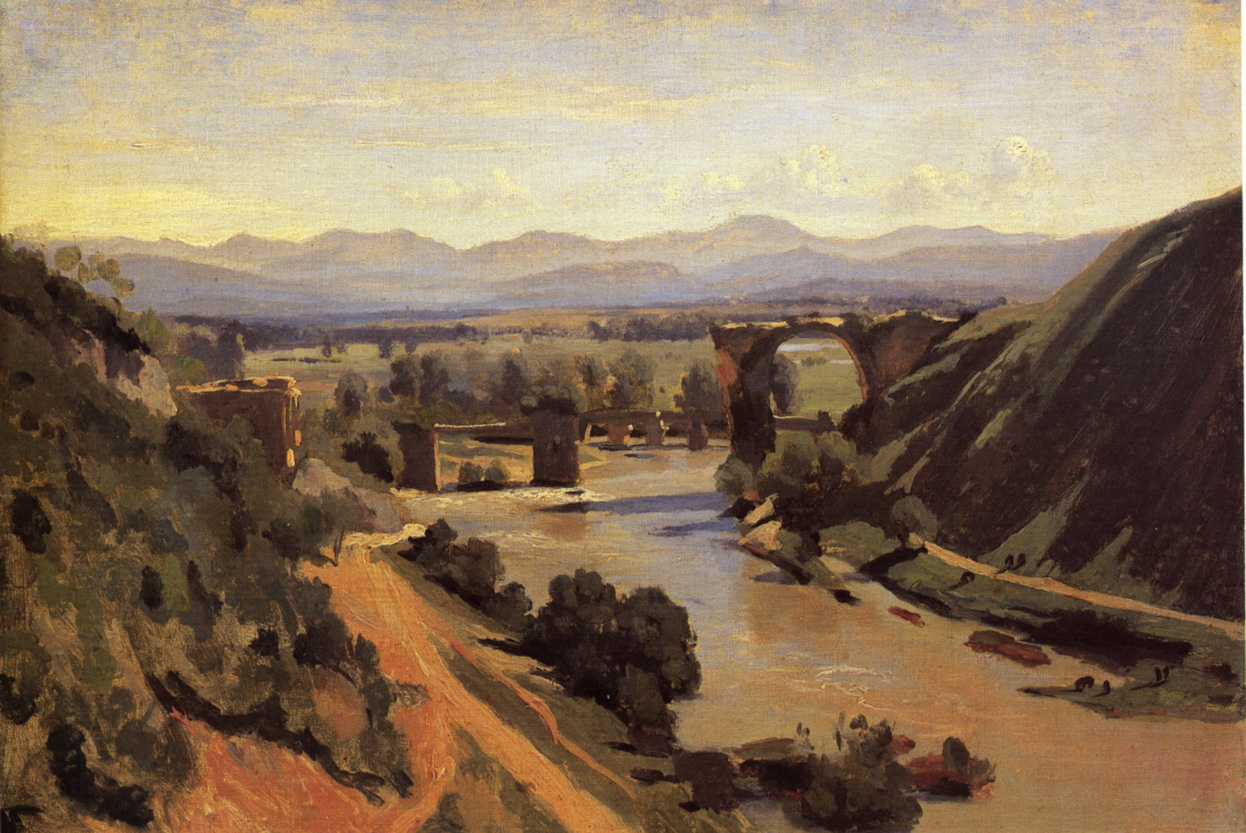
Jean-Baptiste-Camille Corot (1796-1875), The Bridge at Narni (1826), oil on paper, 34 x 48 cm, Musée du Louvre, Paris. WikiArt.
Corot’s years in Italy were formative in his own development, and one of the key elements he put in place to hand on to Camille Pissarro and other Impressionists. The Bridge at Narni is one of his finest oil sketches.
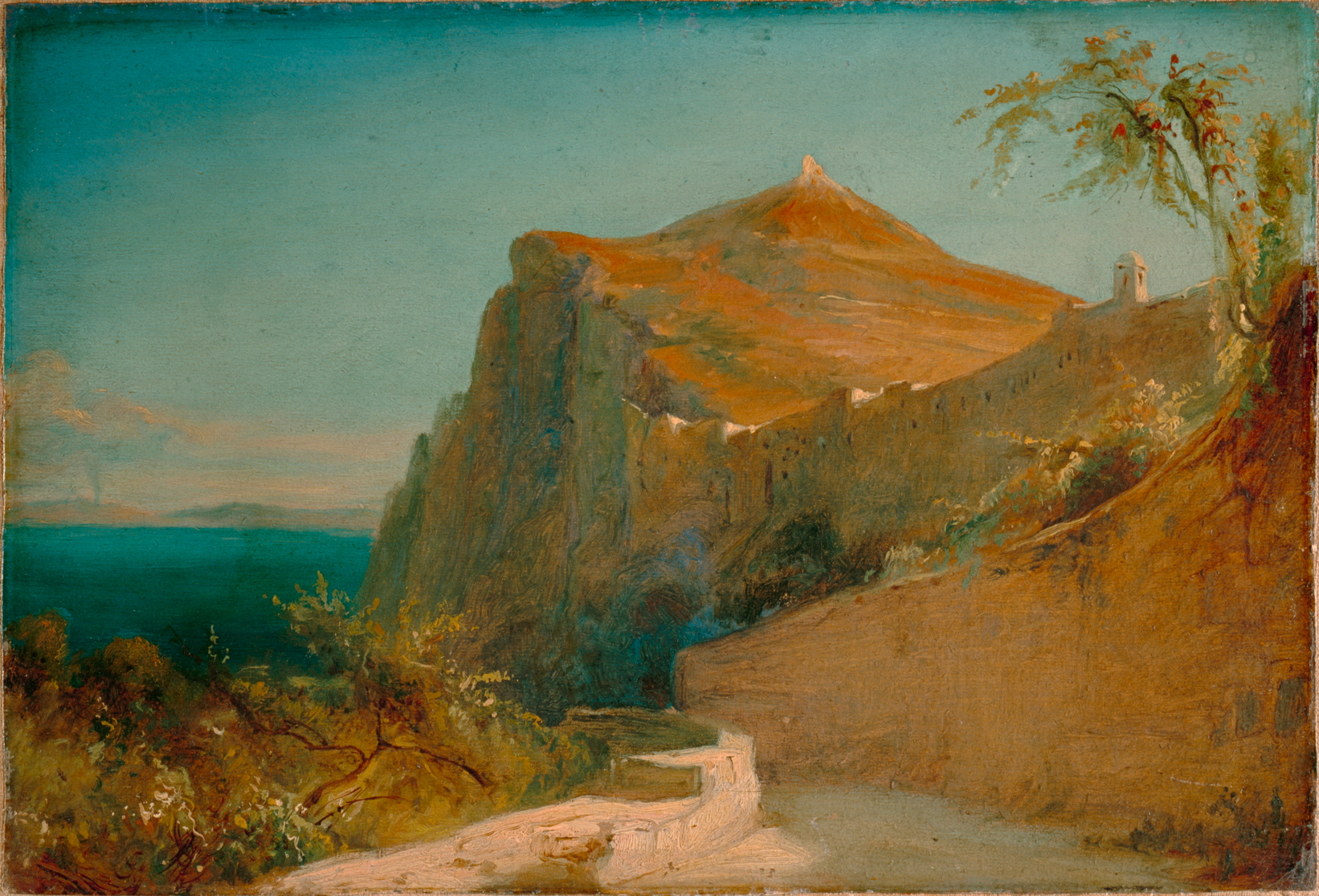
Carl Eduard Ferdinand Blechen (1798-1840), Tiberiusfelsen auf Capri (Tiberius Rocks, Capri) (1828-9), oil on paper mounted on canvas, 20.5 x 30 cm, Lower Saxony State Museum, Hanover. Wikimedia Commons.
Others followed Valenciennes’ instructions, among them Carl Blechen, a brilliant German landscape painter who sketched the Tiberius Rocks, Capri during a visit in 1828-29, again on paper.
Carl Eduard Ferdinand Blechen, (1798-1840) Galgenberg bei Gewitterstimmung (A Scaffold in a Storm) (c 1835), oil on paper mounted on board, 29.5 x 46 cm, New Masters Gallery, Dresden. Wikimedia Commons.
Blechen’s late oil sketch of A Scaffold in a Storm was painted in about 1835, shortly before he succumbed to severe depression. This anticipates many elements of Impressionism: it appears to have been executed rapidly in front of the motif (although a view from his studio over Berlin and Brandenburg), with many brush-strokes plainly visible; details are composed of stylised marks; it is an everyday if not banal subject, with an informal composition.
However, the French Impressionists seldom if ever sketched in oils on paper, as their paintings made in front of the motif were intended to be sold to and viewed by the public, for which paper wasn’t considered suitable. Times had changed.
Over the previous fifteen articles Dante has taken us through his vision of Hell. As he journeys on to Purgatory, this article offers an overview of the best-known book in his Divine Comedy.
Sandro Botticelli (1445–1510), Map of Hell (1480-90), silverpoint, ink and distemper, 33 x 47.5 cm, Biblioteca Apostólica Vaticana, Vatican City. Wikimedia Commons.
It was Botticelli who provided the clearest pictorial map of Dante’s journey, as he descended with Virgil through a succession of circles, each with its own class of sinner. Highest are the woods where Dante was wandering when he encountered the three wild beasts. At the left, Virgil led Dante down to the area where the cowards are trapped, neither being allowed admittance to Heaven, nor to Hell. Charon’s boat then crosses the River Acheron, shown in blue, taking Dante and Virgil to the First Circle of Limbo.
This journey starts just before dawn on Good Friday in 1300, when the poet is wandering lost in a dark wood. His way is blocked first by a leopard, then by a lion, and finally by a wolf.
Jean-Baptiste Camille Corot (1796–1875), Dante and Virgil (1859), oil on canvas, 260.4 x 170.5 cm, Museum of Fine Arts Boston, Boston, MA. Wikimedia Commons.
Forced to retreat back into the wood, Dante comes across a man who introduces himself by way of a riddle, leading Dante to recognise him as the ghost of the classical Roman poet Virgil. He tells Dante that the only way out is to pass through the eternity of Hell. When the pair reach the gate of Hell, they read its warnings, culminating in the bleak exhortation: leave behind all hope, you who enter.
They first encounter those stuck forever on the periphery, those whose lives were too cowardly to enter Heaven or Hell, who are stung repeatedly by flies and wasps.
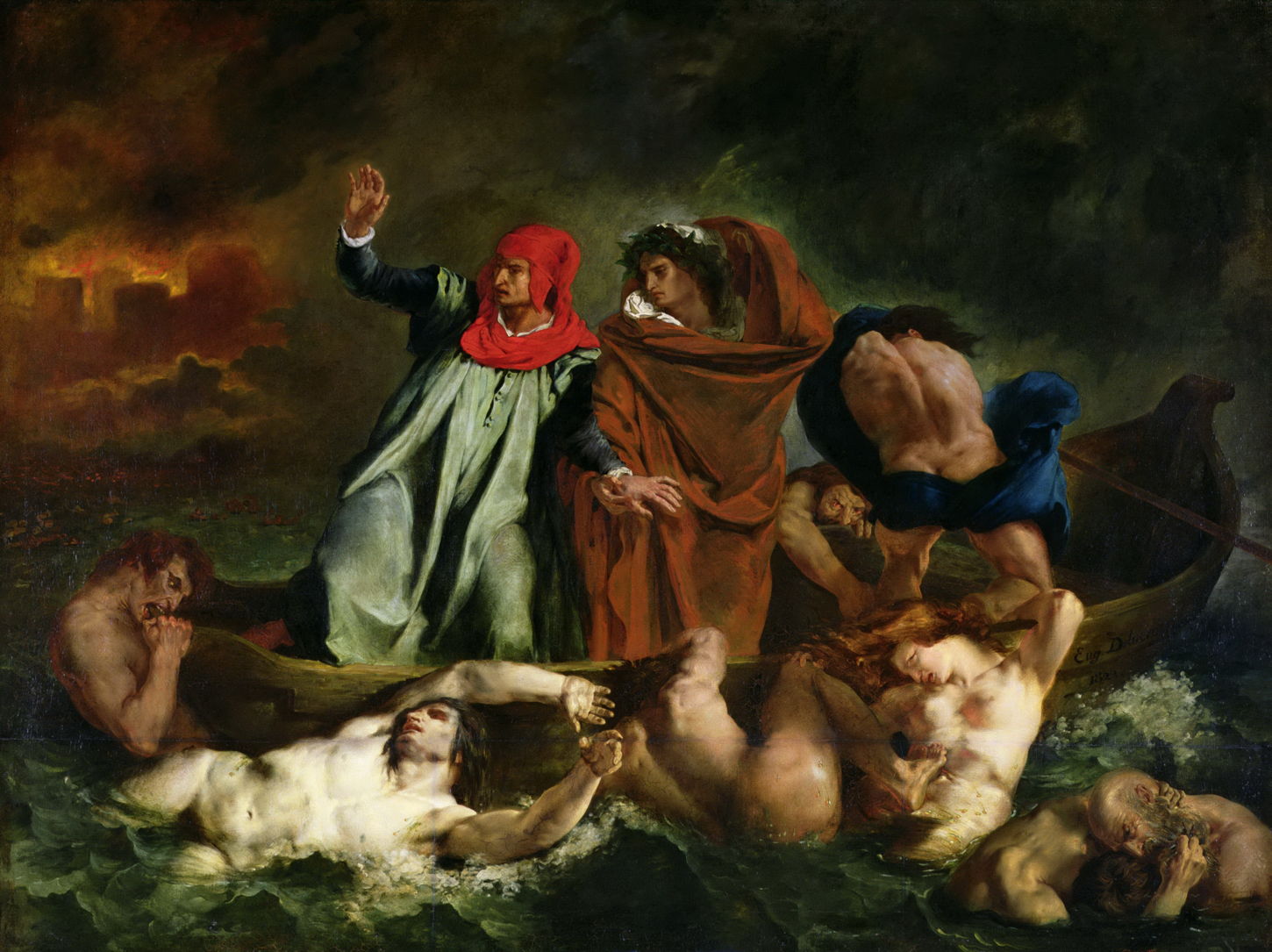
Eugène Delacroix (1798–1863), The Barque of Dante (Dante and Virgil in Hell) (1822), oil on canvas, 189 x 241 cm, Musée du Louvre, Paris. Wikimedia Commons.
They then cross the River Acheron in Charon’s ferryboat, and enter the First Circle of Limbo, a place of tranquil and calm. Here are the souls of those who led honourable lives before the Christian era, and others who never had the opportunity to follow Christ. These include the great classical writers: Homer, Horace the satirist, Ovid and Lucan. Together with Virgil, these five invite Dante himself to join them as the sixth among the ranks of great writers, in an ambitious piece of self-promotion.
Virgil leads Dante down to the Second Circle, for those guilty of the sin of lust.
William Blake (1757–1827), The Circle of the Lustful: Francesca da Rimini (The Whirlwind of Lovers) (c 1824), pen and watercolour over pencil, 36.8 x 52.2 cm, Birmingham Museums and Art Gallery, Birmingham, England. The Athenaeum.
Here the lustful are thrown around by vicious winds, and Dante hears the tragic story of Paolo and Francesca da Rimini, that inspired many fine paintings.
Gustave Doré (1832–1883) Paolo and Francesca da Rimini (1863), oil on canvas, 280.7 x 194.3 cm, Private collection. Wikimedia Commons.
Passing the three-headed dog-monster Cerberus, Virgil takes Dante on to the Third Circle, full of gluttons wallowing in stinking mud, under a constant deluge of rain, sleet and snow. In the Fourth Circle, they see a mixture of the avaricious and prodigals pushing great boulders in opposite directions.
William Blake (1757–1827), The Stygian Lake, with the Ireful Sinners Fighting (Dante’s Inferno) (1824-27) pen, ink and watercolour over pencil, dimensions not known, National Gallery of Victoria, Melbourne, Australia. Wikimedia Commons.
The Fifth Circle holds the swamp of the River Styx, in which sullen spirits are submerged and the wrathful fight one another. Dante and Virgil cross this in a boat piloted by Phlegyas, who deposits them at the gate to the city of Dis, entrance to the lower parts of Hell. The gate is slammed shut on them, and requires a messenger from Heaven to let them through.
William Blake (1757–1827), Farinata degli Uberti (Dante’s Inferno) (1824-27) media and dimensions not known, The British Museum, London. Wikimedia Commons.
Here Dante enters the Sixth Circle, for heretics who denied the soul’s immortality, among them the Florentine Farinata degli Uberti, who is imprisoned in a tomb. The pair are carried by Nessus the Centaur on to the Seventh Circle, for the violent.
William Blake (1757–1827), The Wood of the Self-Murderers: The Harpies and the Suicides (Dante’s Inferno) (1824-27), graphite, ink and watercolour on paper, dimensions not known, National Gallery of Victoria, Melbourne, Australia. Wikimedia Commons.
These not only include tyrannical warriors like Attila the Hun, murderers and bandits, but those whose violence was directed at their own lives in suicide, who are trees in a wood and kept in perpetual pain by harpies feeding on them. The pair then cross a desert on which fire rains to torment the souls of blasphemers, sodomites, and usurers.
William Blake (1757–1827), The Symbolic Figure of the Course of Human History Described by Virgil (Dante’s Inferno) (1824-27), further details not known. Wikimedia Commons.
Dante learns of a statue of an old man on Mount Ida, on the island of Crete, whose tears form the rivers of Hell.
Virgil guides Dante onto the back of Geryon, formerly a king slain by Hercules and condemned to suffer in Hell for his fraud, who flies the pair on to the Eighth Circle, for the fraudulent. This is divided into a series of rottenpockets, depressions in which different types of fraudster are confined. They pass through the areas for pimps, flatterers, corrupt religious leaders, sorcerers, corrupt officials and hypocrites.
William Blake (1757–1827), The Simonist Pope (Dante’s Inferno) (1824-27), watercolour, 52.5 x 36.8 cm, The Tate Gallery, London. Wikimedia Commons.
Among the corrupt religious leaders or simonists is Pope Nicholas III, who had been shamelessly nepotistic.
Joseph Anton Koch (1768-1839), Thieves (1825-28), fresco, dimensions not known, Casa Massimo, Rome, Italy. Image by Sailko, via Wikimedia Commons.
The later rottenpockets contain thieves, those who gave fraudulent counsel, those who sowed discord, and falsifiers and imposters of various kinds. Thieves are attacked repeatedly by snakes to undergo their own reptilian transformation.
Dante and Virgil are lowered into the Ninth Circle by Antaeus, one of the giants who stand guard around its periphery.
Gustave Doré (1832–1883), Dante and Virgil in the ninth circle of hell (1861), oil on canvas, 311 x 428 cm, Musée de Brou, Bourg-en-Bresse, France. Wikimedia Commons.
There is the lake of Cocytus, in which those guilty of treachery are frozen and suffering for eternity. These include souls of those who were treacherous against their relatives, their homeland, guests and benefactors.
William Blake (1757–1827), Count Ugolino and His Sons in Prison (c 1826), pen, tempera and gold on panel, 32.7 x 43 cm, Fitzwilliam Museum, University of Cambridge, Cambridge, England. The Athenaeum.
Among them is Count Ugolino, who sinks his teeth into the neck of Archbishop Ruggieri, who left him to starve to death in a cell.
Joseph Anton Koch (1768-1839), Hell (study for Casa Massimo frescoes) (c 1825), watercolour and gouche, dimensions and location not known. Wikimedia Commons.
The artists
William Blake (1757–1827) was a British visionary painter and illustrator whose last and incomplete work was an illustrated edition of the Divine Comedy for the painter John Linnell. Most of his works shown in this series were created for that, although he did draw and paint scenes during his earlier career. I have a major series on his work here.
Sandro Botticelli (1445–1510) was one of the leading painters of the early Southern Renaissance, working in his native city of Florence. In addition to his huge egg tempera masterpieces of i (c 1482) and The Birth of Venus (c 1485), he was a lifelong fan of Dante’s writings. He produced drawings which were engraved for the first printed edition of the Divine Comedy in 1481, but these weren’t successful, most copies only having two or three of the 19 which were engraved. He later began a manuscript illustrated edition on parchment, but few pages were ever fully illuminated.
William-Adolphe Bouguereau (1825–1905) was a precocious and highly-acclaimed academic painter who dominated the Salon in the late nineteenth century with his figurative works, often drawn from mythology. Classically-trained at the École des Beaux-Arts, he grew infamous for his nudes painted against false settings, and his vehement opposition to Impressionism. However, he taught at the Académie Julian, and worked tirelessly even when his paintings fell from favour.
Jean-Baptiste Camille Corot (1796–1875) was French, and one of the most prolific and greatest European landscape artists of the nineteenth century, who was key to the development of Impressionism. Following in the classical tradition, he also painted several narrative works set in those landscapes.
Eugène Delacroix (1798–1863) was a major French painter whose Romantic and painterly style laid the groundwork for the Impressionists. In addition to many fine easel works, he painted murals and was an accomplished lithographer too. Many of his paintings are narrative, and among the most famous is Liberty Leading the People from 1830. This article introduces a series featuring his major works.
Gustave Doré (1832–1883) was the leading French illustrator of the nineteenth century, whose paintings are still relatively unknown. Early in his career, he produced a complete set of seventy illustrations for translations of the Inferno, first published in 1857 and still being used. These were followed in 1867 by more illustrations for Purgatorio and Paradiso.This article looks at his paintings.
Joseph Anton Koch (1768-1839) was an Austrian landscape painter, who worked mainly in Neoclassical style. During his second stay in Rome, he was commissioned to paint frescos in the Villa Massimi on the walls of the Dante Room there, which remain one of the most florid visual accounts of Dante’s Inferno. He completed those between 1824-29. He also appears to have drawn a set of illustrations for Dante’s Inferno in about 1808.
Purgatory and Paradise
Although Heaven and Hell have clear biblical roots, the concept of Purgatory as part of the Christian life after death is more recent. It originated in the early Christian Church, flourished in the Middle Ages, and ripened only in the Catholic Church after the schism of Protestants in the Reformation during the sixteenth century. It can be seen as a route to Heaven for those who had sinned on earth, so long as they had confessed and repented.
Dante had much greater freedom in imagining what Purgatory might be, and adopted a physical structure that is the exact inverse of his vision of Hell: a mountain rising through seven terraces to culminate in a terrestrial paradise at the summit. Each terrace then accommodates a class of sin, rising from pride at the foot to lust just below Paradise.
The least-known of the three books in Dante’s Divine Comedy,Paradise was its most important to contemporary readers. Having given gruesome detail of what would await them in Inferno, and the penance they would have to pay in Purgatory, Paradise must be everyone’s ultimate aspiration. Dante invokes classical cosmology in nine concentric shells rather than the simple physical structures of the two previous realms, which for many readers is more nebulous.
Robin Kirkpatrick (trans) (2012) Dante, The Divine Comedy, Inferno, Purgatorio, Paradiso, Penguin Classics. ISBN 978 0 141 19749 4.
Richard Lansing (ed) (2000) The Dante Encyclopedia, Routledge. ISBN 978 0 415 87611 7.
Guy P Raffa (2009) The Complete Danteworlds, A Reader’s Guide to the Divine Comedy, Chicago UP. ISBN 978 0 2267 0270 4.
Prue Shaw (2014) Reading Dante, From Here to Eternity, Liveright. ISBN 978 1 63149 006 4.
The Forest of Fontainebleau covers an area of about 250 square kilometres (almost 100 square miles) to the south-east of Paris. It’s mixed deciduous woodland, much of it ancient, with a royal castle at its centre. Around the edge of the forest are several small villages that have attracted painters since the early nineteenth century, and inspired two schools of painting: Barbizon, named after the village where most of its adherents gathered, and Impressionism. This weekend I show some of their paintings, starting today with examples from the Barbizon period up to the early 1860s.
The forest has been a favourite hunting ground for French kings, and for the Emperor Napoleon.
François Flameng (1856–1923), Napoleon hunting in the forest of Fontainebleau (date not known), further details not known. Wikimedia Commons.
Among the paintings of François Flameng showing the Napoleonic period, one of the most striking is this scene of Napoleon Hunting in the Forest of Fontainebleau, where the pack is closing in on a cornered stag as the sun sets.
The royal castle, Château de Fontainebleau, was later used by Napoleon III for receptions.
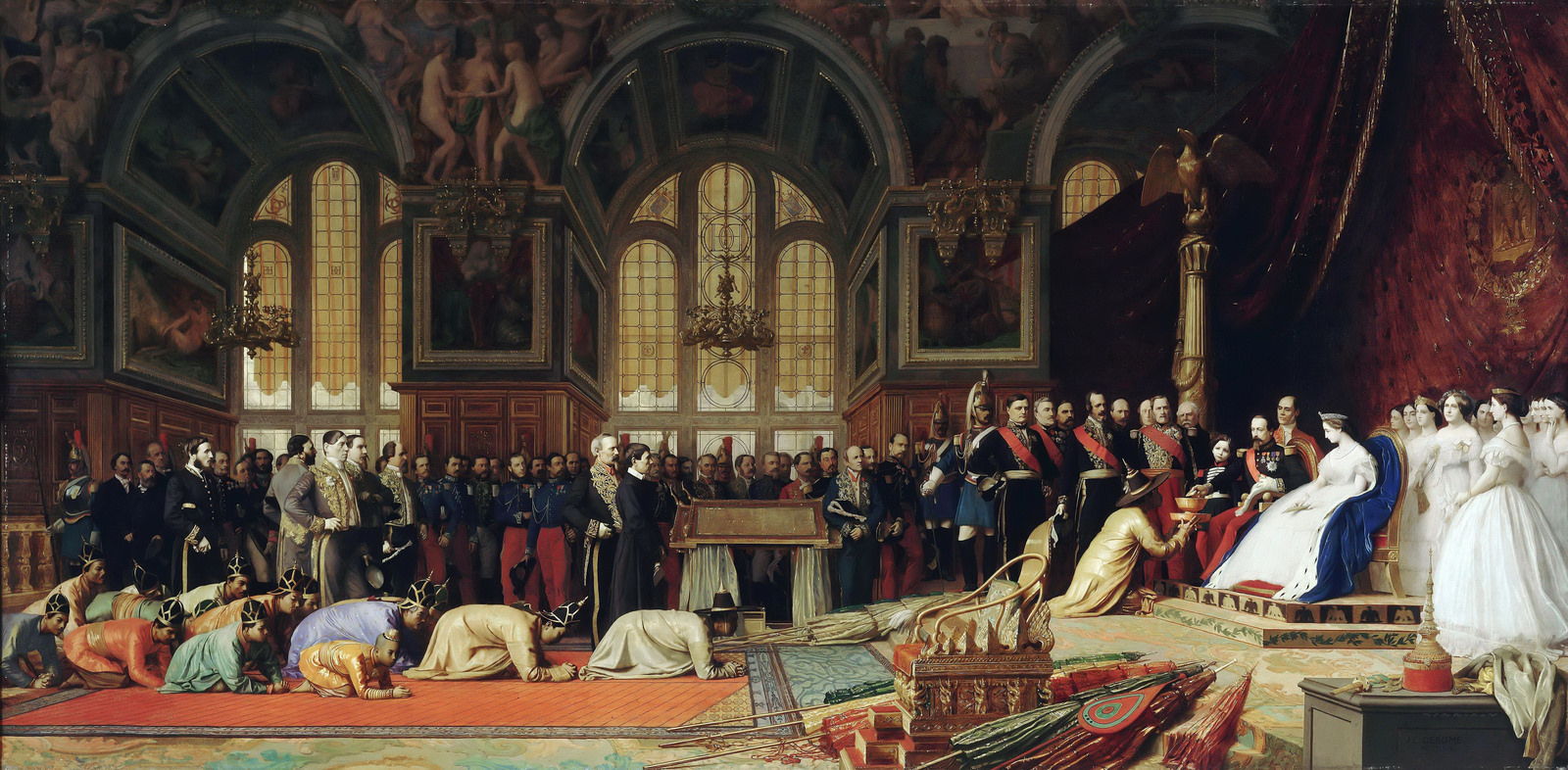
Jean-Léon Gérôme (1824–1904), Reception of Siamese Ambassadors by Napoleon III (1864), oil on canvas, 128 x 260 cm, Château de Versailles, Versailles, France. The Athenaeum.
Jean-Léon Gérôme articulated Napoleon III’s aspirations for empire in his elaborate formal painting of the Reception of Siamese Ambassadors by Napoleon III (1864), depicting the grand reception held at Fontainebleau on 27 June 1861. Gérôme attended in the role of semi-official court painter, made sketches of some of the key figures, and was further aided by photographs made by Nadar. He also included himself, and the older artist Ernest Meissonier (1815-1891), in the painting: I believe that they are both at the back, at the far left.
Achille Etna Michallon (1796–1822), The Fallen Branch, Fontainebleau (c 1816), oil on canvas on card, dimensions not known, Minneapolis Institute of Art, Minneapolis, MN. Wikimedia Commons.
Achille Etna Michallon was one of the first great landscape artists to paint en plein air in the forest. His study of The Fallen Branch, Fontainebleau from about 1816 anticipates the Barbizon School in its motif, style and location. This large branch looks more like a dying animal.
Richard Parkes Bonington (1802–1828), In the Forest at Fontainebleau (c 1825) (188), oil on millboard, 32.4 x 24.1 cm, Yale Center for British Art, New Haven, CT. Wikimedia Commons.
A decade later, the British artist Richard Parkes Bonington visited briefly and both sketched and painted In the Forest at Fontainebleau (c 1825). The rocks here are particularly painterly, suggesting that this may have been started, if not completed, in front of the motif.
Towards 1830, inspired by the paintings of John Constable, several young French landscape painters started visiting the forest. The first was probably Camille Corot, who first painted there in 1822, and returned in earnest in the Spring of 1829, after his long stay in Italy to learn plein air painting technique in the Roman campagna.
Jean-Baptiste-Camille Corot (1796–1875), Fontainebleau Forest (The Oak) (c 1830), oil on canvas, 48 x 59 cm, Private collection. Wikimedia Commons.
In Corot’s Fontainebleau Forest (The Oak) from about 1830, the twisted limbs of the oak have taken time and care, sufficient to give texture and shadows to the trunks and branches. Where the canopy is more broken he painted the leaves in considerable detail.
Corot was joined by Théodore Rousseau, Constant Troyon, Jean-François Millet, Paul Huet, and later Charles-François Daubigny and Henri Harpignies. Although many of their paintings were made in the forest, few have been located with certainty.
Henri Harpignies (1819–1916), Fir Trees in Les Trembleaux, near Marlotte (1854), oil on canvas, 41.3 x 32.1 cm, Metropolitan Museum of Art, New York, NY. Wikimedia Commons.
When Harpignies was on the edge of the Forest of Fontainebleau, he painted largely en plein air, including this fine view of Fir Trees in Les Trembleaux, near Marlotte from 1854.
Rosa Bonheur (1822–1899), Deer in the Forest of Fontainebleau (1862), pencil, watercolor and gum arabic, 34.4 × 50 cm. Private collection. Wikimedia Commons.
The great animalière Rosa Bonheur lived on the edge of the forest, where she painted some fine watercolours, including her Deer in the Forest of Fontainebleau (1862). By that time, the next generation was getting ready to take over from the Barbizon School.
The Eurasian wolf has been subject to a general campaign of extermination across much of Europe since the Middle Ages. The last in England was killed by the end of the fifteenth century, in Scotland in 1684, Denmark in 1772, and Norway in 1973. This hasn’t deterred artists from reminding Europeans of their sinister reputation.
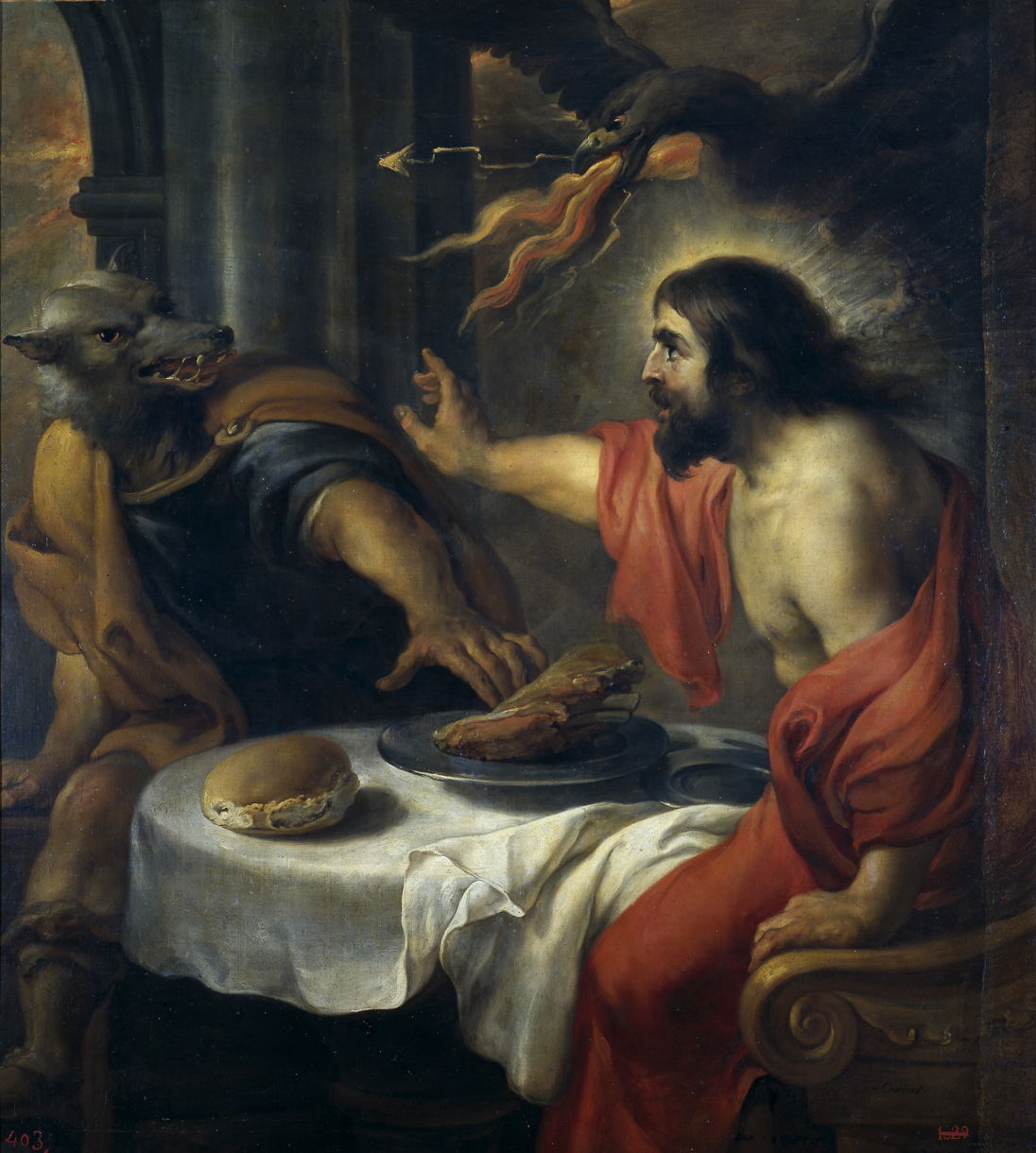
Early in Ovid’s Metamorphoses, he tells of Lycaon, who was transformed into a wolf by Jupiter as punishment for cheating him.
Jan Cossiers (1600–1671), Jupiter and Lycaon (c 1640), oil on canvas, 120 × 115 cm, Museo Nacional del Prado, Madrid. Wikimedia Commons.
Jan Cossiers’ impressive Jupiter and Lycaon from about 1640 shows Jupiter’s eagle vomiting thunderbolts at Lycaon, who is hurrying away as he is being transformed into a wolf, becoming the prototype for the werewolf of the future (see below).
Wolves got a better press in the popular account of the origins of Romulus and Remus, founders of Rome. Numitor’s daughter, a Vestal Virgin, was discovered to be pregnant. Although that would by tradition have led to her death, Amulius’ daughter interceded, and she was merely kept in solitary confinement. She gave birth to twin boys, who were superhuman in their size and beauty. Amulius ordered one of his servants to take the twins away and drown them in the river, but they were put first into a trough that functioned as a boat. As a result they were washed ashore downstream still alive. A she-wolf then fed the babies, and a woodpecker watched over them; both were later considered to be sacred to the god Mars.
Ludovico Carracci (1555–1619) and/or Annibale Carracci (1560–1609), She-Wolf Suckling Romulus and Remus (1589-92), fresco, dimensions not known, Palazzo Magnani, Bologna, Italy. Wikimedia Commons.
One of the frescoes in the Palazzo Magnani, probably painted by Ludovico Carracci and/or Annibale Carracci, shows the She-Wolf Suckling Romulus and Remus (1589-92). The twins are still inside the trough in which they had survived their trip down the river, and on the opposite bank a woodpecker is keeping a close watch.
Peter Paul Rubens (1577–1640), Romulus and Remus (1615-16), oil on canvas, 213 x 212 cm, Musei Capitolini, Rome, Italy. Wikimedia Commons.
Peter Paul Rubens shows Romulus and Remus being discovered by Faustulus, in his painting of 1615-16. Not only is the she-wolf taking care of the twins, but a family of woodpeckers are bringing worms and grubs to feed them, and there are empty shells and a little crab on the small beach as additional tasty tidbits.
Despite that, the wolf had a fearsome reputation in Europe, no doubt amplified by those who sought its extinction.
Pieter Brueghel the Younger (1564–1638), The Good Shepherd (1616), oil on canvas, dimensions not known, Musées royaux des Beaux-Arts de Belgique, Brussels, Belgium. Image by Rama, via Wikimedia Commons.
Pieter Brueghel the Younger’s The Good Shepherd from 1616 shows a shepherd being attacked by a wolf, as he tries to save his flock, which are running in panic into the nearby wood.
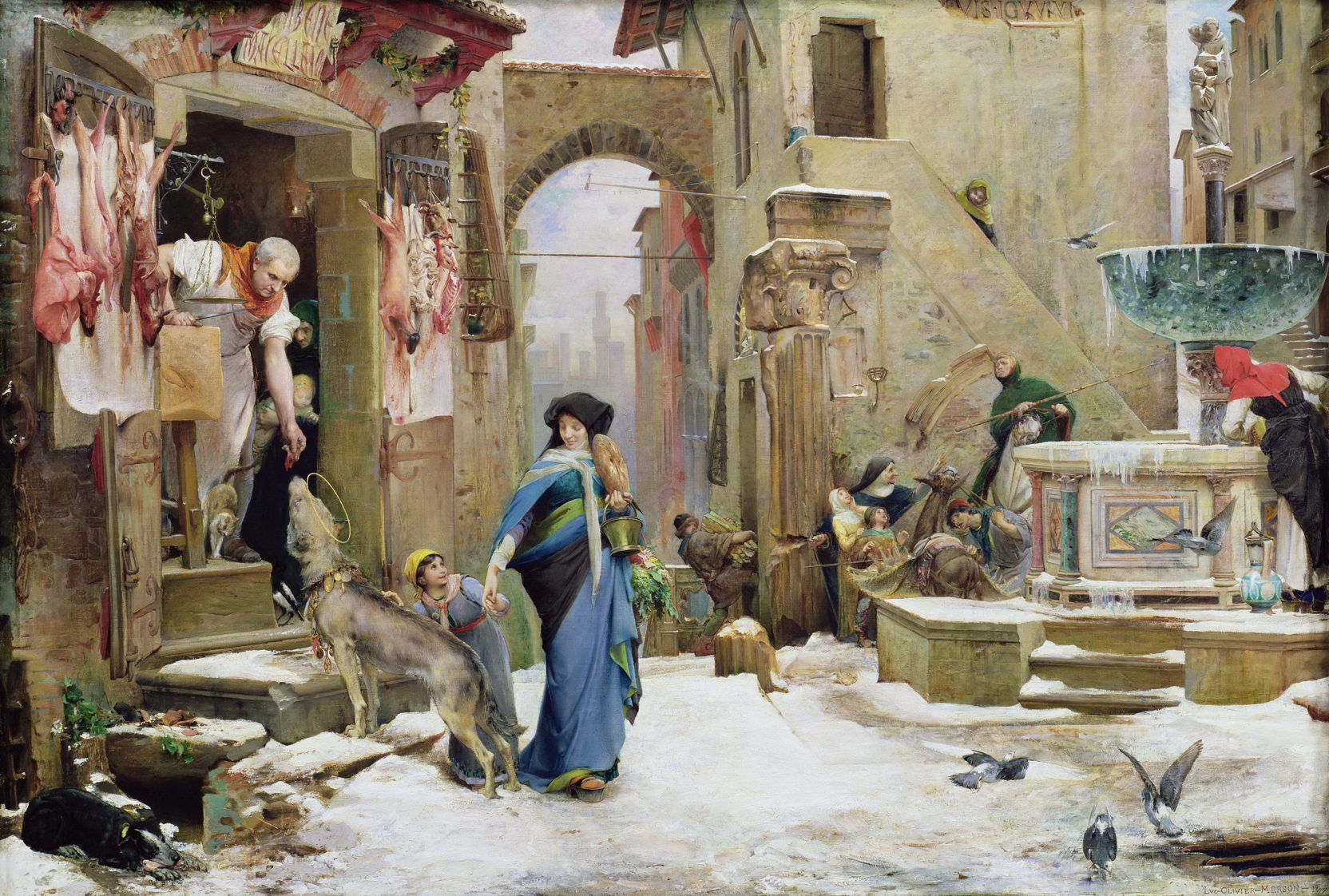
Christian associations can be more positive, particularly in the legend of Saint Francis of Assisi and the wolf of Agubbio, or Gubbio, a small mediaeval town in the Apennine Mountains in central Italy. The saint did a deal with the wolf, where the animal would stop terrorising the town, in return for its people providing it with food.
Luc-Olivier Merson (1846–1920), The Wolf of Agubbio (1877), oil on canvas, 88 x 133 cm, Palais des Beaux-Arts de Lille, Lille, France. Wikimedia Commons.
Luc-Olivier Merson’s marvellous painting of The Wolf of Agubbio from 1877 is set in the town’s central piazza, where it’s a cold winter’s day, so cold that the waters of its grand fountain are frozen as they cascade over its stonework. As the townspeople go about their business, there’s the large wolf of its title with a prominent halo, standing at the door of the butcher’s shop. Leaning out from that door, the butcher is handing a piece of meat to the wolf, as shown in the detail below.
Luc-Olivier Merson (1846–1920), The Wolf of Agubbio (detail) (1877), oil on canvas, 88 x 133 cm, Palais des Beaux-Arts de Lille, Lille, France. Image by Chatsam, via Wikimedia Commons.
A wolf may also appear in association with the Christian virtue of charity, as depicted by Pierre Puvis de Chavannes.
Pierre Puvis de Chavannes (1824–1898), Charity (1887), oil on canvas, 56 x 47 cm, Musée d’Orsay, Paris. Image by Rama, via Wikimedia Commons.
His Charity from 1887 is a personification of one of the seven Christian virtues set in timeless classical terms. She is the mother of twins, one of whom she holds by her breast. She is clasping the back of the neck of a dark wolf, lying beside her, adding an unusual touch. This had apparently become a popular motif, and only nine years previously had been painted by William-Adolphe Bouguereau in contrasting Academic style.
Jean-Baptiste Camille Corot (1796–1875), Dante and Virgil (1859), oil on canvas, 260.4 x 170.5 cm, Museum of Fine Arts Boston, Boston, MA. Wikimedia Commons.
A wolf is one of the three fearsome animals to threaten Dante in the opening of his Divine Comedy. Camille Corot’s painting of Dante and Virgil from 1859 shows Dante as he started to walk up a hill, only to find his way blocked first by a leopard, then by a lion, and finally by a wolf.
Wolves have made their way into other legends and fables.
Jean-Baptiste Oudry (1686–1755), The Wolf and the Lamb (date not known), oil on canvas, 104.1 x 125.7 cm , Private collection. Wikimedia Commons.
Jean-Baptiste Oudry’s undated The Wolf and the Lamb tells a popular story (Perry 155, La Fontaine I.10) in which a wolf tries to justify killing a lamb on the strength of its criminal record. The lamb proves each crime claimed by the wolf to have been impossible, so the wolf says that the offences must have been committed by someone else in the lamb’s family, therefore it can proceed to kill the lamb anyway.
Gustave Moreau (1826–1898), The Wolf and the Lamb (1889), original presumed to be in colour, further details not known. Wikimedia Commons.
Gustave Moreau revisited Aesop’s fables late in his career. The Wolf and the Lamb of 1889 is, I believe, a monochrome image of a painting made in full colour, whose wolf looks more threatening than Oudry’s.
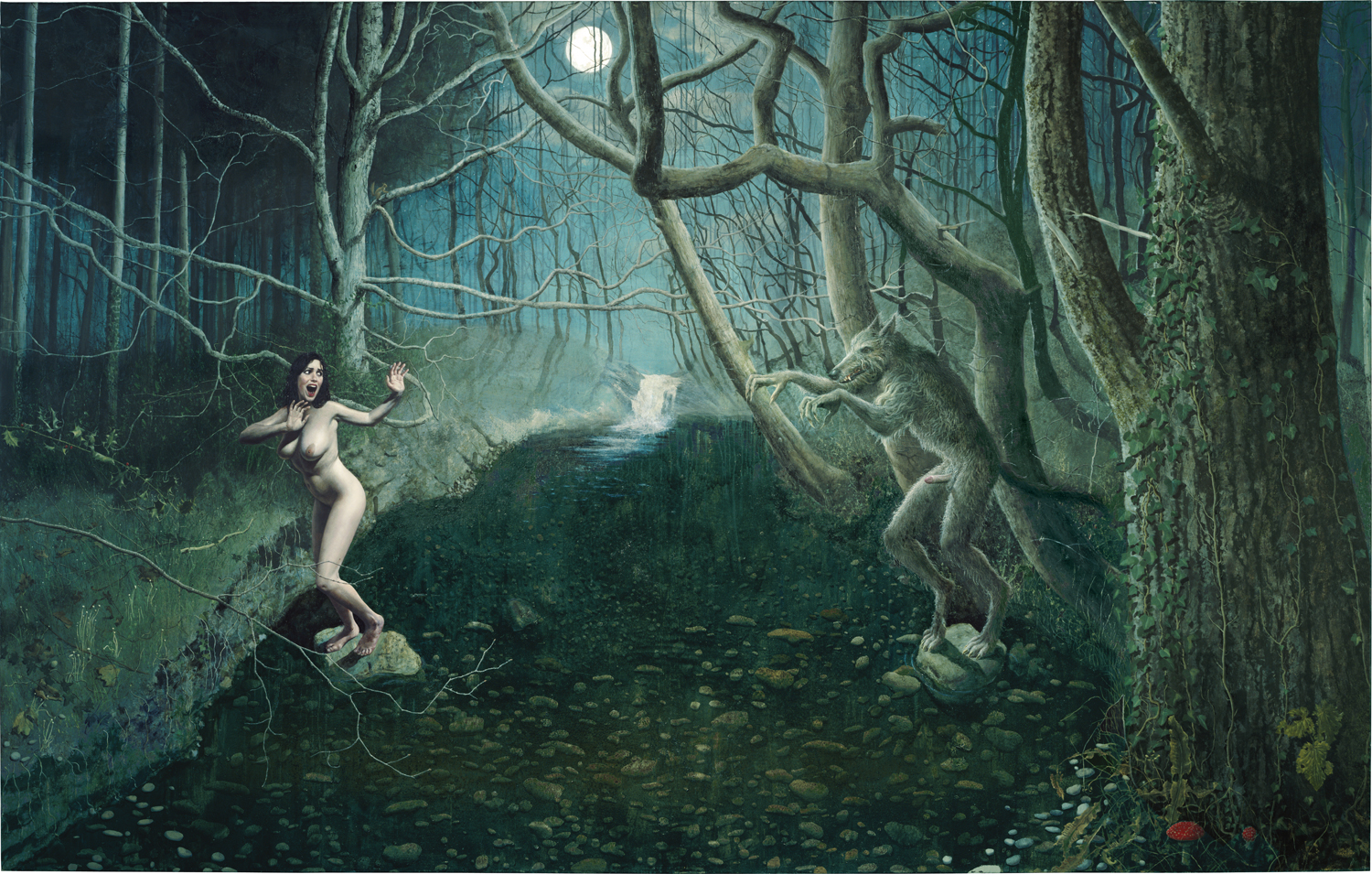
Mediaeval folk mythology developed stories of humans turning into wolves, although these were temporary transformations associated with cannibalistic episodes. They became progressively refined and popularised into the Gothic ‘horror’ stories of werewolves feeding on human blood, although those didn’t reach painting until the twentieth century.
Stuart Pearson Wright’s magnificent Woman Surprised by a Werewolf (2008) was inspired by the movie An American Werewolf in London (1981), itself a further transformation of werewolf stories into comedy horror form. The artist intended “to explore that uncharted place where the mystery and sublime of the romantic landscape meets the high camp and melodrama of Hammer horror”, which has come a long way from Ovid’s original story of lycanthropy.
Finally, wolves can sometimes be depicted as hunting quarry.
Peter Paul Rubens (1577–1640), Wolf and Fox Hunt (c 1616), oil on canvas, 245.4 x 376.2 cm, Metropolitan Museum of Art, New York, NY. Wikimedia Commons.
Peter Paul Rubens’ Wolf and Fox Hunt from about 1616 is one of his brilliant series of hunting scenes, here featuring two large wolves.
The good news is that, since the 1950s, populations of wolves in Europe have been recovering, and with the exception of the British Isles, they’re gradually re-establishing themselves in those countries that had previously hunted them to death.

 Login
Login