Login
LoginReading Visual Art: 237 Blacksmith
The craft of the blacksmith goes back long before the Iron Age, but once our ancestors had learned to work cast iron (by turning it first into wrought iron), in about 1200 BCE, it became one of the key crafts in many societies. It’s also the only craft represented by a deity in the classical Greek pantheon, in the god Hephaistos, translated by the Romans to Vulcan.
He had the misfortune to have been born lame, as a result of which Hera tried to be rid of him, and threw him into the sea. He was there cared for by Thetis and others. He later assumes his role as the god of fire, volcanoes, and crafts allied to blacksmithing, including sculpture.

In paintings, Vulcan is characteristically seen in his forge, as in Tintoretto’s painterly Vulcan’s Forge (1578), one of four mythological paintings he made for the Atrio Quadrato in the Palazzo Ducale in Venice. Tintoretto was clearly familiar with the division of labour in a blacksmith’s workshop. The two well-muscled men wielding large hammers are strikers, whose brute force is more important. Vulcan is the older man at the left, who strikes the casting with his small hammer to tell them where theirs should strike.
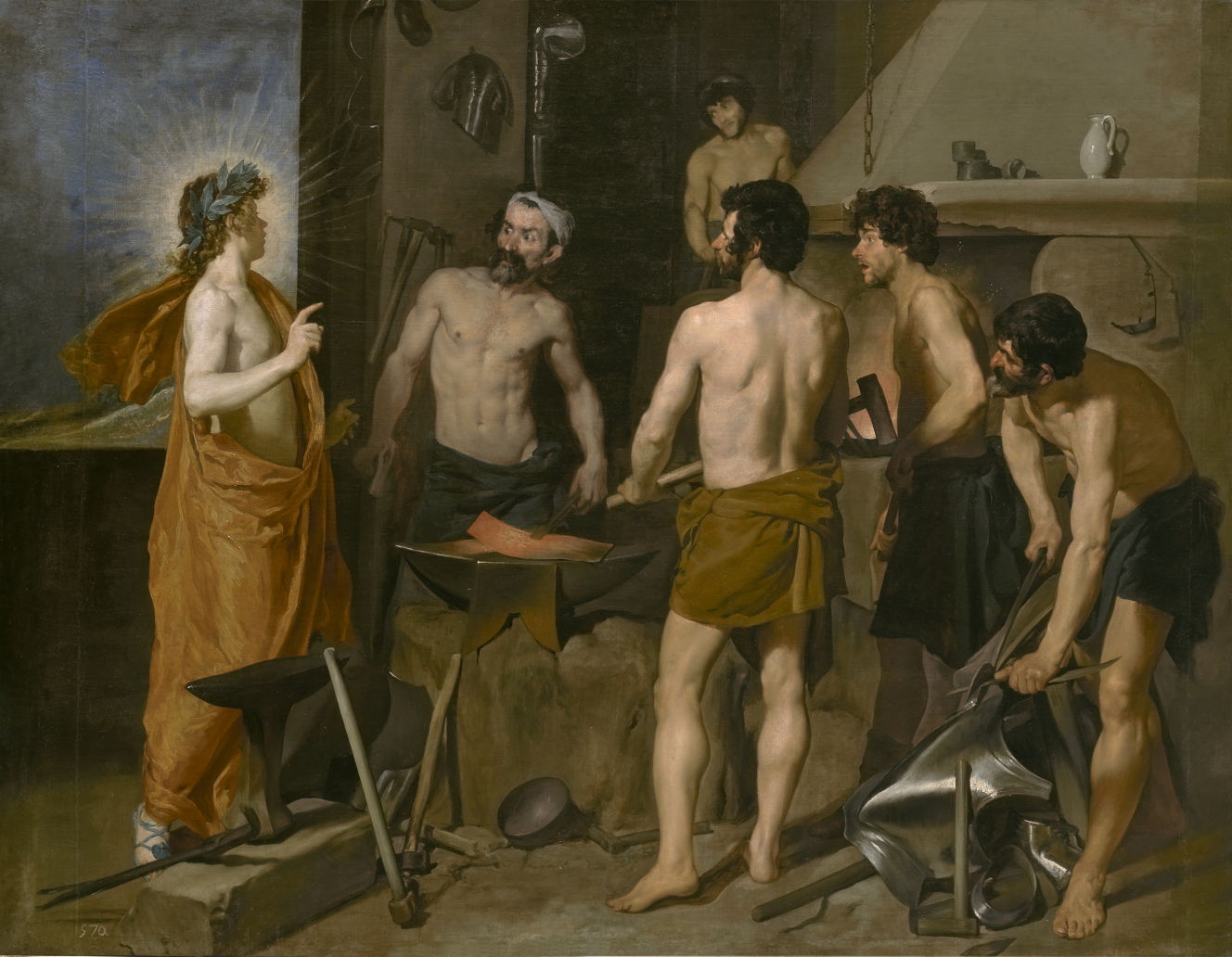
Homer’s story of the adulterous affair of the wife of Hephaistos, Aphrodite (Venus), with Ares (Mars) is retold by Ovid in his Metamorphoses, the likely source for Diego Velázquez’s The Forge of Vulcan from 1630. This shows Apollo, at the left, visiting Hephaistos (to the right of Apollo) in his forge, to tell him about this infidelity.
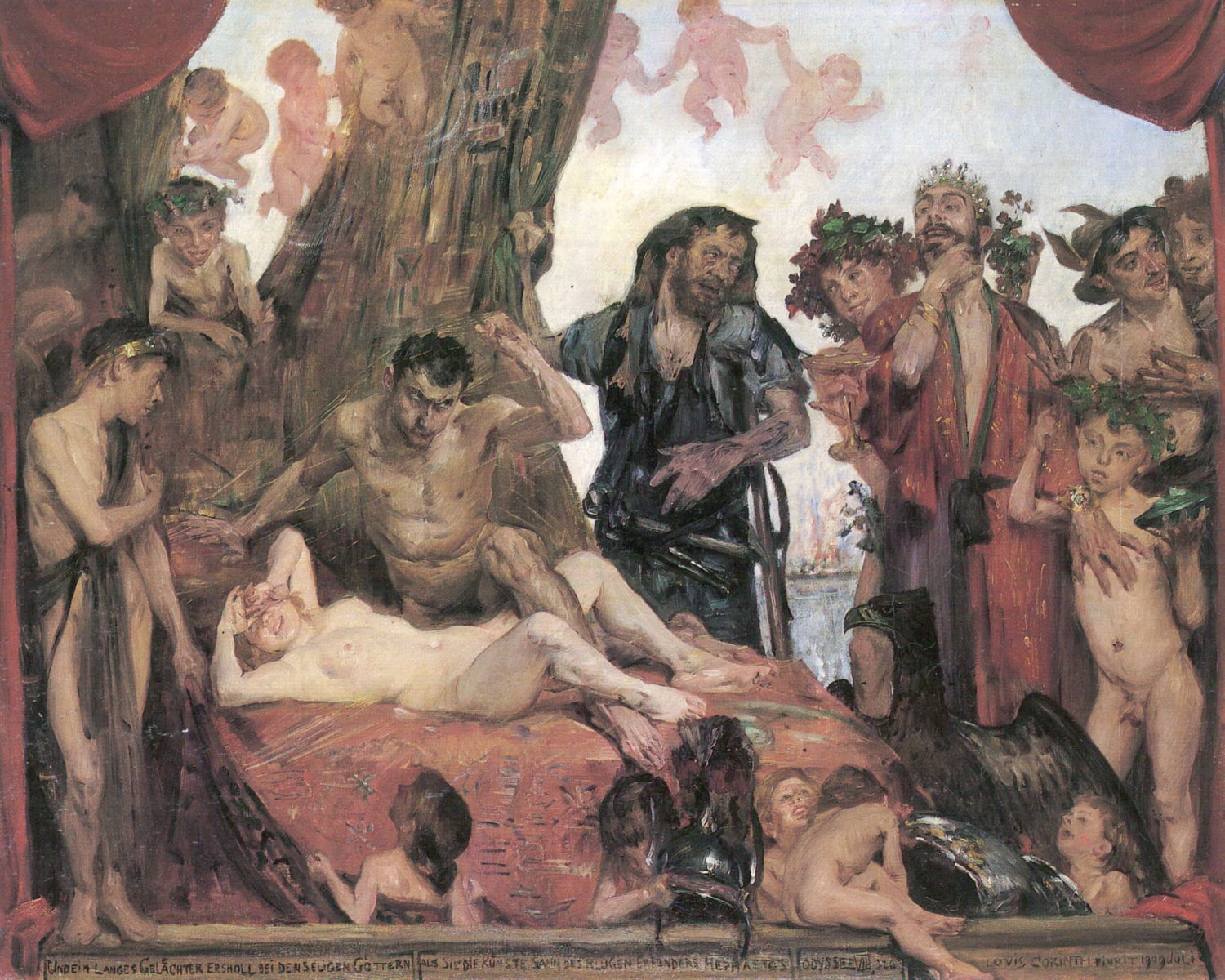
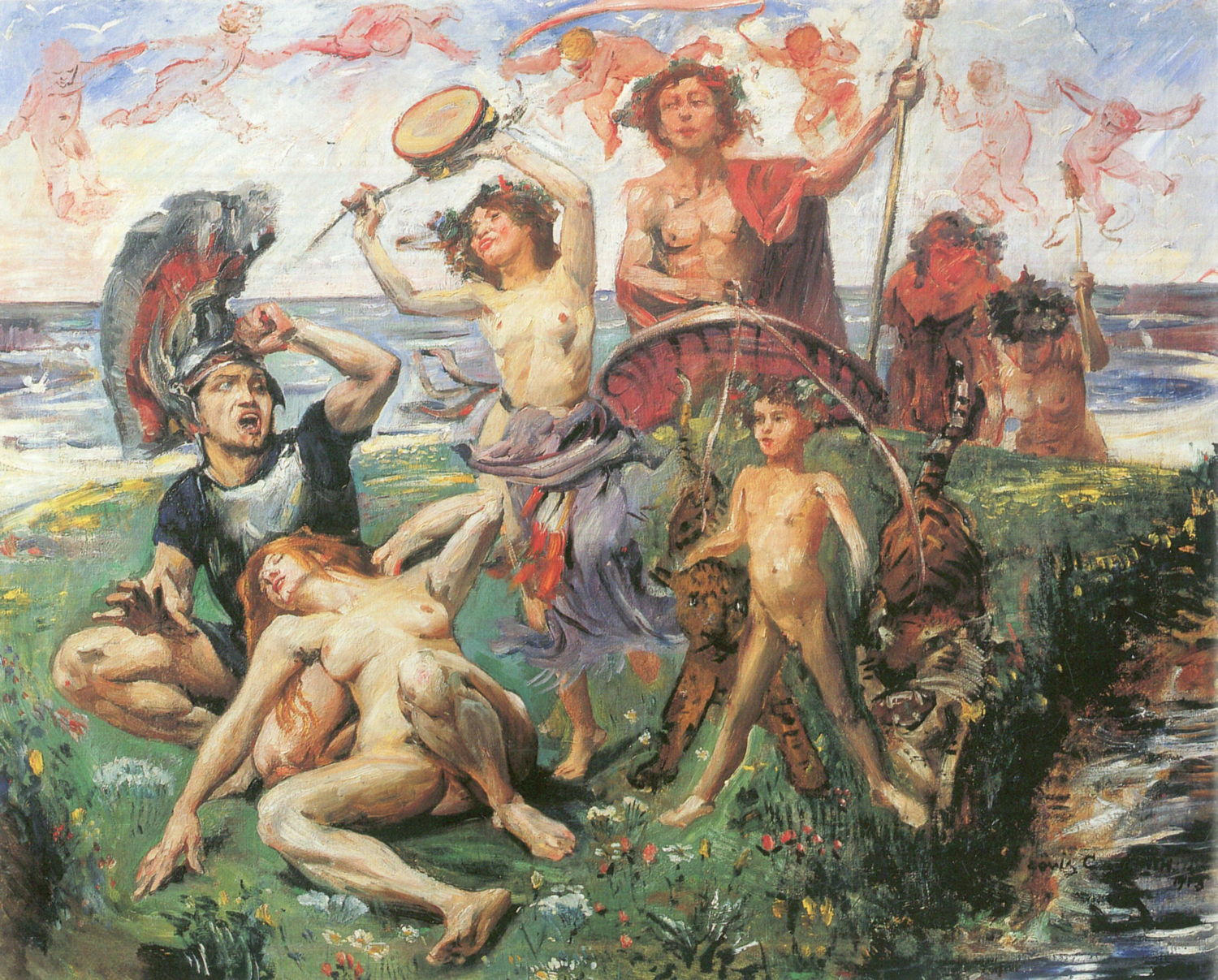
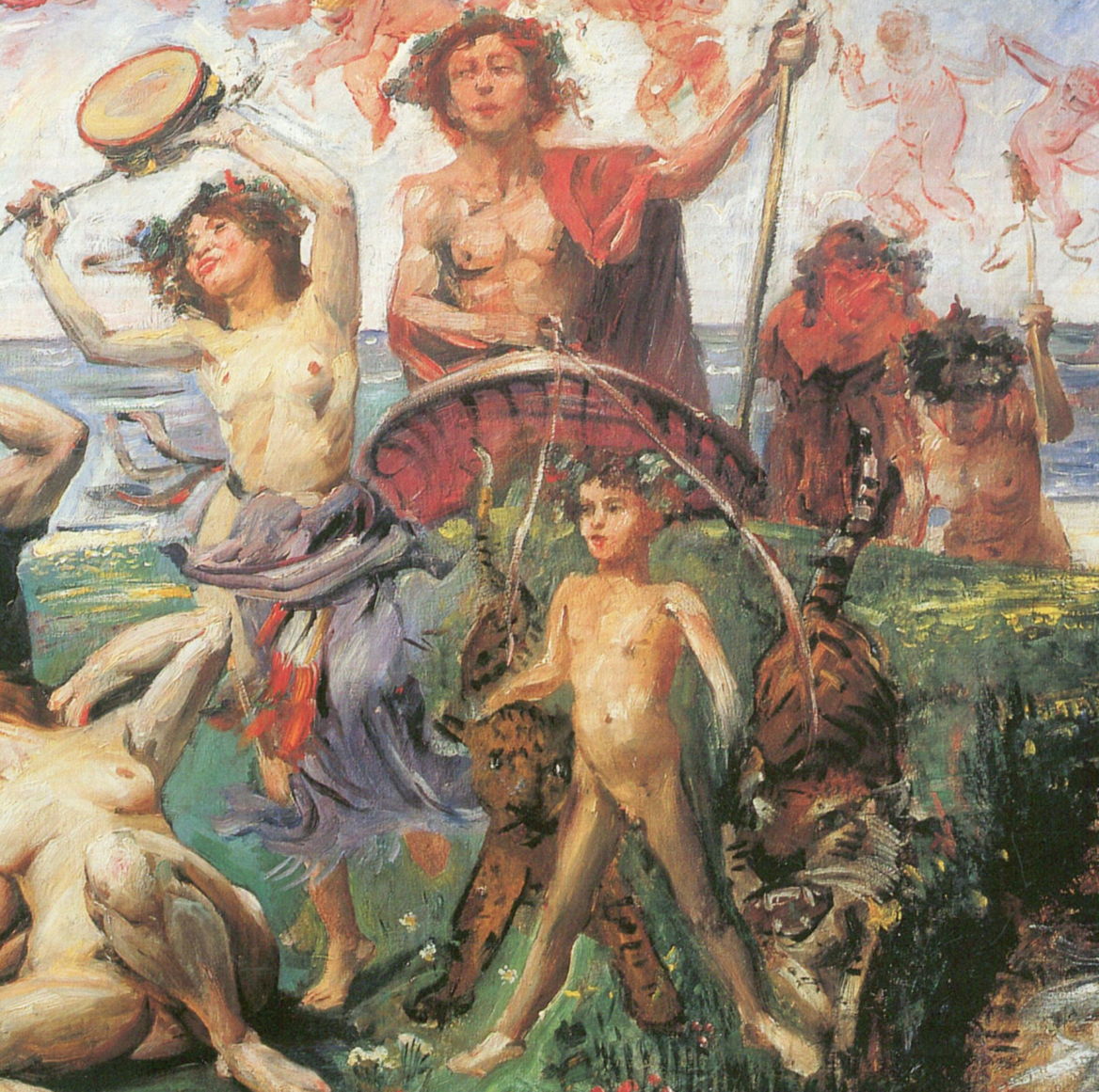
Homeric Laughter (1909) is one of Lovis Corinth’s most complex, even abstruse, paintings of classical myth. He provides a good clue as to its interpretation in his inscription (originally in German translation):
unquenchable laughter arose among the blessed gods as they saw the craft of wise Hephaistos
together with the reference to Homer’s Odyssey book 8 line 326.
In this first version, Corinth shows Aphrodite recumbent on the bed, shielding her eyes from the crowd around her. Ares struggles with the net securing the couple, looking frustrated. Hephaistos, clad in black with his tools slung around his waist, is talking to Poseidon (who wears a crown) with Dionysos/Bacchus behind him (clutching a champagne glass). At the right edge is Hermes/Mercury, with his winged helmet. Sundry putti are playing with Ares’ armour, and an arc of putti adorns the sky.
The blacksmith also features in some accounts of the origin of Pandora.

John Dixon Batten’s The Creation of Pandora was painted anachronistically in egg tempera on a fresco ground by 1913. Batten was one of the late adherents of the Pre-Raphaelite movement, and is now almost forgotten. This work had been put into storage in 1949 and wasn’t rediscovered until 1990.
Pandora is at the centre, having just been fashioned out of earth by Hephaestus, who stands at the left, his foot on his anvil. Behind them, other blacksmiths work metal in his forge. At the right, Athena is about to place her gift of a robe about Pandora’s figure, and other gods queue behind to offer their contributions.
There are several fine paintings of regular blacksmiths at work over the centuries. The earliest I have been able to locate is a disturbing detail in the central panel of Hieronymus Bosch’s triptych The Last Judgment from about 1495-1505.

Among the torments featured in the centre panel are painful punishments in the blacksmith’s at the top.

Francisco Goya’s Forge from 1817 is a superb depiction of the physically demanding work of the blacksmith. Its extensive use of black is also a herald of the Black Period to come in Goya’s paintings at the end of that decade.

Sisley’s Forge at Marly-le-Roi from 1875 shows the village blacksmiths still at work long after the Industrial Revolution brought steam-powered hammers.

Ernst Josephson’s Spanish Blacksmiths from 1882 shows a smith in the shredded remains of his white shirt, and his striker to the right in his black waistcoat, with a horseshoe hanging below the roof of their forge in Seville.

Döme Skuteczky’s painting In the Smithy from 1897 shows another smithy, this time in Slovakia.
These days, across much of Europe the traditional blacksmith earns their keep from forging horseshoes for the many horses ridden for pleasure.