Some stories in Boccaccio’s Decameron attained fame less in the original, more in their later retelling. A good example is the tragic tale of Lisabetta related by Filomena on the fourth day, when it was the fifth about those whose love ended unhappily.
In 1818, the British poet John Keats (1795-1821) wrote his version, titled Isabella, or the Pot of Basil, which was published two years later, shortly after the poet’s untimely death at the age of just twenty-five, and it quickly became one of his most popular works. Here I will tell Boccaccio’s original, using his version of the names, being mindful that Keats called his leading lady Isabella rather than Boccaccio’s Lisabetta. Her lover’s name, common to both accounts, is Lorenzo.
Following the death of a rich merchant of Messina, his three sons inherited his riches, while their sister remained unmarried despite her beauty and grace. Lisabetta and Lorenzo, a Pisan who directed operations in one of the family’s trading establishments, fell in love with one another, and their relationship was consummated.
The couple tried to keep their affair secret, but one night one of her brothers saw her making her way to Lorenzo’s bedroom, and Lisabetta remained unaware of her discovery. Her brother was distressed, but decided to keep quiet, and to discuss it with his brothers next morning.
The following day, the brothers decided that they would also keep quiet until the opportunity arose to end their sister’s relationship. Some time later they pretended they were going to the country for pleasure, and took Lorenzo with them. When they reached an isolated location, they murdered Lorenzo and buried his body. They then told their sister that they had sent him away on a trading mission.
Lisabetta was anxious for her lover’s return, and persistently asked her brothers for news of him. Eventually, one of them rebuked her for this nagging, so she stopped mentioning him altogether, but each night kept repeating his name and pining for him. One night, having finally fallen asleep in tears, she saw him in a dream, in which he said that her brothers had murdered him, and revealed where his body was buried.
In her grief, Lisabetta obtained the permission of her brothers to go to the country for pleasure. Once she had located where she thought Lorenzo was buried, she quickly found his corpse, which remarkably showed no signs of decay. As she couldn’t move his whole body for more appropriate burial, she cut off his head and concealed it in a towel.
When she returned home, Lisabetta cried greatly over Lorenzo’s head, washing it with her tears, then wrapped it in cloth and put it in a large pot. She covered it with soil and in that planted some sprigs of basil. These she watered daily with her tears, as she sat constantly beside the pot in between bouts of crying over it. As a result, the basil grew strong and lush, and richly fragrant.
William Holman Hunt (1827–1910), Isabella and the Pot of Basil (1867), oil on canvas, 187 x 116 cm, Laing Art Gallery, Newcastle upon Tyne, England. Wikimedia Commons.
William Holman Hunt’s Isabella and the Pot of Basil from 1867 is intricately detailed, with several references to the story, such as the relief of a skull on the side of the pot, a red rose on a tray by Lisabetta’s left foot, and a silver watering can at the bottom right. Behind her is the image of a bedroom, possibly showing Lorenzo coming to her in a flashback to their affair.
Joseph Severn (1793-1879), Isabella, or the Pot of Basil (1877), further details not known. Wikimedia Commons.
Joseph Severn’s Isabella, or the Pot of Basil from 1877 appears remarkably high in chroma, and shows Lisabetta fondly embracing the pot and crying over the basil. Severn had been a personal friend of John Keats, and painted this just a couple of years before his own death.
Edward Reginald Frampton (1870-1923), Isabella, or the Pot of Basil (date not known), further details not known. Wikimedia Commons.
Edward Reginald Frampton’s Isabella, or the Pot of Basil was probably painted towards the end of the nineteenth century, or possibly in the early twentieth. Lisabetta is kneeling before her pot of basil at an altar, with a crucifix behind.
Ricciardo Meacci (1856-1938), Isabella and the Pot of Basil (1890), watercolour, dimensions not known, Private collection. Wikimedia Commons.
Ricciardo Meacci’s watercolour of Isabella and the Pot of Basil from 1890 shows Lisabetta embracing her pot of basil, as her three brothers watch with growing anger at her behaviour.
Her brothers began to suspect something, so had the pot removed from her room. This deepened their sister’s grief, and she kept asking after the pot.
John Melhuish Strudwick (1849-1937), Isabella (c 1886), oil on board, 31.1 x 23.2 cm, location not known. Wikimedia Commons.
John Melhuish Strudwick’s Isabella from about 1886 shows Lisabetta staring in grief at the stand on which her pot of basil had stood. Through the window, two of her brothers are seen making off with the pot, and looking back at her.
The brothers examined its contents and discovered Lorenzo’s head. Scared that his murder might cause them problems, they reburied the head, wound up their business, and left Messina for Naples. Lisabetta’s grief only grew deeper, and destroyed her health completely. Still asking for her pot of basil, she finally cried herself to death. Although the brothers had done everything to keep these events secret, eventually they became widely known, and were celebrated in folk verse.
John Everett Millais (1829–1896), Isabella (Lorenzo and Isabella) (1848-49), oil on canvas, 103 x 142.8 cm, Walker Art Gallery, Liverpool, England. Wikimedia Commons.
The first and still greatest depiction of Keats’ retelling is John Everett Millais’ Isabella (Lorenzo and Isabella) from 1848-49, completed before he was twenty, and one of the earliest examples of Pre-Raphaelite art. This is a composite of references to Keats’ poem and Boccaccio’s story, set at an imaginary family meal which the three brothers, Lisabetta and Lorenzo are taking together.
Lorenzo is sharing a blood orange with Lisabetta, white roses and passion flowers climbing from behind their heads. The dog, acting as a surrogate for Lorenzo, is being petted by Lisabetta, but one of her brothers aims a kick at it. Other symbols are shown of the plot to kill Lorenzo: a brother staring at a glass of red wine, spilt salt on the table, and a hawk pecking at a white feather. The pot of basil is already on the balcony, awaiting Lorenzo’s head. When exhibited at the Royal Academy in 1849, it was accompanied by verses 1 and 21 of Keats’ poem.
In 1900, the Swiss painter and print-maker Félix Vallotton was granted French citizenship. He had cut back on his prints to paint more, and the paintings that he made were no longer Nabi, but explored themes and ideas that were to prove influential later in the twentieth century. He also broadened his interests: in the early years of the new century, he wrote eight plays and three novels, although none achieved much success.
Félix Vallotton (1865–1925), The Laundress, Blue Room (La Lingère, Chambre Bleue) (1900), oil on paper laid on canvas, 50 x 80 cm, Dallas Museum of Art, Dallas, TX. Wikimedia Commons.
In 1900, he followed his earlier mysterious interiors with The Laundress, Blue Room, set in the Vallotton apartment in Paris, with two of his step-children squatting on the folds of large fabric sheets, inside a bedroom with blue decor. Two women are sat working, one apparently on the sheets, the other on separate fabrics.
Félix Vallotton (1865–1925), Le Pont Neuf (1901), oil on cardboard, 37 x 57 cm, Kunstmuseum Winterthur, Winterthur, Switzerland. Wikimedia Commons.
Vallotton’s view of the oldest of the great bridges of central Paris, in Le Pont Neuf from 1901, is strange. Like some of the unconventional views of bridges painted in the late nineteenth century, its emphasis is on unusual perspective form, but it manages to avoid showing Pissarro’s dense throng of people, or its place among prominent buildings, and is almost unrecognisable.
Félix Vallotton (1865–1925), Woman Searching in a Cupboard (1901), oil on canvas, 78 × 40 cm, Private collection. Wikimedia Commons.
Woman Searching in a Cupboard from 1901 shuts out half its image with black screens and the doors to the cupboard, giving it a strongly geometric tone. The woman, in spite of a lamp by her side, is little more than a black silhouette too, who appears to absorb the light falling on her. The lamp itself is strange, with a shade showing some sailing ships at sea, its stand being a vertical statuette of Truth, perhaps?
Félix Vallotton (1865–1925), Poker (1902), oil on cardboard, 52 x 67 cm, Musée d’Orsay, Paris. Wikimedia Commons.
Maybe we should read Vallotton’s lamps more carefully. For the following year (1902), he painted this quartet of gamblers in a Poker session. Tucked away in a plush back-room behind a club or bar, these four are in full evening dress, playing for stakes that could be breathtaking and bankrupting. In the centre foreground is another lamp with a patterned shade, showing sailing boats, I think.
Félix Vallotton (1865–1925), Five Painters (1902-03), oil on canvas, 145 x 187 cm, Kunstmuseum Winterthur, Winterthur, Switzerland. Wikimedia Commons.
Then in 1902-03, Vallotton painted one of the seminal records of the Nabis: Five Painters, showing Pierre Bonnard (seated, left), Félix Vallotton (standing, left), Édouard Vuillard (seated), Charles Cottet and Ker-Xavier Roussel (standing, right).
His next views of interiors I find quite cinematic, as if stills from a movie, perhaps reflecting his modern approach to composition and lighting, more akin to those developed by cinematographers of the future rather than painters of the past. They also appear to have been influences over the New Objectivity that developed in central Europe in the 1920s, and later American artists like Edward Hopper.
Félix Vallotton (1865–1925), Interior, Woman in Blue Searching in a Cupboard (1903), oil on canvas, 81 x 46 cm, Musée d’Orsay, Paris. Image by Oakenchips, via Wikimedia Commons.
For his Interior, Woman in Blue Searching in a Cupboard from 1903, Vallotton painted his wife Gabrielle from the back as she stood searching in a cupboard of books.
Félix Vallotton (1865–1925), Interior with Woman in Red (1903), oil on canvas, 92.5 x 70.5 cm, Kunsthaus Zürich, Zürich, Switzerland. Wikimedia Commons.
Vallotton’s Interior with Woman in Red from 1903 develops the framing effect of multiple sets of doors, drawing the eye deeper towards a distant bedroom. The woman wearing a red dress looks away, her skirts swept back as if she has been moving towards the three steps dividing this interior into foreground and background. There are tantalising glimpses of detail on the way: discarded fabric on a settee, clothing on a chair in the next room, and half a double bed with a bedside lamp in the distance.
Félix Vallotton (1865–1925), Woman Reading in an Interior (1904), oil on board, 60.3 x 34.6 cm, Museum of Fine Arts, Houston, TX. Wikimedia Commons.
There’s dispute as to whether this painting shows a Woman Reading in an Interior, as given by its French title, or a woman writing, which appears to be its translation. Vallotton painted this in 1904, and charged it with rather less mystery, although I wonder if the lower of the paintings on the wall might be one of Degas’ works showing horseriding. As usual, the single figure doesn’t show her face as she sits at the small bureau, backlit by the window and its stained glass.
Félix Vallotton (1865–1925), Interior, Bedroom with Two Figures (1904), oil on cardboard, 61.5 × 56 cm, Hermitage Museum Государственный Эрмитаж, Saint Petersburg, Russia. Wikimedia Commons.
Interior, Bedroom with Two Figures from 1904 is one of the last of his series of mysterious interiors, and worthy of the sub-genre of the ‘problem picture’. This is another bedroom, in which the lady of the house is standing over her maid as the latter is sewing up an evening gown for her. The mistress stands with her back to the viewer, but her face is revealed in her reflection in the large mirror on the wardrobe at the back of the room. In that, the maid is all but invisible. These three figures appear in a perspective recession, and to the right of the wardrobe is a doorway, presumably leading through to the master’s bedroom.
Félix Vallotton (1865–1925), The Models’ Smoke Break (1905), oil on canvas, 130 x 195.5 cm, Kunstmuseum Winterthur, Winterthur, Switzerland. Wikimedia Commons.
In this period before the Great War, Vallotton also painted portraits, and several nudes. But the figurative painting from 1905 that I find most fascinating is this, of The Models’ Smoke Break. In an era when most adults smoked, rest periods for models, like those for other workers, were usually termed ‘smoke breaks’ even though neither woman is smoking.
Instead, one model is reclined in a pose (not a pose, as it’s a break) reminiscent of Manet’s Olympia (1863). Instead of her maid bringing her a bouquet, though, she holds a single wilted blue flower, and chats idly to another model who sits by her feet. I wish I could identify the paintings reflected in the mirror behind them, although I think the upper double portrait is that of Vallotton’s parents painted in 1886. That below looks like a coastal landscape, perhaps of Honfleur.
To follow these, Vallotton turned to classical myths.
The craft of the blacksmith goes back long before the Iron Age, but once our ancestors had learned to work cast iron (by turning it first into wrought iron), in about 1200 BCE, it became one of the key crafts in many societies. It’s also the only craft represented by a deity in the classical Greek pantheon, in the god Hephaistos, translated by the Romans to Vulcan.
He had the misfortune to have been born lame, as a result of which Hera tried to be rid of him, and threw him into the sea. He was there cared for by Thetis and others. He later assumes his role as the god of fire, volcanoes, and crafts allied to blacksmithing, including sculpture.
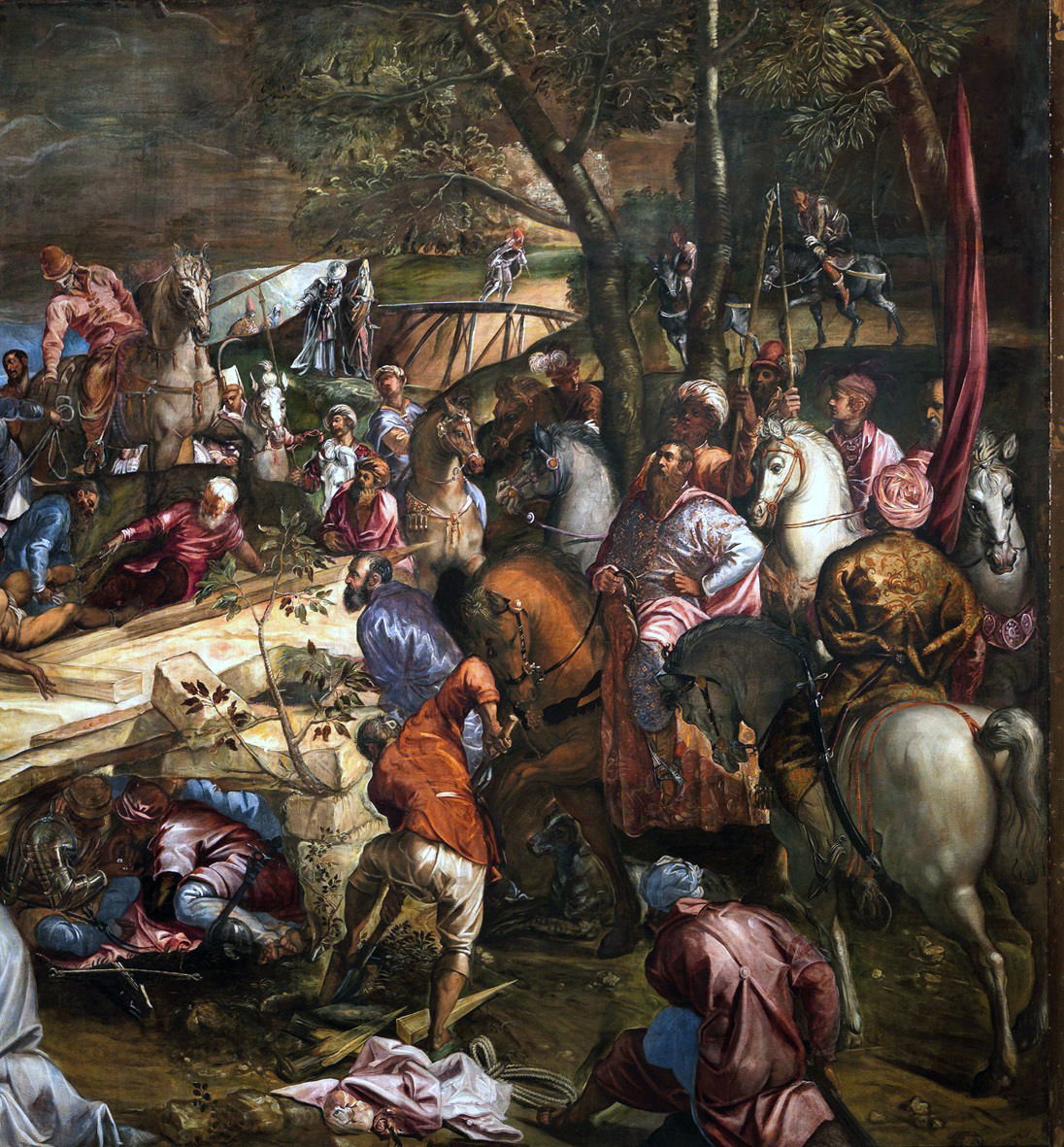
In paintings, Vulcan is characteristically seen in his forge, as in Tintoretto’s painterly Vulcan’s Forge (1578), one of four mythological paintings he made for the Atrio Quadrato in the Palazzo Ducale in Venice. Tintoretto was clearly familiar with the division of labour in a blacksmith’s workshop. The two well-muscled men wielding large hammers are strikers, whose brute force is more important. Vulcan is the older man at the left, who strikes the casting with his small hammer to tell them where theirs should strike.
Diego Velázquez (1599–1660), The Forge of Vulcan (1630) [41], oil on canvas, 223 x 290 cm, Museo Nacional del Prado, Madrid, Spain. Wikimedia Commons.
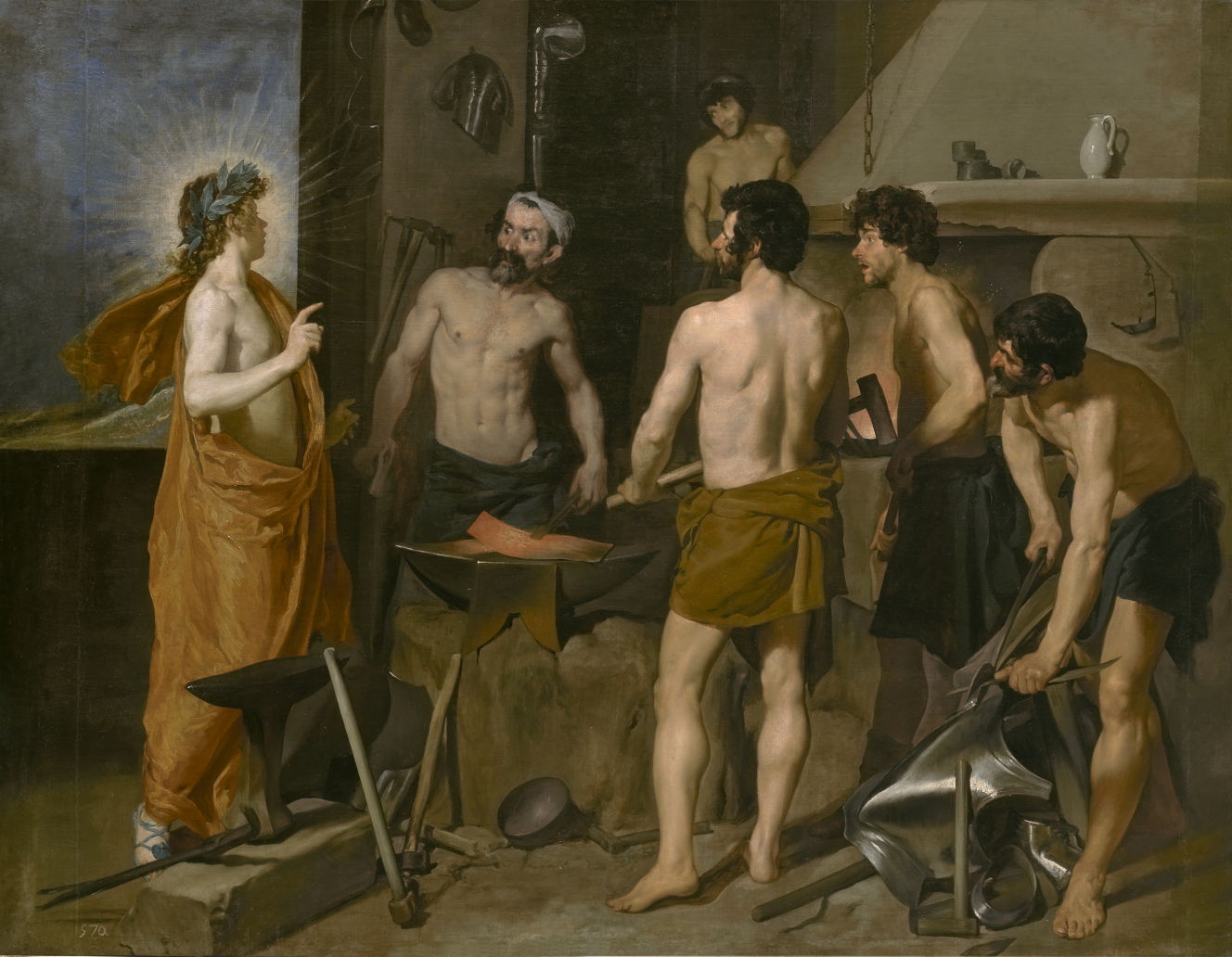
Homer’s story of the adulterous affair of the wife of Hephaistos, Aphrodite (Venus), with Ares (Mars) is retold by Ovid in his Metamorphoses, the likely source for Diego Velázquez’s The Forge of Vulcan from 1630. This shows Apollo, at the left, visiting Hephaistos (to the right of Apollo) in his forge, to tell him about this infidelity.
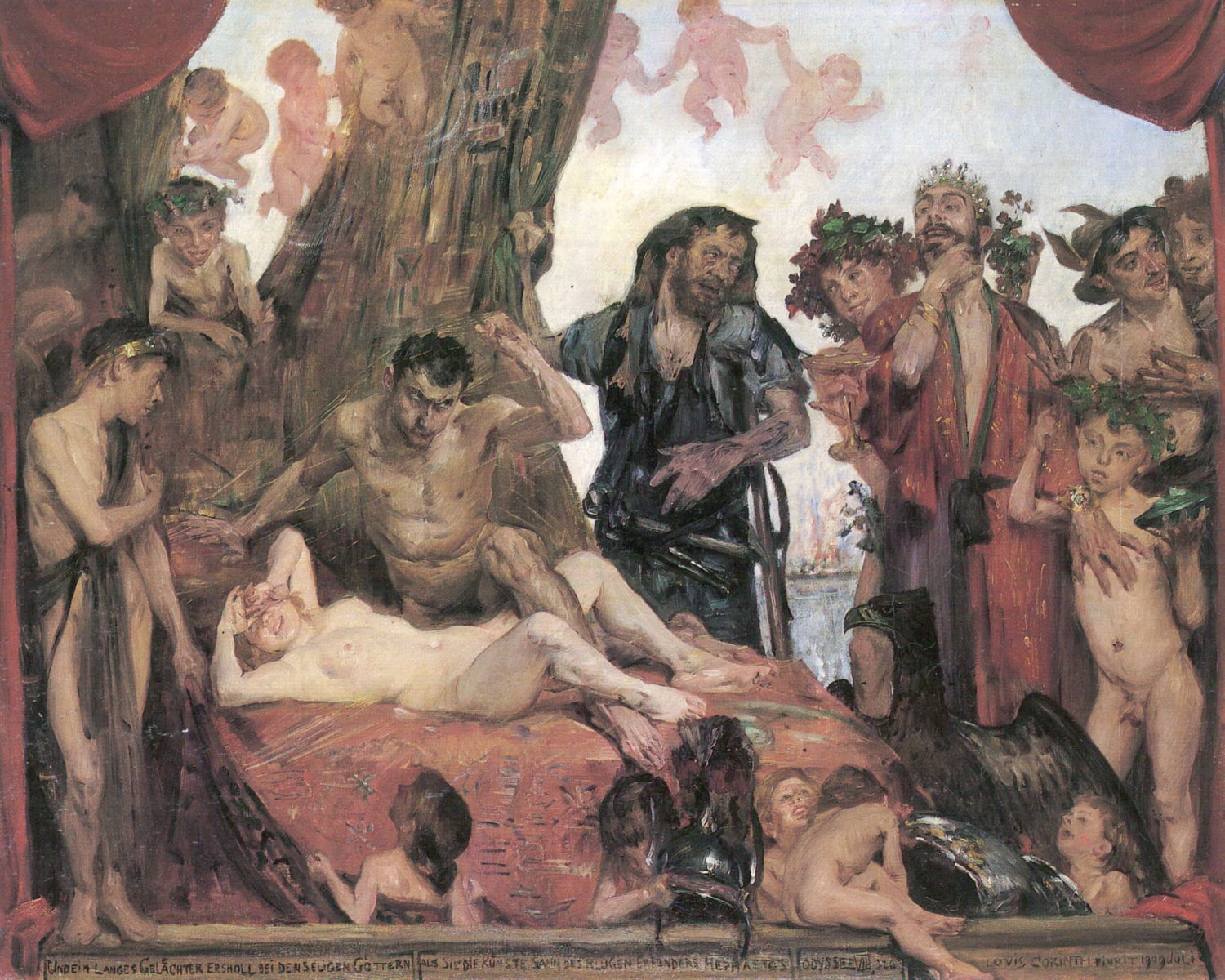
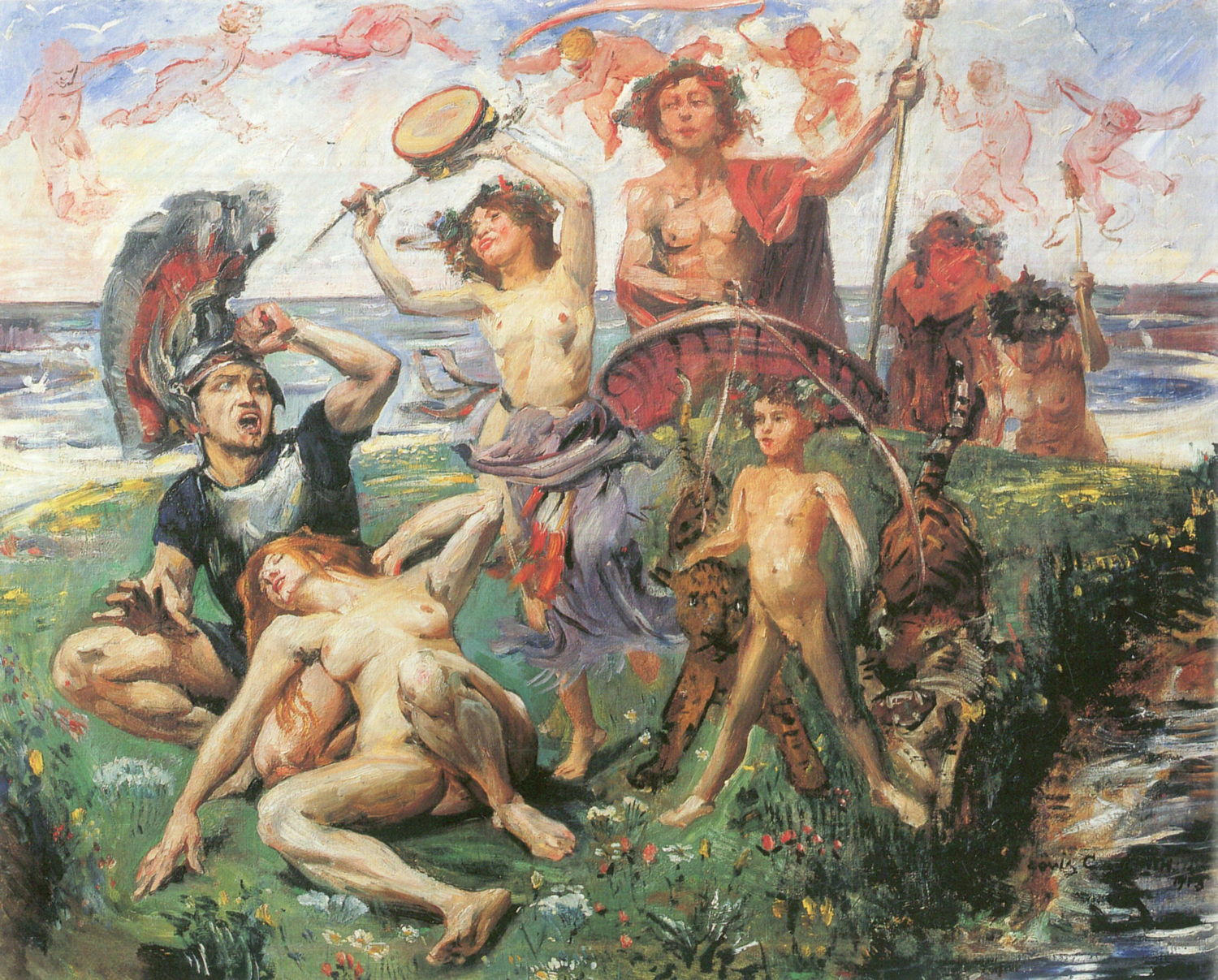
Lovis Corinth (1858–1925) Homeric Laughter (1909), oil on canvas, 98 × 120 cm, Bayerische Staatsgemäldesammlungen, Munich. Wikimedia Commons.
Homeric Laughter (1909) is one of Lovis Corinth’s most complex, even abstruse, paintings of classical myth. He provides a good clue as to its interpretation in his inscription (originally in German translation): unquenchable laughter arose among the blessed gods as they saw the craft of wise Hephaistos
together with the reference to Homer’s Odyssey book 8 line 326.
In this first version, Corinth shows Aphrodite recumbent on the bed, shielding her eyes from the crowd around her. Ares struggles with the net securing the couple, looking frustrated. Hephaistos, clad in black with his tools slung around his waist, is talking to Poseidon (who wears a crown) with Dionysos/Bacchus behind him (clutching a champagne glass). At the right edge is Hermes/Mercury, with his winged helmet. Sundry putti are playing with Ares’ armour, and an arc of putti adorns the sky.
The blacksmith also features in some accounts of the origin of Pandora.
John Dixon Batten (1860-1932), The Creation of Pandora (1913), tempera on fresco, 128 x 168 cm, Reading University, Reading, England. Wikimedia Commons.
John Dixon Batten’s The Creation of Pandora was painted anachronistically in egg tempera on a fresco ground by 1913. Batten was one of the late adherents of the Pre-Raphaelite movement, and is now almost forgotten. This work had been put into storage in 1949 and wasn’t rediscovered until 1990.
Pandora is at the centre, having just been fashioned out of earth by Hephaestus, who stands at the left, his foot on his anvil. Behind them, other blacksmiths work metal in his forge. At the right, Athena is about to place her gift of a robe about Pandora’s figure, and other gods queue behind to offer their contributions.
There are several fine paintings of regular blacksmiths at work over the centuries. The earliest I have been able to locate is a disturbing detail in the central panel of Hieronymus Bosch’s triptych The Last Judgment from about 1495-1505.
Hieronymus Bosch (c 1450–1516), The Last Judgment (central panel, detail) (c 1495-1505), oil on oak panel, left wing 99.5 x 28.8 cm, central panel 99.2 × 60.5 cm, right wing 99.5 × 28.6 cm, Groeningemuseum, Bruges, Belgium. Wikimedia Commons.
Among the torments featured in the centre panel are painful punishments in the blacksmith’s at the top.
Francisco Goya (1746–1828), The Forge (1812-16), oil on canvas, 181.6 x 125.1 cm, The Frick Collection, New York, NY. Wikimedia Commons.
Francisco Goya’s Forge from 1817 is a superb depiction of the physically demanding work of the blacksmith. Its extensive use of black is also a herald of the Black Period to come in Goya’s paintings at the end of that decade.
Alfred Sisley (1839-1899), Forge at Marly-le-Roi (1875), oil on canvas, 55 x 73.5 cm, Musée d’Orsay, Paris. EHN & DIJ Oakley.
Sisley’s Forge at Marly-le-Roi from 1875 shows the village blacksmiths still at work long after the Industrial Revolution brought steam-powered hammers.
Ernst Josephson (1851–1906), Spanish Blacksmiths (1882), oil on canvas, 128.5 x 107 cm, Nasjonalgalleriet, Oslo, Norway. Wikimedia Commons.
Ernst Josephson’s Spanish Blacksmiths from 1882 shows a smith in the shredded remains of his white shirt, and his striker to the right in his black waistcoat, with a horseshoe hanging below the roof of their forge in Seville.
Döme Skuteczky (1849–1921), In the Smithy (1897), mixed media, 28 × 21 cm, location not known. Wikimedia Commons.
Döme Skuteczky’s painting In the Smithy from 1897 shows another smithy, this time in Slovakia.
These days, across much of Europe the traditional blacksmith earns their keep from forging horseshoes for the many horses ridden for pleasure.
The first story on the fourth day of Boccaccio’s Decameron was told by Fiammetta, and relates the tragedy of Ghismonda and her love for Guiscardo.
Ghismonda was the daughter of Prince Tancredi of Salerno, who was known for being a benevolent ruler, but in his later years became a possessive father. He refused to let her marry until she was older than was usual, and when she did, her husband died soon after. She returned to live with her doting father, who had no interest in seeing her married for a second time, so she decided to take a lover instead.
She fell in love with a young valet to her father named Guiscardo, and he fell in love with her. Ghismonda devised an ingenious way of passing him messages concealed inside a reed. They met in an old cavern underneath the palace: Ghismonda’s room had a long-disused door that opened into the cavern, and Guiscardo descended into it from a shaft outside the walls.
Before meeting in this cavern, Ghismonda dismissed all her ladies-in-waiting, telling them she wanted to sleep. She then locked herself in her room, opened the door to the cavern, and descended its staircase to meet her lover, who had roped down from the entrance to the shaft. The couple then spent much of the rest of the day making love in her room before Guiscardo departed.
One day when the couple had arranged to meet in this way, Prince Tancredi came looking for his daughter. Seeing her outside, he settled down in a corner of her room and fell asleep. She was unaware he was there, and proceeded with her lovemaking, during which her father awoke. He remained silent and was undiscovered, eventually climbing out of a window while the couple descended into the cavern to make their farewells.
Later that night, Guiscardo was arrested on the orders of the Prince, and confined to a room in the palace without Ghismonda’s knowledge. Tancredi went to his daughter’s room, where he told her of the dishonour she had brought upon herself. She showed no contrition, nor did she seek her father’s forgiveness, but told her father honestly of the love she shared with Guiscardo, of her youth, and amorous desires. She pleaded her lover’s virtues, and asked that she should bear the brunt of any punishment, rather than her lover.
Prince Tancredi decided to take revenge not on his daughter, but on her lover. He had two of his men strangle Guiscardo, then cut his heart out. The heart was placed inside a gold chalice, and presented to his daughter “to comfort her in the loss of her dearest possession, as she had comforted her father in the loss of his”.
Before she could be given this gruesome present, Ghismonda had called for poisonous herbs, which she turned into a highly toxic potion. When the servants delivered her the chalice, she removed its lid, saw her lover’s heart, and was given her father’s message. Ghismonda raised her lover’s heart to her lips and kissed it. She then thanked the servants for her father’s priceless gift to her, bade farewell to her lover’s heart, and cried profusely over it.
Francesco Bacchiacca (1494–1557), Ghismonda with the Heart of Guiscardo (c 1525), oil on wood, dimensions not known, Lowe Art Museum, Coral Gables, FL. Wikimedia Commons.
Francesco Bacchiacca’s early painting of Ghismonda with the Heart of Guiscardo from about 1525 shows the rather distant figure crying over the heart, with her apparently disinterested ladies-in-waiting around her. In the foreground is her father’s servant who brought the chalice.
Francesco Furini (1600/03-1646), Sigismunda (c 1620-30), media and dimensions not known, Museo civico, Prato, Italy. Image by Sailko, via Wikimedia Commons.
Francesco Furini made at least two similar paintings of Ghismonda, here known by her alternative name of Sigismunda, crying profusely over the chalice. This version is thought to be from about 1620-30, and remains in Prato, Italy.
Francesco Furini (1600/03-1646), Sigismunda with the Heart of Guiscardo (c 1640), oil on canvas, 73 x 59 cm, Birmingham Museum and Art Gallery, Birmingham, England. Wikimedia Commons.
Thought to date from about 1640, this version known as Sigismunda with the Heart of Guiscardo is now in Birmingham, England. It had previously been attributed to Correggio, and was the inspiration for Hogarth’s much later painting shown below. It had only just been purchased at auction by Sir Thomas Sebright.
Interestingly, Furini’s painting of Mary Magdalene from about the same time is almost identical to the earlier version now in Prato, except that a chalice of myrrh had been substituted for that containing Guiscardo’s heart. All three works are notable for their dramatic chiaroscuro.
Mario Balassi (1604-1667), Ghismonda with the Heart of Guiscardo (1650), further details not known. Wikimedia Commons.
Mario Balassi’s Ghismonda with the Heart of Guiscardo from 1650 depicts Ghismonda being taken aback, although in Boccaccio’s account her response is strong and resolute despite the horrific cruelty of her father.
Bernardino Mei (1612-1676), Ghismunda (1650-59), oil on canvas, 66.5 x 47.5 cm, Pinacoteca nazionale di Siena, Siena, Italy. Wikimedia Commons.
It is perhaps Bernardino Mei, in his Ghismunda from 1650-59, who captures her resolute response best of all, as she stands squeezing the heart in her hand, tears still on her face.
William Hogarth’s Sigismunda Mourning over the Heart of Guiscardo from 1759 may come as something of a surprise. Hogarth seemed determined to prove that the ‘modern’ English painter could compete with the “old Italian masters” in handling such heroic narratives. This was one of his last commissions, for Sir Richard Grosvenor, in 1758. He studied Furini’s version (that now in Birmingham), which had been much admired, but when this was completed in 1759, Grosvenor rejected it.
Hogarth then exhibited it with seven other paintings at the Society of Artists in 1761. It was there savaged by the critics, who were apparently repelled by the conflict between the beauty of Sigismunda and the gruesome heart she is touching. Hogarth replaced it in the exhibition, and appears to have made changes to try to assuage its detractors. Unable to sell it or have it engraved for prints, the artist was forced to abandon it, and almost ceased painting for the remaining three years of his life.
Her ladies-in-waiting asked her why she was crying so, as they had not understood what had happened. Ghismonda then poured the deadly potion over Guiscardo’s heart, drank it, and lay down on her bed to await death. Her father was summoned, and Ghismonda asked him a final favour that she should be laid to rest beside Guiscardo. The Prince realised his cruelty and repented for it, ensuring that the two bodies were buried together in honour.
The stories told each day in Boccaccio’s Decameron follow a theme appointed by the ‘ruler’ of that day, as they decree when they are crowned with laurels at the end of the previous day’s storytelling. The theme chosen by the queen of the fifth day, Fiammetta, was the adventures of lovers who survived calamities or misfortunes and reached a state of happiness.
The eighth such story concerns the misfortunes of Nastagio degli Onesti, as told by Filomena. This appears to have been instantly successful, and by the early sixteenth century had been painted by both Botticelli and Ghirlandaio.
Nastagio degli Onesti was a young man from an old and noble family in Ravenna, who inherited a huge fortune, then fell in love with the daughter of a more noble family. His love for her wasn’t returned, though, and she was persistently cruel towards him. This caused the young Nastagio so much grief that he even contemplated suicide.
He continued to try to win her over, and in the course of that spent much of his inheritance. Friends and relatives feared for him and his future, and tried to persuade him to leave the city for a while. He was very reluctant, but finally travelled to Classe, three miles away, in May when the weather was fine.
Once there he wandered off into the local pine woods, thinking as he always did about his cruel love. As he walked in the wood, he heard the screams of a woman in distress. He then caught sight of her running naked towards him. In hot pursuit was a pair of large mastiff dogs, and behind them was a mounted knight brandishing a sword and threatening to kill her.
Nastagio took up a tree branch in her defence, but the knight ordered him by name to keep out, and let him and his dogs give the sinful woman what she deserved. Nastagio challenged the knight, who dismounted and introduced himself as Guido degli Anastagi. He then explained that he had fallen deeply in love with this woman many years ago, but she too had rejected him cruelly. As a result, Guido had killed himself, and was condemned to eternal punishment for that sin. The woman had died shortly afterwards, without repenting her cruelty, and she too was condemned to eternal punishment for her sin.
Their punishment consisted of Guido having to hunt her down in the woods, kill her using the same sword with which he had committed suicide, then cut her back open and remove her stone cold heart. That and her other organs he then has to feed to his dogs. After a short break, she is magically restored, and he has to resume hunting her as before.
Nastagio was horrified by this, stepped back, and watched the dead Guido kill the dead woman with his rapier, and go through the sequence of cutting out her heart and organs. A few moments later, after the ghostly dogs had eaten her organs, the dead woman jumped up and the hunt started all over again.
When he had recovered from the shock, Nastagio came up with a plan to deal with his own predicament. He summoned his friends and relatives, and agreed to stop trying to woo the woman that he loved on one condition, that she and her family should join him in the same place in the pine wood exactly one week later, for a magnificent breakfast banquet.
A week later all her family were present at the meal in the wood, and Nastagio carefully seated the woman he loved so she would get a grandstand view of the proceedings. No sooner had the last course been served, than they heard the dead woman’s screams, and she ran right in front of them.
Many of the guests tried to stop Guido from carrying out this punishment, so he explained to them what he had told Nastagio the week before. Eventually the ghostly couple rushed off again, and the guests talked avidly about what they had witnessed. But the person who was most affected by the spectacle was the cruel woman who Nastagio loved, who had perhaps already put herself in the position of the dead woman.
Nastagio’s plan paid off: the woman he loved soon sent him a servant to inform him that she would do anything he desired. She quickly consented to marriage, and they were wedded the following Sunday.
One perhaps unintended consequence of Nastagio’s breakfast demonstration was that, for some time to come, the women of Ravenna were so frightened of what could happen to them that they responded more favourably to the approaches of men.
Artist not known, The Story of Nastagio degli Onesti (c 1450), manuscript copy, BNF MS Italien 63, fol. 186v, Boccaccio’s Decameron, Bibliothèque nationale de France, Paris. Wikimedia Commons.
The title page of this story in this illustrated manuscript copy of the Decameron from the fifteenth century features a small reminder of the grim human hunt scene at its head.
This gruesome story and ingenious reversal of conventional Christian values became popular and well-known through the fifteenth century, sufficient for it to be depicted in four tempera panels given on the occasion of the arranged marriage of Gianozzo Pucci and Lucretia Bini in 1483. The couple were particularly fortunate in that one of those who made the arrangement, and who had this gift made for them, was Lorenzo de’ Medici, ‘the Magnificent’, who was also Botticelli’s patron at the time, and the ruler of the Florentine Republic.
Sandro Botticelli (1445–1510), The Story of Nastagio Degli Onesti I (1482-83), tempera on panel, 83 x 138 cm, Museo Nacional del Prado, Madrid, Spain. Wikimedia Commons.
The first panel shows the two figures of Nastagio, at the left, in the pine wood, with the naked woman running towards him, a mastiff sinking its teeth into her buttock. Behind them at the right is Guido, his sword ready to kill the woman when he catches her. In the distance is a coastal landscape intended to locate this near Ravenna, which is close to the Adriatic, although that’s idealised not representative.
Sandro Botticelli (1445–1510), The Story of Nastagio Degli Onesti II (1482-83), tempera on panel, 82 x 138 cm, Museo Nacional del Prado, Madrid, Spain. Wikimedia Commons.
Botticelli continues to tell the story using multiplex (‘continuous’) narrative in the second painting. The dead Guido has now caught the dead woman, killed her with his rapier, and with her lying on her face, he is cutting her back open to remove her cold heart. His dogs are already eating her organs at the right, and Nastagio is visibly distressed at the left.
Behind that composite scene is an earlier scene of Guido and his dogs still in pursuit of the woman, preceding the image of the first painting in the series.
Sandro Botticelli (1445–1510), The Story of Nastagio Degli Onesti III (1482-83), tempera on panel, 84 x 142 cm, Museo Nacional del Prado, Madrid, Spain. Wikimedia Commons.
In the third painting, Botticelli shows the breakfast banquet a week later, with the dead woman being attacked by Guido’s dogs, and Guido himself about to catch and kill her, in front of Nastagio’s guests.
Nastagio’s love is sitting at the table on the left, from which all the women have risen in distress at the sight, spilling their food in front of them.
Sandro Botticelli (1445–1510), The Story of Nastagio Degli Onesti IV (1482-83), tempera on panel, 83 x 142 cm, Private collection. Wikimedia Commons.
The fourth and final panel shows Nastagio’s wedding, the bride and her women sitting to the left, and the men to the right, in formal symmetry. The groom is sat on the other side of the same table as the bride.
Botticelli’s series seems to have been celebrated at the time, and shortly afterwards Ghirlandaio, another Florentine master, was asked to make not copies, but paintings in the manner of Botticelli’s series. Two have survived, and are now both in the US.
Davide Ghirlandaio (David Bigordi) (1452–1525), Forest Scene from the Tale of Nastagio degli Onesti (after 1483), tempera on wood panel, 69.9 x 134.6 cm, Brooklyn Museum (A. Augustus Healy Fund and Carll H. de Silver Fund), New York, NY. Courtesy of Brooklyn Museum.
Ghirlandaio’s first panel, now in the Brooklyn Museum, is based on Botticelli’s first, with the addition of an extra scene to its multiplex narrative. Up in the right, he adds the scene from Botticelli’s second panel, showing Guido cutting out the dead woman’s heart through her back.
Davide Ghirlandaio (David Bigordi) (1452–1525), Banquet Scene from the Tale of Nastagio degli Onesti (after 1483), tempera on wood panel, 70.2 x 135.9 cm, The Philadelphia Museum of Art (John G. Johnson Collection, 1917), Philadelphia, PA. Courtesy of The Philadelphia Museum of Art.
Ghirlandaio’s second panel shows an almost identical breakfast banquet to that in Botticelli’s third panel. This is now in the Philadelphia Museum of Art. I don’t know whether Ghirlandaio’s series extended to a third, completing the story with the marriage feast of Nastagio.
Boccaccio’s strange tale, twisted from source material by Dante, resulted in even more curious paintings. Today we might be only too happy to watch it in a horror movie, but seeing it come to life in a series of panels as a wedding gift? That’s surely typical of the late Middle Ages.
Until the Industrial Revolution brought the wide availability of iron, and even well into the twentieth century, the carpenter who worked wonders in wood was one of the key trades. It’s thus odd that remarkably few paintings show carpenters at work, at least until the middle of the nineteenth century.
They also play no role in the best-known classical myths, with the exception of one painting by Piero di Cosimo.
Piero di Cosimo (1462–1522), Vulcan and Aeolus (c 1490), tempera and oil on canvas, 155.5 × 166.5 cm, National Gallery of Canada Musée des beaux-arts du Canada, Ottawa, Canada. Wikimedia Commons.
Piero sometimes assembled his own mythical narratives, such as that in Vulcan and Aeolus from about 1490. From the left the figures are a river god, Vulcan forging a horseshoe, a figure (possibly Aeolus, keeper of the winds) riding a horse, a man curled asleep in a foetal position, a couple and their infant son, and four carpenters erecting the frame of a building. Among the animals are a giraffe and a camel. It’s thought this shows early humans developing crafts at the dawn of civilisation.
Christian religious painting has a better opportunity, with Joseph, husband of the Virgin Mary, the most famous carpenter in European history.
Jacopo Tintoretto (c 1518-1594), The Annunciation (E&I 264) (c 1582), oil on canvas, 440 x 542 cm, Sala terrena, Scuola Grande di San Rocco, Venice, Italy. Wikimedia Commons.
Tintoretto’s Annunciation is thought to have been painted in about 1582. Its composition is unusual by any contemporary standards, with natural rendering of brickwork, a wicker chair, and a splendidly realistic carpenter’s yard at the left. This is coupled with an aerial swarm of infants, at the head of which is the dove of the Holy Ghost in a small mandorla. Christ’s origins are here very real, tangible, and contemporary, in stark contrast to most traditional depictions of this scene.
John Everett Millais’ painting of Christ in the House of His Parents, also known as The Carpenter’s Shop, is one of the foundational paintings of the Pre-Raphaelite Brotherhood, from 1849-50. It was exhibited at the Royal Academy in 1850 with a quotation from the Old Testament book of Zechariah 13:6: “And one shall say unto him, What are those wounds in thine hands? Then he shall answer, Those with which I was wounded in the house of my friends.” It shows an entirely imagined scene, one not even alluded to in the Gospels, in which the young Jesus Christ is being comforted by his kneeling mother, after he has cut the palm of his left hand on a nail.
It’s rich with symbols of Christ’s life and future crucifixion: the cut on his palm is one of the stigmata, and blood dripped from that onto his left foot is another. The young Saint John the Baptist has fetched a bowl of water, indicating his future baptismal role. A triangle above Christ’s head symbolises the Trinity, and a white dove perched on the ladder is the Holy Spirit. A flock of sheep outside represents the Christian flock.
William Holman Hunt (1827–1910), The Shadow of Death (1870-73), oil on canvas, 214.2 x 168.2 cm, Manchester Art Gallery, Manchester, England. Wikimedia Commons.
In William Holman Hunt’s later painting of The Shadow of Death from 1870-73, the young Jesus Christ is seen in his father’s carpentry workshop, holding his arms up to savour the bright sunlight. His cast shadow on the rack of tools and wall behind shows him crucified on the cross, with his mother Mary already on her knees, as shown in so many paintings of the crucifixion.
Christian allusions to carpentry became more popular from the start of the nineteenth century.
William Blake’s The Christ Child Asleep on the Cross, or Our Lady Adoring the Infant Jesus Asleep on the Cross from 1799-1800 is among the few of his glue tempera paintings that has retained its colours. This shows at best an apocryphal if not invented scene, in which the young Jesus anticipates his eventual fate by sleeping on a wooden cross, surrounded by the carpenter’s tools, including compasses or dividers.
Fritz von Uhde (1848–1911), A Difficult Journey (Transition to Bethlehem) (1890), oil on canvas, 117 × 127 cm, Neue Pinakothek, Munich, Germany. Wikimedia Commons.
Fritz von Uhde’s A Difficult Journey from 1890 imagines Joseph and the pregnant Mary walking on a rough muddy track to Bethlehem, in a wintry European village. Joseph has his carpenter’s saw on his back as the tired couple move on through dank mist.
Hans Andersen Brendekilde (1857–1942), People by a Road (1893), oil on canvas, 200 x 263 cm, Statens Museum for Kunst (Den Kongelige Malerisamling), Copenhagen, Denmark. Wikimedia Commons.
There’s a more complex story behind Hans Andersen Brendekilde’s People by a Road from 1893. The group at the left are old road-workers, breaking larger rocks into coarse gravel. They lived out under the wooden shelter behind them, as they made their way slowly around the country roads. The woman holds what is either a small shovel or spade used in their work. Standing and apparently preaching to them is a cleanly dressed carpenter, his saw held in his left hand. The building behind them, on the opposite side of the road, is a church, from which a large congregation has just emerged.
Erik Henningsen (1855–1930), Evicted (1892), oil on canvas, dimensions not known, Statens Museum for Kunst (Den Kongelige Malerisamling), Copenhagen, Denmark. Wikimedia Commons.
This association with the Holy Family may extend to Erik Henningsen’s Evicted from 1892 with its family of four being evicted into the street in the winter snow. With them are their meagre possessions, including a saw suggesting the father may be a carpenter. In the background he is still arguing with a policeman.
It was only then, at the end of the nineteenth century, that artists started to paint portraits of carpenters at work.
Laurits Andersen Ring (1854–1933), Workers at a Water Pipe at Søndersø (1891), oil on canvas, 155 x 185 cm, Fuglsang Art Museum, Lolland, Denmark. Wikimedia Commons.
In 1891 Laurits Andersen Ring painted these Workers at a Water Pipe at Søndersø, in the north of the central Danish island of Fyn (Funen). Two are skilled carpenters, who are sawing a plank of wood to be used in the construction work in progress behind them. The third worker, in his light blue jacket, wears rubber overboots on his wooden clogs, implying he has been working down in the trench. This is one of a series painted by Ring showing trades and crafts.
Many great literary works are compilations of shorter tales, set in a framing story. Among the best known are One Thousand and One Nights and Sanskrit epics including Mahabharata. Among the most enduring in post-classical Europe is Boccaccio’s Decameron, whose stories have also proved popular with painters. Over the next couple of months I’m going to summarise those that have been well depicted in this new series, and show those paintings.
Despite the number of scholars who have researched Giovanni Boccaccio’s life over the last seven hundred years, much of it remains vague. He was either born in Florence, or perhaps near the village of Certaldo to the south-west of the city. His father worked for the Bardi bank, but he is thought to have been illegitimate and his mother hasn’t been identified.
We do know that he was born on 16 June 1313, and while still a child his father married a woman from a rich family, then moved to Naples. At the time, that was a major cultural centre, and as a young man Boccaccio immersed himself in that. His father expected him to become a banker, and Giovanni started work as an apprentice in his father’s bank in the city.
Boccaccio had no interest in banking though, and persuaded his father to let him study canon (ecclesiastical) law at the city’s university. When he was in his twenties, his father introduced him to the Neapolitan court and cultural circles around Robert the Wise, King of Naples. Among Boccaccio’s most important influences at this time was the scholar Paolo da Perugia, who had amassed much information about classical myths. Boccaccio became a scholar, particularly of the classical world, a writer rather than an ecclesiastical lawyer, and his future started to crystallise when he wrote his first poetry.
His early works became sources for Chaucer’s Troilus and Criseyde (Troilus and Cressida), and the Knight’s Tale.
Boccaccio left Naples in 1341, as tensions were growing between its king and the city-state of Florence, and returned to live mainly in Florence, although he also spent time in Ravenna. He developed great admiration for the work of Dante Alighieri, who had died in Ravenna twenty years earlier, and the great poet Francesco Petrarca (Petrarch) (1304-1374), whom he regarded as his teacher.
Giorgio Vasari (1511–1578), Six Tuscan Poets (1544), oil on panel, 132 x 131.1 cm, Minneapolis Institute of Arts, Minneapolis, MN. Wikimedia Commons.
Giorgio Vasari is now more famous for his biographies of the important painters of the Renaissance and earlier, but was also an accomplished artist himself. His tribute to some of the greatest writers of the period is Six Tuscan Poets from 1544. From left to right, I believe these to be Dante Alighieri, Francesco Petrarca (Petrarch), Guido Cavalcanti, Giovanni Boccaccio, Cino da Pistoia, and Guittone d’Arezzo.
William Bell Scott (1811–1890), Boccaccio’s Visit to Dante’s Daughter (date not known), oil on canvas, further details not known. Wikimedia Commons.
William Bell Scott’s undated painting of Boccaccio’s Visit to Dante’s Daughter shows the writer paying indirect homage to his illustrious predecessor. Boccaccio wrote the first biography of Dante, at about the same time he was writing the Decameron.
During the 1340s Boccaccio appears to have been developing the idea of a book in which seven characters take it in turns to tell stories. When the Black Death struck Florence in 1348, killing Boccaccio’s stepmother, this provided him with its framing story. He was already building his collection of tales to form the bulk of the book, and it’s thought he started its writing shortly after the Black Death. What is more doubtful is whether Boccaccio was living in Florence when the epidemic struck. However, as it raged through the whole of Tuscany in that year, hardly sparing a village, it’s most unlikely that he didn’t observe its effects somewhere, perhaps in Ravenna.
In 1349, Boccaccio’s father died, leaving Giovanni as the head of the household. In spite of that, he pressed on and had largely completed the first version in 1352. He revised it in 1370-71, and ever since it has been widely read, translated into all major languages, and its stories have inspired many works of art.
Egide Charles Gustave Wappers (1803–1874), Boccaccio Reading from the Decameron to Queen Johanna of Naples (1849), oil on canvas, 171 x 228 cm, Koninklijke Musea voor Schone Kunsten van België / Musées Royaux des Beaux Arts de Belgique, Brussels, Belgium. Image by Georges Jansoone, via Wikimedia Commons.
Egide Charles Gustave Wappers painted Boccaccio Reading from the Decameron to Queen Johanna of Naples in 1849. Queen Joanna I of Naples (1328-1382) had a reputation that was more than controversial, but Boccaccio was a supporter, and wrote a complementary account in his collection of biographies of famous women, De Mulieribus Claris (On Famous Women).
Master of 1482 and Follower (fl 1485), Giovanni Boccaccio and Florentines who have Fled from the Plague (c 1485), miniature on vellum, in The Decameron, translated by Laurent de Premierfait, Koninklijke Bibliotheek, The Hague, The Netherlands. Wikimedia Commons.
This miniature by the Master of 1482 and Follower conflates Boccaccio, the Black Death in Florence, and the framing story of the Decameron: Giovanni Boccaccio and Florentines who have Fled from the Plague was painted in about 1485 on vellum, in what must have been one of its first illustrated editions.
The Decameron opens with a description of the horrific conditions and events that overwhelmed Florence when the Black Death struck, then takes us to a group of seven young women who are sheltering in one of its great churches. They decide to leave the city rather than waiting amid its rising pile of corpses, to spend some time in the country nearby. They take some servants and three young men to accompany them there.
Once settled in an abandoned mansion, the ten decide that one of the means they will use to pass their self-imposed exile is to tell one another stories. Over the next two weeks, each tells one story on every weekday, delivering a total of one hundred, hence the title of the book.
Raffaello Sorbi (1844–1931), The Decameron (1876), oil on canvas, 45.5 x 88.7 cm, Private collection. Wikimedia Commons.
Raffaello Sorbi show the group of ten during one of the story-telling sessions in The Decameron from 1876, with the city of Florence in the distance.
Salvatore Postiglione (1861–1906), Scene of the Narration of the Decameron (date not known), oil on canvas, 100 x 151 cm, location not known. Wikimedia Commons.
Salvatore Postiglione’s undated, ornate and almost illustrative Scene of the Narration of the Decameron is unusual for omitting one of the seven young women, but links visually to their other musical and craft activities.
Relatively few of the hundred tales in the Decameron have been committed to paint. Some are little more than brief fables, or what used to be known as shaggy dog stories. Others are more lengthy novellas with intricate twisting plots. But many have been painted from the Renaissance until well into the twentieth century, and were particularly popular with the Pre-Raphaelites.
Francesco Pesellino (1422–1457), Scene from the Life of the Griseldis (c 1450), tempera on panel, 42 × 47 cm, Accademia Carrara, Bergamo, Italy. Wikimedia Commons.
The tale of Griselda has cropped up in folk stories across Europe before it was told as the final tale (Day 10, Story 10) of the Decameron. It was then taken up by Chaucer in the Clerk’s Tale, and by Charles Perrault. Francesco Pesellino painted it in this Scene from the Life of the Griseldis from around 1450.
Sandro Botticelli (1445–1510), The Story of Nastagio Degli Onesti I (1482-83), tempera on panel, 83 x 138 cm, Museo Nacional del Prado, Madrid, Spain. Wikimedia Commons.
One of the most significant series of paintings of the Decameron is Sandro Botticelli’s Story of Nastagio Degli Onesti, of which this is the first. Boccaccio includes this horrific tale as the eighth story on Day 5, shown by Botticelli in four panels that were commissioned as a wedding gift for a couple whose marriage was partly arranged by Lorenzo the Magnificent (Lorenzo de’ Medici), ruler of the Florentine Republic in the late fifteenth century, and Botticelli’s patron.
John Everett Millais (1829–1896), Isabella (Lorenzo and Isabella) (1848-49), oil on canvas, 103 x 142.8 cm, Walker Art Gallery, Liverpool, England. Wikimedia Commons.
One of the earliest and greatest examples of Pre-Raphaelite painting is John Everett Millais’ Isabella (Lorenzo and Isabella) from 1848-49. When exhibited at the Royal Academy in 1849, it was accompanied by lines from John Keats’ poem Isabella or the Pot of Basil, referring to the story of the ill-fated love of Lisabetta for Lorenzo, the fifth told on Day 4.
Marie Spartali Stillman (1844–1927), The Enchanted Garden of Messer Ansaldo (1889), watercolour and gouache on paper mounted on panel, 72.4 × 102.9 cm, Private collection. Image courtesy of Julian Hartnoll, Pre‑Raphaelite Inc., via Wikimedia Commons.
Later in the nineteenth century, Marie Spartali Stillman painted The Enchanted Garden of Messer Ansaldo (1889), showing a scene from the fifth story of Day Ten. This was also painted by John William Waterhouse in 1916-17.
Frederic, Lord Leighton (1830-1896), Cymon and Iphigenia (1884), oil on canvas, 218.4 x 390 cm, Art Gallery of New South Wales, Sydney, Australia. Wikimedia Commons.
Perhaps the most popular of all the stories in the Decameron with visual artists has been the romance of Cymon and Iphigenia, here shown in Frederic, Lord Leighton’s luscious and languid painting from 1884.
I hope that you will join me in looking at many more wonderful paintings exploring Boccaccio’s stories from the Decameron in the coming weeks.
In the first of these two articles I showed paintings of fish in myth and other narrative, and had reached examples of fish for sale when it had been landed on the beach.
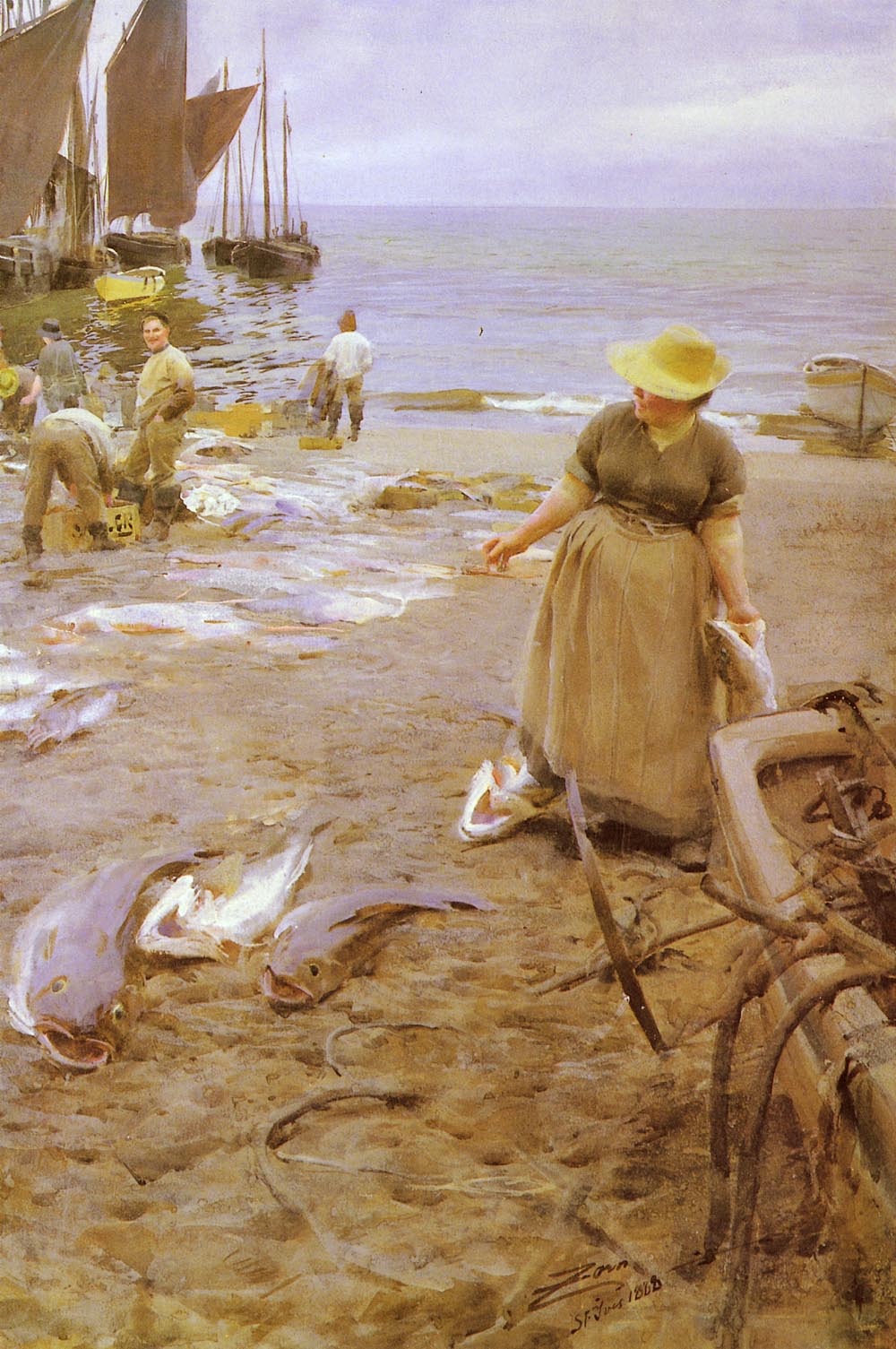
Anders Zorn (1860-1920), Fish Market in Saint Ives (1888), watercolour, 100 x 76.5 cm, Private collection. Wikimedia Commons.
When Anders Zorn was making the transition from watercolour to oil painting, he travelled to the fishing village of Newlyn, near Penzance in Cornwall, where there was an artist’s colony. When there in 1888 he visited the fishing port of Saint Ives, where he painted this Fish Market in Saint Ives.
Although Joaquín Sorolla had been brought up in Valencia and painted its fishing industry and beaches extensively, remarkably few of his paintings show fish.
Joaquín Sorolla y Bastida (1863–1923), Ayamonte, Tuna Fishing (1919), oil on canvas, 349 x 485 cm, Hispanic Society of America, New York, NY. Wikimedia Commons.
In 1919, when he was painting his series of views of Spain for the Hispanic Society of America, those included the tuna market in Ayamonte, Tuna Fishing.
Fish have also appeared in more unusual settings.
Kazimierz Sichulski (1879–1942), Fish (1908), pastel on paperboard, 63 x 82 cm, Muzeum Narodowe w Poznaniu, Poznań, Poland. Wikimedia Commons.
Kazimierz Sichulski’s Fish (1908) is a startlingly original pastel painting, a virtuoso combination of reflections from and views through this water surface, to the fish beneath.
George Dunlop Leslie (1835–1921), The Goldfish Seller (date not known), oil on canvas, 74.9 x 110.5 cm, location not known. Wikimedia Commons.
George Dunlop Leslie’s undated Goldfish Seller shows a hawker trying to sell goldfish to an upper middle class Victorian family. He may have arrived in the horse-drawn cart glimpsed outside the gate, and wears a bowler hat typical of itinerant traders, with a long green smock. The daughter and young son appear particularly unimpressed.
Lovis Corinth (1858–1925), Woman with a Fishtank (the Artist’s Wife) (1911), oil on canvas, 74 × 90.5 cm, Österreichische Galerie Belvedere, Vienna, Austria. Wikimedia Commons.
Lovis Corinth’s Woman with a Fishtank from 1911 shows the artist’s wife Charlotte in their flat on Klopstockstraße in Berlin. The aquarium, full of goldfish, is surrounded by quite a jungle of indoor plants, her little corner of vegetation within their city flat.
Walter Crane (1845–1915), A Diver (date not known), watercolour and gouache on paper mounted on canvas, 55.9 x 66 cm, location not known. Wikimedia Commons.
Painted in a combination of transparent watercolour and gouache, Walter Crane’s undated Diver is an unusual and challenging motif.
Finally, fish have been popular objects included in still life paintings, in what has become termed fruits de mer, the fruit of the sea.
Clara Peeters (fl 1607-1621), Still Life of Fish and a Candlestick (1611), oil on panel, 50 x 72 cm, Museo Nacional del Prado, Madrid. Wikimedia Commons.
Clara Peeters’ Still Life of Fish and a Candlestick is one of the earliest and most accomplished such paintings. She painted this in 1611, when she was in Amsterdam.
Jean-Baptiste-Siméon Chardin (1699–1779), The Ray (1727), oil on canvas, 114.5 x 146 cm, Musée du Louvre, Paris. Wikimedia Commons.
Among the first of Jean-Baptiste-Siméon Chardin’s successful still lifes is The Ray from 1727, exhibited the following year to secure his place in the Académie Royale de Peinture et de Sculpture. This is an extraordinary combination of objects, dominated by the ghostly ‘face’ of the hanging fish, ably supported by the anger of the cat.
Anne Vallayer-Coster (1744–1818), A Still Life of Mackerel, Glassware, a Loaf of Bread and Lemons on a Table with a White Cloth (1787), further details not known. Wikimedia Commons.
After Chardin’s death in 1779, his successor Anne Vallayer-Coster reached her zenith, in brilliant displays such as A Still Life of Mackerel, Glassware, a Loaf of Bread and Lemons on a Table with a White Cloth from 1787. Although reminiscent of Clara Peeters’ fish, these lack the open-mouthed gawp.
The one artist who probably painted more fish than any other was William Merritt Chase, who characteristically dashed off a fish still life to warm up his brushes each day when he was teaching.
William Merritt Chase (1849–1916), The Yield of the Waters (A Fishmarket in Venice) (1878), oil on canvas, 124.5 x 165.1 cm, Detroit Institute of Arts, Detroit, MI. Wikimedia Commons.
After completing his studies in Munich, Chase spent several months in Venice, where he painted one of his best-known still lifes, The Yield of the Waters, also known as A Fishmarket in Venice, (1878). This was probably his most complex and detailed still life, showing a wide variety of the fish and seafood available in the Mediterranean. It also established his own specialist sub-genre of still life: fish, characteristically set against a dark background.
Because most fish aim to spend their entire lives underwater, where few artists go to paint, fish are seldom seen in paintings. That contrasts with those who try to capture fish by going fishing, an activity I have previously covered in this series in this article and a second.
Most of the aquatic creatures seen in paintings of myths, including those accompanying the god Neptune, appear to be caricatures of marine mammals including dolphins, or sea-monsters bearing no resemblance to fish.
Joseph Stella (1877–1946), The Birth of Venus (1922), oil on canvas, 215.9 x 134.6 cm, Private collection. The Athenaeum.
One exception to this is Joseph Stella’s The Birth of Venus from 1922. As might be expected, his treatment is completely novel and seems to have benefited from visits to an aquarium. Aphrodite is shown at sea, in the upper part of the painting her upper body above the waterline, and below morphing into an aquatic plant underneath, where it finally merges into a helical shell. Matching the birds and flowers above the water are brightly coloured fish below.
Joachim Beuckelaer (c 1533–1575), The Four Elements: Water. A Fish Market with the Miraculous Draught of Fishes in the Background (1569), oil on canvas, 158.5 x 215 cm, The National Gallery, London. Wikimedia Commons.
Another interesting exception is Joachim Beuckelaer’s depiction of water in his Four Elements cycle from 1569. This shows A Fish Market with the Miraculous Draught of Fishes in the Background, the one place even landlubbers would come across fish, combined with the Gospel story in the far distance.
Gustave Courbet (1819–1877), The Trout (Summer 1872), oil on canvas, 53 x 87 cm, Kunsthaus Zürich, Zürich, Switzerland. Wikimedia Commons.
In the summer of 1872, as a one-off, Gustave Courbet painted an allegorical still life of The Trout, that is “hooked and bleeding from the gills”, a powerful expression of his personal feelings after being imprisoned for damage to the Vendôme Column during the Paris Commune the previous year.
Joseph Mallord William Turner (1775–1851), Slave Ship (Slavers Throwing Overboard the Dead and Dying, Typhoon Coming On) (1840), oil on canvas, 90.8 × 122.6 cm, Museum of Fine Arts, Boston, MA. Photo by Museum of Fine Arts, Boston, via Wikimedia Commons.
JMW Turner recruits a school of fish for effect in his Slave Ship from 1840. His threatening sky and violent sea put the ship in the middle distance, silhouetted against the blood-red sky. The foreground is filled with the ghastly evidence of the slaves who were cast overboard.
Joseph Mallord William Turner (1775–1851), Slave Ship (Slavers Throwing Overboard the Dead and Dying, Typhoon Coming On) (detail) (1840), oil on canvas, 90.8 × 122.6 cm, Museum of Fine Arts, Boston, MA. Photo by Museum of Fine Arts, Boston, via Wikimedia Commons.
Seen in amongst a feeding frenzy of fish and scavenging seabirds are hands raised from the waves in their final plea for rescue, a gruesome manacled leg, and various shackles used to restrain the slaves when in transit. Further back on the left a vague white form could represent spirits, and on the right is the thrashing tail of a sea monster.
Hans Thoma (1839–1924), Three Mermaids (1879), oil on canvas, 106 × 77.6 cm, Städelsches Kunstinstitut und Städtische Galerie, Frankfurt, Germany. Wikimedia Commons.
Fish make the occasional appearance alongside legendary mermaids, as in Hans Thoma’s Three Mermaids from 1879. These mermaids are remarkably human in form, lacking fishtails, and frolic with fish under the light of the moon.
Historically the most important fish in Europe has been the humble herring. In the Middle Ages herring fisheries prospered and were the foundation of Copenhagen and Great Yarmouth, and influential in early Amsterdam. They remain strongly associated with the Netherlands and Nordic countries, where they are commonly preserved in brine (soused) or pickled.
Gabriel Metsu (1629–1667), Woman Selling Herring (c 1661-62), oil on panel, 37 x 33 cm, Rijksmuseum Amsterdam, Amsterdam, The Netherlands. Wikimedia Commons.
Gabriel Metsu’s Woman Selling Herring (c 1661-62) is going from door to door with her fish, here trying to convince an old woman standing with a stick at the door of her dilapidated cottage in the Dutch Republic.
Hans Andersen Brendekilde (1857–1942), Home for Dinner (1917), further details not known. Wikimedia Commons.
In Hans Andersen Brendekilde’s Home for Dinner from 1917, a young girl holding some fresh fish stands talking to a man with a spade.
JMW Turner (1775–1851), St. Mawes, Cornwall (c 1823), watercolour, 14.3 x 21.9 cm, Yale Center for British Art, New Haven, CT. Wikimedia Commons.
JMW Turner toured the West Country as far as Cornwall in 1811, and the Tate Gallery has his ninety-page sketchbook recording many views of the Cornish coast from that visit. He later developed several into fine oil paintings, although it’s unclear whether this watercolour of St. Mawes, Cornwall, from about 1823, had its origins in those sketches and studies.
As with his paintings of other coastal areas, Turner shows a fishing boat coming in to a beach to land its catch, and the great activity in the open air fish market in the foreground. Behind are typical Cornish cottages stepped up from the shore to the top of the coastal cliffs, and the castles of St Mawes (closer) and Pendennis, in Falmouth (more distant, on the other side of this estuary).
Richard Dadd (1817–1886), Fish Market by the Sea (c 1860), oil on canvas, 100.3 x 125.7 cm, Yale Center for British Art, Paul Mellon Collection, New Haven, CT. Courtesy of the Yale Center for British Art.
Richard Dadd’s Fish Market by the Sea, from about 1860, shows an impromptu open-air fish market, run by the fishermen’s wives, to sell their husband’s catch as soon as it had been landed.
Over the previous fifteen articles Dante has taken us through his vision of Hell. As he journeys on to Purgatory, this article offers an overview of the best-known book in his Divine Comedy.
Sandro Botticelli (1445–1510), Map of Hell (1480-90), silverpoint, ink and distemper, 33 x 47.5 cm, Biblioteca Apostólica Vaticana, Vatican City. Wikimedia Commons.
It was Botticelli who provided the clearest pictorial map of Dante’s journey, as he descended with Virgil through a succession of circles, each with its own class of sinner. Highest are the woods where Dante was wandering when he encountered the three wild beasts. At the left, Virgil led Dante down to the area where the cowards are trapped, neither being allowed admittance to Heaven, nor to Hell. Charon’s boat then crosses the River Acheron, shown in blue, taking Dante and Virgil to the First Circle of Limbo.
This journey starts just before dawn on Good Friday in 1300, when the poet is wandering lost in a dark wood. His way is blocked first by a leopard, then by a lion, and finally by a wolf.
Jean-Baptiste Camille Corot (1796–1875), Dante and Virgil (1859), oil on canvas, 260.4 x 170.5 cm, Museum of Fine Arts Boston, Boston, MA. Wikimedia Commons.
Forced to retreat back into the wood, Dante comes across a man who introduces himself by way of a riddle, leading Dante to recognise him as the ghost of the classical Roman poet Virgil. He tells Dante that the only way out is to pass through the eternity of Hell. When the pair reach the gate of Hell, they read its warnings, culminating in the bleak exhortation: leave behind all hope, you who enter.
They first encounter those stuck forever on the periphery, those whose lives were too cowardly to enter Heaven or Hell, who are stung repeatedly by flies and wasps.
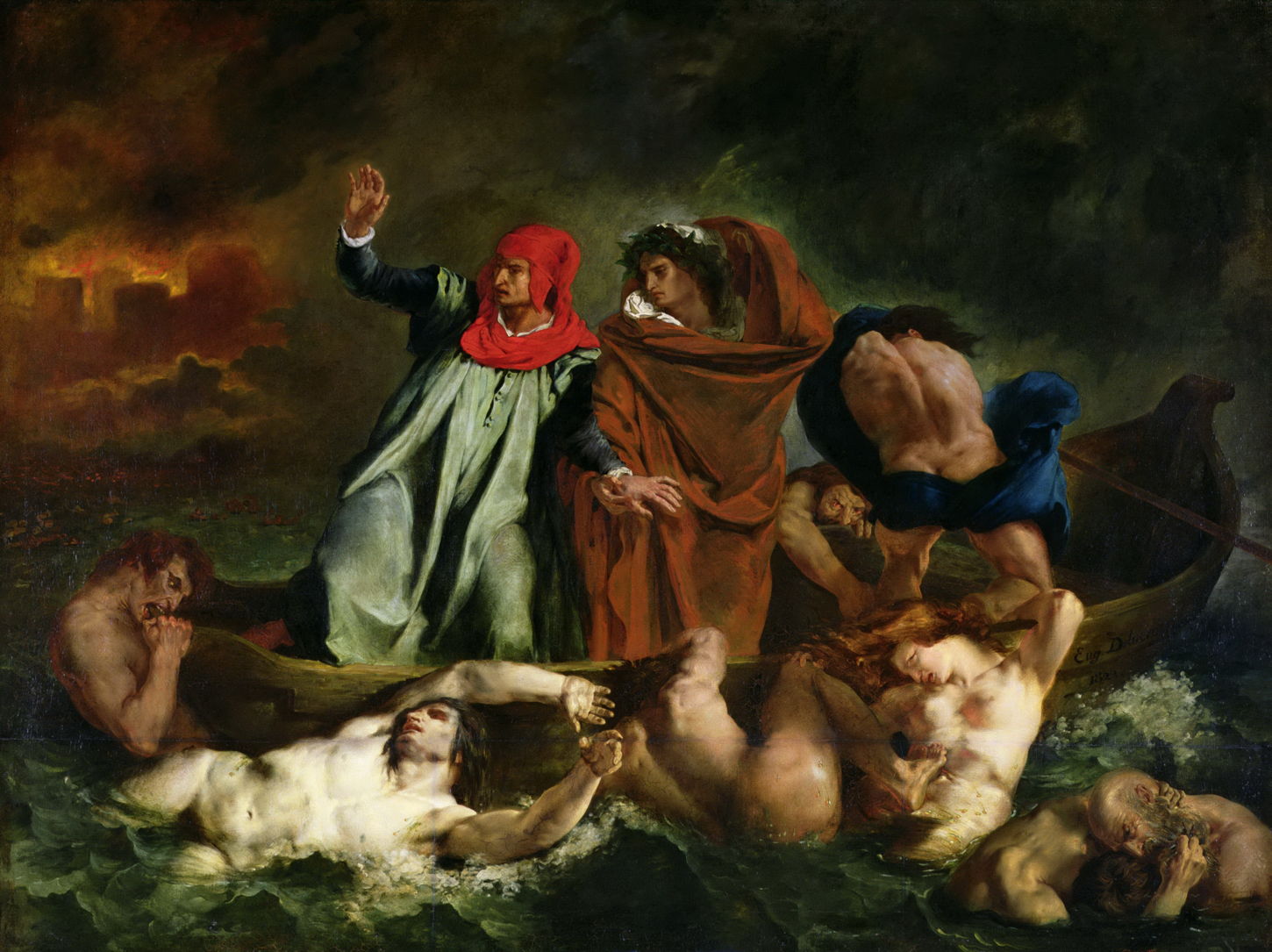
Eugène Delacroix (1798–1863), The Barque of Dante (Dante and Virgil in Hell) (1822), oil on canvas, 189 x 241 cm, Musée du Louvre, Paris. Wikimedia Commons.
They then cross the River Acheron in Charon’s ferryboat, and enter the First Circle of Limbo, a place of tranquil and calm. Here are the souls of those who led honourable lives before the Christian era, and others who never had the opportunity to follow Christ. These include the great classical writers: Homer, Horace the satirist, Ovid and Lucan. Together with Virgil, these five invite Dante himself to join them as the sixth among the ranks of great writers, in an ambitious piece of self-promotion.
Virgil leads Dante down to the Second Circle, for those guilty of the sin of lust.
William Blake (1757–1827), The Circle of the Lustful: Francesca da Rimini (The Whirlwind of Lovers) (c 1824), pen and watercolour over pencil, 36.8 x 52.2 cm, Birmingham Museums and Art Gallery, Birmingham, England. The Athenaeum.
Here the lustful are thrown around by vicious winds, and Dante hears the tragic story of Paolo and Francesca da Rimini, that inspired many fine paintings.
Gustave Doré (1832–1883) Paolo and Francesca da Rimini (1863), oil on canvas, 280.7 x 194.3 cm, Private collection. Wikimedia Commons.
Passing the three-headed dog-monster Cerberus, Virgil takes Dante on to the Third Circle, full of gluttons wallowing in stinking mud, under a constant deluge of rain, sleet and snow. In the Fourth Circle, they see a mixture of the avaricious and prodigals pushing great boulders in opposite directions.
William Blake (1757–1827), The Stygian Lake, with the Ireful Sinners Fighting (Dante’s Inferno) (1824-27) pen, ink and watercolour over pencil, dimensions not known, National Gallery of Victoria, Melbourne, Australia. Wikimedia Commons.
The Fifth Circle holds the swamp of the River Styx, in which sullen spirits are submerged and the wrathful fight one another. Dante and Virgil cross this in a boat piloted by Phlegyas, who deposits them at the gate to the city of Dis, entrance to the lower parts of Hell. The gate is slammed shut on them, and requires a messenger from Heaven to let them through.
William Blake (1757–1827), Farinata degli Uberti (Dante’s Inferno) (1824-27) media and dimensions not known, The British Museum, London. Wikimedia Commons.
Here Dante enters the Sixth Circle, for heretics who denied the soul’s immortality, among them the Florentine Farinata degli Uberti, who is imprisoned in a tomb. The pair are carried by Nessus the Centaur on to the Seventh Circle, for the violent.
William Blake (1757–1827), The Wood of the Self-Murderers: The Harpies and the Suicides (Dante’s Inferno) (1824-27), graphite, ink and watercolour on paper, dimensions not known, National Gallery of Victoria, Melbourne, Australia. Wikimedia Commons.
These not only include tyrannical warriors like Attila the Hun, murderers and bandits, but those whose violence was directed at their own lives in suicide, who are trees in a wood and kept in perpetual pain by harpies feeding on them. The pair then cross a desert on which fire rains to torment the souls of blasphemers, sodomites, and usurers.
William Blake (1757–1827), The Symbolic Figure of the Course of Human History Described by Virgil (Dante’s Inferno) (1824-27), further details not known. Wikimedia Commons.
Dante learns of a statue of an old man on Mount Ida, on the island of Crete, whose tears form the rivers of Hell.
Virgil guides Dante onto the back of Geryon, formerly a king slain by Hercules and condemned to suffer in Hell for his fraud, who flies the pair on to the Eighth Circle, for the fraudulent. This is divided into a series of rottenpockets, depressions in which different types of fraudster are confined. They pass through the areas for pimps, flatterers, corrupt religious leaders, sorcerers, corrupt officials and hypocrites.
William Blake (1757–1827), The Simonist Pope (Dante’s Inferno) (1824-27), watercolour, 52.5 x 36.8 cm, The Tate Gallery, London. Wikimedia Commons.
Among the corrupt religious leaders or simonists is Pope Nicholas III, who had been shamelessly nepotistic.
Joseph Anton Koch (1768-1839), Thieves (1825-28), fresco, dimensions not known, Casa Massimo, Rome, Italy. Image by Sailko, via Wikimedia Commons.
The later rottenpockets contain thieves, those who gave fraudulent counsel, those who sowed discord, and falsifiers and imposters of various kinds. Thieves are attacked repeatedly by snakes to undergo their own reptilian transformation.
Dante and Virgil are lowered into the Ninth Circle by Antaeus, one of the giants who stand guard around its periphery.
Gustave Doré (1832–1883), Dante and Virgil in the ninth circle of hell (1861), oil on canvas, 311 x 428 cm, Musée de Brou, Bourg-en-Bresse, France. Wikimedia Commons.
There is the lake of Cocytus, in which those guilty of treachery are frozen and suffering for eternity. These include souls of those who were treacherous against their relatives, their homeland, guests and benefactors.
William Blake (1757–1827), Count Ugolino and His Sons in Prison (c 1826), pen, tempera and gold on panel, 32.7 x 43 cm, Fitzwilliam Museum, University of Cambridge, Cambridge, England. The Athenaeum.
Among them is Count Ugolino, who sinks his teeth into the neck of Archbishop Ruggieri, who left him to starve to death in a cell.
Joseph Anton Koch (1768-1839), Hell (study for Casa Massimo frescoes) (c 1825), watercolour and gouche, dimensions and location not known. Wikimedia Commons.
The artists
William Blake (1757–1827) was a British visionary painter and illustrator whose last and incomplete work was an illustrated edition of the Divine Comedy for the painter John Linnell. Most of his works shown in this series were created for that, although he did draw and paint scenes during his earlier career. I have a major series on his work here.
Sandro Botticelli (1445–1510) was one of the leading painters of the early Southern Renaissance, working in his native city of Florence. In addition to his huge egg tempera masterpieces of i (c 1482) and The Birth of Venus (c 1485), he was a lifelong fan of Dante’s writings. He produced drawings which were engraved for the first printed edition of the Divine Comedy in 1481, but these weren’t successful, most copies only having two or three of the 19 which were engraved. He later began a manuscript illustrated edition on parchment, but few pages were ever fully illuminated.
William-Adolphe Bouguereau (1825–1905) was a precocious and highly-acclaimed academic painter who dominated the Salon in the late nineteenth century with his figurative works, often drawn from mythology. Classically-trained at the École des Beaux-Arts, he grew infamous for his nudes painted against false settings, and his vehement opposition to Impressionism. However, he taught at the Académie Julian, and worked tirelessly even when his paintings fell from favour.
Jean-Baptiste Camille Corot (1796–1875) was French, and one of the most prolific and greatest European landscape artists of the nineteenth century, who was key to the development of Impressionism. Following in the classical tradition, he also painted several narrative works set in those landscapes.
Eugène Delacroix (1798–1863) was a major French painter whose Romantic and painterly style laid the groundwork for the Impressionists. In addition to many fine easel works, he painted murals and was an accomplished lithographer too. Many of his paintings are narrative, and among the most famous is Liberty Leading the People from 1830. This article introduces a series featuring his major works.
Gustave Doré (1832–1883) was the leading French illustrator of the nineteenth century, whose paintings are still relatively unknown. Early in his career, he produced a complete set of seventy illustrations for translations of the Inferno, first published in 1857 and still being used. These were followed in 1867 by more illustrations for Purgatorio and Paradiso.This article looks at his paintings.
Joseph Anton Koch (1768-1839) was an Austrian landscape painter, who worked mainly in Neoclassical style. During his second stay in Rome, he was commissioned to paint frescos in the Villa Massimi on the walls of the Dante Room there, which remain one of the most florid visual accounts of Dante’s Inferno. He completed those between 1824-29. He also appears to have drawn a set of illustrations for Dante’s Inferno in about 1808.
Purgatory and Paradise
Although Heaven and Hell have clear biblical roots, the concept of Purgatory as part of the Christian life after death is more recent. It originated in the early Christian Church, flourished in the Middle Ages, and ripened only in the Catholic Church after the schism of Protestants in the Reformation during the sixteenth century. It can be seen as a route to Heaven for those who had sinned on earth, so long as they had confessed and repented.
Dante had much greater freedom in imagining what Purgatory might be, and adopted a physical structure that is the exact inverse of his vision of Hell: a mountain rising through seven terraces to culminate in a terrestrial paradise at the summit. Each terrace then accommodates a class of sin, rising from pride at the foot to lust just below Paradise.
The least-known of the three books in Dante’s Divine Comedy,Paradise was its most important to contemporary readers. Having given gruesome detail of what would await them in Inferno, and the penance they would have to pay in Purgatory, Paradise must be everyone’s ultimate aspiration. Dante invokes classical cosmology in nine concentric shells rather than the simple physical structures of the two previous realms, which for many readers is more nebulous.
Robin Kirkpatrick (trans) (2012) Dante, The Divine Comedy, Inferno, Purgatorio, Paradiso, Penguin Classics. ISBN 978 0 141 19749 4.
Richard Lansing (ed) (2000) The Dante Encyclopedia, Routledge. ISBN 978 0 415 87611 7.
Guy P Raffa (2009) The Complete Danteworlds, A Reader’s Guide to the Divine Comedy, Chicago UP. ISBN 978 0 2267 0270 4.
Prue Shaw (2014) Reading Dante, From Here to Eternity, Liveright. ISBN 978 1 63149 006 4.
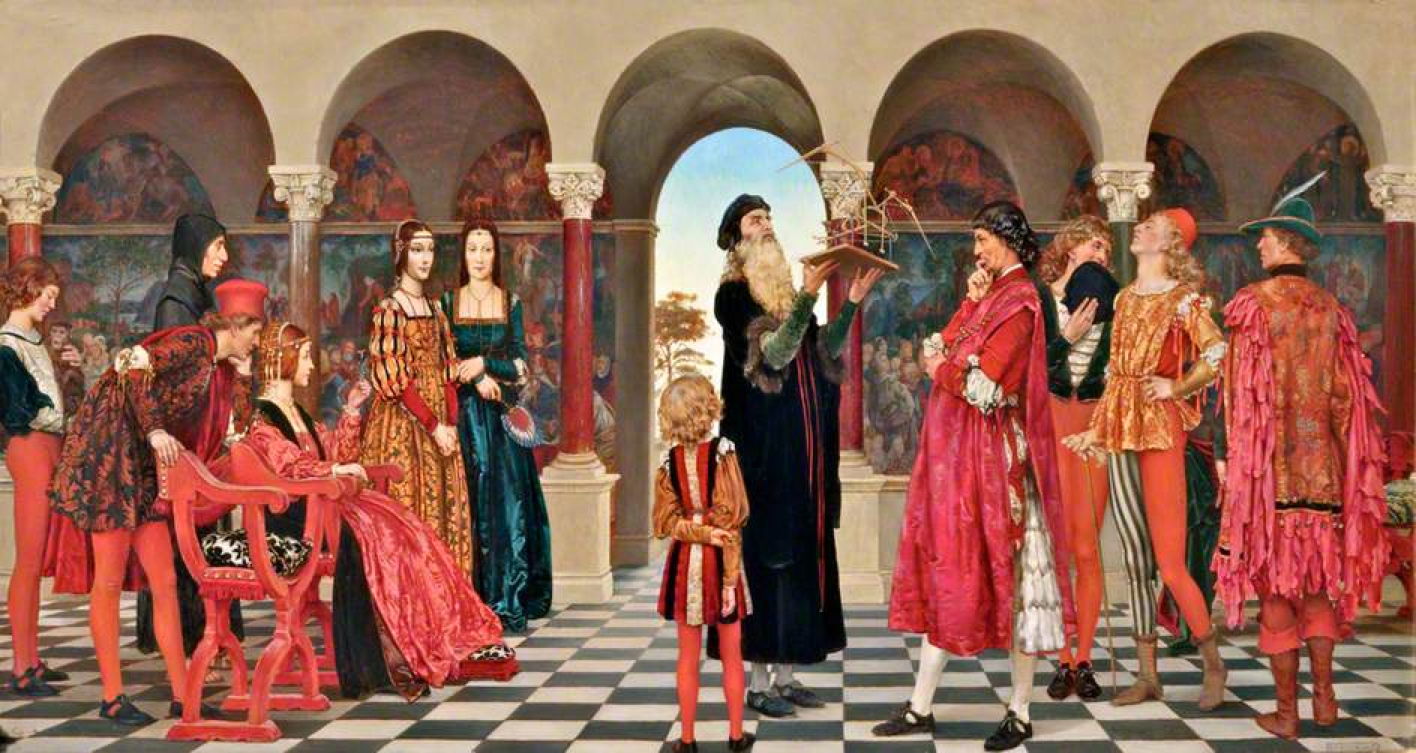
Artists seldom painted the interior of their studio until the nineteenth century, and it was unheard of in the Renaissance. So when you’re offered a glimpse into that of Sandro Botticelli in the 1480s you’d be justifiably suspicious, particularly when it wasn’t painted until 1922, over half a millennium later.
Nevertheless, almost exactly eleven years ago, on the fifth of November 2014, a remarkable painting claiming to depict Botticelli’s studio at that time was auctioned in New York. Captured on its canvas were the faces of those long dead, those of the artist and members of the Medici family.
Eleanor Fortescue-Brickdale (1872–1945), Botticelli’s studio: The first visit of Simonetta presented by Giulio and Lorenzo de Medici (1922), oil on canvas, 74.9 × 126.4 cm, Private collection. Wikimedia Commons.
The painting’s title reveals its key figures: Botticelli’s studio: The first visit of Simonetta presented by Giulio and Lorenzo de Medici (1922). The artist stands at the left in front of an exquisite tondo he is working on. Bowing to him at the centre is Giuliano de’ Medici, who is accompanied by Simonetta Vespucci, wearing the green dress. Behind her is Lorenzo de’ Medici, also known as Lorenzo the Magnificent, and behind him are Giovanna Tornabuoni and her attendants. The view through the window is of the Palazzo Vecchio in the centre of Florence.
Painted by the British artist Eleanor Fortescue-Brickdale, those figures weren’t based on models or imagination, but on contemporary sources.
Domenico Ghirlandaio (1449–1494), Giovanna Tornabuoni and attendants, detail of The Visitation (c 1488), fresco, dimensions not known, Tornabuoni Chapel, Santa Maria Novella Church, Florence. Wikimedia Commons.
Giovanna Tornabuoni comes from a detail of Domenico Ghirlandaio’s painting The Visitation (c 1488) in the Tornabuoni Chapel of the Church of Santa Maria Novella in Florence. Giovanna was born as Giovanna degli Albizzi in 1468, married Lorenzo Tornabuoni in 1486 when she was about eighteen, and died in childbirth two years later in 1488. She is here accompanied by her maid and nurse.
Girolamo Macchietti (1535–1592), Lorenzo the Magnificent (Lorenzo de’ Medici (1449-1492)) (date not known), oil, dimensions not known, location not known. Wikimedia Commons.
Lorenzo de’ Medici (1449-1492) hails from Girolamo Macchietti’s undated portrait of Lorenzo the Magnificent. Lorenzo was born in 1449 into the banking family, the grandson of Cosimo de’ Medici, at the time one of the wealthiest and most powerful people in Europe. Lorenzo was groomed for power, and became de facto ruler of the Florentine Republic when his father died in 1469.
He survived an attempted assassination in the Cathedral of Santa Maria del Fiore on Easter Sunday 1478, in which his brother Giuliano was stabbed to death. This led to his excommunication, and invasion by forces of the King of Naples. He resolved that, and died in 1492, when he was forty-three.
Sandro Botticelli (1445–1510), Portrait of Giuliano de’ Medici (c 1475), tempera on panel, 54 x 36 cm, Accademia Carrara, Bergamo, Italy. Wikimedia Commons.
Botticelli also painted this Portrait of Giuliano de’ Medici in about 1475. Giuliano was born in 1453, younger brother and co-ruler of the Florentine Republic with Lorenzo. He was brutally murdered in that attack in the cathedral on Easter Sunday 1478, dying at the age of twenty-five. Although he never married, an illegitimate son of his became Pope Clement VII.
Sandro Botticelli (1445–1510), Madonna of the Magnificat (1483), tempera on panel, diameter 118 cm, Galleria degli Uffizi, Florence. Wikimedia Commons.
The painting shown in progress is Botticelli’s Madonna of the Magnificat, thought to have been completed in 1483. It shows the Virgin Mary being crowned by a pair of angels, writing down the start of the Magnificat in a book, and holding a pomegranate in her left hand. It has also been interpreted as a family portrait of the de’ Medicis, in which the Virgin is Lucrezia Tornabuoni, the mother of Lorenzo and Giuliano de’ Medici, who are the angels. I believe that Lucrezia was one of Giovanna Tornabuoni’s aunts by marriage.
Sandro Botticelli (1445–1510), The Adoration of the Magi (detail) (c 1475), tempera on wood, dimensions not known, Galleria degli Uffizi, Florence. Wikimedia Commons.
The source of the likeness of Botticelli is more of a problem, as he isn’t known to have painted a formal self-portrait. It’s generally believed, though, that he revealed himself in cameo in this detail from his The Adoration of the Magi from about 1475.
Filippino Lippi (1457–1504), Disputation with Simon Magus and Crucifixion of St Peter (detail) (1424-28), fresco, dimensions not known, Cappella Brancacci, Santa Maria del Carmine, Florence. Image by Marie-Lan Nguyen, via Wikimedia Commons.
It’s also thought that Filippino Lippi included his portrait in this section he painted in 1483-84 of Massaccio’s incomplete fresco in the Cappella Brancacci, Santa Maria del Carmine, Florence, in Disputation with Simon Magus and Crucifixion of St Peter.
But of all the figures shown in this painting, Simonetta Vespucci is the most fascinating. She was born Simonetta Cattaneo in 1453, and when she was only fifteen or sixteen, she married Marco Vespucci, cousin of Amerigo Vespucci, the first to demonstrate that the New World of the West Indies and Brazil wasn’t part of Asia.
Once married, she lived with her husband in Florence, where she was a great favourite at the court of the de’ Medicis. Giuliano de’ Medici entered a jousting tournament in 1475 bearing a banner with an image of Simonetta as Pallas Athene, painted by Botticelli. She had the reputation of being the most beautiful woman in the whole of northern Italy, but that beauty was fleeting as she died of tuberculosis in 1476, when she was only twenty-two.
Piero di Cosimo (1462–1521), Portrait of Simonetta Vespucci (1490), media not known, 57 x 42 cm, Musée Condé, Chantilly, France. Wikimedia Commons.
Many paintings have been claimed to be portraits of her, but perhaps the most credible is Piero di Cosimo’s Portrait of Simonetta Vespucci from 1490.
Sandro Botticelli (1445–1510), Idealized Portrait of a Lady (Portrait of Simonetta Vespucci as Nymph) (1480), media not known, 81.8 x 54 cm, Städelsches Kunstinstitut und Städtische Galerie, Frankfurt, Germany. Wikimedia Commons.
Several of Botticelli’s works have been claimed to feature figures for which Simonetta modelled, even the naked Venus in his famous The Birth of Venus (1484-86). The least unlikely might be his Idealized Portrait of a Lady, also known as Portrait of Simonetta Vespucci as Nymph, thought to have been painted in 1480, four years after her death. Such portraits were commonly not true to life, but idealisations intended to flatter rather than identify, so we will never know if she was its subject.
Inevitably, time in Botticelli’s studio is slightly out of joint. The figures might have been able to gather together in this way in about 1475, before the deaths of Simonetta and Giuliano de’ Medici, but that is well before Botticelli might have painted Madonna of the Magnificat, and when Giovanna Tornabuoni was still a child.
This remarkable painting was the second of its kind by Eleanor Fortescue-Brickdale.
Eleanor Fortescue-Brickdale (1872–1945), The Forerunner (1920), oil on canvas, 59.6 × 122 cm, Lady Lever Art Gallery, Liverpool, England. Wikimedia Commons.
Two years previously, in 1920, she had painted The Forerunner, showing Leonardo da Vinci trying to convince the Milanese court of his idea for flying machines. Notable figures included here are (from the left) Savonarola (from Fra Bartolomeo’s portrait), Beatrice d’Este (Duchess of Milan), Cecilia Gallerani, Elisabetta Gonzaga, Leonardo da Vinci, and Ludovico Sforza (Duke of Milan, and Leonardo’s patron).
Eleanor Fortescue-Brickdale sold The Forerunner to Lord Leverhulme, and it is now on view in the Lady Lever Art Gallery. She was subsequently commissioned to paint Botticelli’s Studio in 1922 for Montague Rendell. That was shown at the Royal Academy later that year, and has been in a succession of private collections since.
Sirens are mythical woman-like creatures with alluring voices, best-known from their appearance in Homer’s Odyssey, but also featuring in other tales including that of Jason and the Argonauts. Typically their singing lures sailors to their death, and that reputation has led them to represent anything that’s dangerously attractive. Originally they weren’t described in any physical detail, but visual representations soon envisaged them as having the upper bodies of beautiful young women, and the lower bodies and legs of birds, and that has been incorporated and elaborated in later accounts and retelling.
At the end of the year that Odysseus and his crew stayed with the sorceress Circe, she helpfully advised him that he would have to sail past the sirens, two to five creatures who lured men to their death with their singing. In preparation, Odysseus got his sailors to plug their ears with beeswax before they reached the sirens, so they couldn’t hear their song, and to bind him to the mast. He gave them strict instructions that under no circumstances, no matter what he said at the time, were they to loosen his bonds, as he would be listening to the sirens’ song.
As the group reached the sirens, Odysseus told his men to release him, but instead they bound him even more closely to the mast. Once they had passed safely from earshot of the sirens, Odysseus used his facial expression to inform his men, who then released him, and they sailed on.
William Etty (1787–1849), The Sirens and Ulysses (c 1837), oil on canvas, 297 x 442.5 cm, Manchester Art Gallery, Manchester, England. Wikimedia Commons.
William Etty’s The Sirens and Ulysses from about 1837 is one of the pioneering accounts in paint of this story from the Odyssey. His three naked sirens are all woman, one playing a lyre, another holding double pipes aloft, all three doing their best to draw the sailors from Odysseus’ ship to a shore where there are the remains of earlier victims.
Edward Poynter (1836–1919), The Siren (c 1864), oil on canvas, dimensions not known, Private collection. Wikimedia Commons.
Edward Poynter’s The Siren from about 1864 has Aesthetic overtones in the lyre she is playing.
Arnold Böcklin (1827–1901), Sirens (1875), tempera on canvas, 46 × 31 cm, Alte Nationalgalerie, Berlin. Wikimedia Commons.
Arnold Böcklin takes an unusual approach of almost dereferencing Odysseus in his painting of Sirens from 1875, although there is an approaching vessel that could be his. The two sirens filling the canvas are very human down to the waist, below which they resemble birds. One sits facing us, clearly in full voice, and highly alluring in looks. The other, her back towards us, is playing an aulos and looks rather obese, to the point of almost being comical, her right breast laid upon a flat-topped rock. At their feet are three human skulls and other bones to indicate their graver intentions.
Gustave Moreau (1826–1898), The Sirens (1882), watercolor and gouache, brown ink, and black chalk on cream wove paper, 32.8 x 20.9 cm, Harvard Art Museums/Fogg Museum (Bequest of Grenville L. Winthrop), Cambridge, MA. Courtesy of Harvard Art Museums.
Gustave Moreau’s The Sirens (1882) shows them as beautiful figures in a static scene, with a saturnine setting sun. There is, though, a lone sail on the horizon that hasn’t yet attracted their attention. Their lower legs turn into the writhing coils of sea serpents.
Gustave Moreau (1826–1898), The Sirens (c 1885), oil on canvas, 89 x 118 cm, Musée National Gustave-Moreau, Paris. Wikimedia Commons.
Moreau’s slightly later group portrait of The Sirens from about 1885 is more complete, with Odysseus sailing past, but its three figures are clearly all woman and no bird.
Hans Thoma (1839–1924), Eight Dancing Women with Bird Bodies (1886), oil on panel, 38 × 58.5 cm, location not known. Wikimedia Commons.
Eight Dancing Women with Bird Bodies (1886) is one of Hans Thoma’s unusual mythological paintings. The best-known women with bird bodies were the sirens, who range in number from two to five. In another painting showing the sirens trying to lure a passing ship, Thoma paints similar figures, suggesting these are intended to be sirens.
John William Waterhouse (1849–1917), Ulysses and the Sirens (1891), oil on canvas, 100.6 x 201.7 cm, National Gallery of Victoria, Melbourne, Australia. Wikimedia Commons.
John William Waterhouse’s Ulysses and the Sirens (1891) is closer to the Homeric account, although he provides a total of seven sirens, shown as large eagle-like birds of prey with only the head and neck of beautiful women. He has added bandage wrappings around the head of each sailor to make it clear that their ears are stopped from hearing sound, a visual device that links neatly with the text. His sirens are clearly singing, particularly the one closest to the viewer, who is challenging the hearing protection of one of the sailors. Another sailor, at the stern of the ship (left of the painting), is seen clutching his ears.
John William Waterhouse (1849–1917), The Siren (1900), oil on canvas, 81 x 53 cm, location not known. Wikimedia Commons.
Almost a decade later, Waterhouse painted this non-narrative portrait of The Siren (1900).
Henrietta Rae (1859–1928), The Sirens (1903), oil on canvas, 114.3 × 254 cm, Private collection. Wikimedia Commons.
The Sirens (1903) marked Henrietta Rae’s return to painting narrative works featuring classical nudes. Odysseus’ ship is in the distance, as three beautiful sirens use their aulos and lyre to lure its occupants.
Late mythology suggests an unpleasant end for these sirens: Hera challenged them to a singing contest against the Muses. When the latter won, the penalty they exacted of the sirens was to have all their feathers plucked out to turn into crowns. As a result of that disgrace, the sirens turned white, fell into the sea, and formed the islands including modern Souda, on the north-west coast of Crete in the Mediterranean.
Sirens have steadily spread their presence into other paintings, particularly during the twentieth century.
Georg Janny (1864–1935), Sirens Bathing by the Sea (1922), gouache on cardboard, further details not known. Wikimedia Commons.
Georg Janny’s fantasy painting of Sirens Bathing by the Sea from 1922 is throughly other-worldly, and there’s no trace of their bird legs.
Paul Nash (1892–1946), Nest of the Siren (1930), oil on canvas, 77 x 51.2 cm, HM Treasury, London, England. The Athenaeum.
More cryptic is Paul Nash’s Surrealist Nest of the Siren (1930), which brings together the incongruous, and hardly refers to Homer’s story. The painting is framed by brightly-painted walls with pillared decorations, perhaps ornate wainscot panelling. In the middle of these is what might be a painting, but also seems to be a three-dimensional plant trough containing sinuous shrubs. In the middle of those is a small nest, like an acorn cup.
Standing in front of this is a structure resembling a weather-vane, mounted on a turned wooden shaft. At the weather end of the vane is the faceless figure of a siren; the leeward end appears purely decorative. Three red rods appear to have detached themselves from the walling, two protruding from the plant trough, the third resting on the floor.
They even manage to sneak symbolically into other classical stories.
Anne-Louis Girodet de Roucy-Trioson (1767-1824), The Meeting of Orestes and Hermione (c 1800), pen and brown and black ink, point of brush and brown and gray wash, with black chalk and graphite, heightened with white gouache on cream wove paper, 28.5 x 21.8 cm, Cleveland Museum of Art (Leonard C. Hanna, Jr. Fund), Cleveland, OH. Courtesy of Cleveland Museum of Art.
In Girodet’s ink and chalk drawing of The Meeting of Orestes and Hermione (c 1800), Hermione is seen at the right, her arms folded, looking coy as Orestes approaches her. The second woman, with Orestes, is presumably Hermione’s maid. This is one of a series of illustrations made by Girodet to accompany Racine’s play, and has subtleties you might expect from a great narrative artist. Visible in the gap between the figures is a table-leg in the form not of a Fury foretelling Orestes’ fate, but of a siren, implying that Hermione is luring Orestes to her. Hermione, for all her apparent coyness, has let the right shoulder-strap of her robe slip, in her enticement of Orestes. She has assumed the role of femme fatale, as portrayed by Euripides and Racine.
In more recent literature, sirens appear in the less-known second part of Goethe’s play Faust.
Margret Hofheinz-Döring (1910–1994), With the Sirens (1962), pastel, 34 x 25 cm, Galerie Brigitte Mauch Göppingen. Image by Peter Mauch, courtesy of Margret Hofheinz-Döring/ Galerie Brigitte Mauch Göppingen, via Wikimedia Commons.
Margret Hofheinz-Döring is one of the few artists who has painted from this second part. With the Sirens from 1962 is her pastel painting showing the sirens among rocky inlets of the Aegean Sea, a sub-scene concluding the second act.
Dante and Virgil move on from their encounter with Count Ugolino towards a great contraption that looks like a windmill from the distance. As they grow closer, they pass by shades of the dead frozen and stacked up.
Joseph Anton Koch (1768-1839), Hell (study for Casa Massimo frescoes) (c 1825), watercolour and gouche, dimensions and location not known. Wikimedia Commons.
Joseph Anton Koch (1768-1839), Lucifer (1825-28), fresco, dimensions not known, Casa Massimo, Rome, Italy. Image by Sailko, via Wikimedia Commons.
Joseph Anton Koch (1768-1839), Lucifer (detail) (1825-28), fresco, dimensions not known, Casa Massimo, Rome, Italy. Image by Sailko, via Wikimedia Commons.
Virgil then shows Dante the ruler of Hell, a huge giant frozen up to his chest. He has three faces: one looking forward is bright red, that on the right a dirty yellow, and on the left black. Behind each face is a pair of vane-like wings fanning the ice-cold wind blowing across Lake Cocytus.
William Blake (1757–1827), Lucifer, Canto 34 (Dante’s Inferno) (1824-27), further details not known. Wikimedia Commons.
Gustave Doré (1832–1883), Lucifer, King of Hell (c 1857), engraving, dimensions and location not known. Image by Karl Hahn, via Wikimedia Commons.
His six eyes are weeping, and each mouth is chewing one of the souls from that pit of Hell. Virgil points out that one of them, his legs protruding from Lucifer’s lips, is Judas Iscariot, who betrayed Jesus Christ for thirty pieces of silver. The other two are Brutus and Cassius being punished for their assassination of Julius Caesar.
Artist not known, illustration to Dante’s Divine Comedy, Canto 34 (c 1350), folio 48r, media and dimensions not known, Bibliotheca Gymnasii Altonani, Hamburg, Germany. Wikimedia Commons.
John Flaxman (1755–1826), Ruler of the Realm of Sadness (Divine Comedy) (1793), engraving by Tommaso Piroli from original drawing, media and dimensions not known, Cornell University Library, Ithaca, NY. Wikimedia Commons.
Virgil tells Dante that he has now seen the whole of Hell, and it’s time for them to leave. They make their way up some steps through a fissure in the rock.
Gustave Doré (1832–1883), Inferno Canto 34 (c 1857), engraving, dimensions and location not known. Wikimedia Commons.
Where Dante expects to see the body of Lucifer again, he sees just his legs.
Artist not known, illustration to Dante’s Divine Comedy, Canto 34 (c 1350), folio 48v, media and dimensions not known, Bibliotheca Gymnasii Altonani, Hamburg, Germany. Wikimedia Commons.
Virgil tells him they must move on quickly, now the sun is rising. They walk through a cavern, along a path long and arduous. Eventually they emerge below the stars. With that, Dante’s account of his visit to Hell is complete.
Filippo Napoletano (1589–1629), Dante and Virgil in the Underworld (1622), oil on slate, 44 × 60 cm, Private collection. Wikimedia Commons.
Wilhelm Trübner (1851–1917), Hell, Scene from Danté’s Divine Comedy (1880), oil on canvas, 137 x 249 cm, Museumslandschaft Hessen Kassel, Kassel, Germany. Wikimedia Commons.
The artists
William Blake (1757–1827) was a British visionary painter and illustrator whose last and incomplete work was an illustrated edition of the Divine Comedy for the painter John Linnell. Most of his works shown in this series were created for that, although he did draw and paint scenes during his earlier career. I have a major series on his work here.
Gustave Doré (1832–1883) was the leading French illustrator of the nineteenth century, whose paintings are still relatively unknown. Early in his career, he produced a complete set of seventy illustrations for translations of the Inferno, first published in 1857 and still being used. These were followed in 1867 by more illustrations for Purgatorio and Paradiso.This article looks at his paintings.
John Flaxman (1755–1826) was a British sculptor and draughtsman who occasionally painted too. When he was in Rome between 1787-91, he produced drawings for book illustrations, including a set of 111 for an edition of The Divine Comedy. In 1810, he was appointed the Professor of Sculpture to the Royal Academy in London, and in 1817 made drawings to illustrate Hesiod, which were engraved by William Blake.
Joseph Anton Koch (1768-1839) was an Austrian landscape painter, who worked mainly in Neoclassical style. During his second stay in Rome, he was commissioned to paint frescos in the Villa Massimi on the walls of the Dante Room there, which remain one of the most florid visual accounts of Dante’s Inferno. He completed those between 1824-29. He also appears to have drawn a set of illustrations for Dante’s Inferno in about 1808.
Filippo Napoletano (1589–1629), whose real name was Filippo Teodoro di Liagno, was an Italian painter who worked in Naples, Florence and Rome, mainly painting dramatic landscapes. He was a court painter to the Medicis from around 1617, who also painted a nocturne of the burning of Troy.
Wilhelm Trübner (1851–1917) was a successful realist painter who was born in Heidelberg and worked almost entirely in Germany. In 1872, with Hans Thoma and others he formed a circle who admired the work of Wilhelm Leibl (1844-1900). His peak is claimed to have occurred in the mid-1870s, and in 1901 he joined the Berlin Secession. During his later years he was a professor in Karlsruhe.
Robin Kirkpatrick (trans) (2012) Dante, The Divine Comedy, Inferno, Purgatorio, Paradiso, Penguin Classics. ISBN 978 0 141 19749 4.
Richard Lansing (ed) (2000) The Dante Encyclopedia, Routledge. ISBN 978 0 415 87611 7.
Guy P Raffa (2009) The Complete Danteworlds, A Reader’s Guide to the Divine Comedy, Chicago UP. ISBN 978 0 2267 0270 4.
Prue Shaw (2014) Reading Dante, From Here to Eternity, Liveright. ISBN 978 1 63149 006 4.
In the first of these two articles showing paintings of Spartans from the city-state in ancient Greece, I illustrated some of the laws laid down by the founder of its warrior tradition, Lycurgus.
When those laws were all in place and in practice, Lycurgus told an assembly of all Spartans that he needed to return to the oracle at Delphi to consult on one final measure. He made the Spartans take an oath to abide by these unwritten laws until his return, then departed for Delphi. There he obtained the approval of the oracle, which he recorded in writing and sent back to Sparta.
Jacopo Palma il Vecchio (c 1480-1528) or Bonifazio Veronese (1487-1553), Lycurgus Gives the Laws to the Spartans (date not known), oil on canvas, 209.5 x 209.5 cm, location not known. Wikimedia Commons.
This undated painting of Lycurgus Gives the Laws to the Spartans has been attributed to either Jacopo Palma il Vecchio (c 1480-1528) or Bonifazio Veronese (1487-1553). It shows an elderly Lycurgus apparently giving a volume of written law to the Spartans in the marketplace, but could equally be of Lycurgus addressing his last assembly of all Spartans before he left for his second visit to Delphi.
Merry-Joseph Blondel (1781–1853), Lycurgus of Sparta (1828), oil, dimensions not known, Musée de Picardie, Amiens, France. Wikimedia Commons.
Merry-Joseph Blondel’s portrait of Lycurgus of Sparta from 1828 also shows him as an older man, here with written scrolls on his right thigh. Given the oral nature of Lycurgus’ laws, this can only be interpreted as the moment that Lycurgus has written his message reporting the oracle’s approval of his laws, ready to send it back to the city.
Lycurgus then did something extraordinary in its selfless ingenuity: having put the whole of Sparta under oath to keep his laws until his return, he then starved himself to death, ensuring that oath could never expire. The laws of Lycurgus lasted through fourteen kings, and five hundred years, without change, until gold and other spoils of war entered Sparta during the reign of King Agis.
The single most celebrated event in Spartan history is the Battle of Thermopylae in 480 BCE, in which three hundred Spartan soldiers, with 700 Thespians and 400 Thebans, were claimed to have kept over one hundred thousand Persians at bay for three days. This is the more remarkable for the fact that the Spartans and their supporters fought to the death, following which the Persians overran Boeotia and captured Athens. It is thus an example of self-sacrifice in the face of overwhelming odds, resulting in most noble defeat.
Jacques-Louis David (1748–1825), Leonidas at Thermopylae (1814), oil on canvas, 392 × 533 cm, Musée du Louvre, Paris. Wikimedia Commons.
The only major painting that I have been able to discover of this is Jacques-Louis David’s Leonidas at Thermopylae (1814). Leonidas, the Spartan King and commander of the force, is at the exact centre of the painting, the viewer fixed in his emotionless gaze. Around him are his three hundred Spartan warriors, with supporting trumpeters, a lyre hanging on the tree, and laurel crowns being handed round.
David leaves some clues to his narrative in inscriptions, which have unfortunately become barely legible. A soldier has climbed up to carve an inscription in Greek at the upper left, the word HERAKLEOS appears on a plinth to the left of Leonidas, and by his right foot is an anachronistic piece of paper bearing more Greek words.
More subtle, perhaps, are the small groups driving pack animals along a narrow path at the upper right: the Persians were shown a mountain path around the narrow pass at Thermopylae, enabling them to gain an advantage over the Spartans.
Recent artistic interest in Thermopylae seems to have started around 1960, and first reached popular culture in Rudolph Maté’s 1962 movie, The 300 Spartans, which has been interpreted as comment on the Cold War at the time. This in turn inspired Frank Miller’s graphic novel 300, which was first published in 1998, and made into a highly successful movie of the same name by Zack Snyder, released in 2006.
In contrast, Sparta’s three wars against the state of Messenia are little-known. Gustave Moreau’s fascination for esoteric ancient history led him to start painting a scene from the Second Messenian War in about 660-650 BCE.
Moreau seems to have worked on Tyrtaeus Singing During the Combat in the early 1860s, abandoned it, then returned to have it enlarged in about 1883, and work it further for a period, before finally giving it up altogether.
Gustave Moreau (1826–1898), Tyrtaeus Singing During the Combat (detail) (1860-, unfinished), oil on canvas, 415 x 211 cm, Musée National Gustave-Moreau, Paris. Image by jean louis mazieres via flickr, https://www.flickr.com/photos/mazanto/13943362382/in/photostream/
This detail shows much of his original painting, which is full to bursting with androgynous and near-naked young men. The priestess-like figure to the left of the centre appears to be Tyrtaeus, an elegiac Greek poet whose verse exhorted the Spartans to fight bravely against the Messenians. He is shown here in action, inspiring the young Spartan warriors to victory. The strange collage-like effect is a combination of Moreau’s emphasis on establishing the form of his figures, and I suspect edge-enhancement in the image’s processing.
Spartans also played a central role in the war with Troy, the result of Paris’s abduction of Helen, a Spartan woman whose origins are the subject of dispute. Later Roman accounts, the basis of most more recent paintings, claim she was the outcome of the union of Leda, wife of Tyndareus, King of Sparta, with Zeus, in the form of a swan. Those dating back to the time of the Cypria and the Epic Cycle are more complex, and make Helen’s mother Nemesis, the personification of public disapproval.
In the Greek version, Zeus appeared to Leda as a swan. Both he and Tyndareus impregnated Leda at about the same time, but as Zeus was then in the form of a swan, her twin pregnancies resulted in two eggs: one hatched into Castor, who was human because his father was Tyndareus; the other hatched into Polydeuces (Latin Pollux), who was divine as his father was Zeus. Despite their different fathers, the twins were known as the Dioskuroi, who were later to rescue Helen.
Unknown follower of Leonardo da Vinci (1452–1519), Leda and the Swan (early 1500s), oil on panel, 131.1 × 76.2 cm, Philadelphia Museum of Art, Philadelphia, PA. Wikimedia Commons.
This interpreted copy of Leonardo da Vinci’s Leda and the Swan, probably painted in the early 1500s and now in the Philadelphia Museum of Art, summarises the later account of Helen’s unique birth, with two eggs and a fourth baby, Clytemnestra. Later paintings, perhaps wisely, concentrated on Leda and Zeus, and skipped the incredible egg phase altogether.
According to most accounts, when Helen was still under age, she was abducted by Theseus, the ‘hero’ who abandoned Ariadne on the island of Naxos. Helen’s adopted brothers the Dioskuroi were unimpressed by this, so they paid Theseus a visit, and persuaded him to return their step-sister. In return for her son’s offence, Aethra, mother of Theseus, was made Helen’s slave, and wasn’t freed until after the fall of Troy many years later.
Jean-Bruno Gassies (1786–1832), Castor and Pollux rescuing Helen (1817), oil on canvas, 113.2 x 145.4 cm, location not known. Wikimedia Commons.
Jean-Bruno Gassies’ painting of Castor and Pollux Rescuing Helen was runner-up in the Prix de Rome in 1817. The woman being escorted away at the left may have been intended to be Theseus’ mother Aethra, although she appears remarkably young.
Helen’s beauty only grew over time, and her hand was sought by many suitors in a contest organised by her brothers Castor and Polydeuces. Among those suitors were many prominent figures, including Odysseus. Helen’s father, King Tyndareus, feared that in choosing between her suitors he would offend and cause trouble. The suitors therefore agreed to swear an oath, under which they would all defend the successful suitor in the event that anyone should quarrel with them, the crucial Oath of Tyndareus. Under that, Menelaos, King of Sparta, was chosen as Helen’s husband.
Helen was the bribe offered by Aphrodite to Paris for judging her the winner of the golden apple of discord. For nine days, Helen’s husband Menelaos entertained Paris as a guest, while Paris plied her with gifts. On the tenth day, Menelaos was called away to Crete for his grandfather’s funeral. He left his house in Helen’s charge, reminding her to ensure their guests were well cared-for, although clearly not in the way that Paris was intending.
Tintoretto (1519–1594), The Rape of Helen (1580), oil on canvas, 186 x 307 cm, Museo Nacional del Prado, Madrid, Spain. Wikimedia Commons.
For Tintoretto, The Rape of Helen (1580) was nothing short of war. As an archer is about to shoot his arrow, and another Trojan fends off attackers with a pike, Helen, dressed in her finery, is manhandled onto Paris’s ship like a stolen statue.
Thus the Spartans were at the centre of the Trojan War.
For all the untold number of paintings of classical myths, there are but a tiny number of works that strive to show historical events and scenes in the great classical civilisations. Even fewer of those show the most anomalous of the classical cultures, that of Sparta. Yet in recent years interest in Sparta, the Spartans, and their extreme way of life has risen, and is reflected in a wealth of modern imagery in graphic novels, movies, and computer games.
This weekend I look at some of the more significant paintings made of the Spartans prior to 1900.
Sparta was the capital of a city-state in ancient Greece, founded as a monarchy in about 930 BCE. The founder of its renowned warrior tradition was Lycurgus, who lived some time between 900-800 BCE and laid down much of the law and institutions of the Spartan state, although he refused to be its king.
Eugène Delacroix (1798–1863), Lycurgus Consulting the Pythia (1835-45), oil on canvas, 32.8 x 41.2 cm, University of Michigan Museum of Art, Ann Arbor, MI. Wikimedia Commons.
Before Lycurgus implemented his reforms, he visited the Oracle at Delphi, who told him that the state which observed his laws would become the most famous in the world. Pythia, the high priestess at Delphi, is shown in Eugène Delacroix’s Lycurgus Consulting the Pythia (1835-45) listening intently to Lycurgus, before giving her prophesy.
Lycurgus was born into a Spartan family, and it’s most probable that he was the son of a reigning king of Sparta who lost his life when he was stabbed with a butcher’s knife as he intervened in a riot. Lycurgus’ older brother Polydectes inherited the throne, but died shortly afterwards.
Polydectes’ wife was pregnant at the time, so Lycurgus could only reign until that child was born: if a boy, then the child would succeed to the throne. After eight months of Lycurgus’ rule, a son Charilaüs was born, and Lycurgus proclaimed him king. To allay suspicion that he might try to usurp the authority of the new king, Lycurgus left Sparta and travelled. This gave him the opportunity to visit other kingdoms to learn of the strengths and weaknesses of the laws and institutions of Crete, the Ionians, and Egypt.
Lycurgus resolved to revolutionise Spartan society by introducing a completely new regime. He therefore visited the oracle at Delphi to discover whether his ideas were sound. The high priestess addressed Lycurgus as “beloved of the gods, and rather god than man”, and endorsed his proposals, that she said would be the best in the world.
His next task was to win over the senior Spartans, so they would be happy to implement his laws. Once he had convinced many of them, Lycurgus got thirty of them to go into the marketplace at dawn, and with their weapons to strike terror into those who opposed the proposals. King Charilaüs first fled to a refuge, then returned to give Lycurgus his support.
The changes made to Spartan law, institutions, and society were fundamental and extensive. Lycurgus established a Council of Elders with twenty-eight senators, to ensure that no king could become a tyrant, and the state couldn’t drift towards democracy. Land was redistributed uniformly and equally in lots: 30,000 in the surrounding countryside of Laconia, and 9,000 in the city of Sparta.
Lycurgus withdrew all gold and silver coinage, leaving only iron in circulation. He then devalued that currency, so that being rich in it would require a large store-room full of heavy iron coins. This forced equality in terms of money and possessions, and helped banish superfluous arts and trades, killing all luxury. To ensure a communal life for the good of society as a whole, he introduced common messing, so that Spartans all ate in large groups, on a simple but healthy diet.
Wealthy Spartans grew incensed with these changes, and started to stone Lycurgus, who was forced to flee from the marketplace. One young Spartan, Alcander, managed to blind him in one eye before he reached safety. Rather than have Alcander put to death, Lycurgus took him in as a servant and companion, so the young man became his most devoted follower, and convinced other opponents to support the reforms.
In his Lives, Plutarch provides considerable detail of the diet provided by these common messes, the fact that Spartan boys attended them, and there learned to withstand others jesting at them.
Lycurgus didn’t put these laws into writing, but established an educational system to instil them into future generations. Other unwritten laws included the requirement for all laws to remain unwritten, and the avoidance of extravagance in property, by the use of common building materials and standards.
Caesar van Everdingen (1616/1617–1678), Lycurgus Demonstrates the Benefits of Education (1660-62), oil on canvas, 167 x 219 cm, Stedelijk Museum Alkmaar, Alkmaar, The Netherlands. Wikimedia Commons.
The narrative in Caesar van Everdingen’s Lycurgus Demonstrates the Benefits of Education from 1660-62 doesn’t appear to relate directly to Plutarch’s text, but shows a young Lycurgus with a couple of young Spartan men, their hair cropped short.
The new laws also regulated marriages and births. As Spartan men were away on military expeditions much of the time, Lycurgus gave their wives sole control when their husbands were away, and the title of Mistress. He ensured that unmarried Spartan women kept healthy, by prescribing that they too undertook running, wrestling, throwing the discus, and the javelin.
Spartan society appears to have been distinctive, perhaps unique, among the many small states of ancient Greece for its dedication to a single product: the perfect (male) warrior. From cradle to grave, males were reared, educated, trained, and worked for the single task of fighting the state’s enemies.
Because Spartan women had the crucial role of producing infant warriors, and of keeping the state going while their menfolk were away for long periods training and fighting, they were highly valued in those roles. They were even encouraged to acquire supporting skills, that enabled two Spartan women to become victors in the Ancient Olympic Games. Lycurgus urged young Spartan girls to engage in wrestling, presumably so that they could defend the homeland when their menfolk were absent.
Christoffer Wilhelm Eckersberg (1783–1853), Three Spartan Boys Practising Archery (1812), oil on canvas, 81 × 63.8 cm, Den Hirschsprungske Samling, Copenhagen, Denmark. Wikimedia Commons.
Christoffer Wilhelm Eckersberg’s Three Spartan Boys Practising Archery (1812) shows three young boys progressing through their training in basic military skills.
Jean-Jacques-François Le Barbier (1738–1826), A Spartan Woman Giving a Shield to Her Son (date not known), oil, further details not known. Wikimedia Commons.
Once old enough and sufficiently skilled, a young man would be given his shield by his mother, as shown in Jean-Jacques-François Le Barbier’s A Spartan Woman Giving a Shield to Her Son. The mother’s instructions would have been for her son to return either with his shield, or on it: he had to make a success of his training, or to die trying.
Cesare Mussini (1804-1879) (?), Education in Sparta (1850), oil, further details not known. Image by Pierre-Selim Huard, via Wikimedia Commons.
Education in Sparta (1850) was, I believe, painted by Cesare Mussini, or possibly his brother, and shows some of the less attractive aspects of the agoge, as one young man has clearly been overdoing the drink. There are also subtle allusions to the acceptance if not encouragement of pederastic relationships.
If this work is by Mussini, the quality of its paint layer should be superb, as Mussini used his own resin-based formulation for oil paints. These were so successful that he was able to sell the recipe to H Schmincke, whose company has continued to sell oil paints based on Mussini’s formulation ever since.
By far the most famous depiction of Spartans is a second attempt by Edgar Degas, Young Spartans Exercising from about 1860, now in the National Gallery in London.
Edgar Degas (1834–1917), Young Spartan Girls Challenging Boys (c 1860), oil on canvas, 97.4 x 140 cm, Art Institute of Chicago, Chicago, IL. The Athenaeum.
Degas’ first attempt, Young Spartan Girls Challenging Boys (c 1860), shown above, was abandoned, but gives insight into the second.
Four Spartan girls taunt six Spartan boys in front of a substantial building. Around that building is a group of Spartan women, presumably mothers of the boys and girls in the foreground, who are talking with Lycurgus. Behind that building is the city of Sparta, and in the distance to the left, behind the girls, is Mount Taygetus, where unfit Spartan babies were abandoned to see if they survived and merited life. Degas may at this stage have wanted to make the visual association between the girls, who would in due course become mothers, and the mountain where some of their infants would have to be abandoned.
Edgar Degas (1834–1917), Young Spartans Exercising (1860), oil on board, dimensions not known, Fogg Museum of Art, Harvard University, Cambridge, MA. The Athenaeum.
Young Spartans Exercising (1860) appears to be an oil study for his second version of this painting, adopting Degas’ revised composition.
Young Spartans Exercising (c 1860) was Degas’ most complete second version, which he listed for display at the Fifth Impressionist Exhibition in 1880, but doesn’t appear to have been shown there.
One of the boys, whose head is just visible in the first version, has been removed, but the two groups otherwise remain similar to the first version. The building in the middle distance has been removed to open the view out, and as a result the group of mothers with Lycurgus appears less prominent and more distant. The whole image has been stretched along its horizontal axis, moving Mount Taygetus to the left of the group of girls.
Degas had undoubtedly read Plutarch’s life of Lycurgus, including the passage: He freed them from softness and delicacy and all effeminacy by accustoming the maidens no less than the youths to wear tunics only in processions, and at certain festivals to dance and sing when the young men were present as spectators. There they sometimes even mocked and railed good-naturedly at any youth who had misbehaved himself; and again they would sing the praises of those who had shown themselves worthy, and so inspire the young men with great ambition and ardour. For he who was thus extolled for his valour and held in honour among the maidens, went away exalted by their praises; while the sting of their playful raillery was no less sharp than that of serious admonitions, especially as the kings and senators, together with the rest of the citizens, were all present at the spectacle.
Degas continued to work sporadically on this painting, leaving it unfinished when he died. The artist never explained his intention, nor did he provide any clues as to how this painting should be read. Modern readings characteristically concentrate on gender contrasts and conflict, but all too often ignore its background, both visually and in historical context.
Marriages became open, in allowing both husband and wife to have relations with the partners of others. Sons were considered not to be ‘owned’ by their fathers, but by the state itself. Newborn infants were taken to a place called Lesche, where they were examined by elders, who decided whether the child was healthy and sturdy. If it was, it was assigned one of the 9,000 plots of land, and reared by its parents. Babies deemed frail or ill-formed were abandoned at Apothetae, a chasm at the foot of Mount Taygetus, to die.
The examination by elders at Lesche is the subject of two little-known paintings that appear to have a common origin. The first, claimed to be by Jacques-Louis David and titled Lycurgus of Sparta (1791), shows this process taking place, with a queue of young parents. A newly-born infant is being presented to the elders for their verdict, perhaps with Lycurgus acting as the organiser.
Jacques-Louis David (1748–1825), Lycurgus of Sparta (1791), oil on canvas, dimensions not known, Musée des Beaux-Arts, Blois, France. Wikimedia Commons.Jean-Jacques-François Le Barbier (1738–1826), The Magnanimity of Lycurgus (1791), oil on canvas, 131 x 170.9 cm, location not known. Wikimedia Commons.
This painting by Jean-Jacques-François Le Barbier is titled The Magnanimity of Lycurgus and was apparently made in the same year of 1791. All its key elements correspond to those in the David, as if one artist partly copied the other.
Plutarch provides lengthy details of the rearing and education of Spartan children, and the effects on Spartan culture. These he summarises thus: [Lycurgus] trained his fellow-citizens to have neither the wish nor the ability to live for themselves; but like bees they were to make themselves always integral parts of the whole community, clustering together about their leader, almost beside themselves with enthusiasm and noble ambition, and to belong wholly to their country.
With the outbreak of the Franco-Prussian War in 1870, Gustave Doré volunteered to serve in the National Guard. When he was trapped in the siege of Paris, he seized the opportunity to paint his friend the actress Sarah Bernhardt (1844-1923), in what was probably the first portrait in her long and glittering career.
Gustave Doré (1832–1883), Portrait of Sarah Bernhardt (1870), oil on canvas, 65.5 × 54 cm, location not known. Wikimedia Commons.
She was only twenty-six at the time, and was just starting a string of successful performances in the city’s Odéon theatre. During the siege she took charge of converting the theatre into a hospital that cared for more than 150 patients. When it re-opened as a theatre the following year, Bernhardt took the lead for a highly successful run. On its opening night, Victor Hugo, author of the play, knelt and kissed her hand.
Doré also produced a series of moving sketches showing the destruction and suffering in Paris at the time of its siege in the autumn of that year.
Gustave Doré (1832–1883), Sister of Charity Saving a Child. An Episode of the Siege of Paris (1870-71), oil on canvas, 97 x 130 cm, Musée Malraux (MuMa), Musée des Beaux-Arts, Le Havre, France. Wikimedia Commons.
Among those is his Sister of Charity Saving a Child. An Episode of the Siege of Paris (1870-71).
Gustave Doré (1832–1883), The Enigma (souvenirs de 1870) (1871), oil on canvas, 128 x 194 cm, Musée d’Orsay, Paris. Wikimedia Commons.
The following year he committed some of his apocalyptic visions of the siege to canvas, in The Enigma (souvenirs de 1870), and two other major paintings. All three were made using grisaille, greys normally used to model tones in traditional layered technique.
This shows the shattered and still-burning remains of the city in the background, bodies of some of the Prussian artillery in the foreground, and two mythical beasts silhouetted in an embrace. The winged creature is female, and probably represents France, who clasps the head of a sphinx, who personifies the forces that determine victory or defeat. The enigmatic question would then relate to the Franco-Prussian War, and the reasons for France’s defeat.
Gustave Doré (1832–1883), A Couple and Two Children Sleeping on a London Bridge (1871), print, 19 × 24.7 cm, Denver Art Museum, Denver, CO. Wikimedia Commons.
When Doré visited London he was shocked by its large population of vagrants and homeless. This print of A Couple and Two Children Sleeping on a London Bridge (1871) is one of several records he made at the time, from which a selection was included in his illustrated book on London published the following year.
Gustave Doré (1832–1883), Christ’s Entry into Jerusalem (before 1876), oil on canvas, 98.4 x 131.4 cm, Private collection. Wikimedia Commons.
Doré continued to paint religious narrative works, in particular several versions of Christ’s Entry into Jerusalem. This, a preparatory sketch for his final huge version exhibited at the Salon in 1876, shows his brushwork at its loosest and most gestural. This shows the conventional Christian account in the Gospels, of Christ entering Jerusalem in triumph on the back of a donkey, as the start (‘Palm Sunday’ because of the palm fronds usually involved) of the series of processes leading to his Crucifixion. A popular biblical narrative in European painting, few finished works can match Doré’s at 6 by 10 metres (20 by 33 feet).
Gustave Doré (1832–1883), Scottish Highlands (1875), oil on canvas, 108.6 x 183.2 cm, Toledo Museum of Art, Toledo, OH. Wikimedia Commons.
In 1873 he visited the Scottish Highlands to fish for salmon, and fell in love with the country. Two of his best paintings of the Highlands are Scottish Highlands (1875) above, and Landscape in Scotland (c 1878) below. These were painted in his studio from the sketches and studies he had made during his tour.
Gustave Doré (1832–1883), Landscape in Scotland (c 1878), oil on canvas, 131 x 196 cm, Walters Art Museum, Baltimore, MD. Wikimedia Commons.
Doré also had good business reasons for being in Britain: in 1867, he held a major exhibition of his work in London, leading to the opening of his Doré Gallery in Bond Street, London. He additionally completed a five year contract with a publisher that required him to stay in London for three months each year.
Gustave Doré (1832–1883), The Vale of Tears (unfinished) (1883), oil on canvas, 413.5 x 627 cm, Petit Palais, Paris. Wikimedia Commons.
At the time of his death in 1883, Doré was close to completing another huge painting showing The Vale of Tears. Drawn not from the Gospels but instead from Psalm 83, reinforced in the writings of Saints Jerome and Boniface, and in the mediaeval hymn Salve Regina (‘Hail Holy Queen’), it refers to the tribulations of worldly life left behind when the pious enter heaven. It’s sometimes known as the Valley of Tears.
Christ, bearing a full-sized cross, is in the distance, surrounded by an arch of light. He is beckoning a large crowd struggling up a steep and rough track leading towards him, and the rocky mountains behind. People in the crowd are of all ages, from infants to the aged, many with obvious physical disorders and ailments, all apparently suffering in their ascent up the Vale of Tears. I wonder whether Doré knew that his journey was also coming to a close.
Gustave Doré died in Paris on 23 January 1883 at the age of only 51. His illustrations live on today even though his paintings may have been sadly forgotten.
If you’ve read any of my articles retelling narratives like Dante’s Inferno, you’ll be familiar with the illustrations of Gustave Doré (1832–1883), who is among the most prolific and famous in Europe. His prints overshadow his paintings, the subject of this and tomorrow’s article, and he was also a sculptor. Some of his landscapes are outstanding, but as they were produced during the era of Impressionism have been cast aside by history. In these two articles I concentrate on his narrative oil paintings, for if anyone understood narrative art, it should surely be such a prolific and successful illustrator.
Doré was a precocious child, and started his career as a caricaturist for a newspaper at the age of 15. By the 1850s his illustrations were being commissioned by major publishers in both France and Britain, including those for a new illustrated English Bible. Here are two prints from that work published in 1866.
Gustave Doré (1832–1883), Judith and Holofernes (1866), print from illustrated edition of the Bible.
The first shows the popular story of Judith and Holofernes; Doré avoids the most powerful scene of the decapitation itself, but follows the more guarded approach adopted by Etty and others, to make it more acceptable to a Victorian publisher.
Gustave Doré (1832–1883), Death on the Pale Horse (1865), print from illustrated edition of the Bible.
His Death on the Pale Horse, accompanying the book of Revelation 6:8, remains one of the most popular and perhaps iconic portraits of the ‘Grim Reaper’, whose visits to families were all too frequent at the time.
Doré first illustrated Dante Alighieri’s Divine Comedy as early as 1857, and returned to it in the mid 1860s. He painted several works derived from the first part Inferno. This describes Dante becoming lost in a wood and unable to find the way to salvation. He is rescued by the classical Roman poet Virgil, and the pair then descend and travel through the underworld together. By convention, Dante himself is shown dressed in red robes with a distinctive hat, and Virgil with a laurel wreath on his head.
Gustave Doré (1832–1883), Dante Lost in the Forest (1861), gouache, dimensions not known, location not known. Image by Gastair, via Wikimedia Commons.
When he reaches the foot of a hill, Dante sees its upper slopes already lit by the first rays of the sun. As he starts walking up, his way is blocked first by a leopard, then by a lion, and finally by a wolf.
Gustave Doré (1832–1883), Dante and Virgil in the ninth circle of hell (1861), oil on canvas, 311 x 428 cm, Musée de Brou, Bourg-en-Bresse, France. Wikimedia Commons.
The sinners in hell are divided according to the type of sin; in this oil painting, Doré shows Virgil (left) and Dante at the last of these ‘circles’, the ninth, for those who committed sins of malice, such as treachery. These sinners are shown partially frozen into an icy lake, with additional blocks of ice scattered around, just as described by Dante.
Gustave Doré (1832–1883) Paolo and Francesca da Rimini (1863), oil on canvas, 280.7 x 194.3 cm, Private collection. Wikimedia Commons.
Among the side-stories related by Dante is that of Paolo and Francesca da Rimini, who are in the second circle for sins of lust. She committed adultery with her husband’s brother, Paolo Malatesta. Her husband Giovanni (or Gian Cotto) then killed them both. In this oil painting Doré shows the lovers, Francesca’s stab wound visible near the middle of her chest, Paolo’s still bleeding, as they are blown around and buffeted for their sins. At the lower right he shows Dante and Virgil looking on. This was first shown at the Salon in 1863, and was praised highly by the critics.
Doré also illustrated Miguel de Cervantes’ Don Quixote in a lengthy set that has been used by others as the basis for further illustrated editions.
Gustave Doré (1832–1883), Don Quixote and Sancho Panza Entertained by Basil and Quiteria (c 1863), oil on canvas, 92.1 x 73 cm, Metropolitan Museum of Art, New York, NY. Wikimedia Commons.
When the newlyweds Basil and Quiteria entertain Don Quixote and Sancho Panza for three days, they visit the Cave of Montesinos and the Lakes of Ruidera nearby. To mark this well-known episode, Doré painted this non-narrative scene of Don Quixote and Sancho Panza Entertained by Basil and Quiteria in oils in about 1863.
Many of Doré’s easel paintings were independent of his illustrations.
Gustave Doré (1832–1883), Summer (c 1860-70), oil on canvas, 266.4 x 200.1 cm, Museum of Fine Arts Boston, Boston, MA. Wikimedia Commons.
One of the few paintings that I have seen that captures the experience of dense clouds of butterflies is his Summer from about 1860-70. Set in what appears to be an upland or alpine meadow, its butterflies look like large flowers that have taken to the air.
Gustave Doré (1832–1883), Between Sky and Earth (1862), oil on canvas, 61 x 51 cm, Musée des Beaux-Arts de Belfort, Belfort, France. Wikimedia Commons.
Between Sky and Earth (1862) remains more of a mystery. The viewer is high above the fields outside Doré’s native Strasbourg, where several small groups are flying kites. The kite shown at the upper left has just been penetrated by a flying bird. Another unseen kite, off the top of the canvas, has a traditional tail, at the end of which is tied an anxious frog by a hindleg. However, a stork appears to have designs on seizing the opportunity to eat the frog, and is approaching from behind, its bill wide open and ready for the meal.
This could be an allegory, of course, but is probably a humorous depiction of kite-flying at the time, when people were still puzzled as to what happened to living creatures as they ascended higher in the atmosphere.
Gustave Doré (1832–1883) The Triumph Of Christianity Over Paganism (c 1868), oil on canvas, 300 x 200 cm, Art Gallery of Hamilton, Ontario. Wikimedia Commons.
By the late 1860s Doré was tackling more heavyweight narratives on very large canvases. The Triumph Of Christianity Over Paganism (c 1868) has become as elaborately symbolic as the paintings of the younger Gustave Moreau. In the upper part of this painting, Christ, bearing his cross, is surrounded by an angelic host flying out, swords drawn and shields borne, to fight the pagan evils on the earth below. Among those are recognisable gods of the Classical pantheon, with Zeus/Jupiter at the centre, holding a thunderbolt in his left hand.
Gustave Doré (1832–1883), Evening in Alsace (1869), oil on canvas, 191.8 x 127 cm, Musée d’art moderne et contemporain de Strasbourg (MAMCS), Strasbourg, France. Wikimedia Commons
In his humorous Evening in Alsace from 1869, four young men are squeezed into an open window as they try to charm the four young women standing below. Along comes a flock of geese to join in and ruin their chances.
After meeting some political traitors, Dante and Virgil have come across Count Ugolino, who is gnawing the back of the head of Archbishop Ruggieri as a dog chews a bone. Their story is one of the most famous and horrific in the whole of the Divine Comedy.
Ugolino raises his mouth from the cleric’s head and wipes his lips on his victim’s hair. He then introduces himself and the Archbishop. He explains how he, a leading politician at the time, was imprisoned with his young sons and left to starve to death. In his hunger he tried gnawing his own hands, but his sons suggested that their father should eat them instead.
Pierino da Vinci (1530–1553), Count Ugolino and his Children in Prison, Visited by Hunger (date not known), pen and black ink, brown wash, and pierre noire, 24 x 23.7 cm, Musée des Beaux-Arts, Marseille, France. Wikimedia Commons.Jan van der Straet, alias Giovanni Stradano (1523-1605), Canto 33 (A) (1587), further details not known. Wikimedia Commons.Joseph Anton Koch (1768-1839), Count Ugolino and Archbishop Ruggieri (1825-28), fresco, dimensions not known, Casa Massimo, Rome, Italy. Image by Sailko, via Wikimedia Commons.William Blake (1757–1827), Count Ugolino and His Sons in Prison (c 1826), pen, tempera and gold on panel, 32.7 x 43 cm, Fitzwilliam Museum, University of Cambridge, Cambridge, England. The Athenaeum.
This glue tempera painting by William Blake is one of the few that isn’t taken from his last works illustrating the Divine Comedy, but is a prior work. Unfortunately, its equivalent in Blake’s last series got no further than a pencil sketch before the artist’s death.
Gustave Doré (1832–1883), Ugolino gnawing the Head of Ruggieri (c 1857), engraving, dimensions and location not known. Image by Karl Hahn, via Wikimedia Commons.
Ugolino stopped gnawing his own flesh, and sat in silence day after day, watching his sons die in front of him. By the time the last was dead, the Count himself had gone blind. Once confident there was no life left in their bodies, his hunger overcame his grief.
In history, Ugolino was born into a Ghibelline family in the city of Pisa. He soon changed allegiance to the Guelphs, whom he helped in their quest for power in Pisa. When that was unsuccessful, the Count was imprisoned and exiled, but later led Pisan naval forces against its rival Genoa, for which he was made Pisa’s leader.
In an act of political expediency, Ugolino then handed over Pisan castles to Lucca and Florence, following which he conspired with Ghibellines including Archbishop Ruggieri. This backfired on him, and the Archibishop had him imprisoned with his two sons, two grandsons, and another young man. After eight months there, the door was locked and nailed shut, and its key thrown into the river. Ugolino and the five young men died fairly quickly of starvation.
Joshua Reynolds (1723–1792), Count Ugolino and his Children in the Dungeon (1770-73), oil on canvas, 52 x 72 cm, The National Trust, Knole, England. Wikimedia Commons.
As far as I’m aware, this painting of Count Ugolino and his Children in the Dungeon is the only work by Joshua Reynolds taken from Dante’s Divine Comedy. Exhibited at the Royal Academy in 1773, nearly five hundred years after the death of the Count, I’m not aware that Reynolds had access to any contemporary images of his subject.
Artist not known, Portrait of Ugolino della Gherardesca (1775-78), engraving in Johann Caspar Lavater’s Fragments of Physiognomy, further details not known. Wikimedia Commons.
It’s therefore revealing that this slightly later copy was one of many images of the faces of the famous and infamous on which Lavater based his textbook of physiognomy, which in turn was popular among painters, making it a self-fulfilling fantasy.
Jan van der Straet, alias Giovanni Stradano (1523-1605), Canto 33 (B) (1587), further details not known. Wikimedia Commons.
Dante and Virgil move on from Ugolino’s tragedy to meet more traitors frozen into Lake Cocytus in Hell, as they make their way towards the bottom of its pit, and Lucifer himself.
The artists
William Blake (1757–1827) was a British visionary painter and illustrator whose last and incomplete work was an illustrated edition of the Divine Comedy for the painter John Linnell. Most of his works shown in this series were created for that, although he did draw and paint scenes during his earlier career. I have a major series on his work here.
Pierino da Vinci (1530–1553) was an Italian Renaissance sculptor, the son of Leonardo da Vinci’s younger brother. He died of malaria, which was still endemic in much of Europe at that time, at the age of only 23, leaving few examples of his work.
Gustave Doré (1832–1883) was the leading French illustrator of the nineteenth century, whose paintings are still relatively unknown. Early in his career, he produced a complete set of seventy illustrations for translations of the Inferno, first published in 1857 and still being used. These were followed in 1867 by more illustrations for Purgatorio and Paradiso.This article looks at his paintings.
Joseph Anton Koch (1768-1839) was an Austrian landscape painter, who worked mainly in Neoclassical style. During his second stay in Rome, he was commissioned to paint frescos in the Villa Massimi on the walls of the Dante Room there, which remain one of the most florid visual accounts of Dante’s Inferno. He completed those between 1824-29. He also appears to have drawn a set of illustrations for Dante’s Inferno in about 1808.
Johann Caspar Lavater (1741-1801) was a Swiss poet and philosopher who was a friend of the painter Henry Fuseli. Between 1775-78, he published an early textbook on physiognomy, in which he related physical appearance, particularly of the face, to specific character traits of individuals. He did this using many illustrations of famous and infamous people. This attracted a popular following, including many artists.
Sir Joshua Reynolds (1723–1792) was the major portrait painter of his day, one of the co-founders and first president of the Royal Academy of Arts in London. He enjoyed royal patronage, and moved in the highest of artistic circles. However, his work and teaching were lambasted by William Blake, and some of his paintings have suffered serious problems in their paint layer as a result of his experimentation with pigments and technique.
Jan van der Straet, also commonly known by his Italianised name of Giovanni Stradano (1523-1605), was a painter who started his career in Bruges and Antwerp in Belgium, but moved to Florence in 1550, where he worked for the remainder of his life. Mannerist in style, he worked with printmakers in Antwerp to produce collections of prints, including an extensive set for The Divine Comedy.
Robin Kirkpatrick (trans) (2012) Dante, The Divine Comedy, Inferno, Purgatorio, Paradiso, Penguin Classics. ISBN 978 0 141 19749 4.
Richard Lansing (ed) (2000) The Dante Encyclopedia, Routledge. ISBN 978 0 415 87611 7.
Guy P Raffa (2009) The Complete Danteworlds, A Reader’s Guide to the Divine Comedy, Chicago UP. ISBN 978 0 2267 0270 4.
Prue Shaw (2014) Reading Dante, From Here to Eternity, Liveright. ISBN 978 1 63149 006 4.
There’s a long and ancient tradition of performing what would now be considered to be crude experiments in physics and chemistry, most commonly aimed at transforming one substance into another. Founded on flawed principles such as matter consisting of four elements, its best-known goal was the transformation of ‘base’ metals like lead into precious metals, particularly gold. In their quest for this, alchemists developed exotic equipment including a range of blown glass such as alembic vessels, trademarks of alchemy.
At least in popular perception, alchemy was one of the ‘dark arts’ and allied with witchcraft and sorcery. Myths like the rejuvenation of Jason’s father Aeson by the sorceress Medea have been depicted as involving both.
Domenicus van Wijnen (1661- c 1695), Medea Rejuvenating Aeson (date not known), oil on canvas, 46 × 53 cm, Musée des beaux-arts de Pau, Pau, France. Wikimedia Commons.
In the late seventeenth century Domenicus van Wijnen painted his account of Medea Rejuvenating Aeson, invoking both alchemy and witchcraft. Medea, naked and reclining in Hecate’s golden chariot, points her wand at the body of Aeson lying on the ground as she casts a spell. A glass sphere above her contains a small devil and shoots a trail of flame and sparks like a rocket. Medea is assisted by four putti and has what appears to be Hecate herself behind her, and a full moon is rising above the horizon. Scattered around the scene are objects associated with the ‘dark arts’, including a glass cauldron, a jar of brown liquid, a sacrificial knife, old books, and a burning candle.
Bartolomeo Guidobono (1654–1709), Medea Rejuvenates Aeson (c 1700), oil on canvas, 173 x 212 cm, Private collection. Wikimedia Commons.
Bartolomeo Guidobono’s Medea Rejuvenates Aeson from about 1700 is more of a puzzle to read, as Medea, now dressed in an unkempt and wild manner, is accompanied by two men. The near-lifeless and pale body of Aeson rests behind her, but a younger man, possibly the rejuvenated Aeson, is materialising under a table. There is now a panoply of symbols associated with magic, including a snake and toad, large tomes of spells on top of which is a lizard, an open fire on a small stand, and an assortment of more normal animals including a dog, fox, and deer. The table in the background has further magical equipment, such as an orrery, and a bat is flying to the right of Medea’s head.
A similar combination is seen in visual accounts of part two of Goethe’s Faust. When Faust is taken unconscious into his old study, Mephistopheles poses as Faust and interviews his young student Wagner, and the latter uses alchemical processes to create a homunculus. This is the one scene from this second part to prove popular with artists.
Alfred van Muyden (1818-1898), Scene: Laboratory, Wagner Creates the Homunculus (c 1840), engraving by Franz Xaver Steifensand (1809–1876) of original drawing, published in Goethe, ‘Faust, Part two’, J. G. Cottáscher Verlag. Wikimedia Commons.
Alfred van Muyden’s illustration of Scene: Laboratory, Wagner Creates the Homunculus from about 1840 is an early example referring to popular imaginings of such alchemical processes.
Artist not known, Homunculus, Faust part 2 (date not known), further details not known. Wikimedia Commons.
This anonymous version of Homunculus, Faust part 2 is simpler in conception.
Franz Xaver Simm (1853-1918), Homunculus in the Vial (1899), illustration for Goethe, ‘Faust, Part two’, Deutsche Verlagsanstalt. Wikimedia Commons.
Franz Xaver Simm’s Homunculus in the Vial from 1899 uses light very effectively.
Moritz Retzsch (1779–1857), “I see in a delicate shape / A kind man to behave. / What do we want, what more does the world want now?” (1836), illustration to Faust Part 2, further details not known. Wikimedia Commons.
Moritz Retzsch’s line drawing for an illustration from 1836 is more detailed and better-developed. Wagner holds the large glass vial in which the homunculus has been created, as Mephistopheles points towards the collapsed figure of Faust in his study, at the left.
With the age of Enlightenment, alchemy was viewed as a proto-science to be debunked with the arrival of early modern chemistry and physics.
Joseph Wright of Derby (1734–1797), The Alchymist, in Search of the Philosopher’s Stone, Discovers Phosphorus, and Prays for the Successful Conclusion of his Operation, as was the Custom of the Ancient Chymical Astrologers (1771-95), oil on canvas, 127 x 101.6 cm, Derby Museum and Art Gallery, Derby, England. Wikimedia Commons.
Today’s concept of alchemy as a mixture of magic and charlatanism hadn’t been established at the time that Joseph Wright of Derby was painting. The Alchymist, in Search of the Philosopher’s Stone, Discovers Phosphorus, and Prays for the Successful Conclusion of his Operation, as was the Custom of the Ancient Chymical Astrologers (1771-95), which summarises its narrative in the title, is comparatively sympathetic to alchemy.
Wright created this image in 1771 from a variety of sources, including drawings provided by Peter Perez Burdett from his new chemical laboratory in Liverpool, and classical engravings. It is particularly appropriate in depicting the purification of phosphorous, which was seen as a productive and positive outcome from the ancient pursuit of alchemy.
Elihu Vedder (1836–1923), The Dead Alchemist (c 1868), oil on panel, 36.6 × 51 cm, Brooklyn Museum, New York, NY. Photo courtesy of Brooklyn Museum, via Wikimedia Commons.
By the late nineteenth century, when Elihu Vedder painted The Dead Alchemist (c 1868), that had changed. Vedder shows a lone figure, slumped and apparently dead against a carved chest. Scattered around him is the equipment that might previously have been used by an alchemist.
Félicien Rops (1833–1898), The Incantation (c 1878), tempera, watercolour, pen and ink, 32 x 18 cm, Musée Provincial Félicien Rops, Namur, Belgium. Wikimedia Commons.
The eccentric Belgian artist Félicien Rops conjured with various images of devils and witches. One of his more gentle paintings of the occult is The Incantation (c 1878). A Faustian character sits in front of an open copy of Compendium Maleficarum, a witch-hunter’s manual first published in Latin in 1608. He’s surrounded by the tools of his trade: alembics from alchemy, a sprig of mandrake, a pelican, an owl, and a black cat is behind his chair. He has just conjured up a naked young woman, who is popping out of a picture frame. It all seems good fun, as if witchcraft and alchemy should be hobbies for every family.
John Collier (1850–1934), The Laboratory (1895), other details not known. WikiArt.
In John Collier’s The Laboratory (1895), there’s clearly a narrative between the old alchemist and a young woman, who is trying to take an object from the man’s right hand. This may be a reference to a written narrative that Collier was exploring prior to painting his real problem pictures.
After Dante and Virgil have heard the story of an alchemist who claimed to be able to transform base metals into gold, Dante mentions examples of those who have fallen victim to sudden changes of fate, in Thebes and Troy. But none compares to two of the spirits who sink their teeth into the flesh of others in this tenth rottenpocket. One is named as Gianni Schicchi, a Florentine fraudster who once impersonated a dead man to draw up a false will.
William-Adolphe Bouguereau (1825–1905), Dante and Virgil In Hell (1850), oil on canvas, 280.5 x 225.3 cm, Musée d’Orsay, Paris. Wikimedia Commons.Gustave Doré (1832–1883), Inferno Canto 30 verse 33 (c 1857), engraving, dimensions and location not known. Wikimedia Commons.
The other is Myrrha, who had incestuous desires for her father so passed herself off as another woman in order to sleep with him. Myrrha was transformed into the tree of that name, and her son was Adonis, the much-admired lover of Venus.
Gustave Doré (1832–1883), Inferno Canto 30 verse 38 (c 1857), engraving, dimensions and location not known. Wikimedia Commons.
They also see Adam a notorious counterfeiter, Sinon the Greek who persuaded the Trojans to bring the wooden horse into their city, and Potiphar’s wife, who repeatedly tried to seduce Joseph before accusing him of trying to seduce her.
Virgil leads Dante on from the eighth circle of Hell towards the next, for the treacherous. As they approach in fog they hear a deafening horn, and Dante then sees what he thinks are the towers of a distant town; Virgil tells him that they are giants who stand circling the rim of Hell, among them the Titans who waged war against the gods of Olympus.
Gustave Doré (1832–1883), Inferno Canto 31 Titans and Giants (c 1857), engraving, dimensions and location not known. Wikimedia Commons.
One of them, Antaeus, takes first Virgil then Dante in his hand to carry them onto Cocytus, the frozen lake forming the ninth circle of Hell.
William Blake (1757–1827), Antaeus Setting Down Dante and Virgil (Dante’s Inferno) (1824-26), ink and watercolour on paper, dimensions not known, National Gallery of Victoria, Melbourne, Australia. Wikimedia Commons.Gustave Doré (1832–1883), The Giant Antaeus lowering Dante and Virgil (c 1857), engraving, dimensions and location not known. Image by Karl Hahn, via Wikimedia Commons.
Here, Dante finds contemporaries who betrayed their kin. Among them are two frozen together almost as one, the Tuscan Sassolo Mascheroni who murdered his cousin for an inheritance, and Camiscion de’ Pazzi who murdered his cousin for property.
Henry Fuseli (1741–1825), Dante and Virgil on the Ice of Kocythos (1774), pen and sepia, watercolour, 39 x 27.4 cm, Kunsthaus Zürich, Zürich, Switzerland. Wikimedia Commons.Gustave Doré (1832–1883), Dante and Virgil in the ninth circle of hell (1861), oil on canvas, 311 x 428 cm, Musée de Brou, Bourg-en-Bresse, France. Wikimedia Commons.Gustave Doré (1832–1883), Inferno Canto 32 verse 97 (c 1857), engraving, dimensions and location not known. Wikimedia Commons.
Next they meet political traitors, including Bocca degli Abati, a Guelph who aided the opposing Ghibellines. They eventually come across Count Ugolino, who is gnawing the back of the head of Archbishop Ruggieri just like a dog chewing a bone. Their story opens the next article in this series.
The artists
William Blake (1757–1827) was a British visionary painter and illustrator whose last and incomplete work was an illustrated edition of the Divine Comedy for the painter John Linnell. Most of his works shown in this series were created for that, although he did draw and paint scenes during his earlier career. I have a major series on his work here.
William-Adolphe Bouguereau (1825–1905) was a precocious and highly acclaimed academic painter who dominated the Salon in the late nineteenth century with his figurative works, often drawn from mythology. Classically trained at the École des Beaux-Arts, he grew infamous for his nudes painted against false settings, and his vehement opposition to Impressionism. However, he also taught at the Académie Julian, and worked tirelessly even when his paintings fell from favour.
Gustave Doré (1832–1883) was the leading French illustrator of the nineteenth century, whose paintings are still relatively unknown. Early in his career, he produced a complete set of seventy illustrations for translations of the Inferno, first published in 1857 and still being used. These were followed in 1867 by more illustrations for Purgatorio and Paradiso.This article looks at his paintings.
Henry Fuseli (1741–1825) was a Swiss artist (originally Johann Heinrich Füssli) who first came to Britain in 1765, where he worked for much of his life. A successful portraitist and figurative painter, many of his works show the supernatural usually in melodramatic chiaroscuro and were unusual for the time. A professor of painting at the Royal Academy in London, his pupils included John Constable and William Etty, and he was an influence on William Blake. I have two articles about his career and extraordinary work, here and here.
Robin Kirkpatrick (trans) (2012) Dante, The Divine Comedy, Inferno, Purgatorio, Paradiso, Penguin Classics. ISBN 978 0 141 19749 4.
Richard Lansing (ed) (2000) The Dante Encyclopedia, Routledge. ISBN 978 0 415 87611 7.
Guy P Raffa (2009) The Complete Danteworlds, A Reader’s Guide to the Divine Comedy, Chicago UP. ISBN 978 0 2267 0270 4.
Prue Shaw (2014) Reading Dante, From Here to Eternity, Liveright. ISBN 978 1 63149 006 4.
In Europe, tigers were best known from the Bengal tiger of the Indian subcontinent, although there were also Caspian tigers in Turkey until they became extinct in the 1970s. As the latter had bright rust-red fur with brown stripes, it should be possible to distinguish them, but I haven’t seen any matching that description in European paintings.
In mythology, tigers are most commonly associated with Bacchus/Dionysus, whose chariot they draw, although there’s considerable variation in the species depicted.
Lovis Corinth (1858–1925) Ariadne on Naxos (1913), oil on canvas, 116 × 147 cm, Private collection. Wikimedia Commons.
Ariadne on Naxos (1913) is one of Lovis Corinth’s most sophisticated mythical paintings, and was inspired by the first version of Richard Strauss’s opera Ariadne auf Naxos, rather than any classical account.
Lovis Corinth (1858–1925) Ariadne on Naxos (detail) (1913), oil on canvas, 116 × 147 cm, Private collection. Wikimedia Commons.
The group in the middle and right is centred on Dionysus, who clutches his characteristic staff in his left hand, and with his right hand holds the reins to the leopard and tiger drawing his chariot. Leading those animals is a small boy, and to the left of the chariot is a young bacchante.
Tigers also feature with other species of large cat including lions in depictions of Christian martyrdom.
Briton Rivière (1840-1920), A Roman Holiday (1881), oil on canvas, 99.5 x 178.2 cm, National Gallery of Victoria, Melbourne, Australia. Wikimedia Commons.
I expect that Briton Rivière was well aware of the contemporary paintings of Gérôme showing scenes of gladiatorial combat and martyrdom in classical Rome. Those may have inspired his A Roman Holiday (1881), showing a wounded Christian inscribing a cross in the sand as a tiger lies dead by him, and another snarls behind.
Tigers became popular in zoos and other animal collections around Europe. When he was in Paris, one of Eugène Delacroix’s favourite activities was to visit the zoo at the city’s Jardin des Plantes and sketch the big cats there.
Eugène Delacroix (1798–1863), Tiger Preparing to Spring (c 1850), pastel on paper, 23 by 31 cm, location not known. Wikimedia Commons.
His pastel painting of a Tiger Preparing to Spring from about 1850 demonstrates his mastery of the medium.
Henri Rousseau (1844–1910), Tiger in a Tropical Storm (Surprised!) (1891), oil on canvas, 128.9 x 161.9 cm, National Gallery, London. Wikimedia Commons.
Henri Rousseau’s Tiger in a Tropical Storm (Surprised!) from 1891 is a fine portrait of a tiger moving through dense vegetation in torrential rain.
Peter Paul Rubens (1577–1640), The Tiger Hunt (c 1616), oil on canvas, 253 x 319 cm, Musée des Beaux-Arts, Rennes, France. Wikimedia Commons.
Peter Paul Rubens’ Tiger Hunt from about 1616 packs its canvas with hunters, their horses, and a collection of big cats, including two tigers, a lion and a leopard. A Samson-like figure in the left foreground is wrestling with the lion’s jaws, as one of the tigers buries its teeth into the left shoulder of the Moorish hunter in the centre.
Briton Rivière (1840–1920) (attr), Tiger Hunt (date not known), oil on canvas, 121 x 108 cm, location not known. Wikimedia Commons.
Colonial powers used elephants when hunting big game such as tigers in countries like India, as seen in this painting attributed to the animal specialist Briton Rivière, Tiger Hunt.
Those tigers that were killed had an unusual fate, as their skin became a prop for beautiful women.
John William Godward (1861–1922), Dolce Far Niente (1897), oil on canvas, 77.4 x 127 cm, Private collection. Wikimedia Commons.
John William Godward’s Dolce Far Niente from 1897 adopts a classical Roman setting, with his model lying and doing sweet nothing on a tiger skin.
After they have talked with the notorious thief Vanni Fucci, Dante and Virgil move on and meet a centaur, identified by Virgil as Cacus, who had been killed by Hercules. Dante’s classical reference here is a little strange in that he gives an account of the killing of Cacus according to Livy, rather than Virgil’s version in his Aeneid.
John Flaxman (1755–1826), And I Saw a Centaur (Divine Comedy) (1793), engraving by Tommaso Piroli from original drawing, media and dimensions not known, Cornell University Library, Ithaca, NY. Wikimedia Commons.William Blake (1757–1827), The Centaur Cacus Threatens Vanni Fucci (Dante’s Inferno) (1824-27), watercolour, 52.5 x 37 cm, The Tate Gallery, London. Wikimedia Commons.
The centaur flees, leaving the pair to meet three more tormented souls. A lizard-like creature then attaches itself to one of them named Agnello, a member of a prominent Florentine Ghibelline family, and their two bodies become one. Another is pierced by a serpent through his navel, and Dante witnesses other horrific reptilian transformations.
Jan van der Straet, alias Giovanni Stradano (1523-1605), Canto 25 (1587), further details not known. Wikimedia Commons.Gustave Doré (1832–1883), Agnello changing into a Serpent (c 1857), engraving, dimensions and location not known. Image by Karl Hahn, via Wikimedia Commons.
Having found five citizens of Florence in this rottenpocket of Hell, Virgil leads Dante through shattered rock to the eighth, where each of the souls is burning with fire in the pit in return for their fraudulent lives.
Gustave Doré (1832–1883), The Flaming Spirits of the Evil Counsellors (c 1857), engraving, dimensions and location not known. Image by Karl Hahn, via Wikimedia Commons.
Virgil explains that among them are Ulysses and Diomedes, who are united in a single flame, telling an invented story of their final and fateful voyage. Dante didn’t have direct access to Homeric accounts of the adventures of Odysseus, so based this on Virgil’s contrasting retelling of the deception of the Trojan horse.
William Blake (1757–1827), Ulysses, Canto 26 (Dante’s Inferno) (1824-27), pen and ink and watercolour over pencil, 52.5 x 37 cm, The Tate Gallery, London. Wikimedia Commons.
After that, another flame identifies itself as Guido da Montefeltro, and relates some of its life as a sly Ghibelline military leader who later repented and became a Franciscan friar.
Virgil takes Dante on to the ninth rottenpocket, where those who used fraud to incite division are suffering for their crimes. The gruesome sight awaiting them here is of gross mutilations, bodies chopped up and torn apart so that their organs spill out. They meet a succession of dismembered and dissected spirits, including Mosca de’ Lamberti, both of whose hands have been cut off. He had been responsible for creating the rift between Guelphs and Ghibellines that scarred Florentine history for so long. Another body passes by carrying its severed head like a lantern from one of its hands. The head tells them that he is Bertran de Born, a Provençal troubadour who sowed discord between King Henry II of England and his son Prince Henry.
John Flaxman (1755–1826), Bertrand de Born (Divine Comedy) (1793), engraving by Tommaso Piroli from original drawing, media and dimensions not known, Cornell University Library, Ithaca, NY. Wikimedia Commons.Gustave Doré (1832–1883), The Severed Head of Bertrand de Born Speaks (c 1857), engraving, dimensions and location not known. Image by Karl Hahn, via Wikimedia Commons.
Dante is so astonished by this display of butchery that he stands and stares at the bodies, but Virgil reminds him that they must move on.
Gustave Doré (1832–1883), Virgil Reproves Dante’s Curiosity (c 1857), engraving, dimensions and location not known. Image by Karl Hahn, via Wikimedia Commons.
The pair then reach a viewpoint over the last of the rottenpockets, from which arises a foul smell. The souls there are all covered with festering sores and scabs, and can only crawl over one another.
William Blake (1757–1827), The Pit of Disease: The Falsifiers (Dante’s Inferno) (c 1824), ink and watercolour on paper, 37.2 x 52.7 cm, The Tate Gallery, London. Wikimedia Commons.
There they hear the story of Capocchio, an alchemist who falsely claimed to be able to transform base metals into gold.
The artists
William Blake (1757–1827) was a British visionary painter and illustrator whose last and incomplete work was an illustrated edition of the Divine Comedy for the painter John Linnell. Most of his works shown in this series were created for that, although he did draw and paint scenes during his earlier career. I have a major series on his work here.
Gustave Doré (1832–1883) was the leading French illustrator of the nineteenth century, whose paintings are still relatively unknown. Early in his career, he produced a complete set of seventy illustrations for translations of the Inferno, first published in 1857 and still being used. These were followed in 1867 by more illustrations for Purgatorio and Paradiso.This article looks at his paintings.
John Flaxman (1755–1826) was a British sculptor and draughtsman who occasionally painted too. When he was in Rome between 1787-91, he produced drawings for book illustrations, including a set of 111 for an edition of The Divine Comedy. In 1810, he was appointed the Professor of Sculpture to the Royal Academy in London, and in 1817 made drawings to illustrate Hesiod, which were engraved by William Blake.
Jan van der Straet, also commonly known by his Italianised name of Giovanni Stradano (1523-1605), was a painter who started his career in Bruges and Antwerp in Belgium, but moved to Florence in 1550, where he worked for the remainder of his life. Mannerist in style, he worked with printmakers in Antwerp to produce collections of prints, including an extensive set for The Divine Comedy.
Robin Kirkpatrick (trans) (2012) Dante, The Divine Comedy, Inferno, Purgatorio, Paradiso, Penguin Classics. ISBN 978 0 141 19749 4.
Richard Lansing (ed) (2000) The Dante Encyclopedia, Routledge. ISBN 978 0 415 87611 7.
Guy P Raffa (2009) The Complete Danteworlds, A Reader’s Guide to the Divine Comedy, Chicago UP. ISBN 978 0 2267 0270 4.
Prue Shaw (2014) Reading Dante, From Here to Eternity, Liveright. ISBN 978 1 63149 006 4.
The Eurasian wolf has been subject to a general campaign of extermination across much of Europe since the Middle Ages. The last in England was killed by the end of the fifteenth century, in Scotland in 1684, Denmark in 1772, and Norway in 1973. This hasn’t deterred artists from reminding Europeans of their sinister reputation.
Early in Ovid’s Metamorphoses, he tells of Lycaon, who was transformed into a wolf by Jupiter as punishment for cheating him.
Jan Cossiers (1600–1671), Jupiter and Lycaon (c 1640), oil on canvas, 120 × 115 cm, Museo Nacional del Prado, Madrid. Wikimedia Commons.
Jan Cossiers’ impressive Jupiter and Lycaon from about 1640 shows Jupiter’s eagle vomiting thunderbolts at Lycaon, who is hurrying away as he is being transformed into a wolf, becoming the prototype for the werewolf of the future (see below).
Wolves got a better press in the popular account of the origins of Romulus and Remus, founders of Rome. Numitor’s daughter, a Vestal Virgin, was discovered to be pregnant. Although that would by tradition have led to her death, Amulius’ daughter interceded, and she was merely kept in solitary confinement. She gave birth to twin boys, who were superhuman in their size and beauty. Amulius ordered one of his servants to take the twins away and drown them in the river, but they were put first into a trough that functioned as a boat. As a result they were washed ashore downstream still alive. A she-wolf then fed the babies, and a woodpecker watched over them; both were later considered to be sacred to the god Mars.
Ludovico Carracci (1555–1619) and/or Annibale Carracci (1560–1609), She-Wolf Suckling Romulus and Remus (1589-92), fresco, dimensions not known, Palazzo Magnani, Bologna, Italy. Wikimedia Commons.
One of the frescoes in the Palazzo Magnani, probably painted by Ludovico Carracci and/or Annibale Carracci, shows the She-Wolf Suckling Romulus and Remus (1589-92). The twins are still inside the trough in which they had survived their trip down the river, and on the opposite bank a woodpecker is keeping a close watch.
Peter Paul Rubens (1577–1640), Romulus and Remus (1615-16), oil on canvas, 213 x 212 cm, Musei Capitolini, Rome, Italy. Wikimedia Commons.
Peter Paul Rubens shows Romulus and Remus being discovered by Faustulus, in his painting of 1615-16. Not only is the she-wolf taking care of the twins, but a family of woodpeckers are bringing worms and grubs to feed them, and there are empty shells and a little crab on the small beach as additional tasty tidbits.
Despite that, the wolf had a fearsome reputation in Europe, no doubt amplified by those who sought its extinction.
Pieter Brueghel the Younger (1564–1638), The Good Shepherd (1616), oil on canvas, dimensions not known, Musées royaux des Beaux-Arts de Belgique, Brussels, Belgium. Image by Rama, via Wikimedia Commons.
Pieter Brueghel the Younger’s The Good Shepherd from 1616 shows a shepherd being attacked by a wolf, as he tries to save his flock, which are running in panic into the nearby wood.
Christian associations can be more positive, particularly in the legend of Saint Francis of Assisi and the wolf of Agubbio, or Gubbio, a small mediaeval town in the Apennine Mountains in central Italy. The saint did a deal with the wolf, where the animal would stop terrorising the town, in return for its people providing it with food.
Luc-Olivier Merson (1846–1920), The Wolf of Agubbio (1877), oil on canvas, 88 x 133 cm, Palais des Beaux-Arts de Lille, Lille, France. Wikimedia Commons.
Luc-Olivier Merson’s marvellous painting of The Wolf of Agubbio from 1877 is set in the town’s central piazza, where it’s a cold winter’s day, so cold that the waters of its grand fountain are frozen as they cascade over its stonework. As the townspeople go about their business, there’s the large wolf of its title with a prominent halo, standing at the door of the butcher’s shop. Leaning out from that door, the butcher is handing a piece of meat to the wolf, as shown in the detail below.
Luc-Olivier Merson (1846–1920), The Wolf of Agubbio (detail) (1877), oil on canvas, 88 x 133 cm, Palais des Beaux-Arts de Lille, Lille, France. Image by Chatsam, via Wikimedia Commons.
A wolf may also appear in association with the Christian virtue of charity, as depicted by Pierre Puvis de Chavannes.
Pierre Puvis de Chavannes (1824–1898), Charity (1887), oil on canvas, 56 x 47 cm, Musée d’Orsay, Paris. Image by Rama, via Wikimedia Commons.
His Charity from 1887 is a personification of one of the seven Christian virtues set in timeless classical terms. She is the mother of twins, one of whom she holds by her breast. She is clasping the back of the neck of a dark wolf, lying beside her, adding an unusual touch. This had apparently become a popular motif, and only nine years previously had been painted by William-Adolphe Bouguereau in contrasting Academic style.
Jean-Baptiste Camille Corot (1796–1875), Dante and Virgil (1859), oil on canvas, 260.4 x 170.5 cm, Museum of Fine Arts Boston, Boston, MA. Wikimedia Commons.
A wolf is one of the three fearsome animals to threaten Dante in the opening of his Divine Comedy. Camille Corot’s painting of Dante and Virgil from 1859 shows Dante as he started to walk up a hill, only to find his way blocked first by a leopard, then by a lion, and finally by a wolf.
Wolves have made their way into other legends and fables.
Jean-Baptiste Oudry (1686–1755), The Wolf and the Lamb (date not known), oil on canvas, 104.1 x 125.7 cm , Private collection. Wikimedia Commons.
Jean-Baptiste Oudry’s undated The Wolf and the Lamb tells a popular story (Perry 155, La Fontaine I.10) in which a wolf tries to justify killing a lamb on the strength of its criminal record. The lamb proves each crime claimed by the wolf to have been impossible, so the wolf says that the offences must have been committed by someone else in the lamb’s family, therefore it can proceed to kill the lamb anyway.
Gustave Moreau (1826–1898), The Wolf and the Lamb (1889), original presumed to be in colour, further details not known. Wikimedia Commons.
Gustave Moreau revisited Aesop’s fables late in his career. The Wolf and the Lamb of 1889 is, I believe, a monochrome image of a painting made in full colour, whose wolf looks more threatening than Oudry’s.
Mediaeval folk mythology developed stories of humans turning into wolves, although these were temporary transformations associated with cannibalistic episodes. They became progressively refined and popularised into the Gothic ‘horror’ stories of werewolves feeding on human blood, although those didn’t reach painting until the twentieth century.
Stuart Pearson Wright’s magnificent Woman Surprised by a Werewolf (2008) was inspired by the movie An American Werewolf in London (1981), itself a further transformation of werewolf stories into comedy horror form. The artist intended “to explore that uncharted place where the mystery and sublime of the romantic landscape meets the high camp and melodrama of Hammer horror”, which has come a long way from Ovid’s original story of lycanthropy.
Finally, wolves can sometimes be depicted as hunting quarry.
Peter Paul Rubens (1577–1640), Wolf and Fox Hunt (c 1616), oil on canvas, 245.4 x 376.2 cm, Metropolitan Museum of Art, New York, NY. Wikimedia Commons.
Peter Paul Rubens’ Wolf and Fox Hunt from about 1616 is one of his brilliant series of hunting scenes, here featuring two large wolves.
The good news is that, since the 1950s, populations of wolves in Europe have been recovering, and with the exception of the British Isles, they’re gradually re-establishing themselves in those countries that had previously hunted them to death.
When a group of devils armed with long hooks threatens Dante, Virgil hurries him along towards the next rottenpocket in Hell. They work their way around some of the damage wrought by Christ’s harrowing of Hell following his crucifixion. With those devils still hanging around, they then reach a pit of boiling tar, in which the spirits of barrators are trapped. These had traded in public office and bought influence in courts of law.
The devils pull out one of the souls for Dante and Virgil to talk to, but quickly return to hacking with their hooks.
John Flaxman (1755–1826), Canto 22 (Divine Comedy) (1793), engraving by Tommaso Piroli from original drawing, media and dimensions not known, Cornell University Library, Ithaca, NY. Wikimedia Commons.Gustave Doré (1832–1883), Inferno Canto 23 verses 52-54 (c 1857), engraving, dimensions and location not known. Wikimedia Commons.
Unlike others, he springs free and escapes their lunges as he plunges back into the pitch.
Gustave Doré (1832–1883), Inferno Canto 22 verses 137-139 (c 1857), engraving, dimensions and location not known. Wikimedia Commons.Gustave Doré (1832–1883), Ciampolo Escaping from the Demon Alichino (c 1857), engraving, dimensions and location not known. Image by Karl Hahn, via Wikimedia Commons.
Dante and Virgil leave the devils attacking other barrators, and walk on in silence. Dante reflects on one of Aesop’s fables about the frog, the rat and the hawk. He blames himself for the tormenting of the devils behind them, but as he looks back he sees them on the wing again heading towards them. As they cross into the next rottenpocket, they realise the pack of devils can’t pursue them beyond that point.
Next are hypocrites, who are dressed up in hooded habits like monks. Although those are coloured bright gold, they’re weighted with lead, forcing the hypocrites into eternal labour against the mass of their clothes.
Gustave Doré (1832–1883), The Hypocrites Address Dante (c 1857), engraving, dimensions and location not known. Image by Karl Hahn, via Wikimedia Commons.
Dante meets two Bolognese friars, Catalano de’ Malavolti and Loderingo degli Andalò, who formed a fake religious order. They point out a figure staked out naked on the ground, who is Caiaphas, the High Priest of Jerusalem who advised scribes and pharisees that Christ’s death would be a good solution.
Jan van der Straet, alias Giovanni Stradano (1523-1605), Hypocrites, Canto 22 (1588), further details not known. Image by Sailko, via Wikimedia Commons.Gustave Doré (1832–1883), Inferno Canto 23 verses 117-120 (c 1857), engraving, dimensions and location not known. Wikimedia Commons.
Virgil moves Dante on towards the damaged crossing to the next rottenpocket for thieves. After negotiating their descent, Dante sees its pit full of snakes, binding the hands of the souls there and covering their naked bodies.
A snake strikes one of the sinners at the back of the neck, causing the ghost to burst into flames then turn into ash, which falls onto the ground and reconstitutes itself.
John Flaxman (1755–1826), Thieves Tortured by Serpents (Divine Comedy) (1793), engraving by Tommaso Piroli from original drawing, media and dimensions not known, Cornell University Library, Ithaca, NY. Wikimedia Commons.Joseph Anton Koch (1768-1839), Thieves (1825-28), fresco, dimensions not known, Casa Massimo, Rome, Italy. Image by Sailko, via Wikimedia Commons.
There they talk with one of the thieves by the name of Vanni Fucci, a black Guelph from Pistoia near Florence who had stolen holy objects from a chapel and betrayed an accomplice for execution in his place. The snakes then take charge of him, winding their coils around his neck and body, and putting him into a reptile straightjacket.
Dante and Virgil move on and meet a centaur.
The artists
William Blake (1757–1827) was a British visionary painter and illustrator whose last and incomplete work was an illustrated edition of the Divine Comedy for the painter John Linnell. Most of his works shown in this series were created for that, although he did draw and paint scenes during his earlier career. I have a major series on his work here.
Gustave Doré (1832–1883) was the leading French illustrator of the nineteenth century, whose paintings are still relatively unknown. Early in his career, he produced a complete set of seventy illustrations for translations of the Inferno, first published in 1857 and still being used. These were followed in 1867 by more illustrations for Purgatorio and Paradiso.This article looks at his paintings.
John Flaxman (1755–1826) was a British sculptor and draughtsman who occasionally painted too. When he was in Rome between 1787-91, he produced drawings for book illustrations, including a set of 111 for an edition of The Divine Comedy. In 1810, he was appointed the Professor of Sculpture to the Royal Academy in London, and in 1817 made drawings to illustrate Hesiod, which were engraved by William Blake.
Joseph Anton Koch (1768-1839) was an Austrian landscape painter, who worked mainly in Neoclassical style. During his second stay in Rome, he was commissioned to paint frescos in the Villa Massimi on the walls of the Dante Room there, which remain one of the most florid visual accounts of Dante’s Inferno. He completed those between 1824-29. He also appears to have drawn a set of illustrations for Dante’s Inferno in about 1808.
Bartolomeo Pinelli (1781-1835) was a Roman illustrator and engraver who provided illustrations for a great many books, and specialised in the city of Rome. He made 145 prints to illustrate Dante’s Divine Comedy, most probably in the early nineteenth century.
Jan van der Straet, also commonly known by his Italianised name of Giovanni Stradano (1523-1605), was a painter who started his career in Bruges and Antwerp in Belgium, but moved to Florence in 1550, where he worked for the remainder of his life. Mannerist in style, he worked with printmakers in Antwerp to produce collections of prints, including an extensive set for The Divine Comedy.
Robin Kirkpatrick (trans) (2012) Dante, The Divine Comedy, Inferno, Purgatorio, Paradiso, Penguin Classics. ISBN 978 0 141 19749 4.
Richard Lansing (ed) (2000) The Dante Encyclopedia, Routledge. ISBN 978 0 415 87611 7.
Guy P Raffa (2009) The Complete Danteworlds, A Reader’s Guide to the Divine Comedy, Chicago UP. ISBN 978 0 2267 0270 4.
Prue Shaw (2014) Reading Dante, From Here to Eternity, Liveright. ISBN 978 1 63149 006 4.
The appearance of new objects or unexpected phenomena in the sky was an event of great significance in the past, and often considered to be a portent of the future, good or bad. This article considers the few that were recorded in paintings, and starts with the most famous of all, the star of Bethlehem that appears in many depictions of the birth of Christ.
The linked stories of the birth of Christ in a shed at Bethlehem, and the subsequent adoration of the infant by three wise men, kings or Magi “from the east”, are among the most popular and enduring among paintings in the Christian canon. The outlines given in the Gospels of Luke, chapter 2, and Matthew, chapter 2, have conventionally become elaborated.
Three wise men had seen a new star, possibly a comet or an unusually bright planet, which they believed would lead them to the birth of a great prophet. They travelled by the guidance of that star, to arrive at Bethlehem. There they found the newborn Christ with Mary his mother, paid homage to him in the shed in which the holy family was lodging, and presented their gifts of gold, frankincense, and myrrh.
Giotto di Bondone (1266–1337), The Adoration of the Magi (c 1305), fresco, approx 200 x 185 cm, Scrovegni Chapel, Padua. Wikimedia Commons.
Giotto’s Adoration of the Magi from about 1305 shows the star as a celestial ball of fire streaking across the sky, and the three wise men pay their respects to the newborn Christ and his mother.
Hieronymus Bosch (c 1450–1516), The Adoration of the Magi (Interior) (Saint Peter with donor, The Adoration of the Magi, Saint Agnes with donor) (1490-1500) (CR no. 9), oil on oak panel, 138 cm x 138 cm overall when open, Museo Nacional del Prado, Madrid. Wikimedia Commons.
Above Bosch’s view of the local Brabant countryside in his Adoration of the Magi of 1490-1500 he places a more modest and stationary star shining bright over its distant city, as shown in the detail below.
Hieronymus Bosch (c 1450–1516), The Adoration of the Magi (detail) (centre panel) (The Adoration of the Magi) (1490-1500) (CR no. 9), oil on oak panel, 138 cm x 138 cm overall when open, Museo Nacional del Prado, Madrid. Wikimedia Commons.William Blake (1757–1827), Adoration of the Kings (1799), tempera on canvas, 25.7 x 37 cm, Brighton and Hove Museums & Art Galleries, Brighton, England. The Athenaeum.
Blake’s version of the Adoration of the Kings is conventional in showing the three wise men presenting their gifts to Jesus and his parents. At the left, outside, shepherds are tending to their flocks of sheep beneath a stylised star, and at the right are the ox and ass.
There remains controversy over what celestial event might have occurred at the time.
Very few paintings show known events in the sky, and I know of only one depicting a full solar eclipse.
Enrique Simonet Lombardo (1866–1927), Eclipse (1905), oil on canvas, 75 x 55 cm, location not known. Wikimedia Commons.
Although many painters, particularly the Impressionists, have shown fleeting effects of light and the occasional rainbow, Enrique Simonet took the opportunity of a solar eclipse on 30 August 1905 to paint his Eclipse (1905). This was visible across eastern and northern Spain between about 1300 and 1320 UTC, and this painting is one of its few remaining records.
Realistic paintings of comets are also rare, and unimpressive.
William Dyce (1806–1864), Pegwell Bay, Kent – a Recollection of October 5th 1858 (c 1858), oil on canvas, 635 cm x 889 cm, The Tate Gallery, London. Wikimedia Commons.
Generally acclaimed as William Dyce’s finest painting, Pegwell Bay, Kent – a Recollection of October 5th 1858 (c 1858) shows this bay on the Kent coast, during a family holiday visit: a coastal scene worked up into a large finished oil painting. Although not easily seen in this image, there’s a small point of light high in the middle of the sky which is Donati’s comet, not due to return until 3811. Couple that with the inclination of the sun and the state of the tide, and you should be able to place this view precisely in both time and space, and confirm that it does indeed show this bay on 5 October 1858.
A few paintings show impossible celestial events.
John Martin (1789–1854), The Deluge (1834), oil on canvas, 168.3 x 258.4 cm, Yale Center for British Art, New Haven, CT. Wikimedia Commons.
John Martin’s painting of The Deluge from 1834 has two points of reference: the Biblical account of the flood, and Martin’s personal belief in prior catastrophe. As the sciences became ascendant during the nineteenth century, some educated people believed that in the past there had been an alignment of the sun, earth, and moon, and the collision of a comet resulting in global flooding. This was promoted by the French natural scientist Baron Georges Cuvier, and subscribed to by Martin.
True to form, his painting is dark and apocalyptic: near the centre, tiny survivors are just about to be overwhelmed by an immense wave bearing down at them from the left and above. The misaligned sun and moon barely penetrate the dense cloud, and to the top right is a melée of rock avalanche and lightning bolt. This was awarded a gold medal at the Paris Salon of 1835.
Paul Nash (1892–1946), Landscape of the Vernal Equinox (III) (1944), oil on canvas, 63.5 x 76.2 cm, Scottish National Gallery of Modern Art, Edinburgh, Scotland. The Athenaeum.
Several of Paul Nash’s surrealist landscapes show the moon in its phases, among them Landscape of the Vernal Equinox (III) from 1944, which presents the impossible view of a full moon and the sun visible close together and just above the horizon.
In their descent into the depths of Hell, Virgil and Dante have just entered circle eight for those who committed fraud in its broadest sense. This consists of what Dante refers to as malebolge, best translated as rottenpockets, a series of ten deep trenches each of which caters for a different type of fraud. Dante compares these to the defensive earthworks surrounding the outer walls of castles of the day.
Virgil leads Dante into the first of these rottenpockets, where souls are being lashed by demons to keep them moving constantly. These are pimps and seducers, among whom is a Bolognese man, a Guelph, who pimped his sister, the beautiful Ghisolabella, for political gain.
The pair move on past other sinners being scourged, where they see Jason, who seduced then abandoned the young Hypsipyle, queen of Lemnos, and later did the same with Medea. They then enter the second rottenpocket, for flatterers, who are wallowing in excrement.
Jan van der Straet, alias Giovanni Stradano (1523-1605), Canto 18 (1587), further details not known. Image by Sailko, via Wikimedia Commons.Gustave Doré (1832–1883), Inferno Canto 18 verses 116-117 (c 1857), engraving, dimensions and location not known. Wikimedia Commons.
They find a contemporary figure from Lucca, and see Thaïs, a Greek courtesan who notoriously flattered her partners. She is now covered in filth and thoroughly crabby.
Gustave Doré (1832–1883), Virgil shows Dante the Shade of Thaïs (c 1857), engraving, dimensions and location not known. Image by Karl Hahn, via Wikimedia Commons.
In the third rottenpocket, Dante and Virgil come across corrupt religious leaders or Simonists, who sold church privileges, and are trapped headfirst in rock holes, their protruding feet being roasted with flames. The key figure here is Pope Nicholas III, who at first confuses Dante with Pope Boniface VIII, who is also in the same rottenpocket. Pope Nicholas was known for his nepotism, which included appointing three of his own family as cardinals.
William Blake (1757–1827), The Simonist Pope (Dante’s Inferno) (1824-27), watercolour, 52.5 x 36.8 cm, The Tate Gallery, London. Wikimedia Commons.Gustave Doré (1832–1883), Dante Addresses Pope Nicholas III (c 1857), engraving, dimensions and location not known. Image by Karl Hahn, via Wikimedia Commons.
Virgil carries Dante on to the fourth rottenpocket, reserved for soothsayers. Their heads are turned to face backwards, so that the tears streaming from their eyes wet their buttocks.
Jan van der Straet, alias Giovanni Stradano (1523-1605), Canto 20 (1587), further details not known. Wikimedia Commons.
Virgil identifies several of them from classical times, including the Theban Tiresias; Dante recounts how he became a soothsayer after he had twice changed gender, as told by Ovid in his Metamorphoses. The list concludes with three near-contemporaries: Michael Scot, a scholar and astrologer to Emperor Frederick II, and two well-known Italians.
The fifth rottenpocket they find to be filled with corrupt public officials, or barrators, who sold public appointments and are immersed in a sea of boiling pitch, while being further tormented by a pack of vicious devils known as malebranche, ‘evil-claws’.
Giotto di Bondone (–1337), Devils Over City Landscape, detail of The Devotion of the Devils from Arezzo, scene in The Life of Saint Francis of Assisi (1296-1298), fresco, dimensions not known, Basilica di San Francesco d’Assisi, Assisi, Italy. Wikimedia Commons.
The latter are armed with long hooks, which they use to push the souls down into the pitch, much as you might push down lumps of meat that rise to the surface of a stew. Those devils are so evil as to threaten Dante, so Virgil whisks him on to the next rottenpocket for hypocrites.
Gustave Doré (1832–1883), The Demons Threaten Virgil (c 1857), engraving, dimensions and location not known. Image by Karl Hahn, via Wikimedia Commons.
Any resemblance to real persons, living or dead, is not only intentional, but of their own making.
The artists
William Blake (1757–1827) was a British visionary painter and illustrator whose last and incomplete work was an illustrated edition of the Divine Comedy for the painter John Linnell. Most of his works shown in this series were created for that, although he did draw and paint scenes during his earlier career. I have a major series on his work here.
Gustave Doré (1832–1883) was the leading French illustrator of the nineteenth century, whose paintings are still relatively unknown. Early in his career, he produced a complete set of seventy illustrations for translations of the Inferno, first published in 1857 and still being used. These were followed in 1867 by more illustrations for Purgatorio and Paradiso.This article looks at his paintings.
Giotto di Bondone (c 1267–1337) was one of the great masters who bridged between the late Middle Ages and the early Renaissance. He was born near Florence, and is reputed from about 1296 to have painted a cycle of frescoes in the Basilica di San Francesco d’Assisi, in Assisi. This is hotly disputed though, and those may have been painted by Cimabue instead. The scene of The Devotion of the Devils from Arezzo shows what may, directly or indirectly, have been an inspiration to Dante, although I don’t know whether there is any evidence that the poet ever visited Assisi.
Jan van der Straet, also commonly known by his Italianised name of Giovanni Stradano (1523-1605), was a painter who started his career in Bruges and Antwerp in Belgium, but moved to Florence in 1550, where he worked for the remainder of his life. Mannerist in style, he worked with printmakers in Antwerp to produce collections of prints, including an extensive set for The Divine Comedy.
Robin Kirkpatrick (trans) (2012) Dante, The Divine Comedy, Inferno, Purgatorio, Paradiso, Penguin Classics. ISBN 978 0 141 19749 4.
Richard Lansing (ed) (2000) The Dante Encyclopedia, Routledge. ISBN 978 0 415 87611 7.
Guy P Raffa (2009) The Complete Danteworlds, A Reader’s Guide to the Divine Comedy, Chicago UP. ISBN 978 0 2267 0270 4.
Prue Shaw (2014) Reading Dante, From Here to Eternity, Liveright. ISBN 978 1 63149 006 4.
Spades are agricultural tools of ancient origin, with a flat blade in line with its shaft, and used for digging. Their closest relative is the shovel with a broader blade for moving loose earth, gravel and snow, and the hoe whose blade is mounted at a right angle to the shaft. In some common applications, such as lifting potatoes and other root crops, a fork with three or more tines is normally preferred.
As a well-known tool for digging, the spade is often associated with the digging of graves, and appears in some religious paintings depicting the imminent interment of Christ’s body following the Crucifixion.
Jacopo Tintoretto (c 1518-1594), The Crucifixion (E&I 123) (1565), oil on canvas, 536 x 1224 cm, Albergo, Scuola Grande di San Rocco, Venice, Italy. Wikimedia Commons.
Jacopo Tintoretto’s huge and magnificent Crucifixion from 1565 shows a man digging a conventional grave, as seen in the detail below.
Jacopo Tintoretto (c 1518-1594), The Crucifixion (detail) (E&I 123) (1565), oil on canvas, 536 x 1224 cm, Albergo, Scuola Grande di San Rocco, Venice, Italy. Wikimedia Commons.
On the left of this detail, two men are gambling with dice in a small rock shelter suggestive of a tomb. To the right of them, a gravedigger has just started his work with a spade.
A spade may also appear in depictions of Christ’s subsequent resurrection, in his appearance to Mary as a gardener, often known by the Latin words from the Vulgate as Noli Me Tangere, “touch me not”, the words attributed to Christ in the Gospels.
Lavinia Fontana (1552–1614), Jesus Appears to Mary Magdalene (1581), oil on canvas, 80 x 65.5 cm, Galleria degli Uffizi, Florence. Wikimedia Commons.
In her Jesus Appears to Mary Magdalene from 1581, Lavinia Fontana re-locates this encounter between Mary and Jesus, dressing him in the garb of a mediaeval Italian gardener, and holding a fine gardener’s spade with his left hand.
Alessandro Magnasco (1667–1749), Noli Me Tangere (1705-10), oil on canvas, 144.8 × 109.2 cm, The J. Paul Getty Museum, Los Angeles, CA. Courtesy of The J. Paul Getty Museum.
The eccentric Alessandro Magnasco painted his Noli Me Tangere (1705-10) over a background of ruins made by a collaborator. Christ is shown standing, holding a long-hafted spade with his left hand. Mary is on her knees, a small urn in front of her. Their clothes are rough, and Christ’s appear to be his burial linen, blowing in the wind.
Spades are not uncommon in paintings set in the countryside.
Hans Andersen Brendekilde (1857–1942), On Forbidden Roads (1886), oil on canvas, 126 x 160 cm, location not known. Wikimedia Commons.
Hans Andersen Brendekilde’s On Forbidden Roads from 1886 shows one of the core themes of Naturalist painting: itinerant workers making their way through neglected corners of the countryside. These two men are equipped for forestry, with a two-man saw, axes, and spades. Almost hidden among the vegetation at the far left is a third figure, who looks anxiously towards them. Maybe none of them should really be there at all.
Hans Andersen Brendekilde (1857–1942), People by a Road (1893), oil on canvas, 200 x 263 cm, Statens Museum for Kunst (Den Kongelige Malerisamling), Copenhagen, Denmark. Wikimedia Commons.
There’s a more complex story behind Brendekilde’s People by a Road from 1893. The group at the left are old road-workers, breaking larger rocks into coarse gravel. They lived out under the wooden shelter behind them, as they made their way slowly around the country roads. The woman holds what is either a small shovel or spade used in their work. Standing and apparently preaching to them is a cleanly dressed carpenter, his saw held in his left hand. The building behind them, on the opposite side of the road, is a church, from which a large congregation has just emerged.
Hans Andersen Brendekilde (1857–1942), The Rest (1887), oil on canvas, 70 x 91.5 cm, location not known. Wikimedia Commons.
One of the most physically demanding tasks of the year was clearing snow in the winter. Brendekilde’s The Rest (1887) shows a younger man taking a short break from cutting a track through to the elderly lady’s farmhouse. The blade of his spade is flat, confirming that it’s used to dig through compacted snow and pile the slabs seen behind him.
Hans Andersen Brendekilde (1857–1942), Home for Dinner (1917), further details not known. Wikimedia Commons.
In Brendekilde’s Home for Dinner from 1917, a young girl holding some fresh fish stands talking to a man with a spade.
Hans Andersen Brendekilde (1857–1942), Afternoon Work (1918), oil on canvas, 77 x 100 cm, Private collection. Wikimedia Commons.
The following year, Brendekilde painted a gardening story, in Afternoon Work (1918). A younger man is out on his finely tilled vegetable patch in front of his thatched cottage, wielding his spade as a weapon. Standing just outside the door, behind him, is his young daughter, and through the window is an older woman, presumably his wife. Both are watching him intently, with an air of fear at what he is about to do. He is about to attack a small crop of molehills that have appeared freshly in the midst of his seedling vegetable plants.
As Europeans and Americans started taking to the beaches, they realised how much fun it is to dig sand and build sandcastles using small buckets and spades.
William Dyce (1806–1864), Pegwell Bay, Kent – a Recollection of October 5th 1858 (c 1858), oil on canvas, 635 cm x 889 cm, The Tate Gallery, London. Wikimedia Commons.
This is William Dyce’s finely detailed view of Pegwell Bay, Kent, on the coast of south-east England, out of season, at the end of a fine day in early October. Visitors to the beach are wrapped for warmth as well as modesty. In the distance, a group of donkeys are being taken to graze for the night, after the day’s work being hired out for children to ride. In the foreground, at the left, a child holds a spade, although there is precious little sand suitable for sandcastles.
Évariste Carpentier (1845–1922), Tréport, Bathing Time (1882), oil on canvas, 50.5 x 80.5 cm, Private collection. Wikimedia Commons.
Later in the nineteenth century, at Le Tréport on the Channel coast of France near Dieppe, Évariste Carpentier’s Le Tréport, Bathing Time shows progress in the development of beach costume and culture. A young girl in the left foreground is playing with her bucket and spade, while her older brother is admiring the fashionable young woman parading her new clothes. A far cry indeed from the grave-digger.
The humble domestic chicken is probably the most common and widely distributed farm animal. It originated in about 8,000 BCE in south-east Asia and spread its way steadily across every continent except Antarctica. It probably reached Europe before the Roman Empire, and since then has been commonplace. Perhaps because of its small size and frequent presence, it features in relatively few paintings.
The cruel sport of cockfighting accompanied its spread, and is depicted in Jean-Léon Gérôme’s first successful painting in 1846.
Jean-Léon Gérôme (1824–1904), The Cock Fight (Young Greeks Attending a Cock Fight) (1846), oil on canvas, 143 x 204 cm, Musée d’Orsay, Paris. Wikimedia Commons.
This motif had started from a relief showing two adolescent boys facing off against one another. Gérôme felt he needed to improve his figurative painting, and after Delaroche’s advice decided to develop that image by replacing one of the boys with a girl. In both Greek and English (but not French) the word cock is used for both the male genitals and a male chicken, and the youthful Gérôme must have found this combined visual and verbal pun witty and very Neo-Greek.
There’s a curious ambivalence in its reading too: two cocks are fighting in front of the young couple. Is one of the birds owned by the girl, and if so, is it the dark one on the left, which appears to be getting the better of the bird being held by the boy? Either way, it’s a lightly entertaining reflection on courtship and gender roles, and a promising debut. The Cock Fight earned Gérôme a third-class medal, and he sold the painting for a thousand francs. With the benefit of favourable reviews from critics, the following year brought him lucrative commissions, and a growing reputation.
A dead chicken plays a significant role in one of Rembrandt’s most famous group portraits.
Rembrandt Harmenszoon van Rijn (1606–1669), The Night Watch (1642), oil on canvas, 363 x 437 cm, Rijksmuseum Amsterdam, Amsterdam, The Netherlands. Wikimedia Commons.
His vast group portrait of The Night Watch (1642) is the most famous of all those of militia in the Dutch Republic. It features the commander and seventeen members of his civic guard company in Amsterdam. Captain Frans Banninck Cocq (in black with a red sash), followed by his lieutenant Willem van Ruytenburch (in yellow with a white sash) are leading out this militia company, their colours borne by the ensign Jan Visscher Cornelissen. The small girl to the left of them is carrying a dead chicken, a curious symbol of arquebusiers, the type of weapon several are carrying.
For a young child, cockerels can appear large and threatening, as used by Gaetano Chierici in a delightful visual joke.
Gaetano Chierici (1838-1920), A Scary State of Affairs (date not known), oil, dimensions and location not known. Wikimedia Commons.
His undated painting of A Scary State of Affairs calls on our experience of the behaviour of cockerels and geese. An infant has been left with a bowl on their lap, and their room is invaded first by cockerels, then by those even larger and more aggressive geese. The child’s eyes are wide open, their mouth at full stretch in a scream, their arms raised, and their legs are trying to fend the birds away.
Being among the most humble and everyday domestic species, chickens seldom make the limelight in religious narratives.
Bartolomé Esteban Murillo (1617–1682), The Adoration of the Shepherds (c 1650), oil on canvas, 187 x 228 cm, Museo Nacional del Prado, Madrid, Spain. Wikimedia Commons.
Murillo’s Adoration of the Shepherds from about 1650 is an exception featuring unusual additional details including the old woman carrying a basketful of eggs, and chickens in front of the kneeling shepherd.
In most paintings including chickens, though, they are just extras in the farmyard.
Paulus Potter (1625–1654), Figures with Horses by a Stable (1647), oil on panel, 45 x 38 cm, Philadelphia Museum of Art, Philadelphia, Pennsylvania. Wikimedia Commons.
Paulus Potter’s Figures with Horses by a Stable (1647) includes finely painted horses, chickens, a dog, and distant cattle, with a magnificent tree in the centre and a sky containing several birds.
Hans Thoma (1839–1924), Chickenfeed (1867), oil on canvas, 104.5 × 62 cm, Staatliche Kunsthalle Karlsruhe, Karlsruhe, Germany. Wikimedia Commons.
In Chickenfeed from 1867, Hans Thoma tackles this genre scene in a traditional and detailed realist style.
Alberto Pasini (1826–1899), A Market Scene (1884), further details not known. Wikimedia Commons.
Alberto Pasini’s Market Scene from 1884 has an eclectic mixture of produce, ranging from live chickens to pots and the artist’s signature melons.
Évariste Carpentier (1845–1922), Eating in the Farmyard (date not known), oil on canvas, 115 x 164 cm, Château de Gaasbeek, Lennik, Belgium. Wikimedia Commons.
Évariste Carpentier’s undated Eating in the Farmyard, an example of the rural deprivation which sparked Naturalist art, shows two kids surrounded by animals and birds in this much-used space.
Évariste Carpentier (1845–1922), Feeding the Chickens (date not known), oil on canvas, dimensions not known, Private collection. Wikimedia Commons.
Here, Carpentier’s old woman is busy Feeding the Chickens.
Friedrich Eckenfelder (1861–1938), Zollernschloss, Balingen (c 1884-5), oil on wood, 16.8 x 22.8 cm, Private collection. Wikimedia Commons.
Friedrich Eckenfelder’s Zollernschloss, Balingen from about 1884-5 shows a small yard just below the back of this castellated farm in Germany, with its lively flock of chickens.
Gustav Klimt (1862–1918), After the Rain (Garden with Chickens in St. Agatha) (1898-99), oil on canvas, 80.3 × 40 cm, Lentos Kunstmuseum Linz, Linz, Austria. Wikimedia Commons.
Gustav Klimt had probably painted his first small landscapes between 1881-87, and returned to the genre more seriously in about 1896. This work, variously known as After the Rain,Garden with Chickens in St. Agatha, or similar, is thought to have been painted when Klimt stayed in the Goiserer Valley with the Flöge family in the summer of 1898.
Very occasionally, a chicken may come as something of a surprise.
Hieronymus Bosch (c 1450–1516), The Ship of Fools (fragment of left wing of The Wayfarer triptych) (1500-10), oil on oak panel, 58.1 x 32.8 cm, Musée du Louvre, Paris. Wikimedia Commons.
Hieronymus Bosch’s Ship of Fools, a fragment from a larger Wayfarer triptych painted in 1500-10, is actually a small boat, into which six men and two women are packed tight. Its mast is unrealistically high, bears no sail, and has a large branch lashed to the top of it, in which is Bosch’s signature owl. Its occupants are engaged in drinking, eating what appear to be cherries from a small rectangular tabletop, and singing to the accompaniment of a lute being played by one of the women. A man has climbed a tree on the bank to try to cut down the carcass of a chicken from high up the mast.

 Login
Login