The craft of the blacksmith goes back long before the Iron Age, but once our ancestors had learned to work cast iron (by turning it first into wrought iron), in about 1200 BCE, it became one of the key crafts in many societies. It’s also the only craft represented by a deity in the classical Greek pantheon, in the god Hephaistos, translated by the Romans to Vulcan.
He had the misfortune to have been born lame, as a result of which Hera tried to be rid of him, and threw him into the sea. He was there cared for by Thetis and others. He later assumes his role as the god of fire, volcanoes, and crafts allied to blacksmithing, including sculpture.
In paintings, Vulcan is characteristically seen in his forge, as in Tintoretto’s painterly Vulcan’s Forge (1578), one of four mythological paintings he made for the Atrio Quadrato in the Palazzo Ducale in Venice. Tintoretto was clearly familiar with the division of labour in a blacksmith’s workshop. The two well-muscled men wielding large hammers are strikers, whose brute force is more important. Vulcan is the older man at the left, who strikes the casting with his small hammer to tell them where theirs should strike.
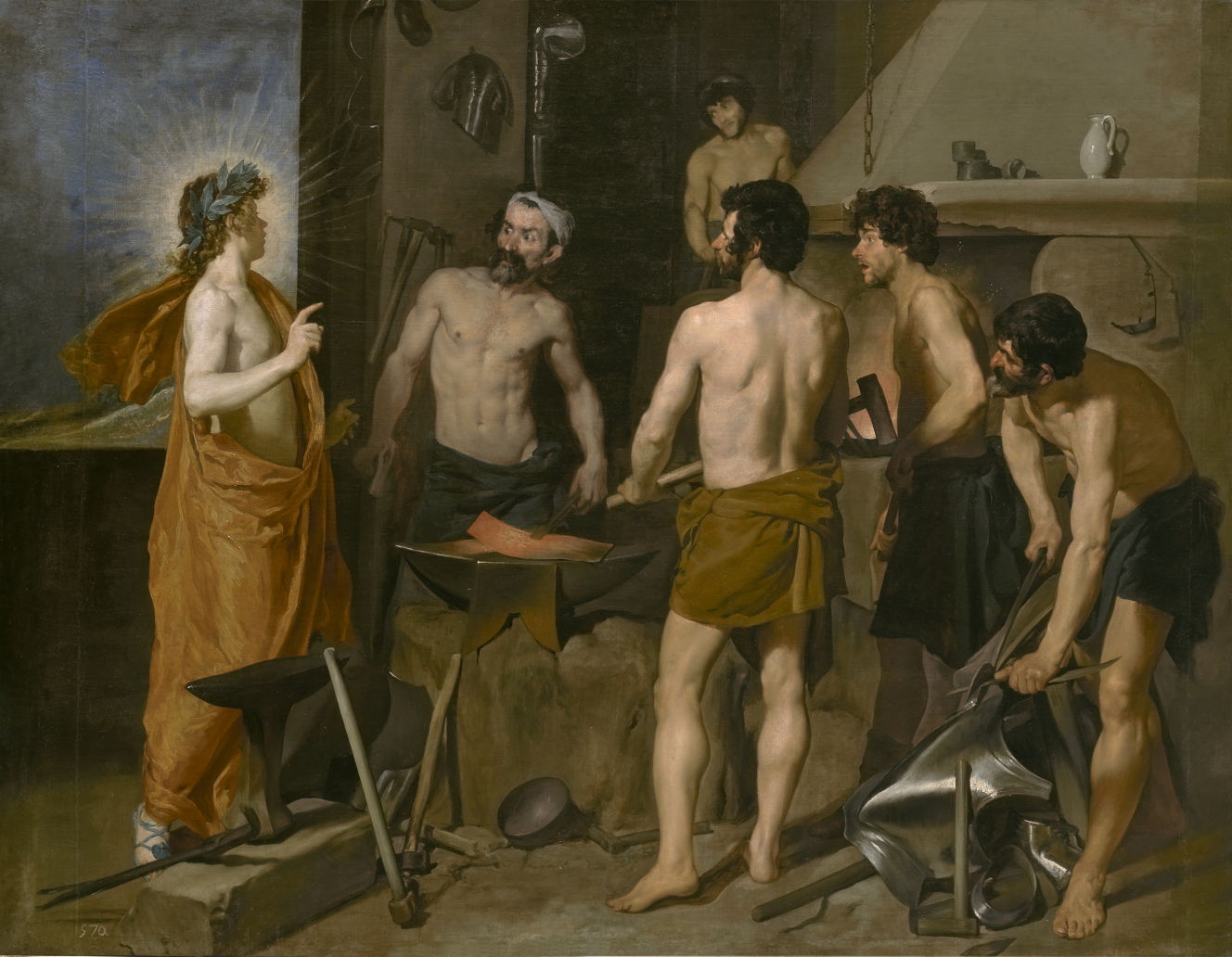
Diego Velázquez (1599–1660), The Forge of Vulcan (1630) [41], oil on canvas, 223 x 290 cm, Museo Nacional del Prado, Madrid, Spain. Wikimedia Commons.
Homer’s story of the adulterous affair of the wife of Hephaistos, Aphrodite (Venus), with Ares (Mars) is retold by Ovid in his Metamorphoses, the likely source for Diego Velázquez’s The Forge of Vulcan from 1630. This shows Apollo, at the left, visiting Hephaistos (to the right of Apollo) in his forge, to tell him about this infidelity.
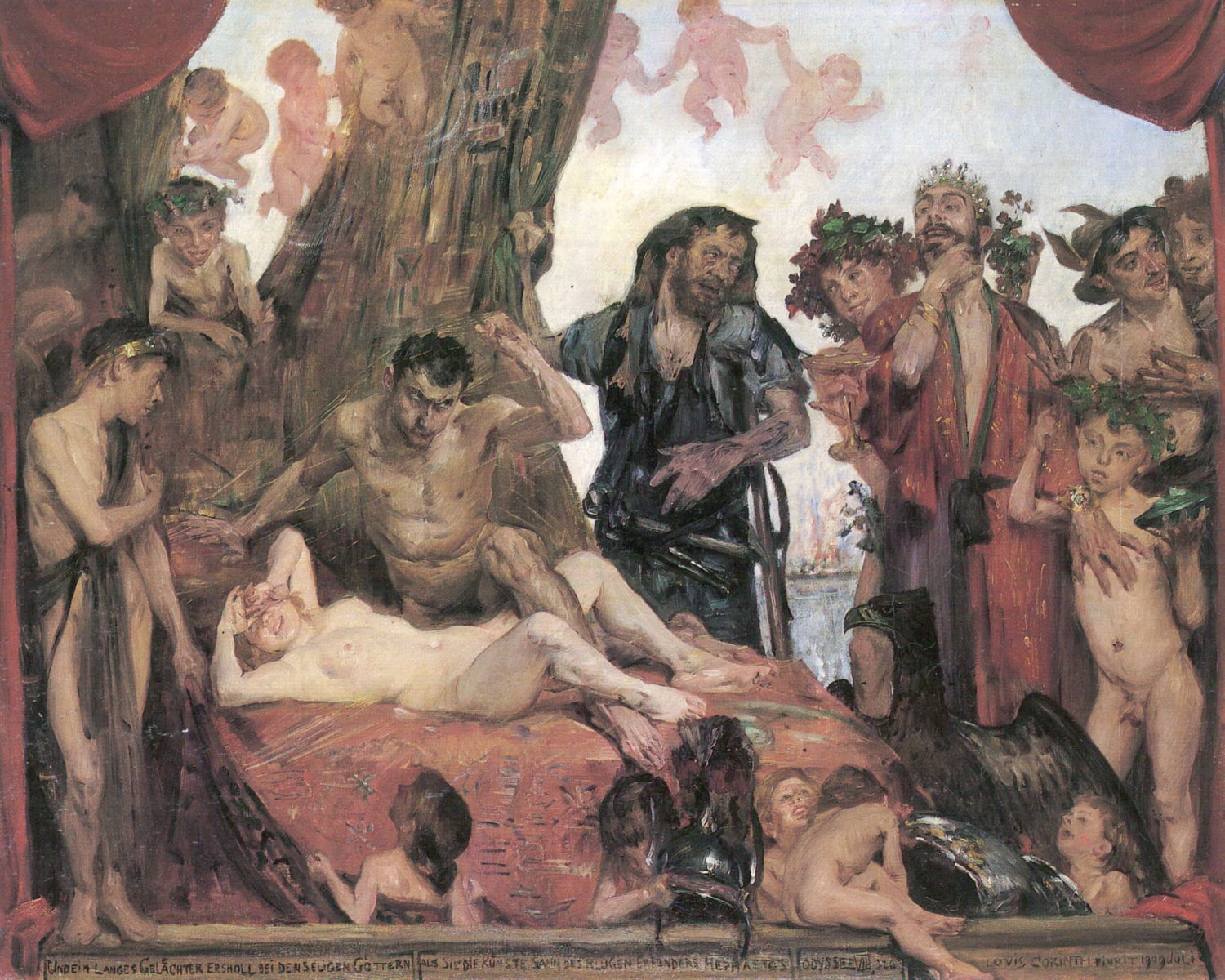
Lovis Corinth (1858–1925) Homeric Laughter (1909), oil on canvas, 98 × 120 cm, Bayerische Staatsgemäldesammlungen, Munich. Wikimedia Commons.
Homeric Laughter (1909) is one of Lovis Corinth’s most complex, even abstruse, paintings of classical myth. He provides a good clue as to its interpretation in his inscription (originally in German translation): unquenchable laughter arose among the blessed gods as they saw the craft of wise Hephaistos
together with the reference to Homer’s Odyssey book 8 line 326.
In this first version, Corinth shows Aphrodite recumbent on the bed, shielding her eyes from the crowd around her. Ares struggles with the net securing the couple, looking frustrated. Hephaistos, clad in black with his tools slung around his waist, is talking to Poseidon (who wears a crown) with Dionysos/Bacchus behind him (clutching a champagne glass). At the right edge is Hermes/Mercury, with his winged helmet. Sundry putti are playing with Ares’ armour, and an arc of putti adorns the sky.
The blacksmith also features in some accounts of the origin of Pandora.
John Dixon Batten (1860-1932), The Creation of Pandora (1913), tempera on fresco, 128 x 168 cm, Reading University, Reading, England. Wikimedia Commons.
John Dixon Batten’s The Creation of Pandora was painted anachronistically in egg tempera on a fresco ground by 1913. Batten was one of the late adherents of the Pre-Raphaelite movement, and is now almost forgotten. This work had been put into storage in 1949 and wasn’t rediscovered until 1990.
Pandora is at the centre, having just been fashioned out of earth by Hephaestus, who stands at the left, his foot on his anvil. Behind them, other blacksmiths work metal in his forge. At the right, Athena is about to place her gift of a robe about Pandora’s figure, and other gods queue behind to offer their contributions.
There are several fine paintings of regular blacksmiths at work over the centuries. The earliest I have been able to locate is a disturbing detail in the central panel of Hieronymus Bosch’s triptych The Last Judgment from about 1495-1505.
Hieronymus Bosch (c 1450–1516), The Last Judgment (central panel, detail) (c 1495-1505), oil on oak panel, left wing 99.5 x 28.8 cm, central panel 99.2 × 60.5 cm, right wing 99.5 × 28.6 cm, Groeningemuseum, Bruges, Belgium. Wikimedia Commons.
Among the torments featured in the centre panel are painful punishments in the blacksmith’s at the top.
Francisco Goya (1746–1828), The Forge (1812-16), oil on canvas, 181.6 x 125.1 cm, The Frick Collection, New York, NY. Wikimedia Commons.
Francisco Goya’s Forge from 1817 is a superb depiction of the physically demanding work of the blacksmith. Its extensive use of black is also a herald of the Black Period to come in Goya’s paintings at the end of that decade.
Alfred Sisley (1839-1899), Forge at Marly-le-Roi (1875), oil on canvas, 55 x 73.5 cm, Musée d’Orsay, Paris. EHN & DIJ Oakley.
Sisley’s Forge at Marly-le-Roi from 1875 shows the village blacksmiths still at work long after the Industrial Revolution brought steam-powered hammers.
Ernst Josephson (1851–1906), Spanish Blacksmiths (1882), oil on canvas, 128.5 x 107 cm, Nasjonalgalleriet, Oslo, Norway. Wikimedia Commons.
Ernst Josephson’s Spanish Blacksmiths from 1882 shows a smith in the shredded remains of his white shirt, and his striker to the right in his black waistcoat, with a horseshoe hanging below the roof of their forge in Seville.
Döme Skuteczky (1849–1921), In the Smithy (1897), mixed media, 28 × 21 cm, location not known. Wikimedia Commons.
Döme Skuteczky’s painting In the Smithy from 1897 shows another smithy, this time in Slovakia.
These days, across much of Europe the traditional blacksmith earns their keep from forging horseshoes for the many horses ridden for pleasure.
Until the Industrial Revolution brought the wide availability of iron, and even well into the twentieth century, the carpenter who worked wonders in wood was one of the key trades. It’s thus odd that remarkably few paintings show carpenters at work, at least until the middle of the nineteenth century.
They also play no role in the best-known classical myths, with the exception of one painting by Piero di Cosimo.
Piero di Cosimo (1462–1522), Vulcan and Aeolus (c 1490), tempera and oil on canvas, 155.5 × 166.5 cm, National Gallery of Canada Musée des beaux-arts du Canada, Ottawa, Canada. Wikimedia Commons.
Piero sometimes assembled his own mythical narratives, such as that in Vulcan and Aeolus from about 1490. From the left the figures are a river god, Vulcan forging a horseshoe, a figure (possibly Aeolus, keeper of the winds) riding a horse, a man curled asleep in a foetal position, a couple and their infant son, and four carpenters erecting the frame of a building. Among the animals are a giraffe and a camel. It’s thought this shows early humans developing crafts at the dawn of civilisation.
Christian religious painting has a better opportunity, with Joseph, husband of the Virgin Mary, the most famous carpenter in European history.
Jacopo Tintoretto (c 1518-1594), The Annunciation (E&I 264) (c 1582), oil on canvas, 440 x 542 cm, Sala terrena, Scuola Grande di San Rocco, Venice, Italy. Wikimedia Commons.
Tintoretto’s Annunciation is thought to have been painted in about 1582. Its composition is unusual by any contemporary standards, with natural rendering of brickwork, a wicker chair, and a splendidly realistic carpenter’s yard at the left. This is coupled with an aerial swarm of infants, at the head of which is the dove of the Holy Ghost in a small mandorla. Christ’s origins are here very real, tangible, and contemporary, in stark contrast to most traditional depictions of this scene.
John Everett Millais’ painting of Christ in the House of His Parents, also known as The Carpenter’s Shop, is one of the foundational paintings of the Pre-Raphaelite Brotherhood, from 1849-50. It was exhibited at the Royal Academy in 1850 with a quotation from the Old Testament book of Zechariah 13:6: “And one shall say unto him, What are those wounds in thine hands? Then he shall answer, Those with which I was wounded in the house of my friends.” It shows an entirely imagined scene, one not even alluded to in the Gospels, in which the young Jesus Christ is being comforted by his kneeling mother, after he has cut the palm of his left hand on a nail.
It’s rich with symbols of Christ’s life and future crucifixion: the cut on his palm is one of the stigmata, and blood dripped from that onto his left foot is another. The young Saint John the Baptist has fetched a bowl of water, indicating his future baptismal role. A triangle above Christ’s head symbolises the Trinity, and a white dove perched on the ladder is the Holy Spirit. A flock of sheep outside represents the Christian flock.
William Holman Hunt (1827–1910), The Shadow of Death (1870-73), oil on canvas, 214.2 x 168.2 cm, Manchester Art Gallery, Manchester, England. Wikimedia Commons.
In William Holman Hunt’s later painting of The Shadow of Death from 1870-73, the young Jesus Christ is seen in his father’s carpentry workshop, holding his arms up to savour the bright sunlight. His cast shadow on the rack of tools and wall behind shows him crucified on the cross, with his mother Mary already on her knees, as shown in so many paintings of the crucifixion.
Christian allusions to carpentry became more popular from the start of the nineteenth century.
William Blake’s The Christ Child Asleep on the Cross, or Our Lady Adoring the Infant Jesus Asleep on the Cross from 1799-1800 is among the few of his glue tempera paintings that has retained its colours. This shows at best an apocryphal if not invented scene, in which the young Jesus anticipates his eventual fate by sleeping on a wooden cross, surrounded by the carpenter’s tools, including compasses or dividers.
Fritz von Uhde (1848–1911), A Difficult Journey (Transition to Bethlehem) (1890), oil on canvas, 117 × 127 cm, Neue Pinakothek, Munich, Germany. Wikimedia Commons.
Fritz von Uhde’s A Difficult Journey from 1890 imagines Joseph and the pregnant Mary walking on a rough muddy track to Bethlehem, in a wintry European village. Joseph has his carpenter’s saw on his back as the tired couple move on through dank mist.
Hans Andersen Brendekilde (1857–1942), People by a Road (1893), oil on canvas, 200 x 263 cm, Statens Museum for Kunst (Den Kongelige Malerisamling), Copenhagen, Denmark. Wikimedia Commons.
There’s a more complex story behind Hans Andersen Brendekilde’s People by a Road from 1893. The group at the left are old road-workers, breaking larger rocks into coarse gravel. They lived out under the wooden shelter behind them, as they made their way slowly around the country roads. The woman holds what is either a small shovel or spade used in their work. Standing and apparently preaching to them is a cleanly dressed carpenter, his saw held in his left hand. The building behind them, on the opposite side of the road, is a church, from which a large congregation has just emerged.
Erik Henningsen (1855–1930), Evicted (1892), oil on canvas, dimensions not known, Statens Museum for Kunst (Den Kongelige Malerisamling), Copenhagen, Denmark. Wikimedia Commons.
This association with the Holy Family may extend to Erik Henningsen’s Evicted from 1892 with its family of four being evicted into the street in the winter snow. With them are their meagre possessions, including a saw suggesting the father may be a carpenter. In the background he is still arguing with a policeman.
It was only then, at the end of the nineteenth century, that artists started to paint portraits of carpenters at work.
Laurits Andersen Ring (1854–1933), Workers at a Water Pipe at Søndersø (1891), oil on canvas, 155 x 185 cm, Fuglsang Art Museum, Lolland, Denmark. Wikimedia Commons.
In 1891 Laurits Andersen Ring painted these Workers at a Water Pipe at Søndersø, in the north of the central Danish island of Fyn (Funen). Two are skilled carpenters, who are sawing a plank of wood to be used in the construction work in progress behind them. The third worker, in his light blue jacket, wears rubber overboots on his wooden clogs, implying he has been working down in the trench. This is one of a series painted by Ring showing trades and crafts.
Many of the greatest paintings succeed in part because they use optical effects in their paint layer. This takes advantage of the fact that thinner layers of paint aren’t completely opaque, so allow some light to pass through them. In watercolours, transparent paints are often referred to as transparent watercolour, while those that are opaque are known as gouache or body colour. In oils, different pigments result in degrees of opacity, expressed as their covering power.
This cross-section of the paint layer from Honoré Daumier’s The Strongman (c 1865) demonstrates how many oil paintings consist of a series of layers, with several pigments present through their depth. Generally, the most opaque are applied first, and on top of those come a series of thinner transparent layers or glazes. Together these allow complex combinations of reflection and refraction of light, generating optical effects.
Layered oil painting technique is best seen in paintings that have been abandoned before completion.
The British portrait painter Sir Joshua Reynolds received a conventional training in traditional and conservative methods with roots dating back to the late 1600s. He painted in layers, starting with dead colouring, the laying in of shadows and lights, then blending in transitions of shading and colour wet-on-wet. Highlights were then brought out, and shadows glazed, to produce a series of thin layers of oil paint, and a smooth, finished paint surface.
Sir Joshua Reynolds (1723–1792), Mrs. Robinson (c 1784), oil on canvas, 88.6 x 68.9 cm, Yale Center for British Art, New Haven, CT. Wikimedia Commons.
Those early stages are shown well in this abandoned portrait of Mrs Robinson from about 1784, where most of the paint layer is sufficiently thin as to allow the texture of the canvas to show through. When used with ‘lean’ paint, this dried quickly and complies with the longstanding edict of applying ‘fat’ over ‘lean’, so that the lowest layers dry first.
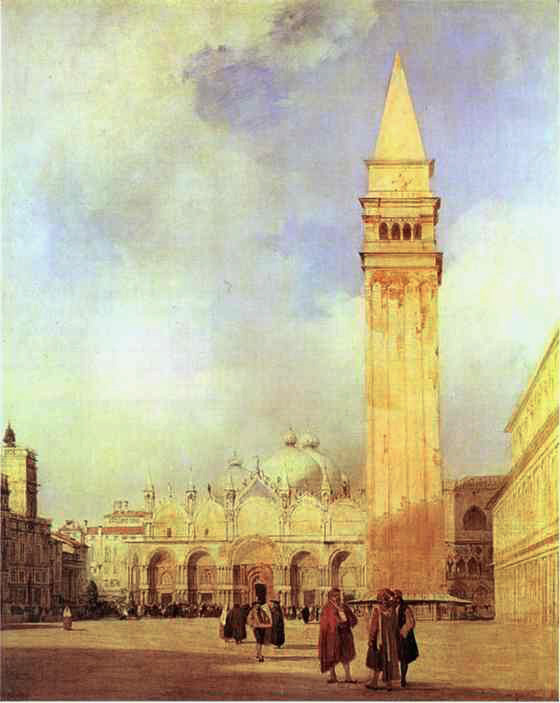
Richard Parkes Bonington (1802-28), Venice: The Piazza San Marco (1827-8), oil on canvas, 99.4 x 80.3 cm, Wallace Collection, London. WikiArt.
Richard Parkes Bonington’s unfinished Venice: The Piazza San Marco (1827-28) shows signs that it might have been among his best. Its buildings have a golden glow from the setting sun, but those colours would undoubtedly have been enhanced by rich glazes had he lived long enough to complete it.
Occasionally the paint layer develops problems that demonstrate the effects of glazes.
Abraham Bloemaert (1564–1651), The Adoration of the Magi (1624), oil on canvas, 168.8 x 193.7 cm, Centraal Museum, Utrecht, The Netherlands. Wikimedia Commons.
In Abraham Bloemaert’s The Adoration of the Magi from 1624, the cloak of the Virgin Mary appears to use two different blues, with its lower passages painted in the duller hue of indigo, which has faded. The dullest areas are those that had the thinnest ultramarine glazes applied, much of which have now abraded away during subsequent cleaning of the painting. The unprotected indigo has therefore suffered sufficient exposure to fade, as well as losing those rich glazes.
Joseph Mallord William Turner (1775–1851), Approach to Venice (1844), oil on canvas, 62 x 94 cm, The National Gallery of Art, Washington, DC. Courtesy of The National Gallery of Art, via Wikimedia Commons.
JMW Turner’s Approach to Venice (1844) was painted with very thin transparent glazes over thick white impasto, creating a distinctive flickering effect in its highlights.
Joseph Mallord William Turner (1775–1851), Approach to Venice (detail) (1844), oil on canvas, 62 x 94 cm, The National Gallery of Art, Washington, DC. Courtesy of The National Gallery of Art, via Wikimedia Commons.
Despite the artist’s efforts to get the white impasto to dry more quickly, the glazes dried first, and cracked as they became stressed over the white that was still wet. This hasn’t been helped by the later conservation process of lining, which places an additional layer on the back of the canvas to help the support do its job.
Although a wide range of pigments have been used successfully in glazes, some were developed specifically for the purpose. From the fifteenth century onwards, verdigris pigment was mixed with natural resins for use in glazes. This produces a different pigment from regular verdigris, as the copper combines with the resin acids to form what is known as copper resinate.
A popular technique among many masters to produce an intense green was to paint an underlayer using verdigris, over which several glazing layers of copper resinate were then applied. Although generally reliable and stable, verdigris and copper resinates have a tendency to turn brown on the surface. Thankfully this affects relatively few paintings.
Tintoretto (1519–1594), Saint George and the Dragon (c 1555), oil on canvas, 158.3 x 100.5 cm, The National Gallery, London. Wikimedia Commons.
Tintoretto used copper resinate glazes in several of his paintings, most notably the rich, varied, and often lush vegetation in his Saint George and the Dragon from about 1555.
Paolo Veronese (1528–1588), The Allegory of Love, Respect (c 1575), oil on canvas, 186.1 x 194.3 cm, The National Gallery, London. Wikimedia Commons.
Studies at the National Gallery, London, have found copper resinate in three of the four paintings in Paolo Veronese’s series The Allegory of Love. In the third of these, Respect (c 1575), the pigment was found in the man’s intense green cloak, and the duller gold-brown brocade patterning on the wall behind his hand (detail below). The surface of that wall has superficial brown discoloration of the paint layer.
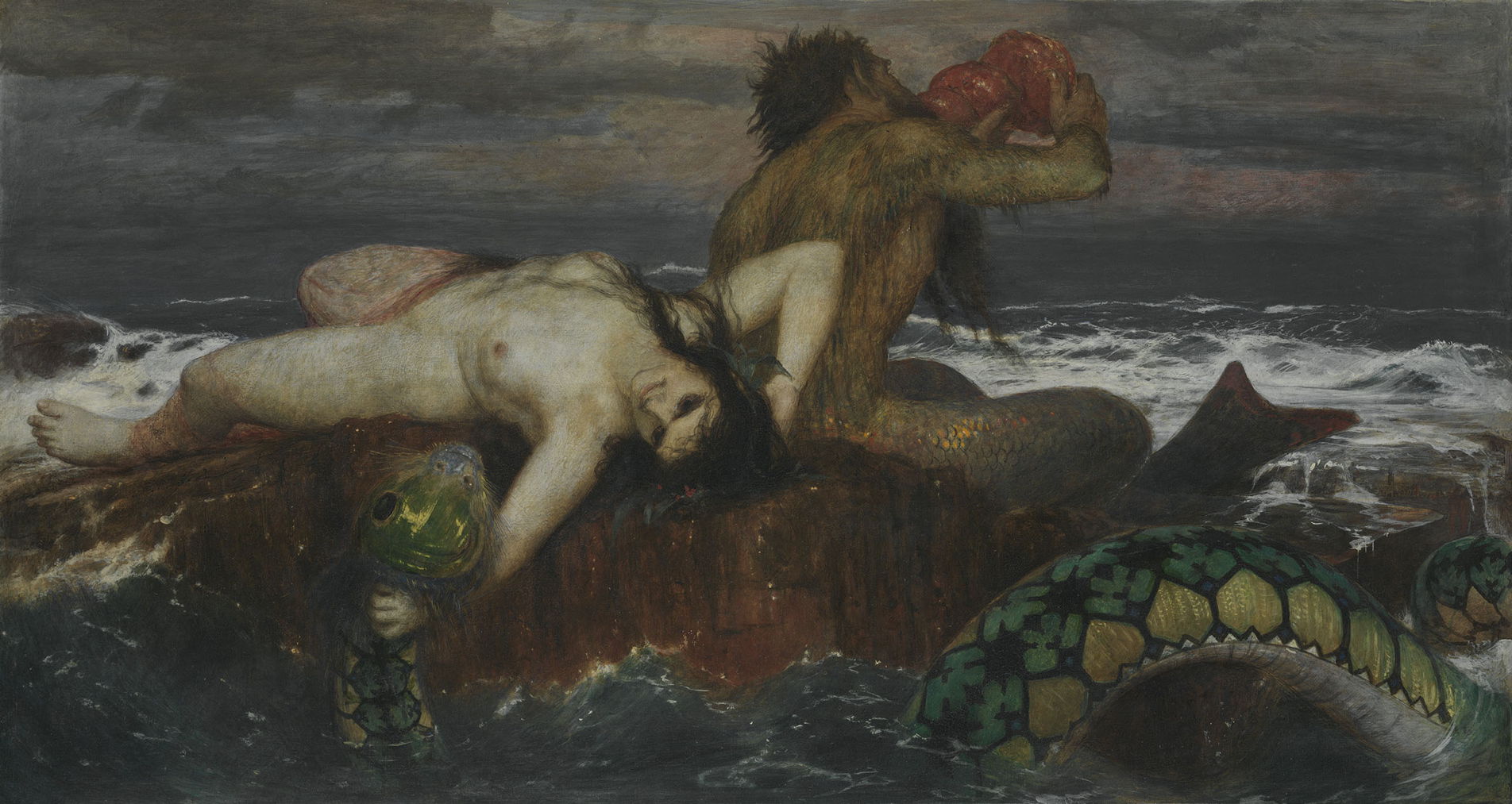
Paolo Veronese (1528–1588), The Allegory of Love, Respect (detail) (c 1575), oil on canvas, 186.1 x 194.3 cm, The National Gallery, London. Wikimedia Commons.Arnold Böcklin (1827–1901), Triton and Nereid (1874), tempera on canvas, 105.3 × 194 cm, Sammlung Schack, Bayerische Staatsgemäldesammlungen, Munich, Germany. Wikimedia Commons.
One of the last major uses of copper resinate is in Arnold Böcklin’s Triton and Nereid from 1874. This is reported as being painted in tempera, but copper resinate glaze appears to have been used to develop the intense green patterns on the sea monster in the foreground. This is consistent with Böcklin adhering to traditional techniques despite working in the late nineteenth century.
During that century, painting slowly in multiple layers with glazes progressively fell from favour. By the end, many oil painters had adopted techniques in which much or all of a painting was made at once, known as direct, alla prima or au premier coup.
In the first of these two articles showing paintings of Spartans from the city-state in ancient Greece, I illustrated some of the laws laid down by the founder of its warrior tradition, Lycurgus.
When those laws were all in place and in practice, Lycurgus told an assembly of all Spartans that he needed to return to the oracle at Delphi to consult on one final measure. He made the Spartans take an oath to abide by these unwritten laws until his return, then departed for Delphi. There he obtained the approval of the oracle, which he recorded in writing and sent back to Sparta.
Jacopo Palma il Vecchio (c 1480-1528) or Bonifazio Veronese (1487-1553), Lycurgus Gives the Laws to the Spartans (date not known), oil on canvas, 209.5 x 209.5 cm, location not known. Wikimedia Commons.
This undated painting of Lycurgus Gives the Laws to the Spartans has been attributed to either Jacopo Palma il Vecchio (c 1480-1528) or Bonifazio Veronese (1487-1553). It shows an elderly Lycurgus apparently giving a volume of written law to the Spartans in the marketplace, but could equally be of Lycurgus addressing his last assembly of all Spartans before he left for his second visit to Delphi.
Merry-Joseph Blondel (1781–1853), Lycurgus of Sparta (1828), oil, dimensions not known, Musée de Picardie, Amiens, France. Wikimedia Commons.
Merry-Joseph Blondel’s portrait of Lycurgus of Sparta from 1828 also shows him as an older man, here with written scrolls on his right thigh. Given the oral nature of Lycurgus’ laws, this can only be interpreted as the moment that Lycurgus has written his message reporting the oracle’s approval of his laws, ready to send it back to the city.
Lycurgus then did something extraordinary in its selfless ingenuity: having put the whole of Sparta under oath to keep his laws until his return, he then starved himself to death, ensuring that oath could never expire. The laws of Lycurgus lasted through fourteen kings, and five hundred years, without change, until gold and other spoils of war entered Sparta during the reign of King Agis.
The single most celebrated event in Spartan history is the Battle of Thermopylae in 480 BCE, in which three hundred Spartan soldiers, with 700 Thespians and 400 Thebans, were claimed to have kept over one hundred thousand Persians at bay for three days. This is the more remarkable for the fact that the Spartans and their supporters fought to the death, following which the Persians overran Boeotia and captured Athens. It is thus an example of self-sacrifice in the face of overwhelming odds, resulting in most noble defeat.
Jacques-Louis David (1748–1825), Leonidas at Thermopylae (1814), oil on canvas, 392 × 533 cm, Musée du Louvre, Paris. Wikimedia Commons.
The only major painting that I have been able to discover of this is Jacques-Louis David’s Leonidas at Thermopylae (1814). Leonidas, the Spartan King and commander of the force, is at the exact centre of the painting, the viewer fixed in his emotionless gaze. Around him are his three hundred Spartan warriors, with supporting trumpeters, a lyre hanging on the tree, and laurel crowns being handed round.
David leaves some clues to his narrative in inscriptions, which have unfortunately become barely legible. A soldier has climbed up to carve an inscription in Greek at the upper left, the word HERAKLEOS appears on a plinth to the left of Leonidas, and by his right foot is an anachronistic piece of paper bearing more Greek words.
More subtle, perhaps, are the small groups driving pack animals along a narrow path at the upper right: the Persians were shown a mountain path around the narrow pass at Thermopylae, enabling them to gain an advantage over the Spartans.
Recent artistic interest in Thermopylae seems to have started around 1960, and first reached popular culture in Rudolph Maté’s 1962 movie, The 300 Spartans, which has been interpreted as comment on the Cold War at the time. This in turn inspired Frank Miller’s graphic novel 300, which was first published in 1998, and made into a highly successful movie of the same name by Zack Snyder, released in 2006.
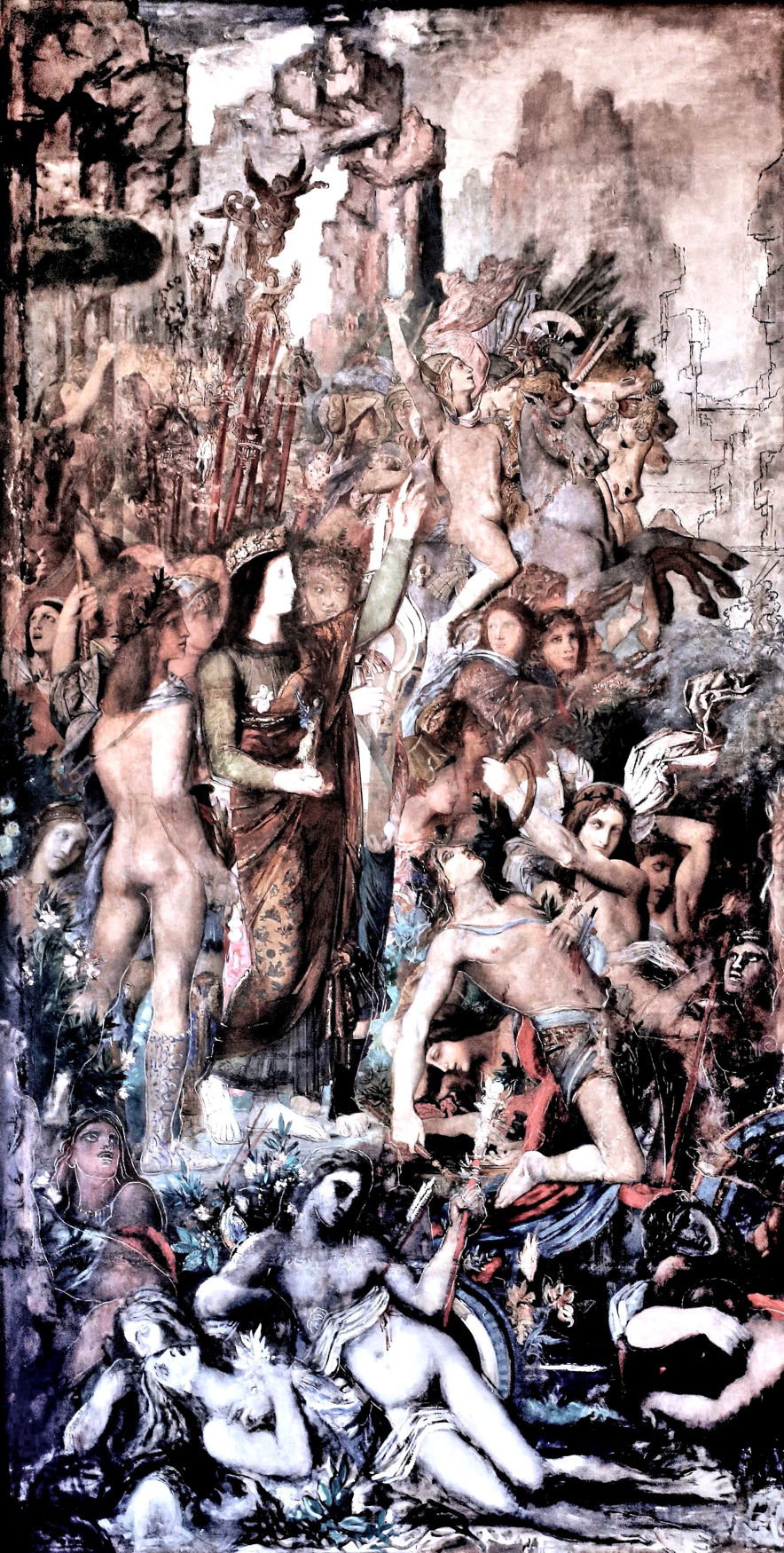
In contrast, Sparta’s three wars against the state of Messenia are little-known. Gustave Moreau’s fascination for esoteric ancient history led him to start painting a scene from the Second Messenian War in about 660-650 BCE.
Moreau seems to have worked on Tyrtaeus Singing During the Combat in the early 1860s, abandoned it, then returned to have it enlarged in about 1883, and work it further for a period, before finally giving it up altogether.
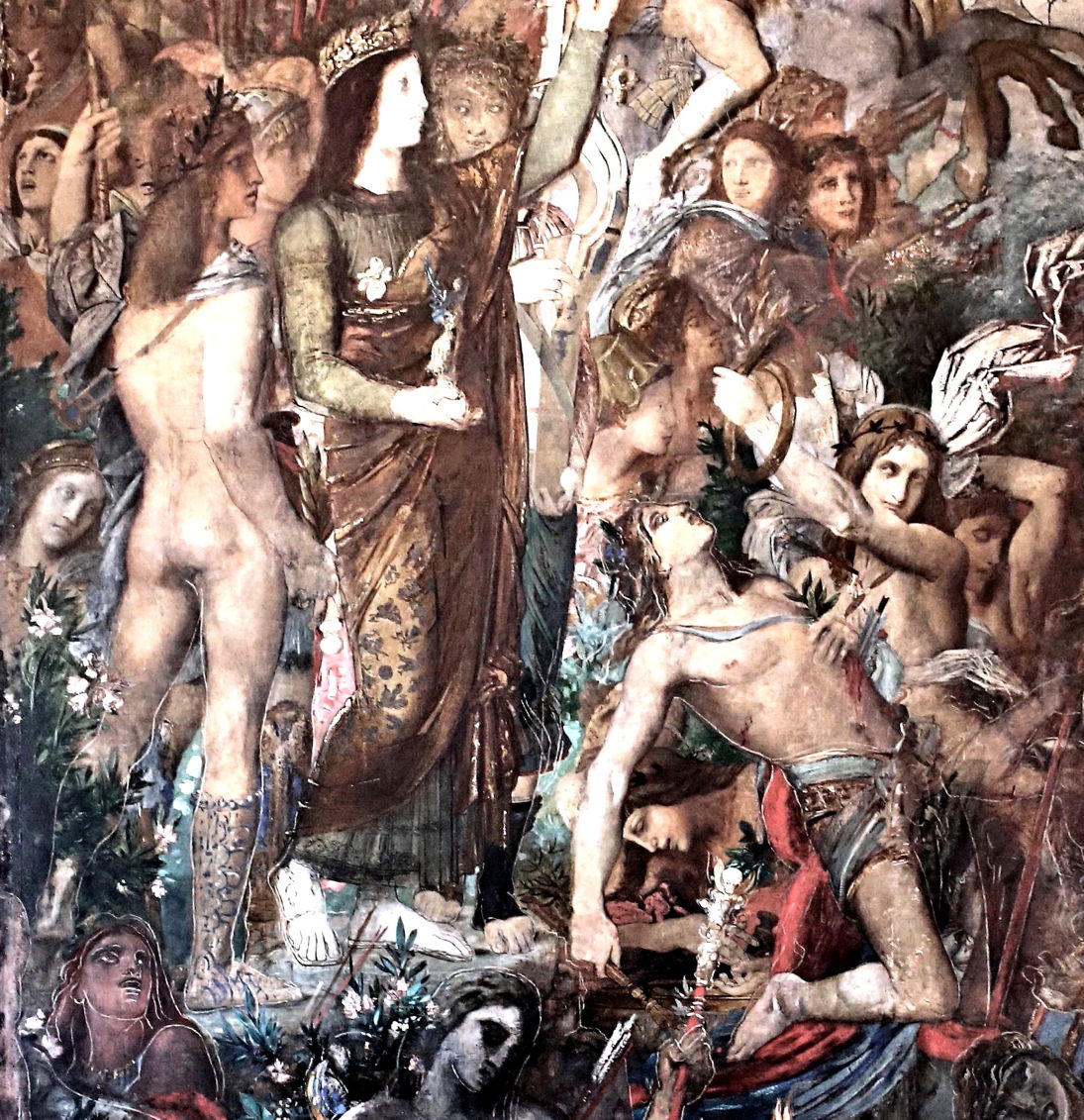
Gustave Moreau (1826–1898), Tyrtaeus Singing During the Combat (detail) (1860-, unfinished), oil on canvas, 415 x 211 cm, Musée National Gustave-Moreau, Paris. Image by jean louis mazieres via flickr, https://www.flickr.com/photos/mazanto/13943362382/in/photostream/
This detail shows much of his original painting, which is full to bursting with androgynous and near-naked young men. The priestess-like figure to the left of the centre appears to be Tyrtaeus, an elegiac Greek poet whose verse exhorted the Spartans to fight bravely against the Messenians. He is shown here in action, inspiring the young Spartan warriors to victory. The strange collage-like effect is a combination of Moreau’s emphasis on establishing the form of his figures, and I suspect edge-enhancement in the image’s processing.
Spartans also played a central role in the war with Troy, the result of Paris’s abduction of Helen, a Spartan woman whose origins are the subject of dispute. Later Roman accounts, the basis of most more recent paintings, claim she was the outcome of the union of Leda, wife of Tyndareus, King of Sparta, with Zeus, in the form of a swan. Those dating back to the time of the Cypria and the Epic Cycle are more complex, and make Helen’s mother Nemesis, the personification of public disapproval.
In the Greek version, Zeus appeared to Leda as a swan. Both he and Tyndareus impregnated Leda at about the same time, but as Zeus was then in the form of a swan, her twin pregnancies resulted in two eggs: one hatched into Castor, who was human because his father was Tyndareus; the other hatched into Polydeuces (Latin Pollux), who was divine as his father was Zeus. Despite their different fathers, the twins were known as the Dioskuroi, who were later to rescue Helen.
Unknown follower of Leonardo da Vinci (1452–1519), Leda and the Swan (early 1500s), oil on panel, 131.1 × 76.2 cm, Philadelphia Museum of Art, Philadelphia, PA. Wikimedia Commons.
This interpreted copy of Leonardo da Vinci’s Leda and the Swan, probably painted in the early 1500s and now in the Philadelphia Museum of Art, summarises the later account of Helen’s unique birth, with two eggs and a fourth baby, Clytemnestra. Later paintings, perhaps wisely, concentrated on Leda and Zeus, and skipped the incredible egg phase altogether.
According to most accounts, when Helen was still under age, she was abducted by Theseus, the ‘hero’ who abandoned Ariadne on the island of Naxos. Helen’s adopted brothers the Dioskuroi were unimpressed by this, so they paid Theseus a visit, and persuaded him to return their step-sister. In return for her son’s offence, Aethra, mother of Theseus, was made Helen’s slave, and wasn’t freed until after the fall of Troy many years later.
Jean-Bruno Gassies (1786–1832), Castor and Pollux rescuing Helen (1817), oil on canvas, 113.2 x 145.4 cm, location not known. Wikimedia Commons.
Jean-Bruno Gassies’ painting of Castor and Pollux Rescuing Helen was runner-up in the Prix de Rome in 1817. The woman being escorted away at the left may have been intended to be Theseus’ mother Aethra, although she appears remarkably young.
Helen’s beauty only grew over time, and her hand was sought by many suitors in a contest organised by her brothers Castor and Polydeuces. Among those suitors were many prominent figures, including Odysseus. Helen’s father, King Tyndareus, feared that in choosing between her suitors he would offend and cause trouble. The suitors therefore agreed to swear an oath, under which they would all defend the successful suitor in the event that anyone should quarrel with them, the crucial Oath of Tyndareus. Under that, Menelaos, King of Sparta, was chosen as Helen’s husband.
Helen was the bribe offered by Aphrodite to Paris for judging her the winner of the golden apple of discord. For nine days, Helen’s husband Menelaos entertained Paris as a guest, while Paris plied her with gifts. On the tenth day, Menelaos was called away to Crete for his grandfather’s funeral. He left his house in Helen’s charge, reminding her to ensure their guests were well cared-for, although clearly not in the way that Paris was intending.
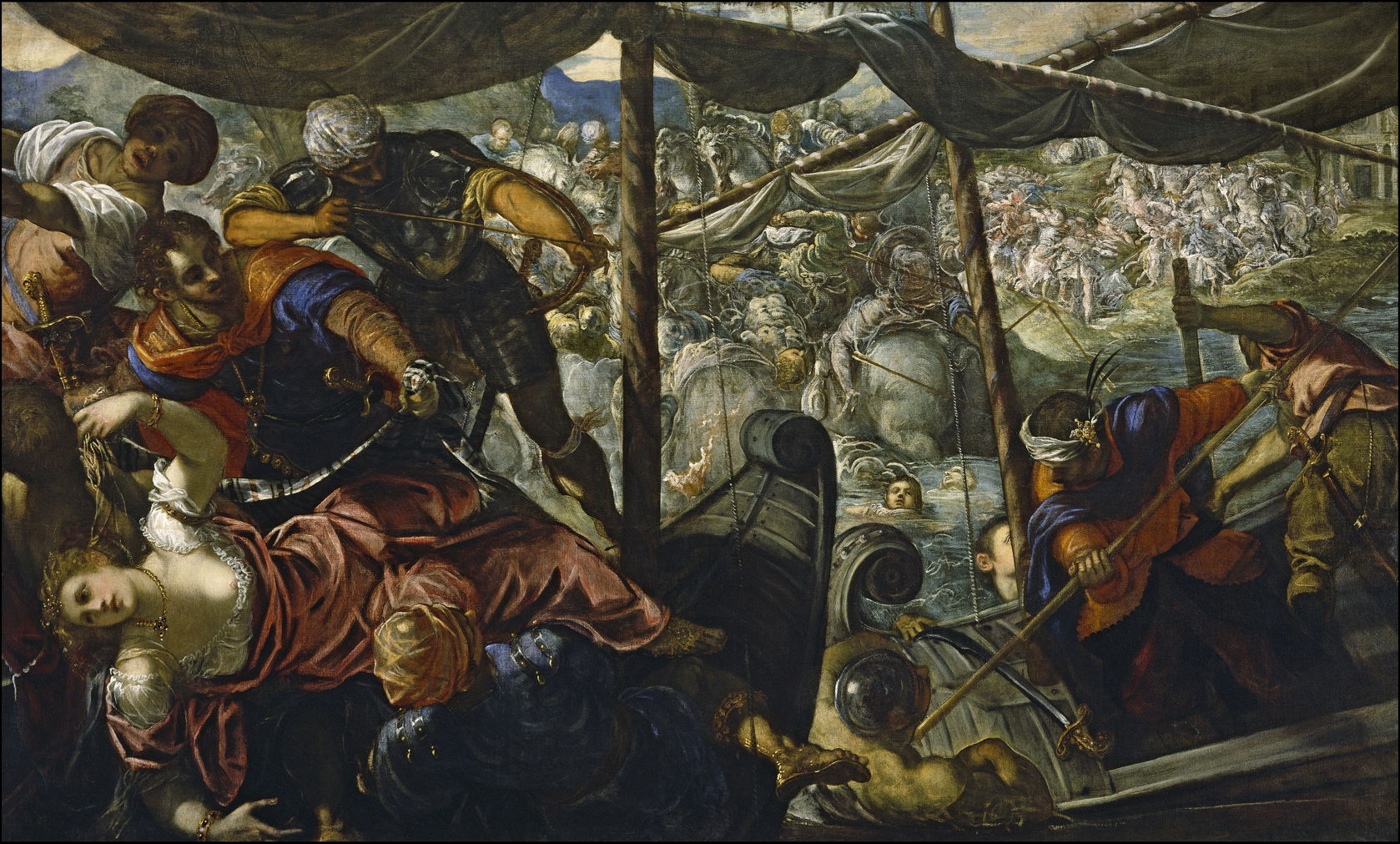
Tintoretto (1519–1594), The Rape of Helen (1580), oil on canvas, 186 x 307 cm, Museo Nacional del Prado, Madrid, Spain. Wikimedia Commons.
For Tintoretto, The Rape of Helen (1580) was nothing short of war. As an archer is about to shoot his arrow, and another Trojan fends off attackers with a pike, Helen, dressed in her finery, is manhandled onto Paris’s ship like a stolen statue.
Thus the Spartans were at the centre of the Trojan War.
Spades are agricultural tools of ancient origin, with a flat blade in line with its shaft, and used for digging. Their closest relative is the shovel with a broader blade for moving loose earth, gravel and snow, and the hoe whose blade is mounted at a right angle to the shaft. In some common applications, such as lifting potatoes and other root crops, a fork with three or more tines is normally preferred.
As a well-known tool for digging, the spade is often associated with the digging of graves, and appears in some religious paintings depicting the imminent interment of Christ’s body following the Crucifixion.
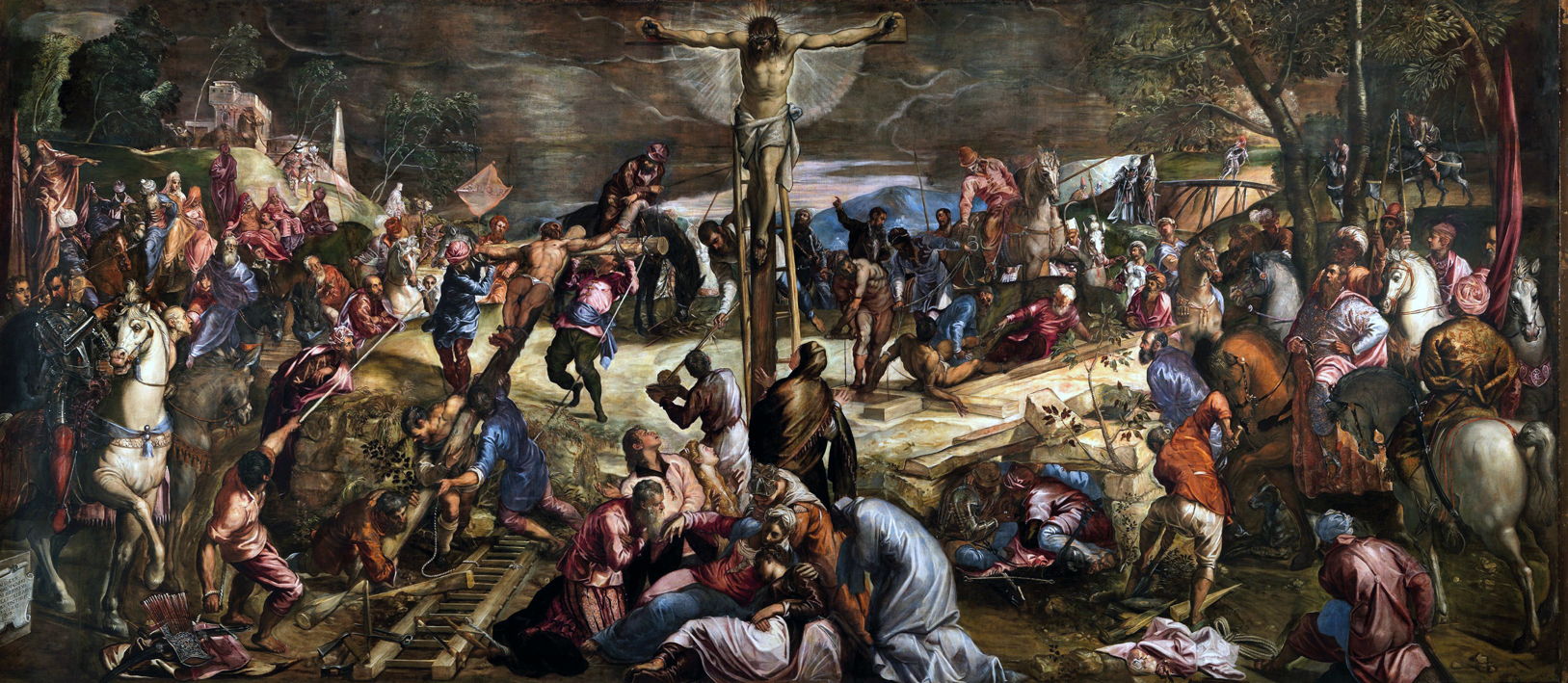
Jacopo Tintoretto (c 1518-1594), The Crucifixion (E&I 123) (1565), oil on canvas, 536 x 1224 cm, Albergo, Scuola Grande di San Rocco, Venice, Italy. Wikimedia Commons.
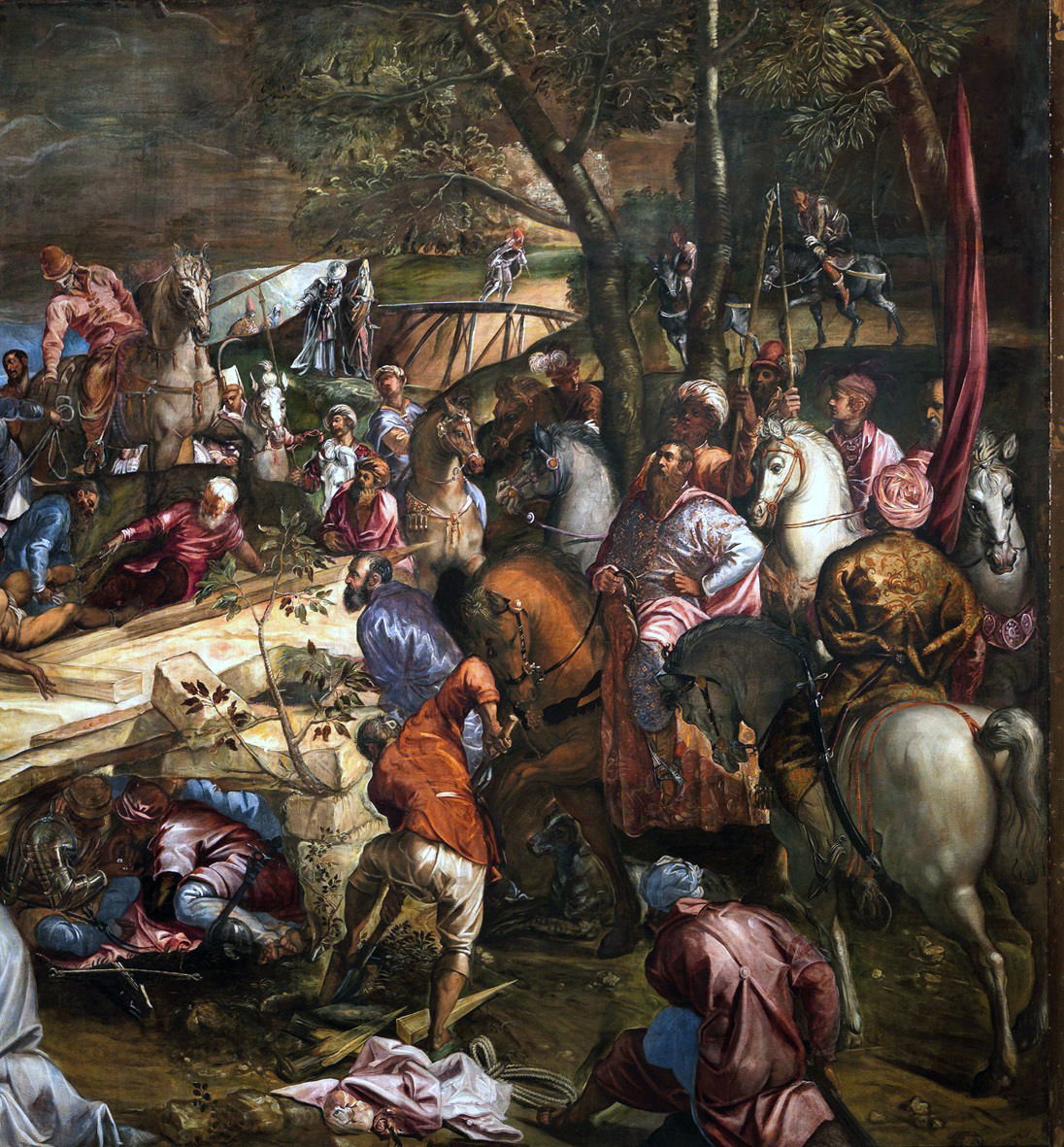
Jacopo Tintoretto’s huge and magnificent Crucifixion from 1565 shows a man digging a conventional grave, as seen in the detail below.
Jacopo Tintoretto (c 1518-1594), The Crucifixion (detail) (E&I 123) (1565), oil on canvas, 536 x 1224 cm, Albergo, Scuola Grande di San Rocco, Venice, Italy. Wikimedia Commons.
On the left of this detail, two men are gambling with dice in a small rock shelter suggestive of a tomb. To the right of them, a gravedigger has just started his work with a spade.
A spade may also appear in depictions of Christ’s subsequent resurrection, in his appearance to Mary as a gardener, often known by the Latin words from the Vulgate as Noli Me Tangere, “touch me not”, the words attributed to Christ in the Gospels.
Lavinia Fontana (1552–1614), Jesus Appears to Mary Magdalene (1581), oil on canvas, 80 x 65.5 cm, Galleria degli Uffizi, Florence. Wikimedia Commons.
In her Jesus Appears to Mary Magdalene from 1581, Lavinia Fontana re-locates this encounter between Mary and Jesus, dressing him in the garb of a mediaeval Italian gardener, and holding a fine gardener’s spade with his left hand.
Alessandro Magnasco (1667–1749), Noli Me Tangere (1705-10), oil on canvas, 144.8 × 109.2 cm, The J. Paul Getty Museum, Los Angeles, CA. Courtesy of The J. Paul Getty Museum.
The eccentric Alessandro Magnasco painted his Noli Me Tangere (1705-10) over a background of ruins made by a collaborator. Christ is shown standing, holding a long-hafted spade with his left hand. Mary is on her knees, a small urn in front of her. Their clothes are rough, and Christ’s appear to be his burial linen, blowing in the wind.
Spades are not uncommon in paintings set in the countryside.
Hans Andersen Brendekilde (1857–1942), On Forbidden Roads (1886), oil on canvas, 126 x 160 cm, location not known. Wikimedia Commons.
Hans Andersen Brendekilde’s On Forbidden Roads from 1886 shows one of the core themes of Naturalist painting: itinerant workers making their way through neglected corners of the countryside. These two men are equipped for forestry, with a two-man saw, axes, and spades. Almost hidden among the vegetation at the far left is a third figure, who looks anxiously towards them. Maybe none of them should really be there at all.
Hans Andersen Brendekilde (1857–1942), People by a Road (1893), oil on canvas, 200 x 263 cm, Statens Museum for Kunst (Den Kongelige Malerisamling), Copenhagen, Denmark. Wikimedia Commons.
There’s a more complex story behind Brendekilde’s People by a Road from 1893. The group at the left are old road-workers, breaking larger rocks into coarse gravel. They lived out under the wooden shelter behind them, as they made their way slowly around the country roads. The woman holds what is either a small shovel or spade used in their work. Standing and apparently preaching to them is a cleanly dressed carpenter, his saw held in his left hand. The building behind them, on the opposite side of the road, is a church, from which a large congregation has just emerged.
Hans Andersen Brendekilde (1857–1942), The Rest (1887), oil on canvas, 70 x 91.5 cm, location not known. Wikimedia Commons.
One of the most physically demanding tasks of the year was clearing snow in the winter. Brendekilde’s The Rest (1887) shows a younger man taking a short break from cutting a track through to the elderly lady’s farmhouse. The blade of his spade is flat, confirming that it’s used to dig through compacted snow and pile the slabs seen behind him.
Hans Andersen Brendekilde (1857–1942), Home for Dinner (1917), further details not known. Wikimedia Commons.
In Brendekilde’s Home for Dinner from 1917, a young girl holding some fresh fish stands talking to a man with a spade.
Hans Andersen Brendekilde (1857–1942), Afternoon Work (1918), oil on canvas, 77 x 100 cm, Private collection. Wikimedia Commons.
The following year, Brendekilde painted a gardening story, in Afternoon Work (1918). A younger man is out on his finely tilled vegetable patch in front of his thatched cottage, wielding his spade as a weapon. Standing just outside the door, behind him, is his young daughter, and through the window is an older woman, presumably his wife. Both are watching him intently, with an air of fear at what he is about to do. He is about to attack a small crop of molehills that have appeared freshly in the midst of his seedling vegetable plants.
As Europeans and Americans started taking to the beaches, they realised how much fun it is to dig sand and build sandcastles using small buckets and spades.
William Dyce (1806–1864), Pegwell Bay, Kent – a Recollection of October 5th 1858 (c 1858), oil on canvas, 635 cm x 889 cm, The Tate Gallery, London. Wikimedia Commons.
This is William Dyce’s finely detailed view of Pegwell Bay, Kent, on the coast of south-east England, out of season, at the end of a fine day in early October. Visitors to the beach are wrapped for warmth as well as modesty. In the distance, a group of donkeys are being taken to graze for the night, after the day’s work being hired out for children to ride. In the foreground, at the left, a child holds a spade, although there is precious little sand suitable for sandcastles.
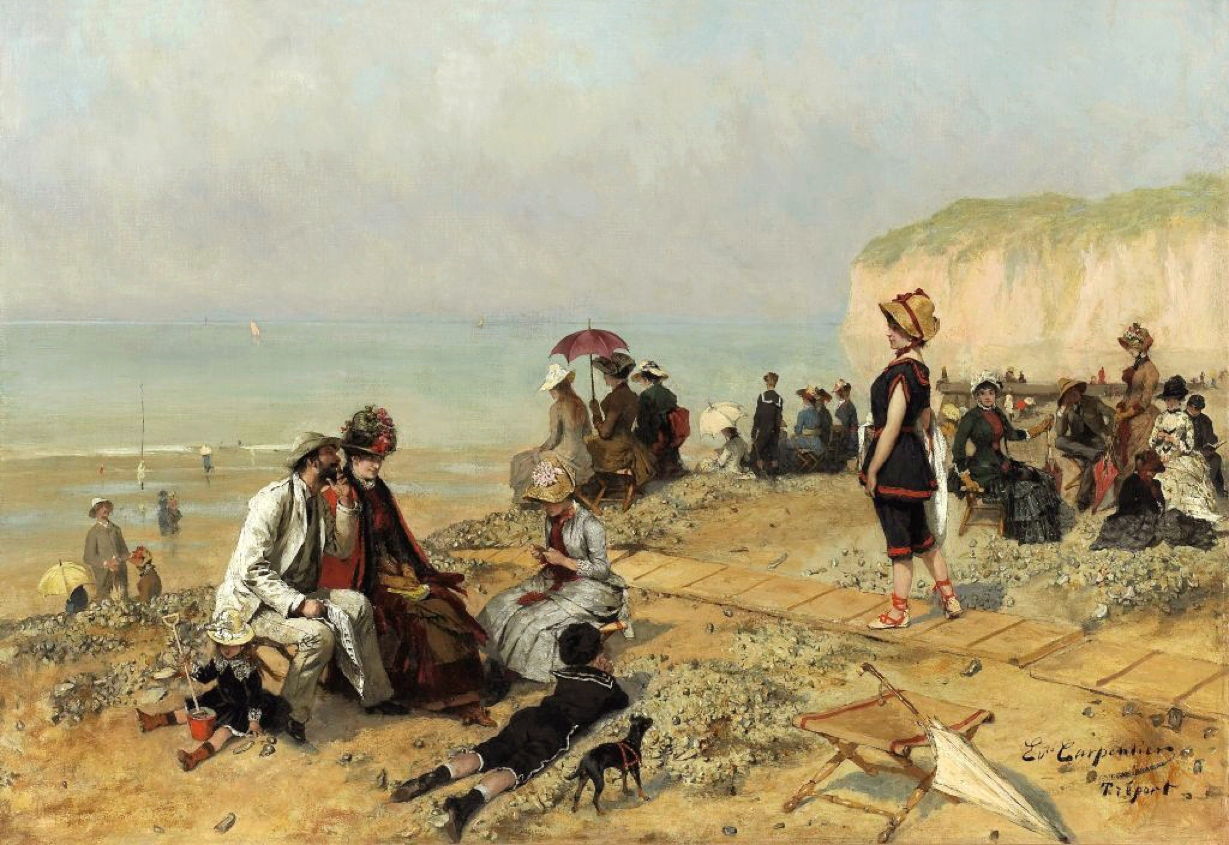
Évariste Carpentier (1845–1922), Tréport, Bathing Time (1882), oil on canvas, 50.5 x 80.5 cm, Private collection. Wikimedia Commons.
Later in the nineteenth century, at Le Tréport on the Channel coast of France near Dieppe, Évariste Carpentier’s Le Tréport, Bathing Time shows progress in the development of beach costume and culture. A young girl in the left foreground is playing with her bucket and spade, while her older brother is admiring the fashionable young woman parading her new clothes. A far cry indeed from the grave-digger.

 Login
Login