Reading view

There are new articles available, click to refresh the page.

The Dutch Golden Age: Aelbert Cuyp 2

By about 1650, Aelbert Cuyp (1620–1691) had demonstrated his proficiency in painting a wide variety of subjects and genres, from mythological landscapes to farm animals. He had become influenced by Jan Dirksz Both (c 1610-52), who had recently returned from working with Claude Lorrain in Rome.
cuypmaasdordrecht
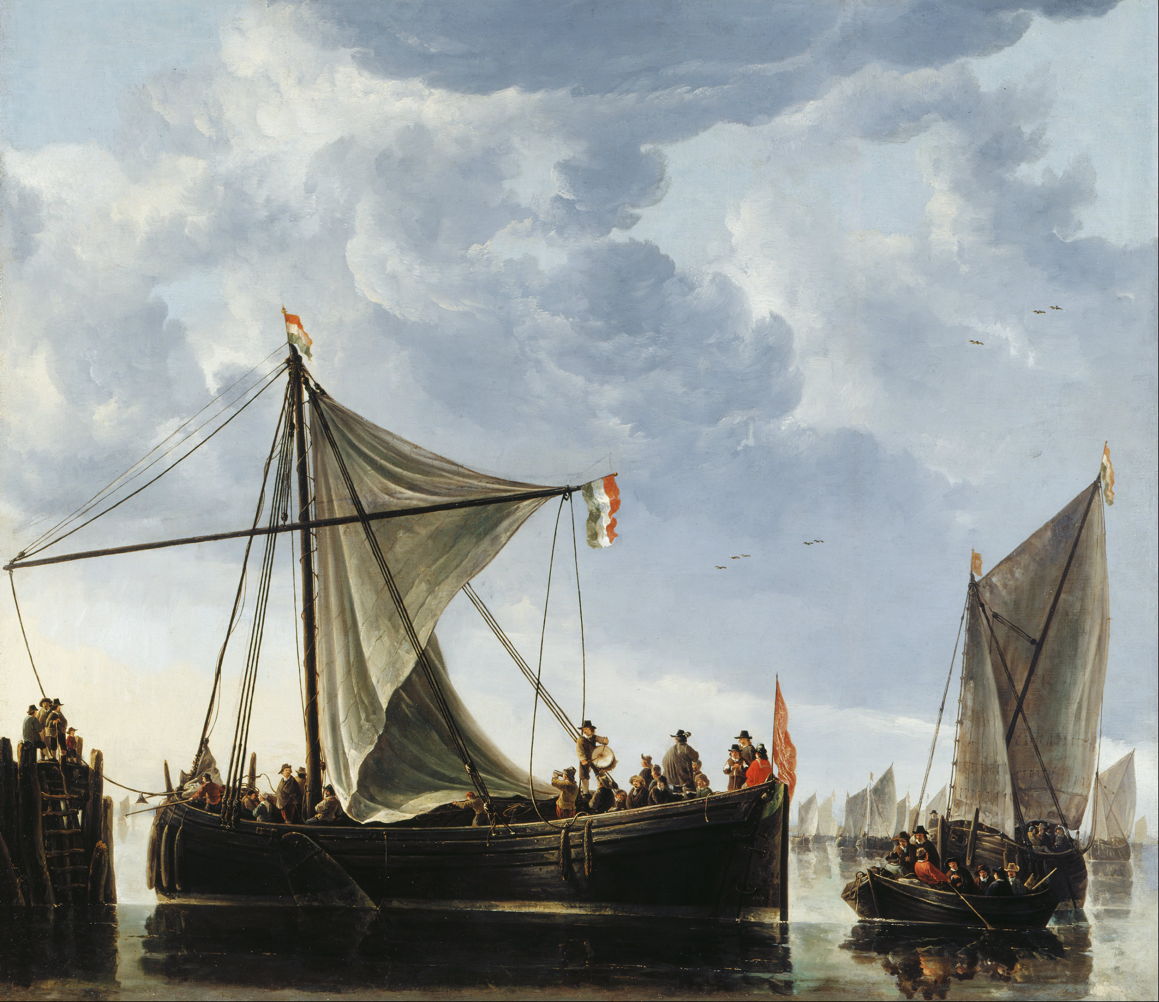
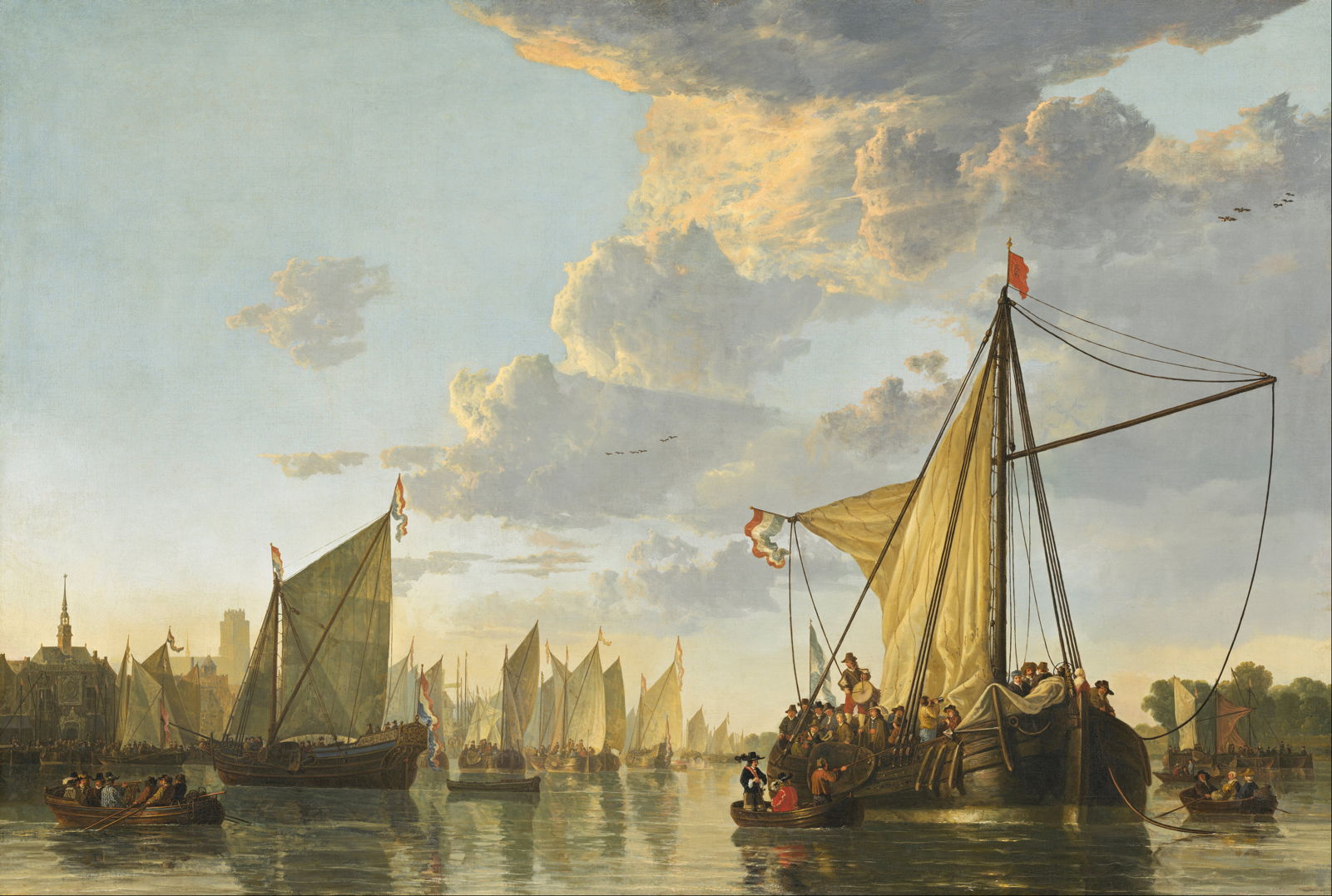
Aelbert Cuyp (1620–1691), The Maas at Dordrecht (c 1650), oil on canvas, 114.9 x 170.2 cm, National Gallery of Art, Washington, DC. Wikimedia Commons.

At their best, Cuyp’s coastal landscapes, such as The Maas at Dordrecht from about 1650, are full of rich light, earning him the title of the Dutch Claude Lorrain. This shows another passage boat packed with passengers, together with its drummer.

cuypcavalrytroopers
Aelbert Cuyp (1620–1691), Two Cavalry Troopers Talking to a Peasant (c 1650), oil, 36 x 46 cm, Royal Collection of the United Kingdom, UK. Wikimedia Commons.

Also thought to have been painted in about 1650, shortly before his father’s death, it’s possible that Two Cavalry Troopers Talking to a Peasant is a collaboration between father and son. Although there’s a slight awkwardness in the figures, the horses are finely painted with great detail on their saddlery, including glinting buckles.

cuypnigratingpeasants
Aelbert Cuyp (1620–1691), Migrating Peasants in a Southern Landscape (c 1652), oil on panel, 38.6 x 52.2 cm, Koninklijk Kabinet van Schilderijen Mauritshuis, The Hague, The Netherlands. Wikimedia Commons.

Some of his landscapes from this period appear to have been painted in very different terrain. His Migrating Peasants in a Southern Landscape from about 1652 shows people dressed for the more temperate climate of northern Europe in a landscape that could be further south.

cuypvalkhofnijmegen
Aelbert Cuyp (1620–1691), The Valkhof at Nijmegen (c 1652-54), oil on wood, 48.8 x 73.6 cm, Indianapolis Museum of Art, Indianapolis, IN. Wikimedia Commons.

Cuyp’s grand view of The Valkhof at Nijmegen from about 1652-54 shows the Imperial castle that was demolished in 1798, on its small hill beside the river. The landscape is bathed in golden light, and broken clouds are tinged with similar Claudean colour as they drift through its lucent sky.

Cuyp, Aelbert, 1620-1691; Saint Philip Baptising the Ethiopian Eunuch
Aelbert Cuyp (1620–1691), Saint Philip Baptising the Ethiopian Eunuch (c 1655), oil on canvas, 115.5 x 169 cm, National Trust, England. Wikimedia Commons.

In about 1655, Cuyp painted this narrative landscape with the story of Saint Philip Baptising the Ethiopian Eunuch, referring to the account of Philip the Evangelist in chapter 8 of the Acts of the Apostles. Following the instructions of an angel, Philip went to the road between Jerusalem and Gaza, where he met the treasurer to Candace, Queen of the Ethiopians. As the Ethiopian Eunuch was sitting reading Old Testament scripture in his chariot, Philip explained the text and taught him the Gospel of Jesus. The eunuch was converted and baptised as a result.

Cuyp sets this story in a golden Claudean landscape more akin to the south of France or even Italy, with rich detail in the riverside plants, the figures and animals.

cuypicehuistemerwededordrecht
Aelbert Cuyp (1620–1691), Ice Scene Before the Huis te Merwede near Dordrecht (c 1655), oil on panel, 64 x 89 cm, Private collection. Wikimedia Commons.

Although Cuyp doesn’t appear to have painted many winter scenes, his Ice Scene Before the Huis te Merwede near Dordrecht from about 1655 is up with the leaders. Notable here are his foreground reflections, and another wonderful sky with its warm clouds. This castle was built to the south-east of Dordrecht in the early fourteenth century, and ruined a hundred years later.

Jacob Mathieusen, and his wife, in the background the fleet in the roads of Batavia, by Aelbert Cuyp
Aelbert Cuyp (1620–1691), A Senior Merchant of the Dutch East India Company (1650-59), oil on canvas, 138 x 208 cm, Rijksmuseum Amsterdam, Amsterdam, The Netherlands. Wikimedia Commons.

A Senior Merchant of the Dutch East India Company is a fascinating double portrait painted during 1650-59. It’s thought to show Jacob Mathieusen and his wife, against a background of the company fleet in Batavia roads. This city in what was then the Dutch East Indies is now the site of Jakarta in Indonesia. There’s no record of Cuyp ever having visited this imagined location, and he appears to have painted the background on the basis of contemporary topographic images, then painted his subjects in the studio.

cuyproadnearriver
Aelbert Cuyp (1620–1691), A Road near a River (c 1660), oil on canvas, 113 x 176.6 cm, Dulwich Picture Gallery, London. Wikimedia Commons.

A Road near a River from about 1660 is the last of Cuyp’s paintings for which I have a date, and perhaps his finest closing summary. It’s a landscape in the style of Claude Lorrain, with long shadows and the warmth of the setting sun. There’s a small flock of sheep and a sleeping dog, the shepherd chatting with a friend. Further down that road are two more figures, one of them sat on a pony. On the other side of the river with its broken reflections, is a cottage and more people. In the distance is a thoroughly alien crag and the ruins of a castle. Above all this is the peaceful sky of settled weather, divided into two by a pair of finely crafted trees.

Aelbert Cuyp: Ladugårdsinteriör.NM 4441
Aelbert Cuyp (1620–1691), Interior of a Cowshed (date not known), oil on oak, 77.5 x 107.2 cm, Nationalmuseum, Stockholm, Sweden. Wikimedia Commons.

Cuyp’s undated Interior of a Cowshed is a fine portrait of a cow leading the herd into a shed, with good use made of chiaroscuro and details of the tools, tackle and equipment inside.

In 1658, Cuyp married Cornelia Bosman. Within two years, he had apparently stopped painting completely, and was a deacon of the Reformed Church. It has been speculated that it was his marriage that brought an end to his art. Whether that’s true or not, for the final thirty years of his life he seems not to have made another painting.

Reference

Wikipedia.

The Dutch Golden Age: Aelbert Cuyp 1

Artists like Rembrandt and Vermeer are exceptional in any period in history. Among the thousands of artists in the Dutch Republic, there were a few dozen who never achieved such greatness, but whose paintings have endured the collapse of the market in the late seventeenth century. Among them is Aelbert Cuyp (1620–1691), who is also a bit of a mystery in that he appears to have stopped painting soon after 1660, although he lived for another thirty years.

Cuyp was born into an artistic family, who were also quite rich. He was taught to paint by his father, Jacob Gerritsz Cuyp, who was primarily a portrait painter, and lived in Dordrecht. Trained as a landscape painter, he often used views as a platform for genre scenes, animal and human portraits, and more, and seems to have been both happy and highly proficient at painting almost anything. During his early career, he was mostly under the influence of the prolific artist Jan van Goyen (1596-1656), but doesn’t appear to have been his pupil.

cuyplandscapecattle
Aelbert Cuyp (1620–1691), Landscape with Cattle (c 1639), oil on wood panel, 65 x 90.8 cm, National Gallery of Victoria, Melbourne, Australia. Wikimedia Commons.

Cuyp is thought to have painted this Landscape with Cattle when he was only about nineteen, in 1639. It’s set against the background of the city of Dordrecht, situated on the Rhine-Meuse-Scheldt river delta. The herdsman and animals in the foreground are engaged in diversions from that landscape: the man is taunting a billy goat, while the cow at the far right is urinating copiously. Above them is a lucent sky with slightly unnatural clouds.

Orpheus charming the animals, by Aelbert Cuyp
Aelbert Cuyp (1620–1691), Orpheus with Animals in a Landscape (Orpheus Charming the Animals) (c 1640), oil on canvas, 113 x 167 cm, Museum of Fine Arts Boston, Boston, MA. Wikimedia Commons.

Cuyp was soon using his landscapes with more diverse themes. Orpheus with Animals in a Landscape from about 1640 is one of at least two different paintings he made of this story from mythology. Here he has included a wide range of both domestic and exotic animals and birds, including a distant elephant, an ostrich, herons and wildfowl.

cuyparnhemsouth
Aelbert Cuyp (1620–1691), View of Arnhem from the South (c 1642-46), grey wash, watercolour and black chalk on paper, dimensions not known, Albertina, Vienna, Austria. Wikimedia Commons.

Throughout his career, Cuyp seems to have made detailed sketches in front of the motif, to inform his studio paintings. This View of Arnhem from the South from about 1642-46 was made using grey wash, watercolour and black chalk.

cuypthunderstormdordrecht
Aelbert Cuyp (1620–1691), Thunderstorm over Dordrecht (c 1645), oil on panel, dimensions not known, Private collection. Wikimedia Commons.

His dramatic Thunderstorm over Dordrecht from about 1645 is amazingly effective and accurate, considering it was painted more than two centuries before anyone saw high-speed photographic images of lightning.

cuypherdsmencows
Aelbert Cuyp (1620–1691), Herdsmen with Cows (c 1645), oil on canvas, 99 x 144 cm, Dulwich Picture Gallery, London. Wikimedia Commons.

Many of Cuyp’s landscapes show more varied terrain than he could ever have seen in the Republic. Although the cliffs at the right of his Herdsmen with Cows (c 1645) may have been fairly local, the more substantial crags in the left distance are far from being Dutch. It’s not known whether he travelled to other countries, or perhaps relied on the paintings of artists who did.

cuypsheepstable
Aelbert Cuyp (1620–1691), Sheep in a Stable (c 1645), oil on panel, 41.1 x 49.9 cm, Private collection. Wikimedia Commons.

His paintings of domestic animals also took him indoors, for example in this fascinating painting of Sheep in a Stable from about 1645. The sheep are faithfully depicted, and surrounded by objects suggesting this was more of a still life. In the foreground are empty mussel shells, a couple of earthenware pots, and two wickerwork baskets with some scarlet cloth. He also renders the texture of the fleeces using painterly brushstrokes, particularly that of the standing ram.

cuyprhine
Aelbert Cuyp (1620–1691), View on the Rhine (c 1645), oil on panel, 27.4 x 36.8 cm, Fondation Custodia, Paris. Wikimedia Commons.

View on the Rhine also from about 1645 appears to have been the result of a trip up river into steeper terrain inland. It’s wonderfully painterly, and might even be mistaken for one of Turner’s landscapes from nearly two centuries later.

In the mid-1640s, Cuyp is believed to have come under the influence of Jan Dirksz Both (c 1610-52), who had returned to Utrecht by 1646 following a formative period spent in Rome. When he was in Italy, Both transformed his painting thanks to the work of, and working with, Claude Lorrain. As a result, Cuyp changed the direction of light in his landscapes to elongate shadows and enrich his colour ranges. His father was still alive for much of this period, and it’s thought that in some paintings prior to about 1650, the son painted the landscape and father the figures.

1975.1.768
Aelbert Cuyp (1620–1691), View of the Groote Kerk in Dordrecht from the River Maas (c 1647-48), black chalk and moistened black chalk, gray wash, greenish yellow and grayish green wash, and touches of brown chalk, 18.2 x 36.8 cm, Metropolitan Museum of Art, New York, NY. Wikimedia Commons.

Cuyp continued to make fine studies in front of the motif, such as this View of the Groote Kerk in Dordrecht from the River Maas from about 1647-48, made using a combination of black and brown chalk and watercolour washes. Like the previous study, it sadly wasn’t intended to be seen by the public.

cuypseamoonlight
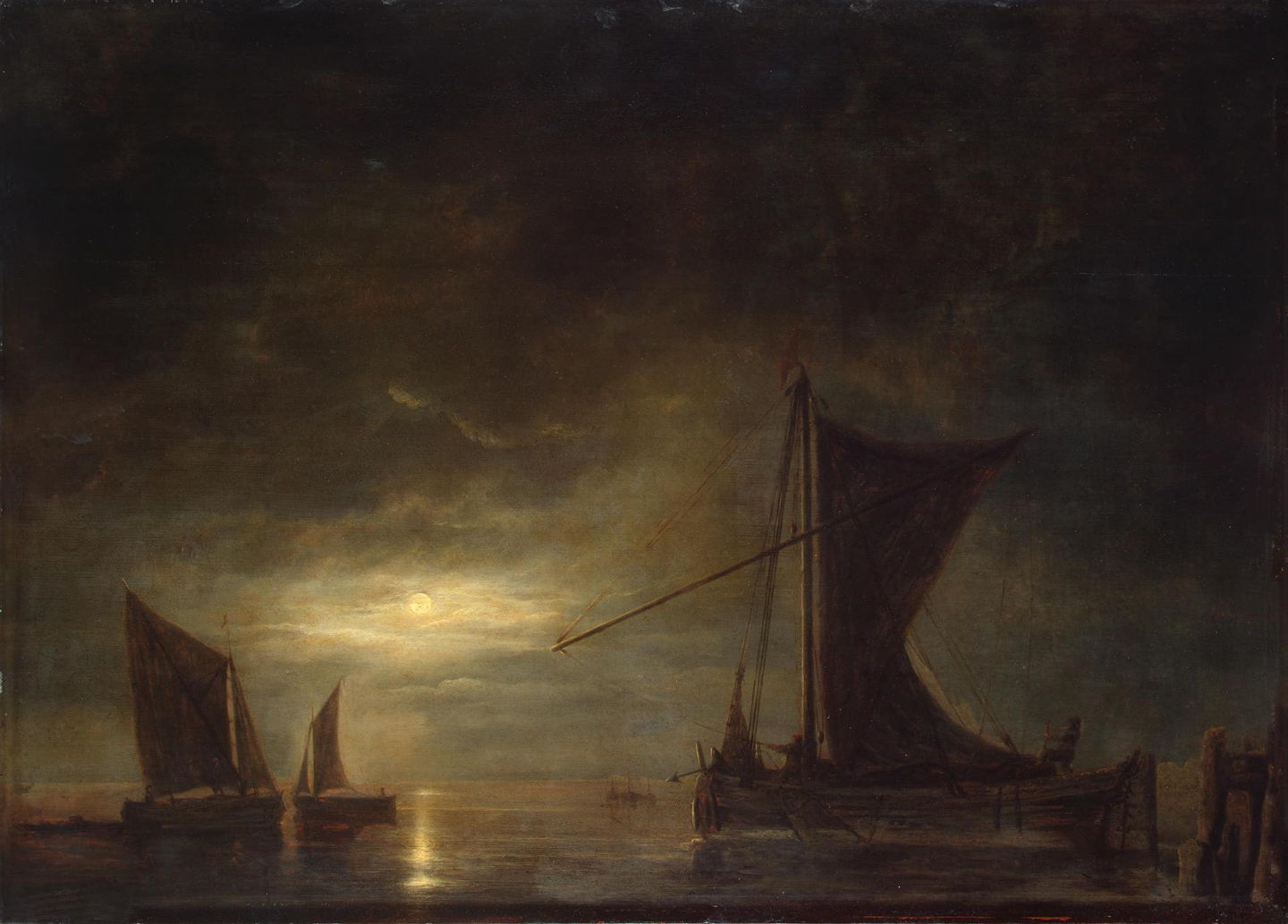
Aelbert Cuyp (1620–1691), Sea by Moonlight (c 1648), oil, 77 x 107.5 cm, Hermitage Museum Государственный Эрмитаж, Saint Petersburg, Russia. Wikimedia Commons.

He also painted a few nocturnes, including this view of the Sea by Moonlight from about 1648, where he extends his exploration of the effects of light.

cuyppassageboat
Aelbert Cuyp (1620–1691), The Passage Boat (c 1650), oil on canvas, 124 x 144.4 cm, Royal Collection of the United Kingdom, UK. Wikimedia Commons.

Although Cuyp never seems to have become a more dedicated marine specialist, his paintings of ships including The Passage Boat from about 1650, are landmarks at the height of his career. This ferry was most probably run between Dordrecht and Rotterdam, a distance of little more than twelve miles (20 km) by river. The figures in the boat are finely detailed, including a drummer towards the stern, and the clouds are also finely crafted.

Reference

Wikipedia.

The Dutch Golden Age: Winter

It happened that the Dutch Golden Age coincided with some of the coldest years during the Little Ice Age. In the previous century, the pioneering Flemish landscape painter Pieter Brueghel the Elder recorded the snow and ice during those exceptionally cold winters.

bruegelwinterlandscapeskaters
Pieter Brueghel the Elder (1526/1530–1569), Winter Landscape with Skaters and Bird Trap (1565), oil on panel, 37 x 55.5 cm, Royal Museums of Fine Arts of Belgium, Brussels. Wikimedia Commons.

Brueghel’s masterpiece Winter Landscape with Skaters and Bird Trap from 1565 is one of the first paintings to show Netherlandish people on the ice in the winter. Although a few similarly wintry views were painted in and around Antwerp, they didn’t really catch on until the middle of the following century. Among their earliest exponents in the Dutch Republic was Hendrick Avercamp, who was born in Amsterdam but painted for most of his career in Kampen, to the north-east, and was probably the first to specialise in winter landscapes.

avercampwinterlandscapeskaters1608
Hendrick Avercamp (1585–1634), Winter Landscape with Skaters (1608), oil on panel, 77.3 x 131.9 cm, Rijksmuseum Amsterdam, Amsterdam, The Netherlands. Wikimedia Commons.

Avercamp’s Winter Landscape with Skaters is seen in his 1608 version above, and from around 1630 below. The whole population seems to have spilled out from the warmth of buildings to take to the ice. The fashionable parade in their best clothes and company, children play, and the occasional less able skater ends up sitting on the ice.

avercampwinterlandscapeskaters1630
Hendrick Avercamp (1585–1634), Winter Landscape with Skaters (c 1630), oil on panel, 23 x 31.5 cm, Museum Boijmans Van Beuningen, Rotterdam, The Netherlands. Wikimedia Commons.
Hendrick Avercamp (1585–1634), Winter Scene on a Canal (c 1615), oil on panel, 49.9 x 95.6 cm, Toledo Museum of Art, Toledo, OH. Wikimedia Commons.

His Winter Scene on a Canal from about 1615 is even richer in detail. In the right of the painting are two tents with flags flying. These are popular koek-en-zopie, literally ‘cake and eggnog’ cafés, selling handheld snacks like cake and pancakes, together with alcoholic drinks such as beer laced with home-made rum.

Hendrick Avercamp (1585–1634), Kolf Players on Ice (1625), media and dimensions not known, Houston Museum of Fine Arts, Houston, TX. Wikimedia Commons.

Avercamp’s Kolf Players on Ice from 1625 features another common sight, the game of kolf, an ancestor of modern golf that became popular in the Netherlands during the thirteenth century, and has all but vanished today. Although also played indoors, it was played widely on frozen bodies of water during these cold winters. This involved striking a ball around a simple course with a club, with the aim of reaching the opponents’ starting point first. In this painting, the player about to strike their ball might be aiming for the post being held in the distance.

vandevennewinter
Adriaen van de Venne (c 1589–1662), The Winter (1614), oil on oak, 43 × 68 cm, Gemäldegalerie der Staatlichen Museen zu Berlin, Berlin. Wikimedia Commons.

Adriaen van de Venne’s early painting of The Winter from 1614 shows two ice yachts under full sail, and dense crowds in the distance.

cuypicehuistemerwededordrecht
Aelbert Cuyp (1620–1691), Ice Scene Before the Huis te Merwede near Dordrecht (c 1655), oil on panel, 64 x 89 cm, Private collection. Wikimedia Commons.

Although Aelbert Cuyp doesn’t appear to have painted many of these, his Ice Scene Before the Huis te Merwede near Dordrecht from about 1655 is among the finest. Notable here are his foreground reflections on the mirror-like surface, and the wonderful sky with its warm clouds. The castle seen here was built to the south-east of Dordrecht in the early fourteenth century, and ruined a hundred years later.

Skating on the ice using long curved blades of wood or metal, seen on the shoes of the man in the left foreground, was also popular. Younger adults made it a sport, and there were long-distance races.

vanderneersportsfrozenriver
Aert van der Neer (1604–1677), Sports on a Frozen River (c 1660), oil on panel, 23 x 35 cm, The Metropolitan Museum of Art, New York, NY. Wikimedia Commons.

Aert van der Neer’s beautifully-lit Sports on a Frozen River (c 1660) includes several kolf players. The reflection of the low sun on the ice is particularly well shown here, giving the ice a polished sheen.

Aert van der Neer (1604–1677), Winter Landscape (c 1660), oil on panel, 46.2 x 70.2 cm, Dorchester House, London. Wikimedia Commons.

Van der Neer was another specialist in painting these views. These contrasting Winter Landscapes show his command of light and skies in his mature works. That above dates from about 1660, and that below from about 1665-70.

Aert van der Neer (1604–1677), Winter Landscape (c 1665-70), oil on canvas, dimensions not known, Herzog Anton Ulrich-Museum, Braunschweig, Germany. Wikimedia Commons.
vandeveldegolfersonice
Adriaen van de Velde (1636–1672), Colf players on the Ice near Haarlem (1668), oil on oak, 30.3 x 36.4 cm, The National Gallery (Bought, 1871), London. Photo © The National Gallery, London.

Adriaen van de Velde’s Kolf Players on the Ice near Haarlem (1668) affords a closer view of a game in progress, with a koek-en-zopie tent in the distance, ready to warm the players up.

The Dutch Golden Age: Water

A glance at a map of the Dutch Republic during its Golden Age reveals that very little was far from the sea, or one of the large rivers that flow through its countryside and cities. In the middle was the Zuiderzee, a large inland sea only kept at bay by a great many dikes.

Fresheneesz, Map of the Low Countries, 1556-1648 (2006). Image by Fresheneesz, via Wikimedia Commons.

With the popularity of landscape painting, it was inevitable that the sea, rivers and other bodies of water became a common feature in those views. This article shows a small selection from some of the most famous artists of the time.

vangoyendordrecht
Jan Josefsz. van Goyen (1596-1656), View of Dordrecht with the Grote Kirk Across the Maas (1644), oil on oakwood, 64.8 x 96.8 cm, Walker Art Gallery, Liverpool, England. Wikimedia Commons.

Jan van Goyen’s View of Dordrecht with the Grote Kirk Across the Maas (1644) shows a familiar view of the city, with particular interest in its buildings. Its skyline is dominated by the still-unfinished 65 metre tower of the Grote Kerk, built between 1285-1470. There are many small boats at work on the choppy water, here depicted in an older fashion similar to works from the Renaissance.

cuyprhine
Aelbert Cuyp (1620–1691), View on the Rhine (c 1645), oil on panel, 27.4 x 36.8 cm, Fondation Custodia, Paris. Wikimedia Commons.

Aelbert Cuyp’s View on the Rhine from the following year appears to have been the result of a trip up river, into steeper terrain inland. It is wonderfully sketchy, and might even be mistaken for one of Turner’s landscapes from nearly two centuries later. In the Netherlands, the lower reaches of this river form part of the great Rhine–Meuse–Scheldt delta, which includes both the major port and city of Rotterdam, and Dordrecht.

cuypviewmaasdordrecht
Aelbert Cuyp (1620–1691), A View of the Maas at Dordrecht (c 1645-46), oil on panel, 50.2 x 107.3 cm, J. Paul Getty Museum, Los Angeles, CA. Wikimedia Commons.

Inevitably, many of Cuyp’s finest landscapes show his home city, such as this View of the Maas at Dordrecht from about 1645-46. This makes best use of an extreme panoramic panel, now commonly used for such marine landscapes.

cuypseamoonlight
Aelbert Cuyp (1620–1691), Sea by Moonlight (c 1648), oil, 77 x 107.5 cm, Hermitage Museum Государственный Эрмитаж, Saint Petersburg, Russia. Wikimedia Commons.

Cuyp also painted a few marine nocturnes, including this view of the Sea by Moonlight from about 1648, where he extended his exploration of the effects of light.

63.43.2
Philip de Koninck (1619–1688), Wide River Landscape (c 1648-49), oil on canvas, 41.3 x 58.1 cm, Metropolitan Museum of Art, New York, NY. Wikimedia Commons.

Philip de Koninck’s Wide River Landscape from about 1648-49 refers to a wide landscape rather than river, I believe. All seems at peace in the countryside, with livestock in the field in the foreground, and a small boat making its way under sail along the river.

cuyppassageboat
Aelbert Cuyp (1620–1691), The Passage Boat (c 1650), oil on canvas, 124 x 144.4 cm, Royal Collection of the United Kingdom, UK. Wikimedia Commons.

Although Cuyp never seems to have become a more dedicated marine specialist, his paintings of ships including The Passage Boat from about 1650, are landmarks at the height of his career. Passage boats were those engaged in regular ferry trips between set ports, in this case probably Dordrecht and Rotterdam, a distance of little more than twelve miles (20 km) by water. With the Republic’s extensive networks of rivers and canals, these were a popular means of transport at the time. The figures in the boat are finely detailed, and include a drummer towards the stern.

cuypmaasdordrecht
Aelbert Cuyp (1620–1691), The Maas at Dordrecht (c 1650), oil on canvas, 114.9 x 170.2 cm, National Gallery of Art, Washington, DC. Wikimedia Commons.

At their best, Cuyp’s coastal landscapes, such as The Maas at Dordrecht from about 1650, are full of rich light, earning him the title of the Dutch Claude Lorrain. This shows another passage boat packed with passengers, together with its drummer.

vanruysdaelalkmaar
Salomon van Ruysdael (c 1600/1603–1670), View of Alkmaar from the Sea (c 1650), oil on panel, 36 x 33 cm, Private collection. Wikimedia Commons.

Salomon van Ruysdael’s View of Alkmaar from the Sea (c 1650) is unusual in showing such a flat coastal landscape on a panel orientated not in landscape mode, but in portrait to include its fine cloudscape.

cuypvalkhofnijmegen
Aelbert Cuyp (1620–1691), The Valkhof at Nijmegen (c 1652-54), oil on wood, 48.8 x 73.6 cm, Indianapolis Museum of Art, Indianapolis, IN. Wikimedia Commons.

Cuyp’s grand view of The Valkhof at Nijmegen from about 1652-54 shows the Imperial castle that was to be demolished in 1798, on its small hill beside the river. The landscape is bathed in golden light, and broken clouds are tinged with similar Claudean colour as they drift through its lucent sky.

vanruisdaelegmondaanzee
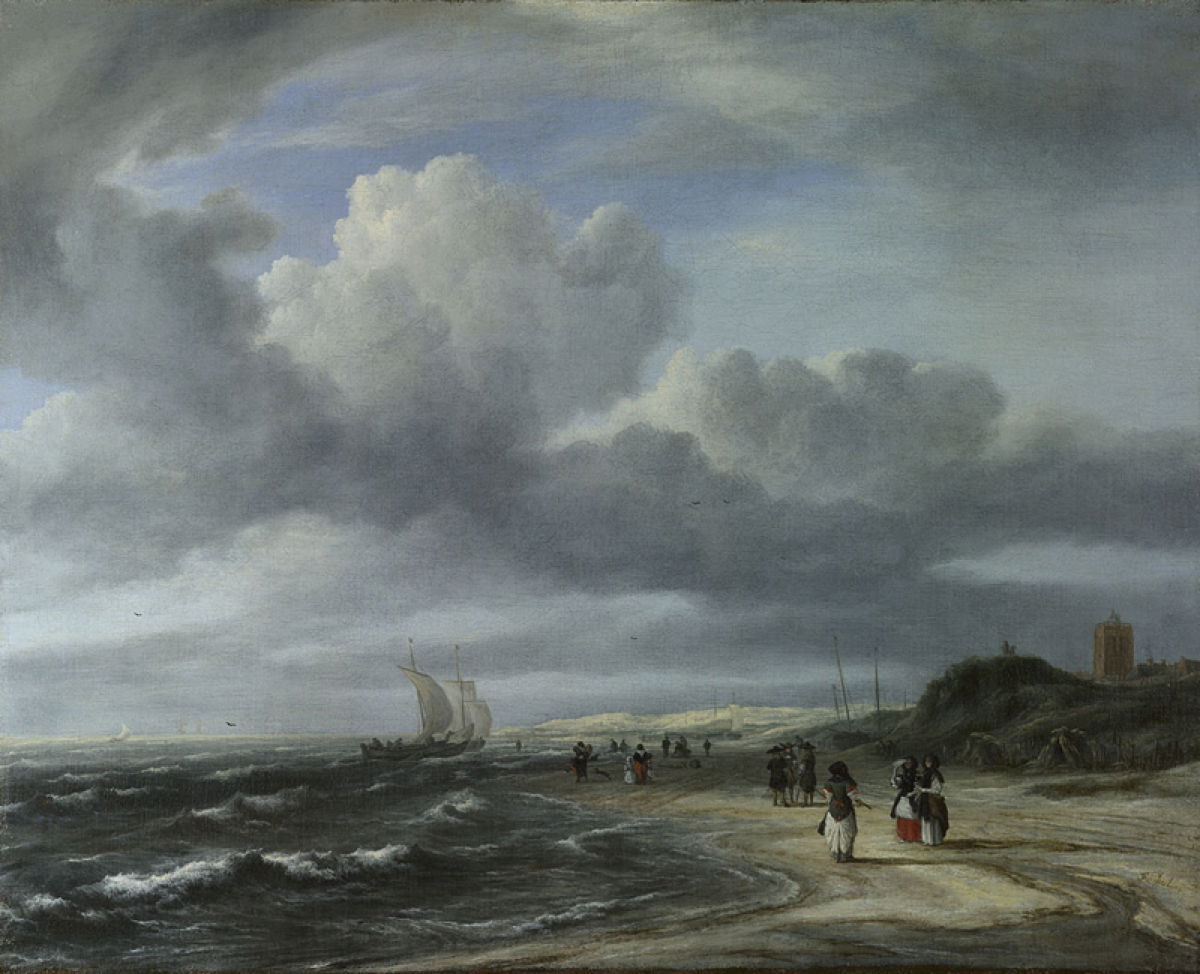
Jacob van Ruisdael (1628/9-1682), The Shore at Egmond-aan-Zee (c 1675), oil on canvas, 53.7 x 66.2 cm, The National Gallery (Bought, 1893), London. Image courtesy of and copyright The National Gallery.

Jacob van Ruisdael’s The Shore at Egmond-aan-Zee from about 1675 was painted to the west of Alkmaar, on the North Sea coast in North Holland, with its stormier weather.

Opnamedatum: 2010-01-11
Philip de Koninck (1619–1688), River Landscape (1676), oil on canvas, 92.5 x 112 cm, Rijksmuseum Amsterdam, Amsterdam, The Netherlands. Wikimedia Commons.

De Koninck’s River Landscape from the following year shows a single oarsman taking a small group of people along the river.

koninckflatbroadriver
Philip de Koninck (1619–1688), Flat Landscape With a Broad River (date not known), oil on canvas, 30 x 49 cm, Museum Boijmans Van Beuningen, Rotterdam, The Netherlands. Wikimedia Commons.

Many of de Koninck’s panoramas are painted on panels or canvases of normal proportions, and just look wide. Flat Landscape With a Broad River is more unusual for his use of a proper marine format. It also appears more sketchy, and has little staffage, as if it may even have been painted in front of the motif.

The Dutch Golden Age: Nocturnes

Before the Dutch Golden Age, painting scenes at night had been restricted to religious and other narrative works, and very few if any landscapes had been depicted during the hours of darkness. After all, what’s the point of a view if it’s all dark and you can’t admire it?

The Dutch Republic changed that, in part because it was in Northern Europe, where for several months each year it’s mostly dark, and these nocturnes had novelty value. Among those of the middle class who could afford to, it was fashionable to cover the walls inside your house with paintings, and nocturnes, known then as maneschijntjes (moonshines), certainly brought variety to those collections.

cuypseamoonlight
Aelbert Cuyp (1620–1691), Sea by Moonlight (c 1648), oil, 77 x 107.5 cm, Hermitage Museum Государственный Эрмитаж, Saint Petersburg, Russia. Wikimedia Commons.

Aelbert Cuyp’s view of the Sea by Moonlight from about 1648 is one of the earlier maritime nocturnes, something of a sub-sub-genre that must have been sought after. Unlike many others, this appears to be faithful to the original light.

During the 1640s, Aert van der Neer, a landscape painter in Amsterdam, started experimenting with his first nocturnes, and came to specialise in them.

Aert van der Neer (c 1604–1677), River View by Moonlight (c 1650-55), oil on panel, 55 x 103 cm, Rijksmuseum Amsterdam, Amsterdam, The Netherlands. Wikimedia Commons.

His River View by Moonlight from about 1650-55 shows a bustling village on a river, with several boats under way and two windmills in the distance. The moon appears to be depicted faithfully in terms of size, without the common tendency to exaggerate that as a result of the Moon Illusion. Surviving studies for some of these nocturnes demonstrate that van der Neer initially sketched a landscape in daylight, and based the detail in his finished studio painting on that.

Aert van der Neer (c 1604–1677), River Landscape with Moonlight (c 1655), oil on panel, 24.1 x 39.7 cm, Gemäldegalerie der Staatlichen Museen zu Berlin, Berlin, Germany. Wikimedia Commons.

In about 1655, he painted this finely detailed River Landscape with Moonlight, with a larger moon lighting clouds dramatically.

vanderneerestuarymoonlight
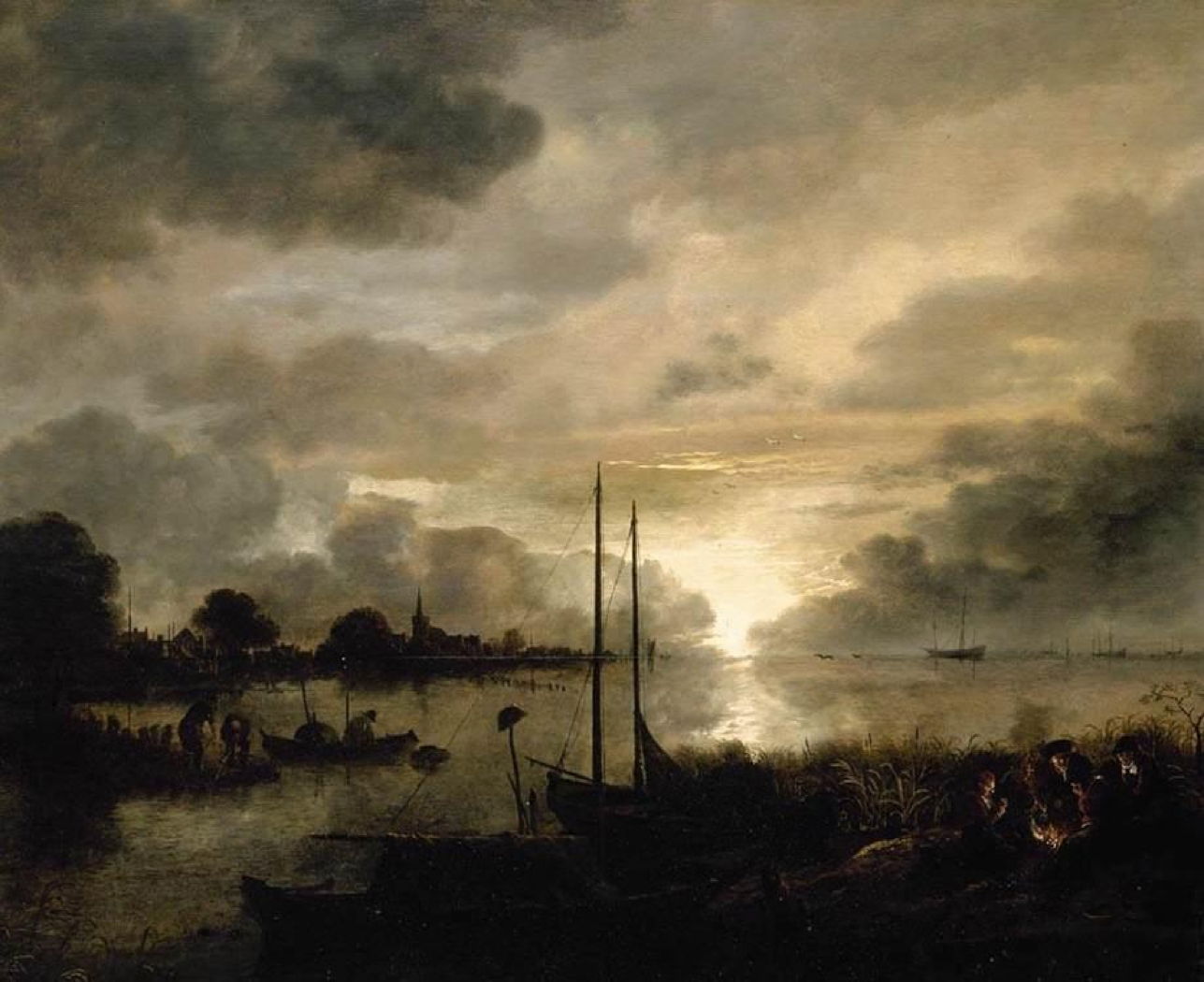
Aert van der Neer (c 1604–1677), Estuary Landscape by Moonlight (date not known), oil on panel, 63 x 76 cm, Private collection. Wikimedia Commons.

Some of his best nocturnes are lit by a combination of the moon and the warmer light from a fire. This undated Estuary Landscape by Moonlight uses light from both sources to great effect. Landscape details are shown largely in silhouette, and lack internal detail except in the group gathered around the fire in the foreground. Van der Neer is unusually faithful to reality in this monochrome, the result of the severely impaired colour vision we all suffer in conditions of low light, when there’s insufficient to enable colour vision using the cone cells in the human retina.

Aert van der Neer (c 1604–1677), Fire in Amsterdam by Night (date not known), oil on canvas, 58.8 x 71.7 cm, Statens Museum for Kunst (Den Kongelige Malerisamling), Copenhagen, Denmark. Wikimedia Commons.

At some stage, van der Neer started painting more destructive fires, including this undated Fire in Amsterdam by Night, leading to another sub-sub-genre that was taken up by others.

beerstraatenoldtownhallamsterdam
Jan Abrahamsz Beerstraaten (1622–1666), The Old Town Hall of Amsterdam on Fire, 7 July 1652 (1652-55), oil on panel, 89 x 121.8 cm, Amsterdam Museum, Amsterdam, The Netherlands. Wikimedia Commons.

In mid 1652, Jan Abrahamsz Beerstraaten seems to have witnessed the destruction by fire of part of the centre of Amsterdam, which formed the basis of his studio painting of The Old Town Hall of Amsterdam on Fire, 7 July 1652 (1652-55). Local inhabitants are walking in orderly queues to boats, in which they escape from the scene. This may have been the same fire painted by van der Neer, above.

Egbert van der Poel specialised in these brandjes,, and probably painted more than any other artist in history. He moved to Delft in 1650, and four years later was a victim of the massive explosion in a gunpowder store there on 12 October 1654. That killed one of his children, and he moved again to Rotterdam.

vanderpoelfirechurch
Egbert van der Poel (1621–1664), Fire of a Church with Staffage and Cattle (1658), oil on oak, 46.3 × 62 cm, Muzeum Narodowe w Warszawie, Warsaw, Poland. Wikimedia Commons.

It has been thought that most of van der Poel’s Fire of a Church with Staffage and Cattle from 1658 is a carefully-composed composite of his experiences. A small church at the edge of a village is well ablaze, and the inhabitants are abandoning it, taking all the possessions they can, including their horses and livestock, and leaving the fire to burn itself out.

vanderpoelfireatnight
Egbert van der Poel (1621–1664), A Fire at Night (date not known), oil, dimensions not known, Kelvingrove Art Gallery and Museum, Glasgow, Scotland. Wikimedia Commons.

Van der Poel’s undated A Fire at Night shows a similar scene and composition, set this time on the bank of a canal.

vanderpoelfirderijp
Egbert van der Poel (1621–1664), Fire in De Rijp of 1654 (1662), oil, dimensions and location not known. Wikimedia Commons.

One established exception to this is van der Poel’s Fire in De Rijp of 1654, completed in 1662. This shows a fire that worked its way through more than eight hundred buildings in the town of De Rijp during the night of 6 January 1654. This left only the northern section of the town standing and inhabitable, and resulted in more casualties than did the more famous explosion in Delft at the end of that year.

vanderpoelfirenieuwekerk
Egbert van der Poel (1621–1664), The Fire in the Nieuwe Kerk, Amsterdam, in 1645 (c 1645), brush and gray wash and black wash with touches of pen and brown ink, 12.5 × 19.4 cm, location not known. Wikimedia Commons.

Doubt is cast on this received account of van der Poel’s work by sketches such as this, of The Fire in the Nieuwe Kerk, Amsterdam, in 1645, made in front of the motif using washes with touches of pen and brown ink. Perhaps he was the first ‘ambulance chaser’ who travelled out to sketch fires, from which he later painted his famous brandjes in the studio.

For the non-specialist like Jacob van Ruisdael, winter was an ideal opportunity to explore the effect of negative images, where objects that would normally be seen as dark on a light background were reversed to white on dark.

vanruisdaelwinterlandscape
Jacob Isaakszoon van Ruisdael (1628/9–1682), Winter Landscape (c 1660-70), oil on canvas, 37.3 x 32.5 cm, Royal Picture Gallery Mauritshuis, The Hague. Wikimedia Commons.

Van Ruisdael painted at least two such landscapes featuring trees. Both are now known by the same name, and are believed to be from the same decade. This Winter Landscape (c 1660-70), in the Mauritshuis, picks out frosted leaves in the half-light of dusk or dawn, by a hamlet at the water’s edge. In the far distance, to the left of the buildings, there is a church with a spire.

vanruisdaelwinterlandscape2
Jacob Isaakszoon van Ruisdael (1628/9–1682), Winter Landscape (c 1660-70), oil on canvas, 36.5 x 32.4 cm, Birmingham Museum of Art, Birmingham, AL. Photo by Sean Pathasema, via Wikimedia Commons.

The other version of Winter Landscape (c 1660-70) is in Birmingham, Alabama. With similar sky, cloud, lighting, and composition, the water here appears to have frozen over. The frost on the trees is just as delicately handled.

❌