
Reading view

There are new articles available, click to refresh the page.

Medium and Message: Glazes and optical effects

Many of the greatest paintings succeed in part because they use optical effects in their paint layer. This takes advantage of the fact that thinner layers of paint aren’t completely opaque, so allow some light to pass through them. In watercolours, transparent paints are often referred to as transparent watercolour, while those that are opaque are known as gouache or body colour. In oils, different pigments result in degrees of opacity, expressed as their covering power.

daumierstrongman
Honoré Daumier (1808-1879), The Strongman (c 1865), oil on wood panel, 26.9 x 35 cm, The Phillips Collection, Washington, DC. Microscopic paint cross-section by Elizabeth Steele at http://blog.phillipscollection.org/2014/02/26/happy-birthday-honore-daumier/. Courtesy of The Phillips Collection.

This cross-section of the paint layer from Honoré Daumier’s The Strongman (c 1865) demonstrates how many oil paintings consist of a series of layers, with several pigments present through their depth. Generally, the most opaque are applied first, and on top of those come a series of thinner transparent layers or glazes. Together these allow complex combinations of reflection and refraction of light, generating optical effects.

Layered oil painting technique is best seen in paintings that have been abandoned before completion.

The British portrait painter Sir Joshua Reynolds received a conventional training in traditional and conservative methods with roots dating back to the late 1600s. He painted in layers, starting with dead colouring, the laying in of shadows and lights, then blending in transitions of shading and colour wet-on-wet. Highlights were then brought out, and shadows glazed, to produce a series of thin layers of oil paint, and a smooth, finished paint surface.

reynoldsmrsrobinson
Sir Joshua Reynolds (1723–1792), Mrs. Robinson (c 1784), oil on canvas, 88.6 x 68.9 cm, Yale Center for British Art, New Haven, CT. Wikimedia Commons.

Those early stages are shown well in this abandoned portrait of Mrs Robinson from about 1784, where most of the paint layer is sufficiently thin as to allow the texture of the canvas to show through. When used with ‘lean’ paint, this dried quickly and complies with the longstanding edict of applying ‘fat’ over ‘lean’, so that the lowest layers dry first.
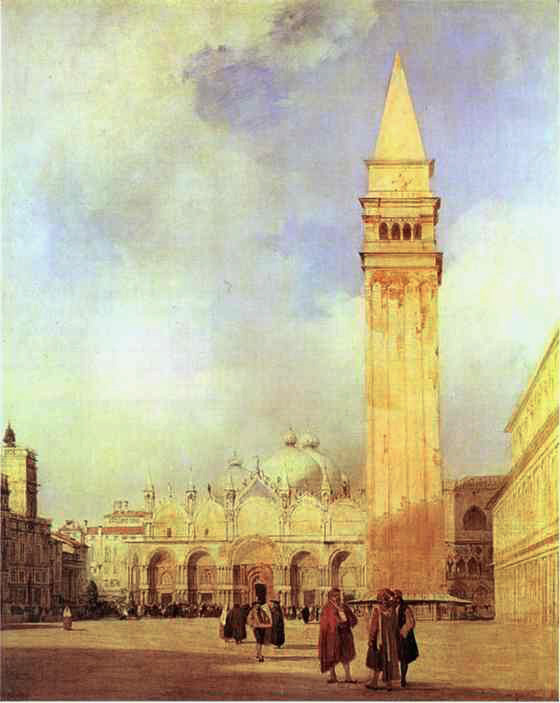
Richard Parkes Bonington (1802-28), Venice: The Piazza San Marco (1827-8), oil on canvas, 99.4 x 80.3 cm, Wallace Collection, London. WikiArt.

Richard Parkes Bonington’s unfinished Venice: The Piazza San Marco (1827-28) shows signs that it might have been among his best. Its buildings have a golden glow from the setting sun, but those colours would undoubtedly have been enhanced by rich glazes had he lived long enough to complete it.

Occasionally the paint layer develops problems that demonstrate the effects of glazes.

bloemaertadorationofmagi
Abraham Bloemaert (1564–1651), The Adoration of the Magi (1624), oil on canvas, 168.8 x 193.7 cm, Centraal Museum, Utrecht, The Netherlands. Wikimedia Commons.

In Abraham Bloemaert’s The Adoration of the Magi from 1624, the cloak of the Virgin Mary appears to use two different blues, with its lower passages painted in the duller hue of indigo, which has faded. The dullest areas are those that had the thinnest ultramarine glazes applied, much of which have now abraded away during subsequent cleaning of the painting. The unprotected indigo has therefore suffered sufficient exposure to fade, as well as losing those rich glazes.

turnerapproachtovenice
Joseph Mallord William Turner (1775–1851), Approach to Venice (1844), oil on canvas, 62 x 94 cm, The National Gallery of Art, Washington, DC. Courtesy of The National Gallery of Art, via Wikimedia Commons.

JMW Turner’s Approach to Venice (1844) was painted with very thin transparent glazes over thick white impasto, creating a distinctive flickering effect in its highlights.

turnerapproachtoveniced1
Joseph Mallord William Turner (1775–1851), Approach to Venice (detail) (1844), oil on canvas, 62 x 94 cm, The National Gallery of Art, Washington, DC. Courtesy of The National Gallery of Art, via Wikimedia Commons.

Despite the artist’s efforts to get the white impasto to dry more quickly, the glazes dried first, and cracked as they became stressed over the white that was still wet. This hasn’t been helped by the later conservation process of lining, which places an additional layer on the back of the canvas to help the support do its job.

Although a wide range of pigments have been used successfully in glazes, some were developed specifically for the purpose. From the fifteenth century onwards, verdigris pigment was mixed with natural resins for use in glazes. This produces a different pigment from regular verdigris, as the copper combines with the resin acids to form what is known as copper resinate.

A popular technique among many masters to produce an intense green was to paint an underlayer using verdigris, over which several glazing layers of copper resinate were then applied. Although generally reliable and stable, verdigris and copper resinates have a tendency to turn brown on the surface. Thankfully this affects relatively few paintings.

tintorettostgeorgedragon
Tintoretto (1519–1594), Saint George and the Dragon (c 1555), oil on canvas, 158.3 x 100.5 cm, The National Gallery, London. Wikimedia Commons.

Tintoretto used copper resinate glazes in several of his paintings, most notably the rich, varied, and often lush vegetation in his Saint George and the Dragon from about 1555.

veroneseallegoryloverespect
Paolo Veronese (1528–1588), The Allegory of Love, Respect (c 1575), oil on canvas, 186.1 x 194.3 cm, The National Gallery, London. Wikimedia Commons.

Studies at the National Gallery, London, have found copper resinate in three of the four paintings in Paolo Veronese’s series The Allegory of Love. In the third of these, Respect (c 1575), the pigment was found in the man’s intense green cloak, and the duller gold-brown brocade patterning on the wall behind his hand (detail below). The surface of that wall has superficial brown discoloration of the paint layer.

veroneseallegoryloverespectd1
Paolo Veronese (1528–1588), The Allegory of Love, Respect (detail) (c 1575), oil on canvas, 186.1 x 194.3 cm, The National Gallery, London. Wikimedia Commons.
bocklintritonnereid
Arnold Böcklin (1827–1901), Triton and Nereid (1874), tempera on canvas, 105.3 × 194 cm, Sammlung Schack, Bayerische Staatsgemäldesammlungen, Munich, Germany. Wikimedia Commons.

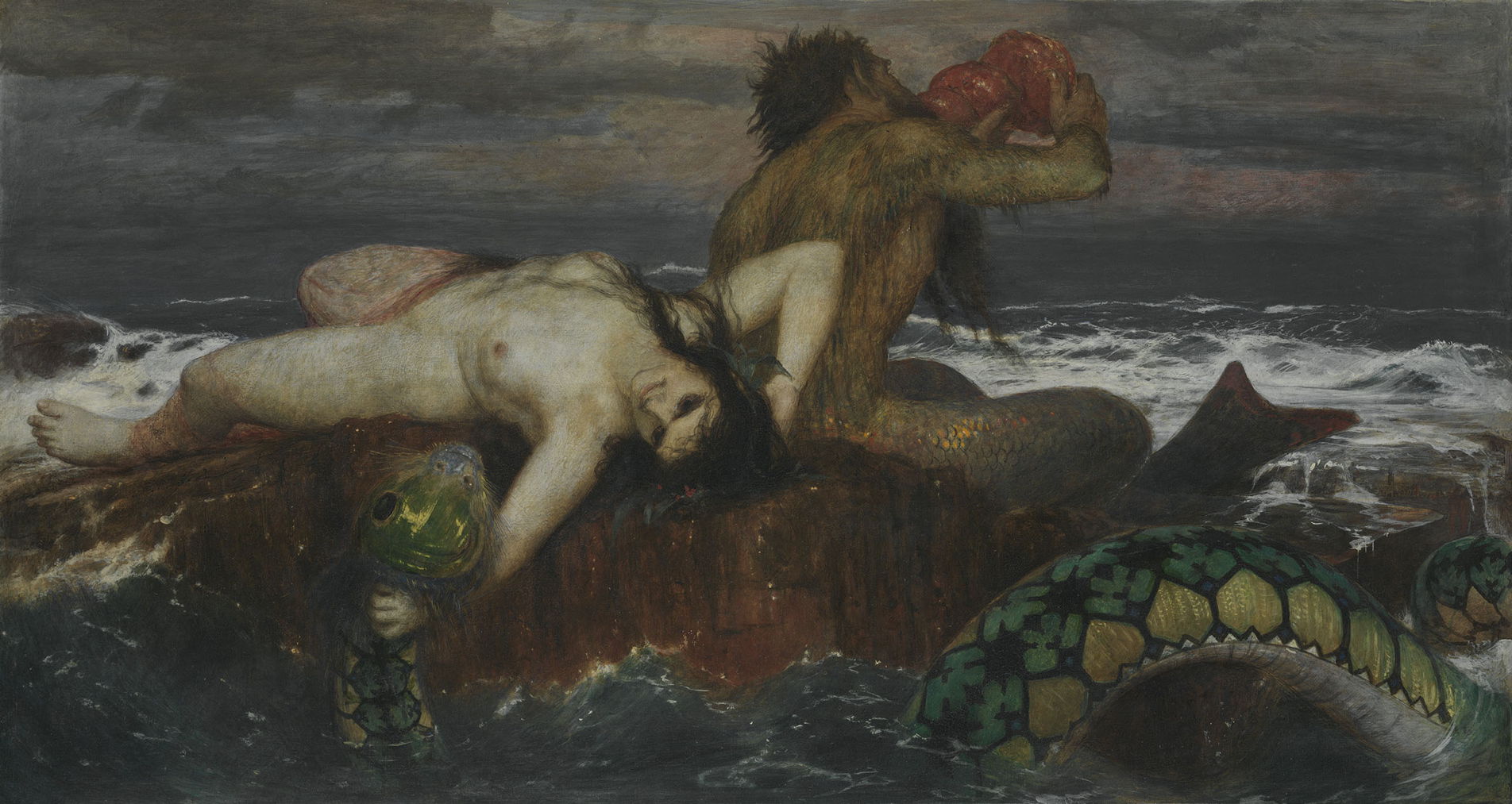
One of the last major uses of copper resinate is in Arnold Böcklin’s Triton and Nereid from 1874. This is reported as being painted in tempera, but copper resinate glaze appears to have been used to develop the intense green patterns on the sea monster in the foreground. This is consistent with Böcklin adhering to traditional techniques despite working in the late nineteenth century.

During that century, painting slowly in multiple layers with glazes progressively fell from favour. By the end, many oil painters had adopted techniques in which much or all of a painting was made at once, known as direct, alla prima or au premier coup.

Medium and Message: Industrial chemistry

Traditional oil paints were the mainstay medium used by professional painters in the west from the Renaissance until the late twentieth century, a period of well over half a millennium. Although other media have been used widely and successfully, until recently the apparently infinite flexibility of effects and painting styles made oil paint dominant. Over that period, much effort has been expended getting oil paint to dry more quickly, and discovering how to create stable paint layers using principles such as the ‘fat over lean’ rule.

In the nineteen-thirties Otto Röhm invented a new synthetic resin formed from acrylate molecules, dubbed acrylic resin. This first became available dispersed in liquid during that decade, and was steadily developed into paints during the nineteen-forties. Their biggest market was in commercial paints for general use, particularly for the outside of buildings.

In the late nineteen-forties, Leonard Bocour and Sam Golden developed and brought to market Magna paints, in which acrylates were suspended in mineral spirits to form an emulsion. Golden later developed a paint based on water, which lives on in his company Golden Artist Colours. In the nineteen-fifties they were joined by Liquitex, then in the sixties by Rowney’s Cryla paints. Acrylic paints were starting to rival oils.

In modern acrylic paints, the acrylics themselves are the binder, with water as its diluent. Wet paint is readily removed from brushes and skin using soapy water, making the use of organic solvents largely unnecessary except when dealing with dried paint. This is much more convenient than working with oils and their toxic organic solvents required for cleaning.

dasapostlesdiscoursingmaternity
Mrinal Kanty Das (dates not known), Apostles Discoursing Maternity (2015), acrylic on canvas, 60 x 50 cm, location not known. By courtesy of the artist https://www.gallery247.com.au/mrinal-kanty-das, via Wikimedia Commons.

Oil paints remain rooted in alchemy to a degree; although modern commercially made oil paints are sophisticated combinations of natural and synthetic ingredients, using them and controlling their visual effects owes as much to tradition as it does to industrial chemistry. Acrylics are thoroughly modern in their formulation and use, carefully packaged blends of polymers with surfactants, plasticisers, dispersants, defoamers, stabilisers, and of course pigments.

Some artists still grind their own oil colours, and many oil painters use traditional media and resins to control their properties. Acrylics are too chemically complex for artists to prepare themselves, although use of special additive media to alter their handling and properties is popular.

oeggerlipizlagrev1
Sylvia Oeggerli (b 1939), Piz Lagrev 1 (2015), mixed media, dimensions and location not known. By courtesy of the artist https://fr.wikipedia.org/wiki/Sylvia_Oeggerli, via Wikimedia Commons.

Early acrylics were fast to dry, making them excellent for painting in layers, but unsuitable for techniques such as ‘wet in wet’ relying on the interaction of wet paint on the ground. Hard edges were easily achieved, as were bright if not garish colours, but effects such as sfumato were simply not possible.

schweigereisig
Birgit Schweiger (dates not known), Icy (2010), acrylic on canvas, 100 x 140 cm, Private collection. By courtesy of the artist https://www.birgitschweiger.com, via Wikimedia Commons.

Over the last fifty years, formulation of acrylic paints and their media have not only resulted in products that remain ‘open’ for longer, but have let painters determine body, flow, finish, and other physical properties of acrylic paint. Paint manufacturers even have fine control over the size of acrylic particles within the paint emulsion, enabling this flexibility, and some offer acrylic inks far more robust and durable than traditional products.

busschersbeyondgrief
Annemarie Busschers (b 1970), Beyond Grief, Self-portrait (2011), acrylic, 180 x 180 cm, location not known. By courtesy of the artist, via Wikimedia Commons.

busschersjacobwitzenhausen
Annemarie Busschers (b 1970), Portrait of Jacob Witzenhausen (2012), acrylic on canvas, 250 x 160 cm, Private collection. By courtesy of the artist, via Wikimedia Commons.

busschersstrokeII
Annemarie Busschers (b 1970), Stroke II (2013), acrylic, 180 x 130 cm, location not known. By courtesy of the artist, via Wikimedia Commons.

Acrylics are also able to adhere to a wide range of grounds. Professional artists often continue using prepared stretched canvas, but acrylic sizing is necessary on that and some others to prevent discolouration from the ground, termed ‘Support-Induced Discolouration’ or SID.

There are still remaining issues in using acrylic paints, though. Many oil paintings show evidence that at some stage part of their paint layer has been scraped off to enable the artist to repaint sections in pentimenti; this isn’t normally possible with acrylics, which tend to be overpainted without scraping, as the latter strips the entire paint layer and may also damage the ground.

haasethbevegelsesmonster
Kolbjørn Håseth (dates not known), Patterns of Movement (2007), acrylic, 89 x 116 cm, location not known. By courtesy of the artist http://www.khz.no, via Wikimedia Commons.

Experience from accelerated ageing of acrylic paints suggests that today’s acrylic paintings should last better than oils. However, the oldest acrylic paints are still well under a hundred years old, making it far too soon to arrive at any definitive conclusion. It’s also telling that even the innovative Golden Artist Colours offers Williamsburg oil paints, and QOR watercolours using a synthetic replacement as its binder.

evervanitas
Jeylina Ever (?1960-), Vanitas Symbolizing Childhood Disease, Culture, Time Passing and Death (2009), acrylic on canvas, 42 cm x 26 cm, location not known. Wikimedia Commons.

❌