Reading view

There are new articles available, click to refresh the page.

Reading Visual Art: 234 Fish A

Because most fish aim to spend their entire lives underwater, where few artists go to paint, fish are seldom seen in paintings. That contrasts with those who try to capture fish by going fishing, an activity I have previously covered in this series in this article and a second.

Most of the aquatic creatures seen in paintings of myths, including those accompanying the god Neptune, appear to be caricatures of marine mammals including dolphins, or sea-monsters bearing no resemblance to fish.

stellabirthofvenus
Joseph Stella (1877–1946), The Birth of Venus (1922), oil on canvas, 215.9 x 134.6 cm, Private collection. The Athenaeum.

One exception to this is Joseph Stella’s The Birth of Venus from 1922. As might be expected, his treatment is completely novel and seems to have benefited from visits to an aquarium. Aphrodite is shown at sea, in the upper part of the painting her upper body above the waterline, and below morphing into an aquatic plant underneath, where it finally merges into a helical shell. Matching the birds and flowers above the water are brightly coloured fish below.

beuckelaerwater
Joachim Beuckelaer (c 1533–1575), The Four Elements: Water. A Fish Market with the Miraculous Draught of Fishes in the Background (1569), oil on canvas, 158.5 x 215 cm, The National Gallery, London. Wikimedia Commons.

Another interesting exception is Joachim Beuckelaer’s depiction of water in his Four Elements cycle from 1569. This shows A Fish Market with the Miraculous Draught of Fishes in the Background, the one place even landlubbers would come across fish, combined with the Gospel story in the far distance.

courbettrout
Gustave Courbet (1819–1877), The Trout (Summer 1872), oil on canvas, 53 x 87 cm, Kunsthaus Zürich, Zürich, Switzerland. Wikimedia Commons.

In the summer of 1872, as a one-off, Gustave Courbet painted an allegorical still life of The Trout, that is “hooked and bleeding from the gills”, a powerful expression of his personal feelings after being imprisoned for damage to the Vendôme Column during the Paris Commune the previous year.

turnerslaveship
Joseph Mallord William Turner (1775–1851), Slave Ship (Slavers Throwing Overboard the Dead and Dying, Typhoon Coming On) (1840), oil on canvas, 90.8 × 122.6 cm, Museum of Fine Arts, Boston, MA. Photo by Museum of Fine Arts, Boston, via Wikimedia Commons.

JMW Turner recruits a school of fish for effect in his Slave Ship from 1840. His threatening sky and violent sea put the ship in the middle distance, silhouetted against the blood-red sky. The foreground is filled with the ghastly evidence of the slaves who were cast overboard.

turnerslaveshipdet
Joseph Mallord William Turner (1775–1851), Slave Ship (Slavers Throwing Overboard the Dead and Dying, Typhoon Coming On) (detail) (1840), oil on canvas, 90.8 × 122.6 cm, Museum of Fine Arts, Boston, MA. Photo by Museum of Fine Arts, Boston, via Wikimedia Commons.

Seen in amongst a feeding frenzy of fish and scavenging seabirds are hands raised from the waves in their final plea for rescue, a gruesome manacled leg, and various shackles used to restrain the slaves when in transit. Further back on the left a vague white form could represent spirits, and on the right is the thrashing tail of a sea monster.

thomathreemermaids
Hans Thoma (1839–1924), Three Mermaids (1879), oil on canvas, 106 × 77.6 cm, Städelsches Kunstinstitut und Städtische Galerie, Frankfurt, Germany. Wikimedia Commons.

Fish make the occasional appearance alongside legendary mermaids, as in Hans Thoma’s Three Mermaids from 1879. These mermaids are remarkably human in form, lacking fishtails, and frolic with fish under the light of the moon.

Historically the most important fish in Europe has been the humble herring. In the Middle Ages herring fisheries prospered and were the foundation of Copenhagen and Great Yarmouth, and influential in early Amsterdam. They remain strongly associated with the Netherlands and Nordic countries, where they are commonly preserved in brine (soused) or pickled.

Gabriel Metsu (1629–1667), Woman Selling Herring (c 1661-62), oil on panel, 37 x 33 cm, Rijksmuseum Amsterdam, Amsterdam, The Netherlands. Wikimedia Commons.

Gabriel Metsu’s Woman Selling Herring (c 1661-62) is going from door to door with her fish, here trying to convince an old woman standing with a stick at the door of her dilapidated cottage in the Dutch Republic.

brendekildehomefordinner
Hans Andersen Brendekilde (1857–1942), Home for Dinner (1917), further details not known. Wikimedia Commons.

In Hans Andersen Brendekilde’s Home for Dinner from 1917, a young girl holding some fresh fish stands talking to a man with a spade.

turnerstmawes
JMW Turner (1775–1851), St. Mawes, Cornwall (c 1823), watercolour, 14.3 x 21.9 cm, Yale Center for British Art, New Haven, CT. Wikimedia Commons.

JMW Turner toured the West Country as far as Cornwall in 1811, and the Tate Gallery has his ninety-page sketchbook recording many views of the Cornish coast from that visit. He later developed several into fine oil paintings, although it’s unclear whether this watercolour of St. Mawes, Cornwall, from about 1823, had its origins in those sketches and studies.

As with his paintings of other coastal areas, Turner shows a fishing boat coming in to a beach to land its catch, and the great activity in the open air fish market in the foreground. Behind are typical Cornish cottages stepped up from the shore to the top of the coastal cliffs, and the castles of St Mawes (closer) and Pendennis, in Falmouth (more distant, on the other side of this estuary).

daddfishmarket
Richard Dadd (1817–1886), Fish Market by the Sea (c 1860), oil on canvas, 100.3 x 125.7 cm, Yale Center for British Art, Paul Mellon Collection, New Haven, CT. Courtesy of the Yale Center for British Art.

Richard Dadd’s Fish Market by the Sea, from about 1860, shows an impromptu open-air fish market, run by the fishermen’s wives, to sell their husband’s catch as soon as it had been landed.

Medium and Message: Knives, fingers and long brushes

Almost all who paint in oils use conventional brushes, but there’s a significant minority who sometimes, or frequently, use different tools to apply and shape the paint layer. Of those, the most popular are palette knives, generally used to move and mix paint on the palette. Others have used the other end of the brush stick to incise, or their fingers.

bashkirtseffinthestudio
Marie Bashkirtseff (1858–1884), In the Studio (1881), oil on canvas, 188 x 154 cm, Dnipro State Art Museum, Dnipro, Ukraine. Wikimedia Commons.

Marie Bashkirtseff’s painting of a class in the Académie Julien in Paris in 1881 demonstrates how oil painting should be done by the textbook. The artist, shown in her self-portrait in the centre foreground, is using a long-bladed palette knife to prepare the paint on her palette. At her feet, on an old sheet of newspaper, are her brushes, all with handles of typical length, and the pupil behind her is using a maul stick to rest her right hand while painting with her brush.

courbetgrottosarrazine
Gustave Courbet (1819–1877), The Grotto of Sarrazine near Nans-sous-Sainte-Anne (c 1864), oil on canvas, 50.2 x 60 cm, J. Paul Getty Museum, Los Angeles, CA. Wikimedia Commons.

Gustave Courbet applied his paint using a palette knife for some of his paintings. This has been identified from the facture in some of his paintings of caves that he made from about 1864, including The Grotto of Sarrazine near Nans-sous-Sainte-Anne above.

Another enthusiast for painting with a knife was Auguste Renoir.

renoirlecoeurhunting
Pierre-Auguste Renoir (1841–1919), Jules Le Coeur and his Dogs in the Forest of Fontainebleau (1866), oil on canvas, 112 x 90 cm, Museu de Arte de São Paulo (MASP), São Paulo, Brazil. Wikimedia Commons.

In 1866, Renoir painted his friend Jules Le Coeur and his Dogs in the Forest of Fontainebleau. This is unusual among his works, as it was preceded by two studies, and all three were made using the palette knife rather than brushes. This makes it most likely to have been painted before Renoir abandoned the knife and returned to the brush, by the middle of May 1866.

renoirmosque
Pierre-Auguste Renoir (1841–1919), The Mosque (1881), oil on canvas, 73 x 92 cm, Musée d’Orsay, Paris. Wikimedia Commons.

Renoir returned to the technique in The Mosque, also known as Arab Festival, in 1881. Small strokes of bright colour and energetic work with the palette knife give it a strong feeling of movement, and it so impressed Claude Monet that he bought it from Durand-Ruel in 1900.

hillsfallorangecopark
Anna Althea Hills (1882-1930), Fall, Orange County Park (1916), oil on board, 35.6 x 45.7 cm, Private collection. The Athenaeum.

Anna Althea Hills’ Fall, Orange County Park (1916) is a classic and highly accomplished plein air painting that appears to have been made with extensive and deft use of the knife, particularly in the foreground.

Perhaps the most famous artist who is known to have painted with his fingers is Leonardo da Vinci.

davinciannunciation
Leonardo da Vinci (1452–1519), Annunciation (c 1473-75), oil and tempera on poplar, 100 x 221.5 cm, Galleria degli Uffizi, Florence, Italy. Wikimedia Commons.

This Annunciation, painted in oil and tempera on a poplar panel, is generally agreed to be one of the earliest of Leonardo’s own surviving paintings. When it was painted is in greater doubt, but a suggestion of around 1473-75 seems most appropriate. There are numerous pentimenti, particularly in the head of the Virgin. Its perspective projection is marked in scores in its ground and Leonardo used his spontaneous and characteristic technique of fingerpainting in some of its passages.

Finally, some painters are well-known for their use of brushes with exceptionally long handles. These enabled them to stand back, sometimes almost on the opposite side of their studio, get an overall view of their canvas, and paint from the same distance as a viewer.

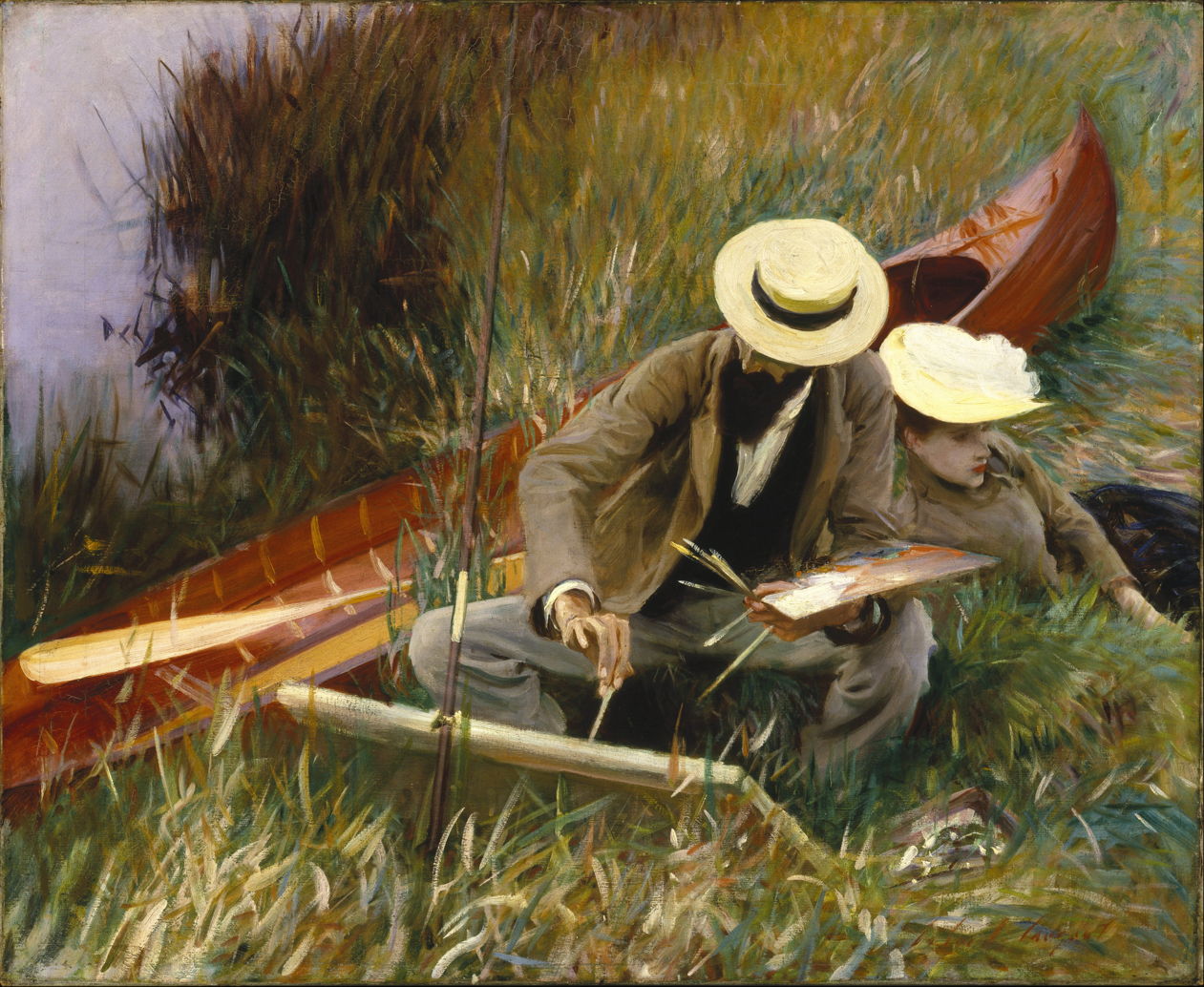
sargentoutofdoorsstudy
John Singer Sargent (1856–1925), An Out-of-Doors Study (c 1889), oil on canvas, 65.9 × 80.7 cm, Brooklyn Museum, New York, NY. Wikimedia Commons.

Like all plein air painters, Paul César Helleu (1859–1927) shown in John Singer Sargent’s An Out-of-Doors Study from about 1889, is using brushes with handles of modest length. His canvas is fairly small, and he’s working close-in while clutching a brace of brushes in his left hand. Some designed for use when painting in front of the motif have even shorter handles, but when back in the studio Helleu would almost certainly have opted for longer.

James Abbott McNeill Whistler, Symphony in White No. 1: The White Girl (1862), oil on canvas, 214.6 x 108 cm, National Gallery of Art, Washington, DC. WikiArt.
James Abbott McNeill Whistler (1834-1903), Symphony in White No. 1: The White Girl (1862), oil on canvas, 214.6 x 108 cm, National Gallery of Art, Washington, DC. WikiArt.

Whistler was renowned for using brushes with handles over one metre (39 inches) long, and appears to have used them when painting Symphony in White No. 1: The White Girl in 1862 on a canvas just over two metres (78 inches) tall. He reworked it between 1867-72 to make it more ‘spiritual’ and reduce its original realism.

sorollasewingsail
Joaquín Sorolla y Bastida (1863–1923), Sewing the Sail (1896), oil on canvas, 220 x 302 cm, Museo d`Arte Moderna di Ca’ Pesaro, Venice, Italy. Image by Flaviaalvarez, via Wikimedia Commons.

Early in his career, Joaquín Sorolla established his reputation of painting ‘voraciously’, often using brushes with extremely long handles and large canvases. Although Sewing the Sail from 1896 may look a spontaneous study of the effects of dappled light, Sorolla composed this carefully with the aid of at least two drawings and a sketch, and given its 2.2 metre (87 inches) height, he was almost certainly using brushes of similar length.

❌