Making a highly successful career for yourself as a woman artist in the Renaissance was an extraordinary if not unique feat. It’s one of the many accomplishments of Sofonisba Anguissola (c 1532-1625), who also managed to survive the ravages of infectious disease, and died in her early nineties, four centuries ago today.
Even more unusually, she wasn’t born into an artistic family, but into minor nobility in Cremona, Lombardy, Italy. The oldest of Amilcare Anguissola’s seven children, the family claimed ancestry going back to ancient Carthage. Amilcare and his wife Bianca educated and encouraged their daughters to develop their abilities, resulting in four of their six girls becoming painters, but it was only Sofonisba who persisted long enough to make a career of her art.
When she was fourteen, Sofonisba went to study in Bernardino Campi’s workshop, then to Bernardino Gatti’s. She probably completed her training in about 1553, but by then was already painting outstanding works in oils.
Sofonisba Anguissola (1530–1625), Self-portrait with Bernardino Campi (1550), oil on canvas, 111 x 109.5 cm, Pinacoteca Nazionale, Sienna, Italy. Wikimedia Commons.
One of her earliest surviving paintings is also one of her most remarkable and ingenious, this Self-portrait with Bernardino Campi, painted in 1550 when she was just eighteen. This double portrait is fascinating in her depiction of two left hands on the portrait that Campi is shown working on: one reaches up to meet his right hand, holding a brush, and the other holds her own brushes.
Sofonisba Anguissola (1530–1625), The Chess Game (Portrait of the artist’s sisters playing chess) (1555), oil on canvas, 72 x 97 cm, Muzeum Narodowe w Poznaniu, Poznań, Poland. Wikimedia Commons.
Only five years later she transformed Renaissance portraiture with her superb The Chess Game (1555), showing her sisters playing chess, with their mother (probably) making an appearance at the right edge. Her sisters Lucia, Minerva and Europa are shown dressed in their finest, but the informality of their poses and expressions is striking, and innovative in portraits at that time. Her attention to detail in clothing and on the table is also notable, and perhaps more characteristic of the Northern Renaissance. Her other portraits are just as finely detailed.
Sofonisba Anguissola (1530–1625), Self-portrait (1554), oil on poplar wood, 19.5 × 12.5 cm, Kunsthistorisches Museum, Vienna, Austria. Wikimedia Commons.
In addition to painting her family, she also completed a series of self-portraits in her early career, including this Self-portrait from 1554, when she was twenty-two. The contrast with the fine dress and relaxed informality of her family portraits is interesting, and may reflect her almost austere devotion to her art.
Sofonisba Anguissola (1530–1625), Self-portrait at the Easel (1556), oil on canvas, 66 × 57 cm, Zamek Lubomirskich i Potockich w Łańcucie, Łańcut, Poland. Wikimedia Commons.
A couple of years later, Self-portrait at the Easel (1556) shows her working on an exquisite devotional painting which may have been of the Virgin and Child, showing the deep relationship between a mother and her infant, and another painting within a painting.
Sofonisba Anguissola (1530–1625), Self-portrait (date not known), oil on panel, diameter 13.2 cm, Private collection. Wikimedia Commons.
This small undated Self-portrait on a tondo is no more relaxed.
Sofonisba Anguissola (1530–1625), Portrait of the Artist’s Family (Portrait of Amilcare, Minerva, and Asdrubale Anguissola) (1557-58), oil, dimensions not known, Nivaagaards Malerisamling, Nivå, Denmark. Wikimedia Commons.
Her Portrait of the Artist’s Family of 1557-58 maintains her style of informality in poses, although its composition is more typical of the day. This shows her younger sister Minerva, father Amilcare, and young brother Asdrubale, with a fantasy landscape of classical ruins and the rising towers of distant castles, receding to a dramatic mountain.
She stayed in Rome in 1554, where she met Michelangelo and several other artists. Michelangelo seems to have mentored her for a while. She became an established portraitist, and in 1559 was invited by King Philip II of Spain to teach painting to his wife, the young Queen Elisabeth of Valois. Anguissola painted many important portraits while in Philip’s court, and prospered as a result.
Sofonisba Anguissola (1530–1625) (attr), Portrait of Prince Alessandro Farnese (1545-1592), later Duke of Parma and Piacenza (c 1560), oil on canvas, 107 × 79 cm, The National Gallery of Ireland / Gailearaí Náisiúnta na hÉireann, Dublin, Ireland. Wikimedia Commons.
This fine Portrait of Prince Alessandro Farnese from about 1560 has been attributed to her. The prince, who later became Duke of Parma and Piacenza, lived from 1545-1592, and this portrait conforms to more standard practice.
Sofonisba Anguissola (1530–1625), Portrait of Anna of Austria (1549-80) (1573), oil on canvas, 86 × 67.5 cm, Museo Nacional del Prado, Madrid. Wikimedia Commons.
Her Portrait of Anna of Austria of 1573 was one of her more important commissions. Anna (1549-1580) was the fourth wife of her uncle, King Philip II of Spain, and the daughter of the Holy Roman Emperor Maximilian II. She married the king in 1570 following the death of Queen Elisabeth of Valois, who had been Anguissola’s pupil. Among Anna’s other portrait painters was Giuseppe Arcimboldo, later famous for his unique ‘vegetable’ portraits.
Although she had married a noble in 1571, she continued to paint professionally, and the couple moved to Paternò, near Catania on the east coast of Sicily. Her first husband died eight years later, and in 1584 she married again, moving to Genoa.
Sofonisba Anguissola (1530–1625), Portrait of Julius Caesar Aged 14 (c 1586), oil on canvas, 186 × 115 cm, location not known. Wikimedia Commons.
This unusual Portrait of Julius Caesar Aged 14 from about 1586 shows, according to its inscription, the famous Roman emperor, who lived from 100-44 BCE. She has approached it as another of her informal portraits rather than as a history painting.
Sofonisba Anguissola (1530–1625), The Holy Family with Saints Anne and John the Baptist (1592), oil on canvas, dimensions not known, Lowe Art Museum, University of Miami, Coral Gables, FL. Wikimedia Commons.
Her religious paintings broke new ground in the intimacy with which she shows family scenes, as in The Holy Family with Saints Anne and John the Baptist (1592).
She taught and provided advice to other painters throughout her later career, and in 1624 was visited by the young Anthony van Dyck. Her sight was failing by that time, but she was still able to give him good advice. Finally, Anguissola moved to Palermo, where she died at the age of 92 or 93 in 1625. She had no children, but left a generation of artists who had benefitted from her innovation and influence. Among those directly inspired by her example and work was Lavinia Fontana. Over two centuries later, Ella Sophonisba Hergesheimer pursued her painting career bearing Anguissola’s name.
Tomorrow, 16 November, marks the four-hundredth anniversary of the death of one of the first great women painters, Sofonisba Anguissola. In preparation, this article looks at four of those who followed in her brushstrokes, and succeeded in a world so dominated by men.
Lavinia Fontana was a precocious painter in the late sixteenth century, the only child of the successful artist Prospero Fontana. With no son to take the family workshop on, it was a relief to her father that she showed strong artistic ability at an early age; so early that by the time she was thirteen, she may have been generating much of the family’s income.
Lavinia Fontana (1552–1614), Portrait of a Newborn in a Cradle (c 1583), oil on canvas, dimensions not known, Pinacoteca Nazionale di Bologna, Bologna, Italy. The Athenaeum.
Her paintings provide unusual insights into contemporary family life, as in her Portrait of a Newborn in a Cradle (c 1583). This is clearly a child of a rich family, wearing a string of pearls in their ornate crib.
Lavinia Fontana (1552–1614), Judith and Holofernes (date not known), oil on canvas, 175.9 x 134.1 cm, location not known. Wikimedia Commons.
Fontana set a tradition that successful women painters should make several works showing Judith with the Head of Holofernes. This version, from 1600, avoids gore and puts the severed head discreetly in half-light, while Judith brandishes the sword with pride, and her maid appears delighted. Her use of rich colours and chiaroscuro were advanced for painting in Bologna at the time.
Her workshop in Bologna was successful and prosperous, but ultimate recognition came in 1603, when Pope Clement VIII invited her to move to Rome. She quickly acquired powerful patronage, painted a portrait of Pope Paul V and became his court portraitist, and was even awarded a bronze medallion made for her by Casone in 1611.
Lavinia Fontana (1552–1614), Portrait of Bianca degli Utili Maselli with six of her children (1604-5), oil on canvas, 99.1 × 133.4 cm, location not known. Wikimedia Commons.
When in Rome, she painted this remarkable family Portrait of Bianca degli Utili Maselli with six of her children (1604-5), showing this wife who died within a year of its completion, five of her sons, and her daughter Verginia. As in many of her portraits, the lapdog was a sign of fidelity, and her depiction of clothing exquisite.
Fontana died in Rome in 1614, leaving the largest oeuvre of any woman painter prior to 1700. Unlike the few who had gone before her, she had succeeded at the highest level in a range of different genres, including mythology, religious works (with some large-scale altarpieces), and portraiture.
While she was painting for the Pope in Rome, in northern Europe still life painting was developing rapidly, thanks to the quiet brilliance of Clara Peeters. We don’t even know when she was born, but she seems to have trained in Antwerp, then pursued her career successfully in the Dutch Republic to the north. She’s thought to have been internationally successful by 1611, when at least four of her paintings were sold to Spain. Her last reliably dated works are from 1621, although there are a few attributed to her from later. No one knows whether she stopped painting when she married, or when she died.
Clara Peeters (fl 1607-1621), Still Life of Fish and a Candlestick (1611), oil on panel, 50 x 72 cm, Museo Nacional del Prado, Madrid. Wikimedia Commons.
Her Still Life of Fish and a Candlestick is one of the earliest and most accomplished paintings of the fruits de mer, which were to find favour with William Merritt Chase nearly three centuries later.
Clara Peeters (fl 1607-1621), Still Life with Flowers and Gold Cups of Honour (1612), oil on oak, 59.5 x 49 cm, Staatliche Kunsthalle Karlsruhe, Karlsruhe, Germany. Wikimedia Commons.
The following year, her still life with Flowers and Gold Cups of Honour (1612) reveals multiple miniature self-portraits reflected in the gold cup at the right. These are shown more clearly in the detail below.
Clara Peeters (fl 1607-1621), Still Life with Flowers and Gold Cups of Honour (detail) (1612), oil on oak, 59.5 x 49 cm, Staatliche Kunsthalle Karlsruhe, Karlsruhe, Germany. Wikimedia Commons.
Her short career overlapped with that of the most famous of all the early women painters, Artemisia Gentileschi. She was the eldest child of the renowned Tuscan painter Orazio Gentileschi, learned to draw at an early age, and soon worked in her father’s workshop. Her father was strongly influenced by the work and friendship of Caravaggio, which in turn was an early influence on Artemisia.
She was taught by Agostino Tassi, when he was working with her father on murals in a palace in Rome, when Artemisia was already painting her own works in oils. Tassi raped Artemisia, and continued to have sexual relations with her in the expectation that they would marry. Her father pressed charges against Tassi, who was eventually convicted after a long trial that was profoundly traumatic physically, mentally, and emotionally for Artemisia.
Her father arranged for her marriage to a modest Florentine painter, and the couple moved to Florence where she started receiving commissions. They worked there between 1614 and 1620, when she became the first woman ever to be accepted into the Accademia delle Arti del Disegno. She enjoyed good relationships with other prominent artists and intellectuals, including Galileo Galilei. In 1618 the only one of her four children to survive into adult life was born, Prudentia, who also became a painter. However, in 1621 she separated from her husband and moved back to Rome. This didn’t prove a success, so she moved to Venice, and on to Naples in 1630.
Artemisia Gentileschi (1593–1653), Susanna and the Elders (1610), oil on canvas, 170 x 119 cm, Schloss Weißenstein, Pommersfelden, Germany. Wikimedia Commons.
Her first painting of Susanna and the Elders from 1610 remains her best-known, and with Tintoretto’s is one of its canonical depictions. Gone are the decorations, symbols, and diversions of earlier artists, in favour of a close-up of the three actors at the crucial moment that the elders tell Susanna of their ‘generous offer’. They’re as thick as thieves, one whispering into the ear of the other, who holds his left hand to his mouth as he commits his crime. Susanna is naked, distressed, and her arms are trying to fend the elders off. Her face tells of her pain and refusal to succumb to their blackmail.
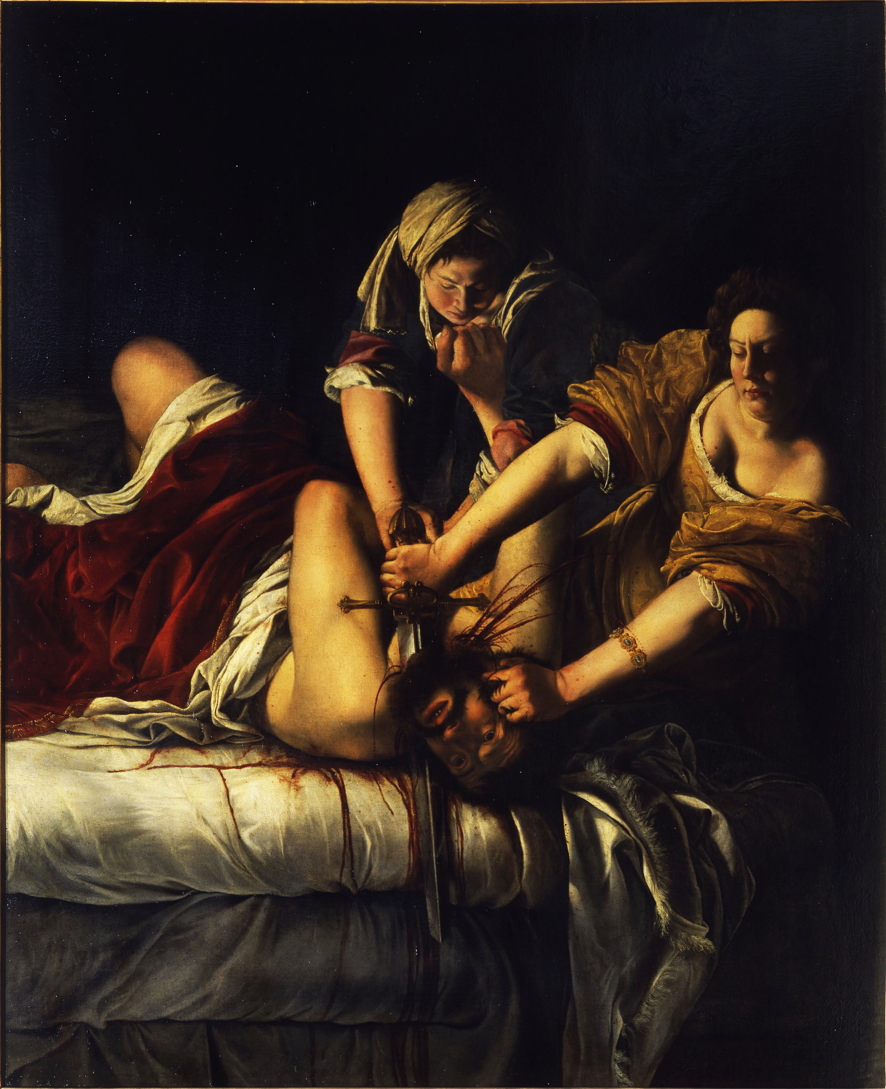
She is most famous for her paintings of Judith Slaying Holofernes, her first version being painted at about the same time as her rape and Tassi’s subsequent trial. It’s generally believed that Tassi was the model for Holofernes, she cast herself as Judith, and a female companion who failed to come to her aid during the rape (and failed to give evidence in her support at the trial) was the maid. It would therefore be natural to interpret this painting as part of her very understandable response to her own traumatic events.
Artemisia Gentileschi (c 1593-1656), Judith Slaying Holofernes (1620-1), oil on canvas, 200 x 162.5 cm, Galleria della Uffizi, Florence. Wikimedia Commons.
Her second version, painted in 1620-21 and now in the Uffizi in Florence, is similar in most respects, although the view isn’t as tightly cropped on the three figures, so that it shows Holofernes’ legs and a deep red wrap around his lower body. The lower section of the blade is also executed better. Judith’s face shows intense concentration and effort, both arms thrust out straight in front of her. The left grips Holofernes by the hair, the right pushes the blade onwards. Her maid is seen holding Holofernes down, pushing hard with both her arms out straight too. Holofernes’s right hand seems to be pushing the maid back, but his left arm is folded over his body.
Artemisia Gentileschi (c 1593-1656), Allegory of Painting (c 1638-9), oil on canvas, 98.6 x 75.2 cm, The Queen’s Collection, England. Wikimedia Commons.
There’s more uncertainty as to whether her brilliant painting of the Allegory of Painting (c 1638-9) is a self-portrait. This striking angle of view can be accounted for if this was a self-portrait composed using two mirrors, one placed above and on the left of the painter, the other directly in front of her, where she is gazing so intently. If so, it was particularly ingenious because the reflection in the second mirror would have normal chirality (left and right would not be reversed).
However, it has been suggested that this isn’t a self-portrait, in which case her choice of view would have been most unusual. It’s believed to have been painted during her stay in London, possibly for King Charles I, as it appears to have passed straight into the Royal Collection, where it has remained ever since.
Returning to Italy, my last great woman painter is Elisabetta Sirani, oldest child of the Bolognese painter Giovanni Andrea Sirani (1610–1670), who had been a pupil of Guido Reni (1575–1642). She was running the family workshop by the time she was only seventeen. Her success was meteoric until she collapsed and died suddenly in August 1665, aged twenty-seven, and has since lapsed into obscurity.
Elisabetta Sirani (1638–1665), The Penitent Magdalene (date not known), oil on canvas, dimensions not known, Musée des Beaux-Arts, Besançon, France. Wikimedia Commons.
Her Penitent Magdalene is a powerful painting using a wide tonal scale to heighten its emotive effect.
Elisabetta Sirani (1638–1665), Portia Wounding her Thigh (1664), oil on canvas, 101 × 138 cm, Collezioni d’Arte e di Storia della Fondazione della Cassa di Risparmio, Bologna, Italy. Wikimedia Commons.
Her Portia Wounding her Thigh (1664) refers not to the Portia of Shakespeare’s play The Merchant of Venice, but to Portia or Porcia Catonis, wife of Marcus Junius Brutus, one of Julius Caesar’s assassins in 44 BCE.
Getting wind of the plot to murder Caesar, Portia asked Brutus what was wrong. He didn’t answer, fearing that she might reveal any secret under torture. She therefore inflicted wounds to her thigh using a barber’s knife to see if she could endure the pain. As she overcame the pain of her wounds, she declared to Brutus that she had found that her body could keep silence, and implored him to tell her. When he saw her wounds, Brutus confided all in her.
By August 1665 Sirani had completed nearly 200 paintings, many fine drawings, and various prints. She died so suddenly that it was at first suspected that she might have been murdered, but it transpired that she had suffered fulminating peritonitis as the result of a burst peptic ulcer.
In tomorrow’s article I will look at the life and work of their forerunner, Sofonisba Anguissola.
Spades are agricultural tools of ancient origin, with a flat blade in line with its shaft, and used for digging. Their closest relative is the shovel with a broader blade for moving loose earth, gravel and snow, and the hoe whose blade is mounted at a right angle to the shaft. In some common applications, such as lifting potatoes and other root crops, a fork with three or more tines is normally preferred.
As a well-known tool for digging, the spade is often associated with the digging of graves, and appears in some religious paintings depicting the imminent interment of Christ’s body following the Crucifixion.
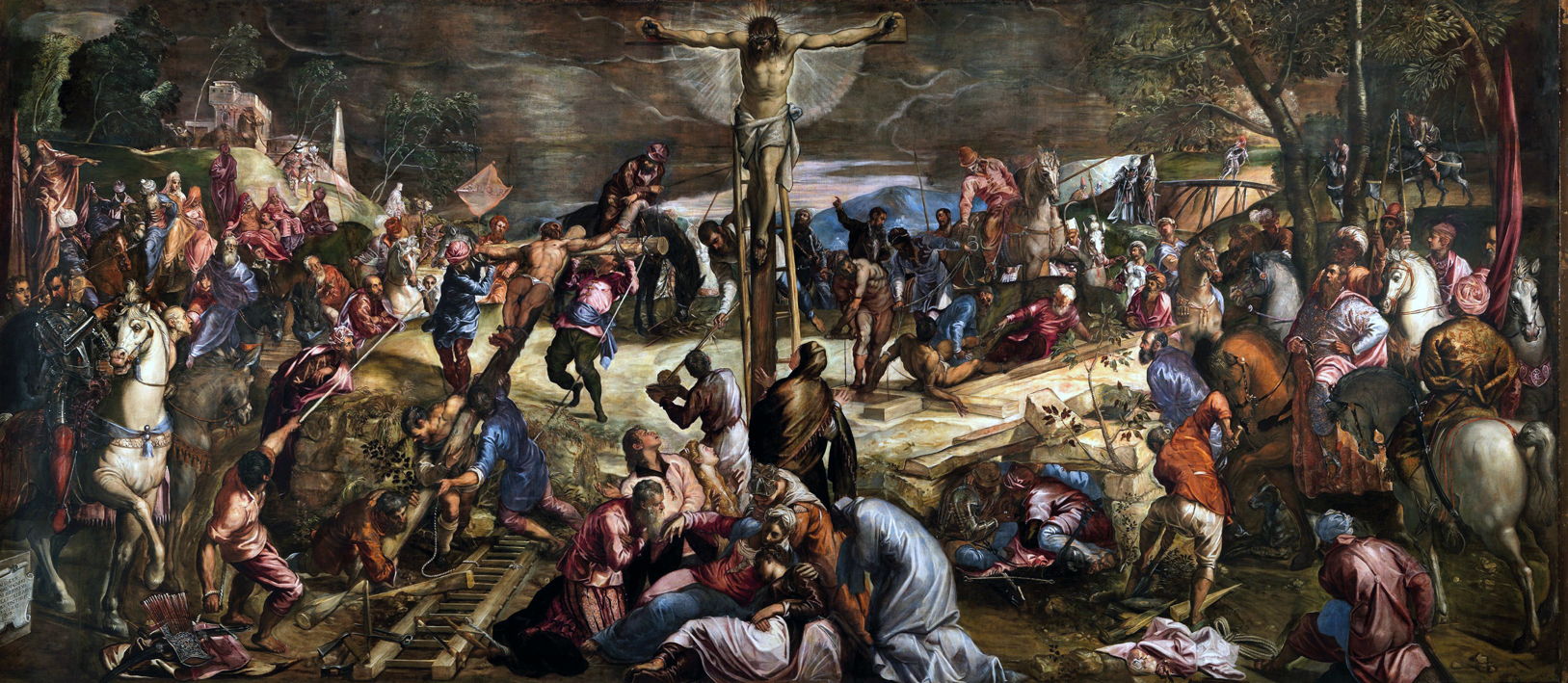
Jacopo Tintoretto (c 1518-1594), The Crucifixion (E&I 123) (1565), oil on canvas, 536 x 1224 cm, Albergo, Scuola Grande di San Rocco, Venice, Italy. Wikimedia Commons.
Jacopo Tintoretto’s huge and magnificent Crucifixion from 1565 shows a man digging a conventional grave, as seen in the detail below.
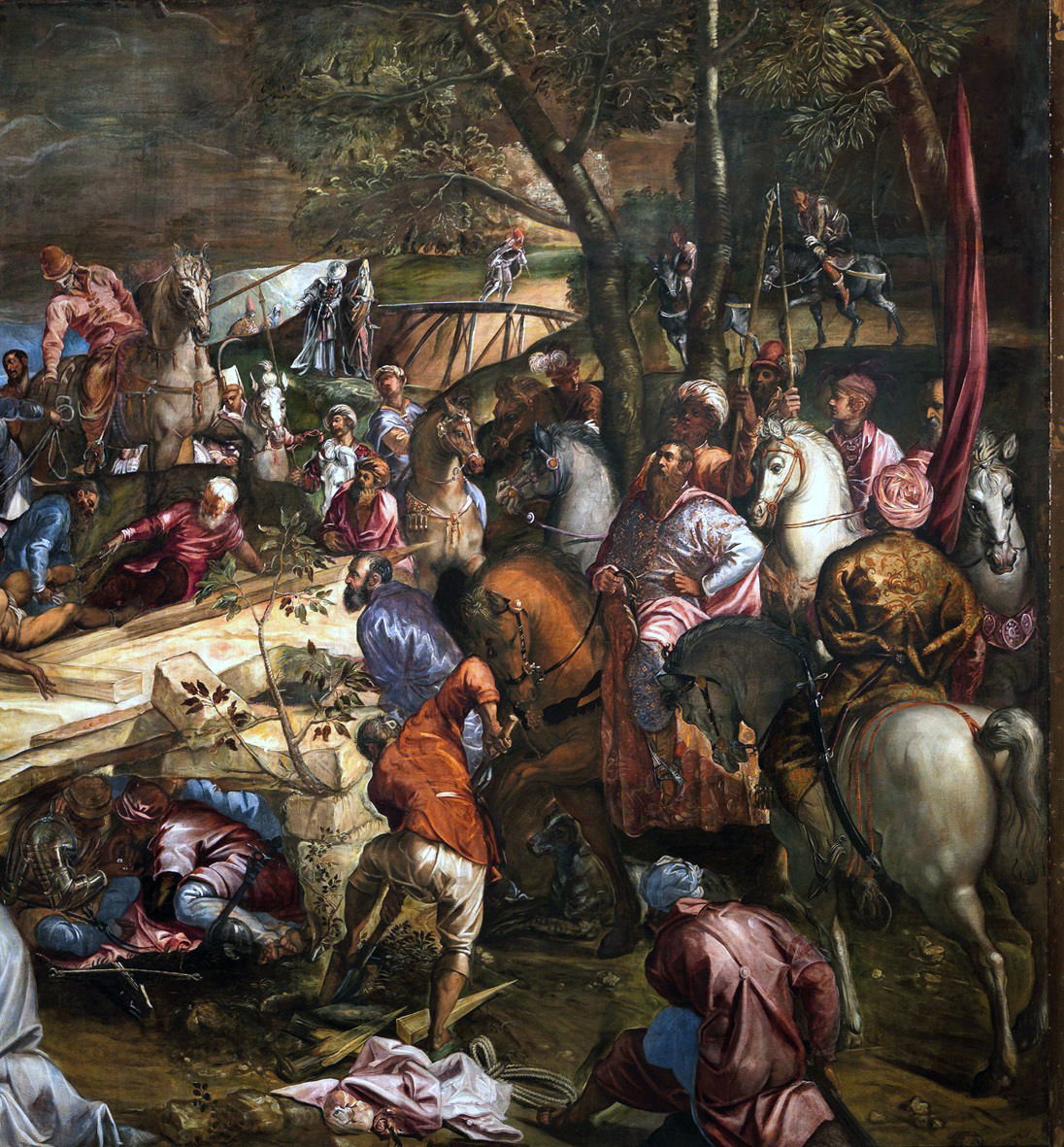
Jacopo Tintoretto (c 1518-1594), The Crucifixion (detail) (E&I 123) (1565), oil on canvas, 536 x 1224 cm, Albergo, Scuola Grande di San Rocco, Venice, Italy. Wikimedia Commons.
On the left of this detail, two men are gambling with dice in a small rock shelter suggestive of a tomb. To the right of them, a gravedigger has just started his work with a spade.
A spade may also appear in depictions of Christ’s subsequent resurrection, in his appearance to Mary as a gardener, often known by the Latin words from the Vulgate as Noli Me Tangere, “touch me not”, the words attributed to Christ in the Gospels.
Lavinia Fontana (1552–1614), Jesus Appears to Mary Magdalene (1581), oil on canvas, 80 x 65.5 cm, Galleria degli Uffizi, Florence. Wikimedia Commons.
In her Jesus Appears to Mary Magdalene from 1581, Lavinia Fontana re-locates this encounter between Mary and Jesus, dressing him in the garb of a mediaeval Italian gardener, and holding a fine gardener’s spade with his left hand.
Alessandro Magnasco (1667–1749), Noli Me Tangere (1705-10), oil on canvas, 144.8 × 109.2 cm, The J. Paul Getty Museum, Los Angeles, CA. Courtesy of The J. Paul Getty Museum.
The eccentric Alessandro Magnasco painted his Noli Me Tangere (1705-10) over a background of ruins made by a collaborator. Christ is shown standing, holding a long-hafted spade with his left hand. Mary is on her knees, a small urn in front of her. Their clothes are rough, and Christ’s appear to be his burial linen, blowing in the wind.
Spades are not uncommon in paintings set in the countryside.
Hans Andersen Brendekilde (1857–1942), On Forbidden Roads (1886), oil on canvas, 126 x 160 cm, location not known. Wikimedia Commons.
Hans Andersen Brendekilde’s On Forbidden Roads from 1886 shows one of the core themes of Naturalist painting: itinerant workers making their way through neglected corners of the countryside. These two men are equipped for forestry, with a two-man saw, axes, and spades. Almost hidden among the vegetation at the far left is a third figure, who looks anxiously towards them. Maybe none of them should really be there at all.
Hans Andersen Brendekilde (1857–1942), People by a Road (1893), oil on canvas, 200 x 263 cm, Statens Museum for Kunst (Den Kongelige Malerisamling), Copenhagen, Denmark. Wikimedia Commons.
There’s a more complex story behind Brendekilde’s People by a Road from 1893. The group at the left are old road-workers, breaking larger rocks into coarse gravel. They lived out under the wooden shelter behind them, as they made their way slowly around the country roads. The woman holds what is either a small shovel or spade used in their work. Standing and apparently preaching to them is a cleanly dressed carpenter, his saw held in his left hand. The building behind them, on the opposite side of the road, is a church, from which a large congregation has just emerged.
Hans Andersen Brendekilde (1857–1942), The Rest (1887), oil on canvas, 70 x 91.5 cm, location not known. Wikimedia Commons.
One of the most physically demanding tasks of the year was clearing snow in the winter. Brendekilde’s The Rest (1887) shows a younger man taking a short break from cutting a track through to the elderly lady’s farmhouse. The blade of his spade is flat, confirming that it’s used to dig through compacted snow and pile the slabs seen behind him.
Hans Andersen Brendekilde (1857–1942), Home for Dinner (1917), further details not known. Wikimedia Commons.
In Brendekilde’s Home for Dinner from 1917, a young girl holding some fresh fish stands talking to a man with a spade.
Hans Andersen Brendekilde (1857–1942), Afternoon Work (1918), oil on canvas, 77 x 100 cm, Private collection. Wikimedia Commons.
The following year, Brendekilde painted a gardening story, in Afternoon Work (1918). A younger man is out on his finely tilled vegetable patch in front of his thatched cottage, wielding his spade as a weapon. Standing just outside the door, behind him, is his young daughter, and through the window is an older woman, presumably his wife. Both are watching him intently, with an air of fear at what he is about to do. He is about to attack a small crop of molehills that have appeared freshly in the midst of his seedling vegetable plants.
As Europeans and Americans started taking to the beaches, they realised how much fun it is to dig sand and build sandcastles using small buckets and spades.
William Dyce (1806–1864), Pegwell Bay, Kent – a Recollection of October 5th 1858 (c 1858), oil on canvas, 635 cm x 889 cm, The Tate Gallery, London. Wikimedia Commons.
This is William Dyce’s finely detailed view of Pegwell Bay, Kent, on the coast of south-east England, out of season, at the end of a fine day in early October. Visitors to the beach are wrapped for warmth as well as modesty. In the distance, a group of donkeys are being taken to graze for the night, after the day’s work being hired out for children to ride. In the foreground, at the left, a child holds a spade, although there is precious little sand suitable for sandcastles.
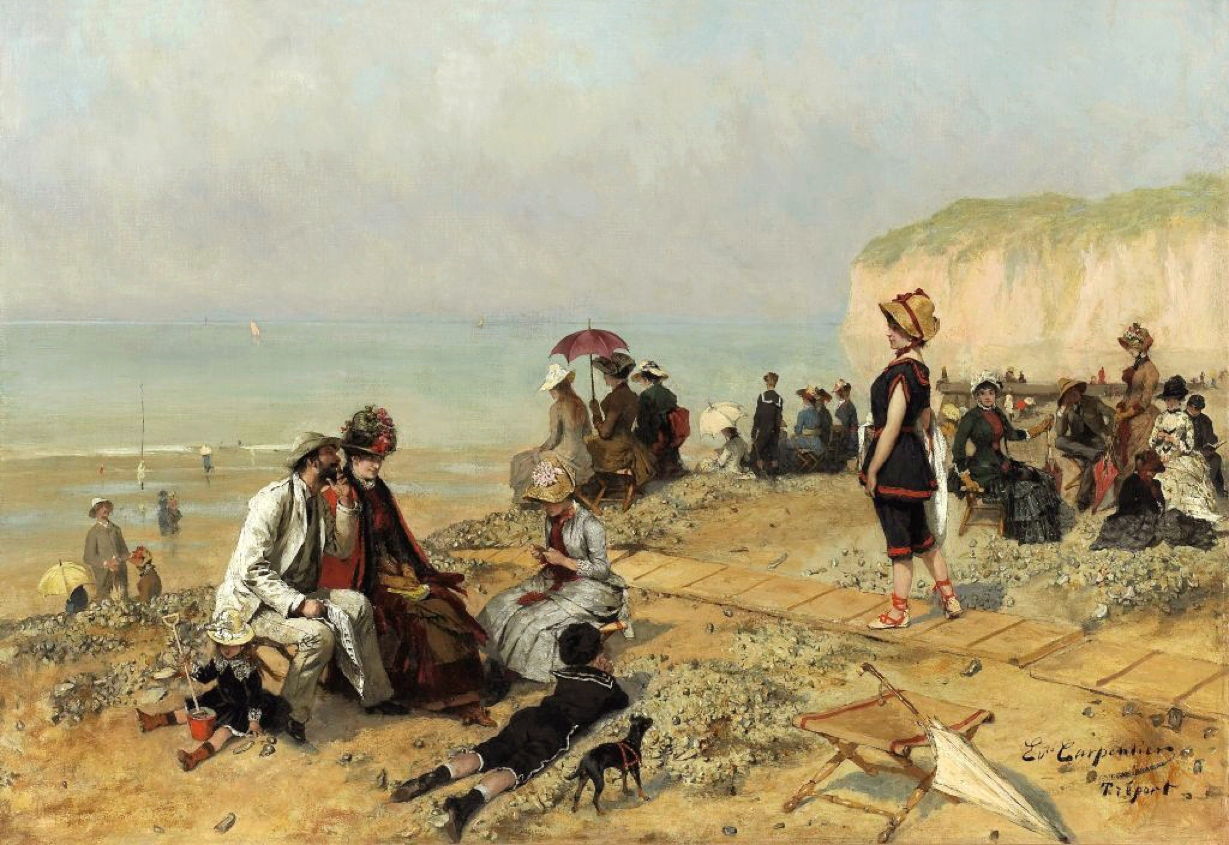
Évariste Carpentier (1845–1922), Tréport, Bathing Time (1882), oil on canvas, 50.5 x 80.5 cm, Private collection. Wikimedia Commons.
Later in the nineteenth century, at Le Tréport on the Channel coast of France near Dieppe, Évariste Carpentier’s Le Tréport, Bathing Time shows progress in the development of beach costume and culture. A young girl in the left foreground is playing with her bucket and spade, while her older brother is admiring the fashionable young woman parading her new clothes. A far cry indeed from the grave-digger.

 Login
Login