The appearance of new objects or unexpected phenomena in the sky was an event of great significance in the past, and often considered to be a portent of the future, good or bad. This article considers the few that were recorded in paintings, and starts with the most famous of all, the star of Bethlehem that appears in many depictions of the birth of Christ.
The linked stories of the birth of Christ in a shed at Bethlehem, and the subsequent adoration of the infant by three wise men, kings or Magi “from the east”, are among the most popular and enduring among paintings in the Christian canon. The outlines given in the Gospels of Luke, chapter 2, and Matthew, chapter 2, have conventionally become elaborated.
Three wise men had seen a new star, possibly a comet or an unusually bright planet, which they believed would lead them to the birth of a great prophet. They travelled by the guidance of that star, to arrive at Bethlehem. There they found the newborn Christ with Mary his mother, paid homage to him in the shed in which the holy family was lodging, and presented their gifts of gold, frankincense, and myrrh.
Giotto di Bondone (1266–1337), The Adoration of the Magi (c 1305), fresco, approx 200 x 185 cm, Scrovegni Chapel, Padua. Wikimedia Commons.
Giotto’s Adoration of the Magi from about 1305 shows the star as a celestial ball of fire streaking across the sky, and the three wise men pay their respects to the newborn Christ and his mother.
Hieronymus Bosch (c 1450–1516), The Adoration of the Magi (Interior) (Saint Peter with donor, The Adoration of the Magi, Saint Agnes with donor) (1490-1500) (CR no. 9), oil on oak panel, 138 cm x 138 cm overall when open, Museo Nacional del Prado, Madrid. Wikimedia Commons.
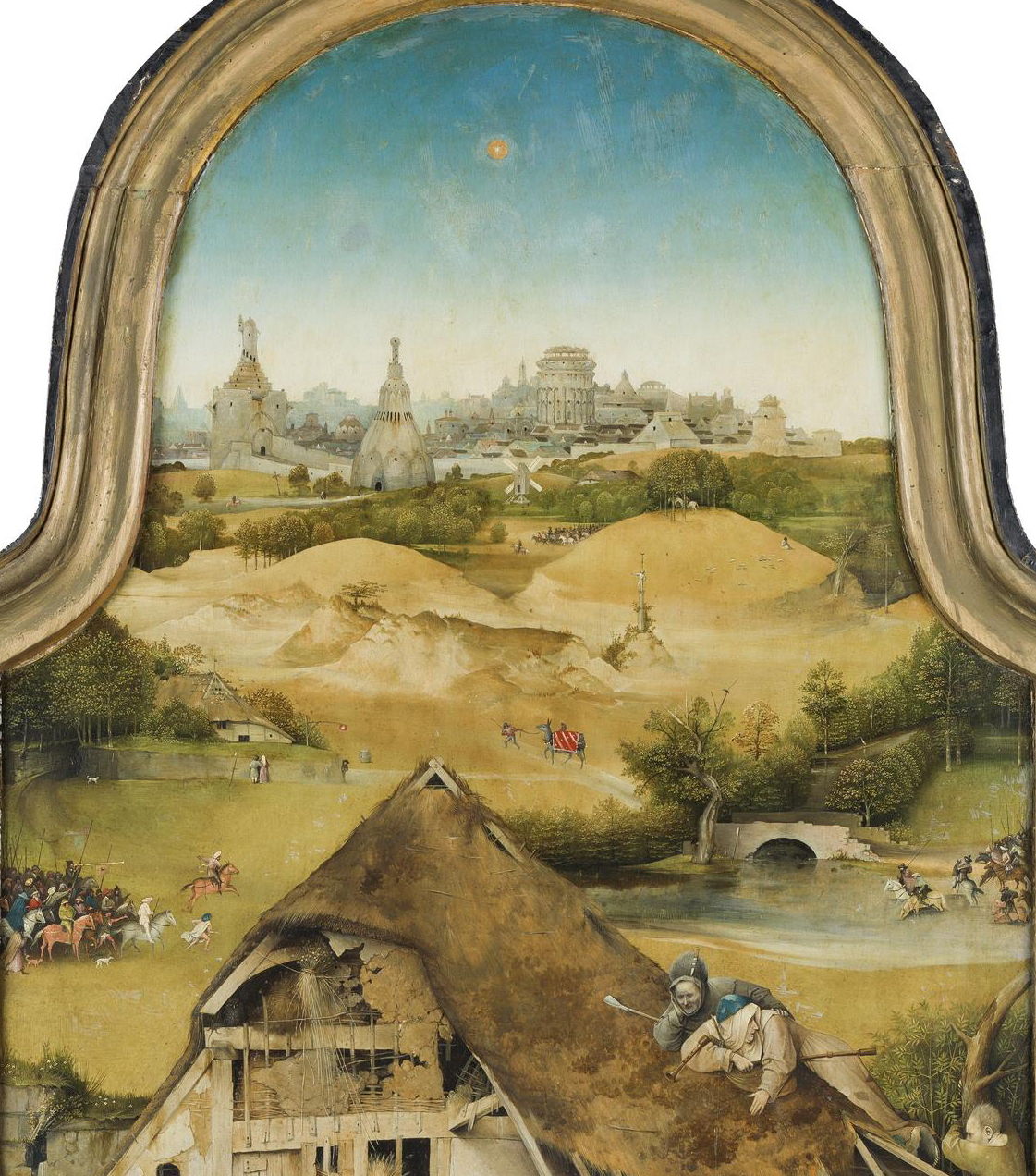
Above Bosch’s view of the local Brabant countryside in his Adoration of the Magi of 1490-1500 he places a more modest and stationary star shining bright over its distant city, as shown in the detail below.
Hieronymus Bosch (c 1450–1516), The Adoration of the Magi (detail) (centre panel) (The Adoration of the Magi) (1490-1500) (CR no. 9), oil on oak panel, 138 cm x 138 cm overall when open, Museo Nacional del Prado, Madrid. Wikimedia Commons.William Blake (1757–1827), Adoration of the Kings (1799), tempera on canvas, 25.7 x 37 cm, Brighton and Hove Museums & Art Galleries, Brighton, England. The Athenaeum.
Blake’s version of the Adoration of the Kings is conventional in showing the three wise men presenting their gifts to Jesus and his parents. At the left, outside, shepherds are tending to their flocks of sheep beneath a stylised star, and at the right are the ox and ass.
There remains controversy over what celestial event might have occurred at the time.
Very few paintings show known events in the sky, and I know of only one depicting a full solar eclipse.
Enrique Simonet Lombardo (1866–1927), Eclipse (1905), oil on canvas, 75 x 55 cm, location not known. Wikimedia Commons.
Although many painters, particularly the Impressionists, have shown fleeting effects of light and the occasional rainbow, Enrique Simonet took the opportunity of a solar eclipse on 30 August 1905 to paint his Eclipse (1905). This was visible across eastern and northern Spain between about 1300 and 1320 UTC, and this painting is one of its few remaining records.
Realistic paintings of comets are also rare, and unimpressive.
William Dyce (1806–1864), Pegwell Bay, Kent – a Recollection of October 5th 1858 (c 1858), oil on canvas, 635 cm x 889 cm, The Tate Gallery, London. Wikimedia Commons.
Generally acclaimed as William Dyce’s finest painting, Pegwell Bay, Kent – a Recollection of October 5th 1858 (c 1858) shows this bay on the Kent coast, during a family holiday visit: a coastal scene worked up into a large finished oil painting. Although not easily seen in this image, there’s a small point of light high in the middle of the sky which is Donati’s comet, not due to return until 3811. Couple that with the inclination of the sun and the state of the tide, and you should be able to place this view precisely in both time and space, and confirm that it does indeed show this bay on 5 October 1858.
A few paintings show impossible celestial events.
John Martin (1789–1854), The Deluge (1834), oil on canvas, 168.3 x 258.4 cm, Yale Center for British Art, New Haven, CT. Wikimedia Commons.
John Martin’s painting of The Deluge from 1834 has two points of reference: the Biblical account of the flood, and Martin’s personal belief in prior catastrophe. As the sciences became ascendant during the nineteenth century, some educated people believed that in the past there had been an alignment of the sun, earth, and moon, and the collision of a comet resulting in global flooding. This was promoted by the French natural scientist Baron Georges Cuvier, and subscribed to by Martin.
True to form, his painting is dark and apocalyptic: near the centre, tiny survivors are just about to be overwhelmed by an immense wave bearing down at them from the left and above. The misaligned sun and moon barely penetrate the dense cloud, and to the top right is a melée of rock avalanche and lightning bolt. This was awarded a gold medal at the Paris Salon of 1835.
Paul Nash (1892–1946), Landscape of the Vernal Equinox (III) (1944), oil on canvas, 63.5 x 76.2 cm, Scottish National Gallery of Modern Art, Edinburgh, Scotland. The Athenaeum.
Several of Paul Nash’s surrealist landscapes show the moon in its phases, among them Landscape of the Vernal Equinox (III) from 1944, which presents the impossible view of a full moon and the sun visible close together and just above the horizon.
In their descent into the depths of Hell, Virgil and Dante have just entered circle eight for those who committed fraud in its broadest sense. This consists of what Dante refers to as malebolge, best translated as rottenpockets, a series of ten deep trenches each of which caters for a different type of fraud. Dante compares these to the defensive earthworks surrounding the outer walls of castles of the day.
Virgil leads Dante into the first of these rottenpockets, where souls are being lashed by demons to keep them moving constantly. These are pimps and seducers, among whom is a Bolognese man, a Guelph, who pimped his sister, the beautiful Ghisolabella, for political gain.
The pair move on past other sinners being scourged, where they see Jason, who seduced then abandoned the young Hypsipyle, queen of Lemnos, and later did the same with Medea. They then enter the second rottenpocket, for flatterers, who are wallowing in excrement.
Jan van der Straet, alias Giovanni Stradano (1523-1605), Canto 18 (1587), further details not known. Image by Sailko, via Wikimedia Commons.Gustave Doré (1832–1883), Inferno Canto 18 verses 116-117 (c 1857), engraving, dimensions and location not known. Wikimedia Commons.
They find a contemporary figure from Lucca, and see Thaïs, a Greek courtesan who notoriously flattered her partners. She is now covered in filth and thoroughly crabby.
Gustave Doré (1832–1883), Virgil shows Dante the Shade of Thaïs (c 1857), engraving, dimensions and location not known. Image by Karl Hahn, via Wikimedia Commons.
In the third rottenpocket, Dante and Virgil come across corrupt religious leaders or Simonists, who sold church privileges, and are trapped headfirst in rock holes, their protruding feet being roasted with flames. The key figure here is Pope Nicholas III, who at first confuses Dante with Pope Boniface VIII, who is also in the same rottenpocket. Pope Nicholas was known for his nepotism, which included appointing three of his own family as cardinals.
William Blake (1757–1827), The Simonist Pope (Dante’s Inferno) (1824-27), watercolour, 52.5 x 36.8 cm, The Tate Gallery, London. Wikimedia Commons.Gustave Doré (1832–1883), Dante Addresses Pope Nicholas III (c 1857), engraving, dimensions and location not known. Image by Karl Hahn, via Wikimedia Commons.
Virgil carries Dante on to the fourth rottenpocket, reserved for soothsayers. Their heads are turned to face backwards, so that the tears streaming from their eyes wet their buttocks.
Jan van der Straet, alias Giovanni Stradano (1523-1605), Canto 20 (1587), further details not known. Wikimedia Commons.
Virgil identifies several of them from classical times, including the Theban Tiresias; Dante recounts how he became a soothsayer after he had twice changed gender, as told by Ovid in his Metamorphoses. The list concludes with three near-contemporaries: Michael Scot, a scholar and astrologer to Emperor Frederick II, and two well-known Italians.
The fifth rottenpocket they find to be filled with corrupt public officials, or barrators, who sold public appointments and are immersed in a sea of boiling pitch, while being further tormented by a pack of vicious devils known as malebranche, ‘evil-claws’.
Giotto di Bondone (–1337), Devils Over City Landscape, detail of The Devotion of the Devils from Arezzo, scene in The Life of Saint Francis of Assisi (1296-1298), fresco, dimensions not known, Basilica di San Francesco d’Assisi, Assisi, Italy. Wikimedia Commons.
The latter are armed with long hooks, which they use to push the souls down into the pitch, much as you might push down lumps of meat that rise to the surface of a stew. Those devils are so evil as to threaten Dante, so Virgil whisks him on to the next rottenpocket for hypocrites.
Gustave Doré (1832–1883), The Demons Threaten Virgil (c 1857), engraving, dimensions and location not known. Image by Karl Hahn, via Wikimedia Commons.
Any resemblance to real persons, living or dead, is not only intentional, but of their own making.
The artists
William Blake (1757–1827) was a British visionary painter and illustrator whose last and incomplete work was an illustrated edition of the Divine Comedy for the painter John Linnell. Most of his works shown in this series were created for that, although he did draw and paint scenes during his earlier career. I have a major series on his work here.
Gustave Doré (1832–1883) was the leading French illustrator of the nineteenth century, whose paintings are still relatively unknown. Early in his career, he produced a complete set of seventy illustrations for translations of the Inferno, first published in 1857 and still being used. These were followed in 1867 by more illustrations for Purgatorio and Paradiso.This article looks at his paintings.
Giotto di Bondone (c 1267–1337) was one of the great masters who bridged between the late Middle Ages and the early Renaissance. He was born near Florence, and is reputed from about 1296 to have painted a cycle of frescoes in the Basilica di San Francesco d’Assisi, in Assisi. This is hotly disputed though, and those may have been painted by Cimabue instead. The scene of The Devotion of the Devils from Arezzo shows what may, directly or indirectly, have been an inspiration to Dante, although I don’t know whether there is any evidence that the poet ever visited Assisi.
Jan van der Straet, also commonly known by his Italianised name of Giovanni Stradano (1523-1605), was a painter who started his career in Bruges and Antwerp in Belgium, but moved to Florence in 1550, where he worked for the remainder of his life. Mannerist in style, he worked with printmakers in Antwerp to produce collections of prints, including an extensive set for The Divine Comedy.
Robin Kirkpatrick (trans) (2012) Dante, The Divine Comedy, Inferno, Purgatorio, Paradiso, Penguin Classics. ISBN 978 0 141 19749 4.
Richard Lansing (ed) (2000) The Dante Encyclopedia, Routledge. ISBN 978 0 415 87611 7.
Guy P Raffa (2009) The Complete Danteworlds, A Reader’s Guide to the Divine Comedy, Chicago UP. ISBN 978 0 2267 0270 4.
Prue Shaw (2014) Reading Dante, From Here to Eternity, Liveright. ISBN 978 1 63149 006 4.
Earlier in this series, I showed an example of the origin of all modern paintings in the decorated caves of pre-history. As shelters became buildings, our ancestors continued to paint their walls, using a technique now known as secco wall or mural painting, where wet paint is applied to dry stone or plaster.
Artist not known, Christ Pantocrator (c 1200), secco wall-painting, dimensions not known, apse of Braunschweig (Brunswick) Cathedral, Braunschweig, Germany. Image by PtrQs, via Wikimedia Commons.
Secco has been widely used outside Europe, and can still be seen in some very old European wall paintings, such as those in Braunschweig Cathedral, including Christ Pantocrator, thought to date from the early thirteenth century. Long before that was created, though, wall painting advanced to improve adhesion between its paint layer and ground. In secco technique, only thin layers of pigment can be used, resulting in weak colours, little detail, and the need for periodic re-painting as pigment is gradually lost over time.
Artists experimented with different binders and secco techniques. Although dry plaster is more absorbent and a better ground than bare stone, success has been limited, and failure a constant danger. At some time before about 1700 BCE, one of the Mediterranean cultures discovered that it was possible to apply paint onto a layer of wet plaster, and the technique of fresco (strictly, buon fresco) was born.
Artist not known, Garden room (before 79 CE), fresco, dimensions not known, The House of the Golden Bracelet, Pompeii, Italy. Image by Stefano Bolognini, via Wikimedia Commons.
The Romans loved frescos that made their rooms look as if they were in a spacious outdoors, like this from the House of the Golden Bracelet in Pompeii.
In fresco, the support remains the wall or ceiling of the building, but the ground is absorbent wet plaster applied to that surface. Pigment is diluted in water and applied directly to the ground while the latter is still wet; this allows the paint to be absorbed into the ground, providing good and durable bonding of the pigment. Plaster is made using lime, derived from crushed limestone, and sets by reaction with carbon dioxide in the air to form calcium carbonate (from which both chalk and limestone are composed) and water, which evaporates during drying.
Techniques became even more refined, with the use of additional layers of plaster prepared in specific ways, to which red pigment sinopia might be added, allowing the artist to draw construction and other lines to assist in final painting. Because these frescos are on a grand scale, transferring the design of a painting from final sketch to the wall or ceiling is also a challenge.
The central problem for the painter is that, to be successful, fresco has to be painted onto the plaster when it is still wet. That means only a limited area can be plastered and painted each day, known as giornate (singular giornata), a day’s work. For all but the smallest of ground-level fresco paintings, work has to be undertaken at height, from a scaffold, posing the very real risk that the artist would fall, or the scaffolding fail. Many fresco painters have fallen at work, some suffering serious injuries or death as a result.
Despite all these practical difficulties, some of the most important European works of art are frescos painted during the Renaissance in places of worship with their high walls and ceilings.
Masaccio (1401–1428), The Holy Trinity (1426-8), fresco, 640 x 317 cm, Basilica of Santa Maria Novella, Florence. Wikimedia Commons.
Masaccio’s magnificent fresco of The Holy Trinity in the Basilica of Santa Maria Novella in Florence, was painted in 1426-28. At the outset he would have made a preliminary plan including his giornate starting at the top and working downwards. Once ready to start the painting, a team of carpenters will have erected wooden scaffolding to give the artist and his assistants access to the whole of that section of the wall, to the full height of over six metres (21 feet). The first stage would then have been completed by assistants, who laid a rough under-layer of plaster known as the arriccio over the whole wall, and left it to dry for several days. This layer often contains abrasive sand particles to provide a key for the final layer of plaster.
Once that had dried completely, Masaccio and his assistants transferred the drawings onto the surface of the arriccio. This may have been performed by scaling up from the squared drawing and painting with sinopia, or full-size drawings may have been pricked to make holes in the paper and a bag of soot banged against the sheet held against the wall, a technique known as pouncing. Masaccio is known to have used both techniques, and may well have used each in different sections of this work.
On each day of painting, assistants would prepare the colours by mixing pigments in water. The day’s supply of plaster, the intonaco, is then prepared by mixing water with lime. That day’s giornata is covered with a thin layer of intonaco, and about an hour later Masaccio started painting into it. He then had about eight hours before it dried and he could apply no more fresh paint. Like many of the best fresco painters, Masaccio extended his painting time by using paint mixed with milk or casein and a little lime, effectively a lime-based casein medium, which could be laid onto dry intonaco.
The geometric requirements of this painting also merited special measures. When the intonaco was first applied, it was marked to indicate key construction lines, such as those in the barrel-vaulted ceiling, and down the pillars at the side. The remains of these incised lines are still visible when the fresco is viewed in raking light. In this case, there is evidence that Masaccio used lengths of string attached to a nail sunk at the vanishing point of the linear projection, below the base of the cross.
Masaccio (1401–1428), The Holy Trinity (1426-8), fresco, 640 x 317 cm, Basilica of Santa Maria Novella, Florence. Wikimedia Commons. Giornate proposed in 1950 marked in light green. Redrawn after the original by Leonetto Tintori (1950).
Although we think of frescos as being fixed, this one has now been moved twice within the same church, which hasn’t helped its appearance. During conservation work and movement of Masaccio’s painting in the 1950s, the opportunity was taken to study its construction. Leonetto Tintori drew up a plan of all the identified construction lines and edges of giornate; I have sketched in the latter from a reproduction of a drawing made at that time, which has since been destroyed.
It’s estimated the whole painting would have required some 24 giornate, although because of the long history of damage and attempts at its restoration, that number remains flexible. Assuming that Masaccio painted six days a week, that would have required a minimum of four weeks working for at least ten hours each day. Fresco painting doesn’t permit easy alterations either: if any repainting was required and couldn’t be accomplished using dry technique, that day’s giornata would have to be removed, replaced and repainted.
Giotto di Bondone (–1337), Scenes from the Life of Christ: 20. Lamentation (1304-06), fresco, 200 x 185 cm, Cappella degli Scrovegni, Padua, Italy. Wikimedia Commons.
Giornate can sometimes become obvious over time, as shown in Giotto’s fresco in the Scrovegni Chapel in Padua, Italy.
Michelangelo di Lodovico Buonarroti Simoni (1475–1564), The Last Judgement (1536-41), fresco, 1,370 × 1,220 cm, Cappella Sistina, The Vatican. Wikimedia Commons.
Perhaps the most famous fresco is Michelangelo’s The Last Judgement (1536-41) in the Sistine Chapel of the Vatican. It covers an area of 13.7 by 12 metres (539 by 472 inches), and took over four years to complete.
In the eighteenth and nineteenth centuries, fresco became relatively neglected.
Johann Friedrich Overbeck (1789-1869), Consecration of Godfrey (1819-27), fresco, dimensions not known, Casa Massimo, Rome, Italy. Image by Sailko, via Wikimedia Commons.
Some new frescos were commissioned for places of worship and other public buildings, and in the early nineteenth century Johann Friedrich Overbeck painted a series telling the story of Torquato Tasso’s epic Jerusalem Delivered, in the Casa Massimo in Rome. There are similar series showing Dante’s Divine Comedy and other long narratives, which are particularly suited to the medium.
William Dyce (1806–1864), Neptune Resigning to Britannia the Empire of the Sea (1847), fresco, 350 x 510 cm, Osborne House, East Cowes, Isle of Wight, England. Wikimedia Commons.
In 1845, the Scottish artist William Dyce was invited to paint frescos for the Royal Family, for which he travelled to Italy to learn technique. On his return in 1847, he painted this curious composition in Queen Victoria and Prince Albert’s new and luxurious holiday palace of Osborne House, at East Cowes, on the Isle of Wight. Neptune Resigning to Britannia the Empire of the Sea (1847) is an impressive fresco, and remains in pristine condition at the top of the main staircase in the house.
John Dixon Batten (1860-1932), The Creation of Pandora (1913), tempera on fresco, 128 x 168 cm, Reading University, Reading, England. Wikimedia Commons.
Frescos have continued in religious painting, with artists such as Sergei Fyodorov painting them in churches and cathedrals, and for the occasional trompe l’oeil. John Dixon Batten’s The Creation of Pandora was painted anachronistically in egg tempera on a fresco ground by 1913. Batten was one of the late adherents of the Pre-Raphaelite movement; this painting was deemed unfashionable in 1949, and was put into storage and quietly forgotten until its rediscovery in 1990.
Akseli Gallen-Kallela (1865–1931), The Defence of Sampo (part of Kalevala Fresco) (1928), fresco, lobby of the National Museum of Finland, Helsinki. Photo by Jean-Pierre Dalbéra, via Wikimedia Commons.
New frescos are still painted in some public buildings too. This work by Finnish painter Akseli Gallen-Kallela is one of a series he painted in the National Museum of Finland in Helsinki in 1928, but most other wall paintings of the twentieth century, such as those of John Singer Sargent in public buildings in Boston, have been painted in oils on canvas rather than buon fresco.
Frescos aren’t the only way of making very large and monumental paintings for places like churches, though. The walls of Venetian buildings are particularly unsuitable for secco or fresco, because they remain so damp all year round. Hence the painters of Venice were innovators in constructing very large canvases, and you will find few frescos there as a result.

 Login
Login