Painting in the Golden Age didn’t occur in isolation, but was greatly influenced by artists of Flanders and Brabant to the south, many of whom visited or migrated to the Dutch Republic. Some Dutch artists effectively exported their landscape and other skills to Italy, where there was a group of emigrés known as the Bentvueghels (meaning birds of a feather) between about 1620-1710.
From the late 1590s until well into the following century, the distinctive style of Caravaggio (1571-1610) drew followers across Europe, most of whom saw his paintings when they were training in Italy. This wave of Caravaggism spread when those painters returned to their native lands, including the states of the Dutch Republic.
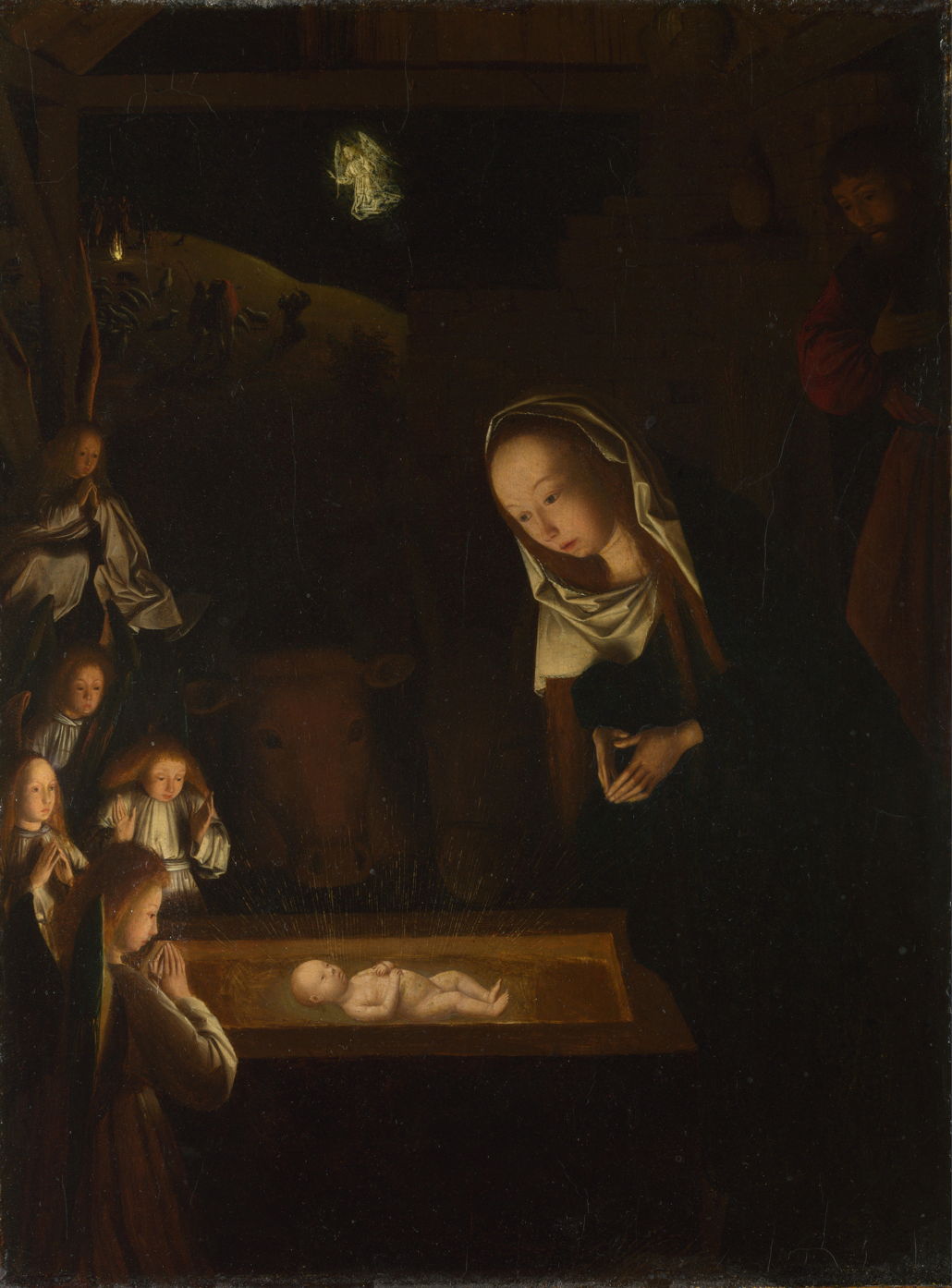
Geertgen tot Sint Jans (c 1460-1488), Nativity at Night (c 1490), oil on oak, 34 x 25.3 cm, The National Gallery, London. Wikimedia Commons.
Caravaggio’s style was by no means unique, and his use of chiaroscuro had been anticipated a century earlier in this wonderful nocturne by the early Netherlandish painter Geertgen tot Sint Jans, Nativity at Night, thought to be from about 1490. Chiaroscuro makes narrative sense here, and results in a scene of great tenderness and reverence, thanks to its soft transitions of tones.
Michelangelo Merisi da Caravaggio (1571-1610), Salome Receives the Head of John the Baptist (c 1609-10), oil on canvas, 91.5 x 106.7 cm, The National Gallery, London. Wikimedia Commons.
Caravaggio’s third painting of Salome Receives the Head of John the Baptist was completed in about 1609-10, shortly before his death, and illustrates his style at its height.
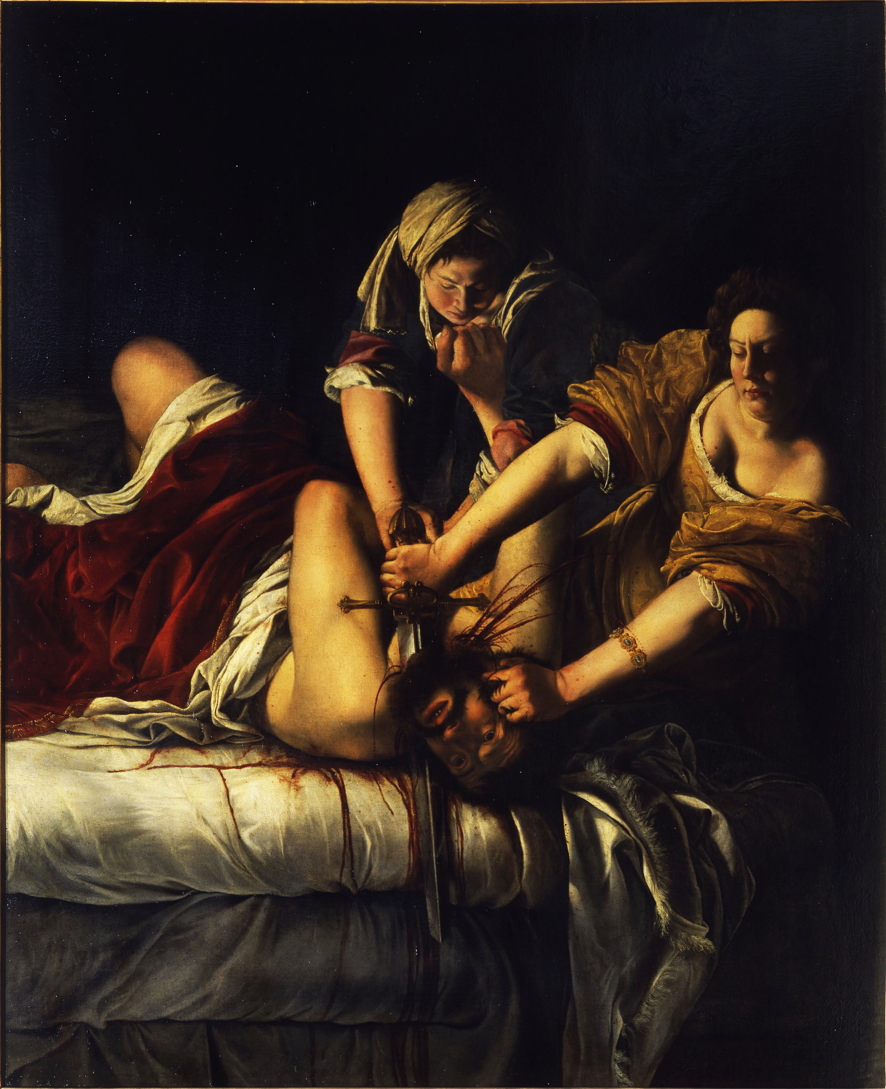
Artemisia Gentileschi (1593-c1656), Judith Slaying Holofernes (1620-1), oil on canvas, 200 x 162.5 cm, Galleria della Uffizi, Florence. Wikimedia Commons.
Artemisia Gentileschi’s father was a well-known Caravaggist, and she followed suit for the early years of her career. Her painting of Judith Slaying Holofernes followed a decade later in 1620-21. Over that period, Hendrick ter Brugghen, Gerrit van Honthorst, Dirck van Baburen and Jan van Bijlert became influenced when in Italy, and returned to Utrecht, where they have become known as the Utrecht Caravaggists.
Gerard van Honthorst (1592–1656), The Soldier and the Girl (c 1621), oil on canvas, 82.6 x 66 cm, Herzog Anton Ulrich-Museum, Braunschweig, Germany. Wikimedia Commons.
Van Honthorst’s The Soldier and the Girl from about 1621 is a good example, where the young woman is lighting her candle from a burning coal.
Gerard van Honthorst (1592–1656), Merry Company (1623), oil on canvas, 125 x 157 cm, Staatsgalerie im Neuen Schloss Schleißheim, Oberschleißheim, Germany. Wikimedia Commons.
Van Honthorst’s dimly lit indoor scenes are associated with pleasures, often fairly sinful ones, as in his Merry Company from 1623. He shows here how directional lighting can transform appearance, turning quite ordinary or ugly faces into caricatures.
Gerard van Honthorst (1592–1656), Concert on a Balcony (1624), oil on canvas, 168 × 178 cm, Musée du Louvre, Paris. Wikimedia Commons.
As music was breaking out of seedy dens of iniquity into mainstream culture, learning to play an instrument and playing to others became fashionable, as shown in van Honthorst’s merry Concert on a Balcony from 1624.
Gerard van Honthorst (1592–1656), Solon and Croesus (1624), media and dimensions not known, Hamburger Kunsthalle, Hamburg, Germany. Wikimedia Commons.
During the 1620s his paintings became more narrative and less Caravaggist, as seen in his Solon and Croesus from 1624. This shows the elderly Greek statesman getting a hostile reception from Croesus, with his court laughing at his responses. Included are two slaves supplicating themselves before the king, in an interesting condemnation of slavery for its time.
Some more mainstream artists also showed Caravaggist tendencies.
Rembrandt Harmenszoon van Rijn (1606–1669), The Operation (The Sense of Touch) (1624-25), oil on panel, 21.6 × 17.7 cm, Private collection. Wikimedia Commons.
Rembrandt’s very early painting of The Operation from 1624-25 shows a barber-surgeon and his assistant performing surgery on the side of a man’s head, by the light of a commonplace candle on a candlestick holder.
Hendrick ter Brugghen’s religious narrative of Jacob Reproaching Laban for Giving him Leah in Place of Rachel is from the later years of Caravaggism, in 1627.
Although remarkably little is known of the paintings of Judith Leyster, she appears to have been influenced when painting in Haarlem.
Judith Leyster (1609–1660), A Game of Tric-Trac (1630), oil on panel, 40.7 x 31 cm, Worcester Art Museum, Worcester, MA. Wikimedia Commons.
Like most of her surviving paintings, A Game of Tric-Trac was made before her marriage to Jan Miense Molenaer, in this case in 1630.
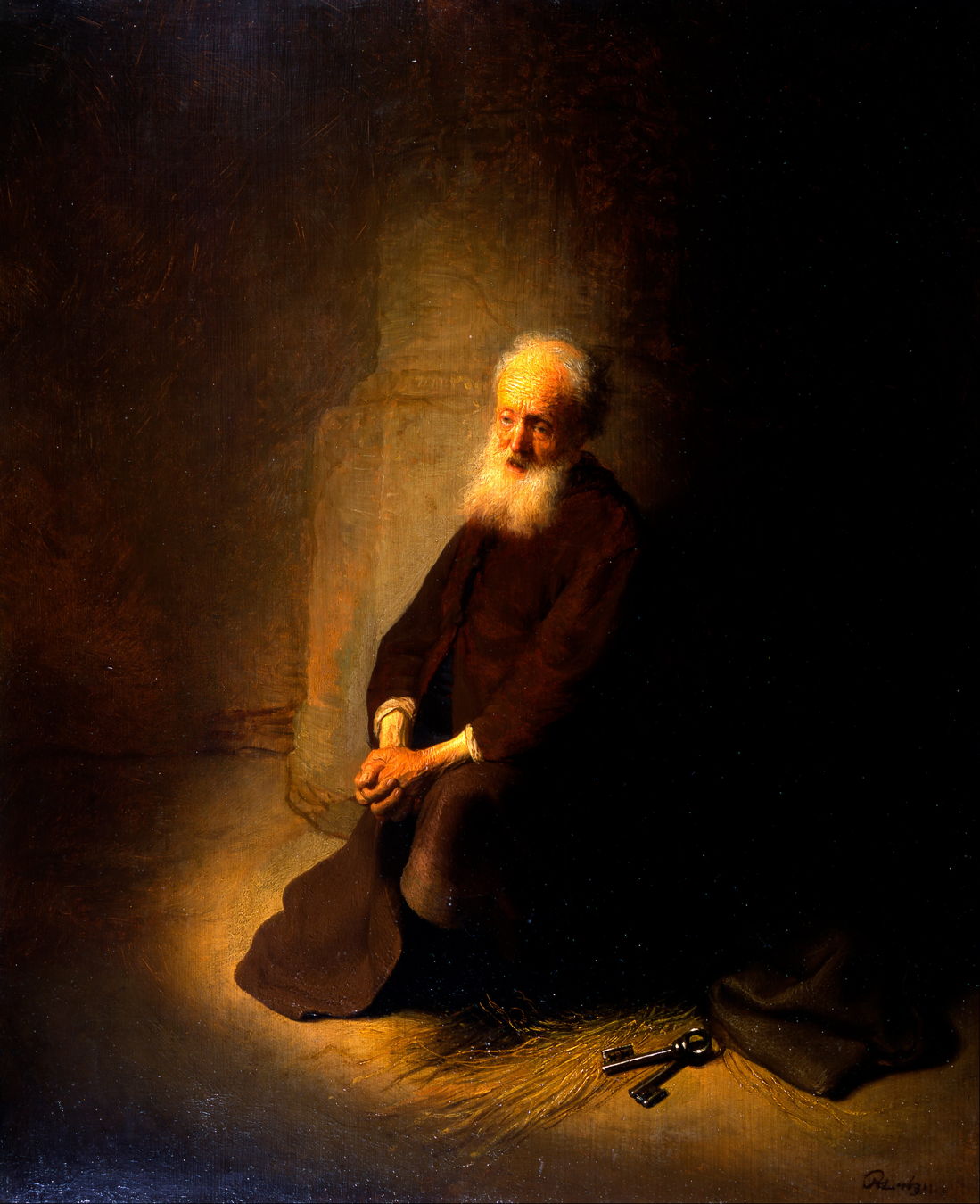
Rembrandt Harmenszoon van Rijn (1606–1669), Saint Peter in Prison (The Apostle Peter Kneeling) (1631), oil on panel, 59 x 47.8 cm, Israel Museum מוזיאון ישראל, Jerusalem, Israel. Wikimedia Commons.
Although Rembrandt’s use of chiaroscuro is best known from his later paintings, Saint Peter in Prison (The Apostle Peter Kneeling) dates from 1631.
Later interiors and genre works show the more lasting influence imported from Italy.
Long before paintings became movable objects of great value used by the rich as investments, artists and the owners of their paintings wanted to protect the paint layer that had been so carefully applied to the ground. From the early Middle Ages onwards, one popular means of doing this has been to apply some form of protective layer, a varnish.
Varnishes have been widely used not only for protection. Careful choice of their composition can enhance the appearance of a painting, through the optical properties of the varnish medium and its smooth, glossy surface. Until the late nineteenth century, the great majority of painters either applied final layers of varnish themselves, or advised their patrons and clients to do so.
Three types of varnish have come into common use:
Drying oil and resin, in effect a resin-rich transparent and unpigmented paint layer, that usually becomes an integral part of that. Some artists have added pigment, perhaps to make a general colour adjustment. There isn’t any clear distinction between that and a final paint glaze.
Solvent and resin, from which the solvent will evaporate, leaving a thin surface coat of resin.
Water-based washes such as egg white, known as glair, vegetable gums like gum arabic, and animal glues.
Resins used in varnishes have rich and sometimes strange histories. Most are exudates from trees in exotic locations, and have evocative names like mastic, sandarac, colophony and dammar. They’re usually highly insoluble, either in drying medium that has to be heated to make oil-based varnishes, or in turpentine or similar organic solvents. A great many recipes have been proposed, and there’s always the lure of the perfect, and inevitably top secret, formula.
Rembrandt Harmenszoon van Rijn (1606–1669), Bathsheba at her Toilet (1643), oil on panel, 57.2 x 76.2 cm, Metropolitan Museum of Art, New York, NY. Wikimedia Commons.
The biggest problems with varnishes are their propensity to yellow or grey with age, and their tendency to take up dirt and atmospheric contaminants. Rembrandt’s first painting of Bathsheba at her Toilet from 1643 has sadly lost much of its detail into the gloom of old varnish, which can be almost impossible to clean off when composed of drying oil and resin, without damaging the paint layer underneath.
Any work older than a few decades that has been varnished or had any form of surface treatment is unlikely to appear today with the colours the artist intended. Multiple layers of old varnish and trapped dirt give a misleading impression of what we would have seen soon after the work was completed. Painstaking work by conservation specialists can often restore old paintings to what we presume is their former glory, in full colour again.
Hieronymus Bosch’s Christ Carrying the Cross (1490-1510) is seen above before recent conservation work, and below is the result of thousands of hours of painstaking cleaning and treatment.
Another problem for the conservation specialist is a painting like Edward Poynter’s A Visit to Aesculapius from 1880. Although this is little more than a century old, the evidence from contemporary prints made from this work is that it was originally far from being so dark. Sadly it’s now almost impossible to read as a result of its near-black shadows.
A good varnish should be both colourless and transparent, but painters haven’t always respected that.
Théodore Géricault (1791–1824), The Raft of the Medusa (detail) (1818-19), oil on canvas, 491 × 716 cm, Musée du Louvre, Paris. Wikimedia Commons.
When finishing his monumental Raft of the Medusa in 1819, Théodore Géricault is thought to have applied glazes or varnish containing asphalt to give the painting a deep brown tone. Asphalt is not only completely unprotective and almost attracts dirt, but it never fully dries, and can have adverse effects on underlying paint too. It hasn’t helped that this two hundred year-old painting was rolled up and stored in a friend’s studio when it remained unsold, and was then transported to London still rolled up the following year.
Conventional wisdom says that it’s best to leave an oil painting to dry for at least six months before varnishing it. JMW Turner sometimes varnished over paint layers that were far from dry. In the case of The Opening of the Wallhalla, 1842 (1843), painted on mahogany, Ruskin reported that it had “cracked before it had been eight days in the Academy Rooms”, although this overall view shows little evidence of that damage.
Hellen and Townsend attribute this to Turner’s extensive use of Megilp, here a product sold by his colourman containing leaded drying oil and mastic varnish. Used sparingly and with great caution, such medium modifiers don’t necessarily cause serious ill-effects. But Turner has used Megilp to excess, to produce a soft impasto used in the foreground figures, in particular. This has resulted in wide and shallow drying cracks, as the surface has dried quickly and shrunk over trapped layers of liquid paint.
Varnishes do provide mechanical protection to the paint layer, but at the cost of locking out atmospheric oxygen, required for drying oils to polymerise properly in their drying process. Applied too early, varnishes can therefore greatly slow drying of underlying paint layers; the danger is that they may saponify (turn to soap) instead of drying normally.
Despite these dangers, varnishes can, when used with care by those who understand them properly, be valuable beyond simply providing a protective coat. Kirsty Whiten’s The Quing of the Now People (2015) achieves its superbly realistic effect by the skilful combination of conventional oil paint with varnish.
In the late nineteenth century, attitudes to varnishing oil paintings changed markedly, as Impressionists like Camille Pissarro started to prescribe that their works should on no account be varnished. This was to preserve the soft matte surface of the paint as applied by the artist, and became increasingly popular in the twentieth century.
For such paintings, protection can be provided by glass, when necessary. That isn’t of course an option for many extremely large oil paintings on canvas, which will probably need to be varnished and cleaned periodically well in the future, as they have in the past.
Varnishes, usually of the third type containing vegetable gums or animal glues, have also been used extensively on paint layers other than oils.
Samuel Palmer (1805–1881), Tintern Abbey at Sunset (1861), watercolor, gouache and varnish over graphite with scratching out on heavy card, 33.3 x 70.5 cm, Yale Center for British Art, New Haven, CT. Wikimedia Commons.
These are reported in Samuel Palmer’s Tintern Abbey at Sunset, above, and Dante Gabriel Rossetti’s Lucrezia Borgia, below. Gum or glue varnishes can have impressive optical effects when used carefully on watercolours.
Unfortunately, their tendency to yellow can also cause colour shifts. William Blake liked to apply glue varnish to his watercolours and perhaps to his glue tempera paintings as well. In the case of his Penance of Jane Shore in St Paul’s Church from about 1793, this has resulted in a generalised yellow shift and loss of chroma.
Henry Ossawa Tanner (1859–1937), The Destruction of Sodom and Gomorrah (1929-30), tempera and varnish on cardboard, 52 x 91.4 cm, High Museum of Art, Atlanta, GA. Wikimedia Commons.
Other artists appear to have been more successful: Henry Ossawa Tanner apparently applied varnish to this tempera painting of The Destruction of Sodom and Gomorrah almost a century ago, and it doesn’t appear to have suffered any adverse consequences, yet.
Varnishing has become such an accepted process that major exhibitions have incorporated ‘varnishing days’, although what happens on those occasions can be quite different. In Turner’s day at the Royal Academy in London, Varnishing Day was an occasion for artists to make any last-minute changes, and Turner himself seems to have turned up armed with paint and brushes and continued to work on his paintings.
Varnishing Day in the Paris Salon was completely different, attended normally by the artists’ colourmen, who applied a coat of varnish to the paintings for which they were responsible. The artists themselves don’t seem to have been involved, unless they chose to apply the varnish in person.
We’re remarkably good at perceiving different surface textures, but find it harder to imagine them in two-dimensional images. While the overwhelming majority of paintings, at least until the twentieth century, consist of a paint layer on a flat ground, there’s nothing that requires the surface of the paint layer to be flat and smooth. But if all you look at are images of paintings, you generally won’t see their surface texture, where the artist has applied and shaped paint in thick layers of impasto, or incised into some of the layer in sgraffito. This article looks in detail at four examples where surface texture in the paint layer is important.
Arnold Böcklin (1827–1901), Sirens (1875), tempera on canvas, 46 × 31 cm, Alte Nationalgalerie, Berlin. Wikimedia Commons.
Arnold Böcklin’s unusual painting of Sirens from 1875 was made in tempera on canvas, with the ground and paint layers thin enough to let the texture of the canvas weave show through. This image was fortuitously taken with lighting that allows the texture to show.
Another famous tempera painting wasn’t painted on a textured ground, but is one of the earlier paintings to feature impasto as a technique.
Artist not known, The Wilton Diptych (c 1395-9), egg tempera on panel, each panel 53 x 37 cm, The National Gallery, London. Wikimedia Commons.
The Wilton Diptych was painted on two small panels of oak wood in the final years of the fourteenth century. That wood was first assembled into the panels, then carved down from a thickness of about 2.5 cm (1 inch) to form an integral frame with a recessed painting surface. A smooth gesso ground was then laid on the wood before the gilded areas were laid onto it using thin sheets of gold leaf, and patterned using a range of punches.
Artist not known, The Wilton Diptych (detail) (c 1395-9), egg tempera on panel, each panel 53 x 37 cm, The National Gallery, London. Image by Sailko, via Wikimedia Commons.
Details of jewels and similar objects such as the white hart brooches were raised using thicker areas of lead white paint, to give the impression of enamelling. Coupled with mordant gilding, they mimic the three-dimensional form of jewels and act as point reflectors of light, sparkling as if they really were gems in the paint layer, as shown in the details above and below.
Artist not known, The Wilton Diptych (detail) (c 1395-9), egg tempera on panel, each panel 53 x 37 cm, The National Gallery, London. Image by Sailko, via Wikimedia Commons.
The finest strokes of paint seen here are less than 0.5 mm (1/50th of an inch) across.
From those early days of modern painting until the decline of ‘academic’ painting in the late nineteenth century, patrons, Salon juries and critics expected paint surfaces to be smooth and flat. But there were rebels.
Many of Rembrandt’s paintings from before 1650 have fairly conventional ‘finished’ surfaces, his monumental Night Watch being a good example. By about 1660, though, many of his paintings had quite rough surfaces that significantly alter their optical properties.
Rembrandt Harmenszoon van Rijn (1606–1669), The Jewish Bride (c 1667), oil on canvas, 121.5 x 166.5 cm, Rijksmuseum, Amsterdam. Wikimedia Commons.
One of the best examples of Rembrandt’s use of texture in the paint layer is The Jewish Bride from about 1667, just a couple of years before his death. This is among his works studied by the Rembrandt Research Project.
Rembrandt Harmenszoon van Rijn (1606–1669), The Jewish Bride (detail) (c 1667), oil on canvas, 121.5 x 166.5 cm, Rijksmuseum Amsterdam. Wikimedia Commons.
In this detail, highlights on the sleeve and jewellery have been applied roughly, although it’s still a matter for speculation as to exactly how he achieved that. Lower down, on the red dress of the bride, the duller top layer of paint has been scraped through to reveal lighter lower layers. The end result is a painting that creates its visual effects as much by its surface textures, as by form or colour.
One of Rembrandt’s secrets that have been sought by so many since lies in how he was able to exploit surface texture in his paint. That is the ‘secret recipe’ which Maroger, Redelius, and others claimed to have discovered. Systematic analyses of Rembrandt’s paint layers by White at the National Gallery in London and the Research Project soundly rebutted the ‘secrets’ claimed. In the main, Rembrandt used linseed oil as his binder, occasionally using walnut oil as well, and just once poppy seed oil.
In some passages the oil had been thickened by heat treatment, but this was by no means widespread. Traces of pine resin found in some samples may have been introduced during retouching, and don’t appear to be a feature of Rembrandt’s impasto work; neither is there any evidence that he added wax to his oil paint to give it body, as some had asserted.
As you might expect, JMW Turner was another such rebel.
Joseph Mallord William Turner (1775–1851), Seapiece with Fishing Boats off a Wooden Pier, a Gale Coming In (date not known, possibly c 1801), oil on panel, 31.8 x 44.5 cm, Private collection. Wikimedia Commons.
For example, in his Seapiece with Fishing Boats off a Wooden Pier, a Gale Coming In, possibly from as early as 1801, Turner made extensive use of sgraffito, made using a knife, brush handle, or even his fingernails for all we know.
Later that century, Vincent van Gogh developed a more radical approach, in his initial version of Wheat Field with Cypresses from 1889, the year before his death.
Vincent van Gogh (1853–1890), Wheat Field with Cypresses (1889), oil on canvas, 73.2 × 93.4 cm, Metropolitan Museum of Art, New York, NY. Wikimedia Commons.
It’s possible that he completed this painting in a single sitting, as this seems to have been intended as an oil sketch for a more finished version which he painted later that summer.
Vincent van Gogh (1853–1890), Wheat Field with Cypresses (detail) (1889), oil on canvas, 73.2 × 93.4 cm, Metropolitan Museum of Art, New York, NY. Wikimedia Commons.
The detail above shows the tops of the wheat towards the lower left of the field, in the foreground. Over his initial thin layers of paint, van Gogh laid thick gestural strokes of highly chromatic paint, orientating those strokes according to the object they show. In the golden yellow of the wheat there are blues and greens, mostly showing through from his underpainting, with superimposed impasto of pale straw, ochre, and pale greens.
Vincent van Gogh (1853–1890), Wheat Field with Cypresses (detail) (1889), oil on canvas, 73.2 × 93.4 cm, Metropolitan Museum of Art, New York, NY. Wikimedia Commons.
This detail, taken from the edge of the wheatfield at the lower right corner of the painting, shows three distinct areas of brushwork: the diagonal strokes forming the standing wheat, swirling loops to form the grasses and weeds below, and shorter marks forming a more random pattern for the heads of the wheat in the upper section.
Vincent van Gogh (1853–1890), Wheat Field with Cypresses (detail) (1889), oil on canvas, 73.2 × 93.4 cm, Metropolitan Museum of Art, New York, NY. Wikimedia Commons.
At the centre of the canvas, from where this detail is taken, impasto blue and white have mixed with the green and yellow of the fields below. This shows that much of the painting was painted wet on wet, either in the same session or on consecutive days. Some of the darker green at the right may have been painted later, onto paint that had by then become touch dry.
Vincent van Gogh (1853–1890), Wheat Field with Cypresses (X-ray) (1889), oil on canvas, 73.2 × 93.4 cm, Metropolitan Museum of Art, New York, NY. Wikimedia Commons.
An X-ray image of the whole painting shows in white those passages likely to contain the most lead white, and some other pigments which are most radio-opaque. This also reveals the pattern of brushstrokes well.
With the introduction of acrylic paints in the latter half of the twentieth century, painters have been able to apply even heavier impasto, and some have used this to paint what are in effect reliefs.
This is why so many paintings have to be seen in the flesh, up close, and in the right light for their full appreciation.
As organised occupational groups, guilds have ancient origins, and in Roman times were known as collegia. Although they were an important part of Renaissance society, few if any appear to have commissioned group portraits, which were largely confined to families at that time. This changed in the Dutch Golden Age, and some of its best-known paintings depict occupational and other groups.
Michiel Jansz. van Mierevelt (1566–1641) and Pieter van Mierevelt (1596–1623), The Anatomy Lesson of Dr. Willem van der Meer (1617), oil on canvas, 146.5 x 202 cm, Museum Prinsenhof Delft, Delft, The Netherlands. Wikimedia Commons.
In 1617, Michiel van Mierevelt and his son Pieter, specialists in portraiture, painted The Anatomy Lesson of Dr. Willem van der Meer, one of the earliest portraits of a social group from the Dutch Golden Age. Members of this group are all ignoring the cadaver in front of them, preferring to look at the painter, and are thought to be members of the Surgeons’ Guild of the city of Delft, who commissioned this work.
Rembrandt Harmenszoon van Rijn (1606–1669), The Anatomy Lesson of Dr. Nicolaes Tulp (1632), oil on canvas, 169.5 x 216.5 cm, Koninklijk Kabinet van Schilderijen Mauritshuis, The Hague, The Netherlands. Wikimedia Commons.
Rembrandt painted his Anatomy Lesson of Dr. Nicolaes Tulp in 1632, as an early commission soon after his arrival in Amsterdam. It’s a group portrait of distinguished members of the Surgeons’ Guild in their working environment. Most remarkable is the fact that its principal, Dr Tulp, and most of his colleagues aren’t looking at the dissected forearm.
As cities developed in the Dutch Republic, guilds and associations flourished. This wasn’t a period of peace, and most towns and cities required adult males to be members of the local civic militia or schutterij for mutual defence. These were operated using the guild model, with local men appointed to military rank for their command. Their roles included helping defend the town or city in the event of attack or revolt, and manning a night watch, in which members took turns to patrol the streets.
Frans Hals (1582/1583–1666), Banquet of the Officers of the Calivermen Civic Guard (1627), oil on canvas, 183 x 266.5 cm, Frans Hals Museum, Haarlem, The Netherlands.
One of the earlier of these group portraits is Frans Hals’ Banquet of the Officers of the Calivermen Civic Guard from 1627. Contemporary records have enabled their identification as (from the left) Willem Claesz. Vooght, Johan Damius, Willem Warmont, Johan Schatter, Gilles de Wildt, Nicolaes van Napels, Outgert Akersloot, Matthijs Haeswindius, Adriaen Matham, Lot Schout, Pieter Ramp, and Willem Ruychaver at the right.
The cost of these group portraits was relatively modest, as it was normally shared between those depicted. In most cases shares weren’t equal, but determined by the member’s rank in the organisation.
Hendrik Gerritsz Pot (c 1580–1657), Portrait of the St Adrian Civic Guard, Haarlem (1630), oil on canvas, 214 × 276 cm, Frans Hals Museum, Haarlem, The Netherlands. Wikimedia Commons.
Hendrik Gerritsz Pot used the novel technique of putting indigo layers over underpainting, without the protection of glazes, in his Portrait of the St Adrian Civic Guard, Haarlem from 1630. As a result of fading of the indigo, what were originally bright blue sashes have become almost white, as shown in the detail below.
Hendrik Gerritsz Pot (c 1580–1657), Portrait of the St Adrian Civic Guard, Haarlem (detail) (1630), oil on canvas, 214 × 276 cm, Frans Hals Museum, Haarlem, The Netherlands. Wikimedia Commons.Frans Hals (1582/1583–1666), Officers and Sergeants of the St Adrian Civic Guard (1633), oil on canvas, 207 × 337 cm, Frans Hals Museum, Haarlem, The Netherlands. Wikimedia Commons.
Frans Hals’ Officers and Sergeants of the St Adrian Civic Guard (1633) not only shows the same group of men, but has suffered exactly the same fate with their formerly blue sashes.
Frans Hals (1582/1583–1666), Militia Company of District XI under the Command of Captain Reynier Reael (1633-37), oil on canvas, 209 x 429 cm, Rijksmuseum, Amsterdam, The Netherlands.
Hals’ Militia Company of District XI under the Command of Captain Reynier Reael (1633-37) shows a group known as the Meagre Company. He was commissioned to paint this in 1633, but three years later it remained unfinished, and the commission was transferred to Codde to complete the right side of the canvas and many of the hands and faces a year later.
Rembrandt Harmenszoon van Rijn (1606–1669), The Night Watch (1642), oil on canvas, 363 x 437 cm, Rijksmuseum Amsterdam, Amsterdam, The Netherlands. Wikimedia Commons.
Painted a decade later, Rembrandt’s vast group portrait of The Night Watch (1642) is perhaps the most famous of them all, although it’s more correctly titled Militia Company of District II under the Command of Captain Frans Banninck Cocq. It features the commander and seventeen members of his civic guard company in Amsterdam, and took the artist three years to complete from his first commission to paint this for display in the great hall of the guards.
Captain Frans Banninck Cocq (in black with a red sash), followed by his lieutenant Willem van Ruytenburch (in yellow with a white sash) are leading out this militia company, their colours borne by the ensign Jan Visscher Cornelissen. The small girl to the left of them is carrying a dead chicken as a symbol of arquebusiers, the type of weapon several are carrying (detail below).
Rembrandt Harmenszoon van Rijn (1606–1669), The Night Watch (detail) (1642), oil on canvas, 363 x 437 cm, Rijksmuseum Amsterdam, Amsterdam, The Netherlands. Wikimedia Commons.Bartholomeus van der Helst (1613–1670) and Jan Vos (1610–1667), The Celebration of the Peace of Münster, 18 June 1648, in the Headquarters of the Crossbowmen’s Civic Guard (St George Guard), Amsterdam (1648), oil on canvas, 232 x 547 cm, Rijksmuseum, Amsterdam, The Netherlands.
Some of these militia group portraits commemorated events of greater significance than social occasions. On 15 May 1648, peace between Philip IV of Spain and the Lords States General of the Dutch Republic was finally ratified to end the Eighty Years’ War, and on 18 June this was marked by The Celebration of the Peace of Münster, 18 June 1648, in the Headquarters of the Crossbowmen’s Civic Guard (St George Guard), Amsterdam, painted here by Bartholomeus van der Helst with Jan Vos.
At the right with a silver horn is Captain Cornelis Jansz. Witsen, who is shaking the hand of Lieutenant Johan Oetgens van Waveren. In the centre, seated behind the drum with a flag draped over him, is Reserve Officer Candidate Jacob Banning, and around him are Sergeants Dirck Claesz. Thoveling and Thomas Hartog.
Neighbourhood and welfare organisations also flourished, and the latter distributed money, food, clothes and fuel to the poor. These were run by the middle classes, who formed themselves into regents for the purpose of their administration.
Johannes Cornelisz Verspronck (c 1600/1603–1662), Regentesses of the St. Elisabeth’s Hospital (1641), oil on canvas, 156.9 x 214.7 cm, Frans Hals Museum, Haarlem, The Netherlands. Wikimedia Commons.
Johannes Cornelisz Verspronck’s Regentesses of the St. Elisabeth’s Hospital (1641) shows the group of august ladies who oversaw that charitable foundation in Haarlem. Time has shown that they too were victims of fugitive pigment, as their tablecloth was originally a rich green. Its unprotected indigo blue has faded from much of its surface, leaving most of it an odd yellow ochre hue.
Frans Hals (1582/1583–1666), Regents of the Old Men’s Alms House, Haarlem (1664), oil on canvas, 172.3 x 256 cm, Frans Hals Museum, Haarlem, The Netherlands.
The gentlemen shown in Frans Hals’ group portrait of the Regents of the Old Men’s Alms House, Haarlem from 1664 were responsible for running the alms house for poor elderly men in the city of Haarlem.
The humble domestic chicken is probably the most common and widely distributed farm animal. It originated in about 8,000 BCE in south-east Asia and spread its way steadily across every continent except Antarctica. It probably reached Europe before the Roman Empire, and since then has been commonplace. Perhaps because of its small size and frequent presence, it features in relatively few paintings.
The cruel sport of cockfighting accompanied its spread, and is depicted in Jean-Léon Gérôme’s first successful painting in 1846.
Jean-Léon Gérôme (1824–1904), The Cock Fight (Young Greeks Attending a Cock Fight) (1846), oil on canvas, 143 x 204 cm, Musée d’Orsay, Paris. Wikimedia Commons.
This motif had started from a relief showing two adolescent boys facing off against one another. Gérôme felt he needed to improve his figurative painting, and after Delaroche’s advice decided to develop that image by replacing one of the boys with a girl. In both Greek and English (but not French) the word cock is used for both the male genitals and a male chicken, and the youthful Gérôme must have found this combined visual and verbal pun witty and very Neo-Greek.
There’s a curious ambivalence in its reading too: two cocks are fighting in front of the young couple. Is one of the birds owned by the girl, and if so, is it the dark one on the left, which appears to be getting the better of the bird being held by the boy? Either way, it’s a lightly entertaining reflection on courtship and gender roles, and a promising debut. The Cock Fight earned Gérôme a third-class medal, and he sold the painting for a thousand francs. With the benefit of favourable reviews from critics, the following year brought him lucrative commissions, and a growing reputation.
A dead chicken plays a significant role in one of Rembrandt’s most famous group portraits.
Rembrandt Harmenszoon van Rijn (1606–1669), The Night Watch (1642), oil on canvas, 363 x 437 cm, Rijksmuseum Amsterdam, Amsterdam, The Netherlands. Wikimedia Commons.
His vast group portrait of The Night Watch (1642) is the most famous of all those of militia in the Dutch Republic. It features the commander and seventeen members of his civic guard company in Amsterdam. Captain Frans Banninck Cocq (in black with a red sash), followed by his lieutenant Willem van Ruytenburch (in yellow with a white sash) are leading out this militia company, their colours borne by the ensign Jan Visscher Cornelissen. The small girl to the left of them is carrying a dead chicken, a curious symbol of arquebusiers, the type of weapon several are carrying.
For a young child, cockerels can appear large and threatening, as used by Gaetano Chierici in a delightful visual joke.
Gaetano Chierici (1838-1920), A Scary State of Affairs (date not known), oil, dimensions and location not known. Wikimedia Commons.
His undated painting of A Scary State of Affairs calls on our experience of the behaviour of cockerels and geese. An infant has been left with a bowl on their lap, and their room is invaded first by cockerels, then by those even larger and more aggressive geese. The child’s eyes are wide open, their mouth at full stretch in a scream, their arms raised, and their legs are trying to fend the birds away.
Being among the most humble and everyday domestic species, chickens seldom make the limelight in religious narratives.
Bartolomé Esteban Murillo (1617–1682), The Adoration of the Shepherds (c 1650), oil on canvas, 187 x 228 cm, Museo Nacional del Prado, Madrid, Spain. Wikimedia Commons.
Murillo’s Adoration of the Shepherds from about 1650 is an exception featuring unusual additional details including the old woman carrying a basketful of eggs, and chickens in front of the kneeling shepherd.
In most paintings including chickens, though, they are just extras in the farmyard.
Paulus Potter (1625–1654), Figures with Horses by a Stable (1647), oil on panel, 45 x 38 cm, Philadelphia Museum of Art, Philadelphia, Pennsylvania. Wikimedia Commons.
Paulus Potter’s Figures with Horses by a Stable (1647) includes finely painted horses, chickens, a dog, and distant cattle, with a magnificent tree in the centre and a sky containing several birds.
Hans Thoma (1839–1924), Chickenfeed (1867), oil on canvas, 104.5 × 62 cm, Staatliche Kunsthalle Karlsruhe, Karlsruhe, Germany. Wikimedia Commons.
In Chickenfeed from 1867, Hans Thoma tackles this genre scene in a traditional and detailed realist style.
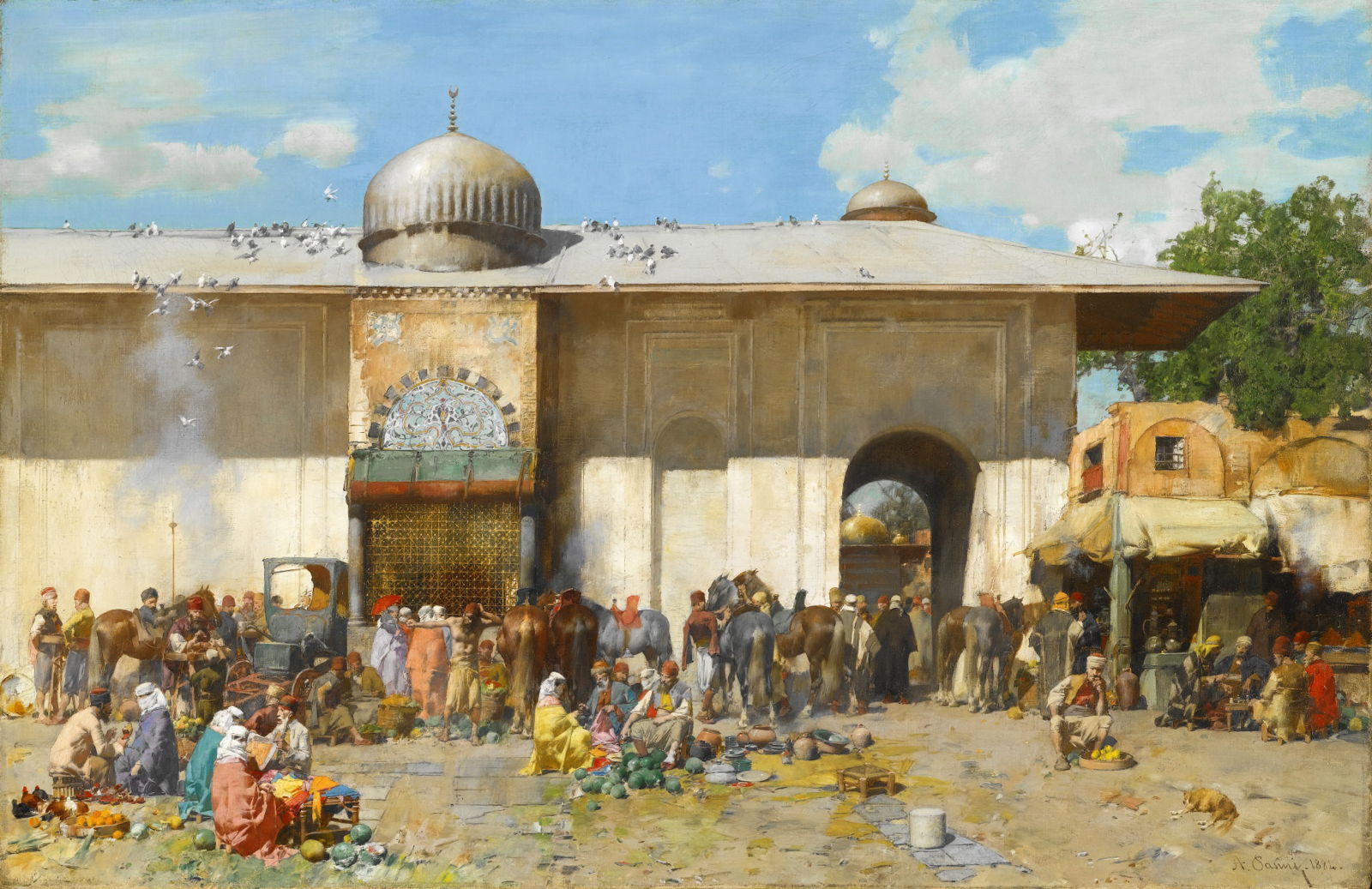
Alberto Pasini (1826–1899), A Market Scene (1884), further details not known. Wikimedia Commons.
Alberto Pasini’s Market Scene from 1884 has an eclectic mixture of produce, ranging from live chickens to pots and the artist’s signature melons.
Évariste Carpentier (1845–1922), Eating in the Farmyard (date not known), oil on canvas, 115 x 164 cm, Château de Gaasbeek, Lennik, Belgium. Wikimedia Commons.
Évariste Carpentier’s undated Eating in the Farmyard, an example of the rural deprivation which sparked Naturalist art, shows two kids surrounded by animals and birds in this much-used space.
Évariste Carpentier (1845–1922), Feeding the Chickens (date not known), oil on canvas, dimensions not known, Private collection. Wikimedia Commons.
Here, Carpentier’s old woman is busy Feeding the Chickens.
Friedrich Eckenfelder (1861–1938), Zollernschloss, Balingen (c 1884-5), oil on wood, 16.8 x 22.8 cm, Private collection. Wikimedia Commons.
Friedrich Eckenfelder’s Zollernschloss, Balingen from about 1884-5 shows a small yard just below the back of this castellated farm in Germany, with its lively flock of chickens.
Gustav Klimt (1862–1918), After the Rain (Garden with Chickens in St. Agatha) (1898-99), oil on canvas, 80.3 × 40 cm, Lentos Kunstmuseum Linz, Linz, Austria. Wikimedia Commons.
Gustav Klimt had probably painted his first small landscapes between 1881-87, and returned to the genre more seriously in about 1896. This work, variously known as After the Rain,Garden with Chickens in St. Agatha, or similar, is thought to have been painted when Klimt stayed in the Goiserer Valley with the Flöge family in the summer of 1898.
Very occasionally, a chicken may come as something of a surprise.
Hieronymus Bosch (c 1450–1516), The Ship of Fools (fragment of left wing of The Wayfarer triptych) (1500-10), oil on oak panel, 58.1 x 32.8 cm, Musée du Louvre, Paris. Wikimedia Commons.
Hieronymus Bosch’s Ship of Fools, a fragment from a larger Wayfarer triptych painted in 1500-10, is actually a small boat, into which six men and two women are packed tight. Its mast is unrealistically high, bears no sail, and has a large branch lashed to the top of it, in which is Bosch’s signature owl. Its occupants are engaged in drinking, eating what appear to be cherries from a small rectangular tabletop, and singing to the accompaniment of a lute being played by one of the women. A man has climbed a tree on the bank to try to cut down the carcass of a chicken from high up the mast.

 Login
Login