
 Login
LoginFog on the Thames 1900-1926
Claude Monet had first visited London as he sought refuge from the Franco-Prussian War in 1870-71, when he painted one of the early impressions of the River Thames in mist, shown in yesterday’s article. He was to return just before the end of the century, when his fortunes had changed and he could afford to travel in search of motifs. Where better than the River Thames for the optical effects of mist, fog and smog?
Monet had started painting formal series during the 1880s, when he was enjoying commercial success at last. From about 1896, almost all his works were part of a series. He started travelling through Europe in search of suitable motifs for these, visiting Norway in 1895, and later Venice. When he returned to London in 1899, and in the following two years, Monet chose a different view of the Palace of Westminster, from a location at the opposite end of Westminster Bridge, for his series of 19 paintings. These were all started from the second floor of the Administrative Block at the northern end of the old Saint Thomas’s Hospital on the ‘south’ bank, and completed over the following three or four years.

His The Houses of Parliament, Sunlight Effect (1903) is more radical than his painting of thirty years earlier, showing little more than the Palace in silhouette, the sun low in the sky, and its broken reflections in the water.

The Houses of Parliament, Sunset (1903) shows the same view in better visibility, but with the sun setting and a small boat on the move in front of the Palace.
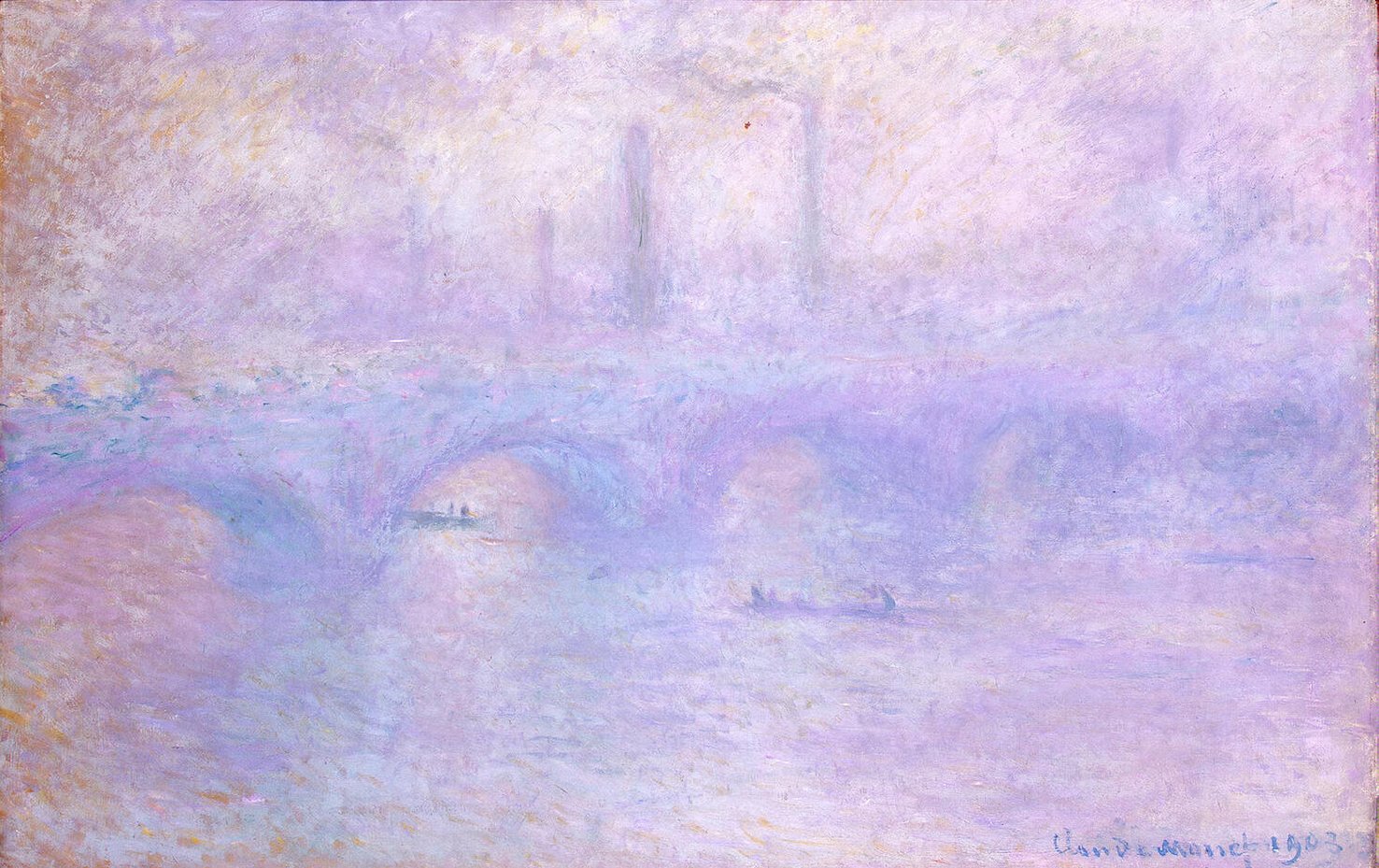
Monet’s Waterloo Bridge from 1903 is the ultimate conclusion of his paintings of fog, in which only the softest of forms resolve in its pale purple and blue vagueness, his common destination with the paintings of Turner over fifty years earlier.

In The Houses of Parliament, Stormy Sky (1904) the sun is higher and further to the south, allowing Monet to balance the silhouette of the Palace with its shadow cast on the water, and the brightness in the sky with its fragmented reflections.

Henri Le Sidaner also visited Britain on several occasions, and in 1906-07 painted this view of St. Paul’s from the River: Morning Sun in Winter, which may have been inspired by Monet’s series paintings of Rouen Cathedral, here expressed using his own distinctive marks.
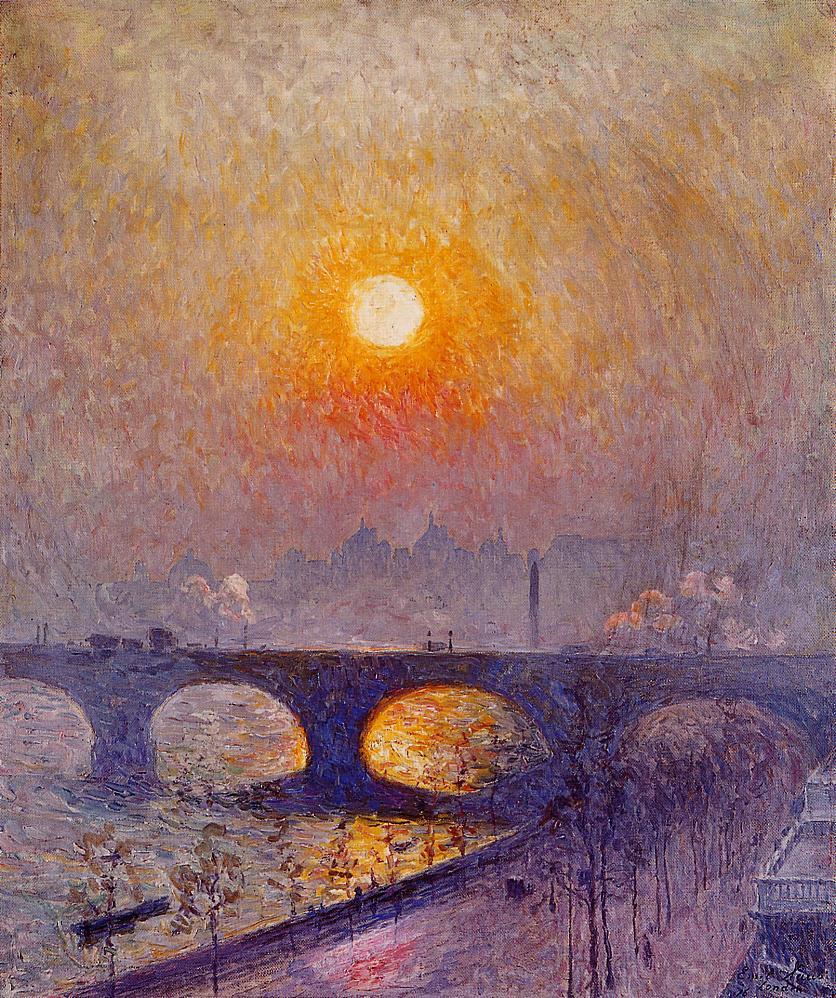
Emile Claus’s Sunset over Waterloo Bridge (1916) was painted from a location on the north bank of the Thames slightly to the east of Waterloo Bridge, the north end of which is prominent, and looks south-west into the setting sun, up river. Claus painted several views of Waterloo Bridge while he was in London, but doesn’t appear to have attempted any formal series, such as Monet’s.
Claus isn’t formulaic in his treatment. He uses billowing clouds of steam and smoke to great effect, and his inclusion of the road, trees and terraces in the foreground, on the Embankment, provides useful contrast with the crisp arches of the bridge, and the vaguer silhouettes in the distance. Like Monet’s series, this was probably painted from a temporary studio inside a building.

Claus’s Morning Reflection on the Thames in London, from 1918, is a view over the Embankment and river that’s desaturated and made vaguer by fog.

My last example is another view over the River Thames, this time by Lesser Ury. London in Fog from 1926 doesn’t appear to be a nocturne, but looks at the effects of fog on both lights and their reflections.
On 4 December 1952, a high pressure system settled over London. The wind fell away, and fog and smoke were trapped under a temperature inversion. The following day the whole of the city and an area totalling over one thousand square miles were blanketed in smog that remained until 9 December. It’s estimated that directly caused over ten thousand deaths. A succession of laws and a major campaign to eliminate open coal fires in London resulted in great improvement, although a decade later there was another lesser smog, perhaps the event I remember from my childhood. The beauty of those paintings can also be deadly.

