Reading view

There are new articles available, click to refresh the page.

Painted stories of the Decameron: Nastagio degli Onesti’s breakfast

The stories told each day in Boccaccio’s Decameron follow a theme appointed by the ‘ruler’ of that day, as they decree when they are crowned with laurels at the end of the previous day’s storytelling. The theme chosen by the queen of the fifth day, Fiammetta, was the adventures of lovers who survived calamities or misfortunes and reached a state of happiness.

The eighth such story concerns the misfortunes of Nastagio degli Onesti, as told by Filomena. This appears to have been instantly successful, and by the early sixteenth century had been painted by both Botticelli and Ghirlandaio.

Nastagio degli Onesti was a young man from an old and noble family in Ravenna, who inherited a huge fortune, then fell in love with the daughter of a more noble family. His love for her wasn’t returned, though, and she was persistently cruel towards him. This caused the young Nastagio so much grief that he even contemplated suicide.

He continued to try to win her over, and in the course of that spent much of his inheritance. Friends and relatives feared for him and his future, and tried to persuade him to leave the city for a while. He was very reluctant, but finally travelled to Classe, three miles away, in May when the weather was fine.

Once there he wandered off into the local pine woods, thinking as he always did about his cruel love. As he walked in the wood, he heard the screams of a woman in distress. He then caught sight of her running naked towards him. In hot pursuit was a pair of large mastiff dogs, and behind them was a mounted knight brandishing a sword and threatening to kill her.

Nastagio took up a tree branch in her defence, but the knight ordered him by name to keep out, and let him and his dogs give the sinful woman what she deserved. Nastagio challenged the knight, who dismounted and introduced himself as Guido degli Anastagi. He then explained that he had fallen deeply in love with this woman many years ago, but she too had rejected him cruelly. As a result, Guido had killed himself, and was condemned to eternal punishment for that sin. The woman had died shortly afterwards, without repenting her cruelty, and she too was condemned to eternal punishment for her sin.

Their punishment consisted of Guido having to hunt her down in the woods, kill her using the same sword with which he had committed suicide, then cut her back open and remove her stone cold heart. That and her other organs he then has to feed to his dogs. After a short break, she is magically restored, and he has to resume hunting her as before.

Nastagio was horrified by this, stepped back, and watched the dead Guido kill the dead woman with his rapier, and go through the sequence of cutting out her heart and organs. A few moments later, after the ghostly dogs had eaten her organs, the dead woman jumped up and the hunt started all over again.

When he had recovered from the shock, Nastagio came up with a plan to deal with his own predicament. He summoned his friends and relatives, and agreed to stop trying to woo the woman that he loved on one condition, that she and her family should join him in the same place in the pine wood exactly one week later, for a magnificent breakfast banquet.

A week later all her family were present at the meal in the wood, and Nastagio carefully seated the woman he loved so she would get a grandstand view of the proceedings. No sooner had the last course been served, than they heard the dead woman’s screams, and she ran right in front of them.

Many of the guests tried to stop Guido from carrying out this punishment, so he explained to them what he had told Nastagio the week before. Eventually the ghostly couple rushed off again, and the guests talked avidly about what they had witnessed. But the person who was most affected by the spectacle was the cruel woman who Nastagio loved, who had perhaps already put herself in the position of the dead woman.

Nastagio’s plan paid off: the woman he loved soon sent him a servant to inform him that she would do anything he desired. She quickly consented to marriage, and they were wedded the following Sunday.

One perhaps unintended consequence of Nastagio’s breakfast demonstration was that, for some time to come, the women of Ravenna were so frightened of what could happen to them that they responded more favourably to the approaches of men.

anonnastagiostart
Artist not known, The Story of Nastagio degli Onesti (c 1450), manuscript copy, BNF MS Italien 63, fol. 186v, Boccaccio’s Decameron, Bibliothèque nationale de France, Paris. Wikimedia Commons.

The title page of this story in this illustrated manuscript copy of the Decameron from the fifteenth century features a small reminder of the grim human hunt scene at its head.

This gruesome story and ingenious reversal of conventional Christian values became popular and well-known through the fifteenth century, sufficient for it to be depicted in four tempera panels given on the occasion of the arranged marriage of Gianozzo Pucci and Lucretia Bini in 1483. The couple were particularly fortunate in that one of those who made the arrangement, and who had this gift made for them, was Lorenzo de’ Medici, ‘the Magnificent’, who was also Botticelli’s patron at the time, and the ruler of the Florentine Republic.

botticellinastagliodeglionesti1
Sandro Botticelli (1445–1510), The Story of Nastagio Degli Onesti I (1482-83), tempera on panel, 83 x 138 cm, Museo Nacional del Prado, Madrid, Spain. Wikimedia Commons.

The first panel shows the two figures of Nastagio, at the left, in the pine wood, with the naked woman running towards him, a mastiff sinking its teeth into her buttock. Behind them at the right is Guido, his sword ready to kill the woman when he catches her. In the distance is a coastal landscape intended to locate this near Ravenna, which is close to the Adriatic, although that’s idealised not representative.

botticellinastagiodeglionesti2
Sandro Botticelli (1445–1510), The Story of Nastagio Degli Onesti II (1482-83), tempera on panel, 82 x 138 cm, Museo Nacional del Prado, Madrid, Spain. Wikimedia Commons.

Botticelli continues to tell the story using multiplex (‘continuous’) narrative in the second painting. The dead Guido has now caught the dead woman, killed her with his rapier, and with her lying on her face, he is cutting her back open to remove her cold heart. His dogs are already eating her organs at the right, and Nastagio is visibly distressed at the left.

Behind that composite scene is an earlier scene of Guido and his dogs still in pursuit of the woman, preceding the image of the first painting in the series.

botticellinastagiodeglionesti3
Sandro Botticelli (1445–1510), The Story of Nastagio Degli Onesti III (1482-83), tempera on panel, 84 x 142 cm, Museo Nacional del Prado, Madrid, Spain. Wikimedia Commons.

In the third painting, Botticelli shows the breakfast banquet a week later, with the dead woman being attacked by Guido’s dogs, and Guido himself about to catch and kill her, in front of Nastagio’s guests.

Nastagio’s love is sitting at the table on the left, from which all the women have risen in distress at the sight, spilling their food in front of them.

botticellinastagiodeglionesti4
Sandro Botticelli (1445–1510), The Story of Nastagio Degli Onesti IV (1482-83), tempera on panel, 83 x 142 cm, Private collection. Wikimedia Commons.

The fourth and final panel shows Nastagio’s wedding, the bride and her women sitting to the left, and the men to the right, in formal symmetry. The groom is sat on the other side of the same table as the bride.

Botticelli’s series seems to have been celebrated at the time, and shortly afterwards Ghirlandaio, another Florentine master, was asked to make not copies, but paintings in the manner of Botticelli’s series. Two have survived, and are now both in the US.

ghirlandaionastagiony
Davide Ghirlandaio (David Bigordi) (1452–1525), Forest Scene from the Tale of Nastagio degli Onesti (after 1483), tempera on wood panel, 69.9 x 134.6 cm, Brooklyn Museum (A. Augustus Healy Fund and Carll H. de Silver Fund), New York, NY. Courtesy of Brooklyn Museum.

Ghirlandaio’s first panel, now in the Brooklyn Museum, is based on Botticelli’s first, with the addition of an extra scene to its multiplex narrative. Up in the right, he adds the scene from Botticelli’s second panel, showing Guido cutting out the dead woman’s heart through her back.

ghirlandaionastagiopa
Davide Ghirlandaio (David Bigordi) (1452–1525), Banquet Scene from the Tale of Nastagio degli Onesti (after 1483), tempera on wood panel, 70.2 x 135.9 cm, The Philadelphia Museum of Art (John G. Johnson Collection, 1917), Philadelphia, PA. Courtesy of The Philadelphia Museum of Art.

Ghirlandaio’s second panel shows an almost identical breakfast banquet to that in Botticelli’s third panel. This is now in the Philadelphia Museum of Art. I don’t know whether Ghirlandaio’s series extended to a third, completing the story with the marriage feast of Nastagio.

Boccaccio’s strange tale, twisted from source material by Dante, resulted in even more curious paintings. Today we might be only too happy to watch it in a horror movie, but seeing it come to life in a series of panels as a wedding gift? That’s surely typical of the late Middle Ages.

Painted stories of the Decameron: Introduction

Many great literary works are compilations of shorter tales, set in a framing story. Among the best known are One Thousand and One Nights and Sanskrit epics including Mahabharata. Among the most enduring in post-classical Europe is Boccaccio’s Decameron, whose stories have also proved popular with painters. Over the next couple of months I’m going to summarise those that have been well depicted in this new series, and show those paintings.

Despite the number of scholars who have researched Giovanni Boccaccio’s life over the last seven hundred years, much of it remains vague. He was either born in Florence, or perhaps near the village of Certaldo to the south-west of the city. His father worked for the Bardi bank, but he is thought to have been illegitimate and his mother hasn’t been identified.

We do know that he was born on 16 June 1313, and while still a child his father married a woman from a rich family, then moved to Naples. At the time, that was a major cultural centre, and as a young man Boccaccio immersed himself in that. His father expected him to become a banker, and Giovanni started work as an apprentice in his father’s bank in the city.

Boccaccio had no interest in banking though, and persuaded his father to let him study canon (ecclesiastical) law at the city’s university. When he was in his twenties, his father introduced him to the Neapolitan court and cultural circles around Robert the Wise, King of Naples. Among Boccaccio’s most important influences at this time was the scholar Paolo da Perugia, who had amassed much information about classical myths. Boccaccio became a scholar, particularly of the classical world, a writer rather than an ecclesiastical lawyer, and his future started to crystallise when he wrote his first poetry.

His early works became sources for Chaucer’s Troilus and Criseyde (Troilus and Cressida), and the Knight’s Tale.

Boccaccio left Naples in 1341, as tensions were growing between its king and the city-state of Florence, and returned to live mainly in Florence, although he also spent time in Ravenna. He developed great admiration for the work of Dante Alighieri, who had died in Ravenna twenty years earlier, and the great poet Francesco Petrarca (Petrarch) (1304-1374), whom he regarded as his teacher.

vasarisixtuscanpoets
Giorgio Vasari (1511–1578), Six Tuscan Poets (1544), oil on panel, 132 x 131.1 cm, Minneapolis Institute of Arts, Minneapolis, MN. Wikimedia Commons.

Giorgio Vasari is now more famous for his biographies of the important painters of the Renaissance and earlier, but was also an accomplished artist himself. His tribute to some of the greatest writers of the period is Six Tuscan Poets from 1544. From left to right, I believe these to be Dante Alighieri, Francesco Petrarca (Petrarch), Guido Cavalcanti, Giovanni Boccaccio, Cino da Pistoia, and Guittone d’Arezzo.

scottboccacciotodantesdaughter
William Bell Scott (1811–1890), Boccaccio’s Visit to Dante’s Daughter (date not known), oil on canvas, further details not known. Wikimedia Commons.

William Bell Scott’s undated painting of Boccaccio’s Visit to Dante’s Daughter shows the writer paying indirect homage to his illustrious predecessor. Boccaccio wrote the first biography of Dante, at about the same time he was writing the Decameron.

During the 1340s Boccaccio appears to have been developing the idea of a book in which seven characters take it in turns to tell stories. When the Black Death struck Florence in 1348, killing Boccaccio’s stepmother, this provided him with its framing story. He was already building his collection of tales to form the bulk of the book, and it’s thought he started its writing shortly after the Black Death. What is more doubtful is whether Boccaccio was living in Florence when the epidemic struck. However, as it raged through the whole of Tuscany in that year, hardly sparing a village, it’s most unlikely that he didn’t observe its effects somewhere, perhaps in Ravenna.

In 1349, Boccaccio’s father died, leaving Giovanni as the head of the household. In spite of that, he pressed on and had largely completed the first version in 1352. He revised it in 1370-71, and ever since it has been widely read, translated into all major languages, and its stories have inspired many works of art.

wappersboccaccioreading
Egide Charles Gustave Wappers (1803–1874), Boccaccio Reading from the Decameron to Queen Johanna of Naples (1849), oil on canvas, 171 x 228 cm, Koninklijke Musea voor Schone Kunsten van België / Musées Royaux des Beaux Arts de Belgique, Brussels, Belgium. Image by Georges Jansoone, via Wikimedia Commons.

Egide Charles Gustave Wappers painted Boccaccio Reading from the Decameron to Queen Johanna of Naples in 1849. Queen Joanna I of Naples (1328-1382) had a reputation that was more than controversial, but Boccaccio was a supporter, and wrote a complementary account in his collection of biographies of famous women, De Mulieribus Claris (On Famous Women).

master1482boccaccioflorentines
Master of 1482 and Follower (fl 1485), Giovanni Boccaccio and Florentines who have Fled from the Plague (c 1485), miniature on vellum, in The Decameron, translated by Laurent de Premierfait, Koninklijke Bibliotheek, The Hague, The Netherlands. Wikimedia Commons.

This miniature by the Master of 1482 and Follower conflates Boccaccio, the Black Death in Florence, and the framing story of the Decameron: Giovanni Boccaccio and Florentines who have Fled from the Plague was painted in about 1485 on vellum, in what must have been one of its first illustrated editions.

The Decameron opens with a description of the horrific conditions and events that overwhelmed Florence when the Black Death struck, then takes us to a group of seven young women who are sheltering in one of its great churches. They decide to leave the city rather than waiting amid its rising pile of corpses, to spend some time in the country nearby. They take some servants and three young men to accompany them there.

Once settled in an abandoned mansion, the ten decide that one of the means they will use to pass their self-imposed exile is to tell one another stories. Over the next two weeks, each tells one story on every weekday, delivering a total of one hundred, hence the title of the book.

sorbidecameron
Raffaello Sorbi (1844–1931), The Decameron (1876), oil on canvas, 45.5 x 88.7 cm, Private collection. Wikimedia Commons.

Raffaello Sorbi show the group of ten during one of the story-telling sessions in The Decameron from 1876, with the city of Florence in the distance.

postiglionedecameron
Salvatore Postiglione (1861–1906), Scene of the Narration of the Decameron (date not known), oil on canvas, 100 x 151 cm, location not known. Wikimedia Commons.

Salvatore Postiglione’s undated, ornate and almost illustrative Scene of the Narration of the Decameron is unusual for omitting one of the seven young women, but links visually to their other musical and craft activities.

Relatively few of the hundred tales in the Decameron have been committed to paint. Some are little more than brief fables, or what used to be known as shaggy dog stories. Others are more lengthy novellas with intricate twisting plots. But many have been painted from the Renaissance until well into the twentieth century, and were particularly popular with the Pre-Raphaelites.

pesellinolifegriseldis
Francesco Pesellino (1422–1457), Scene from the Life of the Griseldis (c 1450), tempera on panel, 42 × 47 cm, Accademia Carrara, Bergamo, Italy. Wikimedia Commons.

The tale of Griselda has cropped up in folk stories across Europe before it was told as the final tale (Day 10, Story 10) of the Decameron. It was then taken up by Chaucer in the Clerk’s Tale, and by Charles Perrault. Francesco Pesellino painted it in this Scene from the Life of the Griseldis from around 1450.

botticellinastagliodeglionesti1
Sandro Botticelli (1445–1510), The Story of Nastagio Degli Onesti I (1482-83), tempera on panel, 83 x 138 cm, Museo Nacional del Prado, Madrid, Spain. Wikimedia Commons.

One of the most significant series of paintings of the Decameron is Sandro Botticelli’s Story of Nastagio Degli Onesti, of which this is the first. Boccaccio includes this horrific tale as the eighth story on Day 5, shown by Botticelli in four panels that were commissioned as a wedding gift for a couple whose marriage was partly arranged by Lorenzo the Magnificent (Lorenzo de’ Medici), ruler of the Florentine Republic in the late fifteenth century, and Botticelli’s patron.

millaisisabella
John Everett Millais (1829–1896), Isabella (Lorenzo and Isabella) (1848-49), oil on canvas, 103 x 142.8 cm, Walker Art Gallery, Liverpool, England. Wikimedia Commons.

One of the earliest and greatest examples of Pre-Raphaelite painting is John Everett Millais’ Isabella (Lorenzo and Isabella) from 1848-49. When exhibited at the Royal Academy in 1849, it was accompanied by lines from John Keats’ poem Isabella or the Pot of Basil, referring to the story of the ill-fated love of Lisabetta for Lorenzo, the fifth told on Day 4.

stillmanenchantedgardenmesseransaldo
Marie Spartali Stillman (1844–1927), The Enchanted Garden of Messer Ansaldo (1889), watercolour and gouache on paper mounted on panel, 72.4 × 102.9 cm, Private collection. Image courtesy of Julian Hartnoll, Pre‑Raphaelite Inc., via Wikimedia Commons.

Later in the nineteenth century, Marie Spartali Stillman painted The Enchanted Garden of Messer Ansaldo (1889), showing a scene from the fifth story of Day Ten. This was also painted by John William Waterhouse in 1916-17.

leightoncymoniphigenia
Frederic, Lord Leighton (1830-1896), Cymon and Iphigenia (1884), oil on canvas, 218.4 x 390 cm, Art Gallery of New South Wales, Sydney, Australia. Wikimedia Commons.

Perhaps the most popular of all the stories in the Decameron with visual artists has been the romance of Cymon and Iphigenia, here shown in Frederic, Lord Leighton’s luscious and languid painting from 1884.

I hope that you will join me in looking at many more wonderful paintings exploring Boccaccio’s stories from the Decameron in the coming weeks.

Paintings of Dante’s Inferno: 16 Overview, Purgatory and Paradise

Over the previous fifteen articles Dante has taken us through his vision of Hell. As he journeys on to Purgatory, this article offers an overview of the best-known book in his Divine Comedy.

botticellimaphell
Sandro Botticelli (1445–1510), Map of Hell (1480-90), silverpoint, ink and distemper, 33 x 47.5 cm, Biblioteca Apostólica Vaticana, Vatican City. Wikimedia Commons.

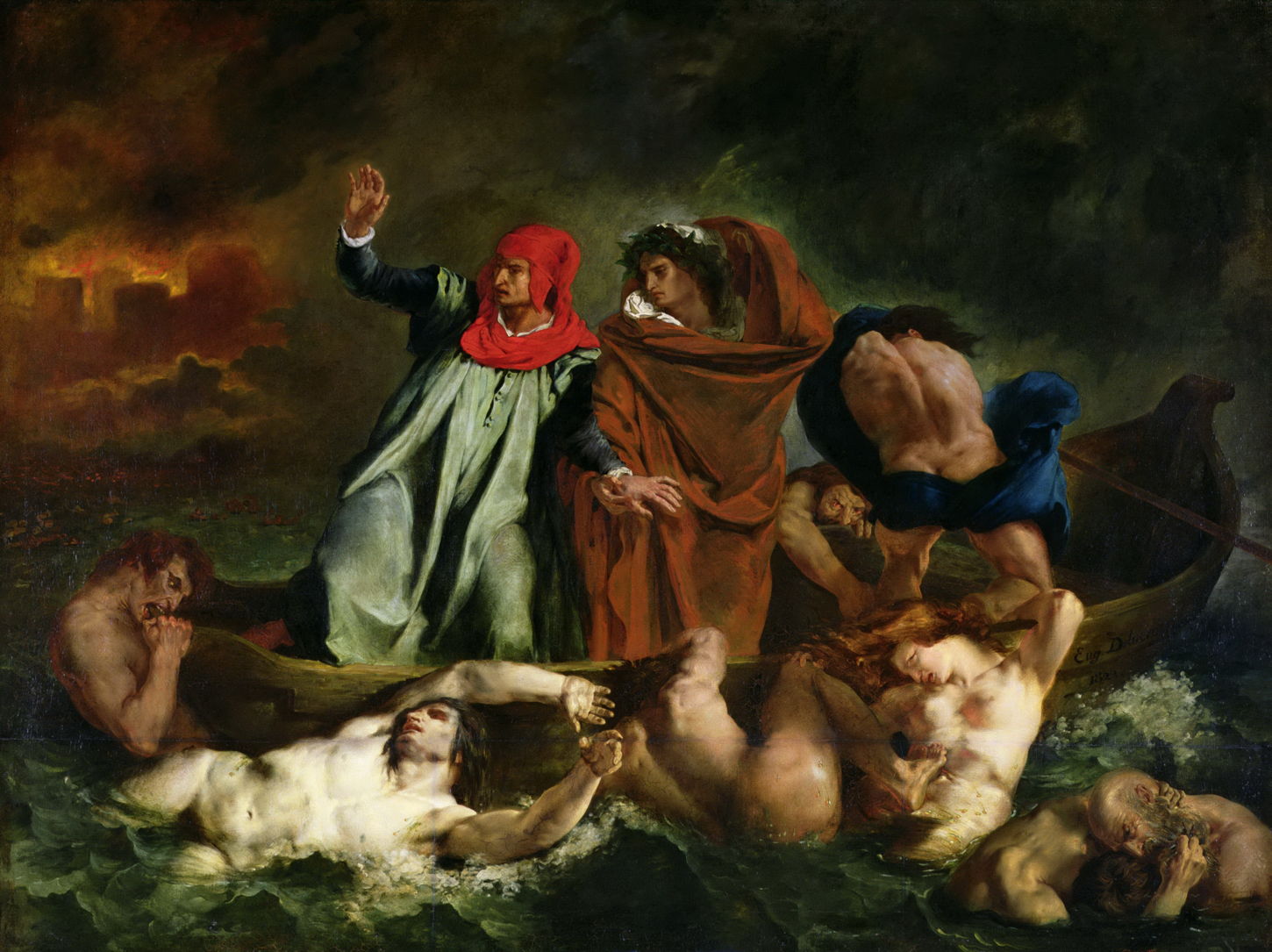
It was Botticelli who provided the clearest pictorial map of Dante’s journey, as he descended with Virgil through a succession of circles, each with its own class of sinner. Highest are the woods where Dante was wandering when he encountered the three wild beasts. At the left, Virgil led Dante down to the area where the cowards are trapped, neither being allowed admittance to Heaven, nor to Hell. Charon’s boat then crosses the River Acheron, shown in blue, taking Dante and Virgil to the First Circle of Limbo.

Introduction

This journey starts just before dawn on Good Friday in 1300, when the poet is wandering lost in a dark wood. His way is blocked first by a leopard, then by a lion, and finally by a wolf.

corotdantevirgil
Jean-Baptiste Camille Corot (1796–1875), Dante and Virgil (1859), oil on canvas, 260.4 x 170.5 cm, Museum of Fine Arts Boston, Boston, MA. Wikimedia Commons.

1 To the gates of Hell

Forced to retreat back into the wood, Dante comes across a man who introduces himself by way of a riddle, leading Dante to recognise him as the ghost of the classical Roman poet Virgil. He tells Dante that the only way out is to pass through the eternity of Hell. When the pair reach the gate of Hell, they read its warnings, culminating in the bleak exhortation: leave behind all hope, you who enter.

They first encounter those stuck forever on the periphery, those whose lives were too cowardly to enter Heaven or Hell, who are stung repeatedly by flies and wasps.

delacroixbarquedante
Eugène Delacroix (1798–1863), The Barque of Dante (Dante and Virgil in Hell) (1822), oil on canvas, 189 x 241 cm, Musée du Louvre, Paris. Wikimedia Commons.

2 Abandon hope

They then cross the River Acheron in Charon’s ferryboat, and enter the First Circle of Limbo, a place of tranquil and calm. Here are the souls of those who led honourable lives before the Christian era, and others who never had the opportunity to follow Christ. These include the great classical writers: Homer, Horace the satirist, Ovid and Lucan. Together with Virgil, these five invite Dante himself to join them as the sixth among the ranks of great writers, in an ambitious piece of self-promotion.

3 In Limbo

Virgil leads Dante down to the Second Circle, for those guilty of the sin of lust.

blakeloverswhirlwind
William Blake (1757–1827), The Circle of the Lustful: Francesca da Rimini (The Whirlwind of Lovers) (c 1824), pen and watercolour over pencil, 36.8 x 52.2 cm, Birmingham Museums and Art Gallery, Birmingham, England. The Athenaeum.

Here the lustful are thrown around by vicious winds, and Dante hears the tragic story of Paolo and Francesca da Rimini, that inspired many fine paintings.

dorepaolofrancesca
Gustave Doré (1832–1883) Paolo and Francesca da Rimini (1863), oil on canvas, 280.7 x 194.3 cm, Private collection. Wikimedia Commons.

4 Paolo and Francesca

Passing the three-headed dog-monster Cerberus, Virgil takes Dante on to the Third Circle, full of gluttons wallowing in stinking mud, under a constant deluge of rain, sleet and snow. In the Fourth Circle, they see a mixture of the avaricious and prodigals pushing great boulders in opposite directions.

5 Cerberus and gluttony

blakestygianswamp
William Blake (1757–1827), The Stygian Lake, with the Ireful Sinners Fighting (Dante’s Inferno) (1824-27) pen, ink and watercolour over pencil, dimensions not known, National Gallery of Victoria, Melbourne, Australia. Wikimedia Commons.

The Fifth Circle holds the swamp of the River Styx, in which sullen spirits are submerged and the wrathful fight one another. Dante and Virgil cross this in a boat piloted by Phlegyas, who deposits them at the gate to the city of Dis, entrance to the lower parts of Hell. The gate is slammed shut on them, and requires a messenger from Heaven to let them through.

6 Money and anger

blakefarinata
William Blake (1757–1827), Farinata degli Uberti (Dante’s Inferno) (1824-27) media and dimensions not known, The British Museum, London. Wikimedia Commons.

Here Dante enters the Sixth Circle, for heretics who denied the soul’s immortality, among them the Florentine Farinata degli Uberti, who is imprisoned in a tomb. The pair are carried by Nessus the Centaur on to the Seventh Circle, for the violent.

7 Furies and heresy

blakesuicidetrees13
William Blake (1757–1827), The Wood of the Self-Murderers: The Harpies and the Suicides (Dante’s Inferno) (1824-27), graphite, ink and watercolour on paper, dimensions not known, National Gallery of Victoria, Melbourne, Australia. Wikimedia Commons.

These not only include tyrannical warriors like Attila the Hun, murderers and bandits, but those whose violence was directed at their own lives in suicide, who are trees in a wood and kept in perpetual pain by harpies feeding on them. The pair then cross a desert on which fire rains to torment the souls of blasphemers, sodomites, and usurers.

8 The Minotaur, killers and suicides

blakesymboliccoursehumanhistory
William Blake (1757–1827), The Symbolic Figure of the Course of Human History Described by Virgil (Dante’s Inferno) (1824-27), further details not known. Wikimedia Commons.

Dante learns of a statue of an old man on Mount Ida, on the island of Crete, whose tears form the rivers of Hell.

9 Violence against God

Virgil guides Dante onto the back of Geryon, formerly a king slain by Hercules and condemned to suffer in Hell for his fraud, who flies the pair on to the Eighth Circle, for the fraudulent. This is divided into a series of rottenpockets, depressions in which different types of fraudster are confined. They pass through the areas for pimps, flatterers, corrupt religious leaders, sorcerers, corrupt officials and hypocrites.

10 Fraud

blakepopenicholasiii
William Blake (1757–1827), The Simonist Pope (Dante’s Inferno) (1824-27), watercolour, 52.5 x 36.8 cm, The Tate Gallery, London. Wikimedia Commons.

Among the corrupt religious leaders or simonists is Pope Nicholas III, who had been shamelessly nepotistic.

kochthieves
Joseph Anton Koch (1768-1839), Thieves (1825-28), fresco, dimensions not known, Casa Massimo, Rome, Italy. Image by Sailko, via Wikimedia Commons.

The later rottenpockets contain thieves, those who gave fraudulent counsel, those who sowed discord, and falsifiers and imposters of various kinds. Thieves are attacked repeatedly by snakes to undergo their own reptilian transformation.

11 Bribery, hypocrisy, theft

bouguereaudantevirgil
William-Adolphe Bouguereau (1825–1905), Dante and Virgil In Hell (1850), oil on canvas, 280.5 x 225.3 cm, Musée d’Orsay, Paris. Wikimedia Commons.

Among these many cheats and frauds are those who fight one another, and sink their teeth into flesh.

12 Fraud and inciting division

Dante and Virgil are lowered into the Ninth Circle by Antaeus, one of the giants who stand guard around its periphery.

doredantevergil
Gustave Doré (1832–1883), Dante and Virgil in the ninth circle of hell (1861), oil on canvas, 311 x 428 cm, Musée de Brou, Bourg-en-Bresse, France. Wikimedia Commons.

There is the lake of Cocytus, in which those guilty of treachery are frozen and suffering for eternity. These include souls of those who were treacherous against their relatives, their homeland, guests and benefactors.

13 Treachery

Blake, William, 1757-1827; Ugolino and His Sons in Prison
William Blake (1757–1827), Count Ugolino and His Sons in Prison (c 1826), pen, tempera and gold on panel, 32.7 x 43 cm, Fitzwilliam Museum, University of Cambridge, Cambridge, England. The Athenaeum.

Among them is Count Ugolino, who sinks his teeth into the neck of Archbishop Ruggieri, who left him to starve to death in a cell.

14 Count Ugolino

Finally, Dante and Virgil see Lucifer himself, before leaving Hell.

15 Lucifer himself

kochinfernostudy
Joseph Anton Koch (1768-1839), Hell (study for Casa Massimo frescoes) (c 1825), watercolour and gouche, dimensions and location not known. Wikimedia Commons.

The artists

William Blake (1757–1827) was a British visionary painter and illustrator whose last and incomplete work was an illustrated edition of the Divine Comedy for the painter John Linnell. Most of his works shown in this series were created for that, although he did draw and paint scenes during his earlier career. I have a major series on his work here.

Sandro Botticelli (1445–1510) was one of the leading painters of the early Southern Renaissance, working in his native city of Florence. In addition to his huge egg tempera masterpieces of i (c 1482) and The Birth of Venus (c 1485), he was a lifelong fan of Dante’s writings. He produced drawings which were engraved for the first printed edition of the Divine Comedy in 1481, but these weren’t successful, most copies only having two or three of the 19 which were engraved. He later began a manuscript illustrated edition on parchment, but few pages were ever fully illuminated.

William-Adolphe Bouguereau (1825–1905) was a precocious and highly-acclaimed academic painter who dominated the Salon in the late nineteenth century with his figurative works, often drawn from mythology. Classically-trained at the École des Beaux-Arts, he grew infamous for his nudes painted against false settings, and his vehement opposition to Impressionism. However, he taught at the Académie Julian, and worked tirelessly even when his paintings fell from favour.

Jean-Baptiste Camille Corot (1796–1875) was French, and one of the most prolific and greatest European landscape artists of the nineteenth century, who was key to the development of Impressionism. Following in the classical tradition, he also painted several narrative works set in those landscapes.

Eugène Delacroix (1798–1863) was a major French painter whose Romantic and painterly style laid the groundwork for the Impressionists. In addition to many fine easel works, he painted murals and was an accomplished lithographer too. Many of his paintings are narrative, and among the most famous is Liberty Leading the People from 1830. This article introduces a series featuring his major works.

Gustave Doré (1832–1883) was the leading French illustrator of the nineteenth century, whose paintings are still relatively unknown. Early in his career, he produced a complete set of seventy illustrations for translations of the Inferno, first published in 1857 and still being used. These were followed in 1867 by more illustrations for Purgatorio and Paradiso. This article looks at his paintings.

Joseph Anton Koch (1768-1839) was an Austrian landscape painter, who worked mainly in Neoclassical style. During his second stay in Rome, he was commissioned to paint frescos in the Villa Massimi on the walls of the Dante Room there, which remain one of the most florid visual accounts of Dante’s Inferno. He completed those between 1824-29. He also appears to have drawn a set of illustrations for Dante’s Inferno in about 1808.

Purgatory and Paradise

Although Heaven and Hell have clear biblical roots, the concept of Purgatory as part of the Christian life after death is more recent. It originated in the early Christian Church, flourished in the Middle Ages, and ripened only in the Catholic Church after the schism of Protestants in the Reformation during the sixteenth century. It can be seen as a route to Heaven for those who had sinned on earth, so long as they had confessed and repented.

Dante had much greater freedom in imagining what Purgatory might be, and adopted a physical structure that is the exact inverse of his vision of Hell: a mountain rising through seven terraces to culminate in a terrestrial paradise at the summit. Each terrace then accommodates a class of sin, rising from pride at the foot to lust just below Paradise.

The least-known of the three books in Dante’s Divine Comedy, Paradise was its most important to contemporary readers. Having given gruesome detail of what would await them in Inferno, and the penance they would have to pay in Purgatory, Paradise must be everyone’s ultimate aspiration. Dante invokes classical cosmology in nine concentric shells rather than the simple physical structures of the two previous realms, which for many readers is more nebulous.

References

Wikipedia
Danteworlds

Robin Kirkpatrick (trans) (2012) Dante, The Divine Comedy, Inferno, Purgatorio, Paradiso, Penguin Classics. ISBN 978 0 141 19749 4.
Richard Lansing (ed) (2000) The Dante Encyclopedia, Routledge. ISBN 978 0 415 87611 7.
Guy P Raffa (2009) The Complete Danteworlds, A Reader’s Guide to the Divine Comedy, Chicago UP. ISBN 978 0 2267 0270 4.
Prue Shaw (2014) Reading Dante, From Here to Eternity, Liveright. ISBN 978 1 63149 006 4.

Botticelli’s studio

Artists seldom painted the interior of their studio until the nineteenth century, and it was unheard of in the Renaissance. So when you’re offered a glimpse into that of Sandro Botticelli in the 1480s you’d be justifiably suspicious, particularly when it wasn’t painted until 1922, over half a millennium later.

Nevertheless, almost exactly eleven years ago, on the fifth of November 2014, a remarkable painting claiming to depict Botticelli’s studio at that time was auctioned in New York. Captured on its canvas were the faces of those long dead, those of the artist and members of the Medici family.

fortescuebrickdalebotticellisstudio
Eleanor Fortescue-Brickdale (1872–1945), Botticelli’s studio: The first visit of Simonetta presented by Giulio and Lorenzo de Medici (1922), oil on canvas, 74.9 × 126.4 cm, Private collection. Wikimedia Commons.

The painting’s title reveals its key figures: Botticelli’s studio: The first visit of Simonetta presented by Giulio and Lorenzo de Medici (1922). The artist stands at the left in front of an exquisite tondo he is working on. Bowing to him at the centre is Giuliano de’ Medici, who is accompanied by Simonetta Vespucci, wearing the green dress. Behind her is Lorenzo de’ Medici, also known as Lorenzo the Magnificent, and behind him are Giovanna Tornabuoni and her attendants. The view through the window is of the Palazzo Vecchio in the centre of Florence.

Painted by the British artist Eleanor Fortescue-Brickdale, those figures weren’t based on models or imagination, but on contemporary sources.

ghirlandaiogiovannatornabuoni
Domenico Ghirlandaio (1449–1494), Giovanna Tornabuoni and attendants, detail of The Visitation (c 1488), fresco, dimensions not known, Tornabuoni Chapel, Santa Maria Novella Church, Florence. Wikimedia Commons.

Giovanna Tornabuoni comes from a detail of Domenico Ghirlandaio’s painting The Visitation (c 1488) in the Tornabuoni Chapel of the Church of Santa Maria Novella in Florence. Giovanna was born as Giovanna degli Albizzi in 1468, married Lorenzo Tornabuoni in 1486 when she was about eighteen, and died in childbirth two years later in 1488. She is here accompanied by her maid and nurse.

macchiettilorenzodemedici
Girolamo Macchietti (1535–1592), Lorenzo the Magnificent (Lorenzo de’ Medici (1449-1492)) (date not known), oil, dimensions not known, location not known. Wikimedia Commons.

Lorenzo de’ Medici (1449-1492) hails from Girolamo Macchietti’s undated portrait of Lorenzo the Magnificent. Lorenzo was born in 1449 into the banking family, the grandson of Cosimo de’ Medici, at the time one of the wealthiest and most powerful people in Europe. Lorenzo was groomed for power, and became de facto ruler of the Florentine Republic when his father died in 1469.

He survived an attempted assassination in the Cathedral of Santa Maria del Fiore on Easter Sunday 1478, in which his brother Giuliano was stabbed to death. This led to his excommunication, and invasion by forces of the King of Naples. He resolved that, and died in 1492, when he was forty-three.

botticelligiulianodemedici
Sandro Botticelli (1445–1510), Portrait of Giuliano de’ Medici (c 1475), tempera on panel, 54 x 36 cm, Accademia Carrara, Bergamo, Italy. Wikimedia Commons.

Botticelli also painted this Portrait of Giuliano de’ Medici in about 1475. Giuliano was born in 1453, younger brother and co-ruler of the Florentine Republic with Lorenzo. He was brutally murdered in that attack in the cathedral on Easter Sunday 1478, dying at the age of twenty-five. Although he never married, an illegitimate son of his became Pope Clement VII.

botticellimagnificatmadonna
Sandro Botticelli (1445–1510), Madonna of the Magnificat (1483), tempera on panel, diameter 118 cm, Galleria degli Uffizi, Florence. Wikimedia Commons.

The painting shown in progress is Botticelli’s Madonna of the Magnificat, thought to have been completed in 1483. It shows the Virgin Mary being crowned by a pair of angels, writing down the start of the Magnificat in a book, and holding a pomegranate in her left hand. It has also been interpreted as a family portrait of the de’ Medicis, in which the Virgin is Lucrezia Tornabuoni, the mother of Lorenzo and Giuliano de’ Medici, who are the angels. I believe that Lucrezia was one of Giovanna Tornabuoni’s aunts by marriage.

botticelliadorationmagidet
Sandro Botticelli (1445–1510), The Adoration of the Magi (detail) (c 1475), tempera on wood, dimensions not known, Galleria degli Uffizi, Florence. Wikimedia Commons.

The source of the likeness of Botticelli is more of a problem, as he isn’t known to have painted a formal self-portrait. It’s generally believed, though, that he revealed himself in cameo in this detail from his The Adoration of the Magi from about 1475.

lippifcrucifixionstpeter
Filippino Lippi (1457–1504), Disputation with Simon Magus and Crucifixion of St Peter (detail) (1424-28), fresco, dimensions not known, Cappella Brancacci, Santa Maria del Carmine, Florence. Image by Marie-Lan Nguyen, via Wikimedia Commons.

It’s also thought that Filippino Lippi included his portrait in this section he painted in 1483-84 of Massaccio’s incomplete fresco in the Cappella Brancacci, Santa Maria del Carmine, Florence, in Disputation with Simon Magus and Crucifixion of St Peter.

But of all the figures shown in this painting, Simonetta Vespucci is the most fascinating. She was born Simonetta Cattaneo in 1453, and when she was only fifteen or sixteen, she married Marco Vespucci, cousin of Amerigo Vespucci, the first to demonstrate that the New World of the West Indies and Brazil wasn’t part of Asia.

Once married, she lived with her husband in Florence, where she was a great favourite at the court of the de’ Medicis. Giuliano de’ Medici entered a jousting tournament in 1475 bearing a banner with an image of Simonetta as Pallas Athene, painted by Botticelli. She had the reputation of being the most beautiful woman in the whole of northern Italy, but that beauty was fleeting as she died of tuberculosis in 1476, when she was only twenty-two.

pierodicosimosimonettavespucci
Piero di Cosimo (1462–1521), Portrait of Simonetta Vespucci (1490), media not known, 57 x 42 cm, Musée Condé, Chantilly, France. Wikimedia Commons.

Many paintings have been claimed to be portraits of her, but perhaps the most credible is Piero di Cosimo’s Portrait of Simonetta Vespucci from 1490.

botticelliportraitlady
Sandro Botticelli (1445–1510), Idealized Portrait of a Lady (Portrait of Simonetta Vespucci as Nymph) (1480), media not known, 81.8 x 54 cm, Städelsches Kunstinstitut und Städtische Galerie, Frankfurt, Germany. Wikimedia Commons.

Several of Botticelli’s works have been claimed to feature figures for which Simonetta modelled, even the naked Venus in his famous The Birth of Venus (1484-86). The least unlikely might be his Idealized Portrait of a Lady, also known as Portrait of Simonetta Vespucci as Nymph, thought to have been painted in 1480, four years after her death. Such portraits were commonly not true to life, but idealisations intended to flatter rather than identify, so we will never know if she was its subject.

Inevitably, time in Botticelli’s studio is slightly out of joint. The figures might have been able to gather together in this way in about 1475, before the deaths of Simonetta and Giuliano de’ Medici, but that is well before Botticelli might have painted Madonna of the Magnificat, and when Giovanna Tornabuoni was still a child.

This remarkable painting was the second of its kind by Eleanor Fortescue-Brickdale.

fortescuebrickdaleforerunner
Eleanor Fortescue-Brickdale (1872–1945), The Forerunner (1920), oil on canvas, 59.6 × 122 cm, Lady Lever Art Gallery, Liverpool, England. Wikimedia Commons.

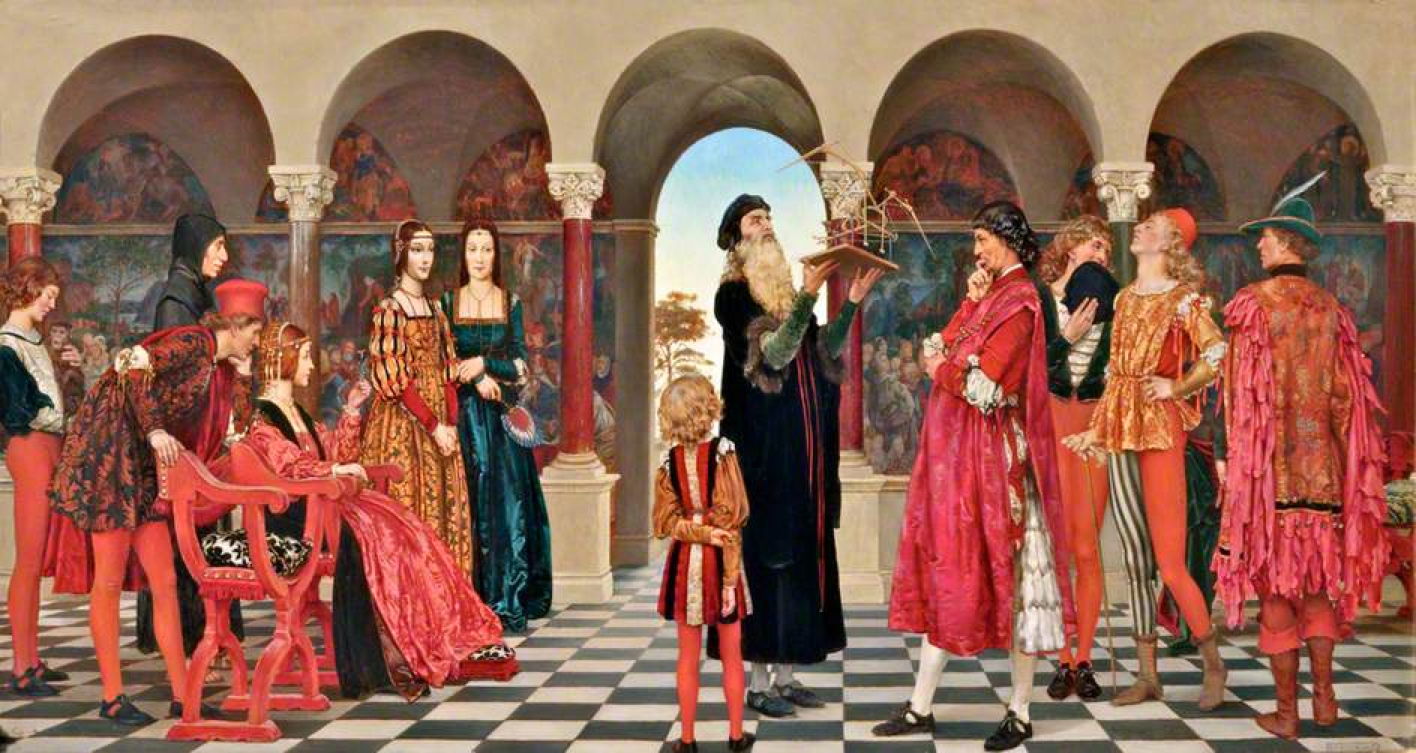
Two years previously, in 1920, she had painted The Forerunner, showing Leonardo da Vinci trying to convince the Milanese court of his idea for flying machines. Notable figures included here are (from the left) Savonarola (from Fra Bartolomeo’s portrait), Beatrice d’Este (Duchess of Milan), Cecilia Gallerani, Elisabetta Gonzaga, Leonardo da Vinci, and Ludovico Sforza (Duke of Milan, and Leonardo’s patron).

Eleanor Fortescue-Brickdale sold The Forerunner to Lord Leverhulme, and it is now on view in the Lady Lever Art Gallery. She was subsequently commissioned to paint Botticelli’s Studio in 1922 for Montague Rendell. That was shown at the Royal Academy later that year, and has been in a succession of private collections since.

Medium and Message: Painting with egg yolk

If you’ve left plates coated with egg for a while, you’ll know how difficult its residue can be to remove. No one knows when people first took advantage of this in paints, but earliest surviving examples date from late classical times. By the Renaissance, egg yolk was popular as a binder in artists’ paints, and the technique of egg tempera was used to create many of the masterpieces of the day.

Pure egg tempera technique uses the proteins, fats and other constituents of the yolk of fresh hens’ eggs as its binder; being water-based, water is its diluent. Applied thinly to an absorbent ground such as powdered chalk in a gesso, this quickly sets to form a hard if not brittle paint layer which, unlike glue tempera, can’t readily be removed by water.

Because egg tempera forms such a hard paint layer but is applied thinly, it’s prone to cracking unless the support is rigid and doesn’t change dimensions over time. Early egg tempera paintings were almost exclusively made on wood, but more recently stretched canvas has been used instead. That can lead to cracks and eventual mechanical failure of the paint layer. Egg tempera on wood panel was the favoured combination for easel paintings during the early Renaissance, particularly in Italy.

The finest paintings in egg tempera use only fresh eggs; as eggs age, particularly when they’re not refrigerated, separating the yolk becomes more difficult, and the resulting paint layer doesn’t appear as strong.

Since the nineteenth century, some paint manufacturers such as Sennelier have offered tubed paints with egg as their main binder, but with the addition of some drying oil to form an egg-oil emulsion. These have some of the properties of pure egg tempera, but are more versatile in their handling, and can be used like gouache and even, to a degree, like oil paints. These appear to have been derived from recipes recorded during the Renaissance.

margaritomadonna
Margarito d’Arezzo (fl c 1250-1290), The Virgin and Child Enthroned, with Scenes of the Nativity and the Lives of the Saints (c 1263-4), egg tempera on wood, 92.1 x 183.1 cm, The National Gallery, London. Wikimedia Commons.

Earliest European examples of egg tempera, such as Margarito d’Arezzo’s The Virgin and Child Enthroned, with Scenes of the Nativity and the Lives of the Saints from the middle of the thirteenth century, often incorporate extensive gilding and today might appear ‘primitive’.

ducciohealingblind
Duccio (fl 1278-1319), The Healing of the Man born Blind (Maestà Predella Panels) (1307/8-11), egg tempera on wood, 45.1 x 46.7 cm, The National Gallery (Bought, 1883), London. Courtesy of and © The National Gallery, London.

Even the earliest paintings in egg tempera can be remarkably well preserved, such as Duccio’s Healing of the Man born Blind from the early fourteenth century. Although it only forms a thin paint layer, egg yolk is sufficient to preserve high levels of chroma in the pigments.

aretinovirginenthroned
Spinello Aretino (1350/52-1410), Virgin Enthroned with Angels (c 1380), tempera and gold leaf on panel, 195.3 x 113 cm, Harvard Art Museums/Fogg Museum (Gift of Mrs. Edward M. Cary), Cambridge, MA. Courtesy of Harvard Art Museums/Fogg Museum.

As the modelling of flesh and clothing became more realistic, egg tempera proved more than sufficient for the task.

Anonymous, The Wilton Diptych (c 1395-9), egg tempera on panel, each panel 53 x 37 cm, The National Gallery, London. Wikimedia Commons.
Artist not known, The Wilton Diptych (c 1395-9), egg tempera on panel, each panel 53 x 37 cm, The National Gallery, London. Wikimedia Commons.

One of the finest early works painted entirely in egg tempera is the anonymous Wilton Diptych in London’s National Gallery. Thought to have been made in France at the end of the fourteenth century, its exquisite detail would have been painted in multiple thin layers using fine brushes, much like miniatures painted on vellum.

Anonymous, The Wilton Diptych (detail of inner right panel) (c 1395-9), egg tempera on panel, each panel 53 x 37 cm, The National Gallery, London. Wikimedia Commons.
masacciojeromejohn
Masaccio (c 1401-1428/9), Saints Jerome and John the Baptist, from the Santa Maria Maggiore Altarpiece (c 1428-29), egg tempera on poplar, 125 x 58.9 cm, The National Gallery (Bought with a contribution from the Art Fund, 1950), London. Courtesy of and © The National Gallery, London.

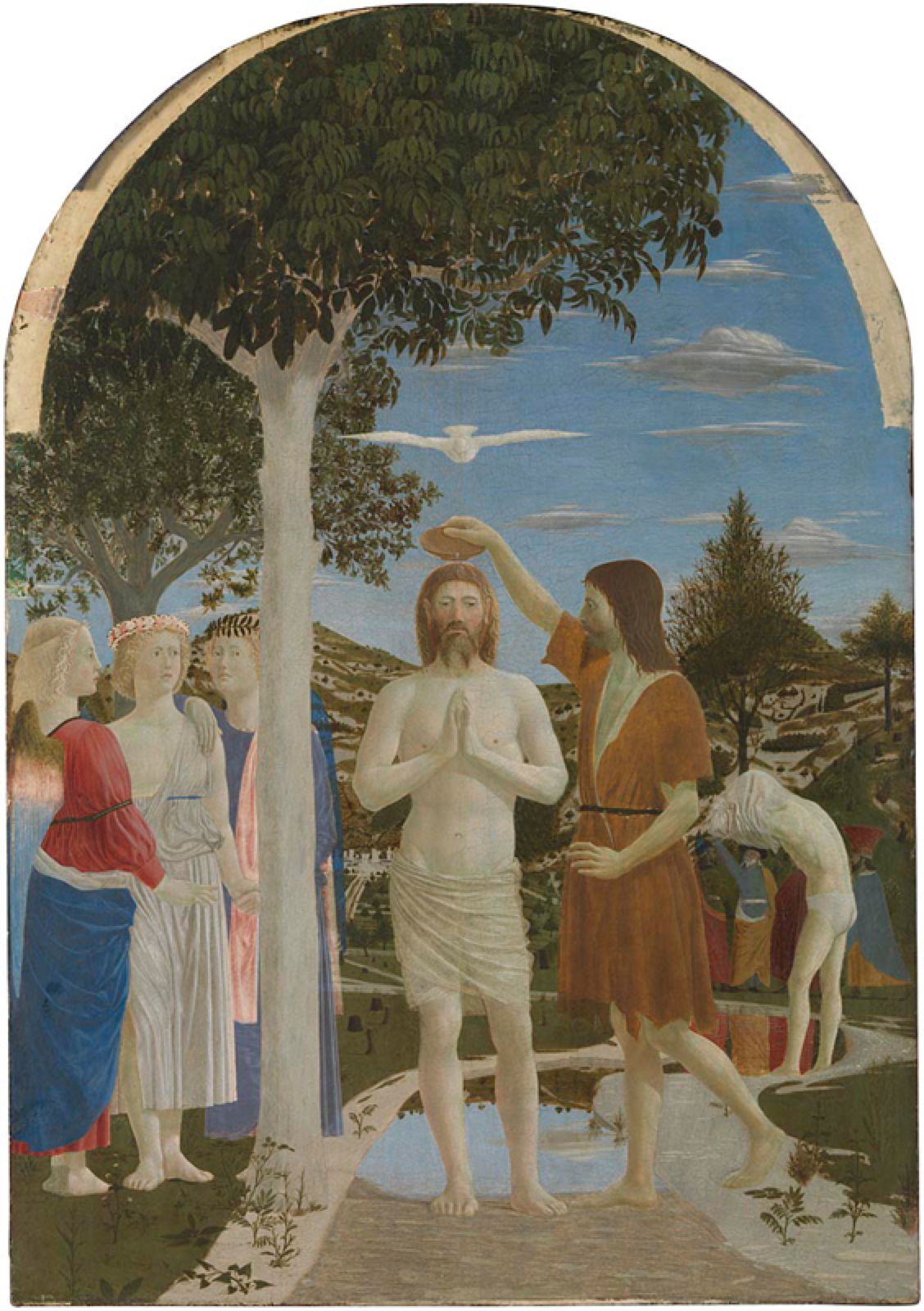
But it was in Italy that painting in egg tempera reached its apogee, with masters like Masaccio, in his Santa Maria Maggiore Altarpiece from about 1428-29 (above) and Piero della Francesca’s Baptism of Christ (below) of a decade later.

dellafrancescabaptismchrist
Piero della Francesca (c 1415/20-1492), The Baptism of Christ (after 1437), egg on poplar, 167 x 116 cm, The National Gallery (Bought, 1861), London. Courtesy of and © The National Gallery, London.

During the fifteenth century, egg tempera was progressively replaced by oils in Italy, as it had been earlier in the Northern Renaissance.

uccellobattlesanromano
Paolo Uccello (c 1397-1475), Niccolò Mauruzi da Tolentino at the Battle of San Romano (c 1438-40), egg tempera with walnut oil and linseed oil on poplar, 182 x 320 cm, The National Gallery (Bought, 1857), London. Courtesy of and © The National Gallery, London.

Uccello’s large panel of the Battle of San Romano incorporated some drying oils, including walnut and linseed, although it was still fundamentally painted in egg tempera.

Sandro Botticelli (Alessandro di Mariano di Vanni Filipepi), Primavera (Spring) (c 1482), tempera on panel, 202 x 314 cm, Galleria degli Uffizi, Florence. Wikimedia Commons.

By the end of the fifteenth century, many studios had changed to oils. Among the last large egg tempera paintings are Botticelli’s Primavera (above) and The Birth of Venus (below), from the 1480s. The craft labour involved in producing these large works must have been enormous. Although Primavera was painted on a panel, Venus is on canvas, making it more manageable given its size of nearly 2 x 3 metres (79 x 118 inches).

Sandro Botticelli (Alessandro di Mariano di Vanni Filipepi), The Birth of Venus (c 1486), tempera on canvas, 172.5 x 278.9 cm, Galleria degli Uffizi, Florence. WikiArt.
michelangelovirginchild
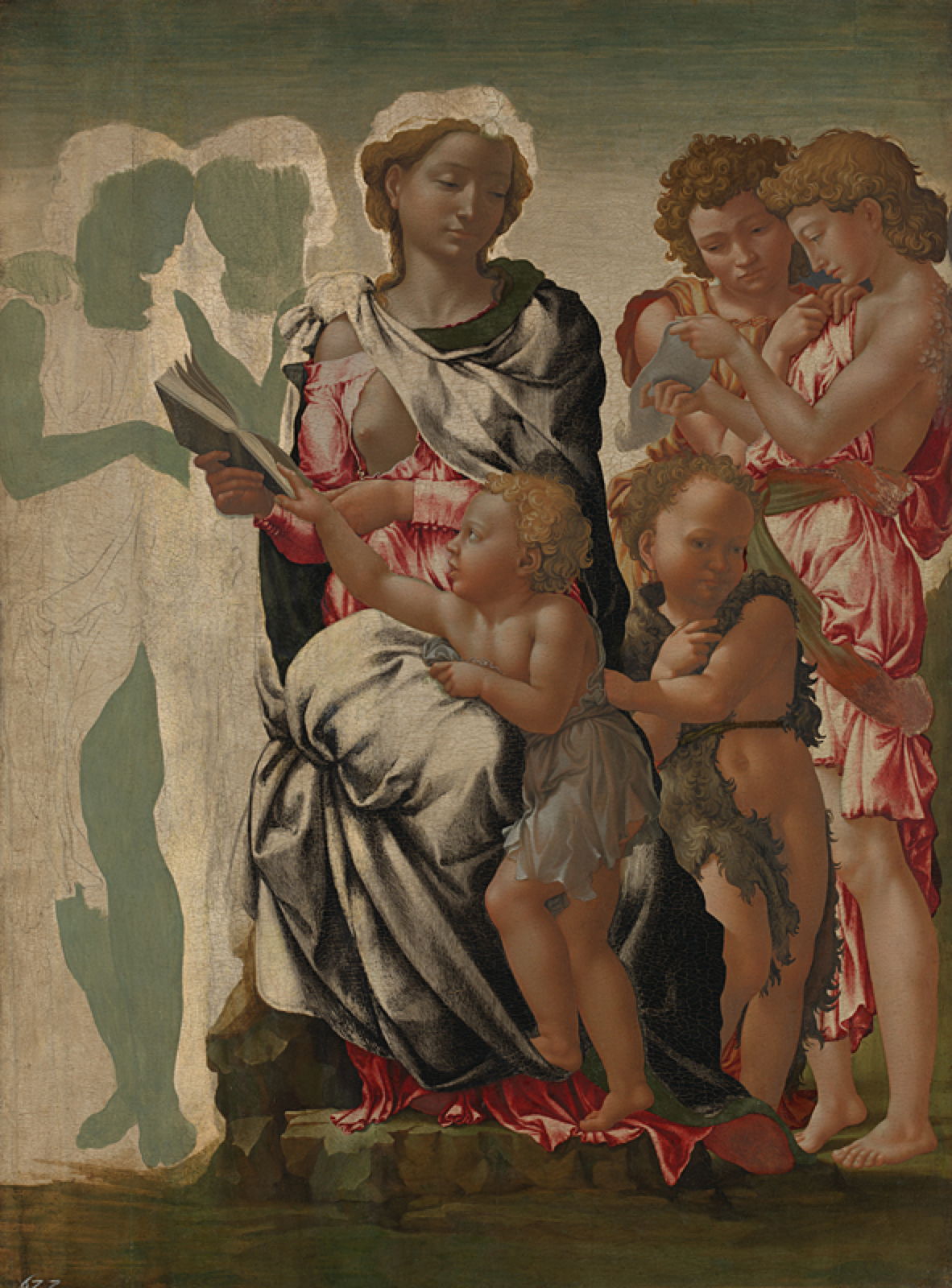
Michelangelo (1475-1564), The Virgin and Child with Saint John and Angels (‘The Manchester Madonna’) (c 1497), tempera on wood, 104.5 x 77 cm, The National Gallery (Bought, 1870), London. Courtesy of and © The National Gallery, London.

In the closing years of the fifteenth century, Michelangelo kept to the hallowed tradition of egg tempera on wood in this unfinished painting of the Virgin and Child known now as The Manchester Madonna. This shows how he painstakingly completed each of the figures before moving onto the next, and the characteristic green earth ground.

By this time, the only common use for egg tempera was in the underpainting before applying oils on top. This remains a controversial practice: performed on top of gesso ground it can be successful, but increasingly studios transferred to oils. Egg tempera didn’t completely disappear, though. With so many fine examples of how good its paintings both look and age, there were always some artists who have chosen it over oils.

spencerstanhopelovemaiden
John Roddam Spencer Stanhope (1829–1908), Love and the Maiden (1877), tempera, gold paint and gold leaf on canvas, 86.4 cm × 50.8 cm, Fine Arts Museums of San Francisco, San Francisco, CA. Wikimedia Commons.

Some nineteenth century movements that aimed to return to the more wonderful art of the past experimented again with egg tempera. In the late 1870s, John Roddam Spencer Stanhope started to use the medium, and made one of his finest works, Love and the Maiden (1877), using it.

Autumn in the Mountains exhibited 1903 by Adrian Stokes 1854-1935
Adrian Stokes (1854–1935), Autumn in the Mountains (1903), tempera on canvas, 80.0 x 106.7 cm, The Tate Gallery (Presented by the Trustees of the Chantrey Bequest 1903), London. Photographic Rights © Tate 2016, CC-BY-NC-ND 3.0 (Unported), http://www.tate.org.uk/art/artworks/stokes-autumn-in-the-mountains-n01927

A later exponent who was rigorous in his technique was Adrian Stokes, who used it to great effect in this landscape of Autumn in the Mountains in 1903.

But for my taste, the greatest painter in egg tempera since the Renaissance has to be one of the major artists of the twentieth century: Andrew Wyeth (1917–2009). As his works remain in copyright, I recommend that you browse his official site, where you can see just how effective egg tempera can be in the hands of a great master. It may not be as popular as in the past, but egg tempera still has a great deal to offer.

❌