Reading view

There are new articles available, click to refresh the page.

Botticelli’s studio

Artists seldom painted the interior of their studio until the nineteenth century, and it was unheard of in the Renaissance. So when you’re offered a glimpse into that of Sandro Botticelli in the 1480s you’d be justifiably suspicious, particularly when it wasn’t painted until 1922, over half a millennium later.

Nevertheless, almost exactly eleven years ago, on the fifth of November 2014, a remarkable painting claiming to depict Botticelli’s studio at that time was auctioned in New York. Captured on its canvas were the faces of those long dead, those of the artist and members of the Medici family.

fortescuebrickdalebotticellisstudio
Eleanor Fortescue-Brickdale (1872–1945), Botticelli’s studio: The first visit of Simonetta presented by Giulio and Lorenzo de Medici (1922), oil on canvas, 74.9 × 126.4 cm, Private collection. Wikimedia Commons.

The painting’s title reveals its key figures: Botticelli’s studio: The first visit of Simonetta presented by Giulio and Lorenzo de Medici (1922). The artist stands at the left in front of an exquisite tondo he is working on. Bowing to him at the centre is Giuliano de’ Medici, who is accompanied by Simonetta Vespucci, wearing the green dress. Behind her is Lorenzo de’ Medici, also known as Lorenzo the Magnificent, and behind him are Giovanna Tornabuoni and her attendants. The view through the window is of the Palazzo Vecchio in the centre of Florence.

Painted by the British artist Eleanor Fortescue-Brickdale, those figures weren’t based on models or imagination, but on contemporary sources.

ghirlandaiogiovannatornabuoni
Domenico Ghirlandaio (1449–1494), Giovanna Tornabuoni and attendants, detail of The Visitation (c 1488), fresco, dimensions not known, Tornabuoni Chapel, Santa Maria Novella Church, Florence. Wikimedia Commons.

Giovanna Tornabuoni comes from a detail of Domenico Ghirlandaio’s painting The Visitation (c 1488) in the Tornabuoni Chapel of the Church of Santa Maria Novella in Florence. Giovanna was born as Giovanna degli Albizzi in 1468, married Lorenzo Tornabuoni in 1486 when she was about eighteen, and died in childbirth two years later in 1488. She is here accompanied by her maid and nurse.

macchiettilorenzodemedici
Girolamo Macchietti (1535–1592), Lorenzo the Magnificent (Lorenzo de’ Medici (1449-1492)) (date not known), oil, dimensions not known, location not known. Wikimedia Commons.

Lorenzo de’ Medici (1449-1492) hails from Girolamo Macchietti’s undated portrait of Lorenzo the Magnificent. Lorenzo was born in 1449 into the banking family, the grandson of Cosimo de’ Medici, at the time one of the wealthiest and most powerful people in Europe. Lorenzo was groomed for power, and became de facto ruler of the Florentine Republic when his father died in 1469.

He survived an attempted assassination in the Cathedral of Santa Maria del Fiore on Easter Sunday 1478, in which his brother Giuliano was stabbed to death. This led to his excommunication, and invasion by forces of the King of Naples. He resolved that, and died in 1492, when he was forty-three.

botticelligiulianodemedici
Sandro Botticelli (1445–1510), Portrait of Giuliano de’ Medici (c 1475), tempera on panel, 54 x 36 cm, Accademia Carrara, Bergamo, Italy. Wikimedia Commons.

Botticelli also painted this Portrait of Giuliano de’ Medici in about 1475. Giuliano was born in 1453, younger brother and co-ruler of the Florentine Republic with Lorenzo. He was brutally murdered in that attack in the cathedral on Easter Sunday 1478, dying at the age of twenty-five. Although he never married, an illegitimate son of his became Pope Clement VII.

botticellimagnificatmadonna
Sandro Botticelli (1445–1510), Madonna of the Magnificat (1483), tempera on panel, diameter 118 cm, Galleria degli Uffizi, Florence. Wikimedia Commons.

The painting shown in progress is Botticelli’s Madonna of the Magnificat, thought to have been completed in 1483. It shows the Virgin Mary being crowned by a pair of angels, writing down the start of the Magnificat in a book, and holding a pomegranate in her left hand. It has also been interpreted as a family portrait of the de’ Medicis, in which the Virgin is Lucrezia Tornabuoni, the mother of Lorenzo and Giuliano de’ Medici, who are the angels. I believe that Lucrezia was one of Giovanna Tornabuoni’s aunts by marriage.

botticelliadorationmagidet
Sandro Botticelli (1445–1510), The Adoration of the Magi (detail) (c 1475), tempera on wood, dimensions not known, Galleria degli Uffizi, Florence. Wikimedia Commons.

The source of the likeness of Botticelli is more of a problem, as he isn’t known to have painted a formal self-portrait. It’s generally believed, though, that he revealed himself in cameo in this detail from his The Adoration of the Magi from about 1475.

lippifcrucifixionstpeter
Filippino Lippi (1457–1504), Disputation with Simon Magus and Crucifixion of St Peter (detail) (1424-28), fresco, dimensions not known, Cappella Brancacci, Santa Maria del Carmine, Florence. Image by Marie-Lan Nguyen, via Wikimedia Commons.

It’s also thought that Filippino Lippi included his portrait in this section he painted in 1483-84 of Massaccio’s incomplete fresco in the Cappella Brancacci, Santa Maria del Carmine, Florence, in Disputation with Simon Magus and Crucifixion of St Peter.

But of all the figures shown in this painting, Simonetta Vespucci is the most fascinating. She was born Simonetta Cattaneo in 1453, and when she was only fifteen or sixteen, she married Marco Vespucci, cousin of Amerigo Vespucci, the first to demonstrate that the New World of the West Indies and Brazil wasn’t part of Asia.

Once married, she lived with her husband in Florence, where she was a great favourite at the court of the de’ Medicis. Giuliano de’ Medici entered a jousting tournament in 1475 bearing a banner with an image of Simonetta as Pallas Athene, painted by Botticelli. She had the reputation of being the most beautiful woman in the whole of northern Italy, but that beauty was fleeting as she died of tuberculosis in 1476, when she was only twenty-two.

pierodicosimosimonettavespucci
Piero di Cosimo (1462–1521), Portrait of Simonetta Vespucci (1490), media not known, 57 x 42 cm, Musée Condé, Chantilly, France. Wikimedia Commons.

Many paintings have been claimed to be portraits of her, but perhaps the most credible is Piero di Cosimo’s Portrait of Simonetta Vespucci from 1490.

botticelliportraitlady
Sandro Botticelli (1445–1510), Idealized Portrait of a Lady (Portrait of Simonetta Vespucci as Nymph) (1480), media not known, 81.8 x 54 cm, Städelsches Kunstinstitut und Städtische Galerie, Frankfurt, Germany. Wikimedia Commons.

Several of Botticelli’s works have been claimed to feature figures for which Simonetta modelled, even the naked Venus in his famous The Birth of Venus (1484-86). The least unlikely might be his Idealized Portrait of a Lady, also known as Portrait of Simonetta Vespucci as Nymph, thought to have been painted in 1480, four years after her death. Such portraits were commonly not true to life, but idealisations intended to flatter rather than identify, so we will never know if she was its subject.

Inevitably, time in Botticelli’s studio is slightly out of joint. The figures might have been able to gather together in this way in about 1475, before the deaths of Simonetta and Giuliano de’ Medici, but that is well before Botticelli might have painted Madonna of the Magnificat, and when Giovanna Tornabuoni was still a child.

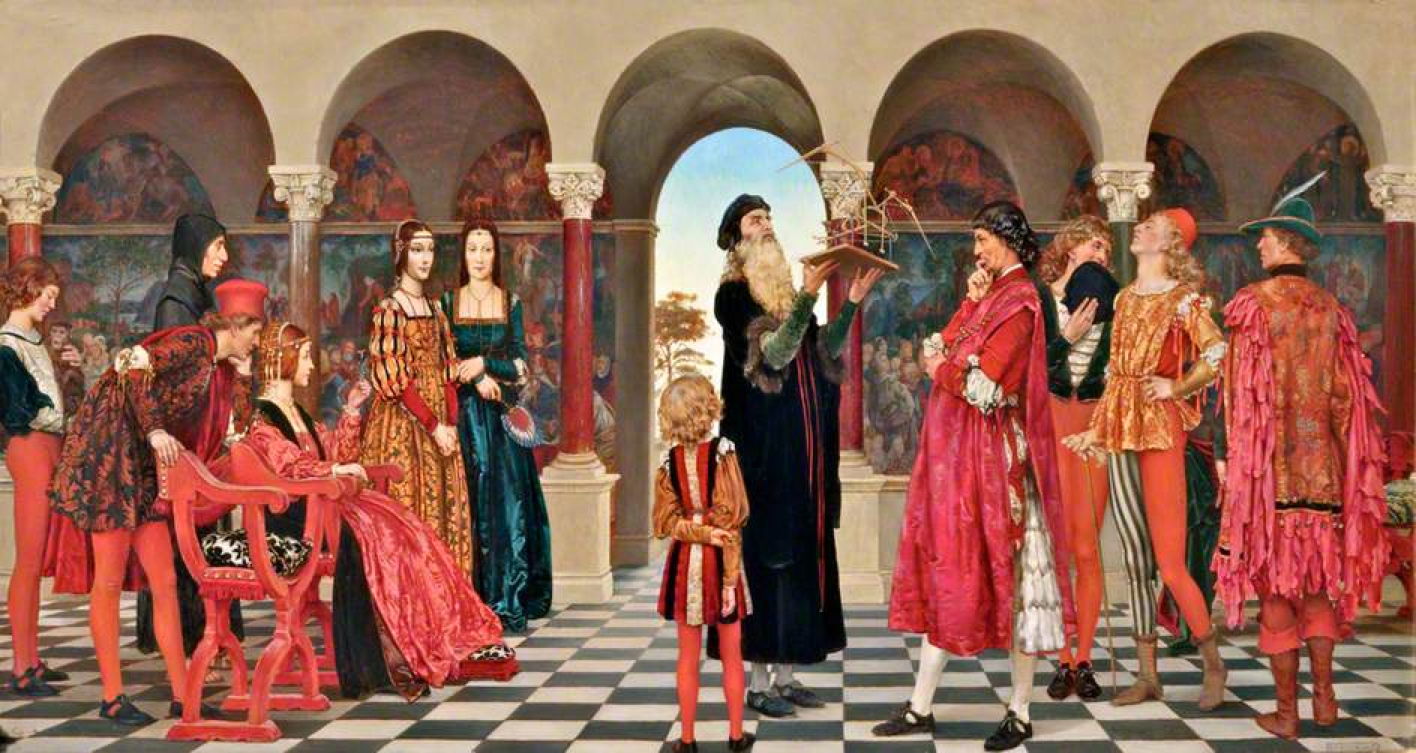
This remarkable painting was the second of its kind by Eleanor Fortescue-Brickdale.
fortescuebrickdaleforerunner
Eleanor Fortescue-Brickdale (1872–1945), The Forerunner (1920), oil on canvas, 59.6 × 122 cm, Lady Lever Art Gallery, Liverpool, England. Wikimedia Commons.

Two years previously, in 1920, she had painted The Forerunner, showing Leonardo da Vinci trying to convince the Milanese court of his idea for flying machines. Notable figures included here are (from the left) Savonarola (from Fra Bartolomeo’s portrait), Beatrice d’Este (Duchess of Milan), Cecilia Gallerani, Elisabetta Gonzaga, Leonardo da Vinci, and Ludovico Sforza (Duke of Milan, and Leonardo’s patron).

Eleanor Fortescue-Brickdale sold The Forerunner to Lord Leverhulme, and it is now on view in the Lady Lever Art Gallery. She was subsequently commissioned to paint Botticelli’s Studio in 1922 for Montague Rendell. That was shown at the Royal Academy later that year, and has been in a succession of private collections since.

Paintings of Dante’s Inferno: 15 Lucifer himself

Dante and Virgil move on from their encounter with Count Ugolino towards a great contraption that looks like a windmill from the distance. As they grow closer, they pass by shades of the dead frozen and stacked up.

kochinfernostudy
Joseph Anton Koch (1768-1839), Hell (study for Casa Massimo frescoes) (c 1825), watercolour and gouche, dimensions and location not known. Wikimedia Commons.

kochinfernodevil
Joseph Anton Koch (1768-1839), Lucifer (1825-28), fresco, dimensions not known, Casa Massimo, Rome, Italy. Image by Sailko, via Wikimedia Commons.

kochinfernodevild1
Joseph Anton Koch (1768-1839), Lucifer (detail) (1825-28), fresco, dimensions not known, Casa Massimo, Rome, Italy. Image by Sailko, via Wikimedia Commons.

Virgil then shows Dante the ruler of Hell, a huge giant frozen up to his chest. He has three faces: one looking forward is bright red, that on the right a dirty yellow, and on the left black. Behind each face is a pair of vane-like wings fanning the ice-cold wind blowing across Lake Cocytus.

blakelucifer
William Blake (1757–1827), Lucifer, Canto 34 (Dante’s Inferno) (1824-27), further details not known. Wikimedia Commons.

doreluciferkingofhell
Gustave Doré (1832–1883), Lucifer, King of Hell (c 1857), engraving, dimensions and location not known. Image by Karl Hahn, via Wikimedia Commons.

His six eyes are weeping, and each mouth is chewing one of the souls from that pit of Hell. Virgil points out that one of them, his legs protruding from Lucifer’s lips, is Judas Iscariot, who betrayed Jesus Christ for thirty pieces of silver. The other two are Brutus and Cassius being punished for their assassination of Julius Caesar.

anonhell48r
Artist not known, illustration to Dante’s Divine Comedy, Canto 34 (c 1350), folio 48r, media and dimensions not known, Bibliotheca Gymnasii Altonani, Hamburg, Germany. Wikimedia Commons.

flaxmaninferno34
John Flaxman (1755–1826), Ruler of the Realm of Sadness (Divine Comedy) (1793), engraving by Tommaso Piroli from original drawing, media and dimensions not known, Cornell University Library, Ithaca, NY. Wikimedia Commons.

Virgil tells Dante that he has now seen the whole of Hell, and it’s time for them to leave. They make their way up some steps through a fissure in the rock.

dorec34v127
Gustave Doré (1832–1883), Inferno Canto 34 (c 1857), engraving, dimensions and location not known. Wikimedia Commons.

Where Dante expects to see the body of Lucifer again, he sees just his legs.

anonhell48v
Artist not known, illustration to Dante’s Divine Comedy, Canto 34 (c 1350), folio 48v, media and dimensions not known, Bibliotheca Gymnasii Altonani, Hamburg, Germany. Wikimedia Commons.

Virgil tells him they must move on quickly, now the sun is rising. They walk through a cavern, along a path long and arduous. Eventually they emerge below the stars. With that, Dante’s account of his visit to Hell is complete.

napoletanodantevirgilhell
Filippo Napoletano (1589–1629), Dante and Virgil in the Underworld (1622), oil on slate, 44 × 60 cm, Private collection. Wikimedia Commons.

trubnerdanteshell
Wilhelm Trübner (1851–1917), Hell, Scene from Danté’s Divine Comedy (1880), oil on canvas, 137 x 249 cm, Museumslandschaft Hessen Kassel, Kassel, Germany. Wikimedia Commons.

The artists

William Blake (1757–1827) was a British visionary painter and illustrator whose last and incomplete work was an illustrated edition of the Divine Comedy for the painter John Linnell. Most of his works shown in this series were created for that, although he did draw and paint scenes during his earlier career. I have a major series on his work here.

Gustave Doré (1832–1883) was the leading French illustrator of the nineteenth century, whose paintings are still relatively unknown. Early in his career, he produced a complete set of seventy illustrations for translations of the Inferno, first published in 1857 and still being used. These were followed in 1867 by more illustrations for Purgatorio and Paradiso. This article looks at his paintings.

John Flaxman (1755–1826) was a British sculptor and draughtsman who occasionally painted too. When he was in Rome between 1787-91, he produced drawings for book illustrations, including a set of 111 for an edition of The Divine Comedy. In 1810, he was appointed the Professor of Sculpture to the Royal Academy in London, and in 1817 made drawings to illustrate Hesiod, which were engraved by William Blake.

Joseph Anton Koch (1768-1839) was an Austrian landscape painter, who worked mainly in Neoclassical style. During his second stay in Rome, he was commissioned to paint frescos in the Villa Massimi on the walls of the Dante Room there, which remain one of the most florid visual accounts of Dante’s Inferno. He completed those between 1824-29. He also appears to have drawn a set of illustrations for Dante’s Inferno in about 1808.

Filippo Napoletano (1589–1629), whose real name was Filippo Teodoro di Liagno, was an Italian painter who worked in Naples, Florence and Rome, mainly painting dramatic landscapes. He was a court painter to the Medicis from around 1617, who also painted a nocturne of the burning of Troy.

Wilhelm Trübner (1851–1917) was a successful realist painter who was born in Heidelberg and worked almost entirely in Germany. In 1872, with Hans Thoma and others he formed a circle who admired the work of Wilhelm Leibl (1844-1900). His peak is claimed to have occurred in the mid-1870s, and in 1901 he joined the Berlin Secession. During his later years he was a professor in Karlsruhe.

References

Wikipedia
Danteworlds

Robin Kirkpatrick (trans) (2012) Dante, The Divine Comedy, Inferno, Purgatorio, Paradiso, Penguin Classics. ISBN 978 0 141 19749 4.
Richard Lansing (ed) (2000) The Dante Encyclopedia, Routledge. ISBN 978 0 415 87611 7.
Guy P Raffa (2009) The Complete Danteworlds, A Reader’s Guide to the Divine Comedy, Chicago UP. ISBN 978 0 2267 0270 4.
Prue Shaw (2014) Reading Dante, From Here to Eternity, Liveright. ISBN 978 1 63149 006 4.

Paintings of Dante’s Inferno: 14 Count Ugolino

After meeting some political traitors, Dante and Virgil have come across Count Ugolino, who is gnawing the back of the head of Archbishop Ruggieri as a dog chews a bone. Their story is one of the most famous and horrific in the whole of the Divine Comedy.

Ugolino raises his mouth from the cleric’s head and wipes his lips on his victim’s hair. He then introduces himself and the Archbishop. He explains how he, a leading politician at the time, was imprisoned with his young sons and left to starve to death. In his hunger he tried gnawing his own hands, but his sons suggested that their father should eat them instead.

davincipugolino
Pierino da Vinci (1530–1553), Count Ugolino and his Children in Prison, Visited by Hunger (date not known), pen and black ink, brown wash, and pierre noire, 24 x 23.7 cm, Musée des Beaux-Arts, Marseille, France. Wikimedia Commons.
stradanoc33a
Jan van der Straet, alias Giovanni Stradano (1523-1605), Canto 33 (A) (1587), further details not known. Wikimedia Commons.
kochugolino
Joseph Anton Koch (1768-1839), Count Ugolino and Archbishop Ruggieri (1825-28), fresco, dimensions not known, Casa Massimo, Rome, Italy. Image by Sailko, via Wikimedia Commons.
Blake, William, 1757-1827; Ugolino and His Sons in Prison
William Blake (1757–1827), Count Ugolino and His Sons in Prison (c 1826), pen, tempera and gold on panel, 32.7 x 43 cm, Fitzwilliam Museum, University of Cambridge, Cambridge, England. The Athenaeum.

This glue tempera painting by William Blake is one of the few that isn’t taken from his last works illustrating the Divine Comedy, but is a prior work. Unfortunately, its equivalent in Blake’s last series got no further than a pencil sketch before the artist’s death.

doreugolinognawingruggieari
Gustave Doré (1832–1883), Ugolino gnawing the Head of Ruggieri (c 1857), engraving, dimensions and location not known. Image by Karl Hahn, via Wikimedia Commons.

Ugolino stopped gnawing his own flesh, and sat in silence day after day, watching his sons die in front of him. By the time the last was dead, the Count himself had gone blind. Once confident there was no life left in their bodies, his hunger overcame his grief.

In history, Ugolino was born into a Ghibelline family in the city of Pisa. He soon changed allegiance to the Guelphs, whom he helped in their quest for power in Pisa. When that was unsuccessful, the Count was imprisoned and exiled, but later led Pisan naval forces against its rival Genoa, for which he was made Pisa’s leader.

In an act of political expediency, Ugolino then handed over Pisan castles to Lucca and Florence, following which he conspired with Ghibellines including Archbishop Ruggieri. This backfired on him, and the Archibishop had him imprisoned with his two sons, two grandsons, and another young man. After eight months there, the door was locked and nailed shut, and its key thrown into the river. Ugolino and the five young men died fairly quickly of starvation.

reynoldsugolino
Joshua Reynolds (1723–1792), Count Ugolino and his Children in the Dungeon (1770-73), oil on canvas, 52 x 72 cm, The National Trust, Knole, England. Wikimedia Commons.

As far as I’m aware, this painting of Count Ugolino and his Children in the Dungeon is the only work by Joshua Reynolds taken from Dante’s Divine Comedy. Exhibited at the Royal Academy in 1773, nearly five hundred years after the death of the Count, I’m not aware that Reynolds had access to any contemporary images of his subject.

anonugolino
Artist not known, Portrait of Ugolino della Gherardesca (1775-78), engraving in Johann Caspar Lavater’s Fragments of Physiognomy, further details not known. Wikimedia Commons.

It’s therefore revealing that this slightly later copy was one of many images of the faces of the famous and infamous on which Lavater based his textbook of physiognomy, which in turn was popular among painters, making it a self-fulfilling fantasy.

stradanoc33b
Jan van der Straet, alias Giovanni Stradano (1523-1605), Canto 33 (B) (1587), further details not known. Wikimedia Commons.

Dante and Virgil move on from Ugolino’s tragedy to meet more traitors frozen into Lake Cocytus in Hell, as they make their way towards the bottom of its pit, and Lucifer himself.

The artists

William Blake (1757–1827) was a British visionary painter and illustrator whose last and incomplete work was an illustrated edition of the Divine Comedy for the painter John Linnell. Most of his works shown in this series were created for that, although he did draw and paint scenes during his earlier career. I have a major series on his work here.

Pierino da Vinci (1530–1553) was an Italian Renaissance sculptor, the son of Leonardo da Vinci’s younger brother. He died of malaria, which was still endemic in much of Europe at that time, at the age of only 23, leaving few examples of his work.

Gustave Doré (1832–1883) was the leading French illustrator of the nineteenth century, whose paintings are still relatively unknown. Early in his career, he produced a complete set of seventy illustrations for translations of the Inferno, first published in 1857 and still being used. These were followed in 1867 by more illustrations for Purgatorio and Paradiso. This article looks at his paintings.

Joseph Anton Koch (1768-1839) was an Austrian landscape painter, who worked mainly in Neoclassical style. During his second stay in Rome, he was commissioned to paint frescos in the Villa Massimi on the walls of the Dante Room there, which remain one of the most florid visual accounts of Dante’s Inferno. He completed those between 1824-29. He also appears to have drawn a set of illustrations for Dante’s Inferno in about 1808.

Johann Caspar Lavater (1741-1801) was a Swiss poet and philosopher who was a friend of the painter Henry Fuseli. Between 1775-78, he published an early textbook on physiognomy, in which he related physical appearance, particularly of the face, to specific character traits of individuals. He did this using many illustrations of famous and infamous people. This attracted a popular following, including many artists.

Sir Joshua Reynolds (1723–1792) was the major portrait painter of his day, one of the co-founders and first president of the Royal Academy of Arts in London. He enjoyed royal patronage, and moved in the highest of artistic circles. However, his work and teaching were lambasted by William Blake, and some of his paintings have suffered serious problems in their paint layer as a result of his experimentation with pigments and technique.

Jan van der Straet, also commonly known by his Italianised name of Giovanni Stradano (1523-1605), was a painter who started his career in Bruges and Antwerp in Belgium, but moved to Florence in 1550, where he worked for the remainder of his life. Mannerist in style, he worked with printmakers in Antwerp to produce collections of prints, including an extensive set for The Divine Comedy.

References

Wikipedia
Danteworlds

Robin Kirkpatrick (trans) (2012) Dante, The Divine Comedy, Inferno, Purgatorio, Paradiso, Penguin Classics. ISBN 978 0 141 19749 4.
Richard Lansing (ed) (2000) The Dante Encyclopedia, Routledge. ISBN 978 0 415 87611 7.
Guy P Raffa (2009) The Complete Danteworlds, A Reader’s Guide to the Divine Comedy, Chicago UP. ISBN 978 0 2267 0270 4.
Prue Shaw (2014) Reading Dante, From Here to Eternity, Liveright. ISBN 978 1 63149 006 4.

Medium and Message: Knives, fingers and long brushes

Almost all who paint in oils use conventional brushes, but there’s a significant minority who sometimes, or frequently, use different tools to apply and shape the paint layer. Of those, the most popular are palette knives, generally used to move and mix paint on the palette. Others have used the other end of the brush stick to incise, or their fingers.

bashkirtseffinthestudio
Marie Bashkirtseff (1858–1884), In the Studio (1881), oil on canvas, 188 x 154 cm, Dnipro State Art Museum, Dnipro, Ukraine. Wikimedia Commons.

Marie Bashkirtseff’s painting of a class in the Académie Julien in Paris in 1881 demonstrates how oil painting should be done by the textbook. The artist, shown in her self-portrait in the centre foreground, is using a long-bladed palette knife to prepare the paint on her palette. At her feet, on an old sheet of newspaper, are her brushes, all with handles of typical length, and the pupil behind her is using a maul stick to rest her right hand while painting with her brush.

courbetgrottosarrazine
Gustave Courbet (1819–1877), The Grotto of Sarrazine near Nans-sous-Sainte-Anne (c 1864), oil on canvas, 50.2 x 60 cm, J. Paul Getty Museum, Los Angeles, CA. Wikimedia Commons.

Gustave Courbet applied his paint using a palette knife for some of his paintings. This has been identified from the facture in some of his paintings of caves that he made from about 1864, including The Grotto of Sarrazine near Nans-sous-Sainte-Anne above.

Another enthusiast for painting with a knife was Auguste Renoir.

renoirlecoeurhunting
Pierre-Auguste Renoir (1841–1919), Jules Le Coeur and his Dogs in the Forest of Fontainebleau (1866), oil on canvas, 112 x 90 cm, Museu de Arte de São Paulo (MASP), São Paulo, Brazil. Wikimedia Commons.

In 1866, Renoir painted his friend Jules Le Coeur and his Dogs in the Forest of Fontainebleau. This is unusual among his works, as it was preceded by two studies, and all three were made using the palette knife rather than brushes. This makes it most likely to have been painted before Renoir abandoned the knife and returned to the brush, by the middle of May 1866.

renoirmosque
Pierre-Auguste Renoir (1841–1919), The Mosque (1881), oil on canvas, 73 x 92 cm, Musée d’Orsay, Paris. Wikimedia Commons.

Renoir returned to the technique in The Mosque, also known as Arab Festival, in 1881. Small strokes of bright colour and energetic work with the palette knife give it a strong feeling of movement, and it so impressed Claude Monet that he bought it from Durand-Ruel in 1900.

hillsfallorangecopark
Anna Althea Hills (1882-1930), Fall, Orange County Park (1916), oil on board, 35.6 x 45.7 cm, Private collection. The Athenaeum.

Anna Althea Hills’ Fall, Orange County Park (1916) is a classic and highly accomplished plein air painting that appears to have been made with extensive and deft use of the knife, particularly in the foreground.

Perhaps the most famous artist who is known to have painted with his fingers is Leonardo da Vinci.

davinciannunciation
Leonardo da Vinci (1452–1519), Annunciation (c 1473-75), oil and tempera on poplar, 100 x 221.5 cm, Galleria degli Uffizi, Florence, Italy. Wikimedia Commons.

This Annunciation, painted in oil and tempera on a poplar panel, is generally agreed to be one of the earliest of Leonardo’s own surviving paintings. When it was painted is in greater doubt, but a suggestion of around 1473-75 seems most appropriate. There are numerous pentimenti, particularly in the head of the Virgin. Its perspective projection is marked in scores in its ground and Leonardo used his spontaneous and characteristic technique of fingerpainting in some of its passages.

Finally, some painters are well-known for their use of brushes with exceptionally long handles. These enabled them to stand back, sometimes almost on the opposite side of their studio, get an overall view of their canvas, and paint from the same distance as a viewer.

sargentoutofdoorsstudy
John Singer Sargent (1856–1925), An Out-of-Doors Study (c 1889), oil on canvas, 65.9 × 80.7 cm, Brooklyn Museum, New York, NY. Wikimedia Commons.

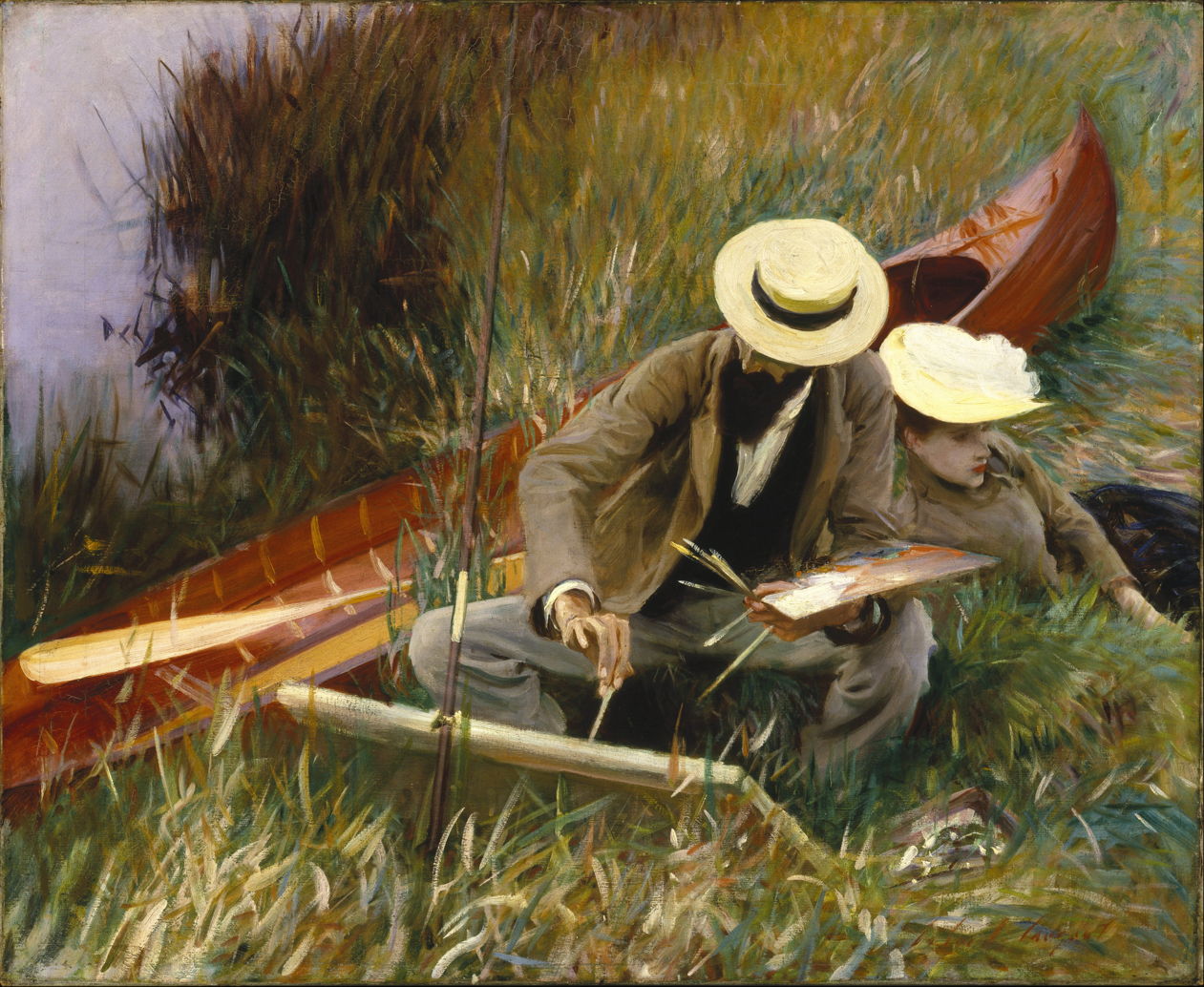
Like all plein air painters, Paul César Helleu (1859–1927) shown in John Singer Sargent’s An Out-of-Doors Study from about 1889, is using brushes with handles of modest length. His canvas is fairly small, and he’s working close-in while clutching a brace of brushes in his left hand. Some designed for use when painting in front of the motif have even shorter handles, but when back in the studio Helleu would almost certainly have opted for longer.

James Abbott McNeill Whistler, Symphony in White No. 1: The White Girl (1862), oil on canvas, 214.6 x 108 cm, National Gallery of Art, Washington, DC. WikiArt.
James Abbott McNeill Whistler (1834-1903), Symphony in White No. 1: The White Girl (1862), oil on canvas, 214.6 x 108 cm, National Gallery of Art, Washington, DC. WikiArt.

Whistler was renowned for using brushes with handles over one metre (39 inches) long, and appears to have used them when painting Symphony in White No. 1: The White Girl in 1862 on a canvas just over two metres (78 inches) tall. He reworked it between 1867-72 to make it more ‘spiritual’ and reduce its original realism.

sorollasewingsail
Joaquín Sorolla y Bastida (1863–1923), Sewing the Sail (1896), oil on canvas, 220 x 302 cm, Museo d`Arte Moderna di Ca’ Pesaro, Venice, Italy. Image by Flaviaalvarez, via Wikimedia Commons.

Early in his career, Joaquín Sorolla established his reputation of painting ‘voraciously’, often using brushes with extremely long handles and large canvases. Although Sewing the Sail from 1896 may look a spontaneous study of the effects of dappled light, Sorolla composed this carefully with the aid of at least two drawings and a sketch, and given its 2.2 metre (87 inches) height, he was almost certainly using brushes of similar length.

❌