
 Login
LoginPaintings of Dante’s Inferno: 16 Overview, Purgatory and Paradise
Over the previous fifteen articles Dante has taken us through his vision of Hell. As he journeys on to Purgatory, this article offers an overview of the best-known book in his Divine Comedy.

It was Botticelli who provided the clearest pictorial map of Dante’s journey, as he descended with Virgil through a succession of circles, each with its own class of sinner. Highest are the woods where Dante was wandering when he encountered the three wild beasts. At the left, Virgil led Dante down to the area where the cowards are trapped, neither being allowed admittance to Heaven, nor to Hell. Charon’s boat then crosses the River Acheron, shown in blue, taking Dante and Virgil to the First Circle of Limbo.
This journey starts just before dawn on Good Friday in 1300, when the poet is wandering lost in a dark wood. His way is blocked first by a leopard, then by a lion, and finally by a wolf.

Forced to retreat back into the wood, Dante comes across a man who introduces himself by way of a riddle, leading Dante to recognise him as the ghost of the classical Roman poet Virgil. He tells Dante that the only way out is to pass through the eternity of Hell. When the pair reach the gate of Hell, they read its warnings, culminating in the bleak exhortation: leave behind all hope, you who enter.
They first encounter those stuck forever on the periphery, those whose lives were too cowardly to enter Heaven or Hell, who are stung repeatedly by flies and wasps.
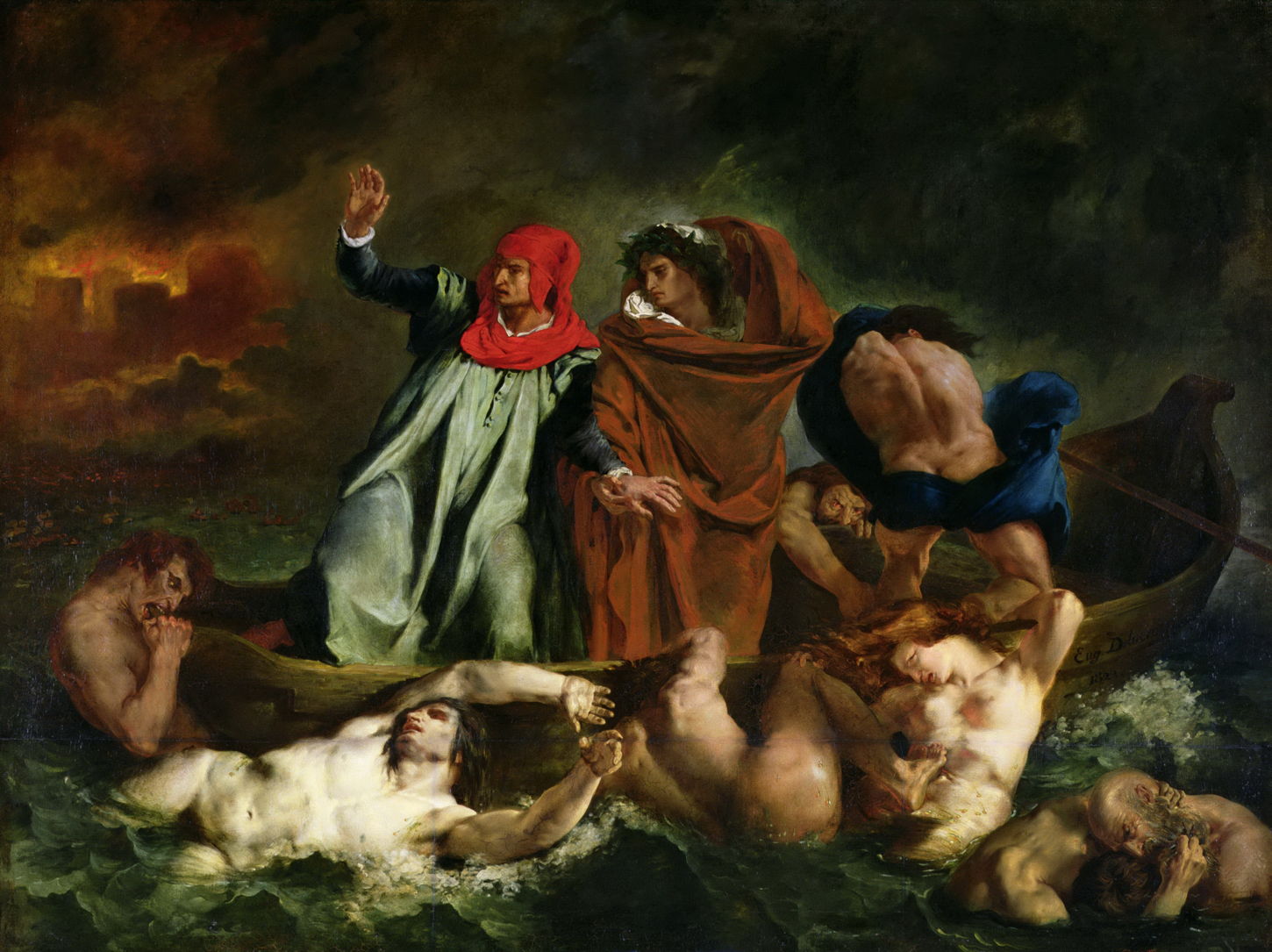
They then cross the River Acheron in Charon’s ferryboat, and enter the First Circle of Limbo, a place of tranquil and calm. Here are the souls of those who led honourable lives before the Christian era, and others who never had the opportunity to follow Christ. These include the great classical writers: Homer, Horace the satirist, Ovid and Lucan. Together with Virgil, these five invite Dante himself to join them as the sixth among the ranks of great writers, in an ambitious piece of self-promotion.
Virgil leads Dante down to the Second Circle, for those guilty of the sin of lust.

Here the lustful are thrown around by vicious winds, and Dante hears the tragic story of Paolo and Francesca da Rimini, that inspired many fine paintings.

Passing the three-headed dog-monster Cerberus, Virgil takes Dante on to the Third Circle, full of gluttons wallowing in stinking mud, under a constant deluge of rain, sleet and snow. In the Fourth Circle, they see a mixture of the avaricious and prodigals pushing great boulders in opposite directions.

The Fifth Circle holds the swamp of the River Styx, in which sullen spirits are submerged and the wrathful fight one another. Dante and Virgil cross this in a boat piloted by Phlegyas, who deposits them at the gate to the city of Dis, entrance to the lower parts of Hell. The gate is slammed shut on them, and requires a messenger from Heaven to let them through.

Here Dante enters the Sixth Circle, for heretics who denied the soul’s immortality, among them the Florentine Farinata degli Uberti, who is imprisoned in a tomb. The pair are carried by Nessus the Centaur on to the Seventh Circle, for the violent.

These not only include tyrannical warriors like Attila the Hun, murderers and bandits, but those whose violence was directed at their own lives in suicide, who are trees in a wood and kept in perpetual pain by harpies feeding on them. The pair then cross a desert on which fire rains to torment the souls of blasphemers, sodomites, and usurers.
8 The Minotaur, killers and suicides

Dante learns of a statue of an old man on Mount Ida, on the island of Crete, whose tears form the rivers of Hell.
Virgil guides Dante onto the back of Geryon, formerly a king slain by Hercules and condemned to suffer in Hell for his fraud, who flies the pair on to the Eighth Circle, for the fraudulent. This is divided into a series of rottenpockets, depressions in which different types of fraudster are confined. They pass through the areas for pimps, flatterers, corrupt religious leaders, sorcerers, corrupt officials and hypocrites.

Among the corrupt religious leaders or simonists is Pope Nicholas III, who had been shamelessly nepotistic.

The later rottenpockets contain thieves, those who gave fraudulent counsel, those who sowed discord, and falsifiers and imposters of various kinds. Thieves are attacked repeatedly by snakes to undergo their own reptilian transformation.

Among these many cheats and frauds are those who fight one another, and sink their teeth into flesh.
12 Fraud and inciting division
Dante and Virgil are lowered into the Ninth Circle by Antaeus, one of the giants who stand guard around its periphery.

There is the lake of Cocytus, in which those guilty of treachery are frozen and suffering for eternity. These include souls of those who were treacherous against their relatives, their homeland, guests and benefactors.

Among them is Count Ugolino, who sinks his teeth into the neck of Archbishop Ruggieri, who left him to starve to death in a cell.
Finally, Dante and Virgil see Lucifer himself, before leaving Hell.

The artists
William Blake (1757–1827) was a British visionary painter and illustrator whose last and incomplete work was an illustrated edition of the Divine Comedy for the painter John Linnell. Most of his works shown in this series were created for that, although he did draw and paint scenes during his earlier career. I have a major series on his work here.
Sandro Botticelli (1445–1510) was one of the leading painters of the early Southern Renaissance, working in his native city of Florence. In addition to his huge egg tempera masterpieces of i (c 1482) and The Birth of Venus (c 1485), he was a lifelong fan of Dante’s writings. He produced drawings which were engraved for the first printed edition of the Divine Comedy in 1481, but these weren’t successful, most copies only having two or three of the 19 which were engraved. He later began a manuscript illustrated edition on parchment, but few pages were ever fully illuminated.
William-Adolphe Bouguereau (1825–1905) was a precocious and highly-acclaimed academic painter who dominated the Salon in the late nineteenth century with his figurative works, often drawn from mythology. Classically-trained at the École des Beaux-Arts, he grew infamous for his nudes painted against false settings, and his vehement opposition to Impressionism. However, he taught at the Académie Julian, and worked tirelessly even when his paintings fell from favour.
Jean-Baptiste Camille Corot (1796–1875) was French, and one of the most prolific and greatest European landscape artists of the nineteenth century, who was key to the development of Impressionism. Following in the classical tradition, he also painted several narrative works set in those landscapes.
Eugène Delacroix (1798–1863) was a major French painter whose Romantic and painterly style laid the groundwork for the Impressionists. In addition to many fine easel works, he painted murals and was an accomplished lithographer too. Many of his paintings are narrative, and among the most famous is Liberty Leading the People from 1830. This article introduces a series featuring his major works.
Gustave Doré (1832–1883) was the leading French illustrator of the nineteenth century, whose paintings are still relatively unknown. Early in his career, he produced a complete set of seventy illustrations for translations of the Inferno, first published in 1857 and still being used. These were followed in 1867 by more illustrations for Purgatorio and Paradiso. This article looks at his paintings.
Joseph Anton Koch (1768-1839) was an Austrian landscape painter, who worked mainly in Neoclassical style. During his second stay in Rome, he was commissioned to paint frescos in the Villa Massimi on the walls of the Dante Room there, which remain one of the most florid visual accounts of Dante’s Inferno. He completed those between 1824-29. He also appears to have drawn a set of illustrations for Dante’s Inferno in about 1808.
Purgatory and Paradise
Although Heaven and Hell have clear biblical roots, the concept of Purgatory as part of the Christian life after death is more recent. It originated in the early Christian Church, flourished in the Middle Ages, and ripened only in the Catholic Church after the schism of Protestants in the Reformation during the sixteenth century. It can be seen as a route to Heaven for those who had sinned on earth, so long as they had confessed and repented.
Dante had much greater freedom in imagining what Purgatory might be, and adopted a physical structure that is the exact inverse of his vision of Hell: a mountain rising through seven terraces to culminate in a terrestrial paradise at the summit. Each terrace then accommodates a class of sin, rising from pride at the foot to lust just below Paradise.
The least-known of the three books in Dante’s Divine Comedy, Paradise was its most important to contemporary readers. Having given gruesome detail of what would await them in Inferno, and the penance they would have to pay in Purgatory, Paradise must be everyone’s ultimate aspiration. Dante invokes classical cosmology in nine concentric shells rather than the simple physical structures of the two previous realms, which for many readers is more nebulous.
References
Robin Kirkpatrick (trans) (2012) Dante, The Divine Comedy, Inferno, Purgatorio, Paradiso, Penguin Classics. ISBN 978 0 141 19749 4.
Richard Lansing (ed) (2000) The Dante Encyclopedia, Routledge. ISBN 978 0 415 87611 7.
Guy P Raffa (2009) The Complete Danteworlds, A Reader’s Guide to the Divine Comedy, Chicago UP. ISBN 978 0 2267 0270 4.
Prue Shaw (2014) Reading Dante, From Here to Eternity, Liveright. ISBN 978 1 63149 006 4.


