Reading view

There are new articles available, click to refresh the page.

Reading Visual Art: 234 Fish A

Because most fish aim to spend their entire lives underwater, where few artists go to paint, fish are seldom seen in paintings. That contrasts with those who try to capture fish by going fishing, an activity I have previously covered in this series in this article and a second.

Most of the aquatic creatures seen in paintings of myths, including those accompanying the god Neptune, appear to be caricatures of marine mammals including dolphins, or sea-monsters bearing no resemblance to fish.

stellabirthofvenus
Joseph Stella (1877–1946), The Birth of Venus (1922), oil on canvas, 215.9 x 134.6 cm, Private collection. The Athenaeum.

One exception to this is Joseph Stella’s The Birth of Venus from 1922. As might be expected, his treatment is completely novel and seems to have benefited from visits to an aquarium. Aphrodite is shown at sea, in the upper part of the painting her upper body above the waterline, and below morphing into an aquatic plant underneath, where it finally merges into a helical shell. Matching the birds and flowers above the water are brightly coloured fish below.

beuckelaerwater
Joachim Beuckelaer (c 1533–1575), The Four Elements: Water. A Fish Market with the Miraculous Draught of Fishes in the Background (1569), oil on canvas, 158.5 x 215 cm, The National Gallery, London. Wikimedia Commons.

Another interesting exception is Joachim Beuckelaer’s depiction of water in his Four Elements cycle from 1569. This shows A Fish Market with the Miraculous Draught of Fishes in the Background, the one place even landlubbers would come across fish, combined with the Gospel story in the far distance.

courbettrout
Gustave Courbet (1819–1877), The Trout (Summer 1872), oil on canvas, 53 x 87 cm, Kunsthaus Zürich, Zürich, Switzerland. Wikimedia Commons.

In the summer of 1872, as a one-off, Gustave Courbet painted an allegorical still life of The Trout, that is “hooked and bleeding from the gills”, a powerful expression of his personal feelings after being imprisoned for damage to the Vendôme Column during the Paris Commune the previous year.

turnerslaveship
Joseph Mallord William Turner (1775–1851), Slave Ship (Slavers Throwing Overboard the Dead and Dying, Typhoon Coming On) (1840), oil on canvas, 90.8 × 122.6 cm, Museum of Fine Arts, Boston, MA. Photo by Museum of Fine Arts, Boston, via Wikimedia Commons.

JMW Turner recruits a school of fish for effect in his Slave Ship from 1840. His threatening sky and violent sea put the ship in the middle distance, silhouetted against the blood-red sky. The foreground is filled with the ghastly evidence of the slaves who were cast overboard.

turnerslaveshipdet
Joseph Mallord William Turner (1775–1851), Slave Ship (Slavers Throwing Overboard the Dead and Dying, Typhoon Coming On) (detail) (1840), oil on canvas, 90.8 × 122.6 cm, Museum of Fine Arts, Boston, MA. Photo by Museum of Fine Arts, Boston, via Wikimedia Commons.

Seen in amongst a feeding frenzy of fish and scavenging seabirds are hands raised from the waves in their final plea for rescue, a gruesome manacled leg, and various shackles used to restrain the slaves when in transit. Further back on the left a vague white form could represent spirits, and on the right is the thrashing tail of a sea monster.

thomathreemermaids
Hans Thoma (1839–1924), Three Mermaids (1879), oil on canvas, 106 × 77.6 cm, Städelsches Kunstinstitut und Städtische Galerie, Frankfurt, Germany. Wikimedia Commons.

Fish make the occasional appearance alongside legendary mermaids, as in Hans Thoma’s Three Mermaids from 1879. These mermaids are remarkably human in form, lacking fishtails, and frolic with fish under the light of the moon.

Historically the most important fish in Europe has been the humble herring. In the Middle Ages herring fisheries prospered and were the foundation of Copenhagen and Great Yarmouth, and influential in early Amsterdam. They remain strongly associated with the Netherlands and Nordic countries, where they are commonly preserved in brine (soused) or pickled.

Gabriel Metsu (1629–1667), Woman Selling Herring (c 1661-62), oil on panel, 37 x 33 cm, Rijksmuseum Amsterdam, Amsterdam, The Netherlands. Wikimedia Commons.

Gabriel Metsu’s Woman Selling Herring (c 1661-62) is going from door to door with her fish, here trying to convince an old woman standing with a stick at the door of her dilapidated cottage in the Dutch Republic.

brendekildehomefordinner
Hans Andersen Brendekilde (1857–1942), Home for Dinner (1917), further details not known. Wikimedia Commons.

In Hans Andersen Brendekilde’s Home for Dinner from 1917, a young girl holding some fresh fish stands talking to a man with a spade.

turnerstmawes
JMW Turner (1775–1851), St. Mawes, Cornwall (c 1823), watercolour, 14.3 x 21.9 cm, Yale Center for British Art, New Haven, CT. Wikimedia Commons.

JMW Turner toured the West Country as far as Cornwall in 1811, and the Tate Gallery has his ninety-page sketchbook recording many views of the Cornish coast from that visit. He later developed several into fine oil paintings, although it’s unclear whether this watercolour of St. Mawes, Cornwall, from about 1823, had its origins in those sketches and studies.

As with his paintings of other coastal areas, Turner shows a fishing boat coming in to a beach to land its catch, and the great activity in the open air fish market in the foreground. Behind are typical Cornish cottages stepped up from the shore to the top of the coastal cliffs, and the castles of St Mawes (closer) and Pendennis, in Falmouth (more distant, on the other side of this estuary).

daddfishmarket
Richard Dadd (1817–1886), Fish Market by the Sea (c 1860), oil on canvas, 100.3 x 125.7 cm, Yale Center for British Art, Paul Mellon Collection, New Haven, CT. Courtesy of the Yale Center for British Art.

Richard Dadd’s Fish Market by the Sea, from about 1860, shows an impromptu open-air fish market, run by the fishermen’s wives, to sell their husband’s catch as soon as it had been landed.

The Dutch Golden Age: Johannes Vermeer 2

At the height of his career, Johannes Vermeer’s paintings seem to have secured good prices, thanks to an affluent collector in Delft. They also appear to have been a significant influence on others, including Gabriël Metsu.

vermeerconcert
Johannes Vermeer (1632–1675), The Concert (c 1663-66), oil on canvas, 72.5 x 64.7 cm, location not known (stolen from Isabella Stewart Gardner Museum, Boston, MA, on 18 March 1990). Wikimedia Commons.

Music features in several of Vermeer’s paintings, in The Concert (c 1663-66) more particularly than any other. Two ladies are making music, one playing a decorated harpsichord (or similar), the other singing. In the left foreground is a cello resting on its back. Tragically, on 18 March 1990 this and a dozen other works were stolen from the Isabella Stewart Gardner Museum in Boston, MA, and it remains unrecovered.

vermeergirlpearlearring
Johannes Vermeer (1632–1675), Girl With a Pearl Earring (c 1664-67), oil on canvas, 44.5 x 39 cm, Koninklijk Kabinet van Schilderijen Mauritshuis, The Hague, The Netherlands. Wikimedia Commons.

Soft edges are obvious in Vermeer’s renowned portrait of a Girl with a Pearl Earring, from about 1664-67. Seen even closer up in the detail below it’s obvious that he has softened most of its edges to some degree, even on highlights such as the white reflections on the pearl itself and the girl’s eyes.

vermeergirlpearlearringd1
Johannes Vermeer (1632–1675), Girl With a Pearl Earring (detail) (c 1664-67), oil on canvas, 44.5 x 39 cm, Koninklijk Kabinet van Schilderijen Mauritshuis, The Hague, The Netherlands. Wikimedia Commons.
vermeermistressmaid
Johannes Vermeer (1632–1675), Mistress and Maid (1664-67), oil on canvas, 90.2 x 78.7 cm, The Frick Collection, New York, NY. Wikimedia Commons.

His Mistress and Maid from about 1664-67 also has many soft edges, particularly those of the maid in the left distance, whose head and forearms are blurry. The crispest edges are those of the mistress’s forearms, particularly the left as it crosses her clothing. These also appear consistent with depth of field effect.

vermeerladywriting
Johannes Vermeer (1632–1675), A Lady Writing a Letter (1665-1666), oil on canvas, 45 × 39.9 cm, National Gallery of Art, Washington, DC. Wikimedia Commons.

Vermeer painted at least two works showing women writing, of which the earlier is A Lady Writing a Letter from 1665-1666. The fur trimmings on her golden jacket confirm this is no country bumpkin, but the lady of an affluent and well-educated house. Rather than looking down at her quill, she stares the viewer out, her faint smile of confidence lit by sunlight coming through the window off to the left.

vermeerartpainting
Johannes Vermeer (1632–1675), The Art of Painting (c 1666-68), oil on canvas, 120 x 100 cm, Kunsthistorisches Museum, Vienna, Austria. Wikimedia Commons.

In Vermeer’s late The Art of Painting from about 1666-68, greatest sharpness is again slightly away from the geometrical centre of the canvas, in the woman holding a wind instrument, as shown in the detail below. The high tonal contrast between the marble tiles on the floor is softened in the foreground, and sharpens as they recede deeper into the picture, as would be expected in depth of field.

vermeerartpaintingd1
Johannes Vermeer (1632–1675), The Art of Painting (detail) (c 1666-68), oil on canvas, 120 x 100 cm, Kunsthistorisches Museum, Vienna, Austria. Wikimedia Commons.
vermeerastronomer
Johannes Vermeer (1632–1675), The Astronomer (c 1668), oil on canvas, 50 x 45 cm, Musée du Louvre, Paris. Wikimedia Commons.

They also appear in Vermeer’s late painting of The Astronomer, from about 1668. He is studying his celestial sphere marked with the symbols of the constellations.

vermeergeographer
Johannes Vermeer (1632–1675), The Geographer (1669), oil on canvas, 53 x 46.6 cm, Städelsches Kunstinstitut und Städtische Galerie, Frankfurt, Germany. Wikimedia Commons.

In The Geographer, visibly dated the following year, the figure holds a pair of dividers over an unidentifiable chart, with a fine globe tucked away behind and above him.

While there are some instances where Vermeer’s blurring could be consistent with motion, most of these paintings appear to show depth of field effects as might be observed through a lens with a shallow depth. They could also be consistent with his use of an edge hierarchy for compositional emphasis.

Recently, several attempts have been made to explain how Vermeer came to use blurring so successfully. One story that has gained some traction is that he used optical devices such as a camera obscura to lay out the forms within each of these scenes, a theory that has been repeatedly claimed by David Hockney among others. Most recently, though, it was realised that alone was insufficient to explain all the optical phenomena modelled so well in these paintings, and it has been proposed by Hockney and Tim Jenison that the artist coupled a concave mirror with another mirror, a system that took Jenison five years to develop and test.

It’s perhaps unsurprising that there’s no evidence whatsoever that Vermeer possessed or used a camera obscura or other optical device, although he was a close friend of the pioneer lens maker Antonie van Leeuwenhoek, at a time when there was considerable interest in optics.

Johannes Vermeer died in 1675, as the Dutch Golden Age was drawing to an end, and the market for paintings collapsed.

References

Vermeer’s popularity in the last century has ensured extensive supporting material. The following is a small selection of what I think is the very best.

Essential Vermeer, Jonathan Janson’s superb site

Gaskell I and Jonker M eds (1998) Vermeer Studies, Yale UP. ISBN 0 300 07521 9.
Liedtke W (2008) Vermeer, the Complete Paintings, Ludion/Harry N Abrams. ISBN 978 90 5544 742 8.
Liedtke W (2009) The Milkmaid by Johannes Vermeer, Metropolitan Museum of Art, New York. ISBN 978 1 58839 344 9. (Available for download from here.)
Wheelock Jr AK (1997) Vermeer, the Complete Works, Abrams. ISBN 978 0 8109 2751 3.

Alain Jaubert, Palettes DVD: Le siècle d’or des Pays-Bas, Le grain de la lumière, Editions Montparnasse.
Tracy Chevalier’s fictional Girl with a Pearl Earring (1999) is also available as a movie under the same title (2003).

The Dutch Golden Age: Ordinary people

Patronage is bad for art, particularly for paintings. Whether they come in the form of commissions for churches or by the powerful and wealthy, paintings to please others are inevitably constrained by what those others want to see. Until the seventeenth century, there were remarkably few depictions of ordinary, everyday people. Then, at about the same time, that changed in paintings by the likes of Bartolomé Esteban Murillo (1617–1682) in Spain, and the Brueghel family and David Teniers the Younger (1610–1690) in Brabant to the south of the Dutch Republic. In the Dutch Golden Age such paintings rose to popularity, and must have graced the walls of many Dutch homes. This article looks at a small selection of those that have survived.

metsuwasherwoman
Gabriël Metsu (1629–1667), Washerwoman (c 1650), oil on panel, 23.9 × 21 cm, Muzeum Narodowe w Warszawie, Warsaw, Poland. Wikimedia Commons.

Portraits of women washing linen first became popular in Dutch and Flemish ‘cabinet’ paintings, such as Gabriël Metsu’s Washerwoman (c 1650), along with other scenes of household and similar activities. This painting appears authentic and almost socially realist: the young woman appears to be a servant, dressed in her working clothes, with only her forearms bare, and her head covered. She’s in the dark and dingy lower levels of the house, and hanging up by her tub is a large earthenware vessel used to draw water. She looks tired, her eyes staring blankly at the viewer.

Gabriel Metsu (1629–1667), The Kitchenmaid (1656), oil on panel, 28.7 x 23.9 cm, Alte Pinakothek, Munich, Germany. Wikimedia Commons.

Metsu’s Kitchen Maid from 1656 is preparing a trussed-up chicken to be roasted on a metal skewer over an open fire. Behind her, hanging from a hook, is a small furry mammal probably intended to be a rabbit, although it worryingly looks more like a very large cat. Below it in the otherwise empty fireplace is a bowl of what look like potatoes.

Gabriel Metsu (1629–1667), The Vegetable Market in Amsterdam (c 1660-61), oil on canvas, 97 x 84 cm, Musée du Louvre, Paris. Image by Shonagon, via Wikimedia Commons.

Metsu followed his subjects beyond the home, here into The Vegetable Market in Amsterdam in about 1660-61. The mistress stands with a metal pail on her arm, detached from the housekeeper to the left of centre, who is bargaining with one of the vendors. Other figures are drawn from a broad range of classes, and there’s produce ranging from cauliflowers to chickens.

Gabriel Metsu (1629–1667), Woman Selling Herring (c 1661-62), oil on panel, 37 x 33 cm, Rijksmuseum Amsterdam, Amsterdam, The Netherlands. Wikimedia Commons.

His Woman Selling Herring (c 1661-62) is going from door to door with her fish, here trying to convince an old woman standing with a stick at the door of her dilapidated cottage.

Gabriel Metsu (1629–1667), The Pancake Baker with a Boy (1655-58), oil on canvas, 65 x 58 cm, Gemäldergalerie, Berlin, Germany. Wikimedia Commons.

Out in the country, Metsu finds The Pancake Baker with a Boy (1655-58), again with fascinating detail. The cook in her roadside tent offers an impressive menu, with fish being supervised by a watchful cat, pancakes cooked to order from the batter in the earthenware pot by the woman’s left leg, and a few apples. Her trade seems to extend to shellfish too, with what appears to be a lobster peering from a wickerwork basket on the table, and a couple of empty mussel shells underneath it. This is the Dutch equivalent of the Spanish bodegone, popular in the earlier years of the century, and successfully painted by Velázquez early in his career.

Several of Vermeer’s masterpieces depict ordinary people in everyday life, among them his Milkmaid from about 1658-1661.

Johannes Vermeer, The Milkmaid (c 1658-1661), oil on canvas, 45.5 x 41 cm, The Rijksmuseum, Amsterdam. WikiArt.
Johannes Vermeer (1632-1675), The Milkmaid (c 1658-1661), oil on canvas, 45.5 x 41 cm, The Rijksmuseum, Amsterdam. WikiArt.

A maid is pouring milk from a jug, beside a tabletop with bread. In the left foreground the bread and pots rest on a folded Dutch octagonal table, covered with a mid-blue cloth. A wicker basket of bread is nearest the viewer, broken and smaller pieces of different types of bread behind and towards the woman, in the centre. Behind the bread is a dark blue studded mug with pewter lid, and just in front of the woman a brown earthenware ‘Dutch oven’ pot into which she is pouring milk.

Figures in the animal paintings of Paulus Potter and Gerard ter Borch were also thoroughly ordinary.

potterpeasantfamilyanimals
Paulus Potter (1625–1654), Peasant Family with Animals (1646), oil on panel, 37.1 x 29.5 cm, Alte Pinakothek, Munich, Germany. Wikimedia Commons.

Paulus Potter’s Peasant Family with Animals (1646) shows a family with a curiously grotesque young daughter, their cottage, and some wizened trees.

pottercowsgrazingfarm
Paulus Potter (1625–1654), Cows Grazing at a Farm (1653), oil on canvas, 58 x 66.5 cm, Rijksmuseum, Amsterdam. Wikimedia Commons.

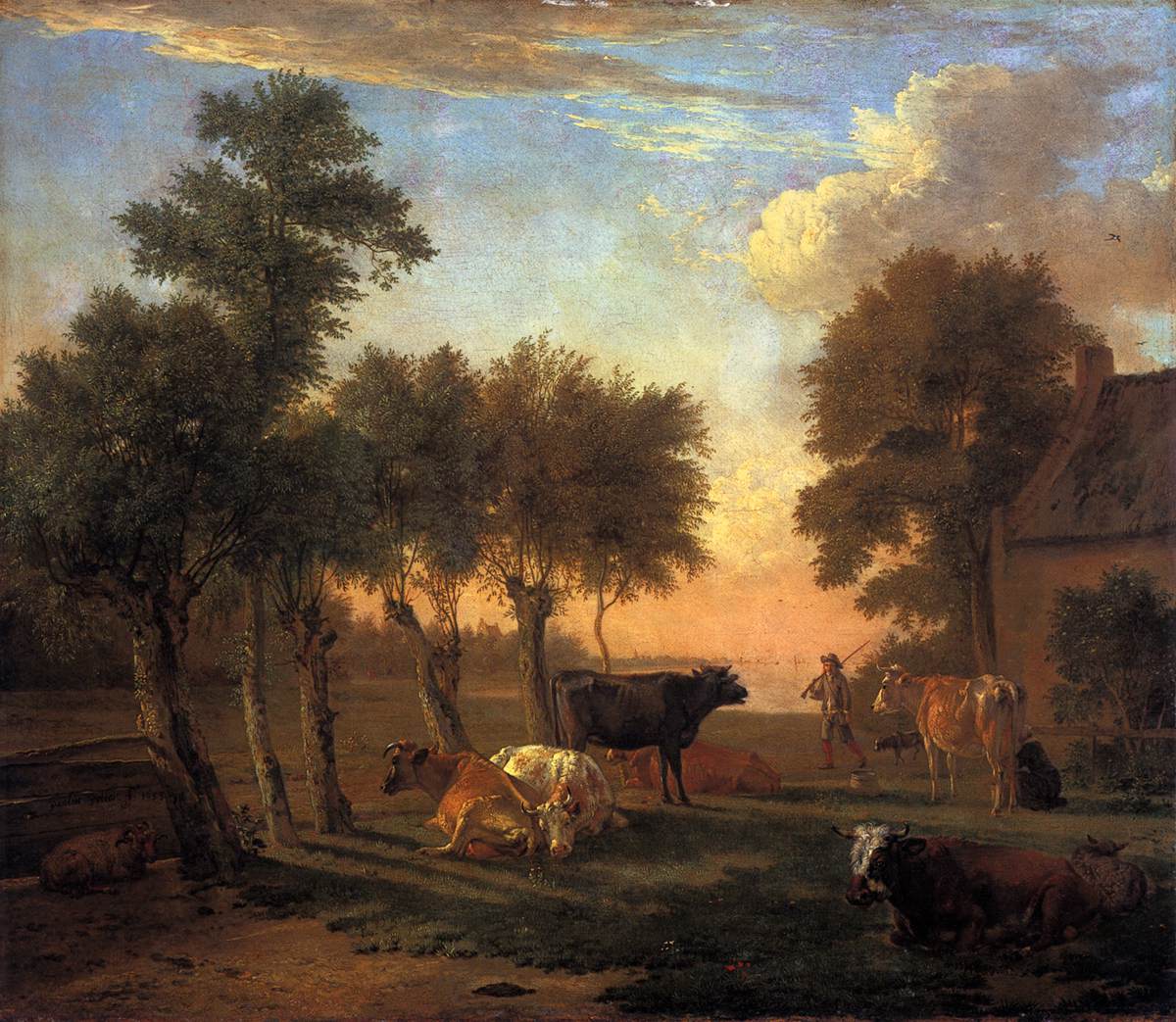
Potter was reticent about showing milkmaids, though. In his Cows Grazing at a Farm, painted in 1653, the year before his early death, the milkmaid is almost hidden by the cow’s hindquarters.

terborchmaidmilkingcow
Gerard ter Borch (1617–1681), A Maid Milking a Cow in a Barn (c 1652-54), oil on panel, dimensions not known, The Getty Center, Los Angeles, CA. Wikimedia Commons.

Gerard ter Borch was prepared to put the milkmaid and her cow at the centre of this painting, A Maid Milking a Cow in a Barn from about 1652-54. As was universal at the time, milk was collected in a wooden bucket.

koedijckbarbersurgeontendingpeasant
Isaac Koedijck (c 1617–1668), Surgeon Tending a Peasant’s Foot (1649-50), oil on panel, 91 x 72 cm, Private collection. Wikimedia Commons.

Isaac Koedijck is a bit more unusual in his Surgeon Tending a Peasant’s Foot (1649-50), with its wooden spiral staircase and collection of weapons and tools mounted high on the wall.

dehoochwomandrinkingtwomen
Pieter de Hooch (1629–after 1684), A Woman Drinking with Two Men (c 1658), oil on canvas, 73.7 x 64.6 cm, National Gallery, London. Wikimedia Commons.

It’s easy to mistake Pieter de Hooch’s A Woman Drinking with Two Men from about 1658 for a Vermeer, and like the latter he decorates the far wall with a contemporary map. The Eighty Years’ War had not long ended, and the Dutch Republic was flourishing. Discarded objects are scattered on its black-and-white tiled floor. There’s a large and empty fireplace, and above it hangs a religious painting.

Gabriel Metsu (1629–1667), The Old Drinker (c 1650-67), oil on panel, 22 x 19.5 cm, Rijksmuseum Amsterdam, Amsterdam, The Netherlands. Wikimedia Commons.

Finally, Gabriel Metsu’s Old Drinker (c 1650-67) is dressed in clothes almost as old as he is, and clutches a clay tobacco pipe in his right hand, and a pewter drinking tankard with his left.

How many of those paintings would have been commissioned by a patron?

❌