Painting in the Dutch Republic during the Golden Age was rich in landscapes, interiors and images of everyday life, but didn’t abandon storytelling. Many of Rembrandt’s finest works are religious narratives and tales drawn from classical mythology and history. This article shows a selection of paintings by the less famous, and how their stories extended beyond those that had been most popular in the Renaissance.
Adriaen van de Velde (1636–1672), The Annunciation (1667), oil on canvas, 128 x 176 cm, Rijksmuseum Amsterdam, Amsterdam. Wikimedia Commons.
The Annunciation (1667) is a large canvas, and among the few religious paintings that Adriaen van de Velde made following his marriage to a Catholic woman, and his conversion to Catholicism. Although the angel is a little awkward, it seems hard to believe that this was painted by a landscape specialist.
Adriaen van de Velde (1636–1672), Vertumnus and Pomona (1670), oil, 76.5 x 103 cm, Kunsthistorisches Museum, Vienna. Wikimedia Commons.
Three years later, van de Velde painted a classical myth in his superb Vertumnus and Pomona (1670). Vertumnus was the Roman god of seasons and change, who could assume whatever form he wished. Book fourteen of Ovid’s Metamorphoses tells the story of his transformation into the form of an old woman, seen here on the left, so that he could gain entry to Pomona’s orchard and seduce her. Sadly, the yellow he used to mix greens has faded in parts, leaving some of his vegetation blue.
Jan Lievens (1607–1674), Quintus Fabius Maximus (1656), media not known, 203 x 175 cm, Paleis op de Dam, Amsterdam, The Netherlands. Wikimedia Commons.
Jan Lievens’ painting of Quintus Fabius Maximus from 1656 may refer to this Roman’s victory at Tarentum, as told in Plutarch’s Lives. The great Carthaginian general Hannibal was only five miles away at the time of the Roman repossession of Tarentum, and this made Hannibal realise the impossibility of mastering Italy.
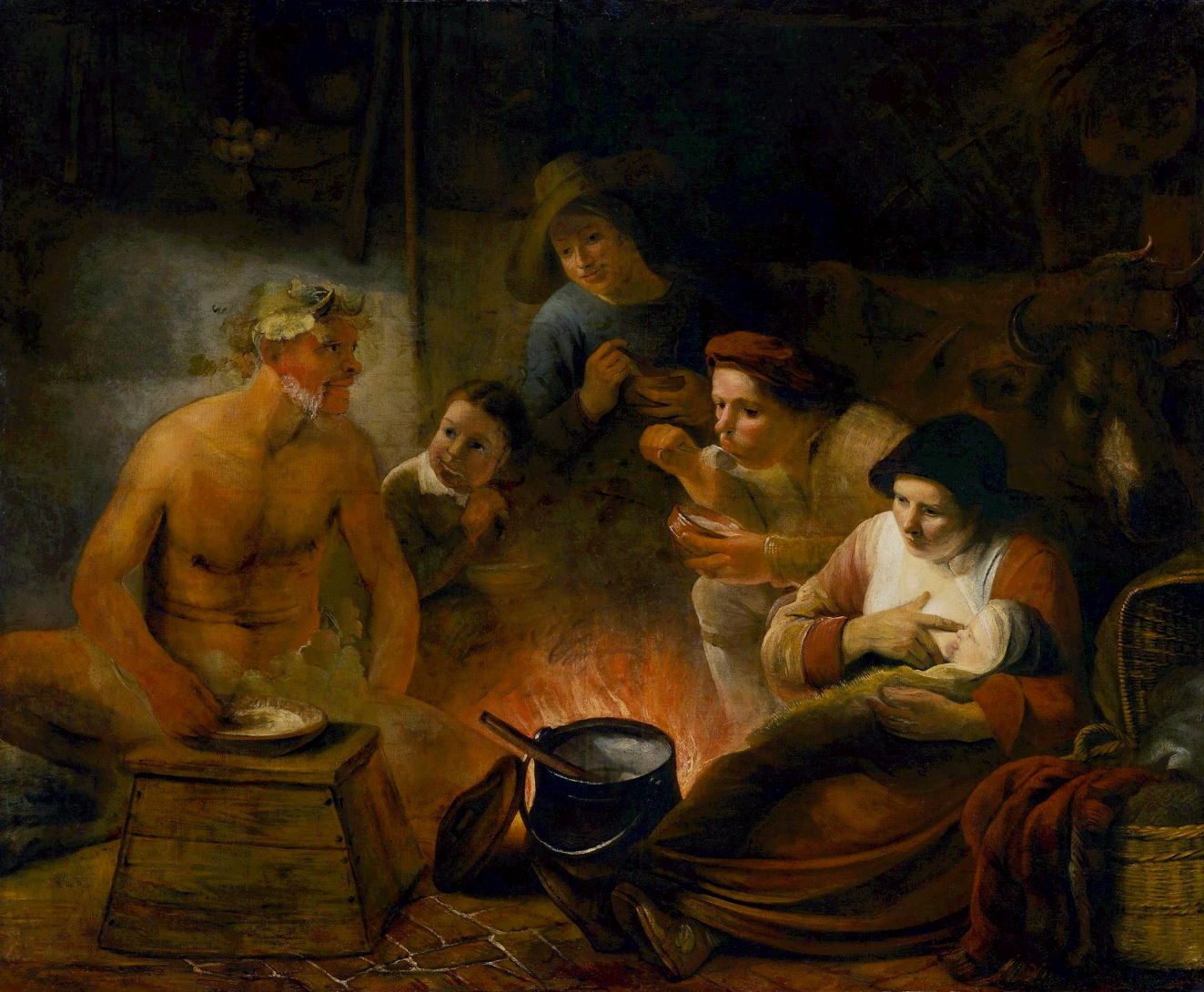
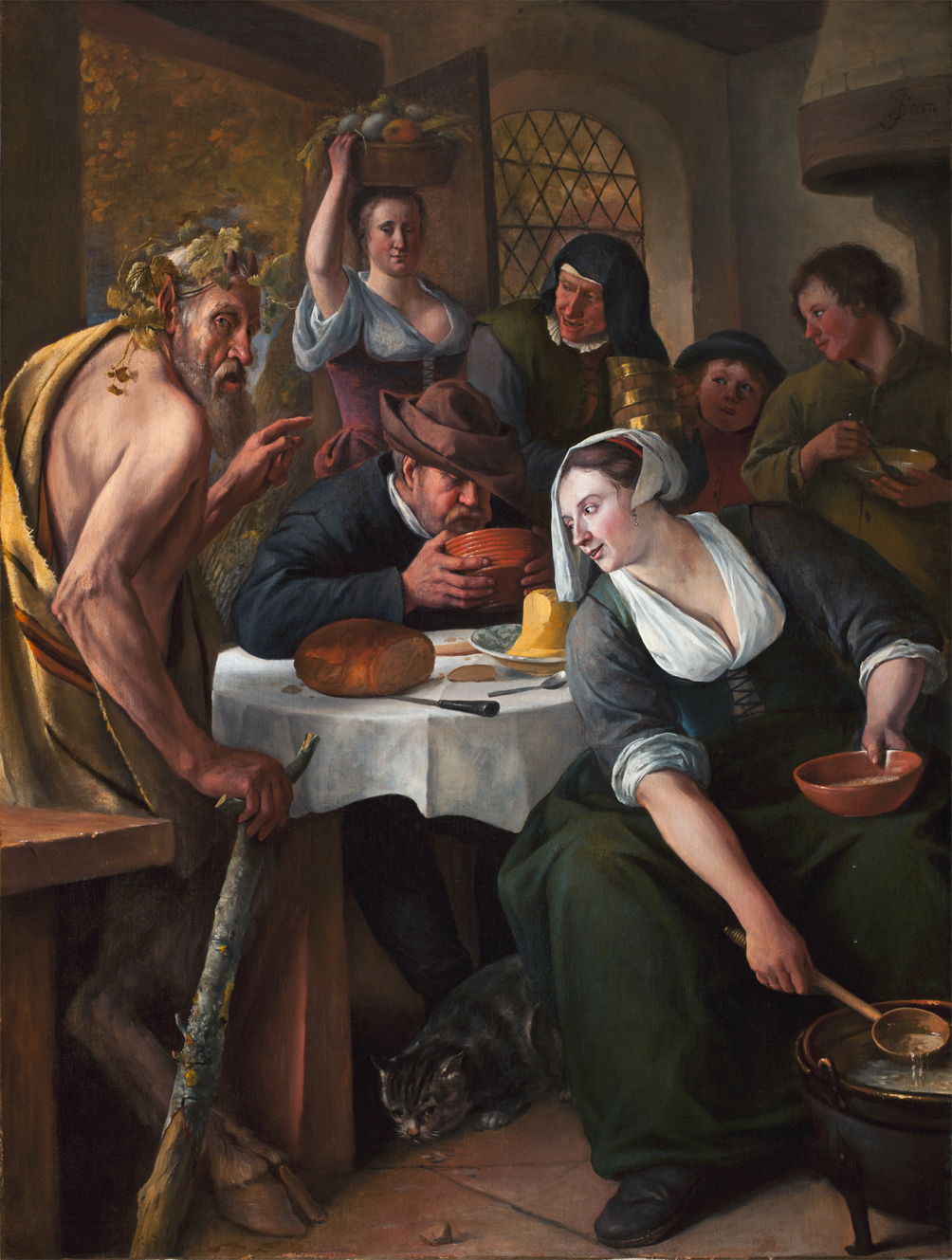
Paintings of fables, that had already started to become popular among Flemish artists at this time, appeared in the Republic to the north. Among them was the story of the Satyr and the Traveller, or the Man and the Satyr. A man made friends with a satyr; when the man’s hands were cold, he blew on them to warm them up. When the two were eating together, the man blew on his hot food in order to cool it down. The satyr decided that he couldn’t trust a creature whose breath blew both hot and cold, so broke off their friendship.
Constantijn à Renesse (1626–1680), Satyr at the Peasant’s House (1653), oil on canvas, 168 x 203 cm, Muzeum Narodowe w Warszawie, Warsaw, Poland. Wikimedia Commons.
In 1653, Constantijn à Renesse, a former pupil of Rembrandt, painted his version of this fable in Satyr at the Peasant’s House. This shows one of the family blowing on the hot food in their spoon, although at this stage the satyr hasn’t reacted to the contradiction.
Jan Steen (1625/1626–1679), The Satyr and the Peasant “Who Blows Hot and Cold” (c 1660), media and dimensions not known, Museum Bredius, The Hague, The Netherlands. Wikimedia Commons.
Jan Steen, in his telling of The Satyr and the Peasant “Who Blows Hot and Cold” from about 1660, gives a clearer account, with the satyr looking worried at the viewer, as a man (still wearing his hat) blows on a bowl of hot stew. He also pays attention to delightful details such as the cat skulking under the table, and a rich supporting cast.
Steen went on to paint two unusual accounts of what happened in schools across country districts in the Republic.
Jan Steen (1625/1626–1679), The Village School (c 1665), oil on canvas, 110.5 x 80.2 cm, National Gallery of Ireland Gailearaí Náisiúnta na hÉireann, Dublin, Ireland. Wikimedia Commons.
His The Village School from about 1665 shows physical punishment in a contemporary school. The child at the right holds out a hand for teacher to strike it with a wooden spoon, and is already wiping tears from his eyes. A girl in the middle of the canvas is grimacing in sympathy.
Jan Steen (1625/1626–1679), The Village School (c 1670), oil on canvas, 81.7 x 108.6 cm, Scottish National Gallery, Edinburgh, Scotland. Wikimedia Commons.
A few years later, Steen painted a scene in a larger and more chaotic classroom, in The Village School from about 1670. Although there are two staff sat at the teachers’ desk, the man is distracted, perhaps in cutting himself a fresh quill. The woman teacher sat next to him is engaged in explaining something to a pupil. Around them, all hell is breaking loose. In the distance, a boy is stood on one of the trestle tables. Older children are teaching younger ones, and a small group at a table at the right are trying to write while others get up to mischief. One younger child in the middle of the foreground has fallen asleep against a hat.
Gerrit Dou (1613–1675), The Young Mother (1658), oil on panel, 73.5 x 55.5 cm, Koninklijk Kabinet van Schilderijen Mauritshuis, The Hague, The Netherlands. Wikimedia Commons.
Gerrit Dou approaches social realism in his detailed account of The Young Mother from 1658. As she sits at her needlework, her child is attended in their wickerwork crib by a young nurse. Around them is an eclectic collection of objects, from a large cabbage, hanging game and a bundle of carrots at the right, to a bird cage and an upholstered chair at the left. Suspended above them is a chandelier, and a wooden spiral staircase ascends to the next floor. This family appears to be living in affluent squalor.
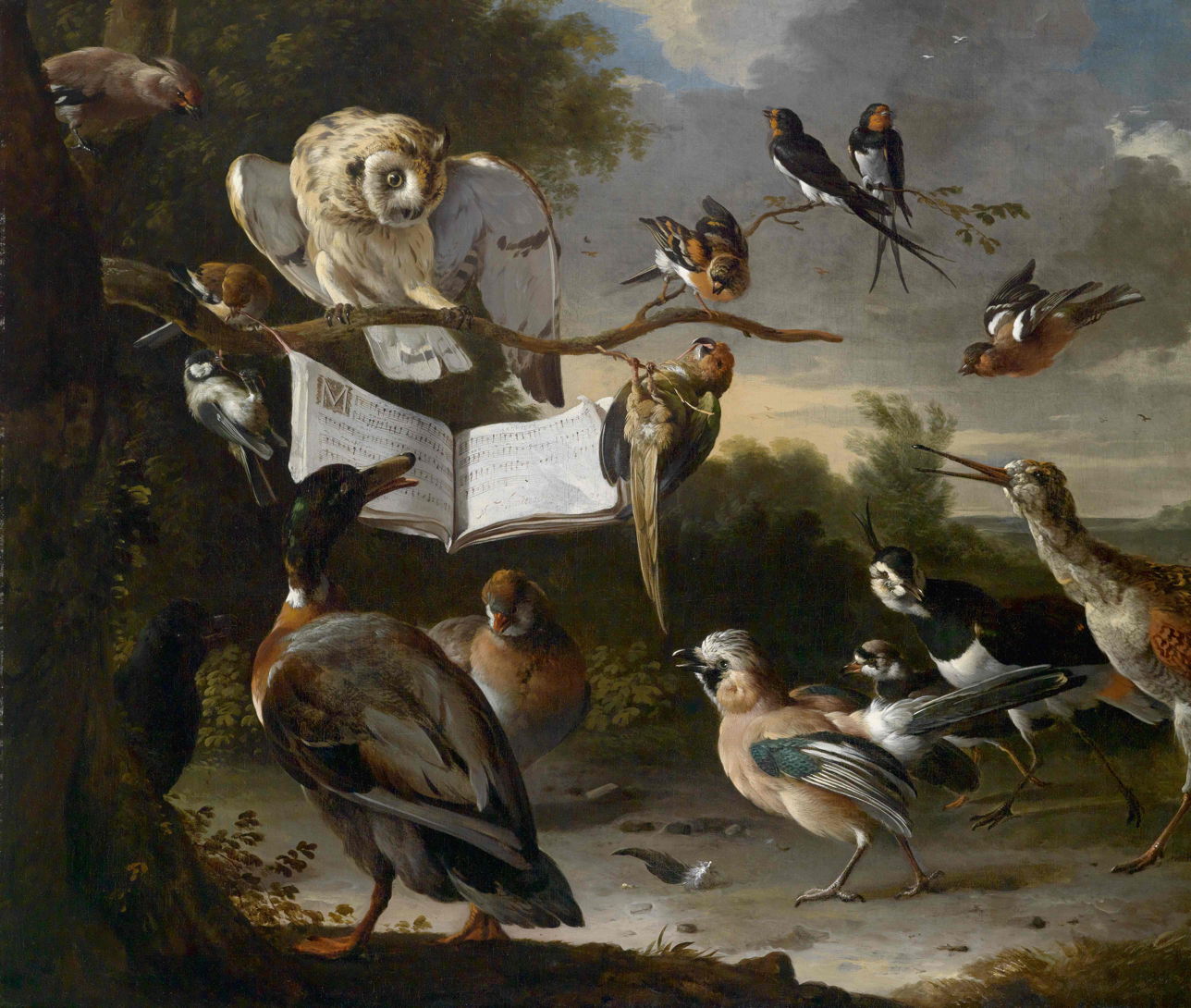
Melchior d’Hondecoeter (1636–1695), Concert of the Birds (1670), oil on canvas, 84 x 99 cm, Private collection. Wikimedia Commons.
There was even an anthropomorphic fad for paintings showing gatherings of birds ‘singing’ together, and I think Melchior d’Hondecoeter’s Concert of the Birds from 1670 is probably the best example of those entertaining paintings.
The first thing I discovered when I started hunting provenance extended attributes (xattr) was a bug in my free utility xattred. This can result in the app crashing when using its Crawler to explore xattrs on items in a folder. I have fixed that in this new version 1.7, available below.
My hunt was by and large successful, with a great many com.apple.provenance xattrs caught. There are some interesting problems, though.
Looking through the contents of the main Applications folder, there are three groups of apps:
Those with Apple certificates, including bundled apps and those delivered through the App Store (which are all signed by Apple, not their developer), which have no provenance xattr as they don’t register with provenance tracking.
Apps with third-party certificates that have been installed simply, which have a single provenance xattr on the app bundle containing that app’s provenance ID.
Apps with third-party certificates that have been installed or updated using a third-party app such as their Sparkle update mechanism, whose entire contents have provenance xattrs attached by the installer/updater, so not bearing the app’s provenance ID.
Examining files in the ~/Documents folder, there are plenty with provenance xattrs, and a great many with quarantine xattrs bearing information about their history including origin. Although some of the provenance IDs on them don’t match with those of apps, there’s sufficient to provide useful information about many without accessing the ExecPolicy database’s Provenance Tracking table. Therefore I will proceed to code up Providable over the next couple of weeks.
This new version of xattred should fix that crashing bug in its Crawler feature, that enables you to scan folders for information about their xattrs.
I have also looked at an issue that I’ve experienced when editing some xattrs such as the new com.apple.icon.folder type used in Tahoe to customise the appearance of folders. When editing them, some of the double-quotation marks used in text content can become changed to ‘smart’ quotes, which isn’t in the least bit smart, as it prevents that xattr from functioning correctly. Although that feature is disabled for that text view, macOS seems to be ignoring its setting and substituting smart quotes regardless. Provided that you’re aware of this danger and take care to ensure that all quotation marks are non-smart, you can edit xattrs successfully. Hopefully this will be improved in the future.
xattred version 1.7 for macOS 11.5 or later is available from here: xattred17
from Downloads above, from its Product Page, and via its auto-update mechanism.
Centuries of experience with painting using oil paints have proved the importance of a robust support and a ground that isolates the paint layer from its support. Older use of wood panels with a gesso ground consisting largely of gypsum or chalk ensured the paint layer wouldn’t be subjected to mechanical stress, and would remain isolated from the underlying wood. Canvases became popular because of their relative lightness particularly in larger sizes, but still require an isolating ground layer both to protect the canvas from damage by the paint, and to prevent discolouration of the paint.
When sketching in oils in front of the motif became increasingly popular in the late eighteenth century, those paintings weren’t intended for public view, but as an aid for the artist when composing finished paintings in the studio. Rather than gather hundreds of small oil sketched on canvas or panels, the first plein air painters usually used paper or cardboard as support and ground. Subsequently, when their studios were sold off following their death, surviving oil sketches were usually laid on canvas for preservation and display.
Although he probably wasn’t the first to compile a library of oil sketches, those gathered by Pierre-Henri de Valenciennes when he was painting in the Roman Campagna in the 1780s are among the most brilliant. This untitled view of the countryside near Rome is thought to have been painted in about 1783.
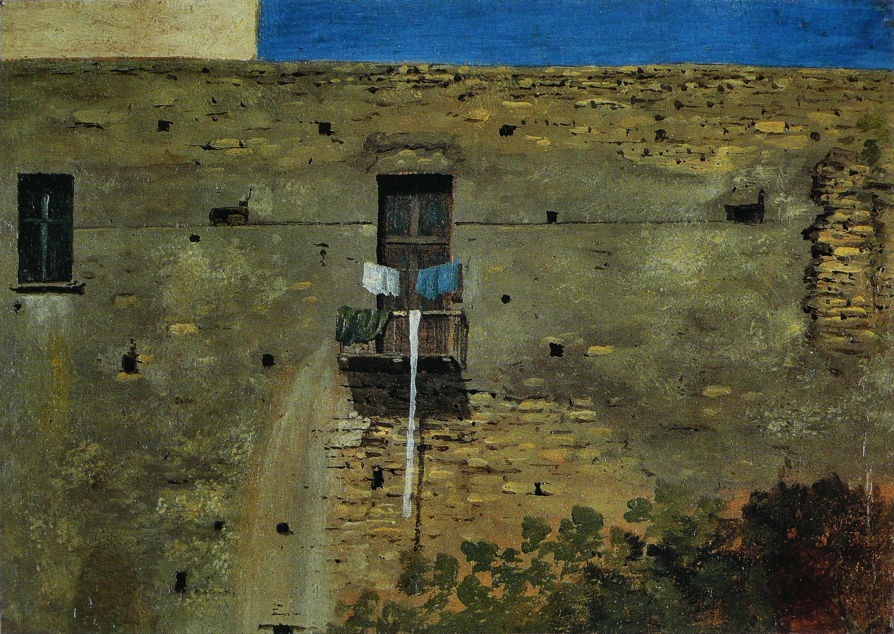
Thomas Jones (1742-1803), A Wall in Naples (c 1782), oil on paper laid on canvas, 11.4 x 16 cm, National Gallery, London. Wikimedia Commons.
At about the same time, the Welsh painter Thomas Jones was doing the same thing in and around Naples as well. This tiny view of A Wall in Naples was painted in about 1782, and is now one of the gems in London’s National Gallery. Below is a detail.
Thomas Jones (1742-1803), A Wall in Naples (detail) (c 1782), oil on paper laid on canvas, 11.4 x 16 cm, National Gallery, London. Wikimedia Commons.Thomas Jones (1742-1803), The Capella Nuova outside the Porta di Chiaja, Naples (1782), oil on paper, 20 x 23.2 cm, Tate Britain, London. Wikimedia Commons.
Jones was taught by the Welsh artist Richard Wilson, but none of his oil sketches have survived. Jones’ Capella Nuova outside the Porta di Chiaja, Naples is another example that’s significantly larger, and now in the Tate Gallery.
Valenciennes went on to assemble a large library of his oil sketches that he used for his studio paintings following his return to Paris. He was admitted to the Academy in 1787, published an influential manual of perspective and painting in 1799, and became Professor of Perspective at l’École des Beaux-Arts in Paris in 1812.
Among the aspiring young landscape painters who followed in the footsteps of Valenciennes was Camille Corot, who was taught by Achille Etna Michallon, who in turn had been taught by Valenciennes. Corot painted in the Roman Campagna between 1825-28, using the same techniques of applying his oil paint direct to sheets of paper.
Jean-Baptiste-Camille Corot (1796-1875), View of Rome: The Bridge and Castel Sant’Angelo with the Cupola of St. Peter’s (1826-7), oil on paper on canvas, 26.7 x 43.2 cm, Fine Arts Museums of San Francisco. WikiArt.
Corot painted this View of Rome: The Bridge and Castel Sant’Angelo with the Cupola of St. Peter’s in 1826-27. This is one of the best-known bridges over the River Tiber, and not far from the centre of the city. The view is taken from the north-east of the bridge, on the ‘left’ bank, probably close to the Piazza di Ponte Umberto I, looking towards the south-west (‘right’ bank). The painting is sketchy rather than finely finished, and appears to have been painted en plein air onto a sheet of paper that has subsequently been laid on canvas.
Jean-Baptiste-Camille Corot (1796-1875), View of the Convent of S. Onofrio on the Janiculum, Rome (1826), oil on paper mounted on canvas, 22 x 33 cm, Fitzwilliam Museum, Cambridge, England. WikiArt.
This View of the Convent of S. Onofrio on the Janiculum, Rome is another from Corot’s first campaign in Rome.
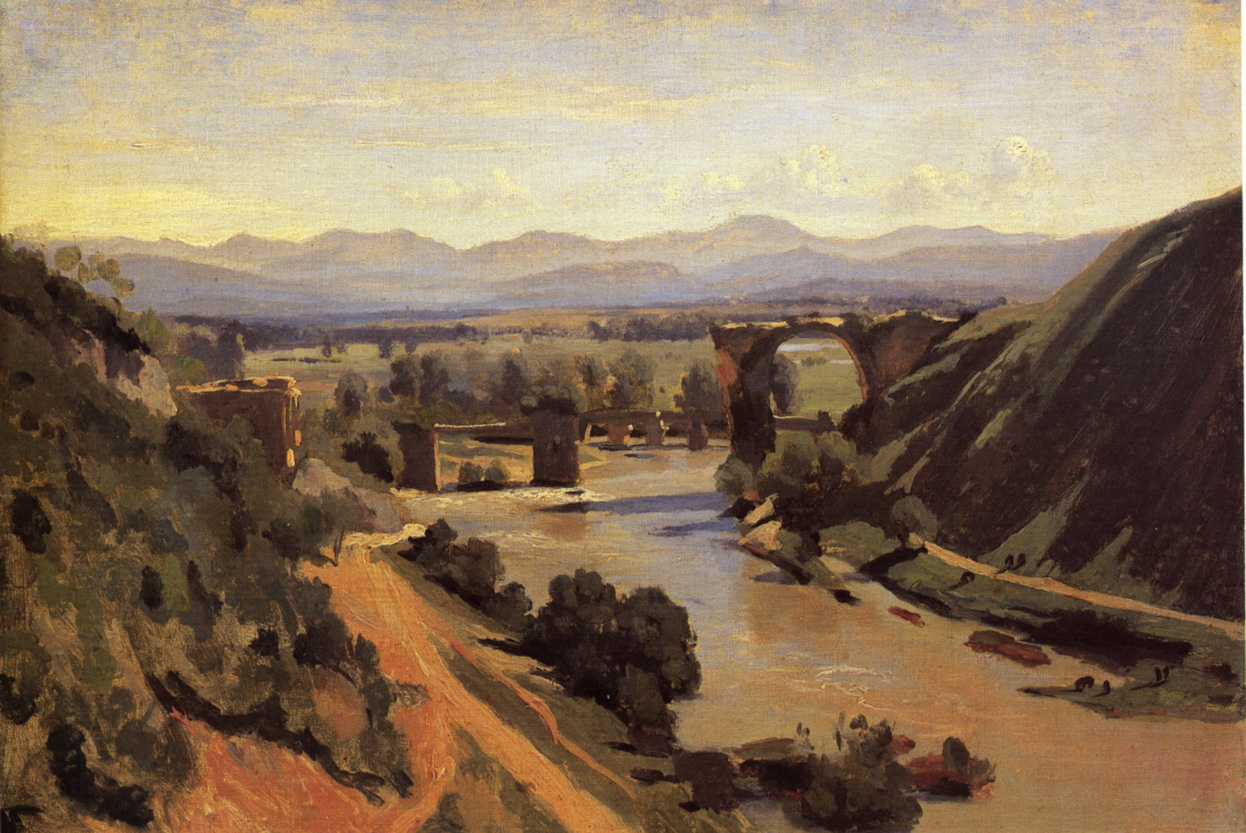
Jean-Baptiste-Camille Corot (1796-1875), The Bridge at Narni (1826), oil on paper, 34 x 48 cm, Musée du Louvre, Paris. WikiArt.
Corot’s years in Italy were formative in his own development, and one of the key elements he put in place to hand on to Camille Pissarro and other Impressionists. The Bridge at Narni is one of his finest oil sketches.
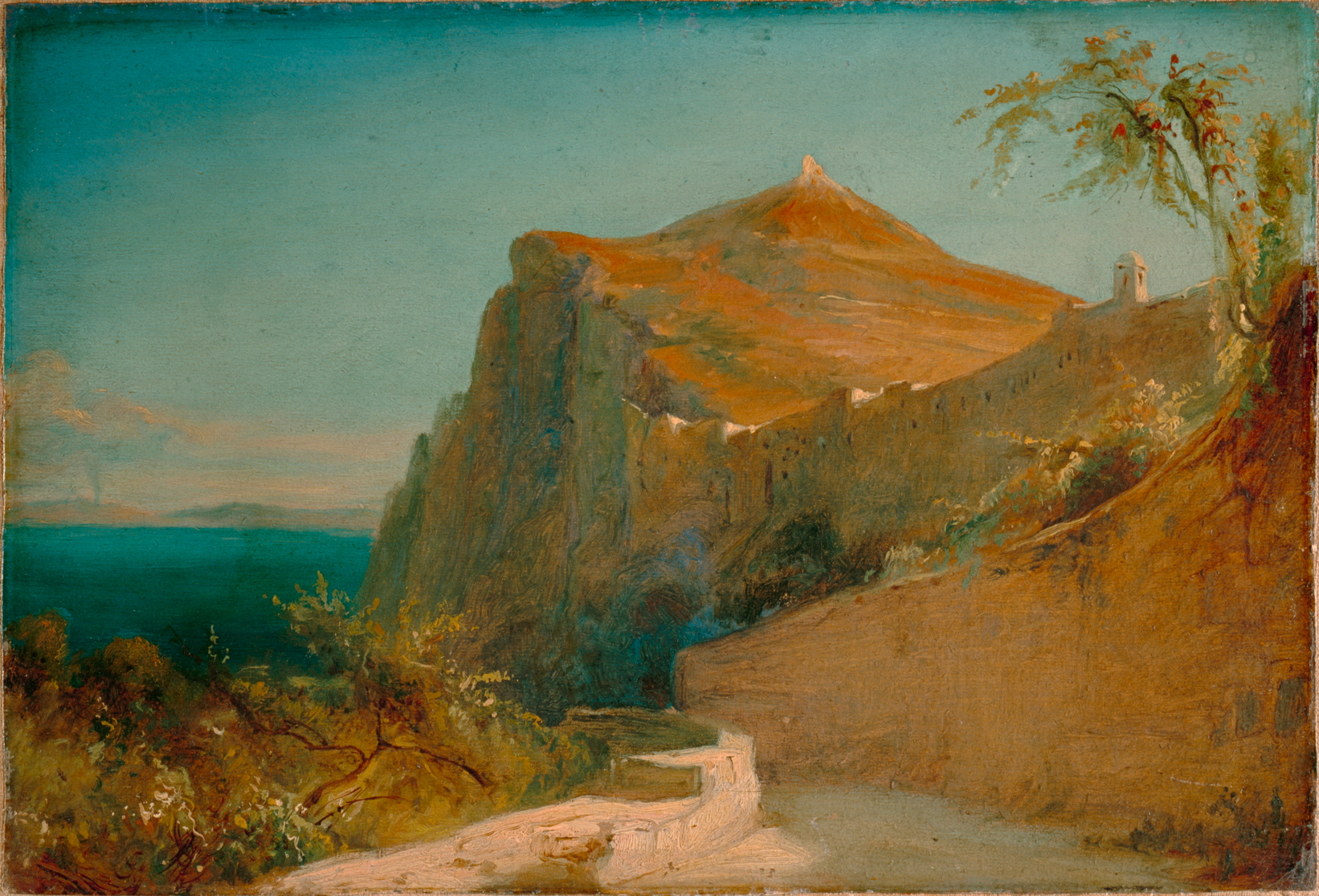
Carl Eduard Ferdinand Blechen (1798-1840), Tiberiusfelsen auf Capri (Tiberius Rocks, Capri) (1828-9), oil on paper mounted on canvas, 20.5 x 30 cm, Lower Saxony State Museum, Hanover. Wikimedia Commons.
Others followed Valenciennes’ instructions, among them Carl Blechen, a brilliant German landscape painter who sketched the Tiberius Rocks, Capri during a visit in 1828-29, again on paper.
Carl Eduard Ferdinand Blechen, (1798-1840) Galgenberg bei Gewitterstimmung (A Scaffold in a Storm) (c 1835), oil on paper mounted on board, 29.5 x 46 cm, New Masters Gallery, Dresden. Wikimedia Commons.
Blechen’s late oil sketch of A Scaffold in a Storm was painted in about 1835, shortly before he succumbed to severe depression. This anticipates many elements of Impressionism: it appears to have been executed rapidly in front of the motif (although a view from his studio over Berlin and Brandenburg), with many brush-strokes plainly visible; details are composed of stylised marks; it is an everyday if not banal subject, with an informal composition.
However, the French Impressionists seldom if ever sketched in oils on paper, as their paintings made in front of the motif were intended to be sold to and viewed by the public, for which paper wasn’t considered suitable. Times had changed.
The Achilles heel of T2 Macs is booting from external storage. Although it’s simple to create a bootable external disk for a T2 Mac, to boot from it you have to allow the Mac to boot from any external disk, removing much of its boot security. Apple silicon Macs were designed to boot almost as securely from external disks as they do from the internal SSD, and that makes setting up a bootable external disk more complicated. This article explains how you can do that for macOS 26 Tahoe.
In this respect, Apple silicon Macs have two central principles:
They always start the boot process from their internal SSD. If that’s not functioning correctly, then they can’t boot at all.
They will only transfer the boot process to an external system when the user has access to a private key making them an Owner of that system, through the Mac’s LocalPolicy system. That’s the part that can cause problems.
Planning
There are alternatives to booting from external storage. If there’s sufficient space, you can install multiple versions of macOS on the internal SSD, or you can run macOS as a guest operating system in a virtual machine (VM). VMs are limited in some important respects, though, as they can’t run most apps from the App Store or use AI, although they can now access iCloud and iCloud Drive.
Like any other Mac, Apple silicon models can only boot from versions of macOS they’re compatible with. You can check which your Mac can run using Mactracker. A VM is the only solution for running older and incompatible versions of macOS, and it gets messy installing versions that are compatible but older than the currently installed major version of macOS. This is because its installer may be blocked by the more recent macOS, for which you’ll need to create a bootable installer disk and run the installation from that. Apple describes how to do that in this support article. For the remainder of this article, I assume that you’re installing a second or subsequent copy of the current version of macOS to an external disk.
Connect and prepare the external disk
First catch your disk, and connect it to one of the non-DFU ports on your Mac. For example, on my Mac mini M4, that’s either the left or right Thunderbolt port, as the middle one is its DFU port. On all other Apple silicon Mac minis, that’s either the centre or right port as you look from the rear, as their DFU port is the one on the left. If you try to install macOS to a drive connected to an Apple silicon Mac’s DFU port, then it’s doomed to fail, and that’s the most common cause of failure. More information on the DFU port is here.
Reformat that disk as you want to use it, with at least one APFS container containing a single APFS volume in regular APFS format, not encrypted.
Download and run the installer
Next catch your installer. Oddly, Apple seems to have stopped providing the current release of macOS through the App Store, so the simplest way to download it in the GUI is from the links provided by Mr. Macintosh, and there are many alternatives. You want a regular installer, not an IPSW image file that you might use to create virtual machines.
Run the installer app from your main Applications folder.
When it asks you whether you want to install macOS on your current system, click on Show All Disks…
Select your external disk from the list and click Continue. If your disk isn’t recognised or listed there, reformat it and start again.
Ownership
This is the important part of the installation; if it fails, the external disk won’t be bootable.
For the macOS system on your external disk to be bootable, it needs a LocalPolicy created for it on your Mac’s internal SSD. To ensure that only fully authorised users can configure and change LocalPolicy, those Image4 files are signed, and an Owner Identity Certificate (OIC) is attached to them. Creating and maintaining LocalPolicies requires a user to have access to the private Owner Identity Key (OIK) in the Secure Enclave, making that user an Owner.
Any user with access to the Volume Encryption Key for the internal storage also has access to the OIK, and has Ownership. By default, that includes all users added after FileVault encryption is enabled on a Data volume, for example. To be able to boot from that second OS, it requires a LocalPolicy with an OIC attached, and Ownership has to be handed off to an Install User created when that OS is installed.
Handing off Ownership to the Install User is more of a problem, as users are only created when the installation is complete. To accommodate that, macOS offers to copy a user from the current boot system as the Install User, and the primary admin user, on the second OS. Provided that you agree to that, the Install User created is actually a Key Encryption Key (KEK) for your password and hardware keys, which is then used to encrypt the OIK as it’s handed over to the new copy of macOS on the external disk. Thus, the installer requests that user’s password to gain access to the OIK for the new macOS in the Secure Enclave.
Following these steps should ensure that works correctly.
When prompted to select the user to be owner of the new boot volume group, pick the current admin user, and tick to copy their account settings.
You’ll then be prompted to enter that user’s password to authenticate as the owner.
Completing installation
Installation follows, and is (as ever) highly non-linear, and may even appear to stall. Persevere, and it will then close apps and restart to complete.
When you’re eventually prompted to Create a Computer Account, it’s simplest to create a local admin account for the owner. The new copy of macOS will then take you through personalising your new system, and, if you’ve added support for your Apple Account, it will do the 2FA dance for iCloud and Apple Account, and so on.
Once configured, you can share that external disk between Macs, but each time you boot from it on a different Mac, you can expect to repeat the 2FA dance for iCloud and Apple Account.
Updates
Once installed, you’ll almost certainly want to keep that external system up to date. To do that, start up from that disk, and use Software Update as normal. Although you could download that latest macOS installer and run that, that’s a much larger download and there’s always the risk it might run a clean install, forcing you to restore from your latest backup. Apple no longer provides downloadable updaters for macOS.
When you update macOS on that Mac, the firmware in it will be updated by the most recent version of macOS you have installed or updated it to, whether that’s on the internal or external disk. To update firmware, you have to install the appropriate macOS update on that Mac. If you update your external disk using another Mac, then that won’t update the firmware in your Mac. That can only be done by performing that update on that Mac.
Key steps
Consider alternatives, including an additional system on the internal SSD, or using a VM instead.
Connect the external storage to a non-DFU port and format it in APFS, not encrypted.
Download and run the appropriate full macOS installer. macOS Tahoe isn’t currently available from the App Store, though.
Select the external disk as the installation target.
Select the current admin user to be Owner of the new system, copy their account settings, and authenticate with that user’s password.
Create a local admin account for that user, if possible.
Complete 2FA to connect to the Apple Account, as necessary.
Update the external system when booted from it, using Software Update.
Some stories in Boccaccio’s Decameron attained fame less in the original, more in their later retelling. A good example is the tragic tale of Lisabetta related by Filomena on the fourth day, when it was the fifth about those whose love ended unhappily.
In 1818, the British poet John Keats (1795-1821) wrote his version, titled Isabella, or the Pot of Basil, which was published two years later, shortly after the poet’s untimely death at the age of just twenty-five, and it quickly became one of his most popular works. Here I will tell Boccaccio’s original, using his version of the names, being mindful that Keats called his leading lady Isabella rather than Boccaccio’s Lisabetta. Her lover’s name, common to both accounts, is Lorenzo.
Following the death of a rich merchant of Messina, his three sons inherited his riches, while their sister remained unmarried despite her beauty and grace. Lisabetta and Lorenzo, a Pisan who directed operations in one of the family’s trading establishments, fell in love with one another, and their relationship was consummated.
The couple tried to keep their affair secret, but one night one of her brothers saw her making her way to Lorenzo’s bedroom, and Lisabetta remained unaware of her discovery. Her brother was distressed, but decided to keep quiet, and to discuss it with his brothers next morning.
The following day, the brothers decided that they would also keep quiet until the opportunity arose to end their sister’s relationship. Some time later they pretended they were going to the country for pleasure, and took Lorenzo with them. When they reached an isolated location, they murdered Lorenzo and buried his body. They then told their sister that they had sent him away on a trading mission.
Lisabetta was anxious for her lover’s return, and persistently asked her brothers for news of him. Eventually, one of them rebuked her for this nagging, so she stopped mentioning him altogether, but each night kept repeating his name and pining for him. One night, having finally fallen asleep in tears, she saw him in a dream, in which he said that her brothers had murdered him, and revealed where his body was buried.
In her grief, Lisabetta obtained the permission of her brothers to go to the country for pleasure. Once she had located where she thought Lorenzo was buried, she quickly found his corpse, which remarkably showed no signs of decay. As she couldn’t move his whole body for more appropriate burial, she cut off his head and concealed it in a towel.
When she returned home, Lisabetta cried greatly over Lorenzo’s head, washing it with her tears, then wrapped it in cloth and put it in a large pot. She covered it with soil and in that planted some sprigs of basil. These she watered daily with her tears, as she sat constantly beside the pot in between bouts of crying over it. As a result, the basil grew strong and lush, and richly fragrant.
William Holman Hunt (1827–1910), Isabella and the Pot of Basil (1867), oil on canvas, 187 x 116 cm, Laing Art Gallery, Newcastle upon Tyne, England. Wikimedia Commons.
William Holman Hunt’s Isabella and the Pot of Basil from 1867 is intricately detailed, with several references to the story, such as the relief of a skull on the side of the pot, a red rose on a tray by Lisabetta’s left foot, and a silver watering can at the bottom right. Behind her is the image of a bedroom, possibly showing Lorenzo coming to her in a flashback to their affair.
Joseph Severn (1793-1879), Isabella, or the Pot of Basil (1877), further details not known. Wikimedia Commons.
Joseph Severn’s Isabella, or the Pot of Basil from 1877 appears remarkably high in chroma, and shows Lisabetta fondly embracing the pot and crying over the basil. Severn had been a personal friend of John Keats, and painted this just a couple of years before his own death.
Edward Reginald Frampton (1870-1923), Isabella, or the Pot of Basil (date not known), further details not known. Wikimedia Commons.
Edward Reginald Frampton’s Isabella, or the Pot of Basil was probably painted towards the end of the nineteenth century, or possibly in the early twentieth. Lisabetta is kneeling before her pot of basil at an altar, with a crucifix behind.
Ricciardo Meacci (1856-1938), Isabella and the Pot of Basil (1890), watercolour, dimensions not known, Private collection. Wikimedia Commons.
Ricciardo Meacci’s watercolour of Isabella and the Pot of Basil from 1890 shows Lisabetta embracing her pot of basil, as her three brothers watch with growing anger at her behaviour.
Her brothers began to suspect something, so had the pot removed from her room. This deepened their sister’s grief, and she kept asking after the pot.
John Melhuish Strudwick (1849-1937), Isabella (c 1886), oil on board, 31.1 x 23.2 cm, location not known. Wikimedia Commons.
John Melhuish Strudwick’s Isabella from about 1886 shows Lisabetta staring in grief at the stand on which her pot of basil had stood. Through the window, two of her brothers are seen making off with the pot, and looking back at her.
The brothers examined its contents and discovered Lorenzo’s head. Scared that his murder might cause them problems, they reburied the head, wound up their business, and left Messina for Naples. Lisabetta’s grief only grew deeper, and destroyed her health completely. Still asking for her pot of basil, she finally cried herself to death. Although the brothers had done everything to keep these events secret, eventually they became widely known, and were celebrated in folk verse.
John Everett Millais (1829–1896), Isabella (Lorenzo and Isabella) (1848-49), oil on canvas, 103 x 142.8 cm, Walker Art Gallery, Liverpool, England. Wikimedia Commons.
The first and still greatest depiction of Keats’ retelling is John Everett Millais’ Isabella (Lorenzo and Isabella) from 1848-49, completed before he was twenty, and one of the earliest examples of Pre-Raphaelite art. This is a composite of references to Keats’ poem and Boccaccio’s story, set at an imaginary family meal which the three brothers, Lisabetta and Lorenzo are taking together.
Lorenzo is sharing a blood orange with Lisabetta, white roses and passion flowers climbing from behind their heads. The dog, acting as a surrogate for Lorenzo, is being petted by Lisabetta, but one of her brothers aims a kick at it. Other symbols are shown of the plot to kill Lorenzo: a brother staring at a glass of red wine, spilt salt on the table, and a hawk pecking at a white feather. The pot of basil is already on the balcony, awaiting Lorenzo’s head. When exhibited at the Royal Academy in 1849, it was accompanied by verses 1 and 21 of Keats’ poem.
Quarantine extended attributes, xattrs named com.apple.quarantine, aren’t attached to all files downloaded to Macs. Although once described as a voluntary scheme, putting files into quarantine is determined by a set of rules. This article explains how those rules work in macOS 26 Tahoe.
The default rule for apps that don’t run in a sandbox is that all new files they create don’t have a quarantine xattr attached to them. This is simple to verify by creating a new file using an app that hasn’t been obtained from the App Store, and isn’t one of Apple’s. Although it’s likely to get a MACL xattr attached, no quarantine xattr should accompany that. The same should also apply to files created by sandboxed apps, including TextEdit.
Info.plist
Although some processes and apps may explicitly attach quarantine xattrs, for example in AirDrop, this is a behaviour normally delegated to macOS by a setting in the app’s Info.plist, LSFileQuarantineEnabled. When that’s set to true, all files created by that app should bear the xattr. You can verify that by inspecting the Info.plist file in apps that download items from the internet, such as Safari, where it’s normally listed immediately below the app’s LSApplicationCategoryType.
No changes can be made to the Info.plist in a signed app, as those would break its signature.
CoreTypes.bundle
If that setting in Info.plist is false, or it doesn’t appear in the Info.plist, then there are additional and overriding settings contained in Exceptions.plist in the CoreTypes bundle, at /System/Library/CoreServices/CoreTypes.bundle/Contents/Resources. That long list contains five dictionaries:
Additions, which assigns a lot of app categories, sets Java version requirements, and determines default settings for quarantine on files created by apps.
AppNapOverrides, which sets App Nap behaviours.
HighResolutionOverrides, which overrides High Res options for apps.
LaunchOverrides, which can disable specific version ranges of apps from being launched; these prevent older apps from being run.
MergeDocumentTypes, which merges some document types such as doc and docx for specific apps.
Overrides, which can override other settings.
Included in the Additions dictionary you should find overriding settings for the popular BitTorrent client Transmission, reading: <key>org.m0k.transmission</key>
<dict>
<key>LSApplicationCategoryType</key>
<string>public-category.internet</string>
<key>LSFileQuarantineEnabled</key>
<true/>
</dict>
Referring to the app by its ID of org.m0k.transmission, the first of those assigns the app to an app category of public-category.internet, then sets the app to attach the quarantine xattr to all documents that it creates, including everything that it downloads.
Among the existing overrides in Tahoe, for example, are org.pythonmac.unspecified.BitTorrent and org.xlife.Xtorrent, to ensure that Transmission, Xtorrent and PythonMac BitTorrent clients should write quarantine xattrs to all their downloaded files. Although this Exceptions property list doesn’t cover every client, it should ensure that most do protect their downloads by attaching a quarantine xattr.
The CoreTypes bundle isn’t in the Signed System Volume of macOS, but is protected from change. Thus, there’s no way the user can alter which apps add the quarantine xattr to new files they create.
Mach-O binaries
I don’t know how this system works with command tools, which are single file executables. They can have an Info.plist embedded in the executable, but this is rare unless they need to be notarized. The most popular tool for downloading files from the internet must be curl, used in commands of the form curl [URL] -o [localfile]
to download the file named in the URL to a local file named localfile. It’s simple to demonstrate that the download then doesn’t have any quarantine xattr attached to it, and those don’t gain the xattr when extracted from archives either.
While this does offer the user a way to download files that don’t have any quarantine xattr attached, it’s also almost universally used for the same purpose by malicious software.
Summary
By default, apps don’t normally attach the quarantine xattr to files they create.
Most apps that can download files from the internet opt to attach the xattr by setting LSFileQuarantineEnabled to true in their Info.plist.
Some of those that don’t, have that overridden in the Additions dictionary of Exceptions.plist in CoreTypes.bundle.
One notable exemption is the command tool curl, which is also used by malware to escape quarantine.
Claude Monet had first visited London as he sought refuge from the Franco-Prussian War in 1870-71, when he painted one of the early impressions of the River Thames in mist, shown in yesterday’s article. He was to return just before the end of the century, when his fortunes had changed and he could afford to travel in search of motifs. Where better than the River Thames for the optical effects of mist, fog and smog?
Monet had started painting formal series during the 1880s, when he was enjoying commercial success at last. From about 1896, almost all his works were part of a series. He started travelling through Europe in search of suitable motifs for these, visiting Norway in 1895, and later Venice. When he returned to London in 1899, and in the following two years, Monet chose a different view of the Palace of Westminster, from a location at the opposite end of Westminster Bridge, for his series of 19 paintings. These were all started from the second floor of the Administrative Block at the northern end of the old Saint Thomas’s Hospital on the ‘south’ bank, and completed over the following three or four years.
Claude Monet (1840–1926), The Houses of Parliament, Sunlight Effect (1903), oil on canvas, 81.3 × 92.1 cm, Brooklyn Museum, New York, NY. Wikimedia Commons.
His The Houses of Parliament, Sunlight Effect (1903) is more radical than his painting of thirty years earlier, showing little more than the Palace in silhouette, the sun low in the sky, and its broken reflections in the water.
Claude Monet (1840–1926), The Houses of Parliament, Sunset (1903), oil on canvas, 81.3 × 92.5 cm, The National Gallery of Art, Washington, DC. Wikimedia Commons.
The Houses of Parliament, Sunset (1903) shows the same view in better visibility, but with the sun setting and a small boat on the move in front of the Palace.
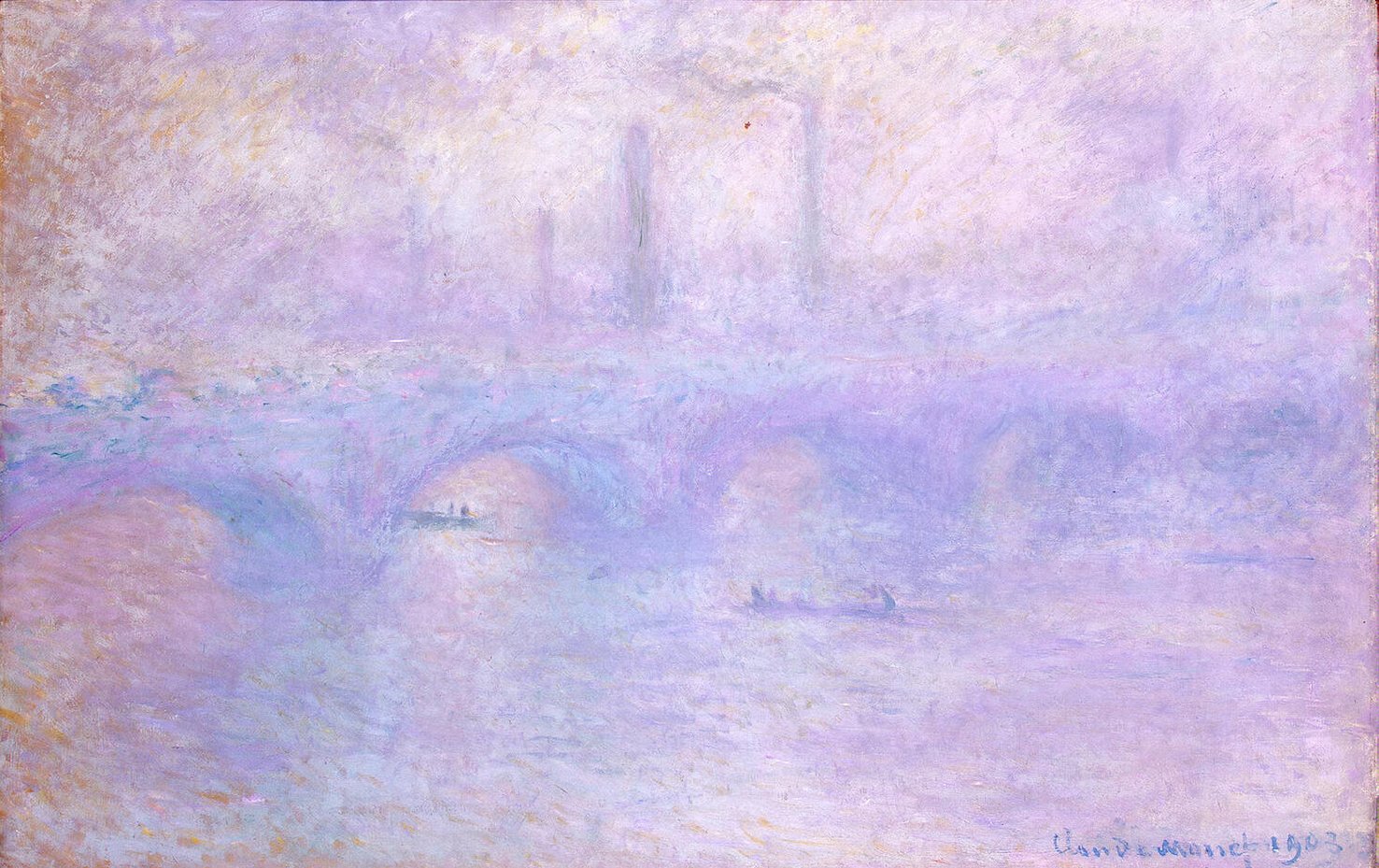
Claude Monet (1840–1926, Waterloo Bridge. Effect of Fog (1903), oil on canvas, 65.3 x 101 cm, Hermitage Museum Государственный Эрмитаж, Saint Petersburg, Russia. Wikimedia Commons.
Monet’s Waterloo Bridge from 1903 is the ultimate conclusion of his paintings of fog, in which only the softest of forms resolve in its pale purple and blue vagueness, his common destination with the paintings of Turner over fifty years earlier.
Claude Monet (1840–1926), The Houses of Parliament, Stormy Sky (1904), oil on canvas, 81.5 × 92 cm, Palais des Beaux-Arts de Lille, Lille. Wikimedia Commons.
In The Houses of Parliament, Stormy Sky (1904) the sun is higher and further to the south, allowing Monet to balance the silhouette of the Palace with its shadow cast on the water, and the brightness in the sky with its fragmented reflections.
Henri Le Sidaner (1862–1939), St. Paul’s from the River: Morning Sun in Winter (1906-07), oil on canvas, 90 x 116 cm, Walker Art Gallery, Liverpool, England. Wikimedia Commons.
Henri Le Sidaner also visited Britain on several occasions, and in 1906-07 painted this view of St. Paul’s from the River: Morning Sun in Winter, which may have been inspired by Monet’s series paintings of Rouen Cathedral, here expressed using his own distinctive marks.
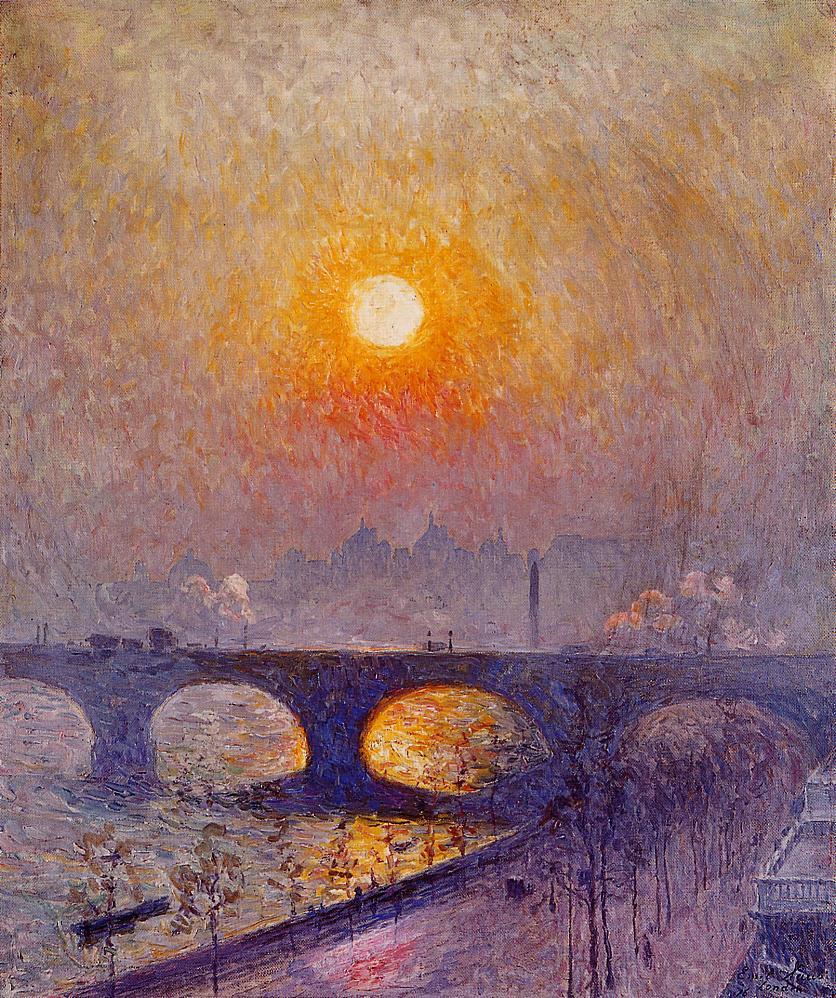
Émile Claus (1849-1924), (Sunset over Waterloo Bridge) (1916), oil on canvas, dimensions not known, location not known. WikiArt.
Emile Claus’s Sunset over Waterloo Bridge (1916) was painted from a location on the north bank of the Thames slightly to the east of Waterloo Bridge, the north end of which is prominent, and looks south-west into the setting sun, up river. Claus painted several views of Waterloo Bridge while he was in London, but doesn’t appear to have attempted any formal series, such as Monet’s.
Claus isn’t formulaic in his treatment. He uses billowing clouds of steam and smoke to great effect, and his inclusion of the road, trees and terraces in the foreground, on the Embankment, provides useful contrast with the crisp arches of the bridge, and the vaguer silhouettes in the distance. Like Monet’s series, this was probably painted from a temporary studio inside a building.
Emile Claus (1849–1924), Morning Reflection on the Thames in London (1918), oil on canvas, 72 x 92 cm, Museum voor Schone Kunsten, Ghent, Belgium. Wikimedia Commons.
Claus’s Morning Reflection on the Thames in London, from 1918, is a view over the Embankment and river that’s desaturated and made vaguer by fog.
Lesser Ury (1861–1931), London in Fog (1926), oil on canvas, 67 x 97 cm, location not known. Wikimedia Commons.
My last example is another view over the River Thames, this time by Lesser Ury. London in Fog from 1926 doesn’t appear to be a nocturne, but looks at the effects of fog on both lights and their reflections.
On 4 December 1952, a high pressure system settled over London. The wind fell away, and fog and smoke were trapped under a temperature inversion. The following day the whole of the city and an area totalling over one thousand square miles were blanketed in smog that remained until 9 December. It’s estimated that directly caused over ten thousand deaths. A succession of laws and a major campaign to eliminate open coal fires in London resulted in great improvement, although a decade later there was another lesser smog, perhaps the event I remember from my childhood. The beauty of those paintings can also be deadly.
This week brought a timely revisit to remind myself just how common the three security extended attributes (xattr) have become, and to see whether we can make use of any of them for our own purposes.
How common?
Checking through one of my ~/Documents folders containing a modest 57,884 files, nearly 60% of them have at least one xattr. By far the most common is com.apple.quarantine on 48%, followed by com.apple.provenance at 14%. Some way behind those, but still one of the most frequent, is com.apple.macl on 2.8%.
Having explained what I think macOS does with all those xattrs, the next step is to ask whether we can use them for our direct benefit. Of the three, quarantine seems least useful to anything beyond Gatekeeper. MACL is like a boil on the bum, and the only time you’ll notice it is when it gets in your way. I can’t make sense from its contents either, but as it’s protected by SIP, there’s little a utility could do to alleviate our suffering, so we just have to learn to live with it. I’m surprised how uncommon it is in comparison with the nuisance it can cause.
Promising provenance
It’s the provenance xattr that looks most promising, and Koh M. Nakagawa has followed up his recent research into its function with an open-source command toolShowProvenanceInfo that can look up provenance IDs found on files, in the ExecPolicy database’s Provenance Tracking table, although that requires root privileges for access.
Apps and executable code signed by third-parties rather than Apple are added to that table when they’ve successfully completed their first run. Each is given a unique provenance ID number that is attached to them in a com.apple.provenance xattr. When they then perform any of 11 types of file operation, such as creating a file or opening one in write mode, that app’s provenance ID is attached to the file in its own provenance xattr.
As apps and other executables that have been entered into that table have their own provenance xattrs, it shouldn’t be too much of a burden to build an independent database from those, together with other information about the executable with that provenance ID. That can then be used to examine provenance xattrs on arbitrary files, to identify which app last worked with that file, the primary task of a new GUI utility I’ve already dubbed Providable.
In addition to telling you which app with a provenance ID last changed a document, there are other functions that Providable could perform. Those property lists forming the basis for Background Items listed in Login Items & Extensions settings are normally created and changed by their owning app. When a third-party app with a provenance ID does that, the property list gains a provenance xattr that can be used to identify the app responsible. That can in turn provide information that’s often sadly lacking from the list of extensions, including the location of the app rather than that of the property list.
One obvious hole in this plan is the fact that apps that are signed by Apple, including those bundled in macOS and everything installed from the App Store, don’t get assigned provenance IDs. They therefore can’t be traced and identified from the files they create or change, as they operate outside the provenance tracking system.
Providable
My outline design for Providable is therefore to inspect provenance IDs saved as xattrs to the apps in the Data volume, and to display their details in a list you can refer to. Alongside that, a window lets you drop files on it for checking. Each will be examined for a provenance xattr, and those that have one will then be associated with the app in the list, providing its path and other details.
Provenance IDs can also be assigned to command tools and other executables, and a later version will allow you to check those in popular locations, and add them to the database so files can be matched to them as well. I don’t currently know how useful that might be, but we should get a better idea once the first version of Providable is in use.
I invite your ideas and comments, please, before I start coding.
One of the enduring memories of my childhood, spent partly in London, is walking in smog, then commonly known as a pea-souper. The combination of dense fog and smoke was so thick I could barely make out street lights, and the streets were for once almost empty, as vehicles could only proceed at walking pace.
This weekend I present a selection of paintings of mist, fog and maybe even a touch of smog on the River Thames, in and near London. Today’s paintings come from the pioneers of the nineteenth century, and tomorrow’s from the twentieth.
Many of JMW Turner’s greatest paintings take advantage of the optical effects of mist and fog. Being a Londoner, he must have experienced these all too frequently.
These peaked in Turner’s famous painting of a Great Western Railway train crossing the River Thames at Maidenhead: Rain, Steam, and Speed, exhibited at the Royal Academy in 1844. The whole image is fogbound and vague, and proved a precursor to the approach of the Impressionists after his death.
Claude Monet (1840–1926), The Thames below Westminster (1871), oil on canvas, 47 x 73 cm, The National Gallery, London. Wikimedia Commons.
Less than thirty years later, when he was taking refuge from the Franco-Prussian War, Claude Monet’s The Thames below Westminster (1871) is less Impressionist. Painted from the Embankment to the north of Westminster Bridge, near what is now Whitehall, the three towers to the south are almost superimposed, and aerial perspective is exaggerated by the mist. The river is bustling with small paddleboat steamers. In the foreground a pier under construction is shown almost in silhouette. Small waves and reflections on the river are indicated with coarse brushstrokes, suggesting this is a rapid and spontaneous work.
Winslow Homer (1836–1910), The Houses of Parliament (1881), watercolour on paper, 32.3 x 50.1 cm, Hirshhorn Museum and Sculpture Garden, Washington, DC. Wikimedia Commons.
A decade later, The Houses of Parliament is Winslow Homer’s faithful representation of the Palace of Westminster when viewed from the opposite bank of the Thames, to the north (downstream) of the end of Westminster Bridge. The tide is high under the arches of Westminster Bridge, and small boats are on the river. This classic watercolour makes an interesting contrast with Monet’s later oil paintings I show tomorrow: Homer provides little more detail, the Palace being shown largely in silhouette, but works with the texture of the paper and careful choice of pigment to add granularity. He provides just sufficient visual cues to fine detail, in the lamps and people on Westminster Bridge, and in the boats, to make this a masterly watercolour.
Jules Bastien-Lepage (1848–1884), The Thames, London (1882), oil on canvas, 54 x 74.3 cm, Philadelphia Museum of Art, Philadelphia, PA. The Athenaeum.
The following year, Jules Bastien-Lepage paid a return visit to the city, when he painted The Thames, London. This view of industrial docklands further downstream maintains detail into the far distance, except where it’s affected by the smoky and hazy atmosphere typical of the city at that time. It was this section of the river that was also painted on several occasions by James Abbott McNeill Whistler.
Tom Roberts (1856-1931), Fog, Thames Embankment (1884), oil on paperboard, 31.6 x 46 cm, Art Gallery of New South Wales, Sydney. Wikimedia Commons.
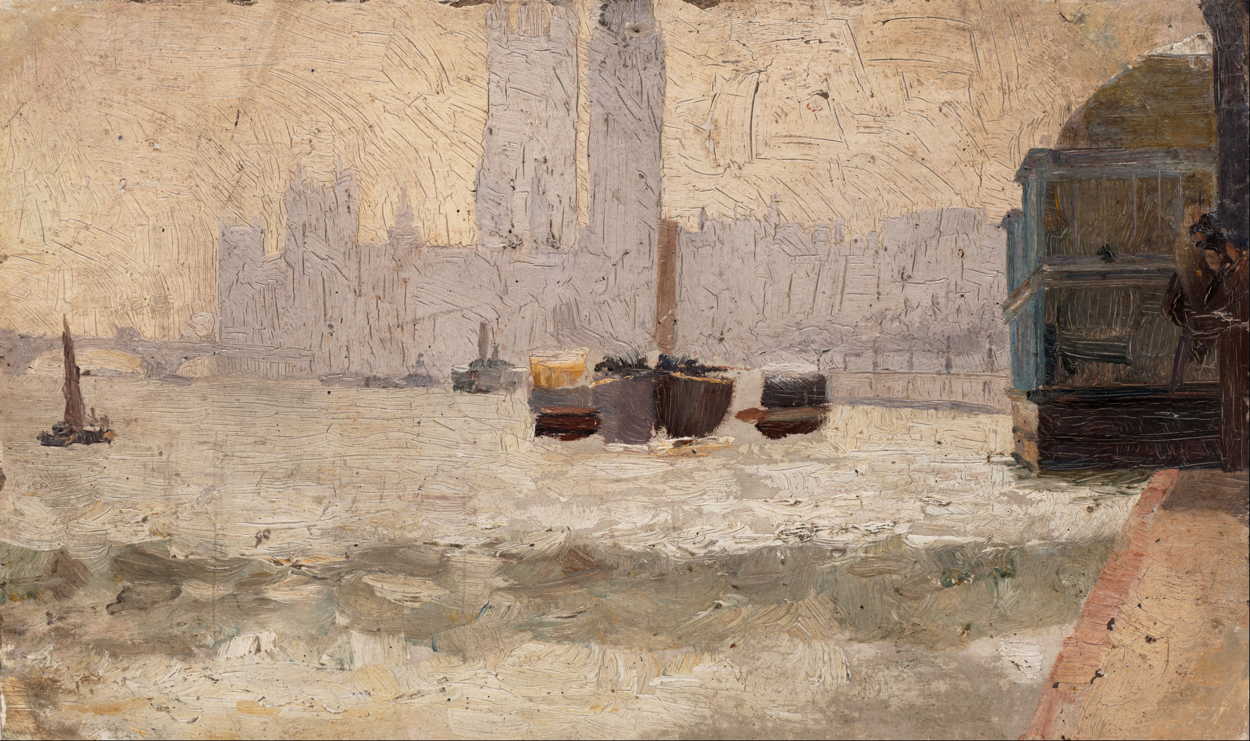
Tom Roberts’ Fog, Thames Embankment (1884) is painted from a similar location to Monet’s The Thames below Westminster above, on the Embankment to the north of Westminster Bridge, but is cropped more tightly, cutting off the tops of the Victoria and Elizabeth Towers. The Palace and first couple of arches of Westminster Bridge appear in misty silhouette, with moored barges and buildings on a pier shown closer and crisper. He renders the ruffled surface of the river with coarse brushstrokes, different from those of Monet.
Camille Pissarro (1830–1903), Charing Cross Bridge, London (1890), oil on canvas, 60 x 90 cm, National Gallery of Art, Washington, DC. Wikimedia Commons.
Among six paintings that Camille Pissarro started work on during his visit to England in 1890 was this view of Charing Cross Bridge, London from Waterloo Bridge. For this he made a sketch in front of the motif, then following his return to his studio in Éragny he painted this in oils. This looks south-west, towards a skyline broken by the Palace of Westminster and the familiar tower of Big Ben.
Frederick Childe Hassam (1859-1935), Houses of Parliament, Early Evening (1898), oil on canvas, 33 x 41.6 cm, Private collection. WikiArt.
In Frederick Childe Hassam’s Houses of Parliament, Early Evening (1898), the sun has already set, and he is viewing the Palace in the gathering dusk from a point on the opposite (‘south’) bank, perhaps not as far south as Lambeth Palace. The Victoria Tower is prominent in the left of the painting, the Central Tower is in the centre, and the most distant Elizabeth Tower is distinctive with its illuminated clock face. Moored boats in the foreground provide the only other detail. His rough facture gives a textured surface to the water.
Numbers – as in maths, not Apple’s spreadsheet – were there at the dawn of computing, and have played a major part in hardware, system software and apps ever since. This article explains some of the numeric types used by your Mac, and how they can catch you out.
Numbers in computing fall into two broad classes: those represented exactly, which are mainly integers, and those normally approximated, including most floating point numbers.
Integers
These are the simplest to represent in binary and hexadecimal, and those that play the fewest tricks. They come in several varieties, determined by their size in bytes, and whether they can be negative rather than only positive. Some of us still remember when the standard integer was represented in just eight bits. The largest unsigned integer is then 1111 1111 in binary, or FF in hexadecimal, that’s 255 in regular decimal notation. If one of those bits is used to indicate whether they include negative values, they can only lie between -127 and +127.
Soon integers grew to 16 bits, then 32, and now the standard length of 64 bits, offering a range of numbers beyond our comprehension, or even the largest of distributed file systems.
Most problems that arise in integers do so from any of five causes:
the order of bytes, which can be ‘big-endian’ or ‘little-endian’ according to processor type and setting;
conversion between different lengths;
whether signed or unsigned;
overflow, in which the product of two integers requires a number larger than the maximum for their length;
arithmetic operations such as division, when performed by zero.
Together, these can result in quite complex errors. For example, suitably misinterpreted as a signed integer using the wrong byte order, the 32-bit unsigned integer for 65,535 (0000 FFFF) can become -2,147,418,112 (FFFF 0000).
Floating point numbers
Integers are fine for counting integral objects such as people and file sizes, but in the real world most things have to be measured in floating point or decimal numbers like 3.14159. In maths, those numbers come from a continuous range that has to include extremely large positive and negative values, and many very close to zero. They’re most familiar to us from engineering or scientific notation expressing them in terms of a number from 1.0 to almost 10.0, multiplied by a power of ten, e.g. 1.68301 x 10e-6, which is just above zero at 0.00000168301.
The most widely used form of floating point number in macOS is the Double, which uses 64 bits to encode a number using similar principles to engineering/scientific notation, only the powers used aren’t decimal but binary, making them more difficult to read and understand. In decimal notation, with the radix 10, 0.00000168301 has the significand of 1.68301 and the exponent of -6, making it 1.68301 x 10e-6. As a computer Double, the radix is 2 (binary), so it has a significand of 1.76476389376 and an exponent of -20, making it 1.76476389376e-20.
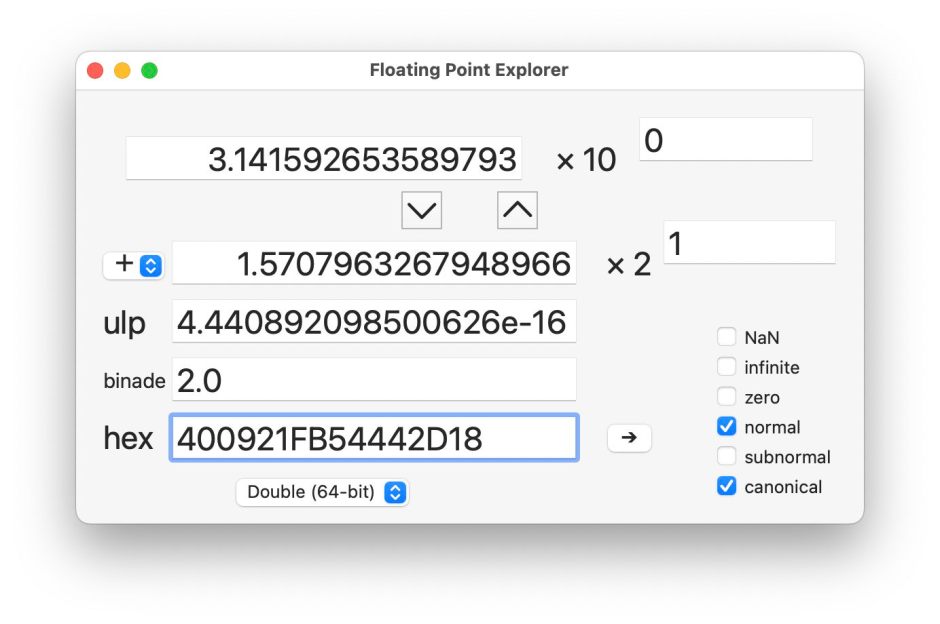
Some Doubles are exact expressions of the number they’re trying to represent. An obvious example is 1.0, represented as 1.0e0, but even fairly simple numbers like 71.3927 are confusing, with a representation of 1.1155109375e6 (radix 2). To convert between regular decimal floating point and 32- and 64-bit floating point numbers, and their hex representations, my free Mints has a Floating Point Explorer window. This is explained here.
Unlike mathematical numbers, there’s a finite number of different Doubles, and their distribution is far from even. The same Double representing 71.39270000000000 also represents 71.39270000000001, and all the numbers in between them, all but one of which is only an approximation. Around those numbers, there are roughly 70 trillion different floating point numbers per unit (1.0) step in number. These become more dense around zero, and less dense at the extreme ends of the number line. As Doubles become larger in absolute value (disregarding their sign), so they become less precise in absolute but not relative terms.
Errors
Because they’re only approximations, Doubles suffer several problems that can adversely affect calculating with them. These include rounding and cancellation errors.
Rounding errors occur because Doubles have fixed length, so the last place has to be rounded up or down to give the best approximation to the real number. The standard for floating point (IEEE 754) specifies no less than five different rounding functions, that can result in a Double being rounded up or down. Although the relative errors from rounding should be small, they can accumulate in long series of calculations to the point where they affect overall accuracy.
Cancellation errors can be very large, even when only the result of a single operation. This term refers to potentially highly inaccurate results from subtracting numbers that are very close in value. When almost all the digits of the result are lost, these errors can be catastrophic, and may cause the order of calculations to determine the result.
These can be illustrated by two simple calculations, each of which should return a result of exactly 0.0: ((10000000.001 - 10000000.000) - 0.001) * 1.0e8
and (10000000.001 - (10000000.000 + 0.001)) * 1.0e8
Yet using Swift Doubles, the first returns the incorrect result of 0.016391277311150754.
With a whole IEEE standard to themselves, floating point numbers have grown their own subdivision of errors and non-errors. The most commonly encountered of these is the NaN, Not a Number, which used to puzzle those plugging through spreadsheets when a formula attempted a heinous crime such as division by zero. The joy of NaNs is their propagation: once a NaN creeps into a calculation, it’s likely to turn the whole thing NaN. Then there are two different signed zeroes, +0 and -0, or if you really want a choice, why not have an unsigned zero too, and then decide whether you want all three to be equal or not.
Others
Some systems also support extended precision beyond Doubles. One of the advances brought by the first widely used maths coprocessor, Intel’s 8087, was the availability of 80-bit Extended calculations. Although valuable for some, in general, mixing precisions leads to further strange errors that can prove hard to trace. macOS tries to avoid those, and ARM processors don’t have any Extended features, which have to be implemented in additional libraries for those that need them.
Most recently, to accommodate AI using neural networks, smaller floating point numbers have become popular. bfloat16 numbers use only 16 bits of storage, but cover the same range as 32-bit floating point numbers with reduced precision. These promise huge gains in speed by allowing arithmetic instructions on twice the numbers at once, and are supported in CPUs in Apple’s M2 and later chips, and in GPUs.
You will occasionally come across other numeric formats, including fixed point and arbitrary precision. These don’t normally have any direct support in general purpose processors, but are implemented in libraries, making them considerably slower and non-transferable. And then there are arrays of numbers in vectors and matrices, complex numbers, and everything else that mathematicians have devised. There is no end.
Further reading
Start with Jean-Michel Muller et al (2018), Handbook of Floating-Point Arithmetic, 2nd ed, Birkhäuser, ISBN 978 3 319 76525 9. Then progress to Peter Kornerup and David W Matula (2010), Finite Precision Number Systems and Arithmetic, Cambridge UP, ISBN 978 0 521 76135 2. Complete the basics with Jean-Michel Muller (2006), Elementary Functions, Algorithms and Implementation, 3rd ed, Birkhäuser, ISBN 978 1 4899 7981 0. You can then progress to matrices, for which there is a huge literature.
In 1900, the Swiss painter and print-maker Félix Vallotton was granted French citizenship. He had cut back on his prints to paint more, and the paintings that he made were no longer Nabi, but explored themes and ideas that were to prove influential later in the twentieth century. He also broadened his interests: in the early years of the new century, he wrote eight plays and three novels, although none achieved much success.
Félix Vallotton (1865–1925), The Laundress, Blue Room (La Lingère, Chambre Bleue) (1900), oil on paper laid on canvas, 50 x 80 cm, Dallas Museum of Art, Dallas, TX. Wikimedia Commons.
In 1900, he followed his earlier mysterious interiors with The Laundress, Blue Room, set in the Vallotton apartment in Paris, with two of his step-children squatting on the folds of large fabric sheets, inside a bedroom with blue decor. Two women are sat working, one apparently on the sheets, the other on separate fabrics.
Félix Vallotton (1865–1925), Le Pont Neuf (1901), oil on cardboard, 37 x 57 cm, Kunstmuseum Winterthur, Winterthur, Switzerland. Wikimedia Commons.
Vallotton’s view of the oldest of the great bridges of central Paris, in Le Pont Neuf from 1901, is strange. Like some of the unconventional views of bridges painted in the late nineteenth century, its emphasis is on unusual perspective form, but it manages to avoid showing Pissarro’s dense throng of people, or its place among prominent buildings, and is almost unrecognisable.
Félix Vallotton (1865–1925), Woman Searching in a Cupboard (1901), oil on canvas, 78 × 40 cm, Private collection. Wikimedia Commons.
Woman Searching in a Cupboard from 1901 shuts out half its image with black screens and the doors to the cupboard, giving it a strongly geometric tone. The woman, in spite of a lamp by her side, is little more than a black silhouette too, who appears to absorb the light falling on her. The lamp itself is strange, with a shade showing some sailing ships at sea, its stand being a vertical statuette of Truth, perhaps?
Félix Vallotton (1865–1925), Poker (1902), oil on cardboard, 52 x 67 cm, Musée d’Orsay, Paris. Wikimedia Commons.
Maybe we should read Vallotton’s lamps more carefully. For the following year (1902), he painted this quartet of gamblers in a Poker session. Tucked away in a plush back-room behind a club or bar, these four are in full evening dress, playing for stakes that could be breathtaking and bankrupting. In the centre foreground is another lamp with a patterned shade, showing sailing boats, I think.
Félix Vallotton (1865–1925), Five Painters (1902-03), oil on canvas, 145 x 187 cm, Kunstmuseum Winterthur, Winterthur, Switzerland. Wikimedia Commons.
Then in 1902-03, Vallotton painted one of the seminal records of the Nabis: Five Painters, showing Pierre Bonnard (seated, left), Félix Vallotton (standing, left), Édouard Vuillard (seated), Charles Cottet and Ker-Xavier Roussel (standing, right).
His next views of interiors I find quite cinematic, as if stills from a movie, perhaps reflecting his modern approach to composition and lighting, more akin to those developed by cinematographers of the future rather than painters of the past. They also appear to have been influences over the New Objectivity that developed in central Europe in the 1920s, and later American artists like Edward Hopper.
Félix Vallotton (1865–1925), Interior, Woman in Blue Searching in a Cupboard (1903), oil on canvas, 81 x 46 cm, Musée d’Orsay, Paris. Image by Oakenchips, via Wikimedia Commons.
For his Interior, Woman in Blue Searching in a Cupboard from 1903, Vallotton painted his wife Gabrielle from the back as she stood searching in a cupboard of books.
Félix Vallotton (1865–1925), Interior with Woman in Red (1903), oil on canvas, 92.5 x 70.5 cm, Kunsthaus Zürich, Zürich, Switzerland. Wikimedia Commons.
Vallotton’s Interior with Woman in Red from 1903 develops the framing effect of multiple sets of doors, drawing the eye deeper towards a distant bedroom. The woman wearing a red dress looks away, her skirts swept back as if she has been moving towards the three steps dividing this interior into foreground and background. There are tantalising glimpses of detail on the way: discarded fabric on a settee, clothing on a chair in the next room, and half a double bed with a bedside lamp in the distance.
Félix Vallotton (1865–1925), Woman Reading in an Interior (1904), oil on board, 60.3 x 34.6 cm, Museum of Fine Arts, Houston, TX. Wikimedia Commons.
There’s dispute as to whether this painting shows a Woman Reading in an Interior, as given by its French title, or a woman writing, which appears to be its translation. Vallotton painted this in 1904, and charged it with rather less mystery, although I wonder if the lower of the paintings on the wall might be one of Degas’ works showing horseriding. As usual, the single figure doesn’t show her face as she sits at the small bureau, backlit by the window and its stained glass.
Félix Vallotton (1865–1925), Interior, Bedroom with Two Figures (1904), oil on cardboard, 61.5 × 56 cm, Hermitage Museum Государственный Эрмитаж, Saint Petersburg, Russia. Wikimedia Commons.
Interior, Bedroom with Two Figures from 1904 is one of the last of his series of mysterious interiors, and worthy of the sub-genre of the ‘problem picture’. This is another bedroom, in which the lady of the house is standing over her maid as the latter is sewing up an evening gown for her. The mistress stands with her back to the viewer, but her face is revealed in her reflection in the large mirror on the wardrobe at the back of the room. In that, the maid is all but invisible. These three figures appear in a perspective recession, and to the right of the wardrobe is a doorway, presumably leading through to the master’s bedroom.
Félix Vallotton (1865–1925), The Models’ Smoke Break (1905), oil on canvas, 130 x 195.5 cm, Kunstmuseum Winterthur, Winterthur, Switzerland. Wikimedia Commons.
In this period before the Great War, Vallotton also painted portraits, and several nudes. But the figurative painting from 1905 that I find most fascinating is this, of The Models’ Smoke Break. In an era when most adults smoked, rest periods for models, like those for other workers, were usually termed ‘smoke breaks’ even though neither woman is smoking.
Instead, one model is reclined in a pose (not a pose, as it’s a break) reminiscent of Manet’s Olympia (1863). Instead of her maid bringing her a bouquet, though, she holds a single wilted blue flower, and chats idly to another model who sits by her feet. I wish I could identify the paintings reflected in the mirror behind them, although I think the upper double portrait is that of Vallotton’s parents painted in 1886. That below looks like a coastal landscape, perhaps of Honfleur.
To follow these, Vallotton turned to classical myths.
Over the last few years, files and apps on our Macs have started to bristle with unfamiliar extended attributes (xattr). The oldest is the quarantine xattr, containing the quarantine flag, dating back to the introduction of Gatekeeper in 2012. Although its primary purpose is to determine which apps should undergo first run checks, it’s also to be found on many files. Then in macOS Catalina, the MACL xattr appeared and now seems to get attached to pretty well everything, no matter where it has come from. It was joined by the provenance xattr in macOS Ventura, and that too is spreading like wildfire on both apps and files. This article reviews why they’re there, and what you can do about them.
Quarantine
Since its introduction, Gatekeeper has drawn a distinction between apps that originated outside the Mac, and those that can be fully trusted, when performing security assessments on the first occasion. To enable that, apps that download items from the internet, or transfer them from another system on the same network, attach a quarantine xattr to every file that arrives on your Mac. When archives are decompressed, for example, the quarantine xattr is propagated to every file they contain. Gatekeeper then performs full first run checks on those apps, and in the right circumstances they may be run in translocation.
This com.apple.quarantine xattr is also attached to non-executable files, where its role isn’t clear, as they aren’t checked by Gatekeeper, and their quarantine flag isn’t cleared after they have been opened for the first time. However, you’ll find them on all items that have been downloaded by an app or tool that attaches them. As this xattr isn’t protected in any way, it’s straightforward to remove, although you should avoid doing so for apps whose origins could be suspicious, as that would prevent Gatekeeper from running its additional checks.
MACL
This is thought to be an abbreviation for Mandatory Access Control List, and might be intended to preserve privacy while allowing the user to open files. The com.apple.macl xattr is now probably the most common of all, as these get attached to any and every file, including apps, even if they were created on that Mac and never left its local storage.
This xattr contains 72 bytes of what could be two UUIDs, or just binary data. However, it’s protected by SIP, preventing any user from stripping it. This can be responsible for problems, for example files that can’t be opened in their default editor app, and some that can’t be saved. In the past one way of triggering this blocking behaviour was to set a document to be opened by default using an app other than its normal app, then saving it from that app before trying to open it again.
Perhaps the simplest way to remove this xattr is to copy the file to another volume, where the xattr is no longer protected by SIP, stripping it using my free editor xattred or the xattr command tool, then copying that back to its original location. Although it’s likely to be given another MACL xattr shortly, that should be less prone to cause problems.
Provenance
Most recent versions of macOS have what’s known as a Provenance Sandbox that enables the security system to track the origins of files, and trace which app has altered them. This has recently been detailed in full in Koh M. Nakagawa’s account of XProtect Remediator. It operates quite differently from the regular app sandbox, and doesn’t appear to impose any restrictions.
Apps that aren’t signed by Apple are assigned an 11-byte integer when they first clear Gatekeeper’s checks, and those are entered into the Provenance Tracking table in the ExecPolicy database, and attached to the app in the com.apple.provenance xattr. When that app performs operations like opening a file in write mode, or creating a new one, the same xattr with that app’s provenance ID is attached to the file. Thus, by checking the provenance ID on any file with the xattr, the app that last wrote to the file can be identified.
Provenance IDs and xattrs aren’t assigned to Apple’s own apps, or those installed from the App Store, but they are to apps that are signed using certificates other than Apple’s, and those that are notarised. When a file is created or changed by an app without a provenance ID, no xattr is attached to that file, and any existing xattr is left unchanged.
This is a powerful tool in gathering security intelligence. For example, suppose a Mac has just installed previously unknown malware that started to write files in one of the locations watched by behavioural XProtect under one of its Bastion rules. Those could be inspected, perhaps by one of the scanning modules in XProtect Remediator, the provenance ID checked against details in the Provenance Tracking table, and information forwarded to Apple for further investigation.
Evidence so far suggests that you don’t want to try to tamper with the provenance xattr, as it doesn’t appear to have any role in blocking access to files, and is working on our side. Like the MACL xattr, it’s now normally protected by SIP, so can’t be removed directly.
Summary
com.apple.quarantine is likely to be found on any app or file downloaded or transferred from another system, but appears harmless.
com.apple.macl is likely to be attached to most apps and files, even those that have remained local at all times. It can sometimes cause problems including blocking the file from being opened or saved, but is hard to remove as it’s protected by SIP.
com.apple.provenance is used to track which app has created or modified files. This can be important in security intelligence, so shouldn’t be removed, although it appears harmless and is working for our benefit.
The craft of the blacksmith goes back long before the Iron Age, but once our ancestors had learned to work cast iron (by turning it first into wrought iron), in about 1200 BCE, it became one of the key crafts in many societies. It’s also the only craft represented by a deity in the classical Greek pantheon, in the god Hephaistos, translated by the Romans to Vulcan.
He had the misfortune to have been born lame, as a result of which Hera tried to be rid of him, and threw him into the sea. He was there cared for by Thetis and others. He later assumes his role as the god of fire, volcanoes, and crafts allied to blacksmithing, including sculpture.
In paintings, Vulcan is characteristically seen in his forge, as in Tintoretto’s painterly Vulcan’s Forge (1578), one of four mythological paintings he made for the Atrio Quadrato in the Palazzo Ducale in Venice. Tintoretto was clearly familiar with the division of labour in a blacksmith’s workshop. The two well-muscled men wielding large hammers are strikers, whose brute force is more important. Vulcan is the older man at the left, who strikes the casting with his small hammer to tell them where theirs should strike.
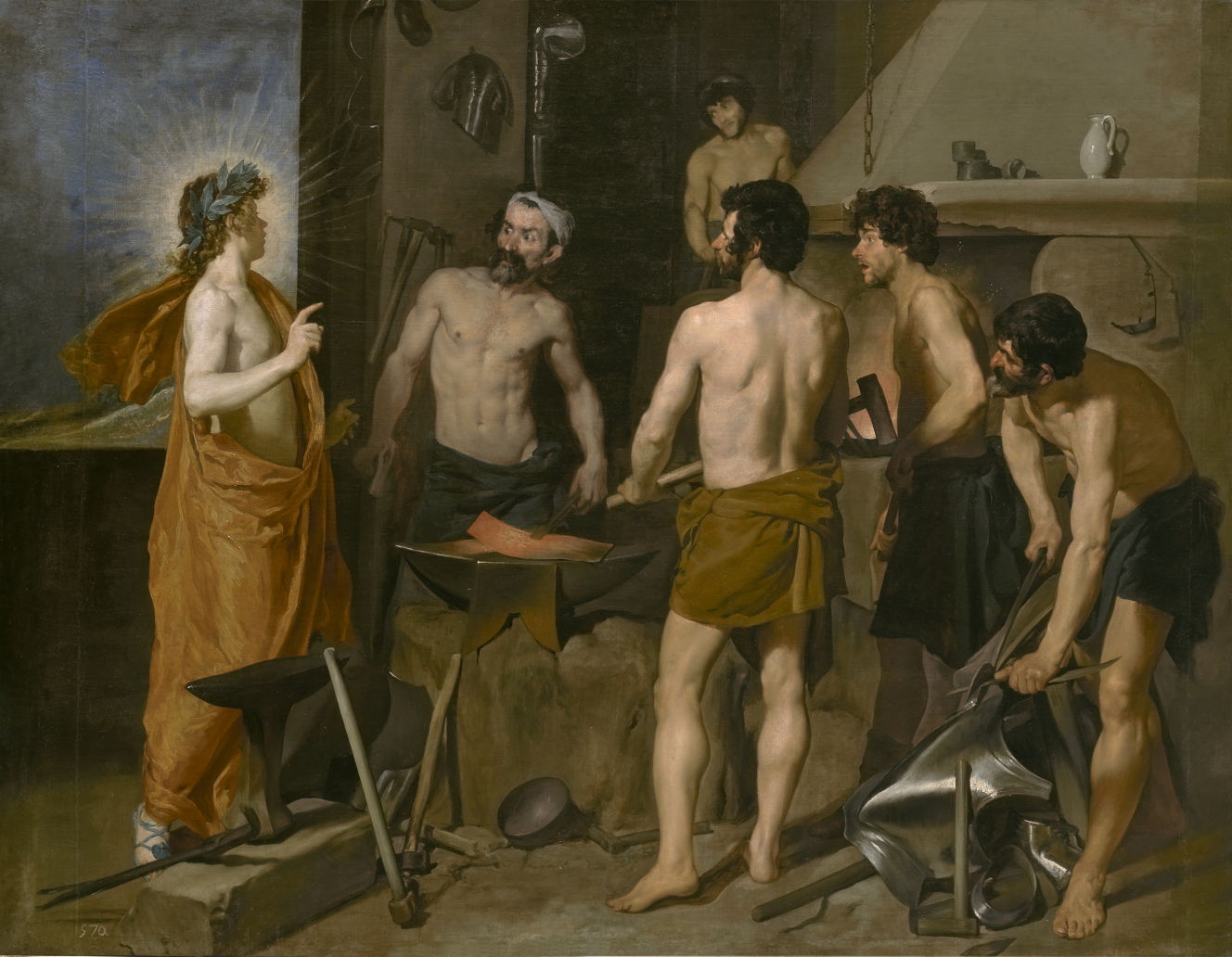
Diego Velázquez (1599–1660), The Forge of Vulcan (1630) [41], oil on canvas, 223 x 290 cm, Museo Nacional del Prado, Madrid, Spain. Wikimedia Commons.
Homer’s story of the adulterous affair of the wife of Hephaistos, Aphrodite (Venus), with Ares (Mars) is retold by Ovid in his Metamorphoses, the likely source for Diego Velázquez’s The Forge of Vulcan from 1630. This shows Apollo, at the left, visiting Hephaistos (to the right of Apollo) in his forge, to tell him about this infidelity.
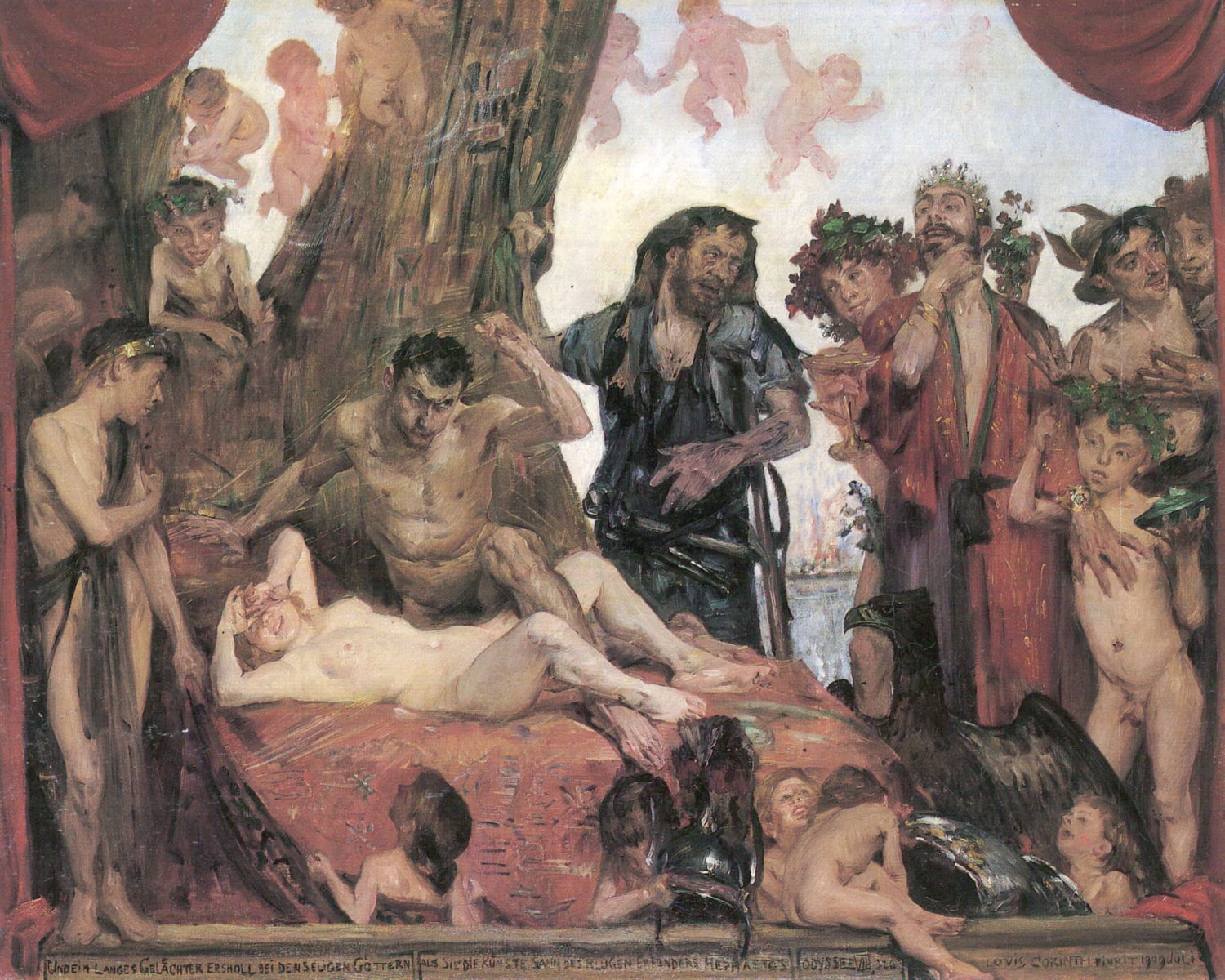
Lovis Corinth (1858–1925) Homeric Laughter (1909), oil on canvas, 98 × 120 cm, Bayerische Staatsgemäldesammlungen, Munich. Wikimedia Commons.
Homeric Laughter (1909) is one of Lovis Corinth’s most complex, even abstruse, paintings of classical myth. He provides a good clue as to its interpretation in his inscription (originally in German translation): unquenchable laughter arose among the blessed gods as they saw the craft of wise Hephaistos
together with the reference to Homer’s Odyssey book 8 line 326.
In this first version, Corinth shows Aphrodite recumbent on the bed, shielding her eyes from the crowd around her. Ares struggles with the net securing the couple, looking frustrated. Hephaistos, clad in black with his tools slung around his waist, is talking to Poseidon (who wears a crown) with Dionysos/Bacchus behind him (clutching a champagne glass). At the right edge is Hermes/Mercury, with his winged helmet. Sundry putti are playing with Ares’ armour, and an arc of putti adorns the sky.
The blacksmith also features in some accounts of the origin of Pandora.
John Dixon Batten (1860-1932), The Creation of Pandora (1913), tempera on fresco, 128 x 168 cm, Reading University, Reading, England. Wikimedia Commons.
John Dixon Batten’s The Creation of Pandora was painted anachronistically in egg tempera on a fresco ground by 1913. Batten was one of the late adherents of the Pre-Raphaelite movement, and is now almost forgotten. This work had been put into storage in 1949 and wasn’t rediscovered until 1990.
Pandora is at the centre, having just been fashioned out of earth by Hephaestus, who stands at the left, his foot on his anvil. Behind them, other blacksmiths work metal in his forge. At the right, Athena is about to place her gift of a robe about Pandora’s figure, and other gods queue behind to offer their contributions.
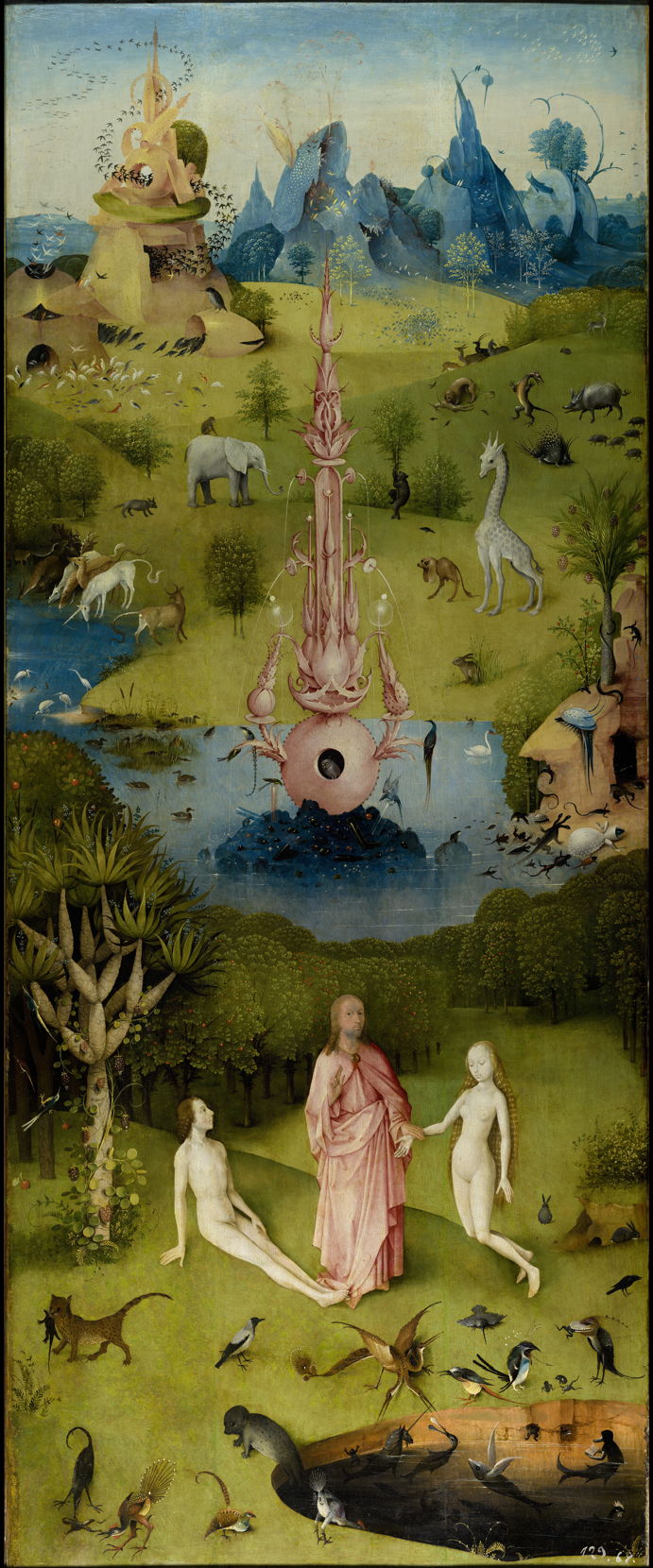
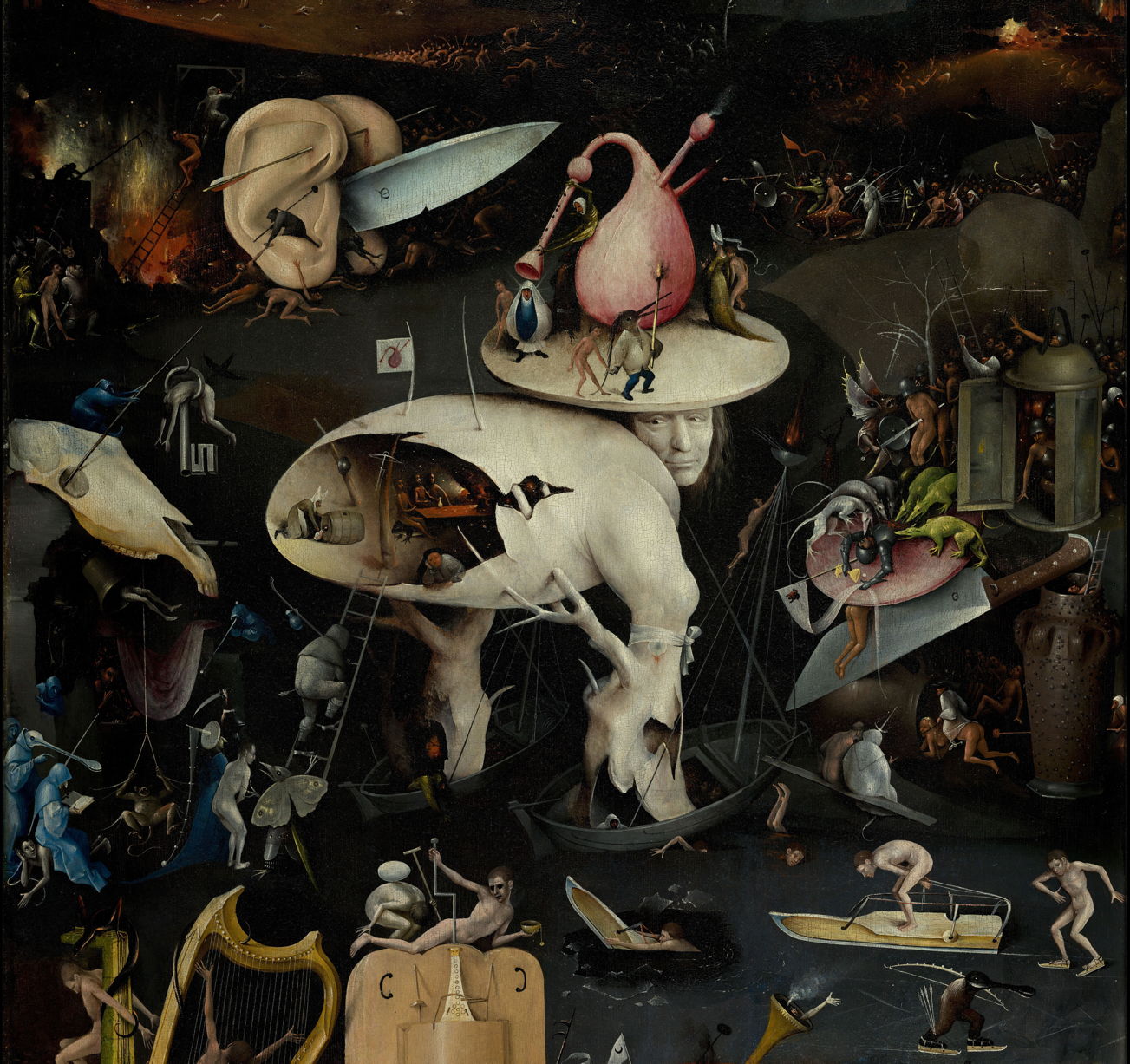
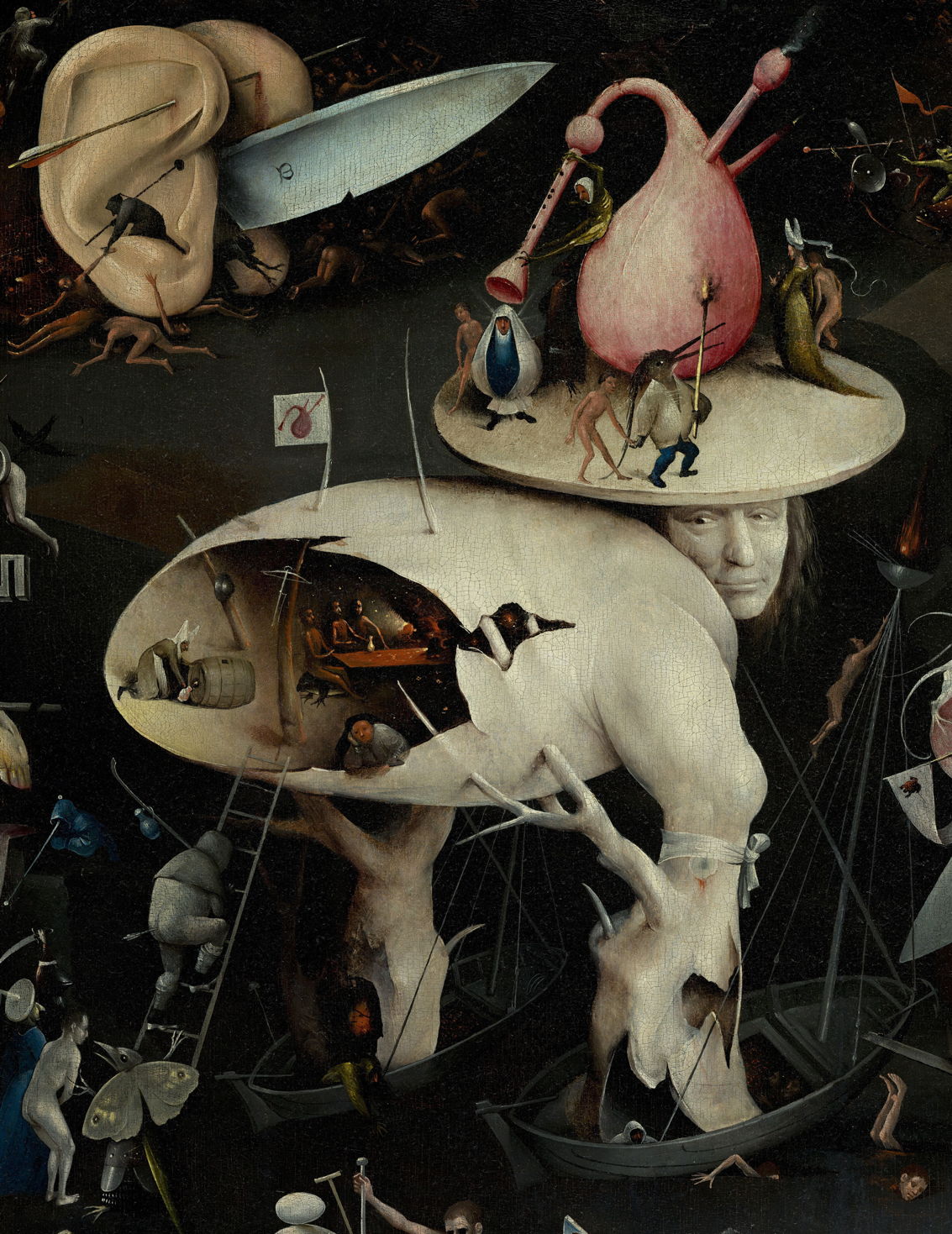
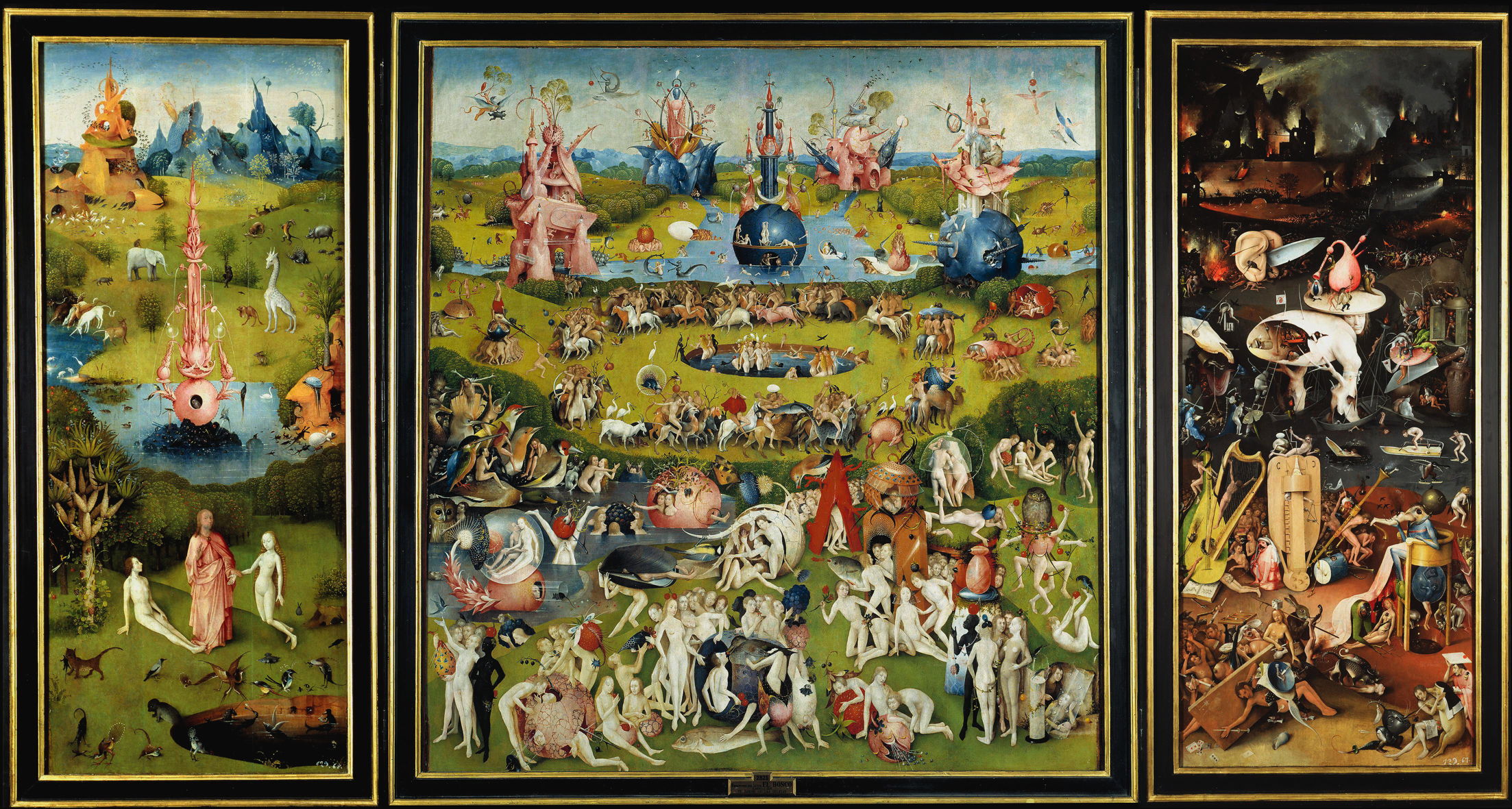
There are several fine paintings of regular blacksmiths at work over the centuries. The earliest I have been able to locate is a disturbing detail in the central panel of Hieronymus Bosch’s triptych The Last Judgment from about 1495-1505.
Hieronymus Bosch (c 1450–1516), The Last Judgment (central panel, detail) (c 1495-1505), oil on oak panel, left wing 99.5 x 28.8 cm, central panel 99.2 × 60.5 cm, right wing 99.5 × 28.6 cm, Groeningemuseum, Bruges, Belgium. Wikimedia Commons.
Among the torments featured in the centre panel are painful punishments in the blacksmith’s at the top.
Francisco Goya (1746–1828), The Forge (1812-16), oil on canvas, 181.6 x 125.1 cm, The Frick Collection, New York, NY. Wikimedia Commons.
Francisco Goya’s Forge from 1817 is a superb depiction of the physically demanding work of the blacksmith. Its extensive use of black is also a herald of the Black Period to come in Goya’s paintings at the end of that decade.
Alfred Sisley (1839-1899), Forge at Marly-le-Roi (1875), oil on canvas, 55 x 73.5 cm, Musée d’Orsay, Paris. EHN & DIJ Oakley.
Sisley’s Forge at Marly-le-Roi from 1875 shows the village blacksmiths still at work long after the Industrial Revolution brought steam-powered hammers.
Ernst Josephson (1851–1906), Spanish Blacksmiths (1882), oil on canvas, 128.5 x 107 cm, Nasjonalgalleriet, Oslo, Norway. Wikimedia Commons.
Ernst Josephson’s Spanish Blacksmiths from 1882 shows a smith in the shredded remains of his white shirt, and his striker to the right in his black waistcoat, with a horseshoe hanging below the roof of their forge in Seville.
Döme Skuteczky (1849–1921), In the Smithy (1897), mixed media, 28 × 21 cm, location not known. Wikimedia Commons.
Döme Skuteczky’s painting In the Smithy from 1897 shows another smithy, this time in Slovakia.
These days, across much of Europe the traditional blacksmith earns their keep from forging horseshoes for the many horses ridden for pleasure.
Programs running in windowing environments, applications as we used to know them, have more complicated requirements than those run from a command line. Rather than embed all the resources they require for windows, menus and the rest in a single file, Mac OS broke new ground by putting those into resources stored in the app’s resource fork.
This is QuarkXPress version 4.11 from around 2000, with its resources displayed in the resource editor ResEdit. Executable code was also stored in CODE resources, and every file contained type and creator information to support the illusions created by the Finder.
Mac OS X
When Mac OS X was designed, it switched to the bundle structure inherited from NeXTSTEP. Instead of this multitude of resources, apps consisted of a hierarchy of directories containing files of executable code, and those with what had in Mac OS been supporting resources. Those app bundles came to adopt a standard form, shown below.
The bundle name has the extension .app, and contains a single directory Contents. Within that, the executable code is in the MacOS directory, which may contain both the main executable for the GUI app and any bundled command tools provided. Another directory contains Resources, including the app’s custom icon, and components of its GUI. In some apps, there’s another directory of Frameworks containing dylibs (libraries).
There are also two important files, Info.plist and PkgInfo. The latter contains the same type and creator information inherited from Classic Mac OS, and apparently isn’t mandatory although it appears universal. The information property list is essential, as it specifies the names of the executable and its icon file in Resources, the minimum version of macOS required, type declarations of the app’s documents, version numbers, and more.
When running a command tool in macOS, its Mach-O executable is launched by launchd, whose purpose is to run code. Launching an app is more demanding, although the app’s executable is still launched by launchd. Before that can happen, macOS starts the launch process using LaunchServices and RunningBoard, which rely on information obtained from Info.plist and other components in the app bundle.
macOS
This structure remained stable until the introduction of code signatures in Mac OS X 10.5 Leopard in 2007. Accommodating those added a directory named _CodeSignature containing the signature in a CodeResources file. That includes code directory hashes (CDHashes) to check the integrity of the contents of the app bundle. Apps distributed by the App Store include a store receipt in another directory, _MASReceipt. Since 2018, when Apple introduced notarization, the ‘ticket’ issued by Apple can be ‘stapled’ into the app bundle as the file CodeResources.
Many apps come with additional items that might in the past have been installed by them in their Library/Application Support folders and elsewhere, but are now included in the app bundle. These can include the following directories:
Library, containing folders of LaunchDaemons and LoginItems that would previously have been installed in either the main Library folder, or that in the user’s Home folder;
XPCServices, for executable code that the app uses to provide specific services;
Plugins, for some types of app extension (Appex);
Extensions, for other types of app extension, including app intents.
You may also come across other components, including a version.plist in Apple’s apps.
This centralisation of components in the app bundle has brought several benefits. Being self-contained, apps are easier to install and update, and cleaner to remove. Their components are less likely to go missing, and most of all they’re held within the protection of the app’s signature and notarisation, an important improvement in security.
Assembling these into a diagram shows how the anatomy of an app has grown over the last few years.
Components shown in pale yellow are either mandatory or essentially universal. Those shown in green are found in apps distributed through the App Store, while that shown in blue is the stapled notarisation ticket (optional). You will also see additional folders and components such as Automator workflows, scripts, and others.
There is no difference in structure between apps built for current Intel and Arm architectures. That’s because binaries in the MacOS folder (and executable code in other directories like Frameworks, XPCServices and Plugins) contain platform-specific code in a single Mach-O executable. Thus, an app that’s Universal and runs native on both architectures includes code for both in its single ‘fat’ code file, and they even have separate signatures stored within common files.
in the seventeenth century, series paintings such as the four seasons and five senses tend to be created by Flemish rather than Dutch masters. There’s at least one notable exception, which also includes some of the most overt visual humour of the Dutch Golden Age, painted by Jan Miense Molenaer (c 1610-1668).
Molenaer seems to have spent much of his life in Haarlem, where he’s thought to have been an apprentice of Frans Hals. Other than marrying a fellow apprentice, Judith Leyster, in 1836, and the couple moving their shared studio to Amsterdam for eleven years, little seems known about his life.
Jan Miense Molenaer (c 1610–1668), The Dentist (1630), oil on panel, 66 x 81 cm, Herzog Anton Ulrich-Museum, Braunschweig, Germany. Wikimedia Commons.
The Dentist, painted in 1630, is one of his earlier paintings, and declares his interest in everyday life. A small crowd has gathered outside a church, where a fashionably dressed man is pulling a tooth from a local. The victim is dressed in tatters, with large holes at both his knees and worn-out shoes. Most around him have their hands clasped in prayer, presumably that the victim doesn’t break free and hit his dentist.
Several of Molenaer’s surviving paintings show the making of music, including A Young Man playing a Theorbo and a Young Woman playing a Cittern from about 1630-32. This is set in the interior of an upper middle class home, with a maid serving a meal in the right background. A theorbo is a member of the lute family, and is plucked, while a cittern has metal strings and is more like an ancestor of the guitar.
Jan Miense Molenaer (c 1610–1668), Allegory of Vanity (1633), oil on canvas, 102 x 127 cm, Toledo Museum of Art, Toledo, OH. Wikimedia Commons.
Several musical instruments also feature in his Allegory of Vanity from 1633, one of his vanitas paintings. An older woman is passing a fine-tooth comb through the long tresses of a younger woman, to check and remove parasites like lice. She is holding a mirror, and resting a foot on a human skull rather than a foot-warmer. The conventional lapdog is replaced by a golden statue, and the young boy in front of her is holding a device used to make bubbles. The woman’s jewellery is on display on a table at the right, and her make-up shown in a dressing table on the left.
Jan Miense Molenaer (c 1610–1668), Card Players by Lamplight (c 1634), oil on panel, 44 × 51 cm, Private collection. Wikimedia Commons.
Molenaer painted many scenes inside taverns and other places where drinking and gambling took place. His Card Players by Lamplight from about 1634 shows a card game in progress by the light of a lamp mounted on a stand in the foreground. The player looking directly at the viewer clearly thinks he holds the winning ace.
Jan Miense Molenaer (c 1610–1668), Family portrait of Jan Miense Molenaer (c 1635), oil on panel, 62.3 × 81.3 cm, Frans Hals Museum, Haarlem, The Netherlands. Wikimedia Commons.
In about 1635, Molenaer painted his family playing music together. Judging by the portraits hanging behind them, the artist is at the extreme left, but his wife Judith Leyster only seems to be shown in her portrait.
Two years later, he painted The Five Senses, relatively small works on panels whose origins are obscure. Most series like these are commissioned, as the chances of finding a purchaser for the whole series are low. These appear to have been completed when he was in Amsterdam, and were only purchased for the Mauritshuis in 1893.
Jan Miense Molenaer (c 1610–1668), Sight (1637), oil on panel, 19.6 x 23.9 cm, Mauritshuis, The Hague, The Netherlands. Wikimedia Commons.
Sight is one of the more straightforward to read, with a man gazing wistfully into an empty flask by the light of the lamp on the table in front of him.
Jan Miense Molenaer (c 1610–1668), Hearing (1637), oil on panel, 19.4 x 24.2 cm, Mauritshuis, The Hague, The Netherlands. Wikimedia Commons.
Hearing is more of an allusion, as three men carouse noisily over a mug of drink.
Jan Miense Molenaer (c 1610–1668), Taste (1637), oil on panel, 19.6 x 24.1 cm, Mauritshuis, The Hague, The Netherlands. Wikimedia Commons.
Taste stays in the same drinking room, as one man savours the last drop of drink, while another lights his pipe from the hot embers in a small earthenware container.
Jan Miense Molenaer (c 1610–1668), Touch (in series The Five Senses) (1637), oil on panel, 19.5 x 24.2 cm, Koninklijk Kabinet van Schilderijen Mauritshuis, The Hague, The Netherlands. Wikimedia Commons.
Touch is rich in ribald humour. The man on the left has thrust his left hand up to grope inside the woman’s skirts, for which she is about to bring her slipper down forcefully on his head.
Jan Miense Molenaer (c 1610–1668), Smell (1637), oil on panel, 19.5 x 24.3 cm, Koninklijk Kabinet van Schilderijen Mauritshuis, The Hague, The Netherlands. Wikimedia Commons.
Smell completes the series with the best of his visual jokes. The woman on the right is cleaning up the bum of the infant on her lap. This also shows severe fading on her skirt, which was painted using indigo with lead white. The original was far darker, as can be seen by the deeper blue at the edge of the panel, where the frame has shielded the pigment from light.
Although Molenaer continued to paint prolifically, this series marks his zenith, with fine examples of genre paintings during the Dutch Golden Age.
Many apps now use helpers and services to handle some of their work. Good reasons for this include needing to perform a task at a higher level of privilege, and for utilities installed into the menu bar. Background helpers can then be run as root, or provide a periodic service, split out from the main app. You manage them in System Settings, in the Login Items & Extensions part of General settings. This article looks at those set there to Open at Login, and others listed in App Background Activity. I’ll keep Extensions for another occasion.
Login Items
These are normally apps intended to be opened automatically when you log into your Mac, and most can be opened manually if you prefer. To add an app or remove it, use the + and – buttons.
To log in without any of those Login Items being started automatically, press and hold the Shift key when you click on the Log In button (at the right end of your password), and keep it held until the Dock appears. You may be asked to enter your password a second time, in which case once you have done that, press and hold the shift key again while clicking on the Log In button. Existing login items won’t then be opened until you log in again.
Background Items
Background items aren’t normally apps as such, but usually small binaries run by launchd as LaunchAgents or LaunchDaemons, in accordance with their property lists. Your control over them is limited: all you can do is turn them off and on.
If you try disabling some of them, you may see that they’re automatically re-enabled. Many appear unidentifiable, and a few have ⓘ Info buttons, to reveal where their property list is on your Mac, but many don’t. One useful piece of information given for some is whether that item affects all users, in other words is installed in a folder outside your Home folder, including the main Library and Applications folders.
Apple maintains a preference file containing details of many helpers and other executables used by major third-party apps. This may help you identify those that appear in LogIn and Background Items. This can be found at /System/Library/PrivateFrameworks/BackgroundTaskManagement.framework/Versions/A/Resources/attributions.plist
Safe mode
Diagnosing problems with helpers and services is extremely difficult, and made harder by the fact that most are now XPC services and only revealed by their entry in Activity Monitor’s lists. When they’re in trouble, they can cause almost anything, including:
unexpected or abnormal behaviour,
their entry in Activity Monitor can take high CPU and/or memory,
spinning beachballs and sluggish performance,
general instability.
The most important test to establish whether any such behaviour is likely to be the result of a third-party helper or service is to start up in Safe mode and demonstrate that the problem disappears then. This is because Safe mode blocks these helper apps and services from being launched. Unfortunately, Safe mode doesn’t help you establish the cause, nor what you should do about it.
Which Library?
In the past, most helper apps and services have been run by launchd on the basis of property lists in LaunchDaemons and LaunchAgents folders in the main Library folder, or in ~/Library/LaunchAgents. One good way to distinguish these is to create a new user account and see if the problem affects that too: if it doesn’t, then it’s more likely that helper or service is being launched from the Library folder in your Home folder rather than the main Library, in other words that the problem lies somewhere in your Home folder.
BTM dump
A better and more systematic approach is to obtain a detailed listing of all those Background Items, and uninstall or delete those you no longer need, or are just old and unnecessary. For this, you need a BTM dump, using an undocumented option to the sfltool command: sudo sfltool dumpbtm > ~/Documents/btmdump.text
to write it to the text file btmdump.text in your Documents folder. This file is also invaluable if you’re going to nuke Login Items in a reset, as it provides a record of what you might need to restore afterwards. This uses a command tool originally intended to manage the Shared File List, which has gained additional features covering Service Management, although its man page hasn’t caught up yet and the most help you’ll get is from its usage info.
This lists full Service Management information for every item currently being managed, by user ID. Normally, the two important user IDs would be 0 for root and 501 for the primary admin user, but here the first list, with a UID of -2, appears to be a composite covering most Background Items. You should also check those for the current user, such as 501. A typical entry might be: UUID: 9A087CA1-250D-4FA6-B00A-67086509C958
Name: Alfred 5.app
Developer Name: (null)
Team Identifier: XZZXE9SED4
Type: app (0x2)
Flags: [ ] (0)
Disposition: [enabled, allowed, not notified] (0x3)
Identifier: 2.com.runningwithcrayons.Alfred
URL: file:///Applications/Alfred%205.app/
Generation: 0
Bundle Identifier: com.runningwithcrayons.Alfred
This gives the location of the executable that is loaded. The Developer Name given is taken from the code signing certificate. The Disposition field is probably most relevant to identifying those causing problems, as it should reflect the status of that entry in the Login Items list, and whether the user has been notified. There’s currently no way to change or correct those, at least using the tools available.
BTM reset
The nuclear solution is to blow the whole lot away, and start from scratch, but if you don’t then delete old apps and their components, including property lists and support files tucked away in Application Support, LaunchAgents and LaunchDaemons folders, then many will return to haunt you. To remove all third-party Login Items and reset those and Background Items to installation defaults, you can use the undocumented command sudo sfltool resetbtm
following which you should restart the Mac.
Summary
Login Items are apps opened automatically when you log in, and are managed in Open at Login in Login Items & Extensions settings.
Background Items are small binaries run by launchd as LaunchAgents or LaunchDaemons, controlled in App Background Activity.
Hold the Shift key when clicking the Log In button to temporarily disable all Login Items.
Safe mode disables both Login and Background Items.
Use sudo sfltool dumpbtm to obtain a BTM dump detailing them all.
To blow them all away, perform a BTM reset using sudo sfltool resetbtm then restarting.
Oil paint has been applied to many different supports, of which the most popular and enduring have been wooden panels and stretched canvas. Panels have tended to become uncommon in recent centuries because of their weight and cost, but in the nineteenth century reappeared in novel form among those sketching in front of the motif, who took to using wood from cigar boxes.
Smoking cigars became popular during that century, particularly among the better-off living in cities. Made from chopped tobacco wrapped in a tobacco leaf, cigars are delicate and affected by humidity, so are sold in small wooden boxes often made from cedar wood. Their lids, particularly those of about 13 by 26 cm (5 x 10 inches) size, were repurposed as the support for many oil sketches. When reading their description, if they’re given as oil on panel with similar dimensions, you should suspect that they may well have been painted on a cigar-box.
The earliest artists who are known to have painted on cigar-boxes are the Italian painters known as the Macchiaioli, a breakaway movement centred on Tuscany in northern Italy from about 1850, that in many ways anticipated Impressionism.
Odoardo Borrani (1833-1905), Peasant Child at Castiglioncello (c 1865), oil on panel, 23.3 x 14.7 cm, Private collection. Wikimedia Commons.
Odoardo Borrani joined the Macchiaioli in 1855, and in about 1865 painted this Peasant Child at Castiglioncello on a wooden panel of 23.3 x 14.7 cm that had almost certainly originated in a cigar box. The unusual linear cracks seen here are characteristic of the thin cedar wood popular in cigar boxes, when used without an adequate ground.
Giovanni Fattori (1825-1908), The Rotonda at Palmieri (1866), oil on panel, 12 x 35 cm, Galleria d’Arte Moderna di Palazzo Pitti, Florence. WikiArt.
Giovanni Fattori’s plein air paintings are characteristic of the Macchiaioli: using small panoramic wood panels, he painted in macchia (taches or patches), in a style not dissimilar to that of the Barbizon School in France. This panel showing The Rotonda at Palmieri (1866) is slightly wider at 12 x 35 cm.
Giovanni Fattori (1825-1908), Portrait of Silvestro Lega, Painting Beside the Sea (1866-7), oil on panel, 12.5 x 28 cm, Private collection. WikiArt.
Fattori’s Portrait of Silvestro Lega, Painting Beside the Sea from 1866-67 is on another panel of 12.5 x 28 cm. This also shows the underlying grain, and its lack of any substantial ground. The artist shown appears to be painting in a pochade box onto another panel that may well be a cigar box.
Later in the century others followed, among them James Abbott McNeill Whistler.
James Abbott McNeill Whistler (1834-1903), Harmony in Blue and Pearl: The Sands, Dieppe (c 1885), oil on panel, 14 x 22.9 cm, National Gallery of Australia, Canberra, Australia. Wikimedia Commons.
In the 1880s, Whistler painted small outdoor views on panels, such as Harmony in Blue and Pearl: The Sands, Dieppe from about 1885. Although its dimensions are slightly different at 14 x 22.9 cm, this is almost certainly on a cigar box. The vertical streaks seen here are probably the result of a thin ground underneath the surface paint layer.
The greatest European exponent of painting on these small wooden panels was Georges Seurat, who mostly used them for studies made in preparation for his larger paintings. When Seurat started work on his monumental painting Les Poseuses(Posers, or Models) in 1886, he made a series of figure studies that are now in the Musée d’Orsay.
Georges Seurat (1859–1891), Model from the Back (study for Poseuses) (1887), oil on wood, 24.4 x 15.7 cm, Musée d’Orsay, Paris. Wikimedia Commons.Georges Seurat (1859–1891), Model Standing (study for Poseuses) (1887), oil on wood, 26 x 17.2 cm, Musée d’Orsay, Paris. Wikimedia Commons.Georges Seurat (1859–1891), Model in Profile (study for Poseuses) (1887), oil on wood, 24 x 14.6 cm, Musée d’Orsay, Paris. Wikimedia Commons.
Each was painted using Seurat’s Divisionist technique on the wooden lid of a cigar box of about 24 by 15 cm size, which the artist termed a croqueton, his favourite support for such sketches.
In the late 1880s, several artists started painting in the rural area of Heidelberg, east of Melbourne, adopting a style that later became known as Australian Impressionism. They came together in a momentous exhibition in the history of Australian art, the 9 by 5 Impression Exhibition, in Melbourne, in 1889, named from the dimensions in inches of the standard Australian cigar-box lid of 13 by 23 cm.
Its principal artists were Charles Conder, Tom Roberts, and Arthur Streeton, many of whose rough-worked and colourful plein air sketches were painted on cigar boxes.
Tom Roberts (1856-1931), Going Home (c 1889), oil on wood panel, 23.4 x 13.6 cm, National Gallery of Australia, Parkes, ACT. Wikimedia Commons.
Roberts’ Going Home from about 1889 has dimensions of 23.4 x 13.6 cm. Linear marks in the lower section appear to be the result of the grain in the wood.
Tom Roberts (1856-1931), Hutt Valley (1900), oil on panel, 10.3 x 19.1 cm, The Museum of New Zealand Te Papa Tongarewa, Wellington, NZ. Wikimedia Commons.
His oil sketch of Hutt Valley from 1900 is slightly smaller at 10.3 x 19.1 cm.
Charles Conder (1868-1909), Dandenongs from Heidelberg (c 1889), oil on wood panel, 11.5 x 23.5 cm, Art Gallery of South Australia, Adelaide. Wikimedia Commons.
Conder’s view of the Dandenongs from Heidelberg from about 1889 uses a more standard size of 11.5 x 23.5 cm.
Charles Conder (1868-1909), Ricketts Point, Beaumaris (1890), oil on wood panel, 12 x 21.5 cm, National Gallery of Australia, Parkes, ACT. Wikimedia Commons.
His Ricketts Point, Beaumaris (1890) is 12 x 21.5 cm with rounded corners.
In the twentieth century, many smokers switched to cigarettes sold in cardboard packets, and the supply of cigar-boxes dried up.
Most problems with Spotlight are assumed to be the result of it failing to index correctly. I’ve recently detailed how you can diagnose those, and explained why blindly rebuilding its indexes is often a waste of time and effort. Problems that aren’t the result of failed indexing are harder to diagnose and fix. This article describes one approach that doesn’t appear to have been used previously: restarting Spotlight.
Relaunch Spotlight
It turns out that it’s quick and easy to restart Spotlight without having to log out and back in. Open the Finder’s Settings, select the Advanced tool and toggle Show all filename extensions off and on (or on and off). While you’re doing that, watch the Spotlight icon at the right end of the menu bar, and you’ll see it vanish and reappear as Spotlight is relaunched.
This may seem strange, but is clear from the log entries. 0.727612 Finder sendAction:
marks when the checkbox was toggled by the user. Within 0.01 second, Spotlight announces it’s relaunching 0.733710 com.apple.spotlight Relaunching Spotlight to respond to user show extensions change.
Then follow log entries detailing Spotlight being shut down 0.741258 gui/501/com.apple.Spotlight [1183] exited due to exit(255), ran for 60931ms
0.741307 gui/501 [100019] service inactive: com.apple.Spotlight
0.742190 com.apple.launchservices DEATH: Received pid death for 1183, found application App:"Spotlight" asn:0x0-39039 pid:1183 refs=5 @ 0x8d0ef9080 in session "LSSession:id=100019 @ 0x102a996e0 Apps:43 ", which was not a LS launched process, so removing it.
This also takes out the StocksKit service, responsible for providing currency conversion rates and more 0.743045 pid/1183 [Spotlight] removing active service: com.apple.StocksKitService
and the Spotlight icon is removed from the menu bar 0.744222 com.apple.controlcenter Removing ephemeral displayable instance DisplayableId(4C3DBA87) from menu bar. No corresponding host (bid:com.apple.Spotlight-Item-0)
Almost immediately, a new Spotlight service is started up to replace that 0.751631 gui/501/com.apple.Spotlight [1185] service state: running
0.751651 gui/501/com.apple.Spotlight [1185] Successfully spawned Spotlight[1185] because semaphore
and its preferences are loaded ready 0.774661 Loading Preferences From User CFPrefsD
0.784283 com.apple.runningboard [osservice<com.apple.Spotlight(501)>:1185] reported to RB as running
following which there are many entries detailing Spotlight services being reinstated, and StocksKit reloading currency conversion rates.
Quite why Spotlight needs to be relaunched when you change the Show all filename extensions setting in the Finder is a mystery, but the same appears to happen in all versions of macOS from Ventura and probably earlier.
Errors
The reason I discovered this is that Adam Engst of TidBITS informed me that he sees an error message when that Finder setting is changed if Spotlight settings are also open. I’ve been unable to reproduce that, but think I can explain it, and why restarting Spotlight can be useful.
When Spotlight starts up again, it may encounter a problem with a Spotlight extension, something you’re unlikely to come across when logging in normally. That can be aided when Spotlight settings are open. If you see an error, open General settings, and Login Items & Extensions within that. At the foot of that, list Extensions By Category rather than By App, and you’ll see at the very end of the list the item named Spotlight.
Click on the ⓘ by that and review the Spotlight extensions your Mac can load. Turn off those you don’t need, click Done, then restart Spotlight again using the Finder’s Settings. That may help you to identify an extension that needs to be updated.
Summary
You can restart Spotlight by toggling Show all filename extensions in the Finder’s Settings.
This could resolve Spotlight problems that aren’t the result of indexing failure.
This could also help you identify incompatible Spotlight extensions.
Let me know if you find this useful, or just a curious quirk.
The first story on the fourth day of Boccaccio’s Decameron was told by Fiammetta, and relates the tragedy of Ghismonda and her love for Guiscardo.
Ghismonda was the daughter of Prince Tancredi of Salerno, who was known for being a benevolent ruler, but in his later years became a possessive father. He refused to let her marry until she was older than was usual, and when she did, her husband died soon after. She returned to live with her doting father, who had no interest in seeing her married for a second time, so she decided to take a lover instead.
She fell in love with a young valet to her father named Guiscardo, and he fell in love with her. Ghismonda devised an ingenious way of passing him messages concealed inside a reed. They met in an old cavern underneath the palace: Ghismonda’s room had a long-disused door that opened into the cavern, and Guiscardo descended into it from a shaft outside the walls.
Before meeting in this cavern, Ghismonda dismissed all her ladies-in-waiting, telling them she wanted to sleep. She then locked herself in her room, opened the door to the cavern, and descended its staircase to meet her lover, who had roped down from the entrance to the shaft. The couple then spent much of the rest of the day making love in her room before Guiscardo departed.
One day when the couple had arranged to meet in this way, Prince Tancredi came looking for his daughter. Seeing her outside, he settled down in a corner of her room and fell asleep. She was unaware he was there, and proceeded with her lovemaking, during which her father awoke. He remained silent and was undiscovered, eventually climbing out of a window while the couple descended into the cavern to make their farewells.
Later that night, Guiscardo was arrested on the orders of the Prince, and confined to a room in the palace without Ghismonda’s knowledge. Tancredi went to his daughter’s room, where he told her of the dishonour she had brought upon herself. She showed no contrition, nor did she seek her father’s forgiveness, but told her father honestly of the love she shared with Guiscardo, of her youth, and amorous desires. She pleaded her lover’s virtues, and asked that she should bear the brunt of any punishment, rather than her lover.
Prince Tancredi decided to take revenge not on his daughter, but on her lover. He had two of his men strangle Guiscardo, then cut his heart out. The heart was placed inside a gold chalice, and presented to his daughter “to comfort her in the loss of her dearest possession, as she had comforted her father in the loss of his”.
Before she could be given this gruesome present, Ghismonda had called for poisonous herbs, which she turned into a highly toxic potion. When the servants delivered her the chalice, she removed its lid, saw her lover’s heart, and was given her father’s message. Ghismonda raised her lover’s heart to her lips and kissed it. She then thanked the servants for her father’s priceless gift to her, bade farewell to her lover’s heart, and cried profusely over it.
Francesco Bacchiacca (1494–1557), Ghismonda with the Heart of Guiscardo (c 1525), oil on wood, dimensions not known, Lowe Art Museum, Coral Gables, FL. Wikimedia Commons.
Francesco Bacchiacca’s early painting of Ghismonda with the Heart of Guiscardo from about 1525 shows the rather distant figure crying over the heart, with her apparently disinterested ladies-in-waiting around her. In the foreground is her father’s servant who brought the chalice.
Francesco Furini (1600/03-1646), Sigismunda (c 1620-30), media and dimensions not known, Museo civico, Prato, Italy. Image by Sailko, via Wikimedia Commons.
Francesco Furini made at least two similar paintings of Ghismonda, here known by her alternative name of Sigismunda, crying profusely over the chalice. This version is thought to be from about 1620-30, and remains in Prato, Italy.
Francesco Furini (1600/03-1646), Sigismunda with the Heart of Guiscardo (c 1640), oil on canvas, 73 x 59 cm, Birmingham Museum and Art Gallery, Birmingham, England. Wikimedia Commons.
Thought to date from about 1640, this version known as Sigismunda with the Heart of Guiscardo is now in Birmingham, England. It had previously been attributed to Correggio, and was the inspiration for Hogarth’s much later painting shown below. It had only just been purchased at auction by Sir Thomas Sebright.
Interestingly, Furini’s painting of Mary Magdalene from about the same time is almost identical to the earlier version now in Prato, except that a chalice of myrrh had been substituted for that containing Guiscardo’s heart. All three works are notable for their dramatic chiaroscuro.
Mario Balassi (1604-1667), Ghismonda with the Heart of Guiscardo (1650), further details not known. Wikimedia Commons.
Mario Balassi’s Ghismonda with the Heart of Guiscardo from 1650 depicts Ghismonda being taken aback, although in Boccaccio’s account her response is strong and resolute despite the horrific cruelty of her father.
Bernardino Mei (1612-1676), Ghismunda (1650-59), oil on canvas, 66.5 x 47.5 cm, Pinacoteca nazionale di Siena, Siena, Italy. Wikimedia Commons.
It is perhaps Bernardino Mei, in his Ghismunda from 1650-59, who captures her resolute response best of all, as she stands squeezing the heart in her hand, tears still on her face.
William Hogarth’s Sigismunda Mourning over the Heart of Guiscardo from 1759 may come as something of a surprise. Hogarth seemed determined to prove that the ‘modern’ English painter could compete with the “old Italian masters” in handling such heroic narratives. This was one of his last commissions, for Sir Richard Grosvenor, in 1758. He studied Furini’s version (that now in Birmingham), which had been much admired, but when this was completed in 1759, Grosvenor rejected it.
Hogarth then exhibited it with seven other paintings at the Society of Artists in 1761. It was there savaged by the critics, who were apparently repelled by the conflict between the beauty of Sigismunda and the gruesome heart she is touching. Hogarth replaced it in the exhibition, and appears to have made changes to try to assuage its detractors. Unable to sell it or have it engraved for prints, the artist was forced to abandon it, and almost ceased painting for the remaining three years of his life.
Her ladies-in-waiting asked her why she was crying so, as they had not understood what had happened. Ghismonda then poured the deadly potion over Guiscardo’s heart, drank it, and lay down on her bed to await death. Her father was summoned, and Ghismonda asked him a final favour that she should be laid to rest beside Guiscardo. The Prince realised his cruelty and repented for it, ensuring that the two bodies were buried together in honour.
I hope that you enjoyed Saturday’s Mac Riddles, episode 336. Here are my solutions to them.
1: Interchange of wealthy words but not plain.
Click for a solution
rich text
Interchange (the format was intended for interchange of documents) of wealthy (rich) words (text) but not plain (not plain text).
2: Microsoft’s proprietary medical practitioner from 1983 until 2007.
Click for a solution
doc
Microsoft’s proprietary (although it has been reversed, it remains proprietary) medical practitioner (a doc) from 1983 until 2007 (although it has changed substantially over that period, it came with Word for MS-DOS in 1983, and was replaced by docx in Word 2007).
3: 2003-2007 = 1,050 afterword.
Click for a solution
WordML
2003-2007 (it was introduced in Microsoft Word 2003, and superseded by Office Open XML in Microsoft Word 2007) = 1,050 (ML in Roman numerals) afterword (after ‘Word’).
As promised last week, I have now produced a new version of Textovert that can extract text from PDF files and convert that to any of the nine formats supported by the app. Testing here suggests this could be generally useful, as the quality of output files appears good, and worth the small effort in conversion.
This new version offers the same conversions as the first, using textutil, but handles PDF files with a .pdf extension (case-insensitive) differently. When converting them to plain text, it loads the PDF and uses Quartz 2D’s PDF engine to extract the text for saving as a text file. When the output format is set to Rich Text (RTF), it uses the same engine to extract styled text and saves that as an RTF file. Note that doesn’t include layout information, but is generally a fairly faithful representation of the styles used in the original.
For the seven other output formats, Textovert first extracts styled text into a temporary RTF file, then hands that over to textutil to convert it to the selected output format.
Each PDF conversion is handled in a separate thread running at a high QoS in the background, to avoid blocking the main thread. As large conversions can take many seconds or even minutes to complete, Textovert’s window tracks how many are running at the moment. That’s most useful when converting batches of PDFs, when it’s easy to forget the last one or two that are still in progress.
Because each conversion gets its own thread, multiple simultaneous conversions will occupy as many CPU cores as are available, as shown in this CPU History for my seven heavyweight test PDFs. At the left of each chart the CPU % rises rapidly as all seven conversion threads are active. As those complete, the bursts of CPU activity diminish until they are from the single thread converting the largest of the PDFs.
To give you an idea of the quality of output, this is a tiny excerpt of the last of those in its original PDF:
And this is the webarchive output from Textovert viewed in Safari:
Converting PDFs does require significantly more memory than those performed by textutil alone. For most documents of more modest size, 100-500 MB is usual, but my monster test PDFs usually rise toward 5 GB during their conversion. I have checked this version for memory leaks, and although it can hold onto some memory longer than I would have expected, that doesn’t continue to rise, and no leak is apparent.
Because PDF conversions are more intricate, I have added extensive error-reporting. For example, if you try to convert a PDF containing scanned images without any recognised text, that won’t have any recoverable text available, as will be reported in the main window. Once conversion is complete, Textovert tries to delete the intermediate RTF file from temporary storage, and if that fails, you’ll be warned.
Textovert version 1.1 for macOS 14.6 and later is now available from here: textovert11
from Downloads above, and from its Product Page.
Bosch’s greatest masterpiece, and one of the greatest paintings in the world, presents an intriguing and intricate vision. Unique in its content, it remains a conversation piece half a millennium after it was painted. Having looked at the structure and higher-level reading of this extraordinarily complex triptych, this article completes my account by delving deeper into some of its details, and trying to put this together in a better understanding of its reading and purpose.
Garden of Eden
Hieronymus Bosch (c 1450–1516), The Garden of Earthly Delights (left panel) (c 1495-1505), oil on oak panel, central panel 190 × 175 cm, each wing 187.5 × 76.5 cm, Museo Nacional del Prado, Madrid. Wikimedia Commons.
The Garden of Eden in the left panel is the most conventional part of the painting, and compares with other works showing similar scenes from Genesis, if you overlook Bosch’s idiosyncratic beasts and structures.
Hieronymus Bosch (c 1450–1516), The Garden of Earthly Delights (left panel, detail) (c 1495-1505), oil on oak panel, central panel 190 × 175 cm, each wing 187.5 × 76.5 cm, Museo Nacional del Prado, Madrid. Wikimedia Commons.
God, Adam, and Eve are fairly traditional in their depiction, and Bosch chooses a happy moment. At this stage, there is no danger from the serpent, and no warning of the Fall that is to come.
Hieronymus Bosch (c 1450–1516), The Garden of Earthly Delights (left panel, detail) (c 1495-1505), oil on oak panel, central panel 190 × 175 cm, each wing 187.5 × 76.5 cm, Museo Nacional del Prado, Madrid. Wikimedia Commons.
On the left, the prominent tree bears bunches of grapes, but others in this wood carry apples, one of which has fallen to the ground. At the right are two rabbits and a crow, two of the few recognisable rather than fanciful species; another is the cat carrying prey in its mouth in front of the tree.
The strange species seen by the small lake in the immediate foreground are portmanteaux, in that each is made up of a composite of parts from other species, with visual references made to peacocks, spoonbills, seals, ducks, unicorns, and others. One duck-fish in the lake is even reading a book, and a bird on the shore has three heads. Several other paintings by Bosch use the same technique to create strange creatures.
Hieronymus Bosch (c 1450–1516), The Garden of Earthly Delights (left panel, detail) (c 1495-1505), oil on oak panel, central panel 190 × 175 cm, each wing 187.5 × 76.5 cm, Museo Nacional del Prado, Madrid. Wikimedia Commons.
The other dominant object is the fountain tower in the middle of the panel, the centre where the Tree of Knowledge (of good and evil) might be expected. This fantastic structure is made up of elements derived from plants, a technique Bosch used in other and earlier paintings. Like the panels themselves, this tower has informal symmetry about its midline, which is placed along the midline of the whole panel.
The small rocky cliff at the right edge is arranged to look like the profile view of a human face, with its eye closed.
A mixture of real, legendary, and portmanteau creatures decorate this area as well. Recognisable species include the ox, deer, elephant, monkey, black bear, giraffe, porcupine, egret, duck, and rabbit, but the more fanciful includes a lizard with three heads. Coiled around the tree at the right is a black snake, the serpent that led to the Fall.
Hieronymus Bosch (c 1450–1516), The Garden of Earthly Delights (left panel, detail) (c 1495-1505), oil on oak panel, central panel 190 × 175 cm, each wing 187.5 × 76.5 cm, Museo Nacional del Prado, Madrid. Wikimedia Commons.
The distant spires are the domain of the birds. Swift-like birds swirl out of the rock at the left, the flock weaving its way through the upper parts of its spire, and off into the sky. Others flock on the ground by species. The more distant blue pinnacles are based on plant structure, incorporating forms from other objects too.
Overall these details make this panel a most explicit and detailed vision of Paradise before the Fall of Man, assembled from Bosch’s rich and inventive imagination.
Pleasure garden
Hieronymus Bosch (c 1450–1516), The Garden of Earthly Delights (centre panel) (c 1495-1505), oil on oak panel, central panel 190 × 175 cm, each wing 187.5 × 76.5 cm, Museo Nacional del Prado, Madrid. Wikimedia Commons.
The pleasure garden in the centre panel is all about people, their pleasures and pleasuring. In stark contrast to the left panel, which contains only three human figures, the centre panel contains many hundreds. Although other objects are also involved, one of the main themes associated with pleasure here is fruit.
Hieronymus Bosch (c 1450–1516), The Garden of Earthly Delights (centre panel, detail) (c 1495-1505), oil on oak panel, central panel 190 × 175 cm, each wing 187.5 × 76.5 cm, Museo Nacional del Prado, Madrid. Wikimedia Commons.
With limited facilities to store or preserve soft fruit in particular, eating fruit and fruit itself was associated with sensual, even carnal, pleasure. Although Bosch’s innumerable figures are naked, almost without exception, strict convention forced him to allude to carnal pleasures indirectly, often here through the eating of fruit.
Hieronymus Bosch (c 1450–1516), The Garden of Earthly Delights (centre panel, detail) (c 1495-1505), oil on oak panel, central panel 190 × 175 cm, each wing 187.5 × 76.5 cm, Museo Nacional del Prado, Madrid. Wikimedia Commons.
In the left foreground, men and women are seen playing with fruit, often of greatly exaggerated size, and feeding fruit to one another. One couple is touching one another inside a transparent sphere, placed on top of a fanciful fruit floating on the lake. Another couple, who have progressed further in their lovemaking, are discreetly tucked inside the part-closed shell of a blue mussel. Giant birds watch this from the left, and a huge small tortoiseshell butterfly investigates a blue thistle flower.
Hieronymus Bosch (c 1450–1516), The Garden of Earthly Delights (centre panel, detail) (c 1495-1505), oil on oak panel, central panel 190 × 175 cm, each wing 187.5 × 76.5 cm, Museo Nacional del Prado, Madrid. Wikimedia Commons.
There are similar scenes in the right foreground, where just below the camel at the top there is a threesome taking place under a transparent dome, in which the woman to the right is clearly pregnant.
Hieronymus Bosch (c 1450–1516), The Garden of Earthly Delights (centre panel, detail) (c 1495-1505), oil on oak panel, central panel 190 × 175 cm, each wing 187.5 × 76.5 cm, Museo Nacional del Prado, Madrid. Wikimedia Commons.
The procession of animals and riders in the middle distance still uses symbolic fruit extensively, but also alludes to riding, hunting, and other mounted sports, common pleasures among the nobility of the day. The central circular pond contains figures of women, while those riding animals appear to be exclusively men: this may allude to the hunting of partners and the division of roles in courtship.
Hieronymus Bosch (c 1450–1516), The Garden of Earthly Delights (centre panel, detail) (c 1495-1505), oil on oak panel, central panel 190 × 175 cm, each wing 187.5 × 76.5 cm, Museo Nacional del Prado, Madrid. Wikimedia Commons.
Flying in the skies above are several strange objects, based sometimes on angels (right), sometimes on legendary or imaginary creatures, complete with more fruit and one tree.
Hieronymus Bosch (c 1450–1516), The Garden of Earthly Delights (centre panel, detail) (c 1495-1505), oil on oak panel, central panel 190 × 175 cm, each wing 187.5 × 76.5 cm, Museo Nacional del Prado, Madrid. Wikimedia Commons.
The towers in the background form the stage for other activities, and in the single example seen in the porthole in the base of the central dark blue tower, almost show explicit sexual activity. As with other structures, Bosch bases these towers on largely vegetable forms, and gives them informal symmetry about the midline of the panel.
The centre panel thus gives a delicately non-explicit and figurative account of the many physical pleasures which the nobility would have engaged in. It matches what we know of Bosch’s likely patron, Count Henry III of Nassau-Breda, who had a vast bed onto which drunk guests would be placed, so that he could act as voyeur over what they got up to.
Garden of Hell
Hieronymus Bosch (c 1450–1516), The Garden of Earthly Delights (right panel) (c 1495-1505), oil on oak panel, central panel 190 × 175 cm, each wing 187.5 × 76.5 cm, Museo Nacional del Prado, Madrid. Wikimedia Commons.
The ‘garden’ of Hell in the right panel is derived from the more restrained panels that Bosch had painted of Saint Anthony, such as that in his Hermit Saints triptych. This is here taken to its nightmare conclusion, in which its many figures are mutilated and tormented, in a landscape harking back to Bosch’s experience when, at the age of 13, he witnessed his home town almost burned to the ground. It moves from the mass of humanity in the centre panel to greater dominance of non-human creatures, and alarming objects.
Hieronymus Bosch (c 1450–1516), The Garden of Earthly Delights (right panel, detail) (c 1495-1505), oil on oak panel, central panel 190 × 175 cm, each wing 187.5 × 76.5 cm, Museo Nacional del Prado, Madrid. Wikimedia Commons.
In the foreground, a huge blue bird, wearing a cauldron on its head and swallowing a whole human, presides over the scene. That bird is sat on an elevated commode, defaecating blue bubbles containing the people it has been ingesting. Faces stare up from the foul brown waters of the cesspit underneath.
The two main groups of victims are clustered around objects associated with gaming and gambling, and those for making music. Placing the former on the road to hell isn’t surprising, but tormenting figures with a harp and other musical instruments may seem strange today. Various religious sects have viewed music as being sinful and the work of the devil, and some of its associated activities, particularly dancing, have attracted wider moral condemnation.
The instruments shown, at greatly exaggerated size, are (left) a lute, a harp, and a hurdy gurdy, a string instrument played by turning the crank shown at its top.
Another notable if not iconic feature in the foreground is the pig dressed partly as a nun, kissing a man, at the right lower corner.
Hieronymus Bosch (c 1450–1516), The Garden of Earthly Delights (right panel, detail) (c 1495-1505), oil on oak panel, central panel 190 × 175 cm, each wing 187.5 × 76.5 cm, Museo Nacional del Prado, Madrid. Wikimedia Commons.
On the near-black frozen surface of the river behind, there are skaters, one of whom has fallen through the ice. Another is tied to his ice craft. Above them is the Tree-Man, a unique structure to Bosch that appears in one of his drawings, presumably a study in preparation for this triptych.
Hieronymus Bosch (c 1450–1516), The Tree-Man (date not known), cat. 35, pen and brown ink on paper, 27.7 x 21.1 cm, Albertina, Vienna. Wikimedia Commons.Hieronymus Bosch (c 1450–1516), The Garden of Earthly Delights (right panel, detail) (c 1495-1505), oil on oak panel, central panel 190 × 175 cm, each wing 187.5 × 76.5 cm, Museo Nacional del Prado, Madrid. Wikimedia Commons.
At its top, on a circular disc, is another strange portmanteau object, which looks to be a cross between bagpipes and an alchemical vessel from an alembic. Further back is a pair of severed ears between which is the blade of a knife.
Hieronymus Bosch (c 1450–1516), The Garden of Earthly Delights (right panel, detail) (c 1495-1505), oil on oak panel, central panel 190 × 175 cm, each wing 187.5 × 76.5 cm, Museo Nacional del Prado, Madrid. Wikimedia Commons.
The background appears apocalyptic. Large armies are on the move: cavalry cross a bridge, and other battalions of infantry fill the roads and fields. A yacht, its sail lit, heads across the water in front of a city. Tiny figures are silhouetted against the light from fires within the large buildings there, apparently engaged in its capture and destruction. Other bodies fall spreadeagle through the air as they leap from the tops of buildings. The moon, hidden behind cloud, casts rays lighting broken clouds and the thick palls of smoke rising from the ruins.
The right panel builds a vivid picture of the torment and destruction of Hell.
Owls
There are some repeated objects shown across the triptych, of which I will consider owls. Several of Bosch’s earlier paintings, even those with little or no fanciful content, have incorporated owls, implying that he used them as a form of graphical signature. This triptych follows the pattern.
Hieronymus Bosch (c 1450–1516), The Garden of Earthly Delights (left panel, detail) (c 1495-1505), oil on oak panel, central panel 190 × 175 cm, each wing 187.5 × 76.5 cm, Museo Nacional del Prado, Madrid. Wikimedia Commons.
There are four obvious and prominent owls shown in the triptych. The first appears in the porthole cut out from the base of the central fountain tower of the left panel.
Hieronymus Bosch (c 1450–1516), The Garden of Earthly Delights (centre panel, detail) (c 1495-1505), oil on oak panel, central panel 190 × 175 cm, each wing 187.5 × 76.5 cm, Museo Nacional del Prado, Madrid. Wikimedia Commons.
Another giant owl appears at the left edge of the centre panel, being embraced by one of its figures.
Hieronymus Bosch (c 1450–1516), The Garden of Earthly Delights (centre panel, detail) (c 1495-1505), oil on oak panel, central panel 190 × 175 cm, each wing 187.5 × 76.5 cm, Museo Nacional del Prado, Madrid. Wikimedia Commons.
The second owl in the centre panel is perched on top of a couple towards the right edge. It’s being tempted by the offer of fruit, but doesn’t appear interested.
Hieronymus Bosch (c 1450–1516), The Garden of Earthly Delights (centre panel, detail) (c 1495-1505), oil on oak panel, central panel 190 × 175 cm, each wing 187.5 × 76.5 cm, Museo Nacional del Prado, Madrid. Wikimedia Commons.
The third owl in the centre panel is perched on the ‘horn’ of one of Bosch’s fanciful creatures in the procession of animals and riders.
Claims that Bosch’s owls are symbols of ignorance, false knowledge, or evil, lack support in his paintings. That one appears in the Garden of Eden, three in the garden of pleasure, and none in the garden of Hell, supports their association with more positive concepts rather than bad ones.
Synthesis
A plain grisaille painting starts the sequence off with its depiction of the creation, the perfect cover for an account in three images of the condition of mankind. We then see the first step in our history, when Adam and Eve were still secure in the Garden of Eden, surrounded by the wonders of God’s creation.
Some have suggested that the left panel, with its depiction of the emergence of animals from water, somehow hints at an evolutionary process. Viewed with a modern mind, this might appear attractive and imbue the painting with even greater meaning and magic. Half a millennium ago that would have been inconceivable: Bosch makes clear his literal belief in the Biblical account, throughout this and his other paintings. Without concepts of geological time or processes (key to the concept of evolution), such modern thinking is as alien as quantum physics.
After the Fall of Man and the expulsion from the Garden of Eden, men and women flourished and engaged in pleasures that were highly carnal and very earthly, detached from God, and outwith his commandments. These only too easily, through sins of gambling and lascivious activities associated with music, take humanity on the road to Hell, with its many torments and great suffering. Ultimately, the final panel may also refer specifically to Armageddon, the end of humanity and its world too.
Bosch takes us through this narrative with some of the richest imagery of any painting in the European canon. Its little scenes may be beautiful, puzzling, enticing, amusing, alarming, gruesome, but they are always fascinating, and the most elaborate conversation piece that you could want.
Falkenburg R (2011) The Land of Unlikeness: Hieronymus Bosch, The Garden of Earthly Delights, WBOOKS. ISBN 978 9 040 07767 8.
Fischer S (2013, 2016) Hieronymus Bosch, The Complete Works, Bibliotheca Universalis, Taschen. ISBN 978 3 8365 3850 3.
Matthijs Ilsink, Jos Koldeweij et al. (2016) pp 356-379 in Hieronymus Bosch, Painter and Draughtsman: Catalogue Raisonné, Yale UP and Mercatorfonds. ISBN 978 0 300 22014 8.
Schwartz G (2016) Jheronimus Bosch, The Road to Heaven and Hell, Overlook Duckworth. ISBNB 978 1 4683 1373 4.
Cast your mind back to when you learned to drive, ride a bike, speak a foreign language, perform a tracheostomy, or acquire any other skill. Wasn’t confidence the key to your success? Whatever we do in life, confidence is always critical. If you run a business, one of the metrics that are likely to be collected is confidence in your business, as that’s such an important economic indicator. Confidence is every bit as important in computing.
Over the last few weeks I’ve been discovering problems that have been eroding confidence in macOS. From text files that simply won’t show up in Spotlight search, to Clock timers that are blank and don’t function, there’s one common feature: macOS encounters an error or fault, but doesn’t report that to the user, instead just burying it deep in the log.
When you can spare the time, the next step is to contact Apple Support, who seem equally puzzled. You’re eventually advised to reinstall macOS or, in the worst case, to wipe a fairly new Apple silicon Mac and restore it in DFU mode, but have no reason to believe that will stop the problem from recurring. You know that Apple Support doesn’t understand what’s going wrong, and despite the involvement of support engineers, they seem as perplexed as you.
One reason for this is that macOS so seldom reports errors, and when it does, it’s uninformative if not downright misleading. Here’s a small gallery of examples I’ve encountered over the last few years, to bring back unhappy memories.
Maybe you saved an important webpage in Safari 26.1 using its Web Archive format, then a couple of days later discovered you couldn’t open it. There’s no error message, just a blank window, so you try again with the same result. Another site shows the same problem, forcing you to conclude that it’s a bug in Safari. Are you now going to devote your time to obtaining sufficient information to report that to Apple using Feedback? Or to contact Apple Support and pursue its escalation to an engineer who might fortuitously discover the cause?
Silent failures like these are least likely to be reported to Apple. In most cases, we find ourselves a workaround, here to abandon Web Archives and switch to saving webpages as PDF instead. When someone else mentions they too have the same problem, we advise them that Web Archives are broken, and our loss of confidence spreads by contagion.
Honest and understandable error reporting is essential to confidence. It enables us to tackle problems rather than just giving up in frustration, assuming that it’s yet another feature we used to rely on that has succumbed in the rush to get the next version of macOS out of the door.
Eroding confidence is also a problem that the vendors of AI appear to have overlooked, or at least seriously underestimated. It’s all very well using the euphemism of hallucination to play down the severity of errors generated by LLMs. But those can only cause users to lose confidence, no matter how ‘intelligent’ you might think your AI is becoming. Go talk to the lawyers who have been caught out by courts submitting AI fabrications whether they still have full confidence in your product.
This weekend I look at one of the greatest paintings in the world, Hieronymus Bosch’s Garden of Earthly Delights, painted between about 1495-1505. Unique in its content, it remains a conversation piece half a millennium after it was completed. This article starts at the top level, and tomorrow’s sequel delves a little into its rich and intriguing details.
Most triptychs were intended for use in places of worship, particularly as altarpieces. This one appears to have been commissioned primarily as a conversation piece for the well-educated nobility, specifically Count Henry III of Nassau-Breda (1483-1538), in what is now Belgium. It’s also one of Bosch’s best documented paintings, first being recorded only a year after his death, and described by a succession of viewers ever since.
Ilsink and others consider that Bosch’s main inspiration and source for the material in this painting was Hartmann Schedel’s extensively illustrated Weltchronik (history of the world) published in Nuremberg in 1493. This uses the same Biblical quotation that appears on the exterior of this painting. Despite those descriptions, extensive research, and many published studies since, it remains one of the most enigmatic paintings, with many different interpretations. Being so detailed, and with details which are so unusual, it is all too easy to get lost among its hundreds of cavorting figures and weird portmanteau objects.
The exterior presents an understated grisaille showing the creation. The interior has three extraordinary panels showing fantastic landscapes which are quite densely covered with figures, real and fictional creatures, and bizarre structures. At first sight these may appear overwhelming, but on more careful examination each panel has a theme and its own pictorial structure. The themes (from the left) are based on creation (the Garden of Eden), pleasure (a pleasure garden), and destruction (the garden of Hell itself).
Exterior
Hieronymus Bosch (c 1450–1516), The Garden of Earthly Delights (exterior) (c 1495-1505), oil on oak panel, central panel 190 × 175 cm, each wing 187.5 × 76.5 cm, Museo Nacional del Prado, Madrid. Wikimedia Commons.
The exterior features a grisaille painting of a portion of the earth within an orb. The surface of that earth is shown at the end of the third day of creation according to the account in Genesis: the land has been separated from water, and plants have started to develop and grow. At the top left is a miniature showing God the Father, apparently based on an engraving in Weltchronik (1493).
The inscription above the painting reads: (left) Ipse dixit et facta sunt (right) Ipse mandavit et creata sunt. This is verse 9 of Psalm 33 from the Latin Vulgate, and is translated into English as ‘For He spake and it was done; He commanded, and it stood fast.’ Opening this restrained and modest cover brings a heady rush of bright colours, greens, reds, and blues, and its seething mass of detail.
Hieronymus Bosch (c 1450–1516), The Garden of Earthly Delights (c 1495-1505), triptych, oil on oak panel, 220 x 390 cm, Museo Nacional del Prado, Madrid. Wikimedia Commons.
Left panel, creation
Hieronymus Bosch (c 1450–1516), The Garden of Earthly Delights (left panel) (c 1495-1505), oil on oak panel, central panel 190 × 175 cm, each wing 187.5 × 76.5 cm, Museo Nacional del Prado, Madrid. Wikimedia Commons.
The left panel shows an innovative view of the Garden of Eden, divided into tiers as it recedes into the background. The foreground is dominated by a scene from the account of the creation of man in Genesis, in which God has just created Eve, and introduces Eve to Adam. Adam is seated on the ground on the right hand of God. God holds Eve, on his left, by the right wrist. She appears to be kneeling on the grass on which they are stood. God wears red robes, Adam and Eve are of course naked.
Hieronymus Bosch (c 1450–1516), The Garden of Earthly Delights (left panel, detail) (c 1495-1505), oil on oak panel, central panel 190 × 175 cm, each wing 187.5 × 76.5 cm, Museo Nacional del Prado, Madrid. Wikimedia Commons.
Closer to the viewer is a small lake which is teeming with extraordinary fish, other aquatic creatures, birds, and land animals. In all about thirty are shown, few of which resemble earthly species. Behind this foreground is dense woodland, with one tree of strange form prominent at the left, similar to a type of palm.
Hieronymus Bosch (c 1450–1516), The Garden of Earthly Delights (left panel, detail) (c 1495-1505), oil on oak panel, central panel 190 × 175 cm, each wing 187.5 × 76.5 cm, Museo Nacional del Prado, Madrid. Wikimedia Commons.
The wood drops down to another lake, in the middle of which is a rocky outcrop containing gems, on which a strange red fountain tower stands. The base of that tower is a sphere with a porthole cut out, and an owl peering out from that hole. At the right is a small rock cliff, with an exotic tree growing at the top. This lake has various waterfowl on it, and at the upper left several mammals including a unicorn are drinking.
Hieronymus Bosch (c 1450–1516), The Garden of Earthly Delights (left panel, detail) (c 1495-1505), oil on oak panel, central panel 190 × 175 cm, each wing 187.5 × 76.5 cm, Museo Nacional del Prado, Madrid. Wikimedia Commons.
Further into the background the land is open grass with scattered trees, and a menagerie of animals including an elephant and a giraffe. At the far (top) left is a complex rock structure from which, and into which, a dense and long flock of swift-like birds are flying. In the far distance to the right is a low but rugged range of pale blue rock spires. The sky is clear, blue, and has many birds in flight.
Hieronymus Bosch (c 1450–1516), The Garden of Earthly Delights (centre panel) (c 1495-1505), oil on oak panel, central panel 190 × 175 cm, each wing 187.5 × 76.5 cm, Museo Nacional del Prado, Madrid. Wikimedia Commons.
Centre panel, pleasure
The centre panel shows a rolling deer park with lakes, overrun by a dense mass of naked men and women, and bizarre objects.
Hieronymus Bosch (c 1450–1516), The Garden of Earthly Delights (centre panel, detail) (c 1495-1505), oil on oak panel, central panel 190 × 175 cm, each wing 187.5 × 76.5 cm, Museo Nacional del Prado, Madrid. Wikimedia Commons.
The foreground contains a dense group of people frolicking on grass with large fruit objects, including strawberries, blackcurrants, blackberries, apples, cherries, and others. Behind that on the left is a small lake, again densely packed with people and extremely large birds, including a kingfisher.
Hieronymus Bosch (c 1450–1516), The Garden of Earthly Delights (centre panel, detail) (c 1495-1505), oil on oak panel, central panel 190 × 175 cm, each wing 187.5 × 76.5 cm, Museo Nacional del Prado, Madrid. Wikimedia Commons.Hieronymus Bosch (c 1450–1516), The Garden of Earthly Delights (centre panel, detail) (c 1495-1505), oil on oak panel, central panel 190 × 175 cm, each wing 187.5 × 76.5 cm, Museo Nacional del Prado, Madrid. Wikimedia Commons.
The middle distance is dominated by a central circular pond, in which there are more groups of people. Around them is a procession of people riding horses, camels, and other mammals, in an anticlockwise direction around the central pond. To the left and right are more groups of people interacting, apparently in playful ways, with bizarre objects, such as the tail of a massive lobster.
Hieronymus Bosch (c 1450–1516), The Garden of Earthly Delights (centre panel, detail) (c 1495-1505), oil on oak panel, central panel 190 × 175 cm, each wing 187.5 × 76.5 cm, Museo Nacional del Prado, Madrid. Wikimedia Commons.
Further into the distance is a larger lake, fed by two rivers leading off into the central distance, and one at each side of the panel. Five fantastic tower structures are by or on the river. The central deep blue tower is based on a sphere, in and on which people are active. The other four towers alternate red and blue in colour, and feature various strange superstructures and ornaments. The two in the far distance, towards the top of the panel, are built over the river.
Far beyond is rolling, wooded countryside. The skies above are blue, cloudless, and contain several bizarre flying contraptions.
Hieronymus Bosch (c 1450–1516), The Garden of Earthly Delights (right panel) (c 1495-1505), oil on oak panel, central panel 190 × 175 cm, each wing 187.5 × 76.5 cm, Museo Nacional del Prado, Madrid. Wikimedia Commons.
Right panel, destruction
The right panel is a complete contrast to the other two in showing a nighttime scene full of suffering, violence, and destruction. It is segregated into three tiers by dominant colour.
Hieronymus Bosch (c 1450–1516), The Garden of Earthly Delights (right panel, detail) (c 1495-1505), oil on oak panel, central panel 190 × 175 cm, each wing 187.5 × 76.5 cm, Museo Nacional del Prado, Madrid. Wikimedia Commons.
The foreground, based on mid-browns, shows two substantial groups of naked men and women apparently in torment or violence. The nearer group has playing cards, dice, a backgammon set, and the trappings of gaming and gambling. Behind them is a separate group apparently undergoing torment with large musical instruments including a lute, harp, and hurdy gurdy. These scenes, on the left, are being overseen by a large bird sitting on an elevated commode.
Hieronymus Bosch (c 1450–1516), The Garden of Earthly Delights (right panel, detail) (c 1495-1505), oil on oak panel, central panel 190 × 175 cm, each wing 187.5 × 76.5 cm, Museo Nacional del Prado, Madrid. Wikimedia Commons.
The middle distance changes to dark grey and black. There is a frozen river, and rising up from that is a weird shell similar to the upper torso of a man’s body, and head, with its arms formed from hollow tree trunks resting in small boats. People there are being tormented by bizarre portmanteau creatures.
Hieronymus Bosch (c 1450–1516), The Garden of Earthly Delights (right panel, detail) (c 1495-1505), oil on oak panel, central panel 190 × 175 cm, each wing 187.5 × 76.5 cm, Museo Nacional del Prado, Madrid. Wikimedia Commons.
The far distance, based on black with red fire and pale yellow shafts of light, is far darker and objects are only made out in silhouette. It shows strife, fire and destruction in the massive buildings of a city.
Composition
Each of the three panels shows a landscape receding into the background. The prominent features within each panel are composed with informal symmetry within that panel, and across the triptych as a whole.
Hieronymus Bosch (c 1450–1516), The Garden of Earthly Delights (c 1495-1505), triptych, oil on oak panel, 220 x 390 cm, Museo Nacional del Prado, Madrid. Wikimedia Commons.
In the left panel, the dominating passages are the foreground figures, centred on God who is in the midline, the red tower in the lake, which is in the midline, and in the distance four pinnacles spread across the skyline.
In the centre panel, the round pond in the middle distance is in the midline, and just above the centre of the panel. The five distant towers are arranged symmetrically about the midline, with the central dark blue tower in the midline.
The dominant feature of the right panel is the ‘man-tree’ structure, which is in the midline just above the centre of the panel.
There are no comparable paintings from the same era, or indeed any period prior to the twentieth century, against which this can reasonably be compared.
History
There has never been any serious doubt that this is an authentic work by Bosch’s hand, and its provenance has been traced back to 1517, when it was at the Nassau Palace in Brussels. Later that century it moved to Spain, and was presented to the Escorial by Philip II in 1593.
Various periods of conservation work have been undertaken, including some retouching and other work to address wear and deterioration in the paint surface. The last major work was undertaken in 1999-2000.
Falkenburg R (2011) The Land of Unlikeness: Hieronymus Bosch, The Garden of Earthly Delights, WBOOKS. ISBN 978 9 040 07767 8.
Fischer S (2013, 2016) Hieronymus Bosch, The Complete Works, Bibliotheca Universalis, Taschen. ISBN 978 3 8365 3850 3.
Matthijs Ilsink, Jos Koldeweij et al. (2016) pp 356-379 in Hieronymus Bosch, Painter and Draughtsman: Catalogue Raisonné, Yale UP and Mercatorfonds. ISBN 978 0 300 22014 8.
Schwartz G (2016) Jheronimus Bosch, The Road to Heaven and Hell, Overlook Duckworth. ISBNB 978 1 4683 1373 4.
Yesterday’s explainer covered a range of text formats, but stopped short of one of the most popular formats for text documents, Adobe’s Portable Document Format, PDF. Its origins are as old as the Mac, and it hasn’t changed much since the start of this century, so PDF is very different from the more recent file formats, and from its antecedent PostScript.
PostScript
PostScript files, with the extension .ps, start with a prologue containing metadata such as %!PS-Adobe-3.0
%%Title: c:\output\online.dvi
%%Creator: DVIPSONE 0.8 1991 Nov 30 16:22:12 SN 102
%%CreationDate: 1992 Mar 26 10:04:36
They then largely consist of dictionaries of PostScript programs, instructions that are to be used to construct the page being described, such as %%Page: 3 4
dvidict begin bp % [3]
38811402 d U
-34996224 d u
-1582039 d U
29614244 r
f2(3)s O o
34996224 d u
-34340864 d u
8708260 r(of)s
185088 W(abstractions,)s
191757 X(such)S(as)S(\\mixed)S(blessing")S(and)S(\\retaliation,")T(in)S
(semantic)S(nets)S(that)s o
and so on. These place each item of text and graphics on that page. PDF is completely different in that it consists of a tree of objects, sometimes many hundreds or thousands of them.
PDF
To be recognised as a PDF file, the first line must start with the ‘magic’ characters and give the version used: %PDF-1.3
followed by a short line of non-ASCII bytes. It may appear surprising that macOS still writes a version that was defined in 1999, when the current version is 1.7 (before ISO standardisation) or 2.0 (standardised), and the Quartz 2D PDF engine may also report version 1.4. At least these ensure wide compatibility.
Then follows the main data, as a series of objects arranged in a flattened tree structure, starting like 3 0 obj
<< /Filter /FlateDecode /Length 158 >>
[…stream length 158…]
with a binary stream of data, which is here compressed using the Flate method (an improvement on LZW), terminated by endobj
which defines object number 3.
Some objects consist of code or definitions, such as 1 0 obj
<< /Type /Page /Parent 2 0 R /Resources 4 0 R /Contents 3 0 R /MediaBox [0 0 595 842]
>>
endobj
which is a Page dictionary.
Somewhere towards the end of the file, you’re likely to find an object containing metadata, such as details of the PDF engine that built the file: 11 0 obj
<< /Title (Untitled) /Producer (macOS Version 26.1 \(Build 25B78\) Quartz PDFContext)
/Creator (DelightEd) /CreationDate (D:20251126211410Z00'00') /ModDate (D:20251126211410Z00'00')
>>
endobj
Right at the end of the PDF file comes the cross reference, which starts like xref
0 12
0000000000 65535 f
0000000252 00000 n
and ends with a trailer trailer
<< /Size 12 /Root 8 0 R /Info 11 0 R /ID [
] >>
startxref
8785
%%EOF
and that EOF marker ends the PDF file.
Problems
Objects, as elements on the page, can be laid out almost randomly, something that often makes converting laid-out columns of text so infuriating. PDF can just drop in blocks of text and images in whatever order they come, which often doesn’t coincide with the original flow in the text. As a PDF file proceeds one page at a time, multiple columns laid out over several pages can be particularly disastrous to extract as text, or to reconstitute in any other way.
PDF files are extremely verbose, and their contents are now largely unreadable due to the extensive use of binary streams of data, and all their supporting information. A document containing a single character may thus result in a PDF file of 160 lines, making even expansive XML files look concise in comparison. The example file used in yesterday’s article takes 9 KB in storage, for a total of only 11 PDF objects.
When a PDF file is changed by annotation, the contents of each annotation are added to the file as further objects. To save apps from having to rewrite the whole PDF file every time a change is made, changes can be appended to the end of the main file contents. Those can then be incorporated into the body by rewriting the file in ‘flattened’ form.
It’s also important to remember how old the roots of PDF are. The first volume of the Unicode standard 1.0 wasn’t published until 1991, and its introduction into Mac OS was long delayed after that. Consequently, PDF remains based on 8-bit extended ASCII text, with the main characters in a PDF file still being original 7-bit ASCII. Handling characters is generally accomplished by specifying individual characters in a specific font. This is why font substitution in PDF documents so commonly results in incorrect characters being displayed, with characters outside the extended ASCII set being most vulnerable. In worst cases, this mojibake can render entire documents incomprehensible.
Just after Christmas, on 29 December, we will commemorate the centenary of the death of one of the most curious French painters of the time. Félix Vallotton (1865–1925) followed the academic tradition, became one of the Nabis, painted a series of disturbing domestic interiors, and some of the finest landscapes of the early twentieth century. This brief series scratches the surface of his eclectic art.
Félix Édouard Vallotton was born in Lausanne in Switzerland, and moved to Paris in 1882 to study under Jules Joseph Lefebvre and Gustave Boulanger at the Académie Julian. His early influences included the paintings of JAD Ingres, and he started painting portraits following the academic tradition.
Félix Vallotton (1865–1925), Self-portrait at 20 (1885), oil on canvas, 70 x 55 cm, Musée cantonal des beaux-arts, Lausanne, Switzerland. Wikimedia Commons.
Among those early works is this Self-portrait at 20 from 1885.
Félix Vallotton (1865–1925), Félix Jasinski in his Printmaking Studio (1887), further details not known. Wikimedia Commons.
In the late 1880s he learned to make prints, apparently through his friendship with the Polish artist in his painting of Félix Jasinski in his Printmaking Studio from 1887. Although Jasinski was successful at the time, his work now seems to have been largely forgotten. Vallotton soon became fascinated by Japanese woodcuts, including ukiyo-e that had become so popular in the late nineteenth century. He collected them, and in 1891 started making his own woodcuts.
Félix Vallotton (1865–1925), The Visit, or Top Hat, Interior (La visite or Le Haut-de-forme, intérieur) (1887), oil on canvas, 32.7 x 24.8 cm, Musée Malraux (MuMa), Le Havre, France. Image by Pymouss, via Wikimedia Commons.
The year that he left the Académie Julian, he started painting his long series of domestic interiors that could be read as ‘problem pictures’ with open narrative. He began gently with The Visit or The Top Hat, Interior (1887), the year that he also exhibited his first two paintings (both portraits) at the Salon. A top hat and walking stick are parked on a chair just inside an apartment, whose door is partly open. Everything looks in order, except for the painting hanging on the wall at the right, which is at an odd angle.
Félix Vallotton (1865–1925), The Sick Girl (1892), oil on canvas, 74 x 100 cm, Private collection. Wikimedia Commons.
The Sick Girl from 1892 uses a theme that was popular with Naturalist painters throughout the 1880s and into the 1890s. His model was his muse and lover Hélène Chatenay, whom he had met in 1889. They remained a couple until the late 1890s, and in 1907 she was tragically killed by a car.
His detailed realism here extends to showpiece surface reflections from the glassware and polished wood, but he curiously obscures the face of the young woman in her sickbed by reversing the bed’s normal orientation. Many of his apparently humdrum interiors have unusual twists such as this, adding the strangeness later to be formally exploited in Surrealism. Another odd feature in this painting is that the maid who has just entered the room appears to be heading towards the viewer, and isn’t even looking towards her patient.
Félix Vallotton (1865–1925), La Cuisinière au fourneau (The Cook at the Stove) (1892), oil on panel, 33 x 41 cm, Private collection. Wikimedia Commons.
The Cook at the Stove, or simply The Cook, from 1892 is another domestic genre scene drawn from Naturalism, and features Hélène Chatenay again. She stands at the solid-top range in a kitchen strangely almost devoid of the one thing that kitchens are for: food. The only edible item visible is a bunch of onions suspended in mid-air. Everything – the chairs, pots and pans, and the range itself – is spotless as if they have never been used, and appear unnatural.
In 1892, Vallotton made lifelong friendships with key members of the Nabis, including Pierre Bonnard, Ker-Xavier Roussel, Maurice Denis, and Édouard Vuillard. Because of his Swiss origins, he was dubbed the Foreign Nabi.
Félix Vallotton (1865–1925), Bathing on a Summer Evening (1892-93), oil on canvas, 97 x 131 cm, Kunsthaus Zürich, Zürich, Switzerland. Wikimedia Commons.
His most overtly Nabi painting is Bathing on a Summer Evening from 1892-93. These flattened and stylised figures representing women of all ages have been applied like collage to a background reminiscent of some of Ferdinand Hodler’s alpine meadows.
Félix Vallotton (1865–1925), Waltz (1893), oil on canvas, 61 x 50 cm, Musée d’art moderne André-Malraux (MuMa), Le Havre, France. Wikimedia Commons.
In 1893, Vallotton painted his remarkable Waltz, on which he appears to have sprinkled thousands of multi-coloured dots to give its surface a fine sparkle. Couples sweep across an unseen dance floor, embraced in a lover’s waltz, with just one of their faces clearly visible.
Félix Vallotton (1865–1925), Street Scene in Paris (1895), gouache and oil on cardboard, 35.9 x 29.5 cm, Metropolitan Museum of Art, New York, NY. Wikimedia Commons.
Unlike Pierre Bonnard, Vallotton doesn’t appear to have painted many views of Paris, but this Street Scene in Paris from 1895 shows more Nabi style and some overlap with Bonnard’s contemporary motifs, even down to the dog wandering in the middle of the road.
Félix Vallotton (1865–1925), Misia at Her Dressing Table (1898), distemper on cardboard, 36 x 29 cm, Musée d’Orsay, Paris. Wikimedia Commons.
Like the other Nabis, Vallotton became involved with the Natanson brothers, and their magazine Revue Blanche published a series of ten of his prints of interiors in 1898. He provides us with a glimpse into the private life of Misia Natanson, as she was at the time, in his Misia at Her Dressing Table (1898), again in Nabi style.
Félix Vallotton (1865–1925), The Red Room (La Chambre rouge) (1898), distemper on cardboard, 50 x 68.5 cm, Cantonal Museum of Fine Arts, Lausanne, Switzerland. Wikimedia Commons.
Vallotton remained under Nabi influence when he painted The Red Room in 1898 to the extent that he used distemper, a traditional medium the group had resurrected. A man and woman stand in a loose embrace in the doorway of a living room with brick red decor. Above the fireplace is what could be a mirror, or a painting, in which a person dressed in black is standing in the distance, apparently looking away from the couple.
Félix Vallotton (1865–1925), The Visit (La Visite) (1899), distemper on cardboard, 55.5 x 87 cm, Kunsthaus, Zürich, Switzerland. Wikimedia Commons.
A similar well-dressed couple embrace more closely in The Visit from 1899, also painted in distemper. Once again, Vallotton leaves the painting’s underlying narrative open.
Félix Vallotton (1865–1925), The Ball (1899), oil on cardboard on wood, 48 x 61 cm, Musée d’Orsay, Paris. Wikimedia Commons.
As he moved on from his brief affair with the Nabis, and the group itself disintegrated, Vallotton experimented with unusual points of view, as in The Ball from 1899. A young girl is chasing her red ball, as two women talk in the distance. This is seen from mid-air above the girl, forming a simple but compelling motif with an air of mystery.
In the last year of the nineteenth century, he turned to painting landscapes on the north coast of France.
Félix Vallotton (1865–1925), On Dieppe Beach (1899), oil on cardboard, 42 x 48 cm, Private collection. Wikimedia Commons.
On Dieppe Beach from 1899 reduces this scene as only a printmaker could, to discrete forms filled with colour: the textured sand, sea, sky, and the simplified shapes of the three figures with a parasol.
Félix Vallotton (1865–1925), Seafront at Étretat (1899), oil on cardboard, 33 x 53 cm, Private collection. Wikimedia Commons.
He even painted one of the formative coastal landscapes of Impressionism, in his Seafront at Étretat (1899). Watching a gathering of fashionable ladies on the promenade is the cyclopean eye of the Manneporte.
In 1899, Vallotton married Gabrielle Rodrigues-Henriques, a rich young widow who already had three children. The following year, he was granted French citizenship. In the early years of the new century, he was to concentrate on painting further strange motifs.

 Login
Login