
Reading view

There are new articles available, click to refresh the page.

The Dutch Golden Age: Ordinary people

Patronage is bad for art, particularly for paintings. Whether they come in the form of commissions for churches or by the powerful and wealthy, paintings to please others are inevitably constrained by what those others want to see. Until the seventeenth century, there were remarkably few depictions of ordinary, everyday people. Then, at about the same time, that changed in paintings by the likes of Bartolomé Esteban Murillo (1617–1682) in Spain, and the Brueghel family and David Teniers the Younger (1610–1690) in Brabant to the south of the Dutch Republic. In the Dutch Golden Age such paintings rose to popularity, and must have graced the walls of many Dutch homes. This article looks at a small selection of those that have survived.

metsuwasherwoman
Gabriël Metsu (1629–1667), Washerwoman (c 1650), oil on panel, 23.9 × 21 cm, Muzeum Narodowe w Warszawie, Warsaw, Poland. Wikimedia Commons.

Portraits of women washing linen first became popular in Dutch and Flemish ‘cabinet’ paintings, such as Gabriël Metsu’s Washerwoman (c 1650), along with other scenes of household and similar activities. This painting appears authentic and almost socially realist: the young woman appears to be a servant, dressed in her working clothes, with only her forearms bare, and her head covered. She’s in the dark and dingy lower levels of the house, and hanging up by her tub is a large earthenware vessel used to draw water. She looks tired, her eyes staring blankly at the viewer.

Gabriel Metsu (1629–1667), The Kitchenmaid (1656), oil on panel, 28.7 x 23.9 cm, Alte Pinakothek, Munich, Germany. Wikimedia Commons.

Metsu’s Kitchen Maid from 1656 is preparing a trussed-up chicken to be roasted on a metal skewer over an open fire. Behind her, hanging from a hook, is a small furry mammal probably intended to be a rabbit, although it worryingly looks more like a very large cat. Below it in the otherwise empty fireplace is a bowl of what look like potatoes.

Gabriel Metsu (1629–1667), The Vegetable Market in Amsterdam (c 1660-61), oil on canvas, 97 x 84 cm, Musée du Louvre, Paris. Image by Shonagon, via Wikimedia Commons.

Metsu followed his subjects beyond the home, here into The Vegetable Market in Amsterdam in about 1660-61. The mistress stands with a metal pail on her arm, detached from the housekeeper to the left of centre, who is bargaining with one of the vendors. Other figures are drawn from a broad range of classes, and there’s produce ranging from cauliflowers to chickens.

Gabriel Metsu (1629–1667), Woman Selling Herring (c 1661-62), oil on panel, 37 x 33 cm, Rijksmuseum Amsterdam, Amsterdam, The Netherlands. Wikimedia Commons.

His Woman Selling Herring (c 1661-62) is going from door to door with her fish, here trying to convince an old woman standing with a stick at the door of her dilapidated cottage.

Gabriel Metsu (1629–1667), The Pancake Baker with a Boy (1655-58), oil on canvas, 65 x 58 cm, Gemäldergalerie, Berlin, Germany. Wikimedia Commons.

Out in the country, Metsu finds The Pancake Baker with a Boy (1655-58), again with fascinating detail. The cook in her roadside tent offers an impressive menu, with fish being supervised by a watchful cat, pancakes cooked to order from the batter in the earthenware pot by the woman’s left leg, and a few apples. Her trade seems to extend to shellfish too, with what appears to be a lobster peering from a wickerwork basket on the table, and a couple of empty mussel shells underneath it. This is the Dutch equivalent of the Spanish bodegone, popular in the earlier years of the century, and successfully painted by Velázquez early in his career.

Several of Vermeer’s masterpieces depict ordinary people in everyday life, among them his Milkmaid from about 1658-1661.

Johannes Vermeer, The Milkmaid (c 1658-1661), oil on canvas, 45.5 x 41 cm, The Rijksmuseum, Amsterdam. WikiArt.
Johannes Vermeer (1632-1675), The Milkmaid (c 1658-1661), oil on canvas, 45.5 x 41 cm, The Rijksmuseum, Amsterdam. WikiArt.

A maid is pouring milk from a jug, beside a tabletop with bread. In the left foreground the bread and pots rest on a folded Dutch octagonal table, covered with a mid-blue cloth. A wicker basket of bread is nearest the viewer, broken and smaller pieces of different types of bread behind and towards the woman, in the centre. Behind the bread is a dark blue studded mug with pewter lid, and just in front of the woman a brown earthenware ‘Dutch oven’ pot into which she is pouring milk.

Figures in the animal paintings of Paulus Potter and Gerard ter Borch were also thoroughly ordinary.

potterpeasantfamilyanimals
Paulus Potter (1625–1654), Peasant Family with Animals (1646), oil on panel, 37.1 x 29.5 cm, Alte Pinakothek, Munich, Germany. Wikimedia Commons.

Paulus Potter’s Peasant Family with Animals (1646) shows a family with a curiously grotesque young daughter, their cottage, and some wizened trees.
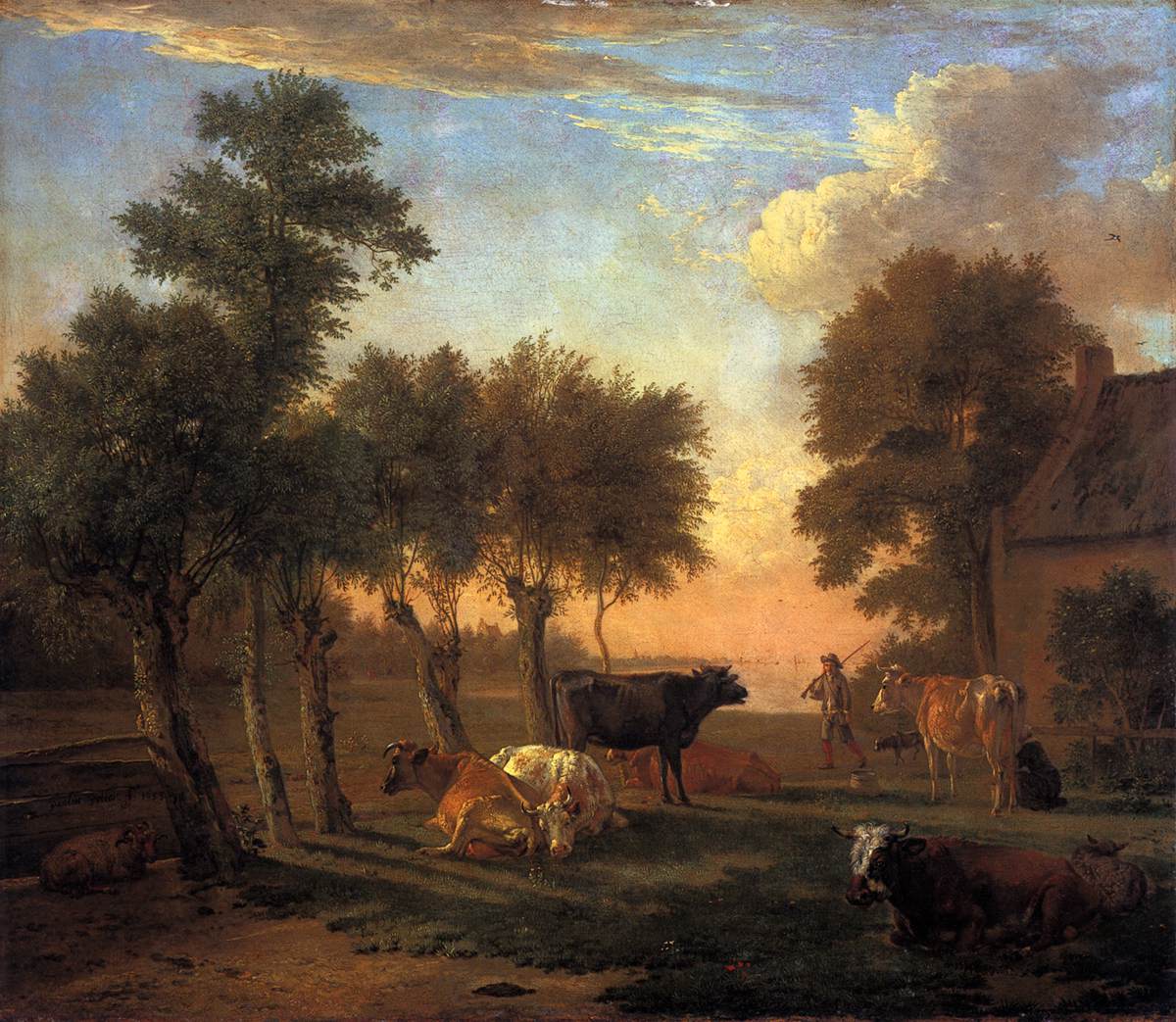
pottercowsgrazingfarm
Paulus Potter (1625–1654), Cows Grazing at a Farm (1653), oil on canvas, 58 x 66.5 cm, Rijksmuseum, Amsterdam. Wikimedia Commons.

Potter was reticent about showing milkmaids, though. In his Cows Grazing at a Farm, painted in 1653, the year before his early death, the milkmaid is almost hidden by the cow’s hindquarters.

terborchmaidmilkingcow
Gerard ter Borch (1617–1681), A Maid Milking a Cow in a Barn (c 1652-54), oil on panel, dimensions not known, The Getty Center, Los Angeles, CA. Wikimedia Commons.

Gerard ter Borch was prepared to put the milkmaid and her cow at the centre of this painting, A Maid Milking a Cow in a Barn from about 1652-54. As was universal at the time, milk was collected in a wooden bucket.

koedijckbarbersurgeontendingpeasant
Isaac Koedijck (c 1617–1668), Surgeon Tending a Peasant’s Foot (1649-50), oil on panel, 91 x 72 cm, Private collection. Wikimedia Commons.

Isaac Koedijck is a bit more unusual in his Surgeon Tending a Peasant’s Foot (1649-50), with its wooden spiral staircase and collection of weapons and tools mounted high on the wall.

dehoochwomandrinkingtwomen
Pieter de Hooch (1629–after 1684), A Woman Drinking with Two Men (c 1658), oil on canvas, 73.7 x 64.6 cm, National Gallery, London. Wikimedia Commons.

It’s easy to mistake Pieter de Hooch’s A Woman Drinking with Two Men from about 1658 for a Vermeer, and like the latter he decorates the far wall with a contemporary map. The Eighty Years’ War had not long ended, and the Dutch Republic was flourishing. Discarded objects are scattered on its black-and-white tiled floor. There’s a large and empty fireplace, and above it hangs a religious painting.

Gabriel Metsu (1629–1667), The Old Drinker (c 1650-67), oil on panel, 22 x 19.5 cm, Rijksmuseum Amsterdam, Amsterdam, The Netherlands. Wikimedia Commons.

Finally, Gabriel Metsu’s Old Drinker (c 1650-67) is dressed in clothes almost as old as he is, and clutches a clay tobacco pipe in his right hand, and a pewter drinking tankard with his left.

How many of those paintings would have been commissioned by a patron?

The Dutch Golden Age: Everyday life of Gerard ter Borch

Before the Dutch Golden Age, paintings of everyday life, now widely termed genre paintings, were seldom seen. That changed in the Dutch Republic, when they became among the most popular, if not the majority. Several of the best known artists of this period specialised in them, among them Gerard ter Borch (1617–1681) who made himself something of an international career as a result.

Ter Borch was born in the city of Zwolle, well to the east of Amsterdam. As his father was also an artist with the same name, he’s sometimes distinguished as Gerard ter Borch the Younger. He had already started to travel in 1632, when he was training in Amsterdam, and for the next twenty years or so he painted in England, Germany, France, Spain and Italy.

terborchratificationoftreatymunster
Gerard ter Borch (1617–1681), The Ratification of the Treaty of Münster, 15 May 1648 (1648), oil on copper, 45.4 x 58.5 cm, Rijksmuseum Amsterdam, Amsterdam, The Netherlands. Wikimedia Commons.

For the thirty years between 1618-1648, central Europe had been engulfed in a bitter war between the Habsburg states, including the Holy Roman Empire and Spain, and their enemies, including the Dutch Republic. Ter Borch’s magnificent painting of The Ratification of the Treaty of Münster, 15 May 1648 (1648) recorded the moment that the Thirty Years War ended, with the ratification of this treaty between the Dutch Republic and Spain. It also marked the birth of the Dutch Republic as an independent country.

The artist even seized the opportunity to include himself among the ranks of dignitaries: he is at the far left, with long hair and looking directly at the viewer. Although this may look a large and grand work, ter Borch painted it on copper, and it is little larger than a miniature.

But most of his surviving works are portraits and interior scenes of everyday life.

terborchmessenger
Gerard ter Borch (1617–1681), The Messenger (Unwelcome News) (1653), oil on panel, 66.7 x 59.5 cm, Koninklijk Kabinet van Schilderijen Mauritshuis, The Hague, The Netherlands. Wikimedia Commons.

The Messenger, popularly know as Unwelcome News, from 1653, develops what came to be one of his favourite themes. The young man at the left is still booted and spurred from riding to deliver a message to this couple. Slung over his shoulder is a trumpet, to announce his arrival and importance. The recipient wears a shiny breastplate and riding boots, and is taken aback at the news. His wife leans on her husband’s thigh, her face looking serious.

The scene is the front room of a house in the Golden Age. Behind them is a traditional bed (typical in living areas at the time), with some of their possessions resting on a table between the couple and their bed. Hanging up on a bedpost is the husband’s sword, and behind them is a gun and powder horn. Is the letter news of his recall to military service, perhaps? Will he soon have to ride away from his wife, leaving her to bring up their family?

terborchmaidmilkingcow
Gerard ter Borch (1617–1681), A Maid Milking a Cow in a Barn (c 1652-54), oil on panel, dimensions not known, The Getty Center, Los Angeles, CA. Wikimedia Commons.

At about the same time, ter Borch painted A Maid Milking a Cow in a Barn (c 1652-54), incorporating its own still life of everyday farming objects including a winnowing sieve and an axe.

terborchmothercombinghairchild
Gerard ter Borch (1617–1681), Mother Combing the Hair of Her Child (Hunting for Lice) (c 1652-53), oil on panel, 33.5 x 29 cm, Koninklijk Kabinet van Schilderijen Mauritshuis, The Hague, The Netherlands. Wikimedia Commons.

Mother Combing the Hair of Her Child (c 1652-53) shows a regular domestic routine, expressed more bluntly in its alternative title of Hunting for Lice. The mother is looking intently at her young daughter’s hair for traces of lice and nits, and running a fine-tooth comb through it to remove any.

terborch3figuresconversing
Gerard ter Borch (1617–1681), Three Figures Conversing in an Interior (Paternal Admonition) (c 1653-55), oil on canvas, 71 x 73 cm, Rijksmuseum Amsterdam, Amsterdam, The Netherlands. Wikimedia Commons.

Three Figures Conversing in an Interior (c 1653-55) is another of his narrative genre works, and more popularly known as Paternal Admonition. Standing with her back to us, wearing a plush going-out dress, is the daughter. To her left is a table, on which there is a small reading stand with books, almost certainly including a Bible. Her parents are young, and they too are fashionably dressed. Her mother appears to be drinking from a glass, but her father is at the very least cautioning his daughter, if not giving her a thorough dressing-down. He wears a sword at his side. Behind them is a large bed, and to the right the family dog looks on from the gloom.

terborchwomanwriting
Gerard ter Borch (1617–1681), Woman Writing a Letter (c 1655), oil on panel, 39 x 29.5 cm, Koninklijk Kabinet van Schilderijen Mauritshuis, The Hague, The Netherlands. Wikimedia Commons.

Ter Borch’s half-sister Gesina, herself a painter, appears to have been his model for Woman Writing a Letter (c 1655), which makes obvious his connection with Vermeer. Move this woman to a desk lit through windows at the left, light her surroundings, and you have a painting very similar to some of Vermeer’s. This painting shows a heavy decorated table cover pushed back to make room for the quill, inkpot, and letter. Behind the woman is her bed, surrounded by heavy drapery, and at the lower right is the brilliant red flash of the seat.

terborchspinner
Gerard ter Borch (1617–1681), The Spinner (c 1655), oil on panel, 33.6 x 28.6 cm, Museum Boijmans Van Beuningen, Rotterdam, Netherlands. Wikimedia Commons.

The Spinner is dated to about 1655, but may well have been the pendant to Mother Combing the Hair of Her Child (c 1652-53), and uses the same model. Here she looks intently at her work, a small dog on her lap.

terborchglasslemonade
Gerard ter Borch (1617–1681), The Glass of Lemonade (1655-60), oil on canvas transferred from panel, 67 x 54 cm, Hermitage Museum Государственный Эрмитаж, Saint Petersburg, Russia. Wikimedia Commons.

Long before its value in preventing scurvy was realised in 1747, or it was carbonated even later, still cloudy lemonade had become a popular soft drink. Extensive trade links of the Dutch Republic made this drink available to the middle classes, as celebrated in ter Borch’s The Glass of Lemonade (1655-60).

A fashionably-dressed young man is helping to prepare a glass of lemonade for a young woman, who is equally open about her love of fashionable clothing. Behind her is the woman’s nurse or maid, who is having to comfort her through the excitement of the experience. They’re surrounded by a contemporary Dutch interior, with the inevitable bed lurking in the dark at the right, a small but heavily-built wooden table to the right, and a lighter-weight table at the lower left.

terborchletter
Gerard ter Borch (1617–1681), The Letter (c 1660-62), oil on canvas, 79 x 68 cm, The Royal Collection, London. Wikimedia Commons.

The Letter from about 1660-62 returns to his favourite theme of the reading and writing of letters. Two young women are working together, apparently to write a reply to the letter which is being read by the woman on the right. A boy, perhaps their younger brother, has just brought in a tray bearing an ornate pitcher of drink. In front, a small dog is curled up asleep on a stool.

terborchmusiclesson
Gerard ter Borch (1617–1681), The Music Lesson (c 1668), oil on canvas, 67.7 x 54.9 cm, J. Paul Getty Museum, Los Angeles, CA. Wikimedia Commons.

Ter Borch’s backgrounds become lighter in his later work, as shown in The Music Lesson from about 1668. A teacher stands over a young woman, who is learning to play the lute. By this time, the basic lute had become extended to accommodate additional strings for a wider register. This is often referred to as a theorbo, although in modern terminology it’s probably more of an archlute, and seems to have been fashionable in the Dutch Republic at this time. Resting on the table is a cello, and asleep on a chair is a small dog. Note that the room still contains a bed in the background.

terborchboydog
Gerard ter Borch (1617–1681), A Boy with his Dog (The Flea-Catcher) (after 1666), oil on canvas mounted on wood, 35 x 28 cm, Alte Pinakothek, Munich, Germany. Wikimedia Commons.

Just as mothers had to check their children for parasites in the hair, so pet owners had to remove fleas from their pets. Ter Borch’s late painting of A Boy with his Dog, also known as The Flea-Catcher (after 1666), shows this, in fairly barren surroundings.

❌