It happened that the Dutch Golden Age coincided with some of the coldest years during the Little Ice Age. In the previous century, the pioneering Flemish landscape painter Pieter Brueghel the Elder recorded the snow and ice during those exceptionally cold winters.
Pieter Brueghel the Elder (1526/1530–1569), Winter Landscape with Skaters and Bird Trap (1565), oil on panel, 37 x 55.5 cm, Royal Museums of Fine Arts of Belgium, Brussels. Wikimedia Commons.
Brueghel’s masterpiece Winter Landscape with Skaters and Bird Trap from 1565 is one of the first paintings to show Netherlandish people on the ice in the winter. Although a few similarly wintry views were painted in and around Antwerp, they didn’t really catch on until the middle of the following century. Among their earliest exponents in the Dutch Republic was Hendrick Avercamp, who was born in Amsterdam but painted for most of his career in Kampen, to the north-east, and was probably the first to specialise in winter landscapes.
Hendrick Avercamp (1585–1634), Winter Landscape with Skaters (1608), oil on panel, 77.3 x 131.9 cm, Rijksmuseum Amsterdam, Amsterdam, The Netherlands. Wikimedia Commons.
Avercamp’s Winter Landscape with Skaters is seen in his 1608 version above, and from around 1630 below. The whole population seems to have spilled out from the warmth of buildings to take to the ice. The fashionable parade in their best clothes and company, children play, and the occasional less able skater ends up sitting on the ice.
Hendrick Avercamp (1585–1634), Winter Landscape with Skaters (c 1630), oil on panel, 23 x 31.5 cm, Museum Boijmans Van Beuningen, Rotterdam, The Netherlands. Wikimedia Commons.Hendrick Avercamp (1585–1634), Winter Scene on a Canal (c 1615), oil on panel, 49.9 x 95.6 cm, Toledo Museum of Art, Toledo, OH. Wikimedia Commons.
His Winter Scene on a Canal from about 1615 is even richer in detail. In the right of the painting are two tents with flags flying. These are popular koek-en-zopie, literally ‘cake and eggnog’ cafés, selling handheld snacks like cake and pancakes, together with alcoholic drinks such as beer laced with home-made rum.
Hendrick Avercamp (1585–1634), Kolf Players on Ice (1625), media and dimensions not known, Houston Museum of Fine Arts, Houston, TX. Wikimedia Commons.
Avercamp’s Kolf Players on Ice from 1625 features another common sight, the game of kolf, an ancestor of modern golf that became popular in the Netherlands during the thirteenth century, and has all but vanished today. Although also played indoors, it was played widely on frozen bodies of water during these cold winters. This involved striking a ball around a simple course with a club, with the aim of reaching the opponents’ starting point first. In this painting, the player about to strike their ball might be aiming for the post being held in the distance.
Adriaen van de Venne (c 1589–1662), The Winter (1614), oil on oak, 43 × 68 cm, Gemäldegalerie der Staatlichen Museen zu Berlin, Berlin. Wikimedia Commons.
Adriaen van de Venne’s early painting of The Winter from 1614 shows two ice yachts under full sail, and dense crowds in the distance.
Aelbert Cuyp (1620–1691), Ice Scene Before the Huis te Merwede near Dordrecht (c 1655), oil on panel, 64 x 89 cm, Private collection. Wikimedia Commons.
Although Aelbert Cuyp doesn’t appear to have painted many of these, his Ice Scene Before the Huis te Merwede near Dordrecht from about 1655 is among the finest. Notable here are his foreground reflections on the mirror-like surface, and the wonderful sky with its warm clouds. The castle seen here was built to the south-east of Dordrecht in the early fourteenth century, and ruined a hundred years later.
Skating on the ice using long curved blades of wood or metal, seen on the shoes of the man in the left foreground, was also popular. Younger adults made it a sport, and there were long-distance races.
Aert van der Neer (1604–1677), Sports on a Frozen River (c 1660), oil on panel, 23 x 35 cm, The Metropolitan Museum of Art, New York, NY. Wikimedia Commons.
Aert van der Neer’s beautifully-lit Sports on a Frozen River (c 1660) includes several kolf players. The reflection of the low sun on the ice is particularly well shown here, giving the ice a polished sheen.
Aert van der Neer (1604–1677), Winter Landscape (c 1660), oil on panel, 46.2 x 70.2 cm, Dorchester House, London. Wikimedia Commons.
Van der Neer was another specialist in painting these views. These contrasting Winter Landscapes show his command of light and skies in his mature works. That above dates from about 1660, and that below from about 1665-70.
Adriaen van de Velde’s Kolf Players on the Ice near Haarlem (1668) affords a closer view of a game in progress, with a koek-en-zopie tent in the distance, ready to warm the players up.
Before the Dutch Golden Age, painting scenes at night had been restricted to religious and other narrative works, and very few if any landscapes had been depicted during the hours of darkness. After all, what’s the point of a view if it’s all dark and you can’t admire it?
The Dutch Republic changed that, in part because it was in Northern Europe, where for several months each year it’s mostly dark, and these nocturnes had novelty value. Among those of the middle class who could afford to, it was fashionable to cover the walls inside your house with paintings, and nocturnes, known then as maneschijntjes (moonshines), certainly brought variety to those collections.
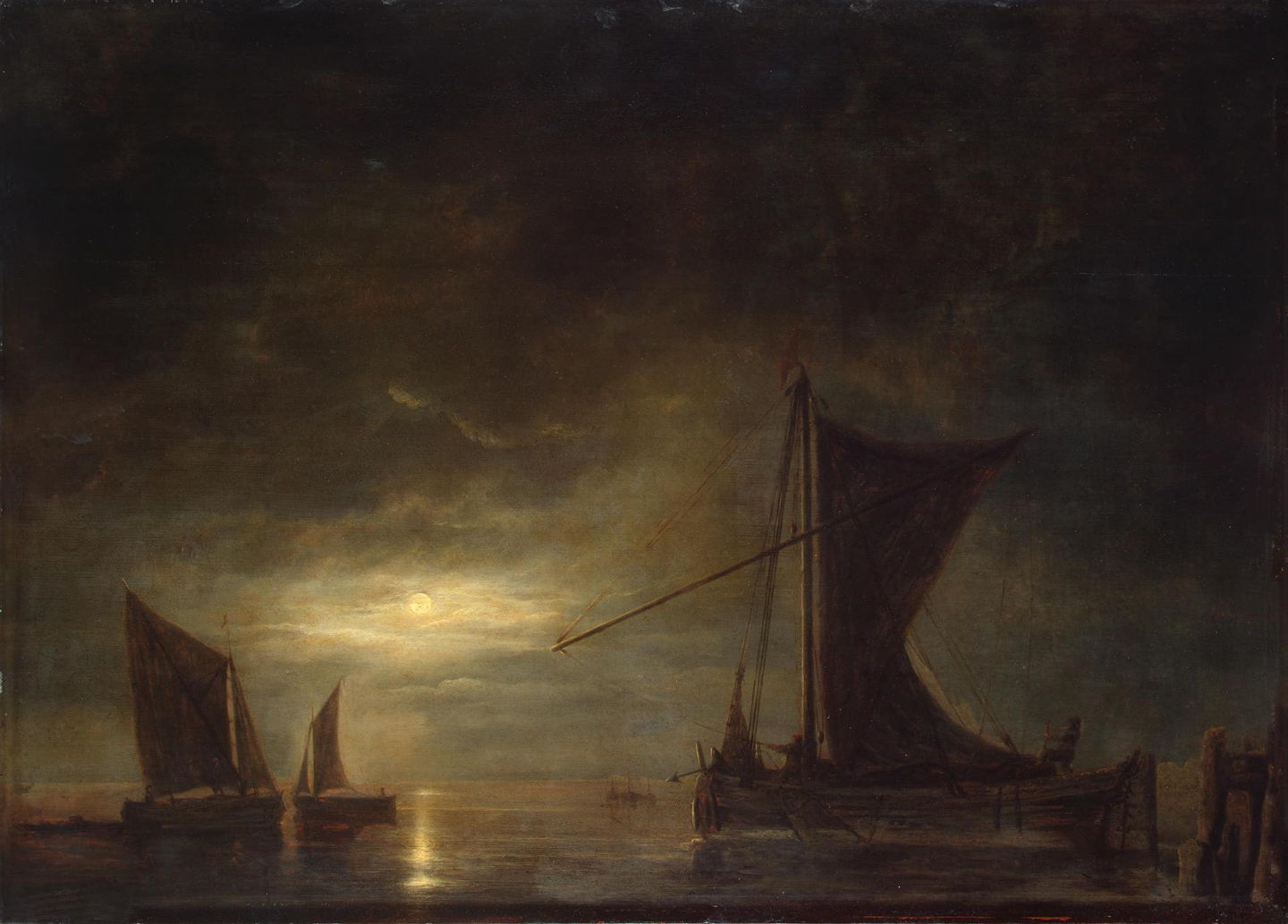
Aelbert Cuyp (1620–1691), Sea by Moonlight (c 1648), oil, 77 x 107.5 cm, Hermitage Museum Государственный Эрмитаж, Saint Petersburg, Russia. Wikimedia Commons.
Aelbert Cuyp’s view of the Sea by Moonlight from about 1648 is one of the earlier maritime nocturnes, something of a sub-sub-genre that must have been sought after. Unlike many others, this appears to be faithful to the original light.
During the 1640s, Aert van der Neer, a landscape painter in Amsterdam, started experimenting with his first nocturnes, and came to specialise in them.
Aert van der Neer (c 1604–1677), River View by Moonlight (c 1650-55), oil on panel, 55 x 103 cm, Rijksmuseum Amsterdam, Amsterdam, The Netherlands. Wikimedia Commons.
His River View by Moonlight from about 1650-55 shows a bustling village on a river, with several boats under way and two windmills in the distance. The moon appears to be depicted faithfully in terms of size, without the common tendency to exaggerate that as a result of the Moon Illusion. Surviving studies for some of these nocturnes demonstrate that van der Neer initially sketched a landscape in daylight, and based the detail in his finished studio painting on that.
Aert van der Neer (c 1604–1677), River Landscape with Moonlight (c 1655), oil on panel, 24.1 x 39.7 cm, Gemäldegalerie der Staatlichen Museen zu Berlin, Berlin, Germany. Wikimedia Commons.
In about 1655, he painted this finely detailed River Landscape with Moonlight, with a larger moon lighting clouds dramatically.
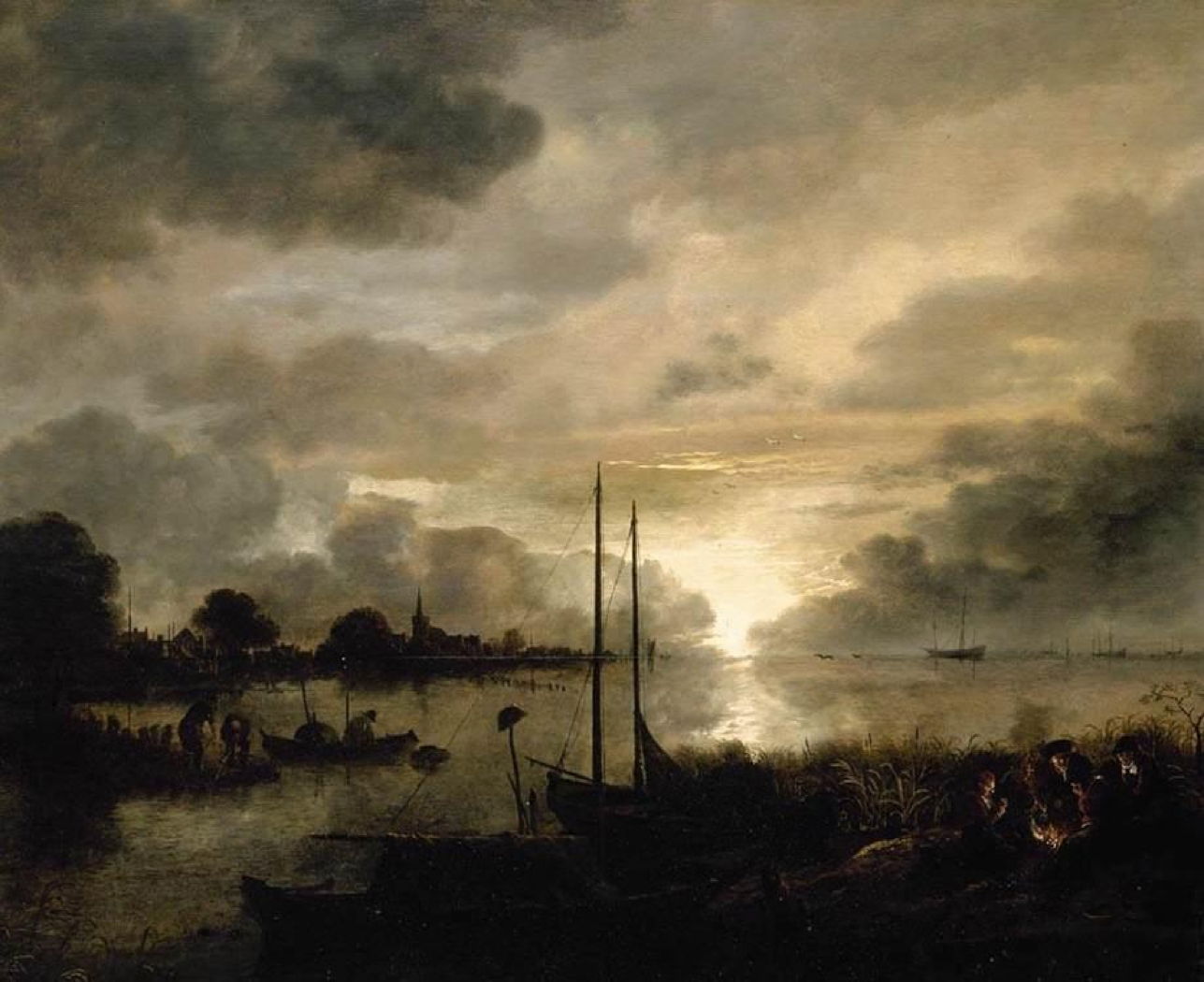
Aert van der Neer (c 1604–1677), Estuary Landscape by Moonlight (date not known), oil on panel, 63 x 76 cm, Private collection. Wikimedia Commons.
Some of his best nocturnes are lit by a combination of the moon and the warmer light from a fire. This undated Estuary Landscape by Moonlight uses light from both sources to great effect. Landscape details are shown largely in silhouette, and lack internal detail except in the group gathered around the fire in the foreground. Van der Neer is unusually faithful to reality in this monochrome, the result of the severely impaired colour vision we all suffer in conditions of low light, when there’s insufficient to enable colour vision using the cone cells in the human retina.
Aert van der Neer (c 1604–1677), Fire in Amsterdam by Night (date not known), oil on canvas, 58.8 x 71.7 cm, Statens Museum for Kunst (Den Kongelige Malerisamling), Copenhagen, Denmark. Wikimedia Commons.
At some stage, van der Neer started painting more destructive fires, including this undated Fire in Amsterdam by Night, leading to another sub-sub-genre that was taken up by others.
Jan Abrahamsz Beerstraaten (1622–1666), The Old Town Hall of Amsterdam on Fire, 7 July 1652 (1652-55), oil on panel, 89 x 121.8 cm, Amsterdam Museum, Amsterdam, The Netherlands. Wikimedia Commons.
In mid 1652, Jan Abrahamsz Beerstraaten seems to have witnessed the destruction by fire of part of the centre of Amsterdam, which formed the basis of his studio painting of The Old Town Hall of Amsterdam on Fire, 7 July 1652 (1652-55). Local inhabitants are walking in orderly queues to boats, in which they escape from the scene. This may have been the same fire painted by van der Neer, above.
Egbert van der Poel specialised in these brandjes,, and probably painted more than any other artist in history. He moved to Delft in 1650, and four years later was a victim of the massive explosion in a gunpowder store there on 12 October 1654. That killed one of his children, and he moved again to Rotterdam.
Egbert van der Poel (1621–1664), Fire of a Church with Staffage and Cattle (1658), oil on oak, 46.3 × 62 cm, Muzeum Narodowe w Warszawie, Warsaw, Poland. Wikimedia Commons.
It has been thought that most of van der Poel’s Fire of a Church with Staffage and Cattle from 1658 is a carefully-composed composite of his experiences. A small church at the edge of a village is well ablaze, and the inhabitants are abandoning it, taking all the possessions they can, including their horses and livestock, and leaving the fire to burn itself out.
Egbert van der Poel (1621–1664), A Fire at Night (date not known), oil, dimensions not known, Kelvingrove Art Gallery and Museum, Glasgow, Scotland. Wikimedia Commons.
Van der Poel’s undated A Fire at Night shows a similar scene and composition, set this time on the bank of a canal.
Egbert van der Poel (1621–1664), Fire in De Rijp of 1654 (1662), oil, dimensions and location not known. Wikimedia Commons.
One established exception to this is van der Poel’s Fire in De Rijp of 1654, completed in 1662. This shows a fire that worked its way through more than eight hundred buildings in the town of De Rijp during the night of 6 January 1654. This left only the northern section of the town standing and inhabitable, and resulted in more casualties than did the more famous explosion in Delft at the end of that year.
Egbert van der Poel (1621–1664), The Fire in the Nieuwe Kerk, Amsterdam, in 1645 (c 1645), brush and gray wash and black wash with touches of pen and brown ink, 12.5 × 19.4 cm, location not known. Wikimedia Commons.
Doubt is cast on this received account of van der Poel’s work by sketches such as this, of The Fire in the Nieuwe Kerk, Amsterdam, in 1645, made in front of the motif using washes with touches of pen and brown ink. Perhaps he was the first ‘ambulance chaser’ who travelled out to sketch fires, from which he later painted his famous brandjes in the studio.
For the non-specialist like Jacob van Ruisdael, winter was an ideal opportunity to explore the effect of negative images, where objects that would normally be seen as dark on a light background were reversed to white on dark.
Jacob Isaakszoon van Ruisdael (1628/9–1682), Winter Landscape (c 1660-70), oil on canvas, 37.3 x 32.5 cm, Royal Picture Gallery Mauritshuis, The Hague. Wikimedia Commons.
Van Ruisdael painted at least two such landscapes featuring trees. Both are now known by the same name, and are believed to be from the same decade. This Winter Landscape (c 1660-70), in the Mauritshuis, picks out frosted leaves in the half-light of dusk or dawn, by a hamlet at the water’s edge. In the far distance, to the left of the buildings, there is a church with a spire.
Jacob Isaakszoon van Ruisdael (1628/9–1682), Winter Landscape (c 1660-70), oil on canvas, 36.5 x 32.4 cm, Birmingham Museum of Art, Birmingham, AL. Photo by Sean Pathasema, via Wikimedia Commons.
The other version of Winter Landscape (c 1660-70) is in Birmingham, Alabama. With similar sky, cloud, lighting, and composition, the water here appears to have frozen over. The frost on the trees is just as delicately handled.

 Login
Login