
 Login
LoginThe Dutch Golden Age: Stories
Painting in the Dutch Republic during the Golden Age was rich in landscapes, interiors and images of everyday life, but didn’t abandon storytelling. Many of Rembrandt’s finest works are religious narratives and tales drawn from classical mythology and history. This article shows a selection of paintings by the less famous, and how their stories extended beyond those that had been most popular in the Renaissance.

The Annunciation (1667) is a large canvas, and among the few religious paintings that Adriaen van de Velde made following his marriage to a Catholic woman, and his conversion to Catholicism. Although the angel is a little awkward, it seems hard to believe that this was painted by a landscape specialist.

Three years later, van de Velde painted a classical myth in his superb Vertumnus and Pomona (1670). Vertumnus was the Roman god of seasons and change, who could assume whatever form he wished. Book fourteen of Ovid’s Metamorphoses tells the story of his transformation into the form of an old woman, seen here on the left, so that he could gain entry to Pomona’s orchard and seduce her. Sadly, the yellow he used to mix greens has faded in parts, leaving some of his vegetation blue.

Jan Lievens’ painting of Quintus Fabius Maximus from 1656 may refer to this Roman’s victory at Tarentum, as told in Plutarch’s Lives. The great Carthaginian general Hannibal was only five miles away at the time of the Roman repossession of Tarentum, and this made Hannibal realise the impossibility of mastering Italy.
Paintings of fables, that had already started to become popular among Flemish artists at this time, appeared in the Republic to the north. Among them was the story of the Satyr and the Traveller, or the Man and the Satyr. A man made friends with a satyr; when the man’s hands were cold, he blew on them to warm them up. When the two were eating together, the man blew on his hot food in order to cool it down. The satyr decided that he couldn’t trust a creature whose breath blew both hot and cold, so broke off their friendship.
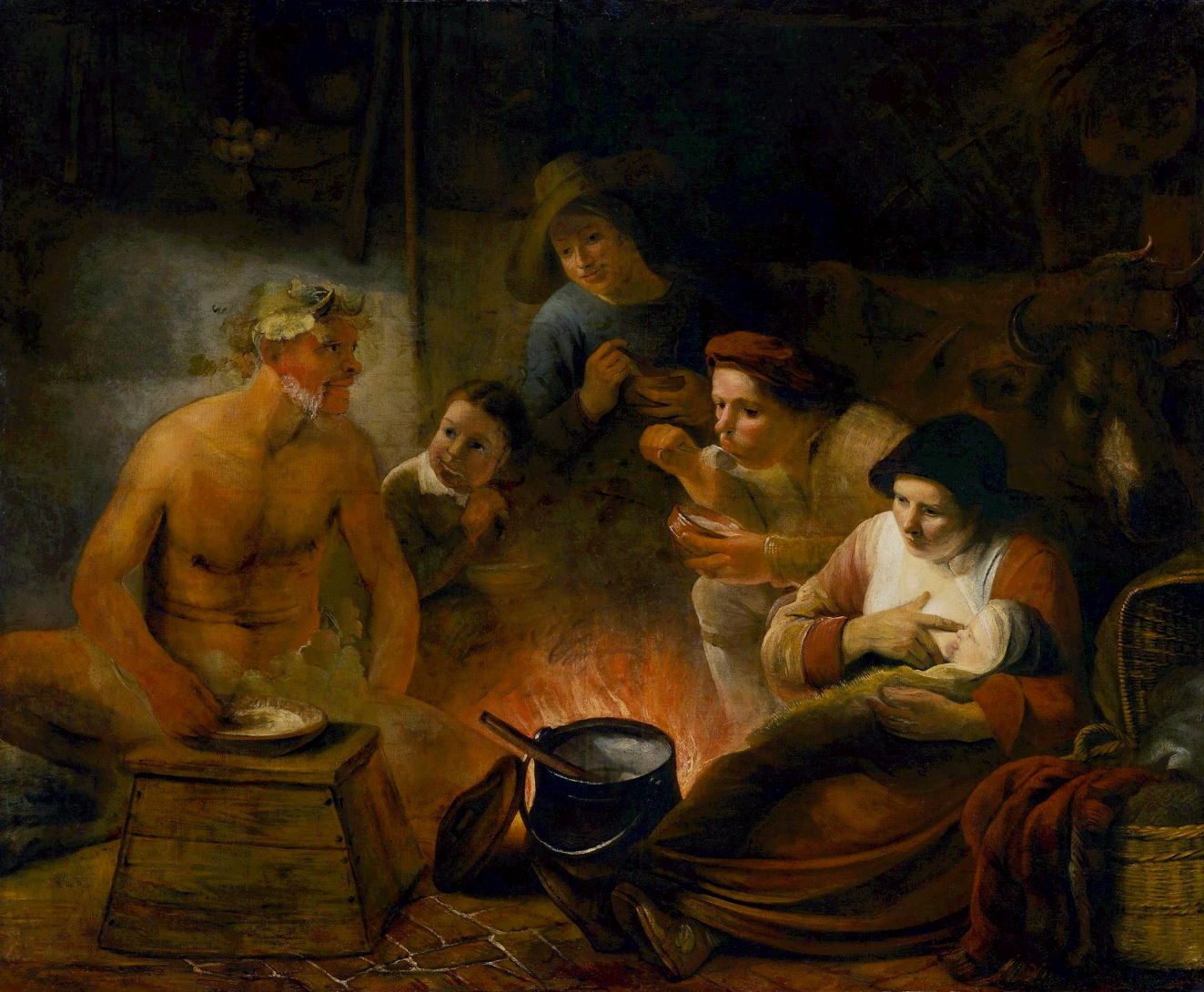
In 1653, Constantijn à Renesse, a former pupil of Rembrandt, painted his version of this fable in Satyr at the Peasant’s House. This shows one of the family blowing on the hot food in their spoon, although at this stage the satyr hasn’t reacted to the contradiction.
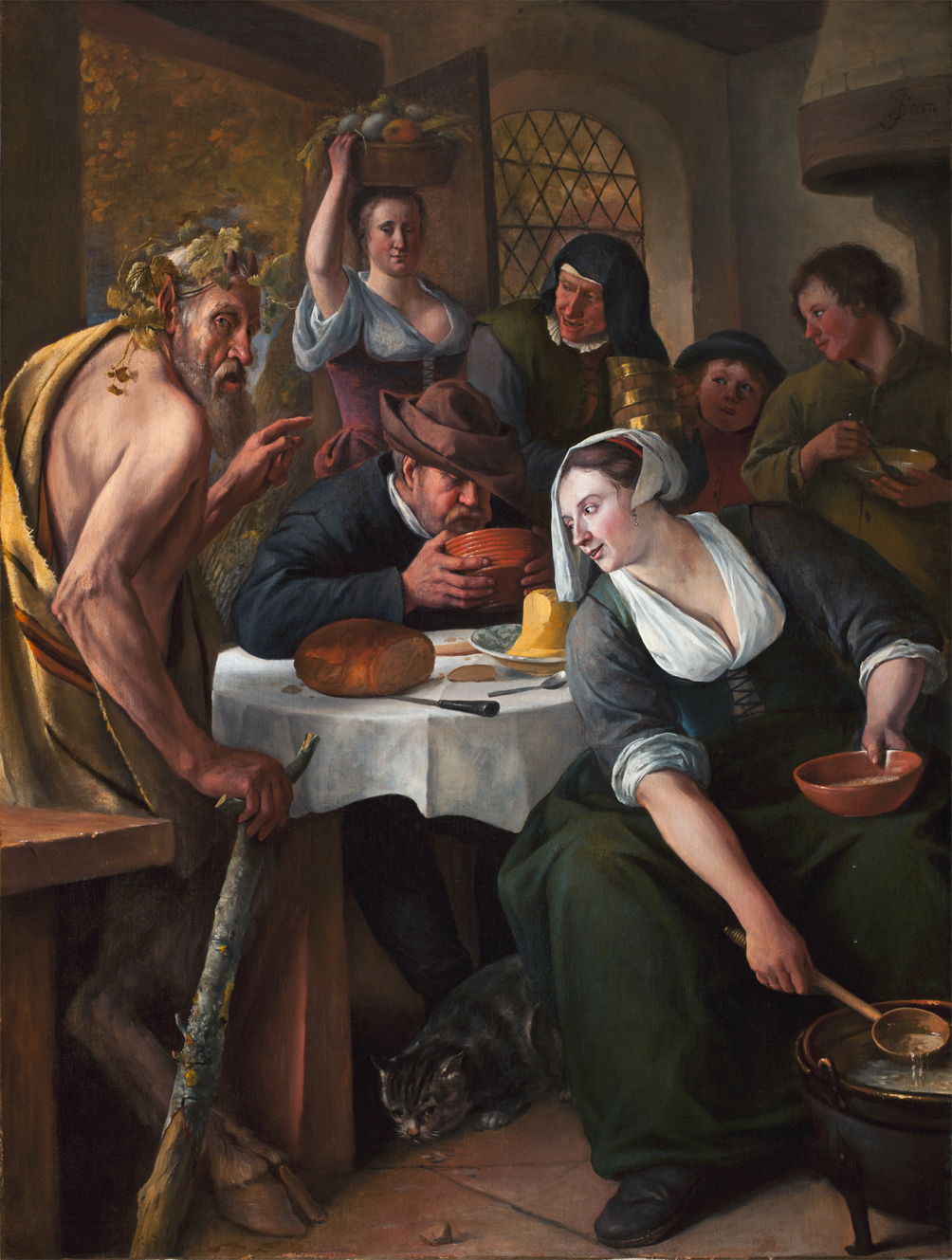
Jan Steen, in his telling of The Satyr and the Peasant “Who Blows Hot and Cold” from about 1660, gives a clearer account, with the satyr looking worried at the viewer, as a man (still wearing his hat) blows on a bowl of hot stew. He also pays attention to delightful details such as the cat skulking under the table, and a rich supporting cast.
Steen went on to paint two unusual accounts of what happened in schools across country districts in the Republic.

His The Village School from about 1665 shows physical punishment in a contemporary school. The child at the right holds out a hand for teacher to strike it with a wooden spoon, and is already wiping tears from his eyes. A girl in the middle of the canvas is grimacing in sympathy.

A few years later, Steen painted a scene in a larger and more chaotic classroom, in The Village School from about 1670. Although there are two staff sat at the teachers’ desk, the man is distracted, perhaps in cutting himself a fresh quill. The woman teacher sat next to him is engaged in explaining something to a pupil. Around them, all hell is breaking loose. In the distance, a boy is stood on one of the trestle tables. Older children are teaching younger ones, and a small group at a table at the right are trying to write while others get up to mischief. One younger child in the middle of the foreground has fallen asleep against a hat.

Gerrit Dou approaches social realism in his detailed account of The Young Mother from 1658. As she sits at her needlework, her child is attended in their wickerwork crib by a young nurse. Around them is an eclectic collection of objects, from a large cabbage, hanging game and a bundle of carrots at the right, to a bird cage and an upholstered chair at the left. Suspended above them is a chandelier, and a wooden spiral staircase ascends to the next floor. This family appears to be living in affluent squalor.
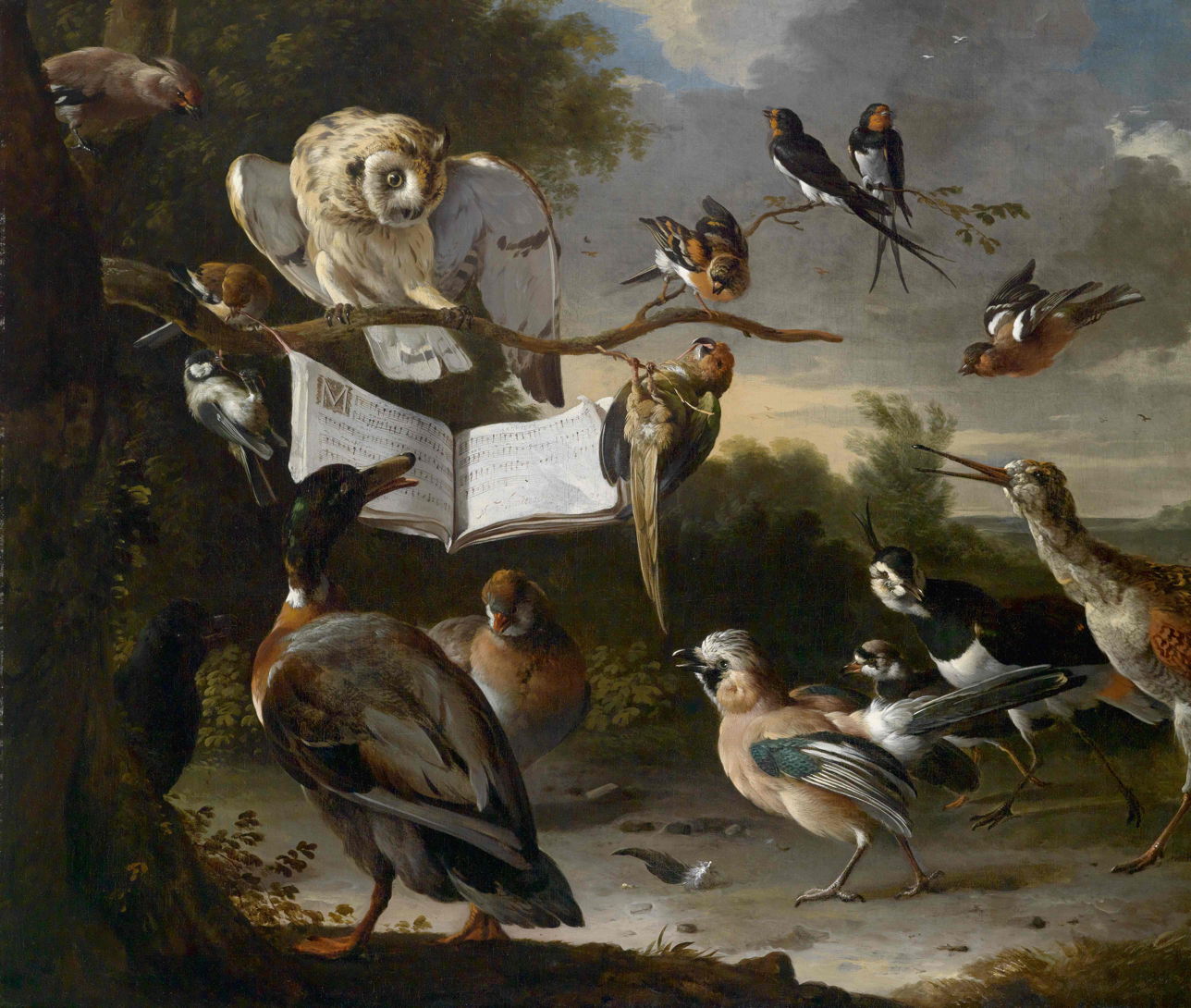
There was even an anthropomorphic fad for paintings showing gatherings of birds ‘singing’ together, and I think Melchior d’Hondecoeter’s Concert of the Birds from 1670 is probably the best example of those entertaining paintings.

