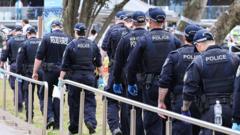
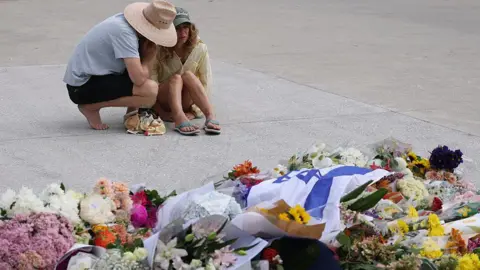
A memorial in Sydney on Tuesday. The shooting, which left at least 15 dead and scores of others injured, has forced a hard look at gun control in Australia.
Dash cam footage has emerged of Boris and Sofia Gurman trying to disarm one of the suspected attackers. The couple was killed, but their bravery was lauded by Australians.
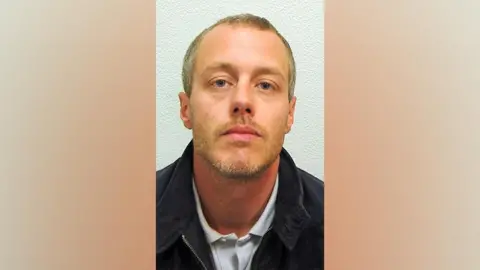
David Norris, who murdered Stephen Lawrence, has been denied parole, the BBC understands.
He sought release during a parole hearing in October, having been jailed in 2012.
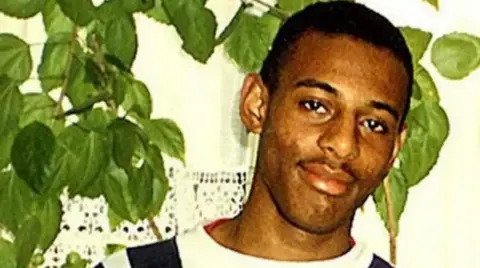
Stephen, 18, was stabbed to death in a racist attack in south London in 1993.
Only two of his killers have been convicted, with police always saying six people were involved.
At the parole hearing, Norris admitted he was part of the attack but refused to name the other killers. He had previously denied involvement.
Norris gave evidence via a video link from prison during the public hearing, in which he was bidding for release on licence.
Stephen's mother, Baroness Doreen Lawrence, said at the hearing that Norris remained a danger to the public and must remain in prison. The justice secretary also opposed Norris's release.
The hearing took place 13 years after Norris was jailed for life, with a minimum sentence of 14 years and three months.
Stephen was stabbed by a gang as he waited at a bus stop in Eltham, south-east London.
Witness evidence in the case records that an extreme racist slur was used towards Stephen just before the gang attacked.
In his evidence to the parole hearing, Norris said he was the last person to punch Stephen. He had tried to hit him two or three times and one of his punches connected.
For decades Norris publicly denied involvement in the murder, giving no-comment interviews to police, and claiming he was innocent during his trial.
However, the hearing heard confirmation that he had admitted involvement since being in prison, but denies stabbing Stephen or using a knife.
It also heard Norris continued to use racist language in prison, with him having been recorded in 2022 using the same racial slur that was hurled at Stephen before he was stabbed.
In a prepared statement that Norris read out, he apologised to the Lawrence family and wider black and ethnic community for the "fear" and "horror" his role in the attack had caused.
In a statement read on her behalf at the hearing, Baroness Lawrence said Norris had "killed my son in the most brutal and callous fashion. In doing so he changed my life and life of my family members forever".
She said she could not forgive Norris because he has not "expressed any acceptance, any contrition and certainly has no humanity".
Stephen's father previously told the BBC that Norris should name the other killers before he could be judged to be safe for release from prison.
Handout
Stephen Lawrence was murdered in a racist attack in 1993, when he was 18
People needing urgent dental treatment and patients requiring complex care will be prioritised under government plans to improve access to NHS dentists in England.
The proposals could mean a saving of £225 for patients requiring numerous appointments for complicated treatments.
For years, many patients have found it increasingly hard to find a dentist, with some towns in England referred to as "dental deserts", with no access to NHS dentists at all.
The British Dental Association (BDA) said that without more funding and real reform, the plans wouldn't solve current issues.
Speaking on Radio 4's Today programme, health minister Stephen Kinnock said the plans were intended to "prioritise" urgent care.
He said there was "a lot of unnecessary routine care going on" in NHS dentistry services at the moment.
If a patient has "good oral health" he said they don't need to see a dentist "more than about once every two years".
He said the current practice of most patients being offered NHS check-ups every six months was "not the right use" of dentists' time, and added that it was "sucking up a lot of money in NHS dentistry".
Under the current system, which dates back to 2006, dentists are paid for what are called Units of Dental Activity, known as UDAs.
Different procedures - fillings, extractions and more complicated work - are assigned a different number of UDAs.
Dentists who provide NHS care have a contract that says how many UDAs they will carry out each year and are paid accordingly.
But this has meant that more money was available to dentists for carrying out simple check-ups, rather than spending longer with patients who needed more complex, time-consuming care.
For years dentists have been complaining that the contract for NHS work fails to cover the costs of what they're being asked to carry out.
As a result many dentists have been walking away from NHS work – meaning it's increasingly hard for people to access care. There are parts of the country where there is simply no access to NHS dentistry.
'Chronic underfunding'
Under the government plans, there would be new incentives for dentists to offer longer-term treatments for major issues such as gum disease and tooth decay through the NHS.
Currently, a patient with tooth decay in several teeth or severe gum disease - both of which require complex treatment - would need to be treated over multiple appointments, which is costly and time consuming.
But under proposed changes to the dental contract for NHS work, dental practices would be able to offer patients a single comprehensive package of treatment over a longer period, tailored to their needs.
And ministers argue that this could save a patient up to £225 in fees.
Shiv Pabary, chair of the BDA's General Dental Practice Committee said "a dental crisis" had come about directly as a result of the contract put in place in 2006.
"The reforms announced today are trying to tweak a system that's broken."
He added that until the "chronic underfunding" and wider systemic problems were addressed, NHS dentistry would continue to fail to work for "dentists and for patients".
"To try and deliver comprehensive care within the same budget that we have at the moment is going to be hugely challenging."
Mr Kinnock said the government had a "massive issue to fix" in dental care and was negotiating with the BDA on a "radical overhaul" of the NHS dentistry contract.
The government has formally begun the process which will decide the future of the BBC.
It has published a consultation document - or green paper - laying out plans to future-proof the BBC, put it on a sustainable financial footing and bolster trust.
This begins the renewal of the BBC charter - the corporation's rulebook and licence to exist - which expires in 2027.
The culture secretary Lisa Nandy said: "The BBC is fundamental to the health of our nation and we want to make sure that we put it on a firm footing for decades to come.
"We're asking everybody to get involved and play their part in helping to shape its future."
Outgoing BBC director general Tim Davie said in a statement: "We welcome the publication of the government's green paper and the start of the public consultation on the future of the BBC. We urge everyone who cares about the success of the UK's world-leading creative industries to have their say.
"At the BBC, we want change, so we can continue to deliver for the UK for generations to come. We want to secure a public service BBC that is independent, sustainably funded for the long term, and meets our audience's needs."
Former BBC controller of editorial policy, Richard Ayre, described the consultation as "the most encouraging start of a charter process in decades, with the government apparently committed to giving the BBC a sustained and financially sustainable future".
The licence fee brought in £3.8 billion last year. Other funding streams - advertising, subscription and fee reform, including charging wealthier people more - are on the table for now, although many media commentators expect the licence fee to remain, with some changes.
Nandy said: "We're keeping all options open. The only option for funding the BBC that we've ruled out is general taxation and that is because it is essential that the BBC can hold governments of any persuasion to account, including ours, without fear or favour and without being heavily reliant on direct funding from government."
She described the BBC as "an institution that matters deeply to the democratic process in this country and to the health of our nation" and said it "has to have sustainable funding in order to thrive".
But she also acknowledged recent issues at the corporation: "There have been serious concerns about developments at the BBC, including editorial standards and about political interference.
"These aren't new challenges for the BBC. Throughout its history it's had to navigate them, but we believe that through this charter we can strengthen the amount of accountability within the BBC."
Former BBC director general Tony Hall suggested there should be careful consideration of a household tax charged in line with council tax bands.
The government rejects that model. It does, however, accept that public funding of the BBC will remain in some form and Lord Hall suggests an independent body, like a pay review body, to "take the politics out of the licence fee debate".
"Give them the task every three years of reviewing whether the money the BBC has got matches our ambitions for the BBC," he said.
He agrees the licence fee needs to be reformed and made "fairer".
The Reform party wants to scrap the licence fee altogether, while Conservative leader, Kemi Badenoch, threatened to withdraw support for it earlier this year.
The Liberal Democrats are supportive of the licence fee up until 2027. The Green Party did not specifically mention the BBC in its 2024 manifesto.
PA Media
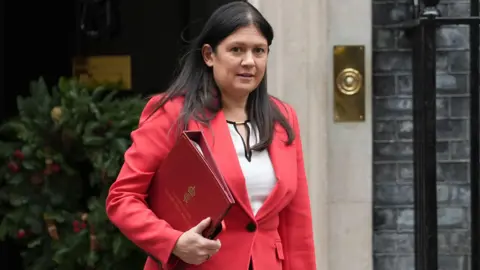
Culture Secretary Lisa Nandy has ruled out general taxation but is otherwise keeping "all options open"
There will be a 12-week public consultation and the government is seeking views on how to ensure the BBC commands the public's trust, is accountable to audiences and fully represents communities.
This includes potentially giving the corporation new responsibilities to counter misinformation and disinformation, updating the BBC's mission to put accuracy on the same footing as impartiality and strengthening the BBC's independence, including examining political appointments to the BBC's board.
Labour MPs raised concerns around this issue in Parliament after the recent BBC controversy over the misleading edit of a Donald Trump speech on a Panorama prompted the resignations of the BBC director general and the CEO of News.
Trump is now suing the BBC for defamation over the edit.
Lord Hall told BBC News: "I think trying to take the politics as much as possible out of the organisation would be good. That means really looking carefully at appointments. I don't think there should be any political appointments to the board."
Others argue these appointments (there are five government-appointees on the BBC board including the chairman) ensure accountability and help challenge groupthink.
The BBC has faced a series of controversies in recent months for which it has had to apologise.
Nandy termed the Labour government "unashamedly supporters of the BBC as an institution, even as we've had serious frustrations with some of the decisions and failings that have taken place at the BBC in recent months".
She said the review of the charter was the chance "to make sure that it can not just survive, but thrive. It's an institution that belongs to us all. If it didn't exist, we would have to invent it".
The consultation will also look at how to devolve more commissioning to the regions and whether there should be a new obligation on the BBC to drive economic growth, build skills and support the UK economy.
The BBC is the only organisation operating under a royal charter with an expiry date. In a speech in November 2024, the BBC chairman Samir Shah said "there are more than 1,000 charter bodies, and I am not aware of any other that needs to be renewed like the BBC".
He asked: "Should we consider the BBC also having a permanent charter like the others?"
The government appears to be consulting on this, with some suggesting the threat of a future Reform government is focusing minds on the uncertainty renewal every decade creates and whether it allows too much political interference.
Ayre said: "It's interesting that the government chooses the word 'future-proof' for the BBC. Can that really mean that they're considering not a 10-year charter, which is the norm, but a sort of self-sustaining charter which will see the BBC continuing in its key position as the national broadcaster for what the government calls decades to come?
"Of course future governments can always try to undo that, but actually a royal charter, it's quite difficult to undo because technically it is the will of the monarch rather than of the government of the day".
Hall said "the great thing about the charter review this time is that I believe the government wants to secure the BBC's future for the long term. It could be a great legacy."
Next year, following the consultation, the government will publish its own vision for the BBC.
Mbappe spent seven seasons at PSG before moving to La Liga
Published
Paris St-Germain have been ordered to pay former striker Kylian Mbappe 60 million euros (£52.5m) in unpaid salary and bonuses by a French court.
Mbappe had been seeking 263m euros (£231.5m) from his former club after the long-running dispute reached a Paris labour court in November.
The European champions were counter suing the France captain for 240m euros (£211m).
The 26-year-old Real Madrid forward claimed the nine-figure sum, which included 55m euros (£46.3m) in unpaid wages, as damages in response to a contract dispute and ill-treatment by the club.
However, he has only been awarded a fraction of that amount, with the court recognising that PSG had failed to pay three months of his salary between April and June 2024 as well as an ethics bonus and a signing bonus under his contract.
"We are satisfied with this ruling. This is what you could expect when salaries went unpaid," Mbappe's lawyer Frederique Cassereau said.
Police 'put their lives on the line', says New South Wales premier
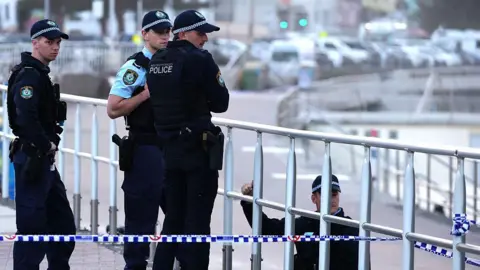
The New South Wales (NSW) premier has strongly rejected criticism of the police response to the attack on a Jewish festival at Bondi Beach, saying officers acted with "bravery and integrity".
Some witnesses have suggested police were too slow to disarm the two gunmen, who killed 15 people and injured dozens at an event celebrating Hanukkah at Australia's best known beach.
"There are two officers in critical care... at the moment," Chris Minns said after sustained questioning from reporters. "They weren't shot in the back as they were running away. They were shot in the front."
There have also been questions about whether adequate security was provided before the shooting took place.
"They shoot, shoot, change magazine and just shoot," one witness, Shmulik Scuri, told reporters the day of the assault, adding he thought officers "froze".
Asked about these criticisms, Minns said the "rush to conclusions" about the police operation was "disrespectful".
"They didn't take a backward step. They engaged the gunmen on the footbridge with handguns. The offenders had long range rifles," Minns said.
"If there's any suggestion that NSW Police didn't live up to their responsibilities to the people of this state, it should be rejected because it's not consistent with the facts."
NSW Police Commissioner Mal Lanyon avoided questions about how many officers had been deployed to police the event in advance. He told reporters police "regularly patrol that area as we did on that day" and that police presence was based "on the threat that exists at the time".
Australia's security agency has said the younger alleged gunman in the father-son duo, Naveed Akram, had come to their attention in 2019 due to his associations, but that there was nothing to suggest he was a risk of violence.
"Had there been intelligence that there was a particular threat at that location, or to that event, we may have had a different policing response," Commissioner Lanyon said.
NSW Police established Operation Shelter after the 7 October 2023 Hamas attack on Israel to investigate antisemitic hate crimes. As part of the operation, regular patrols are conducted of high-risk locations. The eastern suburbs of Sydney, including Bondi, which has a significant Jewish population, is a key focus.
Another taskforce, Strike Force Pearl, was set up later to investigate hate crimes in Sydney.
Getty
NSW Premier Chris Minns says police responding to the attack at Bondi 'didn't take a backwards step'
Police received reports of gunfire at a park in Bondi Beach at 18:47 (07:47 GMT) on Sunday. The gunmen carried out a shooting spree that lasted around ten minutes before police shot both men, killing one and critically injuring the other.
Dr Vincent Hurley, a former police officer who lectures on policing at Macquarie University, told the BBC it was "unrealistic" to expect police to be able to know how to react to every possible scenario.
"To respond to a mass shooting and mass killing event like that, there's no training that can be done."
He pointed out that police officers would have initially been reliant on calls to emergency operators "and everyone would have given them a different story".
"Then they have to fight through traffic at Bondi Beach which is a nightmare at the best of times."
At the scene, police would have been confronted with "absolute chaos" as thousands of people attempted to flee.
Individual officers would also have been faced with difficult choices such as whether to stop and render assistance to injured individuals or to go and look for the gunmen, decisions for which there is no protocol.
And even once the offenders had been identified, he says the risk of hurting bystanders in the crossfire would have complicated responses.
"There would be no way as a police officer, I would have drawn my firearm because all of the innocent individuals", he added. "It's not what you see on Netflix."
At least 15 civilians have been confirmed dead in Sunday's shooting attack at Bondi beach.
Many were attending an event to mark the first day of the Jewish festival of Hanukkah.
Authorities have confirmed that two rabbis, a Holocaust survivor and a 10-year-old girl were among the victims.
This is what we know about those identified so far:
Matilda, 10
Authorities confirmed that a 10-year-old girl, named by her family to local media as Matilda, was among the dead.
Irina Goodhew, who organised a fundraiser for the girl's mother and said she was the child's former teacher, wrote: " I knew her as a bright, joyful, and spirited child who brought light to everyone around her.'
The Harmony Russian School of Sydney also confirmed that she was one of its students.
"We are deeply saddened to share the news that a former student of our school has passed away in the hospital due to injuries sustained from a gunshot," the school wrote on Facebook.
"Our thoughts and heartfelt condolences go out to her family, friends, and everyone affected by this tragic event … Her memory will remain in our hearts, and we honor her life and the time she spent as part of our school family."
Meanwhile her aunt spoke to ABC news and said that Matilda's sister, who was with her when she was shot, was struggling to come to terms with the loss.
"They were like twins — they've never been separated," she told the ABC.
Rabbi Eli Schlanger
Supplied
Eli Schlanger was known as the Bondi rabbi
Known as the "Bondi Rabbi", Eli Schlanger, 41, was one of the key organisers of Sunday's event. He was head of the local Chabad mission, an international Hasidic Jewish organisation based in Brooklyn.
The death of the British-born father of five was confirmed by his cousin, Rabbi Zalman Lewis.
"My dear cousin, Rabbi Eli Schlanger @bondirabbi was murdered in today's terrorist attack in Sydney," Zalman wrote on Instagram. "He leaves behind his wife & young children, as well as my uncle & aunt & siblings … He was truly an incredible guy".
In a post on its website, Chabad said Schlanger's youngest child was just two months old.
"He was the most godly, humane, kind, gracious human being I think I've ever met," Alex Ryvchin of the Executive Council of Australia Jewry, told reporters at Bondi on Monday morning.
Dan Elkayam
The death of French national Dan Elkayam was confirmed by Frances's Foreign Minister Jean-Noël Barrot.
"It's with immense sadness that we have learnt that our compatriot Dan Elkayam was among the victims of the terrorist attack that hit Jewish families gathered on the beach at Bondi in Sydney," he wrote on social media. "We mourn with his family and loved ones, with the Jewish community and the Australian people."
According to his LinkedIn profile, Elkayam worked as an IT analyst for NBCUniversal and had moved to Australia last year.
He was also a keen footballer, and "an integral member" of our premier league squad, the Rockdale Ilindin Football Club in west Sydney wrote on its Facebook page.
He was "an extremely talented and popular figure amongst team mates. Our deepest and sincerest condolances to Dan's family, friends and all that knew him. He will be missed," the club wrote.
Alexander Kleytman
Alexander Kleytman was a holocaust survivor who came to Australia from Ukraine.
"I have no husband. I don't know where is his body. Nobody can give me any answer," his wife Larisa Kleytman told reporters outside a Sydney hospital late on Sunday.
"We were standing and suddenly came the 'boom boom', and everybody fell down. At this moment he was behind me and at one moment he decided to go close to me. He pushed his body up because he wanted to stay near me," she told the Australian.
Chabad wrote on X that Alexander "died shielding her from the gunman's bullets. In addition to his wife, he leaves behind two children and 11 grandchildren."
The couple shared some of their life story with Jewish Care in 2023.
"As children, both Larisa and Alexander faced the unspeakable terror of the Holocaust," the health organisation wrote in its annual report.
"Alex's memories are particularly harrowing; recalling the dreadful conditions in Siberia where he, along with his mother and younger brother, struggled for survival."
How Bondi Beach shooting unfolded minute by minute
Peter Meagher
Former police officer Peter Meagher was working as a freelance photographer at the Hanukkah event when he was killed, his rugby club confirmed.
"For him it was simply a catastrophic case of being in the wrong place and at the wrong time," Mark Harrison, the general manager of Randwick Rugby Club, wrote on its website.
"'Marzo, as he was universally known, was a much loved figure and absolute legend in our club, with decades of voluntary involvement, he was one of the heart and soul figures of Randwick Rugby."
The club said he had spent almost four decades in the NSW Police Force where he was "hugely respected by colleagues".
"The tragic irony is that he spent so long in the dangerous front line as a Police Officer and was struck down in retirement while taking photos in his passion role is really hard to comprehend," the club said.
Reuven Morrison
Reuven Morrison migrated to Australia from the former Soviet Union in the 1970s as a teenager, according to an interview he gave to the ABC exactly a year ago.
"We came here with the view that Australia is the safest country in the world and the Jews would not be faced with such anti-Semitism in the future, where we can bring up our kids in a safe environment," he told the national broadcaster.
Confirming his death, Chabad said that he was a longtime resident of Melbourne, but that he "discovered his Jewish identity in Sydney".
"A successful businessman whose main goal was to give away his earnings to charities dear to his heart, notably Chabad of Bondi," the organisation wrote on X.
Watch: 'Your courage is inspiring' Australian PM tells Bondi shooting 'hero'
Australia's Prime Minister has visited Bondi hero Ahmed al Ahmed in hospital, after the bystander tried to disarm one of the gunmen in the nation's deadliest gun attack since 1996.
"Your heart is strong", PM Anthony Albanese told the father-of-two, later calling him "the best of our country".
The fruit shop owner, who was born and raised in Syria, was shot several times in the shoulder after tackling one of the alleged gunmen. Albanese said Mr Ahmed would "undergo further surgery" on Wednesday.
At least 15 people have been confirmed dead after Sunday's attack in Sydney during an event to mark the first night of Hanukkah.
Police have declared the attack as a terrorist incident targeting the Jewish community.
"He was trying to get a cup of coffee and found himself at a moment where people were being shot in front of him," Albanese said after the bedside visit.
"He decided to take action, and his bravery is an inspiration for all Australians. He is a very humble man."
"At a moment where we have seen evil perpetrated, he shines out as an example of the strength of humanity," the prime minister added.
"We are a brave country. Ahmed al Ahmed represents the best of our country."
He later added: "Ahmed, you are an Australian hero."
There has been nationwide support for the 43-year-old including from US President Donald Trump who commended his courage, and a US billionaire who donated $99,999 (US$ 65,000; £49,000) to Mr Ahmed, calling him a "brave hero".
Watch: Eyewitness captures moment man tackles and disarms Bondi shooter
In the footage, Mr Ahmed is seen hiding behind a parked car before he leaps out.
He runs at the alleged gunman and seizes his weapon, before turning the gun round on him. The suspected attacker then begins to retreat.
Mr Ahmed then lowers the weapon and raises one hand in the air, appearing to show police he was not one of the attackers.
The divisions on the Federal Reserve have forced Jerome H. Powell, the Fed chair, to navigate the difficult task of trying to reach a consensus among his colleagues.
Michelle Obama said on “Jimmy Kimmel Live!” that she and former President Barack Obama were longtime friends of the couple and called them “decent, courageous” people.
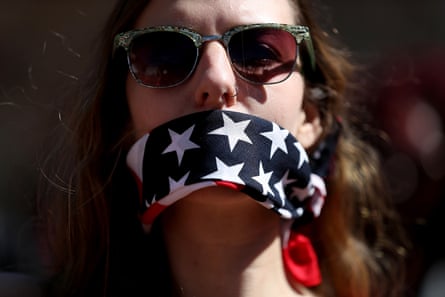
This time last year, women’s rights organisations were bracing themselves for a second Trump term. Few were prepared for the chaos that would be unleashed in January. The volume and speed of executive orders coming out of the White House were seen as a deliberate tactic to overwhelm and create panic. In many ways it worked – there was confusion, anger and exhaustion as organisations scrambled to fill the gap left by the USAID freeze. But that was just the beginning.
The US administration has been the key driver, supported by intense advocacy work by ultra-conservative groups using the moment to strengthen global ties with political allies.
We look at five moments that affected the safety, dignity and lives of women and girls.
Christian-right groups raise voices during UN Women
In March, several Christian-right organisations meet in an upmarket New York hotel for a two-day conference held in parallel with the annual UN Women gathering. It is an opportunity to share tactics on how to defeat the UN’s “radical agenda”. They are in high spirits as they applaud Trump’s second term and changes in US policy on gender, diversity and abortion. Meanwhile, the UN secretary general, António Guterres, opens the women’s summit with a stark warning that “the poison of patriarchy” is back, after a report shows that anti-rights actors are actively undermining longstanding consensus on key women’s rights issues around the world.
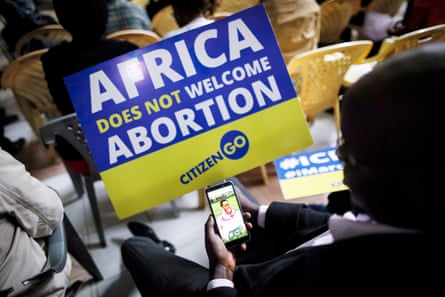
African ‘family values’ conferences
Over the summer, a series of conferences in Africa focused on the traditional family and national sovereignty sparks alarm among rights advocates. On 9 May, Uganda’s president and first lady open the third Interparliamentary Forum on Family, Sovereignty and Values in Entebbe to push back on criminal foreign forces eroding traditional family values. A few days later, the Pan-African Conference on Family Values is held in Nairobi. Both events are attended by leading US and European anti-rights figures, including president of Family Watch International, Sharon Slater; Austin Ruse, president of the Center for Family and Human Rights (C-Fam); and Jerzy Kwaśnewski, co-founder of Poland-based “extremist religious organisation” Ordo Iuris, who calls on African NGOs to push back against “radical global social engineering” of the UN and EU. In June, the Mormon church hosts the Strengthening Families conference in Sierra Leone, an event, reproductive rights advocates say that has become an anti-LGBTQ, anti-gender platform. It is not the first time Americans and Europeans have flown in to strengthen ties with their African allies but campaigners say the scale of their presence has grown significantly.
US threat to burn contraceptives
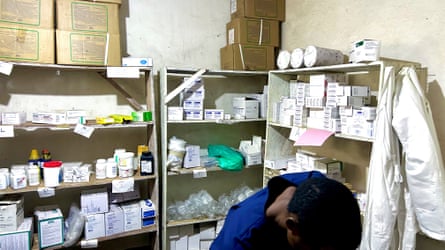
As clinics in sub-Saharan Africa say they are running out of contraceptives, including emergency kits for survivors of sexual violence, the US announces in July plans to destroy $10m of contraceptives held in a warehouse in Belgium. The International Planned Parenthood Federation (IPPF) says their destruction will deny more than 1.4 million women and girls contraceptive supplies, and lead to 174,000 unintended pregnancies and 56,000 unsafe abortions in the five African countries it surveyed. IPPF says the plan is an ideological decision “about imposing an anti-rights agenda on the entire world” and “an intentional act of reproductive coercion”. Médicins San Frontières (Doctors Without Borders) calls it “callous” and “reckless”. NGOs offer to buy the contraceptives so that they can reach their intended destinations but the US refuses all offers. Today, the situation is at a standstill as the Flemish government will not allow usable products to be destroyed.
‘Global gag rule’ expanded
Reviving the global gag rule, which halts US aid to groups that provide, advocate for or advise on abortion services overseas, is standard practice for republican administrations, so it came as no surprise when President Trump reinstated the rule in his first week of office in January. He also rejoined the Geneva Consensus Declaration, an anti-abortion agreement created by former Trump health adviser Valerie Huber that has gained support from about 40 countries. But in October, the US announces it intends to expand the global gag rule to include governments and multilateral organisations in addition to NGOs, and to cover diversity programmes. More details on the expansion of the global gag rule are expected in early 2026. Rajat Khosla, director of the Partnership for Maternal, Newborn and Child Health, says widening the scope of the rule will have “unimaginable effects”. Reproductive justice campaigners fear that new US aid packages being negotiated with countries in Africa will become conditional on accepting the expanded global gag.
Jordan Schneider: Let’s talk about the second strike. Justin, you wrote an article on it. What’s your take?
Justin McIntosh: My hope with that article was to clarify some of the language around this topic.
Shortly after the September strike, it was revealed that Secretary Hegseth was the target engagement authority (TEA). Generally, the TEA is a task force commander or a designee vested with the authority to approve strikes.
There are two main types of strikes. Some are status-based strikes, where a person is a known adversary but isn’t actively engaged in hostile acts. The others are action-based strikes, where adversaries are actively threatening friendly forces.
The bar is lower for an action-based strike, but collateral damage estimates are still required. Strikes must adhere to the principles of proportionality and the laws of war, and avoid causing undue damage or suffering or targeting protected sites. The strikes in the Caribbean seem to be status-based until the targets are in a location where they can actively threaten Americans.
If it were a status-based strike, it had to be approved by a TEA following a briefing. Typically, there’s a period of “soak,” where you watch the target — be it a person, building, or something else — to build a pattern of life. You do SLANT counts, which tally the number of men, women, and children. If the count is unfavorable, meaning women and children are present, you do not strike.
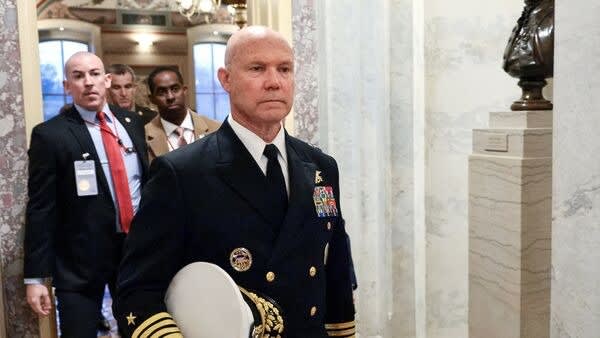
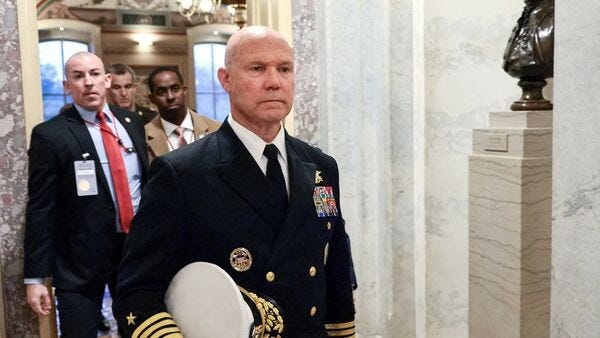
U.S. Navy Admiral Frank “Mitch” Bradley departs the U.S. Capitol following congressional briefings, December 4, 2025.Source.
All of that information is fed by a ground force commander or a strike cell commander to the TEA in an incredibly detailed briefing. Something like, “Sir, I want to direct your attention to this sensor, under this Unmanned Aerial Vehicle (UAV). We are targeting X. Over the last 48 hours of observation, we have this many reports from signals collection co-locating his phone with him. We had a high SLANT count at his location of 4-1-1, but it is currently 1-0-0. We know who it is. We’ve been watching him for 48 hours, and we have a window of opportunity to conduct this strike without causing collateral damage. This is how we will weaponize the strike to keep collateral damage to an absolute minimum, affecting only that person, building, or vehicle. Pending your questions.”
The TEA will then approve, disapprove, or ask for clarification, and give remarks and restrictions, including re-engagement authority. Then he will sit there and watch the strike, because he has now signed on the dotted line as the Target Engagement Authority.
The first thing that was weird about this situation was that Secretary Hegseth was the TEA for these strikes. Assuming everything happened as reported, the strike did not sink the vessel immediately, though it began to sink. There were apparently two clear survivors. 41 minutes later, there was a re-engagement. That is a long gap for re-engagement, which suggests there were discussions among the various stakeholders about whether they were allowed to re-engage. This probably included watching the vessel sink and realizing the strike was not going as planned.
The fact that the TEA left after the initial strike is important. He had already signed off and conceivably given remarks and restrictions, including for re-engaging. If he’d already authorized that, then it doesn’t matter that he wasn’t watching. The commanders below him have a moral, legal, and ethical responsibility to act appropriately, but he has already signed up for whatever comes next if he’d given that clearance.
If you say something like, “Kill them all,” as the TEA, you have technically signed off on whatever happens next, because, as the Target Engagement Authority, you stated your intent was for all targets to be dead.
Tony Stark: I have two thoughts on this. First, ownership is an issue here — I’m sure they are discussing what leadership ownership is behind the scenes. Second, the ethics here aren’t complicated. Every U.S. Army infantryman is taught a simple, non-negotiable rule — a wounded or surrendering enemy is under your care. You do not execute them. Every soldier is taught what it means to commit war crimes, and this is the baseline.
That rule is drilled into every officer, whether from West Point or Reserve Officer Training Corps (ROTC). Everyone in that decision-making room knew the line between engaging a target and recognizing when they are under your care. This is not complex law. The idea of them debating that for 41 minutes is cartoonish.
Justin McIntosh: My task force commander — he’s now a two-star general — once refused to authorize a strike and pissed off a lot of his junior officers and Special Forces captains. The proposed target was a mosque that was a staging location for insurgents — dozens of men were seen moving weapons out. Everybody was excited about the target, but the SLANT count was in the 60s, and Kurdish forces would arrive the next day.
This commander said, “Guys, I understand why you’re proposing this. But we are going to own that terrain tomorrow, and the negative repercussions of this strike greatly outweigh any potential positive benefit. I have not seen anything that shows an imminent threat to our forces or our partner forces that warrants taking secondary risk.”
This is the nuanced distinction between action-based and status-based strikes. A guy running at you with a weapon — that’s a clear threat. But a radio operator 15 kilometers away in a building you can’t see into? That is a tough call. We endlessly debate what constitutes a valid strike. Most commanders I served with were cautious — unless a target said, “We’re about to kill the Americans,” they didn’t shoot. They didn’t know who else was in that building. Sometimes an adversary put a child on the radio, with an adult feeding them lines, to make sure you knew a kid was there.
Warfare is ugly. I allow for confusion in the heat of the moment. But as a commander, you have to see the bigger picture. Is there an active threat? How do the benefits weigh against the costs? We are seeing those repercussions.
Jordan Schneider: If the Secretary of Defense is making these calls, what happens to the mission? They publicized these strikes to look tough and scare drug dealers — to shift their risk-benefit calculus. But the second strike might cost him his job.
Initially, Congressional oversight on this campaign was surprisingly muted. Now, it’s dialed to 10. Most Americans would be deeply uncomfortable reading that article — there is political grist in that. War crimes aside, striking two shipwrecked guys was a politically dumb decision.
Tony Stark: The Democratic base sees the whole episode as illegal, but most of the country doesn’t care if drug traffickers die. That said, most people don’t care if murderers die either, but we don’t execute people in the streets. The rule of law demands we behave better than our animal instincts.
Once the House and Senate Armed Services Committees (HASC and SASC) are involved, the situation changes. Congress hates being lied to, having its funds misused, and having its power usurped. While Congress has abdicated some of its war powers, once HASC and SASC have their hooks in you, they don’t let go, especially before midterms. That will tie up the administration’s agenda.
Any new budget aligned with the National Security Strategy will be filled with restrictive NDAA items. Six months ago, officials felt immune from investigation — now they are concerned. There’s no clean escape — Congressional staffers will want to talk to everyone. I don’t know if they will need a sacrificial lamb or a leadership change, but I doubt the Senate can confirm a new Secretary of Defense.
This is like a Spider-Man meme, everyone pointing fingers at each other. They can’t change what happened, but they can make it painful. I don’t know what comes next.
Justin McIntosh: The Secretary of Defense acting as decision-maker for the strike creates a problematic chain of review. If he had delegated authority — say, to South Command (SOCOM) commander Mitch Bradley — any questions about a strike would have gone to the Secretary for an impartial review. He could have consulted his council and then absolved Bradley of any accusation.
But who can be the impartial reviewer within the department now? By making himself the decision-maker, the Secretary has removed that layer of internal oversight. This puts the department in a weird position, because now questions go to the Senate. The Secretary can’t tell the Senate he is an impartial reviewer of the events — he was the primary decision-maker.
Jordan Schneider: Why would he do it in the first place? Did he want to feel cool and tough watching explosions on TV?
Justin McIntosh: With the right access, the Secretary could have watched Unmanned Aerial Vehicle (UAV) feeds from anywhere in the world. The question is why he was supervising. Mitch Bradley was the squadron commander for DEVGRU, and commander for JSOC, and SOCOM. He was on SEAL Team Six during the bin Laden raid. His entire career was built on these operations — he knows the process and is fully qualified to make decisions without another TEA. It also doesn’t make sense to include the Secretary as a secondary backup. Bradley didn’t need that level of oversight. Or, perhaps he did.
Gray Areas
Tony Stark: More information will come out about this, though Congress is always weird about investigations during the holidays. But the main takeaway should be this — the U.S. military has not abdicated its moral responsibilities. This is not the military’s default setting. Politics aside, we are at a critical point for military ethics. What does good order and discipline look like? Do we still care about these standards?
Justin McIntosh: Warfare is full of gray areas. The Kunduz hospital bombing is a good example. The 3rd Special Forces Group team and their Afghan partners were under fire, likely from the hospital. As protected sites, there is a higher standard for strikes on hospitals, and insurgents exploit that for their advantage.
Some argue we undermine our military by allowing sanctuary sites, but in my service, I was proud that we held ourselves to higher standards than the insurgents. Those standards protect children, sick and wounded people, innocent civilians, and doctors bravely risking their lives to heal.
That said, there are big gray areas. I usually give grace to ground force commanders, who have small optics and are focused on their men under fire. They are directly encountering active threats, and imperfect decisions are understandable.
My grace degrades for commanders removed from danger — secure in a strike cell with cushy leather chairs. That is the problem here. This strike was unnecessarily messy. There was ample time to develop the target and demonstrate our incredible precision. Secretary Hegseth could have justified the first strike by declassifying evidence that they were drug smugglers.
Jordan Schneider: This will not be our last conversation about this strike.
Tony Stark: Certainly not. Some argue ethics of warfare are a new invention, but these norms are shaped by culture and past wars. The many laws that followed WWII were a response to atrocities on the battlefield. Even in the Civil War, there were standards for treating the wounded and negotiating with the enemy to recover the dead.
The question of what defines a valid target is not new. Our modern standards are an important moral evolution.
Justin McIntosh: There is a psychologically strategic advantage to humane treatment. If the enemy knows they will be mistreated or killed if they are captured — like the Bataan Death March or the slave camps of World War II — they will fight harder. If your forces are known to treat POWs well, there will be more enemy defections. That is militarily relevant.
Jordan Schneider: Hegseth is Secretary of War because he defended Eddie Gallagher on Fox News, even though Eddie’s teammates said he did some heinous things. If that is your formative professional experience outside of public service, then you’re learning some twisted lessons. In other contexts, that behavior leads to a dark place. That’s the only logical explanation for what happened in September. It’s disgusting and counterproductive.
This isn’t a sustainable strategy. The American people can tolerate a lot, but celebrating these strikes from the rooftops is a profound misjudgement of the public mood.
Tony Stark: Congress was initially quiet because the American people didn’t care — it was almost a meme. But the public debate around this will change public opinion. Midterms are around the corner — this is a bad time to try to build up support for a military campaign.
DoD will likely be looking for new mission strategies, such as hitting targets at the source — production facilities, for example, anything legally or morally straight, or off camera. If the political fallout worsens, they may even seek congressional authorization to provide official cover.
If Bradley goes down for this, other officers will see that these strikes can cost them their careers. We might reach a critical mass of officers saying, “I am not risking my career, my livelihood, and my pension for this.” Six months ago, that was not a consideration.
Jordan Schneider: It comes back to the SOUTHCOM commander who retired early. How much did he see? Did he hear orders like “kill them all” and decide he wasn’t up for the task? It makes more sense now.
Tony Stark: Has he been called to testify before Congress yet? Bradley testified in a classified hearing this week. I am interested in seeing the former SOUTHCOM commander testify.
Justin McIntosh: I agree. That’ll be the telling moment, because it was around September when he announced he was going to retire early. The timing is weird.
Tony Stark: Congress failed by not immediately saying, “That’s weird, we should ask about that.”
Justin McIntosh: Normally, combatant commanders don’t retire halfway through their command.
Jordan Schneider: Especially when their job suddenly attracts public attention.
Tony Stark: If you’re at SOUTHCOM, you’re thinking, “Oh my God, I finally have assets! This is fantastic.”
Justin McIntosh: They’re in Tampa, so they’re trying to pull CENTCOM guys to fill those roles.
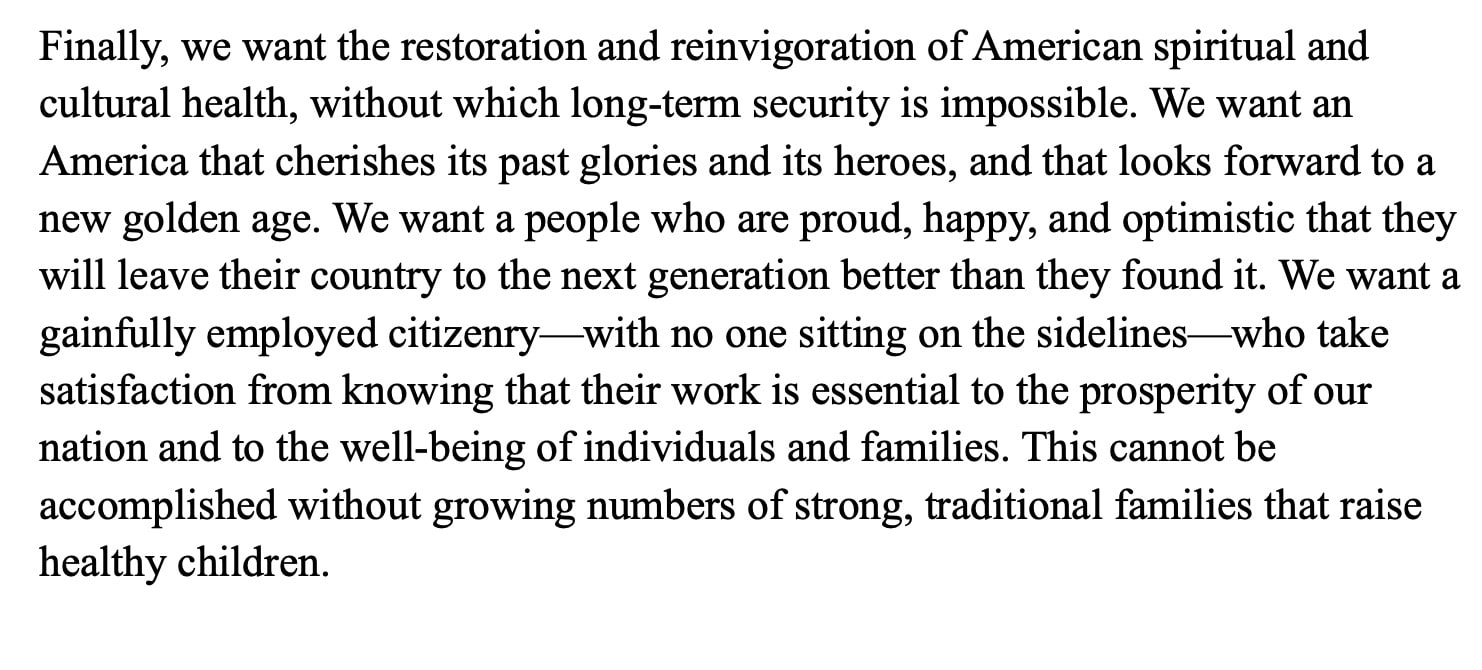
Jordan Schneider: Well, that was some real “SportsCenter for War” action. We’re closing with Grok. I asked it what regimes the paragraph from the National Security Strategy reminded it of.
It answered Fascist Italy, National Socialist Germany, and Franco’s Spain.
Apparently, Fascist Italy had a demographic campaign called the “Battle for Births,” which was intended to boost birth rates. Maybe we’ll cover that next week!
Tony Stark: That’ll really interest our audience.
Jordan Schneider: I’m really excited for the AI song I’m going to make from that paragraph.
ChinaTalk is a reader-supported publication. To receive new posts and support our work, consider becoming a free or paid subscriber.
Two days of talks between President Volodymyr Zelensky and allies have brought some progress on security guarantees, but Russia remains opposed to any foreign forces in Ukraine.
A Siena University poll showed that voters support having wealthy New Yorkers pay more in taxes to fund child care statewide, and favored Gov. Kathy Hochul in next year’s election.
The favorability ratings for Zohran Mamdani, the mayor-elect of New York City, have risen statewide and in New York City rise since his election last month.

 Login
Login