
Reading view

There are new articles available, click to refresh the page.

Fog on the Thames 1844-1899

One of the enduring memories of my childhood, spent partly in London, is walking in smog, then commonly known as a pea-souper. The combination of dense fog and smoke was so thick I could barely make out street lights, and the streets were for once almost empty, as vehicles could only proceed at walking pace.

This weekend I present a selection of paintings of mist, fog and maybe even a touch of smog on the River Thames, in and near London. Today’s paintings come from the pioneers of the nineteenth century, and tomorrow’s from the twentieth.

Many of JMW Turner’s greatest paintings take advantage of the optical effects of mist and fog. Being a Londoner, he must have experienced these all too frequently.

turnerrainsteamspeed
Joseph Mallord William Turner (1775-1851), Rain, Steam, and Speed – The Great Western Railway (1844), oil on canvas, 91 x 121.8 cm, The National Gallery (Turner Bequest, 1856), London. Courtesy of and © 2018 The National Gallery, London.

These peaked in Turner’s famous painting of a Great Western Railway train crossing the River Thames at Maidenhead: Rain, Steam, and Speed, exhibited at the Royal Academy in 1844. The whole image is fogbound and vague, and proved a precursor to the approach of the Impressionists after his death.

Claude Monet (1840–1926), The Thames below Westminster (1871), oil on canvas, 47 x 73 cm, The National Gallery, London. Wikimedia Commons.

Less than thirty years later, when he was taking refuge from the Franco-Prussian War, Claude Monet’s The Thames below Westminster (1871) is less Impressionist. Painted from the Embankment to the north of Westminster Bridge, near what is now Whitehall, the three towers to the south are almost superimposed, and aerial perspective is exaggerated by the mist. The river is bustling with small paddleboat steamers. In the foreground a pier under construction is shown almost in silhouette. Small waves and reflections on the river are indicated with coarse brushstrokes, suggesting this is a rapid and spontaneous work.

Winslow Homer, The Houses of Parliament (1881), watercolour on paper, 32.3 x 50.1 cm, Hirshhorn Museum and Sculpture Garden, Washington, DC. Wikimedia Commons.
Winslow Homer (1836–1910), The Houses of Parliament (1881), watercolour on paper, 32.3 x 50.1 cm, Hirshhorn Museum and Sculpture Garden, Washington, DC. Wikimedia Commons.

A decade later, The Houses of Parliament is Winslow Homer’s faithful representation of the Palace of Westminster when viewed from the opposite bank of the Thames, to the north (downstream) of the end of Westminster Bridge. The tide is high under the arches of Westminster Bridge, and small boats are on the river. This classic watercolour makes an interesting contrast with Monet’s later oil paintings I show tomorrow: Homer provides little more detail, the Palace being shown largely in silhouette, but works with the texture of the paper and careful choice of pigment to add granularity. He provides just sufficient visual cues to fine detail, in the lamps and people on Westminster Bridge, and in the boats, to make this a masterly watercolour.

bastienlepagethameslondon
Jules Bastien-Lepage (1848–1884), The Thames, London (1882), oil on canvas, 54 x 74.3 cm, Philadelphia Museum of Art, Philadelphia, PA. The Athenaeum.

The following year, Jules Bastien-Lepage paid a return visit to the city, when he painted The Thames, London. This view of industrial docklands further downstream maintains detail into the far distance, except where it’s affected by the smoky and hazy atmosphere typical of the city at that time. It was this section of the river that was also painted on several occasions by James Abbott McNeill Whistler.
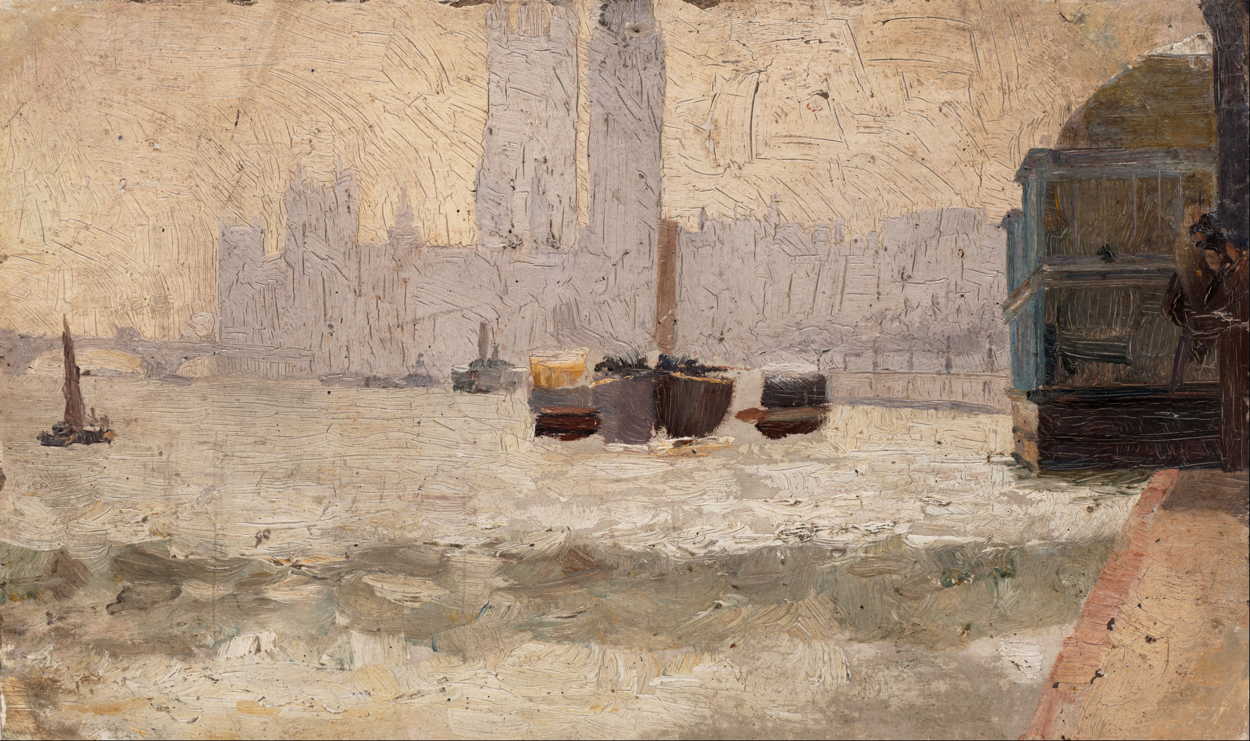
Tom Roberts, Fog, Thames Embankment (1884), oil on paperboard, 31.6 x 46 cm, Art Gallery of New South Wales, Sydney. Wikimedia Commons.
Tom Roberts (1856-1931), Fog, Thames Embankment (1884), oil on paperboard, 31.6 x 46 cm, Art Gallery of New South Wales, Sydney. Wikimedia Commons.

Tom Roberts’ Fog, Thames Embankment (1884) is painted from a similar location to Monet’s The Thames below Westminster above, on the Embankment to the north of Westminster Bridge, but is cropped more tightly, cutting off the tops of the Victoria and Elizabeth Towers. The Palace and first couple of arches of Westminster Bridge appear in misty silhouette, with moored barges and buildings on a pier shown closer and crisper. He renders the ruffled surface of the river with coarse brushstrokes, different from those of Monet.

A20754.jpg
Camille Pissarro (1830–1903), Charing Cross Bridge, London (1890), oil on canvas, 60 x 90 cm, National Gallery of Art, Washington, DC. Wikimedia Commons.

Among six paintings that Camille Pissarro started work on during his visit to England in 1890 was this view of Charing Cross Bridge, London from Waterloo Bridge. For this he made a sketch in front of the motif, then following his return to his studio in Éragny he painted this in oils. This looks south-west, towards a skyline broken by the Palace of Westminster and the familiar tower of Big Ben.

Frederick Childe Hassam, Houses of Parliament, Early Evening (1898), oil on canvas, 33 x 41.6 cm, Private collection. WikiArt.
Frederick Childe Hassam (1859-1935), Houses of Parliament, Early Evening (1898), oil on canvas, 33 x 41.6 cm, Private collection. WikiArt.

In Frederick Childe Hassam’s Houses of Parliament, Early Evening (1898), the sun has already set, and he is viewing the Palace in the gathering dusk from a point on the opposite (‘south’) bank, perhaps not as far south as Lambeth Palace. The Victoria Tower is prominent in the left of the painting, the Central Tower is in the centre, and the most distant Elizabeth Tower is distinctive with its illuminated clock face. Moored boats in the foreground provide the only other detail. His rough facture gives a textured surface to the water.

Painting along the Loing: Grez

One of the small villages on the southern edge of the Forest of Fontainebleau grew into an artist’s colony in the last quarter of the nineteenth century. Grez-sur-Loing is on the bend of the River Loing where it turns to the east to head for Moret-sur-Loing and empty into the River Seine at Saint-Mammès. The village lies between the road north from Nemours to Fontainebleau, and the river meandering in its floodplain.

Among those who painted there are John Singer Sargent, Carl Larsson who met his wife there, Bruno Liljefors the Swedish animal painter, PS Krøyer and other Nordic Impressionists of the Skagen group, Theodore Robinson and Willard Metcalf from the US, and the Glasgow Boys.

hawkinspeasant
Louis Welden Hawkins (1849–1910), A Peasant Woman (c 1880), further details not known. Wikimedia Commons.

Like many others, the British artist Louis Welden Hawkins came to Grez from Paris, in his case by about 1880. He painted rural scenes in a style strongly reminiscent of Jules Bastien-Lepage, who was only slightly older than Hawkins, and at the time making a great impression at the Salon. This is Hawkins’ Peasant Woman from about 1880.

hawkinsorphelins
Louis Welden Hawkins (1849–1910), Orphans (1881), oil on canvas, 125 x 160 cm, Musée d’Orsay, Paris. Wikimedia Commons.

Hawkins’ first success came with Orphans (1881), which shares Bastien-Lepage’s muted colours, attributed to the light supposedly peculiar to Grez. A young brother and sister are in a neglected graveyard, looking together at a pauper’s grave, apparently of one or both of their parents. This painting was awarded a third-class medal at the Salon that year, and marked the start of a run of his paintings exhibited at the following three Salons. It was purchased by the state in 1887 for 10,000 francs, and was also exhibited at the Paris World Exhibition in 1900.

hawkinslaststep
Louis Welden Hawkins (1849–1910), The Last Step (c 1882), oil on canvas, 129.5 x 83.8 cm, Owens Art Gallery, Mount Allison University, Sackville, Canada. The Athenaeum.

Hawkins continued this style in The Last Step (c 1882), showing an elderly woman walking slowly with a stick in what may be the same graveyard. In the distance, a gravedigger is digging a new grave through the stony soil. The two engage in conversation, probably discussing where she will be buried in the not too distant future.

By 1882, the colony at Grez was becoming popular with Nordic painters who were developing their skills in France. Among them were the Swedish artists Carl Larsson and Karin Bergöö, who met there and later married.

larssonoldmannursery1883
Carl Larsson (1853–1919), The Old Man and the Nursery Garden (1883), watercolour, 115 x 83 cm, Nationalmuseum, Stockholm, Sweden. Courtesy of Nationalmuseum, via Wikimedia Commons.

Larsson’s paintings from Grez also appear to have been influenced by Jules Bastien-Lepage. His watercolour of The Old Man and the Nursery Garden from 1883 shows similar muted colours, and common rural themes.

larssonbride1883
Carl Larsson (1853–1919), The Bride (1883), further details not known. Wikimedia Commons.

Larsson painted this touching portrait of The Bride at Grez the same year. It almost certainly shows his wife Karin, and was presumably intended as a wedding gift to her.

larssonincountry1883
Carl Larsson (1853–1919), À la Campagne (In the Country) (1883), further details not known. Wikimedia Commons.

In the Country (1883) is typical of a number of views that Larsson painted of the rural poor in and around Grez, in the same realist style with soft colours. That year, he had his first painting accepted by the Paris Salon, and was getting valuable commissions for book illustrations.

larssonautumn1884
Carl Larsson (1853–1919) Autumn (1884), watercolour, 92 x 60 cm, Nationalmuseum, Stockholm, Sweden. Courtesy of Nationalmuseum, via Wikimedia Commons.

The single figure in Larsson’s watercolour Autumn (1884) is dressed anachronistically in clothing from the previous century. This was most probably to please the Salon jury, as eighteenth century scenes were fashionable at the time. Its setting at Grez and his soft realism combine to make this one of his finest watercolours of this period.

Well before the Glasgow Boys came, John Lavery visited from Glasgow. Although he was born in Belfast, he moved to Glasgow when he was a child. After initially attending the Haldane Academy in Glasgow, he went to Paris in the early 1880s, where he was a student at the Académie Julian, where he was influenced by Jules Bastien-Lepage and Millet, and painted at Grez-sur-Loing in 1884.

laveryprincipalstgrez
John Lavery (1856–1941), The Principal Street at Grez (1884), further details not known. Wikimedia Commons.

Lavery’s plein air oil sketch of The Principal Street at Grez from 1884 shows one of the many artists at work in the village, which had become popular internationally. Although following the course recommended for Naturalist painters, Lavery’s style is here thoroughly Impressionist.

At its height, Grez drew artists from all over the world, including some of the pioneers from Japan. In 1889 Asai Chū founded the first group of western-style (yōga) painters in Japan, and in 1898 was appointed professor of the forerunner of the Tokyo University of the Arts. In 1900 he moved to Paris for two years of study of Impressionism, and went to Grez to paint en plein air.

Asai Chū, Washing Place in Grez-sur-Loing (1901), oil on canvas, 33.3 x 45.5 cm, Bridgestone Museum of Art, Tokyo. Wikimedia Commons.

His Washing Place in Grez-sur-Loing shows small huts used by the village women to wash laundry in 1901.

Asai Chū, Bridge in Grez-sur-Loing (1902), watercolour on paper, 28.4 x 43.5 cm, Bridgestone Museum of Art, Tokyo. Wikimedia Commons.

The following year he painted this Bridge in Grez-sur-Loing before returning to Japan.

For much of that time, just over 12 km (7 miles) downstream, one of the great landscape artists of French Impressionism had been painting alone.

❌