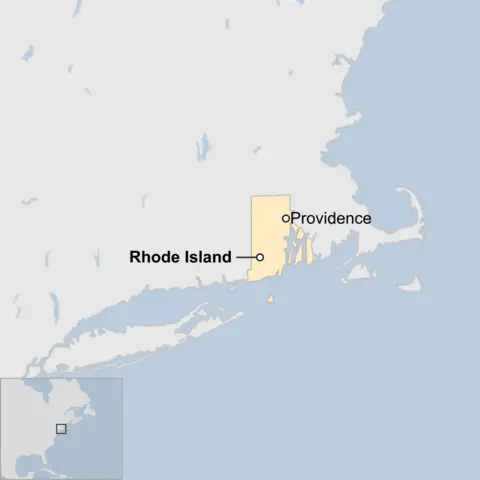
A person of interest has been detained in connection with a US shooting at Brown University that left two people dead, police said.
Nine others were injured when a gunman opened fire at the university in Providence on Saturday.
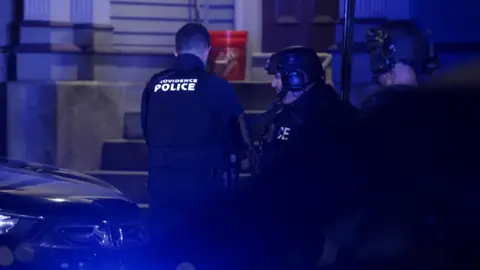
Police confirmed on Sunday a person had been detained, and an earlier order for people on the Brown campus and surrounding areas to shelter had been lifted.
Of those injured, medics said one person was in a critical condition, six were "critical but stable" and two others were less severely hurt.
The gunman opened fire in a classroom at around 16:00 local time (21:00 GMT) on Saturday at the Holley engineering building at the eastern end of Brown's campus, according to officials.
The identities of those killed or injured have not yet been released, but Brown University President Christina Paxson told reporters in a press briefing on Saturday that all the victims, including those killed and wounded, were students.
Police had earlier released CCTV footage of a male suspect walking away from the scene wearing all black clothing. Officers said a firearm was not found in a sweep of the building.
Not once, in the four and a half years I learned at home, did anyone from the state come to assess what sort of education I was receiving, or even just check on me.
Watch: Eyewitness captures moment man tackles and disarms Bondi shooter
Twelve people have died - including one gunman - following a shooting at Australia's Bondi Beach which targeted the Jewish community on the first day of Hanukkah.
According to police, at least 12 others have been injured and two officers were shot during the event, which has since been declared a terror attack by officials. The surviving gunman is in a critical condition.
More than 1,000 people were attending an event on the beach celebrating Hanukkah.
Chris Minns, the premier of New South Wales, said: "Our heart bleeds for Australia's Jewish community tonight.
"I can only imagine the pain that they're feeling right now to see their loved ones killed as they celebrate this ancient holiday".
Mass shootings in Australia are very rare, and the attack at Bondi is the deadliest incident in Australia since the Port Arthur massacre in 1996.
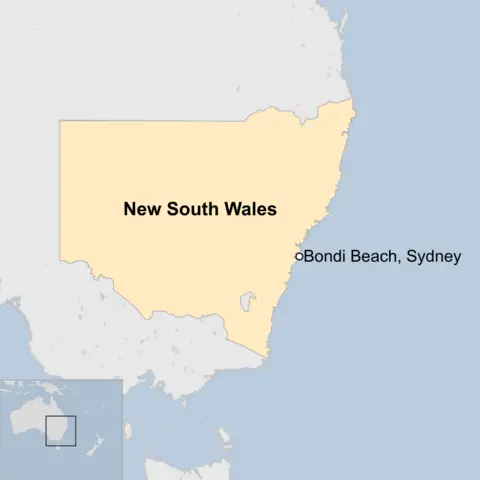
Bondi Beach is located in eastern Sydney in the state of New South Wales, on Australia's east coast.
It is one of Australia's most popular beaches, attracting millions of visitors each year. The area is a significant attraction for tourists.
What happened?
New South Wales (NSW) police responded to reports of gunfire at around 18:47 local time (07:47 GMT), with video showing hundreds of people fleeing from the coastline.
In their initial statement posted on X, NSW Police urged people at the scene to take shelter and other members of the public to avoid the area.
Around the same time, local media began reporting people "on the ground" in the vicinity of Campbell Parade.
A video verified by the BBC appears to shows two gunmen firing from a small bridge which crosses from the car park on Campbell Parade towards the beach itself.
An event to mark the first day of the Jewish celebration Hanukkah was taking place on Bondi Beach, very close to the bridge where the men were firing from. More than 1,000 were in attendance.
Premier Minns also paid tribute to a man filmed wrestling a gun from one of the attackers.
"That man is a genuine hero, and I've got no doubt there are many, many people alive tonight as a result of his bravery," Minns said at a press conference.
In the video, the man is seen sneaking up on the attacker, before grabbing him in a bear hug.
The now-disarmed man then retreats back towards the bridge, where the other attacker is still firing from.
As the video continues, another man appears to be injured and flees the scene, as a policeman arrives behind the attackers and opens fire at them.
A separate video, also verified, shows several policemen on the same bridge. One appears to be administering CPR to a motionless man as someone shouts "he's dead, he's dead".
How many people were killed and injured?
Getty Images
The attack targeted a Hanukkah celebration on the beach, police say
Apart from police confirming one gunman as dead, details on who has been killed and injured are sparse.
Twelve people including one of the armed men have been confirmed dead by police. Another gunman is said to be in a critical condition.
Officials say 29 other people were taken to hospital, and two officers were also shot during the incident.
One eyewitness, Barry, was attending the Hanukkah event on Bondi when with his children when he heard gunshots.
He told the BBC he saw two men on a bridge shooting towards the crowd.
He said there were bodies on the ground. He and his children were able to escape with a friend in a car, he added.
What is the latest?
Getty Images
Police have urged for calm as they carry out their investigation
Police have declared Saturday's shooting a terror attack.
An exclusion zone has been set up around the scene as police use specialist equipment to check improvised explosive devices (IEDs) found in a car linked to the dead gunman, and police are still urging the public to avoid the area."
"No stone will be left unturned" in the investigation, New South Wales Police Commissioner Mal Lanyon said.
He said police would not release any information about the gunmen at this time, and urged for calm while police carry out their duties, adding that this was "not a time for retribution".
Police said they cannot confirm if there was a third gunman involved or if there was anyone else involved in the attack, but enquires are ongoing.
During a televised address, Australian Prime Minister Anthony Albanese called the Bondi Beach shooting "an act of evil antisemitism, terrorism that has struck the heart of our nation".
"We have seen Australians today run towards dangers in order to help others. These Australians are heroes and their bravery has saved lives", he added.
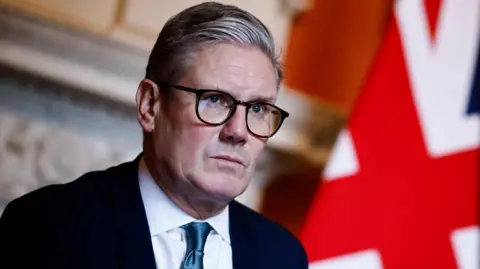
The attack targeting the Jewish community at a Hanukkah event in Australia is "sickening", Sir Keir Starmer has said.
At least 11 people were killed in the shooting at Bondi Beach on Sunday and a further 29 taken to hospital, according to police.
In a statement on X, the UK prime minister said: "The United Kingdom will always stand with Australia and the Jewish community." He added that the government was working with Community Security Trust, a Jewish security organisation, on the policing of Hanukkah events in the UK.
The Metropolitan Police said it was increasing its "police presence, carrying out additional community patrols and engaging with the Jewish community to understand what more we can do".
"It is an awful reality that Jewish communities across the world continue to face a higher level of threat," the force said in a statement.
"At a time when London's Jewish communities are coming together to begin the celebration of Hanukkah, we know this attack will be the cause of not just terrible upset but also significant heightened concern about safety."
In October, two people were killed in an attack at a synagogue in Manchester on Yom Kippur, the holiest day in the Jewish religious calendar.
On Sunday, the UK's Jewish Leadership Council (JLC) called on the police and government to protect events celebrating Hanukkah which begins this evening and lasts for eight days.
Hanukkah, also known as Chanukah, is a festival of light usually observed in December.
"We are devastated and angered that in Sydney, Jews appear to have been targeted once again for being Jewish," the JLC said in a statement.
"We know that such hatred also exists in this country, as we are still reeling from the attack on a synagogue in Manchester on Yom Kippur.
"As we prepare to celebrate Chanukah over the next eight nights, we call on government and law enforcement to work with our community to protect Jewish life in the UK and ensure that events this week can go ahead safely. We must not let hatred extinguish the festival of light."
Specialist rape and sexual offence investigation teams will be introduced to every police force in England and Wales by 2029, the government has pledged.
It is part of a long-delayed plan aimed at halving violence against women and girls within a decade.
The strategy - which will include funding for undercover units operating online, and a roll out of domestic abuse protection orders - is due to be unveiled on Thursday, after being pushed back three times this year.
Home Secretary Shabana Mahmood said the measures will help to "bear down on abusers, stopping them in their tracks. Rapists, sex offenders and abusers will have nowhere to hide."
The government says the new teams will have officers with specialist investigation skills for working on rape and sexual offence cases.
More than 50% of police forces already have these teams in place, but the government says every force will have dedicated officers by 2029.
It says staff will have the right training to understand the mindset of abusers and victims.
Announcing the move, the home secretary said: "This government has declared violence against women and girls a national emergency.
"For too long, these crimes have been considered a fact of life. That's not good enough. We will halve it in a decade."
Also announced is a roll out of domestic abuse protection orders, which have been trialled over the last year, across England and Wales.
They can ban individuals from contacting a victim, visiting their home or posting harmful content online, and can also be used in cases involving coercive or controlling behaviour. Breaching an order is a criminal offence.
There will also be almost £2m in investment for special undercover units of police officers operating online - to target those harassing women and girls on the internet.
It said sexually-motivated crimes against women in public remained widespread, criticised the limited nature of data on them, and called for urgent action to prevent predators from offending.
The publishing of the government's strategy has been long delayed. It was initially expected to be announced in the spring.
In Labour's general election manifesto last year the party pledged to use "every government tool available to target perpetrators and address the root causes of abuse and violence".
A person of interest has been detained in connection with a US shooting at Brown University that left two people dead, police said.
Nine others were injured when a gunman opened fire at the university in Providence on Saturday.
Police confirmed on Sunday a person had been detained, and an earlier order for people on the Brown campus and surrounding areas to shelter had been lifted.
Of those injured, medics said one person was in a critical condition, six were "critical but stable" and two others were less severely hurt.
The gunman opened fire in a classroom at around 16:00 local time (21:00 GMT) on Saturday at the Holley engineering building at the eastern end of Brown's campus, according to officials.
The identities of those killed or injured have not yet been released, but Brown University President Christina Paxson told reporters in a press briefing on Saturday that all the victims, including those killed and wounded, were students.
Police had earlier released CCTV footage of a male suspect walking away from the scene wearing all black clothing. Officers said a firearm was not found in a sweep of the building.
The post box will replace a handmade one currently used at the remote station
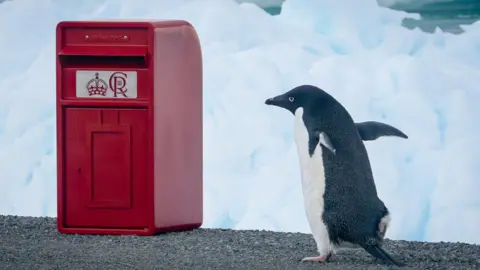
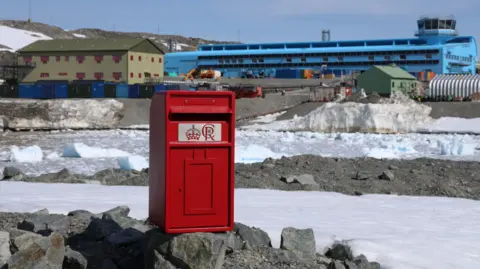
A shiny new red post box has been given as a gift from King Charles III to staff at a remote Antarctic research station.
The Royal Mail red lamp post box was sent to staff at the Cambridge-based British Antarctic Survey station at Rothera.
The box, featuring the King Charles III cypher, was delivered after Kirsten Shaw, a station support assistant who runs the British Antarctic Territory Post Office for staff, requested an upgrade to their handmade box.
"Being in Antarctica is incredible, but it's full of extremes, so I think it's a special thing to send post back home, to communicate your experiences. It's a moment of your life that you put down on paper and give to someone else," she said.
The Rothera research station, which opened in 1975, is the largest British Antarctic Survey (BAS) facility, and a renowned global hub for climatic research.
It is situated 1,860km (1,155 miles) south of the Falkland Islands.
Staff work and live at the station for months at a time.
Ms Shaw said: "Getting post is really special for the team at Rothera.
"If you're doing fieldwork for many months, the feeling of receiving a letter — an actual tangible, piece of paper with handwriting from friends and family — is such a lift.
"It's a wonderful way to connect people that goes beyond what an email or text message can do."
BAS/Jake Martin
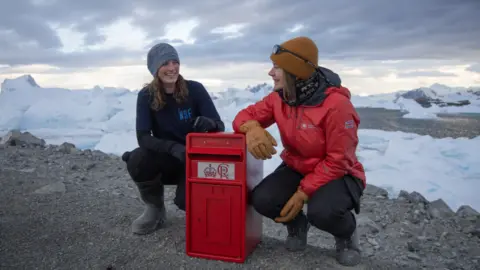
Kirsten Shaw and Aurelia Reichardt, station leader at Rothera, are pictured with the new post box
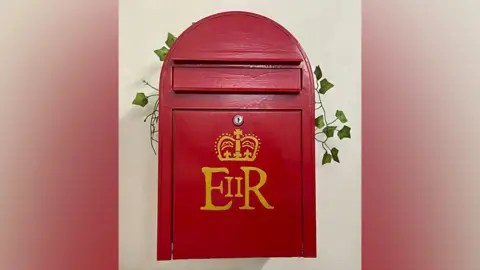
The box will replace the handmade and painted one currently used at the station.
The BAS said "the Royal Household worked with Royal Mail to arrange this particularly special delivery".
It was delivered to Rothera by the UK's polar research vessel RRS Sir David Attenborough, along with the first major drop of supplies to the station following the long Antarctic winter.
The post box will be installed in the Discovery Building, a new scientific support and operations hub.
BAS/Aurelia Reichardt
The handmade box will now be replaced by the official one from the Royal Mail
Postal logistics in such a remote area are understandably not straightforward.
Ms Shaw's job is to oversee the formal Post Office logistics of getting mail in and out of Antarctica from Rothera, as well as getting post out to staff to other BAS stations and science field camps.
Post has to be gathered and put on board the RRS Sir David Attenborough or on BAS aircraft to the Falkland Islands, where BAS maintains an office in Stanley.
The final leg involves transport to RAF Brize Norton in Oxfordshire, where letters enter the Royal Mail postal network for onward delivery.
BAS/Jake Martin
The box will be placed in a new building at the station
Jane Rumble, HM Commissioner for the British Antarctic Territory said: "Maintaining a postal service in the British Antarctic Territory is far more than a symbolic gesture.
"It reinforces Britain's presence and heritage in Antarctica and provides a vital link to the wider world."
Two gunman opened fire at dozens of people who were at a Jewish holiday event. At least 11 people were killed in the attack, and so was one of the shooters, the police said.
In the first of these two articles tracing the history of depictions of the temptation of Saint Anthony, I had reached 1650, when the bizarre composite creatures that flourished in Hieronymus Bosch’s triptych of about 1500-10 were becoming common.
David Teniers the Younger (1610–1690), The Temptation of Saint Anthony (c 1660), media and dimensions not known, Palais des Beaux-Arts, Lille, France. Wikimedia Commons.
The prolific David Teniers the Younger painted several versions of the Temptation of Saint Anthony after about 1650. Most, like this painting now in Lille, show an ordinary landscape with the saint, with the addition of his own species of daemons. Some of these re-use ideas first seen in Bosch’s triptych, such as that of a single figure on the back of a flying narwhal; that figure is wearing an inverted funnel on its head.
David Teniers the Younger (1610–1690), The Temptation of Saint Anthony (c 1650), oil on copper, 55 × 69 cm, Museo Nacional del Prado, Madrid. Wikimedia Commons.
Another of Teniers’ paintings, currently in the Prado, shows three fairly normal humans in a menagerie of daemons, some of which clearly have their origins in Bosch’s work. The figure flying on a fish has changed from the previous painting, but still wears its distinctive inverted funnel.
David Teniers the Younger (1610-1690), The Temptation of Saint Anthony (c 1650), oil on canvas, 80 x 110 cm, National Museum of Western Art, Tokyo. Wikimedia Commons.
This third version, now in Tokyo, repeats many of the same daemons in a different setting, retaining the figure wearing the inverted funnel in close aerial combat.
Domenicus van Wijnen (1661–after 1690), The Temptation of Saint Anthony (c 1685), media and dimensions not known, The National Gallery of Ireland, Dublin. Wikimedia Commons.
Almost two centuries after Bosch’s triptych, more radically different and inventive approaches appear, here in Domenicus van Wijnen’s painting of about 1685. Its daemons are much more human in form, and have proliferated in a way more common in the ‘fairie paintings’ seen around 1840, including some by Richard Dadd. Van Wijnen was a prolific painter of scenes of witchcraft and the ‘dark arts’.
Giovanni Battista Tiepolo (1696–1770), The Temptation of Saint Anthony (c 1740), oil on canvas, 40 x 47 cm, Pinacoteca di Brera, Milan. Wikimedia Commons.
Southern European painters were more likely to keep to more traditional figurative compositions, as used by Tiepolo in about 1740. This is surprising, given the presence of Bosch’s paintings in major collections in both Madrid and Venice.
Henri Fantin-Latour (1836–1904), The Temptation of Saint Anthony (c 1875), oil on canvas, 63.5 x 83.5 cm, National Museum of Western Art, Tokyo. Wikimedia Commons.
Depictions of the Temptation of Saint Anthony remained popular even through the 1800s, although by this time Bosch’s triptych seems to have become long forgotten, and painters seemed no longer to need such excuses to exercise their imagination and inventiveness. The long-awaited publication of Gustave Flaubert’s book The Temptation of Saint Anthony, written in 1874 as a script for a play, brought renewed interest, and a succession of paintings from Henri Fantin-Latour (c 1875, above), Paul Cézanne (c 1875, below), Gustave Moreau (a watercolour), and Fernand Khnopff (1883).
Paul Cézanne (1839–1906), The Temptation of Saint Anthony (c 1875), oil on canvas, 47 x 56 cm, Musée d’Orsay, Paris. Wikimedia Commons.
Cézanne shows the shadowy figure of Saint Anthony slumped against a bush at the left, his arms held out to shield himself from the temptations. The devil is shown in stereotypical form, wearing red robes, with an animal head and horns, behind the saint. In front of them is the naked Queen of Sheba, her right arm held high to accentuate her form. Around her are naked children. In front of Saint Anthony is a black bag presumably containing money, and a book.
Domenico Morelli (1823–1901), The Temptation of Saint Anthony (1878), oil on canvas, 137 × 225 cm, Galleria Nazionale d’Arte Moderna, Rome. Wikimedia Commons.
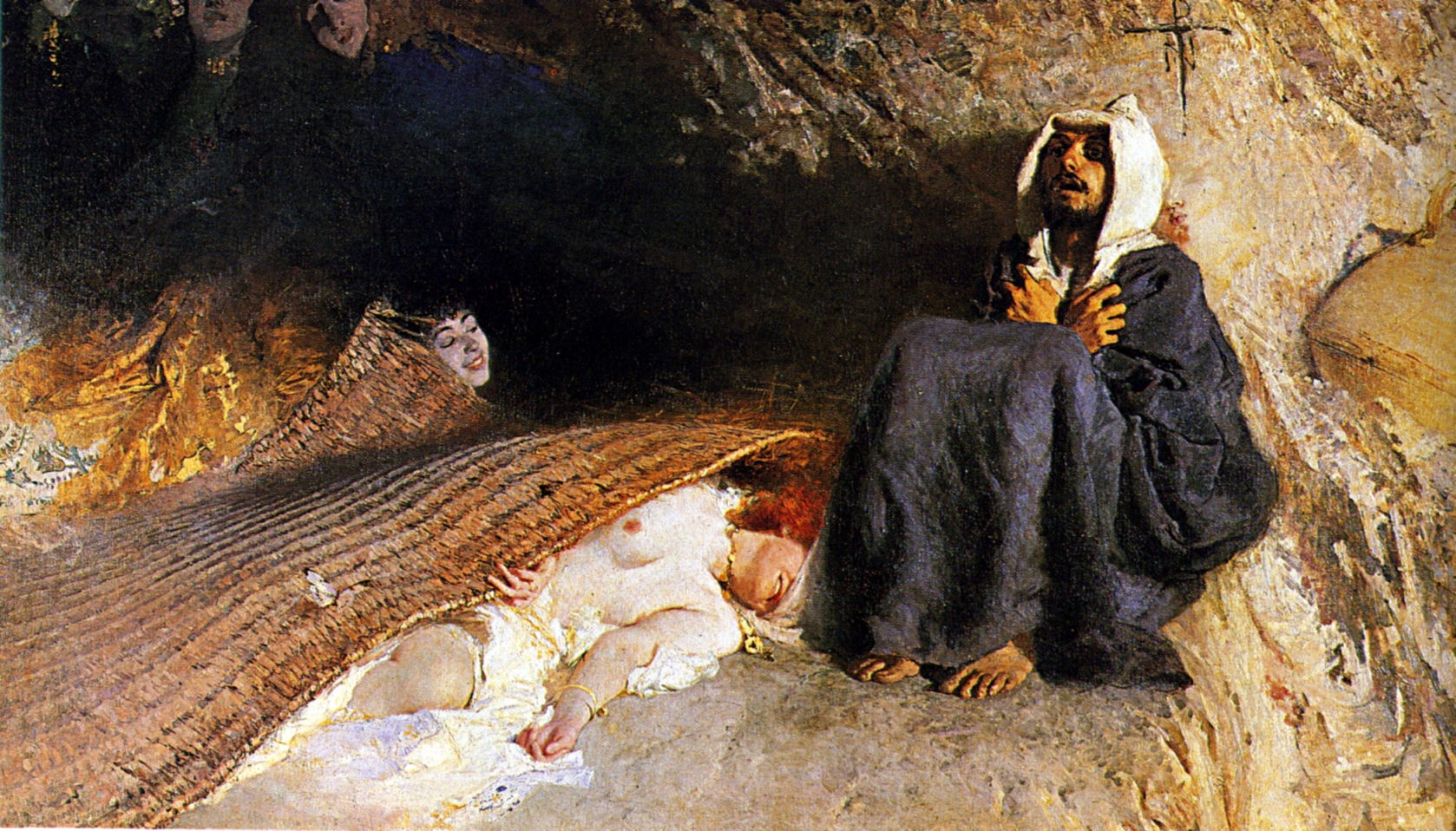
The influential Neapolitan realist Domenico Morelli painted this stark work in 1878, perhaps the exact antithesis of the rich imagery that had developed since the Renaissance.
Félicien Rops (1833–1898), The Temptation of Saint Anthony (1878), pastel and gouache on paper, 73.8 × 54.3 cm, Cabinet des estampes, Bibliothèque Royale Albert Ier, Brussels. Wikimedia Commons.
That same year, Félicien Rops painted his satirical and irreverent version with more subtle details. Bound to the cross in Saint Anthony’s tempting vision is a visibly voluptuous woman, the word EROS replacing the normal initialism of INRI (Iēsūs/Iēsus Nazarēnus, Rēx Iūdaeōrum, meaning Jesus of Nazareth, the King of the Jews) shown above Christ’s head. Christ himself, with full stigmata, has been knocked sideways to accommodate the woman’s naked body. Behind the cross the horned devil wears scarlet robes and pulls faces. Behind him is a pig, Anthony’s attribute. The two daemonic putti are most definitely not references to Bosch.
Lovis Corinth (1858–1925), The Temptation of Saint Anthony (1897), oil on canvas, 88 × 107 cm, Bayerische Staatsgemäldesammlungen, Munich. Wikimedia Commons.
Lovis Corinth painted two versions of the Temptation. The earlier, from 1897, shows Anthony surrounded by beautiful and naked women, offering him fruit, other food, and their bodies. The daemons have faded into the background, and are caricatures based on humans.
Lovis Corinth (1858–1925), The Temptation of Saint Anthony (after Gustave Flaubert) (1908), oil on canvas, 135.3 × 200.3 cm, The Tate Gallery, London. Wikimedia Commons.
His later canvas, explicitly painted after Gustave Flaubert, in 1908, brings in the Queen of Sheba, an elephant and monkey, but is also notable for depicting Anthony as a young man. Even Salvador Dalí’s 1946 painting of the Temptation steers clear of Bosch’s imagery, although it does at least return to the concept of an individualistic and inventive vision.
Specialist rape and sexual offence investigation teams will be introduced to every police force in England and Wales by 2029, the government has pledged.
It is part of a long-delayed plan aimed at halving violence against women and girls within a decade.
The strategy - which will include funding for undercover units operating online, and a roll out of domestic abuse protection orders - is due to be unveiled on Thursday, after being pushed back three times this year.
Home Secretary Shabana Mahmood said the measures will help to "bear down on abusers, stopping them in their tracks. Rapists, sex offenders and abusers will have nowhere to hide."
The government says the new teams will have officers with specialist investigation skills for working on rape and sexual offence cases.
More than 50% of police forces already have these teams in place, but the government says every force will have dedicated officers by 2029.
It says staff will have the right training to understand the mindset of abusers and victims.
Announcing the move, the home secretary said: "This government has declared violence against women and girls a national emergency.
"For too long, these crimes have been considered a fact of life. That's not good enough. We will halve it in a decade."
Also announced is a roll out of domestic abuse protection orders, which have been trialled over the last year, across England and Wales.
They can ban individuals from contacting a victim, visiting their home or posting harmful content online, and can also be used in cases involving coercive or controlling behaviour. Breaching an order is a criminal offence.
There will also be almost £2m in investment for special undercover units of police officers operating online - to target those harassing women and girls on the internet.
It said sexually-motivated crimes against women in public remained widespread, criticised the limited nature of data on them, and called for urgent action to prevent predators from offending.
The publishing of the government's strategy has been long delayed. It was initially expected to be announced in the spring.
In Labour's general election manifesto last year the party pledged to use "every government tool available to target perpetrators and address the root causes of abuse and violence".
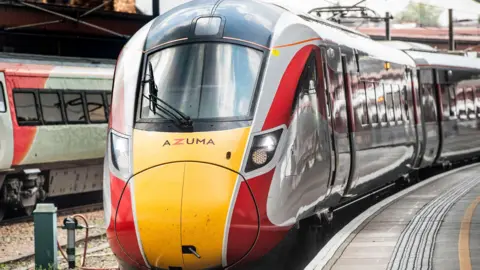
A revamp of train timetables has come into effect across the country, involving some of the most significant changes for nearly a decade.
Rail operators are promising more services across the network and faster journeys on some routes as a result of the changes, with the East Coast Main Line to benefit the most.
Passengers are being advised to check the new timetables before travelling.
The level of change has not been seen since May 2018 when an update sparked major disruption and cancellations on some routes.
Rail timetables are changed every May and December, but rarely to this degree.
Network Rail is promising quicker journeys and thousands of extra seats every day, following a £4bn investment over the past decade.
The changes promise a cut of 15 minutes to journey times between London King's Cross and Edinburgh and 10 minutes between Edinburgh and York.
Network Rail says the rail line, which is used by several operators, will have improved connectivity between Scotland, North East, England, Yorkshire and London.
One of the companies using the line, LNER, called the changes "transformational" and said it expected to run 10,000 additional services per year.
Ellie Burrows, Eastern regional managing director for Network Rail, said: "The industry has been preparing for many years for the new timetable.
"Our priority now is to continue working together to deliver the long-term benefits of this timetable change, the biggest in over a decade, for our passengers and the communities we serve."
The changes will also see Northern launch a new hourly fast service between Leeds and Sheffield.
Another operator, Avanti, says there will be more trains between London and Liverpool.
Meanwhile Transport for Wales is introducing more services for Chester, Wrexham and Swansea.
The changes are the biggest since May 2018 when a timetable update triggered major disruption and cancellations on some services.
That led to a full review and eventually the Labour government's decision to create Great British Railways and bring the industry under state control.
Travel expert Simon Calder said he was "pretty confident we won't see the complete collapse of a network, as we did when the Thameslink line had its timetable completely reconfigured in 2018 - that was an absolute shambles".
"There has been an awful lot of thought and time that has gone into this and the whole idea is to extract the maximum possible capacity from Britain's Victorian rail network without jeopardising reliability."
The post box will replace a handmade one currently used at the remote station
A shiny new red post box has been given as a gift from King Charles III to staff at a remote Antarctic research station.
The Royal Mail red lamp post box was sent to staff at the Cambridge-based British Antarctic Survey station at Rothera.
The box, featuring the King Charles III cypher, was delivered after Kirsten Shaw, a station support assistant who runs the British Antarctic Territory Post Office for staff, requested an upgrade to their handmade box.
"Being in Antarctica is incredible, but it's full of extremes, so I think it's a special thing to send post back home, to communicate your experiences. It's a moment of your life that you put down on paper and give to someone else," she said.
The Rothera research station, which opened in 1975, is the largest British Antarctic Survey (BAS) facility, and a renowned global hub for climatic research.
It is situated 1,860km (1,155 miles) south of the Falkland Islands.
Staff work and live at the station for months at a time.
Ms Shaw said: "Getting post is really special for the team at Rothera.
"If you're doing fieldwork for many months, the feeling of receiving a letter — an actual tangible, piece of paper with handwriting from friends and family — is such a lift.
"It's a wonderful way to connect people that goes beyond what an email or text message can do."
BAS/Jake Martin
Kirsten Shaw and Aurelia Reichardt, station leader at Rothera, are pictured with the new post box
The box will replace the handmade and painted one currently used at the station.
The BAS said "the Royal Household worked with Royal Mail to arrange this particularly special delivery".
It was delivered to Rothera by the UK's polar research vessel RRS Sir David Attenborough, along with the first major drop of supplies to the station following the long Antarctic winter.
The post box will be installed in the Discovery Building, a new scientific support and operations hub.
BAS/Aurelia Reichardt
The handmade box will now be replaced by the official one from the Royal Mail
Postal logistics in such a remote area are understandably not straightforward.
Ms Shaw's job is to oversee the formal Post Office logistics of getting mail in and out of Antarctica from Rothera, as well as getting post out to staff to other BAS stations and science field camps.
Post has to be gathered and put on board the RRS Sir David Attenborough or on BAS aircraft to the Falkland Islands, where BAS maintains an office in Stanley.
The final leg involves transport to RAF Brize Norton in Oxfordshire, where letters enter the Royal Mail postal network for onward delivery.
BAS/Jake Martin
The box will be placed in a new building at the station
Jane Rumble, HM Commissioner for the British Antarctic Territory said: "Maintaining a postal service in the British Antarctic Territory is far more than a symbolic gesture.
"It reinforces Britain's presence and heritage in Antarctica and provides a vital link to the wider world."
Watch: Nobody expecting "toilet police", says UK equality chief
Everyone should "follow the rules" when guidance on single-sex spaces is released, the new head of the equality watchdog has told the BBC.
Dr Mary-Ann Stephenson, chair of the Equality and Human Rights Commission (EHRC), said "things could be sorted out if there is goodwill and recognition that everybody has rights", and that "nobody is expecting there to be a toilet police".
The guidance, for businesses and services, was drawn up after a unanimous Supreme Court ruling in April that legally a woman should be defined by biological sex for the purposes of the Equality Act 2010.
The BBC interview, to be broadcast on Sunday with Laura Kuenssberg, is Dr Stephenson's first in her new role.
The EHRC's guidance was passed to the government three months ago, but it has yet to publish it formally, which would give the code of practice legal force.
It aims to provide advice to businesses and services - such as women's refuges, gyms, hospitals or shopping centres - about how the Supreme Court ruling should work.
Seen by the BBC after it was leaked, the 300-page document says single-sex spaces should only be open to people of the same biological sex, otherwise they cease to be single-sex areas.
That would mean, for instance, that a trans woman – a biological male who identifies as a woman - would not be able to use women's toilets and changing rooms.
The guidance says it may be legitimate for businesses or services to ask people to provide confirmation they are of the eligible sex "by proportionate means".
This has all caused controversy and anger among some transgender campaigners.
Dr Stephenson told the BBC: "Nobody is expecting there to be a toilet police.
"But equally if there are situations where there are complaints about regular problems, then people might need to... improve signage, improve explanations, or make sure they have got alternative provision."
She said she expected both service providers and people using these services to "follow the rules".
Dr Stephenson was challenged on what facilities trans people should use if there were no alternatives, or what businesses should do if they did not have the space or resources to make extra provision.
She said: "There's often unisex provision and where there isn't, as I say, we need to think more broadly about how we make sure those that those facilities are available…
"If you've got, you know, two self-contained cubicles, one of which is labelled men and one of which is labelled women, then the most sensible thing in those circumstances for a service provider to do is to make both of those unisex."
Dr Stephenson was appointed to the role in July and she started earlier this month.
It was greeted with hostility by some trans campaigners, in part because she had donated money to the case of lawyer Allison Bailey, who won part of a tribunal claim that she was discriminated against because of her gender-critical views.
In our interview, Dr Stephenson was adamant she could still be objective when considering trans issues.
She said she donated to the case because she was frustrated by situations where "women were being harassed and losing their jobs on the basis of lawfully held beliefs".
She said she had been concerned by the experiences of some women "when trying to have meetings to discuss proposed changes in the law".
"I thought it was important that actually in a democracy, if there is a proposed change to the law, people should be able to meet and discuss those changes without violence or intimidation," she said.
"If that's taking a side, it's taking a side on the side of kind of democratic norms and open discussion and dialogue."
The full interview will be on Sunday with Laura Kuenssberg.
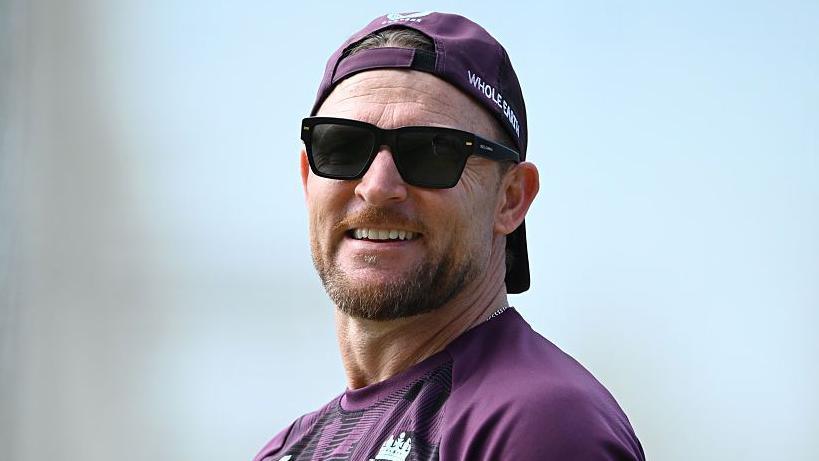
Head coach Brendon McCullum said England are unlikely to make changes to their batting line-up for the crucial third Ashes Test in Adelaide, which begins on Wednesday.
England, 2-0 down after the first two Tests, must beat Australia at the Adelaide Oval to keep their hopes of regaining the Ashes alive.
Number three Ollie Pope and wicketkeeper Jamie Smith may have been candidates to be left out if England had considered making changes.
But asked if he anticipated fielding the usual top seven, McCullum said: "I would have thought so.
"We've been in positions where we have made some mistakes, and that can happen at times. But for us to go on and win this series, it's not about throwing out what has been successful for us over the last few years. It's about having more conviction.
"Knee-jerk reactions and chopping and changing settled batting line-ups is not really our way."
It is unusual for McCullum to address the media before a Test, and he explained his appearance on Sunday was because "we know where we are in the series".
In wide-ranging comments, McCullum:
left the door open for spinner Shoaib Bashir and seamer Josh Tongue to play in Adelaide
said any speculation that his job would be on the line if England lose this week "does not really bother me"
rejected any suggestion his team go about things in a "casual manner".
With changes to the top seven now seemingly off the table, England could opt to refresh their bowling line-up.
Conditions in Adelaide, including the high temperatures forecast when the Test begins on Wednesday (23:30 GMT on Tuesday), could necessitate the inclusion of specialist spinner Bashir.
All-rounder Will Jacks was chosen ahead of Bashir in Brisbane, though captain Ben Stokes insisted Bashir remains England's first-choice spinner.
The 22-year-old was earmarked for this trip more than a year ago, but has not played a Test since July because of a broken finger and has figures of 2-266 from his two tour games in Australia.
Tongue would be the most likely candidate to come in if England want a new paceman, with Gus Atkinson possibly making way.
"We need to have a look at the conditions," McCullum told BBC Sport. "We have a squad of 16 here, which in a five-Test series, we know we will have to call upon the majority if not all of those.
"We will work out what we think is the best option to be successful in these conditions."
Heavy defeats on Ashes tours have often brought changes to England regimes.
This series was billed as a huge opportunity for England to win back the urn, yet the tourists are at risk of being out of the series at the earliest possible opportunity.
Though McCullum and Stokes are contracted to England until the end of the next home Ashes in 2027, their positions - along with that of director of cricket Rob Key - will come in for intense scrutiny if England are beaten in Adelaide.
Asked if a loss would put his job under pressure, McCullum said: "I don't know, but it doesn't really bother me, to be honest.
"I certainly don't coach to protect the job. I coach to get the best out of people and that's the same with the skipper. We both go about that in our same way with the same level of conviction and that won't be changing this week just because the prize is at its highest.
"I firmly believe that if we play our best cricket, we are a massive chance in this Test match. If we do that, then the narrative changes and the series momentum changes."
In the run-up to the second Test, England chose not to send players from the first Test to join a day-night England Lions game against a Prime Minister's XI in Canberra.
The tourists instead opted for five days of training in Brisbane which, in the aftermath of the Gabba defeat, McCullum claimed left them "overprepared".
On Sunday, the former New Zealand captain said he stood by his comments, but also explained he made them to draw attention away from the players.
"There's things that you say and things that you do - in the job you're in, sometimes it's better for the scrutiny to be on yourself," said McCullum.
"There is no perfect preparation. If there was and you could hit 4,000 balls to guarantee an average of 90, or bowl however many balls to guarantee 10 wickets, then we'll do it - don't worry. But that doesn't exist.
"Five intense days leading up to a Test match is not the best way to prepare. We'll be working out these next three days to make sure we get ourselves in the right frame of mind and skill level to be able to perform."
England returned to training on Sunday following a break in the Queensland resort town of Noosa.
Their approach has often attracted criticism, in particular their off-field activities during this tour.
On Sunday they began their training session with intense fielding drills, which have been uncommon for England under Stokes and McCullum.
"I do feel like there's a feeling that we go about our work in a very casual manner, but it couldn't be further from the truth," added McCullum.
"The level of intensity with which we try to operate with and the hard edge we try to bring to the team, is all encompassing. It's how we try to live our lives and set about this cricket team."
Watch: Police release CCTV of Brown University shooting suspect
Police are searching for a gunman who shot dead two students and injured nine others at Brown University in Providence, Rhode Island.
Police say the attacker was a man dressed all in black who fled on foot, and a shelter-in-place warning is in effect for the area surrounding the prestigious university.
The attack on the campus brings the number of mass shootings in the US to 389 for this year, according to the independent analysis website Gun Violence Archive.
It defines mass shootings as having four or more victims killed or injured, not including the attacker.
The gunman opened fire in a classroom at around 16:00 local time (21:00) on Saturday at the Holley engineering building at the eastern end of Brown's campus, according to officials.
Final exams were taking place in the building at the time of the shooting, the school said.
Barus and Holley engineering building is a seven-story block that includes 117 laboratories, dozens of classrooms and three lecture halls.
An economics professor told local public media outlet Ocean State Radio that the shooting had taken place during a review session for her course, which was led by her teaching assistant.
"He said that the shooter came in the doors, yelled something - he couldn't remember what he yelled - and started shooting," Rachel Friedberg said.
"Students started to scramble to try to get away from the shooter, trying to get lower down in the stadium seating, and people got shot," she added.
Two students studying in the nearby Rockefeller library when the active gunman alert came through told the BBC they "stayed away from the windows" as they awaited police escort.
Officers searched the floor, made them drop their bags and raise their hands before before being led out of the library, the pair said.
Brown University, one of the one of the oldest higher education institutions in the US, is part of the Ivy League, a group of elite universities in the northeast of the country.
The university, which has more than 11,000 students, is located in Providence, Rhode Island's capital city, located about 50 miles (80km) from Boston and 180 miles (290km) from New York City.
Who are the victims?
Two students were killed, and a further nine people are being treated. Medics say one person is in a critical condition, six are "critical but stable", and two others are less severely hurt.
The identities of those killed or injured have not yet been released, but Brown University President Christina Paxson told reporters in a press briefing that all the victims, including those killed and wounded, were students.
"This is a day that we hoped never would come to our community. It is deeply devastating for all of us," she said in a statement.
A ninth victim did not suffer a gunshot wound, according to police, who said they suffered non-life threatening injuries from fragments from the shooting "that had occurred near them".
Who is the gunman?
Very little is known about the gunman so far, but police have released CCTV footage of a male suspect, walking away from the scene of the shooting wearing all black clothing.
There is no weapon visible in the video, and his face is covered. Officials also say a firearm was not found in a sweep of the building on Saturday.
Investigators do not yet know if the gunman was a student, but Providence Deputy Police Chief Tim O'Hara said the suspect was a male who was dressed all in black and appeared be in his 30s.
"We're utilising every resource possible to find this suspect," he said.
Some witnesses reportedly told officers he may have been wearing a camouflage grey mask.
One person was arrested before police determined they were not involved in the shooting and released them.
What is the latest?
A massive operation involving police and federal agents is now underway in Providence as around 400 officers try to locate the suspect.
Residents and students near to the university have been told to stay at home and stay inside, or to stay away until the shelter-in-place is lifted.
Students in the area told the BBC they planned to stay at home until the things calm down and the gunman is caught.
US President Donald Trump, speaking to reporters as he returned to the White House from attending the annual Army and Navy football game, described the shooting as "a terrible thing".
"All we can do right now is pray for the victims and for those that were very badly hurt," he said.

 Login
Login
 Reuters