
Reading view

There are new articles available, click to refresh the page.

The Temptation of Saint Anthony 1660-1908

In the first of these two articles tracing the history of depictions of the temptation of Saint Anthony, I had reached 1650, when the bizarre composite creatures that flourished in Hieronymus Bosch’s triptych of about 1500-10 were becoming common.

tenierstemptationstanthonylille
David Teniers the Younger (1610–1690), The Temptation of Saint Anthony (c 1660), media and dimensions not known, Palais des Beaux-Arts, Lille, France. Wikimedia Commons.

The prolific David Teniers the Younger painted several versions of the Temptation of Saint Anthony after about 1650. Most, like this painting now in Lille, show an ordinary landscape with the saint, with the addition of his own species of daemons. Some of these re-use ideas first seen in Bosch’s triptych, such as that of a single figure on the back of a flying narwhal; that figure is wearing an inverted funnel on its head.

tenierstemptationstanthonyprado
David Teniers the Younger (1610–1690), The Temptation of Saint Anthony (c 1650), oil on copper, 55 × 69 cm, Museo Nacional del Prado, Madrid. Wikimedia Commons.

Another of Teniers’ paintings, currently in the Prado, shows three fairly normal humans in a menagerie of daemons, some of which clearly have their origins in Bosch’s work. The figure flying on a fish has changed from the previous painting, but still wears its distinctive inverted funnel.

tenierstemptationstanthonytokyo
David Teniers the Younger (1610-1690), The Temptation of Saint Anthony (c 1650), oil on canvas, 80 x 110 cm, National Museum of Western Art, Tokyo. Wikimedia Commons.

This third version, now in Tokyo, repeats many of the same daemons in a different setting, retaining the figure wearing the inverted funnel in close aerial combat.

vanwijnentemptationstanthony
Domenicus van Wijnen (1661–after 1690), The Temptation of Saint Anthony (c 1685), media and dimensions not known, The National Gallery of Ireland, Dublin. Wikimedia Commons.

Almost two centuries after Bosch’s triptych, more radically different and inventive approaches appear, here in Domenicus van Wijnen’s painting of about 1685. Its daemons are much more human in form, and have proliferated in a way more common in the ‘fairie paintings’ seen around 1840, including some by Richard Dadd. Van Wijnen was a prolific painter of scenes of witchcraft and the ‘dark arts’.

tiepolotemptationstanthony
Giovanni Battista Tiepolo (1696–1770), The Temptation of Saint Anthony (c 1740), oil on canvas, 40 x 47 cm, Pinacoteca di Brera, Milan. Wikimedia Commons.

Southern European painters were more likely to keep to more traditional figurative compositions, as used by Tiepolo in about 1740. This is surprising, given the presence of Bosch’s paintings in major collections in both Madrid and Venice.

fantinlatourtemptationstanthony
Henri Fantin-Latour (1836–1904), The Temptation of Saint Anthony (c 1875), oil on canvas, 63.5 x 83.5 cm, National Museum of Western Art, Tokyo. Wikimedia Commons.

Depictions of the Temptation of Saint Anthony remained popular even through the 1800s, although by this time Bosch’s triptych seems to have become long forgotten, and painters seemed no longer to need such excuses to exercise their imagination and inventiveness. The long-awaited publication of Gustave Flaubert’s book The Temptation of Saint Anthony, written in 1874 as a script for a play, brought renewed interest, and a succession of paintings from Henri Fantin-Latour (c 1875, above), Paul Cézanne (c 1875, below), Gustave Moreau (a watercolour), and Fernand Khnopff (1883).

cezannetemptstanthony
Paul Cézanne (1839–1906), The Temptation of Saint Anthony (c 1875), oil on canvas, 47 x 56 cm, Musée d’Orsay, Paris. Wikimedia Commons.

Cézanne shows the shadowy figure of Saint Anthony slumped against a bush at the left, his arms held out to shield himself from the temptations. The devil is shown in stereotypical form, wearing red robes, with an animal head and horns, behind the saint. In front of them is the naked Queen of Sheba, her right arm held high to accentuate her form. Around her are naked children. In front of Saint Anthony is a black bag presumably containing money, and a book.
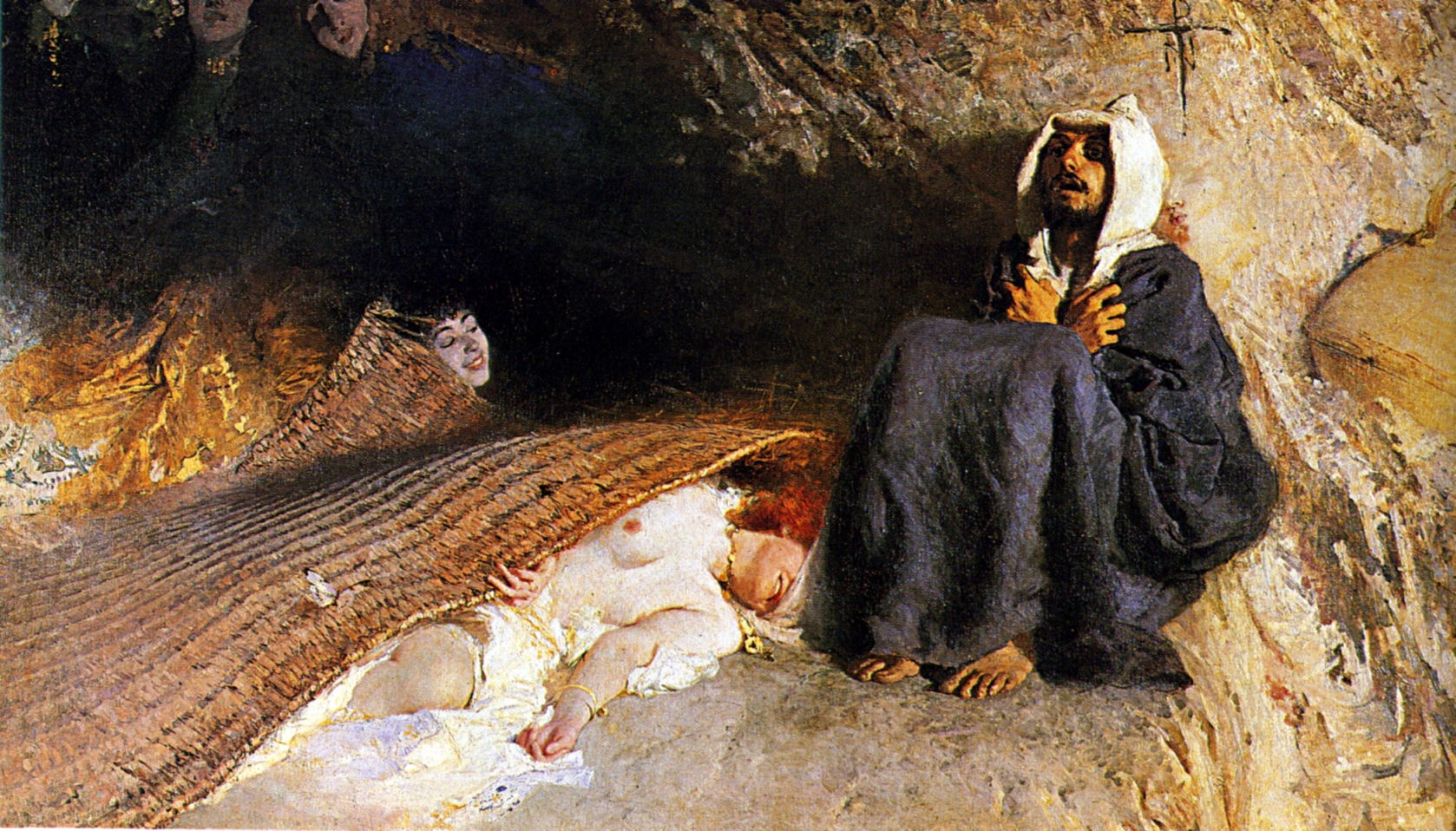
morellitemptationstanthony
Domenico Morelli (1823–1901), The Temptation of Saint Anthony (1878), oil on canvas, 137 × 225 cm, Galleria Nazionale d’Arte Moderna, Rome. Wikimedia Commons.

The influential Neapolitan realist Domenico Morelli painted this stark work in 1878, perhaps the exact antithesis of the rich imagery that had developed since the Renaissance.

ropstemptationstanthony
Félicien Rops (1833–1898), The Temptation of Saint Anthony (1878), pastel and gouache on paper, 73.8 × 54.3 cm, Cabinet des estampes, Bibliothèque Royale Albert Ier, Brussels. Wikimedia Commons.

That same year, Félicien Rops painted his satirical and irreverent version with more subtle details. Bound to the cross in Saint Anthony’s tempting vision is a visibly voluptuous woman, the word EROS replacing the normal initialism of INRI (Iēsūs/Iēsus Nazarēnus, Rēx Iūdaeōrum, meaning Jesus of Nazareth, the King of the Jews) shown above Christ’s head. Christ himself, with full stigmata, has been knocked sideways to accommodate the woman’s naked body. Behind the cross the horned devil wears scarlet robes and pulls faces. Behind him is a pig, Anthony’s attribute. The two daemonic putti are most definitely not references to Bosch.

corinthtemptationstanthony1897
Lovis Corinth (1858–1925), The Temptation of Saint Anthony (1897), oil on canvas, 88 × 107 cm, Bayerische Staatsgemäldesammlungen, Munich. Wikimedia Commons.

Lovis Corinth painted two versions of the Temptation. The earlier, from 1897, shows Anthony surrounded by beautiful and naked women, offering him fruit, other food, and their bodies. The daemons have faded into the background, and are caricatures based on humans.

corinthtemptationstanthony1908
Lovis Corinth (1858–1925), The Temptation of Saint Anthony (after Gustave Flaubert) (1908), oil on canvas, 135.3 × 200.3 cm, The Tate Gallery, London. Wikimedia Commons.

His later canvas, explicitly painted after Gustave Flaubert, in 1908, brings in the Queen of Sheba, an elephant and monkey, but is also notable for depicting Anthony as a young man. Even Salvador Dalí’s 1946 painting of the Temptation steers clear of Bosch’s imagery, although it does at least return to the concept of an individualistic and inventive vision.

How The Times Analyzed the S.E.C.’s Cryptocurrency Enforcement

The New York Times set out to understand — and quantify — just how much things had changed within the agency after President Trump resumed office.

© Alyssa Schukar for The New York Times

A portrait array in the lobby of the Securities and Exchange Commission showing President Trump and Vice President JD Vance; its chairman, Paul S. Atkins; and Commissioners Hester M. Peirce, Caroline A. Crenshaw and Mark T. Uyeda.

The War on ‘Wokeness’ Comes to the U.S. Mint

The Treasury Department unveiled new coins celebrating America’s 250th anniversary. They failed to include planned designs featuring abolition, women’s suffrage and the civil rights movement.

Actors surrounded Brandon Beach, the U.S. treasurer, and Kristie McNally, the Mint’s acting secretary, at a coin unveiling this month at the National Constitution Center in Philadelphia.

Washington Residents Return Home to Extensive Flood Damage

After heavy rains swelled rivers and flooded neighborhoods in northern Washington, residents returned to soggy homes caked in mud. Many tried to salvage what they could.

© Grant Hindsley for The New York Times

Gwendolyn Corley began cleaning up her home after the historic flooding of the nearby Skagit River hit her community of Hamilton, Wash.

U.S.-U.K. Trade Deal Hits Stumbling Block

The U.S. government has paused a tech-focused trade pledge with Britain over broader disagreements about Britain’s digital regulations and food safety rules.

© Doug Mills/The New York Times

President Trump and Prime Minister Keir Starmer of Britain in September, after signing an agreement that pledged to extend research collaborations and deepen partnerships in the tech industry.

MAHA Moms Are Angry at the E.P.A. Lee Zeldin Is Trying to Win Them Back.

A split is emerging within Trump’s base as health activists accuse Mr. Zeldin of leading the agency to prioritize chemical industry interests over public health.

© Niki Chan Wylie for The New York Times

Lee Zeldin, the E.P.A. administrator, appeared with Health Secretary Robert F. Kennedy Jr. in Salt Lake City earlier this year. Recently, Mr. Zeldin has gone on a charm offensive.

Biden Has Raised Little of What He Needs to Build a Presidential Library

His library foundation has told the I.R.S. that by the end of 2027 it expects to bring in just $11.3 million — not nearly enough for a traditional presidential library.

© Alyssa Schukar for The New York Times

Former President Joseph R. Biden Jr. has only just begun to raise money for a presidential library, starting with an event for potential donors on Monday in Washington.

Explainer: WindowServer

macOS apps manage the contents of their own windows, drawing and refreshing them as needed. To assemble all those into what you see on the display requires the services of the master compositor, WindowServer. From the moment the login window appears during startup, WindowServer is hard at work, and remains so until you shut your Mac down. Without WindowServer there could be no GUI.

Open Activity Monitor, and you’ll see WindowServer close to the top of the lists of CPU, Memory and Energy users, and when it’s getting into trouble that’s always a good place to check what’s going on. You may also notice that it’s one of a pair of processes including distnoted with their own user, _windowserver. They’re part of a group of interconnected services that handle window management, compositing of windows into the display image, and event-routing for apps, with distnoted responsible for system message notification. In the log, WindowServer is often associated with the com.apple.SkyLight subsystem.

Compositing

You can get a good idea of what WindowServer does using screenshots. Using Command-Shift-4, then pressing the Space Bar and selecting a window, you’ll get a shot of an individual window, as shown in the examples below.

WindowServer then positions them according to their current locations on the whole display, and produces a layered composite, as you’ll see in a screenshot taken with Command-Shift-3.

That composite is then sent through the graphics driver to graphics output hardware.

With its central position in managing windows and compositing them, WindowServer is also responsible for handling Spaces (introduced in Mac OS X 10.5 Leopard), window tabs, multiple displays, and behaviours that stream or extract parts or all of a display image, such as taking screenshots. Because WindowServer knows which app’s windows are where, and which are at the front, it also routes events to each app. For example, when you click on a window it’s WindowServer that determines which app owns it, and passes the event to that app to handle.

Increasing demands

This has become more involved since the introduction of Catalyst apps from macOS 10.14 to 11, and more so since Apple silicon Macs have brought the ability to run iOS and iPadOS apps. iOS uses a series of -board services in its GUI, including SpringBoard as the Home Screen manager instead of the Finder, FrontBoard to manage the app’s scenes, and FuseBoard its menus, which are now run in macOS as well. RunningBoard, which manages the resources available to apps and processes, has been incorporated into macOS for some years.

The introduction of Stage Manager in macOS Ventura in 2022 has also been stretching WindowServer, and can substantially increase its demands on CPU and memory.

Troubleshooting

You can reduce WindowServer’s workload by closing tabs and windows, turning Stage Manager off, reducing the number of Spaces, and quitting non-essential apps. Even when window or tab contents aren’t visible, they still have to be managed.

If WindowServer stops working, for instance when it crashes, not only does everything on the display(s) freeze, but routing of input events such as clicks or taps also stops. Although in the past macOS has sometimes been able to log the current user out and restart WindowServer, fatal WindowServer problems are now most likely to result in a kernel panic or a complete freeze. If your Mac freezes rather than restarts, a forced shutdown may be your only way forward. Recurrent WindowServer crashes suggest a problem with the graphics driver or graphics hardware, and should always be reported to Apple via Feedback.

Summary

  • WindowServer works between app window management and display drivers to composite windows and on-screen items, producing the image to be displayed.
  • With distnoted it also routes events to apps, and manages system message notification.
  • Demands on its services are increased with Spaces and Stage Manager, and it works with the different expectations of Catalyst and iOS/iPadOS apps running in macOS.
  • When it fails, displays freeze and input responses cease. If those don’t precipitate a kernel panic and restart, a forced shutdown may be the only solution.
  • Report recurrent problems to Apple in Feedback.

In Trump’s Justice Dept., Failing in Court Might Be Better Than Bucking the Boss

This week demonstrated an emerging reality for President Trump: Commanding the Justice Department is not the same as controlling the justice system.

© Vincent Alban/The New York Times

The White House was served a legal rebuke this week when federal grand jurors in Alexandria, Va., rejected the Justice Department’s push to indict Letitia James, the New York attorney general, on mortgage-related charges for the second time in a week.

Amid Fractures on the Right, Tucker Carlson Continues His Attacks

On Theo Von’s show this week, Mr. Carlson lashed out at a major supporter of the president, the F.B.I. and “unimpressive, dumb, totally noncreative people” leading the nation.

© Patrick T. Fallon/Agence France-Presse — Getty Images

Tucker Carlson did not mention President Trump by name in his attacks on Theo Von’s podcast, but his broadsides were the latest evidence of a deepening divide in Republican politics.

Amid Fractures on the Right, Tucker Carlson Continues His Attacks

On Theo Von’s show this week, Mr. Carlson lashed out at a major supporter of the president, the F.B.I. and “unimpressive, dumb, totally noncreative people” leading the nation.

© Patrick T. Fallon/Agence France-Presse — Getty Images

Tucker Carlson did not mention President Trump by name in his attacks on Theo Von’s podcast, but his broadsides were the latest evidence of a deepening divide in Republican politics.
❌