In the first of these two articles looking at bread in visual art, I considered it as a symbol of life, predominantly following the Christian tradition set by the Last Supper. Here I consider bread in its role as food, the staple of most Europeans.
Jean-François Raffaëlli (1850-1924), Man with Two Loaves of Bread (1879), further details not known. Wikimedia Commons.
Man with Two Loaves of Bread (1879) is one of Jean-François Raffaëlli’s social realist paintings. This man’s bowed head and furtive look make you wonder just how he had acquired those loaves.
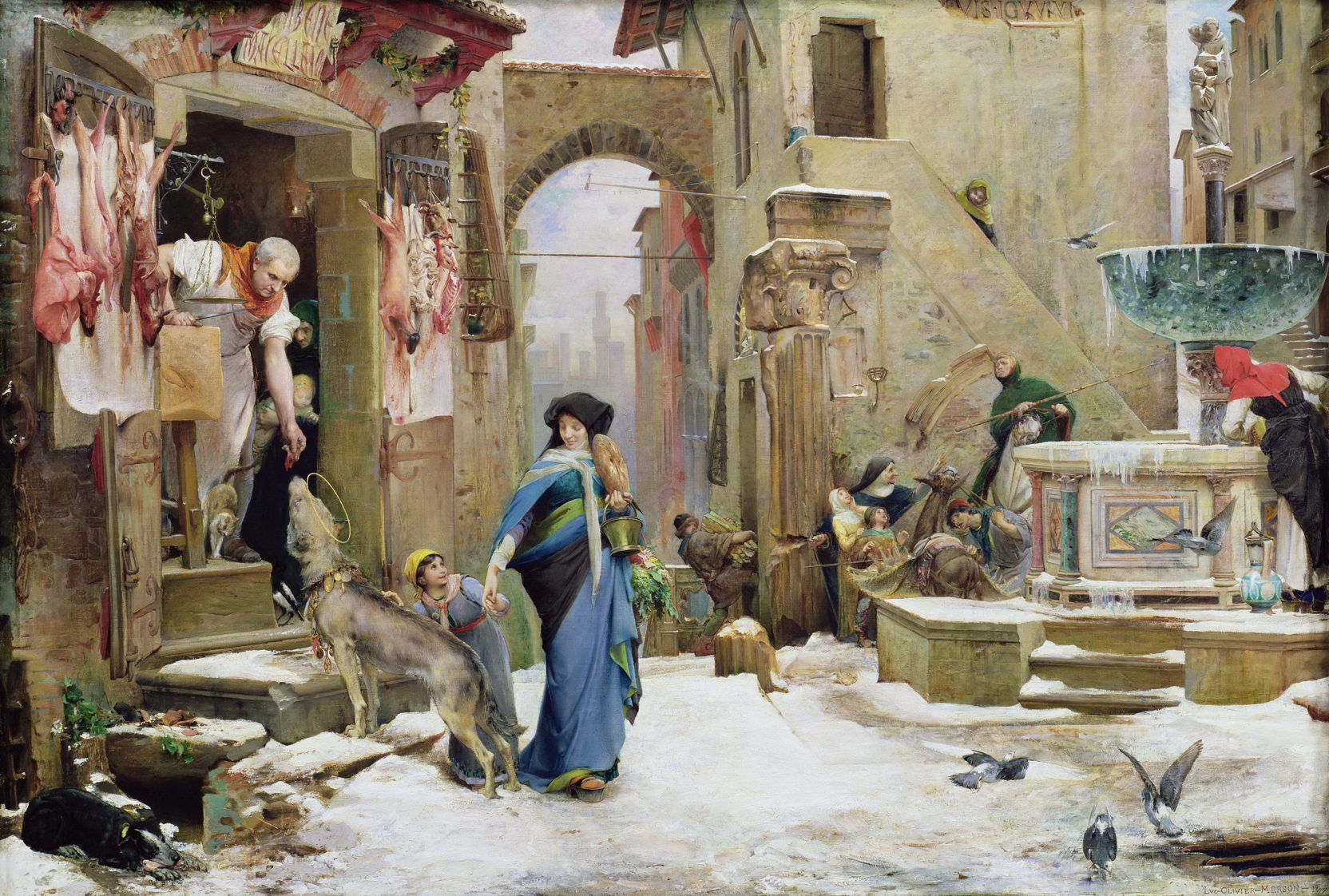
Luc-Olivier Merson (1846–1920), The Wolf of Agubbio (1877), oil on canvas, 88 x 133 cm, Palais des Beaux-Arts de Lille, Lille, France. Wikimedia Commons.
Luc-Olivier Merson’s wonderful painting of the Franciscan legend of The Wolf of Agubbio from 1877 is set in the town’s central piazza on a bitter winter’s day. The large wolf of the legend has a prominent halo and stands at the door of the butcher’s shop, from where the butcher is handing it a piece of meat. A young girl smiles open-mouthed as she strokes the wolf’s back. Her mother holds her other hand, as she walks back clutching a loaf of bread and other provisions (detail below).
Luc-Olivier Merson (1846–1920), The Wolf of Agubbio (detail) (1877), oil on canvas, 88 x 133 cm, Palais des Beaux-Arts de Lille, Lille, France. Image by Chatsam, via Wikimedia Commons.Johannes Vermeer (1632–1675), The Milkmaid (c 1658-59), oil on canvas, 45.5 x 41 cm, The Rijksmuseum Amsterdam, Amsterdam, The Netherlands. Wikimedia Commons.
Vermeer’s Milkmaid, probably from about 1658-59, is less about milk than the bread on the tabletop. A wicker basket of bread is nearest the viewer, broken and smaller pieces of different types of bread behind and towards the woman, in the centre. These are shown in the detail below, where Vermeer’s controlled use of blurring is visible.
Johannes Vermeer (1632–1675), The Milkmaid (detail) (c 1658-59), oil on canvas, 45.5 x 41 cm, The Rijksmuseum Amsterdam, Amsterdam, The Netherlands. Wikimedia Commons.
Perhaps because it was so commonplace in many households and bakers, there are relatively few paintings showing the making and baking of bread.
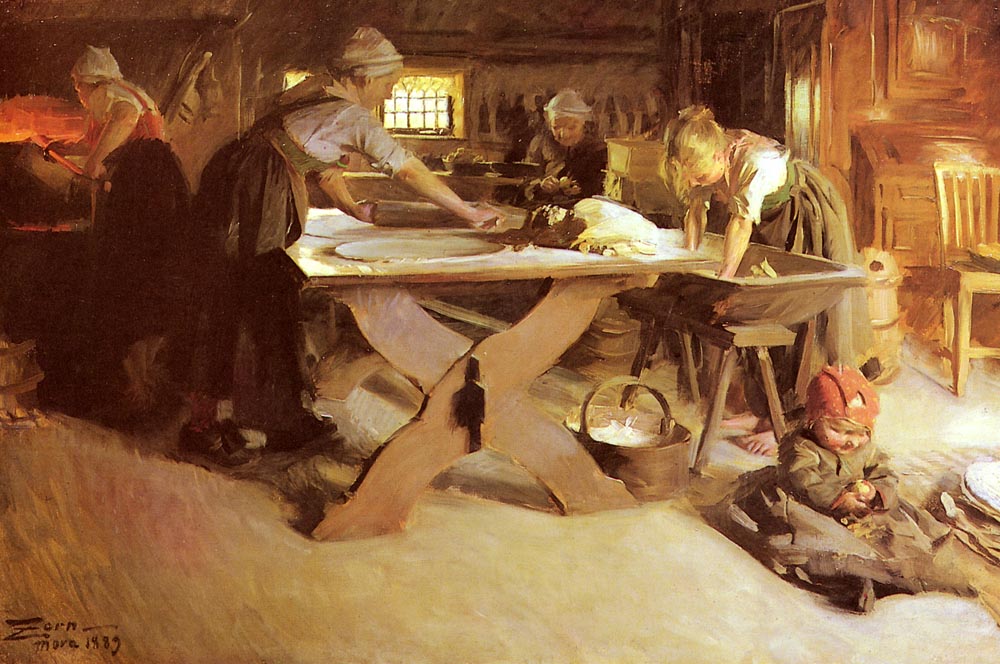
Anders Zorn (1860–1920), Baking Bread (1889), oil on canvas, dimensions not known, Private collection. WikiArt.
In Baking Bread, painted in Mora, the artist’s home town in Sweden in 1889, Anders Zorn captures each step in the process in documentary fashion, from kneading the dough, through rolling and preparing it, to its baking. There’s even an infant in the foreground who looks ready to be its consumer.
Helen Allingham (1848-1926), Baking Bread (date not known), watercolour, further details not known. The Athenaeum.
Helen Allingham’s undated Baking Bread shows a traditional farmhouse baking oven being used to bake the bread for an extended family, or possibly a small village shop. These ovens can still be found in many remaining period dwellings, but are now seldom used.
Christian Krohg (1852–1925), Woman Cutting Bread (1879), oil on canvas, 80 x 60 cm, Bergen kunstmuseum, Bergen, Norway. Wikimedia Commons.
Christian Krohg’s early painting of Ane Gaihede as a Woman Cutting Bread (1879) marked the start of his social realism. Krohg documents her in almost ethnographic detachment. She is aligned in profile, against an almost bare wall, perfectly framed at three-quarter length.
Finally, bread is occasionally featured in still life paintings.
Anne Vallayer-Coster (1744–1818), A Still Life of Mackerel, Glassware, a Loaf of Bread and Lemons on a Table with a White Cloth (1787), further details not known. Wikimedia Commons.
Anne Vallayer-Coster painted A Still Life of Mackerel, Glassware, a Loaf of Bread and Lemons on a Table with a White Cloth in 1787, when she was at her artistic zenith.
Extended attributes (xattr) contain a wide range of metadata, some of which are intended to persist with the file they’re attached to, others to be more transient. Depending on the type of file operation performed, macOS has an elaborate mechanism for determining which are preserved, and which are not. This article tries to explain how this works in macOS Tahoe 26.0.
Xattr flags
When first introduced in Mac OS X, no provision was made for xattrs to have type-specific preservation, and that was added later using flags suffixed to the xattr’s name. For example, the com.apple.lastuseddate xattr found commonly on edited files is shown with a full name of com.apple.lastuseddate#PS to assign the two flags P and S to it, and the most recent xattr com.apple.fileprovider.pinned, used to mark files in iCloud Drive that have been pinned, has the two flags P and X assigned to it for a the full name of com.apple.fileprovider.pinned#PX.
This is a kludge, because you normally have to refer to the xattr name including its flags, although the flags aren’t really part of its name. This can catch the unwary.
It’s further complicated by a set of system tables for some standard xattr types that don’t have flags suffixed, but are treated as if they do. One notable example of those is the quarantine xattr com.apple.quarantine, which is handled by macOS as if it has the PCS flags attached, although those are never used when referring to it by name.
There are also lower case flags that can be used to override those set in system tables, although those appear to be used exceedingly rarely, and I don’t recall ever coming across them. In theory, if you were using a new type based on the standard com.apple.metadata: family, com.apple.metadata:kMDItemNew, you could alter its behaviour to some similar types with the flags psB, as in com.apple.metadata:kMDItemNew#psB. I have no idea whether that would be respected in practice. For the rest of this article, I will ignore the existence of those lower case flags.
Intents
File operations involving decisions about the preservation of xattrs are simplified into the following intents:
copy – simply copying a file from a source to a destination and preserving its data, such as using cp, is labelled XATTR_OPERATION_INTENT_COPY
save – saving a file when probably changing its content, including performing a ‘safe save’; this may over-write or replace the source with the saved file. Some xattrs shouldn’t be preserved in this process of XATTR_OPERATION_INTENT_SAVE
share – sharing or exporting this file, perhaps as an attachment to email, or placing the file in a public folder. Some sensitive metadata shouldn’t be preserved in XATTR_OPERATION_INTENT_SHARE
sync – syncing the file to a service such as iCloud Drive, in XATTR_OPERATION_INTENT_SYNC
backup – backing the file up, perhaps using Time Machine, in XATTR_OPERATION_INTENT_BACKUP.
Flags
As of macOS 15.0 (including 26.0), the following flags are supported:
C: XATTR_FLAG_CONTENT_DEPENDENT ties the flag with the file contents, so the xattr has to be recreated when the file data changes. This may be appropriate for checksums and hashes, text encoding, and position information. The xattr is then preserved for copy and share, but not in a safe save.
P: XATTR_FLAG_NO_EXPORT doesn’t export or share the xattr, but preserves it during copying.
N: XATTR_FLAG_NEVER_PRESERVE ensures the xattr is never preserved, even when copying the file.
S: XATTR_FLAG_SYNCABLE ensures the xattr is preserved during syncing with services such as iCloud Drive. Default behaviour is for xattrs to be stripped during syncing, to minimise the amount of data to be transferred, but this flag overrides that.
B: XATTR_FLAG_ONLY_BACKUP keeps the xattr only in backups, including Time Machine, where there’s no desire to minimise what’s backed up.
X: XATTR_FLAG_ONLY_SAVING keeps the xattr only when saving and in backups, including Time Machine (macOS 15.0 and later only).
There’s another system limit that must be adhered to: total length of the xattr name including any # and flags cannot exceed a maximum of 127 UTF-8 characters.
System tables
These are hard-coded in source, where * represents a ‘wild card’:
com.apple.quarantine – PCS preserved in copy, sync, backup
com.apple.metadata:kMDItemCollaborationIdentifier – B backup
com.apple.metadata:kMDItemIsShared – B backup
com.apple.metadata:kMDItemSharedItemCurrentUserRole – B backup
com.apple.metadata:kMDItemOwnerName – B backup
com.apple.metadata:kMDItemFavoriteRank – B backup
com.apple.metadata:* (except those above) – PS copy, save, sync, backup
com.apple.security.* – S or N depending on sandboxing, see below
com.apple.ResourceFork – PCS copy, sync, backup
com.apple.FinderInfo – PCS copy, sync, backup
com.apple.root.installed – PC copy, backup.
System defaults for com.apple.security.* depend on whether the app performing the file operation is running in an app sandbox. Non-sandboxed apps apply S to preserve the xattr for copy, save, share, sync, backup; for sandboxed apps N is applied so the xattr is never preserved, even when copying the file.
Flags and intents
We can now revisit the list of intents, and establish the effects of xattr flags on each, as:
XATTR_OPERATION_INTENT_COPY preserves xattrs that don’t have flag N or B or X
XATTR_OPERATION_INTENT_SAVE preserves xattrs that don’t have flag C or N or B
XATTR_OPERATION_INTENT_SHARE preserves xattrs that don’t have flag P or N or B or X
XATTR_OPERATION_INTENT_SYNC preserves xattrs if they have flag S, or have neither N nor B
XATTR_OPERATION_INTENT_BACKUP preserves xattrs that don’t have flag N.
Finally, Apple provides separate information on how xattrs are synced by FileProvider, for iCloud Drive and third-party cloud services using that API. This confirms that the S flag should sync a xattr, but is vague on other flags, simply stating “some older attributes are also synced”. However, a cap is applied on the maximum size of xattrs that are syncable, at “about 32KiB total for each item”. If the xattrs exceed that limit “the system automatically makes some of the attributes nonsyncable.” More puzzlingly, it states “the resource fork is content and isn’t included in the extended attributes dictionary.”
Conclusions
Controls over the preservation of xattrs are appended as tags to their name, following a hash #. In most circumstances, they should be treated as part of that xattr’s name, and are required for commands and actions on that xattr, for example when using the xattr command. They should also be left intact and not removed, unless you want to change the behaviour of that xattr in file operations.
Most xattrs commonly used by macOS don’t explicitly use tags, but are governed by a hard-coded system table that can’t be changed.
When using standard commands such as cp, macOS will automatically apply these rules when deciding whether to preserve xattrs. However, using a command for a different intent, such as cp for backing up, won’t normally invoke the behaviour you might want.
Code using standard macOS file operations should follow the behaviour expected for its intent, and shouldn’t require any special handling of xattrs. Lower-level operations are likely to differ, though, and may require implementation of equivalent behaviours.
Those implementing their own xattr types should incorporate flags explicitly to ensure they’re preserved as intended.
In cases of uncertainty, for example when working with files stored in iCloud Drive, you’ll need to step carefully through the rules above.
Sources
xattr_flags.h, xattr_flags.c, xattr_properties.h in copyfile source, e.g. at Apple’s OSS Distributions Github
man xattr_name_with_flags(3), included in copyfile source FileProvider (Apple).
The Trump administration singled out European tech firms by name and promised economic consequences Tuesday unless the E.U. rolls back tech regulation and lawsuits.
The Office of the United States Trade Representative, led by Jamieson Greer, said that the European Union had “persisted in a continuing course of discriminatory and harassing lawsuits, taxes, fines, and directives” against U.S. companies.
People across the United States have endured rushed or premature attempts to remove their organs. Some were gasping, crying or showing other signs of life.
On the fifth day of the Decameron’s stories, Fiammetta chose the theme of the adventures of lovers who survived calamities or misfortunes and reached a state of happiness. The first of those concerns Cimon (or Cymon) and Iphigenia, and was told by Panfilo. This has been painted more than any other story in the whole of the Decameron, by masters from Rubens to Frederic, Lord Leighton, none of whom attempts to tell any more than its opening. Also note that Iphigenia here isn’t the daughter of Agamemnon who had to be sacrificed to bring favourable winds for the Greek fleet to sail against Troy.
Cimon’s father was a wealthy Cypriot, but Cimon, a nickname given in honour of his apparent simplicity and uncouthness, was his problem child. He was exceedingly handsome and had a fine physique, but behaved like a complete imbecile. He appeared unable to learn anything, even basic manners, so was sent to live with the farm-workers on his father’s large estates.
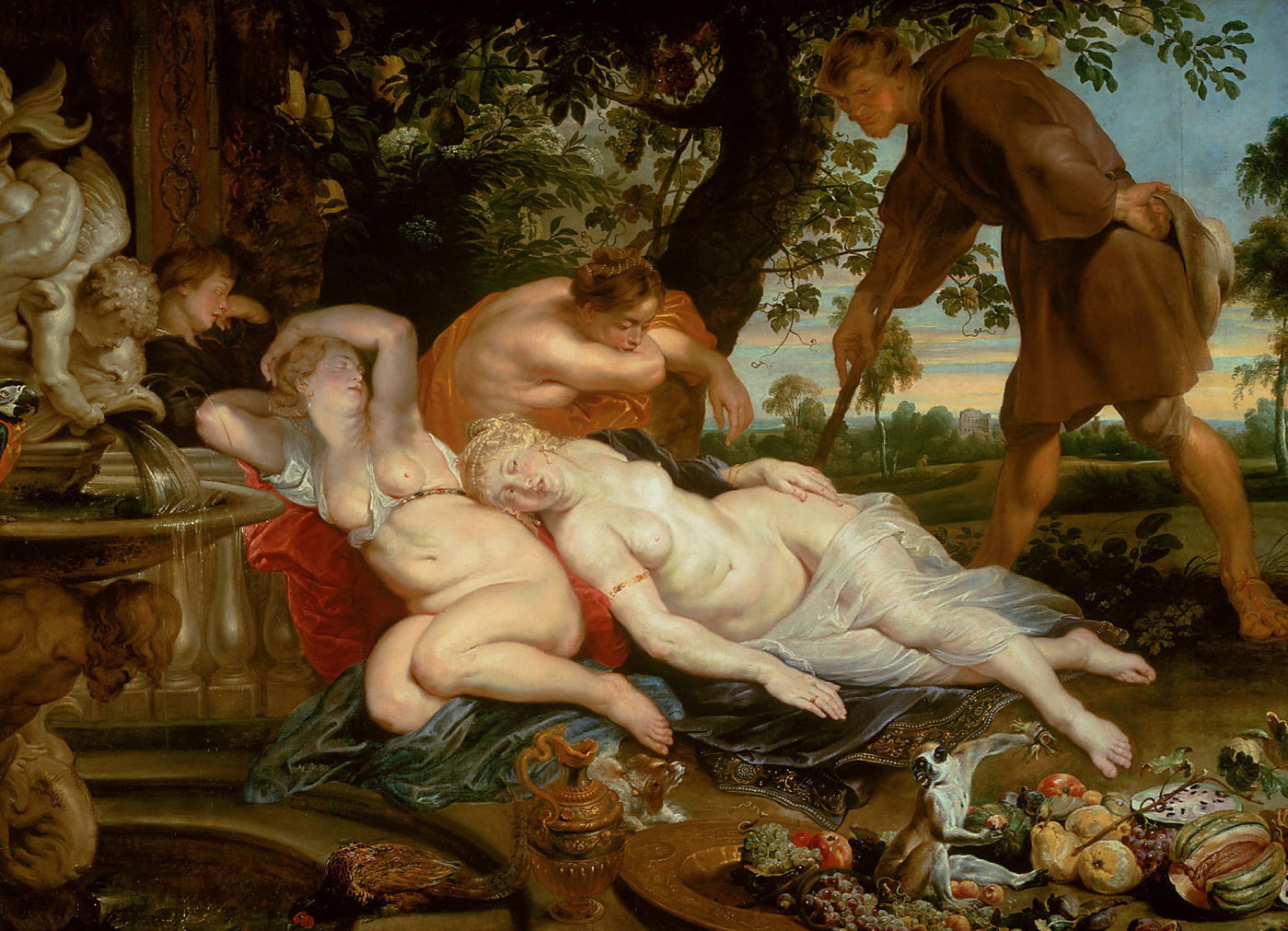
One afternoon in May, Cimon was out walking when he reached a fountain in a clearing surrounded by tall trees. Lying asleep on the grass by that fountain was a beautiful young woman, Iphigenia, wearing a flimsy dress that left nothing to the imagination. Sleeping by her were attendants, two women and a man. Cimon was immediately enraptured, leaned on his stick, and stared at her. As he did so, his simple mind started to change.
Master of the Campana Panels (dates not known), Cymon and Iphigenia (c 1525), tempera on panel, 58 x 170 cm, location not known. Wikimedia Commons.
As with many of Boccaccio’s stories, this is shown on a wedding cassone, here from about 1525. It’s relatively simple: there’s no sign of the attendants, but there is a second image of Cimon walking along a path at the far right.
Peter Paul Rubens (1577–1640), Frans Snyders (1579–1657) and Jan Wildens (1584/86–1653), Cymon and Iphigenia (c 1617), oil on canvas, 208 × 282 cm, Kunsthistorisches Museum, Vienna, Austria. Wikimedia Commons.
In about 1617, Peter Paul Rubens joined with Frans Snyders (who painted the still life with monkeys at the lower right) and Jan Wildens (who painted the landscape background) in their marvellous Cymon and Iphigenia. This is accurate in its details too, with the correct quota of attendants, and a splendid fountain at the left. Cimon really looks like Boccaccio’s uncouth simpleton.
Willem Van Mieris (1662-1747), Cymon and Iphigenia (1698), oil on canvas, 27 x 34.8 cm, Museo Poldi Pezzoli, Milan, Italy. Wikimedia Commons.
Willem Van Mieris’ Cymon and Iphigenia from 1698 treats the scene more in the vein of Poussin or Claude, and again remains faithful to Boccaccio’s details.
Benjamin West (1738–1820), Cymon and Iphigenia (c 1766), oil on panel, 61.3 × 82.6 cm, Yale Center for British Art, New Haven, CT. Wikimedia Commons.
Benjamin West was more coy in both of his depictions of this scene. His earlier Cymon and Iphigenia from about 1766 (above) was well-received at the time. Six years later, in 1773, he reversed the composition, and was even more restrained in the display of flesh, as shown below.
Benjamin West (1738–1820), Cymon and Iphigenia (1773), oil on canvas, 127 x 160.3 cm, Los Angeles County Museum of Art (LACMA), Los Angeles, CA. Wikimedia Commons.Angelica Kauffman (1741–1807), Cymon and Iphigenia (c 1780), oil on canvas, diam 62.2 cm, Gibbes Museum of Art, Charleston, SC. Wikimedia Commons.
A few years later, in about 1780, Angelica Kauffman painted this delightful tondo of Cymon and Iphigenia, another variation on the same theme. The cultural contrast between the young man and woman is not so stark.
John Everett Millais (1829–1896), Cymon and Iphigenia (1848), oil on canvas, dimensions not known, Lady Lever Art Gallery, Liverpool, England. Wikimedia Commons.
When he was only eighteen, John Everett Millais painted what was to be his last work before he embraced Pre-Raphaelite style: Cymon and Iphigenia (1848). At first sight this bears little resemblance to Boccaccio’s story, which is to be expected, as Millais didn’t use the Decameron as his literary reference, but a later re-telling by the English poet John Dryden, to which this is more faithful.
Frederic, Lord Leighton (1830-1896), Cymon and Iphigenia (study) (1884), oil on canvas, 43.1 x 66.2 cm, Art Gallery of New South Wales, Sydney, Australia. Wikimedia Commons.
In 1884, Frederic, Lord Leighton painted what must be the most luxuriant and sensuous version of this scene. This study shows Leighton confirming his composition and use of colour.
Frederic, Lord Leighton (1830-1896), Cymon and Iphigenia (1884), oil on canvas, 218.4 x 390 cm, Art Gallery of New South Wales, Sydney, Australia. Wikimedia Commons.
The finished painting, Cymon and Iphigenia from 1884, shows Iphigenia stretched out languidly in her sleep, in the warmth of the last light of the day; behind her the full moon is just starting to rise. Leighton has changed the season to autumn, with the leaves already brown but the days still hot. Cymon stands in shadow on the right, idly scratching his left knee, gazing intently at Iphigenia.
The story that follows those painted idylls is very different.
When Iphigenia finally awoke, she was surprised to see Cimon there, and recognised him immediately. He insisted on accompanying her to her house, then went to his family home, where he turned a new leaf, and over the following four years transformed himself into the best-dressed, most cultured and refined young man on Cyprus. Despite this transformation, Cimon was unable to persuade Iphigenia’s father to allow him to marry the young woman, but was told she was betrothed to a noble on the island of Rhodes.
When the time came for her marriage, Cimon took an armed vessel and gave chase to the ship carrying Iphigenia to Rhodes. He boarded her ship and abducted her.
With Iphigenia on board, Cimon headed for the island of Crete, where he and his crew had relatives and friends. But shortly after they had altered course, a storm blew up, so violent that it threatened to sink the ship. Unable to tell where they were heading, they ended up taking shelter off the coast of Rhodes, where they were caught up by the ship from which they had just abducted Iphigenia.
When their vessel ran aground, Cimon and his crew were forced ashore, where they were quickly rounded up and thrown into prison, and Iphigenia was returned to her family ready for her wedding. Iphigenia’s fiancé implored the chief magistrate of Rhodes, Lysimachus, to put Cimon to death, but he was held in custody with the rest of his crew.
It happened that Lysimachus was deeply in love with a young woman of Rhodes, who was betrothed to Iphigenia’s future brother-in-law. To Lysimachus’ relief, that marriage had been postponed several times, but it was then decided to hold both weddings in the same ceremony. Lysimachus was aggrieved by this, and decided the only way he could marry the Rhodian woman that he loved was to abduct her. In order to do so, he needed the help of Cimon and his crew, who would undoubtedly be delighted to be able to abduct Iphigenia again.
Lysimachus offered Cimon a deal whereby they would together make off with their partners from the scene of the joint wedding, and they agreed to proceed with that.
Two days later, at dusk, as the weddings were just getting under way, Lysimachus, Cimon and his crew entered the house of the two bridegrooms and seized their brides. Unfortunately, it turned out that both grooms were armed and mounted a determined resistance. Cimon killed Iphigenia’s fiancé with a single blow to the head, and the other woman’s intended husband fell dead following a blow by Lysimachus.
Lysimachus, Cimon, their crew and the two abducted brides then fled to a ship which they sailed to exile in Crete, where the two couples were married, amid great and joyous celebrations. In time, the people of Cyprus and Rhodes forgave them for the violent way they had stolen their brides; Lysimachus and his wife were able to return to Rhodes, and Cimon and Iphigenia returned to live happily ever after on Cyprus.
Sadly, none of the masters who had painted Cimon and Iphigenia seems to have been tempted to depict any of the rest of Panfilo’s story.
Throughout much of Europe, bread has been a staple food for the whole of recorded history, and has become a symbol of life in both language and visual art.
Jean-François Millet (1814–1875), Ceres (The Summer) (c 1864-65), oil on canvas, Musée des Beaux-Arts, Bordeaux, France. Wikimedia Commons.
For the classical civilisations of the Mediterranean, this was embodied in the goddess of Jean-François Millet’s Ceres (The Summer) from about 1864-65. She stands, her breasts swollen and ready for lactation, her hair adorned with ripe ears of wheat, a sickle in her right hand to cut the harvest, and a traditional winnow to separate grain from chaff in her left hand. At her feet is a basketful of bread, with ground flour and cut sheaves of wheat behind. The background shows the wheat harvest in full swing, right back to a group of grain- or hay-stacks and an attendant wagon in the distance.
Bread and its sharing is one of the central symbols of Christian beliefs, most notably in the Last Supper, the meal shared by Christ with his disciples before his crucifixion.
Giampietrino (1495–1549), copy after Leonardo da Vinci (1452–1519), The Last Supper (c 1520), oil on canvas, 298 x 770 cm, The Royal Academy of Arts, London. Wikimedia Commons.
The most famous painting of The Last Supper, and one of the best-known works in the European canon, is of course Leonardo da Vinci’s. Giampietrino’s copy from about 1520 gives the closest impression today of what the original must have looked like. Even this copy has been horribly mutilated: the upper third was cut off, and its width reduced, but at least what remains gives a better idea of the original’s appearance.
Leonardo’s composition wasn’t entirely revolutionary for the time. Previous paintings of The Last Supper had spread the apostles along the length of a table, with Christ at its centre. However, Judas Iscariot was usually placed alone on the near side, his back to the viewer, and sometimes with his bag of silver visible behind his back.
Leonardo shows the moment of surprise and denial when Christ announces that one of those sat around the table would betray him. In this, he was perhaps the first artist to assemble the apostles into small groups, a feature that has been repeated in innumerable images following this. Arrayed along the front of the table is a series of round bread rolls and small glasses of red wine.
Paolo Veronese (1528–1588), The Supper at Emmaus (c 1559), oil on canvas, 241 × 415 cm, Musée du Louvre, Paris. Wikimedia Commons.
After his crucifixion and resurrection, Christ appeared several times to his disciples. In The Supper at Emmaus, painted here by Paolo Veronese, two disciples had travelled on the road from Jerusalem to Emmaus as pilgrims, and recognised Christ as he “sat at meat with them, he took bread, and blessed it, and brake, and gave it to them.”
The painting contains separate passages to cue this narrative: on the far left is an asynchronous ‘flashback’ referring to the journey to Emmaus. Christ is in the centre of the painting, identified by his halo, and in the midst of breaking bread. With him at the table are the two bearded figures of the disciples, dressed as pilgrims and bearing staves. On Christ’s right is a servant, acting as waiter to the group. The onlookers dressed in contemporary costume are an aristocratic Italian family of the day, whose portraits are combined.
Christian rites reiterate the Last Supper in Eucharist, and the blessing of bread plays other roles in its religious ceremonies.
Mykola Pymonenko (1862–1912), Waiting for the Blessing (1891), oil on canvas, 133 x 193 cm, Rybinsk Museum-Preserve Рыбинский историко-архитектурный и художественный музей-заповедник, Rybinsk, Russia. Wikimedia Commons.
Mykola Pymonenko’s Waiting for the Blessing (1891) shows the scene at a country church in Ukraine at dawn on Easter Sunday. The local population is crowding inside, while the women gather with their Paska, traditional ornamental bread that must be blessed before it can be eaten as a brunch.
Bread appears elsewhere as a symbol of life, particularly in the context of poverty and charity.
Edmund Blair Leighton (1852–1922), The Charity of Saint Elizabeth of Hungary (c 1895), oil on panel, 26.7 x 20.3 cm, location not known. Wikimedia Commons.
Edmund Blair Leighton’s Charity of Saint Elizabeth of Hungary from about 1895 shows a famous woman who built a hospital where she personally served the sick. Born in 1207, she died in 1231 at the age of only twenty-four. Leighton doesn’t show her in a nursing role, though, but handing out loaves to feed the poor.
Elizabeth Nourse (1859–1938), The Family Meal (1891), engraving from Charles M. Kurtz, ‘Illustrations from the Art Gallery of the World’s Columbian Exposition’, Philadelphia, 1893, further details not known. Wikimedia Commons.
Elizabeth Nourse painted some social realist works looking at the lives of the rural poor. Among these is The Family Meal from 1891, which was awarded a medal at the World’s Columbian Exposition in Chicago in 1893, and is seen here as an engraving in its catalogue. Parents sit with their two young children at an almost bare table. Their meal consists of a pot of soup and the remains of a loaf of what appears to be stale bread. The older child looks expectantly at her mother, who stares despondently at the table. Her husband stares down at his empty bowl.
Philip Hermogenes Calderon (1833–1898), “Lord, Thy Will Be Done” (1855), oil on canvas, 55.9 x 46.4 cm, The Yale Center for British Art, New Haven, CT. Wikimedia Commons.
The wonderfully named Philip Hermogenes Calderon painted his “Lord, Thy Will Be Done” in 1855. This quotation is derived from the Gospel account of what became the Lord’s Prayer, and has subsequently been used on many Christian religious occasions.
A young mother cradles her baby on her lap, looking up to the left. She’s living in difficult circumstances, but isn’t destitute, and wears a wedding ring on her left hand. The carpet is badly worn, and the coal scuttle empty, but there’s a loaf of bread on the table: she has her ‘daily bread’, another reference to the Lord’s Prayer. A portrait of a fine young man hangs above the mantlepiece, indicating her husband and the baby’s father is currently absent on military service. Several issues of The Times newspaper are scattered on the floor at the right, as if the woman has been following news of a military campaign overseas. Under the table is a letter, most probably from her husband.
Christian Krohg (1852–1925), The Struggle for Existence (1889), oil on canvas, 300 x 225 cm, Nasjonalgalleriet, Oslo, Norway. Wikimedia Commons.
Christian Krohg’s The Struggle for Existence, also translated as The Struggle for Survival from 1889 shows Karl Johan Street in Oslo in the depths of winter, almost deserted except for a tight-packed crowd of poor women and children queuing for free bread. These people are wrapped up in patched and tatty clothing, clutching baskets and other containers in which to put the food. A disembodied hand is passing a single bread roll out to them, from within the pillars at the left edge. That was yesterday’s bread; now stale, the baker is giving it away only because he cannot sell it.
Painting in the Dutch Republic during the Golden Age was rich in landscapes, interiors and images of everyday life, but didn’t abandon storytelling. Many of Rembrandt’s finest works are religious narratives and tales drawn from classical mythology and history. This article shows a selection of paintings by the less famous, and how their stories extended beyond those that had been most popular in the Renaissance.
Adriaen van de Velde (1636–1672), The Annunciation (1667), oil on canvas, 128 x 176 cm, Rijksmuseum Amsterdam, Amsterdam. Wikimedia Commons.
The Annunciation (1667) is a large canvas, and among the few religious paintings that Adriaen van de Velde made following his marriage to a Catholic woman, and his conversion to Catholicism. Although the angel is a little awkward, it seems hard to believe that this was painted by a landscape specialist.
Adriaen van de Velde (1636–1672), Vertumnus and Pomona (1670), oil, 76.5 x 103 cm, Kunsthistorisches Museum, Vienna. Wikimedia Commons.
Three years later, van de Velde painted a classical myth in his superb Vertumnus and Pomona (1670). Vertumnus was the Roman god of seasons and change, who could assume whatever form he wished. Book fourteen of Ovid’s Metamorphoses tells the story of his transformation into the form of an old woman, seen here on the left, so that he could gain entry to Pomona’s orchard and seduce her. Sadly, the yellow he used to mix greens has faded in parts, leaving some of his vegetation blue.
Jan Lievens (1607–1674), Quintus Fabius Maximus (1656), media not known, 203 x 175 cm, Paleis op de Dam, Amsterdam, The Netherlands. Wikimedia Commons.
Jan Lievens’ painting of Quintus Fabius Maximus from 1656 may refer to this Roman’s victory at Tarentum, as told in Plutarch’s Lives. The great Carthaginian general Hannibal was only five miles away at the time of the Roman repossession of Tarentum, and this made Hannibal realise the impossibility of mastering Italy.
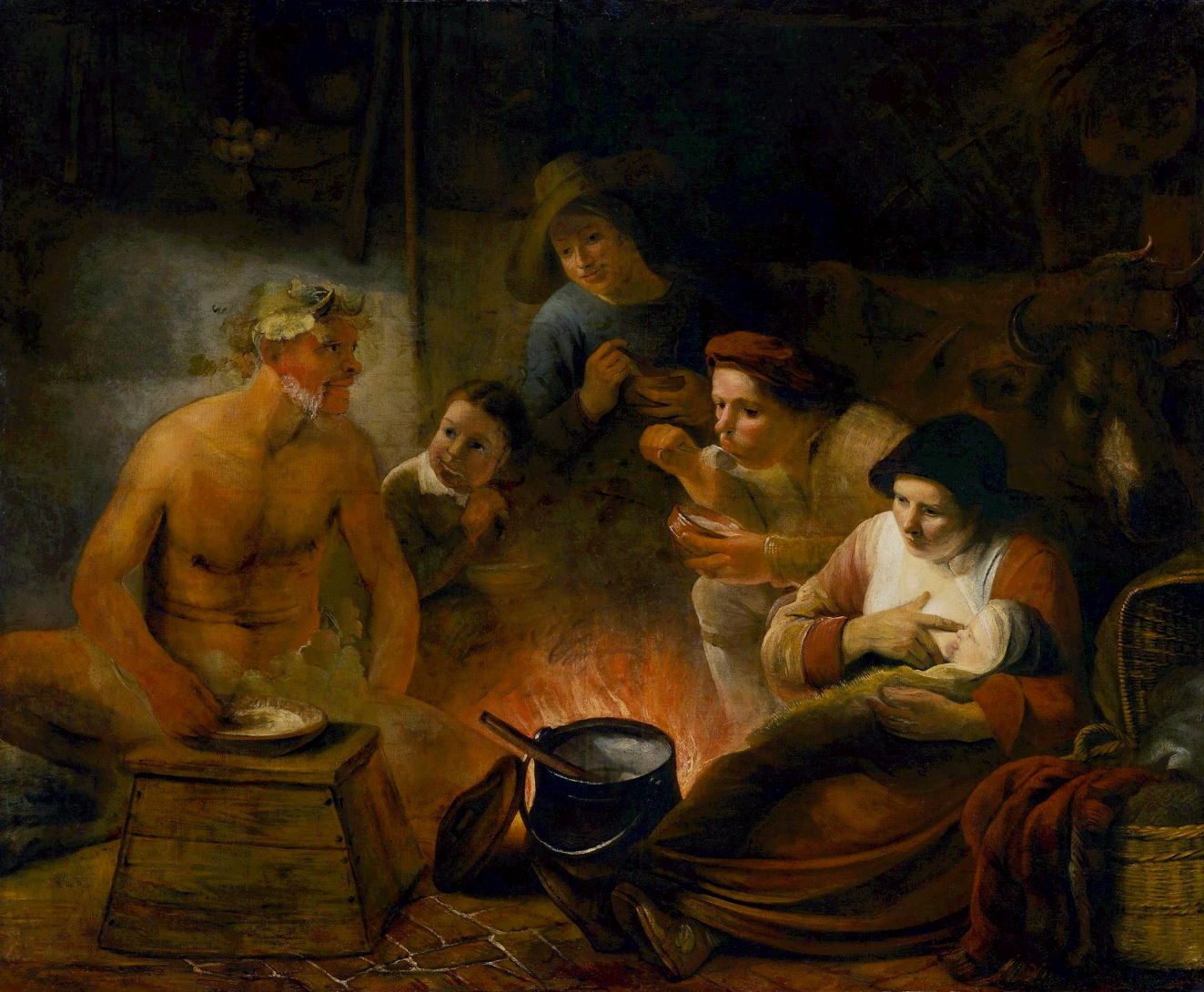
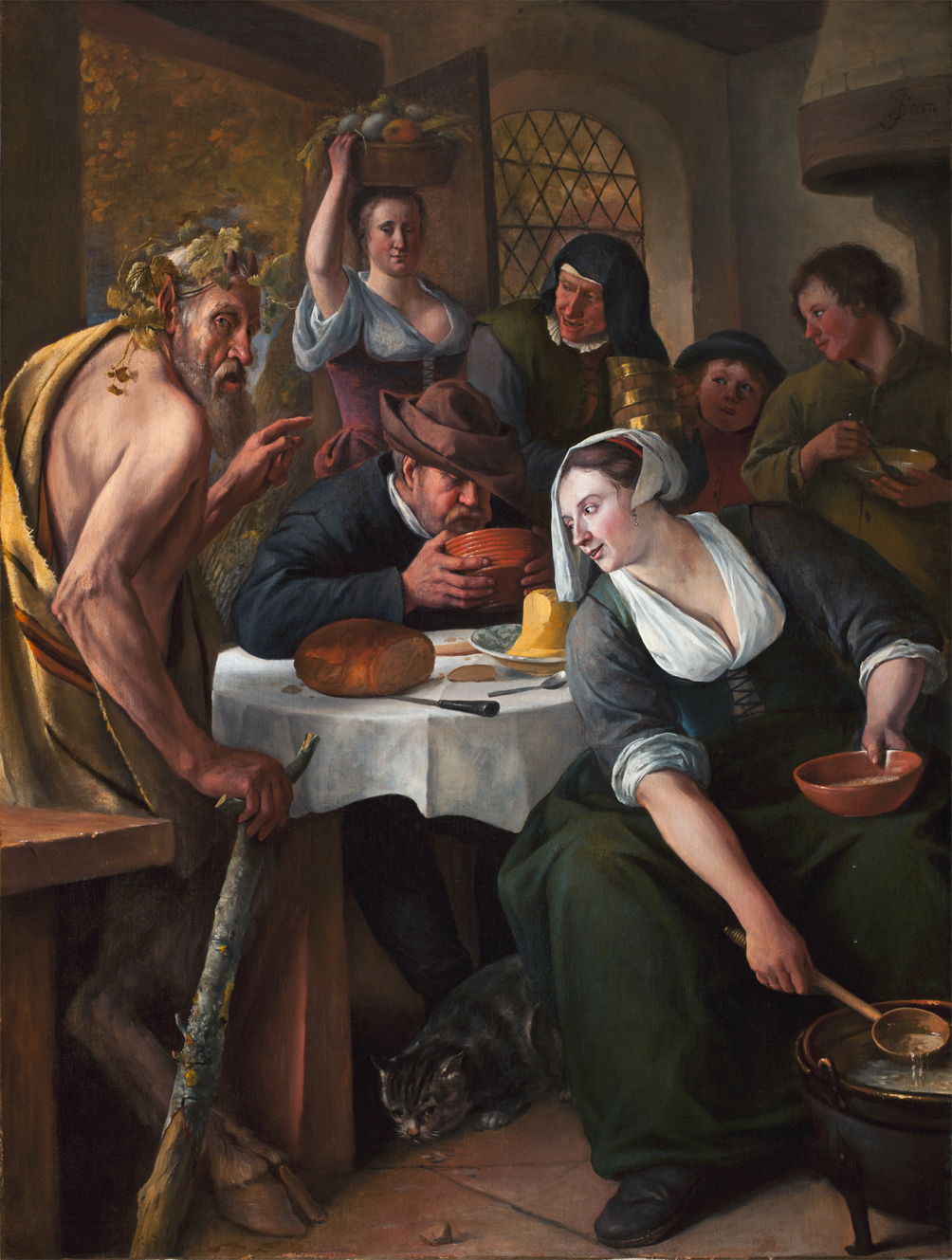
Paintings of fables, that had already started to become popular among Flemish artists at this time, appeared in the Republic to the north. Among them was the story of the Satyr and the Traveller, or the Man and the Satyr. A man made friends with a satyr; when the man’s hands were cold, he blew on them to warm them up. When the two were eating together, the man blew on his hot food in order to cool it down. The satyr decided that he couldn’t trust a creature whose breath blew both hot and cold, so broke off their friendship.
Constantijn à Renesse (1626–1680), Satyr at the Peasant’s House (1653), oil on canvas, 168 x 203 cm, Muzeum Narodowe w Warszawie, Warsaw, Poland. Wikimedia Commons.
In 1653, Constantijn à Renesse, a former pupil of Rembrandt, painted his version of this fable in Satyr at the Peasant’s House. This shows one of the family blowing on the hot food in their spoon, although at this stage the satyr hasn’t reacted to the contradiction.
Jan Steen (1625/1626–1679), The Satyr and the Peasant “Who Blows Hot and Cold” (c 1660), media and dimensions not known, Museum Bredius, The Hague, The Netherlands. Wikimedia Commons.
Jan Steen, in his telling of The Satyr and the Peasant “Who Blows Hot and Cold” from about 1660, gives a clearer account, with the satyr looking worried at the viewer, as a man (still wearing his hat) blows on a bowl of hot stew. He also pays attention to delightful details such as the cat skulking under the table, and a rich supporting cast.
Steen went on to paint two unusual accounts of what happened in schools across country districts in the Republic.
Jan Steen (1625/1626–1679), The Village School (c 1665), oil on canvas, 110.5 x 80.2 cm, National Gallery of Ireland Gailearaí Náisiúnta na hÉireann, Dublin, Ireland. Wikimedia Commons.
His The Village School from about 1665 shows physical punishment in a contemporary school. The child at the right holds out a hand for teacher to strike it with a wooden spoon, and is already wiping tears from his eyes. A girl in the middle of the canvas is grimacing in sympathy.
Jan Steen (1625/1626–1679), The Village School (c 1670), oil on canvas, 81.7 x 108.6 cm, Scottish National Gallery, Edinburgh, Scotland. Wikimedia Commons.
A few years later, Steen painted a scene in a larger and more chaotic classroom, in The Village School from about 1670. Although there are two staff sat at the teachers’ desk, the man is distracted, perhaps in cutting himself a fresh quill. The woman teacher sat next to him is engaged in explaining something to a pupil. Around them, all hell is breaking loose. In the distance, a boy is stood on one of the trestle tables. Older children are teaching younger ones, and a small group at a table at the right are trying to write while others get up to mischief. One younger child in the middle of the foreground has fallen asleep against a hat.
Gerrit Dou (1613–1675), The Young Mother (1658), oil on panel, 73.5 x 55.5 cm, Koninklijk Kabinet van Schilderijen Mauritshuis, The Hague, The Netherlands. Wikimedia Commons.
Gerrit Dou approaches social realism in his detailed account of The Young Mother from 1658. As she sits at her needlework, her child is attended in their wickerwork crib by a young nurse. Around them is an eclectic collection of objects, from a large cabbage, hanging game and a bundle of carrots at the right, to a bird cage and an upholstered chair at the left. Suspended above them is a chandelier, and a wooden spiral staircase ascends to the next floor. This family appears to be living in affluent squalor.
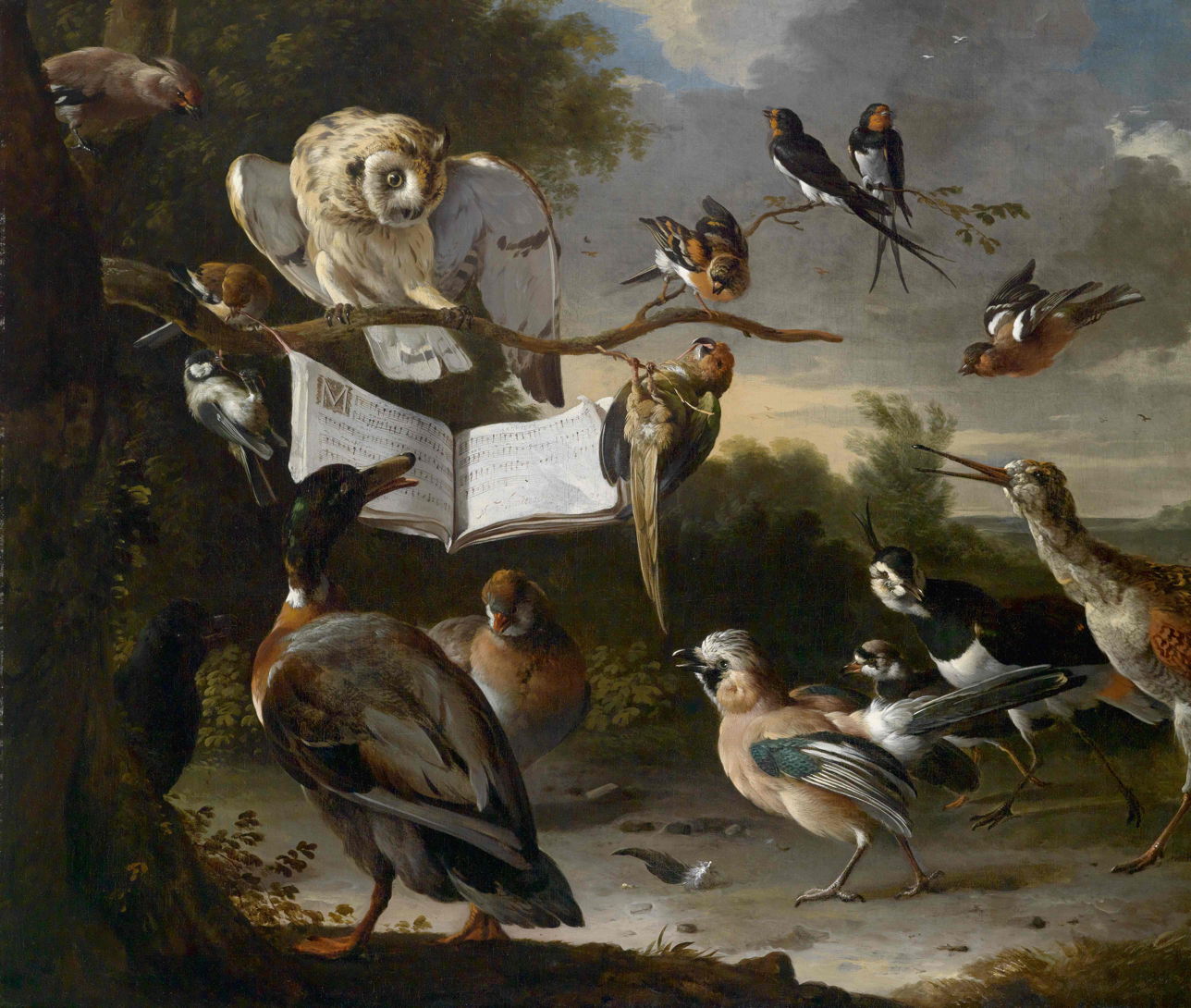
Melchior d’Hondecoeter (1636–1695), Concert of the Birds (1670), oil on canvas, 84 x 99 cm, Private collection. Wikimedia Commons.
There was even an anthropomorphic fad for paintings showing gatherings of birds ‘singing’ together, and I think Melchior d’Hondecoeter’s Concert of the Birds from 1670 is probably the best example of those entertaining paintings.
The Achilles heel of T2 Macs is booting from external storage. Although it’s simple to create a bootable external disk for a T2 Mac, to boot from it you have to allow the Mac to boot from any external disk, removing much of its boot security. Apple silicon Macs were designed to boot almost as securely from external disks as they do from the internal SSD, and that makes setting up a bootable external disk more complicated. This article explains how you can do that for macOS 26 Tahoe.
In this respect, Apple silicon Macs have two central principles:
They always start the boot process from their internal SSD. If that’s not functioning correctly, then they can’t boot at all.
They will only transfer the boot process to an external system when the user has access to a private key making them an Owner of that system, through the Mac’s LocalPolicy system. That’s the part that can cause problems.
Planning
There are alternatives to booting from external storage. If there’s sufficient space, you can install multiple versions of macOS on the internal SSD, or you can run macOS as a guest operating system in a virtual machine (VM). VMs are limited in some important respects, though, as they can’t run most apps from the App Store or use AI, although they can now access iCloud and iCloud Drive.
Like any other Mac, Apple silicon models can only boot from versions of macOS they’re compatible with. You can check which your Mac can run using Mactracker. A VM is the only solution for running older and incompatible versions of macOS, and it gets messy installing versions that are compatible but older than the currently installed major version of macOS. This is because its installer may be blocked by the more recent macOS, for which you’ll need to create a bootable installer disk and run the installation from that. Apple describes how to do that in this support article. For the remainder of this article, I assume that you’re installing a second or subsequent copy of the current version of macOS to an external disk.
Connect and prepare the external disk
First catch your disk, and connect it to one of the non-DFU ports on your Mac. For example, on my Mac mini M4, that’s either the left or right Thunderbolt port, as the middle one is its DFU port. On all other Apple silicon Mac minis, that’s either the centre or right port as you look from the rear, as their DFU port is the one on the left. If you try to install macOS to a drive connected to an Apple silicon Mac’s DFU port, then it’s doomed to fail, and that’s the most common cause of failure. More information on the DFU port is here.
Reformat that disk as you want to use it, with at least one APFS container containing a single APFS volume in regular APFS format, not encrypted.
Download and run the installer
Next catch your installer. Oddly, Apple seems to have stopped providing the current release of macOS through the App Store, so the simplest way to download it in the GUI is from the links provided by Mr. Macintosh, and there are many alternatives. You want a regular installer, not an IPSW image file that you might use to create virtual machines.
Run the installer app from your main Applications folder.
When it asks you whether you want to install macOS on your current system, click on Show All Disks…
Select your external disk from the list and click Continue. If your disk isn’t recognised or listed there, reformat it and start again.
Ownership
This is the important part of the installation; if it fails, the external disk won’t be bootable.
For the macOS system on your external disk to be bootable, it needs a LocalPolicy created for it on your Mac’s internal SSD. To ensure that only fully authorised users can configure and change LocalPolicy, those Image4 files are signed, and an Owner Identity Certificate (OIC) is attached to them. Creating and maintaining LocalPolicies requires a user to have access to the private Owner Identity Key (OIK) in the Secure Enclave, making that user an Owner.
Any user with access to the Volume Encryption Key for the internal storage also has access to the OIK, and has Ownership. By default, that includes all users added after FileVault encryption is enabled on a Data volume, for example. To be able to boot from that second OS, it requires a LocalPolicy with an OIC attached, and Ownership has to be handed off to an Install User created when that OS is installed.
Handing off Ownership to the Install User is more of a problem, as users are only created when the installation is complete. To accommodate that, macOS offers to copy a user from the current boot system as the Install User, and the primary admin user, on the second OS. Provided that you agree to that, the Install User created is actually a Key Encryption Key (KEK) for your password and hardware keys, which is then used to encrypt the OIK as it’s handed over to the new copy of macOS on the external disk. Thus, the installer requests that user’s password to gain access to the OIK for the new macOS in the Secure Enclave.
Following these steps should ensure that works correctly.
When prompted to select the user to be owner of the new boot volume group, pick the current admin user, and tick to copy their account settings.
You’ll then be prompted to enter that user’s password to authenticate as the owner.
Completing installation
Installation follows, and is (as ever) highly non-linear, and may even appear to stall. Persevere, and it will then close apps and restart to complete.
When you’re eventually prompted to Create a Computer Account, it’s simplest to create a local admin account for the owner. The new copy of macOS will then take you through personalising your new system, and, if you’ve added support for your Apple Account, it will do the 2FA dance for iCloud and Apple Account, and so on.
Once configured, you can share that external disk between Macs, but each time you boot from it on a different Mac, you can expect to repeat the 2FA dance for iCloud and Apple Account.
Updates
Once installed, you’ll almost certainly want to keep that external system up to date. To do that, start up from that disk, and use Software Update as normal. Although you could download that latest macOS installer and run that, that’s a much larger download and there’s always the risk it might run a clean install, forcing you to restore from your latest backup. Apple no longer provides downloadable updaters for macOS.
When you update macOS on that Mac, the firmware in it will be updated by the most recent version of macOS you have installed or updated it to, whether that’s on the internal or external disk. To update firmware, you have to install the appropriate macOS update on that Mac. If you update your external disk using another Mac, then that won’t update the firmware in your Mac. That can only be done by performing that update on that Mac.
Key steps
Consider alternatives, including an additional system on the internal SSD, or using a VM instead.
Connect the external storage to a non-DFU port and format it in APFS, not encrypted.
Download and run the appropriate full macOS installer. macOS Tahoe isn’t currently available from the App Store, though.
Select the external disk as the installation target.
Select the current admin user to be Owner of the new system, copy their account settings, and authenticate with that user’s password.
Create a local admin account for that user, if possible.
Complete 2FA to connect to the Apple Account, as necessary.
Update the external system when booted from it, using Software Update.
Some stories in Boccaccio’s Decameron attained fame less in the original, more in their later retelling. A good example is the tragic tale of Lisabetta related by Filomena on the fourth day, when it was the fifth about those whose love ended unhappily.
In 1818, the British poet John Keats (1795-1821) wrote his version, titled Isabella, or the Pot of Basil, which was published two years later, shortly after the poet’s untimely death at the age of just twenty-five, and it quickly became one of his most popular works. Here I will tell Boccaccio’s original, using his version of the names, being mindful that Keats called his leading lady Isabella rather than Boccaccio’s Lisabetta. Her lover’s name, common to both accounts, is Lorenzo.
Following the death of a rich merchant of Messina, his three sons inherited his riches, while their sister remained unmarried despite her beauty and grace. Lisabetta and Lorenzo, a Pisan who directed operations in one of the family’s trading establishments, fell in love with one another, and their relationship was consummated.
The couple tried to keep their affair secret, but one night one of her brothers saw her making her way to Lorenzo’s bedroom, and Lisabetta remained unaware of her discovery. Her brother was distressed, but decided to keep quiet, and to discuss it with his brothers next morning.
The following day, the brothers decided that they would also keep quiet until the opportunity arose to end their sister’s relationship. Some time later they pretended they were going to the country for pleasure, and took Lorenzo with them. When they reached an isolated location, they murdered Lorenzo and buried his body. They then told their sister that they had sent him away on a trading mission.
Lisabetta was anxious for her lover’s return, and persistently asked her brothers for news of him. Eventually, one of them rebuked her for this nagging, so she stopped mentioning him altogether, but each night kept repeating his name and pining for him. One night, having finally fallen asleep in tears, she saw him in a dream, in which he said that her brothers had murdered him, and revealed where his body was buried.
In her grief, Lisabetta obtained the permission of her brothers to go to the country for pleasure. Once she had located where she thought Lorenzo was buried, she quickly found his corpse, which remarkably showed no signs of decay. As she couldn’t move his whole body for more appropriate burial, she cut off his head and concealed it in a towel.
When she returned home, Lisabetta cried greatly over Lorenzo’s head, washing it with her tears, then wrapped it in cloth and put it in a large pot. She covered it with soil and in that planted some sprigs of basil. These she watered daily with her tears, as she sat constantly beside the pot in between bouts of crying over it. As a result, the basil grew strong and lush, and richly fragrant.
William Holman Hunt (1827–1910), Isabella and the Pot of Basil (1867), oil on canvas, 187 x 116 cm, Laing Art Gallery, Newcastle upon Tyne, England. Wikimedia Commons.
William Holman Hunt’s Isabella and the Pot of Basil from 1867 is intricately detailed, with several references to the story, such as the relief of a skull on the side of the pot, a red rose on a tray by Lisabetta’s left foot, and a silver watering can at the bottom right. Behind her is the image of a bedroom, possibly showing Lorenzo coming to her in a flashback to their affair.
Joseph Severn (1793-1879), Isabella, or the Pot of Basil (1877), further details not known. Wikimedia Commons.
Joseph Severn’s Isabella, or the Pot of Basil from 1877 appears remarkably high in chroma, and shows Lisabetta fondly embracing the pot and crying over the basil. Severn had been a personal friend of John Keats, and painted this just a couple of years before his own death.
Edward Reginald Frampton (1870-1923), Isabella, or the Pot of Basil (date not known), further details not known. Wikimedia Commons.
Edward Reginald Frampton’s Isabella, or the Pot of Basil was probably painted towards the end of the nineteenth century, or possibly in the early twentieth. Lisabetta is kneeling before her pot of basil at an altar, with a crucifix behind.
Ricciardo Meacci (1856-1938), Isabella and the Pot of Basil (1890), watercolour, dimensions not known, Private collection. Wikimedia Commons.
Ricciardo Meacci’s watercolour of Isabella and the Pot of Basil from 1890 shows Lisabetta embracing her pot of basil, as her three brothers watch with growing anger at her behaviour.
Her brothers began to suspect something, so had the pot removed from her room. This deepened their sister’s grief, and she kept asking after the pot.
John Melhuish Strudwick (1849-1937), Isabella (c 1886), oil on board, 31.1 x 23.2 cm, location not known. Wikimedia Commons.
John Melhuish Strudwick’s Isabella from about 1886 shows Lisabetta staring in grief at the stand on which her pot of basil had stood. Through the window, two of her brothers are seen making off with the pot, and looking back at her.
The brothers examined its contents and discovered Lorenzo’s head. Scared that his murder might cause them problems, they reburied the head, wound up their business, and left Messina for Naples. Lisabetta’s grief only grew deeper, and destroyed her health completely. Still asking for her pot of basil, she finally cried herself to death. Although the brothers had done everything to keep these events secret, eventually they became widely known, and were celebrated in folk verse.
John Everett Millais (1829–1896), Isabella (Lorenzo and Isabella) (1848-49), oil on canvas, 103 x 142.8 cm, Walker Art Gallery, Liverpool, England. Wikimedia Commons.
The first and still greatest depiction of Keats’ retelling is John Everett Millais’ Isabella (Lorenzo and Isabella) from 1848-49, completed before he was twenty, and one of the earliest examples of Pre-Raphaelite art. This is a composite of references to Keats’ poem and Boccaccio’s story, set at an imaginary family meal which the three brothers, Lisabetta and Lorenzo are taking together.
Lorenzo is sharing a blood orange with Lisabetta, white roses and passion flowers climbing from behind their heads. The dog, acting as a surrogate for Lorenzo, is being petted by Lisabetta, but one of her brothers aims a kick at it. Other symbols are shown of the plot to kill Lorenzo: a brother staring at a glass of red wine, spilt salt on the table, and a hawk pecking at a white feather. The pot of basil is already on the balcony, awaiting Lorenzo’s head. When exhibited at the Royal Academy in 1849, it was accompanied by verses 1 and 21 of Keats’ poem.
In 1900, the Swiss painter and print-maker Félix Vallotton was granted French citizenship. He had cut back on his prints to paint more, and the paintings that he made were no longer Nabi, but explored themes and ideas that were to prove influential later in the twentieth century. He also broadened his interests: in the early years of the new century, he wrote eight plays and three novels, although none achieved much success.
Félix Vallotton (1865–1925), The Laundress, Blue Room (La Lingère, Chambre Bleue) (1900), oil on paper laid on canvas, 50 x 80 cm, Dallas Museum of Art, Dallas, TX. Wikimedia Commons.
In 1900, he followed his earlier mysterious interiors with The Laundress, Blue Room, set in the Vallotton apartment in Paris, with two of his step-children squatting on the folds of large fabric sheets, inside a bedroom with blue decor. Two women are sat working, one apparently on the sheets, the other on separate fabrics.
Félix Vallotton (1865–1925), Le Pont Neuf (1901), oil on cardboard, 37 x 57 cm, Kunstmuseum Winterthur, Winterthur, Switzerland. Wikimedia Commons.
Vallotton’s view of the oldest of the great bridges of central Paris, in Le Pont Neuf from 1901, is strange. Like some of the unconventional views of bridges painted in the late nineteenth century, its emphasis is on unusual perspective form, but it manages to avoid showing Pissarro’s dense throng of people, or its place among prominent buildings, and is almost unrecognisable.
Félix Vallotton (1865–1925), Woman Searching in a Cupboard (1901), oil on canvas, 78 × 40 cm, Private collection. Wikimedia Commons.
Woman Searching in a Cupboard from 1901 shuts out half its image with black screens and the doors to the cupboard, giving it a strongly geometric tone. The woman, in spite of a lamp by her side, is little more than a black silhouette too, who appears to absorb the light falling on her. The lamp itself is strange, with a shade showing some sailing ships at sea, its stand being a vertical statuette of Truth, perhaps?
Félix Vallotton (1865–1925), Poker (1902), oil on cardboard, 52 x 67 cm, Musée d’Orsay, Paris. Wikimedia Commons.
Maybe we should read Vallotton’s lamps more carefully. For the following year (1902), he painted this quartet of gamblers in a Poker session. Tucked away in a plush back-room behind a club or bar, these four are in full evening dress, playing for stakes that could be breathtaking and bankrupting. In the centre foreground is another lamp with a patterned shade, showing sailing boats, I think.
Félix Vallotton (1865–1925), Five Painters (1902-03), oil on canvas, 145 x 187 cm, Kunstmuseum Winterthur, Winterthur, Switzerland. Wikimedia Commons.
Then in 1902-03, Vallotton painted one of the seminal records of the Nabis: Five Painters, showing Pierre Bonnard (seated, left), Félix Vallotton (standing, left), Édouard Vuillard (seated), Charles Cottet and Ker-Xavier Roussel (standing, right).
His next views of interiors I find quite cinematic, as if stills from a movie, perhaps reflecting his modern approach to composition and lighting, more akin to those developed by cinematographers of the future rather than painters of the past. They also appear to have been influences over the New Objectivity that developed in central Europe in the 1920s, and later American artists like Edward Hopper.
Félix Vallotton (1865–1925), Interior, Woman in Blue Searching in a Cupboard (1903), oil on canvas, 81 x 46 cm, Musée d’Orsay, Paris. Image by Oakenchips, via Wikimedia Commons.
For his Interior, Woman in Blue Searching in a Cupboard from 1903, Vallotton painted his wife Gabrielle from the back as she stood searching in a cupboard of books.
Félix Vallotton (1865–1925), Interior with Woman in Red (1903), oil on canvas, 92.5 x 70.5 cm, Kunsthaus Zürich, Zürich, Switzerland. Wikimedia Commons.
Vallotton’s Interior with Woman in Red from 1903 develops the framing effect of multiple sets of doors, drawing the eye deeper towards a distant bedroom. The woman wearing a red dress looks away, her skirts swept back as if she has been moving towards the three steps dividing this interior into foreground and background. There are tantalising glimpses of detail on the way: discarded fabric on a settee, clothing on a chair in the next room, and half a double bed with a bedside lamp in the distance.
Félix Vallotton (1865–1925), Woman Reading in an Interior (1904), oil on board, 60.3 x 34.6 cm, Museum of Fine Arts, Houston, TX. Wikimedia Commons.
There’s dispute as to whether this painting shows a Woman Reading in an Interior, as given by its French title, or a woman writing, which appears to be its translation. Vallotton painted this in 1904, and charged it with rather less mystery, although I wonder if the lower of the paintings on the wall might be one of Degas’ works showing horseriding. As usual, the single figure doesn’t show her face as she sits at the small bureau, backlit by the window and its stained glass.
Félix Vallotton (1865–1925), Interior, Bedroom with Two Figures (1904), oil on cardboard, 61.5 × 56 cm, Hermitage Museum Государственный Эрмитаж, Saint Petersburg, Russia. Wikimedia Commons.
Interior, Bedroom with Two Figures from 1904 is one of the last of his series of mysterious interiors, and worthy of the sub-genre of the ‘problem picture’. This is another bedroom, in which the lady of the house is standing over her maid as the latter is sewing up an evening gown for her. The mistress stands with her back to the viewer, but her face is revealed in her reflection in the large mirror on the wardrobe at the back of the room. In that, the maid is all but invisible. These three figures appear in a perspective recession, and to the right of the wardrobe is a doorway, presumably leading through to the master’s bedroom.
Félix Vallotton (1865–1925), The Models’ Smoke Break (1905), oil on canvas, 130 x 195.5 cm, Kunstmuseum Winterthur, Winterthur, Switzerland. Wikimedia Commons.
In this period before the Great War, Vallotton also painted portraits, and several nudes. But the figurative painting from 1905 that I find most fascinating is this, of The Models’ Smoke Break. In an era when most adults smoked, rest periods for models, like those for other workers, were usually termed ‘smoke breaks’ even though neither woman is smoking.
Instead, one model is reclined in a pose (not a pose, as it’s a break) reminiscent of Manet’s Olympia (1863). Instead of her maid bringing her a bouquet, though, she holds a single wilted blue flower, and chats idly to another model who sits by her feet. I wish I could identify the paintings reflected in the mirror behind them, although I think the upper double portrait is that of Vallotton’s parents painted in 1886. That below looks like a coastal landscape, perhaps of Honfleur.
To follow these, Vallotton turned to classical myths.
The craft of the blacksmith goes back long before the Iron Age, but once our ancestors had learned to work cast iron (by turning it first into wrought iron), in about 1200 BCE, it became one of the key crafts in many societies. It’s also the only craft represented by a deity in the classical Greek pantheon, in the god Hephaistos, translated by the Romans to Vulcan.
He had the misfortune to have been born lame, as a result of which Hera tried to be rid of him, and threw him into the sea. He was there cared for by Thetis and others. He later assumes his role as the god of fire, volcanoes, and crafts allied to blacksmithing, including sculpture.
In paintings, Vulcan is characteristically seen in his forge, as in Tintoretto’s painterly Vulcan’s Forge (1578), one of four mythological paintings he made for the Atrio Quadrato in the Palazzo Ducale in Venice. Tintoretto was clearly familiar with the division of labour in a blacksmith’s workshop. The two well-muscled men wielding large hammers are strikers, whose brute force is more important. Vulcan is the older man at the left, who strikes the casting with his small hammer to tell them where theirs should strike.
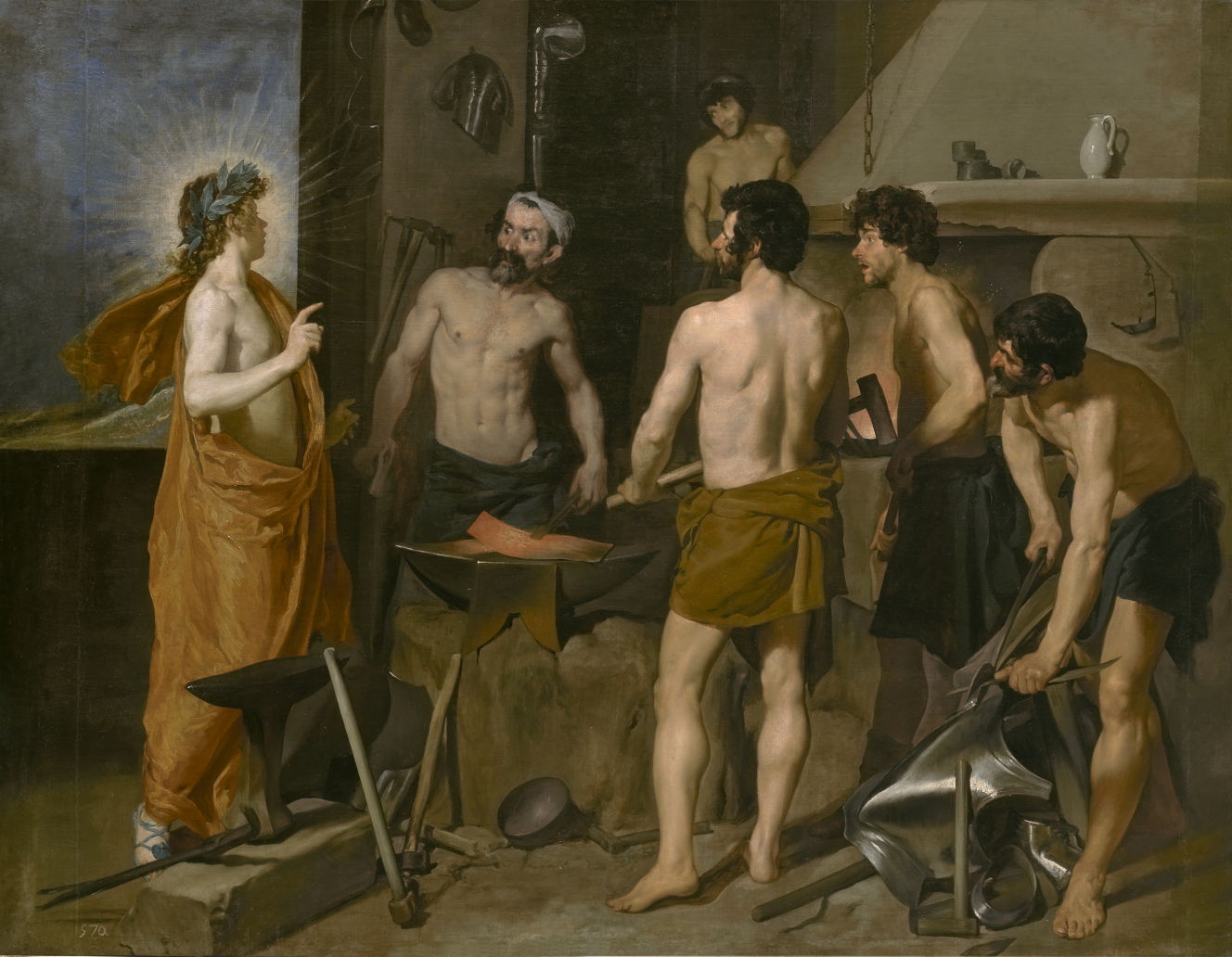
Diego Velázquez (1599–1660), The Forge of Vulcan (1630) [41], oil on canvas, 223 x 290 cm, Museo Nacional del Prado, Madrid, Spain. Wikimedia Commons.
Homer’s story of the adulterous affair of the wife of Hephaistos, Aphrodite (Venus), with Ares (Mars) is retold by Ovid in his Metamorphoses, the likely source for Diego Velázquez’s The Forge of Vulcan from 1630. This shows Apollo, at the left, visiting Hephaistos (to the right of Apollo) in his forge, to tell him about this infidelity.
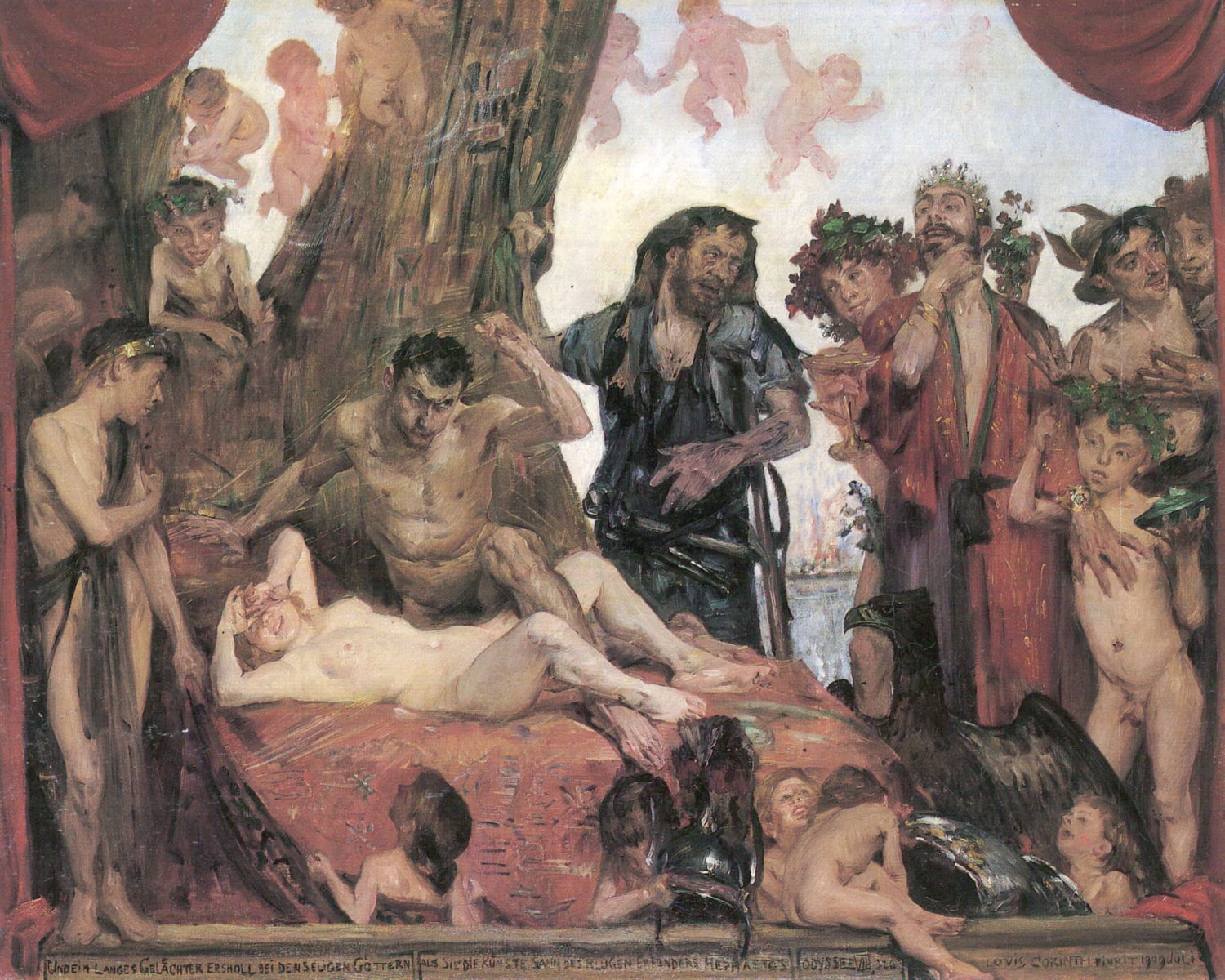
Lovis Corinth (1858–1925) Homeric Laughter (1909), oil on canvas, 98 × 120 cm, Bayerische Staatsgemäldesammlungen, Munich. Wikimedia Commons.
Homeric Laughter (1909) is one of Lovis Corinth’s most complex, even abstruse, paintings of classical myth. He provides a good clue as to its interpretation in his inscription (originally in German translation): unquenchable laughter arose among the blessed gods as they saw the craft of wise Hephaistos
together with the reference to Homer’s Odyssey book 8 line 326.
In this first version, Corinth shows Aphrodite recumbent on the bed, shielding her eyes from the crowd around her. Ares struggles with the net securing the couple, looking frustrated. Hephaistos, clad in black with his tools slung around his waist, is talking to Poseidon (who wears a crown) with Dionysos/Bacchus behind him (clutching a champagne glass). At the right edge is Hermes/Mercury, with his winged helmet. Sundry putti are playing with Ares’ armour, and an arc of putti adorns the sky.
The blacksmith also features in some accounts of the origin of Pandora.
John Dixon Batten (1860-1932), The Creation of Pandora (1913), tempera on fresco, 128 x 168 cm, Reading University, Reading, England. Wikimedia Commons.
John Dixon Batten’s The Creation of Pandora was painted anachronistically in egg tempera on a fresco ground by 1913. Batten was one of the late adherents of the Pre-Raphaelite movement, and is now almost forgotten. This work had been put into storage in 1949 and wasn’t rediscovered until 1990.
Pandora is at the centre, having just been fashioned out of earth by Hephaestus, who stands at the left, his foot on his anvil. Behind them, other blacksmiths work metal in his forge. At the right, Athena is about to place her gift of a robe about Pandora’s figure, and other gods queue behind to offer their contributions.
There are several fine paintings of regular blacksmiths at work over the centuries. The earliest I have been able to locate is a disturbing detail in the central panel of Hieronymus Bosch’s triptych The Last Judgment from about 1495-1505.
Hieronymus Bosch (c 1450–1516), The Last Judgment (central panel, detail) (c 1495-1505), oil on oak panel, left wing 99.5 x 28.8 cm, central panel 99.2 × 60.5 cm, right wing 99.5 × 28.6 cm, Groeningemuseum, Bruges, Belgium. Wikimedia Commons.
Among the torments featured in the centre panel are painful punishments in the blacksmith’s at the top.
Francisco Goya (1746–1828), The Forge (1812-16), oil on canvas, 181.6 x 125.1 cm, The Frick Collection, New York, NY. Wikimedia Commons.
Francisco Goya’s Forge from 1817 is a superb depiction of the physically demanding work of the blacksmith. Its extensive use of black is also a herald of the Black Period to come in Goya’s paintings at the end of that decade.
Alfred Sisley (1839-1899), Forge at Marly-le-Roi (1875), oil on canvas, 55 x 73.5 cm, Musée d’Orsay, Paris. EHN & DIJ Oakley.
Sisley’s Forge at Marly-le-Roi from 1875 shows the village blacksmiths still at work long after the Industrial Revolution brought steam-powered hammers.
Ernst Josephson (1851–1906), Spanish Blacksmiths (1882), oil on canvas, 128.5 x 107 cm, Nasjonalgalleriet, Oslo, Norway. Wikimedia Commons.
Ernst Josephson’s Spanish Blacksmiths from 1882 shows a smith in the shredded remains of his white shirt, and his striker to the right in his black waistcoat, with a horseshoe hanging below the roof of their forge in Seville.
Döme Skuteczky (1849–1921), In the Smithy (1897), mixed media, 28 × 21 cm, location not known. Wikimedia Commons.
Döme Skuteczky’s painting In the Smithy from 1897 shows another smithy, this time in Slovakia.
These days, across much of Europe the traditional blacksmith earns their keep from forging horseshoes for the many horses ridden for pleasure.
The first story on the fourth day of Boccaccio’s Decameron was told by Fiammetta, and relates the tragedy of Ghismonda and her love for Guiscardo.
Ghismonda was the daughter of Prince Tancredi of Salerno, who was known for being a benevolent ruler, but in his later years became a possessive father. He refused to let her marry until she was older than was usual, and when she did, her husband died soon after. She returned to live with her doting father, who had no interest in seeing her married for a second time, so she decided to take a lover instead.
She fell in love with a young valet to her father named Guiscardo, and he fell in love with her. Ghismonda devised an ingenious way of passing him messages concealed inside a reed. They met in an old cavern underneath the palace: Ghismonda’s room had a long-disused door that opened into the cavern, and Guiscardo descended into it from a shaft outside the walls.
Before meeting in this cavern, Ghismonda dismissed all her ladies-in-waiting, telling them she wanted to sleep. She then locked herself in her room, opened the door to the cavern, and descended its staircase to meet her lover, who had roped down from the entrance to the shaft. The couple then spent much of the rest of the day making love in her room before Guiscardo departed.
One day when the couple had arranged to meet in this way, Prince Tancredi came looking for his daughter. Seeing her outside, he settled down in a corner of her room and fell asleep. She was unaware he was there, and proceeded with her lovemaking, during which her father awoke. He remained silent and was undiscovered, eventually climbing out of a window while the couple descended into the cavern to make their farewells.
Later that night, Guiscardo was arrested on the orders of the Prince, and confined to a room in the palace without Ghismonda’s knowledge. Tancredi went to his daughter’s room, where he told her of the dishonour she had brought upon herself. She showed no contrition, nor did she seek her father’s forgiveness, but told her father honestly of the love she shared with Guiscardo, of her youth, and amorous desires. She pleaded her lover’s virtues, and asked that she should bear the brunt of any punishment, rather than her lover.
Prince Tancredi decided to take revenge not on his daughter, but on her lover. He had two of his men strangle Guiscardo, then cut his heart out. The heart was placed inside a gold chalice, and presented to his daughter “to comfort her in the loss of her dearest possession, as she had comforted her father in the loss of his”.
Before she could be given this gruesome present, Ghismonda had called for poisonous herbs, which she turned into a highly toxic potion. When the servants delivered her the chalice, she removed its lid, saw her lover’s heart, and was given her father’s message. Ghismonda raised her lover’s heart to her lips and kissed it. She then thanked the servants for her father’s priceless gift to her, bade farewell to her lover’s heart, and cried profusely over it.
Francesco Bacchiacca (1494–1557), Ghismonda with the Heart of Guiscardo (c 1525), oil on wood, dimensions not known, Lowe Art Museum, Coral Gables, FL. Wikimedia Commons.
Francesco Bacchiacca’s early painting of Ghismonda with the Heart of Guiscardo from about 1525 shows the rather distant figure crying over the heart, with her apparently disinterested ladies-in-waiting around her. In the foreground is her father’s servant who brought the chalice.
Francesco Furini (1600/03-1646), Sigismunda (c 1620-30), media and dimensions not known, Museo civico, Prato, Italy. Image by Sailko, via Wikimedia Commons.
Francesco Furini made at least two similar paintings of Ghismonda, here known by her alternative name of Sigismunda, crying profusely over the chalice. This version is thought to be from about 1620-30, and remains in Prato, Italy.
Francesco Furini (1600/03-1646), Sigismunda with the Heart of Guiscardo (c 1640), oil on canvas, 73 x 59 cm, Birmingham Museum and Art Gallery, Birmingham, England. Wikimedia Commons.
Thought to date from about 1640, this version known as Sigismunda with the Heart of Guiscardo is now in Birmingham, England. It had previously been attributed to Correggio, and was the inspiration for Hogarth’s much later painting shown below. It had only just been purchased at auction by Sir Thomas Sebright.
Interestingly, Furini’s painting of Mary Magdalene from about the same time is almost identical to the earlier version now in Prato, except that a chalice of myrrh had been substituted for that containing Guiscardo’s heart. All three works are notable for their dramatic chiaroscuro.
Mario Balassi (1604-1667), Ghismonda with the Heart of Guiscardo (1650), further details not known. Wikimedia Commons.
Mario Balassi’s Ghismonda with the Heart of Guiscardo from 1650 depicts Ghismonda being taken aback, although in Boccaccio’s account her response is strong and resolute despite the horrific cruelty of her father.
Bernardino Mei (1612-1676), Ghismunda (1650-59), oil on canvas, 66.5 x 47.5 cm, Pinacoteca nazionale di Siena, Siena, Italy. Wikimedia Commons.
It is perhaps Bernardino Mei, in his Ghismunda from 1650-59, who captures her resolute response best of all, as she stands squeezing the heart in her hand, tears still on her face.
William Hogarth’s Sigismunda Mourning over the Heart of Guiscardo from 1759 may come as something of a surprise. Hogarth seemed determined to prove that the ‘modern’ English painter could compete with the “old Italian masters” in handling such heroic narratives. This was one of his last commissions, for Sir Richard Grosvenor, in 1758. He studied Furini’s version (that now in Birmingham), which had been much admired, but when this was completed in 1759, Grosvenor rejected it.
Hogarth then exhibited it with seven other paintings at the Society of Artists in 1761. It was there savaged by the critics, who were apparently repelled by the conflict between the beauty of Sigismunda and the gruesome heart she is touching. Hogarth replaced it in the exhibition, and appears to have made changes to try to assuage its detractors. Unable to sell it or have it engraved for prints, the artist was forced to abandon it, and almost ceased painting for the remaining three years of his life.
Her ladies-in-waiting asked her why she was crying so, as they had not understood what had happened. Ghismonda then poured the deadly potion over Guiscardo’s heart, drank it, and lay down on her bed to await death. Her father was summoned, and Ghismonda asked him a final favour that she should be laid to rest beside Guiscardo. The Prince realised his cruelty and repented for it, ensuring that the two bodies were buried together in honour.
textutil, and Textovert its wrapper, convert between nine different formats, most of them in widespread use for documents that are largely based on text. This article explains a little about each of them, and its sequel tomorrow looks at how PDF differs. In each case, I give an example file size for a document containing the words This is a test.
in a total of 15 characters.
Plain text
Conventionally, plain text files in macOS are most usually encoded using Unicode UTF-8, requiring just 15 bytes for the hex bytes
54 68 69 73 20 69 73 20 61 20 74 65 73 74 2e. Of course that contains no font or layout information, just the raw content.
Rich Text (RTF)
This was introduced and its specification developed by Microsoft during the late 1980s and 90s, for cross-platform interchange, primarily between its own products. Support for this in Mac OS X came in Cocoa and its rich text editor TextEdit, inherited from NeXTSTEP. The format contains two main groups of features, styled text with fonts, and simple layout that has been extended to include the embedding of images and other non-text content.
RTF files consist of text, originally ASCII but now with Unicode support. Although not actually a mark-up language, its source code appears similar.
Each RTF file opens with the ‘magic’ characters {\rtf introducing information about conformity of the code. Following that is a preamble that is likely to contain platform-specific information, a font table and colour tables. The latter should include an expanded colour table for macOS. Then follows content, typically setting the font and size, with the paragraph content. For the example file, size is 378 bytes.
RTFD
RTF has several shortcomings, particularly in handling embedded images, so NeXTSTEP extended it to a bundle format, Rich Text Format Directory, RTFD, that transferred to Mac OS X. RTF content of a document is stored in a file named TXT.rtf, alongside separate files containing scalable images that can include PDF, and the whole directory is treated as if it was a single file. Although this works well in macOS, it never caught on in Windows, so hasn’t achieved the popularity it deserved. As the example file doesn’t have any images, its size as RTFD is also 378 bytes.
Microsoft Word
From its inception in 1983 until it switched to docx, Microsoft Word’s native file format has had the extension .doc. This is a binary format that has been successfully reversed for OpenOffice and LibreOffice open source, so incorporated into many products, including Cocoa and macOS.
From 2002, Microsoft Word has used a series of XML-based formats, since 2006 conforming to standards published first by Ecma then ISO/IEC, using the extension .docx, and known as Office Open XML. Support has been incorporated into macOS.
The .doc version of the example file requires 19 KB, while the .docx version takes only 4 KB.
HTML
This has evolved through a series of versions since its release in 1993, and is the markup language that dominates the web. Its structure should be well-known, and consists of an opening document type declaration followed by tagged elements containing metadata and content. Support for writing HTML is built into the Cocoa HTML Writer in macOS. This uses CSS to define styles in the header that are then applied to sections of the content, for example <body>
<p class="p1">This is a test.</p>
</body>
The example requires only 538 bytes of HTML.
webarchive
This format is proprietary to Apple and its Safari browser, and when viewed in a capable text editor such as BBEdit, is shown as consisting of the serialised contents of a displayed web page, in XML format. In fact, as fds corrects me below, “a .webarchive is better described as a collection of web resources serialized via NSKeyedArchiver into binary plist format, bundled together into a single file in yet another property list, also saved in the binary property list format.”
When viewed in an editor such as BBEdit, after its opening XML and document type declaration as a property list, this consists of a dictionary of key-value pairs, themselves including sub-dictionaries of Web Resources. The content of each, its WebResourceData, is encoded in Base-64, making it impossible to read in a text editor. Although these can be large, for the example only 778 bytes of storage is required, showing the efficiency of the binary property list format.
WordML
Between the original .doc and the Ecma .docx formats, Microsoft Word used an intermediate WordProcessingML (or WordML) format in XML. After a standard XML header, this declares
<?mso-application progid=”Word.Document”?>
followed by a list of schemas. Although of largely historical interest now, some old Word documents may remain in this format. The example file requires 1 KB of storage.
ODT
This is OpenDocument Text, another XML-based format that was developed around the same time as WordML, and supported by many free apps and ‘office’ suites. Its opening structure is similar to that of WordML, but references oasis and OpenDocument sources. The example here requires 2 KB of storage.
Pages
One significant omission from the list of text formats supported by textutil is that used by Apple’s own Pages. This proprietary format changed significantly in 2009. Currently, a .pages document is a Zipped bundle containing thumbnail JPEG previews of the document, and two folders of files. Content appears to be saved in Apple iWork Archive files with the .iwa extension, and quite unlike RTFD.
The stories told each day in Boccaccio’s Decameron follow a theme appointed by the ‘ruler’ of that day, as they decree when they are crowned with laurels at the end of the previous day’s storytelling. The theme chosen by the queen of the fifth day, Fiammetta, was the adventures of lovers who survived calamities or misfortunes and reached a state of happiness.
The eighth such story concerns the misfortunes of Nastagio degli Onesti, as told by Filomena. This appears to have been instantly successful, and by the early sixteenth century had been painted by both Botticelli and Ghirlandaio.
Nastagio degli Onesti was a young man from an old and noble family in Ravenna, who inherited a huge fortune, then fell in love with the daughter of a more noble family. His love for her wasn’t returned, though, and she was persistently cruel towards him. This caused the young Nastagio so much grief that he even contemplated suicide.
He continued to try to win her over, and in the course of that spent much of his inheritance. Friends and relatives feared for him and his future, and tried to persuade him to leave the city for a while. He was very reluctant, but finally travelled to Classe, three miles away, in May when the weather was fine.
Once there he wandered off into the local pine woods, thinking as he always did about his cruel love. As he walked in the wood, he heard the screams of a woman in distress. He then caught sight of her running naked towards him. In hot pursuit was a pair of large mastiff dogs, and behind them was a mounted knight brandishing a sword and threatening to kill her.
Nastagio took up a tree branch in her defence, but the knight ordered him by name to keep out, and let him and his dogs give the sinful woman what she deserved. Nastagio challenged the knight, who dismounted and introduced himself as Guido degli Anastagi. He then explained that he had fallen deeply in love with this woman many years ago, but she too had rejected him cruelly. As a result, Guido had killed himself, and was condemned to eternal punishment for that sin. The woman had died shortly afterwards, without repenting her cruelty, and she too was condemned to eternal punishment for her sin.
Their punishment consisted of Guido having to hunt her down in the woods, kill her using the same sword with which he had committed suicide, then cut her back open and remove her stone cold heart. That and her other organs he then has to feed to his dogs. After a short break, she is magically restored, and he has to resume hunting her as before.
Nastagio was horrified by this, stepped back, and watched the dead Guido kill the dead woman with his rapier, and go through the sequence of cutting out her heart and organs. A few moments later, after the ghostly dogs had eaten her organs, the dead woman jumped up and the hunt started all over again.
When he had recovered from the shock, Nastagio came up with a plan to deal with his own predicament. He summoned his friends and relatives, and agreed to stop trying to woo the woman that he loved on one condition, that she and her family should join him in the same place in the pine wood exactly one week later, for a magnificent breakfast banquet.
A week later all her family were present at the meal in the wood, and Nastagio carefully seated the woman he loved so she would get a grandstand view of the proceedings. No sooner had the last course been served, than they heard the dead woman’s screams, and she ran right in front of them.
Many of the guests tried to stop Guido from carrying out this punishment, so he explained to them what he had told Nastagio the week before. Eventually the ghostly couple rushed off again, and the guests talked avidly about what they had witnessed. But the person who was most affected by the spectacle was the cruel woman who Nastagio loved, who had perhaps already put herself in the position of the dead woman.
Nastagio’s plan paid off: the woman he loved soon sent him a servant to inform him that she would do anything he desired. She quickly consented to marriage, and they were wedded the following Sunday.
One perhaps unintended consequence of Nastagio’s breakfast demonstration was that, for some time to come, the women of Ravenna were so frightened of what could happen to them that they responded more favourably to the approaches of men.
Artist not known, The Story of Nastagio degli Onesti (c 1450), manuscript copy, BNF MS Italien 63, fol. 186v, Boccaccio’s Decameron, Bibliothèque nationale de France, Paris. Wikimedia Commons.
The title page of this story in this illustrated manuscript copy of the Decameron from the fifteenth century features a small reminder of the grim human hunt scene at its head.
This gruesome story and ingenious reversal of conventional Christian values became popular and well-known through the fifteenth century, sufficient for it to be depicted in four tempera panels given on the occasion of the arranged marriage of Gianozzo Pucci and Lucretia Bini in 1483. The couple were particularly fortunate in that one of those who made the arrangement, and who had this gift made for them, was Lorenzo de’ Medici, ‘the Magnificent’, who was also Botticelli’s patron at the time, and the ruler of the Florentine Republic.
Sandro Botticelli (1445–1510), The Story of Nastagio Degli Onesti I (1482-83), tempera on panel, 83 x 138 cm, Museo Nacional del Prado, Madrid, Spain. Wikimedia Commons.
The first panel shows the two figures of Nastagio, at the left, in the pine wood, with the naked woman running towards him, a mastiff sinking its teeth into her buttock. Behind them at the right is Guido, his sword ready to kill the woman when he catches her. In the distance is a coastal landscape intended to locate this near Ravenna, which is close to the Adriatic, although that’s idealised not representative.
Sandro Botticelli (1445–1510), The Story of Nastagio Degli Onesti II (1482-83), tempera on panel, 82 x 138 cm, Museo Nacional del Prado, Madrid, Spain. Wikimedia Commons.
Botticelli continues to tell the story using multiplex (‘continuous’) narrative in the second painting. The dead Guido has now caught the dead woman, killed her with his rapier, and with her lying on her face, he is cutting her back open to remove her cold heart. His dogs are already eating her organs at the right, and Nastagio is visibly distressed at the left.
Behind that composite scene is an earlier scene of Guido and his dogs still in pursuit of the woman, preceding the image of the first painting in the series.
Sandro Botticelli (1445–1510), The Story of Nastagio Degli Onesti III (1482-83), tempera on panel, 84 x 142 cm, Museo Nacional del Prado, Madrid, Spain. Wikimedia Commons.
In the third painting, Botticelli shows the breakfast banquet a week later, with the dead woman being attacked by Guido’s dogs, and Guido himself about to catch and kill her, in front of Nastagio’s guests.
Nastagio’s love is sitting at the table on the left, from which all the women have risen in distress at the sight, spilling their food in front of them.
Sandro Botticelli (1445–1510), The Story of Nastagio Degli Onesti IV (1482-83), tempera on panel, 83 x 142 cm, Private collection. Wikimedia Commons.
The fourth and final panel shows Nastagio’s wedding, the bride and her women sitting to the left, and the men to the right, in formal symmetry. The groom is sat on the other side of the same table as the bride.
Botticelli’s series seems to have been celebrated at the time, and shortly afterwards Ghirlandaio, another Florentine master, was asked to make not copies, but paintings in the manner of Botticelli’s series. Two have survived, and are now both in the US.
Davide Ghirlandaio (David Bigordi) (1452–1525), Forest Scene from the Tale of Nastagio degli Onesti (after 1483), tempera on wood panel, 69.9 x 134.6 cm, Brooklyn Museum (A. Augustus Healy Fund and Carll H. de Silver Fund), New York, NY. Courtesy of Brooklyn Museum.
Ghirlandaio’s first panel, now in the Brooklyn Museum, is based on Botticelli’s first, with the addition of an extra scene to its multiplex narrative. Up in the right, he adds the scene from Botticelli’s second panel, showing Guido cutting out the dead woman’s heart through her back.
Davide Ghirlandaio (David Bigordi) (1452–1525), Banquet Scene from the Tale of Nastagio degli Onesti (after 1483), tempera on wood panel, 70.2 x 135.9 cm, The Philadelphia Museum of Art (John G. Johnson Collection, 1917), Philadelphia, PA. Courtesy of The Philadelphia Museum of Art.
Ghirlandaio’s second panel shows an almost identical breakfast banquet to that in Botticelli’s third panel. This is now in the Philadelphia Museum of Art. I don’t know whether Ghirlandaio’s series extended to a third, completing the story with the marriage feast of Nastagio.
Boccaccio’s strange tale, twisted from source material by Dante, resulted in even more curious paintings. Today we might be only too happy to watch it in a horror movie, but seeing it come to life in a series of panels as a wedding gift? That’s surely typical of the late Middle Ages.
 Login
Login