Reading view

There are new articles available, click to refresh the page.

Paintings of Dante’s Inferno: 16 Overview, Purgatory and Paradise

Over the previous fifteen articles Dante has taken us through his vision of Hell. As he journeys on to Purgatory, this article offers an overview of the best-known book in his Divine Comedy.

botticellimaphell
Sandro Botticelli (1445–1510), Map of Hell (1480-90), silverpoint, ink and distemper, 33 x 47.5 cm, Biblioteca Apostólica Vaticana, Vatican City. Wikimedia Commons.

It was Botticelli who provided the clearest pictorial map of Dante’s journey, as he descended with Virgil through a succession of circles, each with its own class of sinner. Highest are the woods where Dante was wandering when he encountered the three wild beasts. At the left, Virgil led Dante down to the area where the cowards are trapped, neither being allowed admittance to Heaven, nor to Hell. Charon’s boat then crosses the River Acheron, shown in blue, taking Dante and Virgil to the First Circle of Limbo.

Introduction

This journey starts just before dawn on Good Friday in 1300, when the poet is wandering lost in a dark wood. His way is blocked first by a leopard, then by a lion, and finally by a wolf.

corotdantevirgil
Jean-Baptiste Camille Corot (1796–1875), Dante and Virgil (1859), oil on canvas, 260.4 x 170.5 cm, Museum of Fine Arts Boston, Boston, MA. Wikimedia Commons.

1 To the gates of Hell

Forced to retreat back into the wood, Dante comes across a man who introduces himself by way of a riddle, leading Dante to recognise him as the ghost of the classical Roman poet Virgil. He tells Dante that the only way out is to pass through the eternity of Hell. When the pair reach the gate of Hell, they read its warnings, culminating in the bleak exhortation: leave behind all hope, you who enter.

They first encounter those stuck forever on the periphery, those whose lives were too cowardly to enter Heaven or Hell, who are stung repeatedly by flies and wasps.
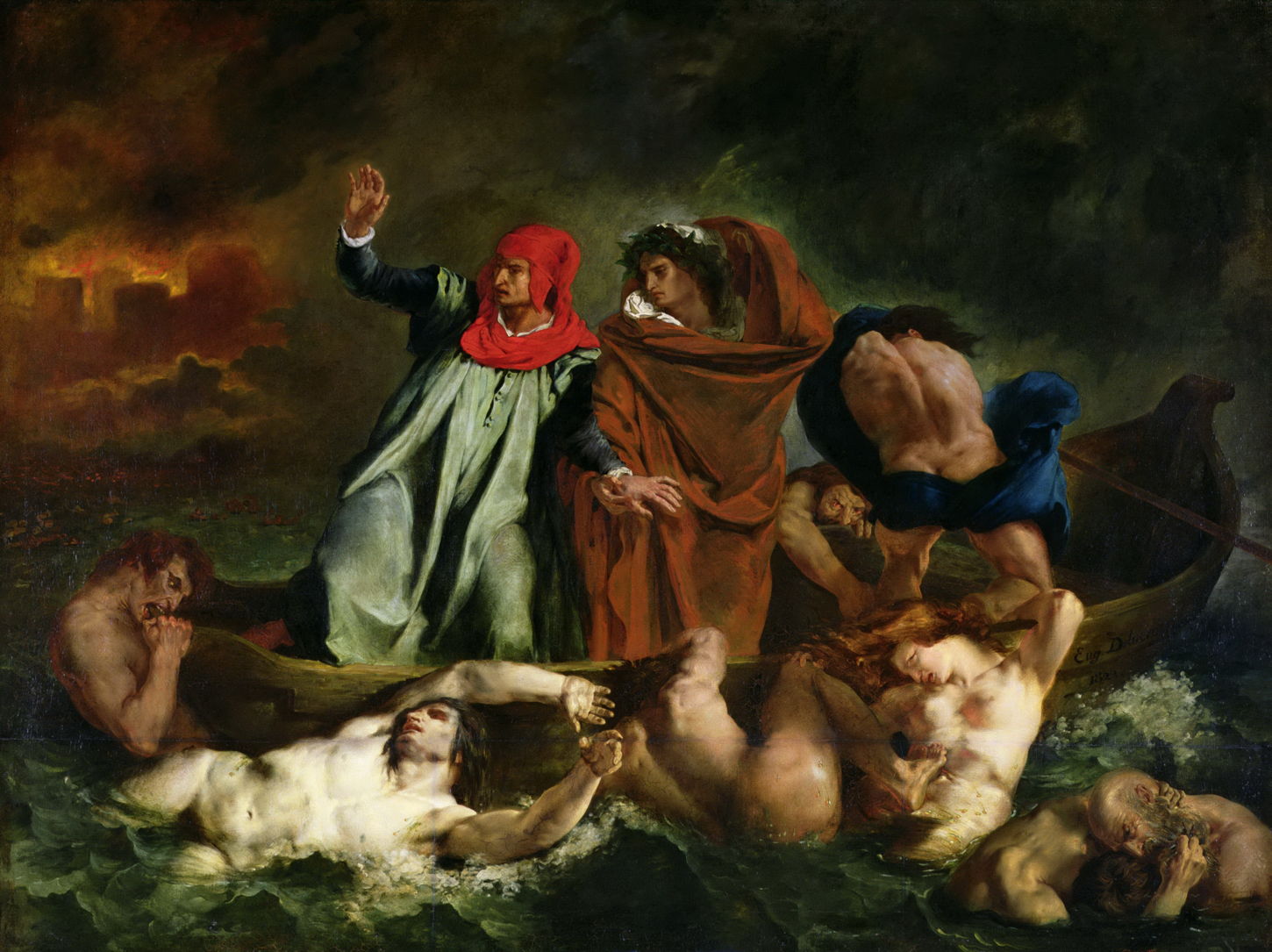
delacroixbarquedante
Eugène Delacroix (1798–1863), The Barque of Dante (Dante and Virgil in Hell) (1822), oil on canvas, 189 x 241 cm, Musée du Louvre, Paris. Wikimedia Commons.

2 Abandon hope

They then cross the River Acheron in Charon’s ferryboat, and enter the First Circle of Limbo, a place of tranquil and calm. Here are the souls of those who led honourable lives before the Christian era, and others who never had the opportunity to follow Christ. These include the great classical writers: Homer, Horace the satirist, Ovid and Lucan. Together with Virgil, these five invite Dante himself to join them as the sixth among the ranks of great writers, in an ambitious piece of self-promotion.

3 In Limbo

Virgil leads Dante down to the Second Circle, for those guilty of the sin of lust.

blakeloverswhirlwind
William Blake (1757–1827), The Circle of the Lustful: Francesca da Rimini (The Whirlwind of Lovers) (c 1824), pen and watercolour over pencil, 36.8 x 52.2 cm, Birmingham Museums and Art Gallery, Birmingham, England. The Athenaeum.

Here the lustful are thrown around by vicious winds, and Dante hears the tragic story of Paolo and Francesca da Rimini, that inspired many fine paintings.

dorepaolofrancesca
Gustave Doré (1832–1883) Paolo and Francesca da Rimini (1863), oil on canvas, 280.7 x 194.3 cm, Private collection. Wikimedia Commons.

4 Paolo and Francesca

Passing the three-headed dog-monster Cerberus, Virgil takes Dante on to the Third Circle, full of gluttons wallowing in stinking mud, under a constant deluge of rain, sleet and snow. In the Fourth Circle, they see a mixture of the avaricious and prodigals pushing great boulders in opposite directions.

5 Cerberus and gluttony

blakestygianswamp
William Blake (1757–1827), The Stygian Lake, with the Ireful Sinners Fighting (Dante’s Inferno) (1824-27) pen, ink and watercolour over pencil, dimensions not known, National Gallery of Victoria, Melbourne, Australia. Wikimedia Commons.

The Fifth Circle holds the swamp of the River Styx, in which sullen spirits are submerged and the wrathful fight one another. Dante and Virgil cross this in a boat piloted by Phlegyas, who deposits them at the gate to the city of Dis, entrance to the lower parts of Hell. The gate is slammed shut on them, and requires a messenger from Heaven to let them through.

6 Money and anger

blakefarinata
William Blake (1757–1827), Farinata degli Uberti (Dante’s Inferno) (1824-27) media and dimensions not known, The British Museum, London. Wikimedia Commons.

Here Dante enters the Sixth Circle, for heretics who denied the soul’s immortality, among them the Florentine Farinata degli Uberti, who is imprisoned in a tomb. The pair are carried by Nessus the Centaur on to the Seventh Circle, for the violent.

7 Furies and heresy

blakesuicidetrees13
William Blake (1757–1827), The Wood of the Self-Murderers: The Harpies and the Suicides (Dante’s Inferno) (1824-27), graphite, ink and watercolour on paper, dimensions not known, National Gallery of Victoria, Melbourne, Australia. Wikimedia Commons.

These not only include tyrannical warriors like Attila the Hun, murderers and bandits, but those whose violence was directed at their own lives in suicide, who are trees in a wood and kept in perpetual pain by harpies feeding on them. The pair then cross a desert on which fire rains to torment the souls of blasphemers, sodomites, and usurers.

8 The Minotaur, killers and suicides

blakesymboliccoursehumanhistory
William Blake (1757–1827), The Symbolic Figure of the Course of Human History Described by Virgil (Dante’s Inferno) (1824-27), further details not known. Wikimedia Commons.

Dante learns of a statue of an old man on Mount Ida, on the island of Crete, whose tears form the rivers of Hell.

9 Violence against God

Virgil guides Dante onto the back of Geryon, formerly a king slain by Hercules and condemned to suffer in Hell for his fraud, who flies the pair on to the Eighth Circle, for the fraudulent. This is divided into a series of rottenpockets, depressions in which different types of fraudster are confined. They pass through the areas for pimps, flatterers, corrupt religious leaders, sorcerers, corrupt officials and hypocrites.

10 Fraud

blakepopenicholasiii
William Blake (1757–1827), The Simonist Pope (Dante’s Inferno) (1824-27), watercolour, 52.5 x 36.8 cm, The Tate Gallery, London. Wikimedia Commons.

Among the corrupt religious leaders or simonists is Pope Nicholas III, who had been shamelessly nepotistic.

kochthieves
Joseph Anton Koch (1768-1839), Thieves (1825-28), fresco, dimensions not known, Casa Massimo, Rome, Italy. Image by Sailko, via Wikimedia Commons.

The later rottenpockets contain thieves, those who gave fraudulent counsel, those who sowed discord, and falsifiers and imposters of various kinds. Thieves are attacked repeatedly by snakes to undergo their own reptilian transformation.

11 Bribery, hypocrisy, theft

bouguereaudantevirgil
William-Adolphe Bouguereau (1825–1905), Dante and Virgil In Hell (1850), oil on canvas, 280.5 x 225.3 cm, Musée d’Orsay, Paris. Wikimedia Commons.

Among these many cheats and frauds are those who fight one another, and sink their teeth into flesh.

12 Fraud and inciting division

Dante and Virgil are lowered into the Ninth Circle by Antaeus, one of the giants who stand guard around its periphery.

doredantevergil
Gustave Doré (1832–1883), Dante and Virgil in the ninth circle of hell (1861), oil on canvas, 311 x 428 cm, Musée de Brou, Bourg-en-Bresse, France. Wikimedia Commons.

There is the lake of Cocytus, in which those guilty of treachery are frozen and suffering for eternity. These include souls of those who were treacherous against their relatives, their homeland, guests and benefactors.

13 Treachery

Blake, William, 1757-1827; Ugolino and His Sons in Prison
William Blake (1757–1827), Count Ugolino and His Sons in Prison (c 1826), pen, tempera and gold on panel, 32.7 x 43 cm, Fitzwilliam Museum, University of Cambridge, Cambridge, England. The Athenaeum.

Among them is Count Ugolino, who sinks his teeth into the neck of Archbishop Ruggieri, who left him to starve to death in a cell.

14 Count Ugolino

Finally, Dante and Virgil see Lucifer himself, before leaving Hell.

15 Lucifer himself

kochinfernostudy
Joseph Anton Koch (1768-1839), Hell (study for Casa Massimo frescoes) (c 1825), watercolour and gouche, dimensions and location not known. Wikimedia Commons.

The artists

William Blake (1757–1827) was a British visionary painter and illustrator whose last and incomplete work was an illustrated edition of the Divine Comedy for the painter John Linnell. Most of his works shown in this series were created for that, although he did draw and paint scenes during his earlier career. I have a major series on his work here.

Sandro Botticelli (1445–1510) was one of the leading painters of the early Southern Renaissance, working in his native city of Florence. In addition to his huge egg tempera masterpieces of i (c 1482) and The Birth of Venus (c 1485), he was a lifelong fan of Dante’s writings. He produced drawings which were engraved for the first printed edition of the Divine Comedy in 1481, but these weren’t successful, most copies only having two or three of the 19 which were engraved. He later began a manuscript illustrated edition on parchment, but few pages were ever fully illuminated.

William-Adolphe Bouguereau (1825–1905) was a precocious and highly-acclaimed academic painter who dominated the Salon in the late nineteenth century with his figurative works, often drawn from mythology. Classically-trained at the École des Beaux-Arts, he grew infamous for his nudes painted against false settings, and his vehement opposition to Impressionism. However, he taught at the Académie Julian, and worked tirelessly even when his paintings fell from favour.

Jean-Baptiste Camille Corot (1796–1875) was French, and one of the most prolific and greatest European landscape artists of the nineteenth century, who was key to the development of Impressionism. Following in the classical tradition, he also painted several narrative works set in those landscapes.

Eugène Delacroix (1798–1863) was a major French painter whose Romantic and painterly style laid the groundwork for the Impressionists. In addition to many fine easel works, he painted murals and was an accomplished lithographer too. Many of his paintings are narrative, and among the most famous is Liberty Leading the People from 1830. This article introduces a series featuring his major works.

Gustave Doré (1832–1883) was the leading French illustrator of the nineteenth century, whose paintings are still relatively unknown. Early in his career, he produced a complete set of seventy illustrations for translations of the Inferno, first published in 1857 and still being used. These were followed in 1867 by more illustrations for Purgatorio and Paradiso. This article looks at his paintings.

Joseph Anton Koch (1768-1839) was an Austrian landscape painter, who worked mainly in Neoclassical style. During his second stay in Rome, he was commissioned to paint frescos in the Villa Massimi on the walls of the Dante Room there, which remain one of the most florid visual accounts of Dante’s Inferno. He completed those between 1824-29. He also appears to have drawn a set of illustrations for Dante’s Inferno in about 1808.

Purgatory and Paradise

Although Heaven and Hell have clear biblical roots, the concept of Purgatory as part of the Christian life after death is more recent. It originated in the early Christian Church, flourished in the Middle Ages, and ripened only in the Catholic Church after the schism of Protestants in the Reformation during the sixteenth century. It can be seen as a route to Heaven for those who had sinned on earth, so long as they had confessed and repented.

Dante had much greater freedom in imagining what Purgatory might be, and adopted a physical structure that is the exact inverse of his vision of Hell: a mountain rising through seven terraces to culminate in a terrestrial paradise at the summit. Each terrace then accommodates a class of sin, rising from pride at the foot to lust just below Paradise.

The least-known of the three books in Dante’s Divine Comedy, Paradise was its most important to contemporary readers. Having given gruesome detail of what would await them in Inferno, and the penance they would have to pay in Purgatory, Paradise must be everyone’s ultimate aspiration. Dante invokes classical cosmology in nine concentric shells rather than the simple physical structures of the two previous realms, which for many readers is more nebulous.

References

Wikipedia
Danteworlds

Robin Kirkpatrick (trans) (2012) Dante, The Divine Comedy, Inferno, Purgatorio, Paradiso, Penguin Classics. ISBN 978 0 141 19749 4.
Richard Lansing (ed) (2000) The Dante Encyclopedia, Routledge. ISBN 978 0 415 87611 7.
Guy P Raffa (2009) The Complete Danteworlds, A Reader’s Guide to the Divine Comedy, Chicago UP. ISBN 978 0 2267 0270 4.
Prue Shaw (2014) Reading Dante, From Here to Eternity, Liveright. ISBN 978 1 63149 006 4.

The way of the Spartans 1

For all the untold number of paintings of classical myths, there are but a tiny number of works that strive to show historical events and scenes in the great classical civilisations. Even fewer of those show the most anomalous of the classical cultures, that of Sparta. Yet in recent years interest in Sparta, the Spartans, and their extreme way of life has risen, and is reflected in a wealth of modern imagery in graphic novels, movies, and computer games.

This weekend I look at some of the more significant paintings made of the Spartans prior to 1900.

Sparta was the capital of a city-state in ancient Greece, founded as a monarchy in about 930 BCE. The founder of its renowned warrior tradition was Lycurgus, who lived some time between 900-800 BCE and laid down much of the law and institutions of the Spartan state, although he refused to be its king.

delacroixlycurgusconsultingpythia
Eugène Delacroix (1798–1863), Lycurgus Consulting the Pythia (1835-45), oil on canvas, 32.8 x 41.2 cm, University of Michigan Museum of Art, Ann Arbor, MI. Wikimedia Commons.

Before Lycurgus implemented his reforms, he visited the Oracle at Delphi, who told him that the state which observed his laws would become the most famous in the world. Pythia, the high priestess at Delphi, is shown in Eugène Delacroix’s Lycurgus Consulting the Pythia (1835-45) listening intently to Lycurgus, before giving her prophesy.

Lycurgus was born into a Spartan family, and it’s most probable that he was the son of a reigning king of Sparta who lost his life when he was stabbed with a butcher’s knife as he intervened in a riot. Lycurgus’ older brother Polydectes inherited the throne, but died shortly afterwards.

Polydectes’ wife was pregnant at the time, so Lycurgus could only reign until that child was born: if a boy, then the child would succeed to the throne. After eight months of Lycurgus’ rule, a son Charilaüs was born, and Lycurgus proclaimed him king. To allay suspicion that he might try to usurp the authority of the new king, Lycurgus left Sparta and travelled. This gave him the opportunity to visit other kingdoms to learn of the strengths and weaknesses of the laws and institutions of Crete, the Ionians, and Egypt.

Lycurgus resolved to revolutionise Spartan society by introducing a completely new regime. He therefore visited the oracle at Delphi to discover whether his ideas were sound. The high priestess addressed Lycurgus as “beloved of the gods, and rather god than man”, and endorsed his proposals, that she said would be the best in the world.

His next task was to win over the senior Spartans, so they would be happy to implement his laws. Once he had convinced many of them, Lycurgus got thirty of them to go into the marketplace at dawn, and with their weapons to strike terror into those who opposed the proposals. King Charilaüs first fled to a refuge, then returned to give Lycurgus his support.

The changes made to Spartan law, institutions, and society were fundamental and extensive. Lycurgus established a Council of Elders with twenty-eight senators, to ensure that no king could become a tyrant, and the state couldn’t drift towards democracy. Land was redistributed uniformly and equally in lots: 30,000 in the surrounding countryside of Laconia, and 9,000 in the city of Sparta.

Lycurgus withdrew all gold and silver coinage, leaving only iron in circulation. He then devalued that currency, so that being rich in it would require a large store-room full of heavy iron coins. This forced equality in terms of money and possessions, and helped banish superfluous arts and trades, killing all luxury. To ensure a communal life for the good of society as a whole, he introduced common messing, so that Spartans all ate in large groups, on a simple but healthy diet.

Wealthy Spartans grew incensed with these changes, and started to stone Lycurgus, who was forced to flee from the marketplace. One young Spartan, Alcander, managed to blind him in one eye before he reached safety. Rather than have Alcander put to death, Lycurgus took him in as a servant and companion, so the young man became his most devoted follower, and convinced other opponents to support the reforms.

In his Lives, Plutarch provides considerable detail of the diet provided by these common messes, the fact that Spartan boys attended them, and there learned to withstand others jesting at them.

Lycurgus didn’t put these laws into writing, but established an educational system to instil them into future generations. Other unwritten laws included the requirement for all laws to remain unwritten, and the avoidance of extravagance in property, by the use of common building materials and standards.

vaneverdingenlycurgus
Caesar van Everdingen (1616/1617–1678), Lycurgus Demonstrates the Benefits of Education (1660-62), oil on canvas, 167 x 219 cm, Stedelijk Museum Alkmaar, Alkmaar, The Netherlands. Wikimedia Commons.

The narrative in Caesar van Everdingen’s Lycurgus Demonstrates the Benefits of Education from 1660-62 doesn’t appear to relate directly to Plutarch’s text, but shows a young Lycurgus with a couple of young Spartan men, their hair cropped short.

The new laws also regulated marriages and births. As Spartan men were away on military expeditions much of the time, Lycurgus gave their wives sole control when their husbands were away, and the title of Mistress. He ensured that unmarried Spartan women kept healthy, by prescribing that they too undertook running, wrestling, throwing the discus, and the javelin.

Spartan society appears to have been distinctive, perhaps unique, among the many small states of ancient Greece for its dedication to a single product: the perfect (male) warrior. From cradle to grave, males were reared, educated, trained, and worked for the single task of fighting the state’s enemies.

Because Spartan women had the crucial role of producing infant warriors, and of keeping the state going while their menfolk were away for long periods training and fighting, they were highly valued in those roles. They were even encouraged to acquire supporting skills, that enabled two Spartan women to become victors in the Ancient Olympic Games. Lycurgus urged young Spartan girls to engage in wrestling, presumably so that they could defend the homeland when their menfolk were absent.

The process of turning a male baby into an adult warrior is known as agoge, and is detailed in this fascinating Wikipedia article.

eckersbergthreespartanboys
Christoffer Wilhelm Eckersberg (1783–1853), Three Spartan Boys Practising Archery (1812), oil on canvas, 81 × 63.8 cm, Den Hirschsprungske Samling, Copenhagen, Denmark. Wikimedia Commons.

Christoffer Wilhelm Eckersberg’s Three Spartan Boys Practising Archery (1812) shows three young boys progressing through their training in basic military skills.

lebarbierspartanwomangivingshield
Jean-Jacques-François Le Barbier (1738–1826), A Spartan Woman Giving a Shield to Her Son (date not known), oil, further details not known. Wikimedia Commons.

Once old enough and sufficiently skilled, a young man would be given his shield by his mother, as shown in Jean-Jacques-François Le Barbier’s A Spartan Woman Giving a Shield to Her Son. The mother’s instructions would have been for her son to return either with his shield, or on it: he had to make a success of his training, or to die trying.

mussinieducationsparta
Cesare Mussini (1804-1879) (?), Education in Sparta (1850), oil, further details not known. Image by Pierre-Selim Huard, via Wikimedia Commons.

Education in Sparta (1850) was, I believe, painted by Cesare Mussini, or possibly his brother, and shows some of the less attractive aspects of the agoge, as one young man has clearly been overdoing the drink. There are also subtle allusions to the acceptance if not encouragement of pederastic relationships.

If this work is by Mussini, the quality of its paint layer should be superb, as Mussini used his own resin-based formulation for oil paints. These were so successful that he was able to sell the recipe to H Schmincke, whose company has continued to sell oil paints based on Mussini’s formulation ever since.

By far the most famous depiction of Spartans is a second attempt by Edgar Degas, Young Spartans Exercising from about 1860, now in the National Gallery in London.

degasyoungspartangirlschicago
Edgar Degas (1834–1917), Young Spartan Girls Challenging Boys (c 1860), oil on canvas, 97.4 x 140 cm, Art Institute of Chicago, Chicago, IL. The Athenaeum.

Degas’ first attempt, Young Spartan Girls Challenging Boys (c 1860), shown above, was abandoned, but gives insight into the second.

Four Spartan girls taunt six Spartan boys in front of a substantial building. Around that building is a group of Spartan women, presumably mothers of the boys and girls in the foreground, who are talking with Lycurgus. Behind that building is the city of Sparta, and in the distance to the left, behind the girls, is Mount Taygetus, where unfit Spartan babies were abandoned to see if they survived and merited life. Degas may at this stage have wanted to make the visual association between the girls, who would in due course become mothers, and the mountain where some of their infants would have to be abandoned.

degasyoungspartansfogg
Edgar Degas (1834–1917), Young Spartans Exercising (1860), oil on board, dimensions not known, Fogg Museum of Art, Harvard University, Cambridge, MA. The Athenaeum.

Young Spartans Exercising (1860) appears to be an oil study for his second version of this painting, adopting Degas’ revised composition.

degasyoungspartansexercising
Edgar Degas (1834–1917), Young Spartans Exercising (c 1860), oil on canvas, 109.5 x 155 cm, The National Gallery (Bought, Courtauld Fund, 1924), London. Image courtesy of and © The National Gallery.

Young Spartans Exercising (c 1860) was Degas’ most complete second version, which he listed for display at the Fifth Impressionist Exhibition in 1880, but doesn’t appear to have been shown there.

One of the boys, whose head is just visible in the first version, has been removed, but the two groups otherwise remain similar to the first version. The building in the middle distance has been removed to open the view out, and as a result the group of mothers with Lycurgus appears less prominent and more distant. The whole image has been stretched along its horizontal axis, moving Mount Taygetus to the left of the group of girls.

Degas had undoubtedly read Plutarch’s life of Lycurgus, including the passage:
He freed them from softness and delicacy and all effeminacy by accustoming the maidens no less than the youths to wear tunics only in processions, and at certain festivals to dance and sing when the young men were present as spectators. There they sometimes even mocked and railed good-naturedly at any youth who had misbehaved himself; and again they would sing the praises of those who had shown themselves worthy, and so inspire the young men with great ambition and ardour. For he who was thus extolled for his valour and held in honour among the maidens, went away exalted by their praises; while the sting of their playful raillery was no less sharp than that of serious admonitions, especially as the kings and senators, together with the rest of the citizens, were all present at the spectacle.

Degas continued to work sporadically on this painting, leaving it unfinished when he died. The artist never explained his intention, nor did he provide any clues as to how this painting should be read. Modern readings characteristically concentrate on gender contrasts and conflict, but all too often ignore its background, both visually and in historical context.

Marriages became open, in allowing both husband and wife to have relations with the partners of others. Sons were considered not to be ‘owned’ by their fathers, but by the state itself. Newborn infants were taken to a place called Lesche, where they were examined by elders, who decided whether the child was healthy and sturdy. If it was, it was assigned one of the 9,000 plots of land, and reared by its parents. Babies deemed frail or ill-formed were abandoned at Apothetae, a chasm at the foot of Mount Taygetus, to die.

The examination by elders at Lesche is the subject of two little-known paintings that appear to have a common origin. The first, claimed to be by Jacques-Louis David and titled Lycurgus of Sparta (1791), shows this process taking place, with a queue of young parents. A newly-born infant is being presented to the elders for their verdict, perhaps with Lycurgus acting as the organiser.

davidlycurgusofsparta
Jacques-Louis David (1748–1825), Lycurgus of Sparta (1791), oil on canvas, dimensions not known, Musée des Beaux-Arts, Blois, France. Wikimedia Commons.
lebarbiermagnanimitylycurgus
Jean-Jacques-François Le Barbier (1738–1826), The Magnanimity of Lycurgus (1791), oil on canvas, 131 x 170.9 cm, location not known. Wikimedia Commons.

This painting by Jean-Jacques-François Le Barbier is titled The Magnanimity of Lycurgus and was apparently made in the same year of 1791. All its key elements correspond to those in the David, as if one artist partly copied the other.

Plutarch provides lengthy details of the rearing and education of Spartan children, and the effects on Spartan culture. These he summarises thus:
[Lycurgus] trained his fellow-citizens to have neither the wish nor the ability to live for themselves; but like bees they were to make themselves always integral parts of the whole community, clustering together about their leader, almost beside themselves with enthusiasm and noble ambition, and to belong wholly to their country.

Reading Visual Art: 231 Tiger

In Europe, tigers were best known from the Bengal tiger of the Indian subcontinent, although there were also Caspian tigers in Turkey until they became extinct in the 1970s. As the latter had bright rust-red fur with brown stripes, it should be possible to distinguish them, but I haven’t seen any matching that description in European paintings.

In mythology, tigers are most commonly associated with Bacchus/Dionysus, whose chariot they draw, although there’s considerable variation in the species depicted.

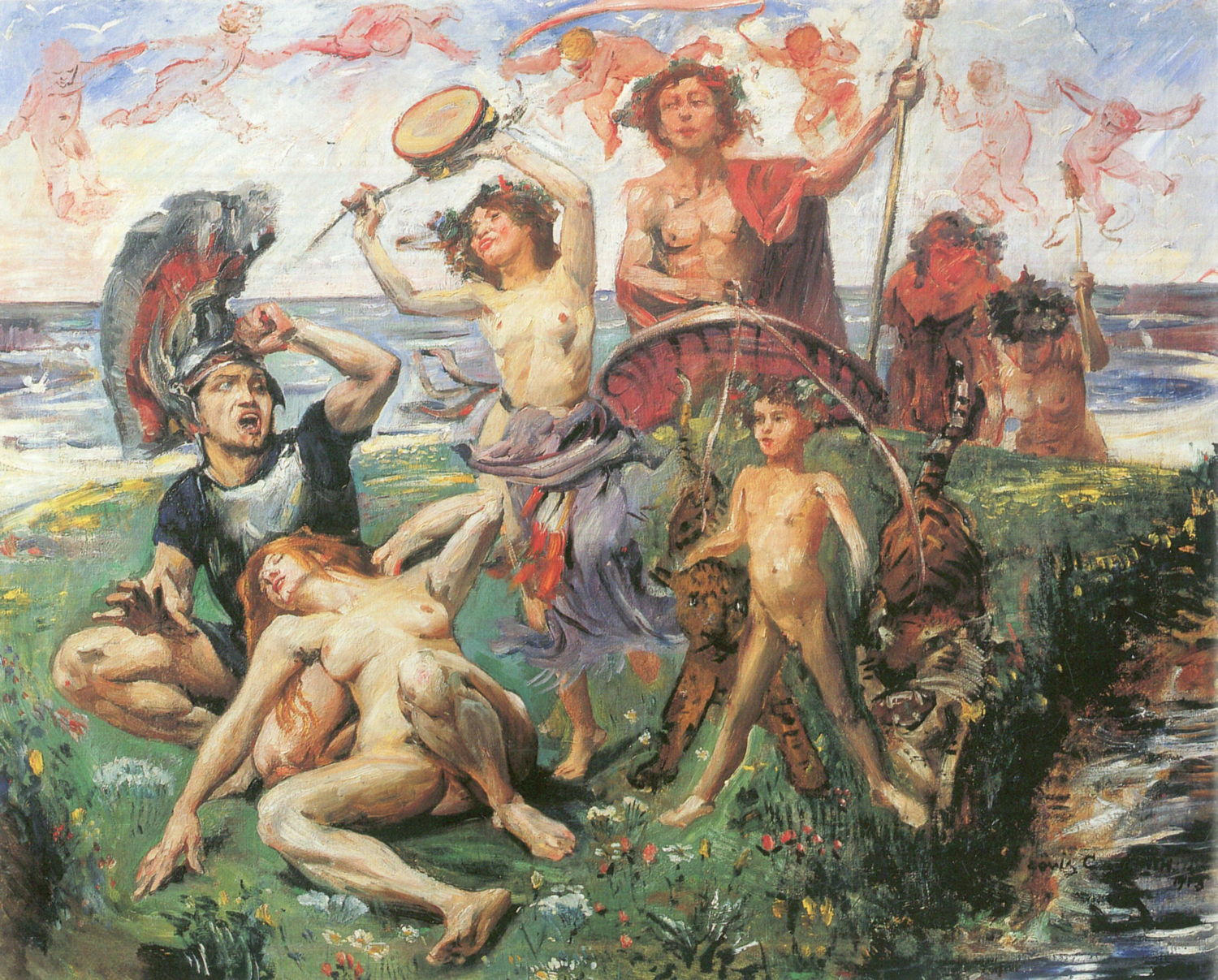
corinthariadnenaxos
Lovis Corinth (1858–1925) Ariadne on Naxos (1913), oil on canvas, 116 × 147 cm, Private collection. Wikimedia Commons.

Ariadne on Naxos (1913) is one of Lovis Corinth’s most sophisticated mythical paintings, and was inspired by the first version of Richard Strauss’s opera Ariadne auf Naxos, rather than any classical account.

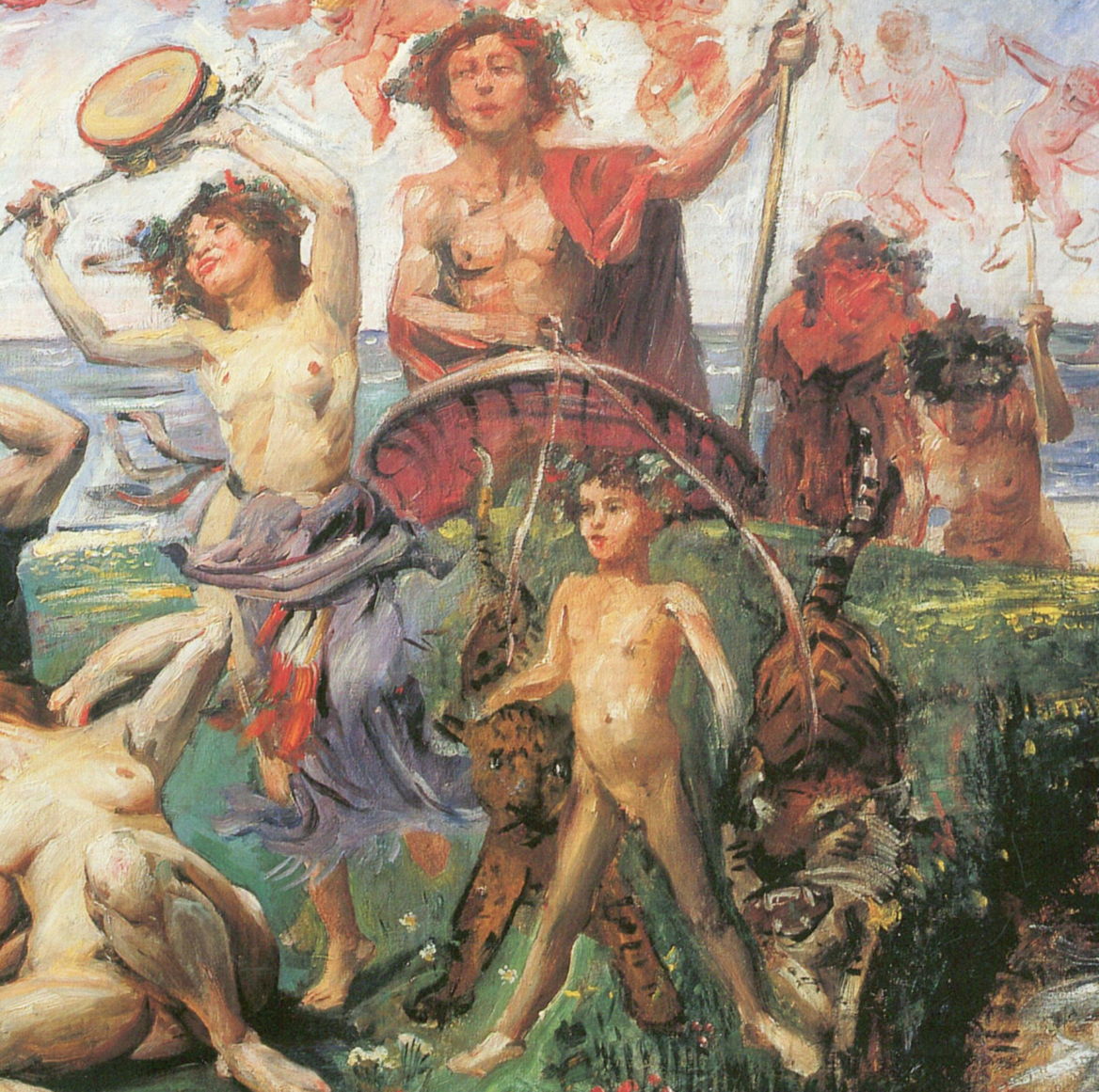
corinthariadnenaxosdet2
Lovis Corinth (1858–1925) Ariadne on Naxos (detail) (1913), oil on canvas, 116 × 147 cm, Private collection. Wikimedia Commons.

The group in the middle and right is centred on Dionysus, who clutches his characteristic staff in his left hand, and with his right hand holds the reins to the leopard and tiger drawing his chariot. Leading those animals is a small boy, and to the left of the chariot is a young bacchante.

Tigers also feature with other species of large cat including lions in depictions of Christian martyrdom.

NGV114845
Briton Rivière (1840-1920), A Roman Holiday (1881), oil on canvas, 99.5 x 178.2 cm, National Gallery of Victoria, Melbourne, Australia. Wikimedia Commons.

I expect that Briton Rivière was well aware of the contemporary paintings of Gérôme showing scenes of gladiatorial combat and martyrdom in classical Rome. Those may have inspired his A Roman Holiday (1881), showing a wounded Christian inscribing a cross in the sand as a tiger lies dead by him, and another snarls behind.

Tigers became popular in zoos and other animal collections around Europe. When he was in Paris, one of Eugène Delacroix’s favourite activities was to visit the zoo at the city’s Jardin des Plantes and sketch the big cats there.

delacroixtigerpreparingspring
Eugène Delacroix (1798–1863), Tiger Preparing to Spring (c 1850), pastel on paper, 23 by 31 cm, location not known. Wikimedia Commons.

His pastel painting of a Tiger Preparing to Spring from about 1850 demonstrates his mastery of the medium.

rousseausurprised
Henri Rousseau (1844–1910), Tiger in a Tropical Storm (Surprised!) (1891), oil on canvas, 128.9 x 161.9 cm, National Gallery, London. Wikimedia Commons.

Henri Rousseau’s Tiger in a Tropical Storm (Surprised!) from 1891 is a fine portrait of a tiger moving through dense vegetation in torrential rain.

rubenstigerhunt
Peter Paul Rubens (1577–1640), The Tiger Hunt (c 1616), oil on canvas, 253 x 319 cm, Musée des Beaux-Arts, Rennes, France. Wikimedia Commons.

Peter Paul Rubens’ Tiger Hunt from about 1616 packs its canvas with hunters, their horses, and a collection of big cats, including two tigers, a lion and a leopard. A Samson-like figure in the left foreground is wrestling with the lion’s jaws, as one of the tigers buries its teeth into the left shoulder of the Moorish hunter in the centre.

rivieretigerhunt
Briton Rivière (1840–1920) (attr), Tiger Hunt (date not known), oil on canvas, 121 x 108 cm, location not known. Wikimedia Commons.

Colonial powers used elephants when hunting big game such as tigers in countries like India, as seen in this painting attributed to the animal specialist Briton Rivière, Tiger Hunt.

Those tigers that were killed had an unusual fate, as their skin became a prop for beautiful women.

godwarddolcefarniente1897
John William Godward (1861–1922), Dolce Far Niente (1897), oil on canvas, 77.4 x 127 cm, Private collection. Wikimedia Commons.

John William Godward’s Dolce Far Niente from 1897 adopts a classical Roman setting, with his model lying and doing sweet nothing on a tiger skin.

❌