Reading view

There are new articles available, click to refresh the page.

Fog on the Thames 1844-1899

One of the enduring memories of my childhood, spent partly in London, is walking in smog, then commonly known as a pea-souper. The combination of dense fog and smoke was so thick I could barely make out street lights, and the streets were for once almost empty, as vehicles could only proceed at walking pace.

This weekend I present a selection of paintings of mist, fog and maybe even a touch of smog on the River Thames, in and near London. Today’s paintings come from the pioneers of the nineteenth century, and tomorrow’s from the twentieth.

Many of JMW Turner’s greatest paintings take advantage of the optical effects of mist and fog. Being a Londoner, he must have experienced these all too frequently.

turnerrainsteamspeed
Joseph Mallord William Turner (1775-1851), Rain, Steam, and Speed – The Great Western Railway (1844), oil on canvas, 91 x 121.8 cm, The National Gallery (Turner Bequest, 1856), London. Courtesy of and © 2018 The National Gallery, London.

These peaked in Turner’s famous painting of a Great Western Railway train crossing the River Thames at Maidenhead: Rain, Steam, and Speed, exhibited at the Royal Academy in 1844. The whole image is fogbound and vague, and proved a precursor to the approach of the Impressionists after his death.

Claude Monet (1840–1926), The Thames below Westminster (1871), oil on canvas, 47 x 73 cm, The National Gallery, London. Wikimedia Commons.

Less than thirty years later, when he was taking refuge from the Franco-Prussian War, Claude Monet’s The Thames below Westminster (1871) is less Impressionist. Painted from the Embankment to the north of Westminster Bridge, near what is now Whitehall, the three towers to the south are almost superimposed, and aerial perspective is exaggerated by the mist. The river is bustling with small paddleboat steamers. In the foreground a pier under construction is shown almost in silhouette. Small waves and reflections on the river are indicated with coarse brushstrokes, suggesting this is a rapid and spontaneous work.

Winslow Homer, The Houses of Parliament (1881), watercolour on paper, 32.3 x 50.1 cm, Hirshhorn Museum and Sculpture Garden, Washington, DC. Wikimedia Commons.
Winslow Homer (1836–1910), The Houses of Parliament (1881), watercolour on paper, 32.3 x 50.1 cm, Hirshhorn Museum and Sculpture Garden, Washington, DC. Wikimedia Commons.

A decade later, The Houses of Parliament is Winslow Homer’s faithful representation of the Palace of Westminster when viewed from the opposite bank of the Thames, to the north (downstream) of the end of Westminster Bridge. The tide is high under the arches of Westminster Bridge, and small boats are on the river. This classic watercolour makes an interesting contrast with Monet’s later oil paintings I show tomorrow: Homer provides little more detail, the Palace being shown largely in silhouette, but works with the texture of the paper and careful choice of pigment to add granularity. He provides just sufficient visual cues to fine detail, in the lamps and people on Westminster Bridge, and in the boats, to make this a masterly watercolour.

bastienlepagethameslondon
Jules Bastien-Lepage (1848–1884), The Thames, London (1882), oil on canvas, 54 x 74.3 cm, Philadelphia Museum of Art, Philadelphia, PA. The Athenaeum.

The following year, Jules Bastien-Lepage paid a return visit to the city, when he painted The Thames, London. This view of industrial docklands further downstream maintains detail into the far distance, except where it’s affected by the smoky and hazy atmosphere typical of the city at that time. It was this section of the river that was also painted on several occasions by James Abbott McNeill Whistler.
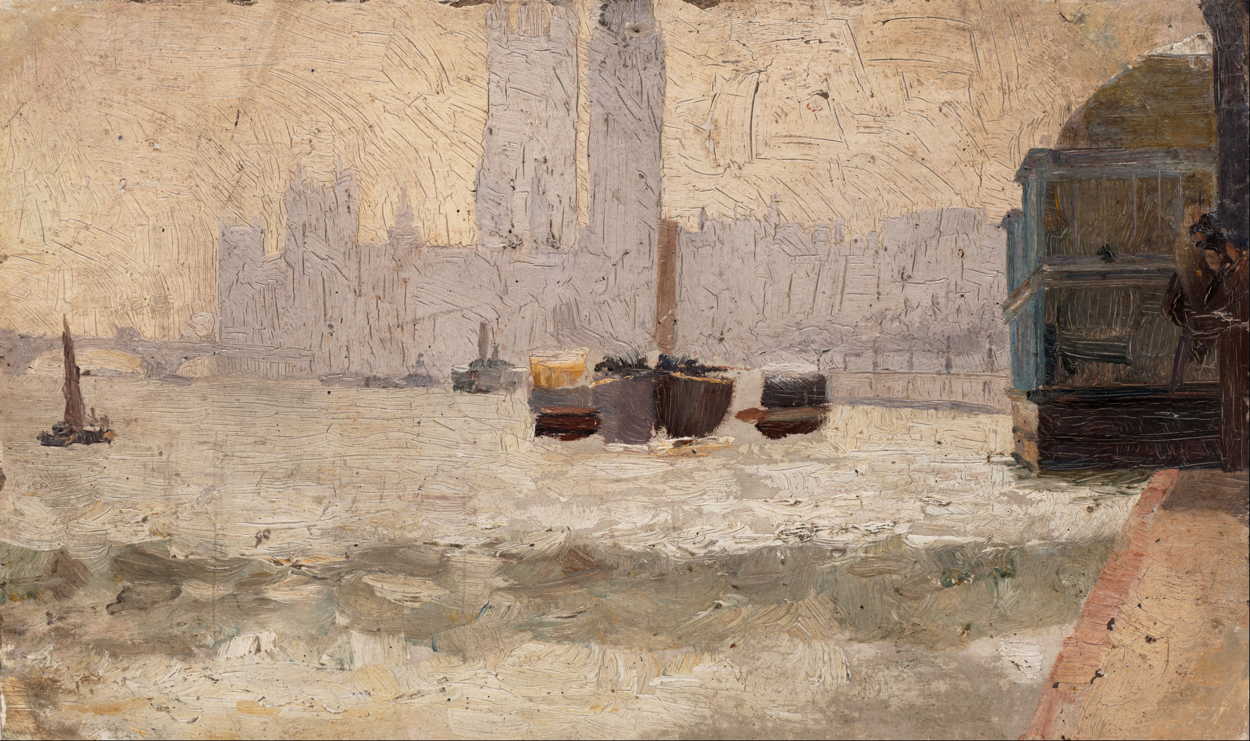
Tom Roberts, Fog, Thames Embankment (1884), oil on paperboard, 31.6 x 46 cm, Art Gallery of New South Wales, Sydney. Wikimedia Commons.
Tom Roberts (1856-1931), Fog, Thames Embankment (1884), oil on paperboard, 31.6 x 46 cm, Art Gallery of New South Wales, Sydney. Wikimedia Commons.

Tom Roberts’ Fog, Thames Embankment (1884) is painted from a similar location to Monet’s The Thames below Westminster above, on the Embankment to the north of Westminster Bridge, but is cropped more tightly, cutting off the tops of the Victoria and Elizabeth Towers. The Palace and first couple of arches of Westminster Bridge appear in misty silhouette, with moored barges and buildings on a pier shown closer and crisper. He renders the ruffled surface of the river with coarse brushstrokes, different from those of Monet.

A20754.jpg
Camille Pissarro (1830–1903), Charing Cross Bridge, London (1890), oil on canvas, 60 x 90 cm, National Gallery of Art, Washington, DC. Wikimedia Commons.

Among six paintings that Camille Pissarro started work on during his visit to England in 1890 was this view of Charing Cross Bridge, London from Waterloo Bridge. For this he made a sketch in front of the motif, then following his return to his studio in Éragny he painted this in oils. This looks south-west, towards a skyline broken by the Palace of Westminster and the familiar tower of Big Ben.

Frederick Childe Hassam, Houses of Parliament, Early Evening (1898), oil on canvas, 33 x 41.6 cm, Private collection. WikiArt.
Frederick Childe Hassam (1859-1935), Houses of Parliament, Early Evening (1898), oil on canvas, 33 x 41.6 cm, Private collection. WikiArt.

In Frederick Childe Hassam’s Houses of Parliament, Early Evening (1898), the sun has already set, and he is viewing the Palace in the gathering dusk from a point on the opposite (‘south’) bank, perhaps not as far south as Lambeth Palace. The Victoria Tower is prominent in the left of the painting, the Central Tower is in the centre, and the most distant Elizabeth Tower is distinctive with its illuminated clock face. Moored boats in the foreground provide the only other detail. His rough facture gives a textured surface to the water.

Louveciennes landscapes: After the war

With the Paris Commune crushed in 1871, and order being restored to France under the new Republic, the Pissarros returned to live a more settled life in Louveciennes again, after the shock of discovering that most of his 1500 or so paintings had been damaged or destroyed by occupying Prussian soldiers. There Pissarro lived close to Alfred Sisley, and the two often painted in company. Renoir’s mother also lived in the village, enabling the three painters to meet frequently.

Among Pissarro’s favourite motifs in this post-war period were numerous views of the Route de Saint-Germain and other roads around Louveciennes, and the River Seine at Bougival.

pissarrolouveciennesroutestgermain
Camille Pissarro (1830–1903), Louveciennes, Route de Saint-Germain (1871), watercolour over black chalk, 30.2 x 49.2 cm, J. Paul Getty Museum, Los Angeles, CA. Wikimedia Commons.

Less known are his watercolours, such as this view of Louveciennes, Route de Saint-Germain from 1871, and are reminiscent of the paintings of Johan Jongkind.

Camille Pissarro (1830-1903), Avenue in the Parc de Marly (c 1871), oil on canvas, 45 x 55 cm, Museo Thyssen-Bornemisza, Madrid. Wikimedia Commons.

Pissarro painted this woodland view of an Avenue in the Parc de Marly in the autumn of 1871. It looks towards the village of Marly-le-Roi from the Port du Phare, inside the grounds of the Château de Marly. His skilful use of staffage draws the eye towards the far end of the avenue. The artist seems to have sold this painting quite quickly to an unknown buyer, from whom Durand-Ruel bought it in early 1873.

sisleyseinebougival1872
Alfred Sisley (1839–1899), The Seine at Bougival (1872), oil on canvas, 50.8 x 65.5 cm, Yale University Art Gallery, New Haven, CT. Wikimedia Commons.

Alfred Sisley also painted here en plein air, as seen in The Seine at Bougival from 1872. The water surface is mirror-smooth, and Sisley has been careful to paint the reflection of the buildings with optical precision.

pissarrorouteversailleslouveciennessnow
Camille Pissarro (1830–1903), The Post-House, the Route de Versailles, Louveciennes, Effect of Snow (1872), oil on canvas, 55 x 91 cm, location not known. Wikimedia Commons.

This is Pissarro’s wintry scene of The Post-House, the Route de Versailles, Louveciennes, Effect of Snow from 1872. This looks from the ‘Royal Gate’ of the Château de Marly towards the post-house, a landmark featured in several of his works from this period. This painting was bought that Spring by Durand-Ruel, who sold it a year later to Jean-Baptiste Faure, the opera singer, Pissarro’s first collector and Sisley’s enduring patron.

pissarrochestnutslouveciennes
Camille Pissarro (1830–1903), Chestnut Grove at Louveciennes (1872), oil on canvas, 41.5 x 53.3 cm, Nelson-Atkins Museum of Art, Kansas City, MO. Wikimedia Commons.

Pissarro must have taken delight in the weird forms of the trees in this Chestnut Grove at Louveciennes, painted in 1872. In the far distance is the massive warm cream stone of Marly Aqueduct.

Although the Pissarros were able to live on the money generated by Camille’s painting, they must have got by in relative poverty. However, in 1872, he sold four stretched canvas overdoor panels depicting the seasons to the banker Achille Arosa for 100 Francs each. Pissarro tried to buy them back when they came up for auction in 1891, but despite appealing to Vincent van Gogh’s brother Theo, they were sold for just over a thousand Francs to the Bernheim-Jeune Gallery, and have remained in private collections since.

In April 1872, the Pissarros moved from Louveciennes to Pontoise, where they rented a house and Camille established his studio.

sisleysnowroadlouveciennes
Alfred Sisley (1839–1899), Snow on the Road, Louveciennes (1874), 38 × 56 cm, Private collection. Wikimedia Commons.

Sisley wasn’t as prolific as Pissarro in either ‘road’ or snow scenes. His Snow on the Road, Louveciennes (1874) clearly comes from the same school, but his trees and buildings remain distinctive.

sisleyaqueductmarly
Alfred Sisley (1839–1899), The Aqueduct at Marly (1874), oil on canvas, 54.3 x 81.3 cm, Toledo Museum of Art, Toledo, OH. Wikimedia Commons.

Sisley’s Aqueduct at Marly (1874) shows the massive form of this aqueduct which appeared in the distance in Pissarro’s Chestnut Grove at Louveciennes above. This and the nearby Machine de Marly, which Sisley also painted, were part of a monumental hydraulic network built in the 1680s for Louis XIV, to supply water to the Château de Marly and the royal gardens of the Palace at Versailles. The stone tower at the right end of the aqueduct is the Tour de Levant, used by Prussian troops as a vantage point for observing the besieged city of Paris, a point that won’t have escaped Sisley’s attention.

Alfred Sisley, Forge at Marly-le-Roi (1875), oil on canvas, 55 x 73.5 cm, Musée d'Orsay, Paris. EHN & DIJ Oakley.
Alfred Sisley (1839-1899), Forge at Marly-le-Roi (1875), oil on canvas, 55 x 73.5 cm, Musée d’Orsay, Paris. EHN & DIJ Oakley.

Sisley’s Forge at Marly-le-Roi from 1875 shows the village blacksmiths at work.

ropssundaybougival
Félicien Rops (1833–1898), Sunday in Bougival (1876), media and dimensions not known, Musée Provincial Félicien Rops, Namur, Belgium. Image by Paul Hermans, via Wikimedia Commons.

In 1876, Félicien Rops must have visited one of the popular bathing resorts nearby, to paint his Sunday in Bougival. This shows a lecherous old man watching two young women preparing to bathe there, a mere 15 km (10 miles) from the heart of Paris.

By this time, the Impressionists had moved away from Louveciennes, and were painting elsewhere.

64.154.2
Alfred Sisley (1839–1899), The Road from Versailles to Louveciennes (c 1879), oil on canvas, 45.7 x 55.9 cm, The Metropolitan Museum of Art, New York, NY. Wikimedia Commons.

Although Sisley was now living near Sèvres, he must have returned in about 1879 for one last painting in front of the motif, on The Road from Versailles to Louveciennes. This is an example of his more sketchy plein air paintings from his time at Sèvres, and a more traditional perspective view of a road of the time. This section of the road is close to Louveciennes, on the main route between Versailles and Saint-Germain-en-Laye.

At that point, the Impressionists finally left Élisabeth Louise Vigée Le Brun to rest in peace.

Louveciennes landscapes: Before the war

When the prolific portraitist in pastels Élisabeth Louise Vigée Le Brun retired to live near Paris, she chose a small hamlet to the west of the city, between the palace at Versailles and Saint-Germain-en-Laye, Louveciennes. She died there in 1842, and is buried in the graveyard not far from her house.

Twenty-seven years later it became the focus for a group of friends, who went on to become the core of the French Impressionists. For the next few years Louveciennes and the adjacent villages of Bougival and Marly-le-Roi were to appear in well over a hundred of their paintings, a few of which I show this weekend.

Just beyond Chatou, the River Seine sweeps to the right in a bend with a series of long islands with popular bathing houses, among them the famous La Grenouillère. In the summer of 1869, Auguste Renoir was living at his parents’ house in Louveciennes, just to the south of this bend, where Camille Pissarro and his family were renting a house. He visited Claude Monet and his family, who were living near Bougival, also on that bend, and they often painted together.

Some of the formative moments in Impressionism if not European art occurred when Monet and Renoir visited La Grenouillère.

renoirgrenouillerestock
Pierre-Auguste Renoir (1841–1919), La Grenouillère (1869), oil on canvas, 66.5 x 81 cm, Nationalmuseum, Stockholm, Sweden. Wikimedia Commons.

Renoir painted at least three different views of La Grenouillère that summer: that above is now in Stockholm, and that below, which is most similar to Monet’s, is in the Oskar Reinhart Collection in Switzerland; the third (not shown here) is in the Pushkin Museum in Moscow. Originally conceived as plein air sketches preparatory to more finished paintings for submission to the Salon the following year, they came to define these brilliant shimmering images formed from high chroma brushstrokes as Impressionist style.

renoirgrenouillerereinhart
Pierre-Auguste Renoir (1841–1919), La Grenouillère (1869), oil on canvas, 65.1 x 92 cm, Oskar Reinhart Collection, Winterthur, Switzerland. Wikimedia Commons.

If Impressionism has to have a single moment of birth, it’s surely in the summer of 1869 at La Grenouillère.

Claude Monet, Bathers at la Grenouillère (1869), oil on canvas, 73 x 92 cm, The National Gallery, London. WikiArt.

Monet’s Bathers at la Grenouillère is his early statement of his Impressionist agenda. The pair realised that Impressionism was about these sketched instants. This also reveals Monet’s preference for modern pigments, as most of the brighter mid-blues here use cobalt blue, introduced earlier in the nineteenth century.

Claude Monet, Bathers at la Grenouillère (detail) (1869), oil on canvas, 73 x 92 cm, The National Gallery, London. WikiArt.

In addition to Renoir, Pissarro and Monet, Alfred Sisley maintained a studio nearer the river in Bougival, where the four artists painted, starved and fought off despair together.

pissarroroadversailles1869
Camille Pissarro (1830–1903), Road to Versailles at Louveciennes (Snow Effect) (1869), oil on canvas, 38.4 × 46.3 cm, Walters Art Museum, Baltimore, MD. Wikimedia Commons.

Pissarro painted a succession of views of the roads around the village. His Road to Versailles at Louveciennes (Snow Effect) (1869) is typical of his earlier ‘road’ paintings, showing an avenue of tall, bare-branched trees, brushed in coarsely.

Camille Pissarro (1830-1903), Route de Versailles, Louveciennes, Winter Sun and Snow (c 1870), oil on canvas, 46 x 55.3 cm, Museo Thyssen-Bornemisza, Madrid. Wikimedia Commons.

The following winter his paintings concentrated on road scenes around Louveciennes, a theme which continued for many years, spanning the seasons.

Camille Pissarro (1830-1903), Winter Landscape at Louveciennes (c 1869), oil on canvas, 37 x 46 cm, Musée d'Orsay, Paris. EHN & DIJ Oakley.
Camille Pissarro (1830-1903), Winter Landscape at Louveciennes (c 1869), oil on canvas, 37 x 46 cm, Musée d’Orsay, Paris. EHN & DIJ Oakley.

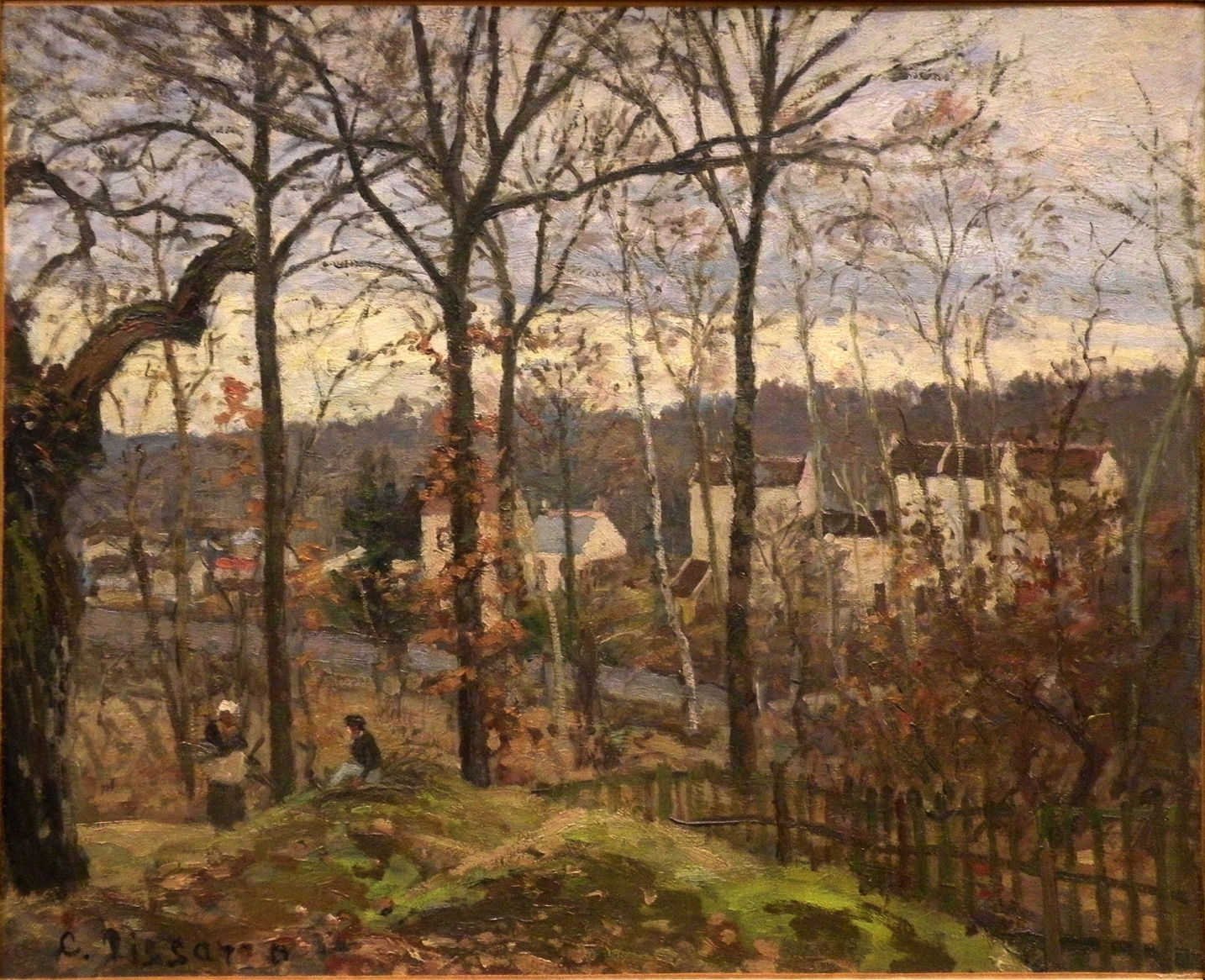
As many artists before him, Pissarro used trees to frame his motifs in repoussouir, but during the late 1860s they started to invade more central areas of the canvas. In about 1869, in his Winter Landscape at Louveciennes for the first time tree trunks and branches spread across his canvas, breaking up the motif behind into small sections.

pissarrohousesbougival
Camille Pissarro (1830–1903), Houses at Bougival, Autumn (1870), oil on canvas, 88.9 x 115.9 cm, J. Paul Getty Museum, Los Angeles, CA. Wikimedia Commons.

Pissarro’s Houses at Bougival, Autumn is clearly dated 1870, although by that time he had moved from Louveciennes. It is also thought to have been exhibited at the Salon that year, suggesting it may have been started in late 1869.

sisleyearlysnowlouveciennes
Alfred Sisley (1839–1899), Early Snow in Louveciennes (1870), oil on canvas, 54 x 73 cm, Museum of Fine Arts Boston, Boston, MA. Wikimedia Commons.

Like Pissarro, Sisley started depicting the streets of suburbs, including Early Snow in Louveciennes. This has been dated to 1870, although it appears more likely that it was painted en plein air late the previous year.

Following the outbreak of the Franco-Prussian War, in September 1870 the Pissarros’ house in Louveciennes was requisitioned by the invading Prussians. The family fled first to their friends in Montfoucault, then in December travelled on to England, where they settled in Norwood, at that time an outer suburb of London. When in England, Pissarro met Paul Durand-Ruel, who became his dealer, and Claude Monet, who had also fled to London.

Bougival was also overrun by Prussian soldiers, who commandeered Sisley’s studio; many of his early works were lost, as Pissarro’s were in Louveciennes, just over a mile away. The Sisleys were forced into the city of Paris, and despite Alfred’s British nationality, they remained trapped through the siege of the city into the following year. Worse still, the Sisley family business collapsed and his parents were in no position to support the artist.

❌