Museums and the consultants who advise them have been busy reviewing their own precautions in the aftermath of the brazen daylight break-in at the Louvre.
A member of the security staff at the Metropolitan Museum of Art. Experts say U.S. institutions are reviewing the Louvre heist to ensure they do not share similar vulnerabilities.
People who brought their blood glucose down to a normal level had a lower risk of death from heart disease or hospitalization for heart failure after 20 years.
As Gao Zhen awaits trial in China, his wife and child live in limbo, unable to return to America, sustained by the portraits he fashions from scraps of paper.
Jack Conte, the chief executive of Patreon, a platform for creators to monetize their art and content, outlines his vision for an internet that puts people, not ad revenues, first.
Making a highly successful career for yourself as a woman artist in the Renaissance was an extraordinary if not unique feat. It’s one of the many accomplishments of Sofonisba Anguissola (c 1532-1625), who also managed to survive the ravages of infectious disease, and died in her early nineties, four centuries ago today.
Even more unusually, she wasn’t born into an artistic family, but into minor nobility in Cremona, Lombardy, Italy. The oldest of Amilcare Anguissola’s seven children, the family claimed ancestry going back to ancient Carthage. Amilcare and his wife Bianca educated and encouraged their daughters to develop their abilities, resulting in four of their six girls becoming painters, but it was only Sofonisba who persisted long enough to make a career of her art.
When she was fourteen, Sofonisba went to study in Bernardino Campi’s workshop, then to Bernardino Gatti’s. She probably completed her training in about 1553, but by then was already painting outstanding works in oils.
Sofonisba Anguissola (1530–1625), Self-portrait with Bernardino Campi (1550), oil on canvas, 111 x 109.5 cm, Pinacoteca Nazionale, Sienna, Italy. Wikimedia Commons.
One of her earliest surviving paintings is also one of her most remarkable and ingenious, this Self-portrait with Bernardino Campi, painted in 1550 when she was just eighteen. This double portrait is fascinating in her depiction of two left hands on the portrait that Campi is shown working on: one reaches up to meet his right hand, holding a brush, and the other holds her own brushes.
Sofonisba Anguissola (1530–1625), The Chess Game (Portrait of the artist’s sisters playing chess) (1555), oil on canvas, 72 x 97 cm, Muzeum Narodowe w Poznaniu, Poznań, Poland. Wikimedia Commons.
Only five years later she transformed Renaissance portraiture with her superb The Chess Game (1555), showing her sisters playing chess, with their mother (probably) making an appearance at the right edge. Her sisters Lucia, Minerva and Europa are shown dressed in their finest, but the informality of their poses and expressions is striking, and innovative in portraits at that time. Her attention to detail in clothing and on the table is also notable, and perhaps more characteristic of the Northern Renaissance. Her other portraits are just as finely detailed.
Sofonisba Anguissola (1530–1625), Self-portrait (1554), oil on poplar wood, 19.5 × 12.5 cm, Kunsthistorisches Museum, Vienna, Austria. Wikimedia Commons.
In addition to painting her family, she also completed a series of self-portraits in her early career, including this Self-portrait from 1554, when she was twenty-two. The contrast with the fine dress and relaxed informality of her family portraits is interesting, and may reflect her almost austere devotion to her art.
Sofonisba Anguissola (1530–1625), Self-portrait at the Easel (1556), oil on canvas, 66 × 57 cm, Zamek Lubomirskich i Potockich w Łańcucie, Łańcut, Poland. Wikimedia Commons.
A couple of years later, Self-portrait at the Easel (1556) shows her working on an exquisite devotional painting which may have been of the Virgin and Child, showing the deep relationship between a mother and her infant, and another painting within a painting.
Sofonisba Anguissola (1530–1625), Self-portrait (date not known), oil on panel, diameter 13.2 cm, Private collection. Wikimedia Commons.
This small undated Self-portrait on a tondo is no more relaxed.
Sofonisba Anguissola (1530–1625), Portrait of the Artist’s Family (Portrait of Amilcare, Minerva, and Asdrubale Anguissola) (1557-58), oil, dimensions not known, Nivaagaards Malerisamling, Nivå, Denmark. Wikimedia Commons.
Her Portrait of the Artist’s Family of 1557-58 maintains her style of informality in poses, although its composition is more typical of the day. This shows her younger sister Minerva, father Amilcare, and young brother Asdrubale, with a fantasy landscape of classical ruins and the rising towers of distant castles, receding to a dramatic mountain.
She stayed in Rome in 1554, where she met Michelangelo and several other artists. Michelangelo seems to have mentored her for a while. She became an established portraitist, and in 1559 was invited by King Philip II of Spain to teach painting to his wife, the young Queen Elisabeth of Valois. Anguissola painted many important portraits while in Philip’s court, and prospered as a result.
Sofonisba Anguissola (1530–1625) (attr), Portrait of Prince Alessandro Farnese (1545-1592), later Duke of Parma and Piacenza (c 1560), oil on canvas, 107 × 79 cm, The National Gallery of Ireland / Gailearaí Náisiúnta na hÉireann, Dublin, Ireland. Wikimedia Commons.
This fine Portrait of Prince Alessandro Farnese from about 1560 has been attributed to her. The prince, who later became Duke of Parma and Piacenza, lived from 1545-1592, and this portrait conforms to more standard practice.
Sofonisba Anguissola (1530–1625), Portrait of Anna of Austria (1549-80) (1573), oil on canvas, 86 × 67.5 cm, Museo Nacional del Prado, Madrid. Wikimedia Commons.
Her Portrait of Anna of Austria of 1573 was one of her more important commissions. Anna (1549-1580) was the fourth wife of her uncle, King Philip II of Spain, and the daughter of the Holy Roman Emperor Maximilian II. She married the king in 1570 following the death of Queen Elisabeth of Valois, who had been Anguissola’s pupil. Among Anna’s other portrait painters was Giuseppe Arcimboldo, later famous for his unique ‘vegetable’ portraits.
Although she had married a noble in 1571, she continued to paint professionally, and the couple moved to Paternò, near Catania on the east coast of Sicily. Her first husband died eight years later, and in 1584 she married again, moving to Genoa.
Sofonisba Anguissola (1530–1625), Portrait of Julius Caesar Aged 14 (c 1586), oil on canvas, 186 × 115 cm, location not known. Wikimedia Commons.
This unusual Portrait of Julius Caesar Aged 14 from about 1586 shows, according to its inscription, the famous Roman emperor, who lived from 100-44 BCE. She has approached it as another of her informal portraits rather than as a history painting.
Sofonisba Anguissola (1530–1625), The Holy Family with Saints Anne and John the Baptist (1592), oil on canvas, dimensions not known, Lowe Art Museum, University of Miami, Coral Gables, FL. Wikimedia Commons.
Her religious paintings broke new ground in the intimacy with which she shows family scenes, as in The Holy Family with Saints Anne and John the Baptist (1592).
She taught and provided advice to other painters throughout her later career, and in 1624 was visited by the young Anthony van Dyck. Her sight was failing by that time, but she was still able to give him good advice. Finally, Anguissola moved to Palermo, where she died at the age of 92 or 93 in 1625. She had no children, but left a generation of artists who had benefitted from her innovation and influence. Among those directly inspired by her example and work was Lavinia Fontana. Over two centuries later, Ella Sophonisba Hergesheimer pursued her painting career bearing Anguissola’s name.
Tomorrow, 16 November, marks the four-hundredth anniversary of the death of one of the first great women painters, Sofonisba Anguissola. In preparation, this article looks at four of those who followed in her brushstrokes, and succeeded in a world so dominated by men.
Lavinia Fontana was a precocious painter in the late sixteenth century, the only child of the successful artist Prospero Fontana. With no son to take the family workshop on, it was a relief to her father that she showed strong artistic ability at an early age; so early that by the time she was thirteen, she may have been generating much of the family’s income.
Lavinia Fontana (1552–1614), Portrait of a Newborn in a Cradle (c 1583), oil on canvas, dimensions not known, Pinacoteca Nazionale di Bologna, Bologna, Italy. The Athenaeum.
Her paintings provide unusual insights into contemporary family life, as in her Portrait of a Newborn in a Cradle (c 1583). This is clearly a child of a rich family, wearing a string of pearls in their ornate crib.
Lavinia Fontana (1552–1614), Judith and Holofernes (date not known), oil on canvas, 175.9 x 134.1 cm, location not known. Wikimedia Commons.
Fontana set a tradition that successful women painters should make several works showing Judith with the Head of Holofernes. This version, from 1600, avoids gore and puts the severed head discreetly in half-light, while Judith brandishes the sword with pride, and her maid appears delighted. Her use of rich colours and chiaroscuro were advanced for painting in Bologna at the time.
Her workshop in Bologna was successful and prosperous, but ultimate recognition came in 1603, when Pope Clement VIII invited her to move to Rome. She quickly acquired powerful patronage, painted a portrait of Pope Paul V and became his court portraitist, and was even awarded a bronze medallion made for her by Casone in 1611.
Lavinia Fontana (1552–1614), Portrait of Bianca degli Utili Maselli with six of her children (1604-5), oil on canvas, 99.1 × 133.4 cm, location not known. Wikimedia Commons.
When in Rome, she painted this remarkable family Portrait of Bianca degli Utili Maselli with six of her children (1604-5), showing this wife who died within a year of its completion, five of her sons, and her daughter Verginia. As in many of her portraits, the lapdog was a sign of fidelity, and her depiction of clothing exquisite.
Fontana died in Rome in 1614, leaving the largest oeuvre of any woman painter prior to 1700. Unlike the few who had gone before her, she had succeeded at the highest level in a range of different genres, including mythology, religious works (with some large-scale altarpieces), and portraiture.
While she was painting for the Pope in Rome, in northern Europe still life painting was developing rapidly, thanks to the quiet brilliance of Clara Peeters. We don’t even know when she was born, but she seems to have trained in Antwerp, then pursued her career successfully in the Dutch Republic to the north. She’s thought to have been internationally successful by 1611, when at least four of her paintings were sold to Spain. Her last reliably dated works are from 1621, although there are a few attributed to her from later. No one knows whether she stopped painting when she married, or when she died.
Clara Peeters (fl 1607-1621), Still Life of Fish and a Candlestick (1611), oil on panel, 50 x 72 cm, Museo Nacional del Prado, Madrid. Wikimedia Commons.
Her Still Life of Fish and a Candlestick is one of the earliest and most accomplished paintings of the fruits de mer, which were to find favour with William Merritt Chase nearly three centuries later.
Clara Peeters (fl 1607-1621), Still Life with Flowers and Gold Cups of Honour (1612), oil on oak, 59.5 x 49 cm, Staatliche Kunsthalle Karlsruhe, Karlsruhe, Germany. Wikimedia Commons.
The following year, her still life with Flowers and Gold Cups of Honour (1612) reveals multiple miniature self-portraits reflected in the gold cup at the right. These are shown more clearly in the detail below.
Clara Peeters (fl 1607-1621), Still Life with Flowers and Gold Cups of Honour (detail) (1612), oil on oak, 59.5 x 49 cm, Staatliche Kunsthalle Karlsruhe, Karlsruhe, Germany. Wikimedia Commons.
Her short career overlapped with that of the most famous of all the early women painters, Artemisia Gentileschi. She was the eldest child of the renowned Tuscan painter Orazio Gentileschi, learned to draw at an early age, and soon worked in her father’s workshop. Her father was strongly influenced by the work and friendship of Caravaggio, which in turn was an early influence on Artemisia.
She was taught by Agostino Tassi, when he was working with her father on murals in a palace in Rome, when Artemisia was already painting her own works in oils. Tassi raped Artemisia, and continued to have sexual relations with her in the expectation that they would marry. Her father pressed charges against Tassi, who was eventually convicted after a long trial that was profoundly traumatic physically, mentally, and emotionally for Artemisia.
Her father arranged for her marriage to a modest Florentine painter, and the couple moved to Florence where she started receiving commissions. They worked there between 1614 and 1620, when she became the first woman ever to be accepted into the Accademia delle Arti del Disegno. She enjoyed good relationships with other prominent artists and intellectuals, including Galileo Galilei. In 1618 the only one of her four children to survive into adult life was born, Prudentia, who also became a painter. However, in 1621 she separated from her husband and moved back to Rome. This didn’t prove a success, so she moved to Venice, and on to Naples in 1630.
Artemisia Gentileschi (1593–1653), Susanna and the Elders (1610), oil on canvas, 170 x 119 cm, Schloss Weißenstein, Pommersfelden, Germany. Wikimedia Commons.
Her first painting of Susanna and the Elders from 1610 remains her best-known, and with Tintoretto’s is one of its canonical depictions. Gone are the decorations, symbols, and diversions of earlier artists, in favour of a close-up of the three actors at the crucial moment that the elders tell Susanna of their ‘generous offer’. They’re as thick as thieves, one whispering into the ear of the other, who holds his left hand to his mouth as he commits his crime. Susanna is naked, distressed, and her arms are trying to fend the elders off. Her face tells of her pain and refusal to succumb to their blackmail.
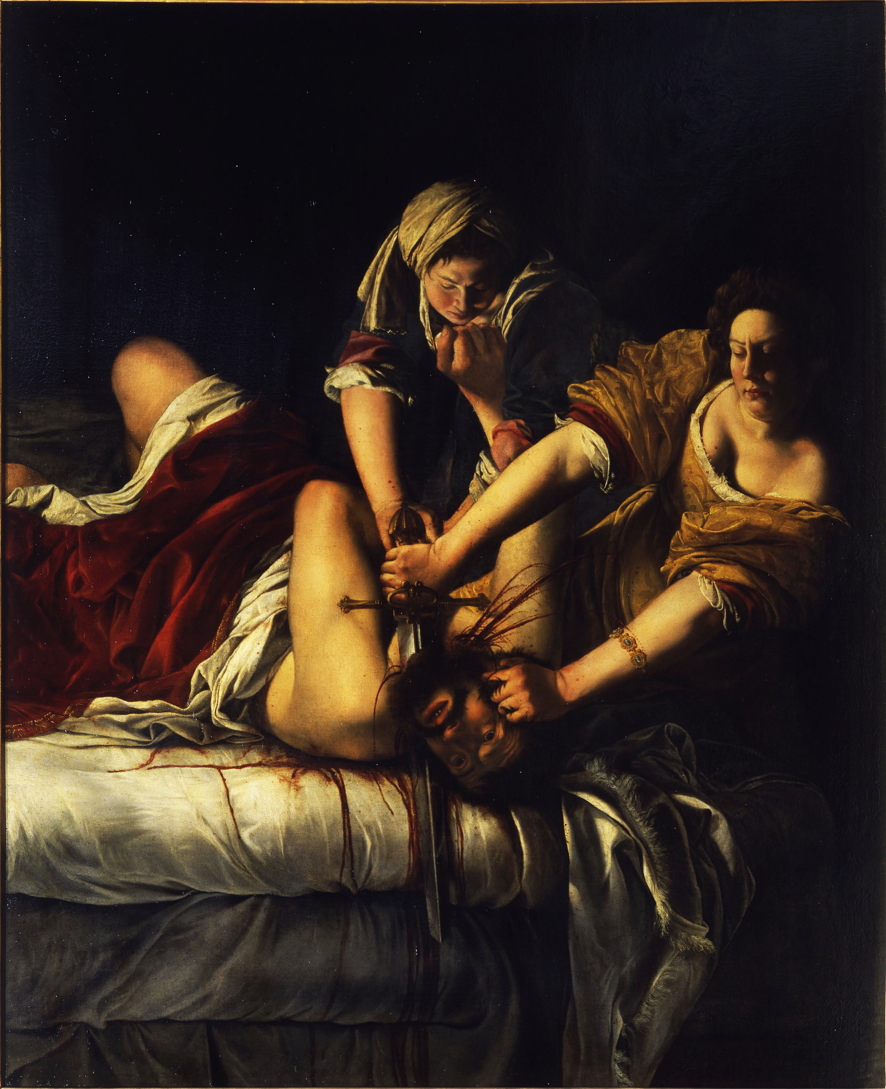
She is most famous for her paintings of Judith Slaying Holofernes, her first version being painted at about the same time as her rape and Tassi’s subsequent trial. It’s generally believed that Tassi was the model for Holofernes, she cast herself as Judith, and a female companion who failed to come to her aid during the rape (and failed to give evidence in her support at the trial) was the maid. It would therefore be natural to interpret this painting as part of her very understandable response to her own traumatic events.
Artemisia Gentileschi (c 1593-1656), Judith Slaying Holofernes (1620-1), oil on canvas, 200 x 162.5 cm, Galleria della Uffizi, Florence. Wikimedia Commons.
Her second version, painted in 1620-21 and now in the Uffizi in Florence, is similar in most respects, although the view isn’t as tightly cropped on the three figures, so that it shows Holofernes’ legs and a deep red wrap around his lower body. The lower section of the blade is also executed better. Judith’s face shows intense concentration and effort, both arms thrust out straight in front of her. The left grips Holofernes by the hair, the right pushes the blade onwards. Her maid is seen holding Holofernes down, pushing hard with both her arms out straight too. Holofernes’s right hand seems to be pushing the maid back, but his left arm is folded over his body.
Artemisia Gentileschi (c 1593-1656), Allegory of Painting (c 1638-9), oil on canvas, 98.6 x 75.2 cm, The Queen’s Collection, England. Wikimedia Commons.
There’s more uncertainty as to whether her brilliant painting of the Allegory of Painting (c 1638-9) is a self-portrait. This striking angle of view can be accounted for if this was a self-portrait composed using two mirrors, one placed above and on the left of the painter, the other directly in front of her, where she is gazing so intently. If so, it was particularly ingenious because the reflection in the second mirror would have normal chirality (left and right would not be reversed).
However, it has been suggested that this isn’t a self-portrait, in which case her choice of view would have been most unusual. It’s believed to have been painted during her stay in London, possibly for King Charles I, as it appears to have passed straight into the Royal Collection, where it has remained ever since.
Returning to Italy, my last great woman painter is Elisabetta Sirani, oldest child of the Bolognese painter Giovanni Andrea Sirani (1610–1670), who had been a pupil of Guido Reni (1575–1642). She was running the family workshop by the time she was only seventeen. Her success was meteoric until she collapsed and died suddenly in August 1665, aged twenty-seven, and has since lapsed into obscurity.
Elisabetta Sirani (1638–1665), The Penitent Magdalene (date not known), oil on canvas, dimensions not known, Musée des Beaux-Arts, Besançon, France. Wikimedia Commons.
Her Penitent Magdalene is a powerful painting using a wide tonal scale to heighten its emotive effect.
Elisabetta Sirani (1638–1665), Portia Wounding her Thigh (1664), oil on canvas, 101 × 138 cm, Collezioni d’Arte e di Storia della Fondazione della Cassa di Risparmio, Bologna, Italy. Wikimedia Commons.
Her Portia Wounding her Thigh (1664) refers not to the Portia of Shakespeare’s play The Merchant of Venice, but to Portia or Porcia Catonis, wife of Marcus Junius Brutus, one of Julius Caesar’s assassins in 44 BCE.
Getting wind of the plot to murder Caesar, Portia asked Brutus what was wrong. He didn’t answer, fearing that she might reveal any secret under torture. She therefore inflicted wounds to her thigh using a barber’s knife to see if she could endure the pain. As she overcame the pain of her wounds, she declared to Brutus that she had found that her body could keep silence, and implored him to tell her. When he saw her wounds, Brutus confided all in her.
By August 1665 Sirani had completed nearly 200 paintings, many fine drawings, and various prints. She died so suddenly that it was at first suspected that she might have been murdered, but it transpired that she had suffered fulminating peritonitis as the result of a burst peptic ulcer.
In tomorrow’s article I will look at the life and work of their forerunner, Sofonisba Anguissola.
At an international conference, researchers at the forefront of animal-human transplantation compared notes and allowed themselves the first real optimism in decades.
President Trump has made it easier for countries that are close to Russia and China to build ties with the United States. Those countries are embracing the opportunity.
By the early 1860s, the large and ancient Forest of Fontainebleau, to the south-east of Paris, had been attracting those of the Barbizon School, who painted realist landscapes in front of the motif. The next generation started visiting in 1865, and went on to form the French Impressionists.
Frédéric Bazille (1841–1870), Landscape at Chailly (1865), oil on canvas, 81 x 100.3 cm, The Art Institute of Chicago, Chicago, IL. Wikimedia Commons.
In May 1865, the young Frédéric Bazille left the city of Paris for the Forest of Fontainebleau, where he painted Landscape at Chailly (1865) in company with Claude Monet, and possibly Auguste Renoir and Alfred Sisley. Although clearly influenced by the Barbizon School, his colours are much brighter, and escape the rather sombre browns and greens that dominated much of the work of that earlier art.
Alfred Sisley (1839–1899), Avenue of Chestnut Trees in La Celle-Saint-Cloud (1865), oil on canvas, 125 x 205 cm, Petit Palais, Paris. Wikimedia Commons.
Sisley painted this Avenue of Chestnut Trees in La Celle-Saint-Cloud to the west of the forest in 1865, again in Barbizon style. He didn’t submit it to the Salon until 1867, when it was refused. It then remained unsold for ten years before being bought by Sisley’s patron Jean-Baptiste Faure, a celebrated opera singer.
The following year, Sisley walked through the forest with Renoir. He then stayed in the village of Marlotte, where Renoir, Monet, Bazille, Pissarro and Cézanne also visited to paint.
Alfred Sisley (1839–1899), Women Going to the Woods (1866), oil on canvas, 65.2 x 92.2 cm, Bridgestone Museum of Art ブリヂストン美術館, Tokyo, Japan. Wikimedia Commons.
Sisley was more successful with Women Going to the Woods, completed in 1866. This was one of his two paintings exhibited at the Salon that year, and shows the main street in the village of Marlotte with a little rustic staffage.
Pierre-Auguste Renoir (1841–1919), Clearing in the Woods (1865), oil on canvas, 57.2 x 82.6 cm, Detroit Institute of Arts, Detroit, MI. Wikimedia Commons.
Clearing in the Woods (1865) is Renoir’s first substantial (surviving) landscape painting, and shows strong influence from Corot. He adopts quite a detailed realist style in this view of a clearing in the midst of massive chestnut trees. These are believed to be near the small village of La Celle-St-Cloud, to the west of Paris not far from Bougival, rather than in the forest. It’s likely that he painted there in the company of Alfred Sisley, who made two views of the same site in very different style.
Pierre-Auguste Renoir (1841–1919), Jules Le Coeur and his Dogs in the Forest of Fontainebleau (1866), oil on canvas, 112 x 90 cm, Museu de Arte de São Paulo (MASP), São Paulo, Brazil. Wikimedia Commons.
The following year Renoir painted his friend Jules Le Coeur and his Dogs in the Forest of Fontainebleau. This is unusual among his works, as it was preceded by two studies, and all three were made using the palette knife rather than brushes. This makes it most likely to have been painted before Renoir abandoned the knife and returned to the brush, by the middle of May 1866.
Abbott Handerson Thayer (1849–1921), Landscape at Fontainebleau Forest (c 1876), oil on cardboard, 54.6 x 45.7 cm, Private collection. Wikimedia Commons.
The following year Abbott Handerson Thayer, an American artist who trained in Paris, painted this wonderful oil sketch of Landscape at Fontainebleau Forest (c 1876). This is probably the loosest and most Impressionist painting of his career.
Henri Rouart (1834–1912), In Fontainebleau Forest (date not known), oil on canvas, 59.5 x 73.2 cm, Private collection. Wikimedia Commons.
At some time in the late nineteenth century, the wealthy industrialist, amateur painter and patron of Impressionism, Henri Rouart painted In Fontainebleau Forest. This may have been inspired by Corot, but is a realist study in light, shade, and the texture of bark.
John Ferguson Weir (1841-1926), Forest of Fontainebleau (c 1902), oil on canvas, 48.9 x 61 cm, Private collection. The Athenaeum.
John Ferguson Weir was another American painter who had trained in Paris, and became the first director of the School of Fine Arts at Yale University. He visited in about 1902, when he painted Forest of Fontainebleau (c 1902), with its tiny solitary figure against the fallen trunk.
In 1867 Théodore Rousseau died in the village of Barbizon, and he was followed in 1875 by Jean-François Millet. By the twentieth century the forest had fallen out of favour with the new generation.
我参与 3DFiti 这个艺术项目,旨在通过 3D 扫描和 3D 打印技术,使我们生活的周边环境增加一些趣味性和艺术性。在人类学家项飙(英国牛津大学社会人类学教授,德国马克斯普朗克社会人类学研究所所长)所描述的那个「附近」的概念之中延展出来,一切我可以到达的地方,只要有我感兴趣的公共区域内的「缺损」部分,就有可能成为这个艺术项目的创作对象。
我通过 iPhone 扫描空间或者物体,并对模型进行二次创作,使用 3D 打印技术将其制作成一件真实的物品,即能够与现场的「缺损」相嵌合的物件,使这个「缺损」转化为一处临时的微型艺术场所。
No.001 作品中的 紫竹观音像 3D 模型,是来自 Funes.world 的文件。他们的工作是在人类从原子社会进入到比特社会的过程中,将原本属于原子世界中的建筑、空间、故事,通过 3D 扫描建模的方式,将其保存在数字世界中,建成一座人类文明的数字空间博物馆。

 Login
Login