
 Login
LoginThe Annunciation imaged 1430-1680
The Annunciation to the Virgin Mary is traditionally celebrated nine calendar months before the feast of Christmas, on 25 March. This marks the Gospel account of the angel Gabriel appearing to Mary and telling her that she will become the mother of Jesus Christ, so marking the first step leading to the Nativity. This weekend I show some of the finest paintings of the Annunciation in preparation for the celebration of Christmas next week. Today’s are drawn from the period from the Renaissance to the seventeenth century, then tomorrow leaps forward to the nineteenth and early twentieth centuries.
As one of the most popular themes for Catholic religious paintings, the majority follow a standard formula, which becomes rather repetitive. The Archangel Gabriel is shown with an astonished young Mary, accompanied by symbols of her purity such as white lily flowers, and sometimes a white dove representing the Holy Spirit.
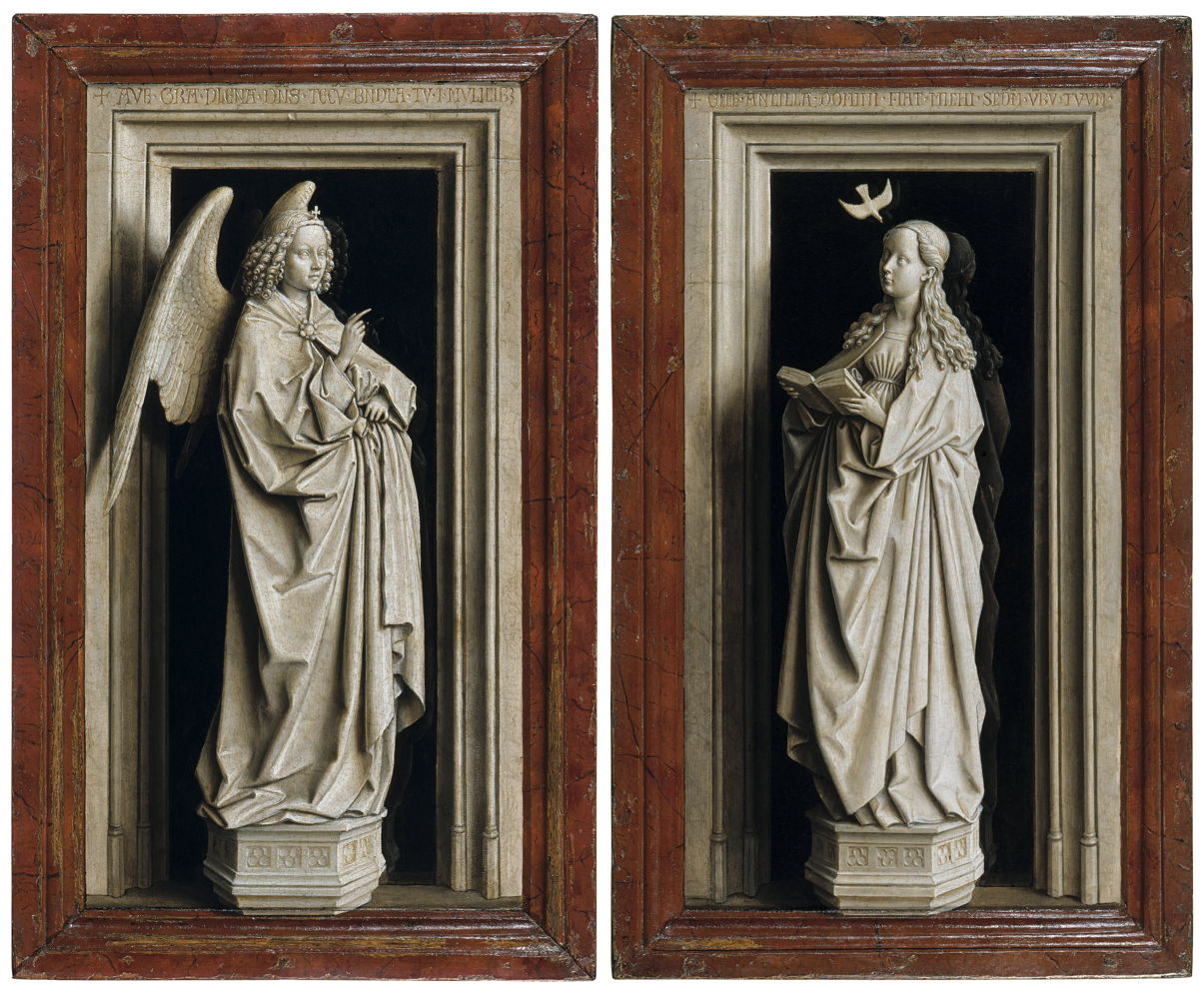
In the early Renaissance, before the stereotype could set in, there was greater innovation. For example, in about 1433-35 Jan van Eyck developed a monochrome grisaille into this brilliant trompe l’oeil, pretending to be a pair of sculpture figures in stone with wooden frames.

This Annunciation, painted in oil and tempera on a poplar panel, is generally agreed to be one of the earliest of Leonardo da Vinci’s own surviving paintings. When it was painted is in greater doubt, but a suggestion of around 1473-75 seems most appropriate. It shows his teacher Verrocchio’s influence, coupled with the less confident hand of a new master.
There are numerous pentimenti, particularly in the head of the Virgin. Its perspective projection is marked in scores in its ground. Nevertheless, Leonardo used his spontaneous and characteristic technique of finger-painting in some of its passages. Its composition and execution are conventional and conform to those seen in the output of Verrocchio’s workshop, complete with finicky detail throughout.

As is conventional, the Virgin Mary is sat reading her book, shown in detail down to lines of its text. The lectern is draped in a diaphanous fabric similar to the wraps seen in Verrocchio’s Madonnas.
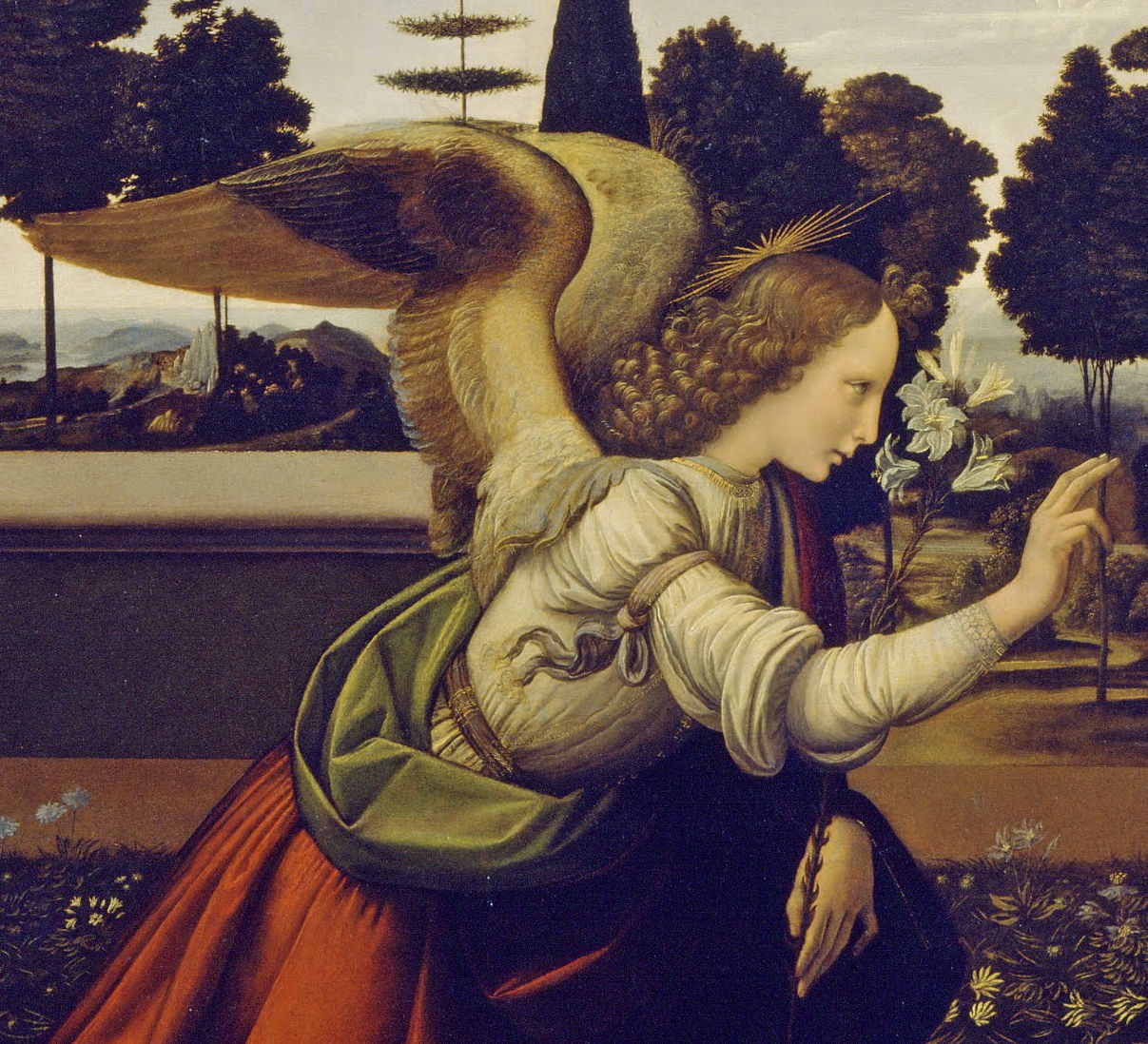
The Archangel Gabriel is seen in profile, holding the usual white lily, and the details of his clothing, the flowers, and surrounds are all painted meticulously.
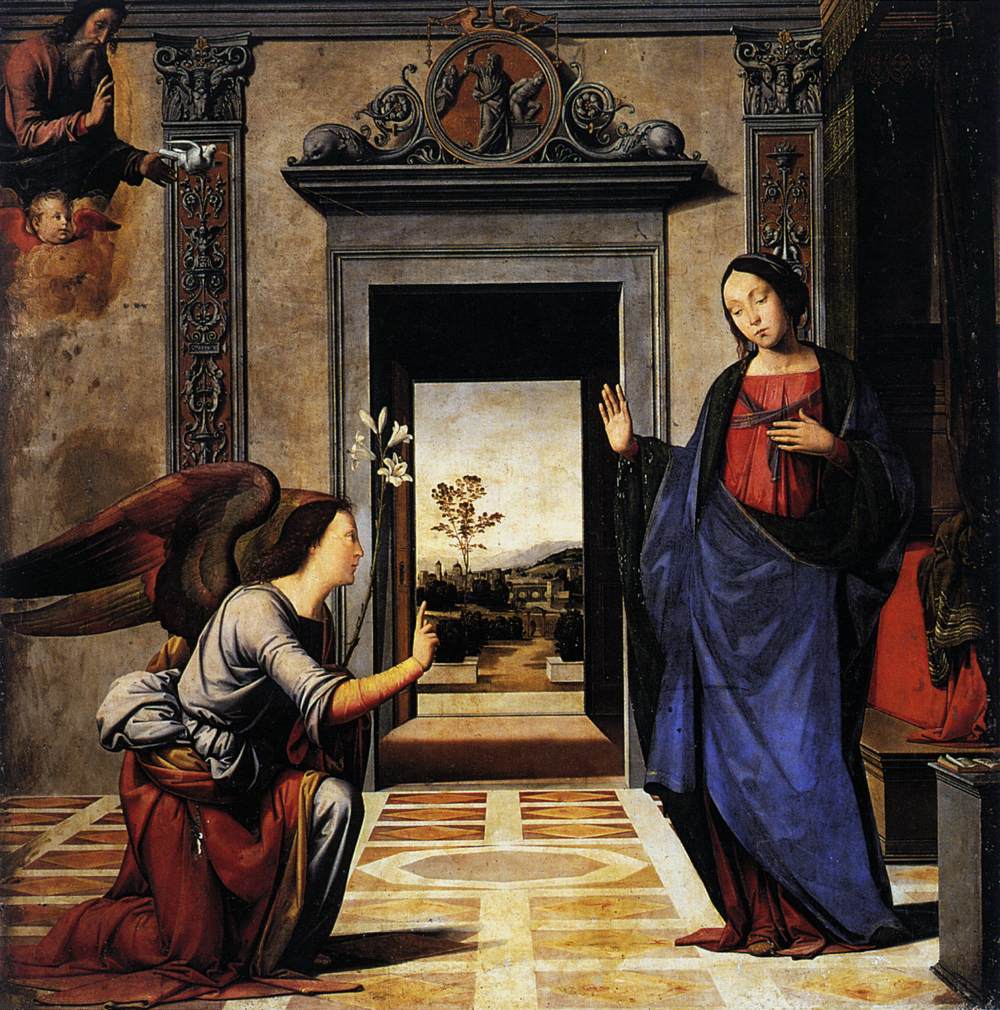
The Annunciation (1497) is visibly one of Fra Bartolomeo’s earliest works, showing the Virgin Mary at the right being told by the angel Gabriel, at the left, that she would conceive Jesus Christ. Bartolomeo’s modelling of flesh is here unsophisticated, but the folds of garments are more advanced, as is his cameo landscape, suggesting influence from the Northern Renaissance. His perspective projection, shown in the floor patterning and the doorways, doesn’t quite resolve to a single vanishing point.

In about 1510 Gerard David painted this diptych of The Annunciation in a style developed from the popular grisailles of the time. At the left is the Archangel Gabriel, with the Virgin Mary on the right. Instead of constraining himself to a true grisaille, David uses colours sparingly to enhance the effect.
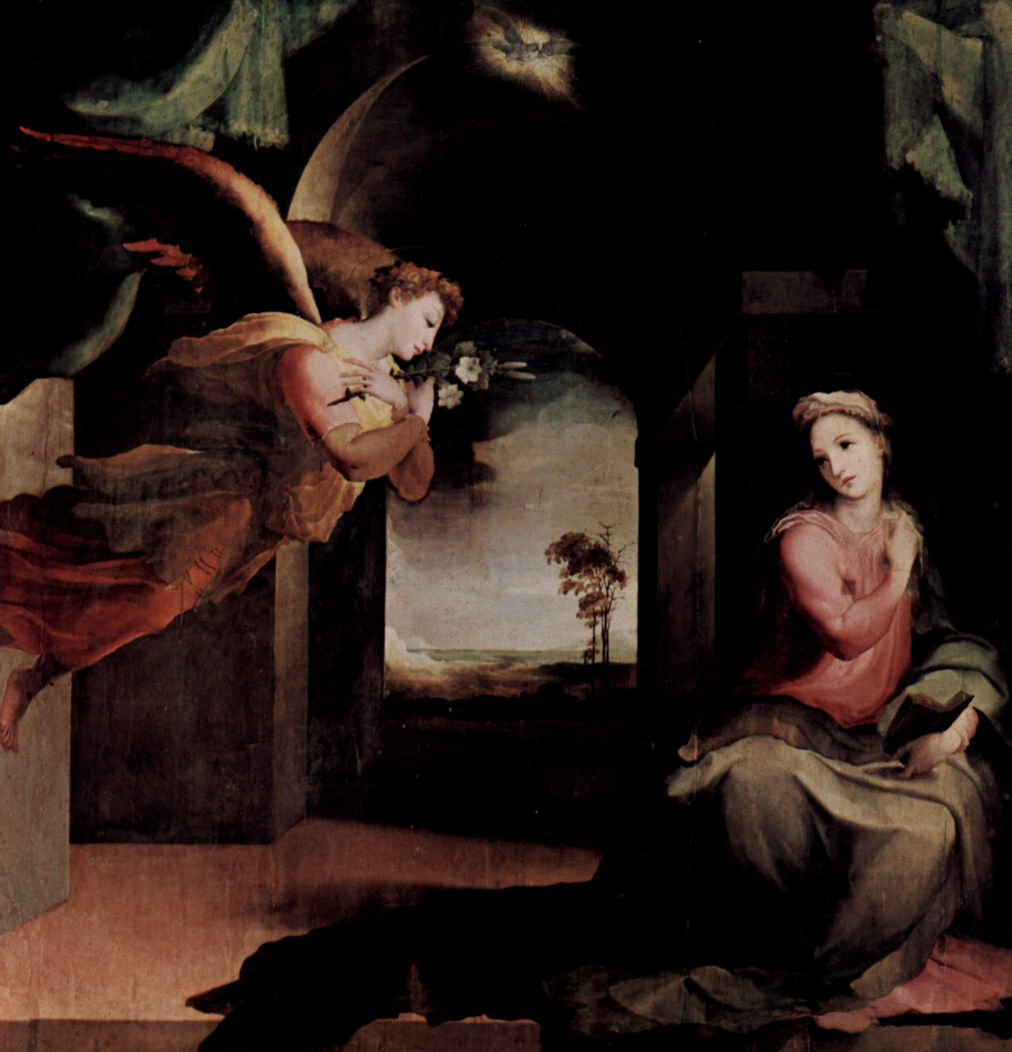
About thirty-five years later, Beccafumi used the extreme contrast of chiaroscuro to heighten the effect of his painting, anticipating the vogue that was to come some fifty years later in the work of Caravaggio and his followers.
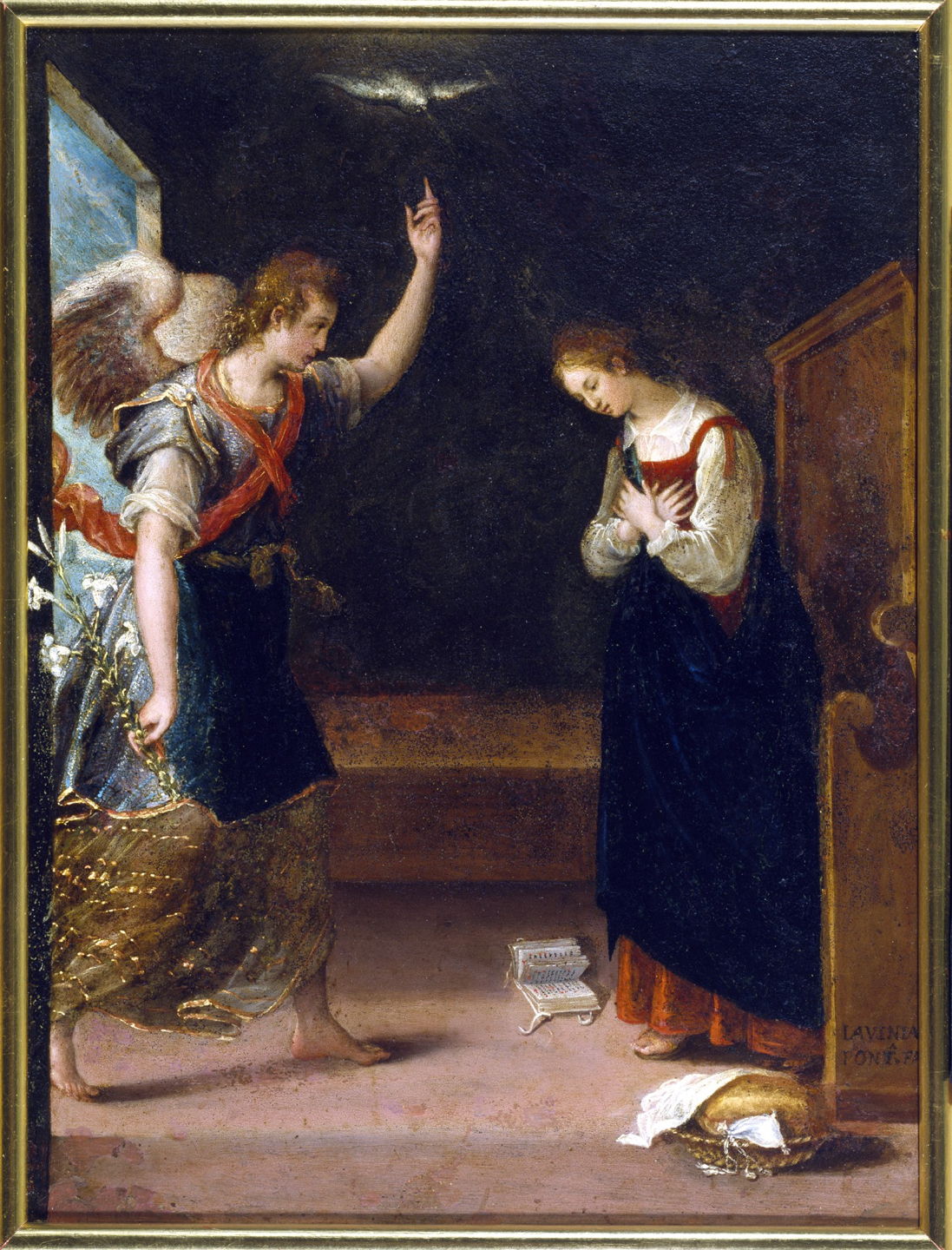
Several of Lavinia Fontana’s early paintings, including The Annunciation (c 1575), were made using oil on copper, an expensive and technically challenging support implying that they had already been commissioned by the more wealthy. This is a naturalistic depiction with the white dove symbolising the Holy Spirit, and traditional floral attributes.

Jacopo Tintoretto turned quite social-realist in this version from about 1582, with its unusually natural rendering of contemporary brickwork, a wicker chair, and a splendidly detailed carpenter’s yard at the left. This shows Christ’s origins as very real, tangible, and contemporary, a concept that didn’t reappear for over two centuries, as we’ll see tomorrow.
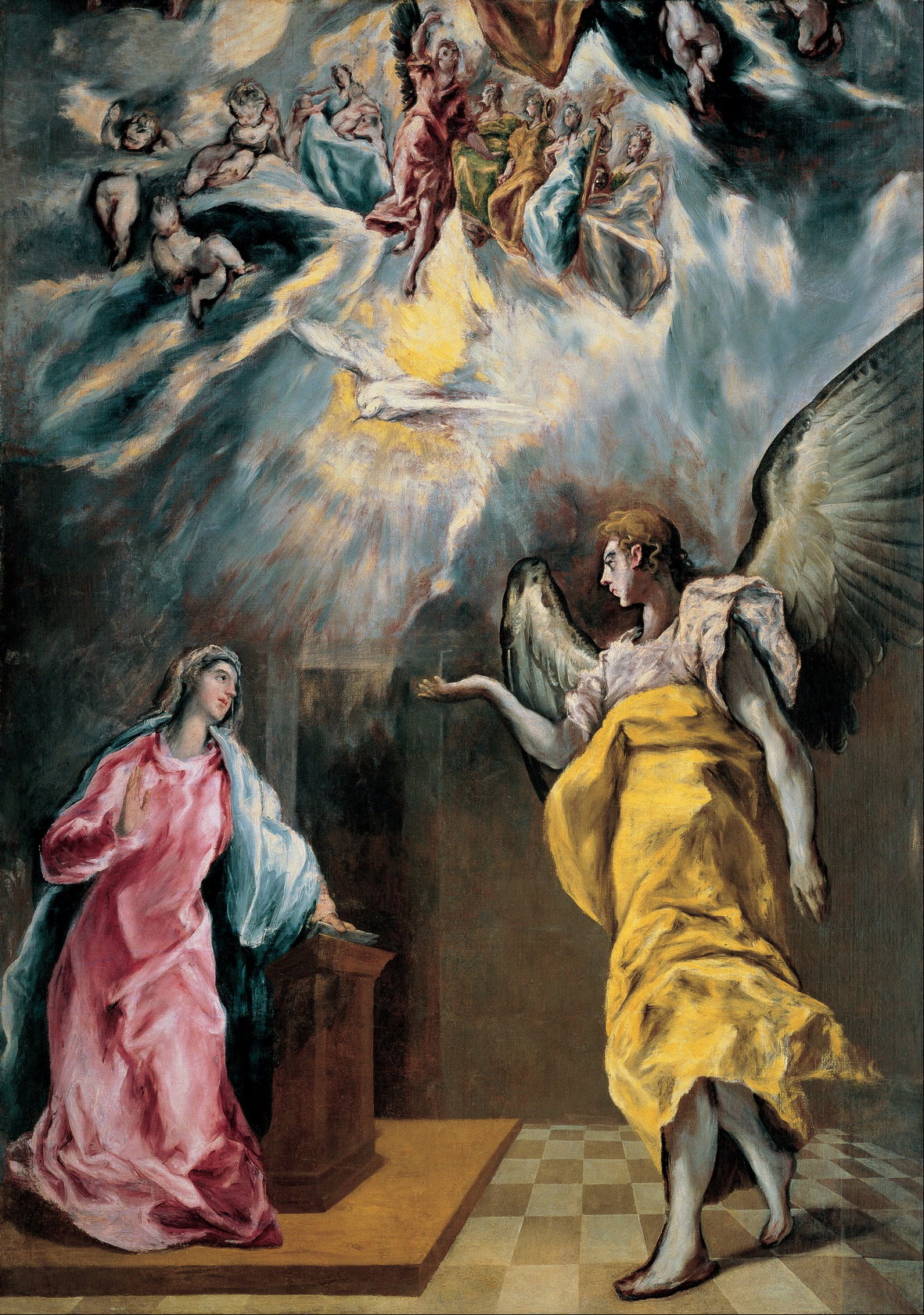
In 1614, El Greco used this unconventional composition, placing the figures in more expressive poses, with eloquent body language. The white dove is flying from a gaping light in the heavens, with a host of mothers and babies above. His brushwork is so painterly it could be mistaken for a much later work.
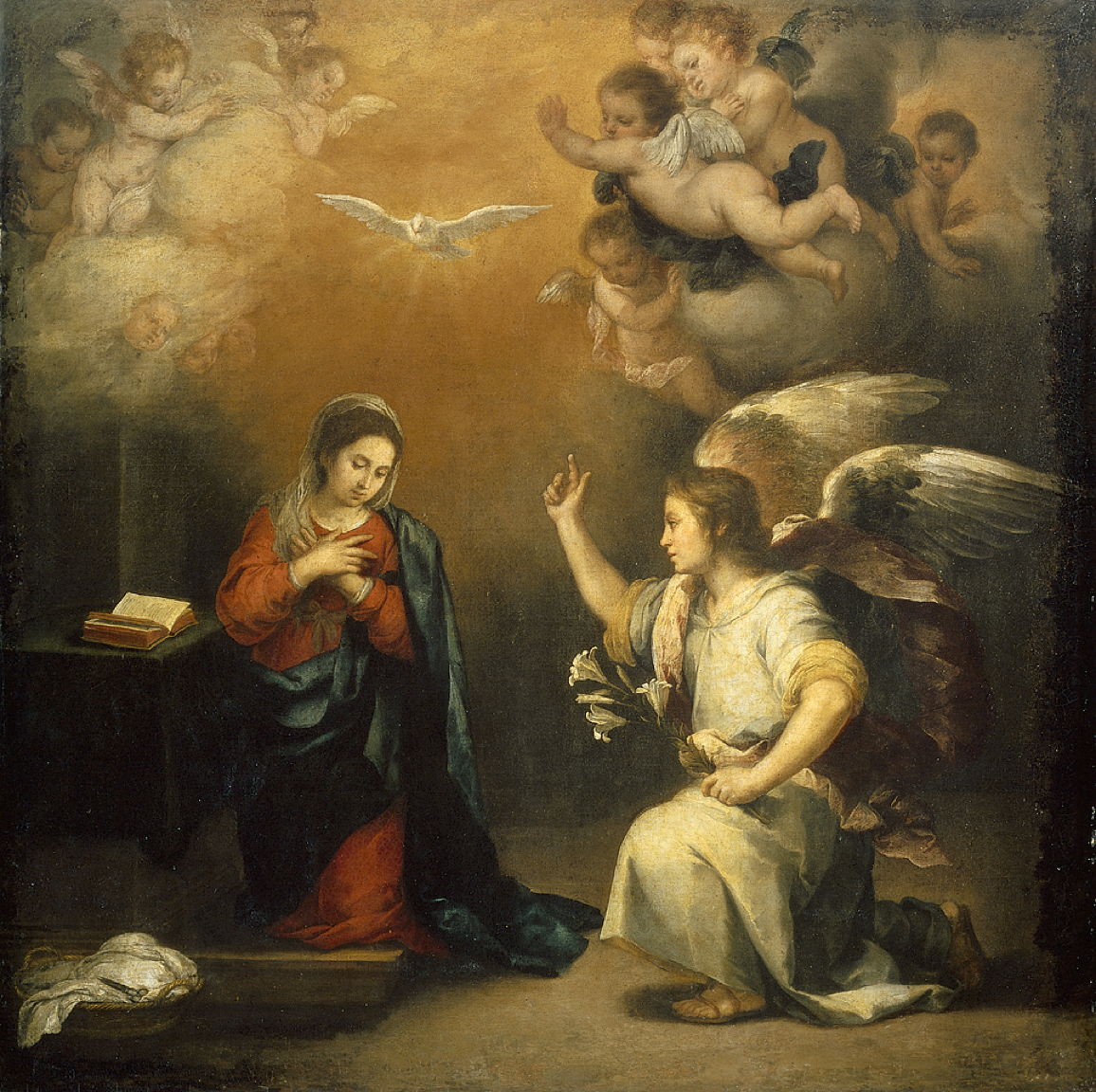
Murillo’s more conventional approach from 1660-80 is notable for the introduction of everyday props, such as the basket of linen under the table at the lower left corner, another herald of the depictions of the nineteenth century.

