Reading view

There are new articles available, click to refresh the page.

Paracetamol is safe in pregnancy, says study refuting US president's claims about autism

Getty Images A pregnant women wearing a grey top is visible from the chest down, and holds a white pill in her left hand and a glass of water in her right (slightly blurred)Getty Images

Taking paracetamol while pregnant is safe and there's no evidence it raises the risk of autism, ADHD and developmental issues in children, say experts behind a major new review.

Pregnant women "should feel reassured" by the findings, they say, which contradict controversial claims from US President Donald Trump last year that paracetamol "is no good" and pregnant women should "fight like hell" not to take it.

His views were criticised at the time by medical organisations worldwide. Experts say this latest review, in a Lancet journal, is rigorous and should end the debate over its safety.

But US health officials maintain that "many experts" have expressed concern over its use during pregnancy.

The US President shocked many doctors worldwide when he and his administration claimed paracetamol or a branded version called Tylenol - which is seen as the go-to painkiller for pregnant women - could be linked to autism in children, if taken during pregnancy.

Those claims led to confusion among women and concern among health experts, and prompted this new research.

Published in The Lancet Obstetrics, Gynaecology & Women's Health, it looked at 43 of the most robust studies into paracetamol use during pregnancy, involving hundreds of thousands of women, particularly those comparing pregnancies where the mother had taken the drug to pregnancies where she hadn't.

The researchers say using these high-quality studies of siblings means they can dismiss other factors such as different genes and family environments, which makes their review "gold-standard".

The research also looked at studies with a low risk of bias and those that followed children for more than five years to check for any link.

"When we did this analysis, we found no links, there was no association, there's no evidence that paracetamol increases the risk of autism," lead study author and consultant obstetrician Professor Asma Khalil, told the BBC.

"The message is clear – paracetamol remains a safe option during pregnancy when taken as guided," she added.

This reinforces guidance from major medical organisations in the UK, US and Europe on the safety of the common painkiller.

Any previously-reported links between the drug and an increased risk of autism are likely to be explained by other factors, rather than a direct effect of the paracetamol itself, the review says.

"This is important as paracetamol is the first-line medication we recommend for pregnant women in pain or with a fever," said Prof Khalil, professor of maternal fetal medicine at City St George's, University of London.

Health advice warns that women can run the risk of harming their baby if they don't take paracetamol to bring down a high temperature or relieve pain when pregnant. This can increase the risk of miscarriage, premature birth or developmental problems in babies.

Medical experts not involved in the research have welcomed the study's findings, saying it will help reduce worry among women.

Prof Grainne McAlonnan, from King's College London, said expectant mothers "do not need the stress of questioning whether medicine most commonly used for a headache could have far reaching effects on their child's health".

"I hope the findings of this study bring the matter to a close," she said.

Prof Ian Douglas, from the London School of Hygiene and Tropical Medicine, said the review was "well-conducted" because it excluded studies of lower quality, where no account was taken of important differences between mothers who use or don't use paracetamol during pregnancy, such as underlying illnesses.

According to Prof Jan Haavik, molecular neuroscientist and clinical psychiatrist at the University of Bergen, the study provides "strong evidence" that use of paracetamol during pregnancy does not increase the risk of autism, ADHD or intellectual disability and "should effectively put this question to rest".

It is widely believed by scientists working in this field that autism is the result of a complex mix of factors, including genetic and environmental ones.
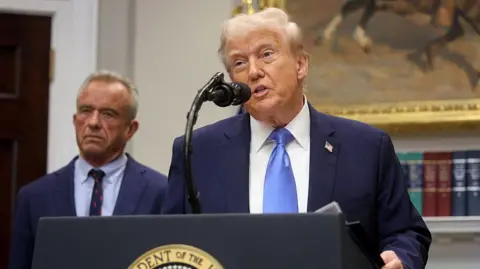
Getty Images US President Donald Trump talks into a microphone in the White House, with Robert F. Kennedy Jr, US Health Secretary on his left, on 22 September 2025, wearing a navy blue suit and sky-blue tieGetty Images
In a speech in September 2025, President Trump said his administration was linking paracetamol (or acetaminophen) to autism and urging pregnant women to largely avoid the pain reliever

A spokesman from the US Department of Health and Human Services said "many experts" had expressed concern over the use of acetaminophen - the US name for paracetamol - during pregnancy.

For example, a review in August 2025 led by Dr Andrew Baccarelli, dean of the Harvard T.H. Chan School of Public Health, found that using acetaminophen during pregnancy may increase children's autism and ADHD risk, and urged caution over "especially heavy or prolonged use".

Months earlier, Health Secretary Robert F Kennedy Jr had pledged to find out the cause of a steep rise in reported autism cases.

In a controversial speech in the Oval Office in September, the US president said doctors would be advised not to prescribe the pain reliever to pregnant women.

The US Food and Drug Administration (FDA) then issued a letter to clinicians urging them to be cautious about the use of acetaminophen in pregnancy, while also saying it was still the only drug approved for treating fevers during pregnancy.

On its website, the FDA says "a causal relationship" between the drug and neurological conditions "has not been established".

Health officials in the UK have stressed that paracetamol remains the safest painkiller available to pregnant women.
Lammy blocks Jimmy Mizen killer's open prison move

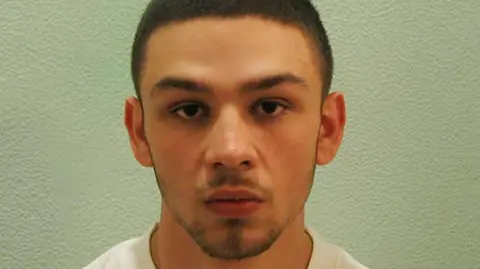
Metropolitan Police/PA Wire A mugshot of Jake Fahri.Metropolitan Police/PA Wire

Justice Secretary David Lammy has intervened to block the transfer of a killer to an open prison after it emerged he had released drill music with lyrics referencing the murder, under a pseudonym.

Jake Fahri was sentenced to life in 2009 for killing 16-year-old Jimmy Mizen by throwing an oven dish at him that shattered and severed the arteries in his neck.

He was released on licence in 2023 but was later recalled after the Sun published a story that alleged Fahri was making music, including about the murder, as balaclava-clad artist TEN.

Two years on, the Parole Board has said he should now be moved to an open prison - but a Ministry of Justice spokesperson said Lammy's intervention was for "public protection".

In its decision summary, the board had said Farhi had initially disputed that the music was "about his own life" but after being recalled to prison, he accepted that he was the artist TEN.

It added that Farhi "needed to reflect" on "why he failed to be open and honest with the professionals managing his case" but this "could be achieved" in an open prison.

Lammy's reversal has been welcomed by Mizen's mother Margaret, who told the Sun she was "shocked" by the Parole Board's initial recommendation.

"I would much prefer this decision didn't have to be made because he would have turned his life around. I'm really sad that he hasn't," she said.

But the reversal shows Farhi had "not changed his attitude".

"He got into the witness box at his trial and lied through his teeth. Clearly, he hasn't changed, and I'm glad the justice secretary has seen through it."

Farhi had been given a minimum 14 year prison term - but, as with all minimum terms, that is the point at which release can be considered, usually with conditions attached about the criminal's behaviour outside prison.

Music by TEN was showcased on BBC 1Xtra. who were unaware of his real identity at the time of broadcast.

Jenrick's move is massive - but could it cause an ever bigger fight on the right?

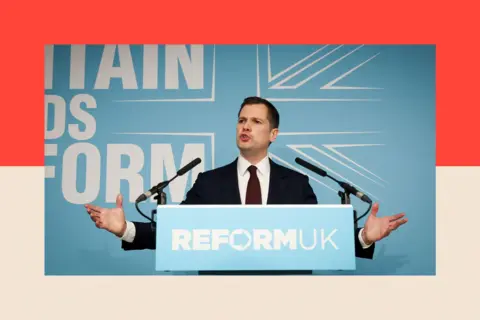
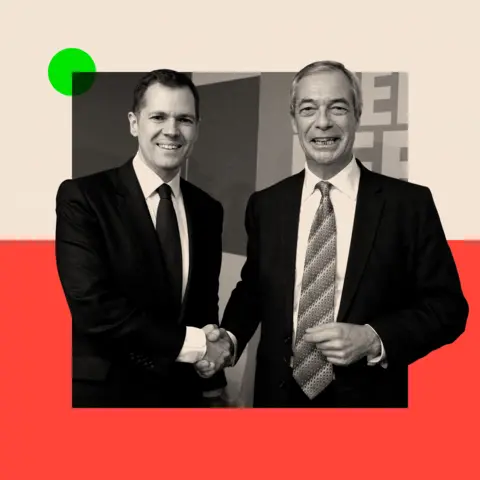
BBC A treated image Robert Jenrick and Nigel FarageBBC

There is fresh paint in Reform HQ - and a fresh face in its line-up.

Before Thursday, the last time Robert Jenrick walked into Millbank Tower, a fabled address in Westminster where lots of political campaigns have been run, was decades ago as an eager Conservative activist.

Now, he's Reform UK's biggest prize so far - the best-known Tory to defect, and a favourite of Conservative party members.

Like or loathe Jenrick's tactics he has campaigning guile, a knack for grabbing headlines, experience of government, knowledge of Parliament and, of course, insider knowledge of what Conservative leader Kemi Badenoch and her team are up to.

So how will this big political character adapt to a new political tribe? And could his huge move be swallowed up by a big fight on the right, at a time when Reform UK are busy trying to appeal to the whole country?

From speaking to Jenrick yesterday, he is plainly deadly serious about his political future, hitching his wagon to the biggest party in the polls right now. But any defection brings with it deep questions about whether that person can be trusted.

Some Conservatives are accusing him of lying and treachery. They say he sat in meetings with colleagues in the last seven days discussing party strategy normally.

He even, one source claimed to me, told the chief whip when challenged on the morning of his defection that it was "nonsense" and that he was "gobsmacked".

EPA-EFE/REX/Shutterstock Kemi Badenoch (R) is congratulated by candidate Robert Jenrick following the party's new leader announcementEPA-EFE/REX/Shutterstock
Badenoch became Conservative leader in 2024, beating Jenrick in a members' vote

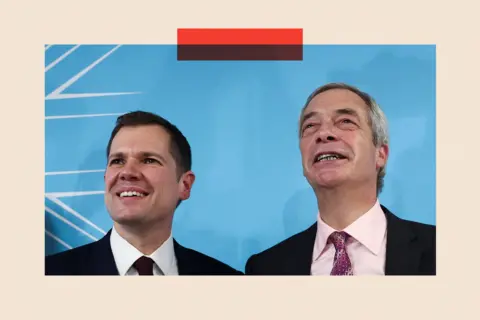
Hours later, Jenrick did appear grinning alongside Reform UK leader Nigel Farage for the public handshake sealing the deal after, remember, being sacked.

Did he serially deny thinking about going to Reform in the last few months?

Yes.

Do we know now that he'd been talking to them since the autumn?

Yes to that too.

Jenrick's answer to accusations of lying, and to the evidence he misled people, is to claim he is the one now being truly honest about the state of the country and the demise of the Conservative Party. He told us that he'd only made a final decision to leave at Christmas.

Whether you have sympathy for him, think his behaviour is appalling, or something in between, there's clearly a poisonous row raging over what he did. That row does nothing for the sense of trust in politicians.

He wouldn't be drawn on whether it was one of his own team who leaked his plans to defect, but you can be sure today won't be the last word on that.

EPA/Shutterstock Britain's former shadow justice secretary Robert Jenrick speaks after defecting to Reform UK during a press conferenceEPA/Shutterstock

One of the reasons for Jenrick's exit from the Tories is that he wanted to strike a more strident tone than his colleagues were willing to do. Political parties traditionally stand or fall on being able to disagree privately but agree in public. Without that discipline, it's chaos.

We asked him if he now agreed with Reform's position on benefits for bigger families – his answer was that the party "needs to think it through". Not exactly the same as the script.

And what about the NHS? Jenrick wasn't ready to agree with Farage's previous comments that it could possibly move to an insurance-based model. But it highlights an area where Reform will be under pressure to take a clearer position.

Political parties aren't just about what colour your banner or tie is, but what you believe in and stand for.

Once upon at time, Jenrick was seen as a 'Cameroon', a devotee of David Cameron's Waitrose-style politics: modern, socially liberal, middle-class-friendly. It is one thing to shift right, shaped by changes in the country and his own experience at the Home Office, for which he quit government in frustration. It's another to take the leap into a party that has a whole different system of beliefs.

And politicians are by nature ambitious people. Jenrick told me he hadn't been offered a job by Farage, but it's crackers to imagine that he doesn't want a prominent position.

How will his arrival go down with Reform's small number of other big names - Richard Tice or Zia Yusuf? Ambition - for themselves and their party, and, they'd say, the country - is what gets politicians out of bed in the morning. Sharing the spotlight is not something they all exactly love.

Jenrick told me he and Farage's previous barbs against each other were just "rough and tumble".

But given their exchanges have involved trading insults including fraud, hypocrite and unserious, we'll have to see how their working relationship evolves.

Reuters A close-up shot of former British Conservative Party member Robert Jenrick and Reform UK leader Nigel Farage Reuters

Jenrick's defection raises one of the biggest questions in politics right now; whether Reform UK can, as Jenrick says he wants to, "unite the right".

It has spent months miles ahead in the polls even as the Tories have pepped up a touch in recent weeks. But as Jenrick himself used to claim, there is a risk that if voters choose Reform that will split the votes on the right, making it easier for Prime Minister Keir Starmer to win next time round.

Truly "uniting the right" would require the Tories limping off - or, what right now seems far-fetched, the opposite. Or indeed doing a deal, which both groups swear blind they wouldn't.

There's no sign Badenoch has the appetite for anything other than a fight to the death.

As Chris Mason wrote yesterday, there is a risk that recruiting Jenrick and others gives Reform the flavour of being a repository for grumpy Conservatives, not the radical insurgent force Farage would like to claim. But nothing would suit Labour more than for the two to stay locked in combat, reminding the public of years of Tory spats and showing that both Reform and the Conservatives are focused on each other, not No 10.

Jenrick has clearly thought deeply about leaving the party that gave him his career and the opportunity to wield power. Over time, you can see that he has come to believe that the problems of the country need something more radical than either of the traditional big parties are prepared to countenance.

Reform will now have his knowledge and backing to help answer that call with a credible offer to the public. The Conservatives, in his view, need more than a fresh coat of paint.

Top image credit: Getty Images

Thin, lobster red banner with white text saying ‘InDepth newsletter’. To the right are black and white portrait images of Emma Barnett and John Simpson. Emma has dark-rimmed glasses, long fair hair and a striped shirt. John has short white hair with a white shirt and dark blazer. They are set on an oatmeal, curved background with a green overlapping circle.

BBC InDepth is the home on the website and app for the best analysis, with fresh perspectives that challenge assumptions and deep reporting on the biggest issues of the day. Emma Barnett and John Simpson bring their pick of the most thought-provoking deep reads and analysis, every Saturday. Sign up for the newsletter here

Plaid Cymru would take minority government over coalition, leader says

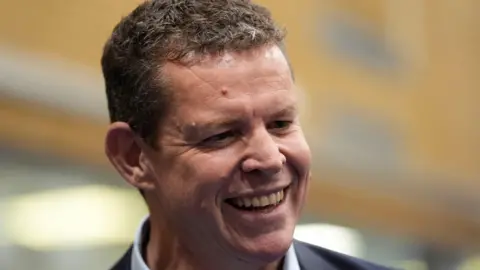
PA Media The image is a close-up of Plaid Cymru's leader Rhun ap Iorwerth. He is looking away from the camera and is smiling. PA Media
Plaid Cymru's Rhun ap Iorwerth is hoping to be Wales' next first minister

Plaid Cymru leader Rhun ap Iorwerth says he would prefer to form a minority government than enter a coalition with another party after the Senedd election.

His comments came after an opinion poll published earlier this week suggested Plaid was on course to win the Welsh election on 7 May.

Previous polls have suggested Plaid and Reform UK are battling to come out on top - but with neither party winning enough seats to be able to pass laws and spending plans without the support of opposition politicians.

Polling expert Dr Jac Larner from Cardiff University said the latest poll could see Plaid win 45 seats, which would leave it four seats short of a majority in the new 96-seat parliament.

Recent polls have sparked ongoing speculation around how Plaid would govern if they won the election but failed to win more than half the seats.

Speaking to the Gwleidydda podcast on BBC's Radio Cymru, ap Iorwerth said it was his party's "wish" to form a minority government made up of only Plaid ministers.

He said the latest opinion poll "confirms what I've felt for a while, which is that we can - if we fight an effective election and build trust with people - lead a minority government and do that successfully".

He added that he was "determined that that minority government would make it clear from the start to whoever else is in that part of the [political] spectrum that we want to work together".

"We'll look at who we can work with, issue by issue, policy by policy, budget by budget and so on," he added.

"I think it could be the beginning of a period of mature cooperation within government."

Ap Iorwerth's interview with Gwleidydda was part of a series the podcast is doing with prominent figures from all the major parties.

Getty Images An exterior image of the Senedd building in Cardiff Bay on a sunny day.Getty Images
No party has ever won a majority of the seats in Cardiff Bay

Responding to ap Iorwerth's comments, Prof Richard Wyn Jones from the Wales Governance Centre at Cardiff University told the podcast: "Of course it's easier to say that when the opinion polls suggest at the moment they aren't far from a majority.

"If you've got a small minority, it much more difficult to run a government."

He also suggested the comments could be a way to "avoid questions and accusations" from the Conservatives and Reform UK that victory for Plaid Cymru at the election would still put Labour in a position of power.

What happens if there's no majority?

No party has ever won a majority in Cardiff Bay, and the upcoming changes to the voting system make it highly unlikely that will change at this election.

Labour has won the most seats at every previous Senedd contest, but without a majority it has always had to strike a deal of some kind with an opposition party.

At times that has led to formal coalitions. This is where at least one member of an opposition party joins the government's ministerial team – giving their party a voice at the cabinet table in exchange for its continued support.

Cardiff Bay has also seen agreements short of a full coalition, with the most recent example being the cooperation deal between Labour and Plaid Cymru between 2021 and 2024.

This saw the Welsh Labour government commit to deliver some Plaid Cymru policies, in exchange for Plaid's support when it came to passing the government's annual budget.

If his party wins the election, Rhun ap Iorwerth is hoping he can avoid both of the above options and run a minority government, where votes are agreed on a case by case basis.

Ultimately what the next first minister decides to do will depend entirely on the makeup of the new Senedd.

After all, as former US President Lyndon B. Johnson said: the first rule of politics is to learn how to count.

The mysterious singer with millions of streams - but who (or what) is she?

Sienna Rose Sienna RoseSienna Rose
Sienna Rose has almost three million monthly listeners on Spotify

Sienna Rose is having a good month.

Three of her dusky, jazz-infused soul songs are in Spotify's Viral Top 50. The most popular, a dreamy ballad called Into The Blue, has been played more than five million times.

If she continues on this trajectory, Rose could become one of the year's hottest new stars.

There's only one problem: All the signs indicate she's not real.

Streaming service Deezer, which has developed tools to tackle AI music, told the BBC that "many of her albums and songs on the platform are detected and flagged" as computer generated.

Look closer and you'll see the indications of an AI artist. Rose has no social media presence, has never played a gig, has no videos, and has released an improbable number of songs in a short space of time.

Between 28 September and 5 December, she uploaded at least 45 tracks to streaming services. Even Prince, an artist known for restless creative mania, would have struggled to match that figure.

Her Instagram account, which is currently deactivated, featured a strangely homogenous series of headshots, all showing the gauzy, unreal lighting that's characteristic of AI image generators.

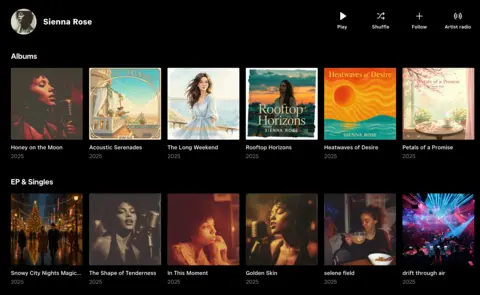
Tidal A screenshot of Sienna Rose's artist page on TidalTidal
On streaming service Tidal, Rose is also credited with albums of folk and ambient music, all uploaded last year, with different singers pictured in the artwork

Then there's the music itself. Songs like Into The Blue and Breathe Again sit neatly next to Norah Jones or Alicia Keys, full of jazzy guitar lines and buttery smooth vocals.

But many listeners have noted what they have identified as "AI artefacts".

Play Under The Rain or Breathe Again and you'll hear a telltale hiss running throughout the tracks.

That's a common trait of music generated on apps like Suno and Udio - partly because of the way they start with white noise and gradually refine it until it resembles music.

It's this quirk that enables Deezer to flag AI songs.

"When the [software] adds all the layers and the instruments, it introduces errors," explains Gabriel Meseguer-Brocal, a senior research scientist for the streaming company.

"They're not perceptual, we cannot listen to them, but they're easy to spot if you do a few mathematical operations."

The errors act like a fingerprint, Meseguer-Brocal says, with a "unique signature" that means it's possible to detect which piece of software was used to create any piece of music.

Sienna Rose Sienna RoseSienna Rose
The mystery surrounding the singer poses bigger questions around AI-generated music

For casual listeners, there are other signs: Inconsistent drum patterns, bland lyrics, and a singer who never strays from the melody or lets rip on the final chorus.

That "generic" sound has been the biggest clue for some of Sienna Rose's listeners.

"I was like, 'I like this', but there was something that was very 'uncanny valley'," said TikTok music critic Elosi57.

"So I went to look [at her profile] and I was like, 'This is AI'."

Another user posted on X: "Started listening to Olivia Dean (fantastic). Within two days Spotify recommended Sienna Rose, who has a similar, but more generic sound. Took me a few songs to realise she's AI."

Broadcaster Gemma Cairney told BBC Radio 4: "The photographs of her do look a little bit unreal... And having listened to the music, is there just some of the soul in the soul missing?"

To be fair, many others have fallen for Rose's songs.

Among them is pop star Selena Gomez, who used the Rose track Where Your Warmth Begins as the background for an Instagram post about Sunday's Golden Globes.

The song was later removed when questions about Rose's identity spread online, but Gomez's post took interest in Rose and her identity to a new level.

And many of the listeners who'd been playing Rose's music reacted with dismay when they learned she might not exist.

"Please tell me she's real," pined one on Threads.

"I'm disappointed cuz a couple of her songs came on and the music isn't BAD," agreed another on Bluesky. "[But] somebody said once you know then it sounds soulless' and I agree."

AI music ban

Of course, it's entirely possible that everyone has got it wrong, and Sienna Rose is a real singer who shuns the limelight. Maybe she's in witness protection. Perhaps she's a real singer, stuck in a contractual dispute with her label, and releasing music under a pseudonym.

If so, I'm sorry. It must be crushing to have your music labelled as soulless "slop". But that's indicative of the problem facing the entire music industry right now.

AI software is becoming so sophisticated that clone artists are competing with genuine musicians.

In Sweden this week, a chart-topping song was banned from the charts after journalists discovered the artist behind it, Jacub, didn't exist.

There are many people - both in tech companies and the business side of the music industry - who want to see AI succeed.

The costs of launching an act like Sienna Rose are practically zero, but her music is making an estimated £2,000 in royalties per week.

Compare that to the K-Pop industry, where labels invest an average of $1m (£750,000) per member of a girl or boy group per year, and you can see the attraction.

Interestingly, several of Rose's songs are credited to New York indie record label Broke - who have a track record in turning viral artists like bbno$ and Ndotz into chart stars.

If you visit their website, Rose isn't listed as one of their signings - but British dance act Haven are.

If that name rings a bell, it's because they got into trouble late last year for creating a song using an AI clone of Jorja Smith's voice.

Their song, Run, was removed from streaming services after record industry bodies issued takedown notices, alleging the track violated copyright - but was re-recorded with human vocals, and entered the UK Top 10 two weeks ago.

The BBC has contacted Broke to ask about their relationship with Sienna Rose, but has yet to receive a reply.

The BBC has also contacted another label, Nostalgic Records, which lists Rose on its website.

Nostalgic Records' biography claims she is "London-based" and says she is "not just a performer, but a storyteller of the heart".

Reuters Raye sings on stageReuters
The pop star Raye says fans prefer genuine, heartfelt music over computer-generated emptiness

Deezer says 34% of the songs uploaded to its streaming service - about 50,000 per day - are AI-generated.

"Eighteen months ago, it was around 5% or 6%," says Meseguer-Brocal. "It's kind of shocking how quickly it's increasing."

Still, Deezer hasn't gone as far as online music store Bandcamp, which this week announced it was banning all AI-generated music.

In a statement, Spotify defended the presence of artists like Rose on its playlists.

"It's not always possible to draw a simple line between 'AI' and 'non-AI' music," a spokesperson said. "Spotify does not create or own any music, and does not promote or penalise tracks created using AI tools."

In the meantime, a backlash against AI music is growing.

Last year, artists including Paul McCartney, Kate Bush, Damon Albarn, the Pet Shop Boys and Annie Lennox released a "silent album" protesting against companies who train their AI models on copyrighted work without permission.

Speaking at the Ivor Novello Awards in 2024, pop star Raye told me she believed fans would always choose real music over algorithmically-generated filler.

"There's no reason to feel a threat," she said. "I don't write because I'm trying to be the best writer. I write because I'm trying to tell my story.

"I'm trying to lift off some weight I've been carrying or I'm trying to express myself and feel better."

At the same event, Kojey Radical said he wasn't worried about AI when he couldn't even trust his washing machine to start at the right time.

"Why is everyone trying to make me scared of the robots?" he laughed.

"I'm not scared of the robots. I will win."

A hotline to report vapers and caning if you're caught: Singapore's e-cigarette crackdown

Getty Images An Asian man puffs on a vape, his face mostly obscured by a cloud of vapourGetty Images

It's a busy day at Woodlands Checkpoint, Singapore's main land crossing on the border with Malaysia, and thousands of cars are slowly trundling past the watchful eyes of customs officer Belinda Liaw and her team.

Suddenly Liaw steps forward, signalling at a white Toyota van to stop. Her team swarms the vehicle immediately, their blue-gloved fists knocking all over the chassis to check for false compartments. Others question the driver, rifle through his belongings and scour his mobile phone.

They are searching for vapes - which the Singapore government has spent months waging war against.

Vapes or e-cigarettes have been banned in the city-state since 2018. But in recent years drug-laced vapes, known by their street name K-pods, have become popular on the black market - unnerving a country known for its zero tolerance of drugs.

Authorities have launched a harsh crackdown, putting in place tough punishments with more targeted laws on the way. Now, if you get caught with an e-cigarette in Singapore, you could be jailed, sent to state rehab, or even caned. A massive public health campaign has blanketed the island, warning Singaporeans of the dangers of vaping.

It comes as many countries consider tighter regulation. A World Health Organization (WHO) bulletin has called Singapore's campaign a "turning point" that will "influence the next decade of global tobacco and drug policy".

Could others follow suit?

A grey divider  line used to break up sections of the story

"Okay, you can go."

Back at Woodlands Checkpoint, Liaw and her team of customs officers wave off the driver they were searching - he was clean.

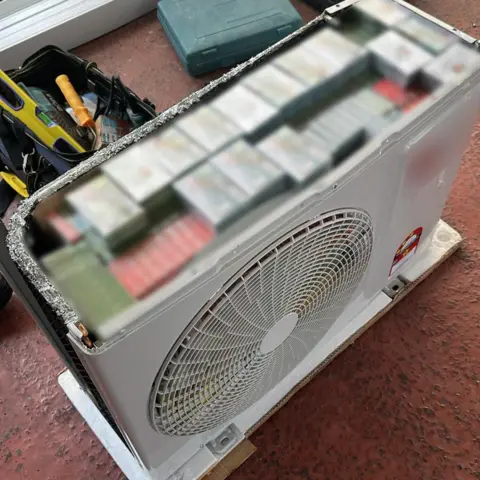
Most vapes come to Singapore from Malaysia. Liaw told the BBC they once found vaping supplies stacked inside air-conditioning equipment and cartons of light switches. Another time, they searched a bread van and discovered thousands of vapes nestled within trays of buns.

In recent months smugglers have changed tactics by bringing in smaller batches squirrelled away in various parts of the vehicle - hence the thorough knocking.

Elsewhere at the checkpoint, the BBC saw officers screening lorries with large X-ray machines before climbing inside to inspect cargo, slashing through plastic wrapping with pen-knives and peering inside pallets with torchlights.

"The [smugglers'] methods are evolving, so we're evolving too… we have to work harder to detect more cases and stop all these vapes from coming in," explained Liaw.

Singapore Immigration and Checkpoints Authority Boxes of vaping supplies are neatly stacked inside an empty air-conditioner fan unit. The boxes have been blurred out by authorities.Singapore Immigration and Checkpoints Authority
Boxes of vaping supplies were discovered in air-conditioner equipment (photo blurring done by authorities)
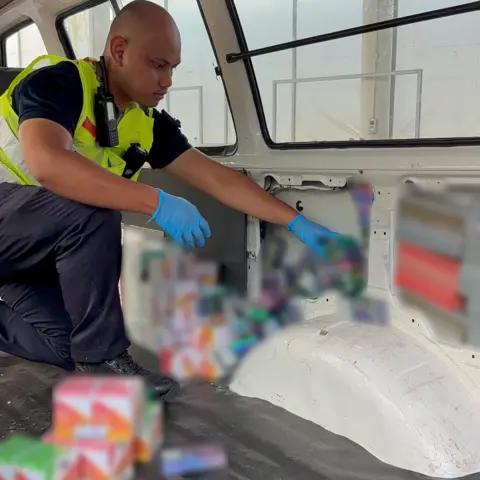
Singapore Immigration and Checkpoints Authority A Singaporean customs officer pulls out boxes of vaping supplies from false compartments inside a van. The boxes have been blurred out by authorities.Singapore Immigration and Checkpoints Authority
Singapore immigration officers have previously found vapes concealed in false compartments in vehicles (photo blurring done by authorities)

Singapore first banned vapes in 2018 as a precaution while it weighed up the evidence on its effects on health, stating it would be "irresponsible to make a hasty decision".

But an underground market for e-cigarettes continued to thrive online. Singaporean vapers have told the BBC that even after 2018 they could easily purchase vape supplies via forums and chat apps.

Then, in recent years, a new product emerged on the black market – K-pods. These are vapes laced with etomidate, a type of anaesthetic which has the same mind-numbing effect as ketamine, hence the nickname.

Soon, videos of young people passing out in public or acting erratically on public transport – all after puffing on K-pods - went viral. Last July, a random test of 100 seized vapes found about one third contained etomidate.

The news shocked Singapore. Many asked how this was possible in a country that prides itself for keeping out most drugs through severe punishments, even for marijuana use, and a mandatory death penalty for traffickers.

Authorities quickly swung into action. Prime Minister Lawrence Wong declared that vaping was now a drug issue and his government would crack down not only on K-pods but all vapes.

"The vapes themselves are just delivery devices. The real danger is what's inside," warned Mr Wong last August. "Right now, it's etomidate. In future, it could be something worse, stronger, far more dangerous drugs."

In September the government rolled out new penalties for vapers including state-mandated rehabilitation and fines of up to 10,000 Singapore dollars (£5,765; $7,780).

The punishments are more severe for sellers, particularly those caught with drug-laced vapes. They could be jailed for up to 20 years and receive up to 15 strokes of the cane - a painful punishment where convicts are flogged on their buttocks.

Foreigners face the same punishments and can also be deported.

Strict rules have been introduced in schools where students caught with vapes could face suspensions, expulsion, and also caning.

More penalties are expected in the next few months, as the government comes up with legislation targeting etomidate and other drugs that could be found in vapes.

"Vape bins" have been placed across the island for users to dispose their devices without penalty. Authorities have also been conducting roving patrols and bag checks at bus and metro stations to catch those reluctant to voluntarily give up their vapes.

A hotline has been set up for the public to report anyone suspected of vaping – more than 2,600 reports were lodged in the first nine weeks.

For the last few months, it has been hard to escape a massive anti-vaping public health campaign.

Local media outlets have run countless stories on the dangers of vaping, while adverts have been plastered everywhere on the island and on social media. Many of them reference popular movies and TV shows in an effort to reach out to youths.

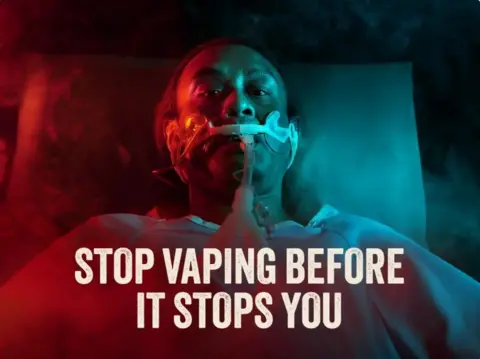
Gov.sg / Stop Vaping An ominous looking public health advertisement showing a man on a hospital bed with an oxygen mask surrounded by smoke and red and blue lighting, with the tagline "Stop vaping before it stops you".Gov.sg / Stop Vaping
Anti-vaping adverts like this one have blanketed Singapore's public spaces and social media

One advert has the tagline "Final Destination - ICU". Another, called "Danger Things", depicts vaping as something out of a zombie movie and references the Netflix hit Stranger Things.

Yet another advert references the TV show Breaking Bad - about a chemistry teacher turned druglord - with the tagline "Breaking Dad".

These adverts highlight real-life case studies such as a father whose teen daughter died from a fall while intoxicated from using K-pods, and a vaper who needed his lungs "washed" four times.

Singaporean authorities, who arrested nearly 2,000 people for vaping offences between September and November, say their clampdown has yielded results. They point to a declining percentage of drug-laced vapes which now make up less than a tenth of seized e-cigarettes, according to police figures.

Not many in Singapore appear to publicly oppose this crackdown – the majority of Singaporeans have long supported the government's tough drug policies. But online and in private, there are some who complain that the new restrictions go too far.

One vaper, who asked to be identified with the pseudonym Michael, said it "wasn't right" that the government was "strong-arming" him into giving up vaping.

"Cigarettes are known to be bad for you, right? Yet they're legal. Vaping is a big question. So do you want something that you know is going to harm you, or will you take a chance?"

"That's a personal choice, I think, and to just blanket-ban [vapes], I think it's sloppy, it's lazy… let the people choose for themselves," said Michael, who says he uses regular vapes.

Another vaper, who wanted to be known by the pseudonym Toby, said he could understand the need for a harsh crackdown, particularly to protect teens from gaining access to drugs via vapes. "It's not the most popular move, but it certainly is the most efficient… it's cutting the head off a snake," he admitted.

But he pointed out that before the crackdown, most e-cigarette users in Singapore were, like him, using regular vapes and not K-pods.

He felt the ban was not fair because "one bad apple spoils the whole batch. I feel that for a lot of the adults who don't take drugs, they have to suffer [this ban]… and they would have to go back to smoking," said Toby, who plans to switch back to smoking cigarettes.

Other Singaporeans have also questioned if the proliferation of drug-laced vapes was in part caused by the government's 2018 ban.

An editorial in independent magazine Jom pointed out that the ban created "incentives for black marketers to create the most high-value, addictive products".

This, in turn, led to the rising popularity of K-pods and the need for a harsher crackdown, which the Jom editorial deemed "the Great Panic of 2025".

In response, a Singapore health ministry spokesperson told the BBC that the government banned vaping before it becomes as "entrenched" as cigarette smoking, to "pre-emptively stop new harmful and addictive products from entering the market and prevent a new set of associated health issues".

"The fact that a black market can sell illicit substances to a small minority cannot possibly be the justification to make abuse of the substance a legitimate mainstream habit."

The dean of the Saw Swee Hock School Of Public Health at the National University of Singapore, Teo Yik Ying, has argued that Singapore did the right thing as "an outright ban has contained the problem".

"In contrast, countries that legalised vapes saw demand explode and youth uptake surge while illicit actors thrive anyway. In other words, regulation in lieu of a ban does not prevent illicit trade – it amplifies it by creating a vast consumer base to serve," he wrote in a commentary published last year.

Singapore's stance stands in contrast to some countries, like the UK, which see vaping as a less dangerous alternative to cigarettes and thus useful for helping people quit smoking.

The National Health Service (NHS) notes that while vaping is "not completely harmless" and that non-smokers and youths should not take it up, it is "less harmful than smoking".

The NHS also states that vaping is "one of the most effective tools" for smoking cessation.

Peter Hajek, a clinical psychologist and director of the health and lifestyle research unit at the Queen Mary University of London, argues that banning vaping is "detrimental to public health".

"It stops smokers who find giving up nicotine difficult from using a method that would help them avoid smoking related cancers, heart disease and lung disease; and it protects the cigarette trade from its much less risky competitor," said Prof Hajek, who has received research funding from manufacturers of stop-smoking medications but has no links with any tobacco or e-cigarettes manufacturers.

Banning all vapes because some e-cigarettes could contain drugs was akin to "banning suitcases because some people can carry drugs in them," said Prof Hajek. "Just ban drug vapes."

But there is also growing concern about the health implications of e-cigarette use, as the number of vapers worldwide swells to an estimated 100 million.

In the UK, a rise of vaping among students has led schools to ask the government for help in tackling what has been described as a "public health emergency".

Research in recent years indicates that vaping could potentially harm users' health by impairing blood vessels and causing lung injuries.

The WHO's current advice states that vaping has "not been proven effective" at the population level in helping smokers quit cigarettes.

Both the WHO and US Centre for Disease Control and Prevention (CDC) insist that e-cigarettes are not completely safe and more research needs to be done on vaping's long-term effects on health.

Singapore's government has made up its mind.

It argues that vape pods could contain much higher doses of nicotine than cigarettes, making vaping "more addictive" and thus tougher to quit.

Singapore also argues that vapes are not safe because they contain "cancer-causing" chemicals, toxins and heavy metals. Some organisations like Cancer Research UK point out that the levels of these chemicals are low and that "there is no good evidence that vaping causes cancer".

While the level of its crackdown is rarely seen elsewhere, Singapore is far from the only country that has restricted vaping. At least 46 countries now ban the sale of vapes, while another 82 have some form of regulation.

The UK's Tobacco and Vapes Bill, which would ban the sale of vapes to under-18s and restrict vape advertising, is making its way through parliament. Australia has made e-cigarettes available only through doctors' prescriptions to quit smoking, while Belgium has banned disposable vapes with plans for further restrictions. Malaysia is targeting to ban all vapes this year.

Much of these efforts are aimed at limiting vape access for youths, a key target market for e-cigarette companies. The WHO estimates there are at least 15 million children – aged 13 to 15 years old – who use e-cigarettes, and that children are nine times more likely than adults to vape.

"If we're not careful, we're going to get a [vaping] epidemic that starts with the younger generations that would just get worse over time," said Yvette van der Eijk, who researches tobacco policies with the National University of Singapore.

She pointed out that cigarette smoking was "an example of how things can turn out if you don't nip these kind of issues in the bud", and warned the world was at risk of "repeating history" if it does not curb vaping soon. A ban like Singapore's, she said, was "more prudent".

But few places in the world are like Singapore, whose tiny size and powerful government have enabled it to effectively enforce a strict ban.

There is also the question of how long any country, let alone Singapore, could sustain a prolonged and exacting war against vapes.

In recent months following the crackdown, vapers in Singapore say it is still possible to get their supplies.

And when it gets too difficult, they can simply cross the border into Indonesian and Malaysian towns, which have reportedly seen thriving demand for vapes from travelling Singaporeans. One Indonesian tourism official has touted the nearby island of Batam as an "alternative [place] to enjoy vapes".

Toby, the vaper who is switching to cigarettes, pointed out that Singapore's crackdown treats vaping as a vice, and "any vice is like a cockroach".

"You can try to kill it, try to enforce against it - but you can never fully get rid of it."

When does the Nasa Moon mission launch and who are the Artemis II crew?

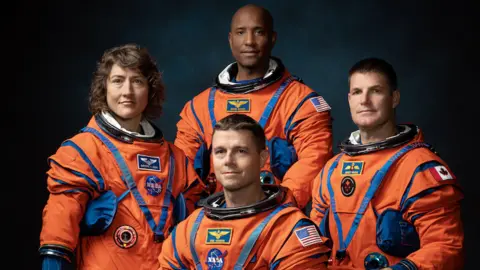
NASA The image shows four astronauts in bright orange space suits posing for a formal group portrait against a dark background. The suits are bulky with blue joints, straps and pockets, emphasising their technical design. Three astronauts stand behind while one is seated or crouching in front, all facing the camera. Their faces are blurred into smooth ovals so no expressions can be seen, keeping the focus on the uniforms. Mission-style patches and flags, including US and Canadian flags, are visible on their arms and chests. Soft, focused lighting makes the vivid orange suits stand out dramatically.NASA
Artemis II Crew: left Christina Koch, back Victor Glover (pilot), front Reid Wiseman (commander), right Jeremy Hansen

The first crewed Moon mission in more than 50 years could be launched by Nasa as soon as the first week of February.

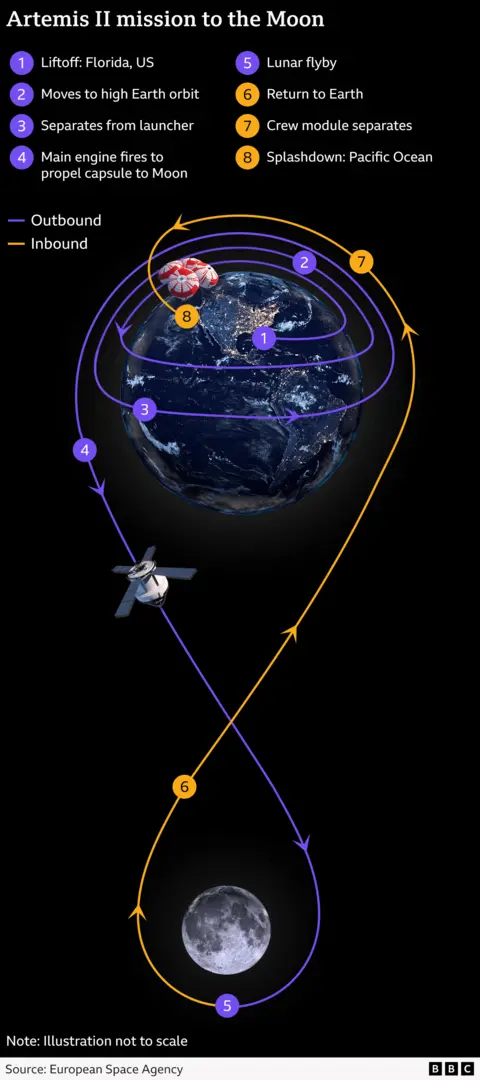
The Artemis II mission, which will last about 10 days, could take its astronauts further into space than anyone has been before.

It aims to set the stage for an eventual human landing on the lunar surface for the first time since the Apollo missions of the 1960s and 70s.

When does Artemis II launch?

Nasa's planned launch window opens on 6 February and runs into the spring. The US space agency wants the rocket to blast off before the end of April.

A date will not be set until final checks on its Space Launch System (SLS) rocket, the Orion capsule - which carries the crew - and ground systems are completed.

The mission will be launched from the Kennedy Space Center in Florida.

Who are the Artemis II crew and what will they be doing?

Artemis II's crew of four includes Nasa's commander Reid Wiseman, pilot Victor Glover and mission specialist Christina Koch. A second mission specialist, Jeremy Hansen of the Canadian Space Agency, will also be on board.

The mission involves the first crewed flight of SLS and Orion.

Once they are safely in orbit, the astronauts will test how the Orion spacecraft handles. This will involve manually flying the capsule in Earth orbit to practise steering and lining up the spacecraft for future Moon landings.

They will then head out to a point thousands of kilometres beyond the Moon to check Orion's life‑support, propulsion, power and navigation systems.

The crew will also act as medical test subjects, sending back data and imagery from deep space.

They will work in a small cabin in weightlessness. Radiation levels will be higher than on the International Space Station, which is in low‑Earth orbit, but still safe.

On return to Earth, the astronauts will experience a bumpy return through the atmosphere and a splashdown off the west coast of the US, in the Pacific.

Will Artemis II land on the Moon?

No. This mission is to lay the ground for a lunar landing by astronauts in the Artemis III mission.

Nasa says the launch of Artemis III will take place "no earlier than" 2027. However, experts believe 2028 is the earliest possible date.

The final choice of a spacecraft to take the crew down to the lunar surface has not yet been made. It will either be SpaceX's Starship lander or a craft designed by Jeff Bezos's Blue Origin.

New spacesuits made by US company Axiom are also not ready.

When Artemis III finally flies, the astronauts will be heading to the Moon's south pole.

After this, the aim is to have a sustained human presence on the Moon.

Artemis IV and V will begin building Gateway, a small space station circling the Moon. After that, there will be more Moon landings, extra sections added to Gateway, and new robotic rovers on the surface. More countries will be involved in keeping people living and working on and around the Moon for longer periods.

Graphic showing the Earth and Moon, with the Artemis II's figure of 8 orbital trajectory highlighted. Specific points are labelled. These are: 1. Lift off at the Kennedy Space Centre, 2. Orbit around Earth, 3. Rocket separation, 4. Main engine fires to take spacecraft to the Moon, 5. Lunar flyby, 6. Return to Earth, 7. Crew module separates, 8. Splashdown in Pacific Ocean.

When was the last Moon mission?

The last crewed Moon mission was Apollo 17, which landed in December 1972 and returned to Earth later that month.

In all, 24 astronauts have travelled to the Moon and 12 of them have walked on its surface, all during the Apollo programme.

America first went in the 1960s, primarily to beat the Soviet Union to assert its geopolitical and technological dominance. Once that goal was achieved, political enthusiasm and public interest ebbed, as did the money for future Moonshots.

Artemis grew out of a desire to return humans to the Moon, this time for a longer-term presence built around new technology and commercial partnerships.

An illustration showing how the Artemis II astronauts will be arranged in the Orion crew module at launch. The four astronauts sit reclined, in two rows of two, facing up with their backs to the ground. During the mission the four crew members will spend 10 days in about nine cubic metres of living space. The image shows that the crew module makes up about half of the Orion spacecraft - with the service module being around the same size - and that, on the launchpad, Orion is only a small section of the 98m (320ft) Space Launch System rocket.

Do other countries plan to send astronauts to the Moon?

Several other countries have ambitions to put people on the Moon in the 2030s.​

European astronauts are set to join later Artemis missions and Japan has also secured seats.

China is building its own craft, targeting a first landing near the Moon's south pole by 2030.

Russia continues to talk about flying cosmonauts to the surface and building a small base sometime between about 2030 and 2035. Sanctions, funding pressures and technical setbacks mean its timetable is highly optimistic.

India has also expressed ambitions to one day see its own astronauts walking on the Moon.

Following the success of Chandrayaan 3's landing near the lunar south pole, India's space agency set out a goal of sending astronauts to the Moon by about 2040. This would be part of a push to move its human spaceflight programme beyond low Earth orbit.

Additional reporting by Kevin Church.

中国出台新措施 过期腐败变质等13类食品直播间禁售

中国出台新措施,明确规定直播间禁售过期、腐败变质、无标签预包装食品等13类食品直播间禁售。

综合央视新闻和中新社报道,将在3月20日实施的《直播电商经营者落实食品安全主体责任监督管理规定》,列出13类直播间禁售食品,其中包括致病性微生物、重金属超标食品;过期、腐败变质、霉变生虫食品;病死毒死或检疫不合格的畜禽水产肉类及其制品。

为重点解决虚假宣传和误导消费等问题,这项规定细化10项直播行为禁令,其中包括不得使用技术手段改变食品真实感官性状;不得暗示食品具有疾病预防、治疗功能或使用医疗用语;不得混淆普通食品、特殊食品、药品;不得虚假宣传食品产地、成分、功能、适用人群等信息。这项措施也包括,必须以显著方式提示直接关系消费者身体健康和生命安全的信息,不得误导消费者。

中国国家市场监管总局食品安全总监孙会川星期五(1月16日)在新闻发布会上说,近年来食品成为中国电商直播带货的主打商品之一,但直播间里虚假宣传、假冒伪劣、售卖过期食品、诱导场外交易等乱象也层出不穷,暴露出网络平台入网审核缺位、管理手段不足等问题。

孙会川也说,这项规定将直播电商平台经营者、直播间运营者、直播营销人员、直播营销人员服务机构全部纳入监管范畴。从直播平台到直播间,再到主播和MCN(多频道网络)机构,都必须按照规定的要求,履行相应食品安全主体责任。“一旦出了问题,该是谁的责任,谁就得负责。”

中国去年用电量首超10万亿千瓦时 创历史新高

中国去年用电量首次突破10万亿千瓦时,创下历史新高。

中国国家能源局星期六(1月17日)在官方微信公众号宣布,2025年中国全社会用电量累计10万3682亿千瓦时,同比增长5%。

新华社报道称,这一数字在全球单一国家中尚属首次,相当于美国全年用电量的两倍多,超过欧盟、俄罗斯、印度、日本四个经济体的年用电量总和。

在人工智能数据中心建设加快、电动车使用扩大背景下,电力需求显著攀升。2025年前11个月,中国互联网及相关服务行业用电量同比增长逾30%,包括纯电动车和混合动力汽车在内的新能源汽车制造业用电需求增长超过20%。

中国国家电网本周指出,未来五年将把固定资产投资提高约40%,以加快扩展全国电力网络。

中国国家能源局也披露,充电和换电服务行业用电量同比增长48.8%,信息传输、软件和信息技术服务业用电量增长17%,成为服务业用电增长的主要驱动力。

台官方通报大陆运载火箭飞行路径经台湾中部朝西太方向

台湾官方公布,中国大陆星期六(1月17日)凌晨发射的运载火箭,飞行路径经台湾中部朝西太平洋方向,高度位于大气层外,对台湾地区无危害。

台湾国防部在官网新闻稿中说,中国大陆在四川西昌卫星发射中心,执行运载火箭搭载卫星发射任务,时间为1月17日凌晨12时56分。

新华网报道,中国于1月17日凌晨12时55分在西昌卫星发射中心,使用长征三号乙运载火箭发射实践三十二号卫星,火箭飞行异常,发射任务失利。具体原因正在进一步分析排查。

另据快科技报道,长征三号乙为中国航天科技集团一院抓总研制的中型液体运载火箭,采用三级半串并联构型,主要用于地球高轨发射任务,兼顾执行地球中轨和深空发射任务。

中国申请承办联合国公海条约秘书处

中国星期五(1月16日)提出申请,愿意承办联合国《公海条约》秘书处,此举凸显北京希望在全球环境治理中拥有更大影响力。

据法新社报道,中国驻联合国代表团在致联合国秘书长古特雷斯的一份信件中说:“中国已决定推荐厦门市承办这一条约秘书处。”此前,比利时和智利也在争取承办这一组织。

经过多年的延迟,旨在保护国际海域的《公海条约》去年9月由60个国家批准生效,并将在星期六(1月17日)正式生效;秘书处的东道国将在今年晚些时候确定。条约生效后,决策机构需与现有监管海洋不同方面的区域性和全球性组织合作。

亚洲协会政策研究所(ASPI)中国气候中心主任李硕指出,厦门的申办显示“中国希望参与制定全球规则”的意图,是一次“值得关注的举动”。

上周,美国总统特朗普刚宣布美国将退出66个全球组织和条约,其中包括《联合国气候变化框架公约》。这一条约是支撑所有主要国际气候协议的母条约,几乎得到全球所有国家批准。

台湾通报中国大陆监侦无人机现身东沙空域

台湾国防部指一架中国大陆监侦无人机星期六(1月17日)清晨现身东沙岛空域,并批评大陆军方此举严重破坏区域和平稳定。

台国防部在官网新闻稿中通报,1月17日凌晨侦获这架监侦无人机进入台湾防空识别区西南空域活动,清晨5时41分接近台湾控制的东沙。国防部随即通报东沙守军,加强对空监视警戒。

台国防部也说:“该机于0544时,进入东沙岛领空,高度位于我防空武器射程外;经我方以国际频道广播、警告,于0548时脱离。”

台国防部批评这是高度挑衅、不负责任的行为,此举已严重破坏区域和平稳定,违反国际法规范,并强调台湾军方将持续严密戒备监控,并依《国军经常战备时期突发状况处置规定》应处。

另一方面,台国防部也在官网公布,从星期五(16日)早上6时至星期六(17日)早上6时,侦获大陆军机26架次、大陆军舰八艘及公务船一艘,持续在台海周边活动,其中逾越台湾海峡中线进入台湾防空识别区北部、中部及西南空域有七架次。

中国国家文物局要求加强博物馆藏品规范管理

中国国家文物局强调,文物保护要系统发力、精准施策,加强博物馆藏品规范管理。

据“国家文物局”微信公号,中国国家文物局星期五(1月16日)召开2025年度工作总结会。中国文化和旅游部副部长、国家文物局局长饶权主持会议并讲话。

针对2026年的文物工作,会议强调,文物保护要系统发力、精准施策,全面完成第四次全国文物普查,健全文物安全长效机制;研究阐释要探索未知、实证文明,深入实施中华文明探源工程等重大工程,促进文物保护和考古成果多渠道展示传播;传承利用要服务人民、扩大影响,加强博物馆藏品规范管理,举办长征文物保护展示主题活动,拓展文物国际交流合作;文物管理要夯基固本、提升综合能力,健全法治体系,推进重点改革,强化科技赋能,建强人才队伍,推动文物事业高质量发展行稳致远。

去年底爆出的南京博物院文物流失事件引发中国社会高度关注。明代画家仇英的《江南春》在上世纪50年代由民间藏家捐赠给南博,1990年代末被南博当赝品处理,2025年5月却以8800万(人民币,约1625万新元)的价格出现在拍卖市场,引爆公众对文物保护单位的信任危机。

江苏省政府随后成立调查组,调查南博受赠文物保管处置中存在的问题,以及其他藏品安全问题。中国国家文物局也成立工作组赴南京就有关情况开展核查。

Sir Tony Blair appointed to Trump's 'Board of Peace' for Gaza

Getty Images A view of the Bank of Palestine building, located in the Al-Rimal neighborhood of Gaza City and heavily damaged during the war between Hamas and Israel.Getty Images

The Trump administration has named US Secretary of State Marco Rubio and former UK prime minister Sir Tony Blair as two of the founding members of its "Board of Peace" for Gaza.

Trump's Middle East envoy Steve Witkoff and the president's son-in-law Jared Kushner will also sit on the "founding executive board", the White House said in a statement on Friday.

Trump will act as chairman of the board, which forms part of his 20-point plan to end the war between Israel and Hamas.

It is expected to temporarily oversee the running of Gaza and manage its reconstruction.

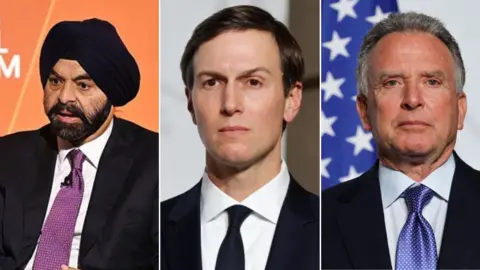
Also on the founding executive board are Marc Rowan, the head of a private equity firm, World Bank chief Ajay Banga and a US national security adviser, Robert Gabriel.

Each member would have a portfolio "critical to Gaza's stabilisation and long-term success", the White House statement said.

Trump had said on Thursday that the board had been formed, calling it the "Greatest and Most Prestigious Board ever assembled at any time, any place".

Further members of the board would be named in the coming weeks, the White House said.

Sir Tony was UK prime minister from 1997 to 2007 and took the UK into the Iraq War in 2003. After leaving office, he served as Middle East envoy for the Quartet of international powers (the US, EU, Russia and the UN).

It comes after the announcement of a separate 15-member Palestinian technocratic committee, the National Committee for the Administration of Gaza (NCAG), charged with managing the day-to-day governance of post-war Gaza.

Ali Shaath, a former deputy minister in the Palestinian Authority (PA) which governs parts of the occupied West Bank not under Israeli control, will head that new committee.

The statement also said that Nickolay Mladenov, a Bulgarian politician and former UN Middle East envoy, would be the board's representative on the ground in Gaza working with the NCAG.

Trump's plan says an International Stabilisation Force (ISF) will also be deployed to Gaza to train and support vetted Palestinian police forces and the White House statement said that US Major General Jasper Jeffers would head this force to "establish security, preserve peace, and establish a durable terror-free environment".

The White House said that a separate "Gaza executive board" was being formed that would help support governance and includes some of the same names as the founding executive board as well as further appointees.

The US peace plan came into force in October and has since entered its second phase, but there remains a lack of clarity about the future of Gaza and the 2.1 million Palestinians who live there.

Under phase one, Hamas and Israel agreed a ceasefire in October, as well as a hostage-prisoner exchange, a partial Israeli withdrawal, and an aid surge.

Earlier this week Witkoff said phase two would see the reconstruction and full demilitarisation of Gaza, including the disarmament of Hamas and other Palestinian groups.

"The US expects Hamas to comply fully with its obligations," he warned, noting these include the return of the body of the last dead Israeli hostage. "Failure to do so will bring serious consequences."

However the ceasefire is fragile, with both sides accusing each other of repeated violations.

Almost 450 Palestinians have been killed in Israeli strikes since it came into force, according to Gaza's Hamas-run health ministry, while the Israeli military says three of its soldiers have been killed in attacks by Palestinian groups during the same period.

And humanitarian conditions in the territory remain dire, according to the UN, which has stressed the need for the unrestricted flow of critical supplies.

Who else has been named to join Trump to oversee 'Gaza's stabilisation'?

Getty Images/EPA A composite image of Ajay Banga, Jared Kushner and Steve Witkoff.Getty Images/EPA

The White House has released the names of the members who will form the Trump administration's new "Board of Peace" for Gaza.

With the US president as chair, the board will oversee the work of a committee of Palestinian technocrats tasked with the temporary governance of Gaza - and its reconstruction.

Each member of the "Board of Peace" is expected to be in charge of a portfolio that will be "critical to Gaza's stabilisation", the White House added. But it is not yet clear who will be responsible for which priorities.

So who is on the board?

Sir Tony Blair

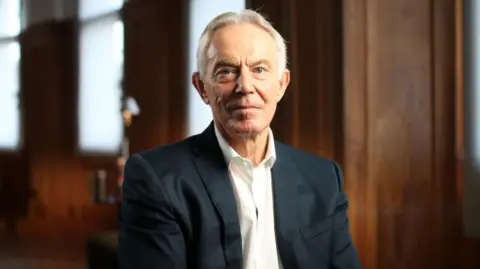
BBC/Monika Ghosh An image of former UK prime minister Tony Blair looking at the camera while dressed in a black suit and white shirt in a room with wooden walls. BBC/Monika Ghosh

Former UK Prime Minister Sir Tony Blair had long been talked about as a potential member of Trump's "Board of Peace, with the US president confirming back in September that he had expressed an interest in joining the body.

The former Labour Party leader was the UK prime minister from 1997 to 2007 and took the country into the Iraq War in 2003, a decision which means some may view his presence on the board as controversial.

After leaving office, he served as Middle East envoy for the Quartet of international powers - the United Nations, European Union, US and Russia - from 2007 to 2015.

Sir Tony is the only founding member of the executive board who is not a US citizen.

Sir Tony previously described Trump's plans for Gaza as the "best chance of ending two years of war, misery and suffering".

Marco Rubio

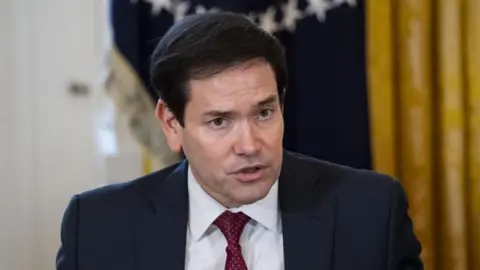
EPA An image of the US Secretary of State, Marco Rubio, speaking into a microphone while wearing a navy suit with a red tie.EPA

As US Secretary of State, Marco Rubio is central to the Trump administration's approach to foreign policy.

Before Trump's return to office, Rubio had spoken out against a ceasefire in Gaza, saying that he wanted Israel "to destroy every element of Hamas they can get their hands on".

But he has since praised the first phase of the Israel-Hamas ceasefire deal signed in October as the "best" and "only" plan.

Also in October, Rubio criticised a move by the Israeli parliament towards annexation of the occupied West Bank.
Steve Witkoff

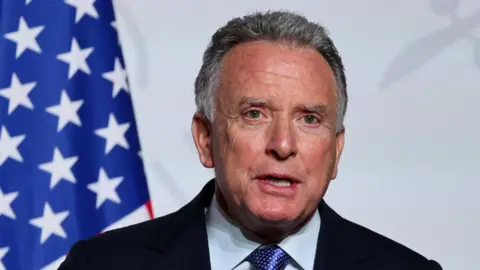
Reuters An image of the US Special Envoy to the Middle East, Steve Witkoff, speaking in front of the American Flag visible to the left.Reuters

US Special Envoy to the Middle East Steve Witkoff, a real estate magnate and golf partner to Trump, will also be on the board.

Earlier this month, Witkoff announced the start of phase two of Trump's plan to end the war in Gaza, adding that it would see the reconstruction and full demilitarisation of Gaza - including the disarmament of Hamas.

He added that he expects Hamas to "comply fully with its obligations" under the deal, or face "serious consequences".

Witkoff has been a central figure in US-led efforts to negotiate a peace deal between Russia and Ukraine, including holding a five-hour meeting with Russian President Vladimir Putin in Moscow in December.

Jared Kushner

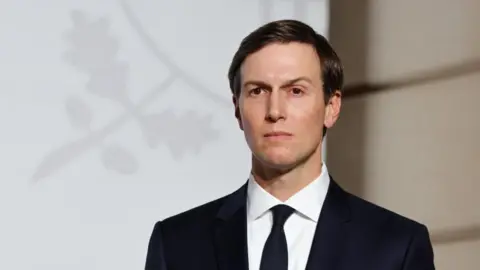
EPA An image of Jared Kushner dressed in a black suit with a white shirt staring off into the distance. EPA

Jared Kushner, the US president's son-in-law, has also played a key role in the Trump administration's foreign policy negotiations.

Alongside Witkoff, Kushner has often worked as a US mediator for the Russia-Ukraine and Israel-Gaza wars.

In November, he met with Israeli Prime Minister Benjamin Netanyahu to discuss key sticking points in the peace deal.

At a talk at Harvard University in 2024, Kushner said "Gaza's waterfront property could be very valuable... if people would focus on building up livelihoods."

Marc Rowan

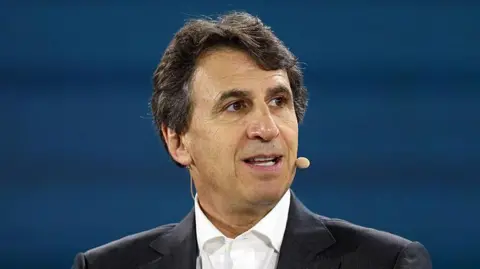
Getty Images An image of businessman Marc Rowan looking to the right with a microphone attached to his face, while dressed in a black suit and sat in front of a blue backdrop. Getty Images

Billionaire Marc Rowan is the CEO of Apollo Global Management, a large private equity firm headquartered in New York.

Rowan was seen as a contender to become US treasury secretary for Trump's second term.

Ajay Banga

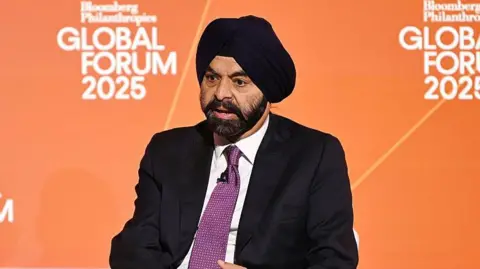
Getty Images An image of Ajay Banga speaking in front of an orange backdrop, while dressed in a black turban and black suit with a purple tie.Getty Images

Ajay Banga, president of the World Bank, has advised a number of senior US politicians, including President Barack Obama, during his lengthy career.

Born in India in 1959, Banga became a US citizen in 2007, and later served as the CEO of Mastercard for more than a decade.

Former US President Joe Biden nominated him to lead the World Bank in 2023.

Robert Gabriel

Robert Gabriel, a US national security adviser, will be the final member of the "founding executive board".

Gabriel has worked with Trump since his 2016 presidential campaign, shortly after which, according to PBS, he became a special assistant to Stephen Miller, another of Trump's key current advisers.

Nickolay Mladenov

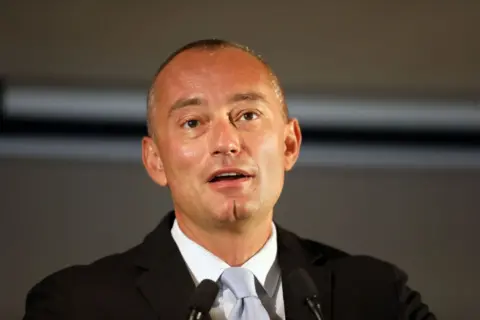
Getty Images Bulgarian politician Nickolay Mladenov speaking into a microphone while dressed in black suit and pale blue tie. Getty Images

The White House statement also said that Nickolay Mladenov, a Bulgarian politician and former UN Middle East envoy, would be the board's representative on the ground in Gaza.

He will oversee a separate 15-member Palestinian technocratic committee, the National Committee for the Administration of Gaza (NCAG), charged with managing the day-to-day governance of post-war Gaza.

The NCAG will be led by Ali Shaath, a former deputy minister in the Palestinian Authority (PA) which governs parts of the occupied West Bank not under Israeli control, will head that new committee.

明天真的会更好吗|杨贵妃们穿马甲——这不只是蠢货作妖,这是时代的倒退

img

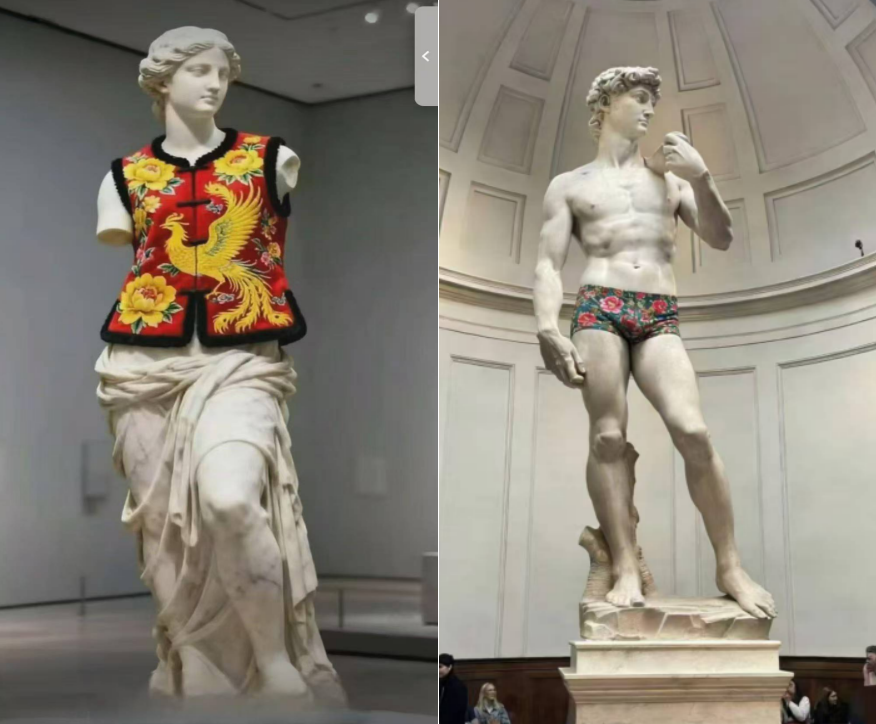
在西安华清池的氤氲水汽与唐风古韵中,一尊建于二十多年前的杨贵妃雕像静静伫立,曾是盛唐气象的诗意象征。然而近日,这尊承载着历史想象与艺术审美的塑像,竟因“裸露”之名竟要被穿上一件突兀的“花棉袄”——贵妃娘娘的玉体要严严实实裹起来,不可“暴露”,网友把效果图都做出来了。

img

这一幕荒诞得令人失笑,却又笑中带悲:给大卫穿裤衩、给蒙娜丽莎戴抹胸这种话题一次次上热搜,这不只是个别“卫道士”的无端作妖,更是一种文化认知的集体倒退,是时代精神在某些角落悄然退潮的警报。

同样的戏码,早不止上演于华清池。黄河壶口瀑布景区内营业的小毛驴因为偶尔想起它的女朋友而不合时宜的生理兴奋竟被投诉“有碍观瞻”,于是小毛驴们都被强行戴上了一个滑稽的“套子”。本国有些女性已经纯洁到脆弱、奇葩、滑稽、荒诞的地步了。都不知道她们的孩子是不是因牵手而受精怀孕……你们可以正常一点吗?

img

这些事件的荒谬性,其实还不在于有人提出奇葩意见,毕竟锑这玩意哪里都有啊!而在于相关部门无脑地“秒速整改”。你不能一接投诉,就无条件“整改”;不能一有争议,就无条件退让与妥协。真正的公共治理,应有底线,也应有风骨。

面对不合理、非专业、甚至带有明显偏执色彩的投诉,管理部门若不加辨析便立即“平事”,实则是对公共审美、文化尊严与艺术自由的双重背叛。这种“宁可错改,不可错放”的懒政思维,助长了极端保守主义的气焰,也助长了“人人皆可审判艺术”的民粹式审查。

杨贵妃雕像建于二十多年前,彼时社会虽不如今日信息发达,但对传统文化的理解与艺术表达的宽容,反而更具底气。那时我们尚能欣赏“回眸一笑百媚生”的风华,尚能接受盛唐的开放与自信;而今,技术更先进、信息更通达,某些人的精神却愈发紧缩,审美愈发贫瘠。这难道不是一种讽刺?

时代的进步,不该表现为对美的遮蔽,而应体现为对多元的包容。可如今,我们却在用“马甲”和“套子”为历史与艺术“消毒”,仿佛唯有如此,才能换取虚假的“纯洁”、“清净”。

img

CDT 档案卡
标题:杨贵妃们穿马甲——这不只是蠢货作妖,这是时代的倒退
作者:张传林
发表日期:2026.1.16
来源:微信公众号“明天真的会更好吗”
主题归类:杨贵妃穿马甲
CDS收藏:公民馆
版权说明:该作品版权归原作者所有。中国数字时代仅对原作进行存档,以对抗中国的网络审查。详细版权说明

这背后,是一种日益泛滥的“道德过敏症”。

它不源于真正的道德修养,而源于认知的狭隘与审美的匮乏。

简单说就是源于无知!

这次连胡锡进都看不下去了,义正严词指出:一个健康的社会,应当有能力区分“艺术表达”与“低俗挑逗”。若连古典雕塑、传统人物塑像都无法容身,那我们的文化自信从何谈起?若公共空间只能容纳千篇一律的“安全形象”,那创新与思想的火花又将在何处点燃?

更深远的危机在于,这种“投诉—整改”模式正在形成一种恶劣的示范效应。美术馆展览因“可能引发不适”而撤下作品,公共艺术因“个别观众不满”而被迫修改,创作者在动笔之初便自我审查:“这个会不会被举报?”长此以往,公共文化空间将沦为“无菌室”——干净,却无生命;安全,却无灵魂。

我们当然要尊重公众意见,但尊重不等于盲从。

公共管理需要倾听,但更需要判断。不能因为有人“看不惯”,就让整个社会为个别人的狭隘审美买单。黄河壶口的毛驴不该戴套,杨贵妃也不该穿马甲。艺术有其语境,历史有其真实,审美有其尊严。我们不能让少数人的“视觉不适”,成为扼杀美的理由。

悲剧的是:时代的倒退,往往不以战火与动荡为标志,而以“温和的保守”悄然完成。当人们开始为雕像穿衣服,为毛驴戴套子,为历史人物“正名”,他们自以为在守护道德,实则正在拆除文明的基石。

真正的文明,不在于人人穿得严实,而在于人人拥有理解美、尊重差异、包容多元的能力。

我们需要一个敢于直面真实、拥抱多元、尊重艺术的社会。 让雕像站立,让艺术呼吸,让思想自由——这才是对文明最基本的尊重。我们不能将审美的阵地交给一群醇货啊! 否则今天是贵妃穿马甲,明天还不知道出什么幺蛾子呢!

—– THE  END——

奥派老古|罗永浩还在煽动反智舆论!

和罗永浩,又开始作妖了。

他先是承认西兰花是在冤枉西贝。

食品工业的朋友们跟我说,冷冻西兰花成本确实更高,所以西兰花的问题在某种程度上是冤枉的(其他的基本都不冤,甚至不能算"黑",因为他家大部分就是预制菜!!!这个事实,靠撒谎、偷换概念,请黑公关都改变不了)

CDT 档案卡
标题:罗永浩还在煽动反智舆论!
作者:奥派老古
发表日期:2026.1.16
来源:微信公众号-奥派老古
主题归类:西贝预制菜风波
CDS收藏:公民馆
版权说明:该作品版权归原作者所有。中国数字时代仅对原作进行存档,以对抗中国的网络审查。详细版权说明

但是,他连道歉都不屑于,他可是带头攻击西兰花的人,传播过反智舆论,就这么轻轻放下自己?严以待人、宽以待已?

食品工业的朋友,会仅仅和他说冷冻西兰花更贵么?不可能,冷冻西兰花比在市场上采购的西兰花更新鲜,这本就是这一行业的常识,不可能不说,罗永浩就选择性的选择一个贵来回避真正的科学问题。

也即西贝选择用冷冻西兰化,是中高档餐饮企业站在给客户更好的营养、口感角度选择的成本更好的手段。

罗永浩一点也不诚实,不敢面对。

不可能是由于西贝今天爆出关店,才有人通知你的吧。

你早就知道至少在西兰花问题上冤枉了西贝,你怎么不早说呢?今天才说呢?你有品吗?敢为自己说错话负责吗?

不敢。

直至今天,还是一句否定自己的话都不说,死不认错。

不仅对西兰花问题不道歉,还在后面加一堆情绪用词,意思是:我只是某种程度 上冤枉了你,但你就是坏,用了预制菜,你就是撒谎。我没错!

贾国龙的应对是错误的,但这种错,可不是撒谎。

按政府出台的预制菜标准和定义,西贝就是没有。你把贾国龙的这种辩护说成成撒谎,偷换概念,这也太没品了吧。

罗永浩这与牛二与泼妇有什么区别?

请记住当时他的言论:

9月13日凌晨3点21分,罗永浩在社交平台上接连发问:“如果只靠冷冻技术,完全不用防腐剂,怎么才能让有机西兰花的保质期达到24个月?还能用它做成适合给孩子吃的菜肴?”

这话就是科盲嘛!

绝大多数冻品都不需要用防腐剂,这种问题导向什么样的舆论呢?

你好歹问一下行业内人士,是个舆论大V,就得让自己少说无知的话。

他无知,但无知得理直气壮。

很多人不知道,网红也不会全知全能,骂错了,收回啊,道歉啊,做个人呀!

比如,他骂电信运营公司的千兆网络下载速度只有九十多兆的问题。

通讯行业里,运营商标称的“千兆”为比特速率(Mbps),而下载速度常显示字节速率(MB/s),换算关系为1MB/s = 8Mbps,因此千兆宽带理论下载速度约125MB/s。

当然有不了解行业的人跟着一起起哄,说,你运营商就应该说明一下标准啊。

他们不知道的是,通讯行业从上游到下游(设备到运营),全部是用比特速率,是软件行业,为了简化理解,搞了一个新的单位。

要修改标准,可不止是运营商,而是整个通讯行业的产品单位都要改,比如千兆交换机,也要改成叫125兆交换机了。

这只是一个通讯行业与软件行业搞出两种计量单位冲突的问题。

罗永浩身为IT圈人士,至少身边不缺这种有基本常识的朋友,怼完了后,有道过歉吗?

九十多兆的下载速度,对于独享千兆网来说,就是正常范围内的事,要知道,网线、路由器、光猫、网卡所有的全部是顶级的,也就能到100-110兆每秒,理论速度永远达不到。

因为传输的过程本身就有速度的损耗。

正常范围内的网速,你怎么就要发疯?就要利用网红身份对运营商?

如果连身边的朋友都不提醒他一下,那他得多没朋友、多没有人缘。如果提醒过他搞错了,他却不道歉,收回无知言论,他得有多没品?

即使是他别的攻击都是对的,光是西兰花问题,就逃不了一个煽动反智舆论的罪名。当然,这些网络大V都很擅长逃避责任,他和司马南一样,喜欢用反问的方式来规避自己煽动的责任。

其他言论基本上和西兰花事件一样,都是构陷和污蔑。

包括现在的回应,也是继续在煽动。以下是他的回应内容:

多数发达国家的预制菜都比我国预制菜的市场份额要高,但这些国家的大部分预制菜都去了消费者市场和快餐业,而不是像在我们这里:去了正式的餐厅冒充现做的饭菜(否则也解释不了我们的餐饮业为什么会有锅气香精这么变态的"科技狠活儿")

国家支持发展预制菜工业,是为了让中国人吃得更方便、更卫生,更健康,不是为了让餐馆老板用料理包骗同胞(之前有媒体报道说他家的海外店就不用预制菜,操!)不是为了让成千上万受过训练的厨师下岗,被"微波炉操作师"和"料理包加热师"替代。

以上,不仅是罗永浩无知,也是利用国人的无知,在继续煽动。

好吧,我就来继续反击吧。

我们就去看一看,罗永浩眼里包括不少人眼里那些被大家奉为“美食圣地”的发达国家,看看他们的餐厅后厨到底长什么样。

我要告诉大家一个可能会让你幻灭,但绝对真实的结论:在欧美和日本,越是成熟的餐饮市场,预制菜的渗透率就越高。

甚至在那些人均消费几百美元的米其林餐厅里,所谓的“预制工艺”,也就是我们通俗说的“料包化”,早已是公开的秘密,甚至是行业运行的基石。

先看那个被无数文青吹捧为“匠人精神”大本营的日本。

在日本餐饮界,有一个公开的数据,预制菜(日本称为“中食”或业务用调理食品)在餐饮行业的渗透率早就超过了百分之六十。

这意味着什么?意味着你在日本街头随便进一家馆子,大概率吃到的一多半都是预处理过的东西。

大家去日本旅游,大概率都吃过像萨莉亚、吉野家、食其家这样的连锁店。尤其是萨莉亚,号称“意大利家庭餐厅”,价格便宜得惊人,味道还相当稳定。

但你知道萨莉亚的后厨长什么样吗?

萨莉亚的后厨,被称为“没有菜刀的厨房”。

这可不是夸张。

在萨莉亚的门店里,你是找不到一把菜刀的。所有的食材,从洗好切好的生菜,到已经调好味的意面酱,再到那些看起来热气腾腾的肉菜,全部都是在中央工厂处理完毕,然后通过冷链配送到店的。

店员要做的事情极其简单,就是剪开包装袋,倒进盘子,或者放进自动化的烤箱和加热器里。甚至连撒在披萨上的罗勒碎,都是工厂按克数分装好的。

日本人对此反感吗?完全没有。

日本人把它称之为“经营的奇迹”。因为只有这样,才能在人力成本极高的日本,让普通工薪阶层只花五百日元就能吃饱吃好。日本消费者非常理性,他们知道,要在这个价位吃到这种品质,工业化是唯一的路径。

哪怕是那些稍微高档一点的日式定食店,甚至是某些所谓的“老铺”。

你以为那个每天早上热气腾腾的味噌汤是老板娘四点钟起来熬的吗?

绝大多数情况下,那也是大型食品公司提供的浓缩味噌汤料,店里只是加了开水和一些冷冻的豆腐丁、海带芽。

日本的味之素、日清等公司,拥有全球最顶尖的汤底提取技术。他们能把鲣鱼和昆布的风味提取出来,做成还原度极高的料包。

好,你可能会说,那是快餐。

那我去吃怀石料理,去吃昂贵的法餐,总该是现做的吧?

这就触及到了现代高端餐饮的一个核心秘密。

在欧美的高端餐饮界,有一个词叫“Sous-vide”,翻译过来叫“真空低温慢煮”。这个词听起来非常高大上,非常有科技感,是分子料理的代表。

但它的操作流程是什么呢?

厨师在后厨(或者在几公里外的备餐厨房),把顶级的牛排、鸭胸或者鱼肉,和香草、黄油、调料一起放进一个塑料袋里,抽成真空。

然后把这个塑料袋扔进一个恒温的水浴箱里,用六十度左右的低温,煮上几个小时甚至十几个小时。

煮好之后呢?并不是马上给客人吃。而是立刻扔进冰水里急冻降温,然后放进冰箱冷藏保存。

等到晚上客人点单的时候,厨师把这个塑料袋拿出来,在热书里回温,剪开袋子,把肉拿出来,在高温的平底锅或者喷枪下,把表面煎至金黄,摆盘上桌。

要是中国这些反对预制菜的人看到这个流程,马上就得炸毛。提前制作、真空包装、冷藏保存、复热出餐。

这在本质上,和西贝被骂的“预制菜”,和罗永浩嘴里的“料理包”,在工业逻辑上有任何区别吗?

没有区别。

唯一的区别就是,一个叫“真空低温慢煮”,卖你两百美元;一个叫“预制菜”,卖你几十人民币。

为什么米其林大厨都要这么做?是因为他们懒吗?

恰恰相反,是因为追求极致的品质。

传统的煎牛排,完全靠厨师的手感。火大一分,外面焦了里面还没熟;火小一分,汁水就流失了。

但是用这种“预制”的方法,可以通过精确的温控,让肉从里到外都达到完美的粉红色,汁水被牢牢锁在细胞里。

在法国和美国的高端餐饮界,这种“预处理”也就是Pre-prep,是绝对的主流。

这就涉及到了另一个关键因素:人力成本。

在欧美,一个成熟厨师的时薪是惊人的。如果让一个拿着几十美元时薪的大厨,每天花三个小时去削土豆皮、去熬基础高汤、去切洋葱,那这家餐厅的老板第二天就得破产。

所以,欧美诞生了像Sysco(西斯科)这样的巨无霸供应链企业。

在那个大家印象中“遍地新鲜食材”的美国,Sysco控制了绝大多数餐厅的命脉。

不管是路边的夫妻店,还是五星级酒店的餐厅,每天早上都会看到Sysco的冷链卡车停在后门。

卸下来的是什么?是已经切好的胡萝卜丝,是已经预炸过的冷冻薯条,是已经调好味的五加仑桶装酱汁,甚至是已经做好的冷冻熔岩蛋糕。

有统计数据显示,美国餐饮食材的预处理率高达百分之七十以上。

很多你以为是餐厅独家秘制的酱料,其实都是工厂生产的。

厨师要做的,可能只是往里面加一点点新鲜的欧芹碎,或者滴两滴柠檬汁,来“唤醒”味道,顺便搞一点“仪式感”。

这就是现代餐饮的真相:除了最顶部的那个摆盘和最后的加热环节,底层的脏活累活,早就被工业化承包了。

再来说说大家最迷信的“生鲜”。

大家去日本吃寿司,去欧洲吃海鲜,觉得那肯定是从海里刚捞上来的。

我又要打破大家的幻想了。在欧美和日本,为了防止寄生虫(比如异尖线虫),法律往往强制要求生食的鱼类必须经过“超低温急冻”处理。

也就是说,你在东京高级寿司店里吃到的金枪鱼,绝大概率是在捕捞船上就已经被零下六十度急冻了,然后是一路冷链运过来的。所谓的“冰鲜”,在很多时候,反而是次一等的选择,因为它的细菌繁殖风险更高。

这种“冻品”,是安全和品质的代名词,而不是廉价的代名词。

那为什么在国外,很少听到消费者像骂西贝一样,疯狂攻击餐厅用预制菜呢?

难道是因为外国人舌头不灵吗?当然不是。

第一,是因为他们的社会科普在精英层面相对做得好。

在欧美,食品工业的透明度相对较高。受过较好教育的消费者从小接受的教育让他们明白,巴氏杀菌是好的,冷链是好的,添加剂只要合法合规就是安全的。他们不会因为看到一个塑料袋就觉得这是“猪食”。他们更看重的是最终端上来的口味和营养成分表。

虽然反现代食品工业舆论依然强大,但在精英层面,没有多少这类声音。

欧美的普通人一样认定预制菜是垃圾食品,但精英层面反而这类声音小得多,与中国不一样,罗永浩这类的言论影响了一大群精英人群。

第二,是因为国外的预制菜产业已经完成了“良币驱逐劣币”的过程。

在日本,做预制菜的企业,是味之素、日冷这样的世界五百强。

他们有庞大的研发团队,他们的产品真的能做到比普通家庭主妇做得好吃。当工业品的品质超过了手作的平均水平时,消费者自然就接受了。

而我们国内的问题在于,预制菜这个赛道还处在草莽阶段。

确实有很多小作坊,用着最烂的边角料,做着几块钱一包的劣质料理包,让大众有一种预制菜就是低档产品的认知。。

可是,罗永浩们的攻击,却是不分青红皂白,一竿子打翻一船人。

他们把“工业化”等同于“低端”,把“标准化”等同于“没有灵魂”。不少人支持罗永浩,他们说,预制菜卖这么贵,就是欺诈。

那我要问的是,凭什么预制菜就应该便宜?

不少人想象中的新鲜健康的餐饮成本是什么?是厨师早上骑着三轮车去菜市场,跟大爷大妈讨价还价,买一堆带着泥的萝卜白菜回来。这个成本确实是肉眼可见的。

但是,当你把这个规模放大到一千家门店,还要保证每一家店的味道都一模一样的时候,这就不是买菜那么简单了,这就变成了一场精密管理的战争。

首先是选材的成本。

你自己做饭,买个土豆,有点歪瓜裂枣,削掉就是了。但是工业化生产不行。为了适应自动化流水线的清洗、去皮和切割设备,原材料必须高度标准化。土豆的大小、形状、淀粉含量,甚至含水量,都有严格的指标。

这意味着什么?这意味着极高的筛选率。

在农业源头,可能只有百分之三十甚至更少的顶级农产品,能够进入西贝这种企业的采购名单。

这种“掐尖儿”的采购方式,直接就拉高了原材料的底价。你是在为“标准化”这个极其昂贵的属性买单。

接下来是处理环节。

很多人觉得,机器切菜肯定比人工便宜啊。

如果你只是用那种几十块钱的切片机,那确实便宜。但现代食品工业用的是什么?是智能化的光学分选机,是能识别出哪怕一根头发丝异物的X光机。

更重要的是“保鲜”这个环节,这是真正的吞金兽。

比如保鲜西兰花用的液氮急冻技术。大家知道那意味着什么吗?那意味着要建立庞大的液氮供应系统,要维持零下几十度的超低温隧道。这不仅是设备折旧的钱,更是巨额的能源账单。

传统的蔬菜运输,是常温或者加冰块,损耗率极高,到了后厨还得扔掉一大半烂叶子。现代供应链是把这个损耗前置了,在工厂里处理干净,然后用全程冷链运送到全国各地。

大家注意,全程冷链。这四个字说出来轻巧,做起来就是钱山银海。

从工厂出货,到干线物流,到城市仓储,再到最后一公里的配送,必须要保证温度恒定。只要有一个环节温度波动,产品质量就会雪崩。

为了维持这个冷链网络,企业需要投入巨大的IT系统来监控,需要购买昂贵的冷藏车辆。这比一个厨师骑三轮车买菜的成本,不知道高到哪里去了。

所以,当你吃到那一口口感依然脆嫩的冷冻西兰花时,你吃的不仅仅是蔬菜,你吃的是液氮技术,是冷链物流,是无数个传感器和数据监控系统。这些科技含量,难道不应该体现在价格里吗?

好,我们再来说说第二个维度的成本,那就是“空间”和“效率”。

现在的餐饮店都开在哪?都开在大型购物中心里。商场的租金是什么水平?那就是寸土寸金。

在传统的正餐馆里,后厨的面积往往要占到总面积的三分之一甚至更多。你需要洗菜区、切配区、烹饪区、仓储区。每一个区域占用的面积,都是实打实的房租成本。

预制菜的逻辑是什么?它是用空间的置换来换取效率。

通过中央厨房的预处理,商场门店的后厨可以大幅缩小。切配区没了,粗加工区没了。省下来的面积,可以摆更多的桌子,接待更多的客人。

有人说了,你看,省面积了,房租低了,那你菜价就该便宜啊。

这就又天真了。这省下来的房租,并没有变成利润装进老板口袋,而是转移支付给了那个更昂贵的中央厨房。建设一个高标准的中央厨房,动辄就是几个亿的投入。那里的洁净度要求是手术室级别的,地板、墙面、空气过滤系统,那都是钱。

而且,为了在商场那种极其有限的厨房条件下,还要实现快速出餐,企业必须在研发上投入巨资。

说到这,肯定还有人不服。说你吹得天花乱坠,预制菜就是为了省人工啊。把大厨裁了,换成操作工,这人工成本不就下来了吗?

这里面有一个巨大的误解。那就是大家严重低估了“顶级预制工艺”的复杂性,也严重高估了普通餐厅里所谓“现炒”的含金量。

西贝还没有做到米其林餐厅那种加热模式,绝大部分菜品的加熟,是在餐厅完成的,美德拉反应是在吃之前才形成的。

当然,米其林餐厅把这一套技术叫作“分子料理”,叫它“现代烹饪艺术”,你就觉得高端,觉得值几千块。

而西贝还只是前面部分进行预处理、工业化,量产了,你就认为是只值路边摊的价。

这就是双标。

事实上,为了达到这种工业级的稳定,西贝付出的成本可能比一个普通饭馆请两个厨师要高得多。

普通的现炒,依赖的是厨师个人的状态。今天心情好,炒得好吃;明天和老婆吵架了,盐就放多了。而顶级的工业化预制,追求的是六西格玛级别的稳定性。为了这个稳定性,企业必须引入昂贵的质检体系。

每一批次的菜品出来,都要经过理化指标的检测。盐度、糖度、酸碱度,甚至色泽,都有数据卡着。不合格的直接销毁。

这种为了“品控”而产生的损耗成本,是普通小馆子根本无法想象的。

预制菜之所以能存在,之所以被所有的餐饮巨头——不管是麦当劳、肯德基、米其林餐厅,欧美各种高档餐厅,还是西贝——作为核心战略,不是因为它“便宜”,而是因为它“稳定”和“安全”。

在一个高度商业化的社会里,稳定和安全,本身就是最昂贵的商品。

你想想看,你在北京吃到的西贝,和在深圳吃到的一模一样。这背后需要多么庞大的物流和管理体系来支撑?

如果真的像网上的键盘侠说的那样,只要买个冷冻包热一下就行,那为什么那些用廉价料理包的小店,卖十几块钱都还要倒闭?

而西贝为什么能长期把客单价维持在那个水平?

因为消费者不是傻子。

消费者的味蕾能分辨出,什么是五块钱的低品质肉,什么是经过液氮急冻、进价极高的草原羊肉。虽然它们都是“预制”的,但一个是垃圾,一个是现代工业的结晶。

这就好比,优衣库的衣服也是流水线生产的,爱马仕的包其实也有很多工序是标准化的。你不能因为它们都是工业品,就要求爱马仕卖优衣库的价。

西贝的问题,不在于它用了预制菜,也不在于它的成本低。而在于它没有把这个价值传递给消费者。

它没有讲清楚,我这个预制菜,不是为了偷工减料,而是为了让你在任何时间、任何地点,都能吃到那一口经过科学计算的、营养保留最完整的、品质最稳定的好菜。

人们总是对“人工”有着过度的迷恋。觉得人才是值钱的,机器是不值钱的。

但现实是,在一个劳动力越来越昂贵,而对食品安全和品质要求越来越高的时代,依“人”才是最不可控、成本最高、风险最大的。

真正的高科技,往往是反直觉的。

它看起来冷冰冰,没有烟火气,但它背后凝聚的资金密度和智力密度,远远超过了一个颠大勺的厨师。

最后,我想说,预制菜在全球范围内的普及,是人类社会分工的必然结果。

三百年前,每个人身上的衣服都是家里女人一针一线缝出来的。那时候,如果有谁穿了一件纺织厂机器织出来的衣服,可能会被嘲笑是没有温度、没有灵魂。

但今天,还有谁会因为穿了优衣库而感到羞耻吗?还有谁会非要追求每一块布料都是手工纺织的吗?

餐饮业正在经历纺织业三百年前经历的变革。

在未来,百分之九十的餐食,注定将由中央厨房和食品工厂来完成。这是效率的胜利,也是品质的胜利。

有一些人说,应该杜绝这种标准化的连锁餐厅,应该回归小馆子靠着厨师手艺来生存的小馆子,不好意思,这种店铺在现代商业体系中,更难以活下去,因为他不能带来质量和安全的稳定性。

绝大部分食品安全问题,包括你吃到的口味不稳定问题,就是小餐厅搞出来的,他没有这么多钱达成稳定与安全,也没有办法给你产品质量的确定性。

消费者最终一定会抛弃这种小馆子。

西贝的尴尬在于,它处在这个变革的夹缝中。它用奢侈品的成本去做工业化的产品,却没能讲好这个价值故事,反而被舆论的脏水泼了一身。

所以,当我们把目光投向全球,你会发现,西贝走的路,其实就是麦当劳走过的路,是吉野家走过的路,是米其林餐厅走过的路,是所有现代餐饮巨头必经的成人礼。

中餐的味道,在全世界餐饮里,是被广泛认同的,但中餐难的就是标准化,西贝本来是中餐标准化的王者,年入七十多亿,快要上市了,有可能成为中高端餐饮的中国麦当劳,甚至走向全球,结果呢?

罗永浩几句话就能毁了它。

我们不需要对“预制菜”感到恐慌。我们需要恐慌的,是那些利用我们的无知,试图把我们拉回农耕时代的“叫魂者”。

因为,阻碍我们吃得更好、更安全、更高效的,从来不是技术,而是傲慢与偏见,是对科学和现代商业的无知。

我不过是再一次在证明,罗永浩是一个无知、偏执、死不认错的网络黑嘴,反智舆论领袖对世界的伤害极大。

刘翔辟谣“移民”传闻:中国人爱中国

中国退役田径运动员刘翔辟谣“移民美国”传闻,自称“爱国热血小青年”,还调侃要造谣者“站出来,保证不打他”。

据长安街知事微信公众号,刘翔近日在小红书账号发布视频《用一场旅行结束2025!》,晒出自己的旅行片段。

视频末尾,刘翔说:“最近还有一个传闻,说我移民了。谁说的?站出来,保证不打他!我一个爱国热血小青年,我移民?到哪儿去移民?真是的。”

他还说,“中国人,爱中国,记住了!”刘翔的账号备注也写着“爱国热血小青年”。

“刘翔回应移民美国”话题星期五(1月16日)一度登上小红书热搜第一。

公开资料显示,刘翔1983年7月出生于上海市,中国前110米栏运动员,曾效力于中国国家田径队,政协第十一、十二届全国委员会委员。

2004年雅典奥运会男子110米栏决赛,刘翔获得金牌,而且他的12秒91成绩也打破奥运会纪录,追平了由英国选手科林·杰克逊创造的世界纪录夺冠。

刘翔是中国田径史上、也是亚洲田径史上第一个集奥运会、室内室外世锦赛、国际田联大奖赛总决赛冠军和世界纪录保持者于一身的田径运动员。

2015年4月7日,刘翔宣布退役。

中国公布去年纪检监察机关立案省部级及以上干部115人

中国官方公布,全国纪检监察机关去年立案省部级及以上干部115人。

中共中央纪委国家监委网站星期六(1月17日)公布,2025年全国纪检监察机关共接收信访举报416.8万件次,其中检举控告类信访举报128.2万件次。处置问题线索263万件。立案101.2万件,其中立案省部级及以上干部115人、厅局级干部5016人、县处级干部4.1万人、乡科级干部13.7万人;立案现任或原任村党支部书记、村委会主任9.1万人。

此外,全国纪检监察机关处分98.3万人,其中党纪处分72.7万人、政务处分32.1万人;处分省部级及以上干部69人,厅局级干部4155人,县处级干部3.5万人,乡科级干部12.5万人,一般干部13.3万人,农村、企业等其他人员68.6万人。

中央纪委国家监委网站也说,坚持受贿行贿一起查,立案行贿人员3.3万人,移送检察机关4306人。

US justice department investigating Minnesota Democrats over alleged obstruction of ICE

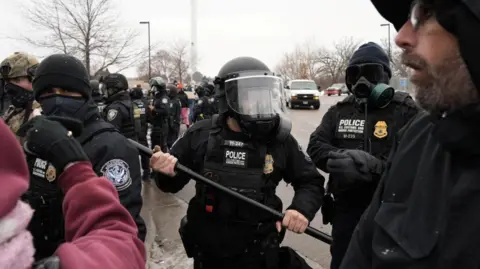
Reuters a Customs and Border Patrol agent holding up a baton as more agents gather behind himReuters
Customs and Border Patrol agents gather as protests continue outside Minneapolis' Whipple Federal Building, which has become a de-facto ICE headquarters

The US justice department is investigating two prominent Minnesota officials over alleged attempts to impede federal immigration agents, in an escalation of the Trump's administration's clash with Democrats.

Governor Tim Walz and Minneapolis Mayor Jacob Frey are facing an inquiry over statements they have made about Immigration and Customs Enforcement (ICE), reports the BBC's US partner CBS.

It comes as fresh details emerged in the death of a Minneapolis woman shot last week by an ICE agent in the city, sparking nationwide protests.

Renee Good, 37, was found with at least three gunshot wounds and possibly a fourth to the head, according to official reports viewed by CBS.

Governor Walz responded on Friday to news of the inquiry against him by posting on X: "Weaponizing the justice system against your opponents is an authoritarian tactic.

"The only person not being investigated for the shooting of Renee Good is the federal agent who shot her."

The governor has urged Minnesotans to protest peacefully, although he has previously been accused by the Trump administration of inflammatory rhetoric for describing ICE as a "modern-day Gestapo". Frey has demanded that immigration agents get out of Minneapolis.

The Washington Post reports that the justice department has issued subpoenas to Walz and Frey.

The inquiry is focused on a federal statute, 18 U.S.C. § 372, which makes it a crime for two or more people to conspire to prevent federal officers from carrying out their official duties through "force, intimidation or threats", a US official told CBS.

Protests continued in Minneapolis on Friday after new details emerged about the death of Good, and local officials appealed for calm on the streets over this public holiday weekend.

An incident report from the Minneapolis Fire Department said when they responded to the shooting scene last week, it appeared Good had been shot twice in the chest, once in her left forearm and a fourth wound, possibly from a gunshot, was seen "on the left side of the patient's head".

Paramedics found Good unresponsive with an irregular pulse, and she was pronounced dead in the ambulance on the way to hospital, according to the report seen by CBS.

The Trump administration has said that Good was impeding federal law enforcement and tried to run the agent over. Local officials say Good was a legal observer who posed no danger.

Video of the incident show ICE agents approaching a car, which is blocking traffic and parked in the middle of the street. An officer instructs her to get out of the car.

As Good turns her wheel apparently trying to drive away, her Honda Pilot SUV pulls forward with one of the agents standing near the front of the vehicle. He pulls his gun and fires.

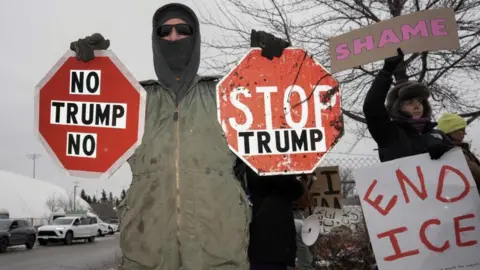
Reuters a protester hold up stop signs with the words "Stop Trump" and "No Trump no"Reuters

Footage from the scene shows the agent walking off afterwards.

But Department of Homeland Security (DHS) officials have told CBS the officer suffered internal bleeding to the torso following the incident. No further details have been disclosed.

The FBI is investigating the incident, although there is no federal civil rights inquiry into the agent who opened fire.

Meanwhile, President Donald Trump blasted demonstrators and local leaders on Friday.

On Truth Social, he accused protesters of being "highly paid professionals", adding that Walz and Frey had "totally lost control".

Later, the Republican president told reporters at the White House that he did not plan to invoke the Insurrection Act and send in troops to quell unrest in Minnesota, after earlier this week suggesting he might do so.

"If I needed it, I'd use it. I don't think there's any reason right now to use it," he said. "It's very powerful," he added.

Bloomberg via Getty Images lawmakers stand in front of podium with Rep. Pramila Jayapal speaking into a microphoneBloomberg via Getty Images
Democratic lawmakers held a hearing and press conference in Minnesota on Friday, led by Washington Rep. Pramila Jayapal (center)

Thousands of ICE officers remain deployed in the state.

Democratic lawmakers travelled to the city and spent Friday condemning federal immigration operations in the state, accusing ICE of reckless and lawless actions.

Ilhan Omar, a congresswoman from Minnesota who has long feuded with Trump, claimed that ICE was trying to "provoke chaos and fear".

Adriano Espaillat, a congressman from New York, said ICE had become a "deadly weapon".

Washington congressman Pramila Jayapal said ICE agents should not be allowed to wear masks, or make arrests without warrants, and should be required to have body cameras and name tags.

The Democratic lawmakers also interviewed several residents who alleged they had been shackled and detained by ICE for hours until they could prove they were US citizens.

The BBC has contacted the DHS and ICE for comment.

DHS spokeswoman Tricia McLaughlin told CNN on Friday that if there was "reasonable suspicion" of someone who is "in the vicinity" of a person being detained by a DHS operation, they might be asked to confirm their identity.

She rejected suggestions such tactics could be discriminatory, saying "racial animus has no place in DHS".

台美洽签谈判文件大陆促恪守一中原则 台外交部:无权置喙

中国大陆针对台湾和美国洽签关税谈判文件,强调反对建交国与台湾商签具有主权意涵和官方性质的协定,台湾外交部回应指责中国大陆无权置喙。

台湾外交部星期五(1月16日)在官网新闻稿中说:“中国无权置喙、也无权干预他国的主权行为,中方的言论凸显其霸权心态,更是企图片面改变国际秩序的麻烦制造者。”

历经九个月关税谈判后,美国对台湾实施的对等关税调确定降为15%,且不叠加原“最惠国”税率,待遇与日、韩、欧盟齐平。

作为回报,台湾也承诺涉及5000亿美元(6439亿新元)晶片投资和授信。但在达成协议后,美国商务部长卢特尼克仍不讳言,华盛顿的目标,是将台湾半导体供应链的40%转移至美国。

美国总统特朗普去年4月宣布对台加征30%对等关税后,双方共进行了六轮谈判,耗时九个月,直到星期四(15日)谈判团队完成总结会议,才签署投资合作谅解备忘录。

对于美台洽签关税谈判文件,中国大陆外交部发言人郭嘉昆星期五在例行记者会上重申,“中方一贯坚决反对建交国与中国台湾地区商签任何具有主权意涵和官方性质的协定,美方应当切实恪守一个中国原则和中美三个联合公报”。

天津大学原校长金东寒被免人大职务 并从院士名单撤下

天津大学原校长金东寒在卸任一年后被罢免天津人大代表、撤销天津人大常委会委员职务。他的名字也从中国工程院院士名单中撤下。

《天津日报》星期四(1月15日)发布的天津市人大常委会公显示,南开区人大常委会决定罢免金东寒的市十八届人大代表职务。依照相关规定,金东寒的市人大常委会委员职务相应撤销。

澎湃新闻同日报道,金东寒名字已从中国工程院官网的“全体院士名单”中撤下。

公开信息显示,今年65岁的金东寒1978年3月就读于武汉水运工程学院(现武汉理工大学),获学士和硕士学位;1989年5月毕业于中国舰船研究院获博士学位。他在2004年2月任中国船舶集团公司第七一一研究所所长兼总工程师,后于2009年当选中国工程院院士。

金东寒曾担任多所知名大学校长、党委书记等职务,他在2019年5月任天津大学校长,2025年1月卸任天津大学校长职务。

中国实践三十二号卫星发射失利

中国实践三十二号卫星发射失利。

据新华社报道,中国星期六(1月17日)凌晨12时55分在西昌卫星发射中心,使用长征三号乙运载火箭发射实践三十二号卫星,火箭飞行异常,发射任务失利。具体原因正在进一步分析排查。

另据快科技报道,长征三号乙为中国航天科技集团一院抓总研制的中型液体运载火箭,采用三级半串并联构型,主要用于地球高轨发射任务,兼顾执行地球中轨和深空发射任务。

报道称,长征三号乙也是中国最常用的高轨道运载火箭,此前承担过众多重要卫星发射任务,有着较为丰富的发射履历。

❌