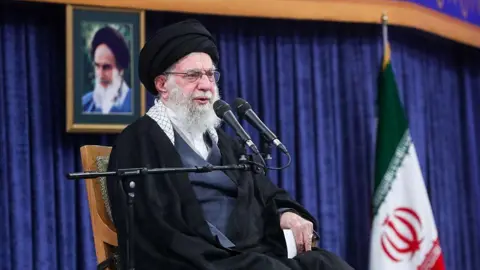
Iran's Supreme Leader, Ayatollah Ali Khamenei, has accused the US and Donald Trump of being responsible for "casualties, damage and slander" in his country during recent protests.
In a speech on Saturday, Khamenei acknowledged that thousands of people had been killed during recent unrest, "some in an inhuman, savage manner" but blamed the deaths on "seditionists".
The US president has urged Iranian anti-government demonstrators to "keep protesting" and threatened military intervention if security forces kill them.
Protests in Iran have claimed 3,090 lives, according to US-based Iranian Human Rights Activists News Agency (HRANA), in unrest that started over the economy on 28 December.
Since then, the protests have turned into calls for the end of the rule of Iran's supreme leader.
The Iranian government has called the demonstrations "riots" backed by Iran's enemies.
Protesters have been met with deadly force and there has been a near-total shutdown of the internet and communication services.
There have been fewer reports of unrest in recent days but with internet access still restricted developments on the ground remain unclear.
During his speech on Saturday, Khamenei also said Iran considered President Trump to be a "criminal" and said the US must be "held accountable" for recent unrest.
He also claimed on social media that "America's goal is to swallow Iran".
Trump has not yet responded to the supreme leader and the BBC has approached the White House for a comment.
Donald Trump said on Wednesday he had been told "the killing in Iran has stopped", but added that he had not ruled out military action against the country.
His comments came after the US and UK both reduced the number of personnel at the Al-Udeid air base in Qatar.
Officials told CBS, the BBC's US partner, that a partial American withdrawal was a "precautionary measure".
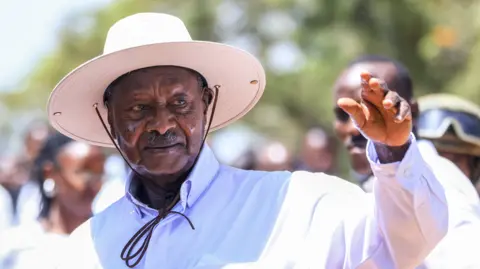
Yoweri Museveni first came to power in 1986 as a rebel leader
President Yoweri Museveni has been declared the winner of Thursday's election extending his four decades in power by another five years.
He gained 72% of the vote, the election commission announced, against 25% for his closest challenger Bobi Wine, who has condemned what he described as "fake results" and "ballot stuffing". He has not provided any evidence and the authorities have not responded to his allegations.
Wine has called on Ugandans to hold non-violent protests.
Museveni, 81, first came to power as a rebel leader in 1986 but since then has won seven elections.
The election process was marred by violence and Wine, a 43-year-old former pop star, says that at least 21 people have been killed around the country in recent days.
The authorities have so far confirmed seven deaths.
Access to the internet has been cut in the country since Tuesday, making it hard to verify information.
The authorities say the blackout was necessary to prevent misinformation, fraud and the incitement of violence - a move condemned by the UN human rights office as "deeply worrying".
Wine has demanded that the internet be restored.
Overnight, Wine's party said that he had been abducted from his home in the capital, Kampala - a claim denied by the police.
Wine later issued a statement on Facebook saying that he had managed to evade a night-time raid by security forces and was in hiding.
He had previously said he was under house arrest.
This has not been confirmed by the police but spokesman Kituuma Rusoke said Wine's movements were restricted because his home was an area of "security interest".
"We have controlled access to areas which are security hotspots," Uganda's Daily Monitor paper quoted him as saying.
"We cannot allow people to use some places to gather and cause chaos," he said.
The Syrian army is moving into areas east of Aleppo city, after Kurdish forces started a withdrawal.
Syrian troops have been spotted entering Deir Hafer, a town about 50km (30 miles) from Aleppo.
On Friday, the Kurdish Syrian Democratic Forces (SDF) militia announced it would redeploy east of the Euphrates river. This follows talks with US officials, and a pledge from Syrian President Ahmed al-Sharaa to make Kurdish a national language.
After deadly clashes last week, the US urged both sides to avoid a confrontation. President al-Sharaa is seeking to integrate the Kurds' military and civilian bodies into Syrian national institutions.
In a statement to state-run news agency Sana, the Syrian army said its forces "began entering the western Euphrates area", and declared it had established "full military control" of Deir Hafer.
The military urged civilians not to enter the operations area until it is secured and "cleared it of all mines and war remnants".
Images showed Syrian forces advancing towards the area, including with tanks.
The move comes after Kurdish leader Mazloum Abdi agreed to pull back his US-backed SDF "towards redeployment in areas east of the Euphrates", responding to "calls from friendly countries and mediators".
US special envoy Tom Barrack and Mazloum Abdi are set to meet later on Saturday in Erbil, the capital of Iraqi Kurdistan.
In recent days, the Syrian army had urged civilians to flee the Deir Hafer area, with at least 4,000 people leaving, according to Syrian authorities.
EPA
Syrian civilians cross a water canal as they flee eastern Aleppo in northern Syria
Before the Kurdish withdrawal, President al-Sharaa said he would make Kurdish a national language, and recognise the Kurdish new year as an official holiday.
The decree, announced on Friday, is the first formal recognition of Kurdish national rights since Syria's independence in 1946. It stated that Kurds were "an essential and integral part" of Syria, where they have endured decades of oppression under previous rulers.
Despite the apparent easing of tensions, disagreements linger. In response to the decree, the Kurdish administration in Syria's north and north-east said it was "a first step" but called for "permanent constitutions that express the will of the people", rather than "temporary decrees".
Meanwhile, after Syrian troops entered areas east of Aleppo, accusing Damascus of "violating" the agreement by moving in earlier than agreed.
Syria's army also accused the SDF of "violating the agreement", saying two of its soldiers had been killed by Kurdish forces as the military moved in.
Kurdish forces have been controlling swathes of Syria's oil-rich north and north-east, much of it gained during the civil war and the fight against the Islamic State group over the past decade.
Following the ousting of longtime leader Bashar al-Assad in late 2024, President al-Sharaa has been seeking to integrate the Kurdish bodies into Syrian institutions.
In March 2025, the SDF signed a deal with the government to that effect. Almost a year on, the agreement is still not implemented, with each sides blaming the other.
Google has appealed a US district judge's landmark antitrust ruling that found the company illegally held a monopoly in online search.
"As we have long said, the Court's August 2024 ruling ignored the reality that people use Google because they want to, not because they're forced to," Google's vice president for regulatory affairs Lee-Anne Mulholland said.
In its announcement on Friday, Google said the ruling by Judge Amit Mehta didn't account for the pace of innovation and intense competition the company faces.
The company is requesting a pause on implementing a series of fixes - viewed by some observers as too lenient - aimed at limiting its monopoly power.
Judge Mehta acknowledged the rapid changes to the Google's business when he issued his remedies in September, writing that the emergence of generative artificial intelligence (AI) had changed the course of the case.
He refused to grant government lawyers their request for a Google breakup that would include a spin-off of Chrome, the world's most popular browser.
Instead, he pushed less rigorous remedies, including a requirement that Google share certain data with "qualified competitors" as deemed by the court.
That data was due to include portions of its search index, Google's massive inventory of web content that functions like a map of the internet.
The judge also called for Google to allow certain competitors to display the tech giant's search results as their own in a bid to give upstarts the time and resources they need to innovate.
On Friday, Mulholland balked at being forced to share search data and syndication services with rivals as she justified the request for a halt to implementing the orders.
"These mandates would risk Americans' privacy and discourage competitors from building their own products — ultimately stifling the innovation that keeps the U.S. at the forefront of global technology," Mulholland wrote.
While the company has invested growing sums of cash into AI, those ambitions have come under scrutiny.
Last month, the EU opened an investigation into Google over its AI summaries which appear above search results.
The European Commission said it would probe whether Google used data from websites to provide the service and failed to offer appropriate compensation to publishers.
Google said the investigation risked stifling innovation in a competitive market.
This week, Google parent Alphabet became the fourth company ever to reach a market capitalisation of $4tn.
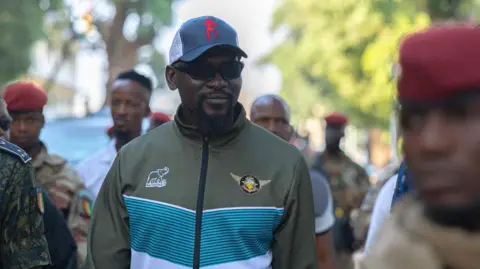
Official pictures of Mamadi Doumbouya have portrayed him in a more relaxed mode
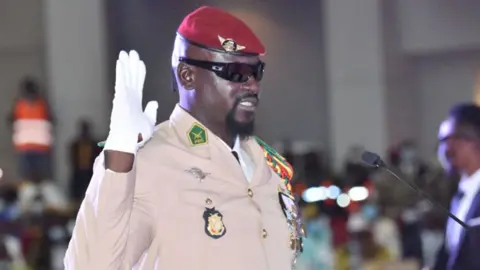
From the moment he seized power in September 2021 Guinea's Mamadi Doumbouya struck an imposing figure.
Just 36 years old at the time, the broad-shouldered colonel, standing at well over six feet (1.8m), wearing military fatigues, mirrored sunglasses and a red beret certainly made an impression when announcing the coup.
A relatively unknown member of an elite army unit, he declared that the government of ousted President Alpha Condé had disregarded democratic principles and that citizens' rights were being trampled on.
After more than four years of acting as interim president, and going back on a promise not to run for leadership of the country, Doumbouya, now 41, is set to be sworn in as the elected head of state on Saturday.
The discreet, disciplined and private man won 87% of the vote in December's election against a severely depleted field.
Ex-Prime Minister Cellou Dalein Diallo, now in exile, described the process as a charade which generated "fabricated" results.
While seemingly enjoying some popular support, critics have questioned Doumbouya's democratic credentials as some political parties have been banned, activists have mysteriously disappeared and media outlets been shut down.
Reuters
Video footage shot in the aftermath of the 2021 coup showed Doumbouya being greeted by enthusiastic crowds
Scrolling back through the social media accounts from the president's office there is a sense of a carefully curated image.
The army man, now a general, has, for the main, ditched the camouflage in favour of the baseball cap and tracksuit, or a boubou - traditional Guinean attire of loose-fitting robes with elaborate embroidery. The shades though are still at times in evidence.
Pictures show him at the opening of schools, or transport and mining infrastructure or cycling through the streets of the capital, Conakry. The message is clear: this is a man of action who is working on behalf of the people.
"This was presenting an image of someone who can be close to civilians, someone who is a civilian leader and can be representative of the people," Beverly Ochieng, senior analyst with Dakar-based security intelligence firm Control Risks, told the BBC.
"In some ways this is distancing himself from what brought him to power – a coup - and the fact that his entire career has been in the military."
In the 15 years before he took power, Doumbouya gained extensive international experience, including being educated to master's level in France and serving in the French Foreign Legion. He was also in Afghanistan, Ivory Coast, Djibouti, Central African Republic and worked on close protection in Israel, Cyprus and the UK.
But the donning of civilian clothes may not be entirely sincere, according to some analysts.
"I'm not sure that he has transitioned from a military man. I think that the military costume will remain even if he is conducting the return to civilian order," argued Aïssatou Kanté, a researcher in the West Africa office of the Institute of Security Studies.
She referred to a ban on political demonstrations, the exclusion of Doumbouya's main challengers in December's election and the suspension of key opposition parties.
Human rights campaigners have demanded to know the whereabouts of two activists - Oumar Sylla (known as Foniké Menguè) and Mamadou Billo Bah – who have not been seen since July 2024. They suspect the men were taken by the military.
Press freedom organisation Reporters Without Borders has also expressed concern that journalist Habib Marouane Camara has been missing for more than a year. It has described how journalists are now censoring themselves and are fearful about what might happen to them.
Nevertheless, the 2021 coup was widely welcomed in the country and since then Doumbouya appears to have remained a popular figure.
Polling organisation Afrobarometer found that between 2022 and 2024 the proportion of people who trusted the president either "partially" or "a lot" grew from 46% to 53%.
Guinea Presidency
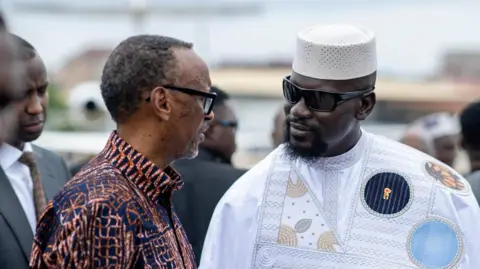
Doumbouya (R) welcomed Rwandan President Paul Kagame to the country in November for the start of operations at the Simandou iron-ore mine
The president-elect may not have a clearly defined ideology guiding him but for Kanté his emphasis on Guineans being in control of their own destiny has become very important.
"It's what keeps coming up in official speeches - this affirmation of political and economic sovereignty," she told the BBC.
In his address to the nation a few days into the new year, he struck a conciliatory tone, calling on all Guineans to build a nation of peace and "fully assumed" sovereignty.
In a country that continues to grapple with high levels of poverty despite plentiful natural resources – including the world's largest reserves of bauxite, which is used to make aluminium - this idea strikes a chord.
The government's messaging on the development of the vast iron-ore resources in Simandou underscores the possible benefits for the people.
The three billion tonnes of ore available in a remote southern part of the country, which began to be exported last month, could transform the global iron market, as well as Guinea's fortunes.
The authorities say earnings from the project, partly owned by Chinese miners as well as the British-Australian corporation Rio Tinto, will be invested in new transport infrastructure as well as health and education.
The success or otherwise of Simandou may define Doumbouya's presidency.
AFP via Getty Images
In 2021, Doumbouya wore formal military dress when he was sworn in as interim leader
He appears determined to keep some of the processing and added-value parts of the industry in Guinea to ensure greater benefits.
Across the broader mining sector, his government has cancelled dozens of contracts over the past year where it was felt that the companies were not investing in Guinea – a move that has led one UAE-based firm to take the country to an international court.
"This move towards resource nationalism makes him look like a local hero. He looks like he's really fighting for the rights of his citizens, even if that means business disruptions," said analyst Ochieng.
The emphasis on sovereignty has also led to a pragmatic approach to international relations, observers say. Unlike coup leaders elsewhere in West Africa, Doumbouya has not outrightly rejected the former colonial power France in favour of Russia.
Neither, despite his background in France and having a French wife, has he been accused of being a puppet of Paris.
Doumbouya very much wants to be seen as someone running things in the interests of the country.
Come Saturday, the president will preach a message of national unity and will hope that he can usher in a new era of prosperity for Guinea.
Watch: Canada-China trade relationship "more predictable" than with US, says Carney
Prime Minister Mark Carney's new approach to Canada's foreign policy can perhaps be distilled in one line: "We take the world as it is, not as we wish it to be."
That was his response when asked about the deal struck with China on Friday, despite concerns over its human rights record and nearly a year after he called China "the biggest security threat" facing Canada.
The deal will see Canada ease tariffs on Chinese electric vehicles that it imposed in tandem with the US in 2024. In exchange, China will lower retaliatory tariffs on key Canadian agricultural products.
Experts told the BBC the move represents a significant shift in Canada's policy on China, one that is shaped by ongoing uncertainty with the US, its largest trade partner.
"The prime minister is saying, essentially, that Canada has agency too, and that it's not going to just sit and wait for the United States," said Eric Miller, a Washington DC based trade adviser and president of the Rideau Potomac Strategy Group.
Carney told reporters on Friday that "the world has changed" in recent years, and the progress made with China sets Canada up "well for the new world order".
Canada's relationship with China, he added, had become "more predictable" than its relationship with the US under the Trump administration.
He later wrote, in a social media post, that Canada was "recalibrating" its relationship with China, "strategically, pragmatically, and decisively".
In Canada, as daylight broke on Friday, reaction to the deal was swift.
Some, like Saskatchewan Premier Scott Moe, hailed it as "very good news". Farmers in Moe's province have been hard hit by China's retaliatory tariffs on Canadian canola oil, and the deal, he said, would bring much needed relief.
But Ontario Premier Doug Ford, whose province is home to Canada's auto sector, was sharply critical of the deal. He said removing EV tariffs on China "would hurt our economy and lead to job losses".
In a post on X, Ford said Carney's government was "inviting a flood of cheap made-in-China electric vehicles without any real guarantees of equal or immediate investment in Canada's economy".
Some experts said the electric vehicle provisions in the trade deal would help China make inroads into the Canadian automobile market.
With the lower EV tariffs, approximately 10% of Canada's electric vehicle sales are now expected to go to Chinese automakers, said Vivek Astvansh, a business professor at McGill University in Montreal.
The expected increase in Chinese EV sales could put pressure on US-based EV makers like Tesla which are seeking to expand their market share in Canada, he said.
"Carney has signalled to the Trump administration that it is warming up to China," Astvansh added.
Reaction from the White House, meanwhile, has been mixed.
In an interview with CNBC on Friday morning, US trade representative Jamieson Greer called the deal "problematic" and said Canada may come to regret it.
President Donald Trump, however, hailed it as "a good thing".
"If you can get a deal with China, you should do that," he told reporters outside the White House.
Since taking office for a second time last year, Trump has imposed tariffs on Canadian sectors like metals and automotives, which has led to swirling economic uncertainty. He has also threatened to rip up a longstanding North American free trade agreement between Canada, the US and Mexico, calling it "irrelevant".
That trade agreement, the USMCA, is now under a mandatory review. Canada and Mexico have both made clear they want it to remain in place.
But the decision to carve out a major new deal with China is a recognition by Carney that the future of North American free trade remains unclear, Miller of the Rideau Potomac Strategy Group told the BBC.
"There's a reasonable chance that we could end up in 2026 without a meaningful, workable trade deal with the United States," he said. "And Canada needs to be prepared."
Getty Images
China is the world's largest producer of EVs, accounting for over 70% of global production
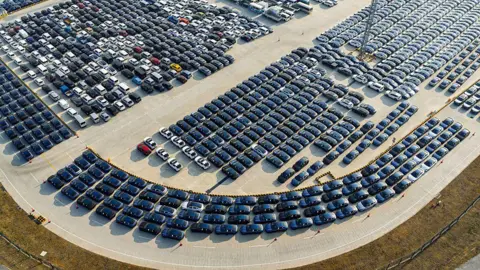
The deal with China drops Canada's levies on Chinese EVs from 100% to 6.1% for the first 49,000 vehicles imported each year. That quota could rise, Carney said, reaching 70,000 in half a decade.
Canada and the US put levies on Chinese EVs in 2024, arguing that China was overproducing vehicles and undermining the ability of other countries to compete.
China is the world's largest producer of EVs, accounting for 70% of global production.
In exchange, China will cut tariffs on Canadian canola seed to around 15% by 1 March, down from the current rate of 84%. Carney said Beijing had also committed to removing tariffs on Canadian canola meal, lobsters, crabs and peas "until at least the end of the year".
China also committed to removing visa requirements for Canadian visitors, Carney said.
Beijing did not corroborate the details in a separate statement, but said "the two reached a preliminary joint agreement on addressing bilateral economic and trade issues".
The introduction of Chinese EVs to Canada's market will likely mean cheaper prices for Canadian consumers, said Gal Raz, an associate professor of Operations Management and Sustainability at Western University and an expert on the EV supply chain.
But Raz acknowledged that the deal Canada struck could hurt Canadian car manufacturers if it comes without further action from the Carney government to help the domestic sector.
He said it was the result of an "unfortunate" deterioration of the Canada-US trade relationship, which he noted has also hurt Canada's automotive industry.
"The US has really put Canada in a corner," he said.
Asked why Canada is giving China access to its automotive market, Carney said that China produces "some of the most affordable and energy-efficient vehicles in the world". He said he expects the deal will spur Chinese investment into Canada's auto industry, though he did not provide further details.
Trump himself has signalled openness to China building plants in the US if it means creating more jobs for Americans, despite his tough-on-China stance.
"If they want to come in and build a plant and hire you and hire your friends and your neighbours, that's great, I love that," Trump said at the Detroit Economic Club on Tuesday. "Let China come in, let Japan come in."
The US president is notably headed to Beijing for his own meeting with President Xi Jinping in April. He has also invited Xi for a state visit to Washington.
For Carney, though, Friday's deal may just be the first step in a "recalibration" of Canada's trade relations.
With additional reporting from Daniel Bush in Washington
Rhoda Levine in 1995 at a rehearsal for her production of Hindemith’s “Mathis Der Maler” at New York City Opera. She was acclaimed for clear, straightforward stagings of classics, rarities and new works.
Credit card debt is an increasingly heavy burden for millions of Americans.
Selena Cooper, 26, is among those dealing with the strain. A former paralegal at the Social Security Administration, she was left without a stable income when the US government shut down a few months ago. She lost her job permanently after Christmas.
Cooper first missed her credit card payments in October, when her paycheques ground to a halt. Since then, she said her debt across her three credit cards has accumulated to $6,000.
Last month, her card issuers Capital One and American Express notified her that they were raising her interest rates due to late payments. The rate on her Capital One cards doubled to 16%, while the one on her Amex jumped from 10% to 18%, she said.
Credit card rates have caught the attention of US President Donald Trump. Last week, he proposed capping them at 10% for one year from 20 January - an idea that Cooper said "would help a little bit, but it's still not going to get me out of debt".
Cooper, who lives in Columbia, South Carolina, is now leaning on her photography business for income. "It'll pay small bills - but not my credit card debt," she said.
Selena Cooper
Selena Cooper said her debt across her three credit cards has accumulated to $6,000
Credit card interest rates have been rising in recent years. They averaged about 22% as of November, up from 13% a decade ago, Federal Reserve data shows. 37% of adults carry a credit card balance, and overall credit card debt in the US totals more than $1tn.
"It does show that consumers are feeling pinched, they're going to continue to feel pinched," Susan Schmidt, portfolio manager at Exchange Capital Resources in Chicago, told the BBC.
"I think the Trump administration is trying to find a way out of it."
Trump's proposal, which was among his campaign promises, was met with a swift backlash from bank executives, who say a cap would erode consumers' access to credit. Banks could cut credit limits or close riskier accounts.
Interest charges are a source of revenue for banks and other big lenders, amounting to $160bn in 2024, according to the Consumer Financial Protection Bureau - an agency that Trump largely dismantled last year.
Banks are already pushing to protect that income, arguing that a rate cap would backfire to the detriment of consumers. JP Morgan hinted at the possibility of legal action.
"People will lose access to credit on a very, very extensive and broad basis, especially the people who need it the most," Jeremy Barnum, JP Morgan's chief financial officer, warned on the company's earnings call on Monday.
Jane Fraser, Citigroup's chief executive, also pushed back against the proposal on Wednesday and warned of a "severe impact on access to credit and on consumer spending across the country".
Some analysts and economists agree that a cap, on its own, might not benefit consumers as much as Trump and lawmakers across the political aisle claim.
"A 10% cap may not be the right solution because the people that are already in trouble, that's not necessarily going to help them," said Schmidt of Exchange Capital Resources.
Benedict Guttman-Kenney, an assistant professor of finance at Rice University, said banks might respond by limiting how much they lend to people with lower credit scores, who are considered higher-risk borrowers. Those are the people most at risk of losing access to credit cards, he said.
Banks, he added, might also try to recoup their revenue elsewhere, like by raising annual fees or late fees.
"It's not clear that people are going to be better off," Guttman-Kenney said. "They're still paying similar amounts of money."
But he noted that some bank expenses are "bloated", meaning they have room to cut costs to keep their margins intact. They could, for example, trim down how much they spend on marketing, he said.
And a recent Vanderbilt University study found that Americans would save roughly $100bn a year in interest costs if a 10% rate cap were to be implemented.
"This is something people would see, they would notice, they would feel it," said Brian Shearer, a researcher at Vanderbilt's Policy Accelerator and the author of the study.
"This alone would impact their household budgets substantially."
Shearer questioned a key argument put forward by bank executives and their lobbyists: that any reduction in rates will necessarily lead to a reduction in lending. He pointed to banks' robust margins in the credit card market.
Interest payments, he added, do not account for the majority of the revenue that banks earn on credit cards.
"No policy is without some pros and cons," Shearer said. "To continue lending, banks would have to reduce rewards to some extent, especially to people with lower FICO scores (credit scores).
"However, the savings from interest, even to those people who lose some rewards, would far exceed the lost rewards."
'I'm losing sleep'
Morgan, 31, who asked to use only her first name, is also among those struggling to pay down thousands of dollars.
Since last May, she has been using her Discover card to pay for her two-year-old daughter's childcare, while unemployed. She said she decided to send her daughter to daycare because she needed the freedom, due to struggles with her mental and physical health.
Those payments have left her with $6,700 in credit card debt.
Morgan's husband works in the military and pays for the family's other expenses. Through a service member benefit programme, she secured an interest rate of roughly 3% on her credit card. Had she been forced to pay the typical 27% interest rate, sending her daughter to childcare would not have been an option, she said.
"I'm losing sleep over the $6,700, but I have a little wiggle room to be able to do that because once I get a job, I can pay it off," Morgan said.
That's why Trump's proposal to cap credit card rates at 10% struck her as a "step in the right direction".
"I hope it actually comes to fruition," she said. "It's one of the few things he's done that prioritises people over businesses."
Will the proposal go anywhere?
The idea to cap credit card rates has been floating in legislative circles for years, and it has garnered bipartisan support.
Senator Josh Hawley, a Republican, and Senator Bernie Sanders, a Democrat, last year introduced a bill to cap credit card interest rates at 10%.
Bloomberg via Getty Images
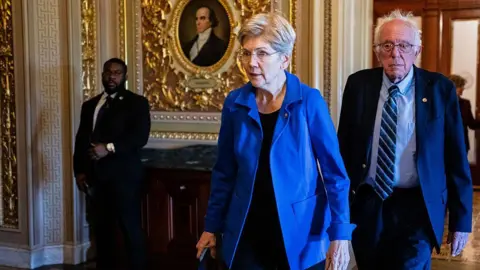
The proposal has received bipartisan support from the likes of Democrat Elizabeth Warren
Democratic Senator Elizabeth Warren said in a statement that she spoke with Trump this week and "told him that Congress can pass legislation to cap credit card rates if he will actually fight for it".
"If he really wants to get something done, including capping credit card interest rates or lowering housing costs, he would use his leverage and pick up the phone," Warren said.
Still, there are hurdles ahead. Getting Congress on board could prove challenging, despite some support on both sides of the aisle.
House Speaker Mike Johnson this week distanced himself from the rate cap proposal, citing "negative secondary effects" and a pullback in lending as a result. "It's something that we've got to be very deliberate about," Johnson said at a press conference.
And banks are poised to keep pushing hard against it.
"If the Trump administration backs down, I think it would be because of the bank lobbying," said Shearer, of Vanderbilt.
"This is their cash cow. They're not going to let it go easily."
Four people have been taken to hospital and several people have been arrested after a protest outside the Iranian embassy in London.
One protester climbed across balconies onto the embassy roof removing a flag on Friday night before being detained, said police.
It added police officers had been injured after missiles were thrown at them, although the ambulance service has not said whether it was police or protesters who were taken to hospital.
Demonstrations have been taking place outside the embassy after widespread anti-government protests in Iran, where more than 2,600 protesters have been killed, according to a US-based human rights group.
The man who removed a flag from the embassy's roof was arrested on suspicion of criminal damage, trespass on diplomatic property and assaulting police, the Metropolitan Police said.
It added "a number" of people had also been arrested on suspicion of violent disorder and a section 35 dispersal order had been imposed outside the embassy "as a result of ongoing disorder".
"A significant police presence remains in place, including additional officers who have been deployed during the evening to prevent further disorder."
A London Ambulance Service spokesperson said it was called at 20:45 GMT "to reports of an incident at the junction of Exhibition Road and Kensington Road".
Four people had been taken to hospital while two others were treated at the scene, it said.
Earlier this week the Iranian ambassador in London was summoned to the Foreign Office after the killings of protesters in Iran.
Last Saturday, two people were arrested at a protest outside the embassy where a protester also climbed onto the building's balcony and appeared to tear down the Iranian flag.
The U.S.-China Economic and Security Review Commission late last year released its annual report to Congress. ChinaTalk welcomes two commissioners to the pod to discuss.
Before joining the Hoover Institution, Mike Kuiken spent two decades on the Hill with Senators Schumer and Durbin. He was appointed to the commission by Leader Schumer. Leland Miller, the co-founder and CEO of China Beige Book, was appointed by Speaker Mike Johnson.
We get into…
What the U.S.-China Commission does, and why “alligators closest to the boat” explains Congress’s blind spots,
The case for an economic statecraft agency, and reorganization lessons from post-9/11 sanctions reform,
The year supply chains became sexy — and the best-case scenario for responding to chokepoints like rare earths and pharmaceuticals,
Xi’s unresponsiveness to consumer spending concerns, and the military-tech developments he’s targeting instead,
The quantum software gap, synthetic biology in space, and Congress’s role in competing with China.
Mike Kuiken: Next year marks the 25th anniversary of the U.S.-China Economic and Security Review Commission. Congress created it around the same time it was debating China’s accession to the World Trade Organization and the establishment of Permanent Normal Trade Relations. Congress approved these measures, but wanted to closely monitor China. The commission was created to keep tabs on both China and the executive branch as events unfolded. That’s our origin story.
Every year, we conduct a series of hearings — usually six — always co-chaired by a Republican and a Democrat in a bipartisan fashion. Then we publish an annual report with recommendations. We also engage regularly with the executive branch, including conversations with figures like Jamison Greer, Undersecretary of Commerce for Industry and Security Jeffrey Kessler, and military leaders. Earlier this year, we met with General Stephen D. Sklenka, among others.
Everyone on the commission brings experience from the Hill, the security space, or the economic policy, like Leland. It’s a fascinating mix of backgrounds, and we have a great team. We produce an 800-page report every year, which dives into a variety of issues. It is the definitive geek-out-on-China document. Our staff does an incredible job. Leland, what did I miss?
Leland Miller: You didn’t do your “alligators closest to the boat” riff. That one’s always good.
Mike Kuiken: Don’t worry, I’ll get to the alligator closest to the boat.
Leland Miller: A million people in D.C. are working on today’s issues. The China Commission focuses on more distant concerns — the ones on the horizon. What should we be paying attention to now? What should Congress be monitoring closely in economics, military affairs, and technology? How do we create smarter policy? We try to look further ahead and recommend ideas that Congress should be considering.
Mike Kuiken: Since Leland decided to trigger me, let me give you the “alligator closest to the boat” analogy. Folks on the Hill deal firsthand every day with the most immediate, pressing issues — the alligators closest to the boat. We’re looking at the horizon or beyond it, focusing on issues that aren’t making headlines yet.We raise awareness and call attention to them. Another part of our work is increasing literacy on these topics.
Vintage alligator hunting near Gainesville, Florida. Source.
Jordan Schneider: As someone who’s been reading this document for a decade now, it’s refreshing. The level of discourse in the American political ecosystem around these topics is often heated and not grounded in evidence. Having this report come out every year offers a different approach — something substantive and measured.
I get a similar feeling listening to nuanced Supreme Court discussions — “Oh, wow, here are people engaging with the world, engaging with facts, and trying to understand things.” You don’t write a 60-page report about China’s ambitions in space without doing research and putting in the work.
We have two commissioners here, and you guys get all the glory, but there’s a large team of staffers putting in the work. From my interactions with them, they take their jobs incredibly seriously. They examine issues in depth. Unlike the intelligence community, where only certain people see the analysis, this is a product for the American people. Thanks, guys, for all your work.
Leland Miller: The staff are the backbone of this operation. The commissioners drive the agenda — we all have our different, overlapping priorities. It’s common for staff to push back and say, “No, I don’t think you can base that on evidence.” We have a discussion, and they do the research — extensive research, constantly. By the time we publish something, it’s not just passing through us. It reflects our perspective, but it’s evidence-based. The report is fundamentally a research document that focuses on policy grounded in real data. The research component is critical.
Mike Kuiken: Before I joined the commission, I spent years with Leader Schumer accessing some of the most sophisticated intelligence in the world. My first year on the commission, as I read through the initial draft our staff put together, I highlighted at least five or ten sections to ask, “Where on earth did you get this?” I was amazed at the amount of information available in open sources and their ability to find and extract it.
Jordan Schneider: We’re not complaining about the seven citations to ChinaTalk this year. That’s how you know it’s good stuff.
Mike Kuiken: Is that too many or too few?
Jordan Schneider: We’ll chart it over time. We’ll have ChatGPT track how we’re doing.Now, make the case for Congress’s influence on U.S.-China issues.
Leland Miller: Start with the guy who’s been on the Hill longer.
Mike Kuiken: If you look at the big moves in U.S.-China policy over the last decade, many have come out of Congress. That includes sanctions bills, the CHIPS and Science Act, and the Foreign Investment Risk Review Modernization Act (FIRRMA), which reformed the Committee on Foreign Investment in the U.S. (CFIUS). The BIOSECURE Act hasn’t passed yet, but the idea for it came from the commission, a legislative branch entity. Outbound investment screening — many of these are ideas that either originated from the commission or from members of Congress.
The CHIPS and Science Act has an interesting origin story. Leader Schumer and Senator Young got together and created the legislation for one of the most significant pieces of industrial policy we’ve seen in a generation. If you look at the last 10 years, Congress has passed incredible, agenda-shaping legislation. The executive branch has broad authority in foreign policy, but many of the guardrails and tools the executive branch uses have been provided by Congress or have been driven by congressional agenda-setting. Leland, what do you think?
Leland Miller:Administrations are fleeting, but Congress is forever. If you want durable, lasting policy, you need Congress involved. Mike gave examples of topics Congress has been essential to. Look at outbound investment — it’s not a success story, at least not yet. It’s something the Biden and Trump administrations handled, but Congress hasn’t cemented the foundation for it in legislation. Right now, you don’t have a durable outbound investment mechanism. This is a call for Congress to constantly be on the tip of the spear, not just reacting to whatever one administration does as Republicans and Democrats alternate in the presidency.
Mike Kuiken: Congress passes a National Defense Authorization Act every year, and that is full of China policy, both on the economic and security side. Pieces of that legislation drive the agenda for both the Department of Defense and the broader executive branch.
Keep in mind that we updated the Taiwan Relations Act three or four years ago, which was also carried by the National Defense Authorization Act. That was driven by Congress, not the executive branch. It was done with a lot of push and pull from the administration, which was saying, “Oh my God, we can’t possibly do this or that.” Ultimately, it was Congress that said, “Yes, we can.”
Jordan Schneider: “Yes, we can.” What a throwback.
There’s this weird dynamic where the executive branch sometimes — perhaps increasingly — doesn’t do what legislation says they have to do. One of your recommendations is to more closely follow the Taiwan Relations Act update. We have the ongoing TikTok saga where both the Biden and Trump administrations have punted, and did not reflect the intent of the votes in the House and Senate. What happens when the executive branch doesn’t follow through on legislation on China-related issues?
Mike Kuiken: I was on the Armed Services Committee in the early days of the wars in Iraq and Afghanistan. Looking back now, I think it was like holding up a fishbowl. If I tilt it this way, the water sloshes one way — if I tilt it that way, it sloshes another. I use that analogy because it’s never perfectly in balance — maybe for brief periods, but not for a sustained time. There’s this historic push-pull relationship between the executive and legislative branches. It’s different with divided government versus one party in power, but there’s always some sloshing around.
Over the years, Congress has provided broad authority to the executive branch. When the executive doesn’t listen, Congress finds ways to put up guardrails, constraints, or funding prohibitions. That’s the tradition of our country. We’re seeing some of that sloshing now. I obviously worked for Democrats, so I see things a particular way, but the fishbowl is never going to sit perfectly settled on the counter. There’s always some rumbling in the water.
Leland Miller: Speaking of rumbling in the water — when administrations come to power, they have a million priorities. Most of the time, they’re not planning to make structural changes to the system. One of our recommendations this year was creating an economic statecraft agency or similar entity to improve coordination and integration among the various entities in government that handle sanctions, export controls, and other tools.
I’m not sure anybody on the Republican or Democrat side would look at that and say it’s a terrible idea. But if for the administration — whatever that administration might be — the last thing they want is to structurally change a bunch of things. What we’re saying is, “We have to focus on the mission, and if the mission is best conducted by restructuring or reintegrating things, then let’s do it.” That’s something an administration focused on getting a million things done in the next 24 hours often can’t do.
“Pulling Thread Through a Needle” 穿针引线
Jordan Schneider: Leland, you jumped the gun here. This is a theme I’ve been writing about and doing shows on for four or five years now — a new reorganization to bring disparate pieces of government that touch the China challenge together. You identify the Bureau of Industry and Security (BIS), the Office of Foreign Assets Control (OFAC), the export control part of the State Department, and the Defense Technology Security Administration (DTSA) — which does export controls for the Defense Department — as pieces that should work together.
During the Biden administration, there was internal disagreement among key officials overseeing economic policy. Each principal controlled different pieces — investment controls, export controls, and so on — and they disagreed about how aggressively to pursue these tools. If cabinet members are already at odds with each other, how would creating a unified economic statecraft entity solve that problem? Would this centralize decision-making in the White House, effectively removing authority from these cabinet-level officials? How exactly would this structure work?
Mike Kuiken: This is something Leland and I worked on together. Beloved Commissioner Randy Shriver and I wrote a piece earlier this year, arguing for reinvigorating the Department of Commerce’s export controls. We argued that similar sanction reforms to the ones at the Treasury Department post-9/11 are needed.
This year, as we held a series of hearings and meetings, I became so frustrated that I almost put my hand on my forehead and said, “Oh my God, we didn’t go big enough.” I’m frustrated that export controls — and also sanctions — happen at a mid-level layer in departments and sometimes don’t reach senior officials. As a result, they often languish — decisions languish — everything languishes. There’s no natural forcing function.
Rather than having these functions sitting at the Assistant Secretary level or below in multiple agencies and departments, you consolidate them. This creates a forcing function not within multiple silos, but in one. Hopefully, you have a senior leader — whether in the Department of Commerce, Treasury, or a standalone entity — that propels the issues to the top. You don’t need to go to the National Security Council every single time to get a resolution.
We’re silent on where this entity should go. The issue of export controls and sanctions is controversial in Congress. The Senate Banking Committee has jurisdiction over export controls and sanctions, while the House Foreign Affairs Committee has jurisdiction in the House. Other committees have significant equities, including the Foreign Relations, Foreign Affairs, and Armed Services Committees, among others. We’re silent on that piece, but we are clear-eyed that we’re in a period of economic statecraft. It’s going to be a cycle of measures and countermeasures between us and China. We need to be thoughtful and strategic in a consolidated way. That was the motivation behind this recommendation. Leland, what did I mess up?
Leland Miller: I’ll offer a pessimistic take. The current structure sets up export controls and sanctions to fail. At the Commerce Department, the undersecretary is in charge of export controls, but the secretary is in charge of promoting U.S. businesses abroad. He is structurally disincentivized from enacting tough policy.
Staffers at the secretary level are patriots and want good policy, but there’s an inherent tension in the system that prevents them from pushing policy if it interferes with their major mandate. The same thing happens at Treasury and, to a degree, at the State Department.
This proposal frees important national security policies from the structural disincentives built into the current system. This is a neglected element of policy we are trying to bring attention to. As long as the top policy is promoting business, it will be hard for a mid-level official to promote a conflicting policy.
Jordan Schneider: Regardless of where you put this entity, there will be counter-forces — parts of the government that want to promote exports, retain global financial stability, keep oil prices low, or other reasonable arguments against coercive actions against Iran, Iraq, Russia, China — pick your country. There is a cost to sharper economic measures the U.S. is considering. Are you arguing for a cabinet position whose job is to push for these tools?
Leland Miller: That would structurally set up the policies to succeed. None of this can succeed without a broader national economic security policy overlaying it. The one thing that administrations — plural — are missing right now is a national economic security strategy that integrates all these different pillars.
There are different reasons why people don’t want to have that — there are many issues in economic foreign policy — trade, investment restrictions, technology controls, supply chain resilience measures, and domestic re-industrialization, whether it’s the defense industrial base or advanced manufacturing. All these pillars are advocated for by people who want their policy to succeed.
Without a broader policy that weaves the pieces together as part of a broader mission, everybody is fighting in parallel for their own piece of the pie and their own resources. The focus on trade and tariffs might siphon focus from export controls and divert all attention from investment restrictions.
With an overarching strategy and structural reform, we could divide economic security issues into those with a national security dimension and those without. For issues with national security implications — supply chain resilience, investment screening, technology controls, trade policy — we need coordination, not competition, between departments. These tools should work in tandem, not against each other. The right policy framework, combined with a structure that doesn’t create conflicting incentives, would make coordination possible.
Jordan Schneider: The catch is that this costs money. Mike made the point earlier that politicians are focused on the alligator closest to the boat.
Mike Kuiken: He’s put it in your mind now. A former colleague of mine on the Armed Services Committee, Tom Goffus, used to talk about the alligator closest to the boat when we were on trips.
Jordan Schneider: The commission is focused on challenges two to five years out. China’s rare earth export controls this year should have been a massive wake-up call. For years, everyone worried China might use rare earths as leverage — and they finally did.
You’d think that would galvanize action — more funding, serious attention, bureaucratic reorganization, even Congress ceding some turf to address the sharp Sword of Damocles held by the Chinese government. You’d think it would accelerate exactly the kind of supply chain security and resilience measures Leland is pushing for. But I’m not seeing it. The moment that should have changed everything has changed little.
Leland Miller: I’m going to push back on your pessimism. Nobody was talking about supply chains until a few months ago — and now everyone is — because they weren’t seen as a tier-one national security priority. Supply chains are boring. If you had brought us on ChinaTalk a year ago and said, “Let’s talk supply chains,” it would have been a different conversation. Fewer people would have tuned in for a podcast on supply chains. They would think, “Oh, gosh, this is boring.”
The way to elevate supply chain resilience — a top-tier priority — is to make it a core pillar of a national economic security strategy. This strategy would define the five critical things we need to do regarding China and other competitors. Supply chains can’t be left to corporate decision-making — they’re a fundamental element of the U.S.-China relationship and require government attention.
Our sixth hearing this year examined Beijing’s choke points on critical U.S. supply chains. We’d been planning it for months, but by the time we held it, rare earths had finally captured everyone’s attention.
Other vulnerabilities will worsen over time, such as pharmaceuticals. China doesn’t ship many finished drugs to the U.S., but it dominates the active pharmaceutical ingredients (APIs) behind medications and the key starting materials (KSMs) behind those APIs. When you see statistics about U.S. pharmaceutical imports from India, most of those drugs trace back to Chinese source materials. How much exactly? We don’t know — even after months of research with full access to government data, we could only produce ranges. The FDA hasn’t been required to collect this information.
The same pattern repeats across printed circuit boards and legacy semiconductors — these are potential choke points that Beijing has over the U.S. economy. APIs and KSMs sound technical and boring — until you realize China may control U.S. access to insulin, heparin, and antibiotics for both civilians and troops. That’s an enormous vulnerability. This needs to be part of our national security strategy. This perspective barely existed a year ago, but has finally entered the discussion in DC.
Supply chain resilience needs to be a core pillar of national security strategy, not just a talking point. Frame it that way, and the logic becomes clear — reducing Beijing’s leverage over critical supplies expands U.S. policy options. The goal is to identify five or six tier-one priorities and integrate them into a unified policy framework. You can debate which issues make the list, but they need to be recognized and addressed together to have a coherent China policy.
Mike Kuiken: When we worked on the CHIPS and Science Act in 2018-2019 — long before it was cool — we pushed supply chain issues. This was in the early days of the Endless Frontier Act debate. Industry pushed back hard — supply chains were their domain, and they didn’t want to share information. That resistance shaped Leland’s thinking.
The second formative experience was the post-9/11 integration of sanctions and intelligence. We embedded the sanctions community into the intelligence apparatus, so intelligence actively fueled Treasury’s work. That integration was crucial.
The Bureau of Industry and Security had access to the intelligence community but wasn’t integrated into it. The difference matters — with access, you get information when you ask. With integration, intelligence proactively dedicates resources to meet your needs. Right now, that industrial-scale effort doesn’t exist for export controls. A core part of our recommendation is to deeply integrate this entity into the intelligence community so it can leverage what we know about supply chains.
The U.S. government hasn’t been strategic about supply chains. We might track sensitive materials for specific defense systems, but we’ve never taken a coherent, comprehensive approach. That gap drove both our hearing and the commission’s recommendation.
Strategies for a Two-Speed China
Jordan Schneider: Leland, in 2024, you said, “supply chains weren’t sexy,” but they were in 2020 and 2021. I’m sure Mike can riff about how the chip crunch during COVID helped get the CHIPS Act across the finish line.
This stuff takes money, or does it? Do you need a double-digit-billion-dollar bill to address printed circuit boards (PCBs), active pharmaceutical ingredients (APIs), and rare earths? The executive branch has been creative with loan guarantees and buying small stakes in companies, but Congress has been inactive. Where’s the bill for this? What should it look like?
Mike Kuiken: None of these things run on fairy dust. They all run on money. Ensuring that we are appropriating the necessary funds to the defense side, but also to the non-defense side — which includes the Bureau of Industry and Security (BIS) — is an important piece.
As Congress evaluates our economic statecraft recommendation, it’ll decide whether to provide more resources to implement it, along with a variety of other decisions.
Jordan Schneider: Congress has been vocal in its displeasure with the lack of semiconductor export controls to China, through bipartisan letters and momentum behind the GAIN Act. Integrating intelligence into BIS sounds good in theory, but if the administration has effectively paused new export controls for a year, what’s the point?
A weaponized API crisis would have triggered more public alarm than temporary car factory shutdowns. What’s your read on congressional appetite for these measures more broadly? How are they thinking about economic security tools right now?
Leland Miller: Those in Congress and the administration who support export controls have to make a better case for why they’re important. Industry is arguing that we need to stop provoking China — “don’t poke the bear.” They argue we want better relations, so why are we acting in ways that could bring us closer to war?
A warning sign adorning the Nanjing Zoo bear enclosure. Source: Eleanor Randolph for ChinaTalk.
This perspective forgets the 30,000-foot view of China’s economy. China has a two-speed economy. The broader macroeconomy is slowing down significantly due to slowing domestic demand, weak consumption, and a deflating property bubble. But the national security side of the economy is running at a different pace. Xi Jinping has made it clear in the “Made in China 2025” sectors.
For our policy, we don’t care if China’s middle class gets richer — that might be a good thing if they import more U.S. goods. We should focus on the economic areas with a national security nexus that Xi Jinping is targeting. That requires smart trade policy, smart outbound investment policy, and smart export controls that target the critical inputs for China’s technological and military machine.
A potential nightmare scenario is China breaking quantum cryptography, achieving AGI, or making some other enormous breakthrough in AI first. Imagine they cure cancer. A shock would go through the system as we’ve never seen — our approach would have failed.
Jordan Schneider: I don’t know, if they cure cancer, hats off to them.
Leland Miller: We want someone to cure cancer, but we don’t want China to control the pipeline for that cure. If China has enormous success in AI, quantum, and biotech, it shows we are failing on the national security side.
Xi Jinping largely ignores the broader consumer economy, letting it generate enough growth to fund the technology and manufacturing sectors he cares about. If China achieves a major technological breakthrough using that model, the U.S. reaction would be severe — probably triggering broader decoupling and a more dangerous, confrontational relationship.
Jordan Schneider: The cancer example illustrates the challenge of deciding what counts as national security. In Washington, every issue becomes a “national security problem” when someone wants attention. You could theoretically connect cancer research to bioweapons or enhanced soldiers, but you need to draw a line somewhere.
Where is that line? Are we only restricting China’s access to advanced technology, or is there no space for cooperation on medical breakthroughs that benefit humanity?
Leland Miller: I’m not against cooperation, and obviously, everyone wants cancer cured. But if there’s going to be a winner in that race, U.S. industry — which funds enormous R&D — should be it. The alternative is China controlling those supply chains and the leverage that comes with them. We need a strategic approach, not a scattershot of policies. Identify what’s providing capital or technology to the Party or military, then shut those channels down. The problem isn’t only weak policies — it’s that we refuse to even track these flows.
Take supply chains. The issue isn’t that our policies are bad — it’s that we’ve refused to collect the basic data needed to understand our vulnerabilities. Why? We’re too concerned about encroaching on industry’s turf and potentially hurting companies.
That concern has merit, but national security priorities have to take precedence. The government needs to require the FDA to collect supply chain data from companies so we can see the problem. First get the data, then develop policies. Right now, we’re nowhere close to good policy because we don’t have good data — not only on supply chains, but on investment and technology flows as well.
Mike Kuiken: Let me approach the innovation cycle from a different angle. We can’t have meaningful conversations about supply chains unless we’re actively innovating. Our report makes several recommendations — on quantum computing, biotech, and other areas — that all stress the importance of protecting and nurturing our innovation ecosystem.
The Endless Frontier Act was designed as a $100 billion investment in innovation. For 80 years, America has reaped the benefits of investments we made during World War II. Those investments launched our innovation flywheel and kept it spinning. Now it’s time to fuel that flywheel again, especially given China’s manufacturing capabilities. They’ve built an impressive manufacturing machine. Our innovation machine is remarkably strong — I genuinely believe that — but it needs sustained investment.
Everything runs on money. If we want to plan for supply chains 10, 20, or 30 years down the road, we must invest in the innovation machine today. That means funding foundational science and early-stage development. These investments tell us what will go into future supply chains and what we’ll need to build tomorrow’s technologies. Without them, we’re guessing.
Jordan Schneider: That dynamic reminds me of Mike Kratsios giving speeches about Vannevar Bush while the government cut science funding.
Let’s shift to the parallel between Treasury sanctions and Commerce export controls. One recommendation that caught my eye was creating a whistleblower program for export control violations. That playbook has been incredibly successful for financial sanctions enforcement, but it doesn’t exist for export controls. Why is there a gap? Is it because export controls are harder to enforce — you’re dealing with physical goods across thousands of small companies rather than dollar flows through banks?
Leland Miller: We have extensive recommendations for bolstering the Bureau of Industry and Security’s export control work. However, BIS is catastrophically under-resourced for the job it’s being asked to do. As export controls expand — especially to the Middle East — the workload grows while staffing remains skeletal. Some countries have one person doing inspections. More funding is coming, but nowhere near enough.
Our recommendations go beyond asking for more money. We focused on force multipliers — how can technology help? What about a whistleblower hotline, like the one that works for sanctions enforcement? Can we shift from a “sale” model to a “rent” model — where U.S. companies and the government maintain ongoing control over how chip technology is used abroad, instead of losing visibility after the initial transaction?
The goal is to make BIS’s job more effective and manageable, in addition to being better funded.
Jordan Schneider: Let’s do a history lesson on financial sanctions. What breakthroughs gave financial sanctions their teeth?
Mike Kuiken: The biggest breakthrough was after 9/11— we began to see how non-state actors were leveraging the financial system, and that invigorated the process. There was also a reorganization in the intelligence community. I don’t remember the exact year, but that allowed for more resources and thoughtfulness in that ecosystem. Those are the big parallels. The current debate isn’t about non-state actors, but a lot of the lessons learned from the post-9/11 sanctions reforms can be applied here.
Finally, the Foreign Investment Risk Review Modernization Act (FIRRMA) did a lot of important work — we need a FIRRMA 2.0 to hit a refresh key. This is a cycle of measure and countermeasure. We need to make sure that the entities involved in the economic statecraft elements of our government are resilient and flexible enough to respond to Chinese actions.
Jordan Schneider: We’ve all been doing this work for a long time. I appreciate Mike’s optimism and Leland’s urgency, but I’m skeptical. This reminds me of defense acquisition reform — everyone thought Ukraine would force fundamental change. Years later, some legislation has been passed, but no paradigm shift.
China’s rare earth controls should have been that catalyst. It wasn’t a surprise threat — it was a threat we’d discussed for years. Yet it hasn’t created a 9/11-style moment — no “enough is enough, we’re spending the money, getting new authorities, and building the government capacity to handle this mission.”
Instead, we have an executive branch divided on what to do. I like these recommendations, but this is the most pessimistic I’ve been in years about whether any of it will happen.
Mike Kuiken: I’ve worked in both the majority and minority in Congress, and I’ve always seen my job the same way — keep pushing. I’ve never been called sunny before, so I’ll take it. Don’t stop when the situation looks bleak.
Someone needs to feed ideas that look beyond the daily crisis — ideas focused on the horizon and beyond. Yes, we can be pessimistic about rare earths and critical minerals. We can also have a strategic conversation — this is happening now, the executive branch has the wheel, so what should we be considering to make ourselves more resilient long-term?
The rare earths problem is serious, but it’s also not going away. We can talk about building mining and processing facilities. We should also ask — what’s the innovation strategy? What alternatives are we investing in to work around this dependency? Are we being thoughtful about diversification, or reactive?
Leland Miller: We are doing that. I’ll be the cheery guy for a change. Let’s enjoy it while it happens. Big things are happening on critical minerals and rare earths. A year ago, nobody was focused on this. Sourcing isn’t the problem — processing is. We’ve all come around to that idea. The rare earth issue has received attention over recent months, partly because it disrupted the President’s trade and tariff agenda. It caught the White House’s attention.
The Pentagon’s response signals a new model — taking equity stakes in companies and establishing price floors. This addresses the fundamental supply chain problem — China has cheaper labor, and massively subsidizes anything it deems a national security priority. That’s why we’ve outsourced so much and become dependent on Chinese imports.
We’re shifting the paradigm. For designated national security priorities, we’re no longer relying on market economics alone. Price floors and equity stakes — like the Mountain Pass rare earths facility or coordination with Australia on processing plants — make sense for these specific cases.
Yes, the U.S. government only reacts to crises. But this mini-crisis has done more than trigger action — it’s prompted genuinely new thinking about economic models for critical supply chains. That’s meaningful progress.
Mike Kuiken: The Chinese are incredibly effective at boiling of the frog or salami-slicing the status quo, right underneath everyone’s nose. I wrote for RealClear about how America’s biotech future is now made in China. China has been steadily acquiring biotech manufacturing and research capabilities, and also the entire infrastructure layer underneath the biotech economy.
When policymakers hear “biotech,” they typically think pharmaceuticals. But it’s much broader — advanced materials, bio-cement from North Carolina companies, even purses made from mushrooms and sawdust in South Carolina.
China has acquired this infrastructure slowly over decades, as it did with rare earths. The spy balloon was unusual — a dramatic moment that broke through the noise. The typical pattern is gradual erosion. They chip away steadily, in Taiwan and across strategic technology sectors, building dependencies before anyone notices the shift.
Leland Miller: Our biggest challenge isn’t convincing Congress to take supply chains or even biotech seriously — those threats are visible. The harder sell is future technologies like quantum computing. Quantum will determine whether we control our own cryptography and digital infrastructure, but the payoff isn’t immediate.
That’s the spectrum we’re dealing with — urgent crises Congress can see versus medium and long-term threats. Quantum sits at the far end. We’ve recommended Congress develop a quantum strategy now, but can we get policymakers focused on tomorrow’s vulnerabilities when today’s are so pressing?
Mike Kuiken: Jordan, I don’t know if you geeked out on quantum, but Leland and I led an incredible commission trip to the West Coast on quantum, and a few things became clear. First, the U.S. is pursuing multiple technological pathways to quantum computing — more diversity than we expected. Second, chemistry and materials science are critical. There’s a physical infrastructure layer to quantum that is often overlooked.
Third, surprisingly, quantum software doesn’t exist yet — not in a meaningful way. People hear “software” and assume Silicon Valley has it. They don’t. None of the major software companies are building software for quantum computers. Both the private and public sectors need to be strategic about these investments now, which is why quantum software made our top 10 recommendations.
Jordan Schneider: The second recommendation says, “See the commission’s classified recommendation annex for a recommendation and discussion related to U.S.-China Advanced Technology Competition.” Mike, blink twice if that’s a Manhattan Project for Unobtainium. Is this how we’re going to solve all our rare earth issues?
Mike Kuiken: I’ve worked in the classified space long enough to know my answer — look at the classified annex. I will note that the commission’s number one recommendation last year — which Cliff Sims and Jacob Helberg worked with me on — was a Manhattan-style project for AGI. We were way ahead of the curve on that conversation.
Jordan Schneider: You called it. Though you didn’t need government action — a few trillion dollars of global capitalism handled it for you.
Space Race 2.0
Jordan Schneider: Let’s close on space, which I know you love. What’s the space recommendation about?
Mike Kuiken: Working with Leader Schumer gave me visibility across all three space communities — civilian (NASA), military, and intelligence. At our hearing, General Salzman spoke more candidly about military space capabilities than I’ve heard from any military leader. We also heard from industry and think tanks on civilian space. You see the enormous public investment over 80 years and what the U.S. government can accomplish.
The problem is that much of that infrastructure, built during the shuttle program and moon race, is aging. Meanwhile, China is accelerating — pouring resources into launch capabilities, infrastructure, and deployable space technology. We’re cruising at 60 miles per hour, but they’re coming up behind us at 100.
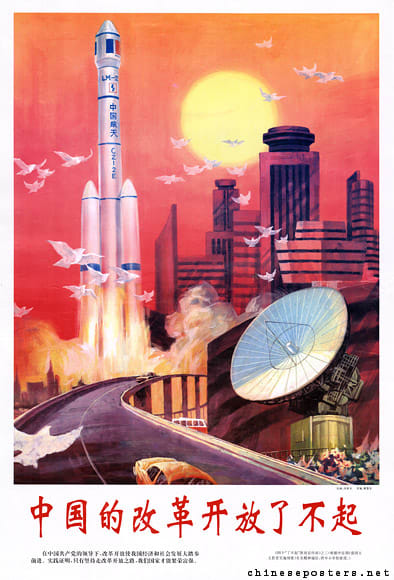
“China’s reform and opening up is amazing,” Liu Xiqi, 1996. Source.
Two weeks ago at the iGEM synthetic biology conference, I had a realization. Sustaining life in space — whether in orbit, on the moon, or on Mars — requires synthetic biology. The biotech ecosystem isn’t only about Earth — it’s foundational for any future space presence, whether sustaining humans, plants, or other life support systems. That’s why we need to be strategic about who’s investing in and controlling these technologies now.
ChinaTalk is a reader-supported publication. To receive new posts and support our work, consider becoming a free or paid subscriber.
It’s time to head off for a weekend away from the January gloom in Granada, Andalusia, southern Spain, where we’ll visit the Alhambra. It’s one of the oldest, grandest, most fascinating and beautiful palaces in Europe.
It started as one of many hill forts used by the Romans in a series of campaigns to control a succession of tribal revolts, and stamp the Empire’s presence close to North Africa. It was rebuilt in 889 CE, but nothing palatial became of it until around 1250, when the ruling Nasrid emir started to turn it into something much grander.
At that time, much of the south of the Iberian peninsula wasn’t ruled by people from Europe to the north, but by Muslim dynasties who had swept up from the south. The Emirate of Granada was the last substantial part of Iberia to remain under Muslim rule, and in 1333 the Sultan of Granada, Yusuf I, decided to transform the Alhambra into a royal palace. In doing so, he and his successors built one of the most exquisite expressions of Arabic Muslim art and architecture along a ridge about half a mile (0.7 km) long overlooking the city of Granada.
This plan from Openstreetmap and its contributors shows the modern site, as of 2013.
Constantin Uhde (1836–1905), Plan of the Nasrid Palaces, Alhambra (1892), illustration, further details not known. Wikimedia Commons.
Constantin Uhde’s plan of 1892 shows the layout of the Nasrid palaces:
Red is the site of the Palace of Comares and the Palaces of the Ambassadors.
Green is the Palace of the Lions.
Yellow is the Mexuar.
Blue is the Garden of Lindajar and later quarters of the Emir.
This article shows a selection of views of the palace up to 1883, and tomorrow’s sequel brings that up to the start of the First World War in 1914.
José de Hermosilla (1715-1776), View of the Alhambra from the Torres Bermejas Castle (1767), watercolour, dimensions not known, Real Academia de Bellas Artes de San Fernando, Madrid, Spain. Wikimedia Commons.
Early paintings of the Alhambra were mainly topographic views, painted in watercolour during the eighteenth century, such as José de Hermosilla’s View of the Alhambra from the Torres Bermejas Castle of 1767. These are similar to views of landmarks being produced in Britain at the time.
John Frederick Lewis (1805–1876), The Torre de Comares, Alhambra (1835), graphite, watercolour, white gouache and scratching out on medium, slightly textured, gray wove paper, 37.1 x 27 cm, Yale Center for British Art, New Haven, CT. Wikimedia Commons.
Others, like John Frederick Lewis in 1835, came to record details of the remains of the Alhambra’s buildings, as in The Torre de Comares, Alhambra, drawn carefully in graphite and only slightly highlighted and coloured with watercolour and gouache.
While every seriously aspiring landscape painter was flocking to paint en plein air in the Roman Campagna in the early nineteenth century, the Alhambra seems not to have been included in the circuit.
David Roberts (1796–1864), Alhambra and Albaicin (date not known), further details not known. Wikimedia Commons.
It was the vogue for Orientalist views in the middle of the nineteenth century that first attracted artists to paint the Alhambra in oils. This is David Roberts’ undated view of Alhambra and Albaicin. Roberts is much better-known for his sketches turned into prints from multiple tours of Egypt and the ‘near east’ made between 1838-40. This work probably originated in sketches made when he visited Spain in 1832, and would have then been painted in this form back in Britain after about 1833, and turned into a print by 1837.
Achille Zo (1826–1901), Patio in the Alhambra (1860), media and dimensions not known, Musée des beaux-arts de Pau, Pau, France. Wikimedia Commons.
Achille Zo was a Basque painter who specialised in views of Spain during the 1860s, such as this Patio in the Alhambra from 1860. These were well received at the Salon in Paris, earning him a gold medal in 1868, following which he too turned to Orientalism.
Franz von Lenbach (1836–1904), The Alhambra in Granada (1868), oil on canvas, 72.1 × 91.5 cm, Sammlung Schack, Bayerische Staatsgemäldesammlungen, Munich, Germany. Wikimedia Commons.
It was the fine collection of paintings of the Prado in Madrid that attracted many great artists to Spain. In 1867, Franz von Lenbach and a student of his travelled to Madrid to copy the masters there for his patron Baron Adolf von Schack. The following year, he painted two works in Granada: The Alhambra in Granada (1868) is a magnificent sketch including the backdrop of the distant mountains, and appears to have been painted in front of the motif.
Franz von Lenbach (1836–1904), Tocador de la Reina (Queen’s Dressing Room) in the Alhambra (1868), oil on canvas, 33.1 × 26.2 cm, Sammlung Schack, Bayerische Staatsgemäldesammlungen, Munich, Germany. Wikimedia Commons.
Von Lenbach’s Tocador de la Reina shows the exterior of the Queen’s Dressing Room in the palaces, with his student sketching.
Henri Regnault (1843–1871), Colonnade of the Court of the Lions at the Alhambra (1869), oil on canvas, dimensions not known, Musée des Augustins de Toulouse, Toulouse, France. Wikimedia Commons.
Just two years before he was killed in the Franco-Prussian War, Henri Regnault toured Spain, and when he was in Granada he painted this view of the Colonnade of the Court of the Lions at the Alhambra (1869). I suspect this is unfinished, and he intended to complete the detail in its lower half.
Martín Rico y Ortega (1833–1908), La Torre de las Damas en la Alhambra de Granada (The Tower of the Ladies in the Alhambra) (1871-72), oil on canvas, 62.5 x 39 cm, Museo Nacional del Prado, Madrid, Spain. Wikimedia Commons.
Martín Rico was one of the most important painters in Spain at this time. Influenced mainly by the Barbizon school, he painted this finely-detailed view of The Tower of the Ladies in the Alhambra in 1871-72. It captures the dilapidation the Alhambra had fallen into before more recent work to restore it to its former glory.
Marià Fortuny (1838–1874), Courtyard at Alhambra (Patio in Granada) (1873), oil on canvas, 111.4 x 88.9 cm, The Fogg Art Museum, Harvard University, Cambridge, MA. Wikimedia Commons.
If Marià Fortuny’s more Impressionist view of a Courtyard at Alhambra (Patio in Granada) from 1873 is to be believed, some parts of the Alhambra had been turned into smallholdings, with free-ranging chickens.
Heinrich Hansen (1821-1890), Granada with the Alhambra in the Nineteenth Century (date not known), further details not known. Image by Sir Gawain, via Wikimedia Commons.
More distant views of the ridge, such as Heinrich Hansen’s undated painting of Granada with the Alhambra in the Nineteenth Century, show its imposing grandeur.
John Haynes Williams (1836-1908), Albaicin from the Alhambra (date not known), further details not known. Wikimedia Commons.
John Haynes Williams (or Haynes-Williams) recognised the merits of views painted from the Alhambra as a high point, in his undated Albaicin from the Alhambra.
Childe Hassam (1859–1935), The Alhambra (1883), oil on canvas, 33 x 40.6 cm, Private Collection. Wikimedia Commons.
The late nineteenth century saw new visitors to copy masters at the Prado: those Americans who came to study painting in France and Germany. Among then, Childe Hassam visited during the summer of 1883, with his friend Edmund H Garrett, and sketch this view of The Alhambra then. This shows the Palace of the Ambassadors, and remains one of the most frequently painted parts of the site.
Tom Roberts (1856–1931), A Moorish Doorway, Alhambra (1883), further details not known. Wikimedia Commons.
From even further afield, the Anglo-Australian Tom Roberts visited Granada when he was in Spain in 1883, when he painted this detailed realist view of A Moorish Doorway, Alhambra. Roberts had migrated with his family in 1869, returned to Britain to study at the Royal Academy Schools from 1881, then went to Spain with the Australian John Peter Russell. He returned to Australia in 1884, becoming one of the early Australian Impressionists.

 Login
Login