
Reading view

There are new articles available, click to refresh the page.

Medium and Message: Fans from Europe

Between 1874 and 1879, Edgar Degas and Camille Pissarro had started making these novel works, and met with success when one was Pissarro’s first painting to be sold to an American collector. Although Pissarro stopped painting fans in about 1885, other artists were starting.
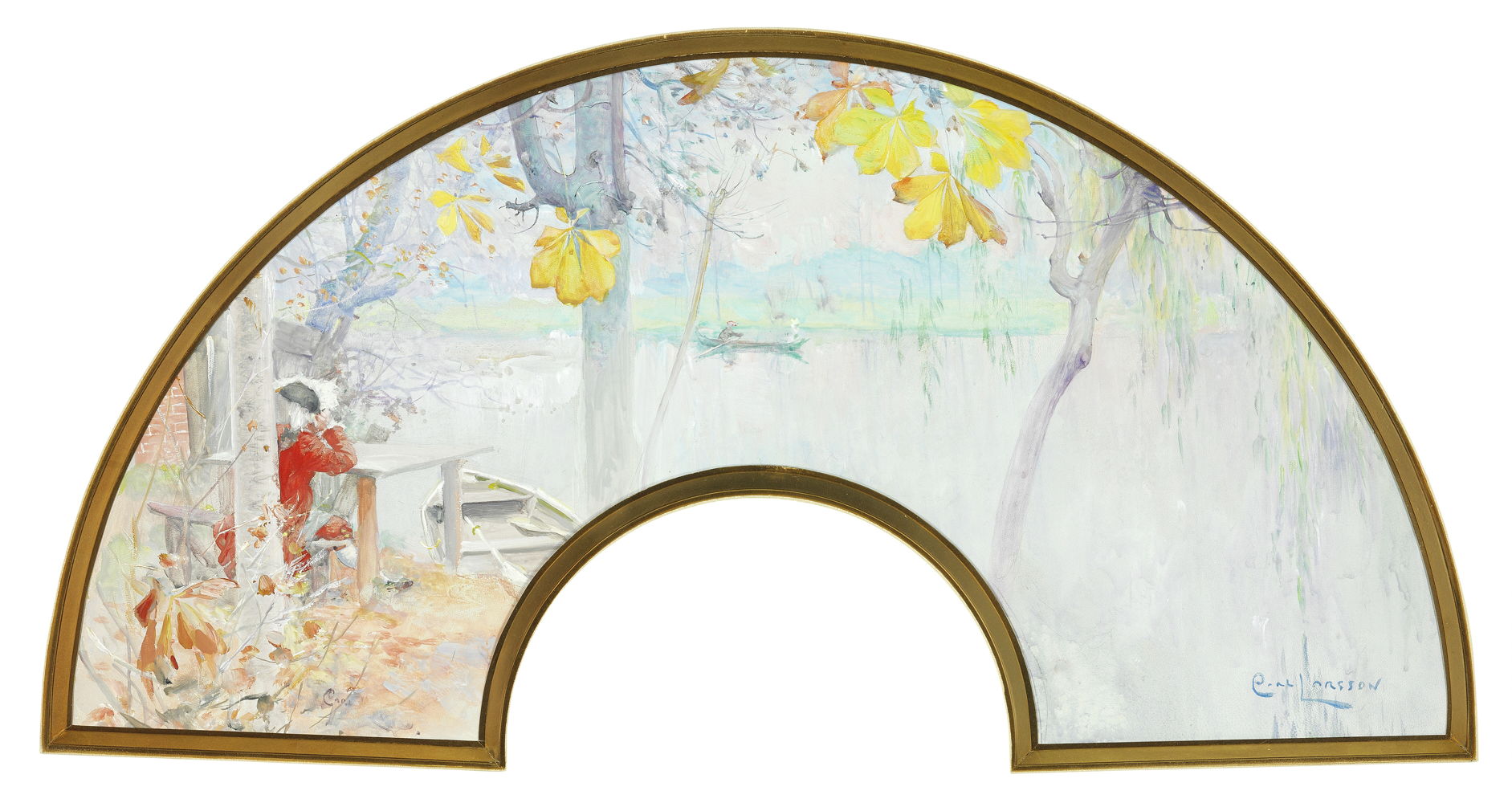
larssonrokokoidyll
Carl Larsson (1853–1919), Rococo Idyll (1884), watercolour on paper, 18 x 60 cm, location not known. Wikimedia Commons.

At that time, the struggling Swedish painter and illustrator Carl Larsson was in Paris. He must have seen some of Pissarro’s painted fans, and as he was switching to his mature medium of watercolour, painted this superb Rococo Idyll, in 1884. At the left, an elegant Rococo gentleman – a recurrent figure in Larson’s paintings at this time, and shown in the detail below – is sat at a table under a chestnut tree by a lake. It’s autumn and the leaves in the foreground have already changed colour. In the misty distance is a couple in a rowing boat.
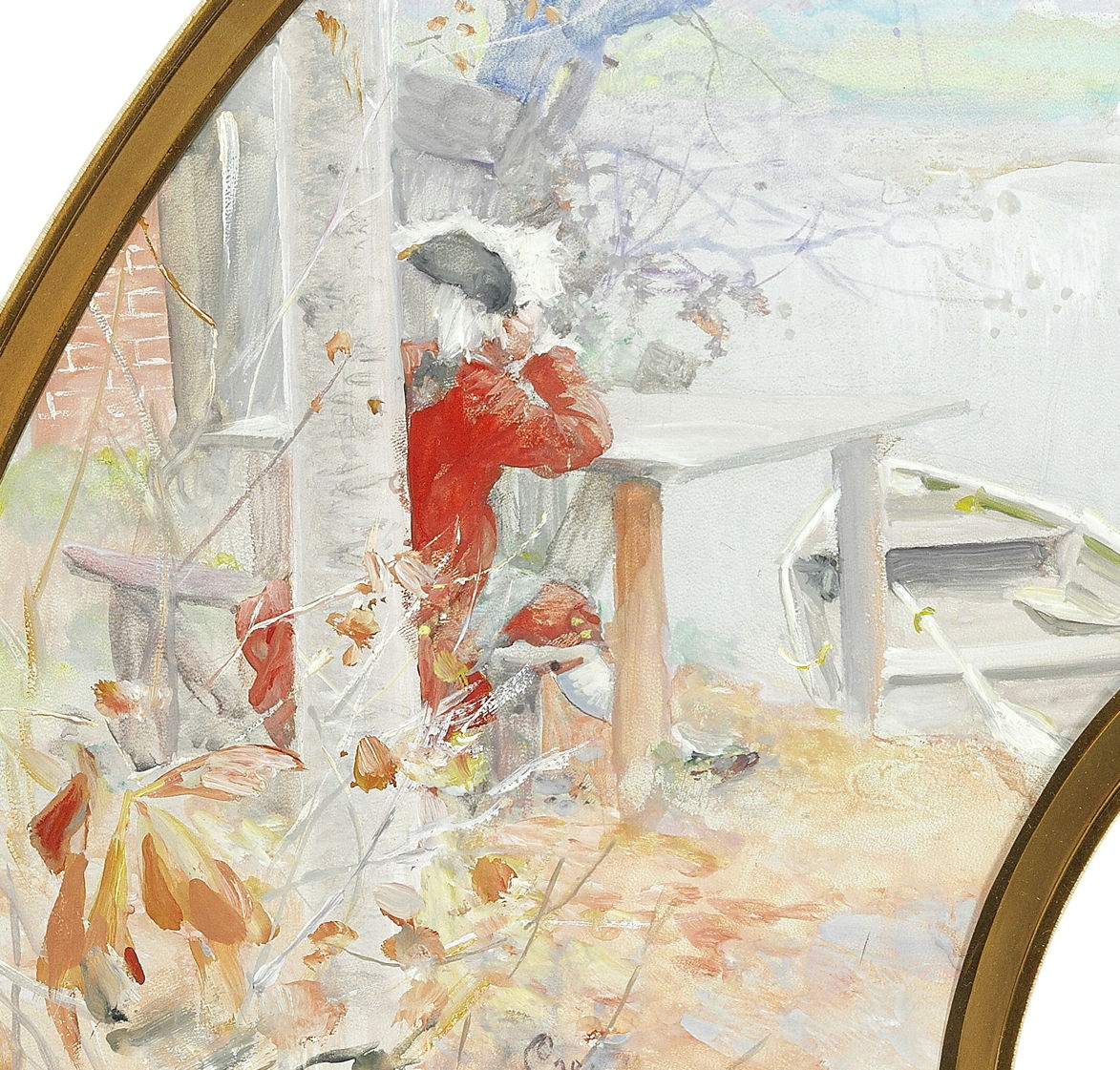
larssonrokokoidylld1
Carl Larsson (1853–1919), Rococo Idyll (detail) (1884), watercolour on paper, 18 x 60 cm, location not known. Wikimedia Commons.
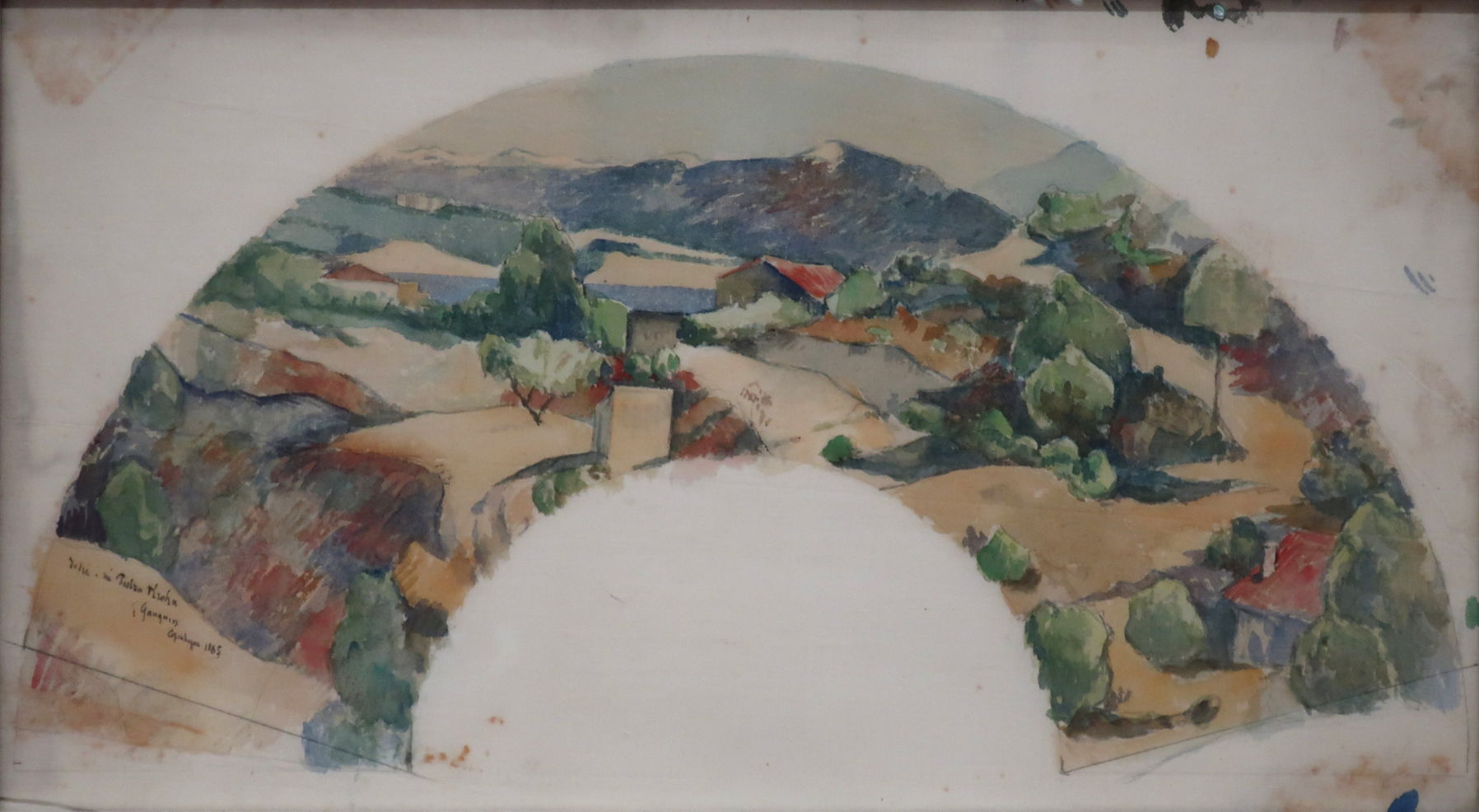
gauguinfrenchlandscape
Paul Gauguin (1848–1903), French Landscape after Cézanne (1885), gouache on canvas, dimensions not known, Ny Carlsberg Glyptotek, Copenhagen, Denmark. Wikimedia Commons.

Paul Gauguin also started painting fans. The earliest of these works that I’ve been able to find is this French Landscape after Cézanne from 1885, apparently painted in gouache on canvas. He has written a dedication to a friend, which he signed in Copenhagen. This dates the painting to the first half of that year, as in the June he moved back to Paris following an unsuccessful attempt to work as a tarpaulin salesman in Denmark. It’s also unclear why he painted this landscape, which is far from being Danish, in the style of Cézanne.

gauguinfrenchlandscape1885
Paul Gauguin (1848–1903), French Landscape (1885), gouache on canvas, dimensions not known, Ny Carlsberg Glyptotek, Copenhagen, Denmark. Wikimedia Commons.

In the same year, Gauguin painted this fan with a more conventional French Landscape, using the same media.
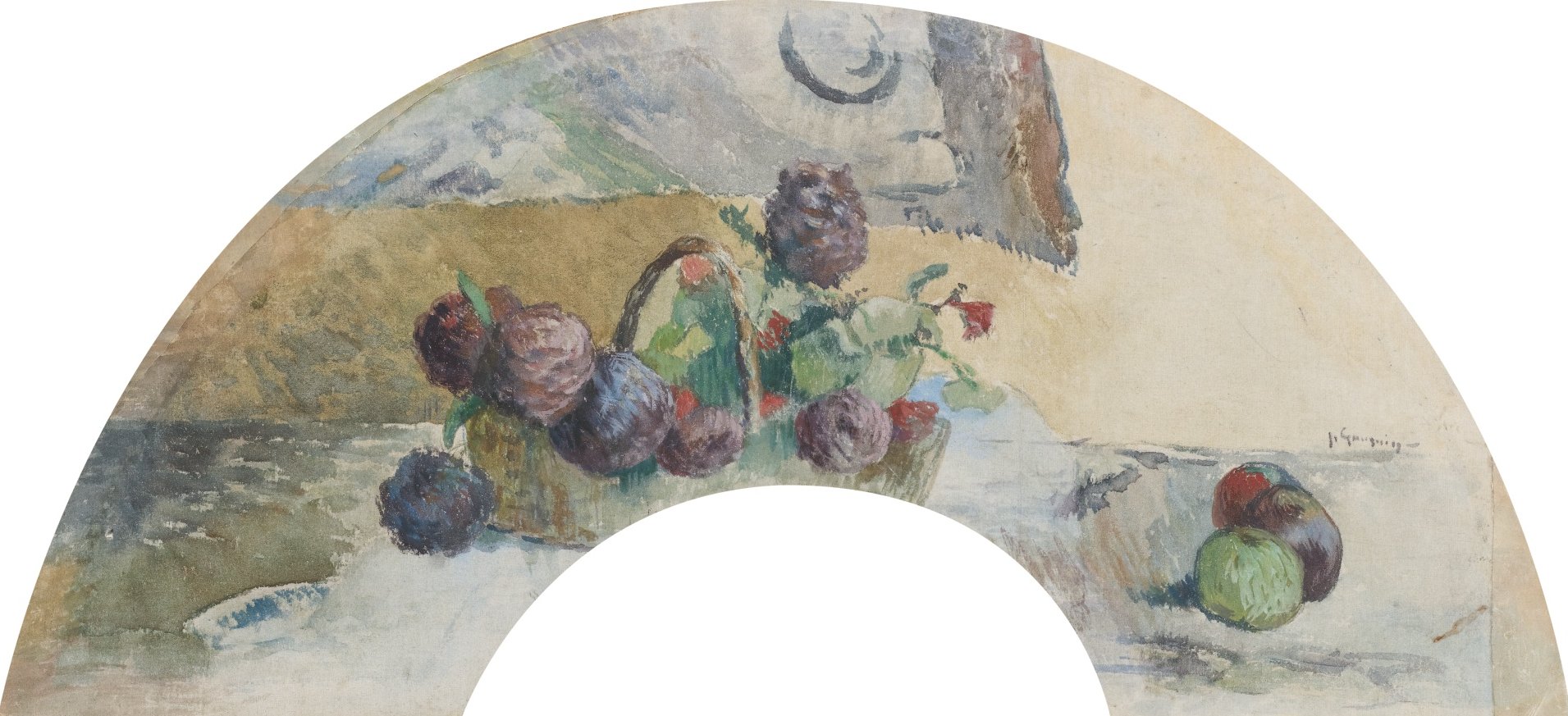
gauguinflowersfruits
Paul Gauguin (1848–1903), Basket of Flowers and Fruits (1886), gouache on silk, 26 x 56.8 cm, Private collection. Wikimedia Commons.

The following year, probably after Gauguin had gone to live in Pont-Aven in Brittany, he painted this Basket of Flowers and Fruits (1886), returning to a more modern style that may again have been intended to recall that of Cézanne. For this he changed to using silk instead of canvas.
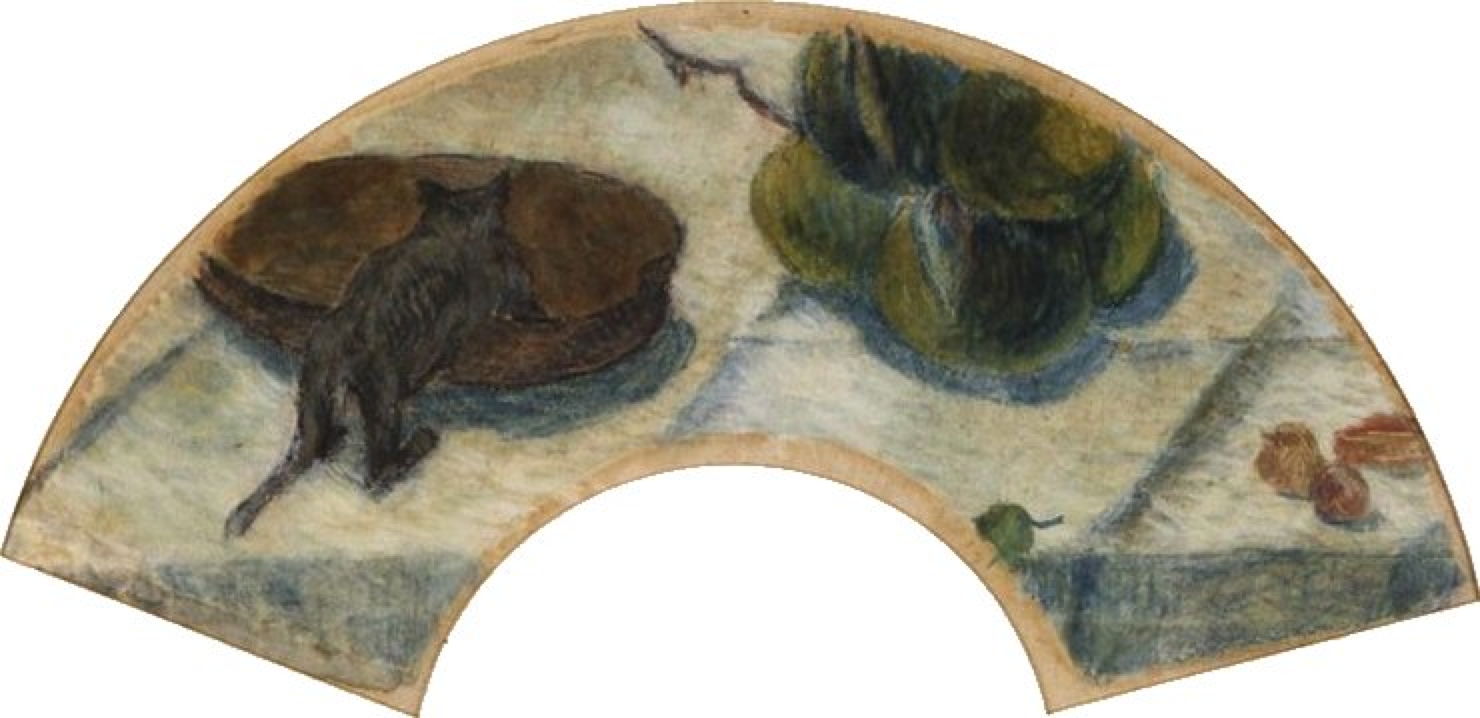
gauguinsmallcateating
Paul Gauguin (1848–1903), Little Cat at Bowl (1888), gouache on paper, 20 x 42.5 cm, Private collection. Wikimedia Commons.

Gauguin’s Little Cat at a Bowl from 1888 shows a kitten who has half-climbed into a bowl on a table, which is covered with a squared cloth. Next to it is a pile of dark green fruit, and below those what could be the rear end of a mouse, or another item of fruit. For this he has changed again to using gouache on paper.
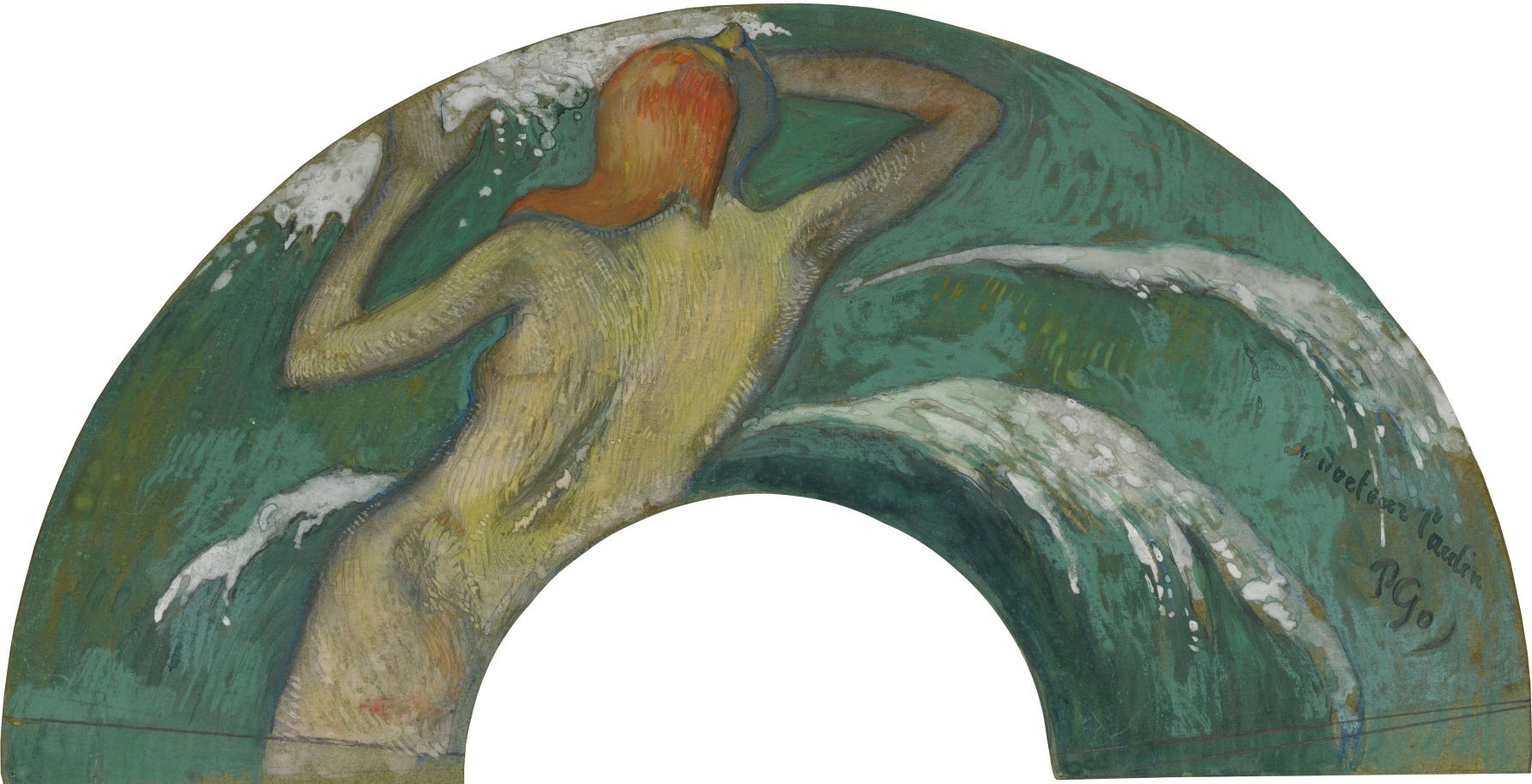
gauguinondineIII
Paul Gauguin (1848–1903), Ondine III (1889), gouache and watercolour on paper, 12 x 38 cm, Private collection. Wikimedia Commons.

It appears that Gauguin continued to paint fans well into the 1890s. His Ondine III from 1889 was painted between his break-up with Vincent van Gogh in Arles and preparations for his trip to Tahiti. It bears a dedication to a Doctor Paulin, and is the third in his series of paintings of this water nymph frolicking in the waves.

gauguinareareajoyousnessII
Paul Gauguin (1848–1903), Arearea (Joyfulness) II (1894), gouache and watercolour on linen, 57.2 x 85.1 cm, Museum of Fine Arts, Houston, TX. Wikimedia Commons.

The last of Gauguin’s painted fans I have been able to locate was made following his return from Tahiti, when he continued to paint Tahitian motifs. Arearea (Joyfulness) II dates from 1894, two years after his original Arearea, and is an adaptation of its motif to the fan format.

zornbathers
Anders Zorn (1860–1920), Bathers (1889), oil, 71.5 × 37.5 cm, Zornsamlingarna, Mora, Sweden. Wikimedia Commons.

A few other artists also continued painting fans. The Swedish painter Anders Zorn perhaps inevitably chose this pair of Bathers in 1889, the year of his great success at the Exposition Universelle in Paris. This is one of the few fan paintings by major artists bearing the marks for folding and mounting in the slats of a real fan.
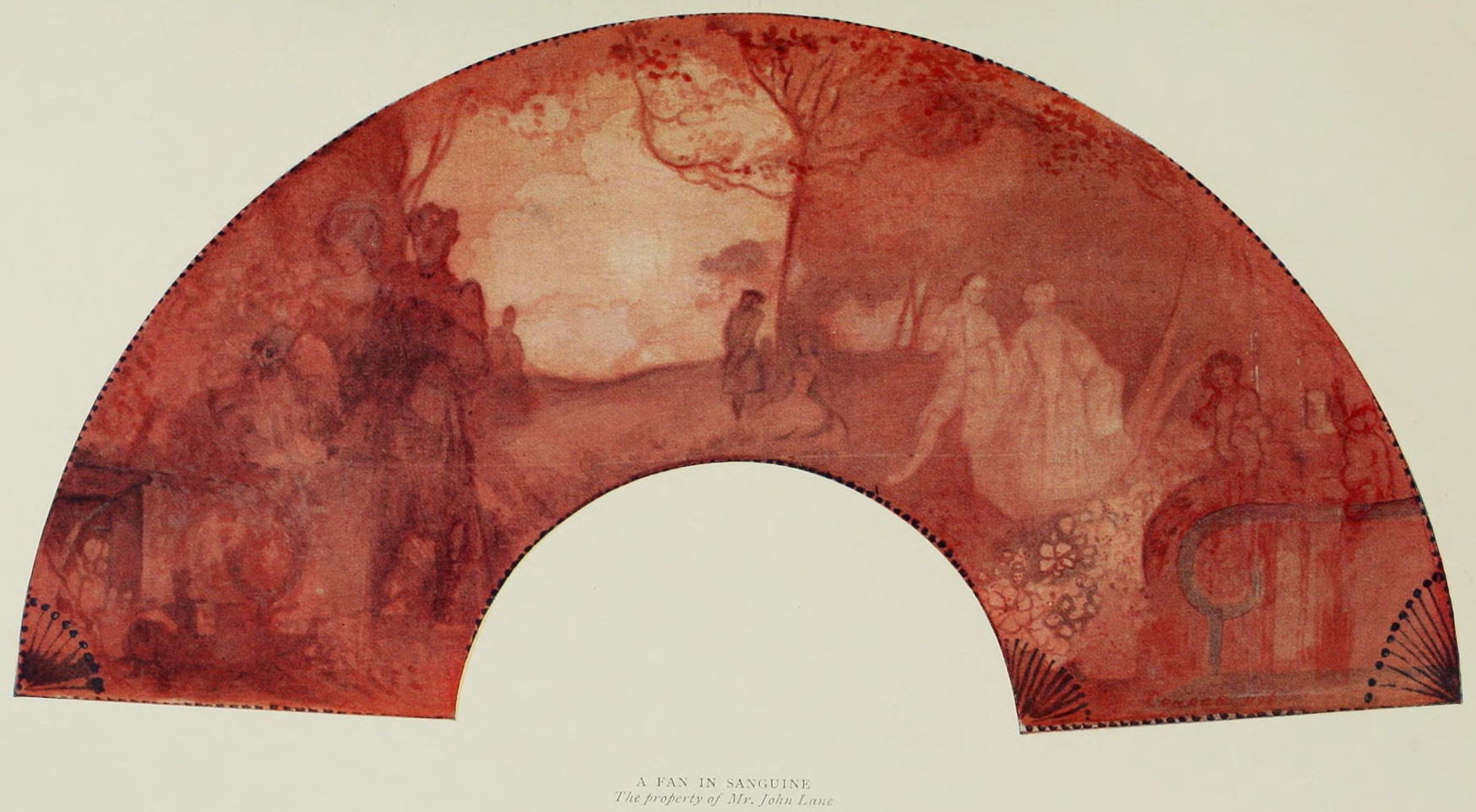
condersanguine
Charles Conder (1868-1909), untitled (c 1890), sanguine, dimensions and location unknown. Wikimedia Commons.

In about 1890, when he was studying in Europe, the Australian Impressionist Charles Conder painted this unusual fan in sanguine, a red hard pastel stick normally used in tonal studies for finished works. This is pictured in an early biography of Conder, but I’ve been unable to discover anything more about it.

By the end of the nineteenth century, fan painting seems to have died out among major artists. My last example, though, comes from the little-known Anglo-French Symbolist painter Louis Welden Hawkins.
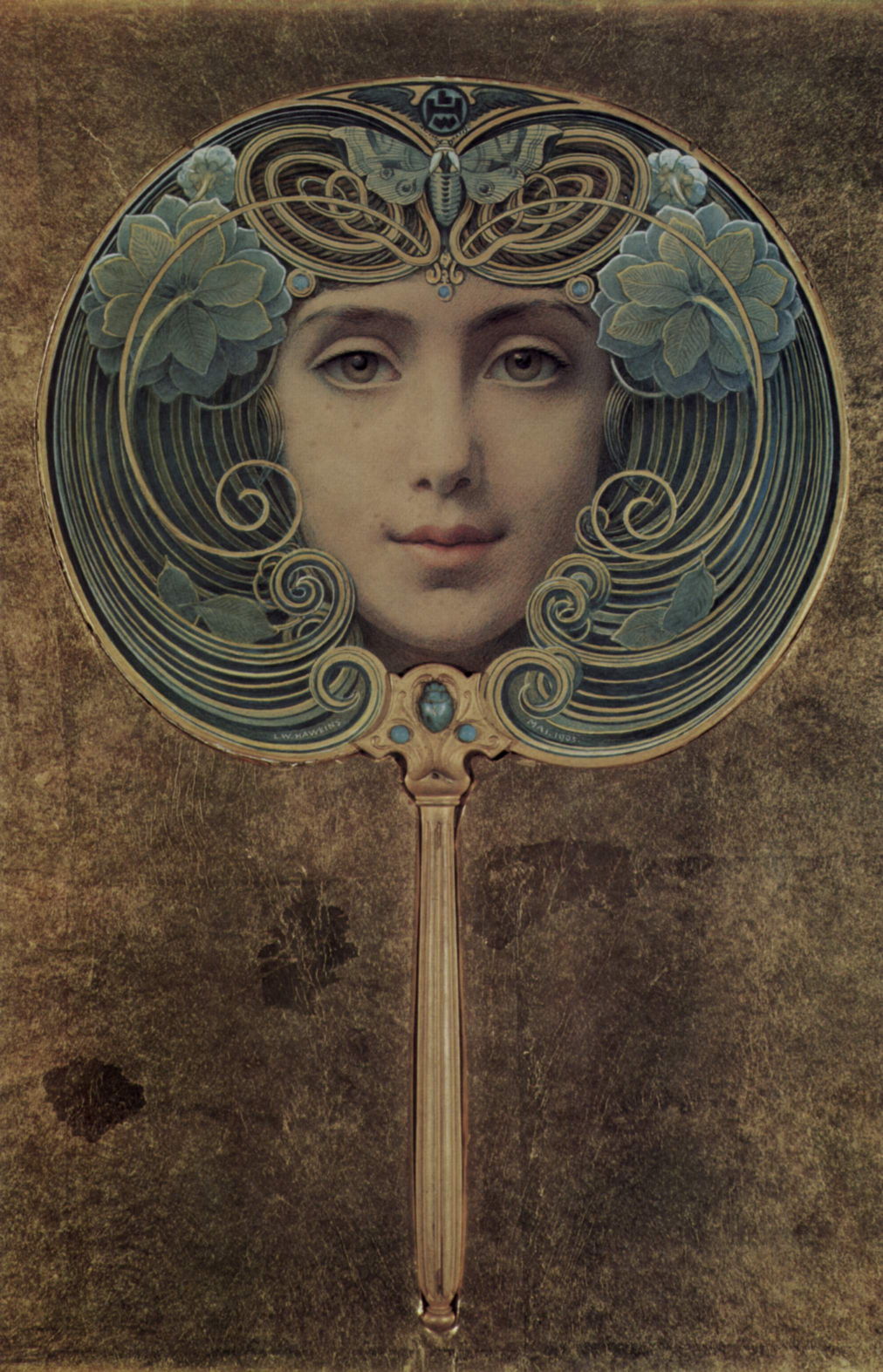
hawkinsfan
Louis Welden Hawkins (1849–1910), Fan (1905), gouache on paper, 22.8 × 28 cm, Private collection. Wikimedia Commons.

Like Degas and Pissarro before him, at the start of the twentieth century Hawkins turned to making masks and fans in a bid to augment his family’s income. These proved most popular at the World Exhibition of 1900, and are exemplified in this non-folding Fan from 1905. His art nouveau style was seen as highly fashionable at the time.

Painting along the Loing: Grez

One of the small villages on the southern edge of the Forest of Fontainebleau grew into an artist’s colony in the last quarter of the nineteenth century. Grez-sur-Loing is on the bend of the River Loing where it turns to the east to head for Moret-sur-Loing and empty into the River Seine at Saint-Mammès. The village lies between the road north from Nemours to Fontainebleau, and the river meandering in its floodplain.

Among those who painted there are John Singer Sargent, Carl Larsson who met his wife there, Bruno Liljefors the Swedish animal painter, PS Krøyer and other Nordic Impressionists of the Skagen group, Theodore Robinson and Willard Metcalf from the US, and the Glasgow Boys.

hawkinspeasant
Louis Welden Hawkins (1849–1910), A Peasant Woman (c 1880), further details not known. Wikimedia Commons.

Like many others, the British artist Louis Welden Hawkins came to Grez from Paris, in his case by about 1880. He painted rural scenes in a style strongly reminiscent of Jules Bastien-Lepage, who was only slightly older than Hawkins, and at the time making a great impression at the Salon. This is Hawkins’ Peasant Woman from about 1880.

hawkinsorphelins
Louis Welden Hawkins (1849–1910), Orphans (1881), oil on canvas, 125 x 160 cm, Musée d’Orsay, Paris. Wikimedia Commons.

Hawkins’ first success came with Orphans (1881), which shares Bastien-Lepage’s muted colours, attributed to the light supposedly peculiar to Grez. A young brother and sister are in a neglected graveyard, looking together at a pauper’s grave, apparently of one or both of their parents. This painting was awarded a third-class medal at the Salon that year, and marked the start of a run of his paintings exhibited at the following three Salons. It was purchased by the state in 1887 for 10,000 francs, and was also exhibited at the Paris World Exhibition in 1900.

hawkinslaststep
Louis Welden Hawkins (1849–1910), The Last Step (c 1882), oil on canvas, 129.5 x 83.8 cm, Owens Art Gallery, Mount Allison University, Sackville, Canada. The Athenaeum.

Hawkins continued this style in The Last Step (c 1882), showing an elderly woman walking slowly with a stick in what may be the same graveyard. In the distance, a gravedigger is digging a new grave through the stony soil. The two engage in conversation, probably discussing where she will be buried in the not too distant future.

By 1882, the colony at Grez was becoming popular with Nordic painters who were developing their skills in France. Among them were the Swedish artists Carl Larsson and Karin Bergöö, who met there and later married.

larssonoldmannursery1883
Carl Larsson (1853–1919), The Old Man and the Nursery Garden (1883), watercolour, 115 x 83 cm, Nationalmuseum, Stockholm, Sweden. Courtesy of Nationalmuseum, via Wikimedia Commons.

Larsson’s paintings from Grez also appear to have been influenced by Jules Bastien-Lepage. His watercolour of The Old Man and the Nursery Garden from 1883 shows similar muted colours, and common rural themes.

larssonbride1883
Carl Larsson (1853–1919), The Bride (1883), further details not known. Wikimedia Commons.

Larsson painted this touching portrait of The Bride at Grez the same year. It almost certainly shows his wife Karin, and was presumably intended as a wedding gift to her.

larssonincountry1883
Carl Larsson (1853–1919), À la Campagne (In the Country) (1883), further details not known. Wikimedia Commons.

In the Country (1883) is typical of a number of views that Larsson painted of the rural poor in and around Grez, in the same realist style with soft colours. That year, he had his first painting accepted by the Paris Salon, and was getting valuable commissions for book illustrations.

larssonautumn1884
Carl Larsson (1853–1919) Autumn (1884), watercolour, 92 x 60 cm, Nationalmuseum, Stockholm, Sweden. Courtesy of Nationalmuseum, via Wikimedia Commons.

The single figure in Larsson’s watercolour Autumn (1884) is dressed anachronistically in clothing from the previous century. This was most probably to please the Salon jury, as eighteenth century scenes were fashionable at the time. Its setting at Grez and his soft realism combine to make this one of his finest watercolours of this period.

Well before the Glasgow Boys came, John Lavery visited from Glasgow. Although he was born in Belfast, he moved to Glasgow when he was a child. After initially attending the Haldane Academy in Glasgow, he went to Paris in the early 1880s, where he was a student at the Académie Julian, where he was influenced by Jules Bastien-Lepage and Millet, and painted at Grez-sur-Loing in 1884.

laveryprincipalstgrez
John Lavery (1856–1941), The Principal Street at Grez (1884), further details not known. Wikimedia Commons.

Lavery’s plein air oil sketch of The Principal Street at Grez from 1884 shows one of the many artists at work in the village, which had become popular internationally. Although following the course recommended for Naturalist painters, Lavery’s style is here thoroughly Impressionist.

At its height, Grez drew artists from all over the world, including some of the pioneers from Japan. In 1889 Asai Chū founded the first group of western-style (yōga) painters in Japan, and in 1898 was appointed professor of the forerunner of the Tokyo University of the Arts. In 1900 he moved to Paris for two years of study of Impressionism, and went to Grez to paint en plein air.

Asai Chū, Washing Place in Grez-sur-Loing (1901), oil on canvas, 33.3 x 45.5 cm, Bridgestone Museum of Art, Tokyo. Wikimedia Commons.

His Washing Place in Grez-sur-Loing shows small huts used by the village women to wash laundry in 1901.

Asai Chū, Bridge in Grez-sur-Loing (1902), watercolour on paper, 28.4 x 43.5 cm, Bridgestone Museum of Art, Tokyo. Wikimedia Commons.

The following year he painted this Bridge in Grez-sur-Loing before returning to Japan.

For much of that time, just over 12 km (7 miles) downstream, one of the great landscape artists of French Impressionism had been painting alone.

❌