“There is massive disappointment and disillusionment,” one Tehran resident said. A human rights group acknowledged that demonstrations had been subdued since Sunday, with thousands of people detained.
Iran’s judiciary said there was no death penalty issued for Erfan Soltani, whose case drew international outcry. Analysts say the government is using fear and intimidation to keep people off the streets.
Between 1874 and 1879, Edgar Degas and Camille Pissarro had started making these novel works, and met with success when one was Pissarro’s first painting to be sold to an American collector. Although Pissarro stopped painting fans in about 1885, other artists were starting.
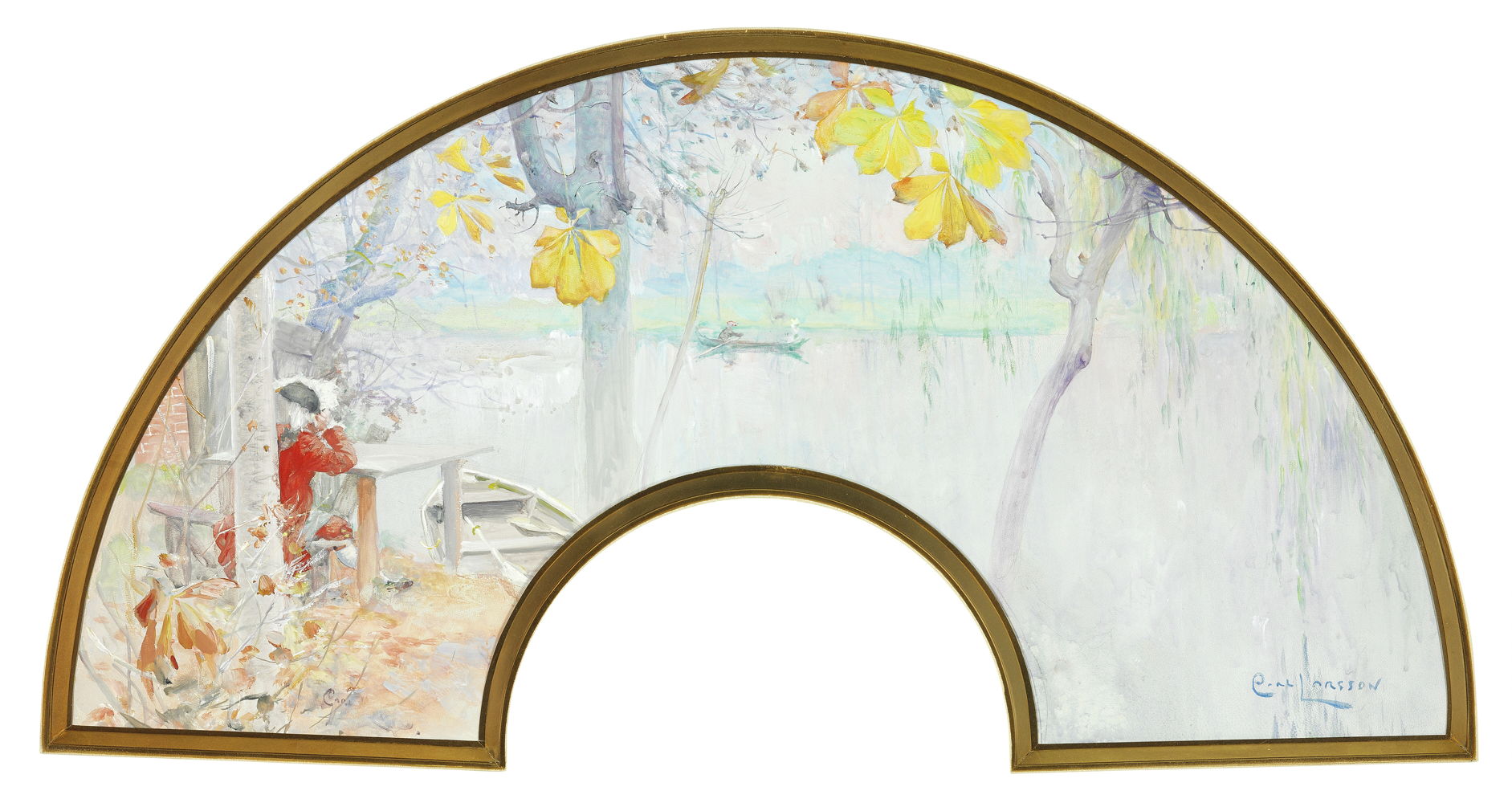
Carl Larsson (1853–1919), Rococo Idyll (1884), watercolour on paper, 18 x 60 cm, location not known. Wikimedia Commons.
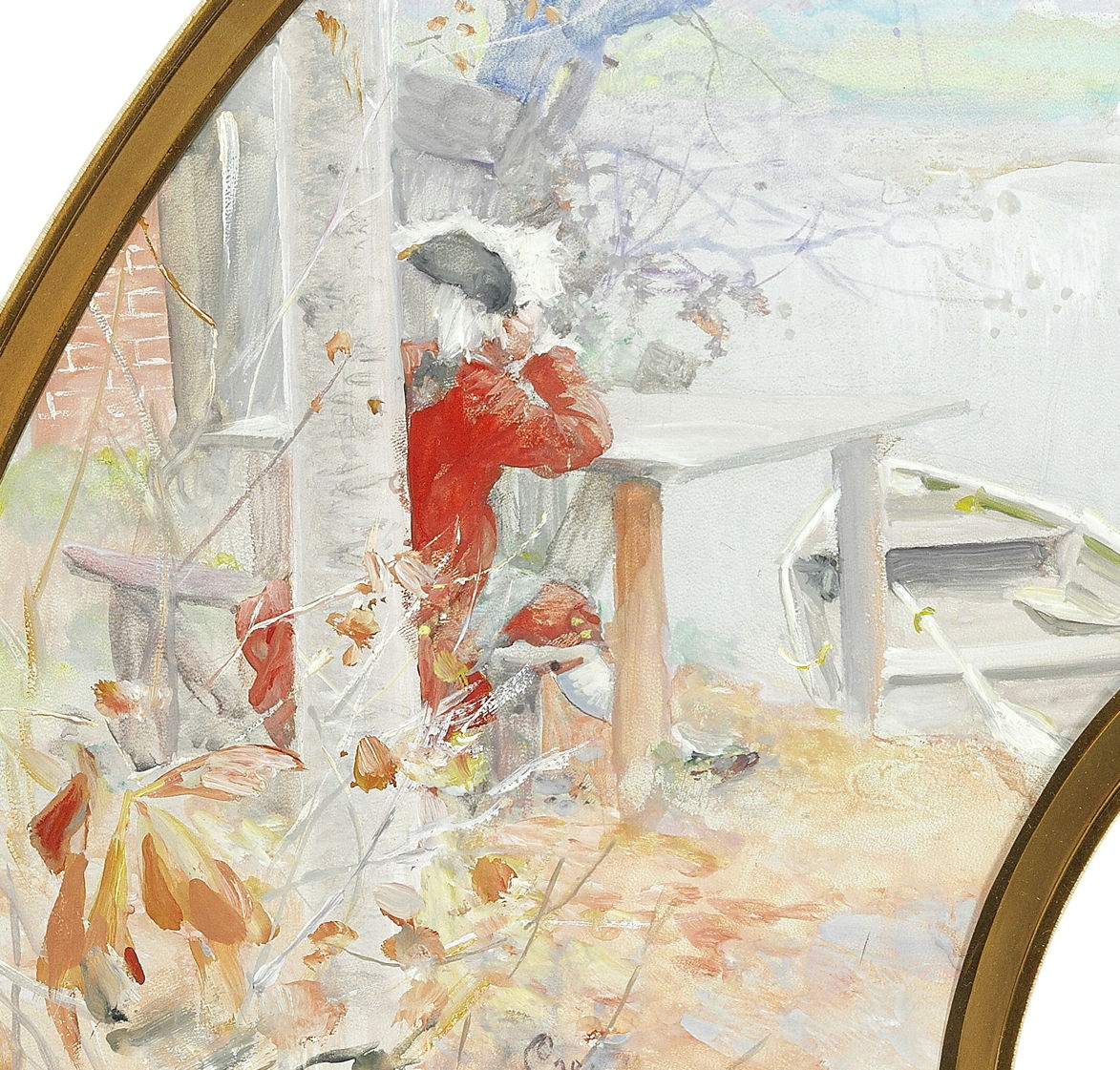
At that time, the struggling Swedish painter and illustrator Carl Larsson was in Paris. He must have seen some of Pissarro’s painted fans, and as he was switching to his mature medium of watercolour, painted this superb Rococo Idyll, in 1884. At the left, an elegant Rococo gentleman – a recurrent figure in Larson’s paintings at this time, and shown in the detail below – is sat at a table under a chestnut tree by a lake. It’s autumn and the leaves in the foreground have already changed colour. In the misty distance is a couple in a rowing boat.
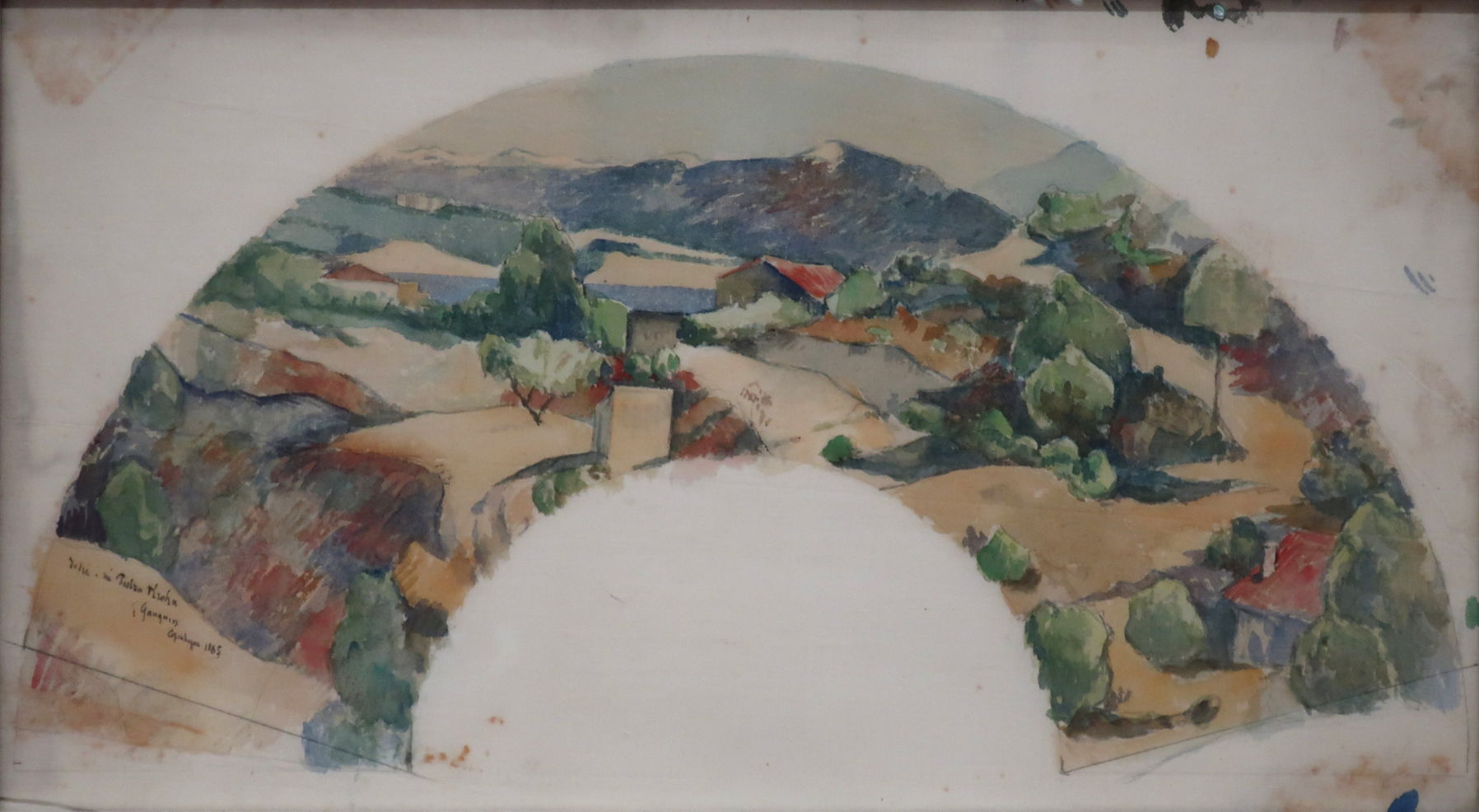
Carl Larsson (1853–1919), Rococo Idyll (detail) (1884), watercolour on paper, 18 x 60 cm, location not known. Wikimedia Commons.Paul Gauguin (1848–1903), French Landscape after Cézanne (1885), gouache on canvas, dimensions not known, Ny Carlsberg Glyptotek, Copenhagen, Denmark. Wikimedia Commons.
Paul Gauguin also started painting fans. The earliest of these works that I’ve been able to find is this French Landscape after Cézanne from 1885, apparently painted in gouache on canvas. He has written a dedication to a friend, which he signed in Copenhagen. This dates the painting to the first half of that year, as in the June he moved back to Paris following an unsuccessful attempt to work as a tarpaulin salesman in Denmark. It’s also unclear why he painted this landscape, which is far from being Danish, in the style of Cézanne.
Paul Gauguin (1848–1903), French Landscape (1885), gouache on canvas, dimensions not known, Ny Carlsberg Glyptotek, Copenhagen, Denmark. Wikimedia Commons.
In the same year, Gauguin painted this fan with a more conventional French Landscape, using the same media.
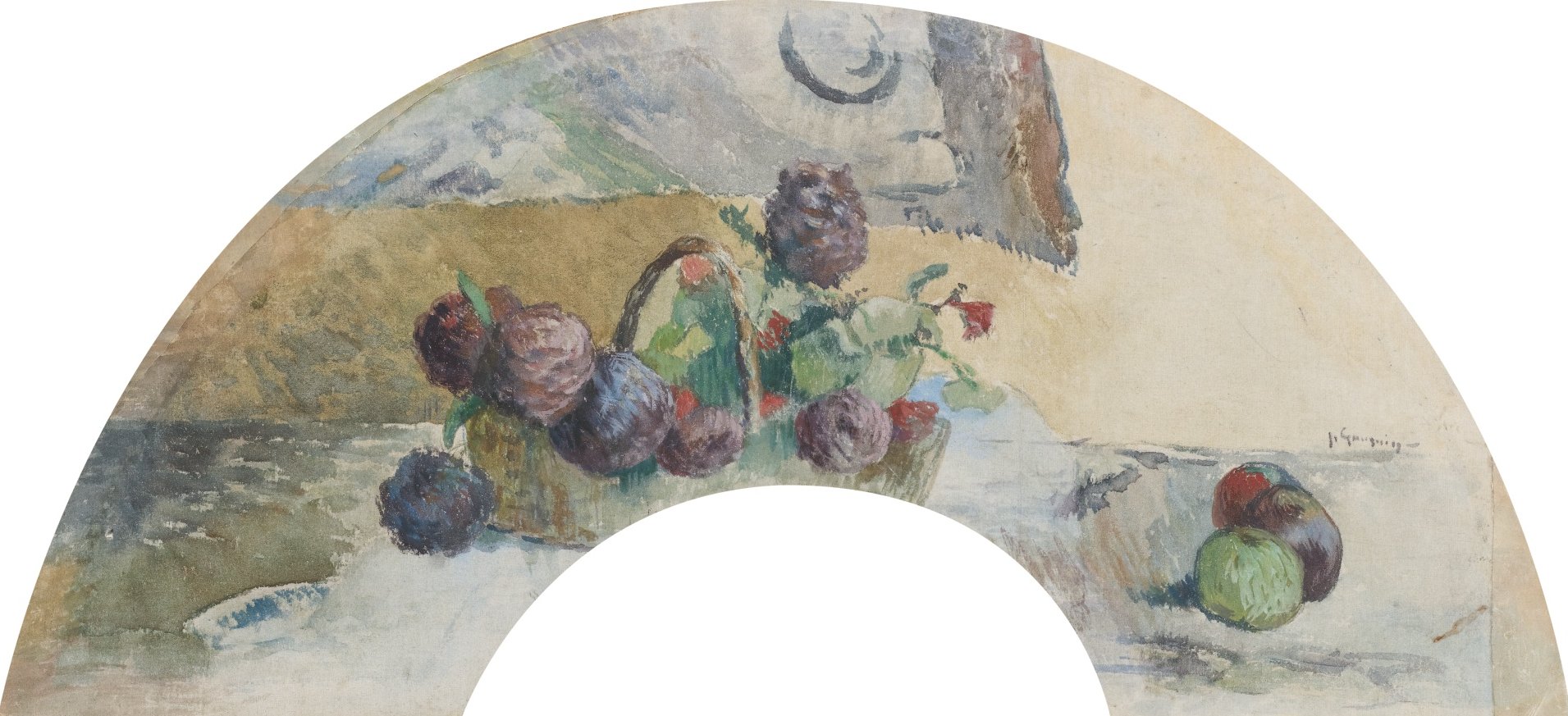
Paul Gauguin (1848–1903), Basket of Flowers and Fruits (1886), gouache on silk, 26 x 56.8 cm, Private collection. Wikimedia Commons.
The following year, probably after Gauguin had gone to live in Pont-Aven in Brittany, he painted this Basket of Flowers and Fruits (1886), returning to a more modern style that may again have been intended to recall that of Cézanne. For this he changed to using silk instead of canvas.
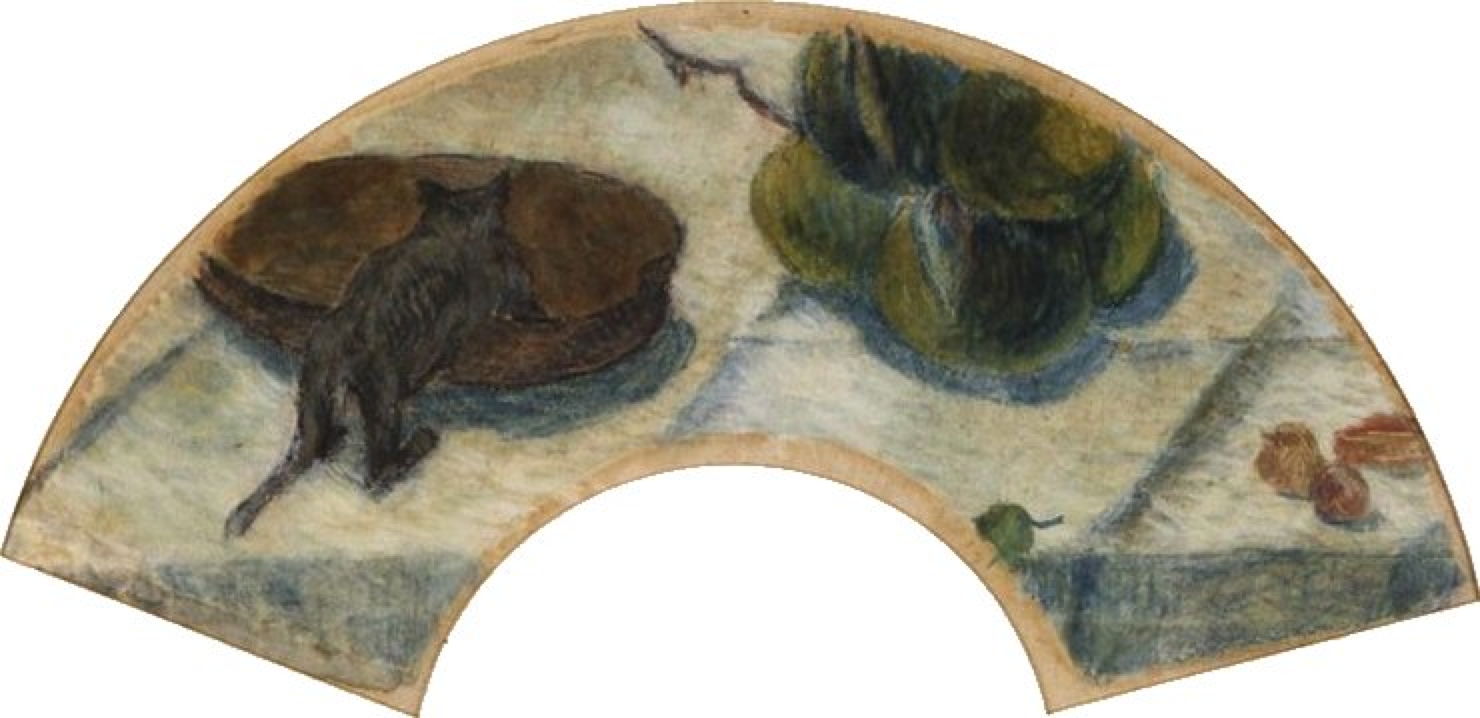
Paul Gauguin (1848–1903), Little Cat at Bowl (1888), gouache on paper, 20 x 42.5 cm, Private collection. Wikimedia Commons.
Gauguin’s Little Cat at a Bowl from 1888 shows a kitten who has half-climbed into a bowl on a table, which is covered with a squared cloth. Next to it is a pile of dark green fruit, and below those what could be the rear end of a mouse, or another item of fruit. For this he has changed again to using gouache on paper.
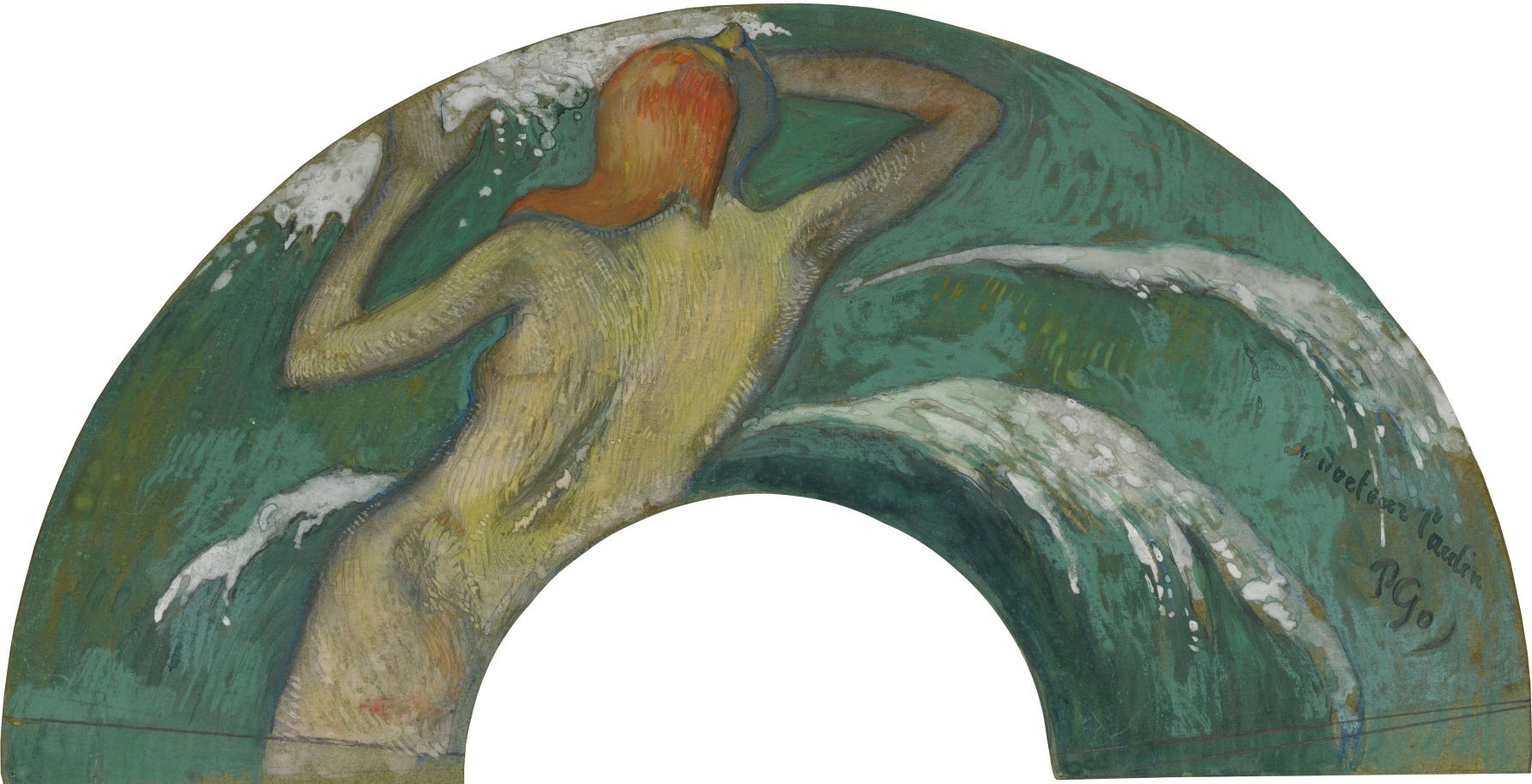
Paul Gauguin (1848–1903), Ondine III (1889), gouache and watercolour on paper, 12 x 38 cm, Private collection. Wikimedia Commons.
It appears that Gauguin continued to paint fans well into the 1890s. His Ondine III from 1889 was painted between his break-up with Vincent van Gogh in Arles and preparations for his trip to Tahiti. It bears a dedication to a Doctor Paulin, and is the third in his series of paintings of this water nymph frolicking in the waves.
Paul Gauguin (1848–1903), Arearea (Joyfulness) II (1894), gouache and watercolour on linen, 57.2 x 85.1 cm, Museum of Fine Arts, Houston, TX. Wikimedia Commons.
The last of Gauguin’s painted fans I have been able to locate was made following his return from Tahiti, when he continued to paint Tahitian motifs. Arearea (Joyfulness) II dates from 1894, two years after his original Arearea, and is an adaptation of its motif to the fan format.
Anders Zorn (1860–1920), Bathers (1889), oil, 71.5 × 37.5 cm, Zornsamlingarna, Mora, Sweden. Wikimedia Commons.
A few other artists also continued painting fans. The Swedish painter Anders Zorn perhaps inevitably chose this pair of Bathers in 1889, the year of his great success at the Exposition Universelle in Paris. This is one of the few fan paintings by major artists bearing the marks for folding and mounting in the slats of a real fan.
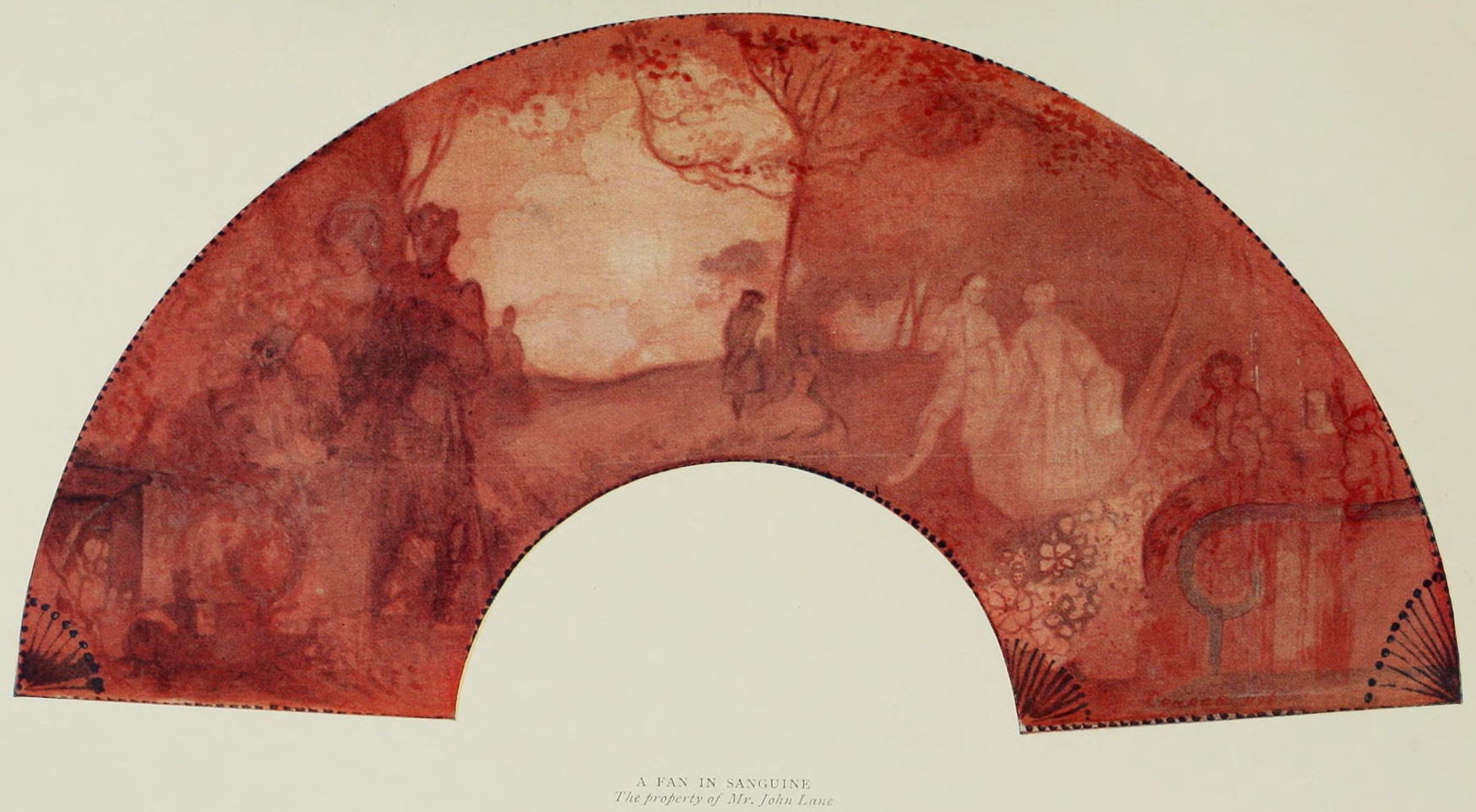
Charles Conder (1868-1909), untitled (c 1890), sanguine, dimensions and location unknown. Wikimedia Commons.
In about 1890, when he was studying in Europe, the Australian Impressionist Charles Conder painted this unusual fan in sanguine, a red hard pastel stick normally used in tonal studies for finished works. This is pictured in an early biography of Conder, but I’ve been unable to discover anything more about it.
By the end of the nineteenth century, fan painting seems to have died out among major artists. My last example, though, comes from the little-known Anglo-French Symbolist painter Louis Welden Hawkins.
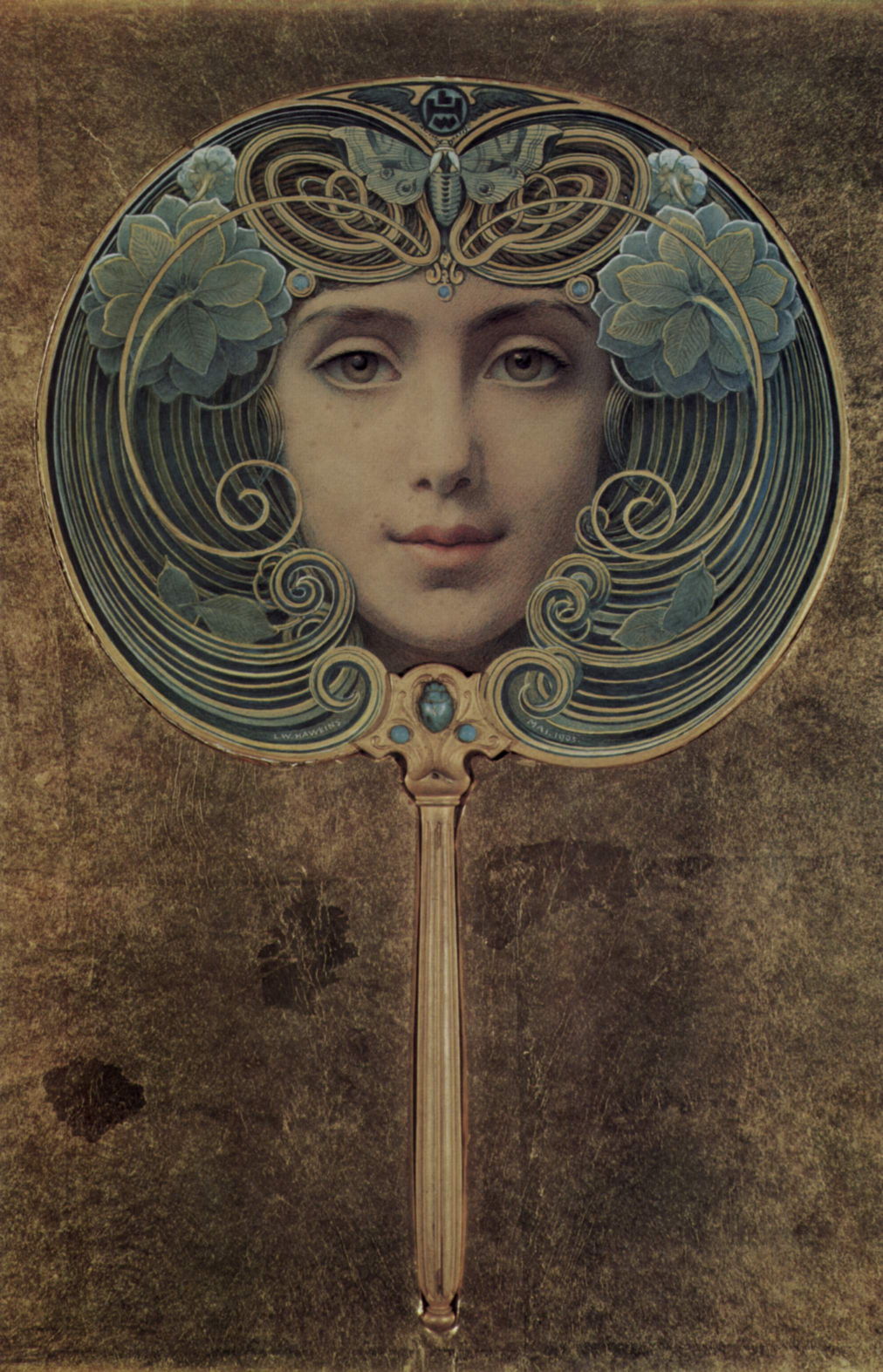
Louis Welden Hawkins (1849–1910), Fan (1905), gouache on paper, 22.8 × 28 cm, Private collection. Wikimedia Commons.
Like Degas and Pissarro before him, at the start of the twentieth century Hawkins turned to making masks and fans in a bid to augment his family’s income. These proved most popular at the World Exhibition of 1900, and are exemplified in this non-folding Fan from 1905. His art nouveau style was seen as highly fashionable at the time.
One of the more popular supports for European paintings of the late nineteenth century was the hand fan, typically made of paper stretched over thin wooden slats. Like the fans themselves, these had originated in East Asia, where they had been used for fine art painting since well before 1600.
Hand fans, held and wafted to force convective cooling in hot conditions, didn’t appear spontaneously in Europe, but seem to have been brought from the Middle East at the time of the Crusades. Following the Renaissance they became more elaborate, a fashion accessory that could be used for surreptitious communication between lovers when in company.
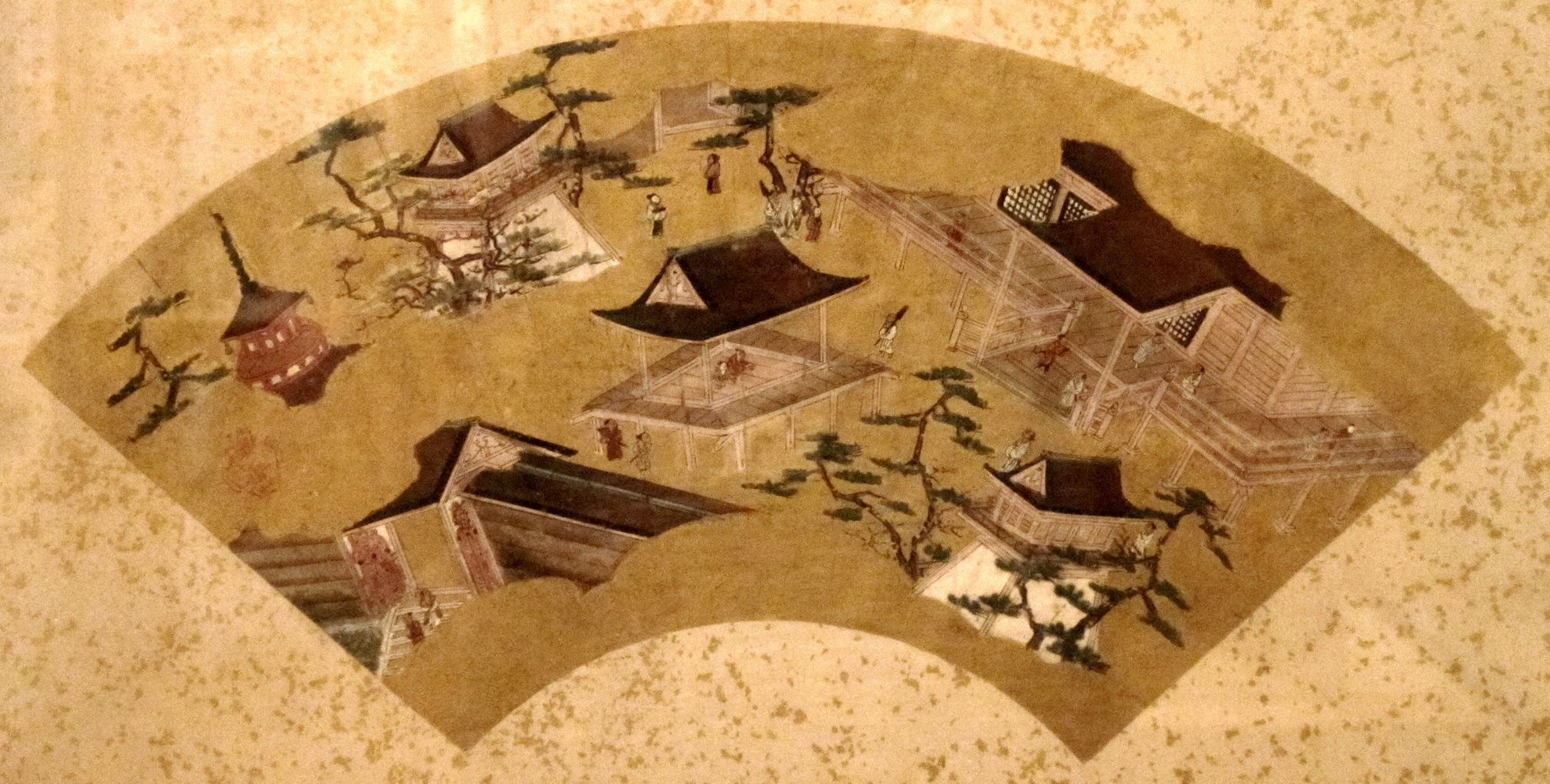
Kanō Munehide (dates not known), View of Kyoto (Momoyama, early 1580s), ink and colour on gold paper, dimensions not known, Honolulu Museum of Art, Hawai’i, HI. Wikimedia Commons.
This exquisite painting of a View of Kyoto by Kanō Munehide was made in ink and colour on gold paper during the Momoyama period, most probably in the early 1580s.
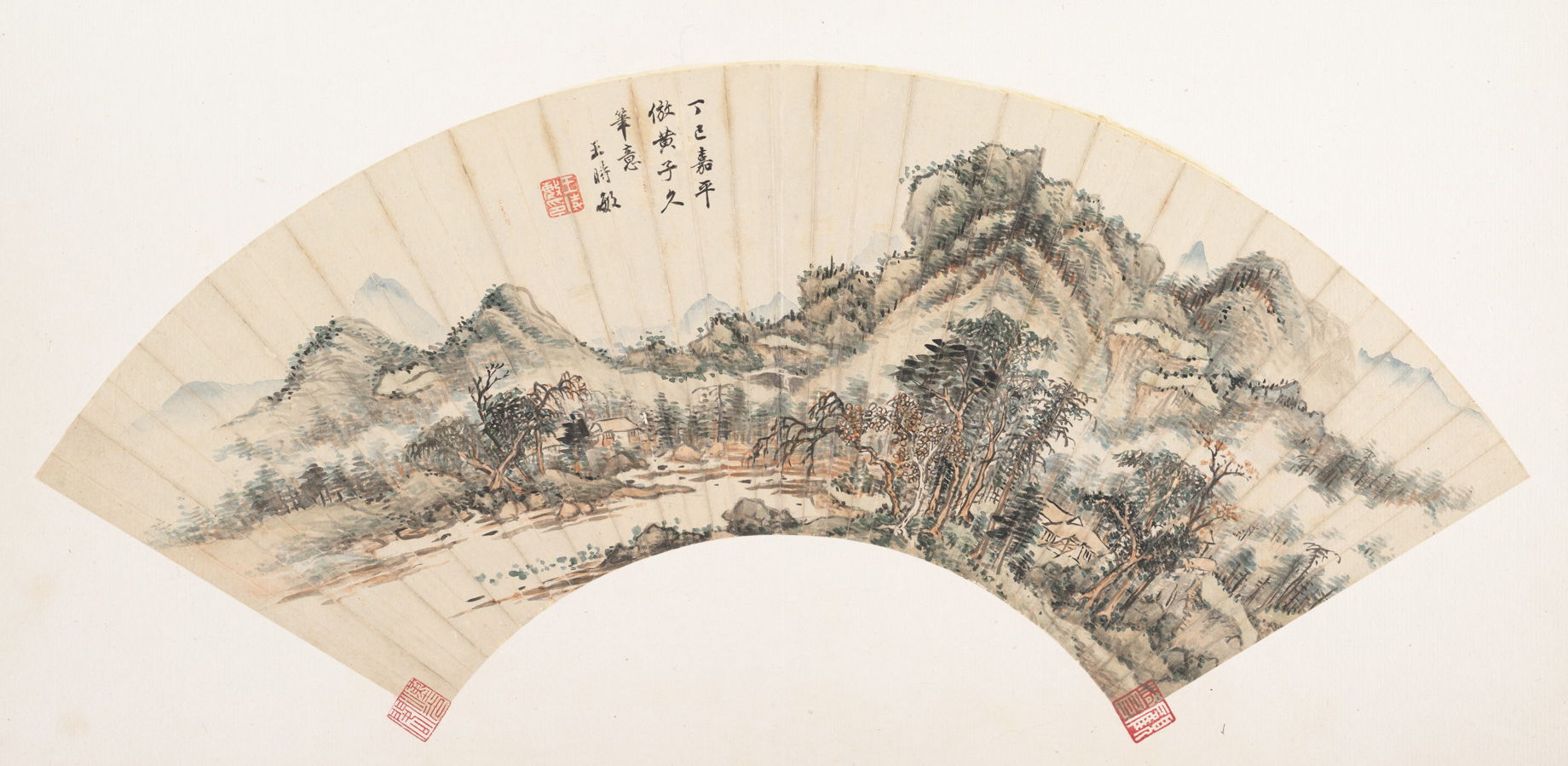
Wang Shimin 王時敏 (1592-1680), untitled folding fan mounted as an album leaf (1677), ink and colour on paper, 15.7 x 49.5 cm, Metropolitan Museum of Art, New York, NY. Wikimedia Commons.
Wang Shimin’s 王時敏 untitled folding fan was painted in 1677, and uses the same media.
Although a few European artists do seem to have painted the occasional fan, by and large those made in Europe were decorated by illustrators rather than established fine art painters. Many of the fan-makers in France were Huguenot craftsmen, Protestants in a Catholic state who suffered repeated oppression, and most were forced to leave before they gained equal rights with the French Revolution at the end of the eighteenth century.
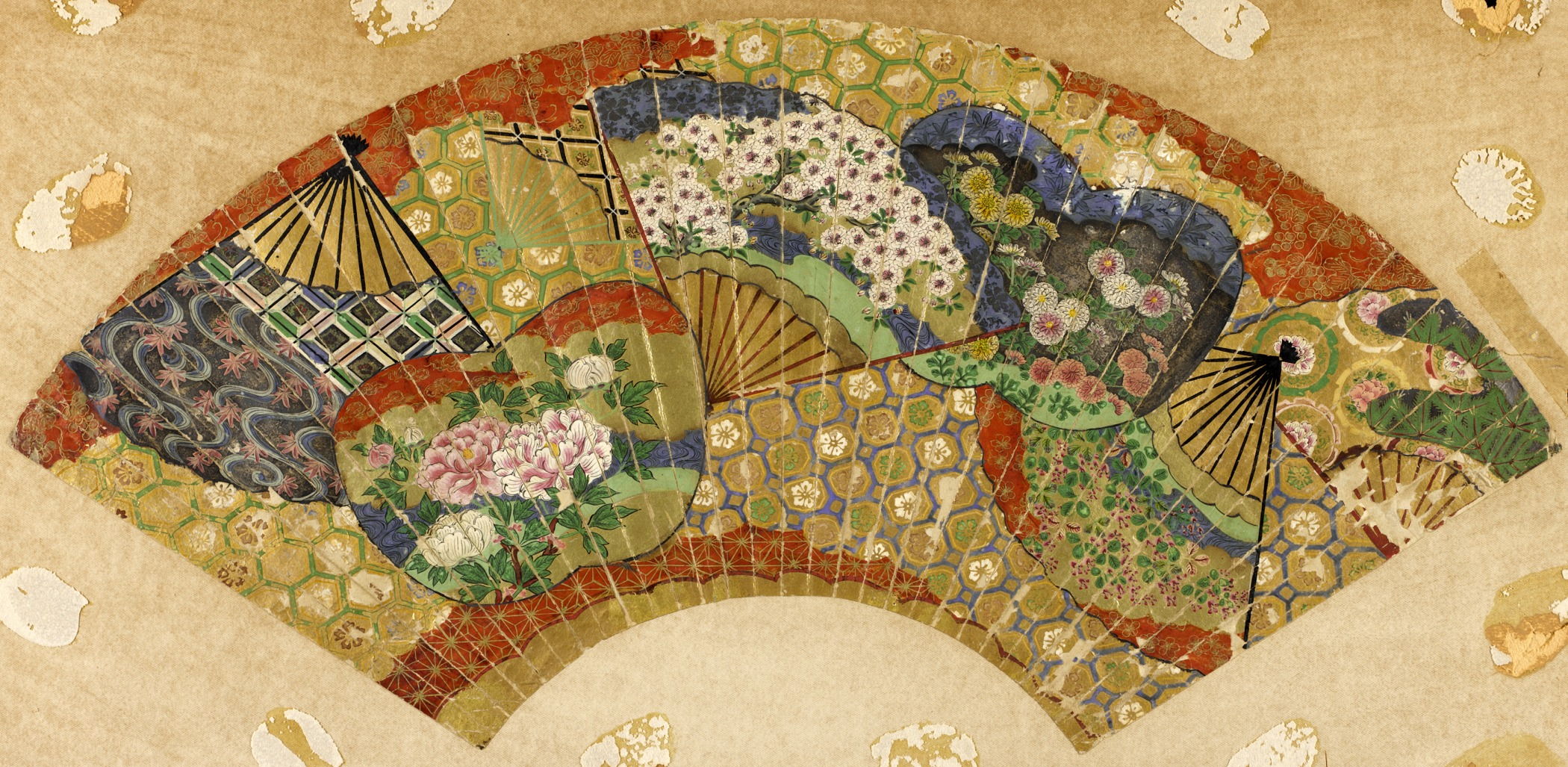
Artist not known, Performance Fan with Design of Fans on Water (19th century), colour and gold on paper, 24.8 x 54 cm, Los Angeles County Museum of Art, Los Angeles, CA. Wikimedia Commons.
When trade between Japan and Europe started to re-open in the middle of the nineteenth century, this was a more typical example of a decorated fan that appeared in Europe, a Performance Fan with Design of Fans on Water.
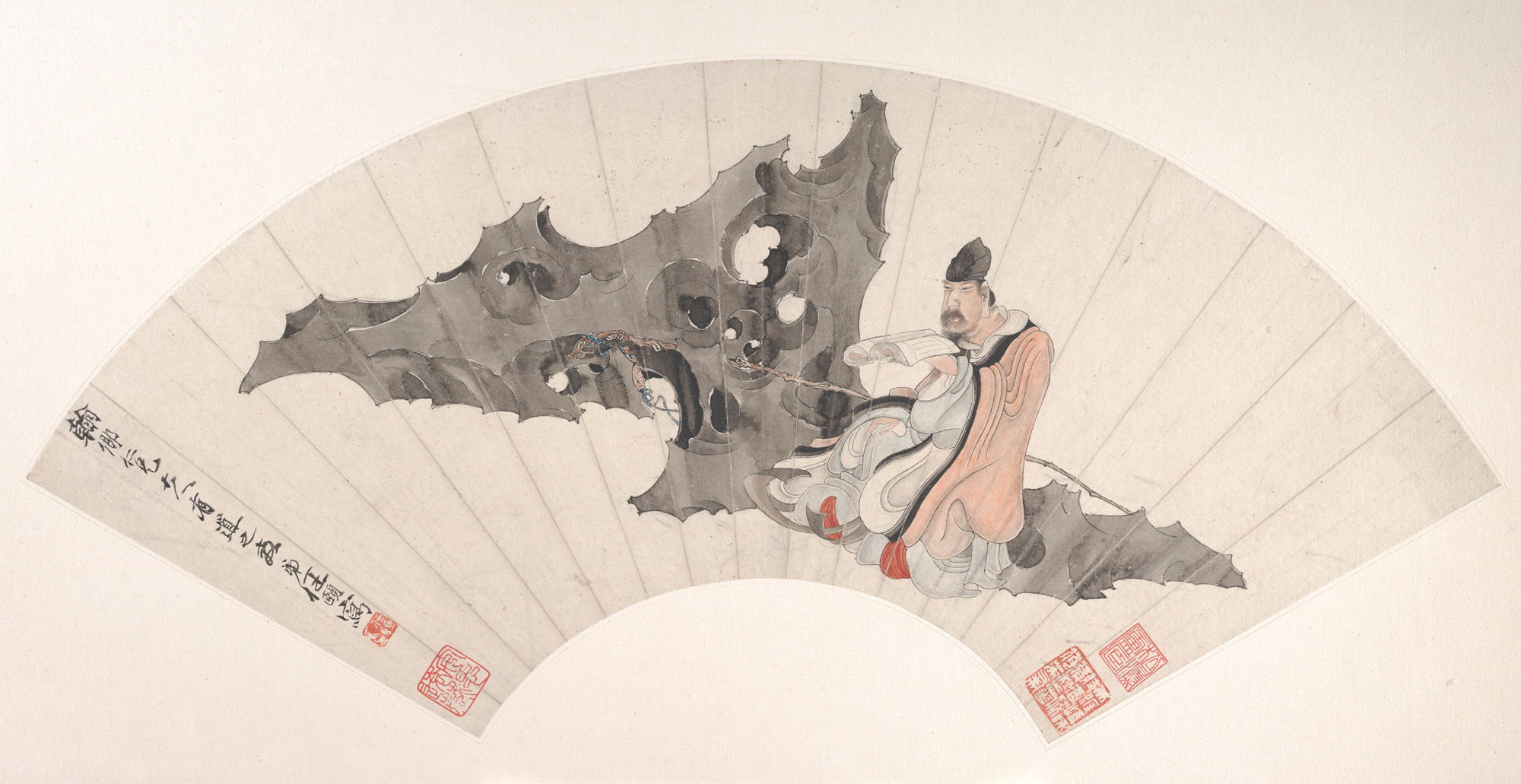
Ren Yi 任頤 (Ren Bonian) (1840-1896), Scholar on a Rock (c 1880), ink and colour on paper, 19.1 x 53.8 cm, Metropolitan Museum of Art, New York, NY. Wikimedia Commons.
When France and most of the rest of Western Europe was swept by enthusiasm for everything Japanese, in the latter half of the nineteenth century, some of the painted fans coming from East Asia were different, clearly the work of artists like Ren Yi 任頤 (Ren Bonian) whose Scholar on a Rock from about 1880 isn’t mere decoration.
Several of the French Impressionists were enthusiastic collectors of Japanese art, and their own work fell under the spell of Japonisme. I’ve been unable to discover which of them first explored the potential of the fan as a form of painting, but it seems to have happened in the five years following the First Impressionist Exhibition of 1874.
The two who were early enthusiastic painters of fans were Edgar Degas and Camille Pissarro. At the time, both were broke and desperately seeking means of increasing the meagre income they made from painting. Decorated fans may have seemed a good little earner at a time when the more affluent were looking for novelties, particularly those that could be given discreetly to a mistress.
It appears to have been Degas who encouraged Pissarro to paint fans, in the hope that the Impressionist Exhibition of 1879 would have a whole room devoted to these works. Although that didn’t happen, a few examples of painted fans have survived from this early period.
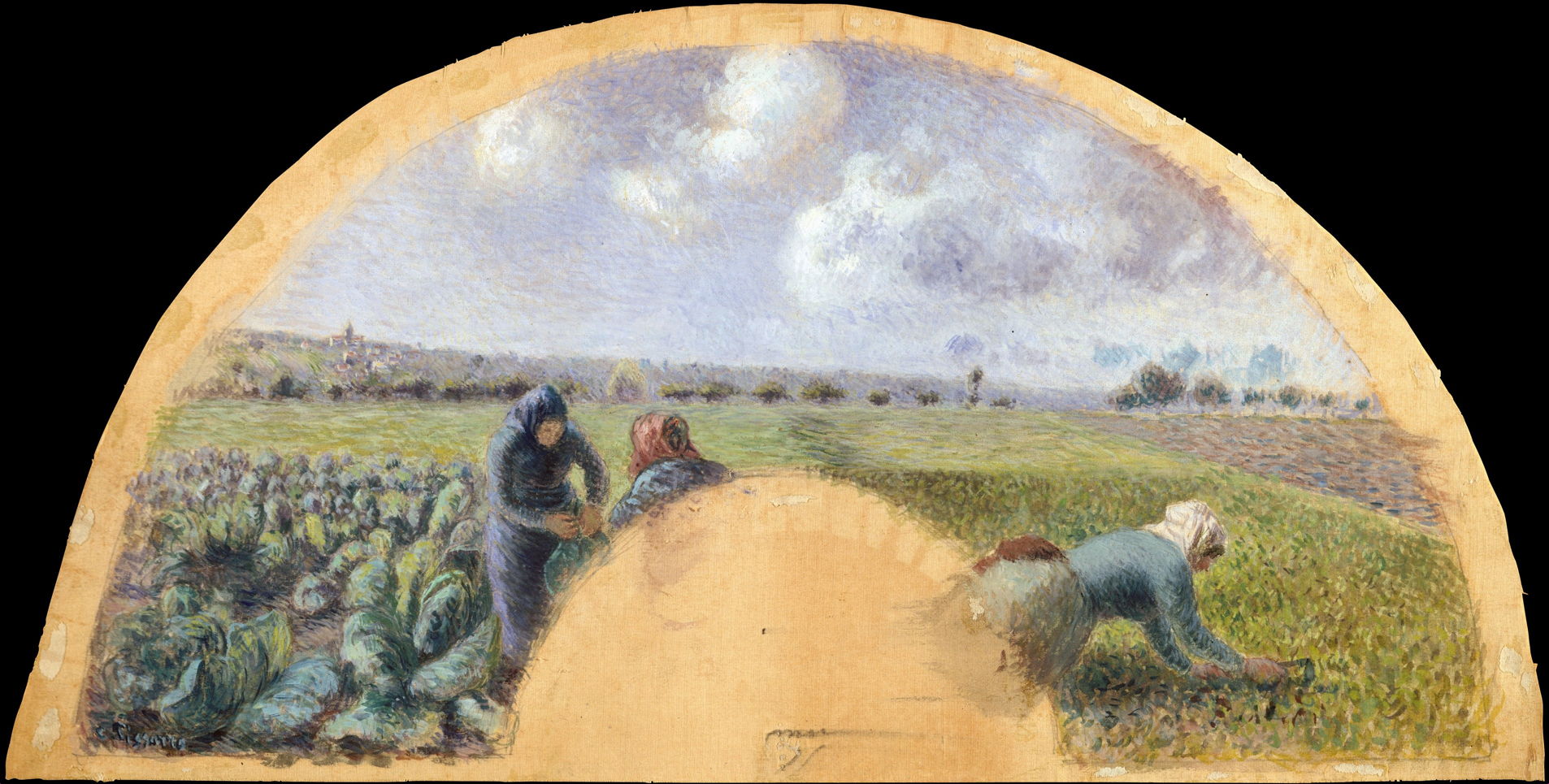
Camille Pissarro (1830–1903), The Cabbage Gatherers (fan mount) (c 1878-79), gouache on silk, 16.5 x 52.1 cm, The Metropolitan Museum of Art, New York, NY. Wikimedia Commons.
Pissarro’s The Cabbage Gatherers is thought to have been painted between 1878-79, and shows countrywomen harvesting cabbages in the fields near Pontoise. This was most probably shown at the Impressionist Exhibition, although not in its own room as Degas had hoped.
This was bought fairly quickly by one of Pissarro’s first American collectors, Louisine Elder, who was to become Mrs. H. O. Havemeyer, thus a major patron of the arts in general and Impressionism in particular. Thanks to the mediation of Mary Cassatt acting as Elder’s agent, Pissarro sold his first fan, and it was shipped to his first American collector.
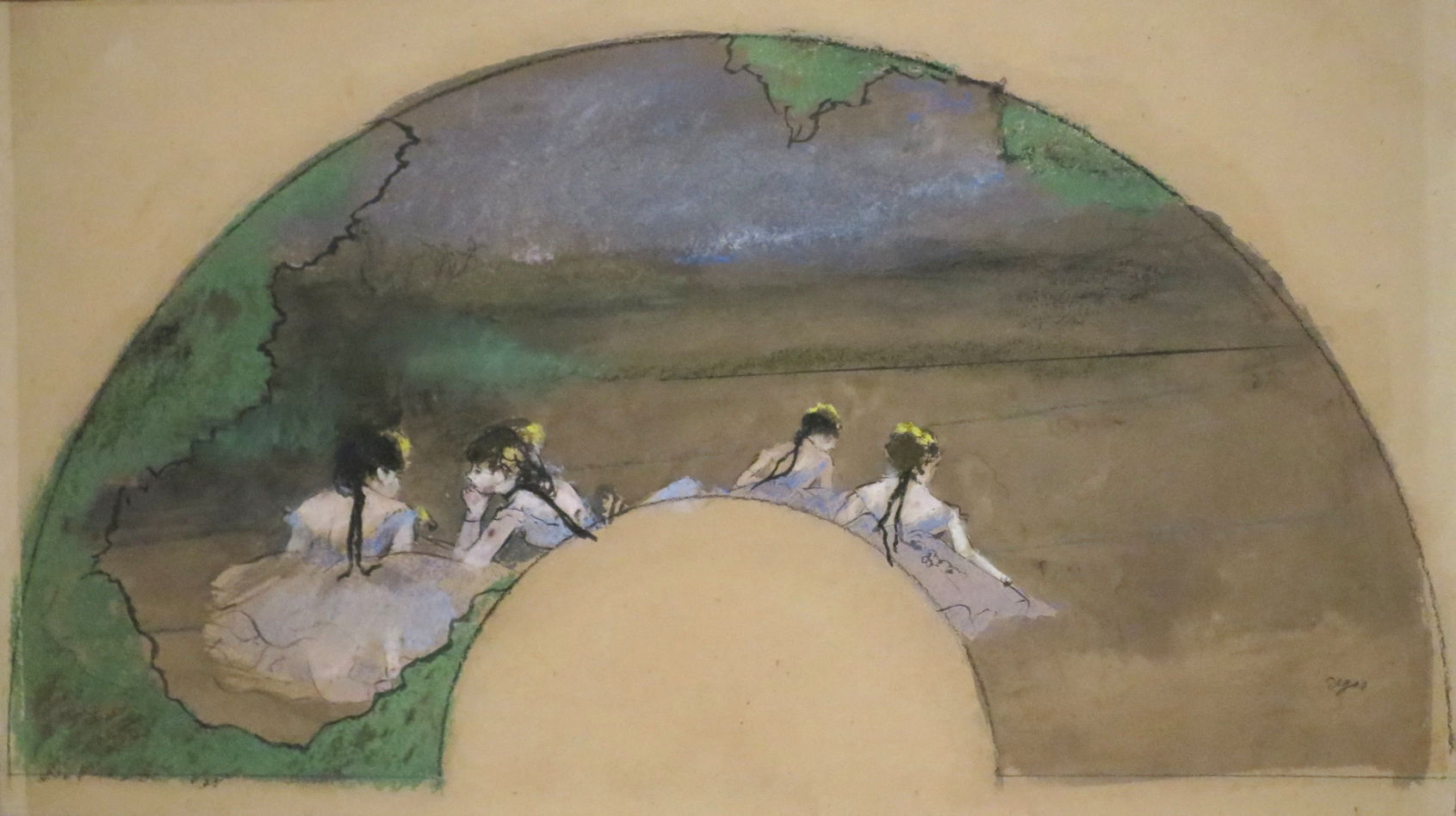
Edgar Degas (1834–1917), Fan: Dancers on the Stage (c 1879), pastel with ink and wash on paper, dimensions not known, Norton Simon Museum, Pasadena, CA. Wikimedia Commons.
The only painted fan I can find by Degas is his Dancers on the Stage from about 1879. Whereas Pissarro had worked in gouache on silk, Degas used pastel with ink and wash on paper, which could have been cut out and mounted in the fan mechanism itself.
Camille Pissarro (1830–1903), The Railway Bridge at Pontoise (c 1882-83), gouache and watercolour on silk, 31 × 60.8 cm, Private collection. Wikimedia Commons.
Over the next decade, Pissarro painted more fans, including this view of The Railway Bridge at Pontoise from about 1882-83, again using gouache and watercolour on silk. His motif here is reminiscent of Monet’s paintings of a similar bridge at Argenteuil almost a decade earlier.
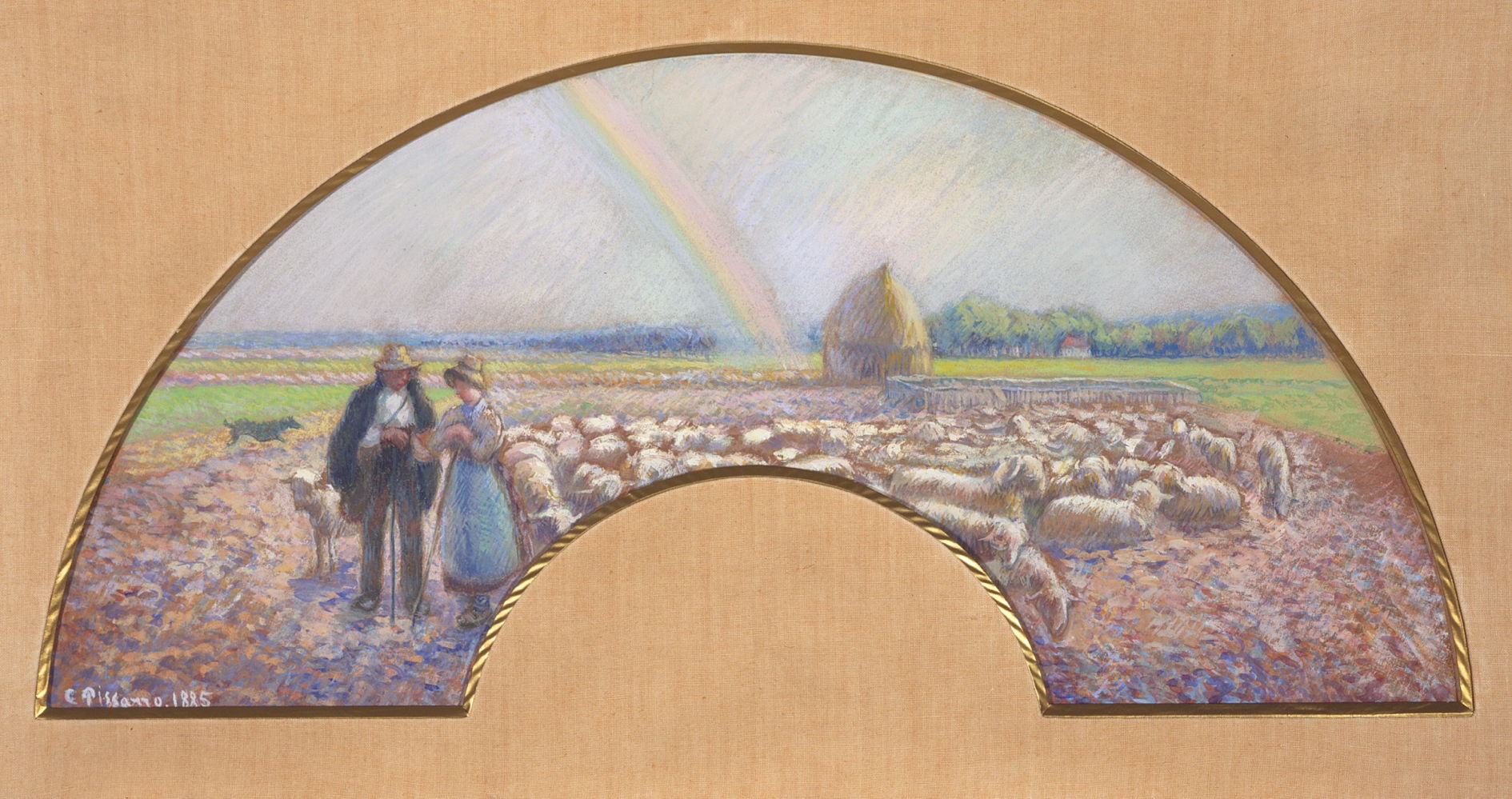
Camille Pissarro (1830–1903), Shepherds in the Fields with a Rainbow (1885), gouache and pastel on silk, 29.5 x 62.9 cm, Los Angeles County Museum of Art, Los Angeles, CA. Wikimedia Commons.
Pissarro used the same media for his Shepherds in the Fields with a Rainbow from 1885, but then seems to have stopped painting fans, just as others were starting.

 Login
Login