
 Login
LoginThe Dutch Golden Age: Mills
As in other countries across Europe at the time, industry in the Dutch Republic during the Golden Age was largely dependent on wind and water, forces that were seldom in short supply. Here’s a small selection of what were effectively some of the first paintings of industry long before the industrial revolution.
Both watermills and windmills date back to ancient times, and became widespread in the Middle Ages. By the seventeenth century they were used for grinding grain into flour, processing wool and fabrics, sharpening tools, forging and metalcraft, manufacturing paper, sawing timber, and sundry other purposes.
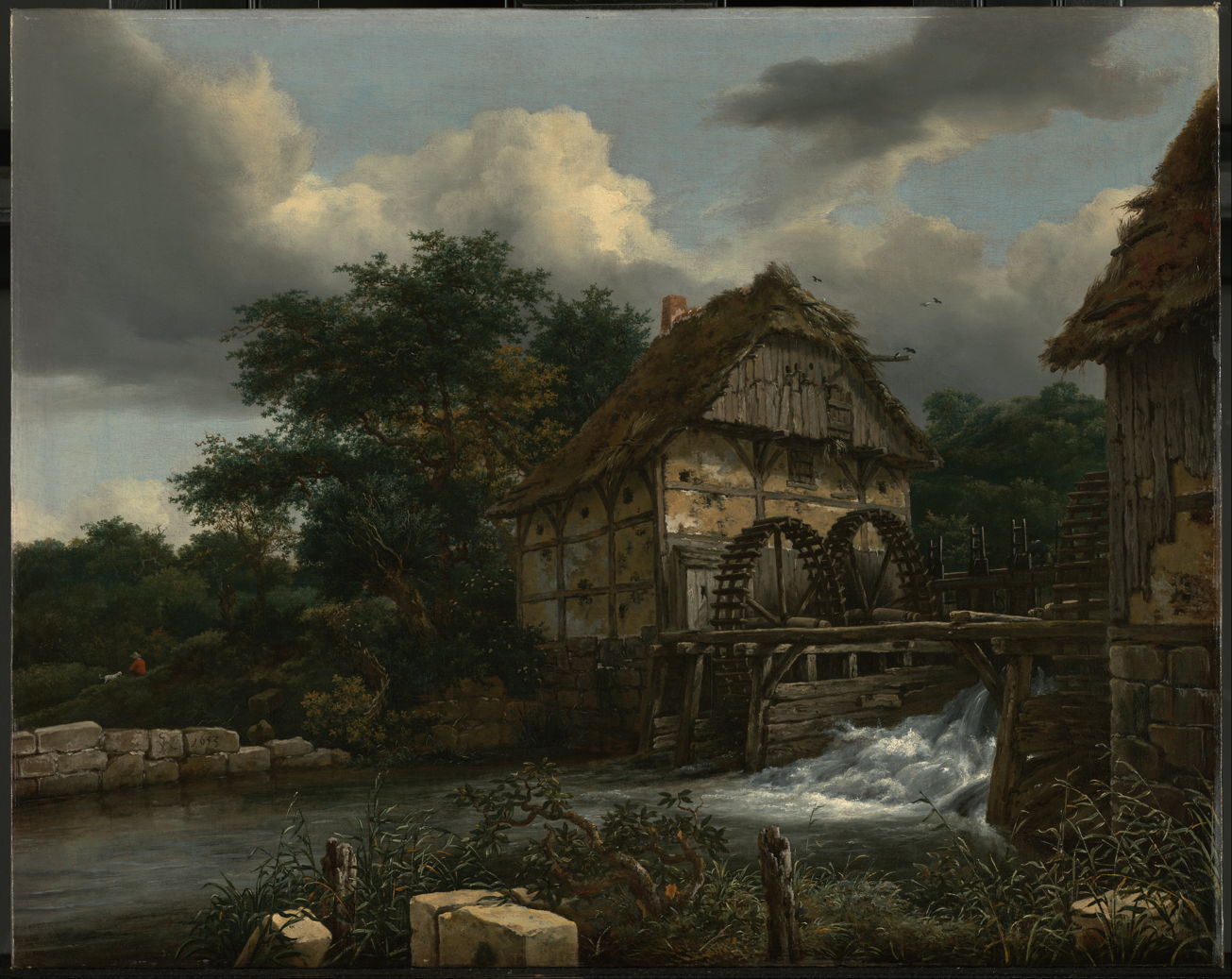
Jacob van Ruisdael’s Two Watermills and an Open Sluice from 1653 is not just a superb landscape painting, but a clear technical account of one of the commonest types of watermill.
Since the Middle Ages in Europe, by far the most common type of waterwheel stands vertically, turning a horizontal axle. The terrain here is fairly flat, so the water supplying the mill comes from only slightly above the level of the outlet. Therefore, the mill is undershot, with only the lowest part of each waterwheel getting wet at any moment. To the right of the twin waterwheels is a sluice gate and overflow to control the level of water in the millpond upstream. Additional sluice gates set upstream of the two wheels give fine control over the water flowing through the mill race or leat, and can be used to stop the wheels from turning when the mill isn’t in use.

Van Ruisdael’s Landscape with a Watermill and Men Cutting Reeds from about the same year shows a smaller and simpler mill which is also undershot. Although the mill buildings may appear dilapidated, the gear appears better maintained and still in everyday use. There’s even a figure at the door of the millhouse.

In another painting from about the same time, van Ruisdael’s Landscape with a Mill-run and Ruins shows what had once been a substantial watermill in an advanced state of decay. The extensive brickwork was used to channel the mill race.
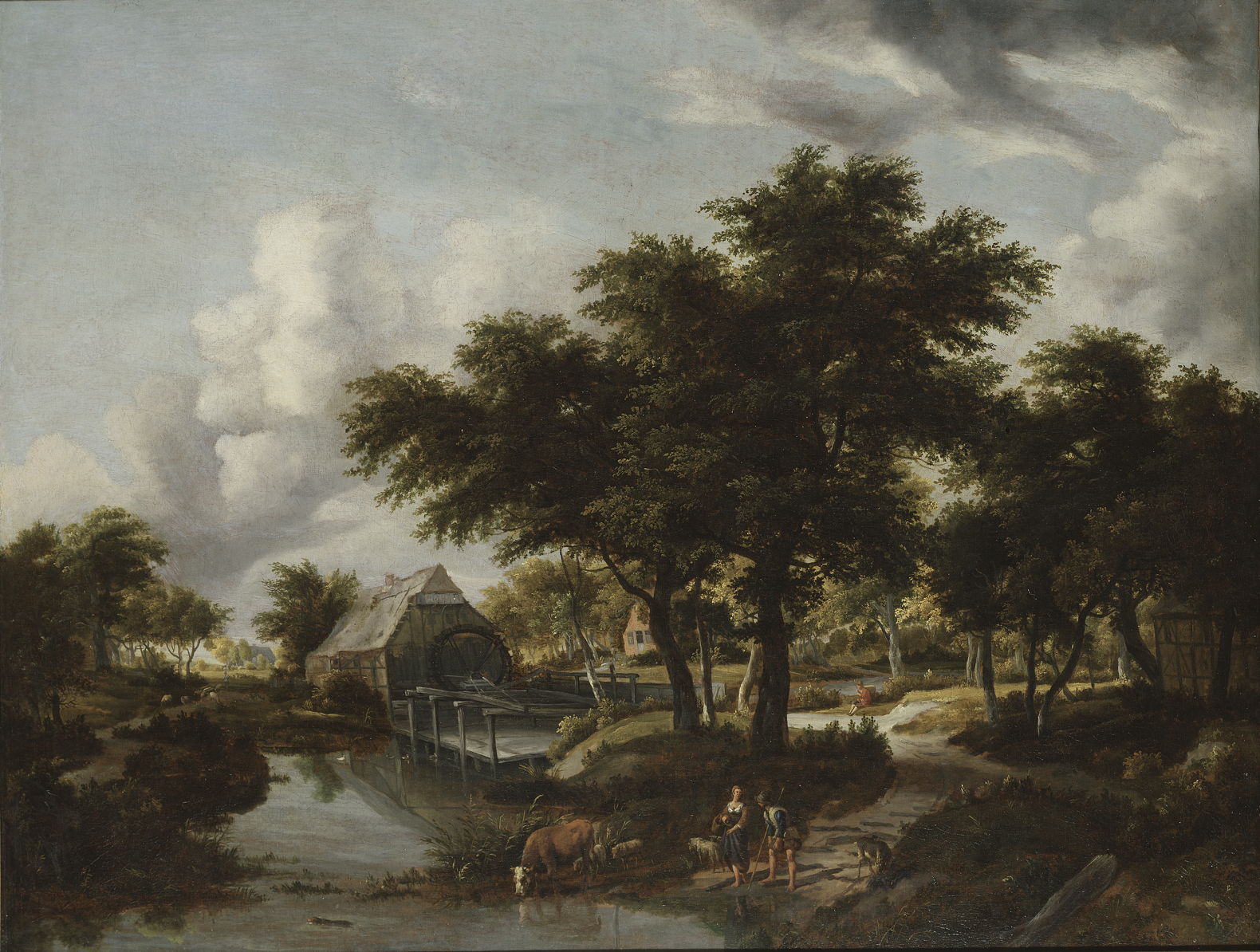
Van Ruisdael’s enthusiasm for painting watermills was passed on to his successor Meindert Hobbema. His Wooded Landscape with a Watermill from 1663 shows another undershot mill in similarly flat and wooded terrain. Hobbema used more staffage than van Ruisdael, though, as shown here in the couple and livestock.
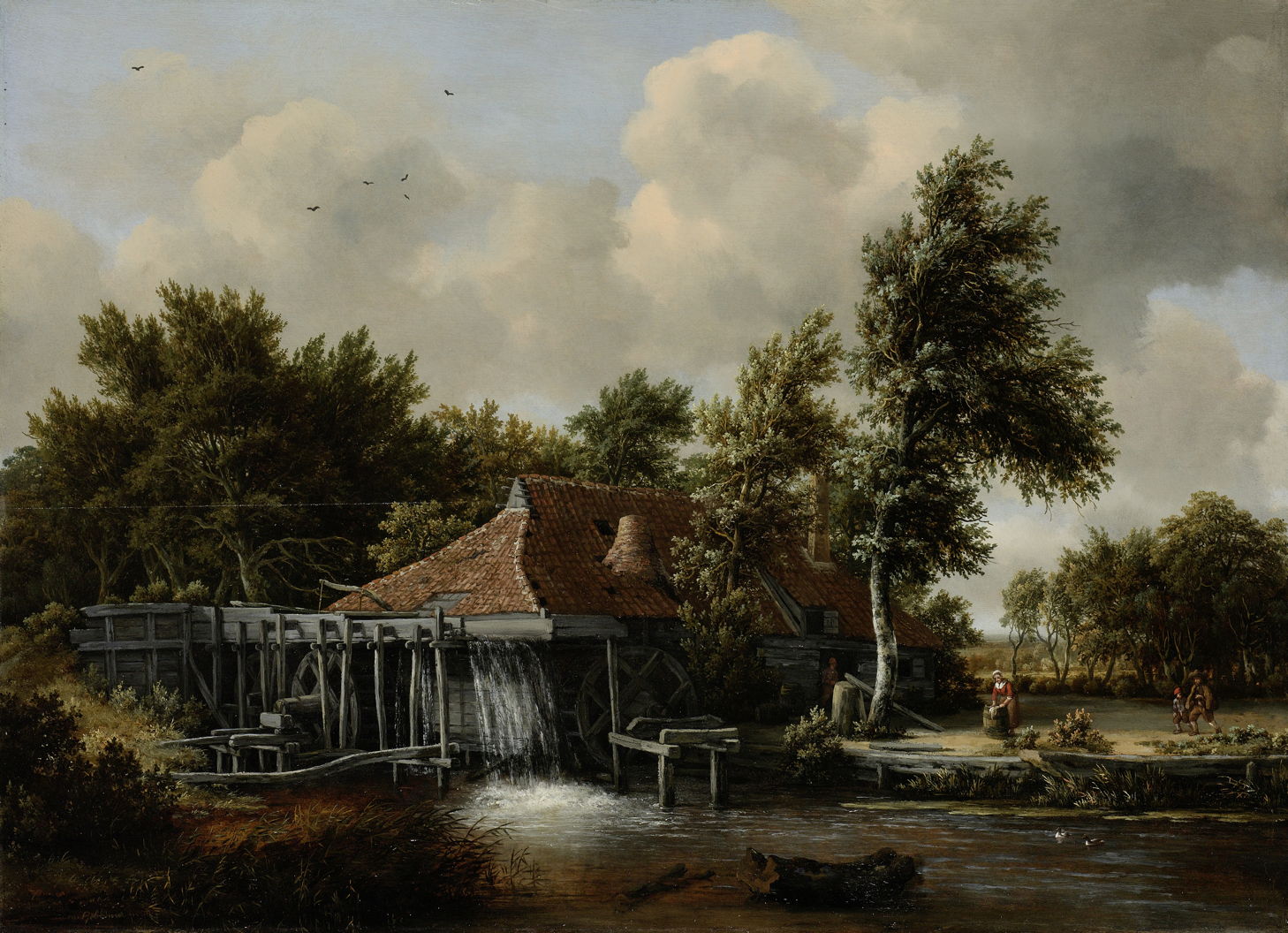
Van Ruisdael’s watermills are desolate, devoid of people, but Hobbema’s magnificent Watermill from about 1664 accommodates a family: the wife is out doing the washing in a barrel, while the husband and son walk through their garden. It’s also relatively unusual in that the water here is fed through the elevated wooden aqueducts, making this watermill overshot. This could develop more power with a lower flow of water, because it uses the weight of water falling against the blades of the waterwheel rather than just its flow.
The Republic was famous for its numerous windmills, that were almost universally vertical in design, with their sails rotating in a vertical plane. Other parts of Europe, mainly the south and east, often preferred horizontal designs that look very different.

I can count half a dozen windmills clustered around the port of Dordrecht in Jan van Goyen’s View of Dordrecht with the Grote Kirk Across the Maas from 1644.

Rembrandt painted few non-narrative landscapes, but among them is this dramatic view of The Mill (1645-48) seen in the rich rays of twilight. This is a classical post mill set on top of a roundhouse, where the whole of the wooden mill structure is built around a central post, and is turned to face into the wind.

The great masters of Dutch landscape art like Jacob van Ruisdael must have painted many hundreds of windmills, of which one of the best-known is this view of The Windmill at Wijk bij Duurstede from about 1670. This is a more substantial tower mill, where only the cap at the top rotated to catch the wind. This small town, now a city, is on the bank of the River Rhine, an ideal location for delivering grain by barge, and shipping the resulting flour. This should have kept the mill as busy as the wind allowed, and its owner prosperous.
Golden Age paintings of windmills became so well-known that later artists copied them.

This view of a Landscape with Windmills near Haarlem was painted by John Constable in 1830, almost two centuries after the original by Jacob van Ruisdael.
Watermills and windmills remained in widespread use in the Netherlands until the latter half of the nineteenth century, when they were largely replaced by steam power, fuelled by coal imported from the mining areas of Belgium and north-eastern France, and Britain. It wasn’t until the twentieth century that wind turbines started to make use of the forces of nature again.

