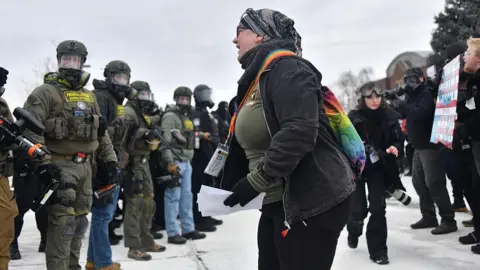
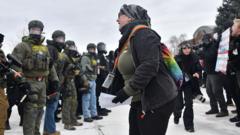
A US federal judge has issued an order limiting the crowd control tactics that can be used by Immigration and Customs Enforcement agents (ICE) towards "peaceful and unobstructive" protesters in Minneapolis.
Judge Katherine Menendez ruled on Friday night that federal agents can't arrest or pepper spray peaceful demonstrators, including those monitoring and observing ICE agents.
The ruling comes ahead of planned weekend protests against the widespread immigration action in the city and follows the fatal shooting of Renee Good by an ICE agent earlier this month.
The US Department of Homeland Security said it is taking measures to protect officers from rioters.
On Friday, Minnesota officials urge protesters expected to take to the streets this weekend to stay orderly and peaceful.
The state's National Guard has been placed on alert and other law enforcement officers have been deployed ahead of both expected anti-ICE demonstrations and a counter march being planned by a conservative influencer.
Judge Menendez's 83-page order bars federal agents from arresting and "using pepper-spray or similar nonlethal munitions and crowd dispersal tools against persons who are engaging in peaceful and unobstructive protest activity".
The ruling, which stems from a lawsuit filed by a group of protesters in December, also limits agents from "stopping or detaining drivers and passengers in vehicles where there is no reasonable articulable suspicion that they are forcibly obstructing or interfering" with their work.
"The act of safely following [immigration agents] at an appropriate distance does not, by itself, create reasonable suspicion to justify a vehicle stop," it says.
In a statement to CBS, the BBC's US partner, in response to the order, a spokesperson for the Department of Homeland Security said the agency "is taking appropriate and constitutional measures to uphold the rule of law and protect our officers and the public from dangerous rioters".
The White House also criticised the ruling.
"This absurd ruling embraces a dishonest, left-wing narrative," spokesperson Abigail Jackson told Politico. "Here's the truth: federal agents have acted lawfully to protect themselves and ensure the integrity of their operations when individuals attempt to intervene."
There have been some reported clashes between protesters and federal officers over the past week.
Additionally on Friday, the justice department announced it was investigating two of the state's leading Democrats - Governor Tim Walz and Minneapolis Mayor Jacob Frey - over alleged attempts to impede federal immigration operations.
Both have condemned the ICE operations in the city.
"A reminder to all those in Minnesota: No one is above the law," US Attorney General Pam Bondi said in an online statement.
The investigation was criticised by Walz and Frey.
"Weaponizing the justice system against your opponents is an authoritarian tactic," Walz said in a statement.
The White House has announced the first members of its Gaza "Board of Peace", and the list of names will do little to dispel the criticism from some quarters that the US president's plan resembles, at its heart, a colonial solution imposed over the heads of the Palestinians.
There are still several unknowns - namely who else might be added, and the exact structure of what is currently a rather complicated layout.
So far, no Palestinian names are included on the two separate senior boards that have been officially unveiled.
One is a "founding Executive Board", with a high-level focus on investment and diplomacy. The other, called the "Gaza Executive Board", is responsible for overseeing all on-the-ground work of yet another administrative group, the National Committee for the Administration of Gaza (NCAG).
That committee is made up of supposedly technocratic, apolitical Palestinians, led by Dr Ali Shaath, a civil engineer by training who's held ministerial positions in the Palestinian Authority.
But of the seven members of the founding Executive Board, six are Americans - including US Secretary of State Marco Rubio and other members of Trump's inner circle like his son-in-law Jared Kushner, and Steve Witkoff, who is US Special Envoy to the Middle East, but also a friend of the president and a fellow real estate developer.
Ajay Banga, president of the World Bank, is something of an exception as a dual-national, Indian-born US citizen. Sir Tony Blair, meanwhile, is a former UK Prime Minister, and his inclusion is likely to further fuel concerns about how the Board of Peace will operate.
Over the past few weeks, criticism of Sir Tony's possible inclusion has come from figures like prominent politician Mustafa Barghouti, general secretary of the Palestinian National Initiative, and newspaper reports quoting unnamed officials from Arab states in the region.
Sir Tony's central role in the Iraq war, coupled with Britain's own colonial history in the Middle East, is deemed by his opponents to make him entirely unsuitable.
Francesca Albanese, the United Nations' special rapporteur on human rights in the occupied Palestinian territories, wrote on social media last year: "Tony Blair? Hell no. Hands off Palestine."
Even Trump seemed to acknowledge the issue.
"I've always liked Tony, but I want to find out that he's an acceptable choice to everybody," the president said last October.
There is significant overlap between the two senior boards, with Kushner, Witkoff and Sir Tony appearing on both.
But the Gaza Executive Board does include the names of some senior political figures and diplomats from Turkey, Qatar and the United Arab Emirates. It will be headed by the former Bulgarian politician, Nickolay Mladenov, who's been given the title of High Representative for Gaza.
Yakir Gabay, a businessman born in Israel and now based in Cyprus is the only Israeli member.
In its statement announcing the names, the White House said those chosen will work to ensure "effective governance and the delivery of best-in-class services that advance peace, stability, and prosperity for the people of Gaza".
And whatever the concerns and complexities, the plan remains the only game in town, with many world leaders pledging their support and commitment to helping make it a success.
Its architecture is further complicated by the fact that, sitting above all the structures announced so far, will be the Board of Peace itself, with President Trump as the chairman.
Names of that supreme body have not yet been announced, but the current UK Prime Minister Sir Keir Starmer, Turkish President Recep Tayyip Erdogan, Egypt's Abdel Fattah El-Sisi and Canadian leader Mark Carney have reportedly been invited to join.
In the end, whether the most vocal critics can be assuaged will depend on how quickly the new members of the senior teams can begin to drive change that makes a real difference in both daily life for Palestinians and, crucially, further concrete steps towards a lasting peace.
Getty Images
Aid groups have accused Israel of continuing restrictions on their work
Major challenges remain to both of those goals.
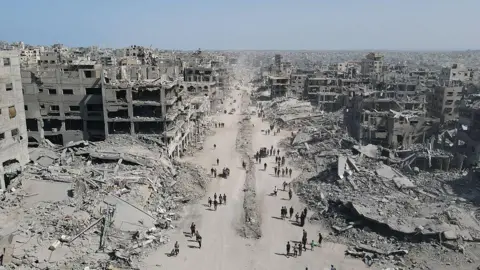
The UN estimates around 80% of buildings in Gaza have been destroyed or damaged and families who have survived the war are now struggling with the winter weather, and a lack of food and shelter.
While aid groups say there has been some improvements, they accuse Israel of imposing continuing restrictions upon their work.
Israel says that it is facilitating humanitarian assistance, and has blamed the UN for failing to distribute supplies already in Gaza. It argues any restrictions are designed to stop Hamas infiltrating and exploiting relief efforts.
Showing meaningful progress towards rebuilding will also be a Herculean task, involving not only the removal of an estimated 60 million tonnes of rubble, but first finding and disposing of the dead bodies and unexploded bombs contained within it.
Perhaps the biggest challenge though is maintaining the fraying ceasefire itself.
Another name has been released by the White House, that of Major General Jasper Jeffers as the Commander of the International Stabilization Force (ISF).
Backed by a UN mandate, it will have the tough job of ensuring the demilitarisation of Gaza.
As yet, there's no clear road map for how Hamas will be persuaded to give up its weapons, nor any clear idea of which country will provide troops for that force or what its remit and rules of engagement will be.
Hamas has said it will only disarm as part of a wider deal establishing a Palestinian state.
Israel, whose ground troops still control more than half of the Gaza Strip, has said it will only withdraw if Hamas disarms.
How that catch-22 can be resolved is perhaps the biggest test of all.
Grace Keeling, left, and Sarah Keeling went into the sea at Withernsea on 2 January
A body has been recovered in the search for a missing girl, 15, who was swept into the sea off the East Yorkshire coast, Humberside Police has said.
Grace Keeling went into the water at Withernsea on 2 January. Her mother, Sarah Keeling, 45, and passer-by Mark Ratcliffe, 67, both died after trying to save her.
While formal identification is yet to take place, police said they believed this person to be Grace Keeling.
Det Supt Simon Vickers said: "This was a deeply upsetting incident, and I cannot begin to understand the heartbreak felt by all the loved ones of those involved."
Vickers said they had spoken to Grace Keeling's family and updated them, and were continuing to support them with specially trained officers.
"Understandably, they have asked for their privacy, and we would ask that this is respected," he said.
Police said her body was discovered at about 08:30 GMT on Thursday following extensive searches over the past 14 days but said it was not possible to recover the body immediately due to the tide times, conditions and location.
Officers said they were able to do so safely on Saturday morning, with the help of HM Coastguard and Humberside Fire and Rescue Service.
Jasmine Lowe / BBC
One of many heartfelt tributes placed at the scene in Withernsea
Humberside Police thanked everyone who had offered or assisted in the search.
Vickers added: "Our thoughts and sincere sympathies will always remain with the families of Grace and Sarah Keeling, and Mark Ratcliffe following this utter tragedy."
Police had previously said that, from trawling through CCTV and speaking to multiple witnesses, it was understood that Grace Keeling and a friend were on the steps near to the rocks when she was "believed to have fallen into the water after being swept by a wave".
A major operation was launched at 15:10 GMT on Friday 2 January following reports of people in the water. It involved HM Coastguard, emergency services, the RNLI and included helicopters and lifeboats.
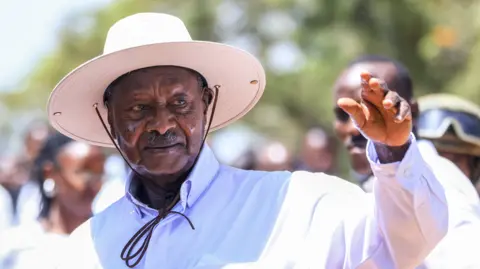
Yoweri Museveni first came to power in 1986 as a rebel leader
President Yoweri Museveni has been declared the winner of Thursday's election extending his four decades in power by another five years.
He gained 72% of the vote, the election commission announced, against 25% for his closest challenger Bobi Wine, who has condemned what he described as "fake results" and "ballot stuffing". He has not provided any evidence and the authorities have not responded to his allegations.
Wine has called on Ugandans to hold non-violent protests.
Museveni, 81, first came to power as a rebel leader in 1986 but since then has won seven elections.
The election process was marred by violence and Wine, a 43-year-old former pop star, says that at least 21 people have been killed around the country in recent days.
The authorities have so far confirmed seven deaths.
Access to the internet has been cut in the country since Tuesday, making it hard to verify information.
The authorities say the blackout was necessary to prevent misinformation, fraud and the incitement of violence - a move condemned by the UN human rights office as "deeply worrying".
Wine has demanded that the internet be restored.
Overnight, Wine's party said that he had been abducted from his home in the capital, Kampala - a claim denied by the police.
Wine later issued a statement on Facebook saying that he had managed to evade a night-time raid by security forces and was in hiding.
He had previously said he was under house arrest.
This has not been confirmed by the police but spokesman Kituuma Rusoke said Wine's movements were restricted because his home was an area of "security interest".
"We have controlled access to areas which are security hotspots," Uganda's Daily Monitor paper quoted him as saying.
"We cannot allow people to use some places to gather and cause chaos," he said.
With the Trump administration unlikely to bring a federal case against the ICE agent who killed Renee Good, our criminal justice reporter Jonah Bromwich explains some of the obstacles for any Minnesota prosecutors trying to charge the agent.
John Furner, incoming chief executive of Walmart, left, and Sundar Pichai, Google’s leader, said at a conference in New York City this week that the two companies would use artificial intelligence to change how all businesses sold their products.
A video from Ken Paxton, a Republican primary challenger to Senator John Cornyn of Texas, depicted A.I.-generated imagery of the senator twirling with Jasmine Crockett, a Democratic Senate candidate.
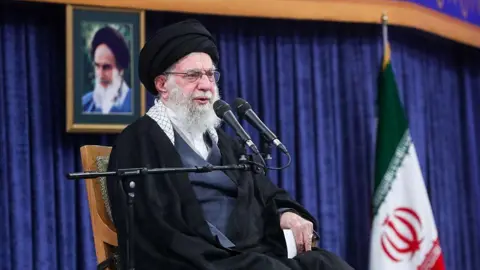
Iran's Supreme Leader, Ayatollah Ali Khamenei, has accused the US and Donald Trump of being responsible for "casualties, damage and slander" in his country during recent protests.
In a speech on Saturday, Khamenei acknowledged that thousands of people had been killed during recent unrest, "some in an inhuman, savage manner" but blamed the deaths on "seditionists".
The US president has urged Iranian anti-government demonstrators to "keep protesting" and threatened military intervention if security forces kill them.
Protests in Iran have claimed 3,090 lives, according to US-based Iranian Human Rights Activists News Agency (HRANA), in unrest that started over the economy on 28 December.
Since then, the protests have turned into calls for the end of the rule of Iran's supreme leader.
The Iranian government has called the demonstrations "riots" backed by Iran's enemies.
Protesters have been met with deadly force and there has been a near-total shutdown of the internet and communication services.
There have been fewer reports of unrest in recent days but with internet access still restricted developments on the ground remain unclear.
During his speech on Saturday, Khamenei also said Iran considered President Trump to be a "criminal" and said the US must be "held accountable" for recent unrest.
He also claimed on social media that "America's goal is to swallow Iran".
Trump has not yet responded to the supreme leader and the BBC has approached the White House for a comment.
Donald Trump said on Wednesday he had been told "the killing in Iran has stopped", but added that he had not ruled out military action against the country.
His comments came after the US and UK both reduced the number of personnel at the Al-Udeid air base in Qatar.
Officials told CBS, the BBC's US partner, that a partial American withdrawal was a "precautionary measure".
The White House has announced the first members of its Gaza "Board of Peace", and the list of names will do little to dispel the criticism from some quarters that the US president's plan resembles, at its heart, a colonial solution imposed over the heads of the Palestinians.
There are still several unknowns - namely who else might be added, and the exact structure of what is currently a rather complicated layout.
So far, no Palestinian names are included on the two separate senior boards that have been officially unveiled.
One is a "founding Executive Board", with a high-level focus on investment and diplomacy. The other, called the "Gaza Executive Board", is responsible for overseeing all on-the-ground work of yet another administrative group, the National Committee for the Administration of Gaza (NCAG).
That committee is made up of supposedly technocratic, apolitical Palestinians, led by Dr Ali Shaath, a civil engineer by training who's held ministerial positions in the Palestinian Authority.
But of the seven members of the founding Executive Board, six are Americans - including US Secretary of State Marco Rubio and other members of Trump's inner circle like his son-in-law Jared Kushner, and Steve Witkoff, who is US Special Envoy to the Middle East, but also a friend of the president and a fellow real estate developer.
Ajay Banga, president of the World Bank, is something of an exception as a dual-national, Indian-born US citizen. Sir Tony Blair, meanwhile, is a former UK Prime Minister, and his inclusion is likely to further fuel concerns about how the Board of Peace will operate.
Over the past few weeks, criticism of Sir Tony's possible inclusion has come from figures like prominent politician Mustafa Barghouti, general secretary of the Palestinian National Initiative, and newspaper reports quoting unnamed officials from Arab states in the region.
Sir Tony's central role in the Iraq war, coupled with Britain's own colonial history in the Middle East, is deemed by his opponents to make him entirely unsuitable.
Francesca Albanese, the United Nations' special rapporteur on human rights in the occupied Palestinian territories, wrote on social media last year: "Tony Blair? Hell no. Hands off Palestine."
Even Trump seemed to acknowledge the issue.
"I've always liked Tony, but I want to find out that he's an acceptable choice to everybody," the president said last October.
There is significant overlap between the two senior boards, with Kushner, Witkoff and Sir Tony appearing on both.
But the Gaza Executive Board does include the names of some senior political figures and diplomats from Turkey, Qatar and the United Arab Emirates. It will be headed by the former Bulgarian politician, Nickolay Mladenov, who's been given the title of High Representative for Gaza.
Yakir Gabay, a businessman born in Israel and now based in Cyprus is the only Israeli member.
In its statement announcing the names, the White House said those chosen will work to ensure "effective governance and the delivery of best-in-class services that advance peace, stability, and prosperity for the people of Gaza".
And whatever the concerns and complexities, the plan remains the only game in town, with many world leaders pledging their support and commitment to helping make it a success.
Its architecture is further complicated by the fact that, sitting above all the structures announced so far, will be the Board of Peace itself, with President Trump as the chairman.
Names of that supreme body have not yet been announced, but the current UK Prime Minister Sir Keir Starmer, Turkish President Recep Tayyip Erdogan, Egypt's Abdel Fattah El-Sisi and Canadian leader Mark Carney have reportedly been invited to join.
In the end, whether the most vocal critics can be assuaged will depend on how quickly the new members of the senior teams can begin to drive change that makes a real difference in both daily life for Palestinians and, crucially, further concrete steps towards a lasting peace.
Getty Images
Aid groups have accused Israel of continuing restrictions on their work
Major challenges remain to both of those goals.
The UN estimates around 80% of buildings in Gaza have been destroyed or damaged and families who have survived the war are now struggling with the winter weather, and a lack of food and shelter.
While aid groups say there has been some improvements, they accuse Israel of imposing continuing restrictions upon their work.
Israel says that it is facilitating humanitarian assistance, and has blamed the UN for failing to distribute supplies already in Gaza. It argues any restrictions are designed to stop Hamas infiltrating and exploiting relief efforts.
Showing meaningful progress towards rebuilding will also be a Herculean task, involving not only the removal of an estimated 60 million tonnes of rubble, but first finding and disposing of the dead bodies and unexploded bombs contained within it.
Perhaps the biggest challenge though is maintaining the fraying ceasefire itself.
Another name has been released by the White House, that of Major General Jasper Jeffers as the Commander of the International Stabilization Force (ISF).
Backed by a UN mandate, it will have the tough job of ensuring the demilitarisation of Gaza.
As yet, there's no clear road map for how Hamas will be persuaded to give up its weapons, nor any clear idea of which country will provide troops for that force or what its remit and rules of engagement will be.
Hamas has said it will only disarm as part of a wider deal establishing a Palestinian state.
Israel, whose ground troops still control more than half of the Gaza Strip, has said it will only withdraw if Hamas disarms.
How that catch-22 can be resolved is perhaps the biggest test of all.
Yoweri Museveni first came to power in 1986 as a rebel leader
President Yoweri Museveni has been declared the winner of Thursday's election extending his four decades in power by another five years.
He gained 72% of the vote, the election commission announced, against 25% for his closest challenger Bobi Wine, who has condemned what he described as "fake results" and "ballot stuffing". He has not provided any evidence and the authorities have not responded to his allegations.
Wine has called on Ugandans to hold non-violent protests.
Museveni, 81, first came to power as a rebel leader in 1986 but since then has won seven elections.
The election process was marred by violence and Wine, a 43-year-old former pop star, says that at least 21 people have been killed around the country in recent days.
The authorities have so far confirmed seven deaths.
Access to the internet has been cut in the country since Tuesday, making it hard to verify information.
The authorities say the blackout was necessary to prevent misinformation, fraud and the incitement of violence - a move condemned by the UN human rights office as "deeply worrying".
Wine has demanded that the internet be restored.
Overnight, Wine's party said that he had been abducted from his home in the capital, Kampala - a claim denied by the police.
Wine later issued a statement on Facebook saying that he had managed to evade a night-time raid by security forces and was in hiding.
He had previously said he was under house arrest.
This has not been confirmed by the police but spokesman Kituuma Rusoke said Wine's movements were restricted because his home was an area of "security interest".
"We have controlled access to areas which are security hotspots," Uganda's Daily Monitor paper quoted him as saying.
"We cannot allow people to use some places to gather and cause chaos," he said.
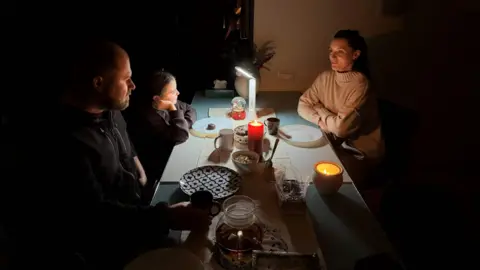
Sergii, Mariia and Eva's Odesa apartment suffers from frequent power cuts
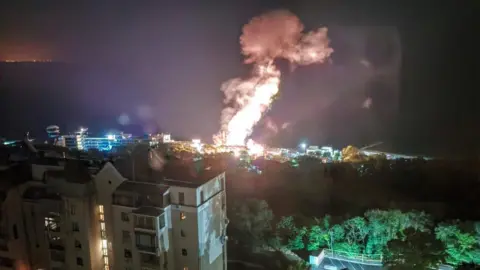
From Mariia's 16th-floor flat, the calm waters of the Black Sea stretch out into the horizon beneath the fading twilight.
"Up here you can see and hear when the drones come," she says, standing by a wall-length, floor-to-ceiling window. When they hit buildings and homes in the city of Odesa down below "we see all the fires too".
Her daughter Eva, who is nine, has learned the shapes and sounds of the objects that zoom through the sky on a daily basis. She proudly shows off a list of social media channels she checks when the air raid alerts go off.
"She knows whether what's coming is a risk or a threat, and that calms her down," her father Sergii says.
There is scarcely a place in Ukraine that has not been targeted since Russia launched its full-scale invasion nearly four years ago.
But in recent weeks Odesa – Ukraine's third largest city – has come under sustained attack. Through strikes on port and energy infrastructure, Russia is trying to cripple the region's economy and dent the population's morale.
Supplied
A view of a recent drone attack from Sergii's window
Moscow, however, does not just hit facilities. Its drones, mostly as big as a motorcycle, regularly crash into high-rise buildings like Masha's, exploding on impact and blowing glass and debris inward. The consequences are often deadly.
"A few months ago Eva said she was afraid the drone would come too fast and we wouldn't have time to hide," Mariia says. "But I explained that if it came towards us, it would get louder and louder and then we'd know we have to run."
Mariia, Sergii and Eva are originally from Kherson, a region 200km (125m) to the east of Odesa which is now in large part occupied by Russia.
They left as soon as the invasion started in 2022 and mother and daughter briefly moved to Germany as refugees. But Sergii and Mariia could not bear the distance, so the family reunited in Ukraine and moved to Odesa.
Now, as attacks on the region intensify, Sergii wonders whether the family should prepare to leave again. "War is only about economics, and Odesa for the Russians is about infrastructure, so they will do their best to conquer it," he says.
'We can see and hear when the drones come' says Odesa resident
Tucked in south-western Ukraine, Odesa was an economic powerhouse before the war. But now that Russia occupies the majority of Ukraine's coastline, the region has become even more vital. Its three ports are Ukraine's largest and include the country's only deep-water port. With land crossings disrupted, 90% of Ukraine exports last year were shipped by sea.
But in wartime the region's importance is also its weakness.
Last month, Vladimir Putin threatened to cut off Ukraine's access to the sea in retaliation for Ukrainian strikes on the "shadow fleet" tankers Russia uses to circumvent sanctions.
That threat has translated into concrete impact. For two years, Russia's attempts to thwart Odesa's economy have been near-relentless - but the last few weeks have been particularly difficult.
Aerial attacks on the ports have destroyed cargo and containers and damaged infrastructure; crew members on foreign merchant ships operating in the Gulf of Odesa have been injured or killed by drones; and 800 air-raid alerts in a year repeatedly halted port operations.
Getty Images
Power outages have plunged much of Odesa into darkness since December
The result last year was a 45% decrease in exports of agricultural products, vital to Odesa's economy.
The day after a drone strike this week set a Panamanian-flagged ship alight and severely injured one of its crew members, regional government head Oleh Kiper said that shipowners entering Odesa ports "clearly understand that they are entering a war zone" and that the ships were insured.
But if such attacks continue, in the long run foreign companies may be put off trading with the port.
"After a strike like last night's, the people who live here will go to shelters for some time, then they will relax again," says Maryna Averina of the State Emergency Service
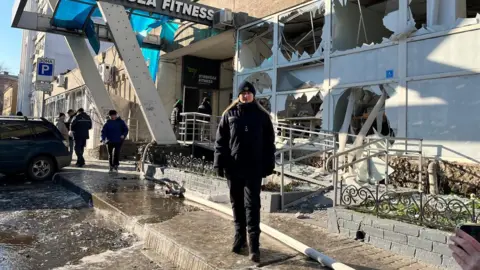
As the strikes surge, air sirens go off frequently, but not everyone heeds them. Standing in front of a destroyed gym the morning after an overnight drone strike that injured seven people, Maryna Averina of the State Emergency Service concedes people have become "very careless about their own safety".
A recent air raid alert lasted for most of the day. "Sitting in a shelter for 16 hours is simply unrealistic," Averina says, as gym staff emerge from the destroyed building with whatever objects they have managed to salvage from the rubble and mangled metal inside.
While many Ukrainians are now sadly accustomed to the drone and missile strikes, they are increasingly frayed by the relentless attacks that cut off electricity and heating in the middle of a particularly biting winter.
In December, almost a million people in Odesa were left with no power. "We were among the first regions to experience what it means to go through the winter period without electricity and without heating," says Oleh Kiper.
"I live in hope that all this will end soon," says Yana. "We've all been living like this for four years now, but unfortunately, for now it's how it is."
A month later, as temperatures hover around -1C, the supply remains severely disrupted.
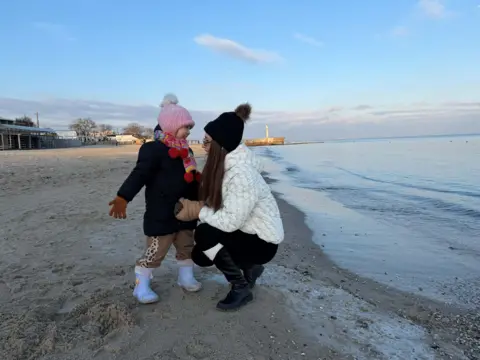
Ada, 36, is strolling on the beach, unfazed by the wail of air alert sirens mingling with the squawking of seagulls. The drone attacks have ramped up but, she says, "the shelling isn't as scary as this cold is".
Nearby, a young mum named Yana agrees. Recently, she says, the situation across the board "has been really, really difficult". At one point, a drone crashed into her flat, and another one hit the block soon afterwards.
Then came the power cuts. She and her family bought an expensive generator, but running it for seven hours costs around $10 - a significant expense in a country where the average monthly salary is around $500 (£375).
"We've all been living like this for four years now, unfortunately. We're as helpless as flies, and everything is just being decided between the authorities," she says, while struggling to keep her shrieking toddler out of the icy water.
"Maybe we're being punished for something – the whole nation, not just a few, but everyone."
Further down the beach, Kostya is fishing on a jetty stretching out into the sea. He says he is not worried about the Russians advancing to the city. "I don't think they'll make it here. [The Ukrainians] will break their legs first."
But, he adds, things are painful, and scary. And like many Ukrainians he still seems to struggle to accept that war came to his country four years ago, waged by a neighbour he once knew so well.
In his youth, Kostya served in the army and swore an oath to the Soviet Union. "I never imagined that I would see something like this in my old age," he says.
While Russian propagandists have long insisted that Ukraine's independence since 1991 is a historical mistake, Odesa's past role as the jewel in the crown of the Russian empire means it still holds particularly strong symbolic importance for Moscow.
Vladimir Putin has repeatedly referred to Odesa as a "Russian city" and frequently invoked the notion of "liberating Novorossiya", a historical region of the Russian empire that encompassed parts of modern southern and eastern Ukraine, including Odesa.
"They wanted and they still want to seize Odesa, just like many other regions, but today everything possible and impossible is being done by our military to prevent this from happening," insists the regional government leader.
Getty Images
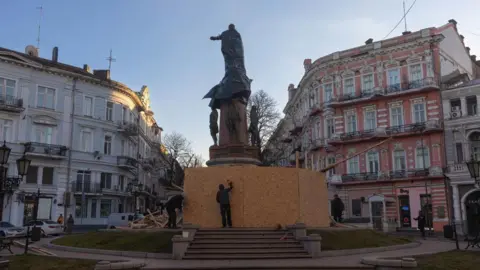
A statue of Russian empress Catherine the Great, the founder of Odesa, was among the first to be dismantled
Oleh Kiper has made it a personal mission to sever any perceived remaining ties that Odesa has with Russia. He is a staunch supporter of a 2023 Law on Decolonisation, which directed local authorities to rid their cities of any street names, monuments or inscriptions that could be linked to Russia's imperial past.
Among the statues to be removed was a monument to the founder of Odesa, Russian Empress Catherine the Great, while streets named after Russian and Soviet figures were renamed. Pushkin Street became Italian Street, and Catherine Street is now European Street. Kiper also champions the usage of Ukrainian in a city where Russian is still very widely spoken.
Asked about the resistance he meets from Odesites who are proud of their heritage as a multicultural port to the world, he is defiant.
"The enemy is doing far more than we are to ensure that a Russian-speaking city becomes Ukrainian," says Kiper. "It is forcing people to understand who the Russians are and whether we need them at all."
The following day, as temperatures dropped to -6C, the city marked one month of partial blackouts, and air raid alerts were in force for four hours. The port of Chernomorsk, east of Odesa, was again hit by a ballistic missile, injuring a crew member on a civilian ship.
As is the case with the rest of Ukraine, if Russia cannot have Odesa, it seems determined to continue crippling it.
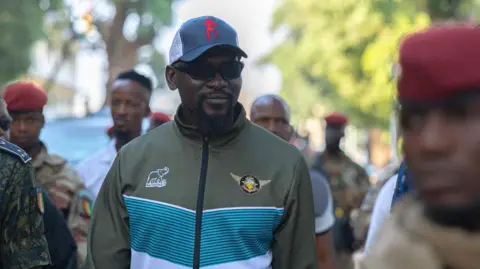
Official pictures of Mamadi Doumbouya have portrayed him in a more relaxed mode
From the moment he seized power in September 2021 Guinea's Mamadi Doumbouya struck an imposing figure.
Just 36 years old at the time, the broad-shouldered colonel, standing at well over six feet (1.8m), wearing military fatigues, mirrored sunglasses and a red beret certainly made an impression when announcing the coup.
A relatively unknown member of an elite army unit, he declared that the government of ousted President Alpha Condé had disregarded democratic principles and that citizens' rights were being trampled on.
After more than four years of acting as interim president, and going back on a promise not to run for leadership of the country, Doumbouya, now 41, is set to be sworn in as the elected head of state on Saturday.
The discreet, disciplined and private man won 87% of the vote in December's election against a severely depleted field.
Ex-Prime Minister Cellou Dalein Diallo, now in exile, described the process as a charade which generated "fabricated" results.
While seemingly enjoying some popular support, critics have questioned Doumbouya's democratic credentials as some political parties have been banned, activists have mysteriously disappeared and media outlets been shut down.
Reuters
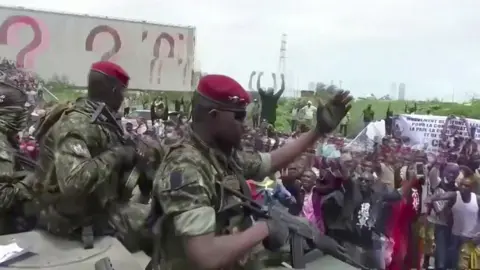
Video footage shot in the aftermath of the 2021 coup showed Doumbouya being greeted by enthusiastic crowds
Scrolling back through the social media accounts from the president's office there is a sense of a carefully curated image.
The army man, now a general, has, for the main, ditched the camouflage in favour of the baseball cap and tracksuit, or a boubou - traditional Guinean attire of loose-fitting robes with elaborate embroidery. The shades though are still at times in evidence.
Pictures show him at the opening of schools, or transport and mining infrastructure or cycling through the streets of the capital, Conakry. The message is clear: this is a man of action who is working on behalf of the people.
"This was presenting an image of someone who can be close to civilians, someone who is a civilian leader and can be representative of the people," Beverly Ochieng, senior analyst with Dakar-based security intelligence firm Control Risks, told the BBC.
"In some ways this is distancing himself from what brought him to power – a coup - and the fact that his entire career has been in the military."
In the 15 years before he took power, Doumbouya gained extensive international experience, including being educated to master's level in France and serving in the French Foreign Legion. He was also in Afghanistan, Ivory Coast, Djibouti, Central African Republic and worked on close protection in Israel, Cyprus and the UK.
But the donning of civilian clothes may not be entirely sincere, according to some analysts.
"I'm not sure that he has transitioned from a military man. I think that the military costume will remain even if he is conducting the return to civilian order," argued Aïssatou Kanté, a researcher in the West Africa office of the Institute of Security Studies.
She referred to a ban on political demonstrations, the exclusion of Doumbouya's main challengers in December's election and the suspension of key opposition parties.
Human rights campaigners have demanded to know the whereabouts of two activists - Oumar Sylla (known as Foniké Menguè) and Mamadou Billo Bah – who have not been seen since July 2024. They suspect the men were taken by the military.
Press freedom organisation Reporters Without Borders has also expressed concern that journalist Habib Marouane Camara has been missing for more than a year. It has described how journalists are now censoring themselves and are fearful about what might happen to them.
Nevertheless, the 2021 coup was widely welcomed in the country and since then Doumbouya appears to have remained a popular figure.
Polling organisation Afrobarometer found that between 2022 and 2024 the proportion of people who trusted the president either "partially" or "a lot" grew from 46% to 53%.
Guinea Presidency
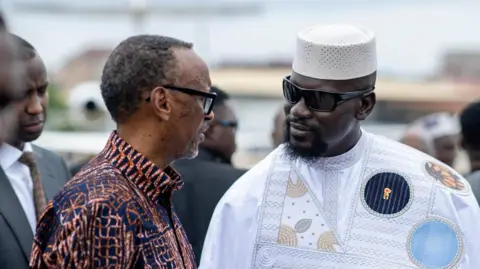
Doumbouya (R) welcomed Rwandan President Paul Kagame to the country in November for the start of operations at the Simandou iron-ore mine
The president-elect may not have a clearly defined ideology guiding him but for Kanté his emphasis on Guineans being in control of their own destiny has become very important.
"It's what keeps coming up in official speeches - this affirmation of political and economic sovereignty," she told the BBC.
In his address to the nation a few days into the new year, he struck a conciliatory tone, calling on all Guineans to build a nation of peace and "fully assumed" sovereignty.
In a country that continues to grapple with high levels of poverty despite plentiful natural resources – including the world's largest reserves of bauxite, which is used to make aluminium - this idea strikes a chord.
The government's messaging on the development of the vast iron-ore resources in Simandou underscores the possible benefits for the people.
The three billion tonnes of ore available in a remote southern part of the country, which began to be exported last month, could transform the global iron market, as well as Guinea's fortunes.
The authorities say earnings from the project, partly owned by Chinese miners as well as the British-Australian corporation Rio Tinto, will be invested in new transport infrastructure as well as health and education.
The success or otherwise of Simandou may define Doumbouya's presidency.
AFP via Getty Images
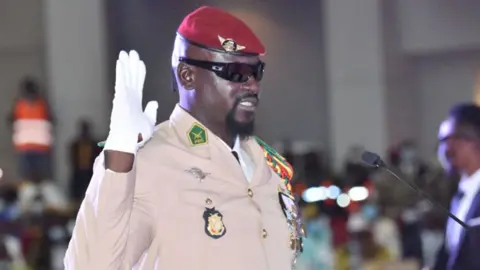
In 2021, Doumbouya wore formal military dress when he was sworn in as interim leader
He appears determined to keep some of the processing and added-value parts of the industry in Guinea to ensure greater benefits.
Across the broader mining sector, his government has cancelled dozens of contracts over the past year where it was felt that the companies were not investing in Guinea – a move that has led one UAE-based firm to take the country to an international court.
"This move towards resource nationalism makes him look like a local hero. He looks like he's really fighting for the rights of his citizens, even if that means business disruptions," said analyst Ochieng.
The emphasis on sovereignty has also led to a pragmatic approach to international relations, observers say. Unlike coup leaders elsewhere in West Africa, Doumbouya has not outrightly rejected the former colonial power France in favour of Russia.
Neither, despite his background in France and having a French wife, has he been accused of being a puppet of Paris.
Doumbouya very much wants to be seen as someone running things in the interests of the country.
Come Saturday, the president will preach a message of national unity and will hope that he can usher in a new era of prosperity for Guinea.
London’s Little Morocco is brimming with pride and anticipation. The Moroccan diaspora in North Kensington is in no doubt that on Sunday the Atlas Lions will triumph against Senegal in the final of the Africa Cup of Nations.
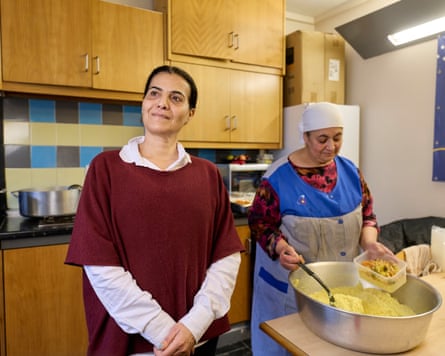
“There’s not just an excitement, it has completely taken over everything else,” said Souad Talsi, who runs the Al-Hasaniya Moroccan women’s centre at the base of 31-storey Trellick Tower, at the north end of Golborne Road.
She added: “There is so much gloom and doom around at the moment and people are depressed about Gaza, but football has given us a respite from all that. It has completely united the Moroccan diaspora and given us a purpose and a sense of belonging.”
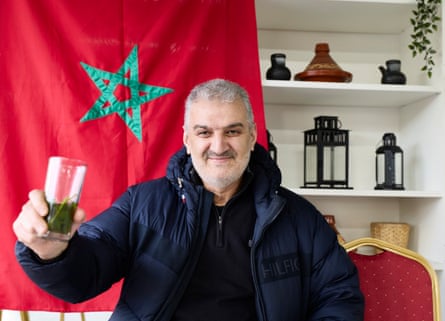
Mohamed Chelh said that if Morocco prevail it will be first time they have lifted the Afcon trophy since 1976, a tournament he cannot even remember.
Sipping mint tea in the Trellick Lounge cafe after Friday prayers, he said: “They should win. They’ve got the best team.” He points to Morocco’s success in the last World Cup when they reached the semi-finals and beat Spain and Portugal on the way.
Chelh, who works in a bakery, plans to head to Trafalgar Square to celebrate Morocco’s anticipated victory.
On a big screen at the back of the cafe, the Trellick Lounge has shown all of Morocco’s games in the tournament so far. On Friday, more than 48 hours before Sunday’s game, it was already showing a buildup programme on the satellite channel Maghreb TV. On Sunday there will also be a screen on the street outside the cafe.
Ali Mssr, who runs the cafe, predicts that hundreds will turn up to the watch the final. “Outside there will be even more,” he said.
Mohamed, a retired gardener, said he could hear the celebrations in the cafe from his flat down the street when Morocco scraped through on penalties against Nigeria in the semi-final.
“It was a beautiful atmosphere. They were really happy. And I’m very proud. I love Morocco, my mum and dad are there. And I love it when they play well and win.”
Further down Golborne Road, at Hakim’s cafe, Yassim, a courier, said: “The mood is very good. I have confidence we will win. We beat Nigeria and they are the toughest team in the tournament. We will win whether it is 90 minutes or 120 minutes.”
Talsi is planning to watch the game with her extended family, including her 85-year-old-mother, her brothers and their children, after a meal of couscous.
She said: “Football reminds us that people are not always bad and people can come together and forget their differences. Whether you are an international trader or a cleaner, all they want is for Morocco to win.
“It has also broken the gender barrier. At the semi-final there was an outdoor screen and there were as many loud girls as there were loud boys.”
Lailah Khallouk, a senior outreach worker at the women’s centre, said: “I hate football but I love to watch the Moroccan team. There’s huge excitement and a lot of organising about where to watch the game –in cafes or social clubs or house parties.
“My son Adam, who is 11, is passionate about it, he’s like a professional fan.
“It’s something that brings us all together. Despite where we were born, our ages, our social classes, is a just a great event. Finally we have something to be proud of.”
Mohamed Rhiam, an Uber driver, has just got back from a visit to relatives in Casablanca. “The atmosphere was crazy. There will be great disappointment if they lose, because everyone is into it now. But we’ll win.”
Rhiam witnessed protests before the tournament on the amount of money spent on stadiums rather than public services. “I share those concerns. I believe the money they spent on it they could have done more for the economy. But the football still makes me proud.”
Asked if an Afcon win would make up for the disappointment of the last World Cup, Rhiam said: “It wasn’t a disappointment, we got to the semi-final.”

 Login
Login