Four years after the Russian invasion of Ukraine sent energy prices soaring, the war in Iran is posing another challenge to efforts to revive European factories.
Jules Bastien-Lepage’s brilliant protégé was a young woman who started training in Paris in 1877, and who died from tuberculosis seven years later, just three months before him, Marie Bashkirtseff (1858–1884).
She was born and brought up in Havrontsi (Gavrontsi), to the north of Poltava in central Ukraine, between Kyiv and Kharkiv, where she first started to learn to draw and paint. Her affluent parents split up when she was twelve, following which she travelled around Europe with her mother, eventually settling in Paris. She originally hoped to be a singer, but after an illness ruined her voice, she decided to be an artist. She then studied with Robert-Fleury from 1877, and at the Académie Julian.
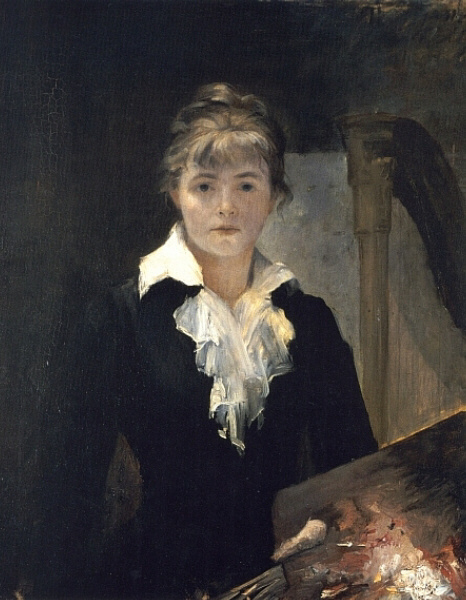
Marie Bashkirtseff (1858–1884), Self-portrait with Palette (1880), oil on canvas, dimensions not known, Musée des Beaux-Arts Jules Chéret, Nice, France. Wikimedia Commons.
A self-assured painter from the beginning, she set her sights high and had the ability and drive to paint excellently. Her early Self-portrait with Palette (1880) was painted in the same year that she first had a work accepted for exhibition at the Paris Salon, and she was successful again in every subsequent Salon until her death.
Marie Bashkirtseff (1858–1884), In the Studio (1881), oil on canvas, 188 x 154 cm, Dnipro State Art Museum, Dnipro, Ukraine. Wikimedia Commons.
While still studying at the Académie Julien in 1881, she painted In the Studio, which gives good insight into what her training was like. Her class was of course entirely female, and the Académie Julien was one of the few reputable schools that accepted women pupils at that time. The artist is seated in the centre foreground, holding her palette and knife as she looks up at one of her fellow pupils.
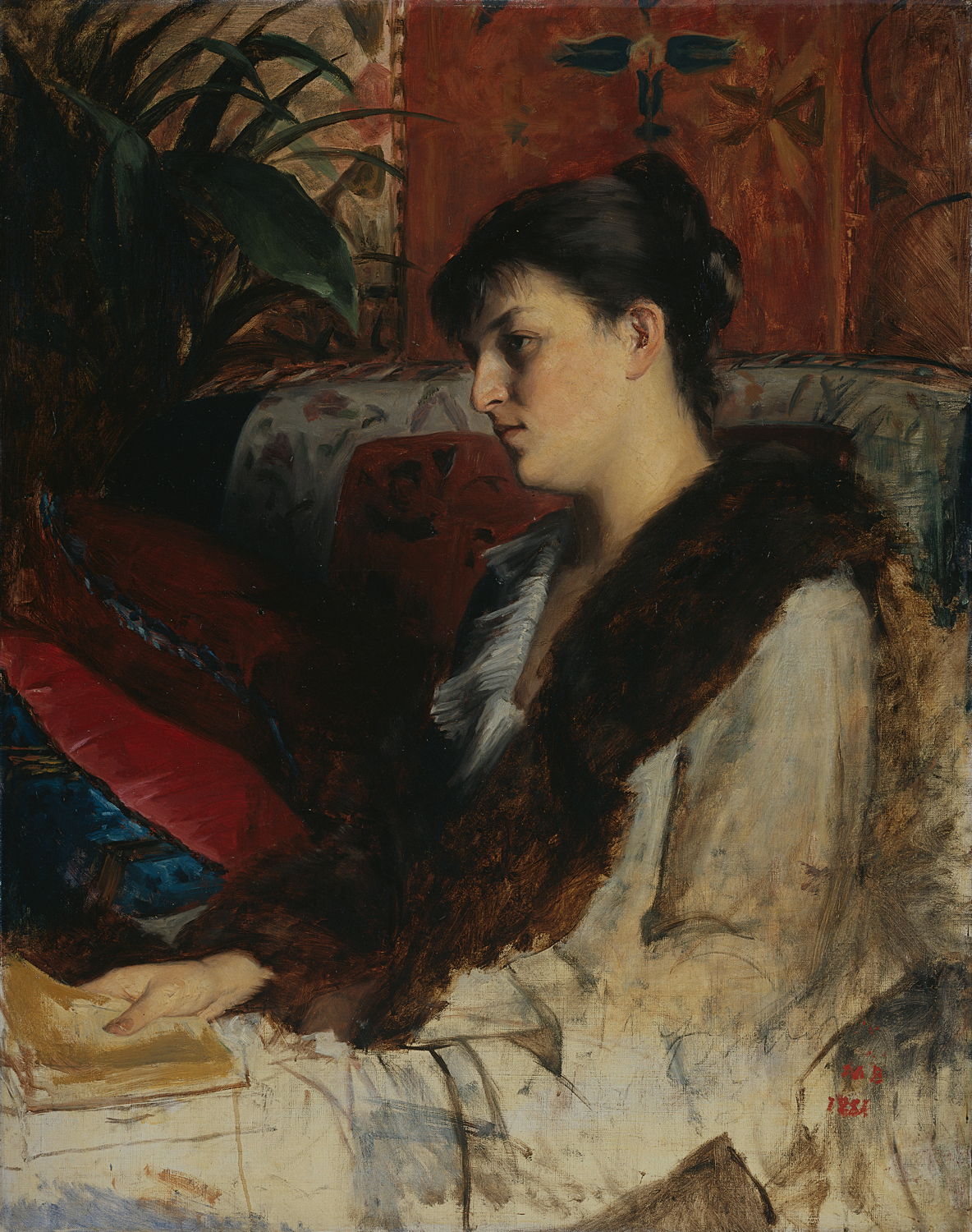
Marie Bashkirtseff (1858–1884), The Artist’s Sister (1881), oil on canvas, 92 x 73 cm, Rijksmuseum, Amsterdam. Wikimedia Commons.
Her early portraits are skilful if conventional, as is The Artist’s Sister from 1881. She started establishing herself in the art scene; it has been claimed that she wrote a column for the mysandrist newspaper La Citoyenne under the name of Pauline Orrel, but that appears to be unsupported by the original edited versions of her diaries.
She became a close friend of Jules Bastien-Lepage when visiting Nice in 1882, and he acted as her mentor if not teacher, as she described herself as his pupil. She also formed a close friendship with the writer Guy de Maupassant.
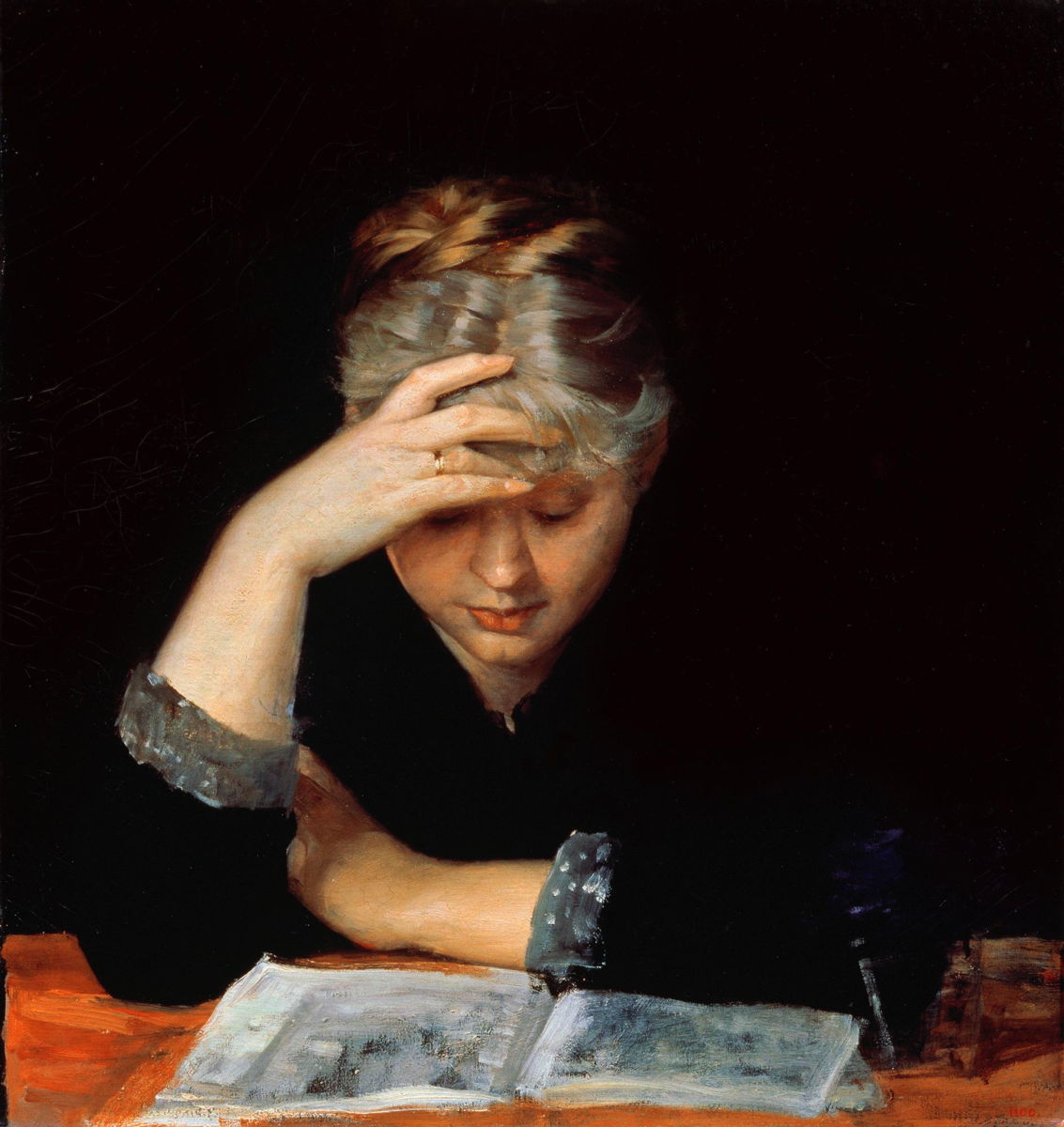
Marie Bashkirtseff (1858–1884), At a Book (c 1882), oil on canvas, 63 × 60.5 cm, Kharkiv Art Museum, Kharkiv, Ukraine. Wikimedia Commons.
As she developed a more distinctive style in her portraits, so her brushwork loosened. She was an astute observer of women’s life, as shown in At a Book (c 1882), with its emphasis on her model’s unusual hair.
Marie Bashkirtseff (1858–1884), Young Russian Girl (c 1882), other details not known. Wikimedia Commons.
Young Russian Girl (c 1882) is another delicate portrait, although I suspect the original isn’t as soft-focus as this image.
Marie Bashkirtseff (1858–1884), In the Mist (1882), oil on canvas, 47 x 55 cm, Österreichische Galerie Belvedere, Vienna, Austria. Wikimedia Commons.
Although Bashkirtseff accepted that her mentor Bastien-Lepage reigned supreme in the countryside, she felt that she was his match when it came to depicting the urban environment of Paris. In the Mist from 1882 is a good demonstration of how well she captures the almost deserted city streets on a foggy day, with a bright plume of flame from a fire in the centre of her canvas.
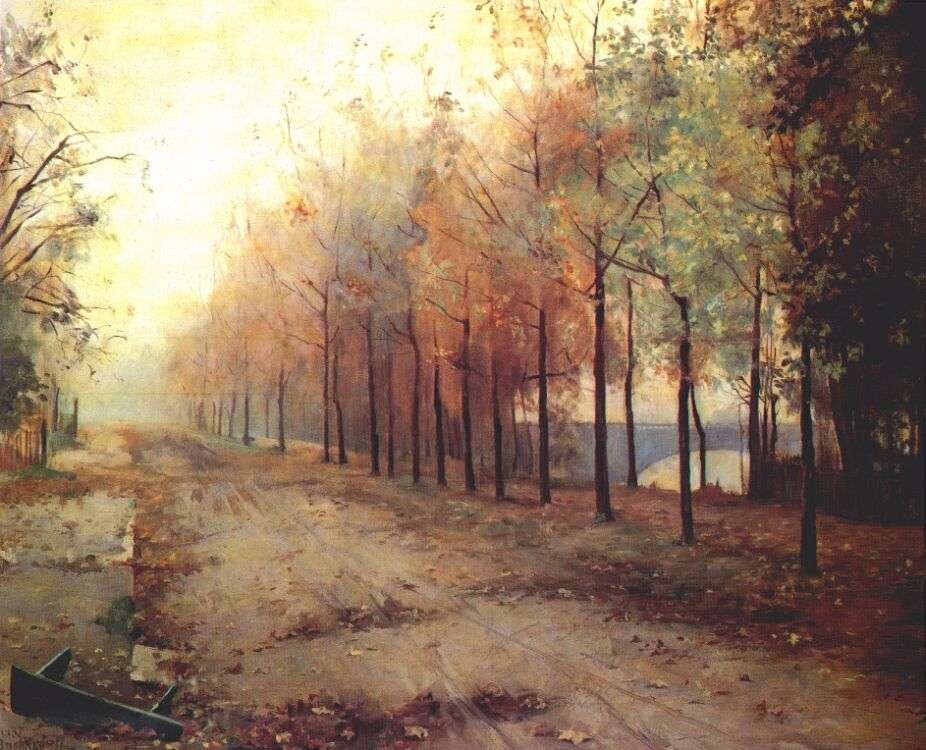
Marie Bashkirtseff (1858–1884), Autumn (1883), oil on canvas, dimensions not known, State Russian Museum, Saint Petersburg. The Athenaeum.
Autumn, from 1883, is an impressive and Impressionist depiction of a row of trees on the bank of the River Seine in the centre of Paris, but is unusual in being devoid of people. The leaf litter, occasional rubbish, and fallen bench strengthen its feeling of desolation in the midst of the bustling city.
Marie Bashkirtseff (1858–1884), The Umbrella (1883), oil on canvas, 93 × 74 cm, State Russian Museum, Saint Petersburg. Wikimedia Commons.
Bastien’s composite of detailed realism blended with more painterly passages shows in one of her best portraits, The Umbrella (1883). This girl’s tenacious stare at the viewer is quite unnerving. That year she was awarded an honourable mention from the Salon.
Marie Bashkirtseff (1858–1884), A Meeting (1884), oil on canvas, 193 x 177 cm, Musée d’Orsay, Paris. Wikimedia Commons.
A Meeting (1884) finally justified her claim to paint the urban poor, and to match Bastien-Lepage. This painting was a great success when shown at the Salon that year, and is probably her finest work.
Marie Bashkirtseff (1858–1884), Portrait of Madame X (1884), pastel and charcoal, 56 x 46.5 cm, Musée d’Orsay. Wikimedia Commons.
Her pastel Portrait of Madame X (1884), now in the Musée d’Orsay together with A Meeting, was also shown in the Salon that year.
By that summer, Bashkirtseff’s fragile health was deteriorating rapidly because of tuberculosis. She died on 31 October, less than a month before she would have turned twenty-six, and less than three months before her mentor died.
Her ambition was better fulfilled after her death than in life. Her huge mausoleum in Cimitière de Passy, Paris, designed by Bastien’s younger brother Émile, contains her artist’s studio complete with an unfinished painting of Holy Women by the Grave. Three years later, her copious and revelatory diaries were published, and propelled her to international fame.
The country has prioritized self-sufficiency in producing a crucial battlefield weapon, though weaning itself fully off cheaper Chinese components is difficult.

 Login
Login