 Login
LoginFC 游戏:超级马里奥三代(Super Mario Bros. 3)
 (Abstract)2008年左右风靡一时的 PC 同人游戏《Mario Forever》(永远的马里奥),里面很多新奇的素材其实来自于 1988 年的超级马里奥兄弟三代。
 (Abstract)2008年左右风靡一时的 PC 同人游戏《Mario Forever》(永远的马里奥),里面很多新奇的素材其实来自于 1988 年的超级马里奥兄弟三代。
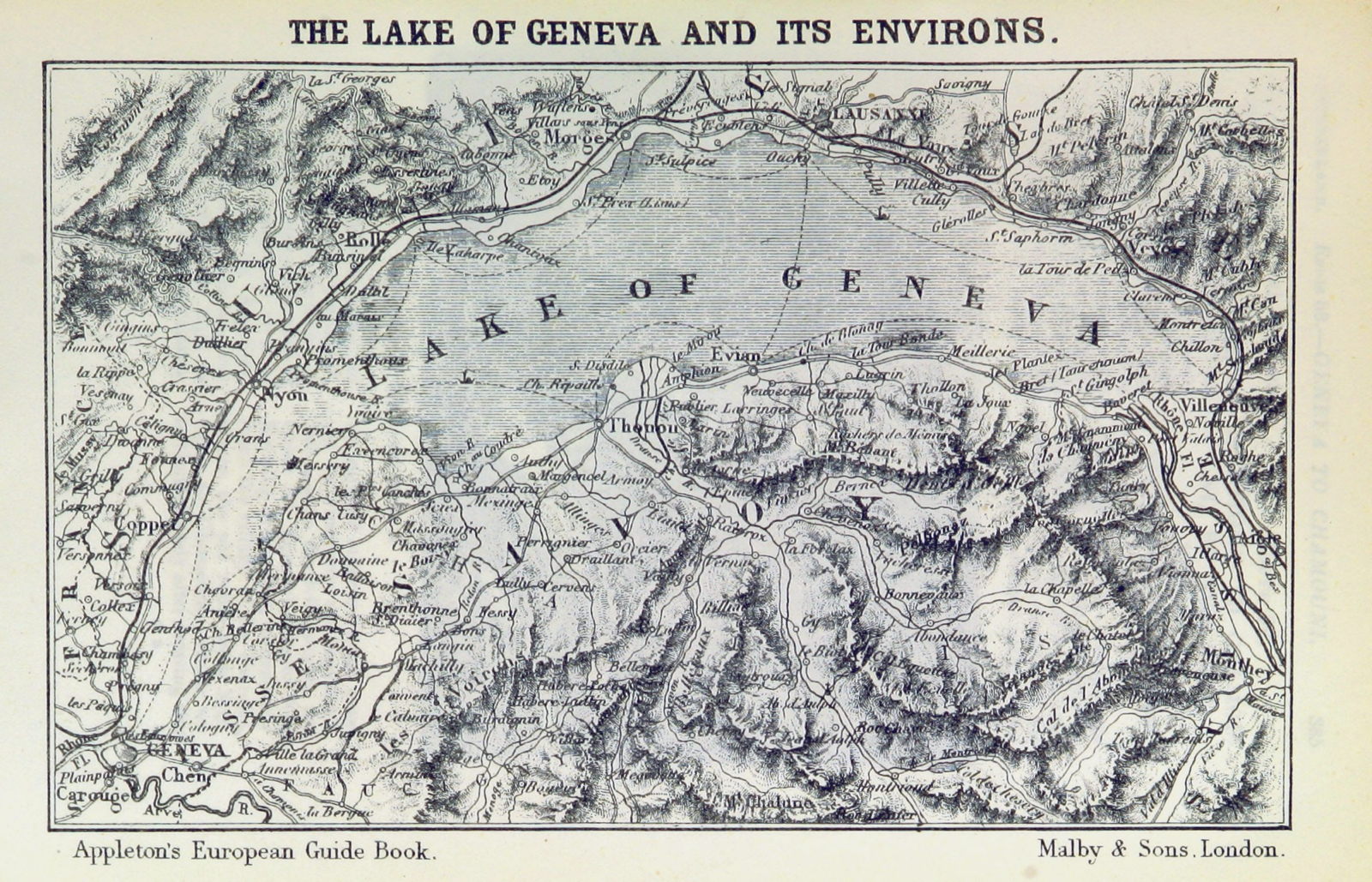
This weekend we’re off to visit Lake Geneva, also known by its French name of Lac Léman, the largest in Switzerland. It’s located in the far south-west of the country, where it forms much of its border with France. It makes a broad arc running north-east from the capital city of Geneva, with some of the highest peaks of the Alps to its south.
Today I start with a selection of paintings almost exclusively from the nineteenth century, when Switzerland was on the itinerary of the Grand Tour undertaken by aspiring young men of the upper class in both Europe and the Americas.
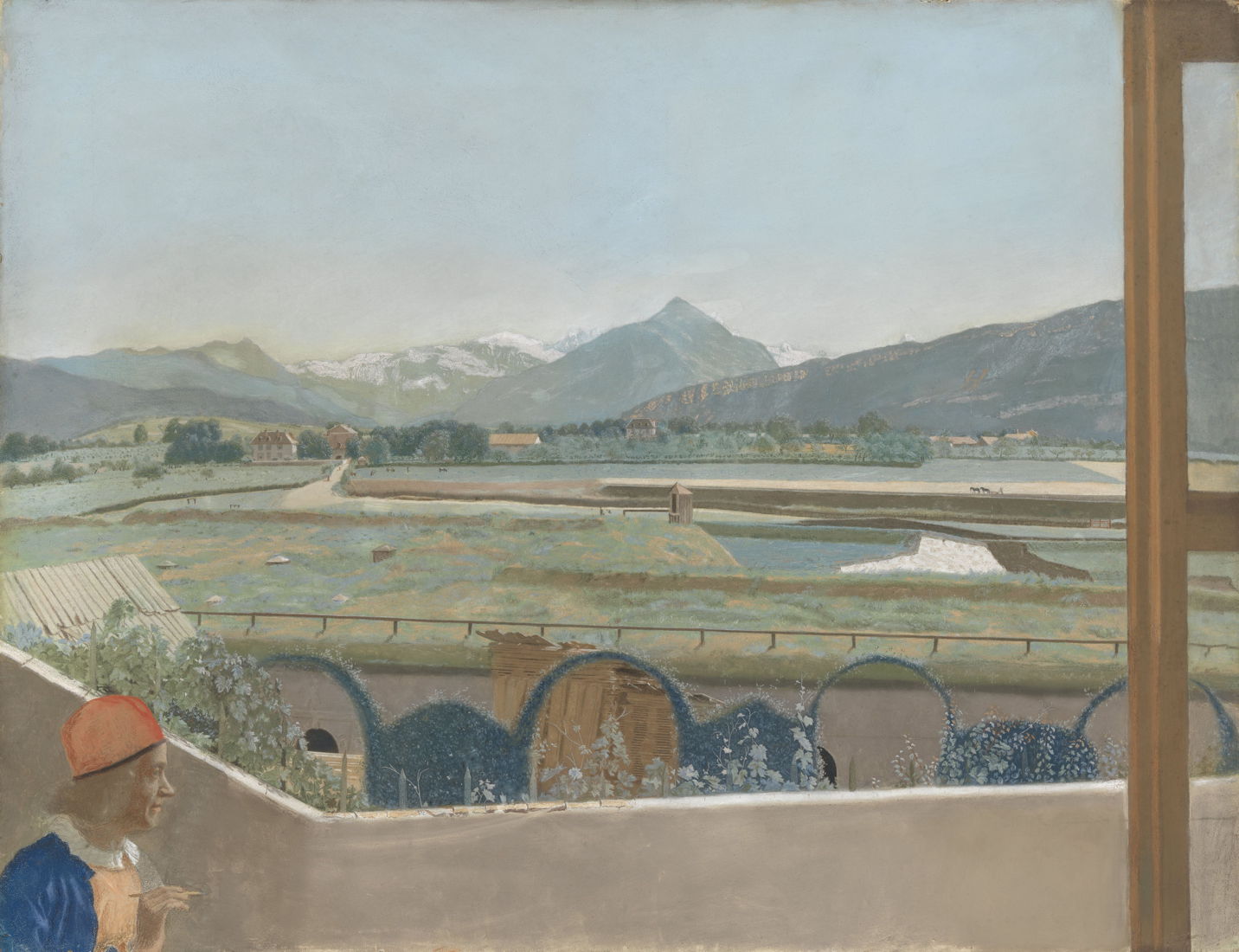
The city of Geneva has long attracted artists, and it was here the eccentric pastellist Jean-Étienne Liotard was born and later kept his studio, and where he eventually retired. His View of the Mont Blanc Massif from the Artist’s Studio from 1765-70 reveals only a little of the southern extreme of the lake, with a cameo self-portrait.

JMW Turner was by no means the first to paint the lake, but his watercolour of Lake Geneva and Mount Blanc from 1802-05 is one of its earliest depictions by a major artist. This view looks south-east over the city of Geneva towards the Mont Blanc massif in the far distance.

Alexandre Calame’s View of Bouveret from 1833 shows a grey heron fishing on the shore at the southern end of the lake, close to the border with France.

While Turner had toured the Alps once travel from England had become possible again in the early nineteenth century, Calame pioneered the painting of views like this of the lake, completed in his studio in 1849. It includes some of the distinctive sailing boats of the Swiss lakes, and a small bird in the shallows, but not a heron here.

In the middle of the nineteenth century, several major American artists visited Switzerland to develop their skills painting mountain views. Despite its finish, John Ferguson Weir’s Lake Leman (Lake Geneva), Switzerland may have been painted in front of the motif, on 11 June 1869.
Following Gustave Courbet’s release from prison for his involvement in the Paris Commune and destruction of the Vendôme Column in 1871, he was forced to flee to the safety of Switzerland, where he lived his remaining years there, unable to return to France.

Courbet painted some of the finest landscapes of his career during his exile in Switzerland, like this Sunset over Lac Léman from 1874, the year of the First Impressionist Exhibition in Paris.

He became particularly obsessed with the island château at the extreme eastern end of Lake Geneva, Chillon Castle, here in 1875. This picturesque château dates back to a Roman outpost, and for much of its recorded history from about 1050 has controlled the road from Burgundy to the Great Saint Bernard Pass, a point of strategic significance. It has since been extensively restored, and is now one of the most visited mediaeval castles in Europe.

Chillon Castle from 1874-77 is another of the views he painted of the castle on the lake.

Sunset on Lake Geneva from about 1876 is reminiscent of Courbet’s earlier seascapes with breaking waves, but now the water is calm once more.
In May 1877, the French government informed Courbet that the cost of rebuilding the Vendôme Column would be over 300,000 Francs, which he could pay in instalments of 10,000 Francs each year, starting on 1 January 1878. Courbet died in Switzerland the day before, on 31 December 1877, at the age of only 58.
(Abstract)262 KB 大小的电影级游戏。 (Abstract)三代难度比二代高很多,但也有意思很多,可以更换人物、更换武器,而且还有多结局系统。 (Abstract)小时候就觉得它和《热血硬派》非常相似。果然是同一家公司的作品。 (Abstract)和松鼠大作战类似的卡通游戏,但是难度要大很多,因为主角太不禁打(仅一次受伤机会,比马里奥还弱) Most figurative art, both painting and sculpture, is the product of a partnership between the artist and their model. This weekend I celebrate the contributions made by the latter, always seen but never credited. The partnership often extends beyond art into their personal lives, but is seldom acknowledged by either party. Ironically, we come to know the faces and bodies of those models far better than those of the artist, so at least the long-suffering model achieves some kind of immortality.
In many circumstances, models are called on to hold certain postures for uncomfortably long times.

Kirsty Whiten‘s models have had to be lithe, nimble, and patient to give her the time to capture such dynamic poses.

But they are momentary in comparison with marathons spread over several months, as required by Ellen Altfest‘s highly detailed realism. In order to achieve this, she enforces a five minute break every thirty minutes of posing, but even then models may have to drop out because of the number of days required posing for each of her paintings.
Some artists have pondered their relationship with their models visually,

Jean-Léon Gérôme’s The Artist’s Model (1895) is one of a series of works considering the artist – here, Gérôme in the role of a sculptor – the model, and the art work. Behind his model Emma Dupont is a completed polychrome statue of her putting her head through a hoop.
Like so many others, Emma Dupont arrived in Paris with her lover at the age of seventeen, only to be abandoned by him. Penniless, she was introduced to modelling by Alfred Stevens, and it was Fernand Cormon who first persuaded her to pose nude. She worked for several other artists before catching Gérôme’s eye, and quickly became his favourite. Over a period of about twenty years, she was frequently to be found naked in Gérôme’s studio, from which she made a comfortable living. No one knows if she had any closer relationship with him, or with any other artist.
One of the most famous of all artists’ models was a young Irish woman, Joanna Hiffernan, who appears in some of Whistler’s and Courbet’s paintings, and was a lover to both. Hiffernan seems to have been born in about 1843, and first met Whistler in 1860. She travelled with him to France in 1861, and posed there in a studio in Boulevard des Batignolles for one of his greatest paintings.
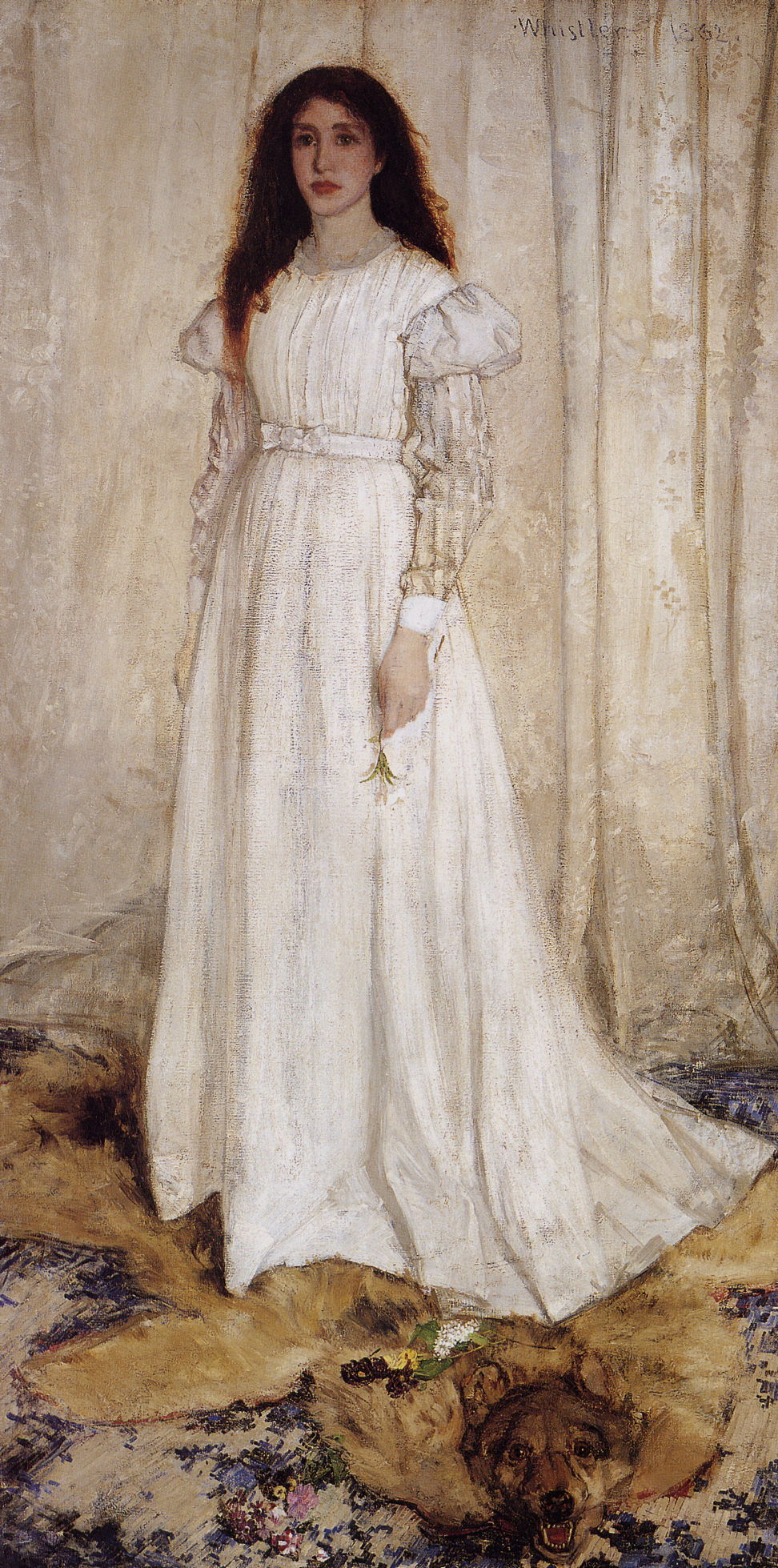
Whistler’s remarkable Symphony in White no 1: The White Girl (1862) shows her great beauty. But there was more to her than her looks: those who knew her remarked on her intelligence, the sympathy that she gave people, and the companionship that she provided the artist.
Attitudes towards artists’ models at the time weren’t even ambivalent: they were seen as little more than common prostitutes. When Whistler’s mother visited in 1864, Hiffernan had to be secreted away from her sight. At some time around 1865-66, she met Gustave Courbet, and when Whistler went off to Valparaiso for seven months in 1866, she returned to Paris and posed for Courbet.
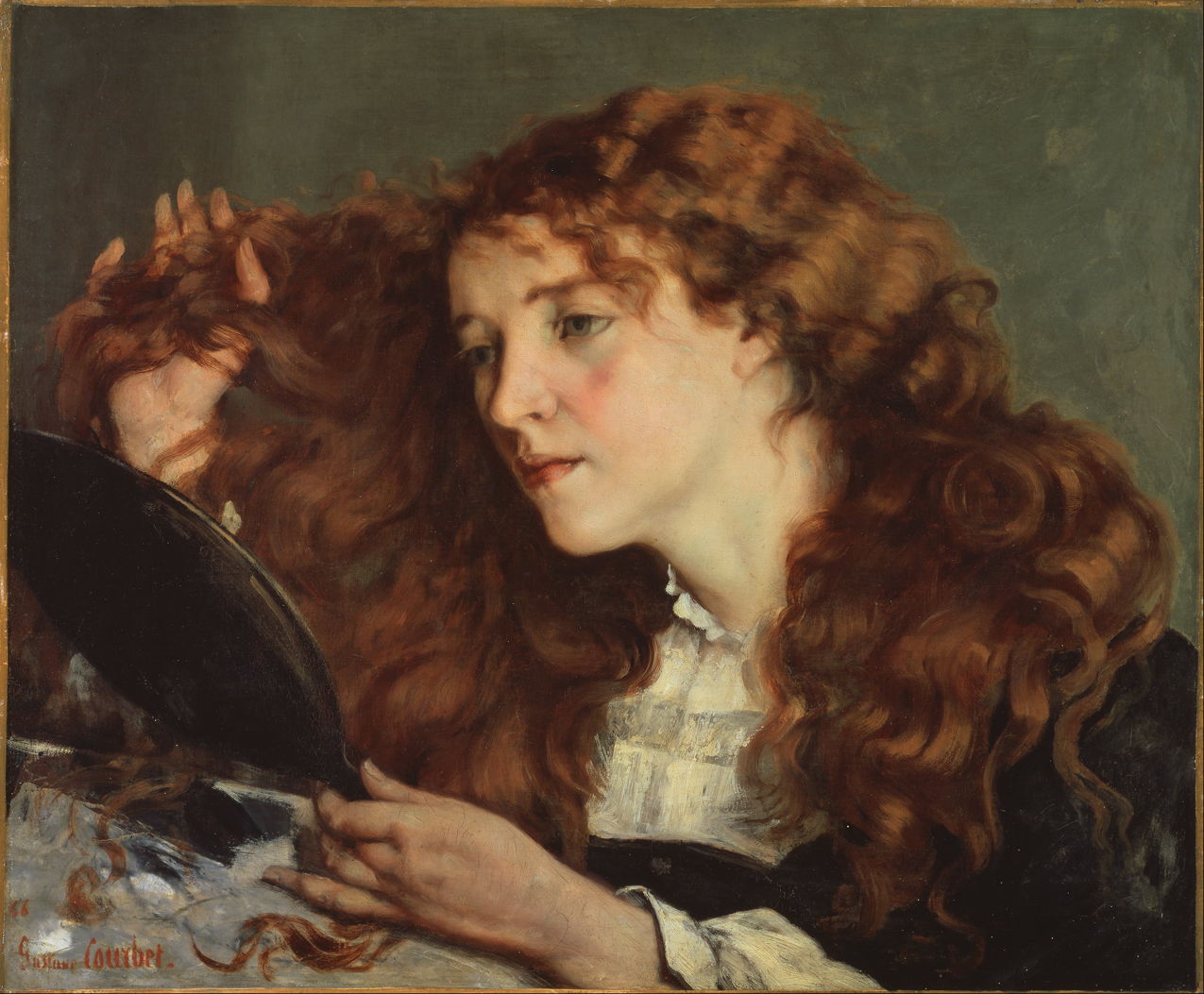
Courbet’s initial modest portrait of Jo, the Beautiful Irish Girl (1866) was a harbinger of more to come.

Next she is the erotically-charged nude in Courbet’s Woman with a Parrot (1866), then in a lesbian embrace in The Sleepers (1866), and possibly even the explicit headless nude of The Origin of the World (1866). After they had separated, Hiffernan raised Whistler’s illegitimate son by another lover, and re-appeared to pay her last respects at Whistler’s funeral in 1903.
Less known but as well-featured is Lise Tréhot, born in 1848, who moved as a child to Paris, as the daughter of a shopkeeper selling lemonade and tobacco. An older sister became the lover of a now-forgotten artist Jules Le Coeur, who in turn introduced Lise to the young painter Pierre-Auguste Renoir in 1865, when he was twenty-four, and she was only seventeen.

Renoir started painting Lise the following year, when she had just turned eighteen. Within another year, she posed nude for Renoir’s Diana as Huntress (1867), which was rejected by that year’s Salon. Over the next five years, she modelled for at least twenty paintings, and was in effect his only model for female figures during this formative period in his career. She also appears in two of Frédéric Bazille’s paintings.

One of Renoir’s best portraits of Tréhot is In the Summer (The Bohemian), painted in 1868 when she would have been twenty.

Later, Renoir posed her in an imaginary Algerian harem in his Odalisque (1870), another of those popular faux-Orientalist paintings.
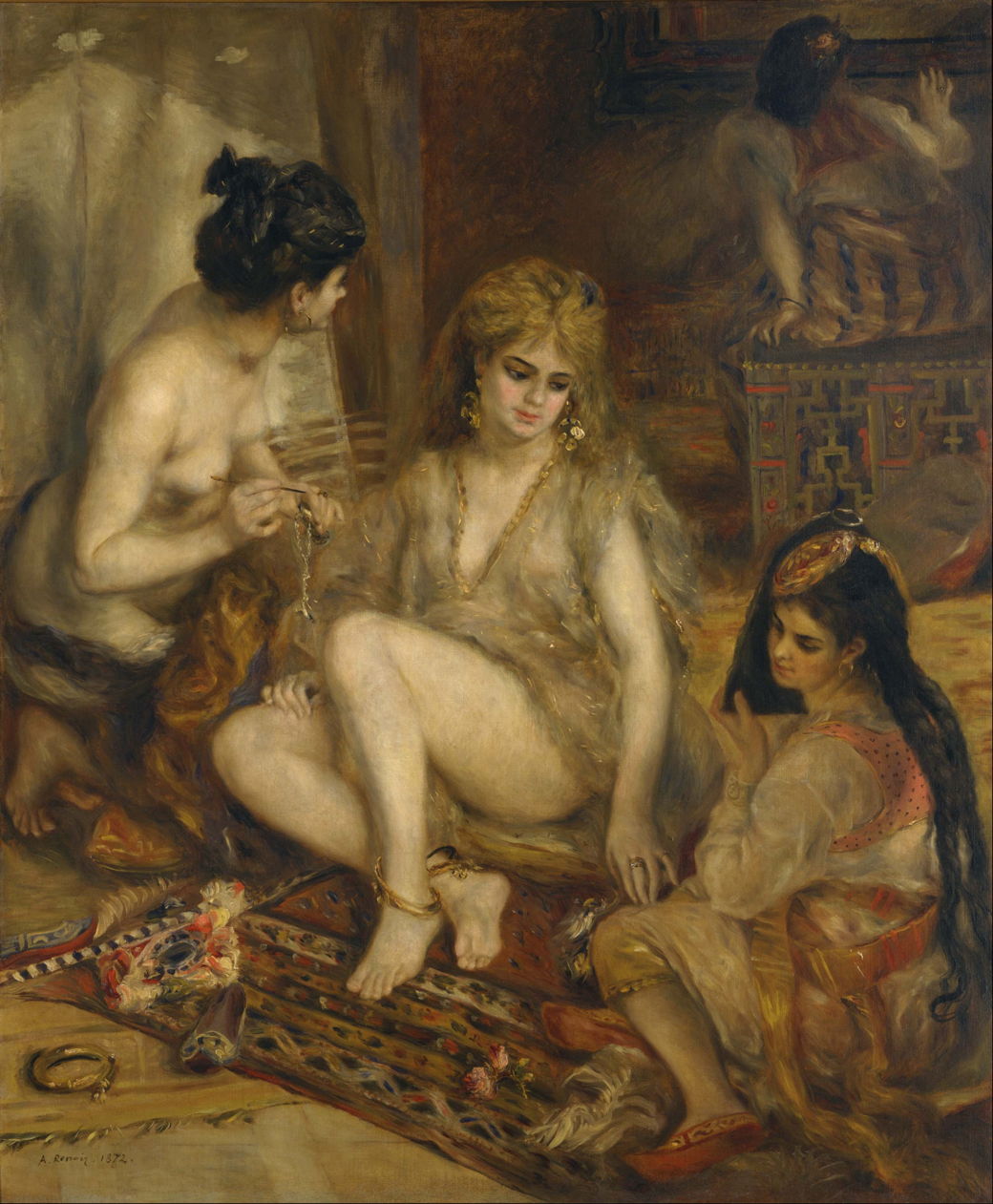
Probably the last of Renoir’s works to feature Tréhot is his Parisiennes in Algerian Costume, or Harem from 1872, where she appears as the woman at the right.
Renoir never mentioned her in any recorded source, but she’s thought to have given birth to their son at the end of 1868, and is recorded as having their daughter in the summer of 1870. Renoir supported her financially throughout the rest of his life, and Ambroise Vollard his dealer continued to do so after his death.
Renoir and Tréhot seem to have separated suddenly in 1872, and it’s thought they never met or spoke again after that. She married in 1883, raised her own family with her architect husband, and died in Paris in 1922.
Reference
Susan Waller’s superb article in Nineteenth-Century Art Worldwide.
(Abstract)弹幕密度最低的飞行射击游戏,比沙罗曼蛇、兵峰都要简单得多。
(Abstract)热血硬派可以视为双截龙的前辈。但是它有计时系统,而且最后一关有迷宫,感觉难度比双截龙大。
Aprons are protective garments normally worn over the front of the body and upper legs, where they’re intended to prevent other clothes from soiling, and sometimes the wearer underneath. Although frequently seen in paintings, their absence must be interpreted with caution: most figurative paintings are made in the studio, where the only folk likely to be wearing aprons are the artist and their assistants. The wear of aprons is also markedly gendered; although in real life many men wear them at work, those most likely to be depicted with them are overwhelmingly women.
Aprons have been strongly associated with those in domestic service, and appear in folk tales such as Cinderella.

Edward Burne-Jones’ Cinderella from 1863 shows her reverted to her plain clothes after the ball, but still wearing one glass slipper on her left foot. She is seen in a scullery with a dull, patched and grubby working dress and apron.

Intimate Conversation from about 1892 shows a young couple talking idly outdoors in the sun. Évariste Carpentier puts a prominent tear in the young woman’s apron to emphasise their poverty.
Probably the most famous painted apron is that worn by Johannes Vermeer’s Milkmaid in about 1658-59.

This woman, seen in three-quarter view, wears working dress: a stiff, white linen cap, a yellow jacket laced at the front, a brilliant ultramarine blue apron, with a dull red skirt underneath. Her work sleeves are pushed up to lay both her weathered forearms bare to the elbow. Her strong-featured face and eyes are cast down, watching the milk as it runs into the pot.

Jean-Baptiste Greuze’s Laundress (1761) is in the dilapidated servants’ area, probably in a cellar, where this flirtaceous young maid is washing the household linen, with her coarse white apron rolled up to enable her to lean forward and down.
Aprons were also common in women working outdoors, such as gleaners.

Those in Jules Breton’s Calling in the Gleaners (also known as The Recall of the Gleaners, Artois) (1859) are using theirs to carry their gleanings. Most are frayed and tatty, faded blue in colour.

They’re being worn by the two women in Jules Bastien-Lepage’s October: Potato Gatherers from 1878.

Some aprons could have more than one purpose, and may need more careful reading. Hans Andersen Brendekilde’s Cowed from 1887 shows gleaners at work in a field after the harvest. The family group in the foreground consists of three generations: mother is still bent over, hard at work gleaning her handful of corn. Her husband is taking a short break, sitting on the sack in his large blue wooden clogs. Stood looking at him is their daughter, engaged in a serious conversation with her father, as her young child plays on the ground. The daughter is finely dressed under her apron, and wears a hat more appropriate to someone in domestic service in a rich household in the nearby town.
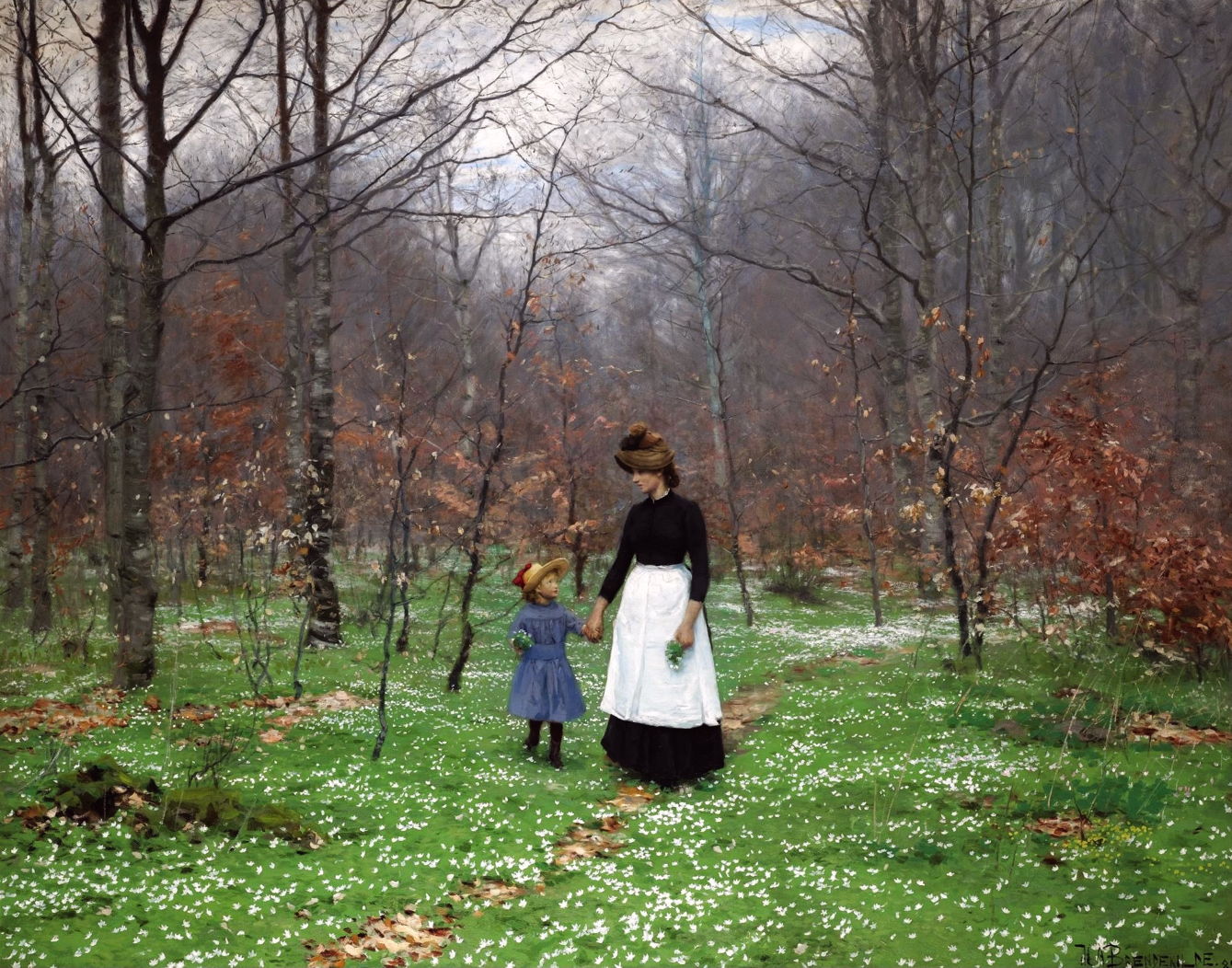
Another painting of Brendekilde’s from this period, his Springtime; The First Anemones from 1889, shows a young woman walking with a small girl in a wood in the early Spring. The woman is unlikely to be the girl’s mother. Instead, she wears the black dress and white apron of a woman ‘in service’, in this case probably as the little girl’s maid or nanny.

Camille Pissarro’s famous depiction of Apple Picking, Éragny, from 1887-88 shows a typical country scene, with three women wearing aprons, but the man still in a waistcoat and trousers.

A Kitchen is one of Maximilien Luce’s early Divisionist paintings, dating from 1888-89. It’s an unusual motif, showing domestic servants at work in the kitchen of a large bourgeois house, both of them wearing long white aprons. Kitchens have become one place where men are also expected to wear aprons.

Jehan Georges Vibert’s meticulously realist painting of The Marvelous Sauce from about 1890 shows its rotund hero wearing an apron and tasting a sauce with his chef in a palatial kitchen.
As they were painted at work during the late nineteenth century, it became clear how many men had been wearing aprons: blacksmiths, butchers, shoemakers, coopers and many other trades.

Maximilien Luce made many paintings of people at work, as his style moved on from Neo-Impressionism to Post-Impressionism during the 1890s. His Charleroi Foundry, Casting (1896) shows this well, and is one of a long series he painted showing those working in heavy industry in this city in the mining area of Belgium. Several of these metalworkers are wearing heavy leather aprons to protect their bodies from burns and injury.
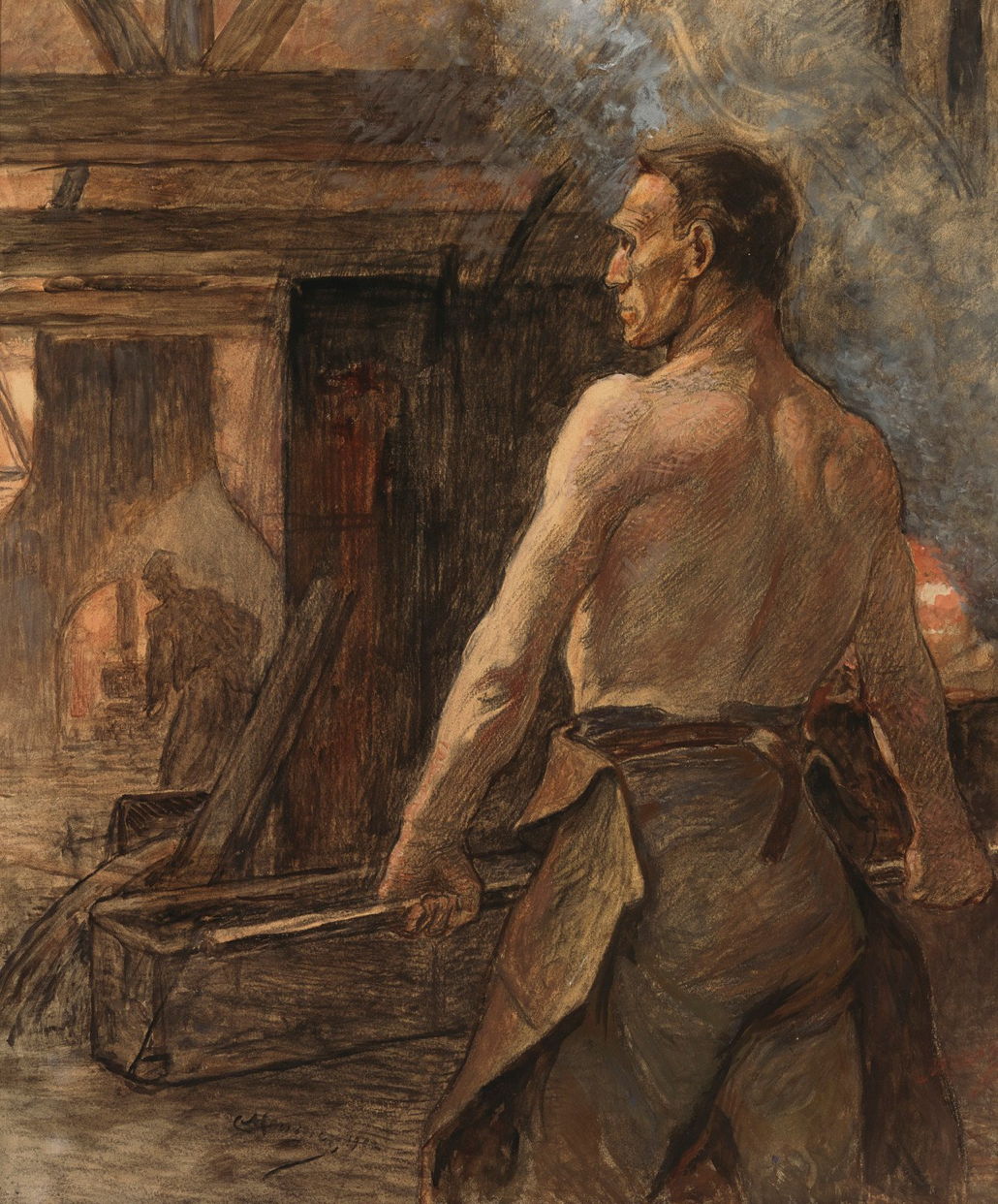
One of Constantin Meunier’s later paintings, Foundry from 1902, shows a worker stripped to the waist to cope with the heat, while wearing a protective leather apron.
In The Artist’s Model (1895), Jean-Léon Gérôme shows himself at work on a marble figure, and wearing a faded blue apron.
(Abstract)128KB 的容量居然能做出打怪升级的(类) RPG 游戏,还有主线和支线剧情。 (Abstract)罕见的即使今天也难以通关的 FC 游戏。
Hokusai’s woodcuts including The Great Wave of Kanagawa from 1831 may now be most strongly associated with the vogue for Japonisme that swept across Europe in the late nineteenth century, but the prints of others were equally important. Among those were the works of Utagawa Hiroshige (歌川広重) (1797–1858).
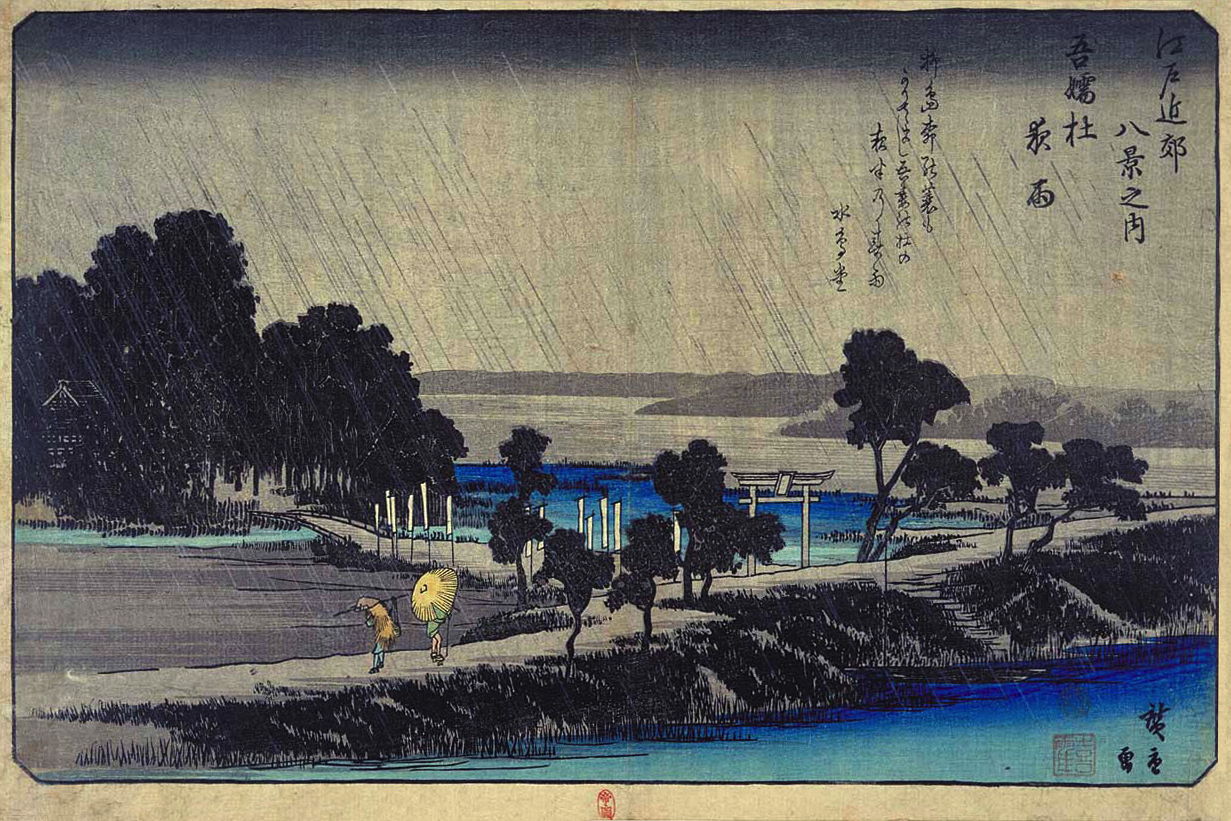
It’s this print by Hiroshige, Evening Rain at Azumi-no Mori (吾嬬杜夜雨) (Edo, 1837-8), that is now thought to have been influential in Vincent van Gogh’s Rain – Auvers (1890), shown below, that he painted just a few days before his death.


Japonisme came to dominate Pierre Bonnard’s early paintings too. Probably the earliest of these is this exquisite three-panelled screen of The Stork and Four Frogs completed around 1889. To mimic the appearance of east Asian lacquerware, Bonnard painted this in distemper on red-dyed cotton fabric. Its story is, though, thoroughly European, based on the fable retold by Jean de la Fontaine of The Frogs who Demand a King.
As Europeans were enthralled by Japanese woodcuts, so more Japanese artists travelled to Europe to learn painting styles and techniques. The son of a samurai in Kagoshima (in the far south-west of Japan), Viscount Kuroda Seiki (黒田 清輝) (Kuroda Kiyoteru) moved to Tokyo, where he first learned English, then switched to French. He went to Paris in 1884 to study law, being supported by his brother-in-law, a member of the Japanese diplomatic mission in France. However after two years there, he changed to study painting in the atelier of Raphael Collin, where he met Kume Keiichirō, also a student of Collin’s; together they explored plein air painting. In 1890 he moved to the international artists’ colony at Grez-sur-Loing, south of Paris, which had been made popular by masters such as Jules Bastien-Lepage.

In France, Hokusai’s Great Wave found greater interest with Paul Gauguin and his circle who gathered first in Pont-Aven then Le Pouldu in Brittany. Gauguin’s gouache Seaweed Gatherers I (1888-90) shows two Breton women gathering seaweed on the beach. Behind them is a huge wave, its spume formed into a claw, which could only have come from Hokusai.

In 1889, Gauguin painted two works showing Ondine in the sea among waves. The first, known now as In the Waves, or Ondine (I), also refers to Hokusai.
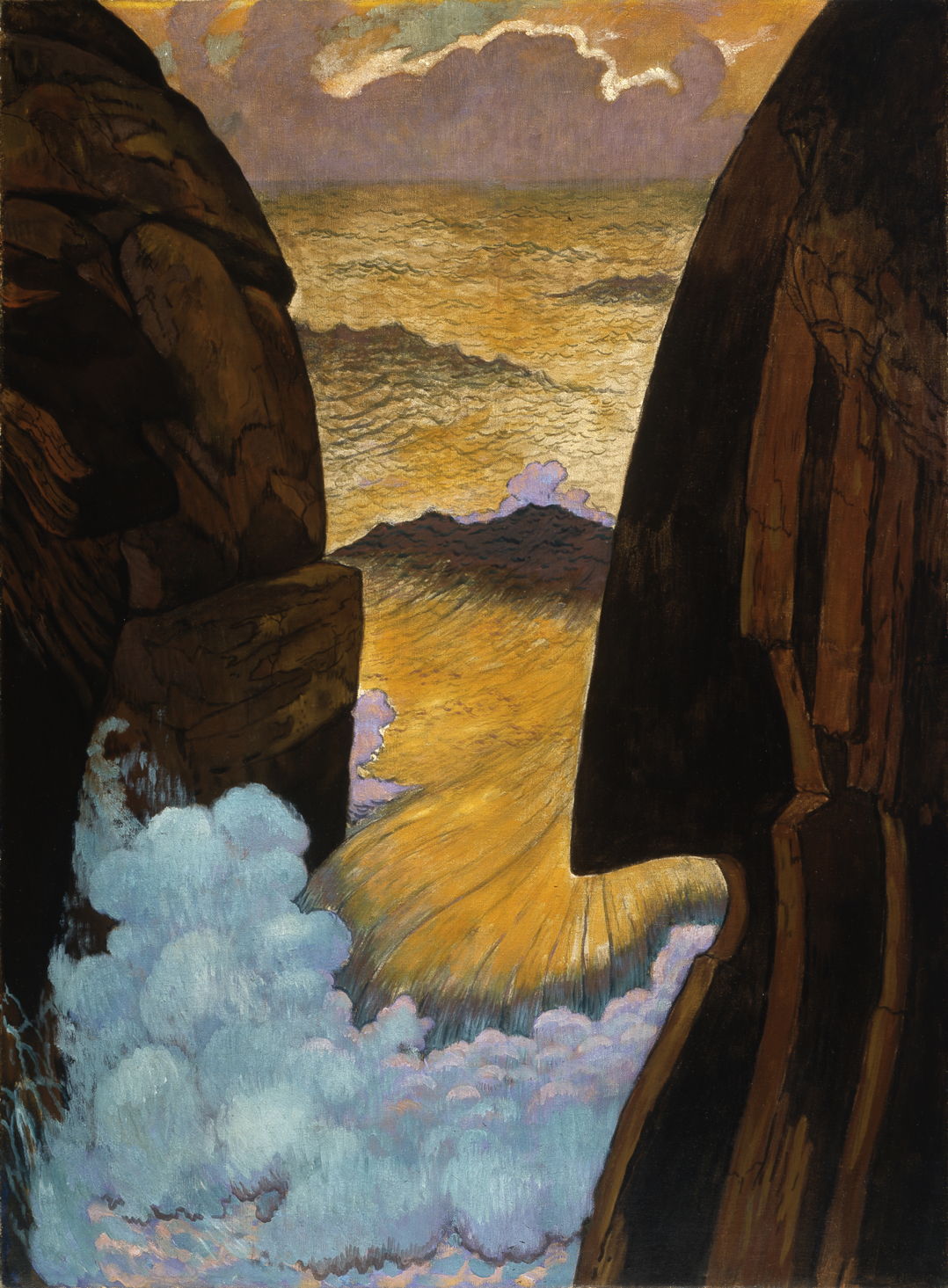
The Nabi sculptor, and painter from Gauguin’s school, Georges Lacombe took Hokusai’s motif forward in several of his paintings. This is his treatment of Vorhor, The Green Wave in egg tempera, showing an Atlantic swell coming into the seacliffs of Vorhor near Camaret-sur-Mer in Brittany.
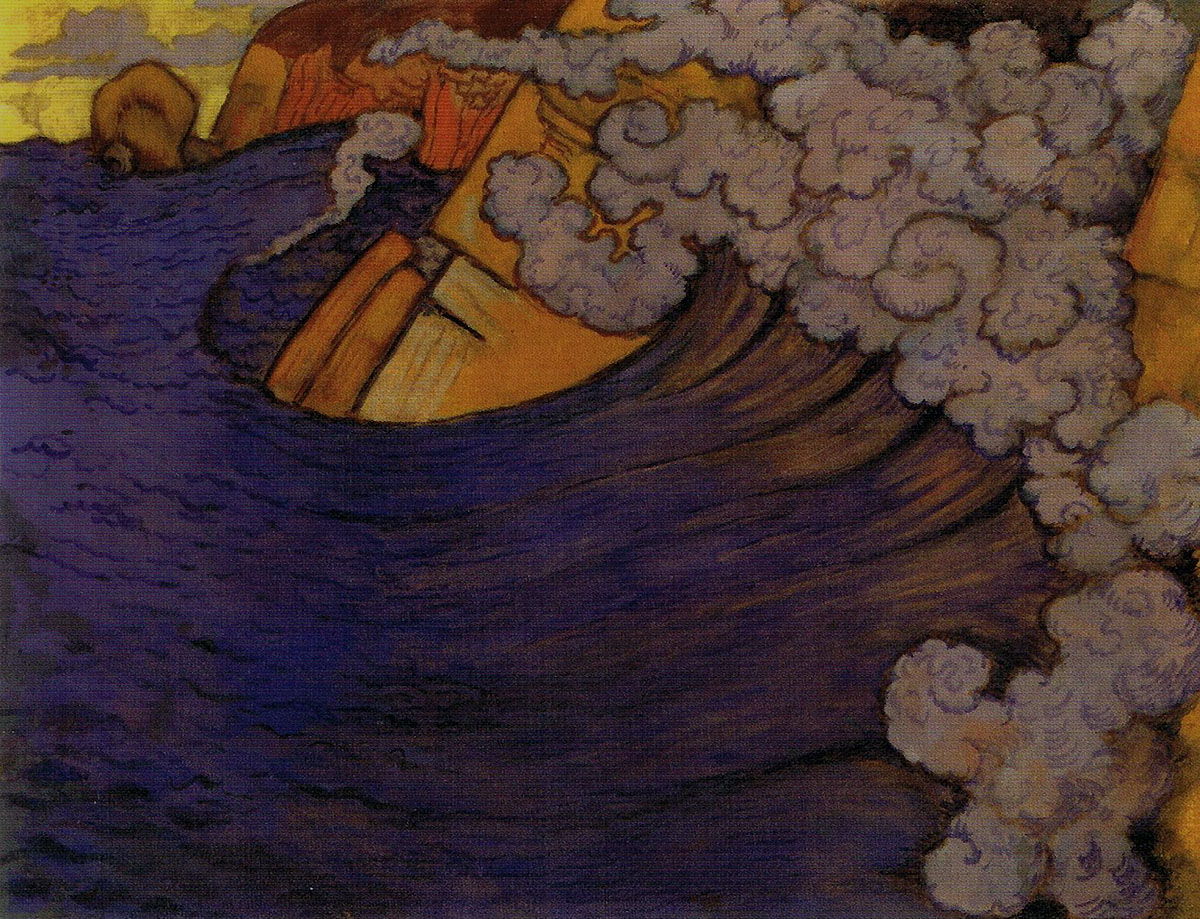
Lacombe’s slightly later The Violet Wave also makes its influence abundantly clear.

In that same year, even the notorious academic artist William-Adolphe Bouguereau joined Hokusai’s crowd of admirers, in The Wave.
As Japanese artists were studying in Europe, Westerners like Helen Hyde went to Japan. She made friends with an unrelated namesake, Josephine Hyde, and in 1899 the two travelled to Japan to learn Japanese print and painting techniques. Helen Hyde was soon making woodblock prints, which she learned from the Austrian Emil Orlik who was also living in Tokyo at the time.
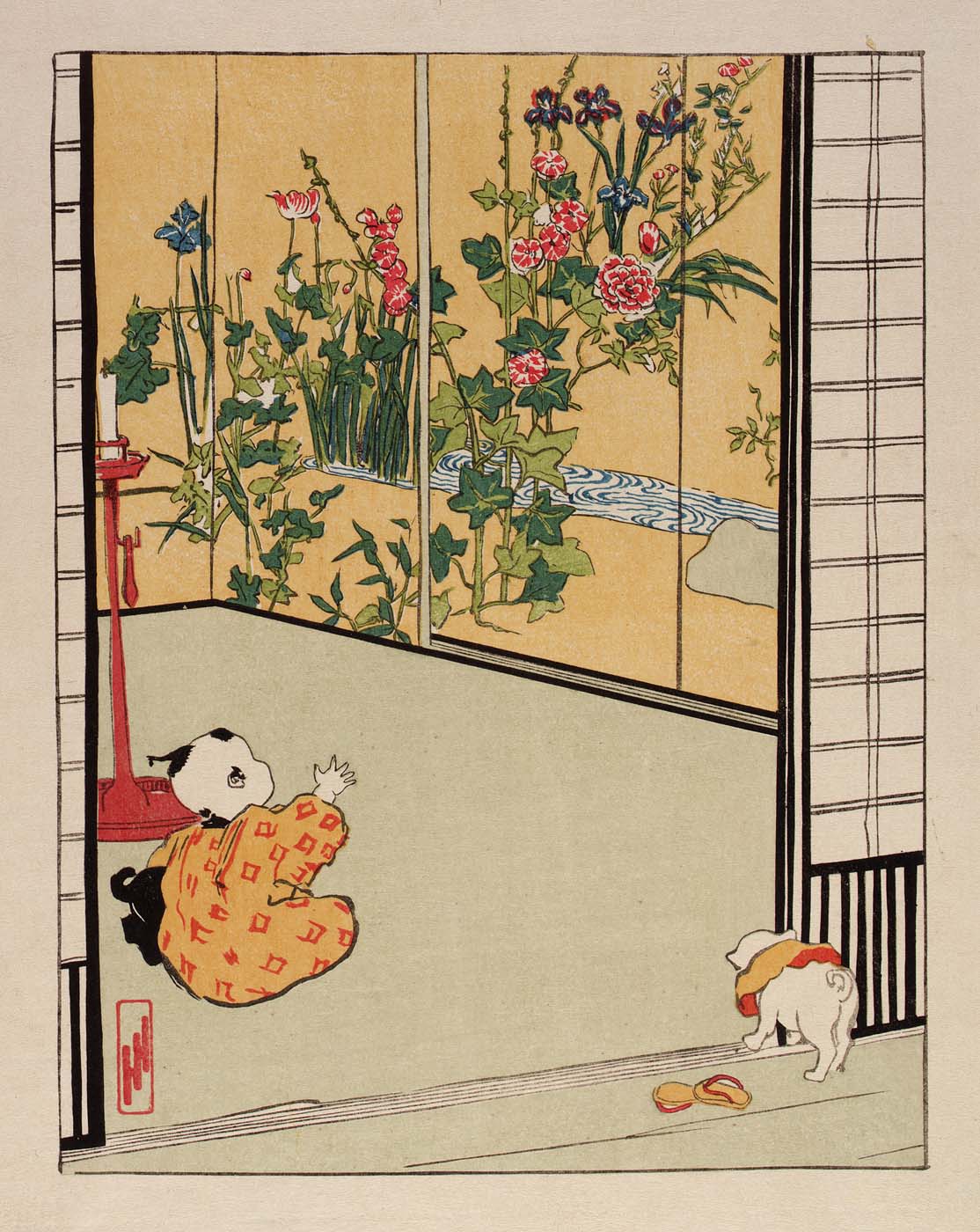
Interior Decoration from 1900 shows how quickly Hyde learned the technique, and her fascination for Japanese art in everyday settings.
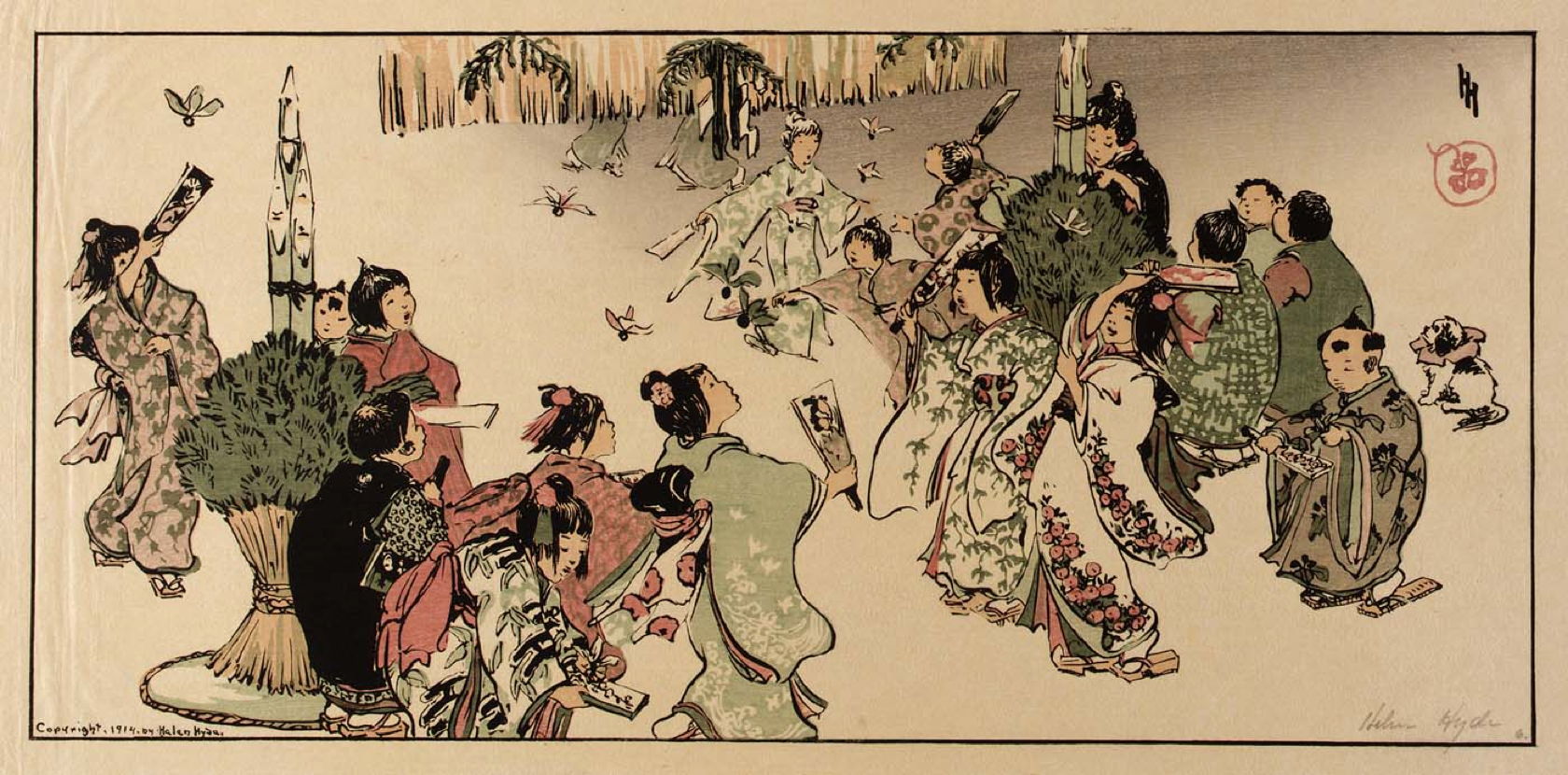
Hyde’s New Year´s Day in Tokyo, from 1912, is grander in conception, and a carefully composed print of key elements in the Japanese New Year celebrations.

My final example was painted in 1918, at the end of the First World War, far from the mud and blood of Europe’s battlefields. Colin Campbell Cooper’s Summer (1918) is inspired by Japonisme, fortified here by the east Asian influence of California, and by Monet’s paintings of his garden at Giverny, itself based on a Japanese water garden.

这篇文章将这 31 个技巧汇编成一份详尽的指南,按从“入门基础”到“高级模式”的逻辑重新组织,并补充了 280 个字符无法容纳的深度背景信息。
无论你是刚刚起步,还是希望利用 Claude Code 提升段位,这里都有适合你的内容。
在深入研究具体功能之前,首先要配置 Claude Code,让它真正理解你的项目。
每个新成员都需要入职文档。使用 /init,Claude 会为自己写一份。
Claude 会读取你的代码库并生成一个 CLAUDE.md 文件,包含:
这是我在任何新项目中运行的第一条命令。
对于大型项目,你还可以创建一个 .claude/rules/ 目录,用于存放模块化、特定主题的指令。该目录下的每个 .md 文件都会作为“项目记忆”与 CLAUDE.md 一起自动加载。你甚至可以使用 YAML frontmatter 基于文件路径有条件地应用规则:
可以把 CLAUDE.md 想象成你的项目总指南,而 .claude/rules/ 则是针对测试、安全性、API 设计等特定领域的专项补充。
想把某些东西存入 Claude 的记忆,又不想手动编辑 CLAUDE.md?
在过去,你需要用 # 开头来让 Claude 将内容追加到文件中。但从 Claude Code 2.0.70 版本开始,流程变得更简单了——你只需要直接告诉它去更新。
直接告诉 Claude 记住它:
“Update Claude.md: always use bun instead of npm in this project”
(更新 Claude.md:在这个项目中始终使用 bun 而不是 npm)
无需打断你的心流,继续编码即可。
@ 提及是将上下文传递给 Claude 的最快方式:
在 Git 仓库中,文件建议的速度提高了约 3 倍,并且支持模糊匹配。@ 是从“我需要上下文”到“Claude 已获取上下文”的最短路径。
这些是你会频繁使用的命令。请将它们刻入肌肉记忆。
不要浪费 token 去问“你能运行 git status 吗?”
只需输入 ! 加上你的 bash 命令:
! 前缀会立即执行 bash 命令并将输出注入到上下文中。没有模型处理延迟,不浪费 token,无需切换多个终端窗口。
这一看似微小的功能,当你每天使用五十次后,就会意识到它的巨大价值。
想尝试一种“如果我们这样做……”的方法,但又不想承担后果?
尽管去试。如果情况变得奇怪,按两次 Esc 键即可跳回到干净的检查点。
你可以回退对话、代码更改,或者两者都回退。需要注意的是:已运行的 Bash 命令无法撤销。
你过去的提示词(Prompts)都是可搜索的:
不要重打,要去回忆。 这对斜杠命令(slash commands)同样适用,体验无缝衔接。
这就好比 git stash,但是用于你的提示词。
Ctrl+S 保存你的草稿。先发送其他内容。当你准备好时,你的草稿会自动恢复。
再也不用复制到记事本,再也不用担心在对话中途打断思路。
Claude 可以预测你接下来要问什么。
完成一项任务后,有时你会看到一个灰色的后续建议出现:
Tab 键曾经用于自动补全代码。现在,它自动补全你的工作流。可以通过 /config 切换此功能。
Claude Code 是一个持久化的开发环境,根据你的工作流对其进行优化,将极大地提升效率。
不小心关掉了终端?电脑在任务中途没电了?没问题。
上下文得以保留,势头得以恢复。你的工作永远不会丢失。你还可以通过 cleanupPeriodDays 设置会话保留的时间。默认是 30 天,但你可以将其设置得更长,或者如果你不想保留会话,可以设为 0。
你的 Git 分支有名字,你的 Claude 会话也应该有。
/resume 界面会对分叉(forked)的会话进行分组,并支持快捷键:P 预览,R 重命名。
在网页上开始任务,在终端里完成它:
这会将云端会话拉取并恢复到本地。无论在家还是在路上,Claude 都在。这也适用于 iOS 和 Android 的 Claude 移动应用,以及 Claude 桌面应用。
有时你需要一份关于发生了什么的记录。
/export 将你的整个对话转储为 Markdown 格式:
非常适合用于文档编写、培训,或者向过去的自己证明:是的,你确实已经尝试过那种方法了。
这些功能旨在消除摩擦,帮助你更快地行动。
厌倦了伸手去拿鼠标来编辑提示词?
输入 /vim,解锁全功能的 Vim 风格编辑体验:
以思维的速度编辑提示词。你几十年的 Vim 肌肉记忆终于在 AI 工具中得到了回报。退出 Vim 模式也前所未有地简单,只需再次输入 /vim。
Claude Code 在终端底部有一个可自定义的状态栏。
/statusline 让你配置显示的内容:
一目了然的信息意味着更少的手动检查和中断。
想知道是什么吃掉了你的上下文窗口?
输入 /context 查看究竟是什么在消耗你的 token:
当你的上下文开始变满时,这就是你找出问题所在的方法。
输入 /stats 查看你的使用模式、最爱用的模型、连续使用天数 (Streaks) 等。
橙色是新的绿色 (Orange is the new green)。
“我快达到限额了吗?”
了解你的极限,然后超越它们。
控制 Claude 如何处理问题。
通过一个关键词按需触发扩展思考:
当你在提示词中包含 ultrathink 时,Claude 会在回答之前分配最多 32k token 用于内部推理。对于复杂的架构决策或棘手的调试会话,这往往决定了你得到的是肤浅的答案还是真正的洞察。
注:以前你可以指定 think, think harder, ultrathink 来分配不同数量的 token,但现在我们已将其简化为单一的思考预算。当配置了 MAX_THINKING_TOKENS 时,ultrathink 关键字将失效,配置项将优先控制所有请求的思考预算。
先驱散战争迷雾。
按两次 Shift+Tab 进入计划模式 (Plan Mode)。Claude 可以:
但在你批准计划之前,它不会编辑任何内容。三思而后行 (Think twice. Execute once.)。
我有 90% 的时间都默认处于计划模式。最新版本允许你在拒绝计划时提供反馈,使迭代更快。
直接使用 Claude API 时,你可以启用扩展思考来查看 Claude 的逐步推理:
Claude 在回答之前会在思考块 (thinking blocks) 中展示其推理过程。这对调试复杂逻辑或理解 Claude 的决策非常有用。
没有控制的力量只是混乱。这些功能让你设定边界。
/sandbox 让你一次性定义边界。Claude 在边界内自由工作。
你获得了速度,同时拥有真正的安全性。最新版本支持通配符语法,如 mcp__server__*,用于允许整个 MCP 服务器。
厌倦了 Claude Code 做什么都要请求许可?
这个标志对一切说 Yes。它的名字里带有“dangerously”(危险地)是有原因的——请明智地使用它,最好是在隔离环境或受信任的操作中。
Hooks 是在预定生命周期事件发生的 shell 命令:
通过 /hooks 或 .claude/settings.json 进行配置。
使用 Hooks 来阻止危险命令、发送通知、记录操作或与外部系统集成。这是对概率性 AI 的确定性控制。
Claude Code 的作用不止于交互式会话。
你可以将 Claude Code 用作脚本和自动化的强大 CLI 工具:
流水线中的 AI。-p 标志以非交互方式运行 Claude 并直接输出到标准输出 (stdout)。
将任何提示词保存为可复用的命令:
创建一个 Markdown 文件,它就变成了一个斜杠命令,并且可以接受参数:
不要重复自己。你最好的提示词值得被复用。
Claude Code 可以看到并与你的浏览器交互。
Claude 现在可以直接与 Chrome 交互:
“修复 Bug 并验证它能工作”现在只需一个提示词。从 claude.ai/chrome 安装 Chrome 扩展程序。
这是 Claude Code 真正强大的地方。
圣诞老人不会自己包装每一份礼物。他有精灵。
子代理 (Subagents) 就是 Claude 的精灵。每一个子代理:
像圣诞老人一样放权。子代理可以在后台运行,而你继续工作,它们拥有访问 MCP 工具的完全权限。
技能 (Skills) 是指导 Claude 完成特定任务的指令、脚本和资源的文件夹。
它们一次打包,随处可用。而且由于 Agent Skills 现在是一个开放标准,它们可以在任何支持该标准的工具中工作。
把技能看作是按需赋予 Claude 专业知识。无论是你公司特定的部署流程、测试方法论,还是文档标准。
还记得以前分享 Claude Code 设置意味着要跨 12 个目录发送 47 个文件吗?
那个时代结束了。
插件将命令、代理、技能、Hooks 和 MCP 服务器打包在一起。通过市场发现新的工作流,市场包含搜索过滤功能,便于发现。
LSP 支持赋予了 Claude IDE 级别的代码智能:
LSP 集成提供:
Claude Code 现在像你的 IDE 一样理解你的代码。
驱动 Claude Code 的代理循环、工具和上下文管理现在作为 SDK 提供。只需不到 10 行代码即可构建像 Claude Code 一样工作的代理:
这仅仅是个开始。
当我开始这个“倒数日历”时,我以为我只是在分享技巧。但回顾这 31 天,我看到了更多的东西:一种人机协作的哲学。
Claude Code 中最好的功能都是为了给你控制权。计划模式、代理技能、Hooks、沙盒边界、会话管理。这些是与 AI 协作的工具,而不是向它投降。
能从 Claude Code 中获得最大收益的开发者,不是那些输入“帮我做所有事”的人。而是那些学会了何时使用计划模式、如何构建提示词、何时调用深度思考 (Ultrathink),以及如何设置 Hooks 在错误发生前捕获它们的人。
AI 是一个杠杆。这些功能帮助你找到正确的抓手。
致 2026 年。
The first organised trading with Japan was established by the Dutch East India Company in 1609, at the start of its Golden Age, and that continued on a small scale from an artificial island in Nagasaki Harbour until the middle of the nineteenth century. Little of that trade involved paintings or other art, although that was sufficient to start small schools of western painting in Japan.
Japan’s isolation continued until a fleet of American ships, under the command of Commodore Matthew C Perry, arrived in Tokyo Bay in 1853. There followed a rapid opening up of trade and cultural exchange, accelerated when the Tokugawa dynasty was overthrown in the brief Boshin War. This marked the beginning of the Meiji period in 1868, with its dramatic reforms and accelerating Westernisation.
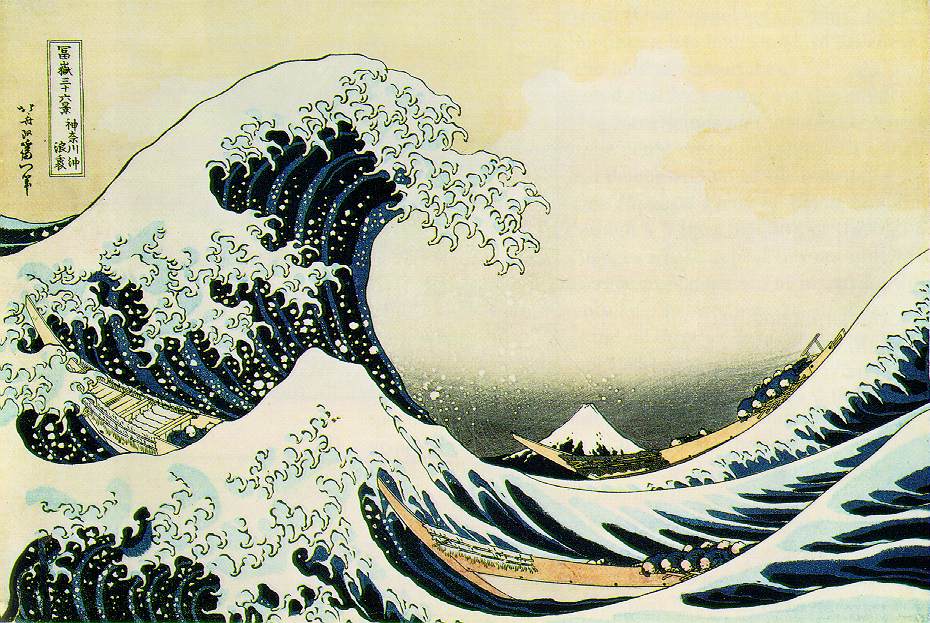
No one knows when Hokusai’s Great Wave first appeared in Europe. Although it’s sometimes claimed that this didn’t happen until the Meiji Restoration in 1868, there are records of the first ukiyo-e prints reaching the hands of artists in France more than a decade earlier.
Although popular in Japan, prints including uki-e, megane-e and the most famous ukiyo-e weren’t considered to be fine art at the time, and Japanese art historians see them as primarily artisanal in nature. Despite this, from their appearance in Europe in the nineteenth century to today, they have been accepted as fine art; indeed for many Westerners they are are the only Japanese visual art with which they are familiar, other than traditional painting.
They appear to have first arrived as protective wrapping for porcelain, and in about 1856 the French artist Félix Bracquemond, an accomplished print-maker, came across Hokusai’s prints. There are claims this happened at the workshop of his printer, or that he found a small volume of Hokusai prints used to pack Japanese porcelain. Japonisme then spread rapidly through artistic circles in Paris and other European cities. Among those who collected these prints were Bracquemond, Vincent van Gogh, Claude Monet, Edgar Degas, Gustav Klimt, Édouard Manet, and Paul Gauguin.
Bracquemond initially trained as a lithographer, but then went to work for Guichard, a former pupil of Ingres. A portrait of his was accepted for the Salon in 1852. After that youthful success, he concentrated on engraving and etching, rather than painting, and was part of the nineteenth century revival of print-making in France. He later went to work in the Sèvres porcelain factory, before working for the manufacturer of Limoges porcelain, in 1870. He was a long-standing friend of Manet and Whistler, as well as Millet, Corot, Rodin, Degas and the Impressionists.

Bracquemond’s Landscape is an unusual and exquisitely beautiful colour lithograph made later in his career. Although hardly Impressionist, its style is more closely related to the many designs that he made for paintings on porcelain.
This is a curious historical twist: European prints taken by the Dutch to Japan had inspired Japanese woodblock prints, which were a key influence on most of the Impressionists, who in turn became the inspiration for Japanese painters who went to Europe to train in Western techniques at the end of the nineteenth and early twentieth centuries.

One of the earliest painters to manifest Japonisme is the American James Abbott McNeill Whistler, as shown in his Princess from the Land of Porcelain, painted for his Peacock Room in 1863-65.

Others like Alfred Stevens followed. The Japanese Parisian from 1872 shows a woman dressed in fashionable Japonaiserie, holding a fan behind her back, and reflected in a large mirror.

The same year William Quiller-Orchardson completed Dolce Far Niente, incorporating in its painted screen a contemporary flavour of Japonisme. His woman, dressed in sober black, reclines on a thoroughly European chaise longue, her open book and fan beside her as she stares idly out of an unseen window.
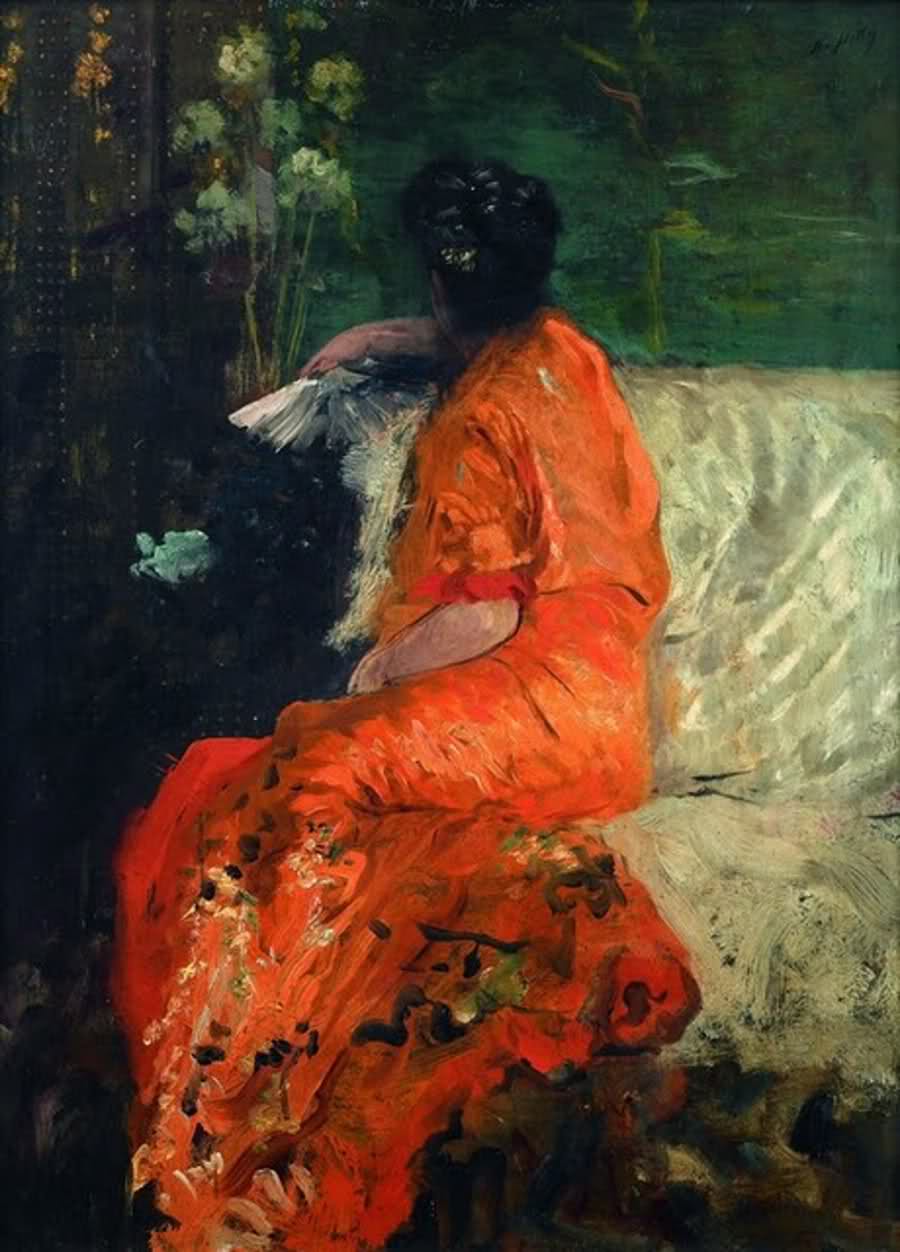
In 1878 the Italian Impressionist Giuseppe De Nittis campaigned successfully in London. Among his paintings from that series is The Orange Kimono.

The American Elihu Vedder also developed a fascination for east Asian objets d’art, which he assembled in this Japanese Still Life in 1879. This unusual collection may have been assisted by the fact that his brother was a US Navy doctor who was stationed in Japan as it was being re-opened.

Pascal Dagnan-Bouveret’s Bouderie, meaning sulking, is a splendid and intimate portrait of the artist’s friend and colleague Gustave Courtois, painted in 1880. Courtois is seen at one end of a large sofa, smiling wryly and staring into the distance. He holds his palette and brushes in his left hand, and what may be a long mahlstick in the right. At the opposite end of the sofa, turned with her back towards Courtois, is a young woman dressed in fashionable black clothing, and on the left is a screen decorated with Japanese imagery.

The Swedish rising star Anders Zorn painted some Japoniste works, including this parasol portrait, Castles in the Air, from 1885.

Before he went to Arles, Vincent van Gogh had copied Utagawa Hiroshige’s woodblock print The Plum Orchard in Kameido. Shortly after his arrival there, in 1888, the fruit trees came into flower, and van Gogh painted a triptych intended for his brother Theo’s apartment, including The Pink Orchard above, and The Pink Peach Tree below.

Van Gogh’s approach to painting blossoming fruit trees was completely different from that of the Japanese prints he had collected. His trees are built anatomically, with trunk and branches drawn in outline, often using contrasting colour. Flowers are applied using impasto; sadly some of these have faded since, and some of the paint that now appears white or off-white was originally much pinker.
(Abstract)《松鼠大作战》二代为卡普空的最后一个 FC 游戏作品,以丰富的剧情故事和特有的双人隐藏关卡而知名。
In 1657, one of the great scientists of the Dutch Golden Age, Christian Huygens, invented the pendulum clock, the first timekeeping device accurate enough to make a second hand worthwhile, as it typically only lost about 15 seconds per day. It was another century before John Harrison developed his marine chronometer, a clock sufficiently accurate to enable precise determinations of longitude. Another hundred years later, with the coming of railways across Europe, ordinary people started synchronising clocks so they caught their train, and our ancestors soon became the first slaves to time.
I’m beginning to wonder whether Apple intends reversing that history. Have you not noticed something odd about setting times in more recent Mac apps, how few allow you to set the seconds? You can see what has happened over the last few years in my log browsers, Ulbow and LogUI.

Most of Ulbow’s interface was written using AppKit seven years ago, and it uses a standard Date Picker with elements containing the year, month, day, hour, minute and second. Given that you can get more than 10,000 log entries in a second, I would have preferred to offer decimal seconds, but that isn’t possible within the standard AppKit picker.

LogUI was written from the start using Apple’s more recent substitute for AppKit, SwiftUI, eighteen months ago. That doesn’t use the AppKit Date Picker, but has its shiny new DatePicker instead. Components available in macOS are there limited to year, month, day, hour and minute. To be able to include seconds your code must be written for an Apple Watch, as macOS, iOS and iPadOS don’t allow seconds at all. That’s why you have to enter them in a separate TextField, although that could perhaps allow the use of decimal seconds.
When I wanted to obtain higher resolution timestamps for log entries in LogUI, I discovered that standard date formatting in macOS only resolves to milliseconds (10^-3 second), and couldn’t stretch to microseconds (10^-6 second), let alone the nanoseconds (10^-9 second) that can be obtained from Mach absolute time, as used internally in parts of macOS. Even that reference has recently become lower resolution, as each ‘tick’ in Apple silicon Macs occurs every 41.67 nanoseconds, rather than once every nanosecond as in Intel Macs.
There’s another difference between Ulbow and LogUI with regard to timestamps that you’re less likely to be aware of: Ulbow obtains its log records indirectly using the log show command, which can include the Mach absolute time of each entry. Instead, LogUI accesses those entries direct through the more recent OSLog API, which doesn’t currently expose such precise times.
Lest this appear too far removed from the world of the user, look in the menu bar clock’s settings, and you’ll see Display the time with seconds is an option, but not the default. When the clock is shown on the Lock Screen or screensaver, it only displays hours and minutes, never seconds, neither can any of the digital clock widgets supplied with macOS. While the Clock app does support decimal seconds, that’s only permitted in its Stopwatch where hundredths are displayed, as they are on an Apple Watch and other devices.
This becomes stranger still when you consider the methods used to synchronise internal clocks. Since High Sierra, macOS has used its own timed service, which Apple describes as “synchronizing the clock with reference clocks via technologies like NTP”, that’s the Internet service provided by time.apple.com as in Date & Time settings. When accessed over the Internet, it’s generally accepted that NTP should be accurate to within tens of milliseconds, although that can at times worsen to 100 milliseconds or more.
As far as I’m aware, no Mac has ever had a GPS receiver built into it, but every iPhone apart from the earliest, and those iPads with cellular support, include assisted GPS and GLONASS. Those are capable of providing time accurate to about 100 and 200 nanoseconds respectively. Even my 11-year-old car corrects its clock using GPS.
Although our Macs and devices can share almost everything else now, my Macs appear unable to adjust their clocks to the more accurate time that should be available to my iPhone. But as iOS is so shy about displaying seconds anywhere, it makes me wonder whether iPhones make full use of GPS time, or mostly rely on that obtained from the nearest cellular mast.
I’m curious whether this is a deliberate campaign to abolish seconds wherever possible, or just the result of doing what looks sufficient. Maybe I’m a mere slave to time, and the Time Lords in Apple Park are on a mission to cure me by travelling back four centuries.
Anyone familiar with Doctor Who will be aware of the power brought by control over time. Although there have been sporadic reports of problems with Apple silicon Macs keeping good time, and they may not synchronise sufficiently accurately for some purposes, they appear to have generally good control over time.
Last year I explained how macOS now uses the timed service with network time (NTP) to perform adjustments while running. This article looks at what happens before that, during startup, when the Mac has only its own devices to tell the time. Although the user sees little of this period, anyone accessing the log recorded during startup could find the timestamps of entries affected by adjustments. It may also provide insights into how Apple silicon Macs tell the time.
To investigate clock initialisation and adjustment during startup, I analysed approximately 100,000 consecutive log entries freshly recorded in the log of a Mac mini M4 Pro booting cold into macOS 26.2, following a period of about 14 hours shut down. These entries covered the period from the initial boot message for approximately 27 seconds, after I had logged in and the Desktop and Finder were displayed. This Mac is configured to Set time and date automatically from the default source of time.apple.com in Date & Time settings, and has both WiFi and Ethernet connections.
Multiple adjustments to wallclock time were recorded during that period, resulting in significant discontinuities in log timestamps. For example,11:40:15.888717 void CoreAnalyticsHub::handleNagTimerExpiry(IOTimerEventSource *)::838:messageClients of 37 available events
11:40:10.045582 === system wallclock time adjusted
11:40:10.053309 000009.664065 Sandboxing init issue resolved: "Success"
11:40:10.053447 com.apple.sandbox.reporting Sandbox: wifiFirmwareLoader(49) deny(1) file-read-metadata /Library
11:40:10.112333 === system wallclock time adjusted
11:40:10.127559 com.apple.Installer-Progress Progress UI App Starting
In the first of those adjustments, the wallclock time was retarded by up to 5.84 seconds, and in the second it was advanced by at most 0.0589 seconds.
Because of those wallclock adjustments, times recorded in the log are discontinuous. Although it’s not possible to correct for the adjustments made completely accurately, assuming that each of those adjustments corresponds to standard time (such as UTC), those can be applied backwards through times recorded in the log to bring them closer to that standard. This could result in some brief periods of entries with times earlier than preceding entries, but is as accurate an estimate possible given the data.
The narrative constructed from the log is summarised in the following table.

This starts with the initial record of the boot process, giving its UUID, within a second of the Power button being pressed (at approximately 0.0 seconds) to initiate the startup. That’s followed by a gap of just over 5 seconds before the second log entry.
The first two wallclock adjustments were made at 10 seconds, before there was any evidence of network connectivity. Those took place one second before the loginwindow was launched.
Two subsequent adjustments were made shortly after 24 seconds, immediately following the removal of the loginwindow after successful authentication. A further three adjustments followed in the 2.5 seconds after the user was logged in, while the Desktop and Finder were being prepared and displayed.
Log entries reporting the timed service was running didn’t occur until shortly before the last of those wallclock adjustments, and that was recorded in the log 0.0003 seconds before timed obtained its first external time.
A total of seven wallclock time adjustments were made before timed was able to obtain a time from any external reference. Over the first 10 seconds, before the initial wallclock adjustment, those were substantial, amounting to 5.8 seconds. For those changes to be made to wallclock time, there must be another source of time deemed more accurate, against which wallclock time can be compared and adjusted.
I’ve been unable to find any trustworthy information about internal clocks and timekeeping in Apple silicon Macs. It has been suggested (and Google AI is confident) that local reference time is obtained from the Secure Enclave. However, Apple’s only detailed account of features of the Secure Enclave fails to mention this. Initialisation of the Secure Enclave Processor also occurs relatively late during kernel boot, in this case at around the same time as the first two adjustments were made to wallclock time.
timed is able to obtain an external time against which to adjust wallclock time.Sculptors and painters are kindred spirits. Although their tools and skills differ, they are all visual artists, and many have mastered both means of expressing their art. In today’s selection of paintings I include depictions of sculptors at work, rather than those merely showing the fruit of their labour in the form of sculpture.
The best-known sculptor in classical mythology is Pygmalion, whose quest for the perfect woman was only satisfied by the statue he made of her.

The Hand Refrainsis one of Edward Burne-Jones’s series telling this myth. Pygmalion stands back, his tools still in his hands and scattered at the foot of his work. Too scared to touch the statue now, he looks longingly at it, as if falling in love, which he did when it came to life.

Jean-Léon Gérôme’s study for Pygmalion and Galatea from 1890 was an early attempt at its composition, where the sculptor’s future bride is still a marble statue at her feet, but very much flesh and blood from the waist up. That visual device was perfect, but Gérôme recognised his painting could be shunned because of its full-frontal nudity, so reversed the view.

His finished Pygmalion and Galatea (c 1890) extends the marble effect a little higher, and by showing Galatea’s buttocks and back and concealing the kiss, it stays on the right side of contemporary standards of decency. His attention to detail is delightful, with two masks against the wall at the right, Cupid ready with his bow and arrow, an Aegis bearing the head of Medusa, and a couple of statues about looking and seeing. For Gérôme recognised other stories about sculpture and seeing that could be brought in to enrich Ovid’s original narrative.

Lawrence Alma-Tadema imagined ancient Greeks admiring this painted frieze as it neared completion in his beautiful painting of its sculptor Phidias Showing the Frieze of the Parthenon to his Friends (1868). The admiring figures include Pericles (at the right), Aspasia, Alcibiades and Socrates.

William Rush Carving His Allegorical Figure of the Schuylkill River (1876-77) is the first of three paintings by Thomas Eakins showing William Rush, a wood sculptor, carving his Water Nymph and Bittern for a fountain in Philadelphia’s waterworks, in 1808. The water nymph is an allegory of the Schuylkill River, the city’s primary source of water at that time.
Rush had been a founder of the Pennsylvania Academy of the Fine Arts, and an enthusiast for the use of nude models in art, as was Eakins. This painting was therefore, at least in part, an attempt to promote Rush’s name, and the practice of working from nude models. Rush prepared thoroughly, as usual, in carving wax studies, and making a series of drawings and oil sketches.
Seated at the right of the model is a chaperone, more interested in her knitting. The model’s complicated clothing is hung and scattered in the light, as if to emphasise her total nudity (apart from a hair-band!), and the sculptor is working in the gloom at the left. Eakins anachronistically included several later works by Rush, as if to provide a resumé of his output. Unfortunately, the scattered garments didn’t go down well, and were deemed scandalous at the time.

Gérôme’s relatively small and simple painting of Michelangelo from 1849 shows Michelangelo in his dotage, hunched over and blind, being led by a young boy whose dress would have aroused his master’s homoerotic desires. The broken sculpture is the Belvedere Torso, a huge fragment of marble statuary so loved by the sculptor that it was nicknamed the School of Michelangelo. The young boy is leading his master’s hands to stroke and caress the marble, now that he was unable to enjoy looking at its classical and very male form.
This is perhaps the first step in his developing theme of sight, and the role of vision in establishing truth. In his blindness, Michelangelo can only feel what we can see, and cannot see the figure of the young boy. This is particularly appropriate to Gérôme, who later in his career became a successful sculptor himself, and whose later paintings referred to his sculptures and the act of creating them.

The End of the Pose (1886) is the first of Gérôme’s series of unusual compound paintings, at the same time self-portraits of the artist as a sculptor, studies in the relationship between a model and their sculpted double, and forays into issues of what is seen, visual revelation, and truth. Here, while Gérôme cleans up, his model is seen covering up her sculpted double with sheets, as she remains naked. Apart from various diversionary entertainments, including a couple of stuffed birds and a model boat, there is a single red rose on the wooden platform on which the model and statue stand. Presumably this is a symbol of thanks from the artist to his model.
In The Artist’s Model (1895), Gérôme paints himself at work on his marble figure of Tanagra (1890), currently in the Musée d’Orsay, already included among the figurines in his painting Sculpturae Vitam Insufflat Pictura. He thus painted himself making a sculpture that he had previously painted in a painting as a sculpture. Not only that, but his model is his favourite Emma Dupont, who over a period of twenty years posed for many of his best-known Orientalist and other works.
Scattered in the image are reminders of gladiatorial armour and other props used for his paintings, one of his paintings of Pygmalion and Galatea, together with one of his polychrome sculptures of a woman with a hoop, at the right edge. In this single image, Gérôme has captured much of his professional career.

This wonderful Portrait of the Sculptor Nikolaus Friedrich (1912) at work wasn’t the first to be painted by Lovis Corinth, who had made a previous portrait in 1904, when the sculptor was young and muscular. Eight years later he’s seen in the midst of a broad and representative range of his work. Friedrich died two years later, when he was only 48.
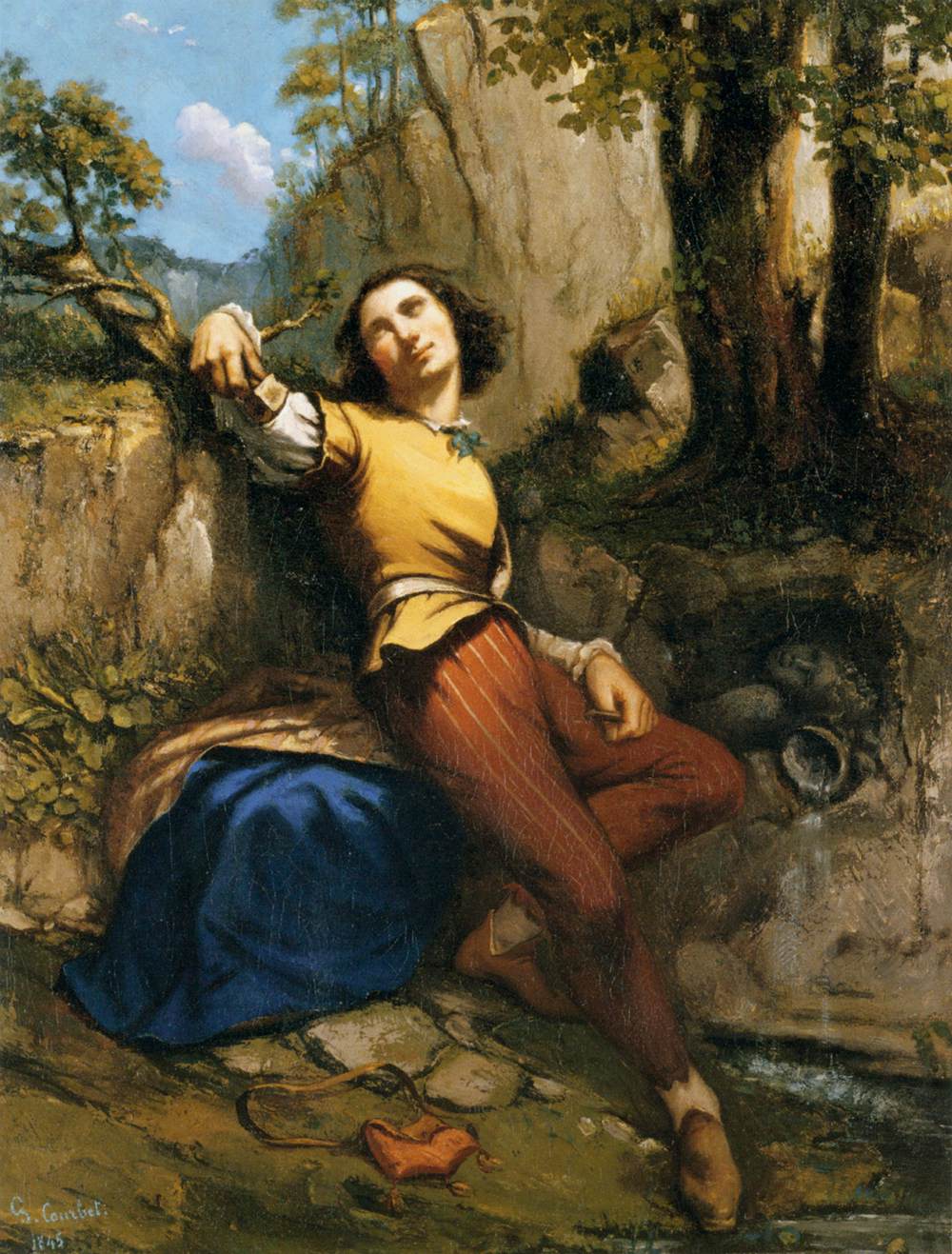
Early in his career, Gustave Courbet planted a gaudily-dressed figure at the foot of some cliffs near his home town of Ornans, put a small mallet in his right hand and a chisel in the other, and painted The Sculptor (1845). The subject of this sculptor’s inattention is the emerging form of a woman in the rock just above his left knee, over a small pipe from which water is pouring into the stream.

Antoine Watteau’s tondo of The Monkey Sculptor from about 1710 is a singerie set in the sculptor’s studio, as if to say that even a monkey can be a good sculptor.
(Abstract)很多人的启蒙游戏。现在最大的看点就是日版精美的剧情动画和各关地图。
The Golden Age of the Dutch Republic was a period of war and turmoil. It started in the latter half of the Eighty Years War, thrived when that came to an end in 1648, and collapsed following the Disaster Year (Rampjaar) of 1672. That year brought both the Franco-Dutch and Third Anglo-Dutch Wars, invasion, rebellion, economic crisis, and collapse of the art market.

When he was just twenty, the French artist Antoine Coypel painted this Glory of Louis XIV after the Peace of Nijmegen (1681), which gained him admission as a full member to the Académie Royale.
The Treaty of Nijmegen brought an end to the Franco-Dutch War of 1672-78, and was one of a series France signed between August 1678 and September of the following year. These were acclaimed a great success for Louis XIV and France, which gained extensive territory in the north and east as a result. Louis was henceforth known as the Sun King. In this elaborate allegorical flattery, the king is being crowned in the upper left, above a gathering of deities including Minerva, who is wearing her distinctive helmet and golden robes.
Painting didn’t stop, of course, and some artists continued into the following century, but the number of masters declined rapidly.

Domenicus van Wijnen continued to paint, for example his radical interpretation of The Temptation of Saint Anthony in about 1685. Although this may have appeared an outlier at the time, its symbols and composition may have inspired the ‘faerie’ paintings that became popular in the middle of the nineteenth century.

Other artists like Adriaen van der Werff reverted to more traditional themes and style, in his Judgement of Paris from 1716.

The Golden Age was revisited by artists in the nineteenth century, particularly in the period scenes painted by Herman Frederik Carel ten Kate. His Soldier and Men in an Inn shows a scene from the Eighty Years War, with the walls decorated by blue on white Delft tiles. This must have been painted between 1850-80, over two centuries after the end of that war.

Early in the career of the Dutch artist Jozef Israëls, he painted The Seamstress (1850-88) as a genre interior from the Golden Age. A young Dutchwoman works with her needle and thread in the light of an unseen window at the left. In the background to the right, there’s a group of Delft tiles on the wall, and there’s a single tulip in a glass vase at the left.
The impact of Golden Age paintings on European art history was broad and deep, with secular themes becoming more popular than the religious and mythological works that had dominated the art of the Renaissance. New genres, like still life, may not have been rated as highly as history painting, but became widespread.
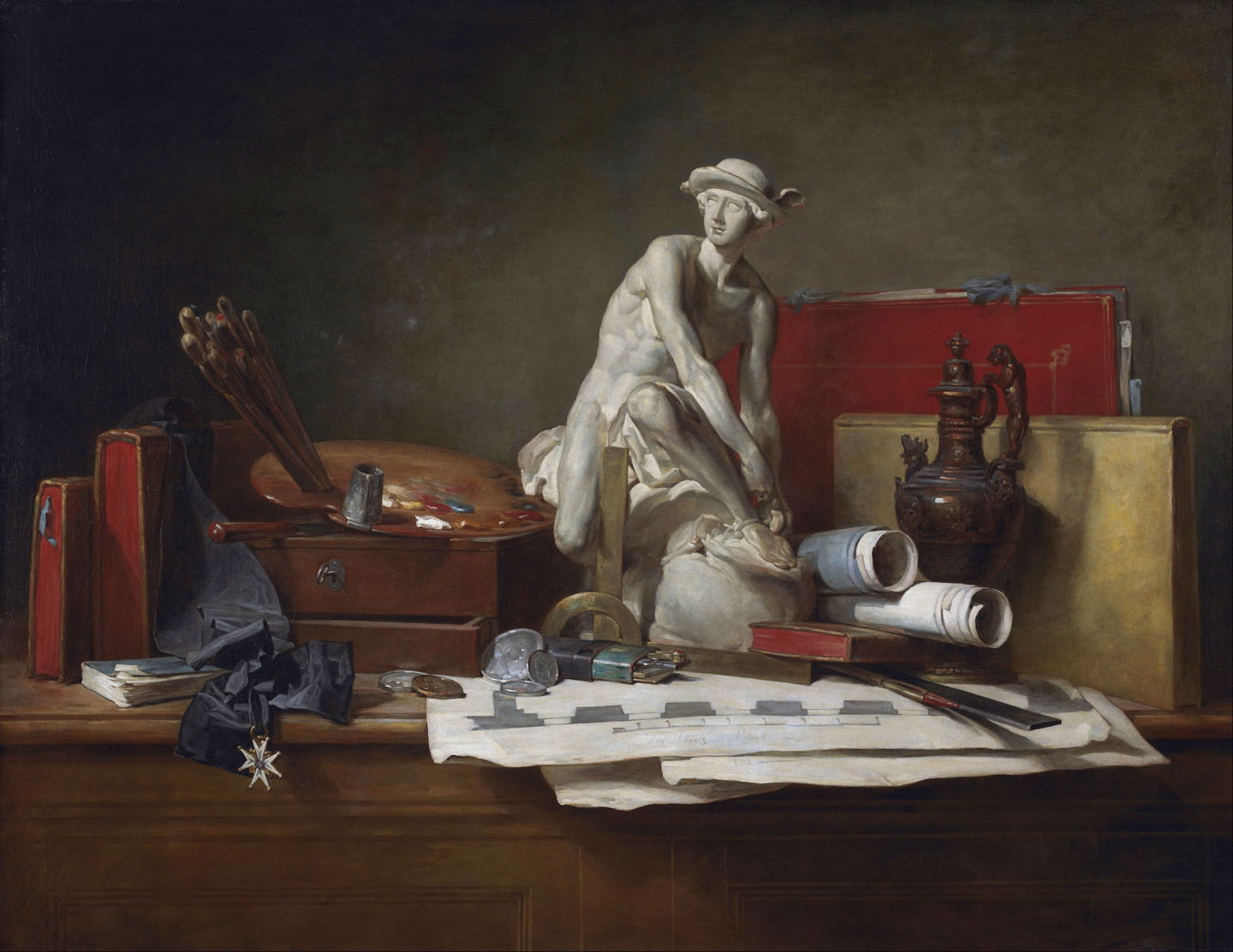
Late in his career, in 1766, Jean-Baptiste-Siméon Chardin painted The Attributes of the Arts and the Rewards Which Are Accorded Them, in which each object has a clear association. Painting is represented by the brushes and palette on top of a paintbox. Architectural drawings and drawing tools represent architecture. The bronze pitcher at the right refers to the work of the goldsmith. The red portfolio tied with ribbons represents drawing. The plaster model of the figure of Mercury in the centre is a copy of a sculpture by J B Pigalle, a friend of Chardin, who was the first sculptor to win the highest French honour for artists, the Order of Saint Michael, whose cross and ribbon are shown at the left.
Greatest impact was in landscape painting. Prior to the Golden Age, landscapes had primarily been used as accessories to other genres. Most were idealised rather than accurate representations of any real location, and many were mere settings for narratives.

The Dutch vogue for expressive skies spread steadily across Europe. This is reflected in Joseph Vernet’s Italianate Harbour Scene from 1749. He still retains formal compositional elements, with figures in the foreground, and scenery behind, but delights in showing us these towering cumulus clouds lit so richly.
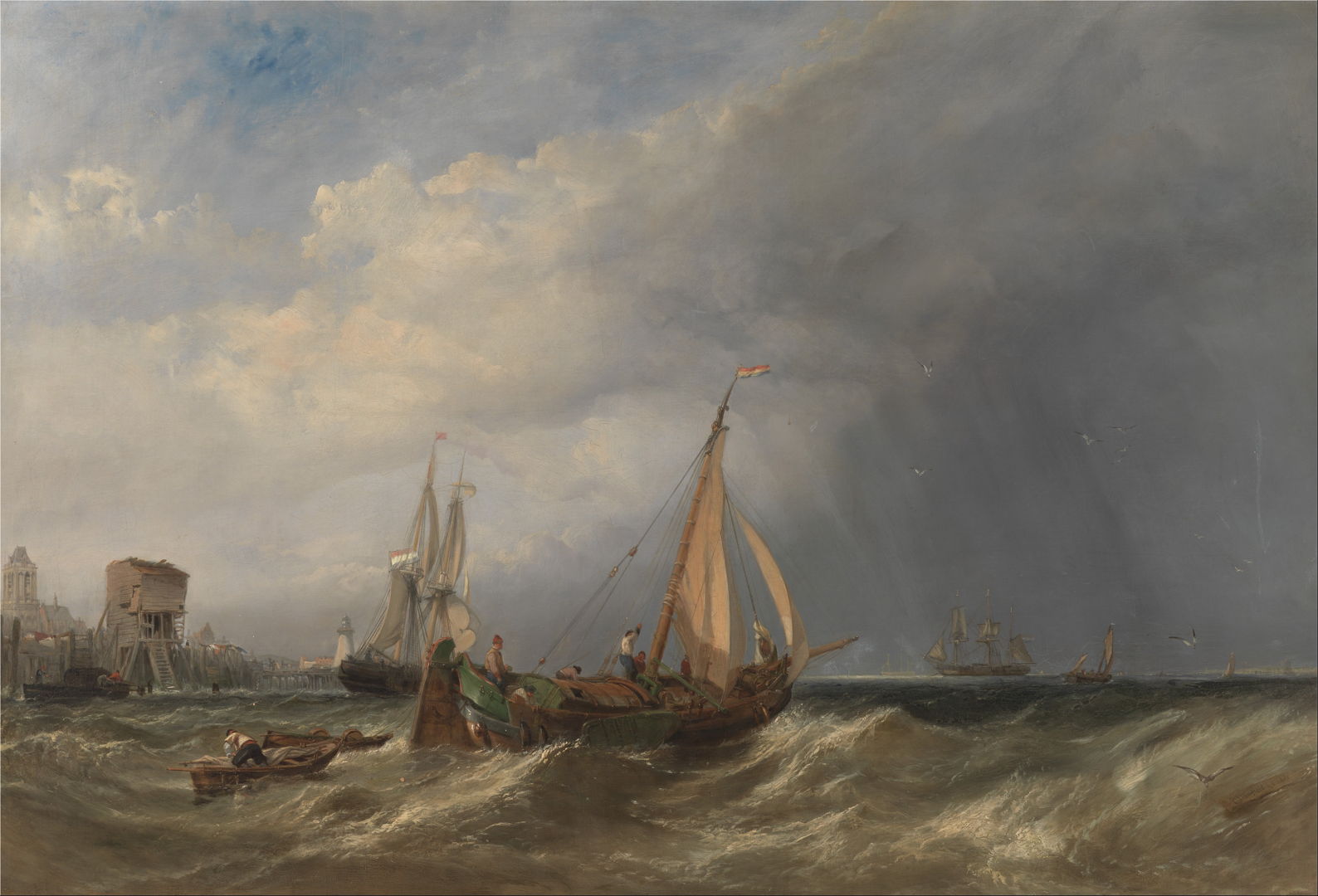
Marine painting became established as a sub-genre, as shown by the British painter Clarkson Stanfield, whose Dutch Barge and Merchantmen Running out of Rotterdam from 1856 includes rich detail, even down to dilapidated buildings on the waterfront.

Many of John Crome’s landscapes feature skies inspired by Dutch painters. His Landscape with Windmills is one of his most remarkable, as a signed painting that appears to have been sketched in front of the motif. Others who skied include John Constable and JMW Turner.
Nocturnes were less reliable, as they underwent phases when they were fashionable, then fell into neglect for a while.

James Abbott McNeill Whistler had a penchant for nocturnes, here his Nocturne: Blue and Gold — Southampton Water from 1872. Its vague blue-greys make the pinpoints of light and the rising sun shine out in contrast, a good reason for limiting his palette, while remaining faithful to nature.
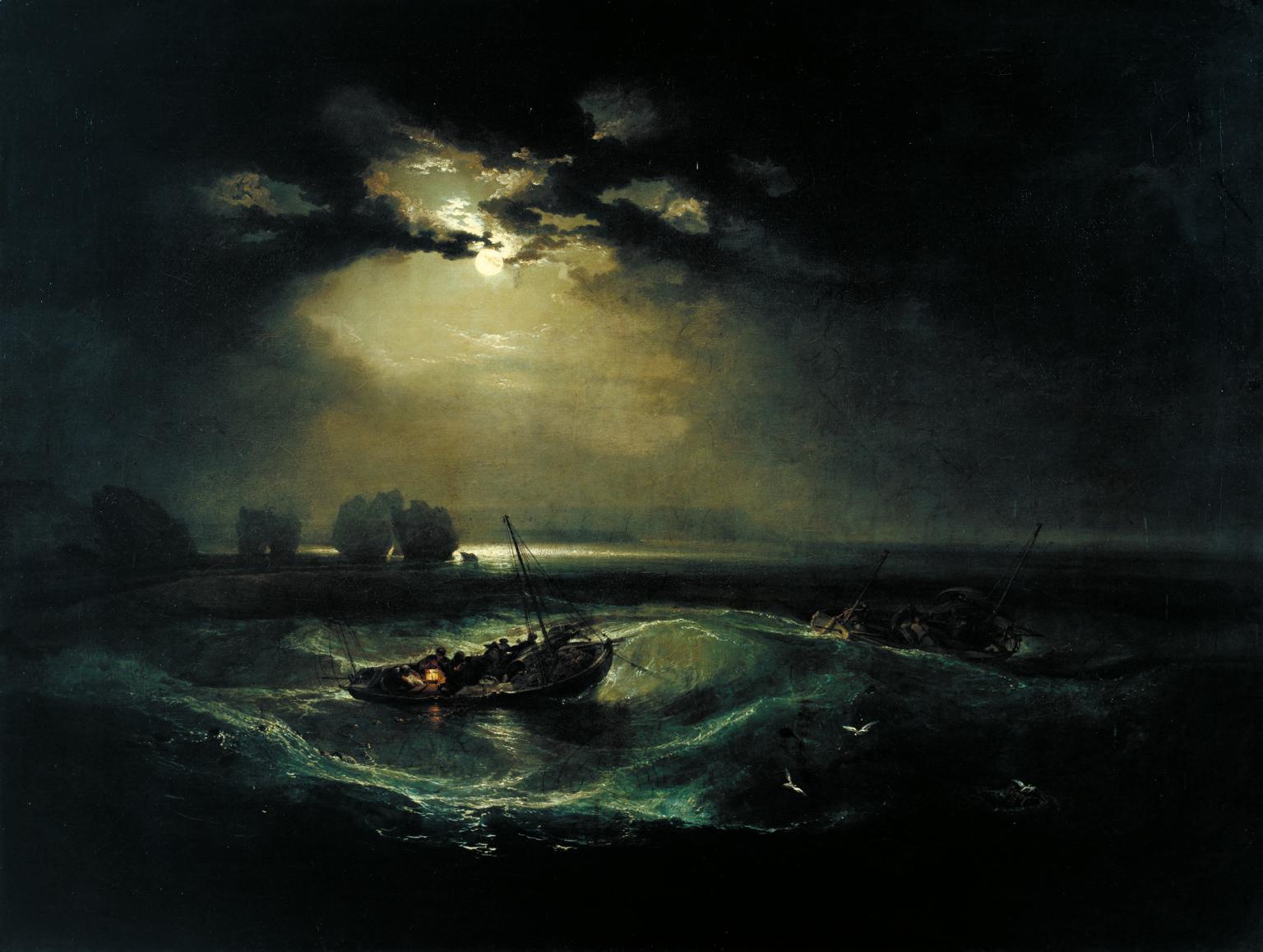
JMW Turner’s Fishermen at Sea from 1796, showing small fishing boats working in heavy swell off The Needles, on the Isle of Wight, is probably the most famous and successful coastal nocturne of all time. This was Turner’s first oil painting to be exhibited at the Royal Academy, when he was just twenty-one.
Paintings by artists of the Dutch Republic had been sold into collections across Europe, where many remain, influencing today’s artists.
(Abstract)回忆老游戏里的有趣故事:小时候能够通关《沙罗曼蛇》(Salamander)是多亏盗版商提供了一个简单版。
(Abstract)回忆老游戏的有趣故事:超级马里奥(Super Mario Bros.)中、加速跑是一个很重要的功能。

那年冬天,国际天文学联合观测网宣布,人类再次捕捉到一个“跨恒星访客”。
代号:3I / ATLAS。
它并非金属,也不像冰体。所有望远镜的数据都在闪烁、紊乱、跳跃。
有科学家提出,它的表面并非反光均匀,而是一种会散射观测波段的天然迷彩。
这意味着,它在主动隐藏自己。
天文学家称之为“被注视的凝视物”。
两个月后,一个名叫苏弋的工业设计师在社交媒体上发布了一张照片。
他掌心托着一个13厘米长的灰黑色小模型,表面布满刻意的不规则反光。
标题很简单:
照片下没有说明,也没有解释。
但第二天早晨,它就出现在各大科技博主与艺术账号的页面上。
短短几天,#ATLAS掌心体# 的话题播放量突破一千万。
人们惊讶地发现:这个模型拿在手里,会因角度与光线不同而不断改变亮度与轮廓,好像真的在呼吸。
没有任何机械结构,却让人产生一种“被凝视”的幻觉。
潮流品牌纷纷推出联名款、限量款,甚至高定银质版本。
3I/ATLAS 成了地球上最受欢迎的“掌心饰物”。
直到那时,人们才开始注意到模型命名里那个奇怪的后缀:SUiTHiNK。
起初只是粉丝在 Reddit 上随口猜测:
“是不是苏弋 think 的意思?他在表达‘思考的我’?”
很快,语言学与符号学圈子加入了讨论。
牛津大学的一位古文字学家在论坛上指出,SUi 在苏美尔语音节表中确有记录,对应音素「šù-i」,意为“手中之物”或“掌握的”。
而 THiNK 若取古日耳曼转写体系中「þenkaz」的变体,则可指“思想、意志”。
这两个词放在一起——SUi / THiNK——意外构成一种双重结构:
“思想被握于手中”
“手成为思想的延伸”
正好对应了那枚贴合掌心的模型。
一个名为《ATLAS分析草稿》的PDF文件在暗网流出,署名不明。
文件记录了苏弋受邀前往某个“国际天文资料保存计划”设计储存容器的过程。
文件被加密,只能读到部分片段:
「……他拒绝使用镜面金属,要求采用能分散反射的表层……」
「……他说它看我们的方式,与光的角度有关……」
消息曝光后,网友纷纷去翻苏弋的旧贴。
有人发现,在他早期设计的数个装置艺术中,常出现一种奇怪的结构:
不规则的反光面、内部空洞、可置于掌心的尺寸。
似乎他早在3I/ATLAS出现前,就在“模拟它”。
半年后,苏弋停止更新。
没有告别,也没有声明。
他最后一条动态是一张模糊的近景:
灰色反光面,指纹模糊,背景是实验室的冷光。
账号沉寂,模型销量却持续飙升。
ATLAS 成了新世代的“图腾物”——有人把它挂在胸前祈祷,有人说握着它冥想能听见低频嗡鸣。
心理学家解释那是“自我投射效应”,
可越来越多的视频声称,模型在暗处能“微微震动”。
一位梵文与苏美尔语双修的学者在学术会议上展示了一页《纳格·哈玛第文库》的边注。
那是一段13世纪的修订版手抄本,边缘用拉丁混写体标注着一个模糊的词组:
“SUI · THINC”
他解释说,古修士在这里用“sui”(自我)与“thinc”(思想、议会)并置,
象征“自我与思想的合一”。
而这页手稿讨论的主题正是——“被造物如何回望造物主”。
学者最后说:
“这并非巧合。有人在重新复写那一页。”
几个月后,一个匿名账户上传了一段短片。
画面是普通实验室,一枚3I/ATLAS模型被置于光谱仪下。
随着仪器启动,反射光像是被吸入某种结构中——
在高倍放大镜头下,模型表面出现了极细的刻痕,
排列成一种自相似的螺旋分布。
字幕写着:
「不是反射,而是记忆。」
短片很快被删除,但无数人下载、转发。
有科技频道尝试复刻实验,结果不同——有的只是普通塑料折射,有的却出现微光闪烁。
人们开始相信,真正的那批限量模型里藏着“某种东西”。
如今,3I/ATLAS 已成全球设计学院的研究对象。
有人研究其造型心理学,有人分析其符号学层次。
但没人再提那个名字——苏弋。
只有极少数人记得,他在一篇采访中留下过一句话:
“如果我们注视的东西,也在注视我们,那我们看到的,或许只是它让我们看到的部分。”
这句话如今被无数次印在ATLAS周边的包装盒上,
也被误以为是广告语。
而在某个收藏论坛上,一张从未公开的照片被匿名发出:
桌上放着数枚模型,灯光昏暗,镜头对焦在最后一排。
那些模型的反光形成一条微弱的线,连成一个英文单词——
RETURN.


模型由我使用 Midjourney、Tripo 设计制作;
短文由 ChatGPT 配合我完成;
首图为模型实拍,经 Banana 和 Snapseed 处理。
点击这里打印模型,祝大家玩得开心!
在 Pixel 设备上打开 Google app 的新闻链接,或在 Windows 设备上通过开始菜单访问网络搜索结果,这两种情况都存在一个共同点:系统会忽略你的默认浏览器设置,强行使用自家的浏览器(Chrome 或 Edge)进行访问。
对此,似乎大家并没有太大反应,正如人们对欧盟地区用户在数字生活中享有选择而感到无奈似的。
今天我们就来探讨一个问题:如何成为一名数字意义上的欧盟地区 Windows 用户。
受《数字市场法案》影响,微软在欧盟地区针对用户做出了很多让步,包括:
关于 Windows 的地区设置,你可以在「系统设置 > 时间和语言 > 语言和区域」中找到几个选项:

不过,今天的重点是一个新加入的、不可更改的选项——设备设置区域。将其更改为欧盟地区是个不错的切入点。

我最初想到的是去年推出的 Edge 重定向工具 MSEdgeRedirect,但不久后发现该模式在 2024 年 3 月后将失效,原因是微软的 UCPD 驱动3。

UCPD(用户选择守护驱动)利用内置的黑白名单机制,屏蔽非微软签名的进程,阻止第三方工具对系统的修改。这不仅影响到一些文件协议的处理,而且更难被禁用。微软还设置了一个名为 UCPD velocity 的自动化任务,每次用户登录时都会恢复被禁用的系统文件和设置。

因此,想要使用 MSEdgeRedirect 开启「欧盟模式」的用户,首先可以按照 SetUserFTA 开发者的思路摆脱微软的干预。
彻底解决方案:直接删除 UCPD 驱动。以管理员权限运行 CMD,执行命令 sc.exe delete UCPD,然后重启。需要注意的是,该驱动可能会在系统更新后复活。
温和解决方案:禁用 UCPD 驱动,以管理员权限在 CMD 下执行:
完成后,便可以正常使用 MSEdgeRedirect 修改地区设置。

成功更改设备设置区域后,不仅能享受之前提到的「权益」,更能在各类设置中拥有更多自由,成为一个选择上的欧洲人、商店里的美国人、文本习惯上的中国人——这份灵活,值得我们珍惜。

参考链接:

膝盖骨乐队 Kneecap,8.5/10
评分给高了一点,是因为我部分地代入了音乐教师 Dj Próvai 的角色,于是它似乎成为了对我而言最好的中年电影之一。
不再是那种俗套的中年电影:在生活压力或者虚无中产生情绪,寄情于(事业 or 自然 or 某种兴趣爱好 or 性爱)之中,最终(成功 or 不成功)的故事。
而是,在碌碌生活中,仍然坚信自己的某些想法是对的(譬如怎样普及爱尔兰语),尽管无力去做什么,却仍然保持着心底的理念,不让屁股决定自己的脑袋。然后,某一天,恰逢其会,遇到了更有天赋和激情的小朋友们,就可以随时行动起来,为他们提供支持,用自己的经验和技术,让那些 idea 更有机会实现。
同时,一方面,在社群中维持某种程度而又不喧宾夺主的 ego;另一方面,在自己原有的社会连接中,纠结而微妙地平衡着,和各种被动或主动地岁月静好的人们、为你好但理念非常不兼容的人们、以及用非无政府主义的态度搞事情的人们,或者试探、或者坦承、若即若离。
以及,经常遇到小朋友们听不懂年代梗的尴尬。
:我这个录音棚比不上 Abbey Road 啦。
:Abbey 啥玩意?
:……
:大家看啊,Roland 808 鼓机!
:这是啥?看着像 80 年代的垃圾?
:……是我们要用来录音的设备。
(Update,才发现这两个梗都被放到官方预告片里了 lol


