Reading view

There are new articles available, click to refresh the page.

The bicentenary of Gustave Moreau: 1852-1871

The great Symbolist painter Gustave Moreau was born almost two centuries ago, on 6 April 1826. To mark his bicentenary early next month, this short series outlines his career in a small selection of his more important paintings. They are at once history, symbolic explorations, as phantasmagoric as the most radical of William Blake or Odilon Redon, and torrents of figures and forms drawn from all human cultures. They’re elaborate, complex, and appear to defy reading.

Moreau was a precocious artist who started copying in the Louvre, in his native Paris, when he was only seventeen. A year later he started attending a private studio run by François-Édouard Picot, to prepare him for the entrance exam for the École des Beaux-Arts. In Picot’s studio, he learned the methods to which he adhered for the rest of his career: each painting started with a series of drawings, which developed both composition and details. The final drawing was squared up on a grid, to enable its transfer to canvas, where he painted conventionally in oils, using layers.

He was admitted to the École des Beaux-Arts in 1846, and decided to be a history painter. He competed twice for the Prix de Rome, which would have taken him to continue his studies in Rome, but was unsuccessful on both occasions. He therefore left the École in 1849, and started making a precarious living with small commissioned works including favourite scenes from the plays of Shakespeare. His work changed markedly in 1851, the year that JMW Turner died, when he befriended Théodore Chassériau, a former pupil of JAD Ingres; Moreau set up his first studio near Chassériau’s, and started painting more ambitious works to submit to the Salon.

moreaujudgementofparis
Gustave Moreau (1826–1898), The Judgement of Paris (1852), watercolor on paper, 40.7 × 48.3 cm, Private collection. Wikimedia Commons.

The Judgement of Paris (1852) is one of his early watercolours, showing great promise of things to come. At its heart is a fairly faithful representation of this classical myth, in which Paris (right of centre) is deciding which of Hera, Athena, and Aphrodite is the most fair, and should be awarded the golden apple given by Eris from the Garden of the Hesperides.

moreauapolloninemuses
Gustave Moreau (1826–1898), Apollo and the Nine Muses (1856), oil on canvas, dimensions not known, Private collection. The Athenaeum.

Apollo and the Nine Muses (1856) is another significant step towards his mature work. Apollo, a young and surprisingly androgynous figure, sits in the foreground, his distinctive lyre part-hidden under his right foot. To the right of him is a wild rose, with both white flowers and red hips. The muses cluster on a small mound behind that, equipped for and engaged in their respective arts.

That year, his friend and mentor Chassériau died at the age of only 37. Moreau was devastated, and decided to travel to Italy to complete his education as a painter and resolve his future. From October 1857 to June 1858, he copied Renaissance paintings in Rome, then moved on to Florence, Milan, and Venice. He finally returned to Paris in September 1859, having made about a thousand copies in less than two years. He had also met and made friends with several other artists, including Edgar Degas and James Tissot.

moreauhesiodandmuses
Gustave Moreau (1826–1898), Hesiod and the Muses (1860), oil on canvas, 155 × 236 cm, Musée National Gustave-Moreau, Paris. Wikimedia Commons.

Hesiod and the Muses (1860) is probably the first of Moreau’s novel history paintings, and the first of a series of works showing Hesiod, generally considered to be the first written poet in the Western tradition to exist as a real person, and to play an active role in his poetry. Hesiod is the young man holding a laurel staff in his right hand, to the left of centre.

There are four swans on the ground, and one in flight above Hesiod, a winged Cupid sat on the left wing of Pegasus, and a brilliant white star directly above the winged horse. However, the Cupid and Pegasus were only added in about 1883, when the canvas was extended.

Moreau met his mistress and muse Alexandrine Dureux (whom he never married, both remaining single) that year, and set her up in a nearby flat, where she lived until her death in 1890.

By 1864, he had abandoned three attempts to produce a radical work for the Salon. However, he had been working on something different, that he completed during the winter of 1863-4: Oedipus and the Sphinx (1864)

moreauoedipussphinx
Gustave Moreau (1826–1898), Oedipus and the Sphinx (1864), oil on canvas, 206.4 x 104.8 cm, The Metropolitan Museum of Art (Bequest of William H. Herriman, 1920), New York, NY. Courtesy of The Metropolitan Museum of Art, via Wikimedia Commons.

This was a bold move. Not only was this painting startlingly original and different, but it visited a motif that had recently resulted in Ingres’ success at the Salon, in 1827. Just as Oedipus is seen to be staring out the fearsome sphinx, so Moreau was visibly challenging his seniors.

This shows a key scene from Sophocles’ tragedy Oedipus the King. The sphinx had effectively put the ancient Greek city of Thebes under siege, by sitting outside and refusing to let anyone pass unless they answered a riddle correctly. Those who failed to do that it killed by strangulation. When Oedipus arrived, intending to enter Thebes, the sphinx asked him “Which creature has one voice and yet becomes four-footed, two-footed, and three-footed?” Oedipus solved this in his answer of humans, who crawl when a baby, walk on two feet as an adult, then walk with a stick when old. The defeated sphinx then threw itself into the sea below, Oedipus entered Thebes, was awarded the throne of Thebes in return for destroying the sphinx, and married its queen Jocasta, who turned out to be his mother.

moreauoedipussphinxd1
Gustave Moreau (1826–1898), Oedipus and the Sphinx (detail) (1864), oil on canvas, 206.4 x 104.8 cm, The Metropolitan Museum of Art (Bequest of William H. Herriman, 1920), New York, NY. Courtesy of The Metropolitan Museum of Art, via Wikimedia Commons.

The apparently emotionless faces of Oedipus and the sphinx are not an attempt to reject facial expression as a narrative tool. In fact, they confirm its value. The pair are engaged in staring intently into one another’s eyes, in the way that poker players might, almost eyeball to eyeball. The most plausible moment to be shown here is the brief interval between the sphinx asking its riddle, and Oedipus answering it.

The sphinx has already latched onto the front of what it comfortably assumes is going to be another, rather delectable victim. Its forelegs are ready to reach up and strangle him once he guesses the wrong answer, and its hindlegs are ready to unsheath claws and walk up, burying them in his flesh. The sphinx is ready to prove itself a femme fatale for Oedipus.

Oedipus knows that he cannot falter. A false guess, even a slight quaver in his voice, and this beautiful but lethal beast will be at his throat. His left hand clenches his javelin, knowing that what he is about to say should save his life, and spare the Thebans. He will then no longer be pinned with his back to the rock, and the threat of the sphinx will be gone.
moreauoedipussphinxd2
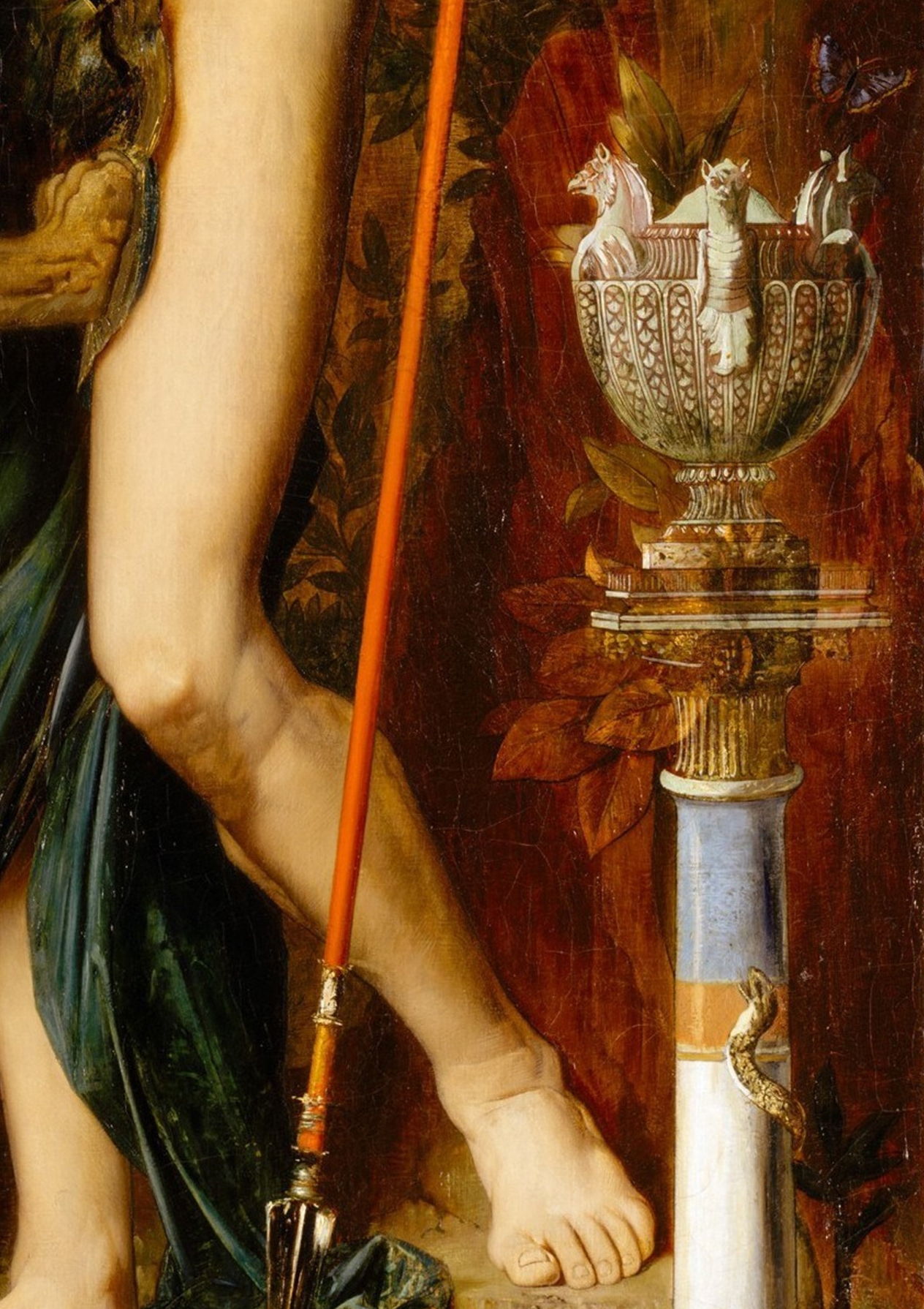
Gustave Moreau (1826–1898), Oedipus and the Sphinx (detail) (1864), oil on canvas, 206.4 x 104.8 cm, The Metropolitan Museum of Art (Bequest of William H. Herriman, 1920), New York, NY. Courtesy of The Metropolitan Museum of Art, via Wikimedia Commons.

Around this central narrative core, Moreau feeds us symbolic morsels to supplement that main course without supplanting it. Behind Oedipus is a bay tree, sacred to Apollo, representing man’s highest achievements; behind the sphinx is a fig tree, a traditional symbol of sin. The small polychrome column at the right is topped by a cinerary urn, symbolising death, and above it is a butterfly, representing the soul. Ascending the column is a snake, again associated with death, and through the biblical serpent, with sin.

Moreau’s bold move worked, as Oedipus and the Sphinx took the Salon of 1864 by storm, winning him a medal. The following year, he tried to consolidate that success with Jason.
moreaujason
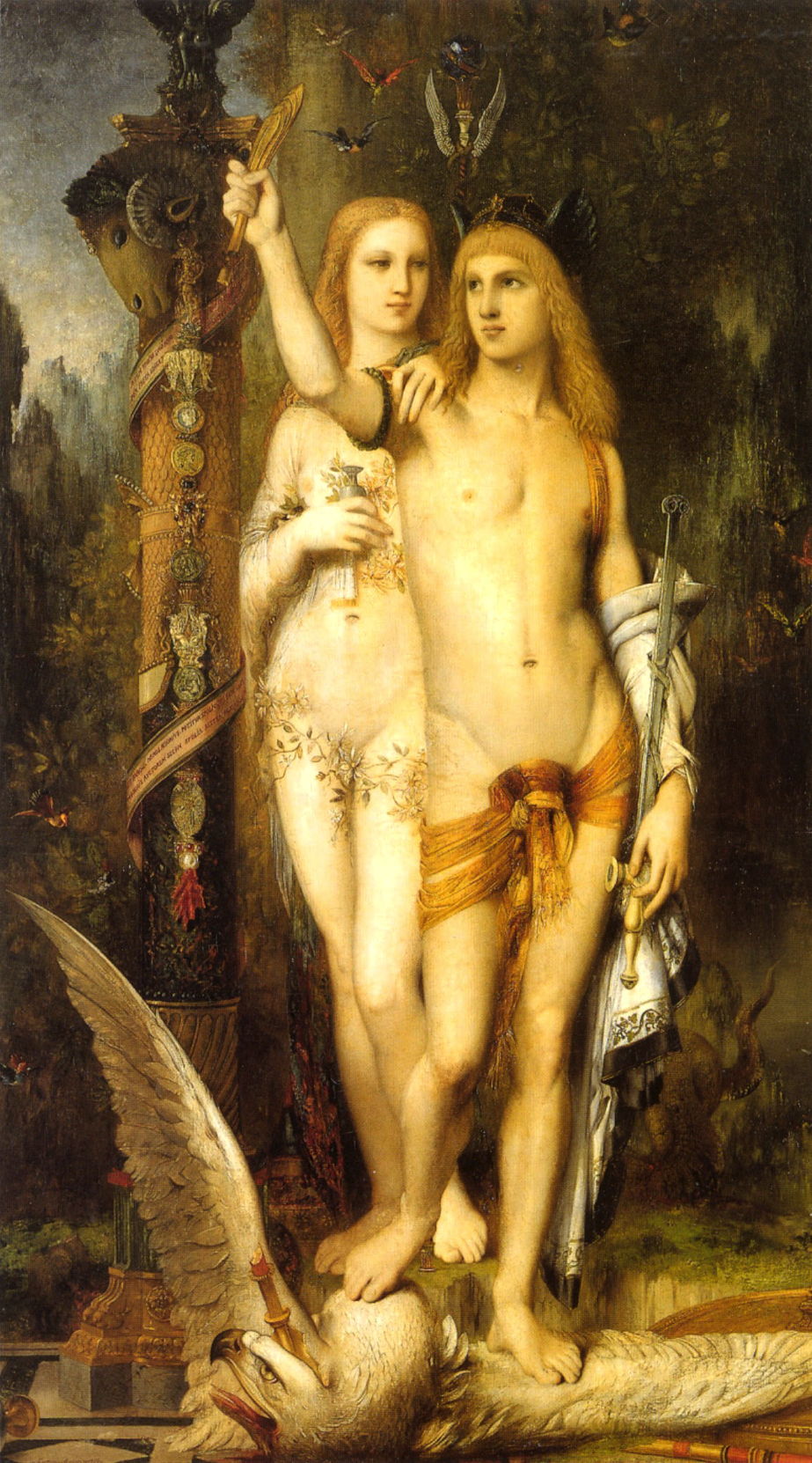
Gustave Moreau (1826–1898), Jason (1865), oil on canvas, 204 × 115 cm, Musée d’Orsay, Paris. Wikimedia Commons.

The name Jason refers, of course, to Jason of Golden Fleece and Argonauts fame, a series of swashbuckling adventures offering ample opportunities for theatrical narrative painting. Moreau avoids them all, and shows us a static Jason, with Medea stood behind him, not a Golden Fleece in sight. Instead of providing narrative, the artist offers us symbols as clues to what might be going on.

The broad outline of Jason’s story is simple. When he reached Colchis, he underwent a series of trials imposed by King Aeëtes, culminating in his victory over the dragon guarding the Golden Fleece. These were accomplished with the help of Medea, the King’s daughter, in return for a promise of marriage.

The almost naked woman behind Jason is Medea, the sorceress who has fallen in love with the hero. The ram’s head at the top of the pillar on the left signifies the Golden Fleece, and the dragon which guarded it is shown as the eagle on which Jason is standing, with the broken tip of his javelin embedded in it. This is the more confusing, as in the original story the dragon was put to sleep by one of Medea’s potions, rather than being killed with a javelin.

Yet Medea holds a vial in her right hand, and her body is swathed with the poisonous hellebore plant, a standard tool of witchcraft. These may allude to Jason’s future rejection of Medea and her poisoning of his replacement bride, but there is a lot of story between this moment and that later episode, so that is speculative and hardly clarified by the painting.

Moreau provided some clues to his intentions in this painting, in the almost illegible inscriptions on the two phylacteries wound around the column. These bear the Latin:
nempe tenens quod amo gremioque in Iasonis haerens
per freta longa ferar; nihil illum amplexa timebo

(Nay, holding that which I love, and resting in Jason’s arms, I shall travel over the long reaches of the sea; in his safe embrace I will fear nothing)
et auro heros Aesonius potitur spolioque superbus
muneris auctorem secum spolia altera portans

(And the heroic son of Aeson [i.e. Jason] gained the Golden Fleece. Proud of this spoil and bearing with him the giver of his prize, another spoil)
(Cooke, pp 55-56.)

These could be interpreted as suggesting that the painting should be read in terms of the conflict between Jason and Medea: Medea expresses her subjugate trust in him, while Jason considers her to be just another spoil won alongside the Golden Fleece. More puzzling is the spattering of other details, of hummingbirds, the sphinx on top of the pillar, medals decorating the shaft of that pillar, and more. Some appear merely to be decorative, but drawing the line between the decorative and the symbolic is impossible.

The end result in Jason is almost the opposite of Oedipus and the Sphinx: the latter consists of a clear narrative lightly embellished with symbols, the former relies on the interpretation of symbols to construct any narrative; as those symbols conflict with the original narrative, the viewer can readily become bewildered.

The 1865 Salon didn’t provide the consolidation for which Moreau had hoped, although much of that was the result of an accident of history: dominating all discussion that year was another painting, Manet’s Olympia. He needed to do better in 1866 if he wasn’t going to slip back into obscurity.

moreauorpheus
Gustave Moreau (1826–1898), Orpheus (1865), oil on panel, 154 × 99.5 cm, Musée d’Orsay, Paris. Wikimedia Commons.

In Moreau’s Orpheus (1865) a sombrely-dressed Thracian woman holds Orpheus’ lyre, on which rests his head, blanched in death, as if affixed to the lyre like the head of a hunting trophy. Her eyes are closed in reverie.

One version of the legend of Orpheus’ death holds that his head and lyre were borne by the river Hebrus, which is shown in the background landscape to the right. Again, though, Moreau pursues his own adjusted version of the written narrative, as according to that account (in Ovid’s Metamorphoses, book 11), the head and lyre were washed up on the coast of Lesbos.

Orpheus adopts a unified tonality, colour, form, character, and style that could be viewed as a ‘mode’, as conceived by Nicolas Poussin. The gentle and natural beauty of the Thracian woman, her ornate clothes, flowers, and the strange beauty of Orpheus’ head on the lyre contrast with a harsh and barren landscape, which might have been more appropriate in a Renaissance painting, perhaps by Leonardo da Vinci.

Moreau has carefully avoided elaborate symbols and decoration, although he has left us two further puzzles at the painting’s corners: the three figures, apparently shepherds, on the rocks at the upper left, and a pair of tortoises at the lower right. The figures refer to music, which seems in keeping with Orpheus and his lyre, but the significance of the tortoises is open to speculation.

moreauorpheusd1
Gustave Moreau (1826–1898), Orpheus (detail) (1865), oil on panel, 154 × 99.5 cm, Musée d’Orsay, Paris. Wikimedia Commons.

What Moreau lost in the absence of narrative, this painting gained in its remarkable tranquillity. Two faces, eyes closed, (don’t) look at one another. The intricate decoration of the lyre seems unified with the Thracian woman’s clothing, even the coiled braids of her hair. Although one of his most profoundly beautiful and moving paintings, this failed to impress the Salon.

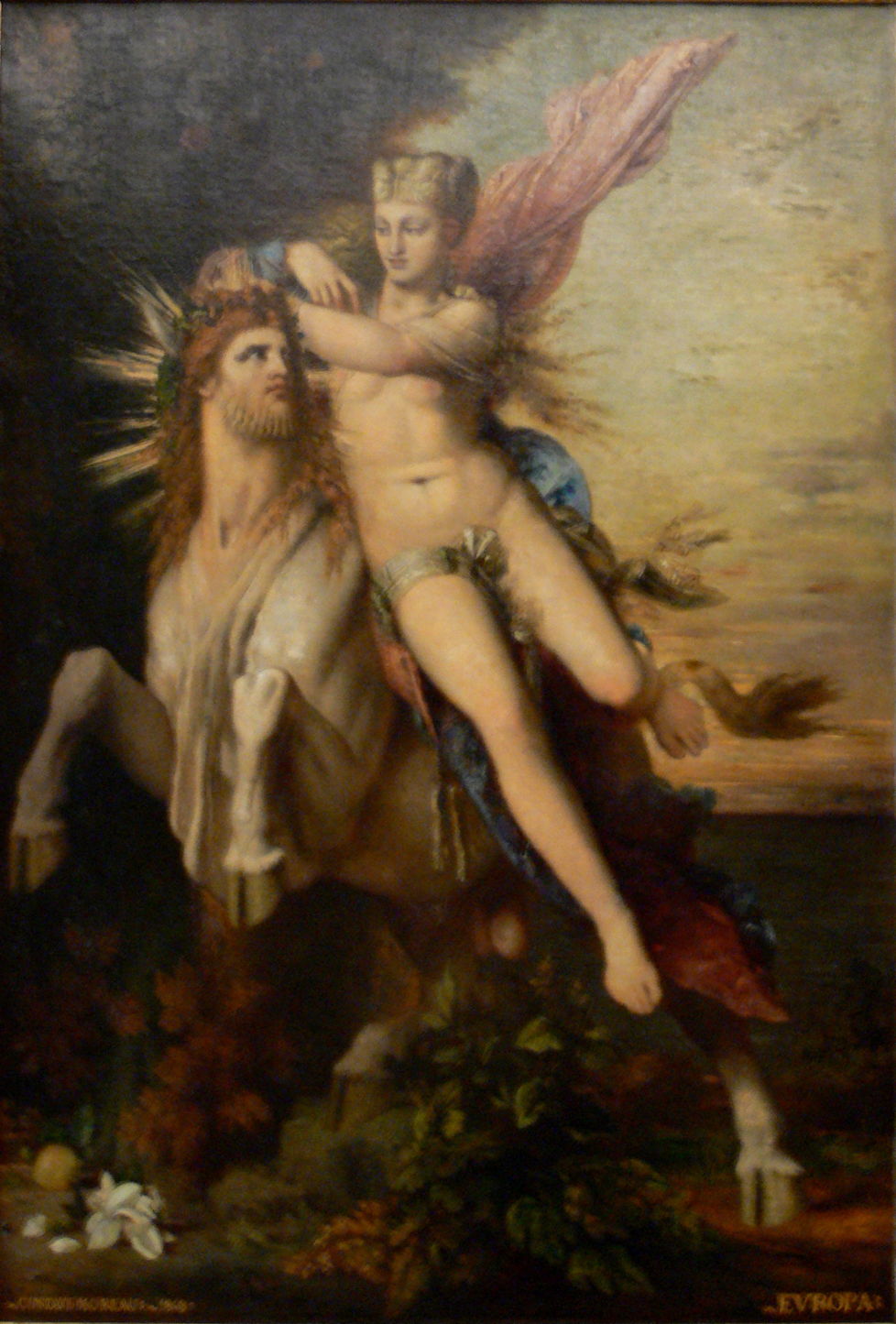
In 1868-9 he turned to one of the most frequently painted stories from Greek mythology, that of the abduction and rape of Europa. She was the mother of King Minos of Crete, and the story of Cretan origin; the bull was the main sacred animal in Crete. Zeus (Jupiter to the Romans), a notorious ravisher of women, lusted after the beautiful Europa. He therefore metamorphosed himself into a white bull, and hid among Europa’s father’s herd in Phoenicia. When Europa and other maidens came to gather flowers near this herd, she saw the white bull, caressed it, and climbed onto its back.

Zeus then ran to the sea and swam with Europa on his back until they reached the shores of Crete. There he revealed himself, and Europa became the first queen of the island. He gave her in return a necklace, Talos (a giant bronze automaton who protected Crete by circling its shores), Laelaps (an unfailing hunting dog), and a javelin that always struck its target.

Almost universally, previous depictions of this myth have shown the start of the abduction, from the pastures of Phoenicia to the bull heading off to sea. Moreau’s white bull, with Europa riding a precarious side-saddle, has just emerged from the sea, so is presumably now on the island of Crete.
moreaujupitereuropa
Gustave Moreau (1826–1898), Jupiter and Europa (1868-9), oil on canvas, 175 x 130 cm, Musée National Gustave-Moreau, Paris. Wikimedia Commons.

The finished work, known as Jupiter and Europa (1868-9) (I apologise for the lack of sharpness in this image) but titled Europa, shows the bull with a human head, presumably as Zeus has revealed himself to Europa. The head of Zeus recalls those of sculptures of Assyrian kings.

It’s hard to see what Moreau brought in terms of originality to this well-worn motif, and the critics drew comparison with Veronese rather than Titian. Either way, this seems to be a painting in search of a reason, and the Salon agreed. As there was now a small but dedicated group of collectors who were prepared to purchase his paintings, Moreau decided to withdraw from exhibiting at the annual Salon.

In the Franco-Prussian War, Moreau joined the National Guard, and served in the defence of Paris in the autumn of 1870, besieged there with his mother. Over the winter his left shoulder and arm became immobile because of ‘rheumatism’, but he remained in the city. Finally, during the Commune in the spring of 1871, he defended the paintings he had amassed in his home, and watched his late friend Chassériau’s murals in the Cour des Comptes being destroyed by fire. He spent that summer recovering in the spa at Néris-les-Bains in the Auvergne.

References

Cooke P (2014) Gustave Moreau, History Painting, Spirituality and Symbolism, Yale UP. ISBN 978 0 300 20433 9.
Mathieu P-L (1998, 2010) Gustave Moreau, the Assembler of Dreams, PocheCouleur. ISBN 978 2 867 70194 8.

Reading Visual Art: 243 Dryads and Hamadryads

Most mythologies have tree spirits, although those in Asia tend to be expressed in sculpture rather than painted images. In European art, these are most usually termed Dryads or Hamadryads, drawing from classical Greek and Roman myth.

Strictly speaking, a Dryad is the spirit of a specific oak tree, although the term is normally used more broadly for the nymph associated with any specific tree, of whatever type, or a wood nymph. A Hamadryad is a Dryad who is irreversibly bonded to and in a tree, such that the death of the tree brings about the death of the Hamadryad. The term also seems to be used for a Dryad associated with a specific species of tree, such as Balanos for the oak. However, I suspect the terms are used interchangeably in the titles of most paintings.

Paintings of classical myths were most frequent and popular during and after the Renaissance, but at that time, few if any depicted tree spirits or Dryads.

The Wood Nymph's Hymn to the Rising Sun 1845 by Francis Danby 1793-1861
Francis Danby (1793–1861), The Wood Nymph’s Hymn to the Rising Sun (1845), oil on canvas, 107.3 x 152.4 cm, The Tate Gallery (Presented by the Friends of the Tate Gallery 1969), London. © The Tate Gallery and Photographic Rights © Tate (2016), CC-BY-NC-ND 3.0 (Unported), http://www.tate.org.uk/art/artworks/danby-the-wood-nymphs-hymn-to-the-rising-sun-t01132

They became more popular in the nineteenth century, in association with the growing interest in ‘faerie’ paintings and the like. Francis Danby, a contemporary of JWM Turner, painted this magnificent view of The Wood Nymph’s Hymn to the Rising Sun (1845), in which the Dryads are all but invisible, I think.

binhamadryad
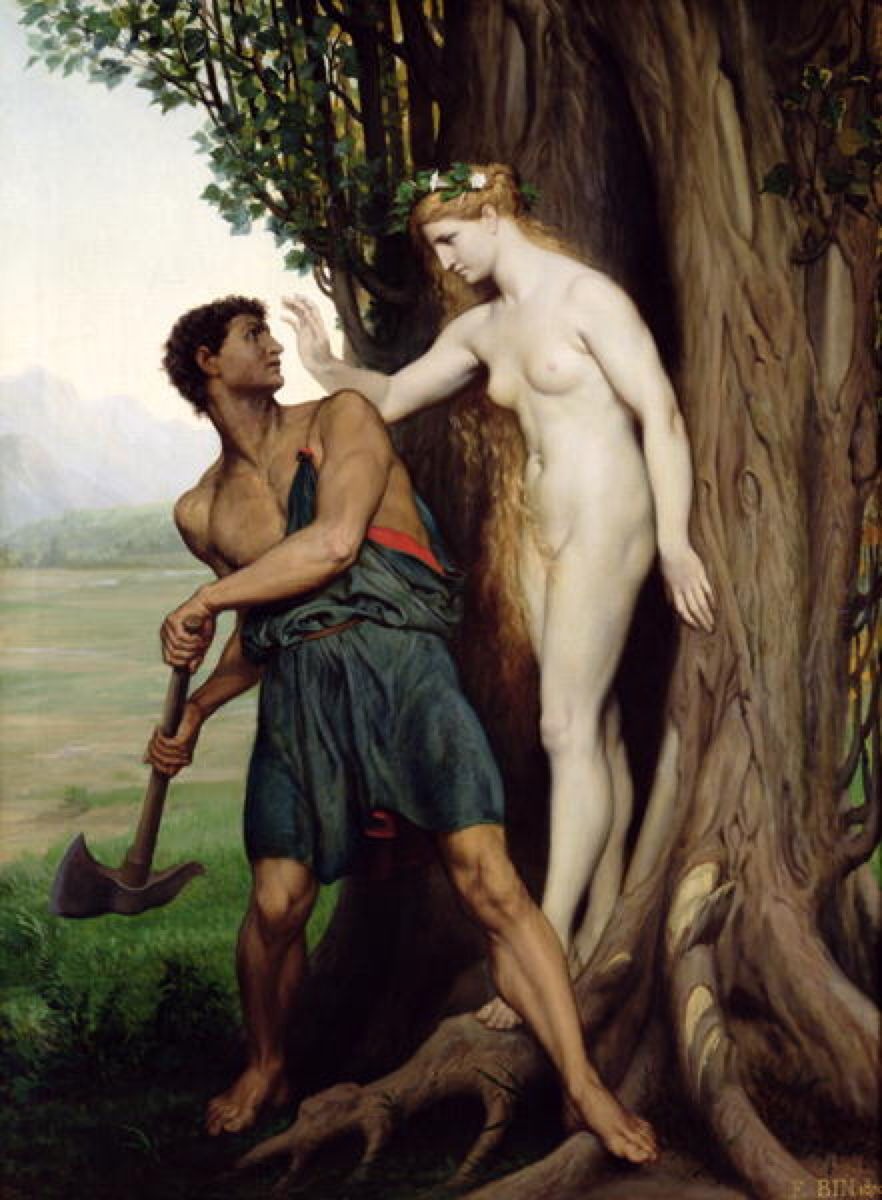
Émile Bin (1825–1897), The Hamadryad (1870), oil on canvas, Musée Thomas-Henry, Cherbourg-Octeville, France. Wikimedia Commons.

Their first clear expression seems to have been in Émile Bin’s The Hamadryad in 1870. Being nymphs, of course, they must be shown nude. When I first saw this painting, I thought it was a depiction of Erysichthon chopping down Ceres’ sacred oak, from Book 8 of Ovid’s Metamorphoses. However, the man is far too young to have an adult daughter, and this tree doesn’t appear to be an oak, nor is it in a sacred grove.

demorgandryad
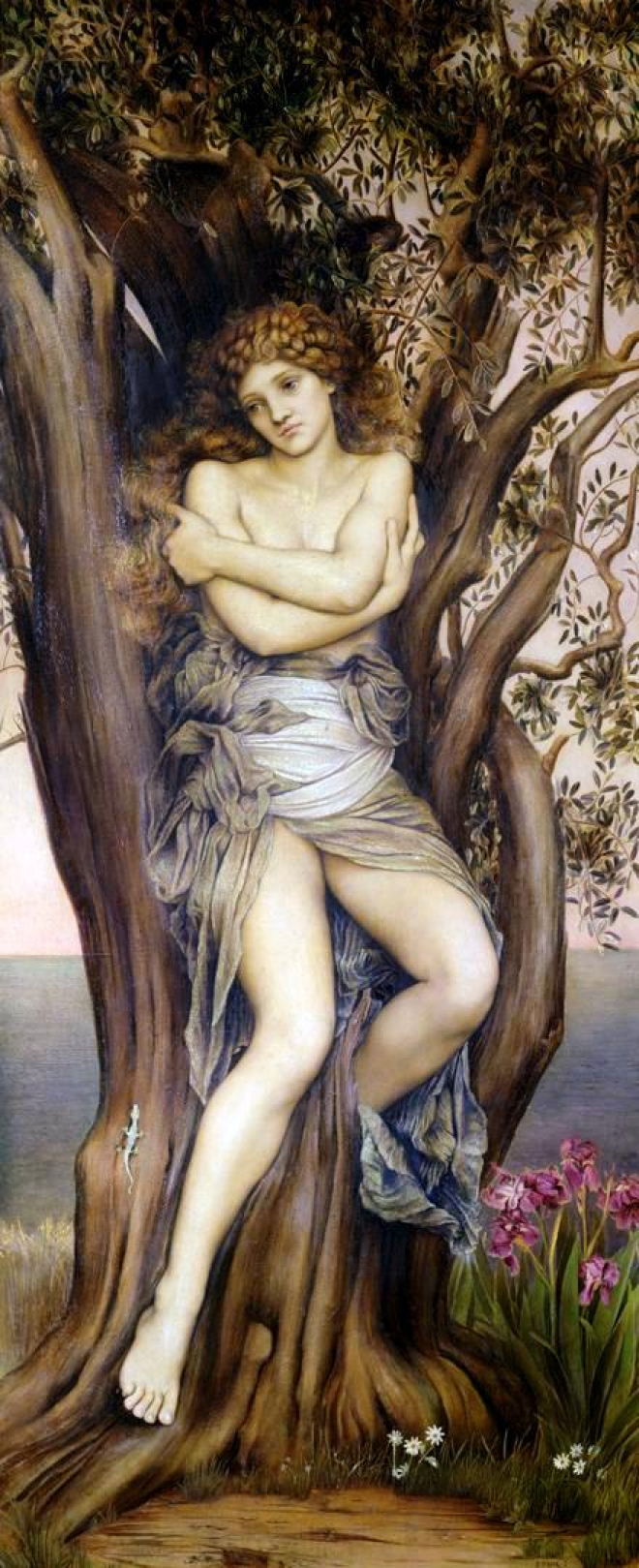
Evelyn De Morgan (1855–1919), The Dryad (1884-85), oil on panel, 107.8 × 43.8 cm, The De Morgan Centre, London. Wikimedia Commons.

Evelyn De Morgan’s The Dryad (1884-85) looks worryingly sad and lonely as she stares into the distance from within the trunk of her ancient ash. There are delightful details too: the flowers at the foot of the tree, a cat and a bird in its branches, and a pale lizard beside the Dryad’s right leg.

ropshamadryad
Félicien Rops (1833-1898), Hamadryad (c 1885), gouache, watercolour, ink wash, crayon, pen and ink, grattage, dimensions not known, Montreal Museum of Fine Arts, Montreal, Canada. Image by Daderot, via Wikimedia Commons.

Even the renegade and often sacrilegious Félicien Rops seems to have taken his Hamadryad (c 1885) quite seriously. But, as usual with Rops, nothing is quite as straightforward as it seems.

The nude woman is seen embracing the trunk of a tree, and is definitely not a part of it. In her left arm, she holds a blue cape, and scattered around the foot of the tree are white garments or pieces of fabric. There’s a green furled umbrella on the ground, with a woman’s hat on top. Around the base of the tree, and decorating the woman’s hair, are scarlet flowers. Rops has written at the top of the sheet about ‘Le Grand Pan’ singing, and at the lower left about travels to the countries of the ‘vieux dieux’, or old gods. Perhaps the woman has come to visit her lover the Hamadryad, and has undressed ready to make love?

cranenyadsdryads
Walter Crane (1845–1915), Nyads and Dryads (date not known), watercolour on paper, 23.5 × 16.5 cm, location not known. Wikimedia Commons.

Walter Crane’s more illustrative watercolour of Nyads and Dryads, probably painted between 1880-1900, is less enigmatic. He melds the Dryads in with their trees, puts the Naiads or water nymphs in the water, and has a river god watch from the reeds in the distance.

guaylastdryad
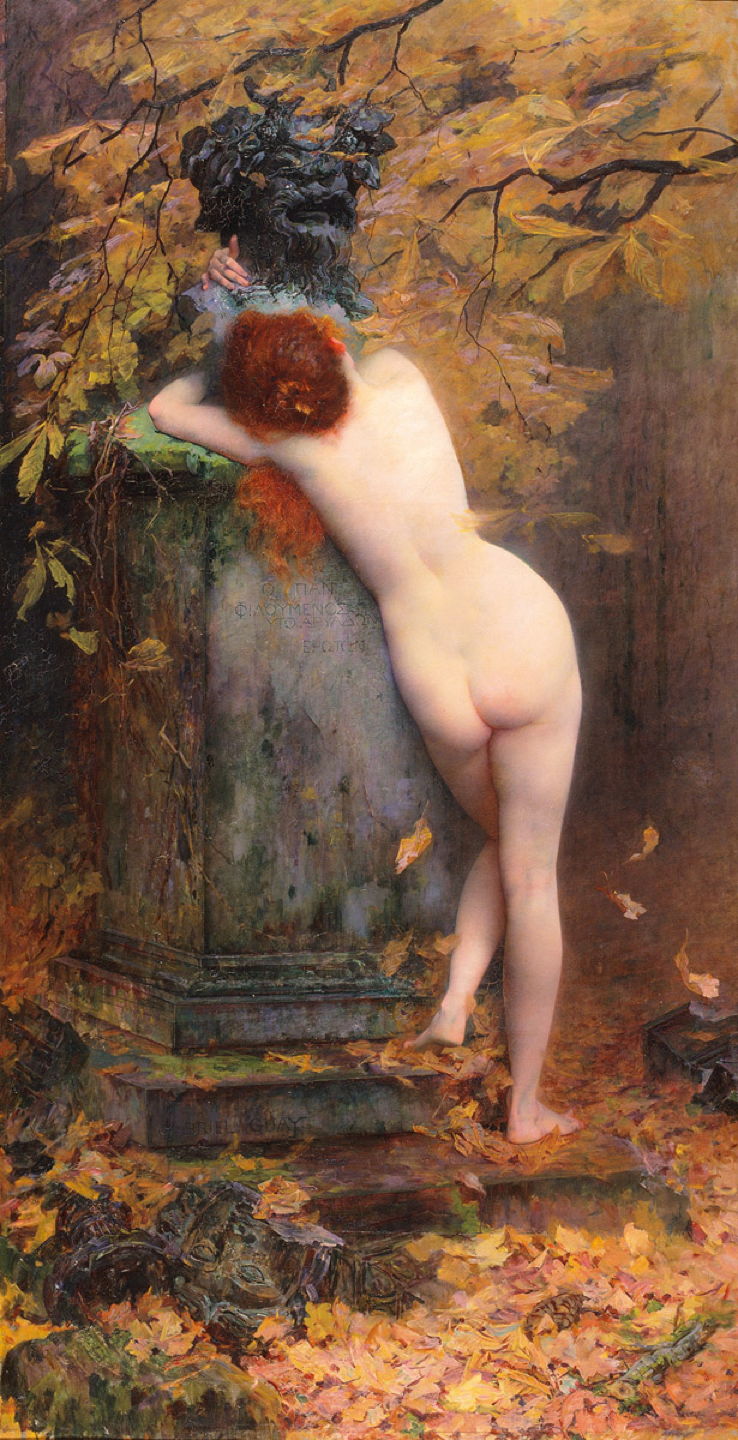
Gabriel Guay (1848–1923) The Last Dryad (date not known), oil on canvas, 272 x 136 cm, Musée des Augustins de Toulouse, Toulouse, France. Wikimedia Commons.

Painted at about the same time, Gabriel Guay’s autumnal vision of The Last Dryad has her embracing a herm or term (a bust of a god on a rectangular pillar). Her deep copper hair matches the paler yellows and browns of the leaves falling around her.

waterhousehamadryad
John William Waterhouse (1849–1917), Hamadryad (1893-95), oil on canvas, 158 × 59.5 cm, Plymouth City Museum and Art Gallery, Plymouth, England. Wikimedia Commons.

John William Waterhouse’s Hamadryad from 1893-95 is watching a young faun, perhaps Pan himself, playing reed pipes. At his feet is a thyrsus tipped with a pine cone, referring to Maenads or Bacchantes.

stockdryad
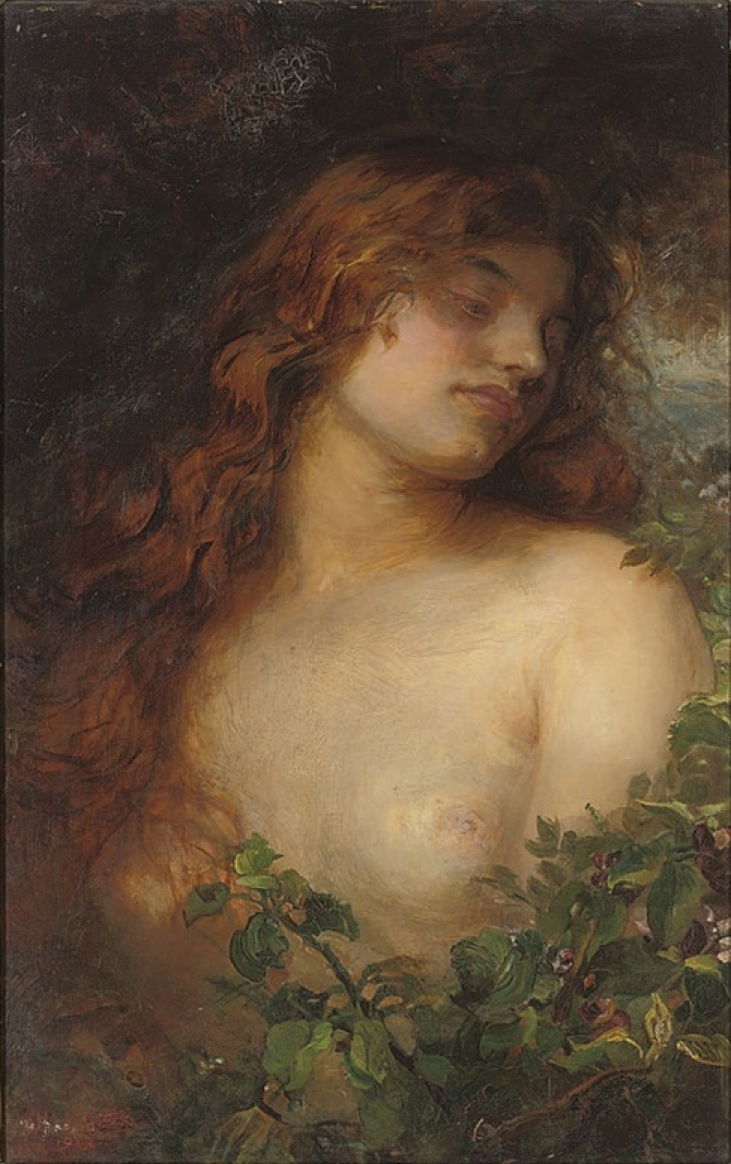
Henry John Stock (1853–1930), The Dryad (1913), oil on canvas, 62.3 × 39.4 cm, location not known. Wikimedia Commons.

Henry John Stock’s painterly portrait of The Dryad from 1913 skilfully blends her hair and torso with the tree. Almost forgotten today, Stock trained in the Royal Academy Schools in London, and made a living painting portraits. However, he also had a leaning towards painting more imaginative and narrative works, influenced by William Blake and George Frederic Watts. Stock’s paintings are starting to become popular again, and now fetch substantial prices at auction.

The other great tradition of visual art which features tree spirits as motifs is Japanese painting.

ogatagekkoihonhanazue
Ogata Gekkō (1859–1920), Nihon hana zue (1896), pigments on mulberry paper, 36 × 24 cm, Walters Art Museum, Baltimore, MD. Wikimedia Commons.

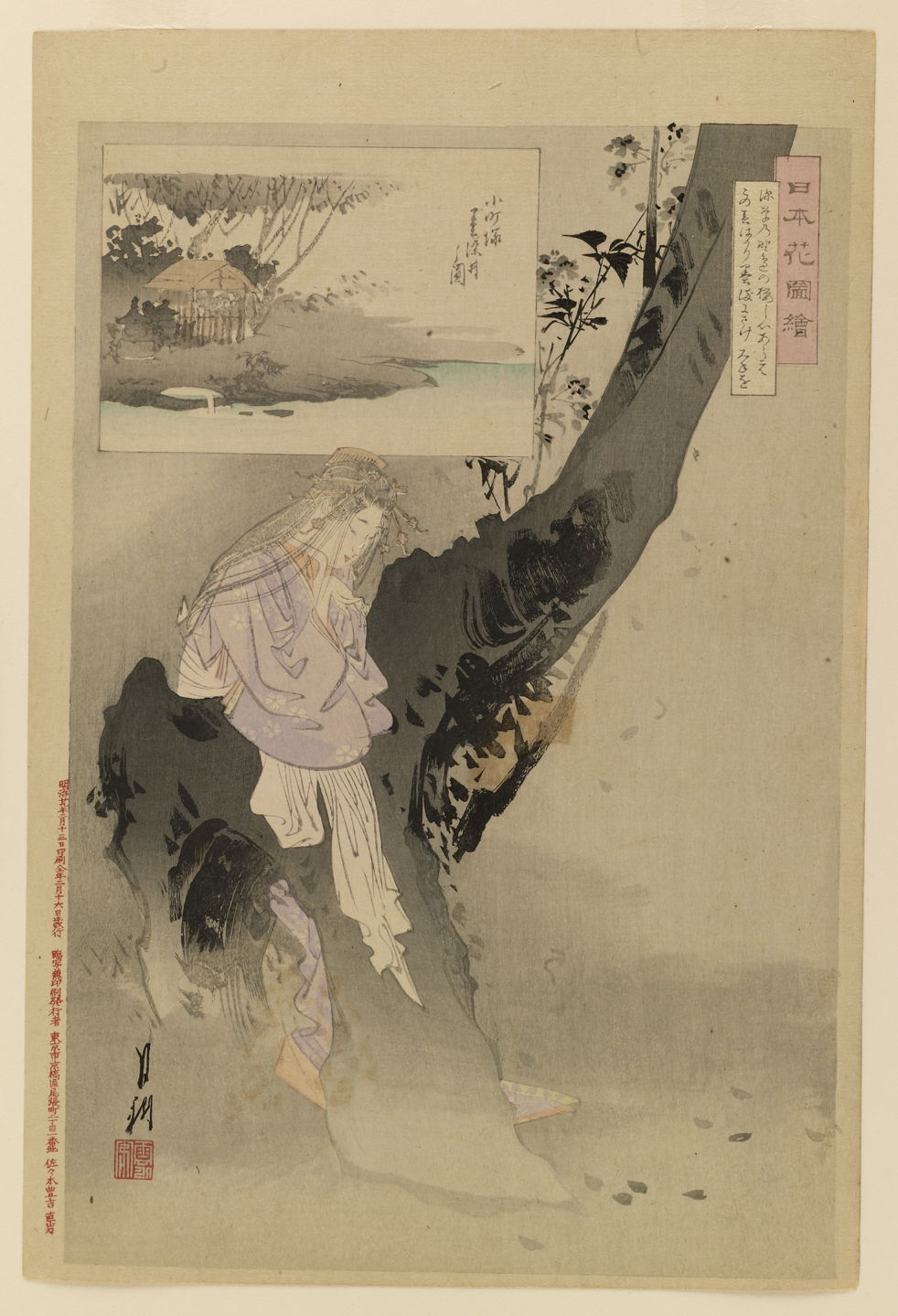
Ogata Gekkō painted his Nihon hana zue (which may just mean In Japan!) in 1896, using pigments on mulberry paper, and this was apparently published by Sasaki Toyokichi. The painting refers to a play Love Story at the Snow-covered Barrier, with a story similar to that of Erysichthon in Ceres’ sacred grove. Its villain wants to cut down a huge black cherry tree in full blossom. Just as he is about to swing his axe, the spirit of the tree appears as a courtesan, and freezes the villain’s hands. The spirit of the tree then overcomes him, and the tree is left unscathed.

I would have loved to show paintings of tree spirits from other mythologies. One I find particularly interesting is the Gille Dubh or Ghillie Dhu of Scottish (Gaelic) mythology, who is a solitary male faerie devoted to children. In addition to stories about him in the birch woods near Gairloch, in the Highlands, his name has become associated with the camouflage suit worn by military snipers, known as a Ghillie Suit. These were originally developed by Scottish gamekeepers for camouflage when hunting, and were then used by the Lovat Scouts, a Highland regiment of the British Army, during the second Boer War.

Painting the spirits of water: Ondines and their curse

Not content with Naiads and other water nymphs, the alchemist and proto-scientist Paracelsus (1493-1541) invented his own elemental beings associated with water, Undines or Ondines. He also elaborated their nature: although they cunningly resemble beautiful young women, they aren’t human, so lack a soul. The only way they can enjoy an afterlife is thus to marry a human.

Although that might appear a beguiling option for both, any man who is unfaithful to their Ondine wife will die as a result. The children of a union between a man and an Ondine are humans, having a soul, but also have a trait linked to water, known as a watermark. This might be some anatomical abnormality that periodically has to be bathed in water, for example.

By the nineteenth century, this amalgam of classical Naiads and alchemical elements was becoming popular in artistic creation. In 1842, the year after his death from tuberculosis, Aloysius Bertrand’s (1807-1841) collection of prose poems Gaspard de la Nuit was published, featuring the poem Ondine. The collection inspired Maurice Ravel’s brilliant piano suite of the same name, of which the first piece is the ferociously difficult Ondine.

Undine, a novella by Friedrich de la Motte Fouqué (1777-1843), was published in 1811, and has since influenced a slightly different tradition. It gave rise to Hans Christian Andersen’s story of The Little Mermaid in 1837, which became extremely popular throughout Europe and North America.

maclisesceneundine
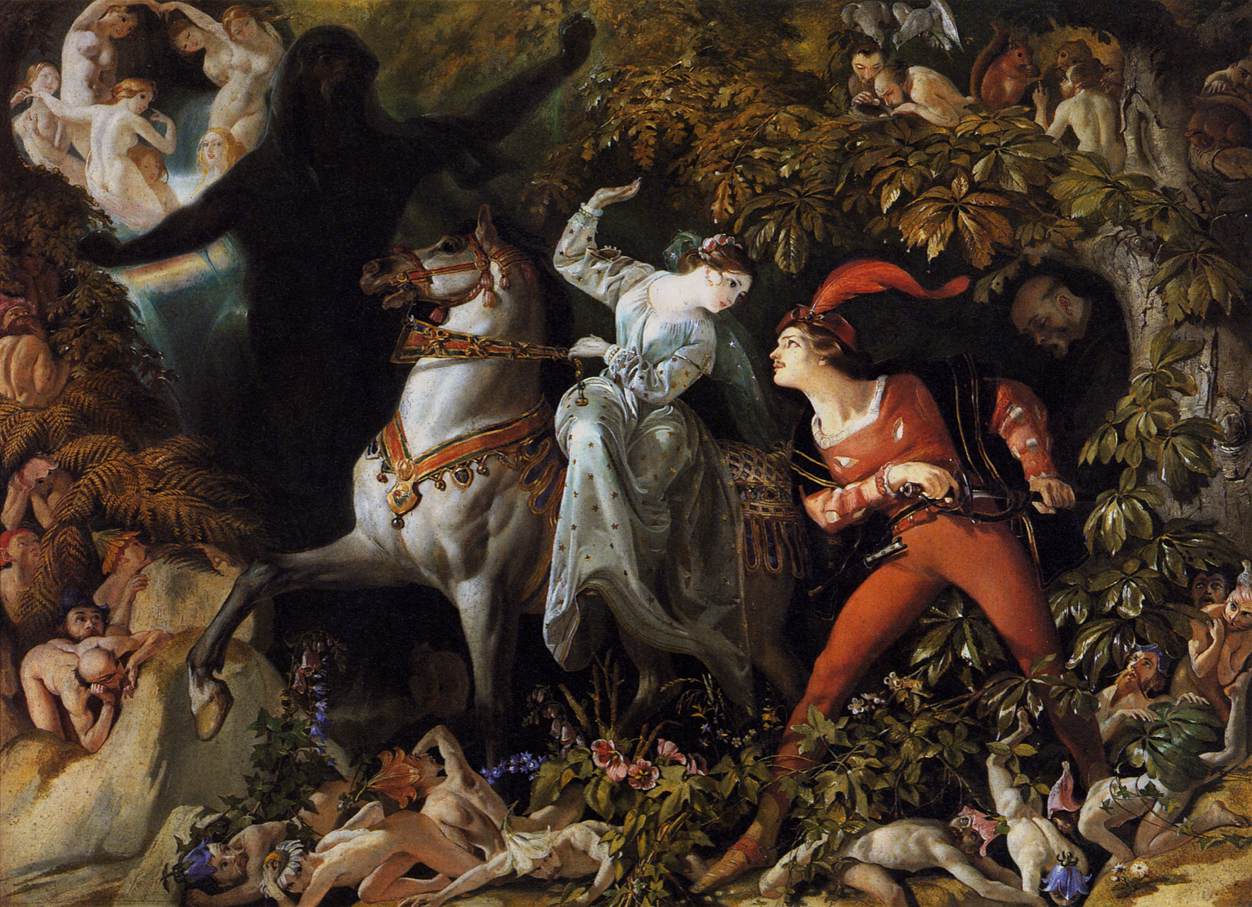
Daniel Maclise (1806–1870), A Scene from ‘Undine’ (1843), oil on canvas, 45 x 61 cm, The Royal Collection at Windsor Castle, Windsor, England. Wikimedia Commons.

In the 1840s, versions of Fouqué’s story had made their way to London in the form of a play. One of the first artists to commit this to canvas was the great ‘faerie painter’ Daniel Maclise, in his 1843 depiction of A Scene from ‘Undine’. Although there are other Undines frolicking in the water at the upper left, Maclise concentrates on the romance between Undine and the man who is to give her a soul, in exchange for his lifelong fidelity.

turnerundinegivingring
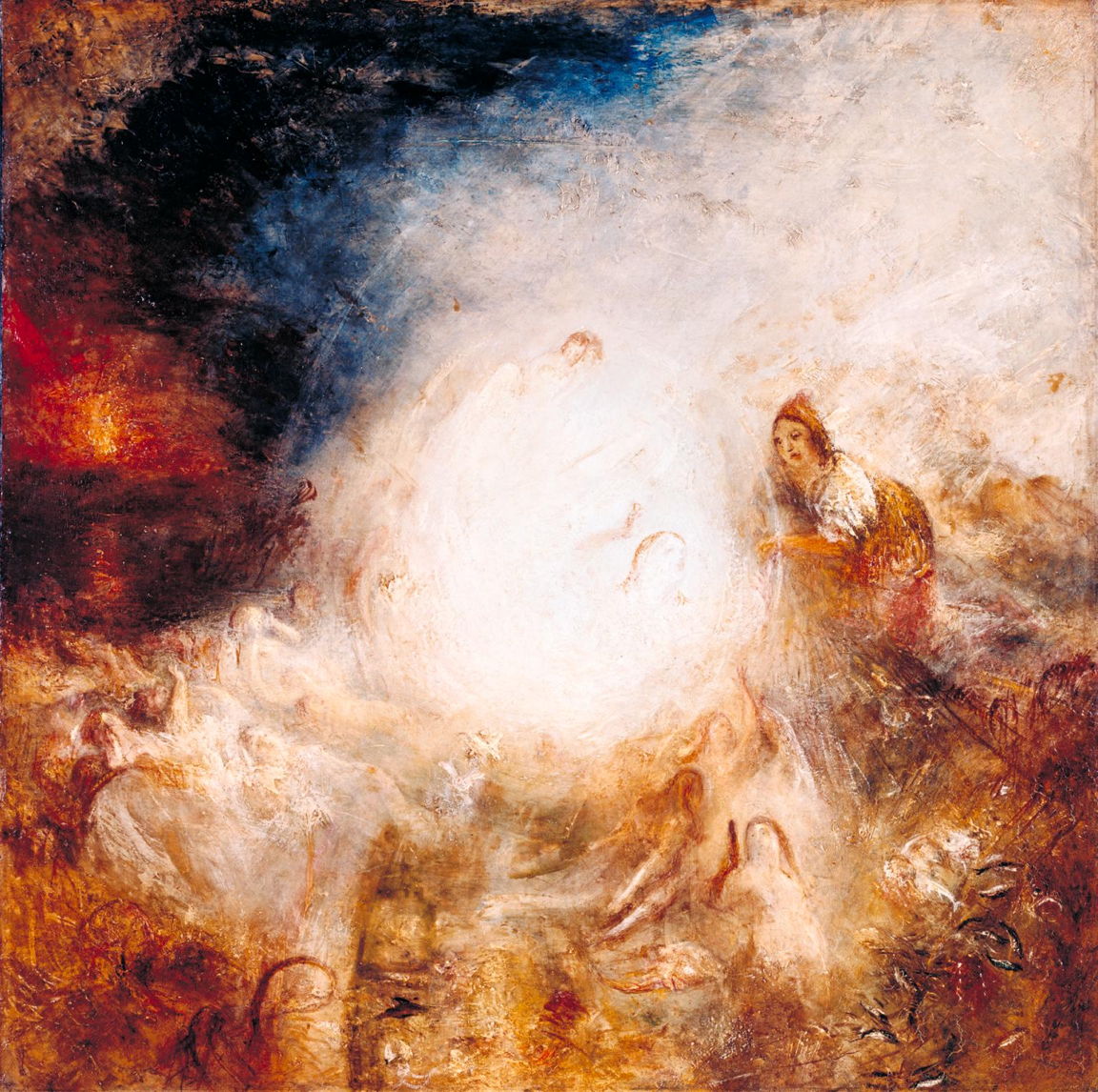
Joseph Mallord William Turner (1775–1851), Undine Giving the Ring to Massaniello, Fisherman of Naples (1846), oil on canvas, 79.1 x 79.1 cm, The Tate Gallery (part of the Turner Bequest 1856), London. © The Tate Gallery and Photographic Rights © Tate (2016), CC-BY-NC-ND 3.0 (Unported), https://www.tate.org.uk/art/artworks/turner-undine-giving-the-ring-to-massaniello-fisherman-of-naples-n00549

JMW Turner appears to have seen a similar stage production that inspired his Undine Giving the Ring to Massaniello, Fisherman of Naples of 1846. This is one of a pair of his paintings in which spiritual power and transformation are represented by brilliant light; the other, The Angel standing in the Sun, is a vision of the Last Judgement. Turner apparently shows Undine offering a wedding ring to a fisherman, although much of its detail has now been lost in the dazzling light. Around are other Undines in the waves.

waterhouseundine
John William Waterhouse (1849–1917), Undine (1872), oil on canvas, dimensions not known, Private collection. Wikimedia Commons.

Perhaps living up to his name, John William Waterhouse painted Undine in 1872, arising from a fountain, and modestly dressed. This was twenty years before he took to the nude Naiads of Hylas, shown in yesterday’s article.

lefebvreondine
Jules Lefebvre (1834–1912), Ondine (1882), oil on canvas, 151 x 92.5 cm, Szépművészeti Múzeum, Budapest, Hungary. Wikimedia Commons.

Jules Lefebvre had no qualms with turning his Ondine of 1882 into yet another classical nude, although her brilliant red hair is an unusual touch.

gauguinondine
Paul Gauguin (1848–1903), In the Waves, or Ondine (I) (1889), oil on canvas, 92.5 x 72.4 cm, Cleveland Museum of Art, Cleveland, OH. Wikimedia Commons.

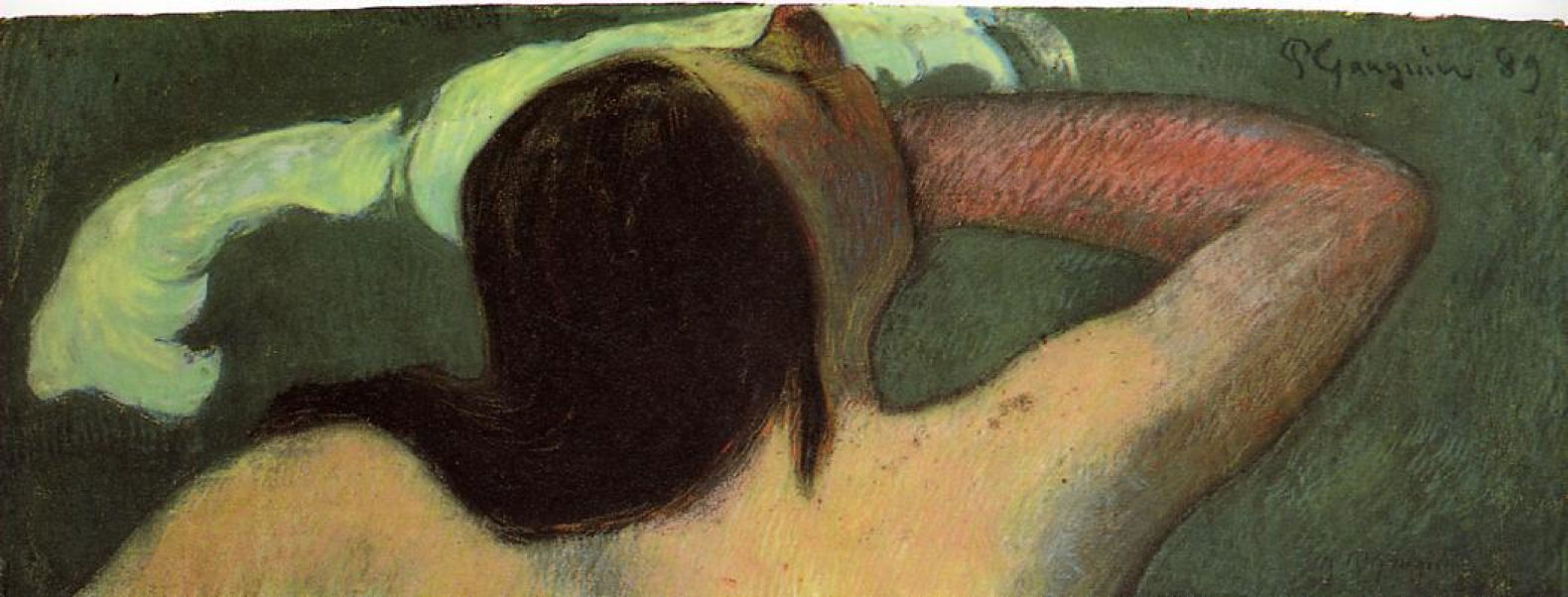
In 1889, Paul Gauguin painted two works in which Ondine is shown among waves in the seas. The first, known now as In the Waves, or Ondine (I) (above), appears the more complete. Ondine II, in pastel and gouache (below), seems likely to have been a study, and its lower edge appears to have been cut or cropped out. He may well have seen Lefebvre’s painting, as the fuller version also features red hair.

gauguinondineii
Paul Gauguin (1848–1903), Ondine II (1889), pastel and gouache on paper mounted on panel, 18 x 48.2 cm, Private collection. Wikimedia Commons.
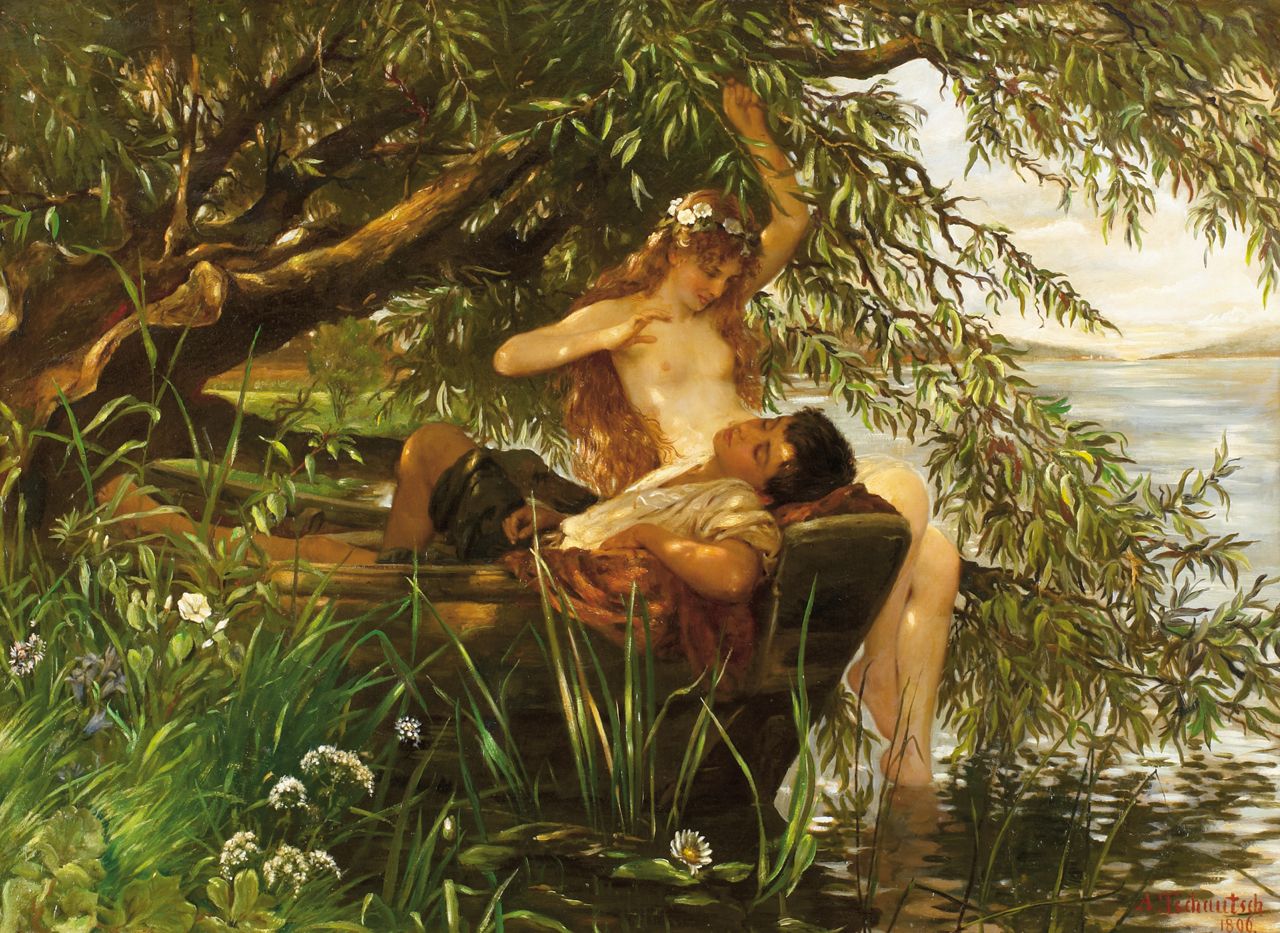
tschautschenchantment
Albert Tschautsch (1843–1922), Enchantment (1896), oil on canvas, 96 x 134 cm, location not known. Wikimedia Commons.

With interest growing in the femme fatale, Ondine was revamped into a figure like Medea, who cast a spell on her husband. Albert Tschautsch’s Enchantment from 1896 is an example of this changing image.

wilhelmsonundine
Carl Wilhelmson (1866–1928), Undine (1899), oil on canvas, 39 x 46.5 cm, Göteborgs konstmuseum, Gothenburg, Sweden. Wikimedia Commons.

Carl Wilhelmson is one of the few who has succeeded in making Undine (1899) appear not quite physically there, as she shimmers among red tulips.

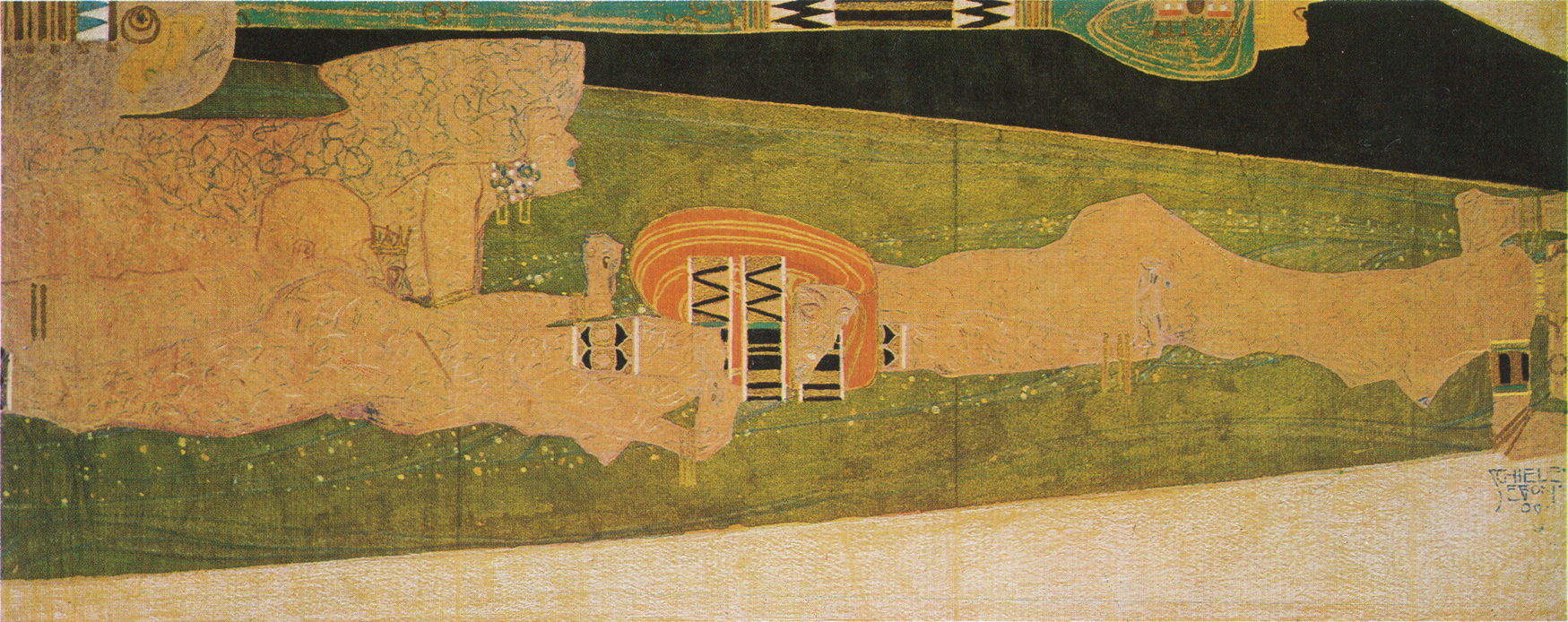
schieleondineii
Egon Schiele (1890–1918), Undine II (1908), gouache, crayons, watercolour, white and gold paint on paper, 20.7 x 50.6 cm, Private collection. Wikimedia Commons.

Egon Schiele’s Undine II of 1908 was made in truly mixed media, including gouache, crayons, watercolour, white and gold paints, and a dash of Cubism too, it would appear. Although notoriously hard to read, I can see Undine at the upper left, propped up on her elbows. Nearer to the viewer is a bald-headed man, and there are other presumably female figures laid across the centre of the paper.

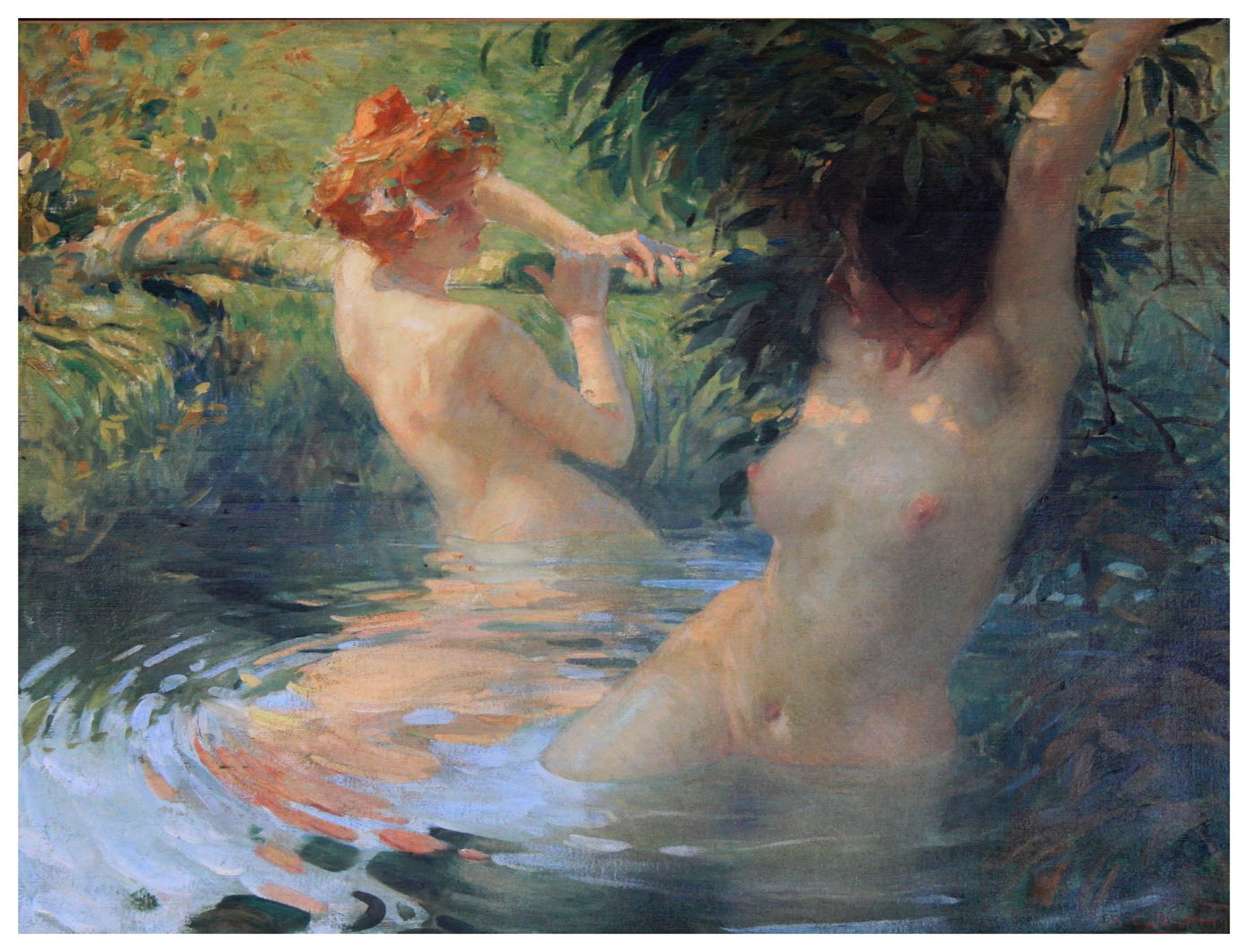
calbetondines
Antoine Calbet (1860–1942), Ondines (date not known), oil on canvas, 80.6 x 100.3 cm, Musée de Cambrai, Cambrai, France. Wikimedia Commons.

My final selection is an undated work from around the turn of the 19th-20th centuries by Antoine Calbet: Ondines, showing two nymphs in a rippled pool of water. One has red hair, which may refer to Gauguin’s version. His style is reminiscent of the great Swedish figurative painter Anders Zorn.

In 1939, Jean Giradoux based his play Ondine on Fouqué’s novella of 1811, and that has in turn been performed in a ballet by Hans Werner Henze (music) and Frederick Ashton (choreography). Ondine there tells her future husband Hans that she will be the breath of his lungs. After they are married, Hans reunites with his first love Bertha; when Hans later marries Bertha, he has to make a conscious effort to breathe. Ondine then kisses Hans, causing him to stop breathing and die, a femme fatale indeed.

There is a rare medical condition in which the automatic control of breathing fails, putting the patient at risk of stopping breathing when they fall asleep. This is known as congenital central hypoventilation syndrome, or Ondine’s curse. I’m confident that neither Paracelsus nor Giradoux had ever come across this condition, but their concepts and words proved extraordinarily prescient.

Painting the spirits of water: gods and Naiads

Narrative painting of classical myths has many conventions that can appear confusing. This weekend I look at those associated with river gods and their associated nymphs Naiads, and tomorrow more recent relatives Ondines.

In Greek, and subsequently Roman, mythology, the river gods or Potamoi (Greek for rivers) are three thousand sons of Oceanus, the great river encircling the earth, and Tethys, his Titan sister and wife. A river god is both that river and a distinct deity: Achelous is the god of the River Achelous, the largest in Greece, who wrestled unsuccessfully with Hercules for the right to marry Deianira.

Associated with sources and bodies of fresh water are also water nymphs, Naiads or Potamides, often stated to be the daughters of the river gods. In ancient times, there was a weaker distinction between fresh and salt waters, so although nymphs associated with the sea are usually termed Nereids when in Mediterranean waters, or Oceanids, Naiads can also be encountered in what we would consider to be sea.

dititoheliades
Santi di Tito (1536–1603) The Sisters of Phaethon Transformed into Poplars (c 1570), fresco, dimensions not known, Palazzo Vecchio, Musei Civici Fiorentini, Florence. Wikimedia Commons.

The standard depiction for any river god in a classical story is that of an older bearded man lounging by a large earthenware pot from which water pours forth into the river. This is shown well in Santi di Tito’s fresco of The Sisters of Phaethon Transformed into Poplars, from about 1570. Although this story tells how the sisters of Phaeton grieve for him after his death, and are transformed into poplar trees, as it shows a river, there must still be a god of that river.

rubensromulusremus
Peter Paul Rubens (1577–1640), Romulus and Remus (1615-16), oil on canvas, 213 x 212 cm, Musei Capitolini, Rome, Italy. Wikimedia Commons.

Rubens’ delightful painting of Romulus and Remus being discovered by Faustulus, from 1615-16, shows both the river god Tiberinus and his daughter nymph, at the left with the god’s pot.

poussincephalusaurora
Nicolas Poussin (1594–1665), Cephalus and Aurora (1630), oil on canvas, 96.9 x 131.3 cm, The National Gallery, London. Wikimedia Commons.

In Nicolas Poussin’s Cephalus and Aurora from 1630, the river god is again at the left, and looks tired of the whole business, with a mere trickle of water emerging from his pot.

garzialpheusarethusa
Luigi Garzi (attr) (1638–1721), Alpheus and Arethusa (c 1690), oil on canvas, 120.7 x 171.5 cm, location not known. Wikimedia Commons.

This beautiful painting attributed to Luigi Garzi, of Alpheus and Arethusa from around 1690, shows one river god and two nymphs. The god leans on his pot, and in his left hand holds a small spade, another attribute sometimes seen with them.

coypelalpheuschasingarethusa
Antoine Coypel (1661–1722), Alpheus Chasing Arethusa (c 1710), oil on canvas, dimensions and location not known. Wikimedia Commons.

Antoine Coypel’s version of the same Ovidian myth, Alpheus Chasing Arethusa from about 1710, places the river god at the lower left, and two Naiads separately on the right.

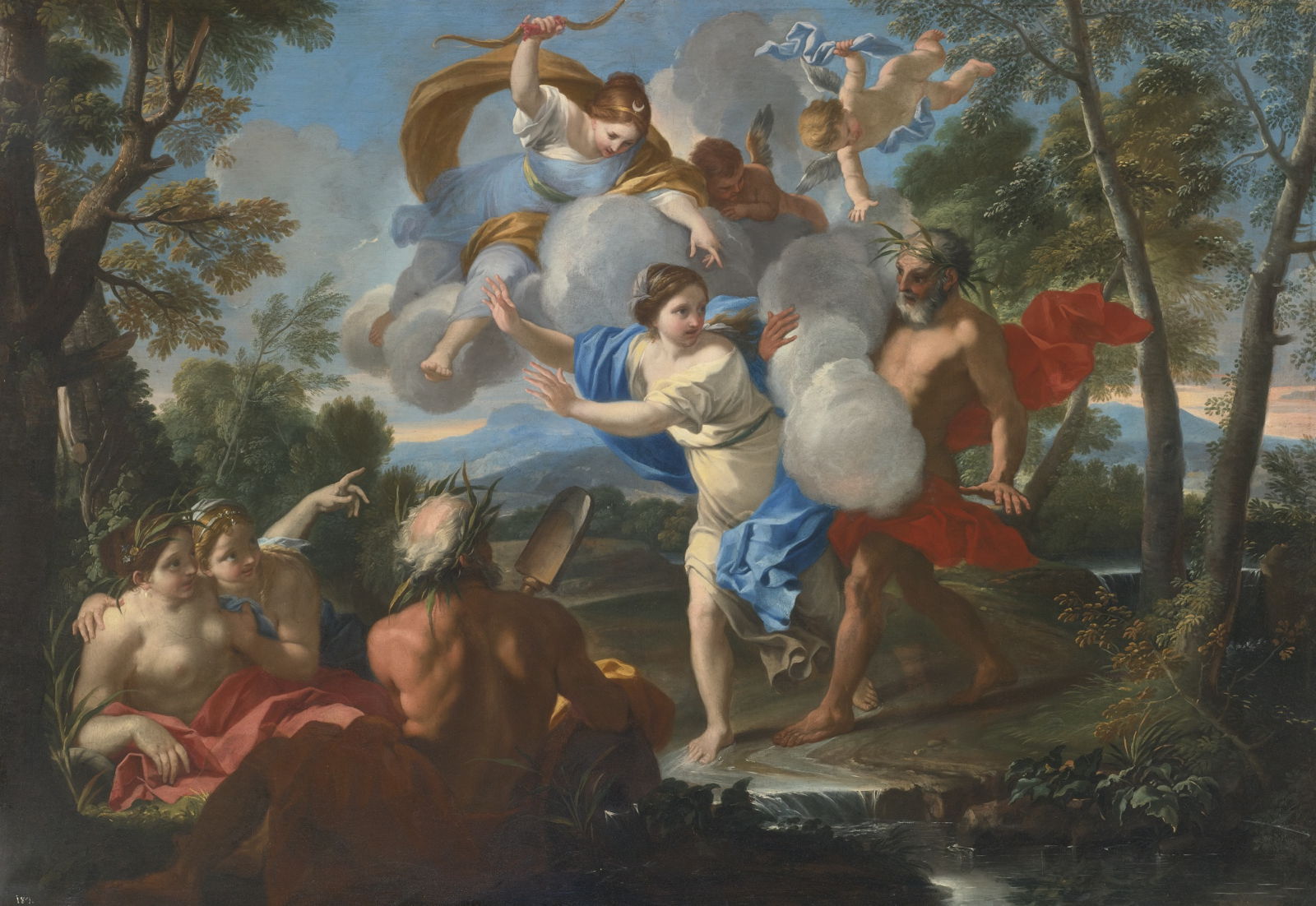
boucherpansyrinx
François Boucher (1703–1770), Pan and Syrinx (1743), oil on canvas, 101 × 133 cm, Private collection. Wikimedia Commons.

So far, the river deities have enjoyed a rather passive life in paintings, but this wasn’t a requirement. In François Boucher’s Pan and Syrinx from 1743, the nymph Syrinx is seeking the help of the river god and Naiad, as she attempts to evade Pan’s attentions. The god’s pot is almost hidden beneath luxuriant red fabric, under his right hand.

tiepoloapollodaphne
Giovanni Battista Tiepolo (1696–1770), Apollo and Daphne (c 1744-45), oil on canvas, 96 x 79 cm, Musée du Louvre, Paris. Wikimedia Commons.

In Tiepolo’s Apollo and Daphne (c 1744-45), the river god is given much of the foreground and lower section of the painting, and holds an oar or paddle, a more unusual but distinctive attribute.

mengsapollomnemosyne
Anton Raphael Mengs (1728–1779), Apollo, Mnemosyne, and the Nine Muses (1761), fresco, 313 × 580 cm, Gallery of the Villa Albani-Torlonia, Rome. Wikimedia Commons.

Sometimes, artists conceal the river god as if challenging the viewer to locate him. This is the case in Anton Raphael Mengs’ fresco of Apollo, Mnemosyne, and the Nine Muses (1761), in which the god’s bearded and hoary figure is tucked away behind Apollo’s legs. There’s also an Orphic tradition in which the River Mnemosyne is the source of water to bring inspiration, and this perhaps alludes to that obscure sub-narrative.

brenetaethrashowingtheseus
Nicolas-Guy Brenet (1728–1792), Aethra Showing her Son Theseus the Place Where his Father had Hidden his Arms (1768), oil on canvas, 50.2 × 59.7 cm, Los Angeles County Museum of Art, Los Angeles, CA. Wikimedia Commons.

In some paintings, river gods seem to be included even when their river is nowhere to be seen. Nicolas-Guy Brenet’s painting of Aethra Showing her Son Theseus the Place Where his Father had Hidden his Arms (1768) tucks this extra into the lower left corner again.

schmidtdanaides
Martin Johann Schmidt (1718–1801), The Labour of the Danaides (1785), oil on copper plate, 54.5 × 77 cm, Narodna galerija Slovenije, Ljubljana, Slovenia. Wikimedia Commons.

Martin Johann Schmidt’s Labour of the Danaides (1785) informs us that the Danaïds were also water-nymphs by placing a river god at the left. They were condemned to keep trying to fill this leaky container with water as their penance in the underworld.

cranenyadsdryads
Walter Crane (1845–1915), Nyads and Dryads (date not known), watercolour on paper, 23.5 × 16.5 cm, location not known. Wikimedia Commons.

Walter Crane shows the association between Naiads and other nymphs in his watercolour of Nyads and Dryads, probably painted between 1880-1900. He melds the Dryads in with their trees, puts the ‘Nyads’ or Naiads in the water, and has a river god watching from the reeds in the distance.

waterhousenaiad
John William Waterhouse (1849–1917), A Naiad, or Hylas with a Nymph (1893), oil on canvas, 66 x 127 cm, Private collection. Wikimedia Commons.

By the end of the nineteenth century, enthusiasm for the tradition of showing river gods was waning, and nude, cavorting Naiads came to the fore. One of their greatest exponents was John William Waterhouse, who led with this first tentative retelling of the myth of Hylas in 1893, in A Naiad, or Hylas with a Nymph.

Hylas was companion and servant to Heracles (Hercules), who accompanied the hero on Jason’s ship Argo. When the Argonauts were ashore in modern Turkey, Hylas approached the spring of Pegae, where the Naiads fell in love with and kidnapped him. He vanished without trace, leading Heracles and Polyphemus to search for him at length. They were delayed in this so long that the Argo sailed without them.

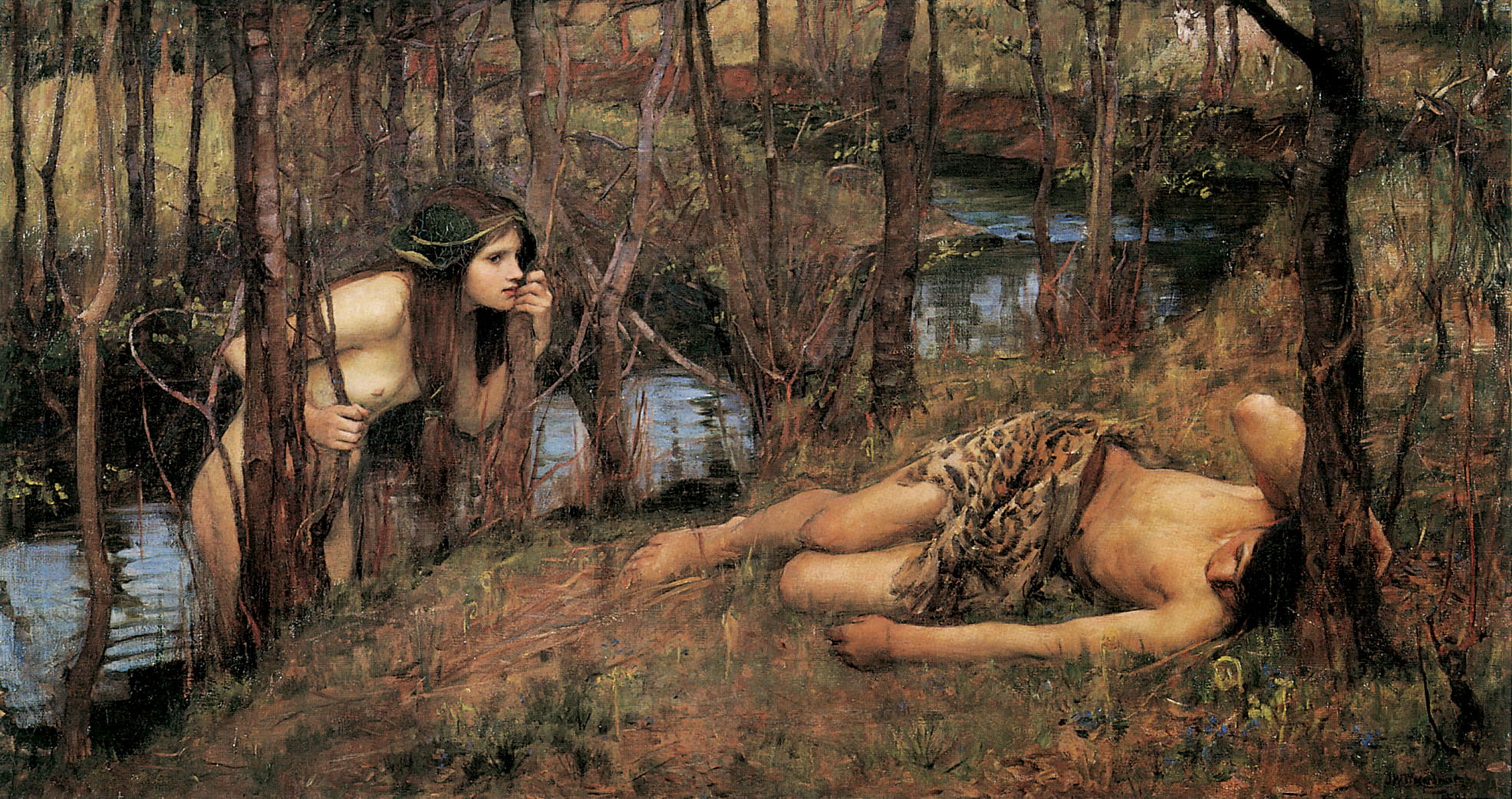
This first version shows one of the Naiads discovering the sleeping Hylas by a small river. There’s no sign of any river god, but there are some goats on the right side of the painting.

waterhousehylasnymphs
John William Waterhouse (1849–1917), Hylas and the Nymphs (1896), oil on canvas, 132.1 x 197.5 cm, Manchester Art Gallery, Manchester, England. Wikimedia Commons.

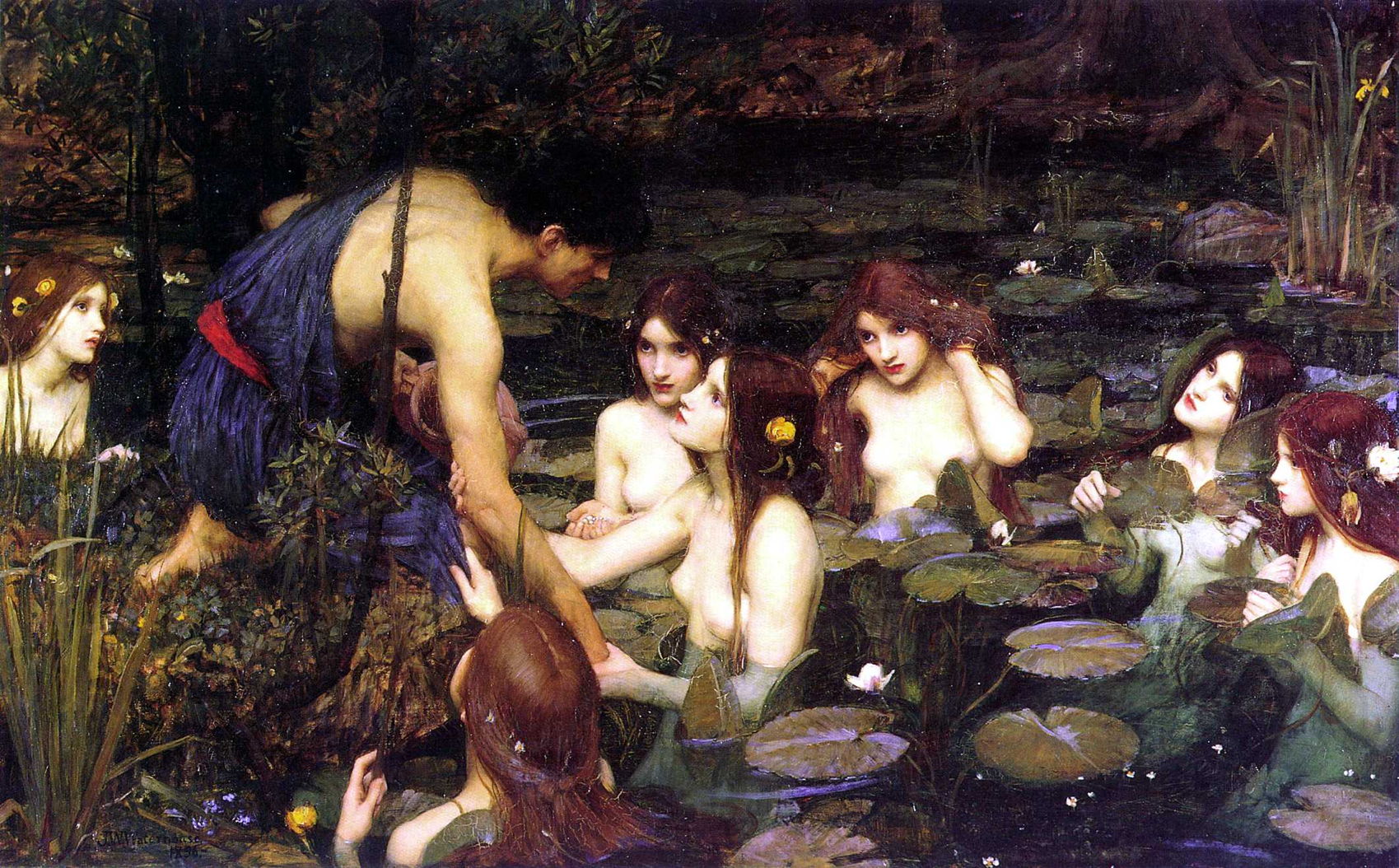
Three years later, Waterhouse’s Hylas and the Nymphs (1896) stays closer to the myth. Hylas holds an earthenware pot, almost as if he were about to become the river god.

In January 2018, this well-known painting was removed from exhibition in Manchester, England, and replaced by a notice which explained that a temporary space had been left “to prompt conversations about how we display and interpret artworks in Manchester’s public collection”. The painting soon returned after protests. It’s surprising that more than a century after it was first exhibited, it was still capable of causing such controversy.

raehylaswaternymphs
Henrietta Rae (1859–1928), Hylas and the Water Nymphs (c 1909), oil on canvas, 142.3 × 222.8 cm, Private collection. Wikimedia Commons.

Waterhouse is not the only artist to have courted controversy with this story. Henrietta Rae’s Hylas and the Water Nymphs from about 1909 was exhibited at the Royal Academy in 1910, and is no less fleshly than Waterhouse’s version. Rae was a pioneer in her painting of nudes, at a time when most of society still considered that women shouldn’t be allowed to attend classes learning to draw or paint nude models.

poyntercaveofstormnymphs
Edward Poynter (1836–1919), Cave of the Storm Nymphs (1903), oil on canvas, 145.9 × 110.4 cm, Private collection. Wikimedia Commons.

Edward Poynter’s Cave of the Storm Nymphs (1903) might appear to be still more exploitative of the male appeal of the female nude, but there’s a more complex narrative behind this scene. Its literary reference is most probably to the Naiads of Homer’s Odyssey, book 13, who live in a sea cave, updated to encompass more contemporary references to Wreckers, who lured ships onto the rocks in order to steal their precious cargos: sirens without the socially unacceptable habit of cannibalism.

❌