Reading view

There are new articles available, click to refresh the page.

中国、伊朗、俄、日《游戏视频工业》地缘政治要素 敌人英雄定位争夺战 腾讯大肆收购欧美市场 - RFI - 法国国际广播电台

01/04/2026 - 09:35

各位听众,中国腾讯在国内和国际市场上大幅增加了对电子游戏行业的收购和投资。受到玩家追捧的电子游戏从《使命召唤 (Call of Duty)》到《战地风云系列(Battlefield)》,一般他们都会根据地缘政治和市场情况调整其“反派”和英雄角色;通常是俄罗斯或中国或伊朗或日本,甚至是一些虚拟国家,因为如今市场利益为导向的视频游戏开发商,试图在不断变化的地缘政治格局中避免冒犯某些市场。 

战争题材电子游戏长期以来一直主导着全球电子游戏市场,直至如今仍是该市场的旗舰类型之一。从销量超过5亿份的《使命召唤 (Call of Duty)》系列,到全球销量达数千万份的《战地风云系列(Battlefield)》系列,这一类型具备了游戏所有成功的要素,例如:紧张刺激的节奏、好莱坞式的壮观画面,以及毫不迟疑地打出令人惊艳的大阵仗的宏伟戏剧手法。 

这些电子游戏以全球冲突为背景,从历史事件到虚构事件,再到重现的特种作战和虚构的地缘政治危机,让玩家置身于壮观的战争中心,打仗动作为首要,但也细致夹带这某些世界观以及国际权力关系的愿景。 

然而,如今最细心的玩家或许已经注意到一个重要的细节:那些扮演敌人角色的已经发生了变化。就像电影一样,电子游戏也早已有了现成的替罪羊。多年来,“苏联”或后苏联时代的俄罗斯人一直被系统性地妖魔化。例如,在《使命召唤》系列的多款游戏中,我们都能找到像扎卡耶夫 Zakhaev 或马卡洛夫 Makarov 这样的极端民族主义反派分子,像德拉戈维奇 Dragovich, 这样的苏联将军,甚至是像克拉夫琴科这样的格鲁乌军官。 

这种设定在其他系列游戏中也屡见不鲜。在《武装突袭2》中,亲俄叛军与受美国和北约支持的当地部队展开对抗。同样的逻辑也适用于该系列最著名的作品之一《战地3》,玩家将先后遭遇俄罗斯特种部队、俄罗斯狙击手,甚至还有……伊朗军队的崛起。与此同时,玩家还要与一名部署在伊拉克的美国海军陆战队员并肩作战。这种电子游戏“反派”的设定在《战地4》中得以延续,玩家在游戏中操控的英雄们的对手变成了中国海军上将张伟,也就是策划推翻当前中国政府的张伟。 


里昂让·穆兰大学战略与国防研究所的研究员布莱恩·卡拉法蒂安向法国新闻电视台BFM指出,“美国电子游戏产业直接将敌人定义为恐怖组织或正规军,为年轻玩家创造了一个虚构的世界。这反映了冷战以来一直延续的文化,这种文化塑造了公众对国际关系的看法。” 

战争游戏,地缘政治游戏 换句话说,在大多数战争题材电子游戏中看到相同的敌人并不奇怪。许多游戏确实是美国制作的,或者至少是西方文化的产物。因此,它们自然反映了这种世界观。 

“许多军事射击游戏借鉴了与好莱坞电影非常相似的意象:西方士兵作为英雄,敌人往往是刻板印象,冲突也被简化了。这不一定是直接的宣传,但它有助于传播某种地缘政治的叙事。”政治学研究员暨欧洲电子游戏观察站创始人奥利维尔·毛科 Olivier Mauco如此解释道。 

有时,叙事与现实的联系会更加紧密,模糊虚构与现实之间的界限。《使命召唤:现代战争2》便是如此,它是备受赞誉的《使命召唤》系列的第19集,也是重启之作《使命召唤:现代战争》的续集。在其中一个任务中,玩家目睹了一枚导弹袭击,目标是一名虚构的伊朗军官戈尔布拉尼 Ghorbrani。这一场景发生在以中东为灵感的沙漠地带,位于虚构的阿达尔共和国的阿尔马兹拉地区。戈尔布拉尼被设定为一名与俄罗斯进行武器走私的军官。 

然而,这一幕清晰地提醒人们注意一个真实世界里的一起刺杀事件:伊朗将军卡西姆·苏莱曼尼被暗杀。2020年1月,他被美国无人机袭击巴格达国际机场身亡,此次行动由美国总统唐纳德·特朗普下令。 


此次袭击还夺去了伊拉克人民动员部队(PMF)副指挥官阿布·马赫迪·穆罕迪斯的生命。甚至连游戏中虚构人物的名字似乎都与一位真实的伊朗军官:优素福·戈尔巴尼将军 Yousef Ghorbani遥相呼应。在这个案例中,这款电子游戏不再仅仅是虚构一场冲突,而是灵感直接受到了当前地缘政治事件的启发。 

另一款游戏《战地3》也是以伊朗为背景。该游戏描绘了对伊朗首都的空袭,包括装甲车和战斗机作战,玩家扮演美国海军陆战队。游戏发行后,伊朗当局决定在其境内全面禁售这款热门射击游戏。 


敌人角色定位正在逐渐改变 

但那些来自在这些场景中常被描绘成“反派”国家的玩家又该如何看待呢?对于年轻的中国或俄罗斯玩家来说,用像素轰炸自己的同胞而没有丝毫隔阂感是很难的。而对于大型游戏工作室而言,失去这些玩家群众就意味着巨大的收入损失。 

据估计,中国目前拥有超过6亿游戏玩家,而俄罗斯也拥有近6000万。诚然,并非所有玩家都玩战争游戏,但这样的数字足以吸引投资者,有时因为了适应这些群众,甚至会促使发行商调整游戏中的战争题材。 

;50;; 

“电子游戏可以进行调整以保护特定市场的准入。例如,《使命召唤》系列游戏会虚构国家或修改地图,以避免直接点名领导人或敌人,以免引发法律或外交摩擦,或阻碍投资和国际市场扩张。”法国全天候新闻电视技术台BFM Tech 的工作人员 Brian Kalafatian如此解释道。 

的确,虚构国家通常比冒犯现实国家要容易得多。电子游戏工作室经常这样做。例如,《使命召唤》系列游戏中就存在卡斯托维或乌尔兹克斯坦这样的虚构国家。而在最近的《战地6》中,编剧甚至虚构了像“Pax Armata”这样的私人武装组织。 


在《武装突袭》系列军事模拟游戏 也长期采用这种手法。玩家在虚构的领土上把玩作战,例如切尔纳鲁斯、塔基斯坦,或是虚构的阿尔提斯共和国和斯特拉提斯共和国的岛屿。这种方式既能描绘受真实事件启发而发生的冲突,又能保持一定的现实生活中外交距离。 


电子游戏的革命?  

有时,决定改编游戏的不再是游戏工作室,而是收购它们的公司。过去几年,中国企业在电子游戏市场表现得尤为活跃。巨头腾讯持有Epic Games约28%的股份,这家美国电子游戏与软件开发公司工开发了《堡垒之夜》、《火箭联盟》或者《虚幻引擎 Unreal Engine 》。腾讯还全资拥有Riot Games(它是创作《英雄联盟》游戏的开发商),接着腾讯还进攻芬兰的游戏工作室Supercell(它是创作游戏市场受欢迎的《部落冲突》和《荒野乱斗》等热门手游项目的开发商)。 


腾讯大幅增购并投资法国电子游戏发行商 

中国集团腾讯也通过其内部团队开发游戏,其中最著名的当属天美工作室,该工作室打造了《王者荣耀 Honor of Kings 》和《使命召唤手游》等全球热门游戏。但腾讯的影响力远不止 于此:该公司在中国和国际市场上都大幅增加了对电子游戏行业的收购和投资。例如,腾讯持有法国发行商育碧 Ubisoft 的股份(约10%),此外还持有育碧旗下首个创意工作室Vantage Studios的 25%股份,该工作室负责开发《刺客信条》、《孤岛惊魂》和《彩虹六号》等系列游戏),这表明腾讯在游戏这一高度战略性行业中的重要性日益凸显。 

简而言之,当游戏开发工作室由中国公司所有时,很难塑造出中国为反派角色的游戏。但本土玩家也不甘示弱。几周前,一款名为《十四年烈焰》(Fourteen Years of Flames)的中国电子游戏的首支预告片在网上发布,该游戏被宣传为“一款以故事驱动的第一人称射击游戏,重现了中国在第二次中日战争(1931-1945)期间的艰苦斗争”。 

中国奉行长期战略逐步投资国内继而国际市场 

在其Steam商店页面上,我们看到的事,游戏商宣称“玩家将扮演7个关键角色,参与16个真实的历史事件,体验14年斗争中所经历的艰辛与牺牲。”布莱恩·卡拉法蒂安解释说:“另一方面,中国奉行的是长期战略:逐步投资,开发具有文化意义的游戏,并首先专注于国内市场,然后再将产品推向国际市场。” 

法国专家布莱恩总结道:“这是一种精心策划的做法,类似于中国企业逐步融入国际市场的商业化进程,其目的是通过文化和历史的正常化来施加软实力,同时最大限度地发挥经济和战略影响力。”  

如今,出于避免冒犯某些市场和文化再投资的考量,电子游戏正日益成为一种政治工具,进而成为重塑历史和记忆的手段。 

Energy bill help would be based on household income, Reeves says

Watch: Chancellor Rachel Reeves speaks to BBC about energy bill support plans

Any support the government offers to help people with high energy bills pushed up by the Iran war would be based on household income, the chancellor has told the BBC.

Wholesale oil and gas prices have soared over the past month, with supply from the Middle East severely disrupted. While household energy bills are set to fall in April under Ofgem's price cap, there is likely to be a big jump over the summer.

Rachel Reeves said it was "too early" to say exactly who would get help but hinted any support would not arrive until the autumn.

However, she refused to promise any immediate support for drivers, emphasising the need to keep the public finances under control.

Last week, Reeves confirmed that any help with gas and electricity bills would be targeted at "those who need it most", rather than the universal support that was rolled out by Liz Truss's government in 2022.

In a new interview with BBC Breakfast, she said: "I want to learn the lessons of the past because when Russia invaded Ukraine, the richest, the best-off third of households got more than a third of the support. That makes no sense at all."

Reeves acknowledged that gas usage would go up in the autumn – when Ofgem's current price cap for households in England, Scotland and Wales expires. The next price cap is yet to be announced but is expected to increase significantly.

"From July to September, gas usage, especially by families and pensioners, is the lowest of any months of the year because it is the summer months," she said.

When asked if support could go beyond people who receive benefits, Reeves said: "We're looking at ways in which we can support people based on their household income."

But the chancellor refused to commit to cutting fuel duty or VAT on petrol, saying she had to be "careful" with promises to lower prices for everyone because it risked pushing up inflation, interest rates and taxes in the future.

She added that the best way to bring prices down for people was for the conflict to come to an end and for the Strait of Hormuz to reopen. The Strait is a key waterway that usually carries a fifth of the world's oil and liquefied natural gas but has been effectively closed since the war began.

"That is why Keir Starmer is absolutely right to not get us dragged into a war that we didn't start because of the impact it has on people here at home," she said.

The Conservatives have called on the government to remove VAT from household energy bills for the next three years to help ease the cost of living.

Reform UK has also promised to scrap VAT and green levies on household energy bills if the party were to win power.

The Liberal Democrats have said they would cut household energy bills by changing how new renewable projects are paid for, in order to break the link between gas prices and energy costs.

The Green Party has said ministers should guarantee bills will not rise in July, when the price cap is updated, with the costs funded by hiking taxes on capital gains, and tightening an existing tax on energy firms' profits.

Plaid Cymru has also called for broader direct support for households when bills rise above the current price cap. It also supports long-term investment in renewables to break the link between electricity and gas prices.

The SNP argues that Holyrood should control energy policy and claims that independence is the best route to lowering Scotland's energy bills.

'It's going to be a great show': Crowds gather for countdown to Nasa’s Artemis launch

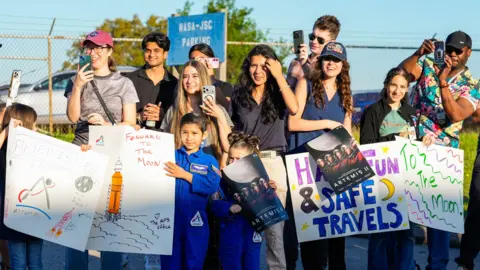
Getty Images Employees from the Johnson Space Center hold signs along Brantly Avenue near Ellington Field as they gather to send off the Artemis II astronauts ahead of their mission to the moon in Houston, Friday, March 27, 2026. Getty Images
Hundreds of thousands of people are expected to watch the rocket launch

"People going up to the Moon is kind of cool," eight-year-old Isiah says.

He is among the 400,000 people expected to cram the causeways, beaches and motel balconies of Florida's Space Coast for the launch attempt of Artemis II tonight.

They will watch as four astronauts blast into space in the hope of flying around the Moon and potentially travelling further from Earth than anyone has ever been before.

Nasa's 10-day test flight will not land on the Moon. However, the crew may witness views of the lunar landscapes that have never been seen by human eyes.

Amanda Garcia has travelled more than 1,000 miles from New Mexico to witness the launch. "I'm pretty excited about it," she tells us.

"I came out here to see it, and I heard it's gonna be a great show. A lot of people are going to be here."

Kevin Church/BBC News Split screen showing a woman holding a small dog, and a young man with the beach behind him.Kevin Church/BBC News
Amanda Garcia has travelled more than 1,000 miles to watch the launch, while Isiah, 8, said it was "kind of cool"

Beyond the Kennedy Space Centre launch site, along the lagoon and beaches of Titusville and Cocoa Beach, bars are advertising "moonshots" and hotels are warning guests to expect long delays getting to and from viewing spots.

Local officials talk of a "historic influx" of tourists and an economic impact of around $160m (£121m), putting traffic plans in place for a night when the highway lights will compete with the glow of floodlit launch towers as well as camper van barbecues.

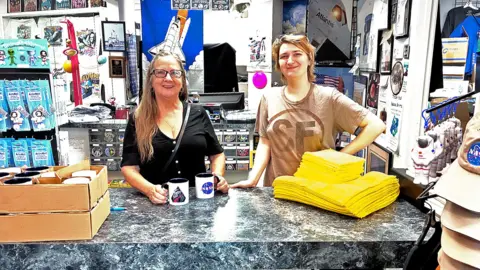
A mile or so from the pads where Artemis II will light up the sky, Brenda Mulberry, owner of Space Shirts, has been selling Nasa T-shirts and souvenirs for 40 years.

In her small shop on Merritt Island, racks of orange, blue and black T-shirts depict hand drawn rockets, mission patches and moonscapes, ready for the crowds who arrive on regular launch days. But this launch is different, she tells us. "We've wanted to go back to the Moon since the '70s. People are excited. People are beyond excited," she said.

Brenda says she has stocked up for the biggest surge of customers she has ever seen.

"I want to have the first T-shirt shop on the Moon," she says. "Because if you've been there, you get the T-shirt, right?" she adds, laughing.

Pallab Ghosh/BBC News Inside a small, crowded NASA gift shop, two people stand behind a grey marble-effect counter. Shelves and walls around them are packed with space souvenirs, mission posters, and astronaut photos. On the left are boxes of mugs; the woman holds two white mugs decorated with NASA-style logos. Next to her, a younger person in a pale T‑shirt leans on the counter near two neat piles of bright yellow folded T‑shirts. To the right, a rack displays beige and orange NASA baseball caps and small astronaut toys, giving the scene a busy, colourful, fan-filled atmosphere.Pallab Ghosh/BBC News
Brenda Mulberry (left) has been selling Nasa souvenirs for 40 years and ambitiously wants to open the first T-shirt shop on the Moon

Future Artemis missions plan to land humans on the Moon for the first time since 1972. But this time, the goal is to build a permanent Moon base to exploit its natural resources and provide a springboard for an attempt to reach Mars.

Artemis II's mission commander, Reid Wiseman, said he hoped the effort to return to the Moon would inspire a new generation.

"In our lifetime, we've looked at the Moon knowing that people had been there. And now in the Artemis generation, kids will walk out and look at the Moon going, we are there. We are there now, and we are going further into our solar system."

Joe Raedle/Getty Images On a grassy patch near water, three Artemis II astronauts in bright blue flight suits crouch down to talk with a group of young children. The children in the centre wear miniature pink spacesuits and caps, facing the astronauts and giving them high‑fives. Other children and parents cluster around them, some holding toddlers, forming a loose semicircle. In the distance, partly blurred, a tall rocket and launch tower rise above the trees. The mood is warm and playful, with astronauts and families smiling and interacting at eye level, turning a serious mission into a friendly, down‑to‑earth moment.Joe Raedle/Getty Images
The astronauts want their mission to inspire a new generation to follow in their footsteps

Tonight, all attention will turn to Launch Pad 39B - the same historic stretch of concrete from which the US Apollo programme first landed men on the Moon in 1969. Standing on the pad is Nasa's Space Launch System (SLS) rocket.

At 98m (321ft) tall, the white and orange giant is the heaviest rocket the agency has ever launched. At its top sits Orion, a capsule about the size of a small van, where the four astronauts will spend the next 10 days in close proximity. It will be the first time the capsule has been put through its paces with a human crew on board.

If all goes to schedule, the rocket will launch between 18:24-20:24 local time (23:24-01:24 BST) on Wednesday.

The astronauts who will strap into Orion about four hours before launch have spent years training together.

Up front, on the left hand side will be Wiseman, the Artemis II commander, while pilot Victor Glover will sit beside him. Behind them will be Christina Koch and Jeremy Hansen, a Canadian fighter pilot turned astronaut. This will be his first trip into space.

After reaching orbit, Orion spends its first day in high Earth orbit practising manual flying and testing life support before shaping its path towards the Moon.

On Day 2, a long trans-lunar injection burn puts the spacecraft onto a free return trajectory that would naturally loop it around the Moon and back to Earth, with small correction burns fine tuning the course.

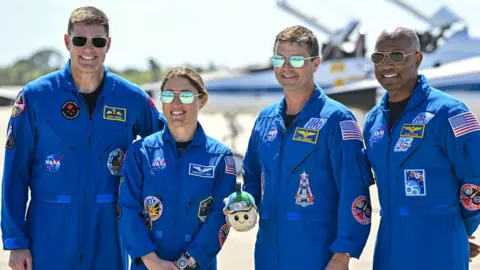
AFP via Getty Images Four Artemis II astronauts stand side by side on a sunny runway, posing for a group portrait. They all wear bright blue NASA flight suits covered in mission patches and name badges, with dark boots. One astronaut in the centre holds a small mascot or model in both hands. Behind them, two sleek white-and-blue T‑38 training jets sit on the concrete, their pointed noses facing left and right, with the NASA “meatball” logo visible on a tail fin. The sky above is clear and pale blue, giving the scene a crisp, formal but upbeat feel.AFP via Getty Images
Astronauts Jeremy Hansen, Christina Koch, Commander Reid Wiseman and Pilot Victor Glover arrive in style at Kennedy Space Centre on their Nasa jets with shades to match

Each day of the mission involves different tests and challenges for the crew.

Day 6 stands out because Orion is due to fly around the far side of the moon. All radio contact will be lost for about 40 minutes, meaning flight controllers won't know what is happening on board.

Orion will be travelling about 4,000–6,000 miles above the Moon's surface and may slightly exceed Apollo 13's record distance of about 250,000 miles (400,000km) from Earth, depending on the exact trajectory.

In the days that follow, Orion will be pulled naturally back towards Earth by the same free return trajectory that sent it out, with small course adjustment burns ensuring the capsule hits the atmosphere at just the right angle.

On the final day, the crew will strap in for the most brutal part of the trip: re-entry into Earth's atmosphere at about 25,000mph (40,000 km/h), when Orion's heat shield must again face temperatures hot enough to char rock.

NASA A small, round soft toy sits on a white tabletop, about the size of a large grapefruit. Its fabric face is pale cream with big black embroidered eyes, rosy pink cheeks and a simple smiling mouth, giving it a cute cartoon look. On top, it wears a dark blue cap sprinkled with embroidered yellow stars and tiny white rockets. Above the cap is a padded green‑and‑blue globe, like a miniature Earth, with a short dark loop for hanging. The toy’s overall impression is friendly and playful, like a cheerful mascot for a children’s space adventure.NASA
Rise, the Artemis II "zero‑g indicator" – a soft toy the crew will release inside Orion to show when they've reached weightlessness – sits ready for its first trip to space

After the first uncrewed test flight, Artemis I, engineers found that chunks of the heat shield's coating had cracked and broken away during a two‑stage "skip" re‑entry manoeuvre. This saw the capsule dip into the upper atmosphere, briefly climb again, then plunge back in so as to best cope with the heat, G-forces and splashdown accuracy needed.

For Artemis II they are keeping this two‑step re-entry, but changing the angle and timing so Orion spends less time in the initial, gentler dip. Modelling suggests this should reduce the heating and loads that caused extra charring, but this will be the first time the revised descent is flown with a crew.

If Artemis II is a success, the next time the Space Coast fills up like this it will be for another test flight – another step closer to people actually walking on the Moon again, half a century after the last footprints were made.

And somewhere between the marsh grass and the launch pads, there will almost certainly be someone wearing one of Brenda Mulberry's shirts, already dreaming of the day when her logo appears not just on Florida cotton, but in a photograph taken on the Moon.

Megan Thee Stallion taken to hospital during Moulin Rouge performance

Getty Images Megan Thee Stallion makes her Broadway debut in Moulin Rouge! The Musical at Al Hirschfeld Theatre on March 24, 2026Getty Images
Megan Thee Stallion wows audiences on opening night of Moulin Rouge! The Musical on 24 March

Rapper Megan Thee Stallion had to be taken to hospital mid-way through her performance of Moulin Rouge! The Musical, in New York on Tuesday night, her representative has confirmed.

"Megan started feeling very ill and was promptly transported to a local hospital, where her symptoms are currently being evaluated," the spokesperson told US media outlets.

"We will share additional updates as more information becomes available."

The musician, 31, is performing as Zidler – the show's eccentric master of ceremonies – marking her highly anticipated Broadway debut.

Her hair stylist, Kellon Deryck, wrote on X: "Everyone say a prayer for Megan, we are all at the hospital."

Megan Thee Stallion, whose real name is Megan Pete, is scheduled to play Zidler until 17 May, the Moulin Rouge website says. Ahead of her premiere, she expressed excitement for briefly substituting concerts with theatre performances.

'HOTTIES IM ON BROADWAY!!" she wrote on social media after her first performance on 24 March, referencing her fanbase, called the "hotties".

Megan Thee Stallion is best-known for hits including Savage, WAP and Body.

In 2021, she won three Grammy awards for Best Rap Song, Best New Artist and Best Rap Performance. The following year she was nominated for Album of the Year.

Harold Zidler was first played by Danny Burstein in the original Broadway cast of Moulin Rouge, and won a coveted Tony award in 2020 for it. More recently, celebrity drag artist Bob the Drag Queen played Zidler in the musical for eight weeks earlier this year.

The BBC has contacted Megan Thee Stallion's team for comment.

When is Nasa's Moon mission launch and what will Artemis do?

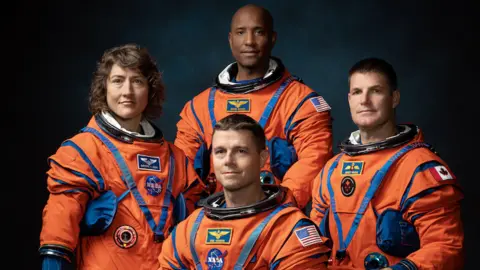
NASA The image shows four astronauts in bright orange space suits posing for a formal group portrait against a dark background. The suits are bulky with blue joints, straps and pockets, emphasising their technical design. Three astronauts stand behind one who is seated, all facing the camera. They all have fairly neutral expressions, keeping the focus on the uniforms. Mission-style patches and flags, including US and Canadian flags, are visible on their arms and chests. Soft, focused lighting makes the vivid orange suits stand out dramatically.NASA
Artemis II Crew: left Christina Koch, back Victor Glover (pilot), front Reid Wiseman (commander), right Jeremy Hansen

Nasa's target of a March launch for the first crewed mission around the Moon in more than 50 years has been delayed after a fault was detected.

Nasa had set a target of 6 March, but 24 hours later said the newly discovered fault made a March launch "out of consideration".

The Artemis II mission, which will last about 10 days, could take its astronauts further into space than anyone has been before.

It aims to set the stage for an eventual human landing on the lunar surface for the first time since the Apollo missions of the 1960s and 70s.

When will Artemis II launch?

With a March launch no longer being considered, the next possible dates are April 1, 3, 4, 5 and 6.

A potential February launch was ruled out after a pre‑flight test - known as a wet dress rehearsal - was cut short when hydrogen rocket fuel leaked from an umbilical connection linking the launch tower to the rocket.

Beyond resolving the technical issues, mission planners also have to wait until the Moon is in the right part of its orbit, so launch windows are timed accordingly.

In practice, this creates a pattern of roughly one week at the start of each month when the rocket can be pointed in the right direction, followed by about three weeks with no launch opportunities.

Watch: Timelapse shows Nasa rocket's 12-hour journey to launch pad

Who are the Artemis II crew?

Artemis II's crew of four is made up of Nasa commander Reid Wiseman, pilot Victor Glover and mission specialist Christina Koch. A second mission specialist, Jeremy Hansen of the Canadian Space Agency, will also be on board.

Wiseman is a US Navy veteran of 27 years. A pilot and engineer, he lives in Baltimore, Maryland. He was selected as an astronaut by Nasa in 2009 and served as Flight Engineer aboard the International Space Station (ISS) for Expedition 41 in 2014.

Glover was selected as a Nasa astronaut in 2013. He previously served as the pilot of SpaceX Crew-1 and holds three master's degrees. He was born in California and is married with four children.

Koch grew up in Michigan and became an astronaut in 2013. She worked on the International Space Station in 2019, setting a record for the longest single spaceflight by a woman. She also participated in the first all-female spacewalk.

Hansen joined the Canadian Space Agency in 2009 after a career as a fighter pilot. He became the first Canadian to lead astronaut training at Nasa's Johnson Space Centre and will be the first Canadian to go to the Moon.

What will the Artemis crew do during the Moon mission?

The mission involves the first crewed flight of Nasa's gigantic Space Launch System (SLS) rocket and the Orion space capsule.

Once they are safely in orbit, the astronauts will test how the Orion handles. This will involve manually flying the capsule in Earth orbit to practise steering and lining up the spacecraft for future Moon landings.

They will then head out to a point thousands of kilometres beyond the Moon to check Orion's life‑support, propulsion, power and navigation systems.

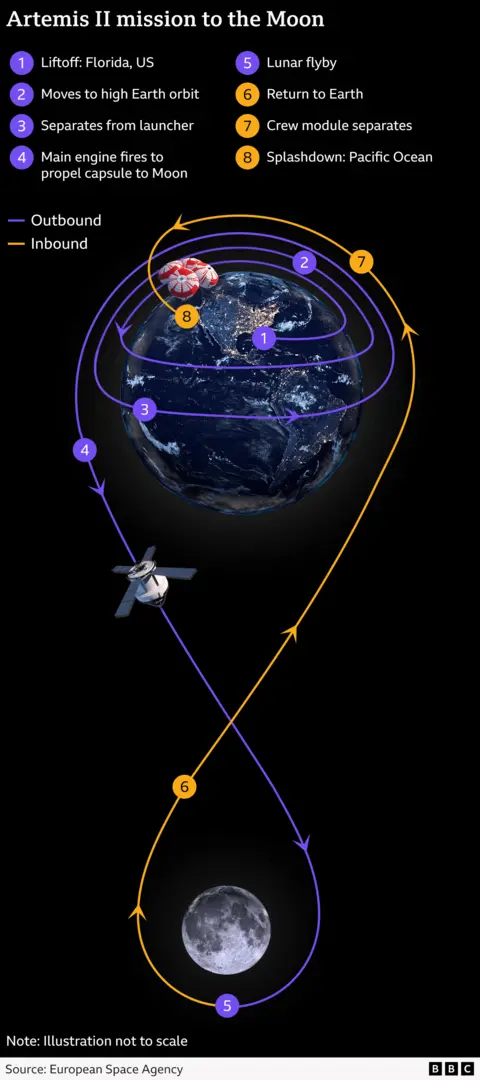
Graphic showing the Earth and Moon, with the Artemis II's figure of 8 orbital trajectory highlighted. Specific points are labelled. These are: 1. Lift off at the Kennedy Space Centre, 2. Orbit around Earth, 3. Rocket separation, 4. Main engine fires to take spacecraft to the Moon, 5. Lunar flyby, 6. Return to Earth, 7. Crew module separates, 8. Splashdown in Pacific Ocean.

The crew will also act as medical test subjects, sending back data and imagery from deep space.

They will work in a small cabin in weightlessness. Radiation levels will be higher than on the ISS, which is in low‑Earth orbit, but still safe.

On return to Earth, the astronauts will experience a bumpy return through the atmosphere and a splashdown off the west coast of the US, in the Pacific.

Will Artemis II land on the Moon?

No. This mission is to lay the ground for a lunar landing by astronauts in the Artemis III mission.

Nasa says the launch of Artemis III will take place by 2028. But experts believe that is a very ambitious timeline.

The final choice of a spacecraft to take the crew down to the lunar surface has not yet been made. It will either be SpaceX's Starship lander or a craft designed by Jeff Bezos's Blue Origin.

New spacesuits made by US company Axiom are also not ready.

When Artemis III finally flies, the astronauts will be heading to the Moon's south pole.

After this, the aim is to have a sustained human presence on the Moon.

Artemis IV and V will begin building Gateway, a small space station circling the Moon. That will be followed by more Moon landings, extra sections being added to Gateway, and new robotic rovers operating on the surface.

More countries will be involved in keeping people living and working on and around the Moon for longer periods.

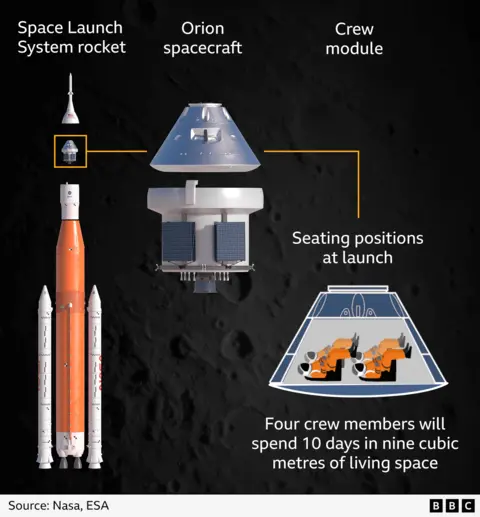
An illustration showing how the Artemis II astronauts will be arranged in the Orion crew module at launch. The four astronauts sit reclined, in two rows of two, facing up with their backs to the ground. During the mission the four crew members will spend 10 days in about nine cubic metres of living space. The image shows that the crew module makes up about half of the Orion spacecraft - with the service module being around the same size - and that, on the launchpad, Orion is only a small section of the 98m (320ft) Space Launch System rocket.

When was the last Moon mission?

The last crewed Moon mission was Apollo 17, which landed in December 1972 and returned to Earth later that month.

In all, 24 astronauts have travelled to the Moon and 12 of them have walked on its surface, all during the Apollo programme. Of the 24 to have been to the Moon, just five are still alive.

America first went in the 1960s, primarily to beat the Soviet Union to assert its geopolitical and technological dominance. Once that goal was achieved, political enthusiasm and public interest ebbed, as did the money for future Moonshots.

The Artemis programme grew out of a desire to return humans to the Moon, but this time for a longer-term presence built around new technology and commercial partnerships.

Do other countries plan to send astronauts to the Moon?

Several other countries have ambitions to put people on the Moon in the 2030s.​

European astronauts are set to join later Artemis missions and Japan has also secured seats.

China is building its own craft, targeting a first landing near the Moon's south pole by 2030.

Russia continues to talk about flying cosmonauts to the surface and building a small base sometime between about 2030 and 2035. However, sanctions, funding pressures and technical setbacks mean its timetable is highly optimistic.

India has also expressed ambitions to one day see its own astronauts walking on the Moon.

Following the success of Chandrayaan 3's landing near the lunar south pole in August 2023, India's space agency set out a goal of sending astronauts to the Moon by about 2040. This would be part of a push to move its human spaceflight programme beyond low Earth orbit.

Additional reporting by Kevin Church and Emily Selvadurai.

The personal items the crew are taking with them

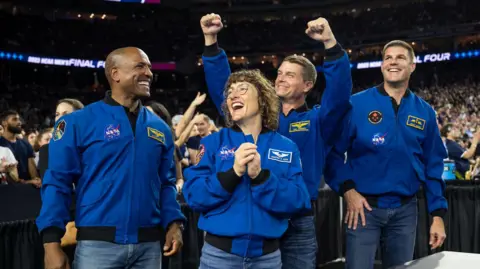
NASA The photo shows four astronauts from NASA’s Artemis II Moon mission standing in a busy indoor sports arena, wearing bright blue flight jackets with mission patches and logos. They are in the foreground, smiling and cheering, with one woman in the centre clasping her hands and two of the men raising their fists in the air in celebration. The crowd behind them is slightly out of focus but fills the stands, suggesting a major sporting event. The lighting is bright and even, and the mood is joyful, energetic and triumphant.NASA
The Artemis II crew celebrate with fans while watching a university basketball final in a packed arena in Houston, Texas

Four astronauts are about to become the most closely watched crew since Apollo.

They will be the first to orbit the moon for more than 50 years, testing the path back for the next generation.

The crew includes three Nasa astronauts - Commander Reid Wiseman, Victor Glover and Christina Koch - along with Jeremy Hansen of the Canadian Space Agency.

Not only are they accomplished pilots, engineers and scientists, they are also spouses and parents balancing a heroic adventure against the risks they and their loved ones will face.

Here's what we know about them.

Reid Wiseman - Commander

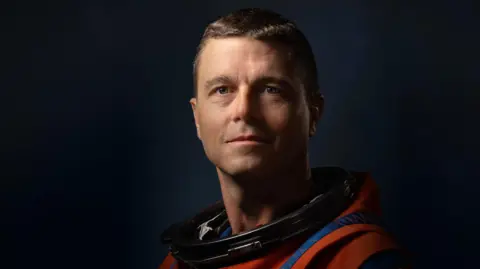
NASA/BBC News Headshot of astronaut Reid Wiseman  NASA/BBC News

Reid Wiseman is a US Navy test pilot turned astronaut, who spent six months on the International Space Station in 2014 as a flight engineer on Expedition 40. Wiseman says he has a lifelong love of flying, but on the ground he's afraid of heights.

He will command Artemis II in what is the second flight of the Orion spacecraft, and the first to carry people around the Moon in more than 50 years.

Born in Baltimore, Maryland, Wiseman lost his wife to cancer in 2020 and has raised their two teenage daughters alone. He describes being a single parent as his "greatest challenge and the most rewarding phase" of his life.

He has not shielded his children from the realities of risk, however. While out on a walk with them, he said: "Here's where the will is, here's where the trust documents are, and if anything happens to me, here's what's going to happen to you… That's part of this life."

He says he wishes more families had that conversation – because "you never know what the next day is going to bring".

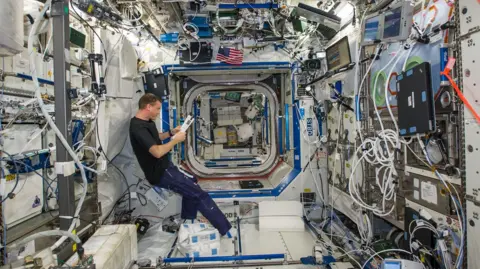
NASA Wiseman floats weightless inside a busy space station module, surrounded by equipment, laptops and tangled cables on every surface. He reads from a tablet while cargo bags, experiments and storage lockers line the walls and ceiling. The narrow, tunnel-like lab stretches away into connecting modules, lit by bright white panels. Every available space is packed with instruments, giving the high-tech interior a dense, cluttered feel ideal for microgravity research.
NASA
Wiseman spent six months as a flight engineer aboard the International Space Station for Expedition 41 in 2014

Although he carries the title of commander, he is careful not to make Artemis II sound like his mission alone.

"When I look at Victor, Christina and Jeremy, they want to go do this mission, they are keenly driven, they are humble to a fault. It is so cool to be around them," he says, hoping that in decades to come their flight will be seen as a "tiny step" towards people living on the Moon and, eventually, walking on Mars.

For the personal item Nasa allows astronauts to take up with them, Wiseman plans to take a small notepad so that he can jot down his thoughts during the mission.

Christina Koch - Mission specialist

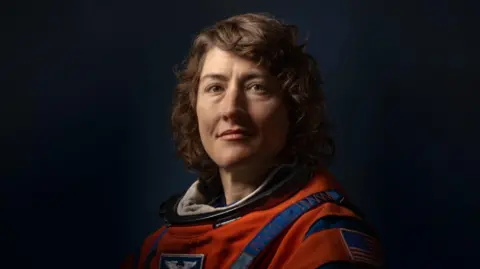
NASA/BBC News Headshot of astronaut Christina KochNASA/BBC News

Christina Koch is an engineer and physicist who became an astronaut in 2013 and went on to set the record for the longest single spaceflight by a woman, spending 328 days aboard the International Space Station in 2019. During that mission she also took part in the first all-female spacewalk.

Born in Grand Rapids, Michigan, and raised in North Carolina, she will become the first woman to travel to the Moon.

Her journey to Artemis II began with a photograph. As a child she kept a poster of the Earth rising above the lunar surface – Bill Anders' famous Earthrise picture from Apollo 8 – on her bedroom wall, and decided she wanted to become an astronaut when she learnt that a human, not an automatic camera, had squeezed the shutter.

"The fact that it was a human behind that lens made that picture so much more profound and changed the way we thought of our own home," she says. "The Moon was not just a symbol for thinking about our place in the Universe, it is a beacon for science and understanding where we came from."

Koch has spent more than 25 years around Apollo veterans through a scholarship foundation and Nasa remembrance events, and says that what the former astronauts have really taught her is camaraderie.

Koch is taking handwritten notes from people close to her for her personal item, which she has described as a "tactile connection" to loved ones back on Earth.

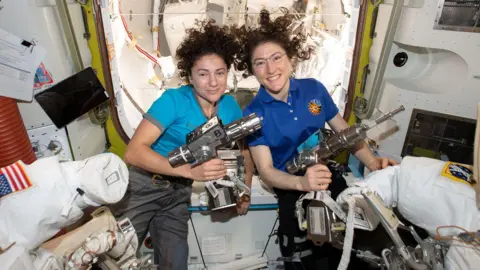
NASA Astronauts Jessica Meir and Christina Koch float side by side inside the space station, their hair fanned out in weightlessness. Jessica, on the left in a turquoise T‑shirt, and Christina, on the right in a blue polo shirt, each hold a large silver power tool used to service spacesuits. Around them are white spacesuit parts, cables and panels, giving a busy workshop feel inside the curved, pale interior of the airlock module.NASA
Astronauts Jessica Meir (left) and Christina Koch prepare for their first spacewalk together

At home, spaceflight is a running conversation with her husband. She says he's inquisitive about "what the big milestones are, what the risky parts are, when he can sigh a sigh of relief, when he needs to be glued to the TV".

One of the more prosaic preparations has been to persuade him that Artemis is not like her ISS mission - there will be no casual phone calls from orbit, no quick check-ins to locate a missing item in a cupboard. "He's not going to be able to ring me and ask where something is in the house," she laughs. "He's going to have to find it."

Jeremy Hansen - Mission specialist

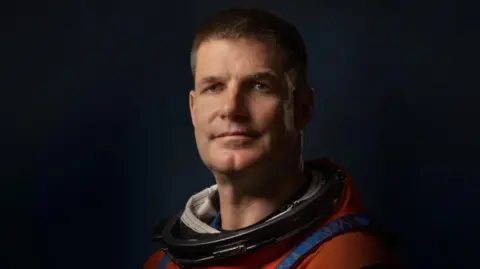
NASA/BBC News Headshot of astronaut Jeremy HansenNASA/BBC News

Jeremy Hansen is a former Royal Canadian Air Force fighter pilot and physicist who joined the Canadian Space Agency in 2009. Although he has never flown in space before, he has played a key role in training new astronauts at Nasa's Johnson Space Centre, becoming the first Canadian to lead that work.

He is married with three children and enjoys sailing, rock climbing and mountain biking.

Like Koch, Hansen traces his fascination with space back to Apollo 8. Growing up in rural Canada, he turned his treehouse into an imaginary spaceship after seeing a photograph of Buzz Aldrin standing on the lunar surface.

The risks the Apollo astronauts took has shaped how he talks to his own family about Artemis II. Over the Christmas holidays they watched footage of the uncrewed Artemis I launch together so he could warn them that, when the main engines light, it can briefly look and sound like the rocket is exploding – and reassure them that this is normal.

He has told them, too, that when they hear engineers on the loop discussing "worst case scenarios" or unusual sensor readings, it will often sound scarier than it is; it is simply how teams probe the edges of safety on a first crewed flight.

If all goes to plan, Hansen will become the first non-American to travel to the Moon – a milestone he sees as a sign of how far international cooperation in space has come since Apollo. "The Artemis missions have set such an ambitious goal for humanity that… nations around the globe are coming together," he says.

Hansen will carry four Moon-shaped pendants for his wife and three children, engraved with the phrase "Moon and back" and set with their birthstones. The Canadian will also be taking maple syrup and maple cookies on his lunar voyage.

Victor J Glover - Pilot

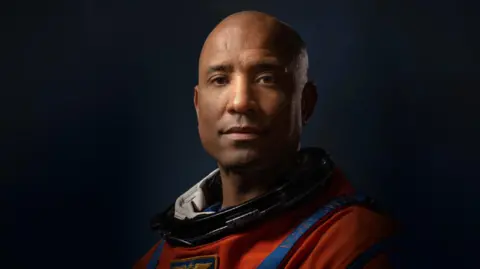
NASA/BBC News Headshot of Victor J Glover NASA/BBC News

Victor Glover is a former US Navy fighter pilot and test pilot who was selected as a Nasa astronaut in 2013. He served as pilot of Nasa's SpaceX Crew 1 mission and spent nearly six months on the International Space Station as part of Expedition 64. Born in Pomona, California, he is married with four children and is set to become the first black person to travel to the Moon.

Those who know him say he is the most charismatic of the quartet and the most sharply dressed, with designer brown leather boots that somehow look good even with an orange flight suit. His call sign, "IKE", is reputedly short for "I Know Everything", a nod to his three master's degrees in flight test engineering, systems engineering and military operational art and science.

At a red carpet event in 2023, in New York, he looked every inch the modern astronaut celebrity, alongside his wife Dionna.

Preparing for Artemis II, Glover has been working through original Gemini and Apollo journal papers from the 1960s, hunting for engineering and piloting lessons that might still apply. Between the graphs and equations, he says, you glimpse the people behind the missions; what their families were going through, what they knew and did not yet know as they pushed into the unknown.

"Pushing ourselves to explore is core to who we are," he says. "It is part of being human… We go out to explore, to learn where we are, why we are, understanding the big questions about our place in the universe."

Glover has said he will take with him a Bible, his wedding rings and family heirlooms, along with a collection of inspirational quotations compiled by Apollo 9 astronaut Rusty Schweickart.

Getty Images Victor Glover stands on the right in a dark suit, white shirt and slim black tie, his arm gently around Dionna’s back as they pose together on the red carpet. Dionna, on the left, wears a simple knee‑length black dress and carries a patterned clutch bag in her right hand. They stand close, facing the camera against a dark backdrop printed with “TIME100 Next” and sponsor logos, giving a formal but relaxed, celebratory feelGetty Images
Glover and his wife Dionna arrive on the red carpet at a gala celebrating rising stars in science, culture and public life

In a Nasa video, each of the astronauts distil the mission into a single phrase. "We are ready," says Koch; "We are going," adds Hansen; "To the Moon," says Glover. Wiseman, completes the sentence: "For all humanity!"

Trump sees 'America First' opportunity in going to the Moon

Andrew Harrer/Bloomberg via Getty Images Close-up of President Donald Trump as he listens intently during an event commemorating the 50th anniversary of the Apollo 11 moon landing in the Oval Office of the White HouseAndrew Harrer/Bloomberg via Getty Images
A successful Artemis mission could give Trump's administration a boost

The first journey to deep space since 1972 comes at a crucial time in Donald Trump's presidency.

The US is bitterly divided on topics ranging from the ongoing US strikes in Iran to immigration and the economy.

So a successful Artemis mission, sending four astronauts to the Moon on Wednesday, could give Trump's administration a boost. The potential benefits are huge - a competitive edge with China, the possibility of a lunar gold rush, and a rare moment of national unity.

Officially, the mission - which will take the crew further into space than anyone has ever been before - is a stepping stone, Nasa says, towards a permanent lunar base and eventually, Mars.

'Stars and Stripes on the planet Mars'

While US interest in returning to the Moon pre-dates his entry into politics, Trump directly created what became Artemis in his first term, vowing to "launch American astronauts to plant the Stars and Stripes on the planet Mars". He also saw military opportunities and launched a new arm of the Pentagon, Space Force.

In his second term, however, Trump's goal has shifted to the Moon. In December last year, he signed an executive order calling for a US return to the Moon by 2028 and the establishment of a permanent outpost there by 2030. The order said that US superiority in space was a measure of national vision and willpower, contributing to the nation's strength, security and prosperity.

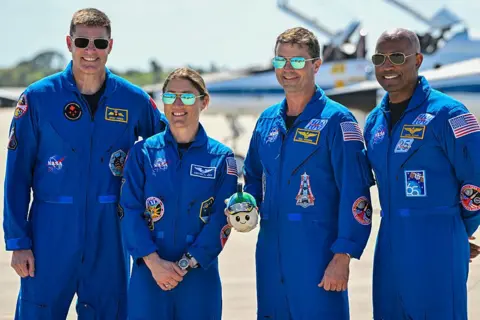
Miguel J. Rodriguez CARRILLO / AFP via Getty Images Artemis crew stand side by side in blue overalls and sunglasses, smiling at the camera Miguel J. Rodriguez CARRILLO / AFP via Getty Images
Three Americans and one Canadian head to the Moon on Wednesday

Not mentioned in the executive order was lunar competition from China - a factor that Nasa administrator Jared Isaacman has laid out explicitly.

"We find ourselves with a real geopolitical rival, challenging American leadership in the high ground of space," Isaacman said at a Nasa event on 24 March. "This time, the goal is not flags and footprints," he added. "This time, the goal is to stay. America will never again give up the Moon."

Battle for ideological influence on Earth

During the Cold War space race with the Soviets, the point of getting to the Moon was almost entirely geopolitical.

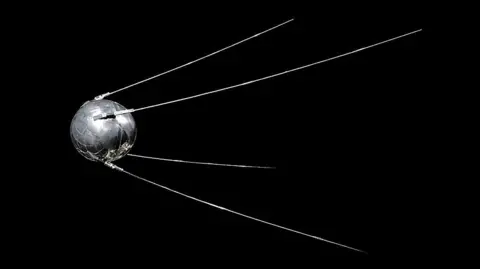
With Washington and Moscow locked in a battle for ideological influence on Earth, space became another arena in which to demonstrate technological superiority, which for the US became increasingly urgent after the 1957 Soviet launch of Sputnik - the world's first satellite - sent shockwaves through the US.

Universal History Archive/Universal Images Group via Getty Images Sputnik 1, a polished metal sphere with four external radio antennas, against a black background  Universal History Archive/Universal Images Group via Getty Images
The 1957 Soviet launch of Sputnik - the world's first satellite - was a wake-up call for the US

John F Kennedy made the mission explicitly political, both publicly and in private.

"This is important for political reasons," Kennedy said in a declassified 1962 recorded White House conversation with Nasa administrator James Webb. "This is, whether we like it or not, a race."

Space race with China

The new Moon race is between the US and China, which has its own fast-moving plans to put a crew on the lunar surface in the next few years.

This exploration could have a vast, potentially lucrative economic angle at a time when both countries are locked in trade tensions.

Former Nasa administrator Sean O' Keefe told the BBC that the nations that land on the Moon will have the advantage of exploring and developing the resources that are there.

"After all these years of thinking it was nothing more than a dust bowl, we have come to realise it has a significant amount of helium 3," he said, adding that the element can be potentially used to operate small, compact nuclear fusion reactors with relatively long lifespans. "That opens up all sorts of other opportunities."

Additionally, the moon is home to water ice, which can be used for rocket propulsion, as well as rare earth minerals such as lithium, platinum and other materials critical to electronics and clean energy technology.

On Earth, these markets are currently dominated by Chinese mining operations, a key concern of the Trump administration.

The value of these resources remains unknown, but could be massive. Helium 3 alone currently trades at more than $20,000 per kilogram, making it one of the most valuable resources on earth.

'Lunar gold rush'

Clayton Swope, a veteran of the CIA's Directorate of Science and Technology and former adviser on space affairs on Capitol Hill, compared the "lunar gold rush" to the Lewis and Clark expedition across the western US in the early 1800s.

"We didn't quite know the value of the western part of the US, or the Pacific Northwest, but we thought it was there," he said. "Part of [the mission] is trying to figure out what that value is. We can't quite put a price tag or a dollar amount on the Moon, but you can't get away from that competition and rivalry with China."

The White House certainly views space as another arena for the US to exert its dominance.

"With President Trump's America-First policies, the United States will lead humanity into space and enter a new era of groundbreaking achievements in space technology and exploration," said spokeswoman Liz Huston.

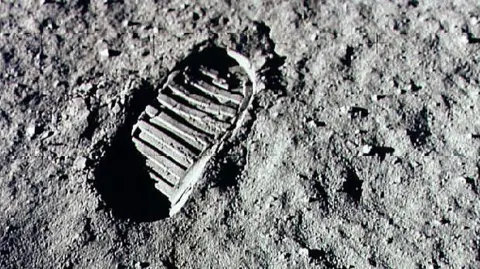
Trump's generation grew up with images of astronaut Neil Armstrong taking his historic first steps on the moon in July 1969 - they are etched on their collective consciousness.

NASA/Newsmakers Neil Armstrong's human footprint on the surface of the moon in black and white NASA/Newsmakers
Trump's generation grew up with images of astronaut Neil Armstrong taking his historic first steps on the moon in July 1969

At the time, the US was in turmoil.

American soldiers were fighting and dying in an unpopular war in Vietnam; civil rights tensions were rife; the assassinations of Martin Luther King and Robert Kennedy were still being felt; and the polarising figure of Richard Nixon was sat in the White House.

Despite those divisions, an estimated 125 to 150 million Americans tuned in to watch the Apollo 11 Moon landing, providing a rare moment of collective national pride at a difficult time in US history.

Collective national pride

Some experts say that the Artemis mission could replicate that again in 2026, at a time when Americans are polarised once more, and again the US is at war.

"Space is one of the few areas that Americans with different political views can enjoy and watch together," said Esther Brimmer, a senior fellow at the Council of Foreign Relations who specialises in space policy.

"The space programme is something that most Americans have grown up with and see as a point of pride," she added. "It's by and large unifying, in terms of the social impact."

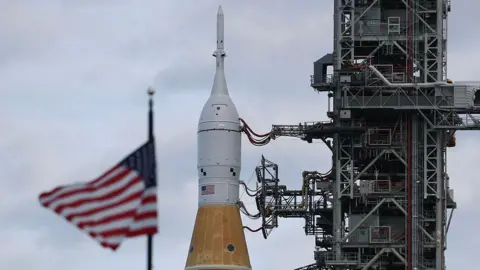
Joe Raedle/Getty Images NASA's Artemis II is rolled from the Vehicle Assembly Building at NASA’s Kennedy Space Center as the American flag sits in the foreground Joe Raedle/Getty Images
"The space programme is something that most Americans have grown up with and see as a point of pride," says Esther Brimmer, a senior fellow at the Council of Foreign Relations

Astrophysicist David Gerdes was five years old when Armstrong walked on the moon.

"One of my very earliest memories was being allowed to stay up way past my usual bedtime, dozing on a blanket in front of our black-and-white television, watching Walter Cronkite report on the Apollo 11 landing," said Gerdes, now a professor at Case Western Reserve University in Ohio.

"Many, many people of all ages were inspired by the technology, the boldness, and the spirit of the astronauts."

For a moment, he adds, it transcended partisan divisions.

"I would certainly hope that a return to the Moon by a group of Americans that is more diverse than those who took part in the 1960s can really help bring the country together."

Next stop, Mars? Why Nasa's mission matters

Getty Images A digital illustration shows red clouds and water ice on the surface of Mars against the black abyss of space.
Getty Images

In just a few days Nasa is planning to launch the Artemis II mission, sending four astronauts on their way to the Moon.

Their voyage around our nearest neighbour will pave the way for a lunar landing and, eventually, a Moon base.

Nasa's Artemis programme has taken years of work, involved thousands of people and is estimated to have cost $93bn to date.

But for some, there's a distinct feeling of "been there, done that".

More than 50 years ago, America's Apollo missions made history when the first people set foot on the lunar surface. With six landings in total, it felt like the Moon had been well and truly ticked off the space to-do list.

So why is the US spending so much time, effort and money racing to return?

Valuable resources

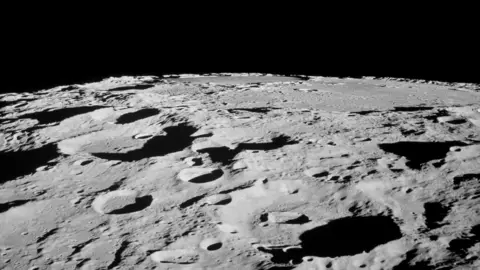
NASA Up-close views of impact craters on the Moon's surface NASA
"The Moon has got the same elements in it that we have here on Earth," says Prof Sara Russell

The terrain might look dry, dusty and seems rather barren, but it's far from that.

"The Moon has got the same elements in it that we have here on Earth," says Prof Sara Russell, a planetary scientist at the Natural History Museum.

"An example is rare earth elements, which are very scarce on Earth, and there might be parts of the Moon where these are concentrated enough to be able to mine them."

There are metals too, like iron and titanium, and also helium, which is used in everything from superconductors to medical equipment.

But the resource that's the biggest draw is the most surprising: water.

"It has water trapped in some of its minerals, and it also has substantial amounts of water at the poles," says Russell.

There are craters that are permanently in shadow, she says, where ice can build up.

Having access to water is vital if you want to live on the Moon. It not only provides drinking water, but can also be split into hydrogen and oxygen to provide air for astronauts to breathe, and even fuel for spacecraft.

Race for space dominance

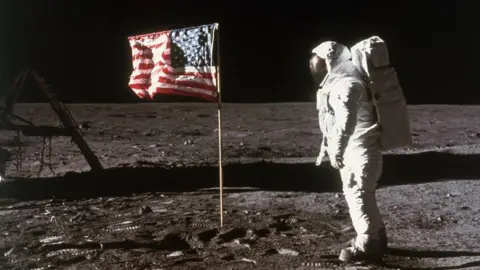
Getty Images Astronaut Buzz Aldrin stands beside an American flag placed on the moon during Apollo 11 extravehicular activity, 1969
Getty Images
Astronaut Buzz Aldrin salutes an American flag on the Moon's surface in 1969

America's Apollo missions of the 1960s and 1970s were driven by a race for space dominance with the Soviet Union. This time around China is the competition.

China has been making fast progress with its space programme. It's successfully landed robots and rovers on the Moon, and says it will get humans there by 2030.

There's still prestige in being the first to plant your flag in the lunar dust. But now it really matters where you plant it.

Both the US and China want access to the areas with the most abundant resources, which means securing the best lunar real estate.

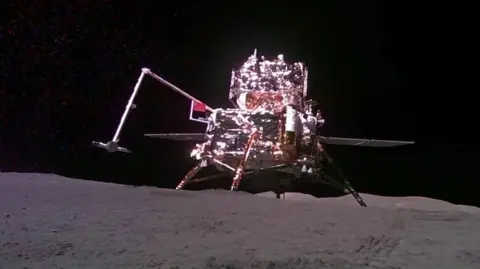
CNSA HANDOUT via EPA The  Chinese lander-ascender mooncraft is pictured while being captured from the 'mobile camera' carried by the Chang'e-6 probe (out of frame), as it holds out  a Chinese flag while stood on the surface of the moon against the dark abyss of space during China's moon mission on 4 June, 2024.CNSA HANDOUT via EPA
China put its flag on the Moon when it landed a robotic spacecraft in 2020

The United Nations 1967 Outer Space Treaty says that no country can own the Moon. But when it comes to what's found on the Moon, it's not quite so straightforward.

"Although you can't own a piece of the land because of the UN treaty, you can basically operate on that land without anybody interfering with it," says Dr Helen Sharman, the first British astronaut.

"So the big thing right now is to try to grab your piece of land. You can't own it, but you can use it. And once you're there, you've got it for as long as you want it."

Paving the way to Mars

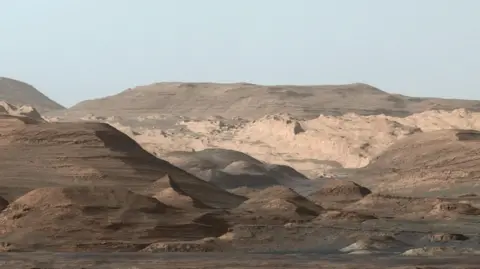
NASA The picture shows the higher regions of Mount Sharp on Mars. In the foreground are some darker areas with some small hillocks with a slightly larger slope off to the left. In the middle of the photo are some lighter more craggy looking rocky areas. In the distance are bigger hills that are more rounded with gentle slopes. The sky, which is visible at the very top is a dark grey.NASA
Living on Mars will be much harder than the Moon

Nasa has its sights set on Mars and wants to send people there by the 2030s.

Given the technological hurdles it needs to overcome, it's a pretty ambitious timeline.

But you have to start somewhere, and the US has decided the Moon is that place.

"Going to the Moon and staying there for a sustained period is much safer, much cheaper and much easier to be a test bed for learning how to live and work on another planet," says Libby Jackson, head of space at the Science Museum.

On a Moon base, Nasa can perfect the tech to provide the air and water astronauts need. They'll have to work out how to generate power and build habitats to protect people from extreme temperatures as well as dangerous space radiation.

"These are all technologies that if you try them for the first time on Mars and they go wrong, it's potentially catastrophic. It's much safer and much easier to try them out on the Moon," Jackson says.

Mysteries yet to be unlocked

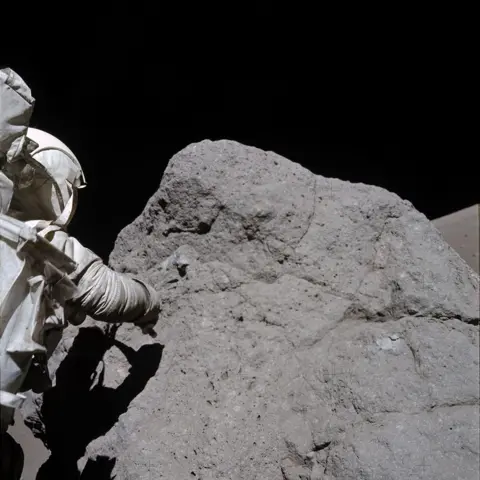
NASA The Apollo astronaut Harrison Schmitt, from Apollo 17,  is collecting samples  rock on the Moon. The rock is slightly taller than him and about 3 times as wide. He is on the left of the photo with his back to the camera, and is wearing a white NASA space suit as he tries to collect the sample using his right arm. His body is creating a shadow on the large dark grey rock. At the top of the photo you can see the blackness of space. 

NASA
The Apollo astronauts collected samples of rock during their missions

Scientists can't wait to get their (gloved) hands on material from the Moon.

The rocks brought home by the Apollo astronauts transformed our understanding of our celestial neighbour.

"They told us that the Moon was formed by this incredibly dramatic event, where a Mars-sized body smashed into the Earth and the bits that came off formed the Moon. We know about that because of the Apollo rocks," says Prof Sara Russell.

But she says there is still much to discover.

Because the Moon was once a part of the Earth, it holds a record of 4.5bn years of our own planet's history. And with no plate tectonics, or wind and rain to wipe this record away, the Moon is a perfect time capsule.

"The Moon is a fantastic archive of the Earth," says Russell. "A new haul of rocks from a different area of the Moon would be amazing."

Inspiring a new generation

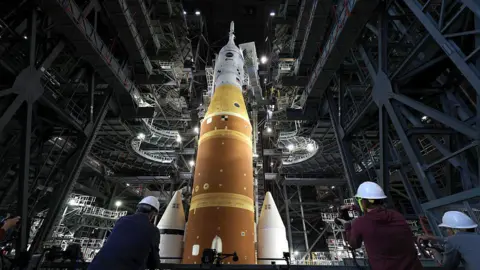
Joe Raedle/Getty Images Artemis II sits in the Vehicle Assembly Building at NASA’s Kennedy Space Center as three workers wearing white hard hats look up at the rocket Joe Raedle/Getty Images
It's hoped that the Artemis missions will excite people about careers in science, technology and engineering

The grainy black-and-white footage beamed back from the Apollo missions transformed the dream of space into a reality.

And while only a lucky few watching would become astronauts themselves, many went on to careers in science, technology and engineering.

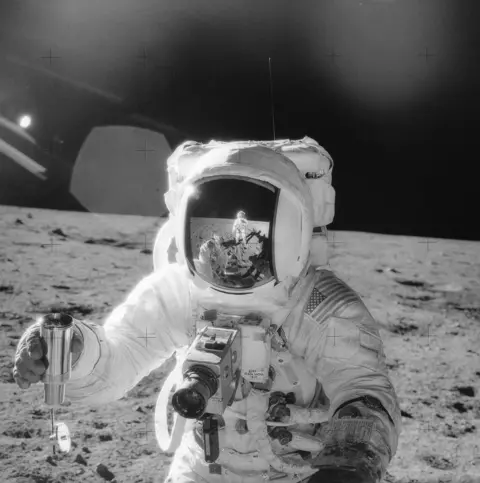
NASA Black-and-white still of Apollo 12 mission in 1969 showing one of the astronauts on the Moon’s surface holding a container of lunar soil. The other astronaut is seen reflected in his helmet. NASA
Black-and-white footage beamed back from the Apollo missions transformed science fiction into reality

It's hoped that the Artemis missions - streamed live and in 4k - will inspire a new generation.

"We live in a world of technology. We need scientists, engineers and mathematicians - and space has a brilliant ability to excite people about those subjects," says Libby Jackson.

New jobs and a thriving space economy will give the US a return on the billions of dollars it's poured into Artemis. As will any spin-offs from the technology developed for the missions that have a use on Earth.

But Helen Sharman says a return to the Moon will also give the world a much-needed boost.

"If we really come together, we can produce so much that's beneficial to humankind," says Sharman.

"It shows us what humans are capable of."

Top image shows a digital illustration of the surface of Mars.

My daughter has childhood dementia and may not live past 16

Darren Scott Darren and Sophia Scott. He has longish blond hair and a beard and is wearing a blue T‑shirt. His arm is around Sophia who is wearing glasses and a blue, brown and white cotton scarf tied around her head. He is smiling at the camera while she is looking off camera. They are in a park.Darren Scott
Darren Scott is a full-time carer for his daughter Sophia, who is now 15

Just before her fourth birthday Sophia Scott's parents were told she had a condition that causes childhood dementia.

They walked away with a single sheet of paper and were advised to make the most of the time they had left with her.

Now 15, Sophia can no longer speak and cannot walk unaided. She may not live past her 16th birthday.

Her dad Darren and mum Amanda are now separated but both help care for Sophia.

Darren juggles this with his job as a hospitality manager while Amanda left her job to look after her.

Darren also campaigns to raise awareness of Sophia's condition, Sanfilippo syndrome.

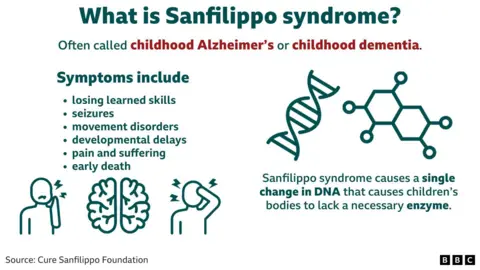
It is an inherited, rare, progressive and incurable condition.

Darren Scott Sophia as a very young child. She has shoulder-length, blonde hair with a black bow clipping it away from her face. She is looking off camera and is wearing an autumnal brown dress with short sleeves and a green bow on a ribbon around itDarren Scott
Sophia, who was diagnosed at the age of four, had a happy early childhood

Sophia's early childhood was happy. Darren, from Glasgow, said she loved dancing, cooking, playing and going to school.

Although there were some delays in her development, there was nothing to suggest the scale of what was to come.

"We didn't have any concerns there was something remotely wrong," he told BBC Scotland News.

"There were some delays on her markers, but we didn't think anything this huge.

"We were basically given a life sentence, this progressive incurable disease was going to take our only child.

"We were given a piece of A4 paper, and essentially told to make the most of the time we had."

Darren Scott Sophia as a baby. She is half smiling at the camera and is wearing a pink and white fluffy dressing gown with the hood up.Darren Scott
Initially Sophia showed no signs of the condition but there were later some delays in her development.

Darren said the couple were given no support or expertise.

"We were told to make memories," he said.

Darren, and Sophia's mum Amanda, were so shocked and devastated at the news that they threw up in the street outside the hospital.

"We were collapsed outside - we were told our daughter is going to die," Darren said.

"In that moment we both were broken, our lives had been shattered.

"We were in a complete state of shock and left feeling like what do we do now? Our life had changed forever and we felt alone."

Darren Scott The image shows Darren and Sophia Scott in a selfie. He has longish blond hair and a beard and is wearing sunglasses and a grey T‑shirt. His arm is around Sophia who is wearing glasses and a scarf. They are both smiling.
Behind them is a weathered stone monument or sculpture featuring carved figures and what appears to be a crest or coat of arms.Darren Scott
Darren Scott campaigns to raise awareness of Sophia's condition

What made the diagnosis even more difficult for the family was that, for a while, life still felt normal.

The condition is initially very gradual so for the next few years, Sophia, who is an only child, was still very much herself.

It left her family living with the knowledge of what was coming, while trying to hold on to everyday life.

As she got older, the disease began to progress.

Darren said that by the age of six or seven, changes in Sophia's behaviour had become more noticeable, including hyperactivity and mood swings.

An explainer on what Sanfilippo syndrome is, including symptoms such as losing learned skills and movement disorders.
About 140 children in the UK are believed to have the condition

Over time, her condition continued to worsen and she can now no longer speak.

"We would look at Sophia, this perfectly happy little girl and think why her? Why? And how is this all going to change?' he said.

"We just kept looking at every little thing she did and thought will that be the last time she does that? Or will this be the last time she says that?"

Darren said it was very hard to cope with the fact that Sophia could no longer tell them when something was wrong.

But he said one of the hardest parts was not hearing her voice anymore.

"As for her last words, like much of her loss, it's all rather cloudy and painful," he said.

"It's all such a slow decline but we would sing together as much as possible as she'd remember the words of her favourite songs and smile.

"She always said I love you a lot and we have a video late on of her still just managing to say this."

Darren Scott Sophia Scott, a young girl, is looking at the camera. She has long, blonde hair, with some of it party tied at the top with a bobble. She is wearing pale pink-rimmed glasses, a denim shirt or jacket with a pink, grey, black and white striped top underneath.Darren Scott
Sophia's behaviour began to change when she was about six or seven
Darren Scott Sophia as a younger child on skis in the snow. She has long, blonde hair and glasses and is wearing a pink helmet, blue waterproof jacket and pink ski trousers. She is holding a ski stick and there is red writing on her skis. She is looking at the camera.Darren Scott
Sophia's development has gradually declined and she is no longer able to walk unaided

Campaigners say childhood dementia remains one of the least understood and least recognised life-limiting conditions affecting children.

  • According to Alzheimer Scotland, around 380 families in Scotland are affected by childhood dementia
  • There are estimated to be 204 deaths a year of people with childhood dementia. The figure for childhood cancer (0-14 years) is 260
  • Half of those with childhood dementia die by the age of 10 and 70% before their 18th birthday

The charity says the condition is caused by more than 145 rare genetic disorders, including Sanfilippo syndrome, and that children and families are too often left to navigate it without a clear pathway of care or support.

As well as caring for Sophia, Darren has become an advocate for families affected by childhood dementia, working with Alzheimer Scotland and speaking at the Scottish Parliament to push for better awareness and practical support.

He also raises awareness through his Instagram page @hundredsofpromises and has connected with families around the world facing similar experiences, including in Australia, where he says support for children with dementia and their carers is far more developed.

Darren Scott Sophia Scott is smiling broadly, looking off camera. She has long, blonde hair and brown-rimmed glasses. She is wearing a blue top with pink trim and a pale pink cotton scarf around her neck.Darren Scott
Sophia may not live past 16

Although Sophia's family receives some support, Darren says it falls far short of what is needed.

They are entitled to about 20 hours of care a week but outside that, the responsibility falls almost entirely on him and Sophia's mum.

The Scottish government recently announced it was providing £118,873 to Alzheimer Scotland to support the employment of two new childhood dementia development officers - making Scotland the first country in the UK to fund this kind of dedicated support.

Darren Scott Sophia looks slightly off camera. She has long, blonde hair tied back and is wearing large pink-rimmed glasses and a white summer top.Darren Scott
Darren wants whatever time Sophia has left to be as comfortable as possible

The development officers will be responsible for raising awareness of childhood dementia, developing understanding among professionals, and ensuring a support network is in place for families affected by it.

Health Secretary Neil Gray said: "Childhood dementia may still be considered rare but for many it can be life-limiting.

"That's why we're doing all we can to maximise life expectancy and to ensure families have access to the support and care they need."

While Darren welcomed the move, he said it highlighted what little help there had been available to families like his.

Darren Scott Sophia Scott is standing on a beach. She is a young girl with long, blonde hair and is wearing large, pink-rimmed glasses. She is wearing a cream-coloured sweatshirt and half smiling at the camera.Darren Scott
Darren says no family should have to receive the diagnosis they did

In a report published in December 2025, Alzheimer Scotland called for childhood dementia to be included in the Scottish government's national dementia strategy, alongside a nationally standardised framework of care and increased research investment.

Alzheimer Scotland said the newly funded roles were an important step, but campaigners believe much more still needs to be done.

Jim Pearson, the charity's deputy chief executive and chairman of Childhood Dementia Scotland, said in the report that childhood dementia remained "largely invisible" within health, social care and education systems.

He said: "Families cannot wait. Scotland must act now so every child gets timely, compassionate support."

For Darren, the issue is not only about awareness but about making whatever time Sophia has left as supported and comfortable as possible.

He added that no family should ever receive a diagnosis like his daughter's and be left to face it alone.

中国教育部推20禁令 基础教育政治定调

3月27日,中国教育部对外发布《关于开展基础教育规范管理巩固年行动的通知》,同步公布《基础教育规范管理负面清单(2026版)》,列出20项“严禁”规定,涉及意识形态、教学安排、考试管理、教师行为及校园收费等多个方面。

观察人士指出,该清单尽管打着“规范管理”的旗号,实则通过设定明确边界,对中国基础教育的运行方式产生影响。其中,将“意识形态”置于首位,也被解读为针对校园思想领域的一次集中整顿。

清单第一条明确,严禁出现反党反社会主义、丑化党和国家形象、诋毁党和国家领导人或英雄模范等言行,并要求不得通过教材、试题、讲座、教辅资料及网络空间传播相关内容。相关规定同时覆盖电子产品及各类公开场合,管控范围较以往明显扩大。

意识形态条款被置于首位

陕西太原中学教师何玲(化名)本周三(4月1日)接受本台记者采访时表示,这20条负面清单中,前两条严格来说并不属于教学层面的具体规范:“我感觉与当局巩固统治根基的需要直接相关。他们把这两条放在最前面,说明基础教育首先要服从这一政治目标,其次才是教学本身。换句话说,是先看政治要求,再谈教学内容。”

文件明确规定,不得通过网络媒介、论坛讲座、试卷试题、教辅材料及电子产品传播被认定为不当的观点。多位受访教师表示,相关要求已从课堂延伸至更广泛的教育场景,甚至从幼儿园开始。

青岛某中学教师黄思维(化名)告诉记者,近年来教育领域对“导向”的要求不断强化。他说:“现在连试卷出题、推荐书目,甚至家校群里的每一句发言,都得慎之又慎。在一些学校内部,会强调所谓’正确的教育观’,要求教学内容与官方导向保持一致。”

教学与言论边界进一步收紧

黄思维说:“很多时候,我们担心的不是怎么教,而是能不能说。学校不断强调‘政治导向’,而且出了问题要个人负责。在这种情况下,教学空间被压得很紧,老师只能跟着要求走,心理负担也越来越重。”

官方文件第二条,要求校方严格执行国家课程方案,禁止超前教学,并明确不得挤占思想政治、体育、艺术及劳动等课程时间。

贵州大学退休教授梁先生认为,当前将意识形态要求与教学规范并列推进,使基础教育在制度层面表现出更明确的导向。他说:“当局对学生的意识形态和教学管理一直是同时推进的,这在中国的教育体系里一直存在。学校的运作,还是要服从整体体制的需要。”

他表示,在这种安排下,教育体系的空间会受到限制,意识形态要求也较为刚性,也在影响家庭的教育选择。“一些中产家庭会选择把孩子送到国外去,这其实是一种现实反应。”

教师称课堂与表达空间受限

除前两条外,其余条款主要集中在教学与管理层面的具体行为,包括禁止超标超前教学、控制作业总量、规范考试频次、保障学生睡眠时间,以及严禁节假日补课等。

中学教师黄思维认为,除前两条属于明确的政治性要求、需要严格执行外,其余内容更多是配套性安排,并非核心。他说:“这些规定看起来很细,但在实际操作中,学校最重视的还是前面那几条。只要涉及导向的问题,都会被反复强调,其它教学安排反而是其次。说到底,前面那些要求优先级更高,后面的内容才更多和学生本身有关。”

此外,文件还对教师行为与校园治理提出多项限制,包括禁止体罚学生、有偿补课,以及通过直播或知识付费向家长收费,并对教辅征订、校服采购和校园餐等环节进行整治。在校园安全方面,通知提出完善风险排查和应急处置机制,同时要求对教学内容、讲座活动及网络空间加强管理,并明确将对制造教育焦虑、传播不实信息的行为依法处理。

有受访者认为,通过负面清单方式划定禁止行为,使学校在教学与管理中的边界更加明确。其中,意识形态相关条款被置于首位,被部分观察人士视为当前教育管理中的优先方向。

责编:李诺

© Reuters

中国教育部推出针对基础教育的进一步规范。图为广西桂林一所小学的活动。(资料照)

Planning for macOS this summer

With macOS Tahoe already more than half way through its cycle, and Apple’s WWDC announced, now is a good time to plan your Mac’s calendar. This article peeks at what lies ahead for macOS over the next six months.

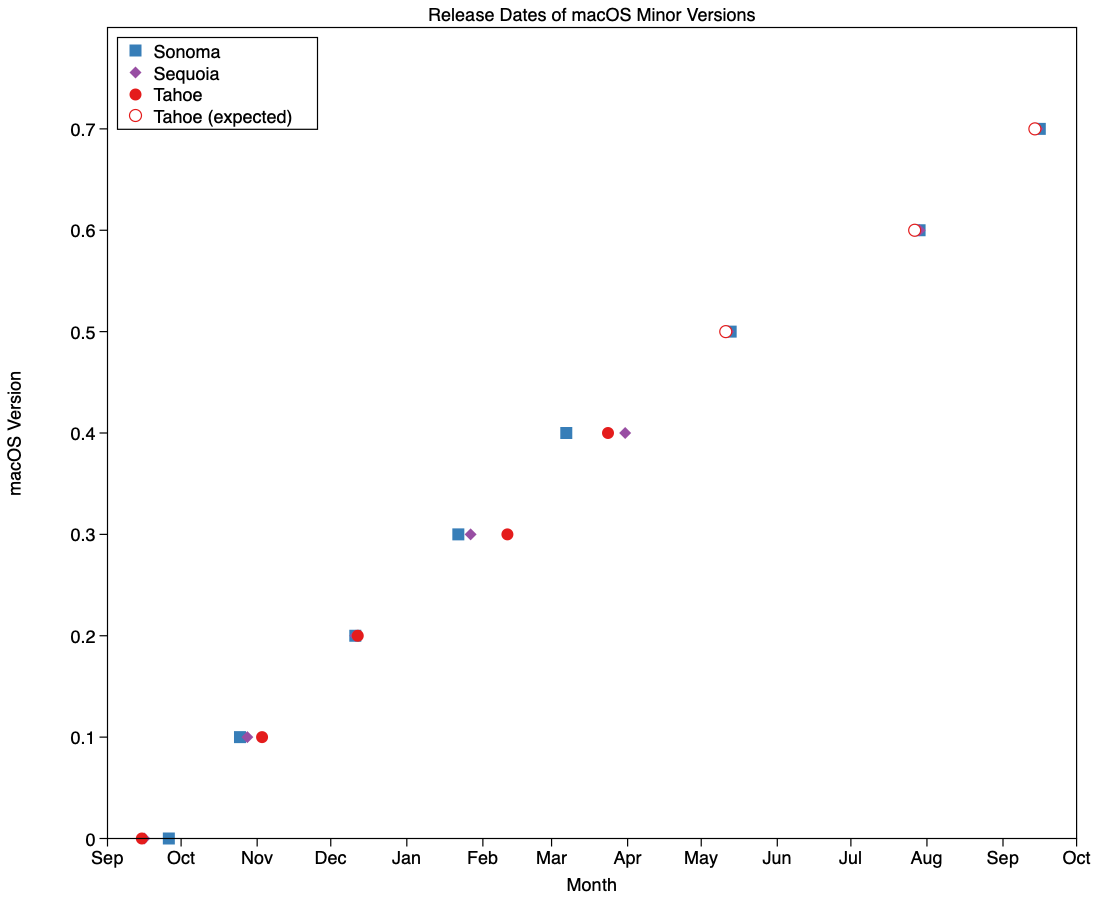
Since the pandemic disruption settled, minor version updates to macOS have become more regular. Looking across Sonoma, Sequoia and Tahoe, greatest variation in their timing has been in their x.3 and x.4 releases, that have varied between 22 Jan – 11 Feb, and 7 – 31 March, respectively. x.5 to x.7 have been more consistent, as they’re more tightly constrained by events including WWDC, the subsequent new beta season, and for some maybe even a vacation.

Those are summarised in the chart above, together with my predictions for the dates we should expect the remaining minor versions of Tahoe. Those should bring its cycle to look like:

  • 26.0 – 15 September 2025
  • 26.1 – 3 November 2025
  • 26.2 – 12 December 2025
  • 26.3 – 11 February 2026
  • 26.4 – 24 March 2026
  • 26.5 – 11 May 2026
  • 26.6 – 27 July 2026
  • 26.7 – 14 September 2026.

Where my forecasts are given in italics. Patch releases, such as 26.3.1, and BSIs occur outside that schedule. While we’re on the topic of BSIs, all indications are that Apple only intends to provide them for the current release of macOS, as it did with RSRs, which means that those Macs staying with Tahoe from 26.7 will no longer get them. It’s unclear how significant a loss that might prove.

WWDC this year is being held between 8-12 June, and will almost certainly bring the first developer beta release of macOS 27.0 (and all Apple’s other OSes). That’s likely to be made available to public beta-testers in early July. This is particularly significant this year, as it will be the first version of macOS to run exclusively on Apple silicon Macs.

For those with Intel Macs, or intending to remain with older versions of macOS, likely dates of release for scheduled security updates to Sonoma and Sequoia are:

  • 15.7.6, 14.8.6 – 11 May 2026
  • 15.7.7, 14.8.7 – 27 July 2026
  • 15.7.8, 14.8.8 – 25 August 2026
  • 15.8 – 14 September 2026.

The date at the end of August is possible, but less likely than the previous two. So far this year, security updates for Sonoma and Sequoia have been keeping reasonably close to those for Tahoe, in terms of vulnerabilities addressed, so the security gap between them has been rather less than in previous cycles.

However, the important message here is that it’s unlikely that Sonoma will receive any further security updates after the end of August this year. If your Mac is capable of being upgraded to Sequoia, now is the time to plan that, or it’ll all too quickly be September and your macOS will have lost its last support.

Similarly, if you’ve been holding back from upgrading to Tahoe in the hope that it will undergo interface improvements, I’m afraid that’s now looking increasingly unlikely. If it’s an Intel Mac capable of running Tahoe, there’s little point in avoiding making that decision any longer. There’s only limited time and scope left for improvement in macOS 26, with most engineers now more focussed on getting macOS 27 ready for WWDC.

Key forecasts

  • 26.5, 15.7.6, 14.8.6 – 11 May 2026
  • 27.0 developer beta – 8 June 2026
  • 27.0 public beta – 8 July 2026
  • 26.6, 15.7.7, 14.8.7 – 27 July 2026
  • 27.0, 26.7, 15.8 – 14 September 2026.

不要让年轻人为不必要的战争送命

简繁中文
纽约时报 出版语言
字体大小
专栏作者

不要让年轻人为不必要的战争送命

纪思道
Mark Peterson for The New York Times
我在越战期间还是个孩子,那时几乎不可能不注意到反战抗议。我记得当时有一种普遍情绪,充分体现在了参议员乔治·麦戈文的一句话中:“我厌倦了老年人构想战争,却让年轻人去打。”
而现在,这似乎又在重演。
特朗普总统在伊朗战争问题上走到了一个岔路口。一条路是外交途径,特朗普也试图让金融市场放心,我们正朝着那个方向前进。他声称,伊朗正在“‘恳求’我们达成协议”。
问题在于,伊朗实际上并没有在恳求达成协议。恰恰相反,它通过将霍尔木兹海峡关闭、只允许本国船只通行,获得了巨大的筹码。伊朗人想必在想,他们在与奥巴马总统达成的协议中基本上放弃了核计划,却只得到了区区4亿美元(后来又获得了一些)。而在这个月,伊朗只需要将霍尔木兹海峡封锁几周,特朗普政府就解除了部分石油制裁,其价值可能高达140亿美元。难怪伊朗似乎觉得自己占了上风。
广告
因此,尽管特朗普可能希望找到一个台阶下,但他面临的难题在于,现在达成的任何协议都会远逊于伊朗上个月据称提出的条件(即暂停所有铀浓缩活动三年,并在此后施加严格限制)。
我支持外交途径,但实话实说:任何协议都可能相当糟糕,并且会巩固一个压迫本国人民、威胁整个地区安全的残暴政权。
由于外交选项如此缺乏吸引力,特朗普似乎准备选择一条更糟糕的道路:派遣地面部队入侵伊朗。他正在向该地区增派数千名海军陆战队员和伞兵,而《华尔街日报》报道称,五角大楼正在考虑是否再增派1万名地面部队
“这是一个危险的时刻,”约翰斯·霍普金斯大学资深伊朗问题专家瓦利·纳斯尔告诉我。“也许特朗普别无选择,只能走这条路,因为现在走到谈判桌前就等于承认失败。但这是他自己造成的困境。”
最受关注的打击目标是哈尔克岛——伊朗的主要石油出口基地。是的,海军陆战队或许能拿下哈尔克岛,尽管据报道伊朗人已经布设了陷阱并加强了防御。正如特朗普的心腹、参议员林赛·格雷厄姆所说:“我们打下过硫磺岛,我们也能拿下这里。”格雷厄姆没有提到的是,在二战末期攻占日本硫磺岛时,有2.6万名美军伤亡。
问题不仅在于占领哈尔克岛,更大的噩梦在于此后如何一天天、一周周地保护驻扎在那里的部队免受无人机和其他攻击。
广告
美国在该地区拥有多处坚固的军事基地,距离伊朗要远得多,但即便如此,美军也未能完全保护这些基地,士兵们被迫撤离到酒店。“美军在该地区使用的13个军事基地中,有许多几乎无法居住,”我在《纽约时报》的同事海伦·库珀和埃里克·施密特报道称。那么,如果我们连自己的基地都保护不了,又该如何保护被投放到一座伊朗岛屿上的海军陆战队员呢?
那为什么还要夺取哈尔克岛?鹰派的理论是,如果失去石油收入,伊朗将被迫投降。“控制那个岛,让这个政权自生自灭,”格雷厄姆敦促道。
不幸的是,这种理论很可能是错误的。
“即使我们拿下哈尔克岛,伊朗也不会投降,”曾任以色列国防军情报局首席伊朗问题分析师丹尼斯·西特里诺维奇告诉我。“一切都会不断升级,油价等等都将大幅上涨。”
如果特朗普真的想夺取领土,更好的选择或许是几个较小的岛屿——阿布穆萨岛和大小通布岛——阿联酋也对这些岛屿提出了主权主张。美国与阿联酋的联合部队可以夺取这些岛屿,然后由阿联酋方面驻守。
但即便如此,这也将是一次巨大的升级。现实是,任何夺取伊控领土的行动都极有可能招致伊朗的报复,比如攻击该地区的能源基础设施——更可怕的是,袭击为一些海湾城市提供水源的海水淡化厂。一旦炼油设施瘫痪,我们可能会在未来数年面临石油和天然气短缺。也门的胡塞武装也可能加入冲突,通过封锁曼德海峡来阻断航运。曼德海峡是红海的咽喉要道,相当于波斯湾的霍尔木兹海峡。
广告
“我不认为这会在短期内结束,”纳斯尔警告说。“我认为局势变得更加糟糕、让美国付出巨大代价的风险相当高。”
如果特朗普派遣地面部队,他的目的很可能是“以升级促降级”,希望借此获得对伊朗的筹码,从而谈成一笔更有利的协议。这种可能性是存在的。但我更倾向于相反的判断:金融市场的崩溃反而会让伊朗获得比现在更大的筹码。
伊朗政权可能也比我们更有战略耐心。别忘了,1980年伊拉克入侵伊朗后,伊朗在1982年收复了失地,但因愤怒而拒绝停火,又打了六年仗,希望能推翻伊拉克政权。我们有同样的持久力吗?
尽管存在诸多不确定性,但有一个我在近距离目睹战争后深信不疑的道理:老一辈不应通过让年轻人为不必要的战争送命来收拾他们自己制造的烂摊子。

免费下载 纽约时报中文网
iOS 和 Android App

点击下载iOS App 点击下载Android App
© 2026 The New York Times Company.

Megan Thee Stallion taken to hospital during Moulin Rouge performance

Getty Images Megan Thee Stallion makes her Broadway debut in Moulin Rouge! The Musical at Al Hirschfeld Theatre on March 24, 2026Getty Images
Megan Thee Stallion wows audiences on opening night of Moulin Rouge! The Musical on 24 March

Rapper Megan Thee Stallion had to be taken to hospital mid-way through her performance of Moulin Rouge! The Musical, in New York on Tuesday night, her representative has confirmed.

"Megan started feeling very ill and was promptly transported to a local hospital, where her symptoms are currently being evaluated," the spokesperson told US media outlets.

"We will share additional updates as more information becomes available."

The musician, 31, is performing as Zidler – the show's eccentric master of ceremonies – marking her highly anticipated Broadway debut.

Her hair stylist, Kellon Deryck, wrote on X: "Everyone say a prayer for Megan, we are all at the hospital."

Megan Thee Stallion, whose real name is Megan Pete, is scheduled to play Zidler until 17 May, the Moulin Rouge website says. Ahead of her premiere, she expressed excitement for briefly substituting concerts with theatre performances.

'HOTTIES IM ON BROADWAY!!" she wrote on social media after her first performance on 24 March, referencing her fanbase, called the "hotties".

Megan Thee Stallion is best-known for hits including Savage, WAP and Body.

In 2021, she won three Grammy awards for Best Rap Song, Best New Artist and Best Rap Performance. The following year she was nominated for Album of the Year.

Harold Zidler was first played by Danny Burstein in the original Broadway cast of Moulin Rouge, and won a coveted Tony award in 2020 for it. More recently, celebrity drag artist Bob the Drag Queen played Zidler in the musical for eight weeks earlier this year.

The BBC has contacted Megan Thee Stallion's team for comment.

特朗普为何积极推动美国“重返月球”

简繁中文
纽约时报 出版语言
字体大小

特朗普为何积极推动美国“重返月球”

PETER BAKER
2020年5月,特朗普总统在首个任期内访问肯尼迪航天中心,观看SpaceX的火箭发射。
2020年5月,特朗普总统在首个任期内访问肯尼迪航天中心,观看SpaceX的火箭发射。 Doug Mills/The New York Times
|1月中旬,贾里德·艾萨克曼就任NASA局长才一个月,正在办公室里,他的手机突然响了。
“贾里德,我想跟你聊聊,”唐纳德·特朗普总统在电话里说,艾萨克曼回忆这段对话。“我们在2028年这个时间窗口有没有针对火星的相关计划?你对核动力火箭怎么看?”
艾萨克曼领导的NASA正处在现代航天史上最具里程碑意义的时刻之一:阿耳忒弥斯二号发射任务即将实施。按照计划,执行此次任务的宇航员将绕月飞行,距离地球之远将超越人类历史上任何一次太空航行。总统的注意力却已经投向了这项任务之后的未来。
今年将迎来80岁生日的特朗普成长于阿波罗计划的年代。当时宇航员奔赴另一个星球,令地球上的人们浮想联翩。而如今,特朗普想要超越阿波罗11号及其他阿波罗系列任务创下的成就。月球基地!核动力火箭!火星之旅!无论最终要实现什么,规模必须足够宏大,而且必须在他2029年1月卸任前正式启动。
广告
这个热衷于把自己的名字刻在各大建筑上、梦想着把自己的头像加到拉什莫尔山总统群雕里的男人希望将太空探索推向新的高度——无论是字面意义还是象征意义,以此来创造历史。自肯尼迪与约翰逊执政时期的NASA黄金岁月以来,没有任何一任美国总统像特朗普这样对航天局施加如此之大的推动力度。
即将实施的阿耳忒弥斯二号发射将是这段征程的第一步。四名宇航员计划最早于本周三启程,执行绕月飞行任务。
1月,NASA局长贾里德·艾萨克曼(左二)与阿耳忒弥斯二号任务机组人员在肯尼迪航天中心合影。
1月,NASA局长贾里德·艾萨克曼(左二)与阿耳忒弥斯二号任务机组人员在肯尼迪航天中心合影。 Cassandra Klos for The New York Times
如果一切顺利,特朗普希望亲临发射现场,见证火箭升空。他要为美国的这一里程碑式成就庆贺,也希望这能成为自己政治遗产中的一笔。
在一次采访中,艾萨克曼表示,总统的这些目标背后是国家安全、商业、资源与技术利益的多重考量,同时也源于他对宏大事业异乎寻常的敏锐直觉。
“总统深知开展宏大、大胆事业的重要性,而且他在所有关键的技术领域都在践行这一点,”艾萨克曼说。“所以当他和我谈及重返月球时,他说的不是重复阿波罗计划。他会问:我们要不要建月球基地?月球经济会是什么样子?我们要做的不仅仅是插上一面国旗。”
艾萨克曼还说,事实上,特朗普已经明确表态,人类必须在月球驻留。“我多次听他说过:‘一定要确保,我们这次回去,不是开展像阿波罗计划那样短暂的任务,’”艾萨克曼回忆道。“他还特别强调:‘这次我们最好不要只带回几块石头。’”
广告
白宫发言人莉兹·休斯顿在声明中表示,总统正在其首个任期的“变革性成就基础上继续前行”。“凭借特朗普总统的美国优先政策,美国将带领人类走向太空,开启航天技术与太空探索领域突破性成就的新时代。”
入主白宫前,特朗普算不上航天爱好者。1969年尼尔·阿姆斯特朗与巴兹·奥尔德林实现月球登陆时,他23岁,但从未有人听说过他深情追忆当年观看登月直播的经历。
NASA拟建月球基地的艺术概念图。
NASA拟建月球基地的艺术概念图。 NASA
2015年,特朗普在新罕布什尔州举行竞选活动时,一个10岁的男孩向他询问太空相关的问题,当时这位总统候选人显得漠不关心。“眼下,我们有更棘手的问题——你明白吗?”他说。“我们得先把路上的坑洼补好。”
但随着时间推移,他逐渐意识到,修补路面坑洼与奔赴星辰大海终究不是一回事。2016年大选前几周,他的竞选团队代言人承诺,要为美国的航天计划勾勒“全新愿景”。
“竞选期间,他看清了太空事业与‘让美国再次伟大’这一更宏大愿景之间的关联,”乔治·华盛顿大学太空政策研究所所长斯科特·佩斯说。佩斯曾担任美国国家太空委员会执行秘书,该委员会正是特朗普在首个任期内重新组建的。
肯尼迪当年定下登月目标并非出于对太空探索的热爱,而是为了与苏联展开竞争。一旦美国赢得了这场太空竞赛,美国公众与历任总统就基本失去了对航天事业的兴趣。
尼克松取消了阿波罗计划的最后三次登月任务,将资源转向打造一款实用性更强的航天飞机。里根启动了永久性载人空间站的研发,比尔·克林顿则将其转变为美俄合作项目。老布什与小布什都曾定下先重返月球、再登陆火星的目标,却都未能取得实质性进展。奥巴马曾计划让宇航员登陆小行星,这一愿景最终也不了了之。
2019年7月,特朗普总统与宇航员迈克尔·柯林斯(特朗普右侧)和巴兹·奥尔德林(特朗普左侧)合影。
2019年7月,特朗普总统与宇航员迈克尔·柯林斯(特朗普右侧)和巴兹·奥尔德林(特朗普左侧)合影。 Erin Schaff/The New York Times
然而,特朗普却将太空视为一个可以让他留下印记的领域。阿波罗11号历史性登月50周年之际,他邀请奥尔德林以及同乘阿波罗11号的成员迈克尔·柯林斯到访白宫;2019年的国情咨文演讲中,他还特意邀请奥尔德林出席国会旁听席。2020年,当埃隆·马斯克的公司帮助美国宇航局恢复了从本土向国际空间站发射宇航员的能力时,他专程飞往佛罗里达,亲临现场见证了SpaceX公司的发射任务。
但总统是否会持续关注阿耳忒弥斯二号任务目前还是未知数。随着发射日期一再推迟,特朗普并未采取任何行动来引起人们对该任务的关注。尽管执行此次任务的四名宇航员出席了他2月的国情咨文演讲,坐在国会旁听席上,特朗普却既没有向他们致意,也没有提及这次太空任务。
广告
阿耳忒弥斯二号任务之后,NASA的月球计划仍面临诸多不确定性。而能否让全世界持续关注这项事业很大程度上取决于特朗普是否会持续支持该计划。
“航天飞行这种技术难度极高的事业,必须要有白宫和总统亲自为其发声,”哈里森·施密特说。“这一点是毋庸置疑的。”1972年,作为阿波罗17号任务的宇航员,施密特成为最后两位踏上月球表面的人类之一,也是如今仍在世的仅有的四位登月宇航员之一。

Peter Baker是《纽约时报》首席白宫记者。特朗普是他报道的第六任美国总统,有时他也撰写将总统和美国政府置于更宏观的背景和历史框架下的分析性文章。

翻译:纽约时报中文网

免费下载 纽约时报中文网
iOS 和 Android App

点击下载iOS App 点击下载Android App
© 2026 The New York Times Company.

Weight-loss jabs will be offered on NHS for people at risk of further heart attacks

Getty Images A woman uses a pre-filled injection pen to administer a dose. She is lifting her t-shirt to be able to inject.Getty Images

Weight-loss jab Wegovy will be offered for free on the NHS to more than a million people in England at risk of heart attacks and strokes.

The watchdog NICE says people with these health issues, or serious circulation problems in their legs, and who are overweight, should have the weekly jab "as an extra layer of protection".

A GP or specialist will check if it is the right option for those already taking other heart medicines, such as statins, and alongside a healthy diet.

Drug trials suggest Wegovy can help slash the risk of future heart and circulation problems.

Cutting heart risk

In tests on tens of thousands of people, the jabs - alongside existing heart medicines - were linked to a 20% reduced risk of heart attacks and strokes.

Importantly, benefits were seen early in the clinical trial, before significant weight loss occurred, suggesting the drug works directly on the heart and blood vessels, not just through weight loss, says NICE (the National Institute for Health and Care Excellence).

Each year in the UK, there are around 100,000 hospital admissions due to heart attacks, another 100,000 people experience a stroke and around 350,000 people live with peripheral arterial disease.

People who have already had one of these health issues are at higher risk of experiencing more problems and stand to benefit from medicines that can cut that risk.

Disease might be prevented in around seven in 10 cases, experts estimate, based on best evidence.

Helen Knight, from NICE, said: "We know that people who have already had a heart attack or stroke are living with real fear that it could happen again.

"The evidence from the clinical trial is compelling. It showed that people taking semaglutide alongside their existing heart medicines were significantly less likely to have another heart attack or stroke.

"Today's decision gives thousands of people in that situation an extra layer of protection, on top of the medicines they are already taking."

Patients prescribed Wegovy will be able to self-administer the drug at home using a special pen injector device.

It is recommended for those with a Body Mass Index (BMI) classed as overweight or obese - higher or equal to 27.

Rollout should begin this summer.

The drug, also known as semaglutide, works as an appetite suppressant by mimicking a hormone called GLP-1 that makes people feel fuller, which can help them lose weight.

It also slows down how quickly food is digested. Some people may experience bloating, nausea or discomfort as a side effect.

Doctors should also prescribe lifestyle changes that include eating healthily and getting enough exercise to help people keep the weight off.

Currently, treatment with Wegovy is limited to two years on the NHS through specialist services and its long-term risks are still being studied.

Many say the treatment should be considered life-long, given the risk of relapse.

NICE says the NHS has reached an agreement with the pharmaceutical company Novo Nordisk that makes the treatment, ensuring it will be cost-effective.

Dr Sonya Babu-Narayan from the British Heart Foundation said she hoped the injections could be made available to everyone who could benefit "as soon as possible".

Prof Robert Storey, an expert in heart health at the University of Sheffield, warned GLP-1 drugs could reduce muscle mass as well as fat.

"Physical activity, such as resistance training, is important to counteract potential negative effects on muscle strength," he added.

Pay rise for 2.7 million people as minimum wage increase comes into force

iStock A woman working as a cleaner in an office building. She is wearing yellow rubber gloves, a striped top and a blue apron. iStock
The Treasury said around 2.7 million people are on minimum wage

Around 2.7 million people are set to receive a pay rise this week as the national minimum wage goes up by 50p to £12.71 for over 21s.

Workers aged 18-20 will see an 85p rise to £10.85, and under-18s and apprentices will get 45p more to £8 an hour.

Campaigners have welcomed the increases, but businesses have said the higher wage bills will force them to increase prices or cut staff.

The Low Pay Commission, the government agency which recommended the increases, said previous minimum wage rises for over-21s had "not had a significant negative impact on jobs".

Prime Minister Sir Keir Starmer said wages were going up "for the lowest paid" but said the government "must go further to bear down on costs".

Spencer Bowman is the managing director of of Mettricks, a chain of four coffee shops in Southampton. He says he would normally be "thrilled" to pay staff more, but "the cost increases have got to be sustainable".

"There's nothing that I'd want more than to ensure that my team can earn a really fair amount of money for a fair day's work. And it's been one of my long-term ambitions to see hospitality workers, my employees, paid far more."

But Spencer says his business is being squeezed from every angle – as well as minimum wage, he has had increases in business rates, national insurance, and statutory sick pay. He also expects energy bills to go up because of the war in the Middle East.

"We're running on a minimum number of staff on shift. We can't run on fewer people," he says.

"If something doesn't give somewhere, we will be closing sites.

Spencer Bowman, a white man, standing in a coffee shop. He is wearing a blue t shirt with the shop's logo on it.
Spencer Bowman says he may have to close one of his four coffee shops due to cost pressures

"It doesn't make any sense. Revenue is up. Our customer numbers are up. But our costs everywhere have hit a point where we're not financially sustainable and if that continues, there's only one outcome for that."

The minimum wage increases are on top of a 6.7% rise for over-21s and a 16.3% rise for 18 to 20-year-olds respectively last year, when there was also a rise in employers' National Insurance contributions.

Ministers are considering slowing down plans to pay adults of all ages the same minimum wage.

Labour committed in their election manifesto to remove "discretionary age bands" and increase the wages of 18 to 20-year-olds so they are paid the same as those over 21.

Ifunanya Ezechukwu, 25, calls the minimum wage rise a "step in the right direction".

"Especially with the cost of living being really bad, people need more money so they can actually afford the basics," she tells BBC Newsbeat.

She doesn't think employers paying staff more will necessarily translate to fewer job opportunities.

"I feel like they're probably just going to up the prices of their services, so I don't think there'll be less job opportunities," she says.

"I just feel like some things might get more expensive, which is unfortunate, and then the cycle just continues."

Ifunanya Ezechukwu smiles as she speaks in to a green BBC microphone.
Ifunanya says people need more money to afford the basics

Alex McCarthy, a university student who works part-time in a pub, says he is feeling "very, very happy" about the rise.

But the 18-year-old says it probably won't be enough for some of his friends, who are working while living at university but are still struggling to do weekly shops and are having to borrow money off their parents.

Amelia Evans, 18, believes the rise is necessary because "everything is going up in price". But she is concerned it will limit her job opportunities.

"So far this year I think I've done maybe 20 applications, and haven't got any. I feel like it's going to impact me even more now."

When Chancellor Rachel Reeves announced the increases in the Budget last year, she said the cost of living was still the biggest issue for working people.

"The economy isn't working well enough for those on the lowest incomes," she added.

At the time, the Treasury said the new minimum wage rates for 2026 struck a balance between "the needs of workers, the affordability for businesses and the opportunities for employment".

The Living Wage Foundation has welcomed the rises but says they do not go far enough.

The Foundation calculates what is known as the Real Living Wage, which it says is a more accurate reflection of the cost of living in the UK. It currently stands at £13.45 across the UK and £14.80 in London.

Kate Chapman, the executive director of the Living Wage Foundation, said one in seven businesses now pay the Real Living Wage.

"That's because they know the Living Wage is good for people, good for society and good for business," she said.

The British Chamber of Commerce has said that tax and labour costs are the biggest concerns for British businesses.

In its quarterly survey of 4,000 firms, 73% said labour costs are putting pressure on them to raise prices.

Additional reporting by Georgia Levy-Collins, Lizzy Bella, and Jemma Crew

苹果 50 年,什么都被抄走了,除了这一样

2002 年,苹果申请了一项专利。

无关芯片、屏幕、系统这些「硬货」,只聚焦在一颗灯上——那颗 MacBook 合上后,机身前端小小的 LED 灯。

专利编号 US 6658577 B2,描述的是一个「呼吸状态 LED 指示灯」。苹果工程师研究了成年人静息状态下的呼吸频率,大概在 12-20 之间,于是取了下限,让这颗状态指示灯以每分钟 12 次的节奏明灭,亮起的过程比熄灭的过程略短,模拟一次真实的吸气与呼气。

专利中还特别写道:根据本发明,睡眠模式指示灯的闪烁效果模仿了呼吸的节奏,这在心理上对人有吸引力。

没有用户会拿秒表去计算这颗灯的频率,也不会有评测会提到这个细节,但苹果为它做了研究,最终选定了一个让人深夜看到时不会焦虑的频率。

这颗灯如何闪烁,几乎毫不影响它的功能,但却划出了一条关于「品味」的分明泾渭。

1

要聊到苹果的品味源流,自然离不开创始人史蒂夫 · 乔布斯,他对「品味」的近乎执拗,彻底塑形了这家企业。

虽然这件事本身相对私人化,每个人对所谓「好品味」都有自己的看法,但不可否认的是,对设计、艺术、禅宗天生就更有浓厚兴趣的乔布斯,确实具有普世意义上的好品味。

1973 年,乔布斯从里德学院退学。

但他没有马上离开学校,而是继续旁听一些课程,其中一门是书法课。教课的人名为罗伯特 · 帕拉迪诺,是一位前特拉普派修士,一笔一画间带着修道院的沉静与讲究。

▲ 罗伯特 · 帕拉迪诺

乔布斯在那里学到了衬线字体与无衬线字体,学到了字母之间微妙的间距调整,以及版面设计的诀窍。

十年后,当乔布斯在打造第一台 Mac 电脑时,这些在多数人眼里「无用」的知识又再次在他脑海里冒了出来。

因此,Mac 电脑采用了位图显示,可以支持无数种字体,苹果还聘请了专人和乔布斯一同设计了大量字体。

▲ Macintosh 上的字体

当时苹果的其他高层无法理解乔布斯对 Mac 字体的痴迷,认为这是在「浪费时间」。结果,这些漂亮的字体,以及其与激光打印机和图形功能的结合,让 Mac 催生出了桌面出版行业,并从中大举获利。

这是一个典型的「乔布斯品味」案例,乔布斯对此相当满意,并认为如果自己没上那门书法课,个人电脑时至今日都可能不会有漂亮的字体,因为 Windows 界面深受 Mac 影响。

在 Mac 之前,没人认为电脑屏幕上的字需要好看。

一个退学生从修士那里学到的书法美学,最终改写了全世界每一块屏幕上文字的面貌。乔布斯说这叫「connecting the dots」,将点连成线。

但能连上这些点的前提是,你得先有这些点。一个只活在代码和数据里的人,连不出这条线。

在他成长的时代,硅谷也同步崛起,大多数科技公司里,工程师地位无可挑战,设计师只是成本项,技术决策由效率和数据驱动。

这是纯粹的工具理性,什么跑得更快,什么转化率更高,什么能更节省成本,这些才是做产品的第一标准。

▲ 左边:Macintosh,右边:IBM PC,图源:Digitalfire

但在乔布斯眼中,设计师、艺术家和工程师一视同仁,甚至在苹果的很多时候,是先有了产品设计,然后乔布斯和艾维再去推动工程实现。

有时候,这些决定是相当「反常识」的。

iMac G3 外壳顶部有一个内嵌的提手,它几乎没有实际意义,因为这是一台台式电脑,没有人会提着它到处走。

艾维解释,加入提手的意义在于让这台计算机「平易近人」,让大众更愿意接触计算机,乔布斯非常支持这个设计,即使它成本高昂。

最终,世人永远记住了这个提手。

这说明,苹果遵循的是「价值理性」,追问的首先是「值不值得做」,然后才是「能不能做到」。

这是一种独立思考的能力,而不是照抄行业的现成答案,是看到千篇一律的选择时,跳出框架给出一个不一样的答案。

一家遵循工具理性的公司,会在睡眠指示灯上选最省电的方案;一家遵循价值理性的公司,会去研究人类的呼吸频率,然后为一颗灯申请专利。

乔布斯并不将自己视作单纯的企业家,也不认为自己的团队只是工程人员。在初代 Macintosh 电脑的机壳内部,有着这四十五人的签名,因为「真正的艺术家会在作品上签名」。

从皮克斯,到 iPad 2 发布会,乔布斯很喜欢提到一句 Slogan:「科技与人文的交汇」,不少人认为这是公关金句。

但你究竟在信奉着什么,产品会替你诉说一切。

2

品味并不只是「要做什么」,更多是知道「不做什么」。这种取舍的能力,自史蒂夫·乔布斯时代起,便被写入苹果的文化基因,成为了「极简主义」的核心表达。

这同样是一种必须经过独立思考才能得到的结果。极简主义不是「为减而减」,需要去审视那些习以为常的惯例,是真正必要,抑或是只是多余。

在乔布斯离开、斯卡利掌舵后,苹果曾经经历了一个「失去品味」的低谷。

那时,苹果推出了 Newton MessagePad,某种意义上说,它的理念接近 15 年后的 iPhone,是一台使用手写笔交互的触控掌上设备,几乎是当时的苹果唯一能称得上「创新」的产品。

但 Newton 过度追求功能的丰富性,外形极其臃肿,更像当年苹果鄙夷的 IBM 产品;更要命的是,这台产品出厂时有将近数千个漏洞,手写笔输入的效果很糟糕,明显是还没有打磨完全,当时市面s没有人喜欢这台设备。

毫不意外,等乔布斯回来执掌大权,立马不计成本直接大刀阔斧砍掉了 Newton 整个产品线。

对于 Newton 上这只「手写笔」,乔布斯更是深恶痛绝,「明明上帝给了我们 10 支手写笔,我们何必再发明一个?」

「臃肿」的问题不止停留在单一产品设计上,当时的苹果电脑同时在售卖 Apple II、Macintosh、Lisa、Performa 等产品线,定位重复,亮点匮乏,销量低迷。

所以,乔布斯直接对整个产品线动手术,70% 的品类被去除,然后画了一个四宫格,将他们需要做的电脑品类数量压缩到最少。

这个动作,已经成了商学院课堂上的经典案例,但讲的都是「聚焦」「战略收缩」这些更「专业」的解读。

其实乔布斯想得还真没那么多,他只是觉得,这些产品不配存在。

所有人都会做加法。但知道该删什么、敢删什么,这需要判断力。

在 iPod 诞生之前,市场上已经有不少 MP3 播放器,它们功能更多,按钮更丰富,文件管理更灵活,但没有人觉得它们好用——只能装 16 首歌,并且功能眼花缭乱。

iPod 反其道而行之,交互被删剩一个转盘,和听歌无关的功能统统去掉,必须要交由 Mac 完成。

于是乎,iPod 几乎只为「聆听」一个行为服务,不能做歌单,不能删歌,却能装下 1000 首歌曲。这也是因为乔布斯立下了一个规矩:iPod 上所有功能使用,按键次数都不能超过三次

至今,我仍然钟情 iPod 的「转盘」,它用简单直觉的动作,替代了过去需要不断按下按钮的繁琐操作。

本质上,这是一种对常规的反叛,交互不一定需要通过按钮完成,跳出框架反而会有更合理的解决方式。

类似的决断,在将近 15 年后出现在了苹果的另一款音频产品上。

似乎自电器诞生起,「电源键」就如影随形。人们从不追问它为何存在,反倒是在它消失时,质疑才会汹涌而来。

但在 AirPods 去掉电源键之后,用户才发现,不受「关机」制约,体验竟变得如此畅快舒服,自然而然,几乎无需思考。

▲ AirPods Pro

所以你看现在的 TWS 无线耳机,哪里还有什么开关,所有人都习惯了打开盖子直接把耳机塞进耳朵的动作。

大多数公司的产品决策由数据驱动,要做大量的市场调查,去了解用户要什么,竞品做了什么,什么趋势正在起来。

苹果的产品决策由一个更刺眼的问题驱动:这个东西有没有必要出现在世界上?

前者是在回应市场,后者则直接定义市场。

我们看到的极简主义,只不过是这个过程最终呈现的结果,而推动它产生的判断力,就是「品味」。

3

在乔布斯小时候,他的父亲保罗 · 乔布斯教导他:做一个衣柜,哪怕是贴墙看不见的背面,也不应该用胶合板敷衍,而应该继续用一块漂亮的木头,因为你知道它始终在哪里。

▲ 左:Paul Jobs,右:Steve Jobs

在看不见处下工夫,在无用之用上较真,一直是乔布斯和苹果的不妥协之处。

对于 Apple II 内部的电路板布局,乔布斯要求设计得尽善尽美,芯片、插口都要排列整齐,即使很多人不关心也看不见。

时至今日,苹果产品全面采用封闭式设计,个人用户很难自行打开一台 Mac,但从最昂贵的 MacBook Pro,到最便宜的 MacBook Neo,内部的电路板排布,依旧执拗地遵守着对称美学。

我相信世界上绝大部分人都很难理解,为什么苹果要将 Home 键和触控板做成不可按压的平面,然后再用 Tapic Engine 来模拟按动的手感,这样做的成本更高,且用户获得的反馈感几乎没有不同的。

但通过这种方式,苹果几乎将这两个部分的接缝完全消除,也没有影响任何用户体验。

和力度 Home 键一同问世的,是那台经典的 Jet Black iPhone 7,通过技术层面尽可能挤压物理接缝,再通过通体的高光掩盖这些感知上的「缝隙」。

最终,连正面的那颗标志性的按钮,都彻底融入了玻璃之中。

如果说这弥合了手机物理的接合处,那么 Apple Watch 那颗手感以假乱真的数字表冠,则抹平了交互上的「缝隙」。

苹果利用振动马达,赋予一颗平滑的旋钮齿轮般的转动感,让第一次面对 Apple Watch 这个新兴物种的用户,可以将以往操作机械手表指针的经验,平滑转移到操作 Apple Watch 的应用界面上。

这不是一种炫技——既然是「炫」,那必然是大部分用户能明确感知到的细节,但多数用户不关心 MacBook 里面长什么样,也不会意识到这些按钮背后的玄机。

这是一种比「完美主义」更深一层的追求,产品的完整性不由用户的注意力边界来定义。

好不好,不取决于有没有人在看,只取决于你是不是真的想把它做「好」。

4

现在随便走进一家消费电子品牌门店,各种产品上或多或少的白色、圆角、留白、克制设计,门店的玻璃幕墙和木质长桌,都不难发现苹果的影子。

▲ 北京三里屯 Apple Store

这些东西都是可以被计算的,可以拆解为流程、参数、方案,然后在另一个生产线上组装。

但品味本身无法被复现,你可以模仿别人的品味和设计,这个行为本身就暴露了你本身没有品味。

品味也没有参数,写不进规范,却支撑着所有决定,最终来到我们手上的产品,品味定义了它的一切。

50 岁的苹果,给这个行业,甚至这个世界最重要的一课,就是品味。

这不是说,苹果之前就不存在「有品味」的企业,但作为全球最有影响力的科技公司,苹果确实极大推动了全世界人民对品味的关注,面对一个产品,除了它好不好用,耐不耐用,我们已经完全习惯用「品味」去评价。

被品味所成就的苹果,如今更是被放在了大众更严格的「品味」放大镜下去审判,每一个细节都无所遁形。

不可否认,如今的苹果已不再是乔布斯与艾维时代的品味巅峰,产品设计更容易向功能和实用性妥协,也不再像以往那样,极度重视一些细枝末节,甚至还有一些被批评「没品位」的时刻。

▲ iPad Pro 广告,近年来苹果创意「翻车时刻」之一

不过,即使售价 3000 多元的 MacBook Neo,上手依旧是熟悉的铝合金机身细腻手感和扎实做工,在同价位几乎无出其右,低价但不廉价,这依旧是当下稀缺的品质和品味。

如果说苹果 50 年最大的遗产,我认为是证明了一件事:

在一个被工程效率和数据理性统治的行业里,品味可以赢。一家把价值判断置于工具理性之上的公司,赢了。

在今天,这个结论比以往任何时候都更值得被重新看见。

我们正在进入一个 AI 为所有人拉高平均线的时代。AI 能写出 80 分的文案、做出 80 分的设计、生成 80 分的代码。能力差距正在被快速抹平,「还不错」变得前所未有地容易获得。

但 AI 只是让抹平了门槛,天花板依旧在别处。

从 80 分做到 90 分,靠的还是专业能力;但从 90 分到 100 分,只有品味能突围,在 AI 给出的海量选项中,能够知道要什么,不要什么,知道什么才是更好的,比以往都要更重要。

计算可以穷举方案,却无法决定方向;数据可以逼近最优,却做不出判断。

这种能力,只能在人漫长而反复的审美积累与价值排序中生长出来。

这就是品味,那个唯一抄不走的东西。

品味,即苹果。

#欢迎关注爱范儿官方微信公众号:爱范儿(微信号:ifanr),更多精彩内容第一时间为您奉上。

所有人都在追赶 AI,但有个真相被忽略了……

2026 年,AI 的效率高到每天都像愚人节。当我们都在焦虑被时代抛下时,回头看看科技公司们曾经的「离谱脑洞」才发现:科技跑得再快,最终还是为了回到生活里。曾经的玩笑,给未来铺好了路。

来,看个视频,放松下。

#欢迎关注爱范儿官方微信公众号:爱范儿(微信号:ifanr),更多精彩内容第一时间为您奉上。

普京强化互联网管控,俄罗斯转向伊朗模式?

简繁中文
纽约时报 出版语言
字体大小

普京强化互联网管控,俄罗斯转向伊朗模式?

PAUL SONNE, VALERIE HOPKINS, OLEG MATSNEV
在乌克兰战争持续的四年间,俄罗斯日益加剧的种种压制手段中,几乎没有哪一项像互联网限制举措那样影响到如此多的人。
在乌克兰战争持续的四年间,俄罗斯日益加剧的种种压制手段中,几乎没有哪一项像互联网限制举措那样影响到如此多的人。 Alexander Zemlianichenko/Associated Press
3月,克里姆林宫步行几分钟外的一家购物中心发生火灾时,俄罗斯一家以敢拼著称的Telegram新闻频道派了一名记者赶赴现场。
但出现了一个问题。莫斯科市中心的移动数据完全中断,而该国最流行的应用程序Telegram也被限流。
“就像回到了1997年,”这个名叫“Ostorozhno Novosti”的新闻频道主编谢尔盖·季托夫说。他回忆道,由于无法发回照片或视频,派到前方的记者只能打编辑部的座机电话进行口述——“三辆消防车,两辆救护车,很多人在奔跑。”
这起持续数天、发生在莫斯科最重要区域的断网事件加剧了人们的担忧:总统普京可能会采取比俄罗斯人想象的更进一步的措施,将他们与外界隔绝,并在把该国的互联网完全置于克里姆林宫控制之下的过程中,打乱他们的日常生活。
最近几周,俄罗斯人面临两重中断。当局凭借新的技术能力和战时借口在特定区域关闭移动互联网。同时,他们也在屏蔽越来越多被数百万俄罗斯人使用的外国应用程序。
1月,遭围困的乌克兰康斯坦丁尼夫卡市,一名乌克兰步兵。俄罗斯以战争为借口在国内打压互联网自由。
1月,遭围困的乌克兰康斯坦丁尼夫卡市,一名乌克兰步兵。俄罗斯以战争为借口在国内打压互联网自由。 Tyler Hicks/The New York Times
政府称断网是出于安全考量,称这是为防范利用俄罗斯移动网络进行定位的乌克兰无人机袭击所采取的预防措施。但专家指出,政府也在实施定向断网措施,这种手段通常发生在社会动荡时期,比如今年席卷伊朗的大规模示威期间。
在许多俄罗斯人看来,普京对Telegram的打击更为激进。在封锁了Facebook、Instagram、WhatsApp和YouTube之后,这位俄罗斯领导人现在又采取行动,削弱一款每月有超过1亿俄罗斯人用于通信和阅读新闻的应用(包括阅读来自被俄罗斯封禁的流亡媒体的新闻)。
广告
与此同时,莫斯科方面正迫使俄罗斯人改用一款经克里姆林宫批准的“超级应用”——MAX。有俄罗斯媒体报道称,当局计划从周三起全面封锁Telegram,但有迹象显示,由于引发公众反弹,当局可能会推迟这一行动。
在乌克兰战争持续的四年间,俄罗斯日益加剧的种种压制手段中,几乎没有哪一项像互联网限制举措那样影响到如此多的人。
时断时续的断网和封锁造成了严重混乱,支撑日常生活的数字服务时有时无,迫使人们费尽周折寻找替代方案。
当莫斯科部分地区的移动互联网中断时,人们开始改用现金支付。打车软件无法使用后,一些人只能搭乘顺路车。对讲机、模拟电话线路、纸质地图以及老式MP3播放器的网上销量激增。甚至在克里姆林宫内,官员们也重新用起座机电话。
本月,莫斯科市中心的移动互联网中断令许多俄罗斯人感到震惊。
本月,莫斯科市中心的移动互联网中断令许多俄罗斯人感到震惊。 Igor Ivanko/Agence France-Presse — Getty Images
一些影响甚至是危险的。例如在断网期间,糖尿病儿童佩戴的血糖监测设备无法传输实时数据,而父母需要这些数据来调整胰岛素剂量。
在种种混乱中,公众愤怒的迹象开始显现,一些城市出现了针对断网和应用程序限流的抗议活动,尽管这些抗议被当局阻止。为了正常使用Telegram等应用,数百万俄罗斯人转而使用VPN来绕过限制。
Ostorozhno Novosti频道的主编季托夫强调,Telegram不仅仅是一个“社交网络”,更是俄罗斯所剩无几的自由互联网的基石。该媒体由俄罗斯名媛、前总统候选人克谢尼娅·索布恰克所有。
广告
“对俄罗斯人来说,至少对我这一代人——比如从20岁开始使用Telegram的那批人——它几乎就是他们全部的互联网生活,”季托夫说。从这个意义上讲,他说,“人们所熟悉的整个互联网体系,现在正在被摧毁。”
正在消失的自由
几十年来,俄罗斯一直享有一个相对自由、去中心化的互联网环境。一种充满活力的数字文化在这里生根发芽,人们可以自由地表达观点、组织政治活动,而且可以经常使用西方科技平台。
在2011年和2012年席卷莫斯科的大规模抗议活动之后,克里姆林宫开始将这种不受管控的俄罗斯互联网视为严重威胁。面对美国科技巨头的影响力,普京感到不满,于是着手打造一个“主权互联网”——一个他可以控制的、与外界隔绝的网络空间。
对克里姆林宫而言,也许没有人比反腐活动人士阿列克谢·纳瓦利内更具威胁性。他最初因在LiveJournal上揭露国家腐败走红。凭借获得数百万点击量的视频,他展示了爆火的网络内容如何在现实世界引发抗议。
在俄罗斯通信监管机构Roskomnadzor牵头下,当局封锁了他的网站,并施压西方科技巨头删除他的抗议投票应用和相关视频广告。
在2022年普京发动对乌克兰的全面入侵后,克里姆林宫开始以更为激进、更具破坏性的手段来收紧俄罗斯的互联网自由。
阿列克谢·纳瓦利内广泛的网络影响力曾对俄罗斯政府构成挑战。
阿列克谢·纳瓦利内广泛的网络影响力曾对俄罗斯政府构成挑战。 Sergey Ponomarev for The New York Times
莫斯科迅速屏蔽了Twitter、Instagram和Facebook,并最终将矛头指向YouTube——这个长期以来在俄罗斯使用最广泛的网站之一——以及WhatsApp,试图封杀它们。VPN的使用量随之激增。
在国家强力打压之下,Telegram一度仍是相对开放的空间。
广告
利用自己的Telegram频道网络,克里姆林宫依靠这款应用传播其战争宣传信息,士兵则使用该应用与家人保持联系,并为部队筹集资金。与此同时,俄罗斯民众仍可以读到未经审查的新闻和评论,甚至包括最尖锐的批评政府的声音。
其中一位批评者是俄罗斯雇佣兵头目叶夫根尼·普里戈任。他在Telegram上发布未经修饰,甚至夹杂粗口的前线视频。他在心怀不满的士兵中培养了一批狂热的追随者,这股势力在2023年演变成一场未遂政变,这也让克里姆林宫意识到,Telegram上的帖子可能催生现实中的威胁。
“敌对的通信形式”
两年多之后,俄罗斯通信监管机构Roskomnadzor宣布对Telegram进行限制,并在今年2月表示,该应用程序因未能保护个人数据、打击欺诈以及防止被恐怖分子和犯罪分子利用,因而违反了俄罗斯法律。
此后,对该服务的间歇性封锁开始出现。《纽约时报》在3月中旬使用分布在俄罗斯各地的72台服务器测试了访问Telegram的情况,发现其中只有39台能够加载该应用的网页版。
长期以来,一种普遍看法认为,由于俄罗斯的互联网起步时是自由的,从技术和政治层面来说,克里姆林宫都不可能再把“精灵”重新塞回瓶子里。
广告
德国外交关系委员会的俄罗斯问题分析师阿列娜·叶皮凡诺娃表示,尽管俄罗斯无法复制中国那种从一开始就封闭互联网的“防火长城”模式,但它正迅速转向伊朗模式。她说,这种模式包括对网站实行“白名单”、实施定点断网,以及建立一个受政府控制的内部局域网。
许多俄罗斯人,包括一些普京的支持者,都认为封禁Telegram做得太过分了。
这一决定甚至让长期形同橡皮图章的俄罗斯议会短暂出现了政治争论。
公正俄罗斯党的领导人、乌克兰战争的高调支持者谢尔盖·米罗诺夫称,Telegram是俄罗斯军队“唯一可靠的通信手段”。
别尔哥罗德州州长维亚切斯拉夫·格拉德科夫去年在莫斯科,照片来自俄罗斯官方媒体发布。他称Telegram是关键的生存基础设施。
别尔哥罗德州州长维亚切斯拉夫·格拉德科夫去年在莫斯科,照片来自俄罗斯官方媒体发布。他称Telegram是关键的生存基础设施。 Mikhail Metzel/Agence France-Presse — Getty Images
“那些正在流血牺牲的人无法与亲友取得联系,”米罗诺夫说。“你们在干什么,你们这些白痴?”
在俄罗斯国家杜马的一次投票中,包括米罗诺夫所在政党和共产党阵营在内的77名议员投票要求政府解释这一决定。该动议以102票反对未获通过,但暴露出罕见的意见分歧。
广告
普京此前曾表示,为了维护主权,莫斯科必须“扼杀”外国科技公司,但在该问题上他基本保持沉默。
不过,在3月5日克里姆林宫的一次会议上,他意味深长地询问一名军官,使用那些“不受我们控制”的通信系统,是否会对人员构成危险。
这名军官回答称确实如此,并称Telegram是一种“敌对的通信形式”。不过后来俄罗斯记者发现,这名军官本人却拥有Telegram的高级账号。
被压制的不满情绪
Telegram融合了类似Twitter和WhatsApp的功能,由出生于俄罗斯的科技亿万富翁帕维尔·杜罗夫创建,他现居阿联酋。杜罗夫谴责莫斯科此举是对言论自由的侵犯,是“一个害怕自己人民的国家的可悲景象”。俄罗斯方面已对他展开调查。
杜罗夫尚未宣布任何应对措施,但他可能通过技术手段调整Telegram,使俄罗斯用户在封锁的情况下仍能访问该应用。
组织抗议的尝试均告失败。
据俄罗斯政治活动人士德米特里·基西耶夫称,俄罗斯17个地区的28个城镇已提交了针对互联网限制的抗议活动许可申请,但全部被拒。俄罗斯人权组织OVD-Info表示,自2025年12月以来,至少有50人因参加反对互联网限制的抗议活动而被拘留。
在俄罗斯南部城市克拉斯诺达尔,一名支持战争的地方议员亚历山大·萨夫罗诺夫原本获得了举行一场200人规模抗议的许可,但随后又被撤销,当地官员称是出于安全考虑。
俄罗斯彼尔姆市,一场原计划针对Telegram限制的抗议活动许可被撤销后,警察出现在现场。
俄罗斯彼尔姆市,一场原计划针对Telegram限制的抗议活动许可被撤销后,警察出现在现场。 Associated Press
“左翼人士、右翼人士——许多人都不同意封禁和限制使用的做法,”他在电话采访中说。“政府甚至没有试图与公民进行清晰、严肃的对话,也没有向他们做任何解释。”
尽管人们表达了愤怒,并希望翻墙手段能够一直有效,但许多人也逐渐接受一个现实:未来将处于更严格的国家控制之下。
季托夫预测,他的新闻频道在政府管控的应用程序MAX上不会取得同样的成功。MAX的母公司、社交媒体巨头VK已经在对批评性的评论和新闻进行审查。但他说,他看不到任何能够回到过去的办法。
“很容易在互联网上看到社会各阶层的不满,”季托夫说。“但这种不满无处宣泄。即使在支持战争的人当中,也有很多对国家的批评,但每个人都多少已经明白,对此你无能为力。”

Alina Lobzina 、Nataliya Vasilyeva和Milana Mazaeva对本文有报道贡献。

Paul Sonne是一名国际新闻记者,报道俄罗斯新闻和普京的国内和国际政策产生的一系列影响,主要关注乌克兰战争。

Valerie Hopkins报道乌克兰战争和这场冲突正在如何改变俄罗斯、乌克兰、欧洲和美国,她常驻莫斯科。

翻译:纽约时报中文网

免费下载 纽约时报中文网
iOS 和 Android App

点击下载iOS App 点击下载Android App
© 2026 The New York Times Company.
❌