After Alexandre Calame’s views of Lake Geneva painted in the middle of the nineteenth century, the next great artist to devote as much attention to the lake was Ferdinand Hodler, a native of Bern, Switzerland. At the age of eighteen, Hodler had walked across the country to attend the Collège de Genève there, and train as a painter, initially by copying Calame’s paintings.
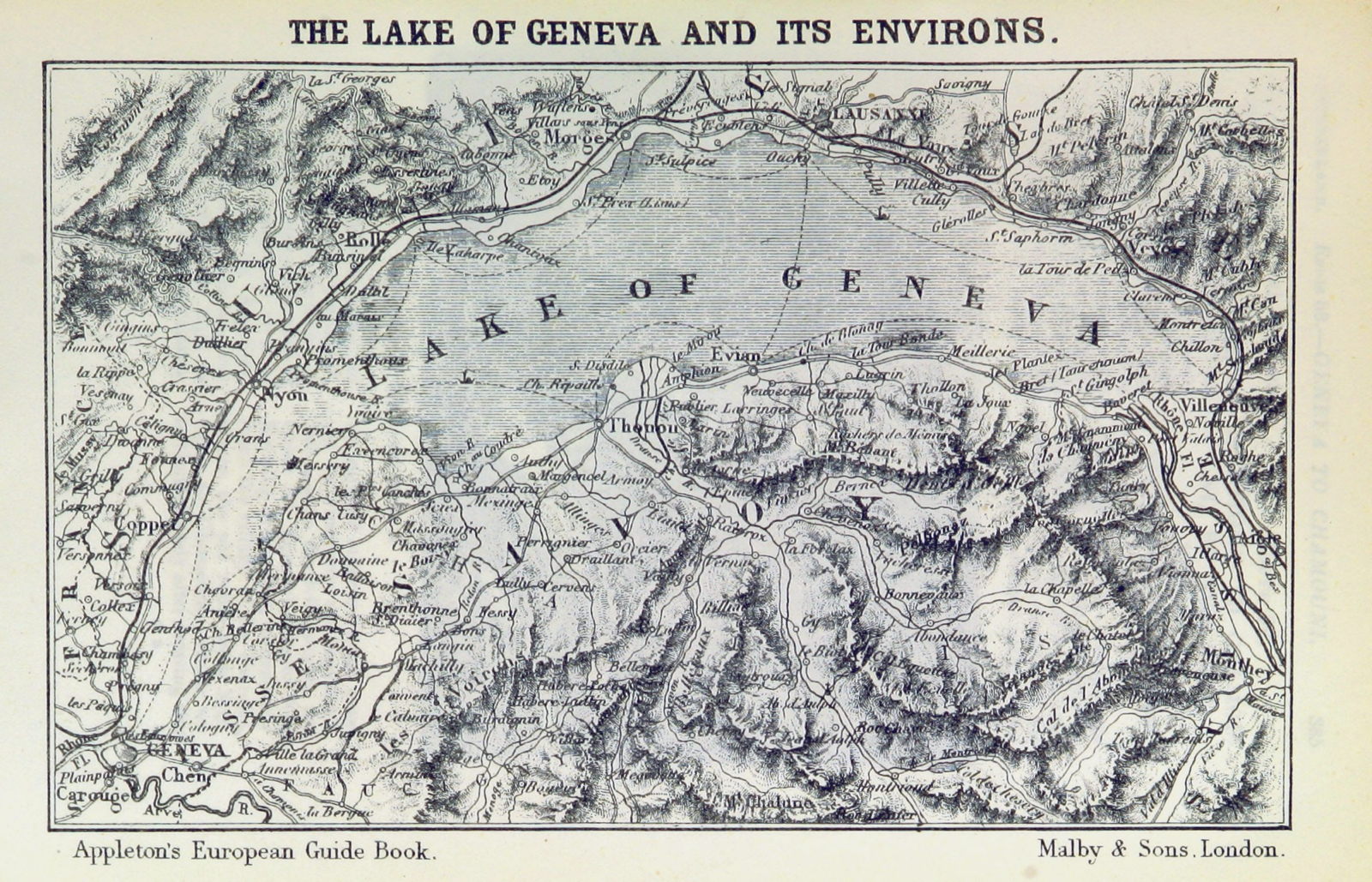
Daniel Appleton et al., Map of Lake Geneva (1877), p 521 in Appleton’s European Guide Book illustrated, 10th edition, D. Appleton & Co, New York. The British Library, London. Wikimedia Commons.Ferdinand Hodler (1853–1918), Lake Geneva from Chexbres (c 1898), oil on canvas, 100.5 × 130 cm, Private collection. Wikimedia Commons.
Hodler started painting a series of views from the north-eastern shore of Lake Geneva looking south, across to the major peaks of the Chablais Alps. He was to continue this series until his death twenty years later. Lake Geneva from Chexbres from about 1898 shows one of the first of these, painted near the village of Chexbres, between Lausanne and Montreux, in early winter.
Ferdinand Hodler (1853–1918), Lake Geneva from St Prex (1901), oil on canvas, 72 x 107 cm, Private collection. Wikimedia Commons.
Lake Geneva from Saint-Prex (1901) is another view across the lake, from a town to the west of Lausanne, looking south with a closer view of the peaks of the Chablais Alps. This appears to have been painted in the summer, with the trees in full leaf and a rich range of flowers. The clouds over the mountains are starting to become more organised in a regular rhythm, a trend that resulted in some of his most distinctive later landscapes.
Ferdinand Hodler (1853–1918), The Grammont (1905), oil on canvas, 65 x 105.5 cm, Private collection. Wikimedia Commons.
The Grammont (1905) shows this mountain in the Chablais Alps, to the south of the eastern end of Lake Geneva, towards which many of Hodler’s favourite views over that lake were aimed. Again he uses a limited palette; the lake itself reminds me of Gustav Klimt’s wonderful paintings of Attersee from a few years earlier, although Hodler’s darker blue ripples quickly vanish as the lake recedes from the viewer.
Ferdinand Hodler (1853–1918), Landscape at Lake Geneva (c 1906), media not known, 59.8 x 84.5 cm, Neue Pinakothek, Munich, Germany. Image by Rufus46, via Wikimedia Commons.
The following year, he painted Landscape at Lake Geneva.
Ferdinand Hodler (1853–1918), Rhythmic Landscape on Lake Geneva (1908), oil on canvas, 67 x 91 cm, Private collection. Wikimedia Commons.
One of the clearest examples of Hodler’s distinctive Parallelist landscapes is his Rhythmic Landscape on Lake Geneva from 1908. This was a second version of a view he had previously painted in 1905, when he wrote “This is perhaps the landscape in which I applied my compositional principles most felicitously.”
Most of his symmetry and rhythm is obvious; what may not be so apparent are the idiosyncratic reflections seen on the lake’s surface. The gaps in the train of cumulus clouds here become dark blue pillars, which are optically impossible, but are responsible for much of the rhythm in the lower half of the painting.
In the final years of Hodler’s life he painted some of the most sublime landscapes of his career. During the winter of 1917-18, his health deteriorated, but he continued to paint from the window of his room in Geneva, completing more than eighteen views during those final months. Here are three examples.
Ferdinand Hodler (1853–1918), Lake Geneva with Mont Blanc by Morning Light (1918), oil on canvas, 59 × 119.5 cm, Private collection. Wikimedia Commons.
In Lake Geneva with Mont Blanc by Morning Light (1918), one of the more complex paintings of this series, bands represent the lake shore, four different zones of the surface of the lake, the lowlands of the opposite bank, the mountain chains, and two zones of colour in the dawn sky. The lower section of the sky and the foreground shore echo in colour, and contrast in their pale lemon-orange with the blues of the other bands.
Ferdinand Hodler (1853–1918), Lake Geneva with Mont Blanc in the Morning Light (1918), oil on canvas, 65 x 91,5 cm, Kunsthaus Zürich, Zürich, Switzerland. Wikimedia Commons.
Lake Geneva with Mont Blanc in the Morning Light (1918) has a simpler structure, with the water, a band of reflections, the mass of the far shore and mountains merged, and the dawn sky. The dominant colour is the yellow to pale red of the dawn sky and its reflection.
Ferdinand Hodler (1853–1918), Lake Geneva with Mont Blanc in the (Red) Dawn Light (1918), oil on canvas, 74.5 x 150 cm, Private collection. Wikimedia Commons.
Lake Geneva with Mont Blanc in the (Red) Dawn Light (1918) is also simpler in its structure, with the water coloured by the sky, a zone of blue reflections of the far bank, the merged distant shore and mountains, and the sky.
In Hodler’s ultimate and most sublime landscapes, he eliminated the unnecessary detail, stating just the elements of water, earth, air, and the fire of the rising sun, in their natural rhythm. On 19 May 1918, Hodler died in Geneva, at the age of 65.
This weekend we’re off to visit Lake Geneva, also known by its French name of Lac Léman, the largest in Switzerland. It’s located in the far south-west of the country, where it forms much of its border with France. It makes a broad arc running north-east from the capital city of Geneva, with some of the highest peaks of the Alps to its south.
Daniel Appleton et al., Map of Lake Geneva (1877), p 521 in Appleton’s European Guide Book illustrated, 10th edition, D. Appleton & Co, New York. The British Library, London. Wikimedia Commons.
Today I start with a selection of paintings almost exclusively from the nineteenth century, when Switzerland was on the itinerary of the Grand Tour undertaken by aspiring young men of the upper class in both Europe and the Americas.
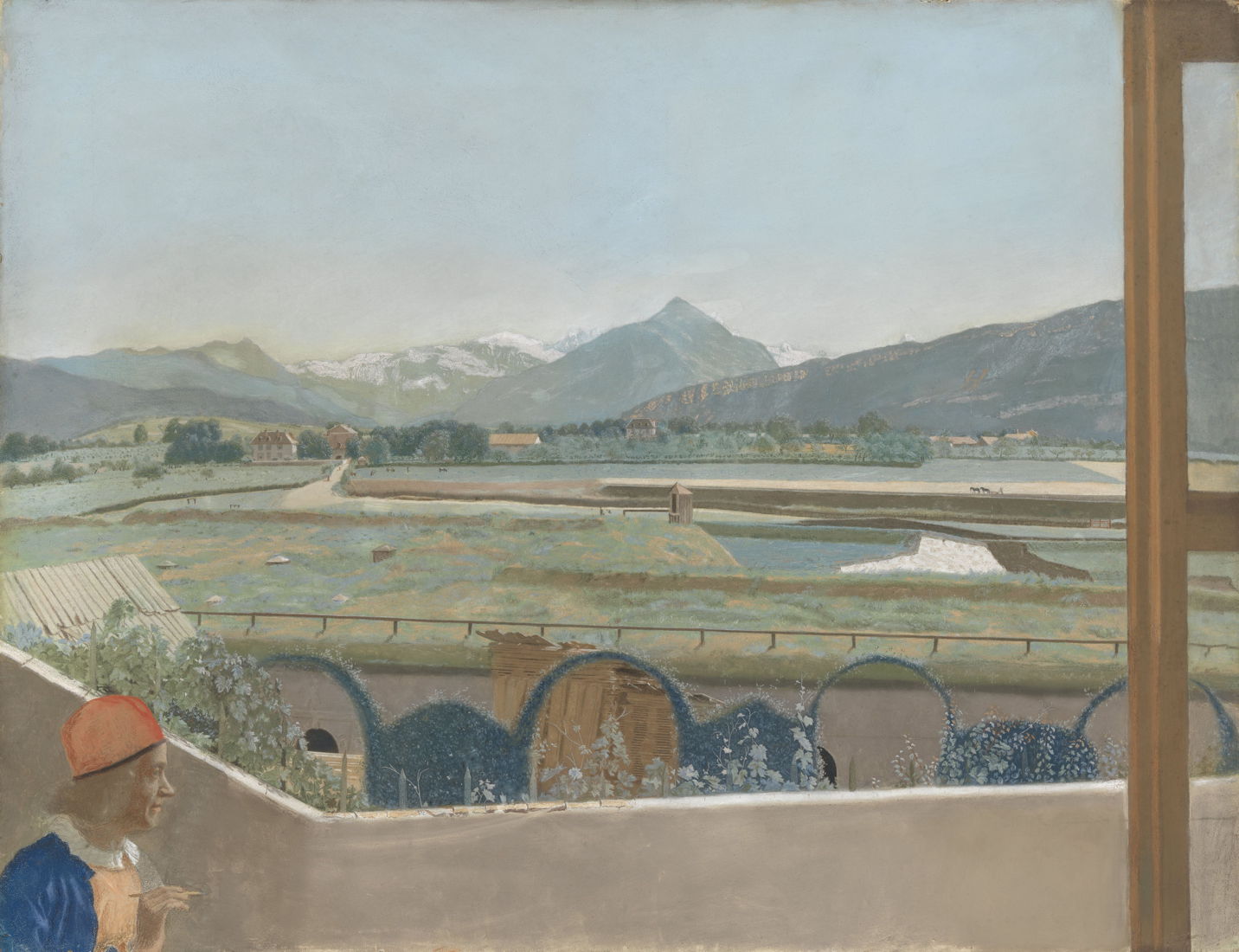
Jean-Étienne Liotard (1702-1789), View of the Mont Blanc Massif from the Artist’s Studio (1765-70), pastel on parchment, 46 x 59.7 cm, location not known. Wikimedia Commons.
The city of Geneva has long attracted artists, and it was here the eccentric pastellist Jean-Étienne Liotard was born and later kept his studio, and where he eventually retired. His View of the Mont Blanc Massif from the Artist’s Studio from 1765-70 reveals only a little of the southern extreme of the lake, with a cameo self-portrait.
Joseph Mallord William Turner (1775–1851), Lake Geneva and Mount Blanc (1802-05), watercolour, 90.5 x 128.6 cm, Yale Center for British Art, New Haven, CT. Wikimedia Commons.
JMW Turner was by no means the first to paint the lake, but his watercolour of Lake Geneva and Mount Blanc from 1802-05 is one of its earliest depictions by a major artist. This view looks south-east over the city of Geneva towards the Mont Blanc massif in the far distance.
Alexandre Calame (1810–1864), View of Bouveret (1833), oil on panel, 35 x 47.5 cm, location not known. Wikimedia Commons.
Alexandre Calame’s View of Bouveret from 1833 shows a grey heron fishing on the shore at the southern end of the lake, close to the border with France.
Alexandre Calame (1810–1864), View of Lake Geneva (Lac Léman) (1849), oil on wood, 67 x 86 cm, Villa Vauban, Musée d’art de la ville de Luxembourg, Luxembourg. Wikimedia Commons.
While Turner had toured the Alps once travel from England had become possible again in the early nineteenth century, Calame pioneered the painting of views like this of the lake, completed in his studio in 1849. It includes some of the distinctive sailing boats of the Swiss lakes, and a small bird in the shallows, but not a heron here.
John Ferguson Weir (1841-1926), Lake Leman (Lake Geneva), Switzerland (1869), oil on paper, 20.3 x 33 cm, Private collection. Wikimedia Commons.
In the middle of the nineteenth century, several major American artists visited Switzerland to develop their skills painting mountain views. Despite its finish, John Ferguson Weir’s Lake Leman (Lake Geneva), Switzerland may have been painted in front of the motif, on 11 June 1869.
Following Gustave Courbet’s release from prison for his involvement in the Paris Commune and destruction of the Vendôme Column in 1871, he was forced to flee to the safety of Switzerland, where he lived his remaining years there, unable to return to France.
Gustave Courbet (1819–1877), Sunset over Lac Leman (1874), oil on canvas, 55 x 65 cm, Musée Jenisch, Vevey, Switzerland. Image by Volpato, via Wikimedia Commons.
Courbet painted some of the finest landscapes of his career during his exile in Switzerland, like this Sunset over Lac Léman from 1874, the year of the First Impressionist Exhibition in Paris.
Gustave Courbet (1819–1877), Chillon Castle (1875), oil on canvas, dimensions not known, Private collection. Wikimedia Commons.
He became particularly obsessed with the island château at the extreme eastern end of Lake Geneva, Chillon Castle, here in 1875. This picturesque château dates back to a Roman outpost, and for much of its recorded history from about 1050 has controlled the road from Burgundy to the Great Saint Bernard Pass, a point of strategic significance. It has since been extensively restored, and is now one of the most visited mediaeval castles in Europe.
Gustave Courbet (1819–1877), Chillon Castle (1874-77), oil on canvas, 73 x 92 cm, location not known. Wikimedia Commons.
Chillon Castle from 1874-77 is another of the views he painted of the castle on the lake.
Gustave Courbet (1819–1877), Sunset on Lake Geneva (c 1876), oil on canvas, 74 x 100 cm, Kunstmuseum St. Gallen, St. Gallen, Switzerland. Wikimedia Commons.
Sunset on Lake Geneva from about 1876 is reminiscent of Courbet’s earlier seascapes with breaking waves, but now the water is calm once more.
In May 1877, the French government informed Courbet that the cost of rebuilding the Vendôme Column would be over 300,000 Francs, which he could pay in instalments of 10,000 Francs each year, starting on 1 January 1878. Courbet died in Switzerland the day before, on 31 December 1877, at the age of only 58.
In the late nineteenth century, Realist landscape painters challenged themselves with increasingly difficult reflections, where the water surface isn’t mirror-like, but broken.
Gustave Caillebotte (1848–1894), Rain on the Yerres (1875), oil on canvas, 81 x 59 cm, Indiana University Art Museum, Bloomington IN. WikiArt.
Gustave Caillebotte’s Rain on the Yerres (1875) is an innovative study of a reflective water surface disrupted by circles projected by raindrops.
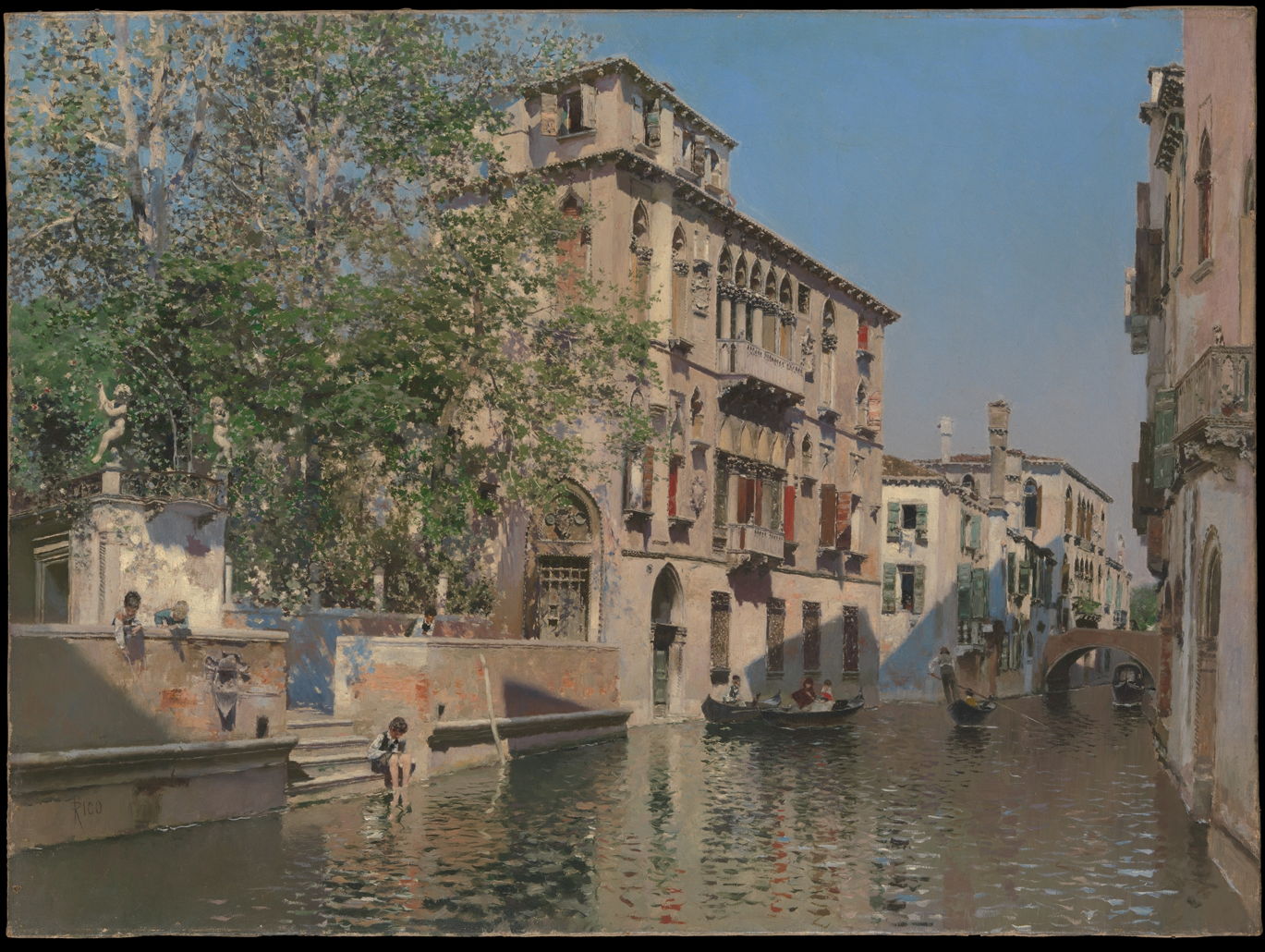
Martín Rico y Ortega (1833–1908), A Canal in Venice (c 1875), oil on canvas, 50.2 x 67.9 cm, The Metropolitan Museum of Art, New York, NY. Wikimedia Commons.
The broken reflections in Martín Rico’s A Canal in Venice from about the same time may have been painted mostly en plein air, despite their fine detail.
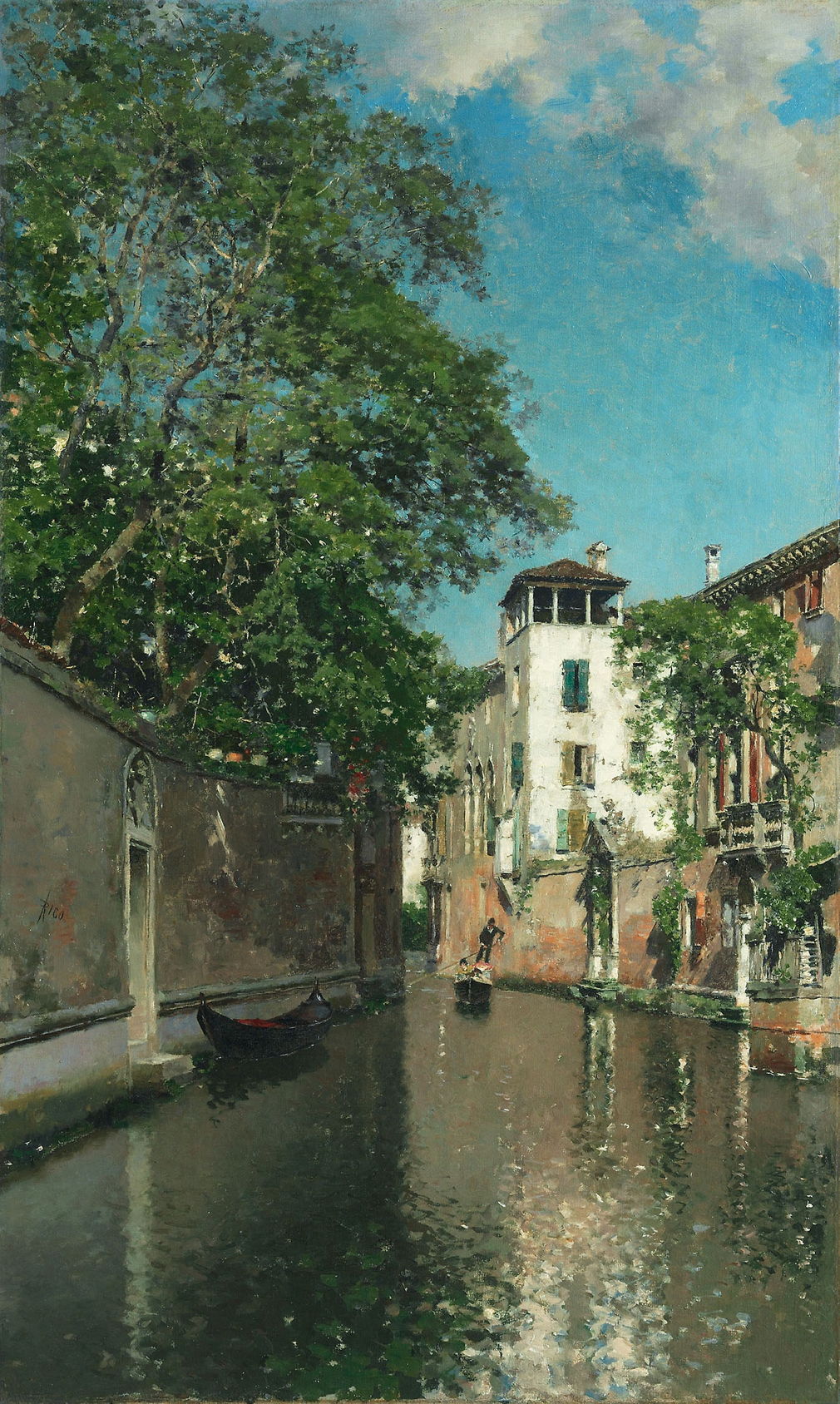
Martín Rico y Ortega (1833–1908), Canal in Venice (date not known), oil on canvas, dimensions not known, The Art Institute of Chicago, Chicago, IL. Wikimedia Commons.
Rico’s Canal in Venice uses more painterly marks in its reflections.
At the same time, Eilert Adelsteen Normann was painting the grander effects seen in the fjords of Norway.
Eilert Adelsteen Normann (1848–1918), From Romsdal Fjord, 1875 (1875), oil on canvas, dimensions not known, Bergen kunstmuseum (Kunstmuseene i Bergen), Bergen, Norway. Wikimedia Commons.
Normann’s From Romsdal Fjord, also from 1875, shows the ninth longest fjord in Norway as it carves its way through this huge mountain gorge. Although much of the water surface is glassy calm, there’s a slight blur of fine ripples, and patches where it’s more disrupted by gentle breeze.
Eilert Adelsteen Normann (1848-1918), The Steamship (date not known), further details not known. Wikimedia Commons.
The unidentified fjord in Normann’s undated The Steamship shows a similar repertoire of subtle optical effects.
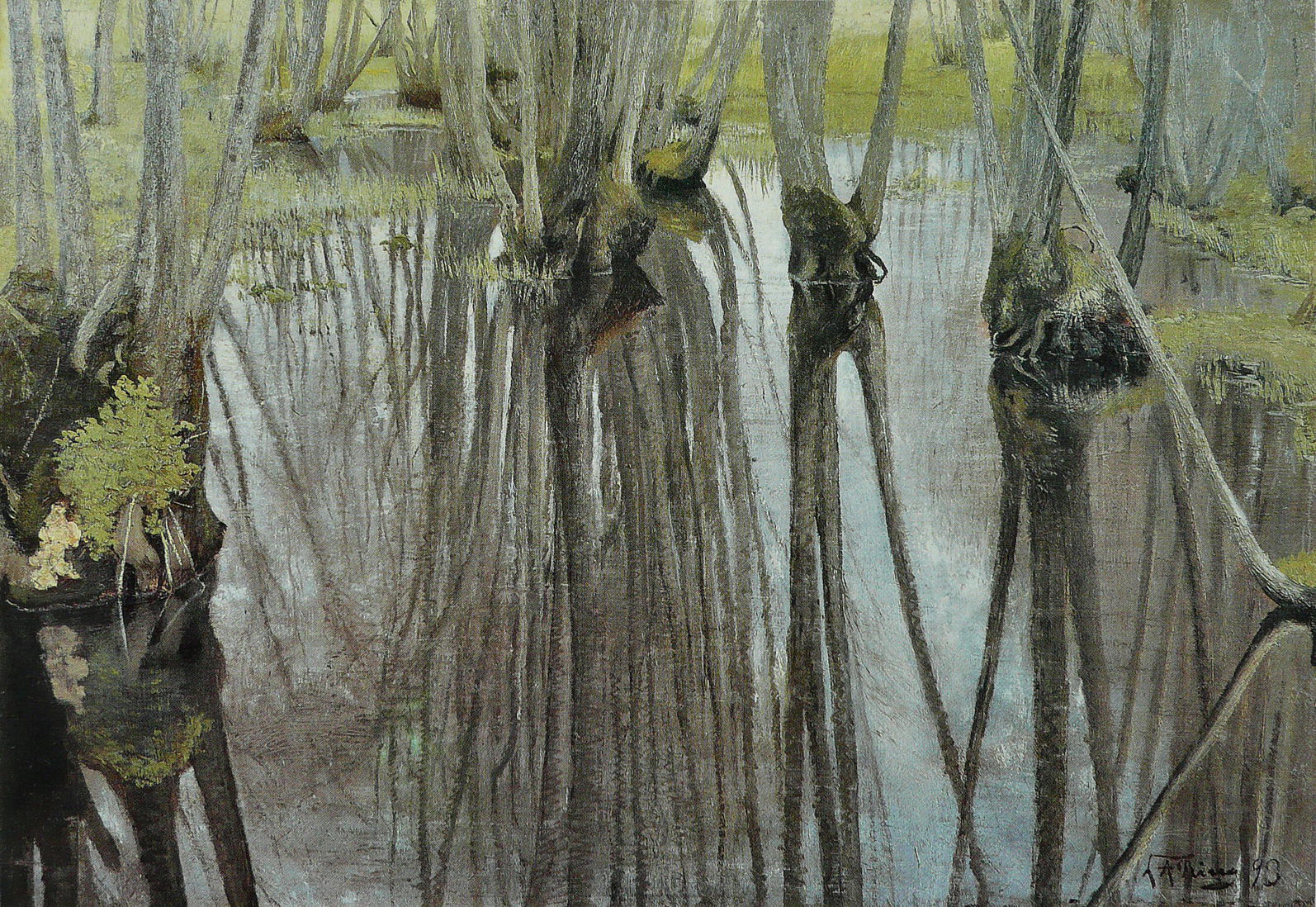
Laurits Andersen Ring (1854–1933), Alder Trunks (1893), oil on canvas, 52.9 x 73.5 cm, Collection of Her Majesty the Queen Margrethe II, Copenhagen, Denmark. Wikimedia Commons.
Alder Trunks from 1893 is one of Laurits Andersen Ring’s finest landscapes, and has earned its place in the Danish Royal Collection. He shows these old coppiced alders mainly in reflection. Although their details are quite painterly, the overall effect is that of meticulous realism.
The specialist of this period is the Norwegian Frits Thaulow.
Frits Thaulow (1847–1906), Winter at the River Simoa (1883), oil on canvas, 49.5 x 78.5 cm, Nasjonalgalleriet, Oslo, Norway. Wikimedia Commons.
Thaulow seems to have discovered what was going to be his recurrent theme for much of his career by 1883, when he painted this scene of Winter at the River Simoa. A lone woman, dressed quite lightly for the conditions, is rowing her tiny boat over the quietly flowing river, towards the tumbledowns on the other side. The surface of the river shows the glassy ripples so common on semi-turbulent water, and the effect on reflections is visibly complex. The distant side of the river is also partly frozen, breaking the reflections further.
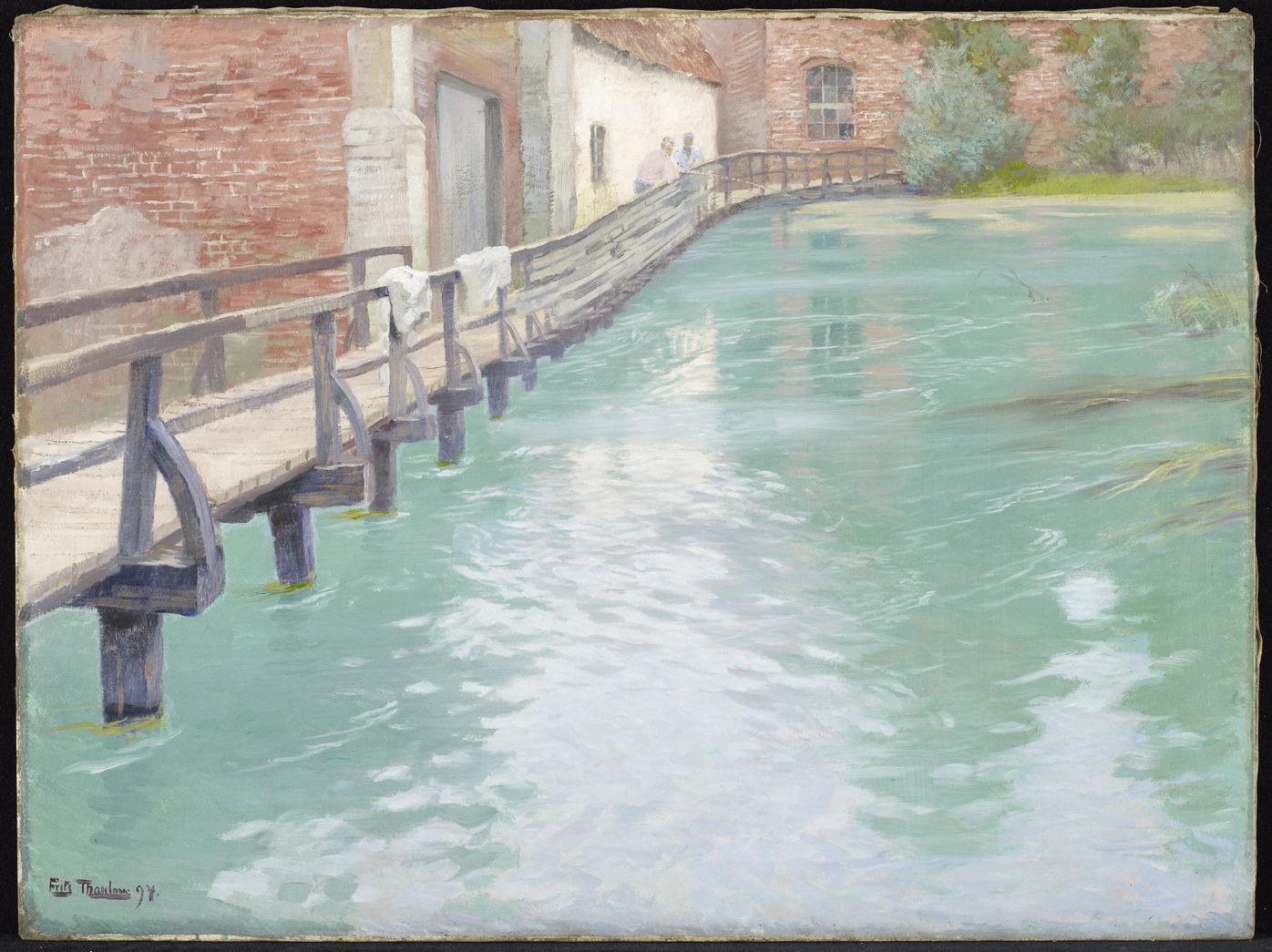
Frits Thaulow (1847–1906), The Mills at Montreuil-sur-Mer, Normandy (1894), oil on canvas, dimensions not known, Minneapolis Institute of Art, Minneapolis, MN. Wikimedia Commons.
Thaulow later returned to his studies of flowing rivers, for example in The Mills at Montreuil-sur-Mer, Normandy. This painting has been claimed to date from 1891, before the artist moved to Montreuil, but I think that its date reads 1894.
Frits Thaulow (1847–1906), The Adige River at Verona (c 1894), oil on canvas, 81 x 100 cm, Walters Art Museum, Baltimore, MD. Wikimedia Commons.
In 1894, Thaulow travelled across northern Italy to Venice, stopping off to paint The Adige River at Verona. This shows the five arches of the Ponte della Pietra, with wonderfully disrupted reflections describing the river’s turbulent flow.
Frits Thaulow (1847–1906), La Dordogne (1903), oil, further details not known. Wikimedia Commons.
Soon after Thaulow had settled at Beaulieu in central France, he found form with the magnificent river surface and lighting of La Dordogne (1903), whose precise detail in the foreground quickly yields to a more sketchy background.
A few artists rose to the challenge of combined reflected and refracted images, among them Kazimierz Sichulski.
Kazimierz Sichulski (1879–1942), Fish (1908), pastel on paperboard, 63 x 82 cm, Muzeum Narodowe w Poznaniu, Poznań, Poland. Wikimedia Commons.
Sichulski’s Fish (1908) is a startlingly unusual pastel painting, a virtuoso combination of reflections from and views through this water surface. It’s an essay in practical optics.
As landscape painters increasingly came to rely on studies made in front of the motif, and their views came closer to reality, faithful depictions of reflections on water increased. But the fundamental challenges of painting accurate reflections remained. Both John Constable and JMW Turner started their careers drawing, trained in the Royal Academy Schools, and should have had a thorough grounding in 3D projection and reflections, as well as ample experience recording what they saw.
Several of Constable’s major works include reflected passages, painted slowly in the studio following extensive studies made of the motif.
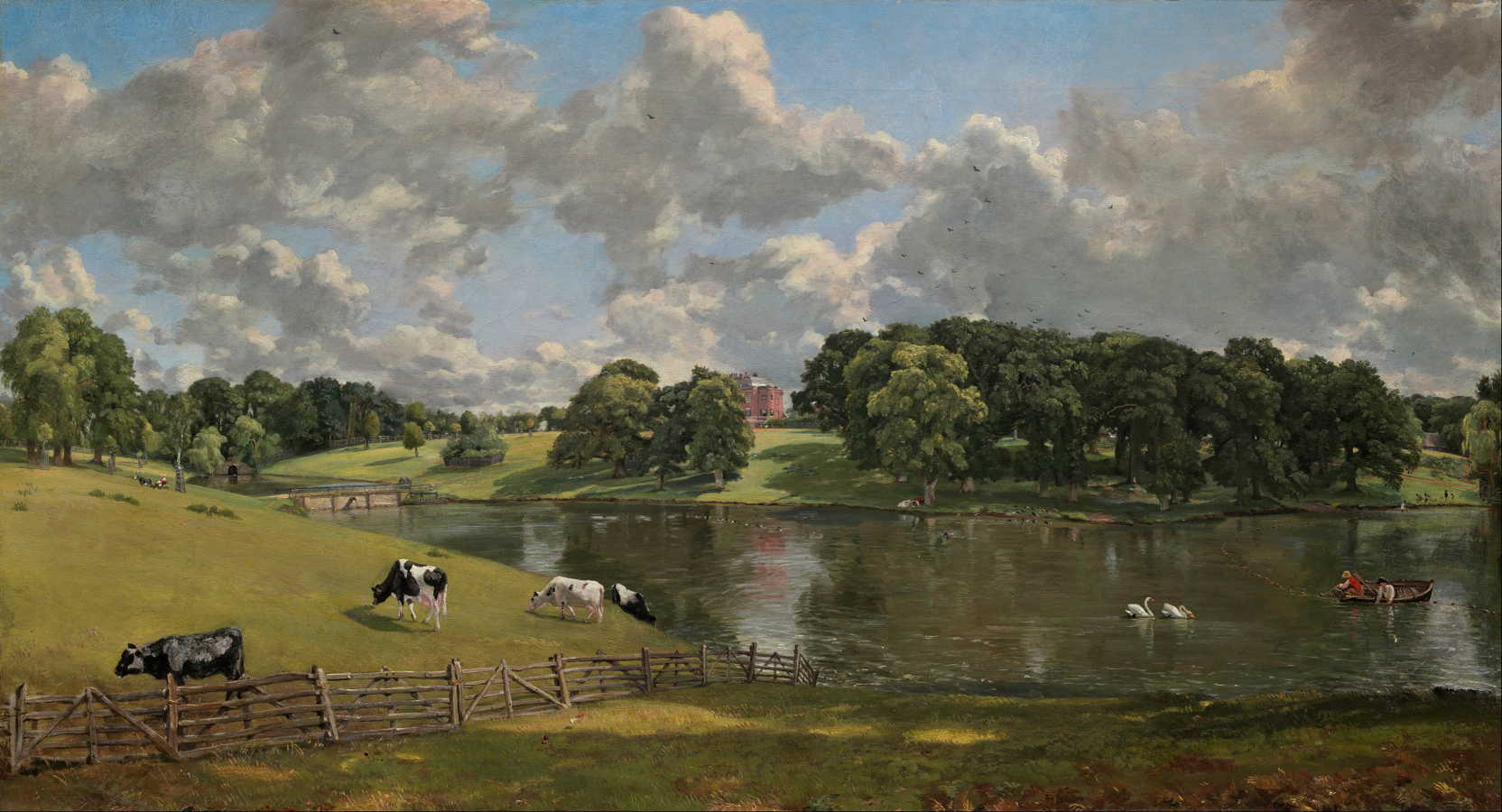
John Constable (1776–1837), Wivenhoe Park, Essex (1816), oil on canvas, 56.1 x 101.2 cm, The National Gallery of Art, Washington, DC. Wikimedia Commons.
Constable’s commissioned painting of the house and estate at Wivenhoe Park, Essex from 1816 is an oddly distant view of Major-General Francis Slater-Rebow’s country seat. Given the expanse of mirror-like lake, he might have been expected to include meticulous reflections. There are obvious anomalies, such as the brick-red reflection of the modest section of the house visible through a break in the trees in the centre of the canvas. The house is sufficiently distant that little or none of it would have been visible in reflection, let alone the two large areas of brick red stretching well over half way across the water. That was in all probability painted for effect.
John Constable (1776–1837), Wivenhoe Park, Essex (detail with reflection) (1816), oil on canvas, 56.1 x 101.2 cm, The National Gallery of Art, Washington, DC. Wikimedia Commons.
Reflections of the pair of swans and boatmen are also out of kilter. Constable may well have neither seen nor sketched them from life, and then struggled to envision their reflections in the studio.
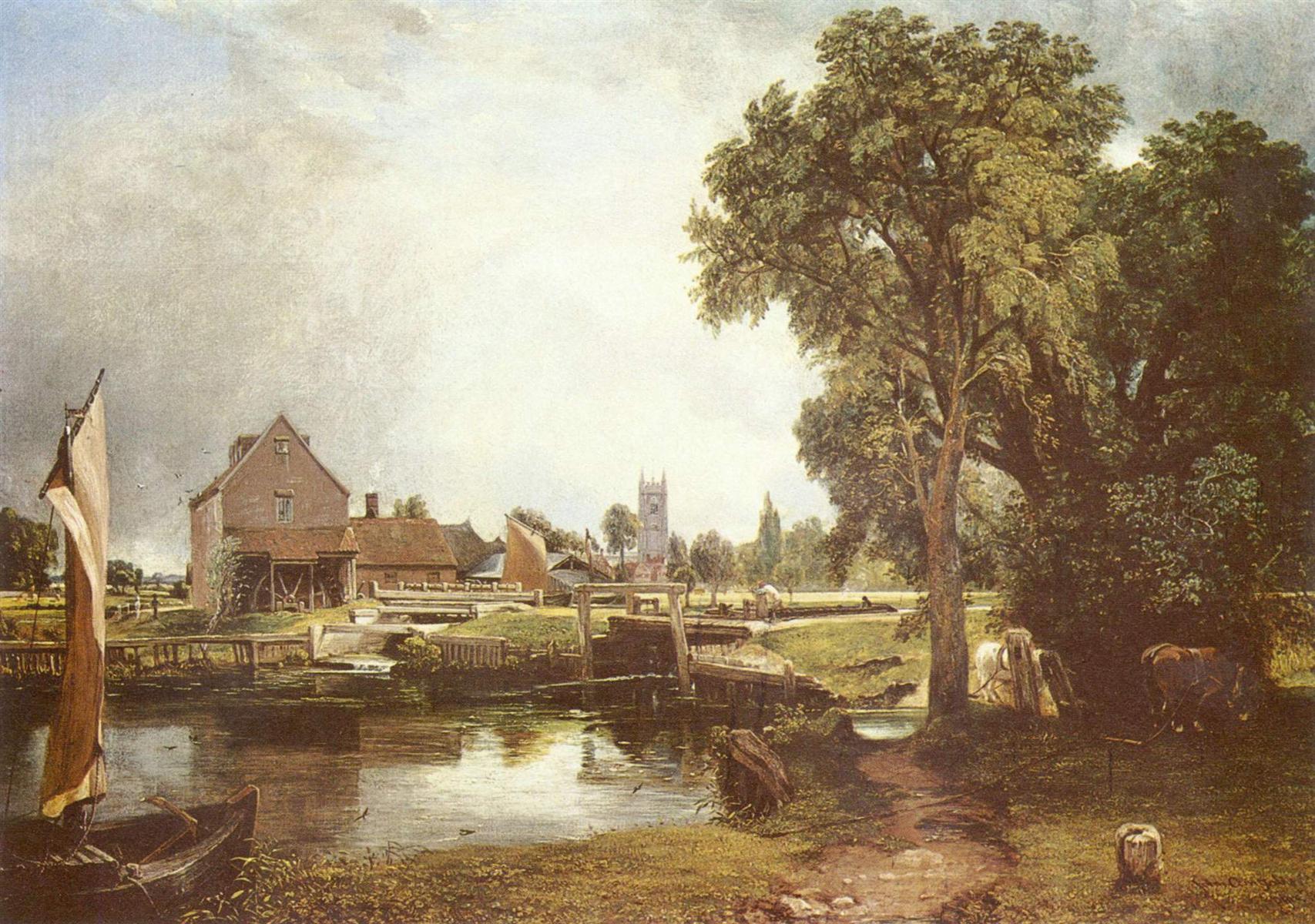
John Constable (1776–1837), Dedham Lock and Mill, 1820, oil on canvas, 53.7 x 76.2 cm, Victoria and Albert Museum, London. WikiArt.
Four years later, this painting of Dedham Lock and Mill (1820) is more familiar territory from the artist’s home ground. His family owned this lock on the River Stour, and he would have worshipped in the village church of Dedham seen in the distance. His reflections here appear accurate throughout.
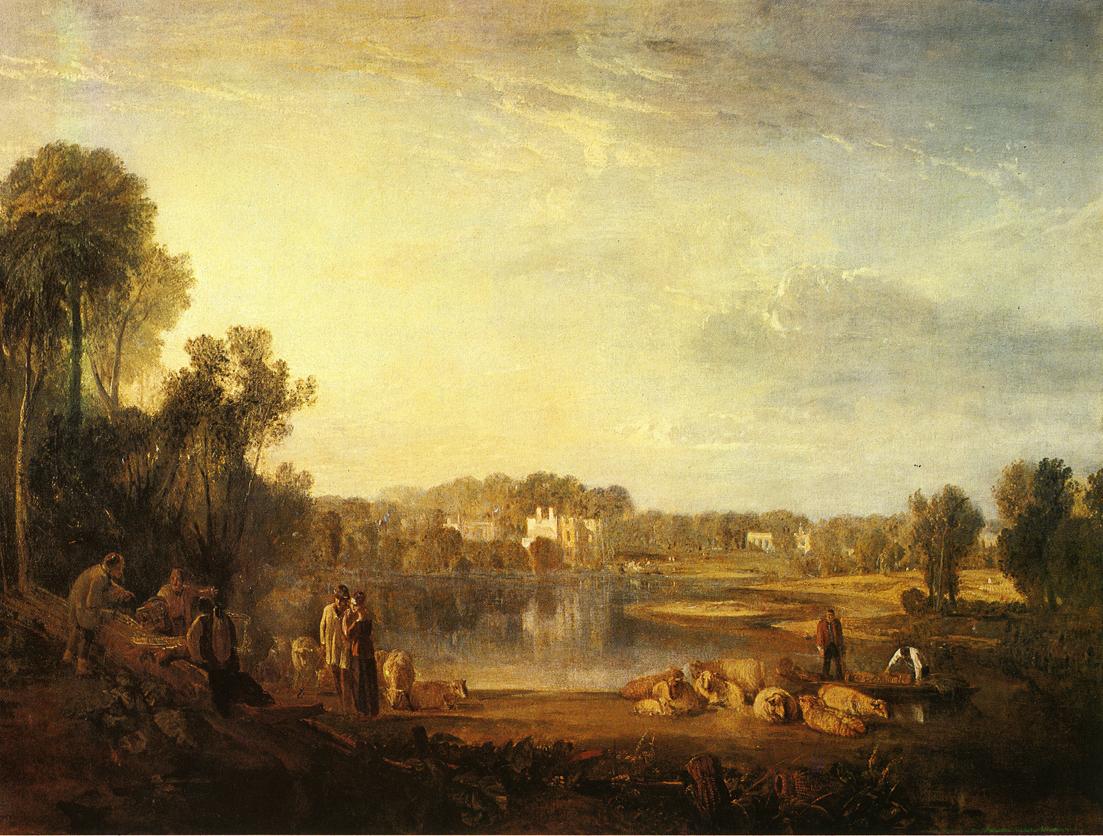
Joseph Mallord William Turner (1775–1851), Pope’s Villa, at Twickenham (1808), oil on canvas, 120.6 x 92.5 cm, Private Collection. WikiArt.
Turner’s approach to reflections changed over the course of his career. In Pope’s Villa, at Twickenham from 1808, he depicted complex and intricate reflections in careful detail.
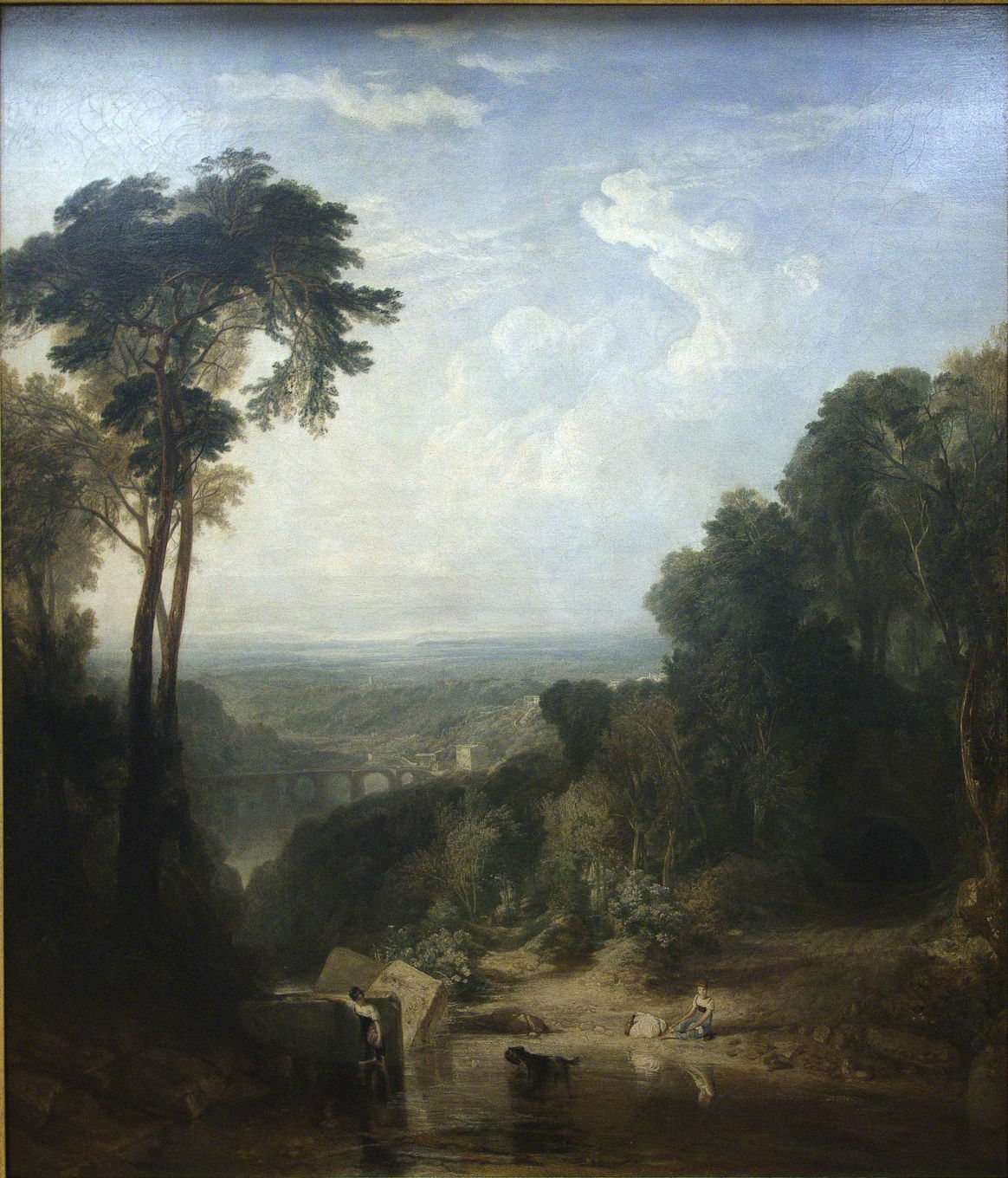
I’ve previously considered the relatively small anomalies in another of his early oil paintings, Crossing the Brook from 1815.
Joseph Mallord William Turner (1775-1851), Crossing the Brook (1815), oil on canvas, 193 x 165.1 cm, Tate Britain, London (N00497). EHN & DIJ Oakley.
These could be accounted for by the figures being staffage added in the studio without the benefit of plein air studies.
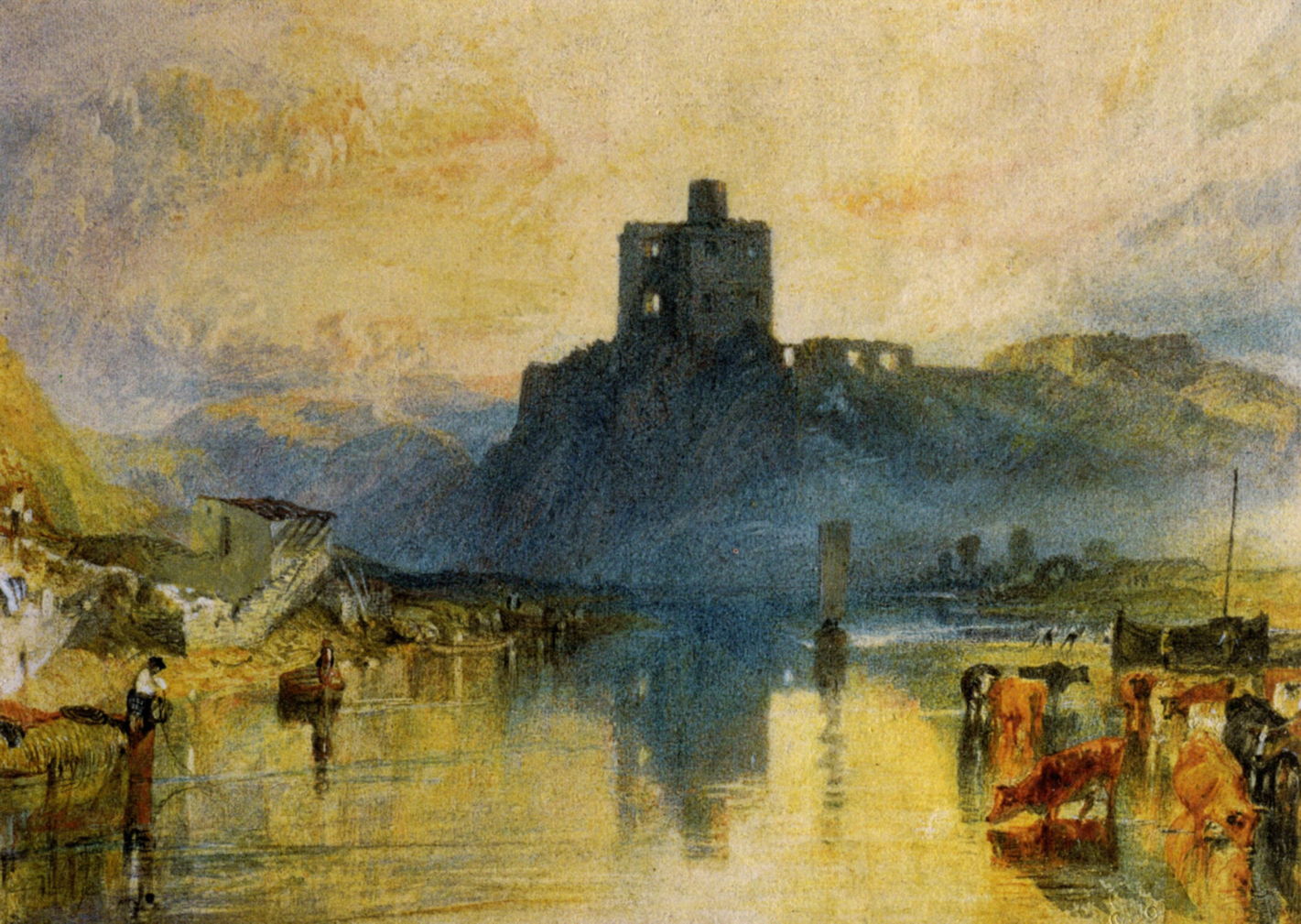
Joseph Mallord William Turner (1775–1851), Norham Castle, on the River Tweed (1823), watercolour on paper, 15.6 x 21.6 cm, British Museum, London. WikiArt.
Some of his later watercolours, such as Norham Castle, on the River Tweed (1823), have obvious quirks in their reflections: here the reflection appears to show another high point at the left edge of the castle that isn’t matched by an equivalent high point in the real castle.
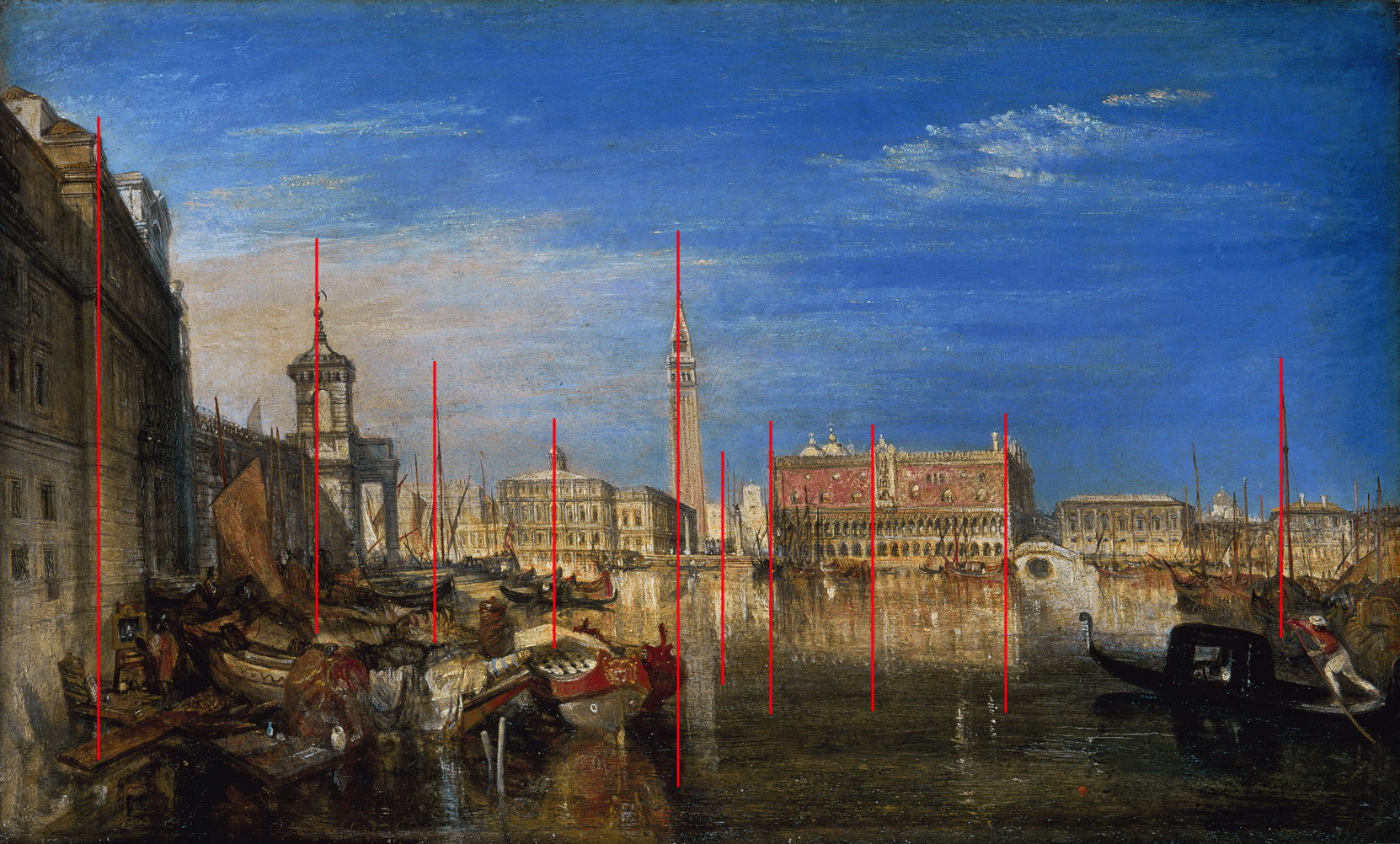
Joseph Mallord William Turner (1775–1851), Bridge of Sighs, Ducal Palace and Custom-House, Venice: Canaletti Painting (1833), oil on mahogany, 51.1 x 81.6 cm, Tate Britain, London (N00370). Wikimedia Commons. Perpendiculars have been superimposed to show failure in vertical alignment of the unreflected and reflected images.
Some of his paintings show other optical oddities. His Bridge of Sighs, Ducal Palace and Custom-House, Venice: Canaletti Painting (1833), his first oil painting of Venice, places all the buildings leaning to the left, with their reflections leaning in the opposite direction. Had this painting been on a canvas support, there might have been distortion applied by its stretching or subsequent treatment, but unusually Turner painted this on a mahogany panel. I have checked this image matches those from other sources, to ensure this isn’t a photographic artefact.
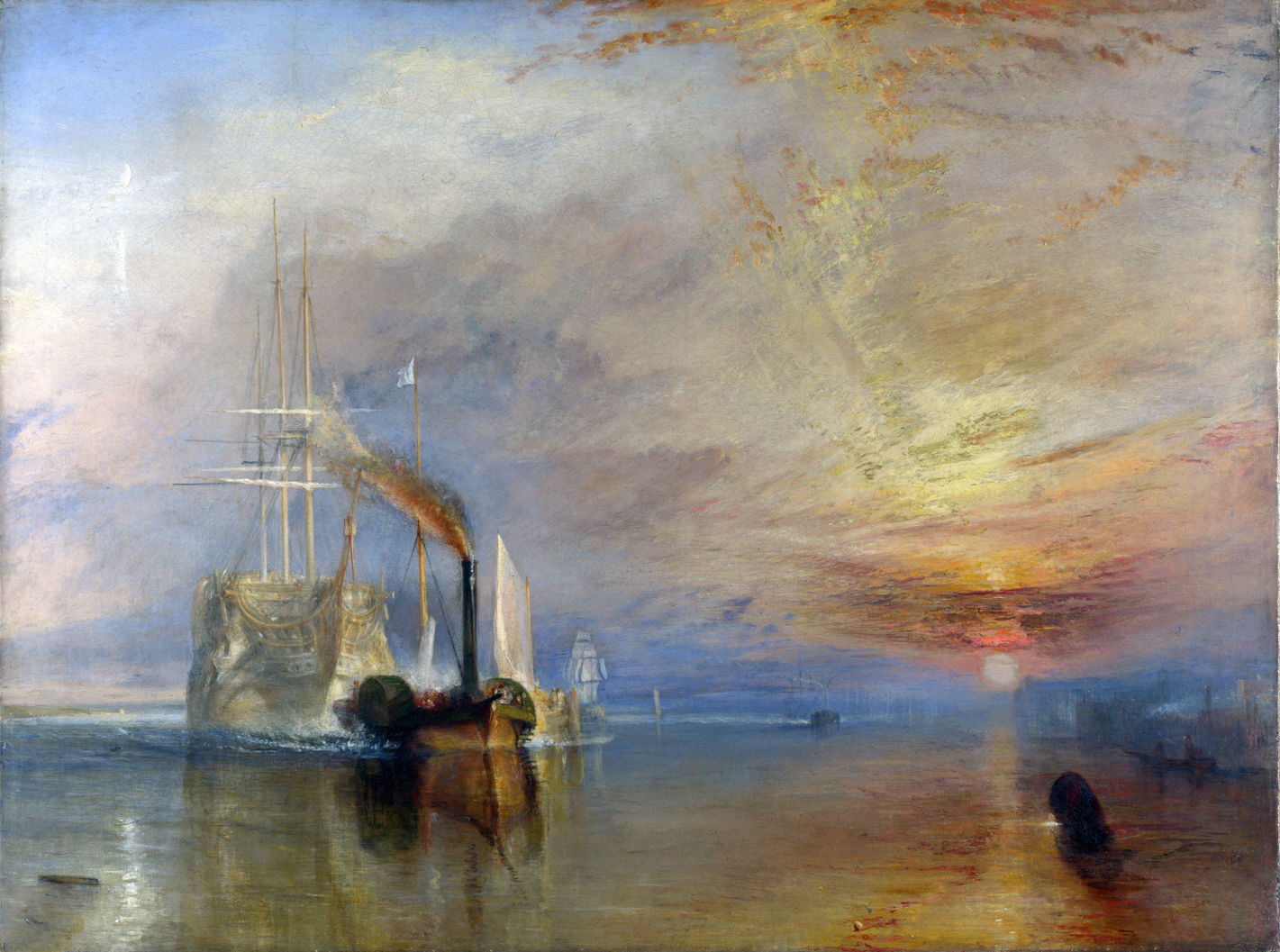
Joseph Mallord William Turner (1775–1851), The Fighting Temeraire tugged to her last Berth to be broken up (1839), oil on canvas, 90.7 × 121.6 cm, The National Gallery, London. Wikimedia Commons.
Turner’s famous Fighting Temeraire from 1839 breaks most of the optical rules of reflections, most obviously in the extraordinary reflected image of the tug’s prow. The tip of the bowsprit isn’t vertically aligned between original and reflection, and there’s gross vertical exaggeration, as there is in the ghostly reflection of the Temeraire under tow.
Joseph Mallord William Turner (1775–1851), Campo Santo, Venice (1842), oil on canvas, 62.2 x 92.7 cm, Toledo Museum of Art, Toledo. WikiArt.
Several of Turner’s later paintings appear founded in sound optical principles, then exaggerated for artistic effect. While many of the reflections in his Campo Santo, Venice from 1842 appear faithful, he has grossly exaggerated the vertical axis of the reflections of the white sails to the left of centre. But the effect is wonderful.
The Dogano, San Giorgio, Citella, from the Steps of the Europa, from the same year, takes a few gentle liberties with optics without becoming too obviously inaccurate. Again this is mainly in vertical scaling, and Turner has been careful to ensure good vertical alignment throughout.
Joseph Mallord William Turner (1775–1851), War. The Exile and the Rock Limpet (1842), oil on canvas, 79.4 x 79.4 cm, Tate Britain, London (N00529). WikiArt.
I have already pointed out some of the apparently deliberate optical anomalies seen in the reflections in Turner’s late oil painting War. The Exile and the Rock Limpet (1842).
Given Turner’s experience and record, I don’t think those discrepancies are errors, but are devices he has successfully used for their effect.
There are only two ways a painter can depict reflections on water in accordance with optical reality: they can paint exactly what they see when in front of the motif, or they can understand optical principles sufficiently to recreate what they would have seen. This article looks at how those worked out in landscape paintings to the end of the eighteenth century.
Jan van Eyck (c 1390–1441), The Madonna of Chancellor Rolin (detail) (c 1435) oil on panel, 66 x 62 cm. Musée du Louvre, Paris (WikiArt).
Look in the landscape behind Jan van Eyck’s Madonna of Chancellor Rolin (c 1435) and you’ll see one of the earliest examples of the meticulously accurate depiction of reflections on water. These could only have resulted from careful studies made in front of the motif.
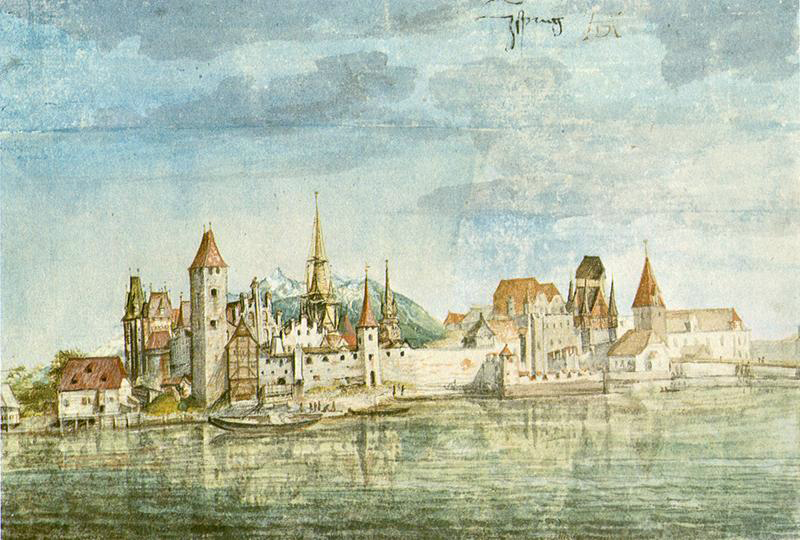
Albrecht Dürer (1471-1528), View of Innsbruck (c 1495), watercolour on paper, 12.7 x 18.7 cm. Albertina, Vienna (WikiArt).
For Albrecht Dürer painting this View of Innsbruck in about 1495, this watercolour is evidence that he both recognised the challenge, and went to the trouble to paint what he actually saw, even though the overall geometry isn’t perfect, with its downward slope to the left.
Following the Northern Renaissance, other landscape painters continued this tradition, into the Dutch Golden Age.
Aelbert Cuyp (1620–1691), View on the Rhine (c 1645), oil on panel, 27.4 x 36.8 cm, Fondation Custodia, Paris. Wikimedia Commons.
Although Aelbert Cuyp’s View on the Rhine from about 1645 isn’t optically perfect and must at least have been finished in the studio, it demonstrates his care in trying to be faithful in its reflections.
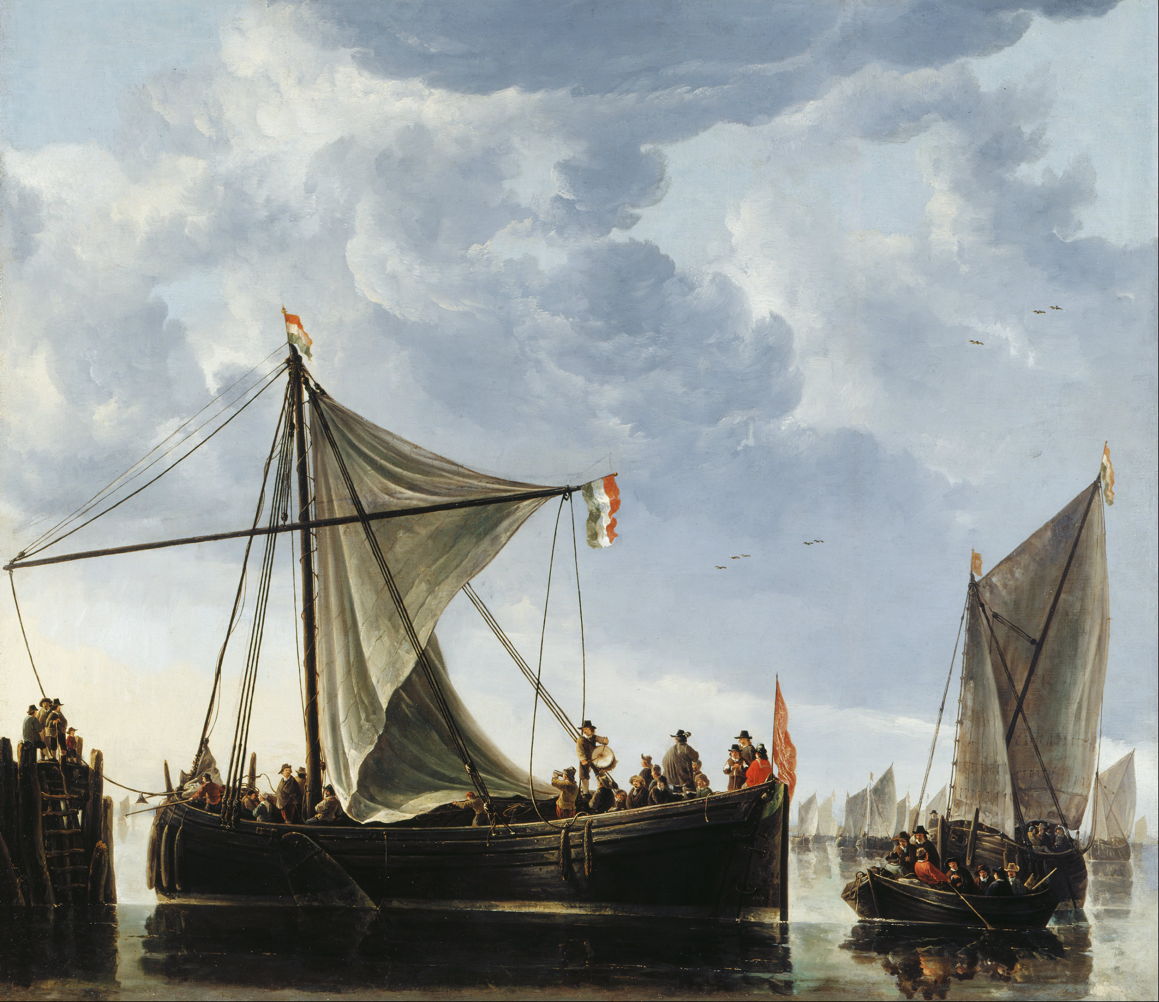
Aelbert Cuyp (1620–1691), The Passage Boat (c 1650), oil on canvas, 124 x 144.4 cm, Royal Collection of the United Kingdom, UK. Wikimedia Commons.
Cuyp’s larger and more detailed painting of The Passage Boat from about 1650 is similarly attentive, implying the use of careful studies made in front of the motif.
Aelbert Cuyp (1620–1691), The Valkhof at Nijmegen (c 1652-54), oil on wood, 48.8 x 73.6 cm, Indianapolis Museum of Art, Indianapolis, IN. Wikimedia Commons.
Cuyp’s grand view of The Valkhof at Nijmegen from about 1652-54 is a fine example from later in his career.
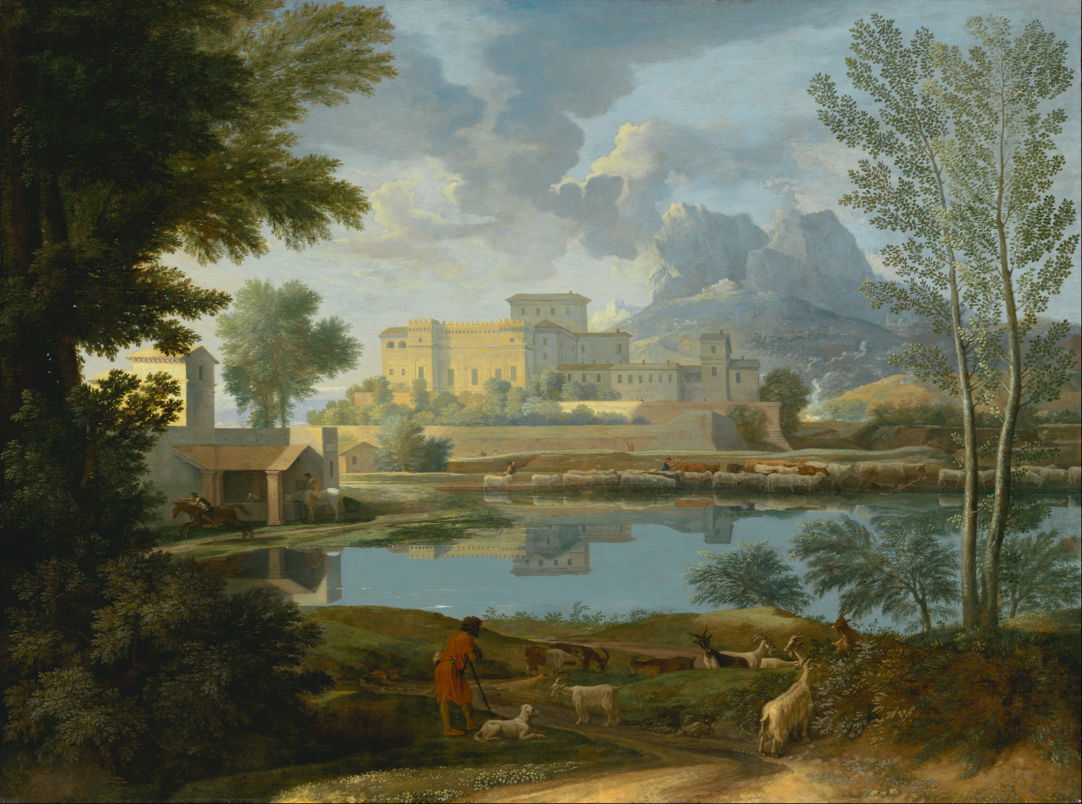
Nicolas Poussin (1694-1665), Landscape with a Calm (c 1651), oil on canvas, 97 x 131 cm, J. Paul Getty Museum, Los Angeles. Digital image courtesy of the Getty’s Open Content Program.
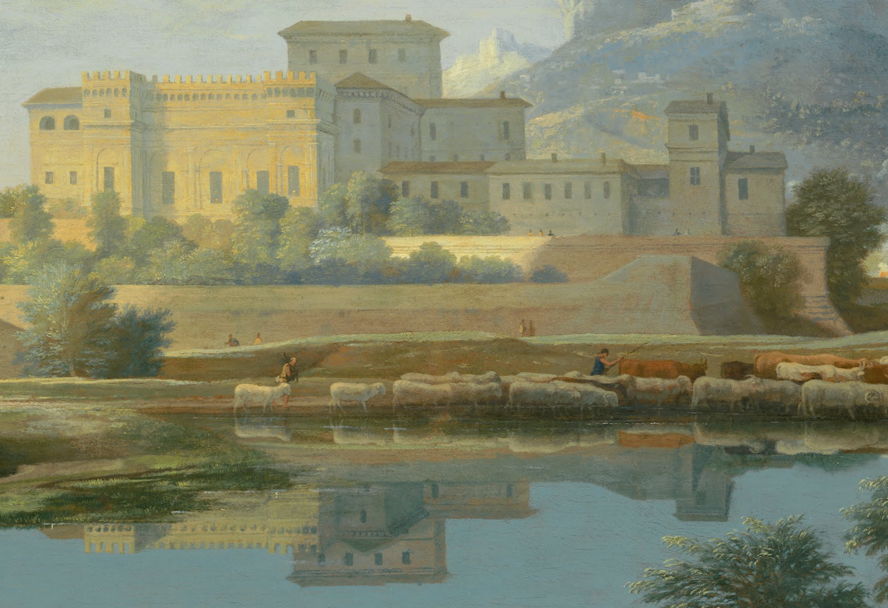
At about the same time, Nicolas Poussin used extensive reflections to augment the placid atmosphere in his idealised Landscape with a Calm (c 1651). The upper parts of the Italianate mansion, together with the livestock on the far bank of the lake, are painstakingly reflected on the lake’s surface, telling the viewer that there isn’t a breath of breeze to bring ripples to disturb those reflections.
Nicolas Poussin (1594–1665), Landscape with a Calm (detail) (c 1651), oil on canvas, 97 x 131 cm, J. Paul Getty Museum, Los Angeles. Digital image courtesy of the Getty’s Open Content Program.
Closer examination of the reflections reveals small disparities, though. Poussin has broken the rule of depth order in painting the brown reflection of one of the cattle that is well behind the sheep at the edge of the lake, and there are inaccuracies obvious in the reflection of the villa. Those may well be the result of his assembling passages from the original plein air studies he used to build this composite.
Nicolas Poussin (1594–1665), Landscape with a Calm (detail) (c 1651), oil on canvas, 97 x 131 cm, J. Paul Getty Museum, Los Angeles. Digital image courtesy of the Getty’s Open Content Program.
His reflections appear most accurate in the passage showing horsemen at the left end of the lake. These make interesting comparison with Poussin’s contemporary Claude Lorrain, who appears to have avoided tackling the problems posed by reflections.
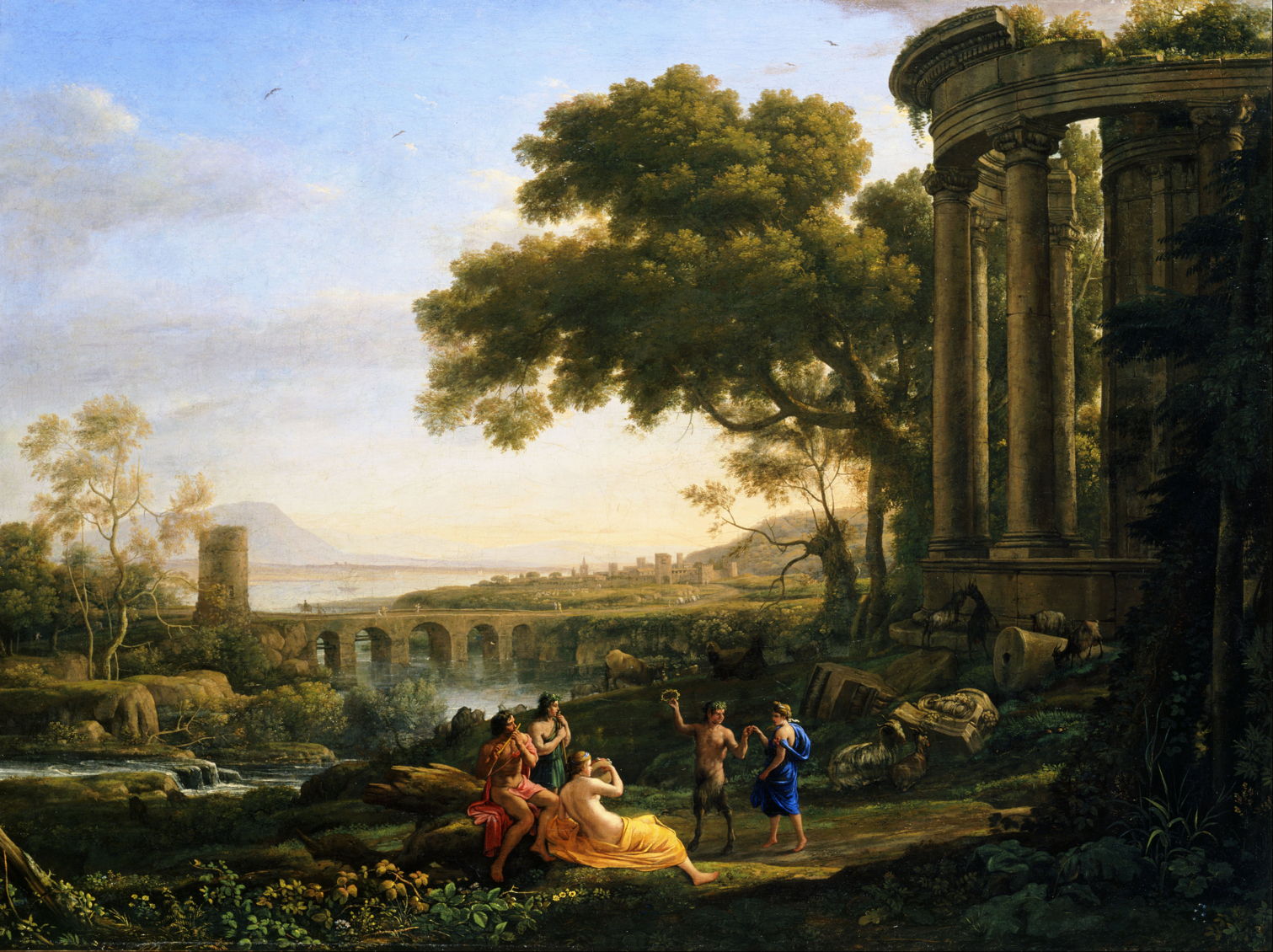
Claude Lorrain (1604/5–1682), Landscape with Nymph and Satyr Dancing (1641), oil on canvas, 99.7 x 133 cm, Toledo Museum of Art, Toledo, OH. Wikimedia Commons.
In Claude’s Landscape with Nymph and Satyr Dancing from 1641, another idealised composite assembled from the artist’s library of sketches, little attempt is made to depict the reflection of the prominent viaduct. What has been shown is unaccountably darker than the original, and vague in form. Most of Claude’s other paintings that could have included reflections show water surfaces sufficiently broken to avoid tackling the problem.
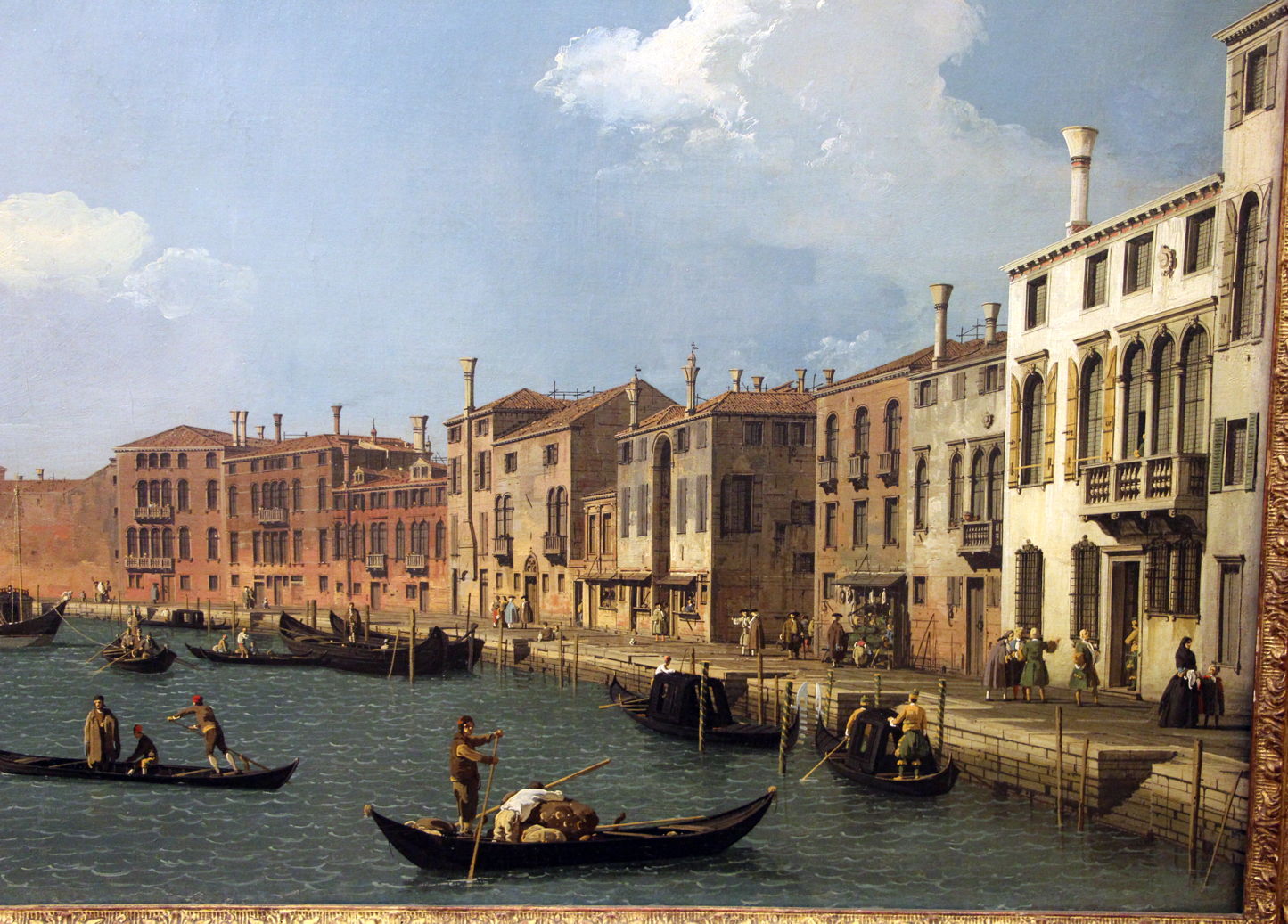
Canaletto (Giovanni Antonio Canal) (1697–1768), Canale di Santa Chiara, Venice (c 1730), oil, dimensions not known, Musée Cognacq-Jay, Paris. Image by Sailko, via Wikimedia Commons.
Paintings of Venice and London by Canaletto in the eighteenth century are also largely devoid of reflections. In his Canale di Santa Chiara, Venice from about 1730 the gondola in the left foreground has no reflection at all, and its three figures are similarly absent from the surface of the water.
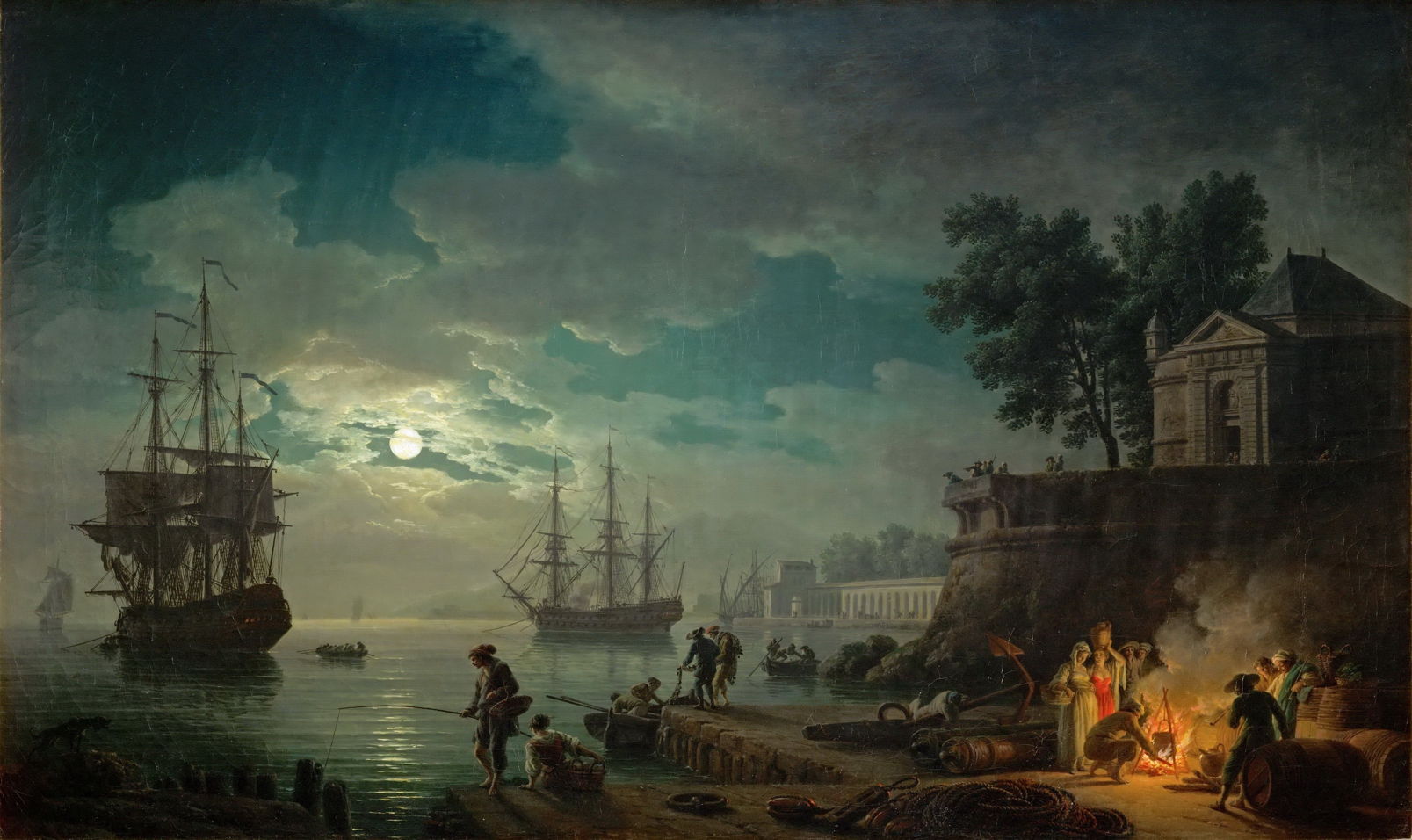
Claude-Joseph Vernet (1714–1789), Seaport by Moonlight (c 1771), oil on canvas, 98 x 164 cm, Musée du Louvre, Paris. Wikimedia Commons.
Reflections return in the studio paintings of those whose sketches made in front of the motif were sufficiently detailed to include them. Among them is Claude-Joseph Vernet, whose Seaport by Moonlight from about 1771 appears faithful. Sadly, none of his preparatory drawings or sketches appear to have survived, although they were a key influence on the next generation of landscape artists.
Understanding the optical principles involved in reflections is important for recognising when artists deviate from them, as in many cases that’s intentional. These can readily become complicated when considering mirrors that can be orientated at will, and are at their simplest when the reflecting surface is horizontal with respect to the earth, as with reflections on water.
Basic optics
The fundamental optical principles underlying reflections on water surfaces are:
light travels in a straight line when passing through a medium of constant refractive index;
when light reaches the interface between two media of different refractive indexes, some will be reflected from the boundary, and some will be refracted through that boundary;
the angle of reflection of a ray of light from a boundary surface is equal to the angle of incidence of that light on that boundary;
a water surface with air above it presents a suitable boundary at which reflection and refraction occur;
still water surfaces are horizontal planes that act as horizontal planar mirrors as far as incident light rays are concerned.
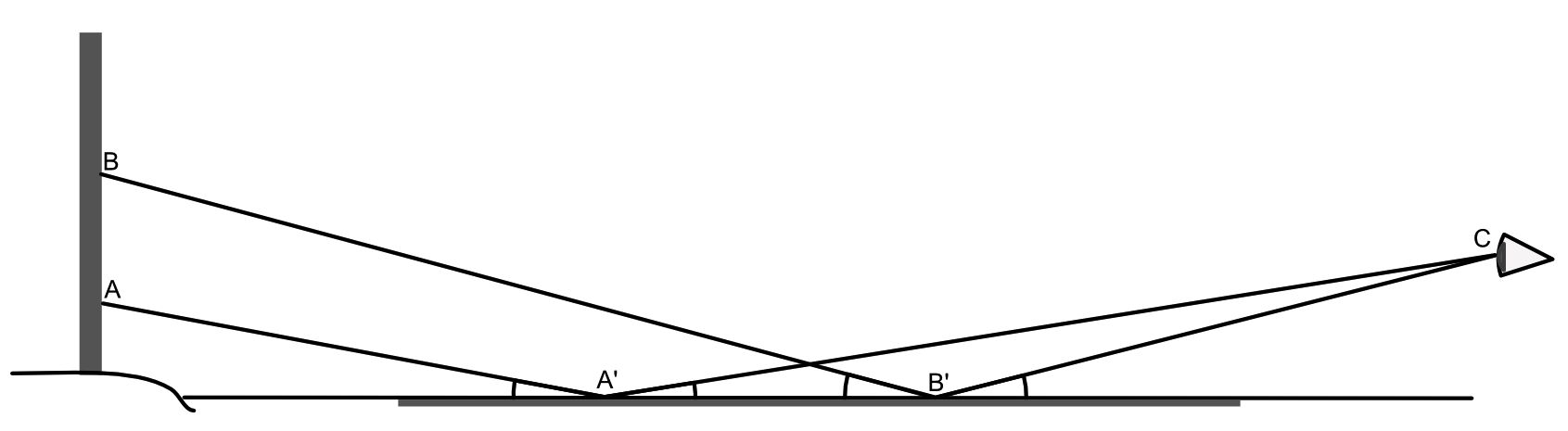
Basic diagram showing the geometry of reflections on water. EHN & DIJ Oakley.
Here a post (with marks A and B), on the left of the diagram, is on the bank of a completely flat lake, with the observer on the opposite side of the lake at C, looking over the lake towards the post. A ray of light scattered from point A on the post passes over the lake to point A’. There, in passing from air to water, it reaches a boundary between media of different refractive indexes, and most of that light will then be reflected towards the observer at C.
Measured at the point of reflection A’ on the lake, the angle of incidence (between the ray and the horizontal water surface) equals the angle of reflection (between the ray and the water surface). The same process of reflection occurs to light scattered from point B on the post, with respect to its reflection at point B’ and the observer’s eye at C, although the angles at point A’ are less than those at point B’.
The relationship between heights above the water plane and the distances from the reflection on the water are a matter of simple geometry. Taking first the right-angled triangle formed by the points B, B’, and the base of the post, the perpendicular height of B above the water (H) and the distance from the base of the post to the point of reflection B’ (D) is the tangent of the angle of incidence of the light ray at B’, as H/D.
As the angle of reflection at B’ must be the same as the angle of incidence (point 3 above), the ratios of the heights at B and C to the distances along the water surface from the base of the post to the point of reflection, and the point of reflection to the observer, must be equal. Hence if three of the four variables are known, the fourth can be calculated, e.g. H = H’.D/D’.
This may seem complex and confuddling, but it’s worth taking the time to understand these basic principles, as they make everything else clearer and more logical.
Putting it together
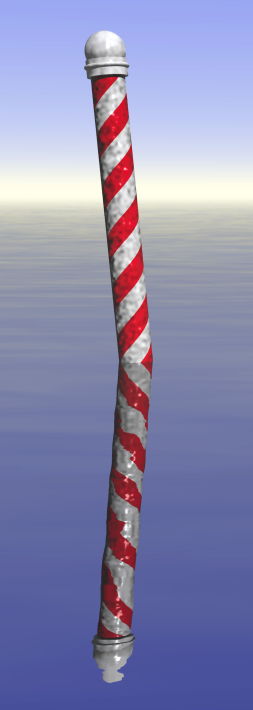
Ray-traced reflections of a barber’s pole. EHN & DIJ Oakley.
Repeating this simple tracing of light rays enables visualisation of more complex examples of reflection, such as that shown above. It quickly becomes tedious for humans to trace individual light rays in a three-dimensional model, but computers excel at the task of ray-tracing. The resulting image makes it clear that corresponding points in a reflection on water are vertically below their originals, although the slight waves seen here can result in limited lateral shift in the reflected points.
As is well known from real life, the reflected image in a horizontal mirror is effectively reflected on a local horizontal plane, so the left of the original remains on the left of the reflection, but the reflected image is inverted, where the top of the reflection shows the lowest part of the original; that’s unlike reflections in a mirror positioned vertically, such as those in which we inspect our face, shave, or apply make-up, which fortuitously remain uninverted. Whether a mirror is vertical or horizontal, the left of the reflected image shows the left of the real image, and similarly for the right.
The patterning and slant of the pole illustrates the differences between such a reflected image and one that has simply been rotated through 180˚, as might be achieved by a painter rotating the canvas on an easel. In the latter case the chirality (handedness) of the transformed image is opposite, the post would lean the opposite way, and its red spiral pattern would differ too. Surprisingly, rotating the canvas through 180˚ has often been recommended as an aid to painting faithful reflections, when all it can do is further confuse.
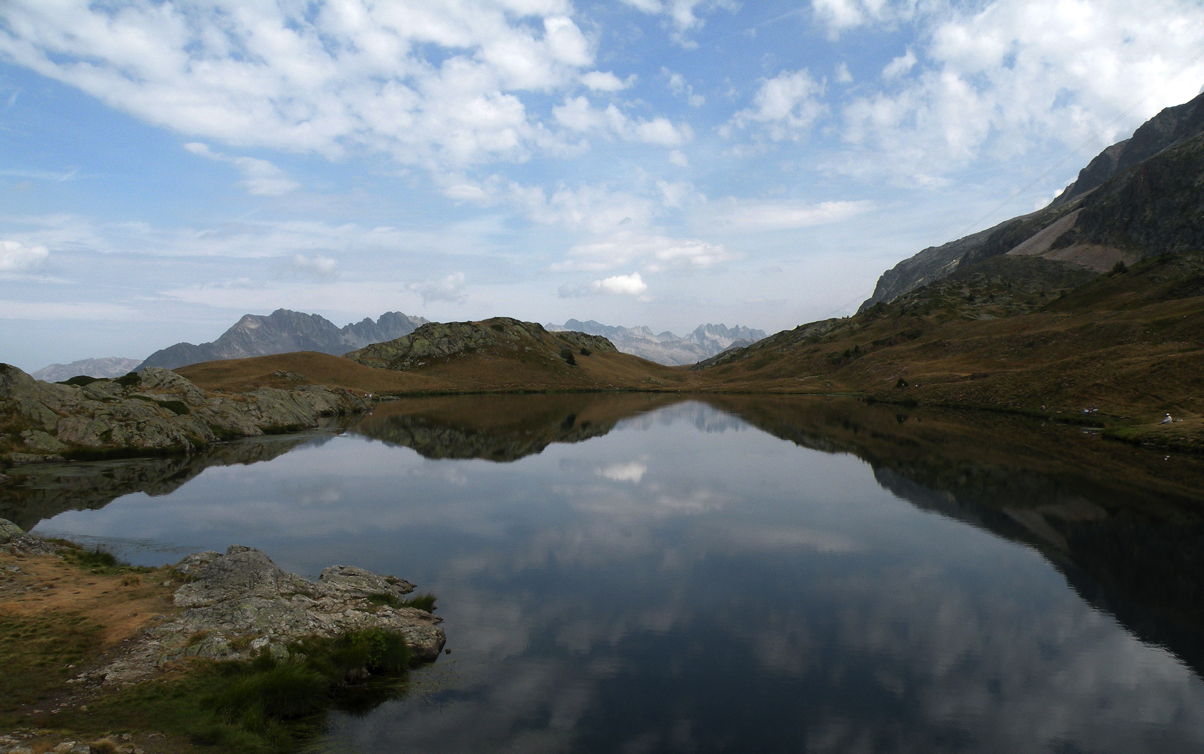
Photograph of extensive reflections on water, Lac Besson, Alpe d’Huez. EHN & DIJ Oakley.
Real world reflections can become complex, as the photo above demonstrates. One method I use to check for discrepancies between the unreflected and reflected images is to un-reflect the reflected image by reflecting it a second time, and align it above the unreflected image. It’s then easy to check the alignment and representation of objects shown in the reflection.
Composite image of extensive reflections on water, Lac Besson, Alpe d’Huez. EHN & DIJ Oakley.
JMW Turner, Crossing the Brook
In the summer of 1811, JMW Turner toured the west of England, where he made studies of the River Tamar, marking the boundary between Devon and Cornwall. The second major painting he exhibited in the summer of 1815 had been developed from one of those plein air studies of the river: Crossing the Brook.
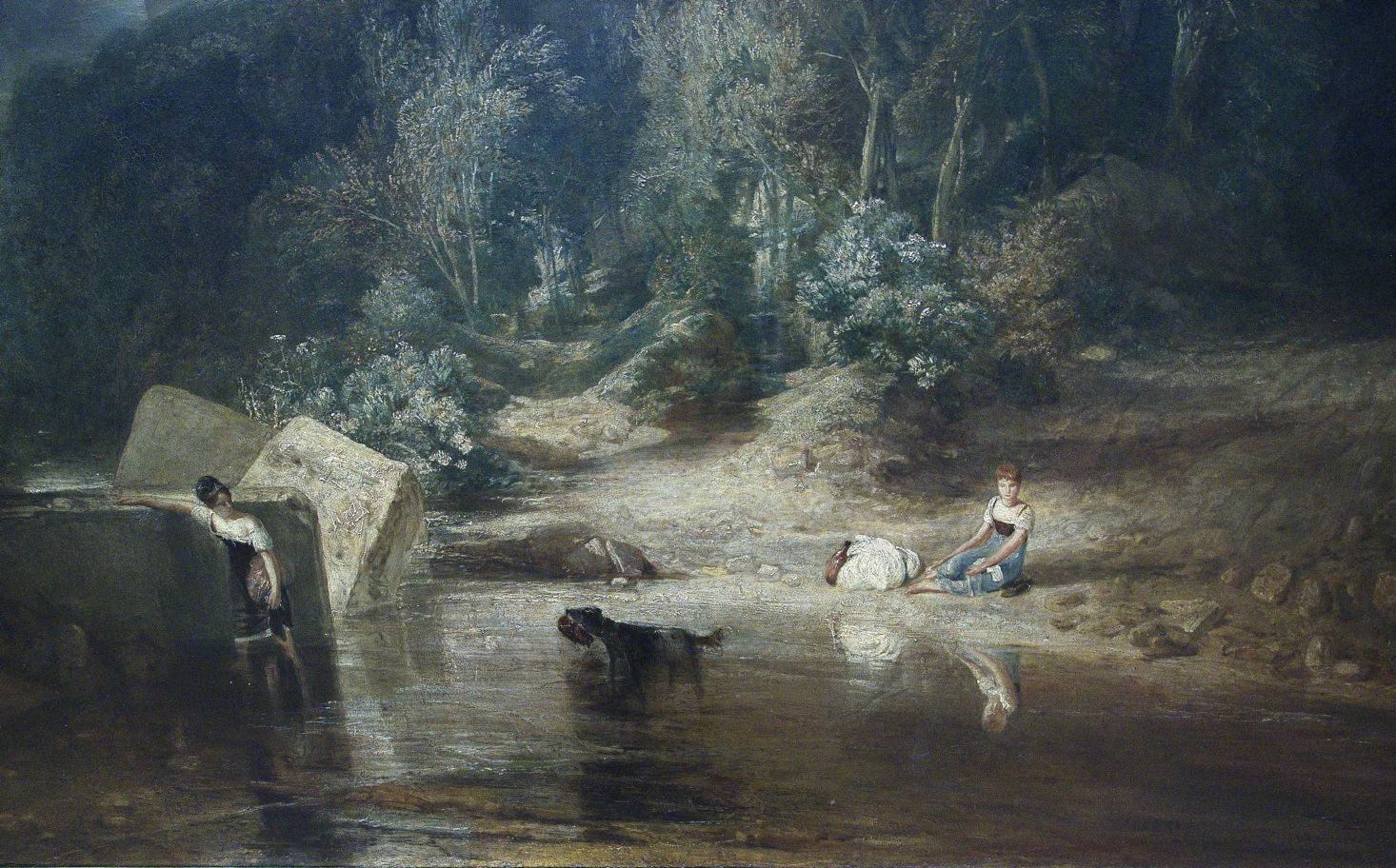
Joseph Mallord William Turner (1775-1851), Crossing the Brook (1815), oil on canvas, 193 x 165.1 cm, Tate Britain, London (N00497). EHN & DIJ Oakley.
It was inspired by Claude Lorrain, but is more conventional, revealing its influence from the landscape tradition, including the British line tracing back to Richard Wilson (1714-1782). In the light of Turner’s later and more overtly experimental paintings, Crossing the Brook may today seem tame and conservative. It shows two women at a ford across the brook, one (left of centre) wading in the river by some massive stone blocks, and in company with a black dog, seen with a large fish in its mouth. The other sits on the far bank, beside a large bundle wrapped in white cloth, with her shoes removed.
The ford is in an opening within a large wooded area, with tall trees providing repoussoir at both sides of the painting. This drops away to a long bridge with multiple arches in the middle distance, and the river (as it is by then) meanders through rolling and wooded countryside until it reaches the sea at Plymouth in the far distance.
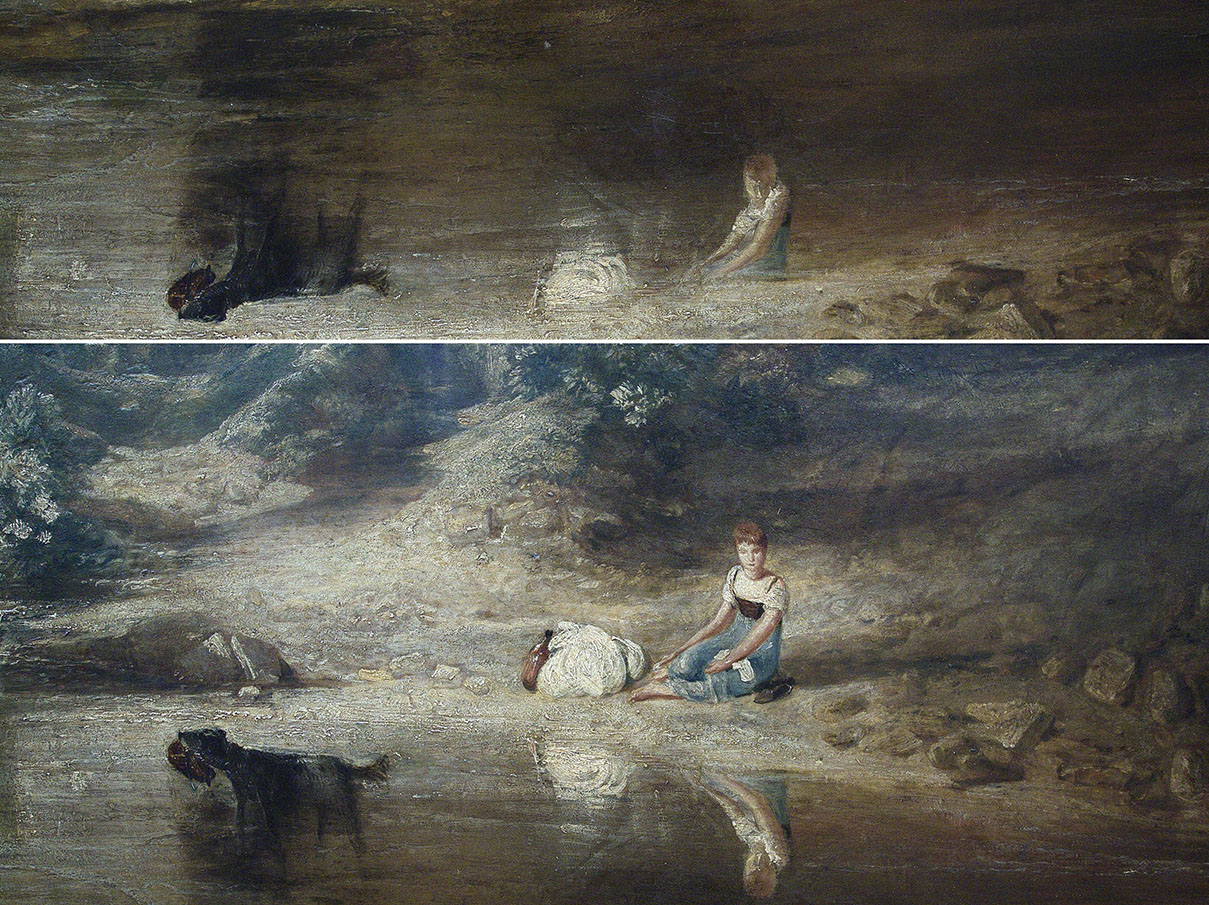
Joseph Mallord William Turner (1775-1851), Crossing the Brook (detail) (1815), oil on canvas, 193 x 165.1 cm, Tate Britain, London (N00497). EHN & DIJ Oakley.
One of the most remarkable features of this painting is Turner’s depiction of the reflections in the water, because there are marked discrepancies between the unreflected image of the woman sat on the bank, and her reflection. Those are shown clearly in the composite detail below.
Joseph Mallord William Turner (1775-1851), Crossing the Brook (detail) (1815), oil on canvas, 193 x 165.1 cm, Tate Britain, London (N00497). EHN & DIJ Oakley. Shown as a composite view, to highlight the discrepancies between the original and reflected images.
Throughout his career, and most particularly in his later more radical works, Turner took liberties with optics. One of the best examples of this is in his late oil painting War. The Exile and the Rock Limpet, painted over twenty-five years later, in 1842.
Joseph Mallord William Turner (1775-1851), War. The Exile and the Rock Limpet (1842), oil on canvas, 79.4 x 79.4 cm, Tate Britain, London (N00529). WikiArt.
The left, more distant, figure (of the guard to Napoleon) shouldn’t have appeared in reflection at all, let alone been vertically aligned with Napoleon’s reflection. However, strict adherence to optics would have significantly detracted from the effect of this painting. Turner has also omitted shadows that would have been cast by the figures, presumably for the same reason.
3D scenes
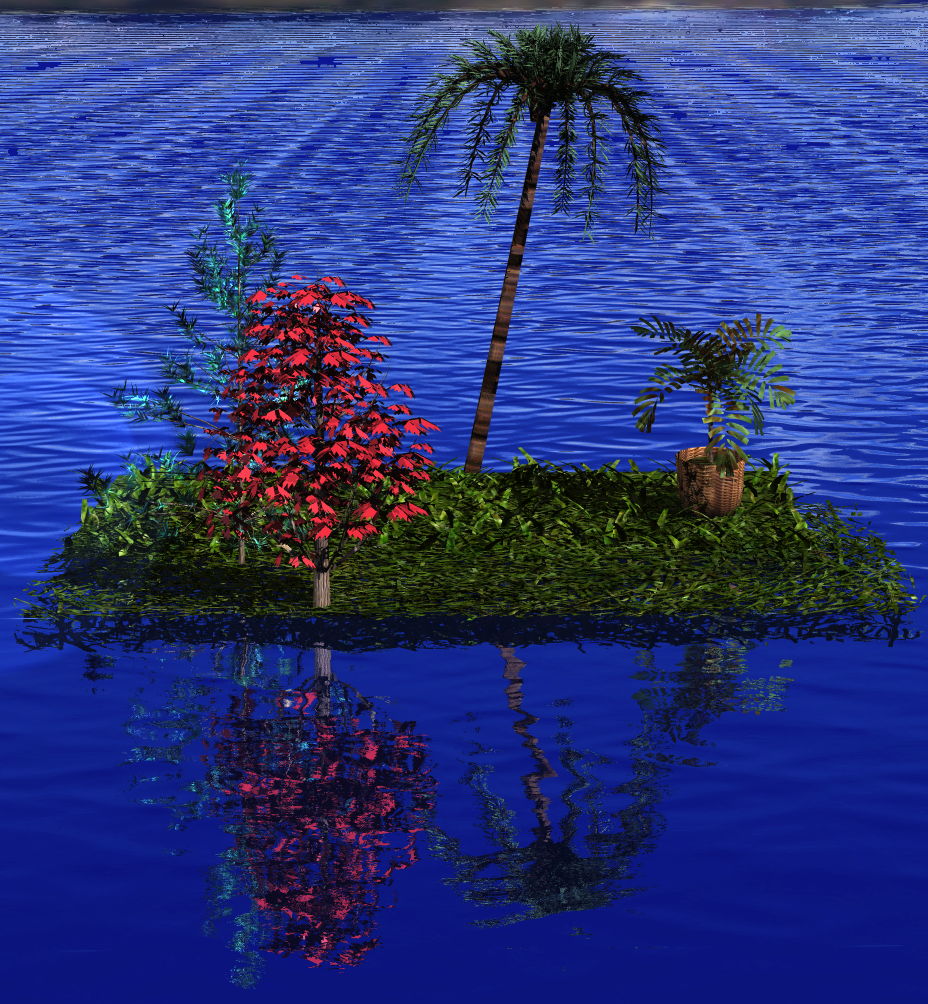
Ray-traced image showing a more complex 3D scene. A rectangular island consisting of a low bank of rough grass is situated in a lake, whose surface is highly reflective but has small, slight waves. On the island are three trees and a potted plant, of various heights and positioned at various distances from the edge of the bank. EHN & DIJ Oakley.
Reflections in a more complex 3D scene, above, show slight alteration in vertical dimensions, but remain strictly aligned with the original. Although the slight waves produce very small lateral displacements in the reflection, every point in the reflection corresponding to a point in the original remains in alignment across the width of the image.
Those objects at the front of the original remain at the front of the reflection: for example, the tree with red leaves retains its position relative to the green conifer tree behind it. The further back from the water’s edge that an object is situated, the more truncated is its reflection; truncation appears as if it occurred at the base of the original.
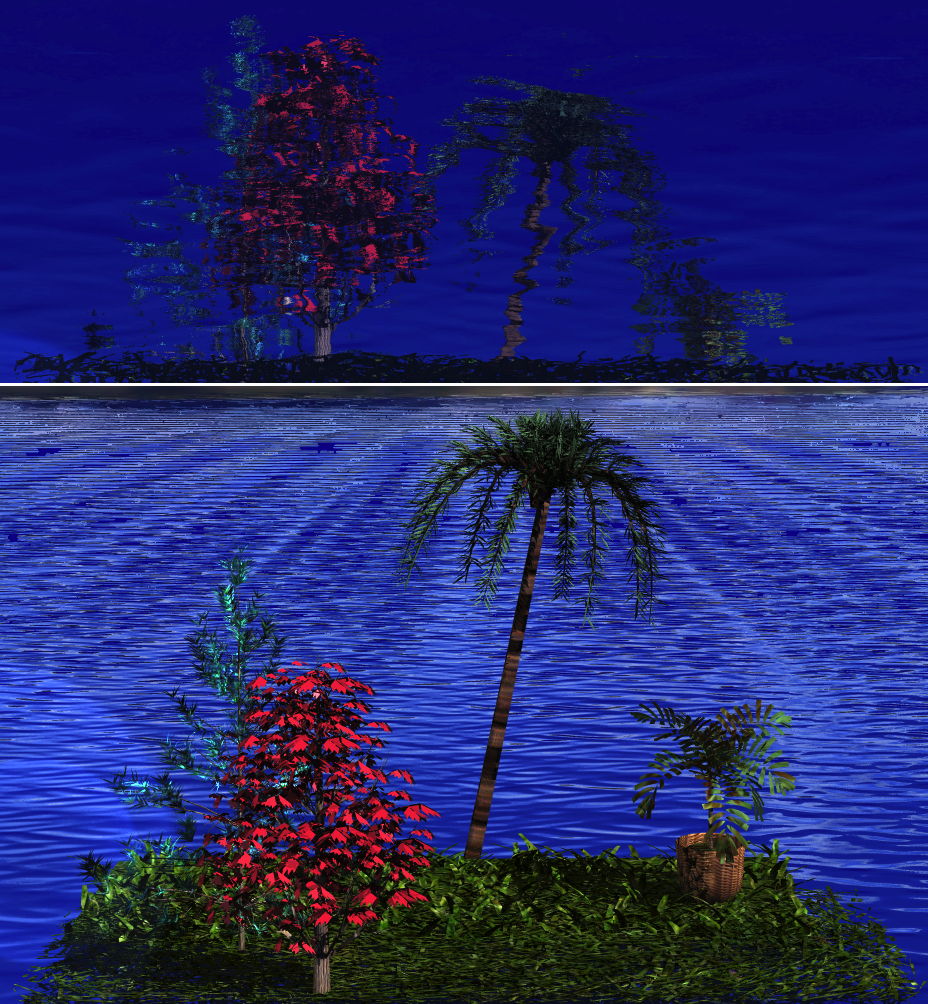
Composite image of ray-tracing of more complex 3D scene. EHN & DIJ Oakley.
One useful rule of thumb sometimes given to gauge the effect of truncation is to imagine that the water extends right back to the base of the original, then construct the reflection on that imaginary water surface, and to erase the reflection on the water where it doesn’t actually exist.
There are complex differences between the original and its reflection with respect to the position of details, tones and highlights. Although highlights are seen on the red leaves, their pattern isn’t the same, because the original leaves are seen direct, but those in the reflection are viewed as if from below and in front of the tree (from their points of reflection on the water).
This makes it impossible to create a completely accurate representation of a reflection unless you can see that reflection; even using modern ray-tracing software on a computer it is extremely difficult to construct or reconstruct a reflection from real life. Any painter who paints the original en plein air and later attempts to paint its reflection in the studio is only going to be able to guess its form and appearance, and will be unable to get tones and highlights correct with respect to those seen in nature.
Composite image of extensive reflections on water, Lac Besson, Alpe d’Huez. EHN & DIJ Oakley.
The difficulties encountered in extensive reflections on water in the real world are illustrated in the composite image above. Note how the distant mountains almost disappear from the reflection with the change in vertical dimensions, but rigorous vertical alignment is maintained across the entire image. Painting reflections in images such as this is an incredibly difficult task without the complete view in front of the painter at the time.
Practical principles
Any faithful depiction of reflections on water will therefore show the following features:
a line joining any point on the original with its equivalent on the reflection will be strictly vertical, allowing slight lateral shift resulting from the effects of small waves;
an object which is behind another object in the original will also remain behind that object in the reflection, as reflections preserve depth order;
the further back that an original object is from the water’s edge, the more its reflection will be cropped vertically;
vertical cropping loses the lower section of the original from the reflection, and the upper section remains in the reflection;
when the water surface is smooth, the position of reflections can be determined by simple geometry relating the height above the water surface to the distance between the point of reflection on the water and the perpendicular projection down onto the water plane (the tangent of the angle or incidence or reflection being equal to height/distance);
the view of each part of the original seen in the reflection will be that as seen from the points of reflection, those being lower than the observer and closer to the original;
what is seen on the (observer’s) left of the original appears on the left of the reflection, and what is seen on the right remains on the right of the reflection;
because the reflection is vertically inverted, what is seen at the top of the original appears at the bottom of the reflection;
the more the water surface departs from being a flat and smooth mirror, the more distortion will be introduced into the reflection, until eventually its form is lost in a series of vague areas of broken colour.
References
Brook Taylor (1719) New Principles of Linear Perspective, or the Art of Designing on a Plane the Representations of All Sorts of Objects, in a more General and Simple Method than has been done before, London. (Not available online, and later editions omit much of the material on reflections.)
Cole, Rex Vicat (1921) Perspective, Seeley, Service and Co, London. (Available in various reprints, and Archive.org.)
de Piles, Roger (1708) Cours de Peinture par Principes, Paris. (Available at Archive.org.)
de Valenciennes P-H (1820) Élémens de Perspective Pratique à l’usage des artistes, 2nd edn., Paris.
Following the early death of Thomas Girtin in 1802, there was no successor who proved as prolific in painting the cathedrals of Britain, and attention was transferred to those further south.
Benjamin Williams Leader (1831–1923), Worcester Cathedral (1894), oil on canvas, dimensions not known, Chazen Museum of Art, University of Wisconsin-Madison, Madison, WI. Wikimedia Commons.
In 1894, Benjamin Williams Leader painted this view of Worcester Cathedral backing onto the River Severn. This was built between 1084-1504 in an unusual mixture of styles from Norman to Perpendicular Gothic, and contains the tomb of King John in its chancel. Judging by the smoke rising from the chimneys, this was painted in the early autumn.
John Constable (1776–1837), Salisbury Cathedral from the Bishop’s Garden (1823), oil on canvas, 87.6 × 111.8 cm, V&A, London. Wikimedia Commons.
If any artist came close to Girtin’s achievement it must have been John Constable. In about 1820, Bishop John Fisher commissioned him to paint Salisbury Cathedral from the grounds of his Palace, and Constable started to prepare sketches and studies for that medium-sized painting Salisbury Cathedral from the Bishop’s Garden, completed in 1823.
John Constable (1776–1837), Study for Salisbury Cathedral from the Meadows (1830-1), oil on canvas, 71 × 90 cm, Private collection. Wikimedia Commons.
Constable was still battling with depression after the death of his wife when Archdeacon John Fisher, younger cousin of the Bishop, who had died in 1825, encouraged him to paint a larger and more ambitious view of Salisbury Cathedral, from the nearby meadows on the banks of the River Nadder. This late oil sketch was sold by auction in 2015 for more than five million dollars.
John Constable (1776–1837), Salisbury Cathedral from the Meadows (1831), oil on canvas, 151.8 × 189.9 cm, The Tate Gallery, London. Wikimedia Commons.
Constable completed his finished painting above for exhibition in the Royal Academy in 1831. It is perhaps a little over-egged with its storm clouds, rainbow and bolt of lightning. Despite several showings, it remained unsold when Constable died. Salisbury Cathedral was almost entirely built within the period 1220-1258, although its tower and spire, the tallest in England, were completed by 1330.
Although there is a Westminster Cathedral in London, it’s Roman Catholic, unlike the more famous Westminster Abbey, a collegiate church of the Church of England that has long been popular for coronations and interments of British monarchs and the nation’s most distinguished figures. The present building was constructed between 1245-1269 close to the Palace of Westminster on the north bank of the River Thames.
Samuel Scott (1702–1772), Westminster from Lambeth, with the Ceremonial Barge of the Ironmongers’ Company (c 1745), oil on canvas, 79.4 x 150.5 cm, Yale Center for British Art, New Haven, CT. Wikimedia Commons.
Samuel Scott’s Westminster from Lambeth, with the Ceremonial Barge of the Ironmongers’ Company (c 1745) shows a section of the River Thames on a windy day, with showers not far away. Teams of rowers pull their boats out to attend to the ceremonial barges in the foreground, reminiscent of Venetian boat ceremonies. The opposite bank shows, from the left, the imposing twin towers of Westminster Abbey, the old Palace of Westminster almost hidden behind trees, and Westminster Bridge.
Benjamin West (1738–1820), Milkmaids in St. James’s Park, Westminster Abbey beyond (c 1801), oil on panel, further details not known. Wikimedia Commons.
The American history painter Benjamin West painted this view of Milkmaids in St. James’s Park, Westminster Abbey beyond in about 1801. Two cows and attendant milkmaids are providing a supply of fresh milk for the crowds in this royal park with Buckingham Palace on its edge. This remains 57 acres (23 hectares) of grass, trees and lakes.
The Church of England cathedral in London is of course Saint Paul’s, on Ludgate Hill a few miles to the east in the centre of the city of London. It was built between 1675-1710 to the designs of Sir Christopher Wren, following the destruction of its predecessor in the Great Fire of London of 1666.
Canaletto (Giovanni Antonio Canal) (1697–1768), St. Paul’s Cathedral (c 1754), oil on canvas, 52.1 x 61.6 cm, Yale Center for British Art, New Haven, CT. Wikimedia Commons.
Canaletto painted this imposing view of St. Paul’s Cathedral when he was working in England in about 1754. This Venetian artist lived and painted in London between 1746-1755 when the War of the Austrian Succession disrupted the art market in Venice.
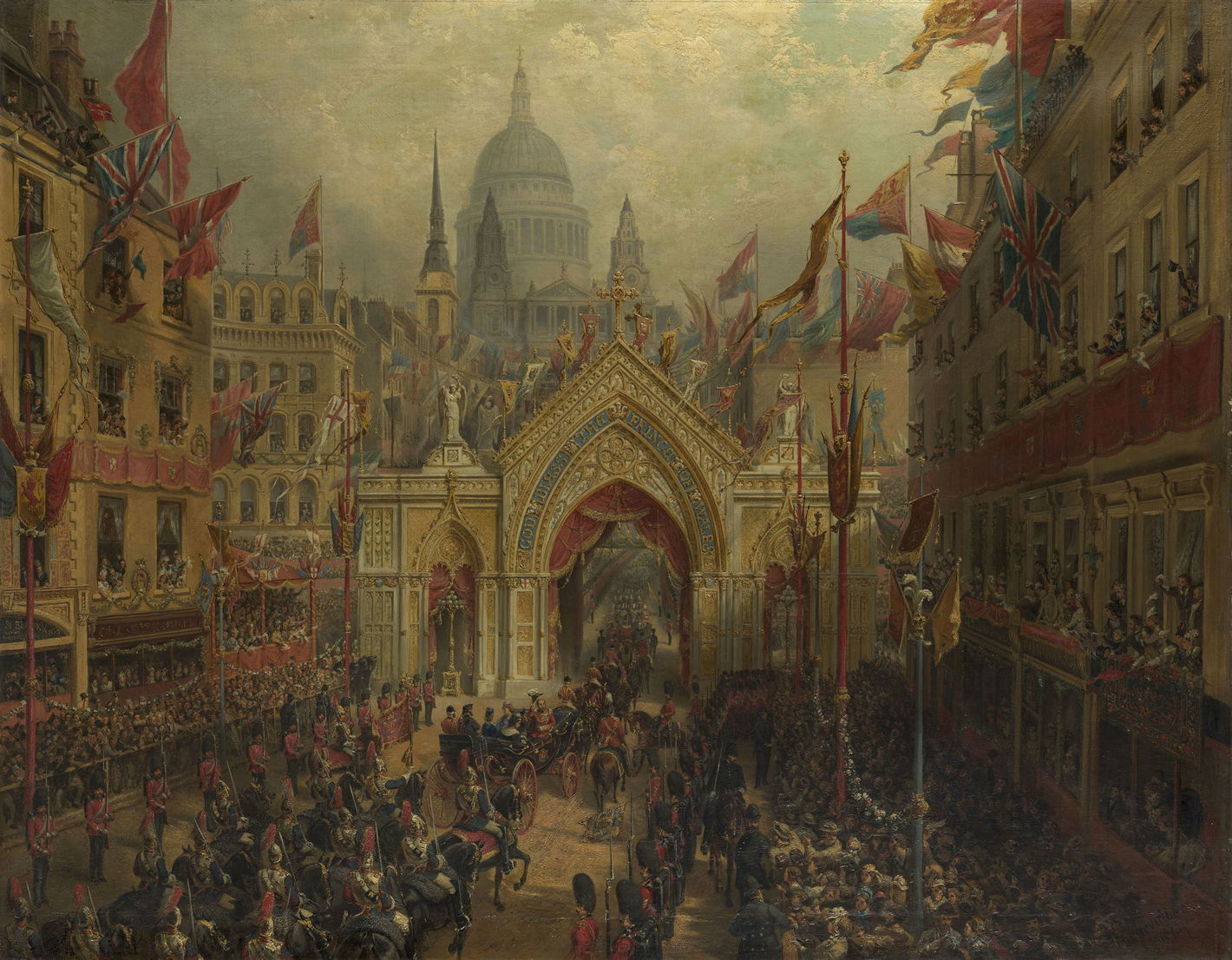
Nicholas Chevalier (1828–1902), ‘Thanksgiving Day’: The Procession to St Paul’s Cathedral, 27 February 1872 (after 1872), oil on canvas, 79 x 99.3 cm, Royal Collection of the United Kingdom, UK. By courtesy of the Royal Collection Trust, via Wikimedia Commons.
Nicholas Chevalier painted ‘Thanksgiving Day’: The Procession to St Paul’s Cathedral, 27 February 1872 shortly after this royal event. Not to be confused with US Thanksgiving, this was a one-off state thanksgiving for the recovery from severe illness of the Prince of Wales. The widowed Queen Victoria and her son Prince Edward attended Saint Paul’s Cathedral (the obvious dome in the distance) to give public thanks to God. Approaching the arch is the carriage containing the royal party.
Canaletto wasn’t the only visitor from continental Europe to paint Wren’s prominent dome.
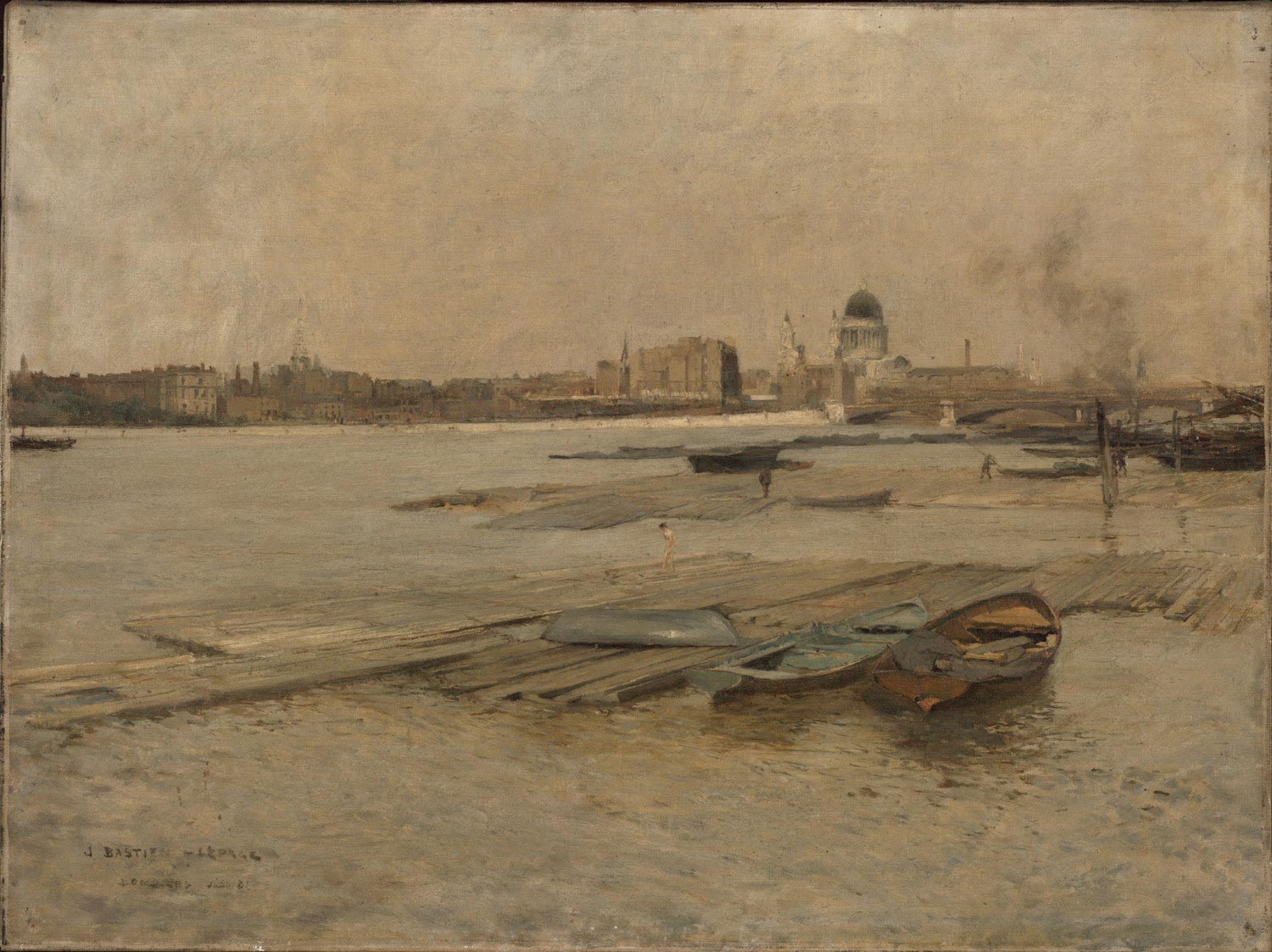
Jules Bastien-Lepage (1848–1884), Blackfriars Bridge and the Thames, London (1881), oil on canvas, 51.1 x 68.9 cm, Philadelphia Museum of Art, Philadelphia, PA. The Athenaeum.
From 1880, Jules Bastien-Lepage visited London repeatedly. Blackfriars Bridge and the Thames, London (1881) is his fine depiction of this stretch of the River Thames, with his characteristic gradation of detail from its foreground into the distance. Standing proud on the skyline towards the right is the distinctive dome of Saint Paul’s.
Henri Le Sidaner (1862–1939), St. Paul’s from the River: Morning Sun in Winter (1906-07), oil on canvas, 90 x 116 cm, Walker Art Gallery, Liverpool, England. Wikimedia Commons.
Henri Le Sidaner also visited Britain on several occasions, and in 1906-07 painted this view of St. Paul’s from the River: Morning Sun in Winter, which may have been inspired by Monet’s series paintings of Rouen Cathedral, here expressed using his own distinctive marks.
In case you think Wren’s Saint Paul’s appears recent compared with Britain’s older cathedrals, in my lifetime I have seen two new Church of England cathedrals consecrated: Coventry in 1962, replacing an older building destroyed during the Second World War, and Guildford in 1961, built on a new site altogether over a period of twenty-five years.
This weekend I’m touring the cathedrals and abbeys of Britain in the company of some of their finest artists. Today I concentrate on the best of them, whose life was cut short when he died at the age of just twenty-seven as a result of asthma. Thomas Girtin was a contemporary, friend and competitor of JMW Turner, but when it came to painting cathedrals there was no contest.
Thomas Girtin (1775–1802), Rochester, Kent: from the North (c 1790), watercolour with pen and black ink over graphite on beige, thick, moderately textured, cartridge paper, 31.8 x 46.4 cm, Yale Center for British Art, New Haven, CT. Wikimedia Commons.
Girtin was just fifteen when he painted the fine sky and effective aerial perspective in his view of Rochester, Kent: from the North (c 1790), although some have argued that he might have been a couple of years older. The cathedral shown here was built between 1079-1238, and its central tower was raised in 1343, just before the Black Death struck.
Thomas Girtin (1775–1802), Lichfield Cathedral, Staffordshire (1794), watercolour with pen in gray ink over graphite on moderately thick, moderatetly textured, brown, wove paper, 38.3 x 28.9 cm, Yale Center for British Art, New Haven, CT. Wikimedia Commons.
Although he had possibly travelled to paint earlier, Girtin’s first major painting tour with his employer James Moore was of the Midlands in 1794. They visited Warwick, Stratford, Lichfield, Peterborough, and Lincoln; this fine view of Lichfield Cathedral (1794) was one of its successes, and already secured him a place alongside the better watercolour landscape painters of the day. This cathedral was built between the early thirteen century and 1330, and underwent extensive renovation following damage during the English Civil War.
Thomas Girtin (1775–1802), Glasgow Cathedral (1794-1795), watercolour with pen in brown and black ink over graphite on moderately thick, slightly textured, cream, wove paper mount, 29.8 x 24.9 cm, Yale Center for British Art, New Haven, CT. Wikimedia Commons.
Girtin’s skills of composition were well in advance of his experience and time. This view of Glasgow Cathedral from 1794-5 shows one of the lesser-known cathedrals in Britain, most of whose structure dates from its rebuilding during the thirteenth century, making it the oldest cathedral in mainland Scotland, and the oldest building in the city.
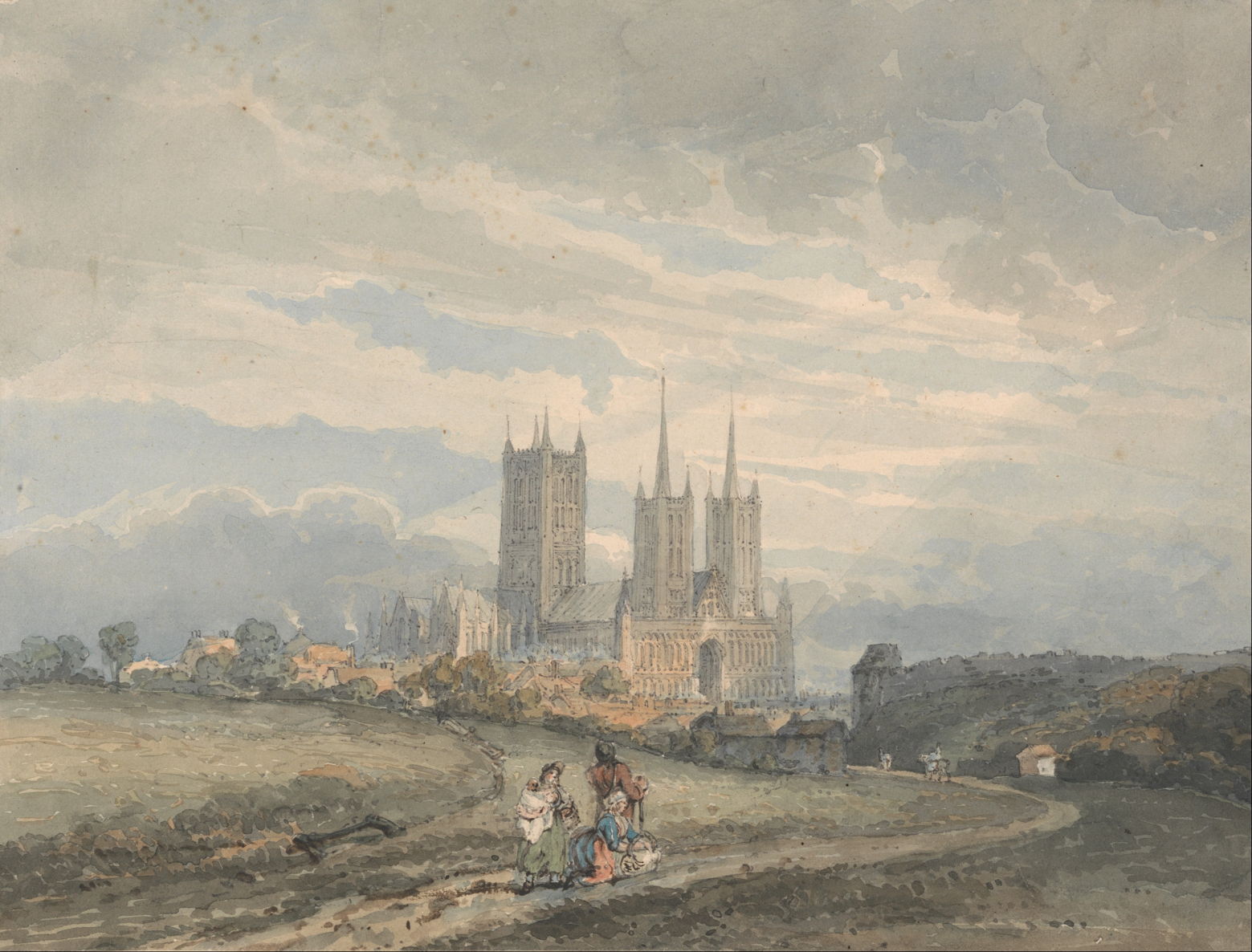
Thomas Girtin (1775–1802), Lincoln Cathedral (c 1795), watercolour with pen in black ink over graphite white gouache on mounted on, moerately thick, moderately textured, beige, laid paper, 23.7 x 28.9 cm, Yale Center for British Art, New Haven, CT. Wikimedia Commons.
Painted in the same tour, this view of Lincoln Cathedral from about 1795 marks his transition from topographic illustration to pure watercolour, with the last vestiges of ink almost gone. This cathedral had first been built in 1092, but was badly damaged by an earthquake in 1185, following which it was rebuilt, and largely completed by 1311.
Colin Campbell Cooper (1856–1937), The Interior of Lincoln Cathedral (c 1905), other details not known. Wikimedia Commons.
A century later, it was visited by the American skyscraper artist Colin Campbell Cooper. The Interior of Lincoln Cathedral shows the area of the organ, which had only recently been installed by the classical organ-builder Henry Willis. Cooper captures particularly well the lofty and distinctive vaulted ceiling and incoming shafts of light.
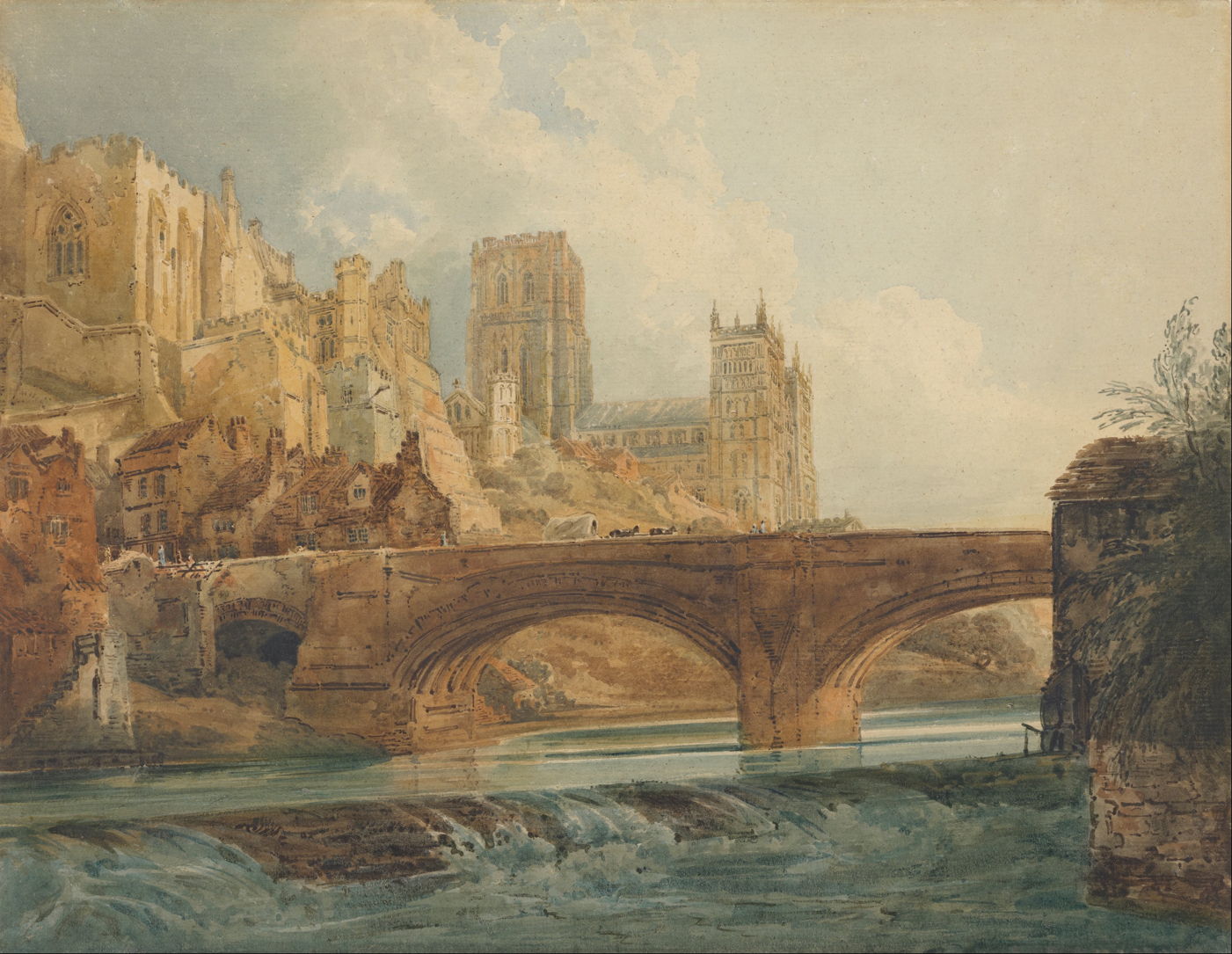
Thomas Girtin (1775–1802), Durham Cathedral and Castle (c 1800), watercolour over pencil heightened with gum arabic, 37.5 x 48.9 cm, Getty Center, Los Angeles, CA. Wikimedia Commons.
Girtin’s wonderful view of Durham Cathedral and Castle from about 1800 contains as much detail as his earlier views, but is better integrated into the whole instead of competing for the viewer’s attention. The cathedral is the more distant of the two massive buildings overlooking the River Wear. Much of it was constructed between 1093-1133, with further additions made until 1490.
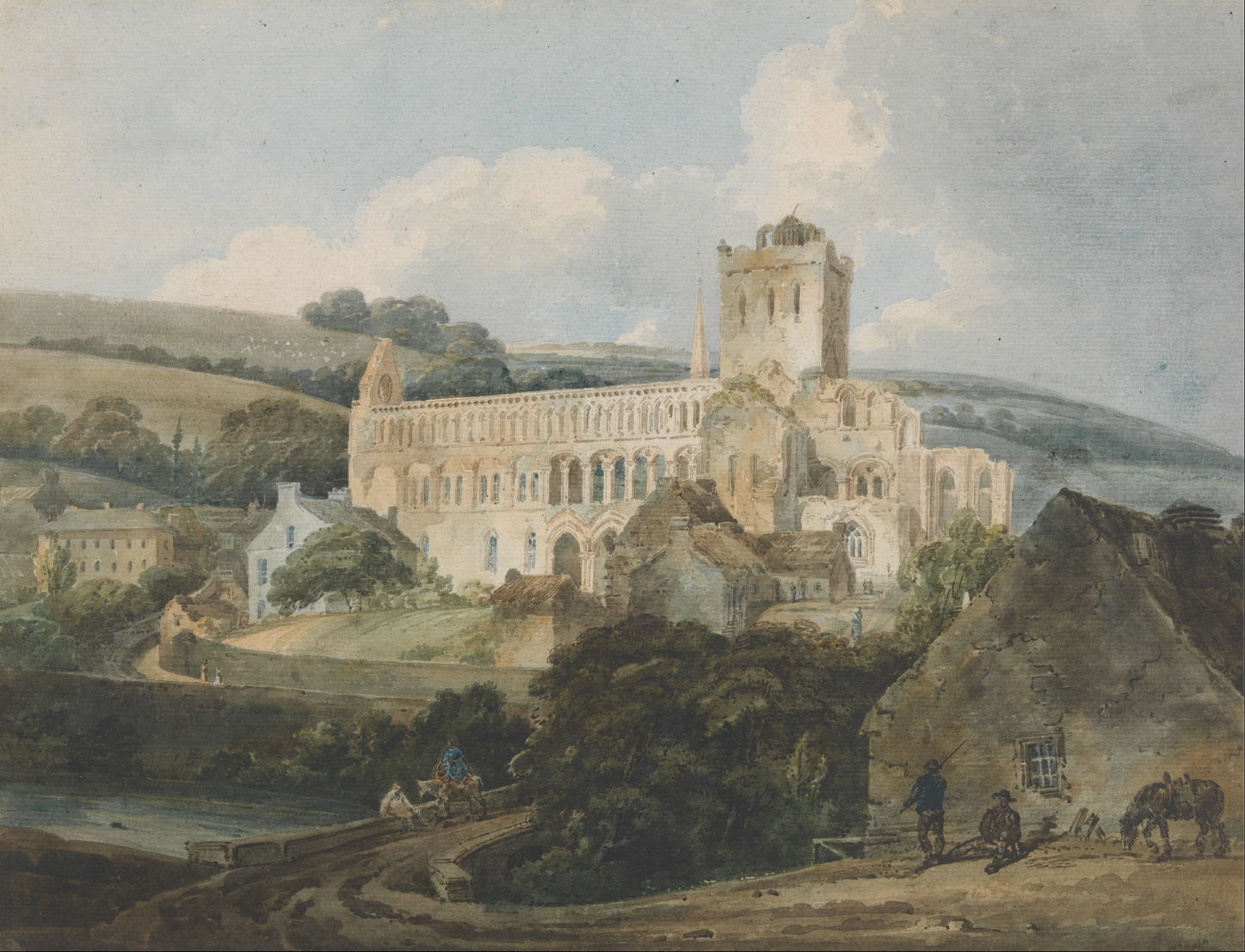
Thomas Girtin (1775–1802), Jedburgh Abbey, Roxburghshire (c 1793), watercolour over graphite, and gray wash on moderately thick, slightly textured, beige, wove mount paper, 24.8 x 29.7 cm, Yale Center for British Art, New Haven, CT. Wikimedia Commons.
These two paintings of Jedburgh Abbey show how Girtin’s art matured during those years. He painted Jedburgh Abbey, Roxburghshire above in about 1793, when he was just eighteen, and Jedburgh Abbey from the South East below in 1800, when he had reached twenty-five. This is a former Augustinian abbey just north of the border between Scotland and England. Much of it was built between about 1153-1285, and it was disestablished and largely abandoned in 1560, with the Scottish Reformation.
Thomas Girtin (1775–1802), Jedburgh Abbey from the South East (1800), watercolour, gouache and graphite on medium, cream, moderately textured laid paper, 66 x 79.1 cm, Yale Center for British Art, New Haven, CT. Wikimedia Commons.Thomas Girtin (1775–1802), Ripon Minster, Yorkshire (1800), watercolour with pen in black and brown ink, with scraping over graphite on medium, slightly textured, beige, laid paper, 31.4 x 47.6 cm, Yale Center for British Art, New Haven, CT. Wikimedia Commons.
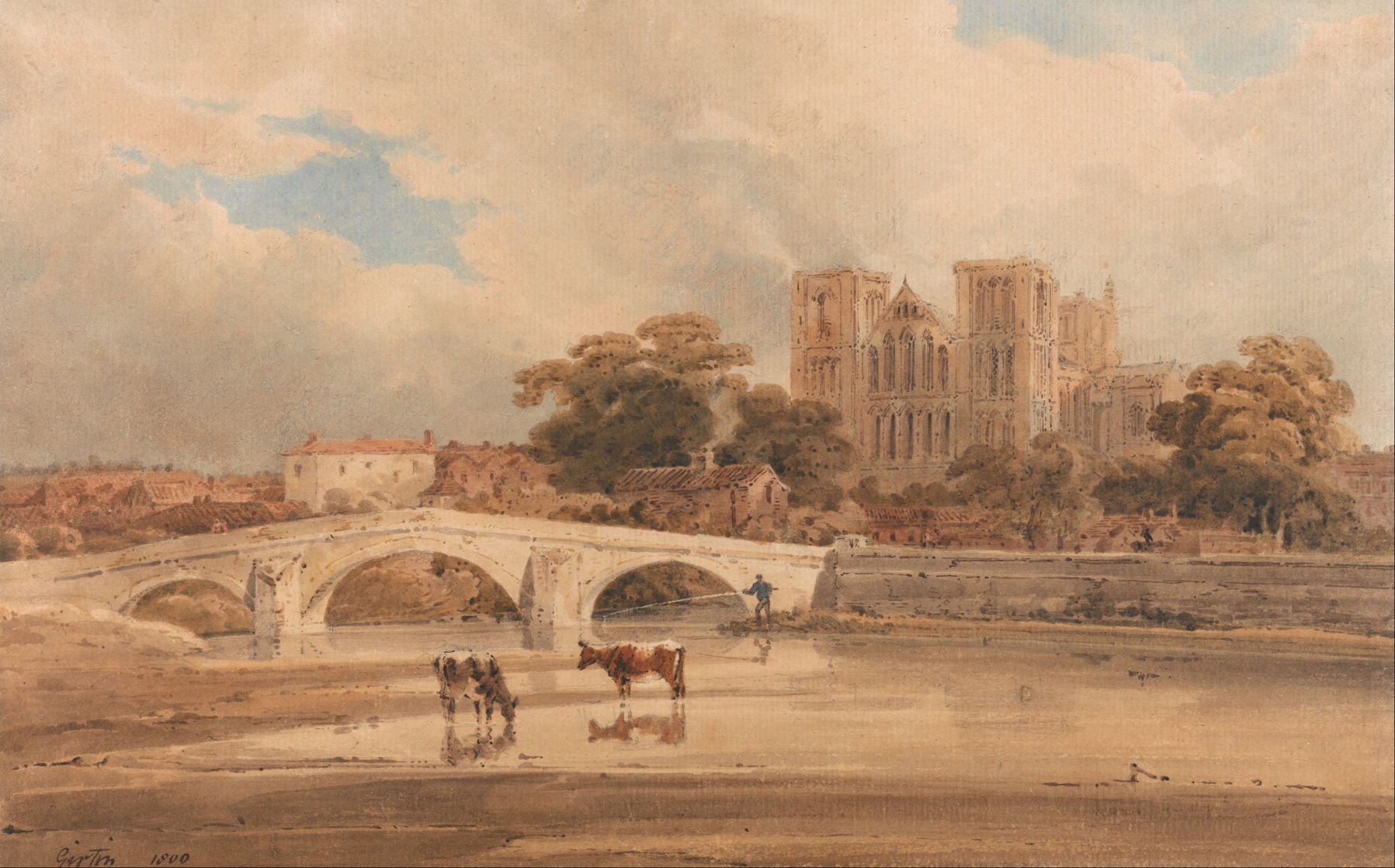
In Girtin’s Ripon Minster, Yorkshire (1800), it’s the features of the river, its bridge, cattle, and a single angler, that steal the gaze, rather than the bulk of the minster behind. Now commonly known as Ripon Cathedral, this was a minster util 1836. The present building was started in 1160, and progressively modified and expanded until 1547.
This weekend we’re sheltering on the island of Capri, at the southern end of the Bay of Naples, Italy, where we’ve reached the 1880s, a time when Capri had become popular with landscape painters.
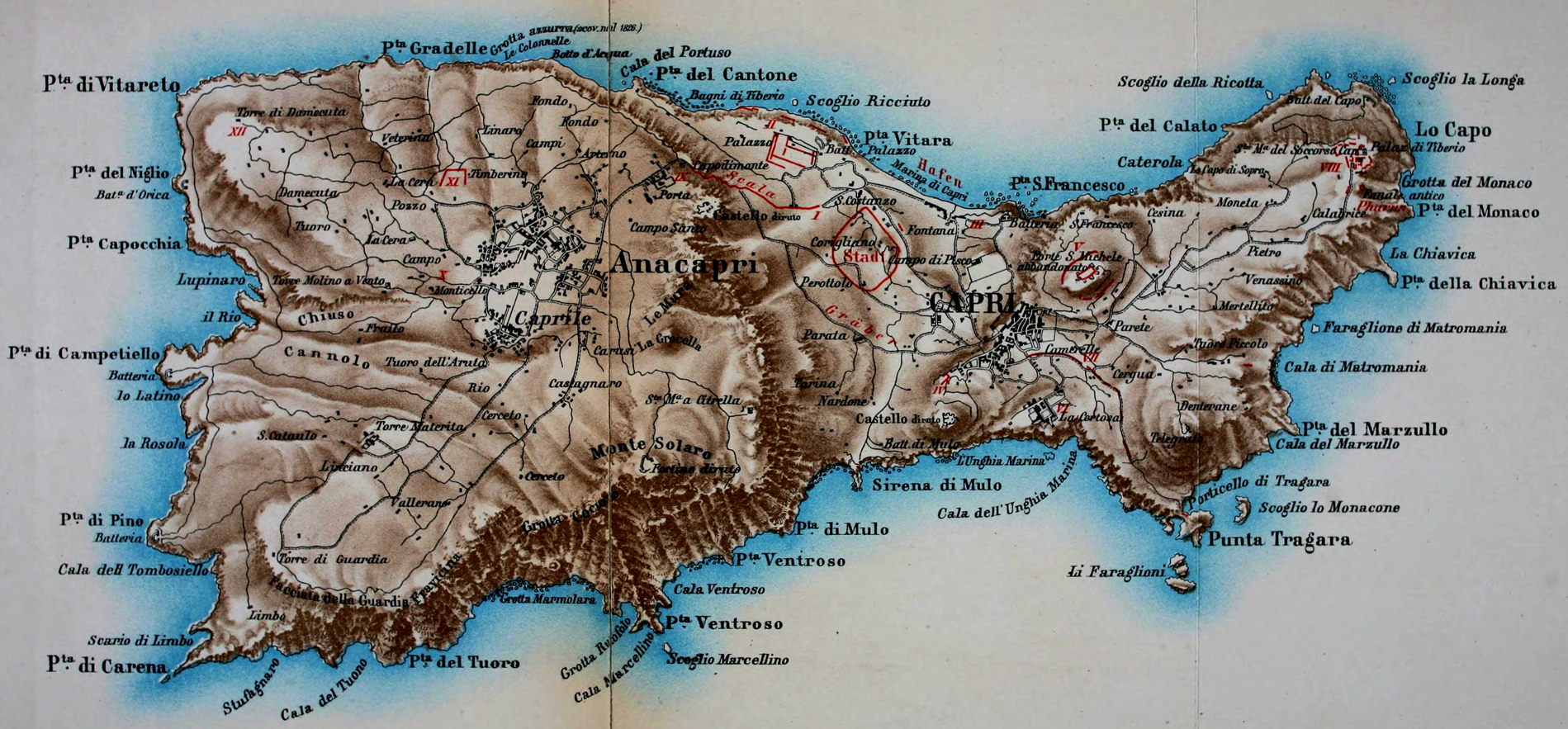
Karl Julius Beloch (1854–1929), Map of Capri (1890), from From Karl Julius Beloch: Campanien. Breslau, 1890. Wikimedia Commons.
Among the many artists who visited the island during the nineteenth century were several who had trained in Düsseldorf, Germany, whose works became popular both in Germany and in the USA.
Oswald Achenbach (1827–1905), View of Capri (1884), oil on canvas, 44 × 60.5 cm, Von-der-Heydt-Museum, Wuppertal, Germany. Wikimedia Commons.
Oswald Achenbach’s View of Capri from 1884 shows the island from a vantage point in the hills above Sorrento on the mainland. Achenbach was another member of the Düsseldorf School who visited Italy on several occasions during his career. His last extended visit started in 1882, and took him to Sorrento, but he had visited Capri a decade earlier, in 1871.
Hercules Brabazon Brabazon (1821-1906), Capri (date not known), gouache on paper, 6.9 x 10.1 cm, Phillips Collection, Washington, DC. Wikimedia Commons.
Hercules Brabazon Brabazon’s undated gouache painting of Capri is an unusual nocturne, showing a lonely and rugged section of the coast. An isolated villa stands in the bay, steps curving their way from it down to the tiny beach. This was most probably painted around 1890.
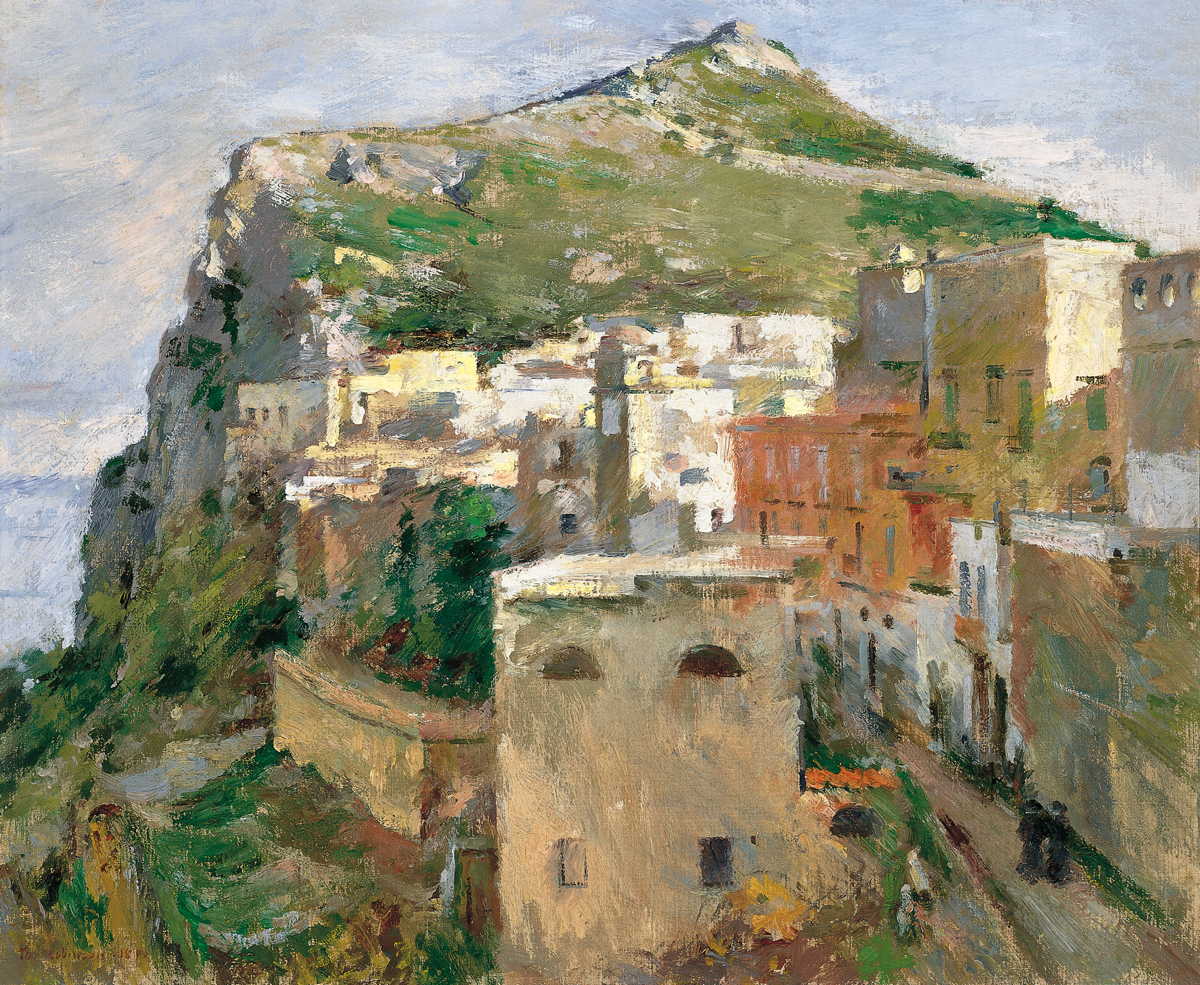
Theodore Robinson (1852-1896), Capri (1890), oil on canvas, 44.5 x 53.3 cm, Thyssen-Bornemisza Museum, Madrid. Wikimedia Commons.
Theodore Robinson was an American Impressionist who trained in New York before heading to Europe in 1876, and must have painted this view of Capri when visiting the island in 1890. It appears to show Monte Tiberio in the far north-east, from the west. Robinson is most famous for his Impressionist landscapes from Giverny, mostly painted after he had moved into the property next door to Claude Monet. Although Monet doesn’t appear to have visited Capri, Robinson here adapted Monet’s style from his views of the cliffs at Étretat and other rugged coasts. Robinson tragically died of an asthma attack in 1896 when he was only 43.
Nicholas Chevalier (1828-1902), View of the Faraglioni, Capri (1892), watercolour, 50 x 73.7 cm, location not known. Wikimedia Commons.
Nicholas Chevalier’s View of the Faraglioni, Capri (1892) is a detailed watercolour view painted from the Marina Piccola on the south coast, looking south-east to the rock stacks of the Faraglione in the distance. He trained in Munich rather than Düsseldorf, and from 1851 painted in Britain, then in Australia and New Zealand. This was made during a visit to the island in his late career, when he was growing old and less active.
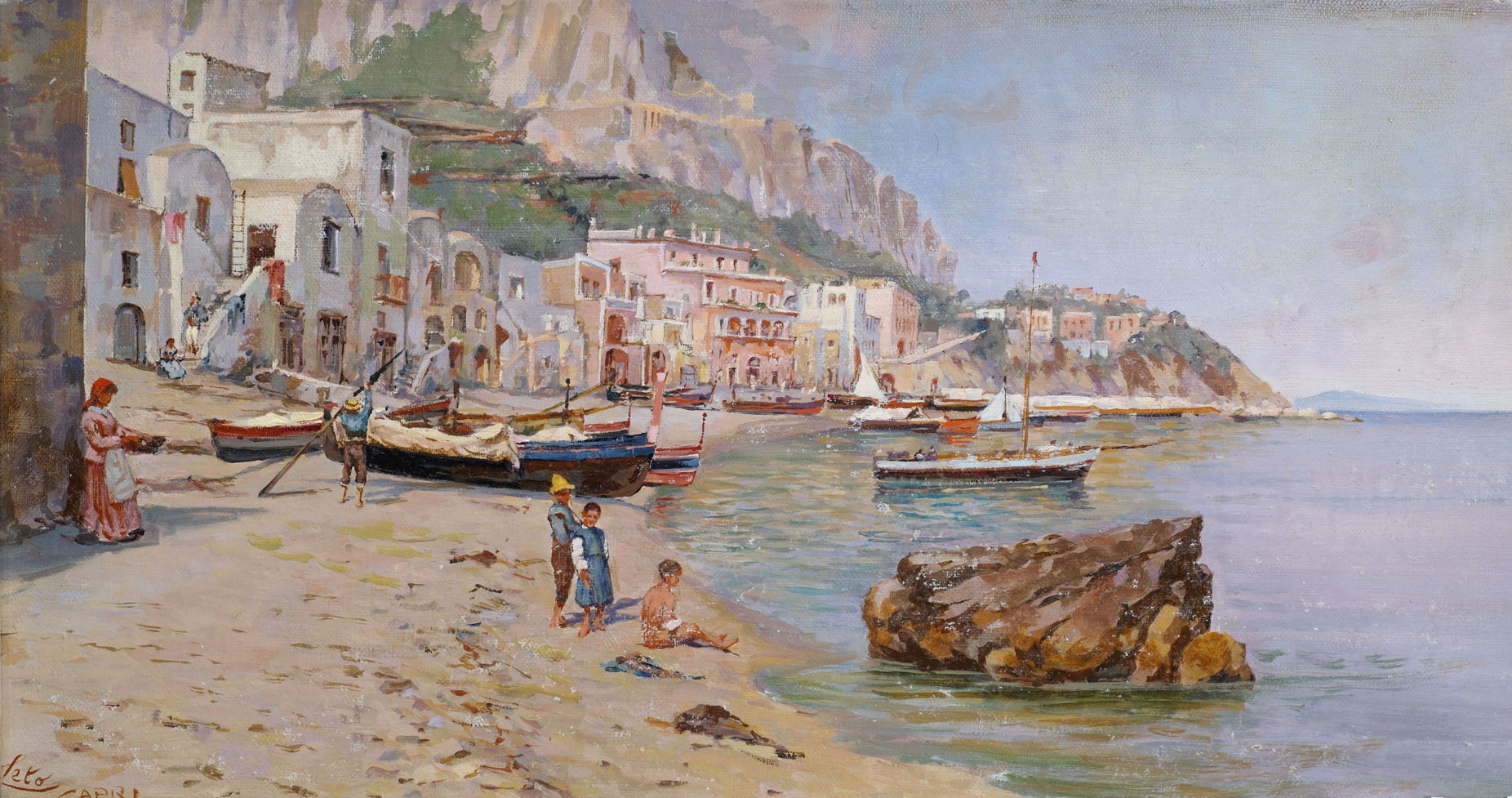
Antonino Leto (1844–1913), Capri (date not known), oil on canvas, 21.5 × 30.5 cm, location not known. Wikimedia Commons.
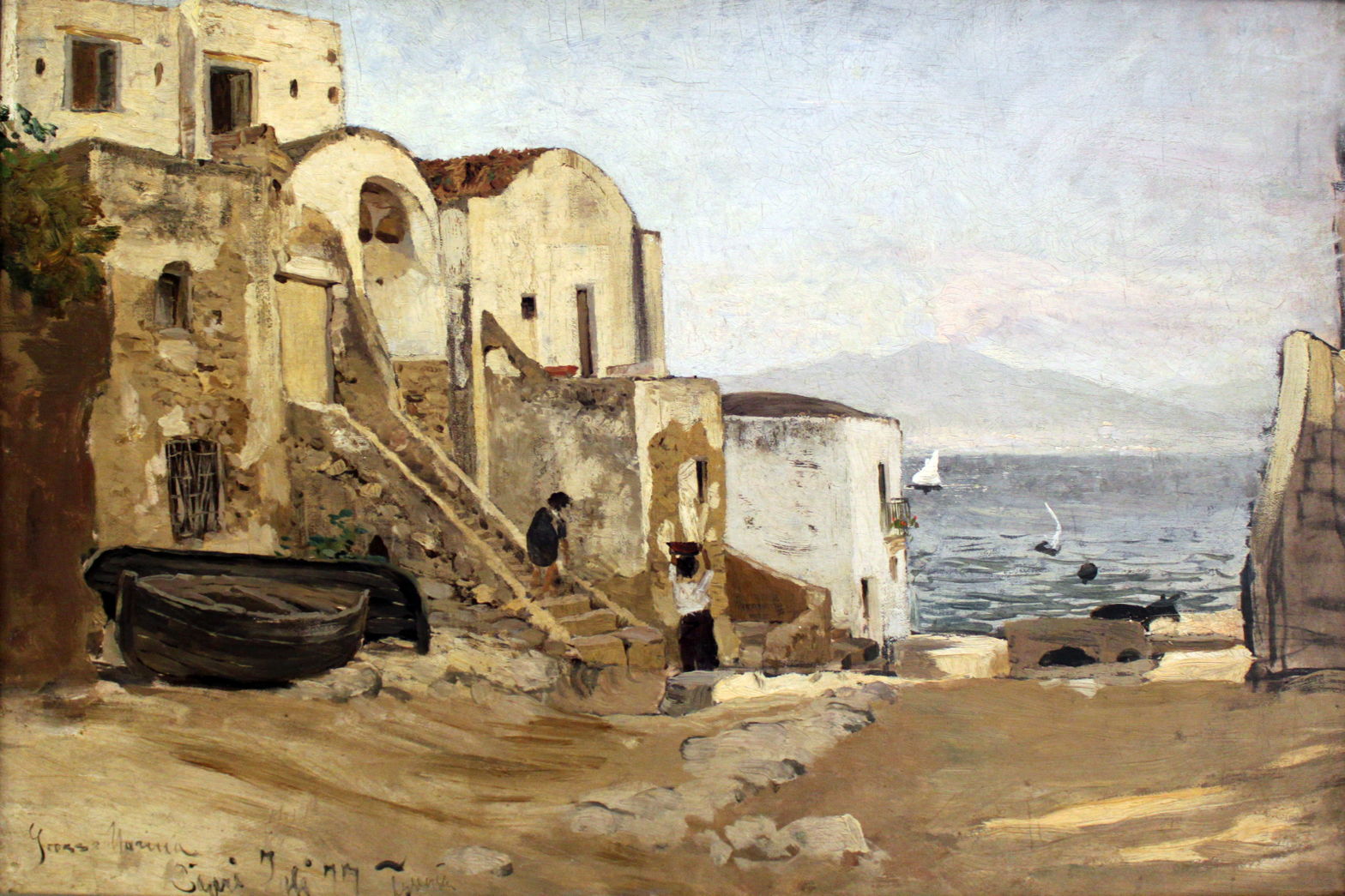
Antonino Leto’s undated view of Capri was most probably painted after he had retired to the island in 1882, following his career of painting landscapes and genre views in Impressionist style. I think that this shows the Marina Grande on the north coast, viewed from the east. Leto was originally inspired by the work of Giuseppe De Nittis, and in 1879 joined him and the group of Italian Impressionists who had gathered in Paris.
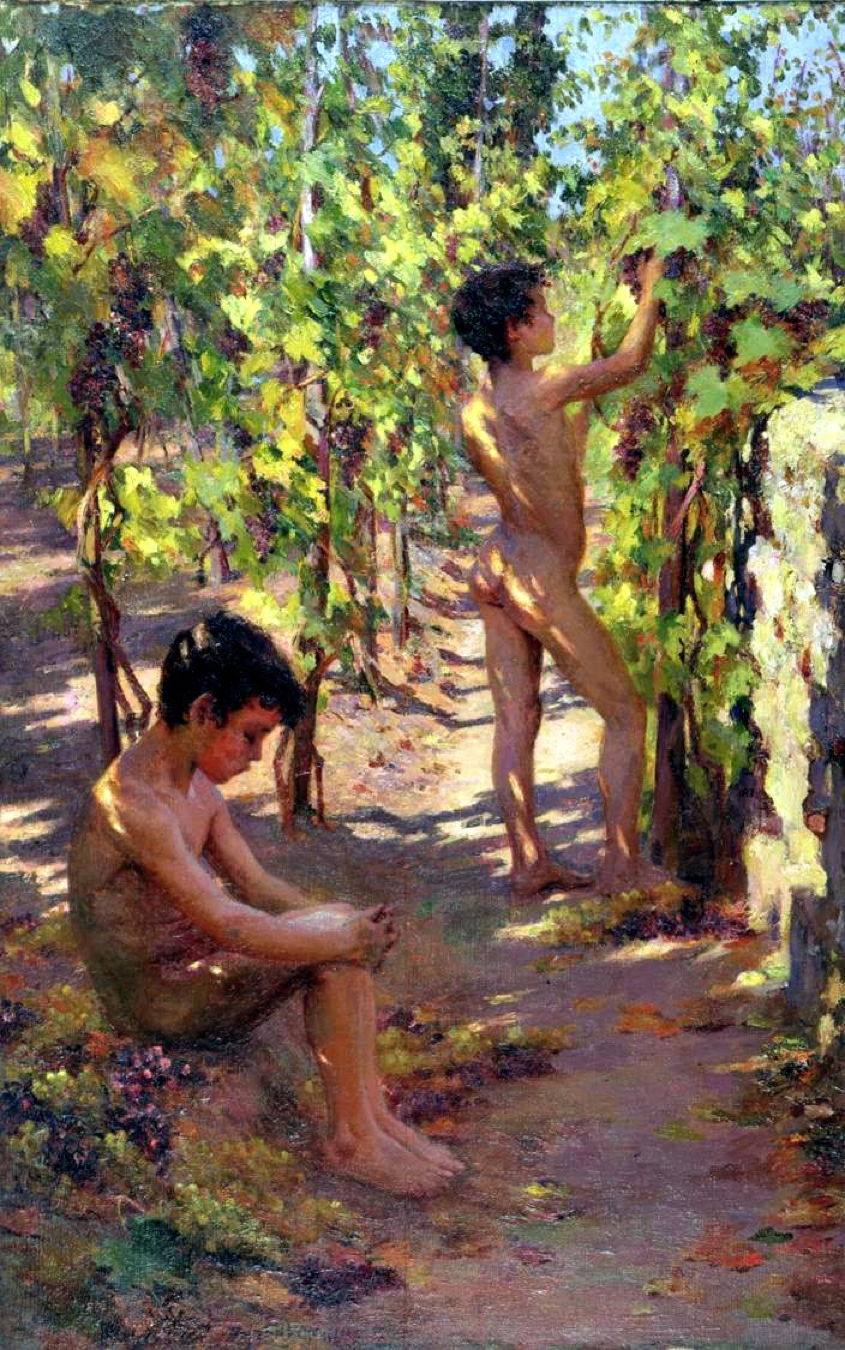
By the start of the twentieth century, painting in Capri was changing again. After his naturist and vegan painters’ commune and colony near Vienna went bankrupt from 1899, Karl Wilhelm Diefenbach moved to the island, where others joined him in another commune, perhaps in a more appropriate climate.
Susan Watkins (1875–1913), Boys Picking Grapes at Capri (c 1906), oil on canvas, 79.4 × 52.1 cm, Chrysler Museum of Art, Norfolk, VA. Wikimedia Commons.
In about 1906, Susan Watkins appears to have visited the island. When there, she painted two superb studies for one of her finest works, showing local boys picking grapes on the island. Her finished painting of Boys Picking Grapes at Capri (c 1906) shows the much looser, more painterly, and richly chromatic style typical of her more mature work.
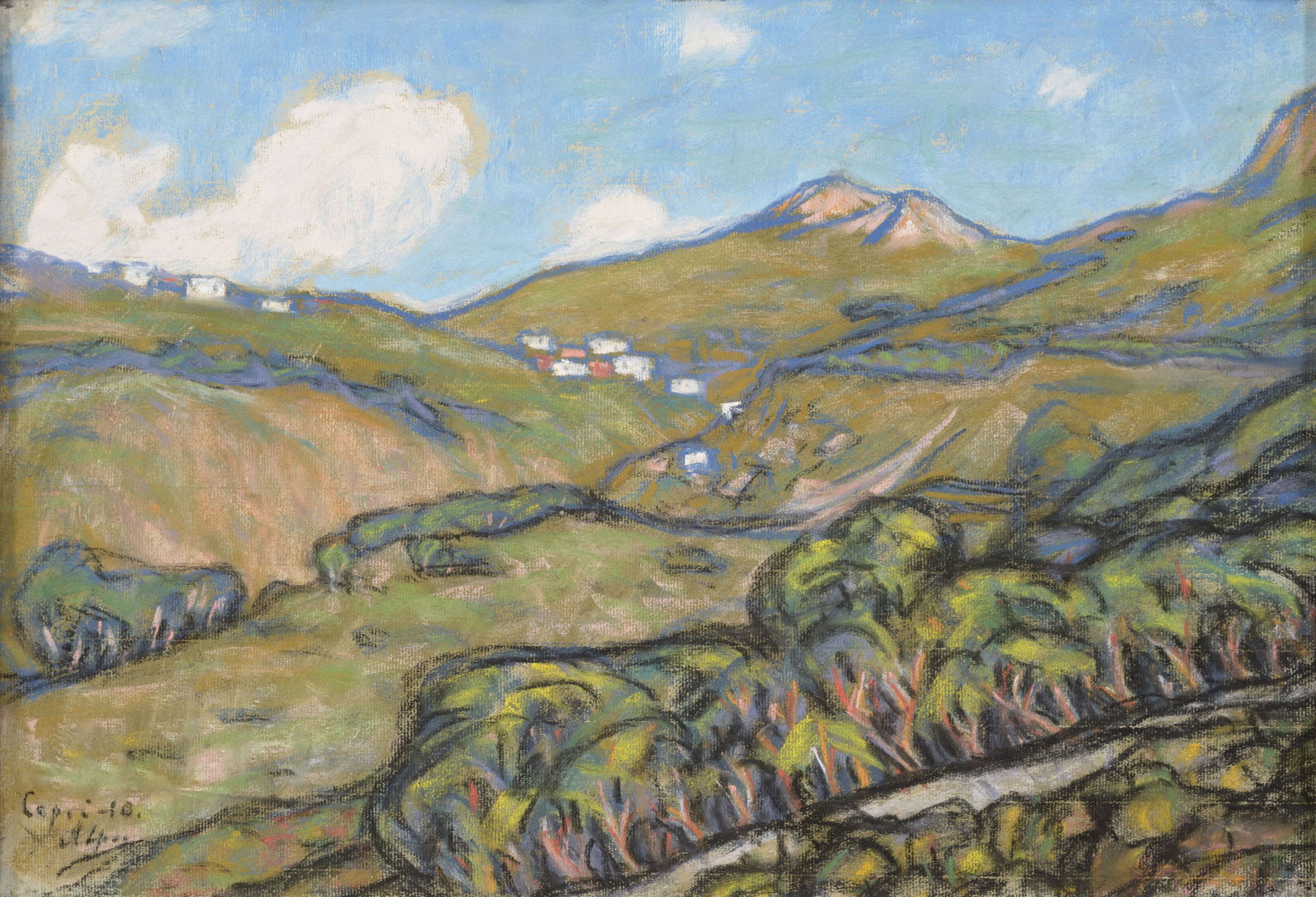
Ants Laikmaa (1866–1942), Capri Landscape (1910), pastel on paper, 31.5 x 47 cm, Private collection. Wikimedia Commons.
Between 1910 and 1912, the Estonian pastellist Ants Laikmaa (1866–1942) lived on Capri, where he painted many landscapes. His Capri Landscape from 1910 is unusual for showing the interior of the island with its scattered white houses.
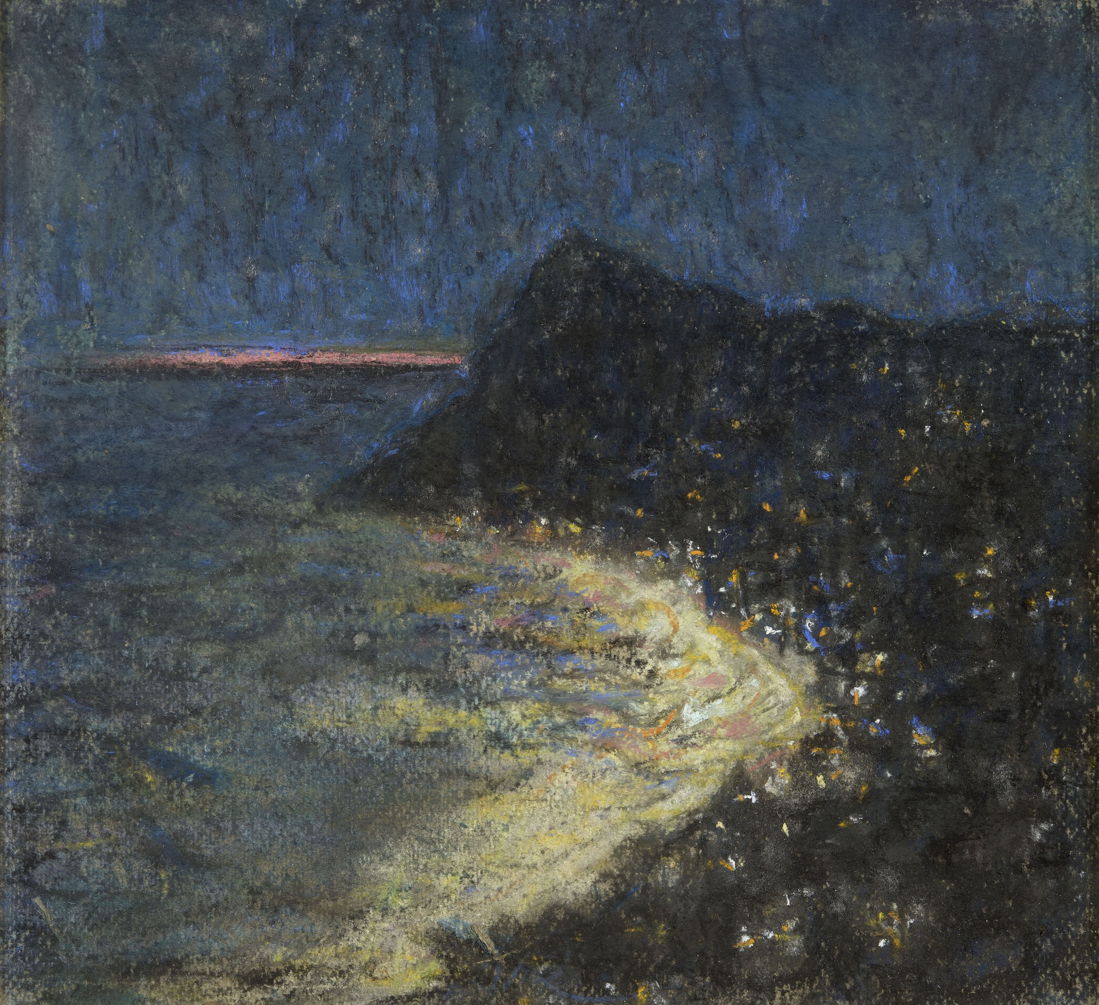
Ants Laikmaa (1866–1942), Night Motif from Capri (1910), pastel on paper, 19 x 20.5 cm, Private collection. Image courtesy of Enn Kunila, via Wikimedia Commons.
Laikmaa’s Night Motif from Capri from the same year is more of an impression of the coast, dotted with lights.
Paul von Spaun (1876–1932), The Faraglioni Cliffs on Capri (1913), oil on canvas, 60 x 60 cm, location not known. Wikimedia Commons.
Paul von Spaun painted this striking view of The Faraglioni Cliffs on Capri from above in 1913. As far as I can gather, he was Diefenbach’s son in law, an Austrian painter who lived in Diefenbach’s commune and fathered Fridolin von Spaun, who went on to research Diefenbach’s life and works, and collected his paintings in a museum on the island, in the Carthusian monastery at Certosa di San Giacomo, painted by Marie-Caroline de Bourbon, shown in the first of these two articles.
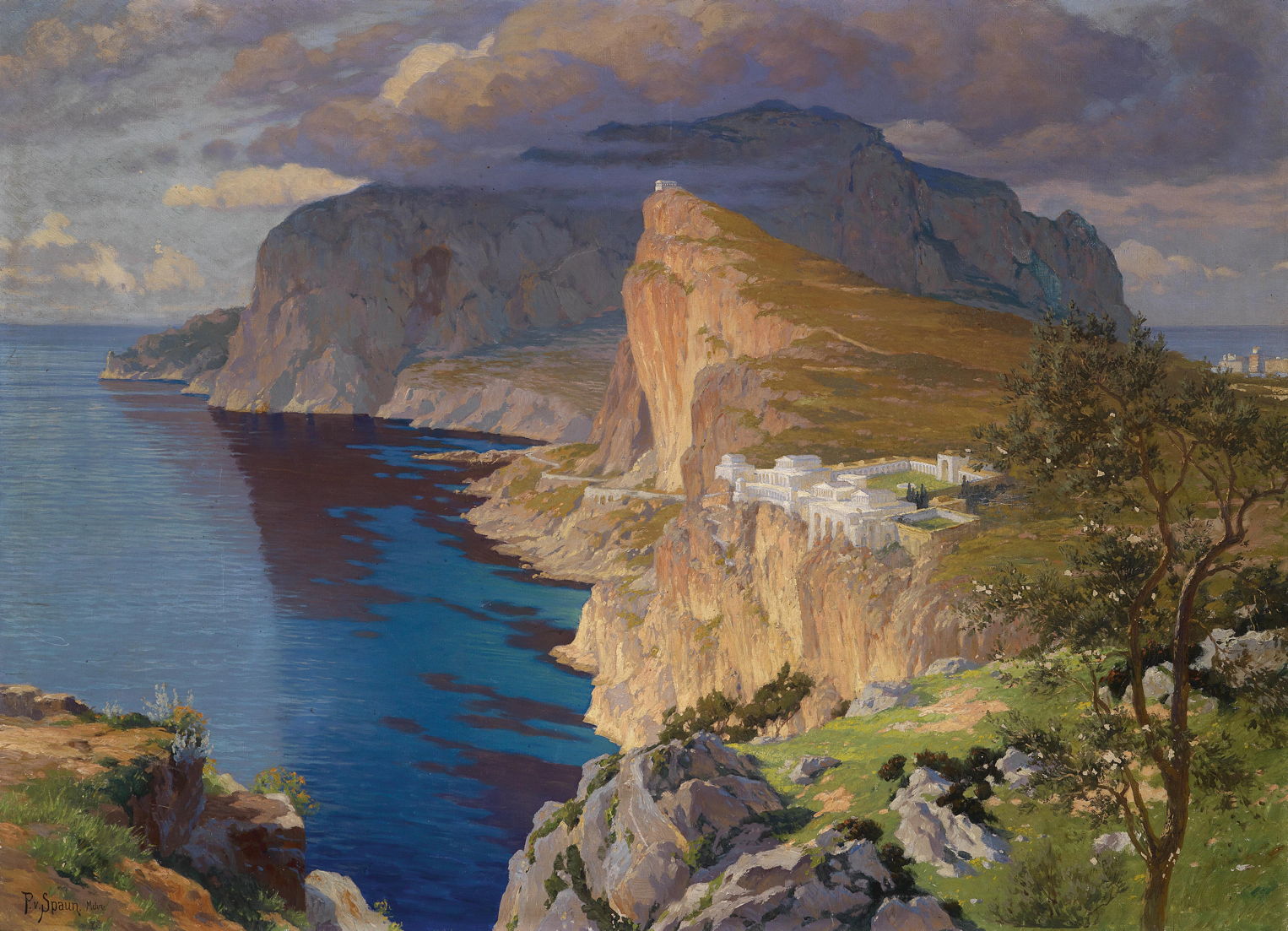
Paul von Spaun (1876-1932), Idealised View of Villa Jovis on the Island of Capri (date not known), oil on canvas, 80 x 110.4 cm, location not known. Wikimedia Commons.
Von Spaun’s undated Idealised View of Villa Jovis on the Island of Capri is one of the most outstanding paintings of the island. But it isn’t a ‘real’ view, as far as I can tell, rather a composite cleverly built from several different features, much in the way that landscape Masters like Nicolas Poussin assembled their idealised landscapes.
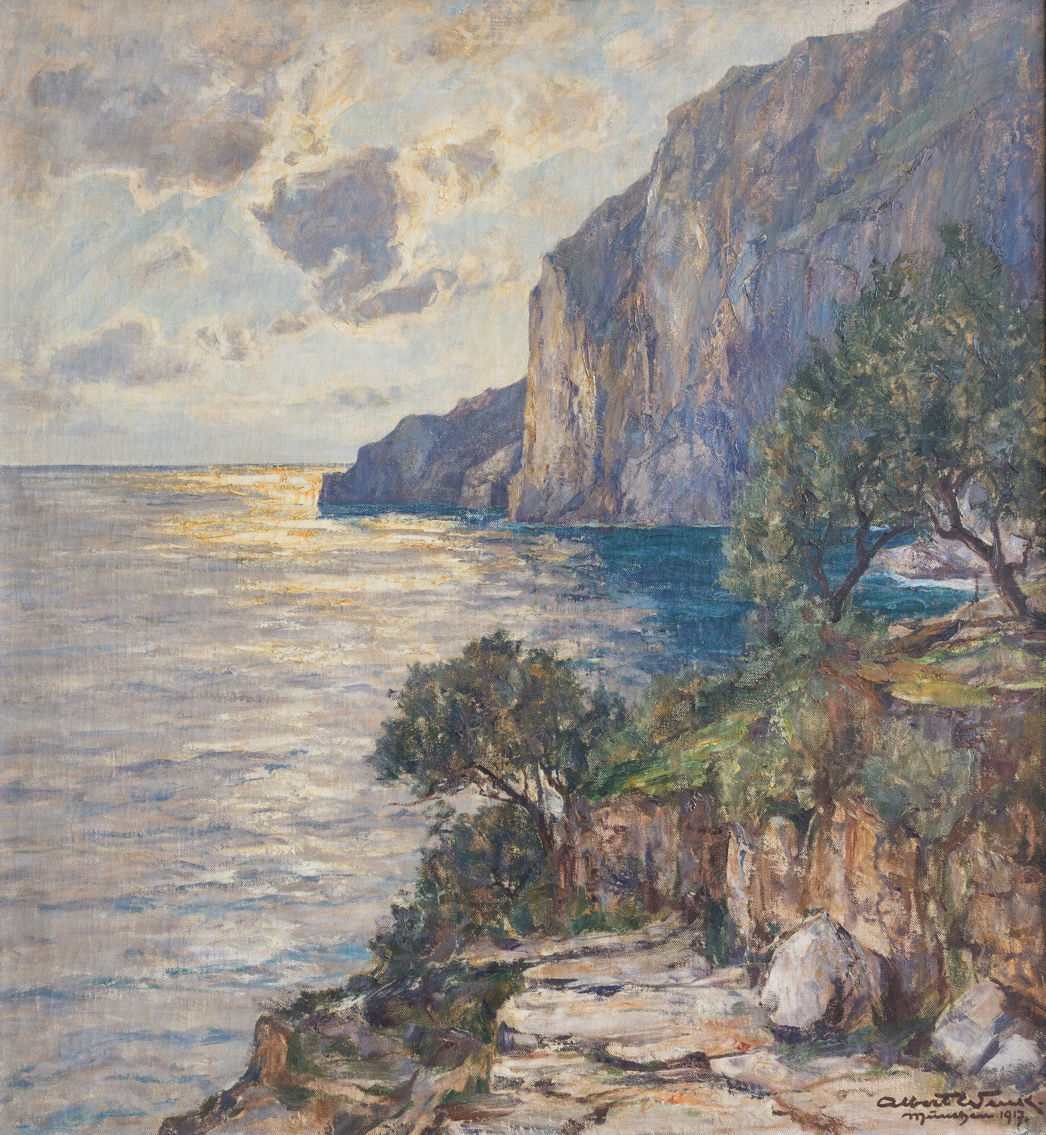
Albert Wenk (1863-1934), Capri (1917), oil on canvas, dimensions and location not known. Image by JTSH26, via Wikimedia Commons.
Albert Wenk’s view of Capri, painted in 1917, may look as if it was painted en plein air, but was probably made, or at least completed, in his Munich studio. It shows the vertiginous steps of the Via Krupp tumbling down the cliff on the south coast to the Marina Piccola, looking to the west in the late afternoon. Wenk had also trained in Düsseldorf.
My final three paintings are by the Russian Post-Impressionist Konstantin Ivanovich Gorbatov. He initially studied civil engineering, but in 1904 started training as an artist. He won a travelling scholarship taking him to Rome, from where he first visited Capri. He left Russia in 1922, and from then until 1926 lived and painted on the island. He next moved to Berlin, where he was an active member of a group of Russian emigré artists, and during the 1930s travelled widely across Europe and the Middle East. His career ended with the outbreak of the Second World War, and he died in Germany just after the Allied victory.
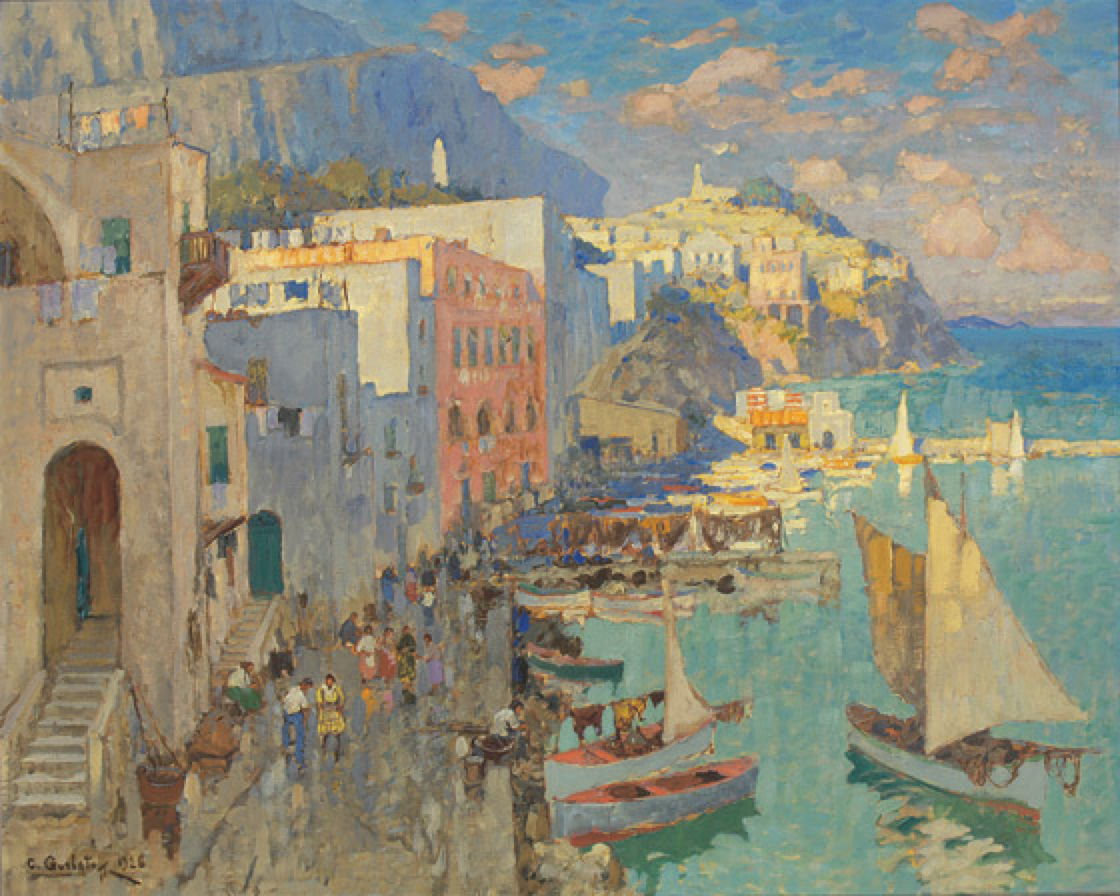
Konstantin Gorbatov (1876-1945), The Port of Capri (1926), oil on canvas, dimensions not known, location not known. Wikimedia Commons.
Gorbatov’s view of The Port of Capri (1926) shows the Marina Grande with the first of its jetties that now provide a more sheltered harbour. This looks west over the harbour on the north coast.
Konstantin Gorbatov (1876-1945), Capri (1928), oil, dimensions not known, Private collection. Wikimedia Commons.
His slightly more distant view in Capri, painted in 1928, shows the high chroma style that he appears to have adopted when he moved to Berlin.
Konstantin Gorbatov (1876-1945), Capri (date not known), watercolour, dimensions not known, Private collection. Wikimedia Commons.
This undated watercolour reverses those previous views, and looks east along the north coast, towards Monte San Michele and the more distant Monte Tiberio, at the far north-eastern tip of the island.
This weekend we’re escaping from the chills of February to travel to Capri, off the coast of southern Italy. From the north coast of this island you can look across the Bay of Naples towards the crowded city to the north. It’s a small island, with two little towns: Capri in the east, spilling down to harbours on the north and south coasts, and Anacapri, nestling in the hills to the west.
Karl Julius Beloch (1854–1929), Map of Capri (1890), from From Karl Julius Beloch: Campanien. Breslau, 1890. Wikimedia Commons.
It’s ruggedly hilly, with spectacular coastal scenery of high sea cliffs, small bays, and plenty of rock. Although only around 6 km (4 miles) long, it rises to nearly 600 metres (2,000 feet) at its highest point, Monte Solaro. It has everything to offer the coastal painter, including a superb climate, and a refuge from the winters of northern Europe.
Among the more famous artists who have stayed on this island are Albert Bierstadt and John Singer Sargent, while Adrian and Marianne Stokes honeymooned there. Although it has been claimed that Capri only became popular with painters in the late nineteenth century, its fame started rather earlier.
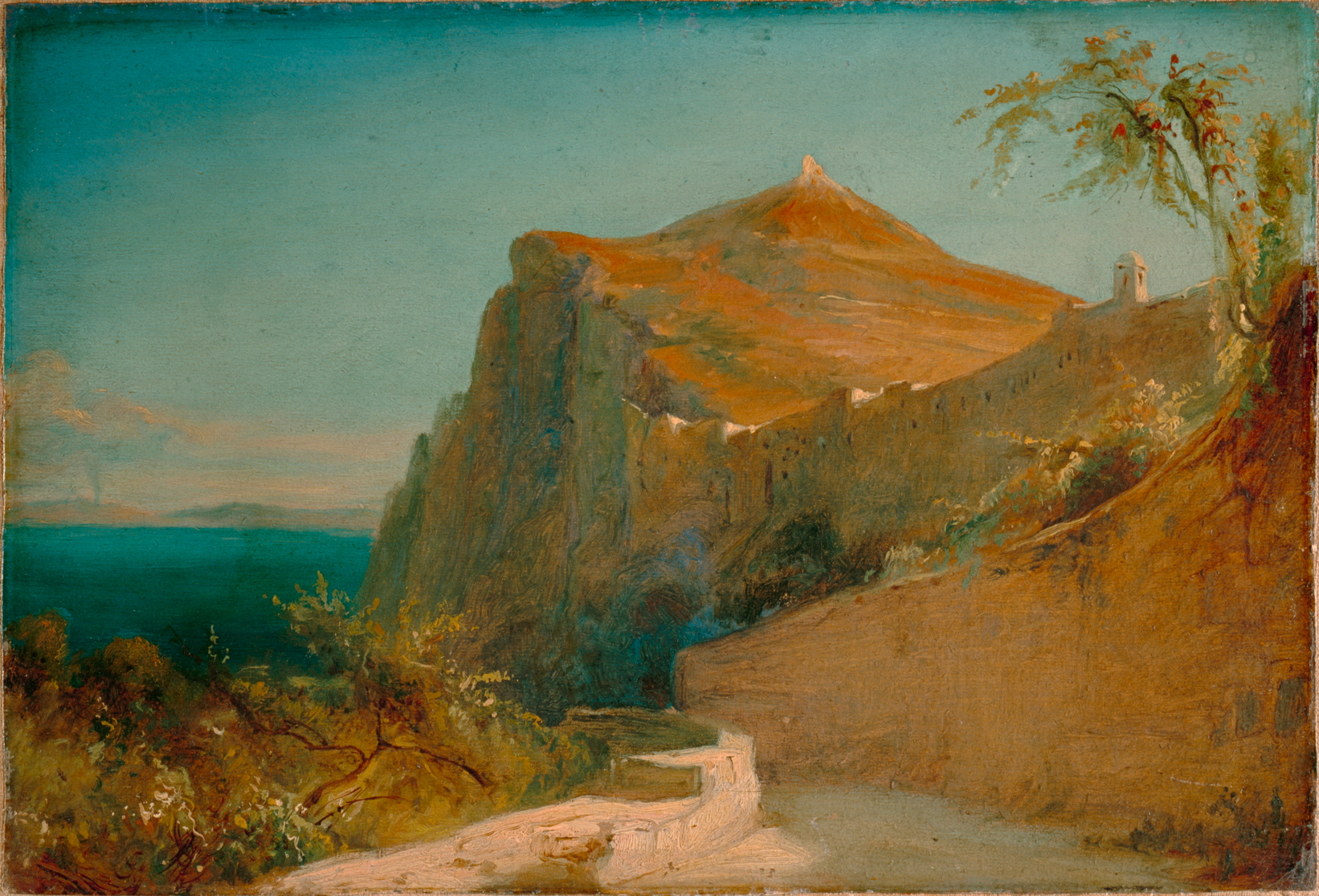
Carl Eduard Ferdinand Blechen (1798–1840), Tiberiusfelsen auf Capri (Tiberius Rocks, Capri) (1828-9), oil on paper mounted on canvas, 20.5 x 30 cm, Lower Saxony State Museum, Hanover. Wikimedia Commons.
Carl Blechen visited the island in 1828, made hundreds of sketches there, and developed some into finished paintings when he was back in his Berlin studio. This painting of Tiberius Rocks, Capri (1828-9) seems to have been at least started en plein air, in oils on paper, although he may have finished it after his return. It shows the north coast, looking east to the peak of Monte Tiberio, with the Bay of Naples in the background.
Carl Eduard Ferdinand Blechen (1798–1840), Marina Grande, Capri (1829), oil on canvas, 90 × 130 cm, Österreichische Galerie Belvedere, Vienna, Austria. Wikimedia Commons.
Blechen’s superb finished painting of Marina Grande, Capri (1829) was made in the studio, though. This shows the north coast again, looking from the west of the Marina Grande towards the east, with the Tiberius Rocks and Monte Tiberio in the distance, and that may well be Vesuvius in the far distance.
Heinrich Jakob Fried (1802-1870), The Blue Grotto, Capri (1835), oil on canvas, 50 × 63 cm, Kunsthalle Bremen, Bremen, Germany. Wikimedia Commons.
Heinrich Jakob Fried’s painting of The Blue Grotto, Capri (1835) shows one of the island’s most famous sights, which has been the motif for many paintings since. This has to be visited by boat, and is at the north-western tip of the island. It features in August Kopisch’s book, published in German in 1838, describing his re-discovery of this cave in 1826, which popularised the island across northern Europe. Fried visited the cave in 1835, and probably painted this in a studio in Naples shortly afterwards, just in time for the book’s publication.
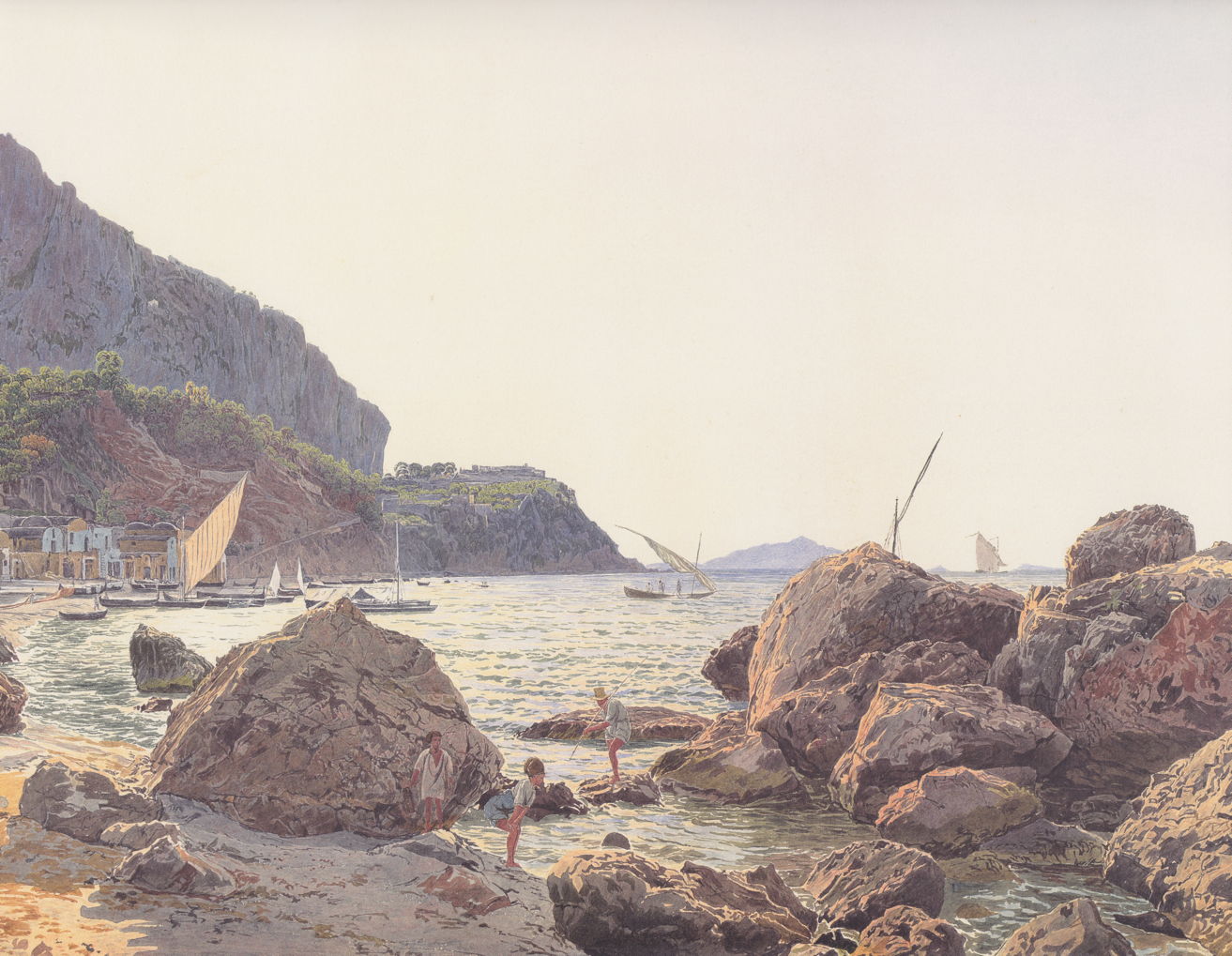
Jakob Alt (1789–1872), Marina Grande, Capri (1836), watercolour, 41.1 x 51.7 cm, Albertina, Vienna, Austria. Wikimedia Commons.
Jakob Alt’s view of Marina Grande, Capri (1836) is an extraordinary watercolour with painstaking detail. His view reverses Blechen’s, looking across the harbour from the east to the west, dropping almost to water level. Alt visited Italy in the mid-1830s, during which he too painted the Blue Grotto.
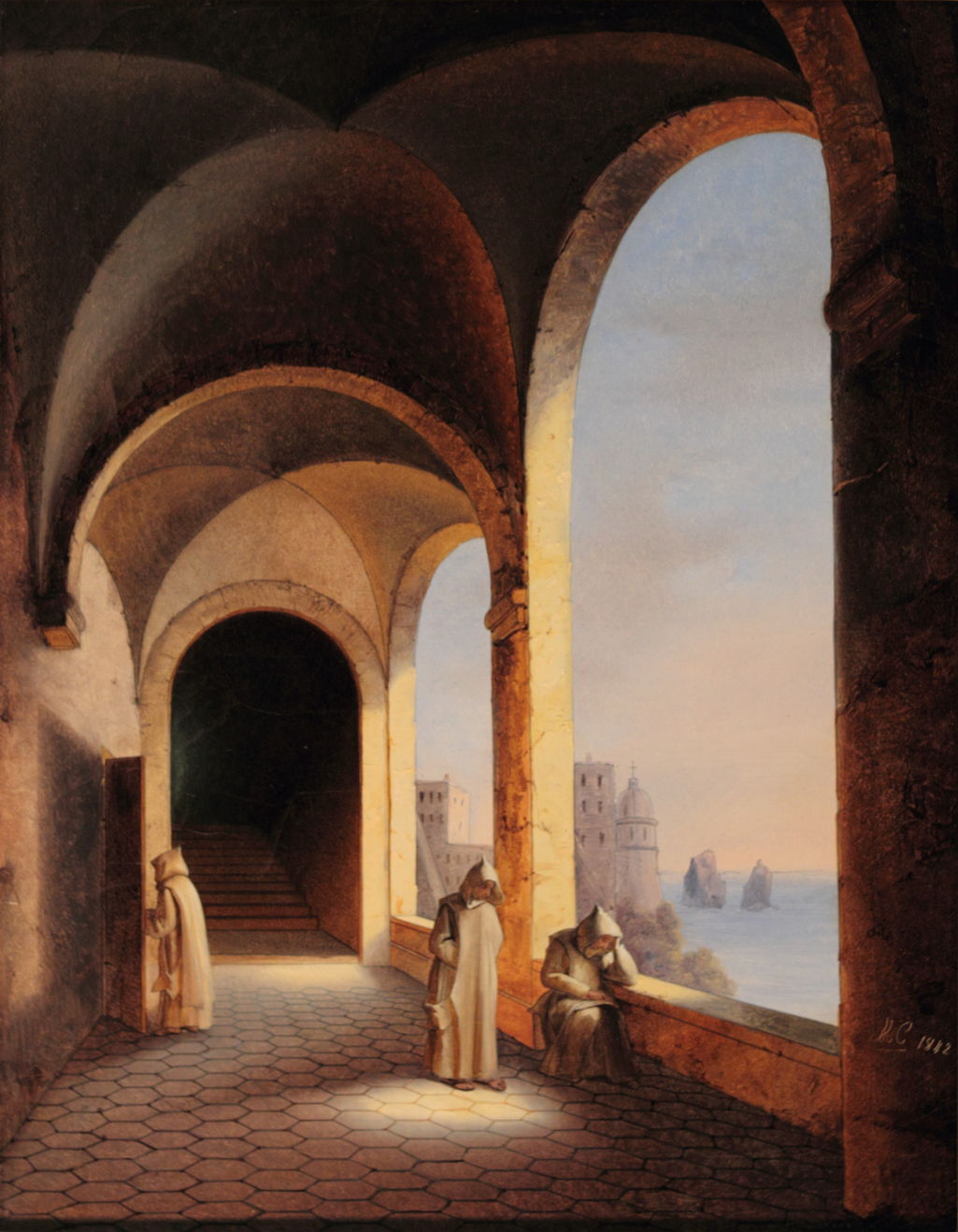
Marie-Caroline de Bourbon (Princess Caroline of Naples and Sicily) (1798–1870), Brothers in the Carthusian Monastery of San Giacomo, Capri (1842), further details not known. Image by PierreSelim, via Wikimedia Commons.
Marie-Caroline de Bourbon, Princess Caroline of Naples and Sicily, was an enthusiastic painter as well as being an avid collector of landscape paintings. The last serious Bourbon pretender to the crown of France, she visited Capri in the early 1840s, after she had been released from imprisonment in the Château of Blaye, and before moving to a palazzo on the Grand Canal in Venice. Her unusual painting of Brothers in the Carthusian Monastery of San Giacomo, Capri (1842) incorporates a vignette landscape view of the coast, almost in the manner of the Renaissance.
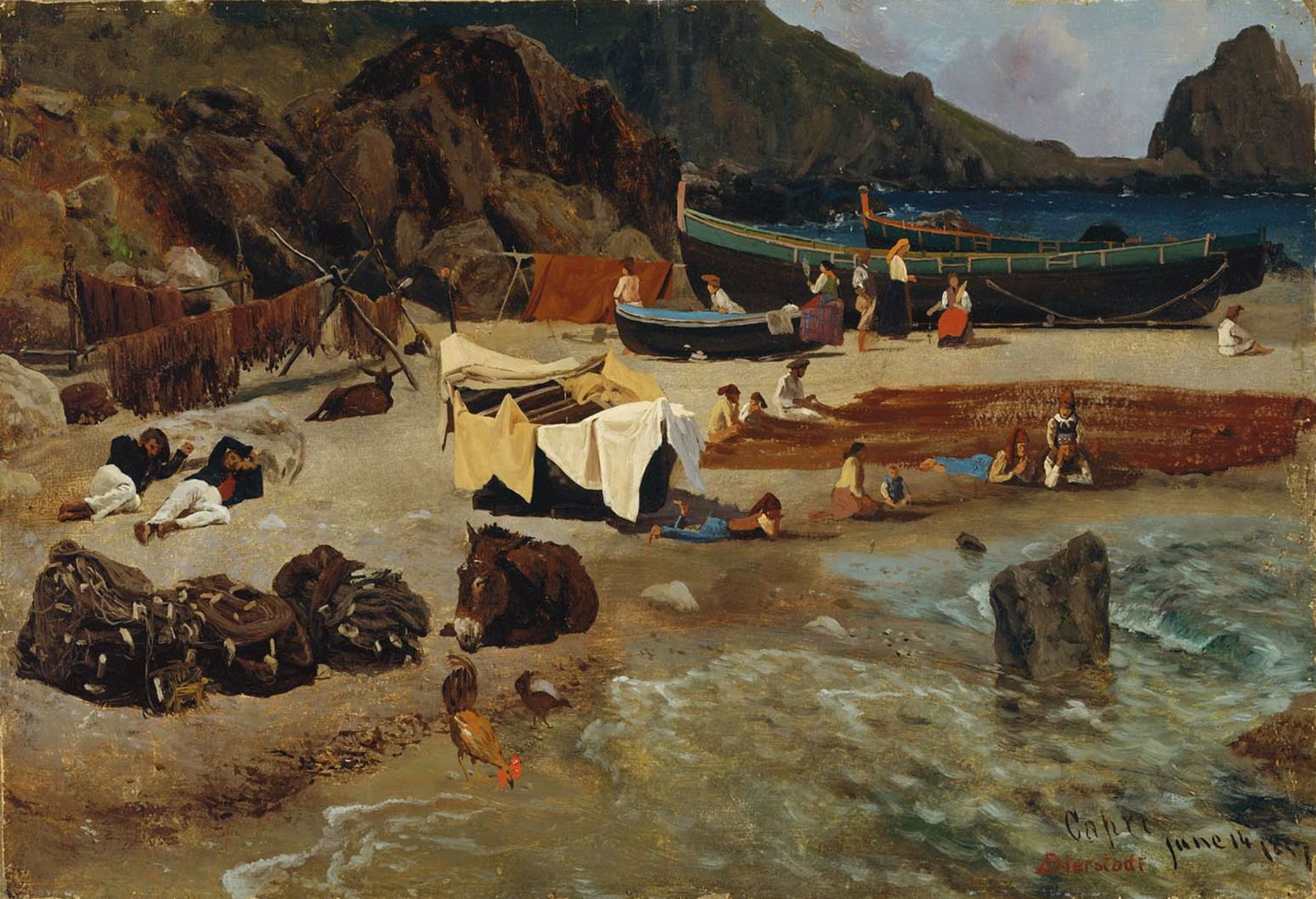
Albert Bierstadt (1830–1902), Fishing Boats at Capri (1857), oil on paper mounted on canvas, 34 × 49.9 cm, Museum of Fine Arts Boston, Boston, MA. Wikimedia Commons.
The great American landscape painter Albert Bierstadt visited Capri on his way back to New Bedford in 1857, following his training in Düsseldorf, Germany, only six years after he had started painting in oils. His Fishing Boats at Capri (1857) is painted in oils on paper, suggesting it may well have been started in front of the motif, and is quite unlike his mature style.
Albert Bierstadt (1830–1902), The Marina Piccola, Capri (1859), oil on canvas, 106.7 × 182.9 cm, Albright-Knox Art Gallery, Buffalo, NY. Wikimedia Commons.
Bierstadt’s The Marina Piccola, Capri was painted on canvas in 1859, when the artist made his first journey westward to sketch American landscapes, and is more typical of the drama of his mature style. This smaller harbour is on the south side of the island, to the south-west of the town of Capri, and this view looks to the east, showing the distant sea stacks of the Faraglioni at the right.
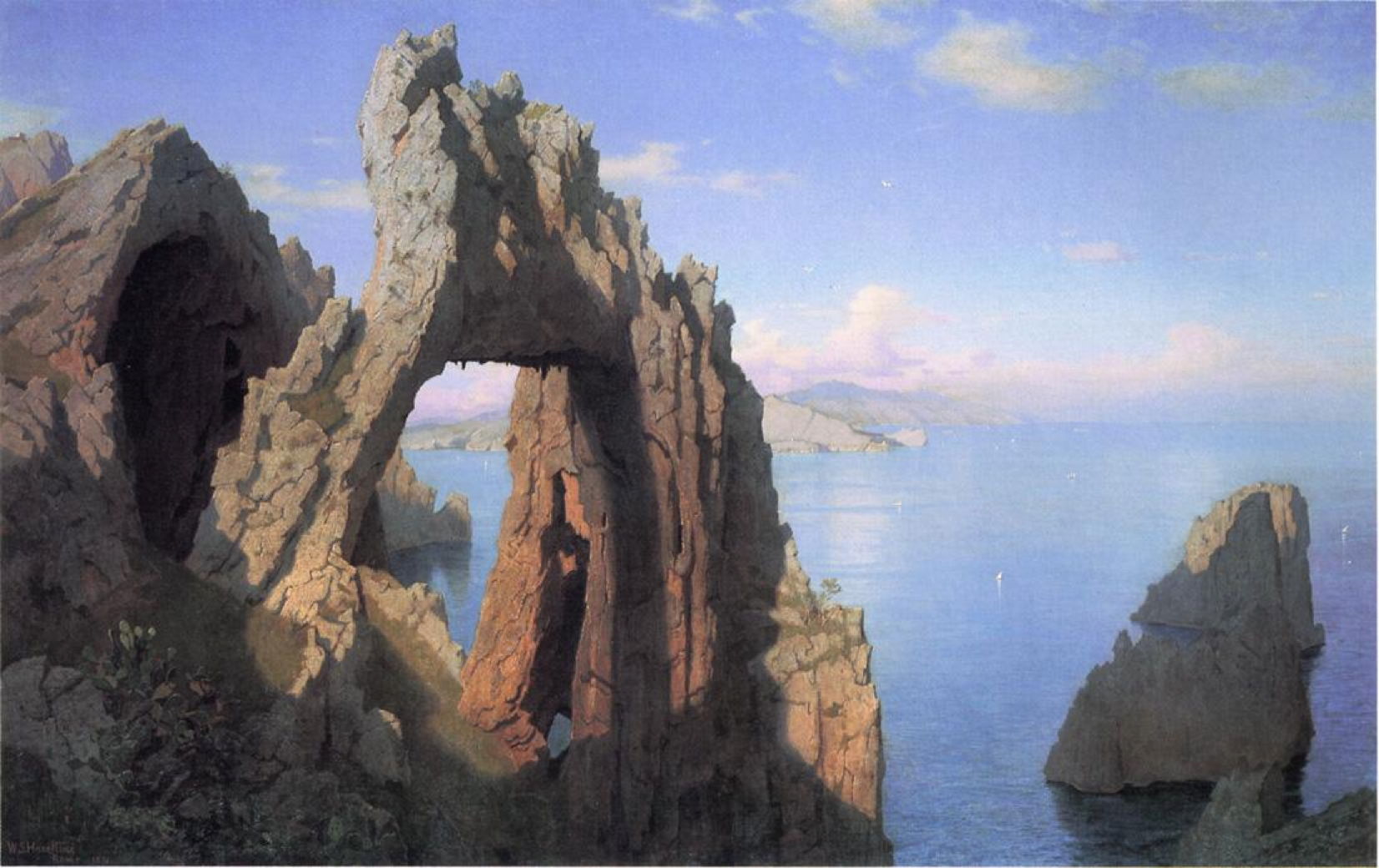
William Stanley Haseltine (1835–1900), Arco Naturale, Capri (c 1870), further details not known. Wikimedia Commons.
William Stanley Haseltine was another great American landscape painter associated with the Hudson River School, and first met Bierstadt in Düsseldorf in the mid 1850s. Haseltine lived in Rome in 1857-58, and drew and painted both the Roman campagna and Capri during that time. Having made his reputation with dramatic depictions of the New England coast, he moved back to Rome in 1867, from where he travelled to paint across Europe. His paintings of Capri from this period proved popular with visiting Americans, and remain among some of the finest realist views of the island. Arco Naturale, Capri from about 1870 shows another of Capri’s famous sights, a natural rock arch on its short eastern coast.
William Stanley Haseltine (1835–1900), Isle of Capri: The Faraglioni (1870s), oil on canvas, 83 x 142 cm, Princeton University Art Museum, Princeton, NJ. Wikimedia Commons.
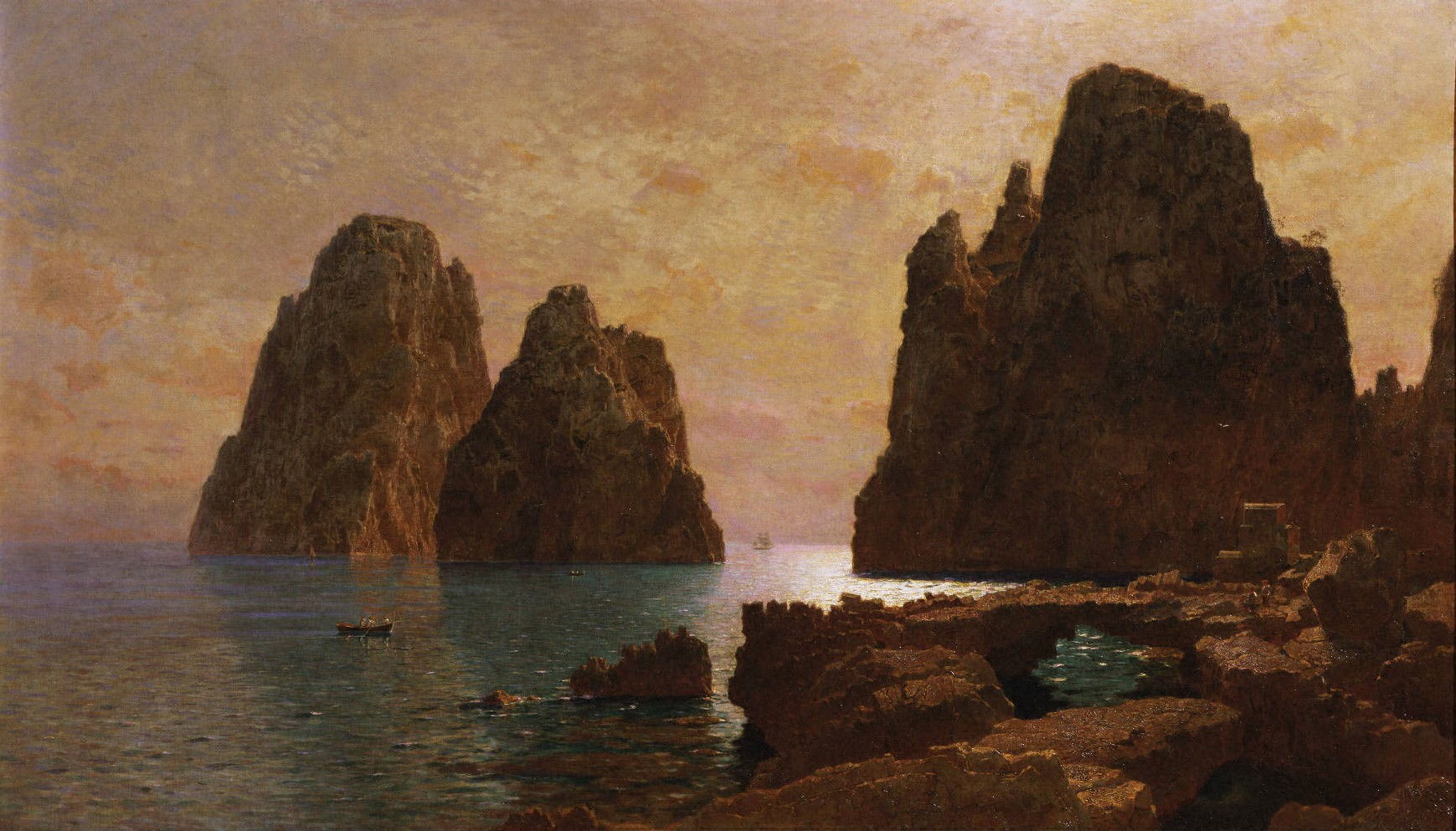
Haseltine’s Isle of Capri: The Faraglioni, from the 1870s, shows these stacks from the north-east, and was probably painted at the Villa Malparte, to the south of the Arco Naturale. He skilfully suggests scale with the tiny boats shown at their foot, although there may be a little exaggeration.
Alessandro la Volpe (1820–1887), View of Capri (1875), oil on canvas, 52.5 x 106.5 cm, location not known. Wikimedia Commons.
Alessandro la Volpe was an Italian who was born in, and worked from, Naples. His View of Capri (1875) shows the island in a heat haze, from the hills above Sorrento, to the north-east.
Hans Peter Feddersen (1848–1941), Marina Grande, Capri (1877), oil on canvas, dimensions not known, Museumsberg Flensburg, Flensburg, Germany. Image by anagoria, via Wikimedia Commons.
Hans Peter Feddersen was another former student from Düsseldorf, although after Bierstadt and Haseltine. He visited Italy and Capri from April to June 1877, when he painted this view of the Marina Grande, Capri in oils, probably en plein air. Rather than follow early examples, he looks to the north across the harbour, with Vesuvius in the background.
In the summer of 1878, John Singer Sargent had just completed his studies with Carolus-Duran, and had already started to have success at the Salon in Paris. He went off on a working holiday to Capri, staying in the village of Anacapri, as was popular with other artists at the time.
Getting a local model was tricky, because of the warnings that women were given by priests. One local woman, Rosina Ferrara, seemed happy to pose for him, though. She was only 17, and Sargent a mere 22 and just developing his skills in portraiture, following the advice of his teacher Carolus-Duran. Over the course of that summer, Sargent painted at least a dozen works featuring Rosina, who seems to have become an obsession.
John Singer Sargent (1856–1925), Capri Girl (Dans les Oliviers, à Capri) (1878), oil on canvas, 77.5 x 63.5 cm, Private collection. The Athenaeum.
One, Dans les Oliviers, à Capri, he exhibited at the Salon the following year. He sent a near-identical copy back for the annual exhibition of the Society of American Artists in New York, in March 1879.
John Singer Sargent (1856–1925), View of Capri (c 1878), oil on cardboard, 26 x 33.9 cm, Yale University Art Gallery, New Haven, CT. Wikimedia Commons.
Sargent also painted a pair of views of what was probably the roof of his hotel. In View of Capri, above, made on cardboard, Rosina stands looking away, her hands at her hips. In the other, Capri Girl on a Rooftop, below, she dances a tarantella to the beat of a friend’s tambourine.
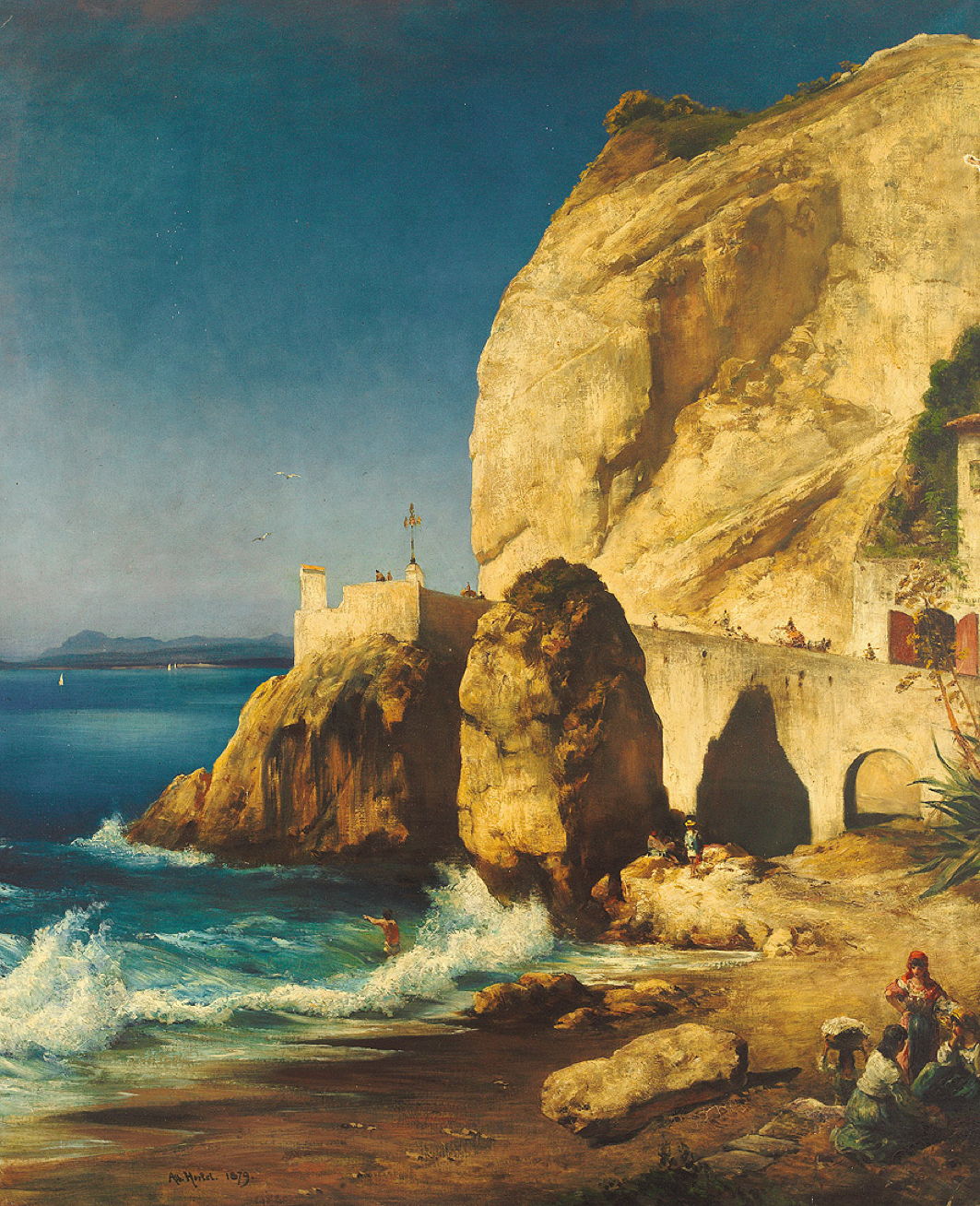
John Singer Sargent (1856–1925), Capri Girl on a Rooftop (1878), oil on canvas, 50.8 x 63.5 cm, Crystal Bridges Museum of American Art, Bentonville, AR. Wikimedia Commons.Albert Hertel (1843–1912), View of the Shores of Capri with People (1879), oil on canvas, 173 × 143 cm, location not known. Wikimedia Commons.
Albert Hertel trained in Düsseldorf in 1868-69, prior to which he had lived as a student in Rome for several years. He established himself as a landscape painter in Berlin, from where he seems to have returned to Italy and visited Capri in the late 1870s. His View of the Shores of Capri with People (1879) shows a small bay near Punta Carena, at the south-western tip of the island.
Landscape painters came to the Alhambra in the Andalucian city of Granada relatively late. But once they started to visit the Prado in Madrid to view and copy its magnificent collection of masters, a steady succession travelled south to paint the Moorish palaces of the Alhambra.
To remind you, this plan from Openstreetmap and its contributors shows the modern site, as of 2013.
Constantin Uhde (1836–1905), Plan of the Nasrid Palaces, Alhambra (1892), illustration, further details not known. Wikimedia Commons.
Constantin Uhde’s plan of 1892 shows the layout of the Nasrid palaces:
Red is the site of the Palace of Comares and the Palaces of the Ambassadors.
Green is the Palace of the Lions.
Yellow is the Mexuar.
Blue is the Garden of Lindajar and later quarters of the Emir.
Edmund Wodick (1816–1886), Granada (1886), oil on canvas, dimensions not known, Kulturhistorisches Museum Magdeburg, Magdeburg, Germany. Wikimedia Commons.
For Edmund Wodick, who must have visited Granada to paint this spectacular landscape in early 1886, it was probably the last work that he completed. Shortly after this, he developed pneumonia and died at the age of 69. He painted this just outside the city walls, looking across at the Alhambra and its towers, down towards the lush green plain and the snow-capped peaks in the far distance.
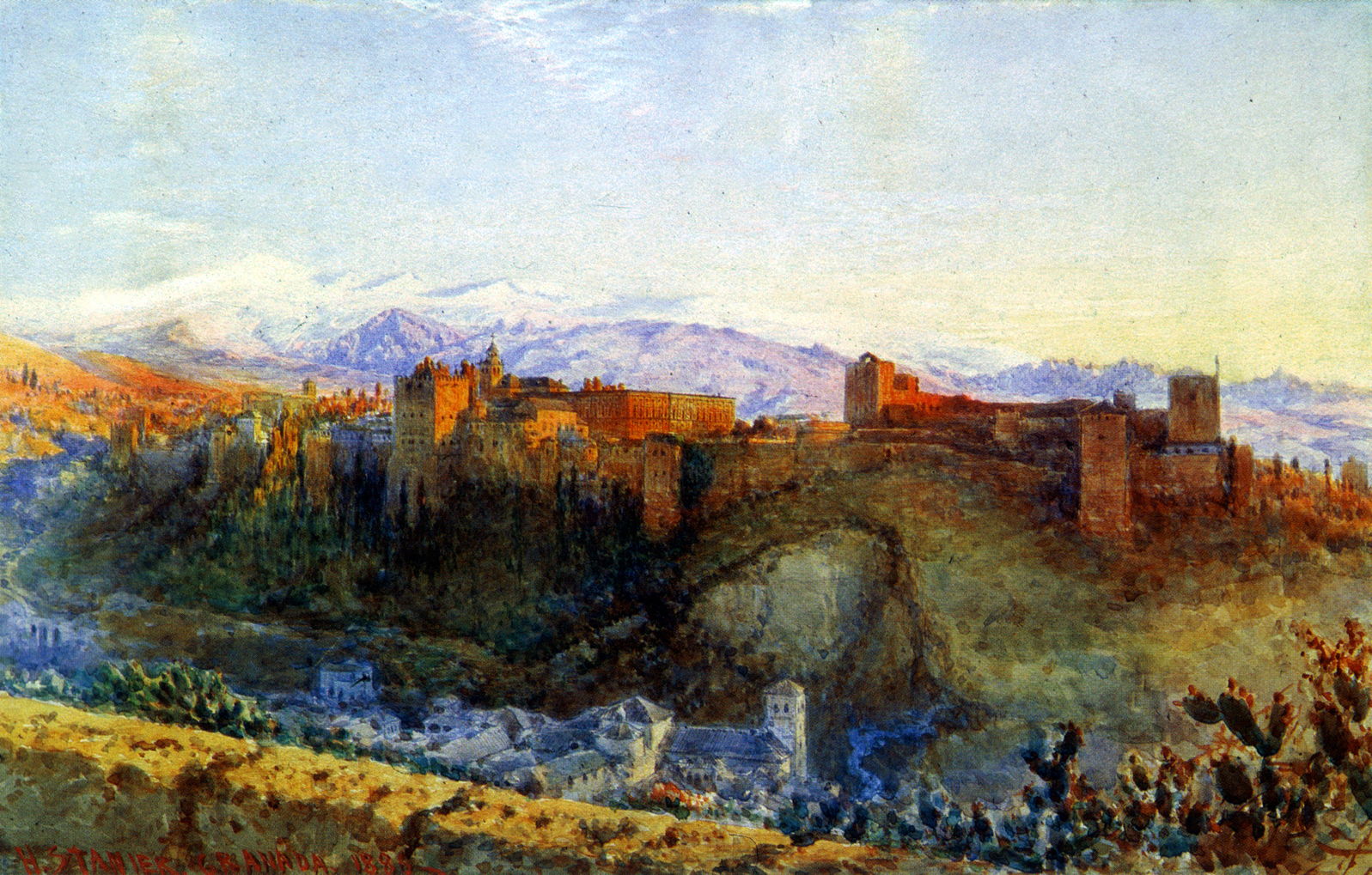
Henry Stanier (1832-1892), Alhambra from San Nicolas (1886), further details not known. Wikimedia Commons.
Long before the brash colours of the Fauves, those who painted the Alhambra in the rich light of dawn or dusk surprised viewers with the intensity of its colours. Henry Stanier’s view of the Alhambra from San Nicolas from 1886 is a good example, and another from late in an artist’s career. Stanier was a topographical draughtsman and sometime Orientalist from the city of Birmingham in England, whose work is now almost forgotten.
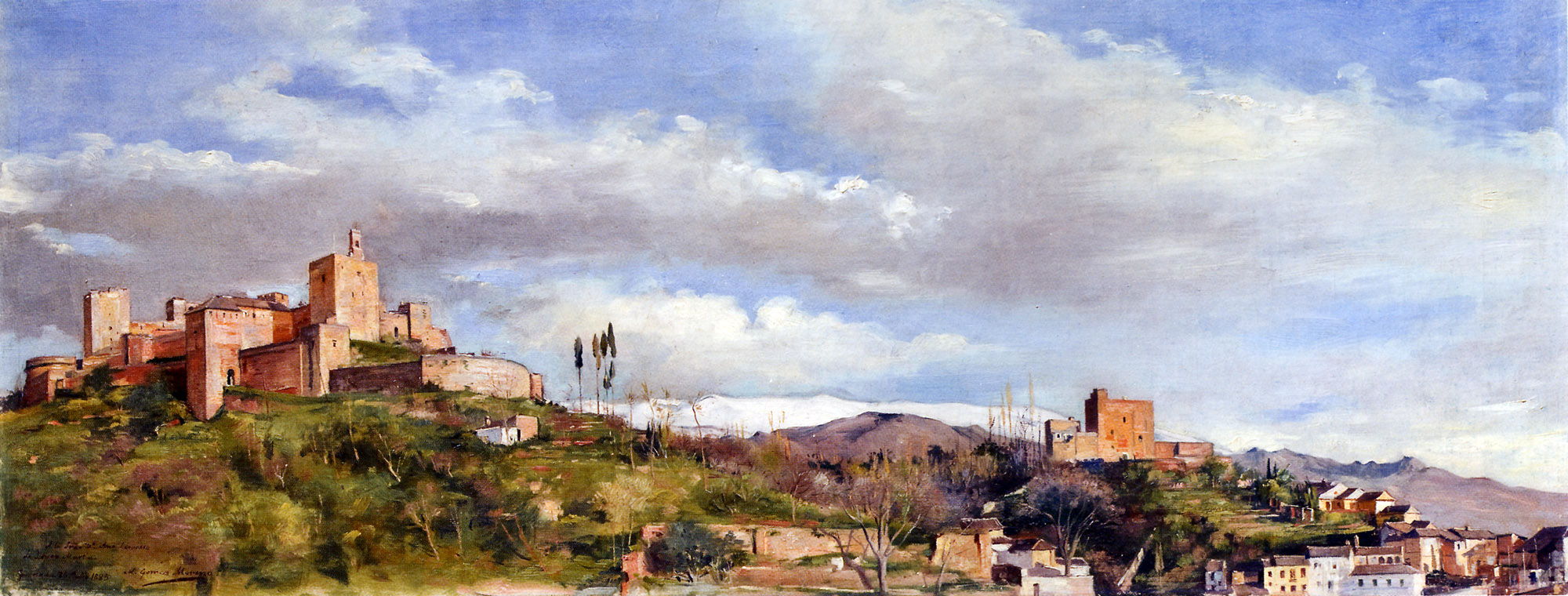
Manuel Gómez-Moreno González (1834–1918), La Alcazaba y Torres Bermejas (The Alhambra and Castle of Torres Bermejas) (c 1887), oil on canvas, 35.5 x 89.5 cm, Casa de los Tiros, Granada, Spain. Wikimedia Commons.
Local painter and amateur archaeologist Manuel Gómez-Moreno González was fascinated by the history of the Alhambra, and the first to compile an account of its depictions in paintings. His own works showing the site include The Alhambra and Castle of Torres Bermejas from about 1887, painted from an unusual viewpoint below its ridge.
The Alhambra dominates the left, with the much smaller castle to the right. The snow-clad peaks of the Sierra Nevada rise to over 3,000 metres (10,000 feet), and resemble a bank of white cloud peeking over the skyline in between.
Hernandez Miguel Vico (1850-1933), Alhambra and Cuesta de los Chinos (date not known), further details not known. Wikimedia Commons.
Hernandez Miguel Vico, another local artist, also favoured a view from below in his undated painting of Alhambra and Cuesta de los Chinos. In 1877, he exhibited an interior of the Alhambra at the Salon in Paris, but I have been unable to locate an image of that.
John Ferguson Weir (1841-1926), The Alhambra, Granada, Spain (c 1901), oil on canvas, 92.1 x 118.1 cm, The Metropolitan Museum of Art (Gift of David T. Owsley, 1964), New York, NY. Courtesy of The Metropolitan Museum of Art.
The founder of the School of Fine Arts at Yale University, John Ferguson Weir, had studied in Europe, and his brother Julian Alden Weir was a student at the École des Beaux-Arts in Paris. Later in his career, John Ferguson Weir returned to Europe on several trips, and in about 1901 painted this fine view of The Alhambra, Granada, Spain.
Laurits Tuxen (1853–1927), View of the Alhambra (1902), oil on canvas, 54 x 72 cm, location not known. Wikimedia Commons.
As far as I can tell, Laurits Tuxen was the first Danish artist to paint a View of the Alhambra, a year after marrying his second wife. He was one of the leading members of the Skagen Painters, ‘Danish Impressionists’, and completed this en plein air on 4 May 1902, in marvellously fine weather.
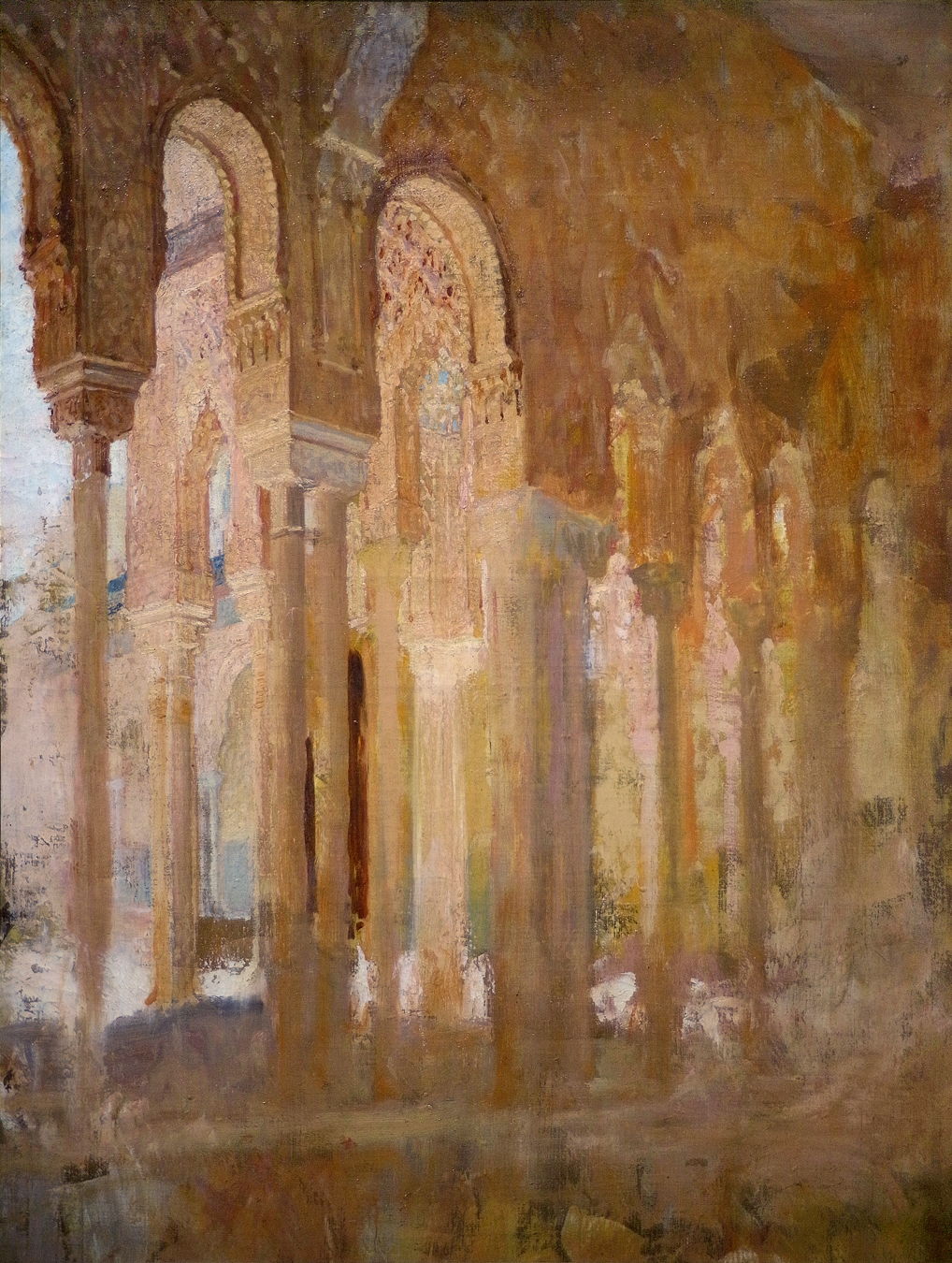
The early twentieth century brought two of the greatest artists to have painted the Alhambra: Joaquín Sorolla, who seems to have been most active in Granada in 1909, and John Singer Sargent, who visited in 1912 at least.
Sorolla came from Valencia, and is still best-known for his magnificent paintings of people and activities on the beach there. He travelled extensively during his career, but doesn’t seem to have painted in Granada until 1909, when he also spent five months in the USA. These four oil sketches are a marked contrast to the more familiar finished paintings that he exhibited.
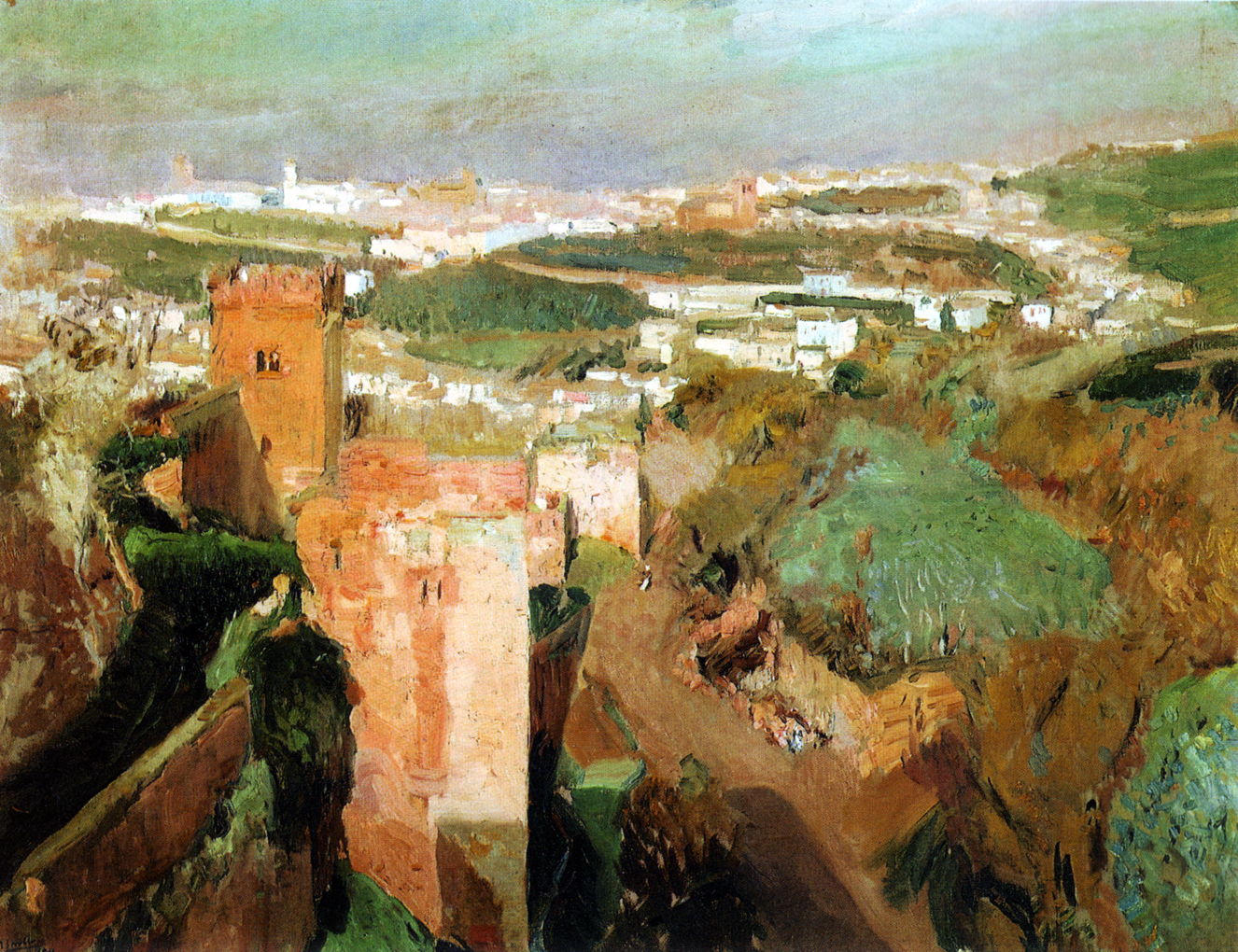
Joaquín Sorolla y Bastida (1863–1923), Los Picos Tower (date not known), further details not known. Wikimedia Commons.
Los Picos Tower is a virtuoso oil sketch looking along the precipitous walls and towers at the edge of the site, and beyond to the dazzling white buildings of the city.
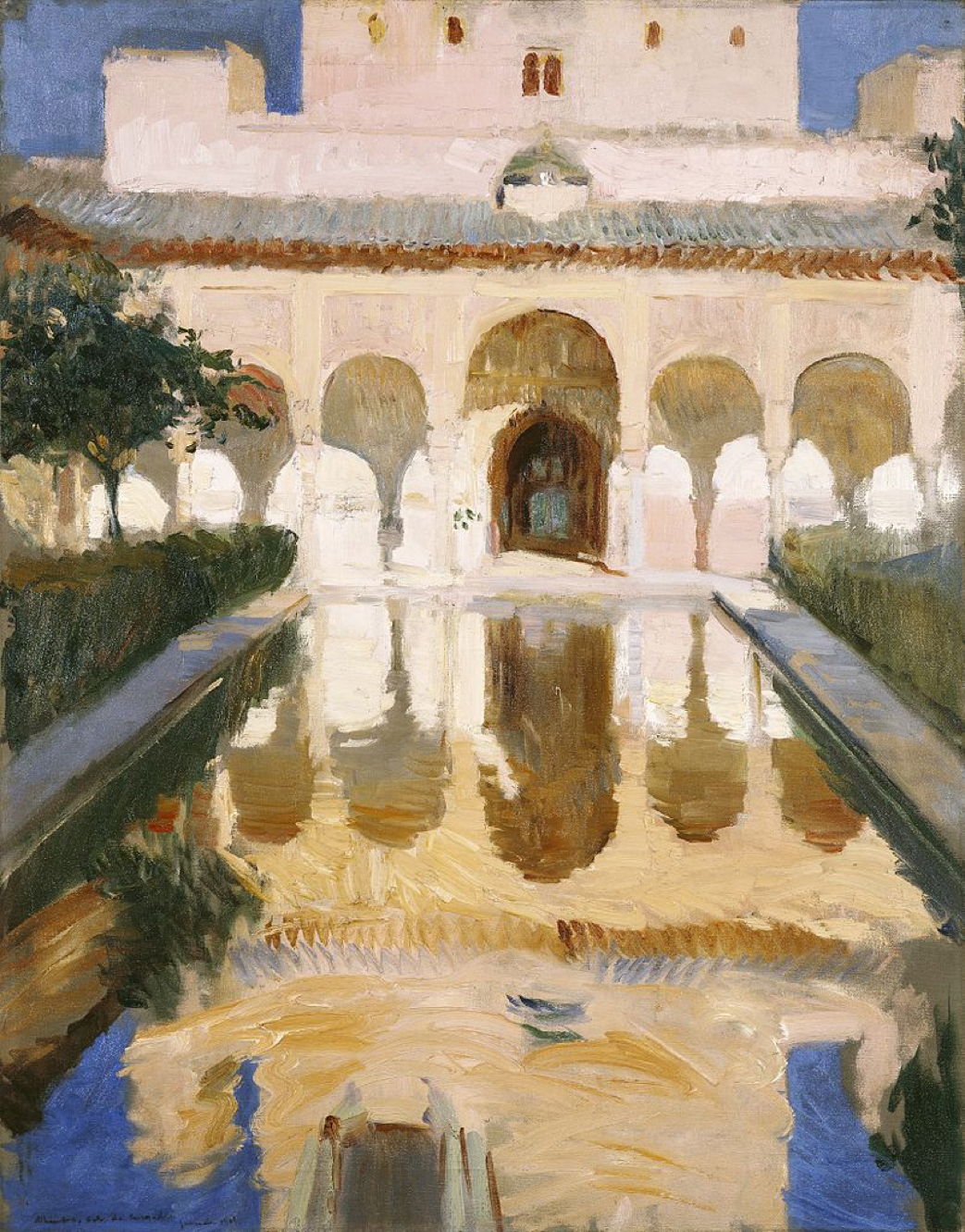
Joaquín Sorolla y Bastida (1863–1923), Hall of the Ambassadors, Alhambra, Granada (1909), oil on canvas, 104.1 x 81.2 cm, J. Paul Getty Museum, Los Angeles, CA. Wikimedia Commons.
Hall of the Ambassadors, Alhambra, Granada (1909) shows this classical view with some of Sorolla’s vigorous brushstrokes texturing the paint.
Joaquín Sorolla y Bastida (1863–1923), Torre de las Infantas de la Alhambra (Tower of the Children) (1909), dimensions not known, Museo Sorolla, Madrid, Spain. Image by Quinok, via Wikimedia Commons.
Tower of the Children (1909) looks past another tower towards the distant mountains, the sunlight filtering through a curtain of trees.
Joaquín Sorolla y Bastida (1863–1923), Albaicin (date not known), further details not known. Wikimedia Commons.
In Sorolla’s Albaicin, he looks down from one of the Alhambra’s towers at the bleached white buildings below.
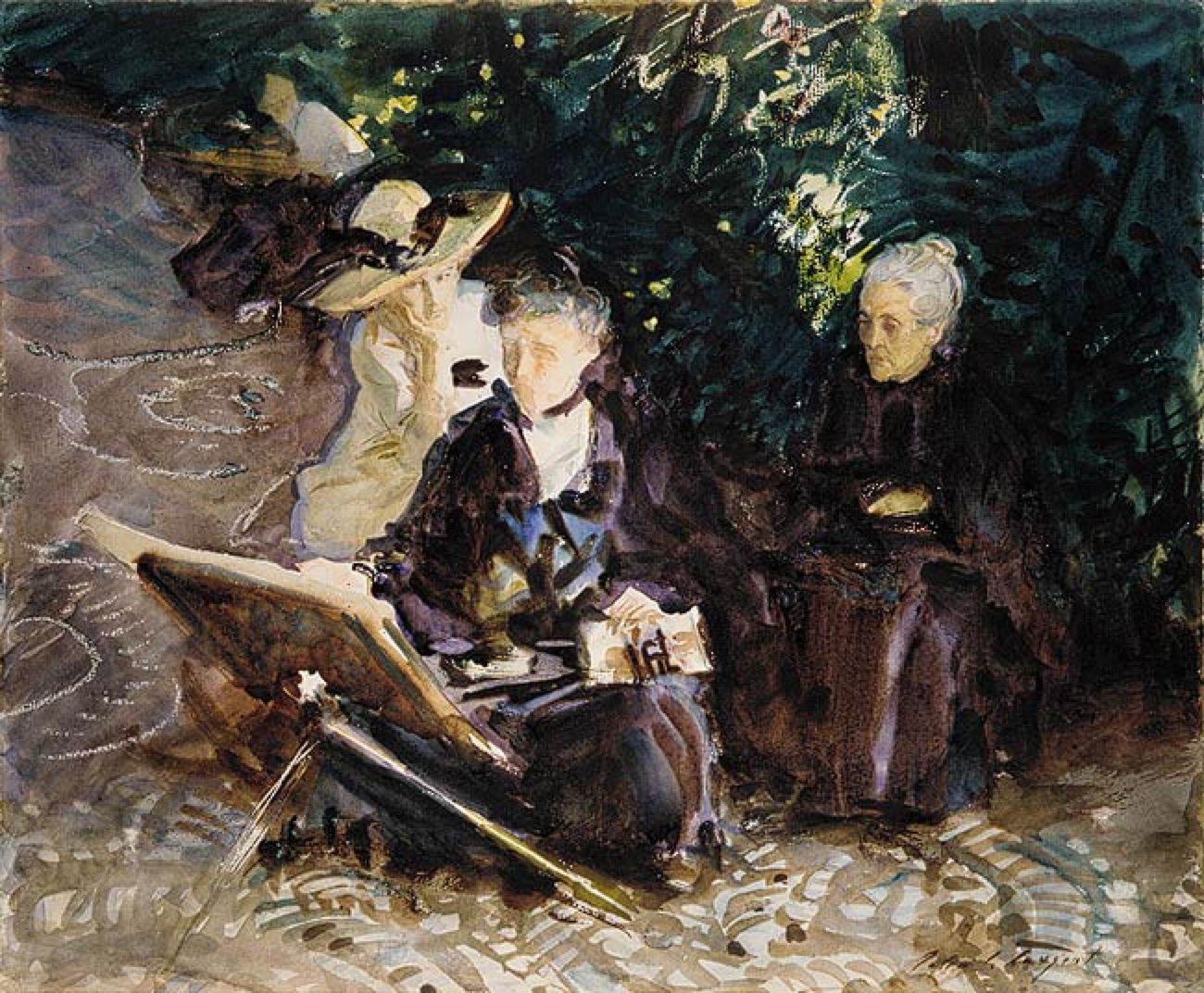
John Singer Sargent (1856–1925), In the Generalife (1912), watercolour and graphite on paper, 37.5 x 45.4 cm, The Metropolitan Museum of Art, New York, NY. Wikimedia Commons.
The only available image of Sargent’s paintings of the Alhambra I have able to find is this watercolour showing his sister Emily, also a keen artist, sketching In the Generalife (1912). Behind her is Jane de Glehn, and to the right is a Spanish friend known only as Dolores. The unusual highlight effect seen in bushes above them, and on parts of the ground, was produced by scribbling with a colourless beeswax crayon, which resists the watercolour paint.
Théo van Rysselberghe, Fountain at the Generalife in Granada (1913), oil on canvas mounted on cardboard, 65.8 x 46 cm, Private collection. WikiArt.
Théo van Rysselberghe had first visited Spain in 1881 or 82, when he too went to the Prado, and travelled on to Morocco. He visited Andalucia in company with John Singer Sargent in the Spring of 1884, but doesn’t appear to have painted the Alhambra until after his retirement to the Côte d’Azur in 1911. He then painted Fountain at the Generalife in Granada in 1913, in his late high-chroma style.
The last two paintings in my selection are both by the eclectic Valencian painter Antonio Muñoz Degrain, and demonstrate his wide range of styles.
Antonio Muñoz Degrain (1840-1924), View of the Alhambra (1914), oil on canvas, 125 x 83 cm, Museo de Málaga. Wikimedia Commons.
Muñoz Degrain’s view of the Alhambra from Albaicin District from 1914 is remarkable for the rhythm established by the poplar trees around its base, which become an integral part of the fortified ridge.
Antonio Muñoz Degrain (1840-1924), View of the Alhambra (date not known), further details not known. Wikimedia Commons.
His View of the Alhambra is one of my favourite paintings of this motif, for its intriguing foreground details, and the poplars lit as white-hot pokers in the fiery light of the sunset.
What better way to end our weekend away from the chill and gloom of winter.
It’s time to head off for a weekend away from the January gloom in Granada, Andalusia, southern Spain, where we’ll visit the Alhambra. It’s one of the oldest, grandest, most fascinating and beautiful palaces in Europe.
It started as one of many hill forts used by the Romans in a series of campaigns to control a succession of tribal revolts, and stamp the Empire’s presence close to North Africa. It was rebuilt in 889 CE, but nothing palatial became of it until around 1250, when the ruling Nasrid emir started to turn it into something much grander.
At that time, much of the south of the Iberian peninsula wasn’t ruled by people from Europe to the north, but by Muslim dynasties who had swept up from the south. The Emirate of Granada was the last substantial part of Iberia to remain under Muslim rule, and in 1333 the Sultan of Granada, Yusuf I, decided to transform the Alhambra into a royal palace. In doing so, he and his successors built one of the most exquisite expressions of Arabic Muslim art and architecture along a ridge about half a mile (0.7 km) long overlooking the city of Granada.
This plan from Openstreetmap and its contributors shows the modern site, as of 2013.
Constantin Uhde (1836–1905), Plan of the Nasrid Palaces, Alhambra (1892), illustration, further details not known. Wikimedia Commons.
Constantin Uhde’s plan of 1892 shows the layout of the Nasrid palaces:
Red is the site of the Palace of Comares and the Palaces of the Ambassadors.
Green is the Palace of the Lions.
Yellow is the Mexuar.
Blue is the Garden of Lindajar and later quarters of the Emir.
This article shows a selection of views of the palace up to 1883, and tomorrow’s sequel brings that up to the start of the First World War in 1914.
José de Hermosilla (1715-1776), View of the Alhambra from the Torres Bermejas Castle (1767), watercolour, dimensions not known, Real Academia de Bellas Artes de San Fernando, Madrid, Spain. Wikimedia Commons.
Early paintings of the Alhambra were mainly topographic views, painted in watercolour during the eighteenth century, such as José de Hermosilla’s View of the Alhambra from the Torres Bermejas Castle of 1767. These are similar to views of landmarks being produced in Britain at the time.
John Frederick Lewis (1805–1876), The Torre de Comares, Alhambra (1835), graphite, watercolour, white gouache and scratching out on medium, slightly textured, gray wove paper, 37.1 x 27 cm, Yale Center for British Art, New Haven, CT. Wikimedia Commons.
Others, like John Frederick Lewis in 1835, came to record details of the remains of the Alhambra’s buildings, as in The Torre de Comares, Alhambra, drawn carefully in graphite and only slightly highlighted and coloured with watercolour and gouache.
While every seriously aspiring landscape painter was flocking to paint en plein air in the Roman Campagna in the early nineteenth century, the Alhambra seems not to have been included in the circuit.
David Roberts (1796–1864), Alhambra and Albaicin (date not known), further details not known. Wikimedia Commons.
It was the vogue for Orientalist views in the middle of the nineteenth century that first attracted artists to paint the Alhambra in oils. This is David Roberts’ undated view of Alhambra and Albaicin. Roberts is much better-known for his sketches turned into prints from multiple tours of Egypt and the ‘near east’ made between 1838-40. This work probably originated in sketches made when he visited Spain in 1832, and would have then been painted in this form back in Britain after about 1833, and turned into a print by 1837.
Achille Zo (1826–1901), Patio in the Alhambra (1860), media and dimensions not known, Musée des beaux-arts de Pau, Pau, France. Wikimedia Commons.
Achille Zo was a Basque painter who specialised in views of Spain during the 1860s, such as this Patio in the Alhambra from 1860. These were well received at the Salon in Paris, earning him a gold medal in 1868, following which he too turned to Orientalism.
Franz von Lenbach (1836–1904), The Alhambra in Granada (1868), oil on canvas, 72.1 × 91.5 cm, Sammlung Schack, Bayerische Staatsgemäldesammlungen, Munich, Germany. Wikimedia Commons.
It was the fine collection of paintings of the Prado in Madrid that attracted many great artists to Spain. In 1867, Franz von Lenbach and a student of his travelled to Madrid to copy the masters there for his patron Baron Adolf von Schack. The following year, he painted two works in Granada: The Alhambra in Granada (1868) is a magnificent sketch including the backdrop of the distant mountains, and appears to have been painted in front of the motif.
Franz von Lenbach (1836–1904), Tocador de la Reina (Queen’s Dressing Room) in the Alhambra (1868), oil on canvas, 33.1 × 26.2 cm, Sammlung Schack, Bayerische Staatsgemäldesammlungen, Munich, Germany. Wikimedia Commons.
Von Lenbach’s Tocador de la Reina shows the exterior of the Queen’s Dressing Room in the palaces, with his student sketching.
Henri Regnault (1843–1871), Colonnade of the Court of the Lions at the Alhambra (1869), oil on canvas, dimensions not known, Musée des Augustins de Toulouse, Toulouse, France. Wikimedia Commons.
Just two years before he was killed in the Franco-Prussian War, Henri Regnault toured Spain, and when he was in Granada he painted this view of the Colonnade of the Court of the Lions at the Alhambra (1869). I suspect this is unfinished, and he intended to complete the detail in its lower half.
Martín Rico y Ortega (1833–1908), La Torre de las Damas en la Alhambra de Granada (The Tower of the Ladies in the Alhambra) (1871-72), oil on canvas, 62.5 x 39 cm, Museo Nacional del Prado, Madrid, Spain. Wikimedia Commons.
Martín Rico was one of the most important painters in Spain at this time. Influenced mainly by the Barbizon school, he painted this finely-detailed view of The Tower of the Ladies in the Alhambra in 1871-72. It captures the dilapidation the Alhambra had fallen into before more recent work to restore it to its former glory.
Marià Fortuny (1838–1874), Courtyard at Alhambra (Patio in Granada) (1873), oil on canvas, 111.4 x 88.9 cm, The Fogg Art Museum, Harvard University, Cambridge, MA. Wikimedia Commons.
If Marià Fortuny’s more Impressionist view of a Courtyard at Alhambra (Patio in Granada) from 1873 is to be believed, some parts of the Alhambra had been turned into smallholdings, with free-ranging chickens.
Heinrich Hansen (1821-1890), Granada with the Alhambra in the Nineteenth Century (date not known), further details not known. Image by Sir Gawain, via Wikimedia Commons.
More distant views of the ridge, such as Heinrich Hansen’s undated painting of Granada with the Alhambra in the Nineteenth Century, show its imposing grandeur.
John Haynes Williams (1836-1908), Albaicin from the Alhambra (date not known), further details not known. Wikimedia Commons.
John Haynes Williams (or Haynes-Williams) recognised the merits of views painted from the Alhambra as a high point, in his undated Albaicin from the Alhambra.
Childe Hassam (1859–1935), The Alhambra (1883), oil on canvas, 33 x 40.6 cm, Private Collection. Wikimedia Commons.
The late nineteenth century saw new visitors to copy masters at the Prado: those Americans who came to study painting in France and Germany. Among then, Childe Hassam visited during the summer of 1883, with his friend Edmund H Garrett, and sketch this view of The Alhambra then. This shows the Palace of the Ambassadors, and remains one of the most frequently painted parts of the site.
Tom Roberts (1856–1931), A Moorish Doorway, Alhambra (1883), further details not known. Wikimedia Commons.
From even further afield, the Anglo-Australian Tom Roberts visited Granada when he was in Spain in 1883, when he painted this detailed realist view of A Moorish Doorway, Alhambra. Roberts had migrated with his family in 1869, returned to Britain to study at the Royal Academy Schools from 1881, then went to Spain with the Australian John Peter Russell. He returned to Australia in 1884, becoming one of the early Australian Impressionists.
As in other countries across Europe at the time, industry in the Dutch Republic during the Golden Age was largely dependent on wind and water, forces that were seldom in short supply. Here’s a small selection of what were effectively some of the first paintings of industry long before the industrial revolution.
Both watermills and windmills date back to ancient times, and became widespread in the Middle Ages. By the seventeenth century they were used for grinding grain into flour, processing wool and fabrics, sharpening tools, forging and metalcraft, manufacturing paper, sawing timber, and sundry other purposes.
Jacob van Ruisdael (1628/1629–1682), Two Watermills and an Open Sluice (1653), oil on canvas, 66.4 x 84.1 cm, J. Paul Getty Museum, Los Angeles, CA. Wikimedia Commons.
Jacob van Ruisdael’s Two Watermills and an Open Sluice from 1653 is not just a superb landscape painting, but a clear technical account of one of the commonest types of watermill.
Since the Middle Ages in Europe, by far the most common type of waterwheel stands vertically, turning a horizontal axle. The terrain here is fairly flat, so the water supplying the mill comes from only slightly above the level of the outlet. Therefore, the mill is undershot, with only the lowest part of each waterwheel getting wet at any moment. To the right of the twin waterwheels is a sluice gate and overflow to control the level of water in the millpond upstream. Additional sluice gates set upstream of the two wheels give fine control over the water flowing through the mill race or leat, and can be used to stop the wheels from turning when the mill isn’t in use.
Jacob van Ruisdael (1628/1629–1682), Landscape with a Watermill and Men Cutting Reeds (c 1653), oil on oak panel, 37.6 x 44 cm, Museum Boijmans Van Beuningen, Rotterdam, The Netherlands. Wikimedia Commons.
Van Ruisdael’s Landscape with a Watermill and Men Cutting Reeds from about the same year shows a smaller and simpler mill which is also undershot. Although the mill buildings may appear dilapidated, the gear appears better maintained and still in everyday use. There’s even a figure at the door of the millhouse.
Jacob Isaakszoon van Ruisdael (1628/9–1682), Landscape with a Mill-run and Ruins (c 1653), oil on canvas, 59.3 x 66.1 cm, Art Gallery of South Australia, Adelaide. Wikimedia Commons.
In another painting from about the same time, van Ruisdael’s Landscape with a Mill-run and Ruins shows what had once been a substantial watermill in an advanced state of decay. The extensive brickwork was used to channel the mill race.
Meindert Hobbema (1638–1709), Wooded Landscape with a Watermill (1663), oil on canvas, 99 x 129 cm, Nationalmuseum, Stockholm, Sweden. Wikimedia Commons.
Van Ruisdael’s enthusiasm for painting watermills was passed on to his successor Meindert Hobbema. His Wooded Landscape with a Watermill from 1663 shows another undershot mill in similarly flat and wooded terrain. Hobbema used more staffage than van Ruisdael, though, as shown here in the couple and livestock.
Meindert Hobbema (1638–1709), A Watermill (c 1664), oil on panel, 62 x 85.2 cm, Rijksmuseum Amsterdam, Amsterdam, The Netherlands. Wikimedia Commons.
Van Ruisdael’s watermills are desolate, devoid of people, but Hobbema’s magnificent Watermill from about 1664 accommodates a family: the wife is out doing the washing in a barrel, while the husband and son walk through their garden. It’s also relatively unusual in that the water here is fed through the elevated wooden aqueducts, making this watermill overshot. This could develop more power with a lower flow of water, because it uses the weight of water falling against the blades of the waterwheel rather than just its flow.
The Republic was famous for its numerous windmills, that were almost universally vertical in design, with their sails rotating in a vertical plane. Other parts of Europe, mainly the south and east, often preferred horizontal designs that look very different.
Jan Josefsz. van Goyen (1596-1656), View of Dordrecht with the Grote Kirk Across the Maas (1644), oil on oakwood, 64.8 x 96.8 cm, Walker Art Gallery, Liverpool, England. Wikimedia Commons.
I can count half a dozen windmills clustered around the port of Dordrecht in Jan van Goyen’s View of Dordrecht with the Grote Kirk Across the Maas from 1644.
Rembrandt Harmenszoon van Rijn (1606–1669), The Mill (1645-48), oil on canvas, 87.6 x 105.6 cm, National Gallery of Art, Washington, DC. Wikimedia Commons.
Rembrandt painted few non-narrative landscapes, but among them is this dramatic view of The Mill (1645-48) seen in the rich rays of twilight. This is a classical post mill set on top of a roundhouse, where the whole of the wooden mill structure is built around a central post, and is turned to face into the wind.
Jacob van Ruisdael (1628/1629–1682), The Windmill at Wijk bij Duurstede (c 1670), oil on canvas, 83 x 101 cm, Rijksmuseum Amsterdam, Amsterdam, The Netherlands. Wikimedia Commons.
The great masters of Dutch landscape art like Jacob van Ruisdael must have painted many hundreds of windmills, of which one of the best-known is this view of The Windmill at Wijk bij Duurstede from about 1670. This is a more substantial tower mill, where only the cap at the top rotated to catch the wind. This small town, now a city, is on the bank of the River Rhine, an ideal location for delivering grain by barge, and shipping the resulting flour. This should have kept the mill as busy as the wind allowed, and its owner prosperous.
Golden Age paintings of windmills became so well-known that later artists copied them.
John Constable (1776-1837), Landscape with Windmills near Haarlem, after Jacob van Ruisdael (1830), oil on oak panel, 31.6 x 34 cm, Dulwich Picture Gallery, London. Wikimedia Commons.
This view of a Landscape with Windmills near Haarlem was painted by John Constable in 1830, almost two centuries after the original by Jacob van Ruisdael.
Watermills and windmills remained in widespread use in the Netherlands until the latter half of the nineteenth century, when they were largely replaced by steam power, fuelled by coal imported from the mining areas of Belgium and north-eastern France, and Britain. It wasn’t until the twentieth century that wind turbines started to make use of the forces of nature again.

 Login
Login