Although Naturalist painting had originated in the countryside among the rural poor, it soon came to record changing times in science. One of the more prominent painters of science and scientists was Léon Lhermitte, now known almost entirely for his rural paintings.
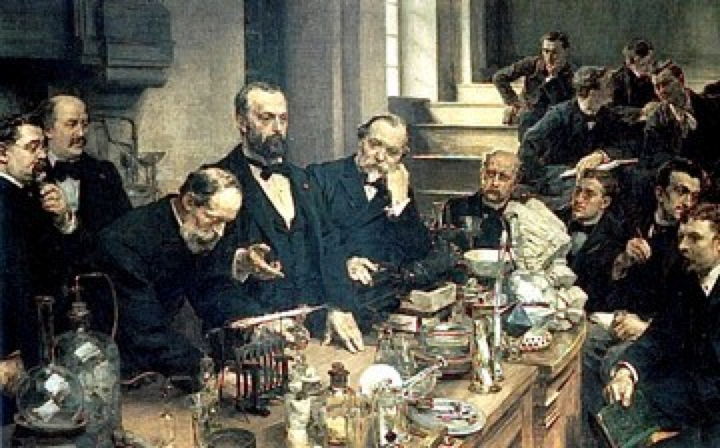
Léon Augustin Lhermitte (1844–1925), Claude Bernard and His Pupils (1889), copy of original by unknown artist, oil on canvas, 86.5 x 112.5 cm, Wellcome Library no. 45530i, London. Courtesy of Wellcome Images, via Wikimedia Commons.
Claude Bernard (1813-1878) was a pioneering physiologist whose writings were of great influence to Naturalists, including Émile Zola. Following Bernard’s death, the Sorbonne (where he had taught) commissioned Lhermitte to paint his portrait in 1886. This is a faithful anonymous copy of Claude Bernard and His Pupils, which was exhibited at the Salon in 1889. This shows Bernard in the midst of performing an experiment on a rabbit, his students discussing its results, and one writing the experimental observations in the laboratory daybook.
Léon Augustin Lhermitte (1844–1925), The Chemist Henri Sainte Claire Deville, Lesson on Aluminium (1890), The Sorbonne, Paris. Wikimedia Commons.
Lhermitte’s painting of The Chemist Henri-Étienne Sainte-Claire Deville, Lesson on Aluminium from the following year was also commissioned by the Sorbonne in Paris; I apologise for the small size of this image. Henri-Étienne Sainte-Claire Deville (1818-1881) was responsible for many significant discoveries in chemistry, the most important being a method for the industrial manufacture of aluminium. He’s shown here surrounded by objects made from this new material, which quickly came to transform manufacturing and to invade every home.
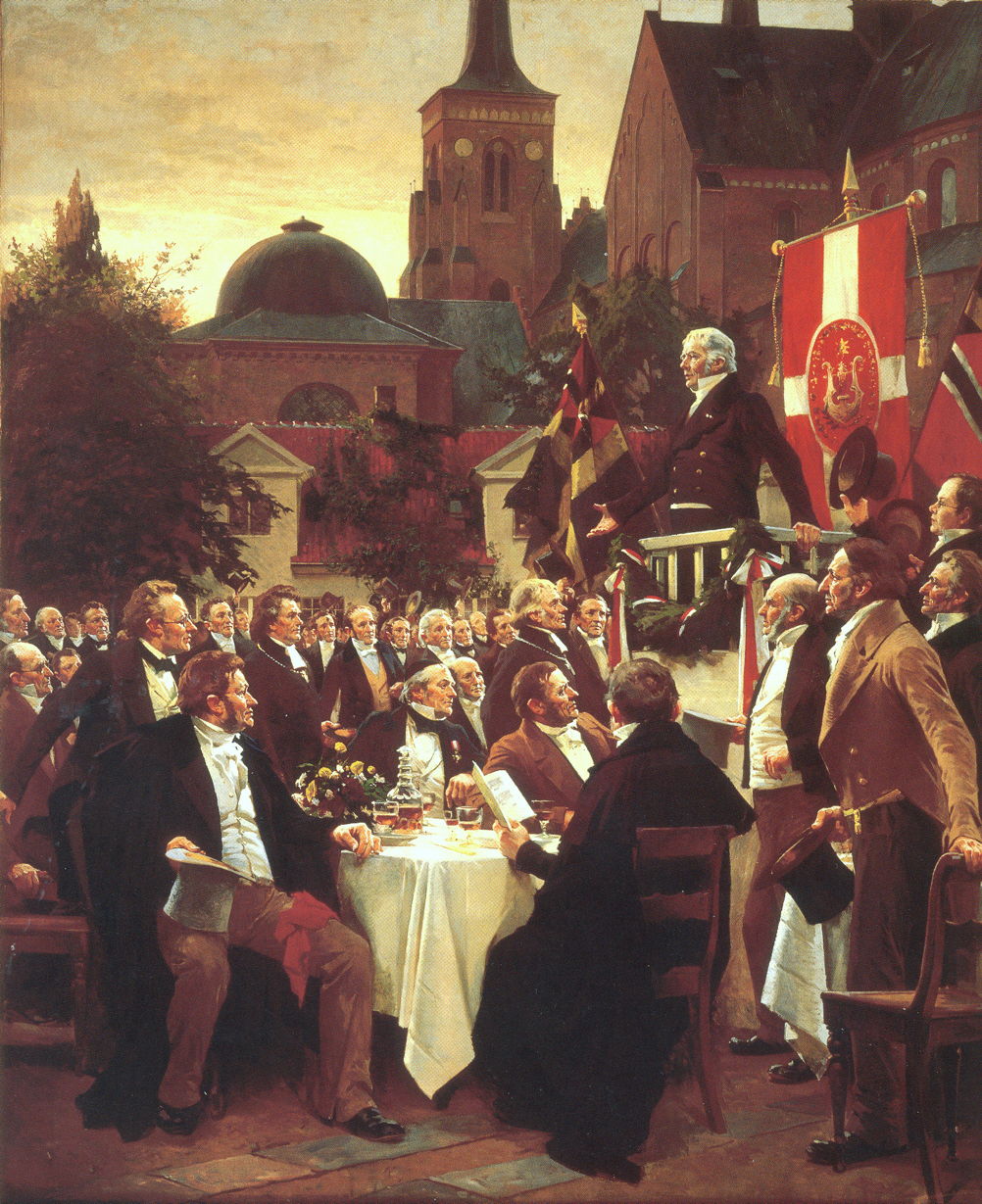
Erik Henningsen (1855–1930), The Nordic Natural Science Research Meeting 14 July 1847 (1895), mural, dimensions not known, Aula, University of Copenhagen, Copenhagen, Denmark. Wikimedia Commons.
Several Naturalist painters were commissioned to paint murals depicting scientific events for universities. Among them is Erik Henningsen’s The Nordic Natural Science Research Meeting 14 July 1847, completed in 1895 for the Aula of the University of Copenhagen. Presiding over this scientific meeting was the great Danish physicist and chemist Hans Christian Ørsted, who was nearly seventy at the time.
Technology was also becoming commonplace at work.
Charles Frederic Ulrich (1858–1908), The Village Printing Shop, Haarlem (1884), oil on panel, 54 × 58.3 cm, Terra Museum of American Art, Chicago, IL. Wikimedia Commons.
Charles Frederic Ulrich painted a young apprentice drinking during a moment’s pause in his work in The Village Printing Shop, Haarlem (1884). In the background is a large and relatively modern printing press.
Jean-Eugène Buland (1852–1926), Un Patron, or The Apprentice’s Lesson (1888), oil on canvas, 102 x 82 cm, Nationalmuseum, Stockholm, Sweden. Image by Erik Cornelius, via Wikimedia Commons.
Another Naturalist artist, Jean-Eugène Buland, in his Un Patron, or The Apprentice’s Lesson from 1888 shows a young boy being trained to make a cogwheel. This was part of the French industrial recovery following its defeat in the Franco-Prussian War.
Louis Muraton (1850–1919), The Photographer (before 1901), further details not known. Wikimedia Commons.
The subject of Louis Muraton’s The Photographer, painted before 1901, is rocking a glass plate in a bath of developer, in his improvised darkroom, another sign of the times.
Major innovations in medical procedures and care were introduced, and duly recorded in Naturalist paintings.
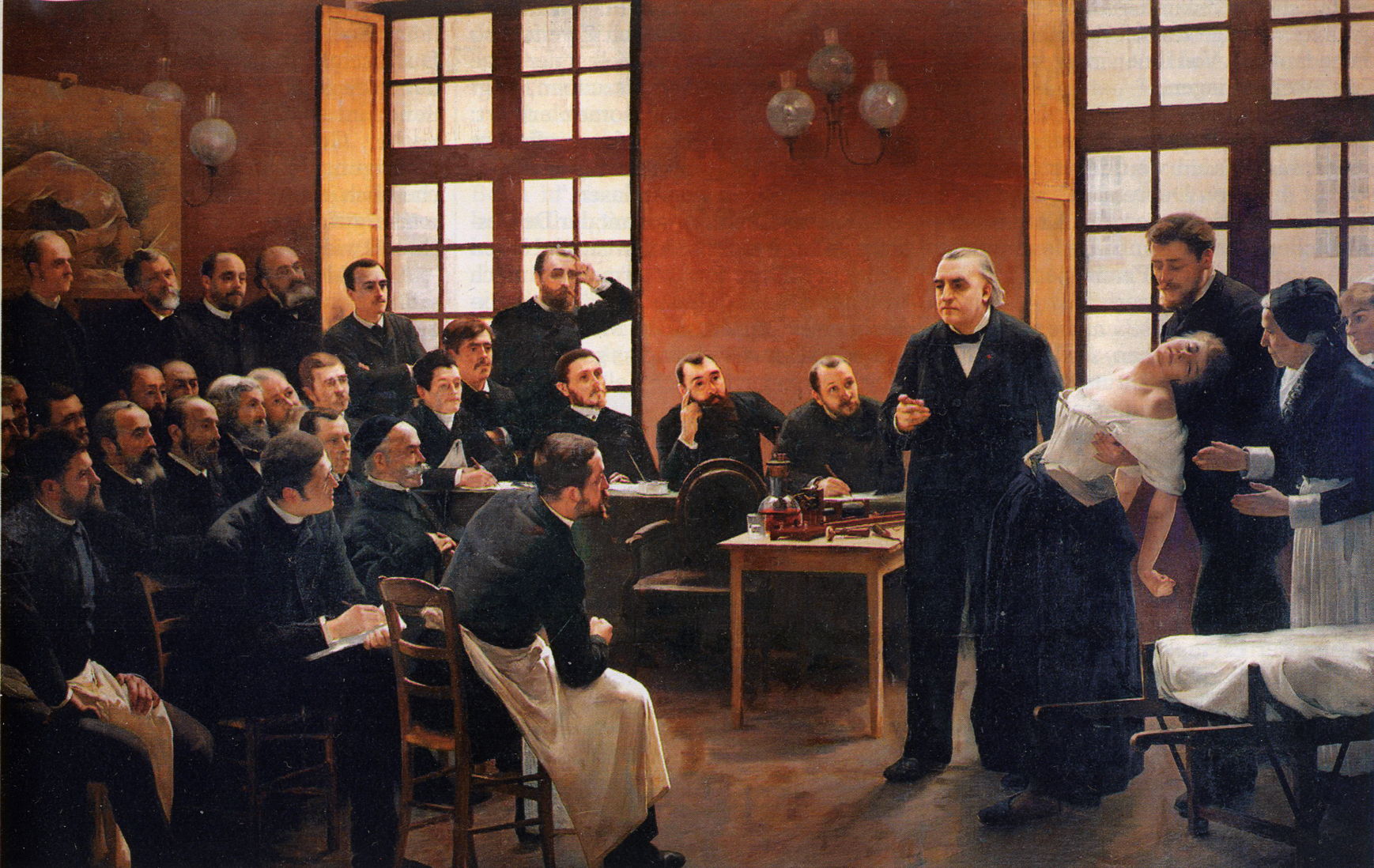
André Brouillet (1857–1914), A Clinical Lesson at The Salpêtrière Hospital (1887), oil, 290 x 430 cm, Paris Descartes University, Paris. Wikimedia Commons.
In André Brouillet’s A Clinical Lesson at the Salpêtrière Hospital (1887), an eminent neurologist Jean-Martin Charcot is demonstrating how he could hypnotise Marie “Blanche” Wittman, the ‘Queen of Hysterics’, into suffering hysterical collapse. Charcot and Wittman were a renowned partnership in this ‘act’, who performed in front of Sigmund Freud when he visited the hospital.
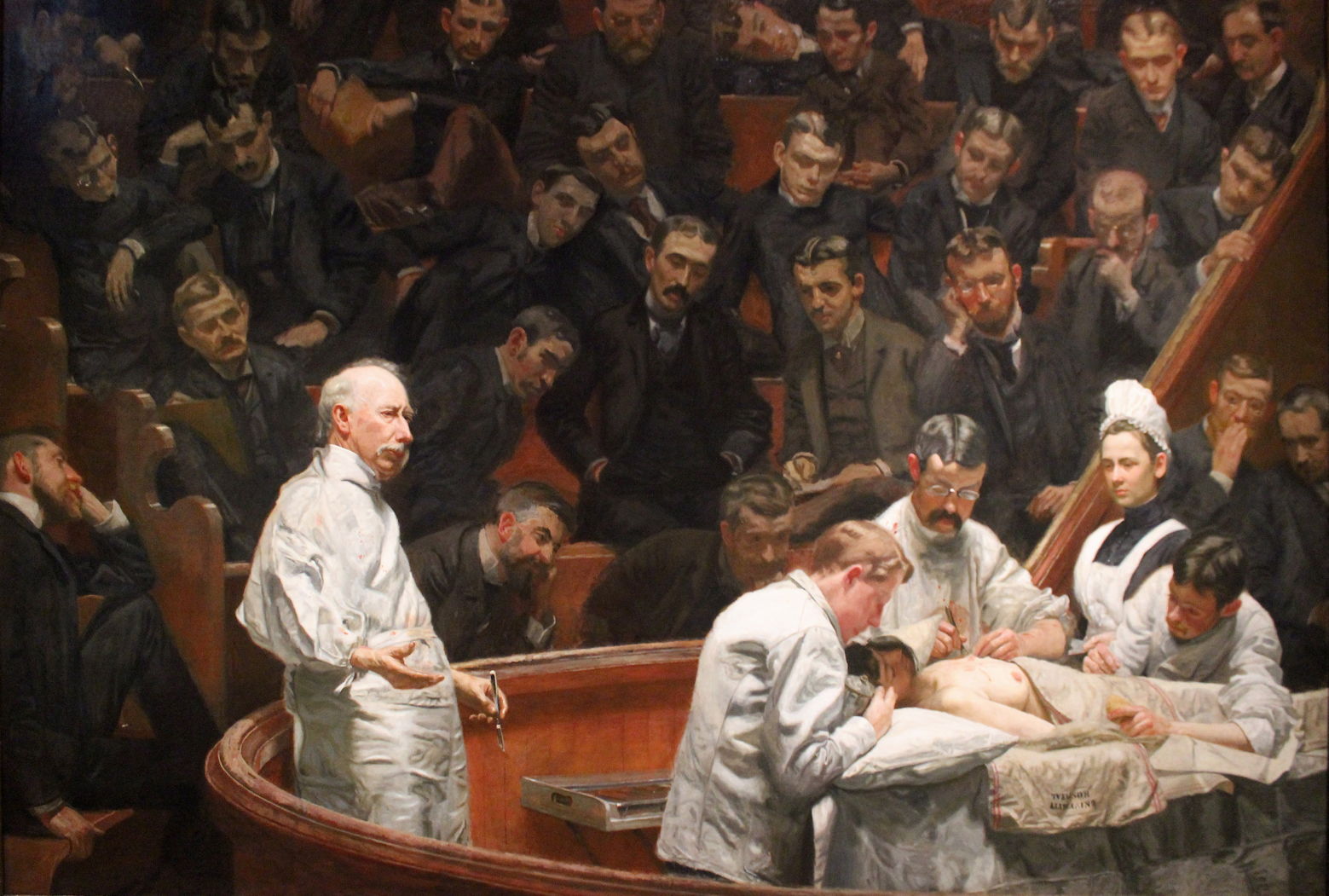
Thomas Eakins (1844–1916), The Agnew Clinic (1889), oil on canvas, 214.2 x 300.1 cm, Philadelphia Museum of Art, Philadelphia, PA. Wikimedia Commons.
In the USA, Thomas Eakins painted the retiring professor of surgery, Dr. David Hayes Agnew, at work in the University of Pennsylvania School of Medicine. The patient is unconscious thanks to a volatile liquid general anaesthetic administered via a mask. Bright surgical lighting puts six figures literally in the limelight, including that of Agnew, holding a scalpel at the left.
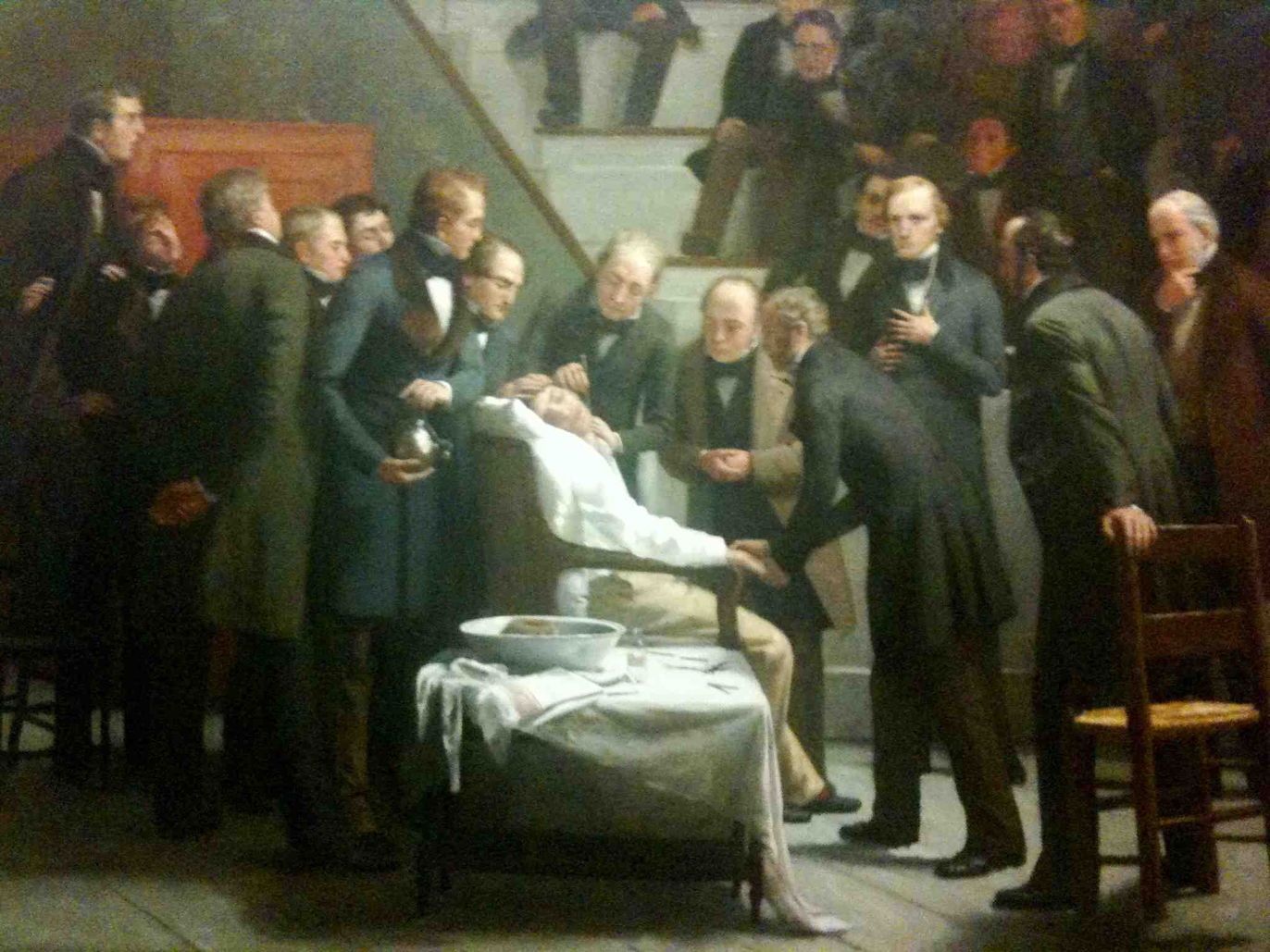
Robert C. Hinckley (1853–1941), Ether Day, or The First Operation with Ether (1882-93), oil on canvas, 243.8 x 292.1 cm, Francis A. Countway Library of Medicine, Harvard University, Cambridge, MA. Wikimedia Commons.
Robert C. Hinckley’s Ether Day, or The First Operation with Ether, painted between 1882-93, recreates the scene on 16 October 1846 in what is now known as the Ether Dome in the Massachusetts General Hospital, Boston, MA. Here John Collins Warren is removing a tumour from the neck of a local printer, Edward G Abbott, who was anaesthetised using ether, in its first recorded use for a general surgical procedure; I apologise for the poor quality of this image.
Anna Sahlstén (1859–1931), Surgery in hospital (c 1893), oil on canvas, dimensions not known, EMMA – Espoon modernin taiteen museo, Espoo, Finland. Wikimedia Commons.
Finally, Anna Sahlstén’s Surgery in Hospital from about 1893 shows the dazzling whiteness of the modern hospital, with a smart professional nurse caring for a child patient in the background. On the wall is a large radiator for the hospital’s modern heating system, which replaced the old stoves seen in so many earlier images of hospital wards.
Many of the great Masters are known to have painted preparatory studies prior to starting on full-size finished studio paintings. Unfortunately, most of those studies were either destroyed by the artist in their lifetime, or by their heirs following their death. Seeing studies alongside a finished work tells a great deal about the artist’s intent and methods, and some exhibitions have made a point of including as many studies as possible. This article shows a small selection of some whose images I have been able to gather.
Some of the best surviving studies are the oil sketches made by Peter Paul Rubens, some of which were given to assistants in his studio for completion.
Peter Paul Rubens (1577–1640), The Rape of Hippodame (sketch) (c 1637-38), oil on panel, 26 × 40 cm, Koninklijke Musea voor Schone Kunsten van België / Musées Royaux des Beaux Arts de Belgique, Brussels, Belgium. Wikimedia Commons.
Towards the end of his life, he painted this brilliant oil sketch of The Rape of Hippodame (c 1637-38). At the right, Eurytus is trying to carry off Hippodame, the bride, with Theseus just about to rescue her from the centaur’s back. At the left, Lapiths are attacking with their weapons, and behind them another centaur is trying to abduct a woman. Rubens typically sketched on small wood panels, here 26 x 40 cm (10 x 16 inches), with wonderfully painterly brushstrokes.
Peter Paul Rubens (1577–1640), The Rape of Hippodame (Lapiths and Centaurs) (1636-38), oil on canvas, 182 × 290 cm, Museo Nacional del Prado, Madrid, Spain. Wikimedia Commons.
That became this finished painting, The Rape of Hippodame (Lapiths and Centaurs) (1636-38), which remains faithful to the sketch and its composition. Facial expressions, particularly that of the Lapith at the left bearing a sword, are particularly powerful.
Studies were better preserved in the nineteenth century, when tastes changed and some realised worthwhile sums in posthumous sales of the contents of studios.
Jean Louis Théodore Géricault (1791–1824), Study for The Raft of the Medusa (1819), oil on canvas, 36 x 48 cm, Musée du Louvre, Paris. Wikimedia Commons.
Among the most studied are those made by Géricault when he was working up his landmark painting of The Raft of the Medusa. This oil study on canvas was probably made as he was completing his preparations during the autumn of 1818, and reveals some of his compositional thinking, for instance over the size of the ship that rescued the survivors.
Jean Louis Théodore Géricault (1791–1824), The Raft of the Medusa (1818-19), oil on canvas, 491 x 716 cm, Musée du Louvre, Paris. Wikimedia Commons.
The end result is this vast canvas, its figures shown life-sized, which has had huge impact on everyone who has seen it since its completion in 1819. It appears completely authentic, and given the work that Géricault put into making it so, that’s perhaps not surprising. But most gain the impression that the raft was almost square in form, as a result of the tight cropping applied, and that even with those few survivors on board, it was overcrowded. This is because Géricault chose to pack all his figures into one small section of the raft.
I was fortunate enough to visit an exhibition of some of John Constable’s works, in which his studies were shown alongside finished paintings. Here I show just one example. Had Constable lived fifty years later, he might have been persuaded to stop his paintings when they were still late oil studies, rather than take them to their finished conclusions.
John Constable (1776–1837), Hadleigh Castle (sketch) (1828-29), oil on millboard, 20 × 24 cm, Yale Center for British Art, New Haven, CT. Wikimedia Commons.
This early sketch of Hadleigh Castle (1828-29) already contains some surprisingly detailed passages: at the far left, a shepherd, his black dog by his side, with a small flock of sheep grazing near the ruined tower. There’s a brown and white blob on the seaward slope, probably a cow grazing there. Wheeling in wrinkles of impasto above the tower are a few birds resembling small runnels of liquid metal like solder. By this time, many artists were painting their oil studies on cheaper millboard, as Constable did here. Millboard is made by pasting together many sheets of fine paper, so isn’t as durable as cheaper stretched canvas.
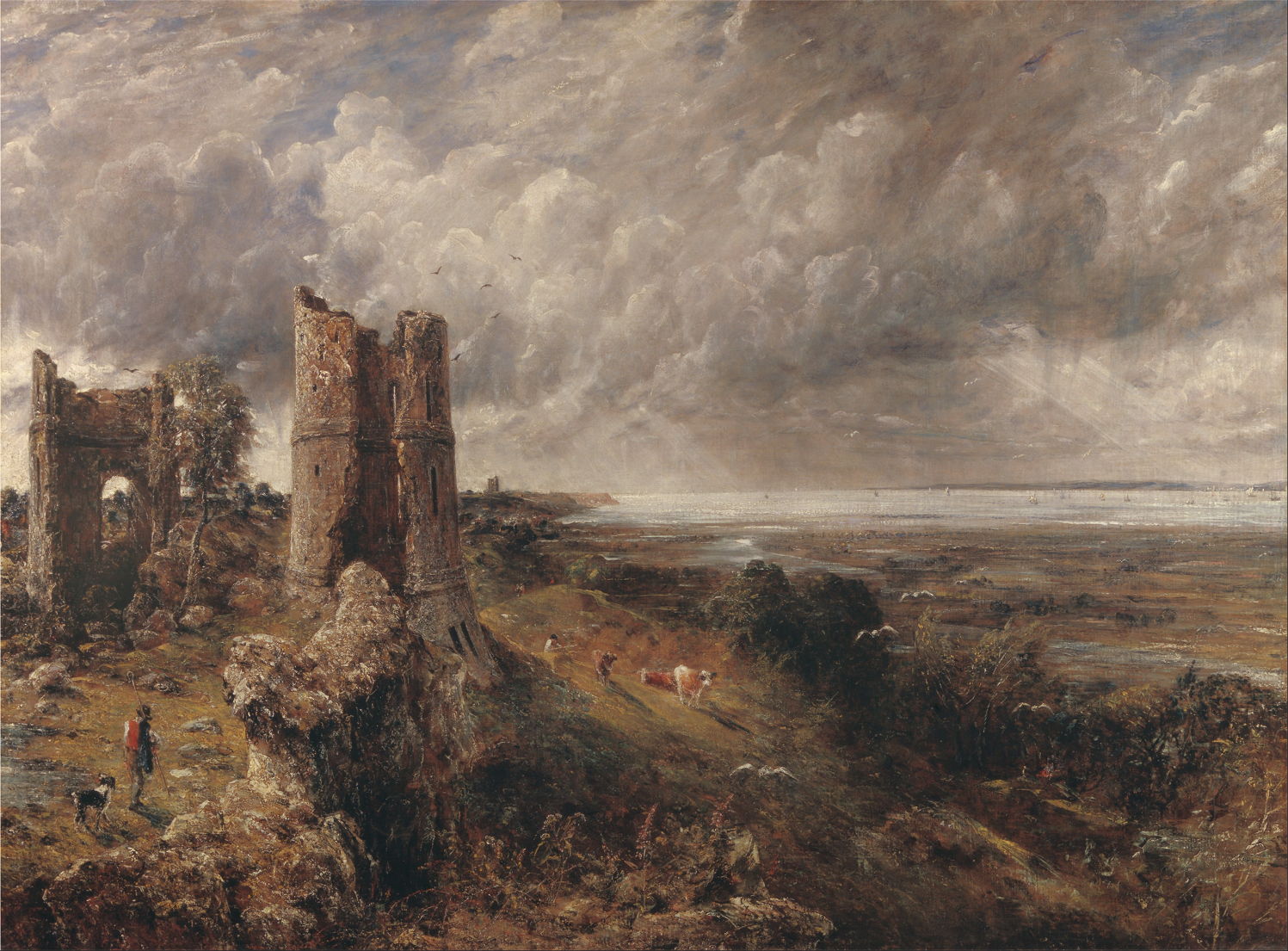
John Constable (1776–1837), Hadleigh Castle, The Mouth of the Thames – Morning after a Stormy Night (1829), oil on canvas, 121.9 x 164.5 cm, Yale Center for British Art, New Haven, CT. Wikimedia Commons.
By the finished work, the splendid Hadleigh Castle, The Mouth of the Thames – Morning after a Stormy Night (1829), the basic disposition of those figures has changed little, but Constable has changed each to suit his image. The shepherd, still carrying his long crook, is separated from his dog, and has lost his sheep, which have become scattered rocks. The single cow on the sloping grass has gained a couple of friends, and a cowherd. Beyond them are another couple of tiny specks of figures, and there are more by the wood in the lower right corner.
William Powell Frith (1819–1909), Derby Day (study) (before 1857), oil on canvas, 39.4 x 91.1 cm, Private collection. Wikimedia Commons.
William Powell Frith’s late study for Derby Day was probably painted in about 1856, and is very close to the finished work shown below, although covering only about a tenth of its area.
William Powell Frith (1819–1909), The Derby Day (1856-58), oil on canvas, 140.5 x 264 cm, The Tate Gallery, London. Wikimedia Commons.
Jacob Bell commissioned Frith to paint his finished Derby Day (1856-58) for the huge fee of £1,500, and the artist was paid a further £1,500 for rights to make prints. It was exhibited at the Royal Academy in 1858, and proved so popular that a guard rail had to be installed in front of it to protect the work from the admiring crowds.
Georges Seurat’s preparations are also revealed in his surviving studies, and are very different given his Pointillist technique. Some of the later Divisionists made conventional studies, and there are some experimental examples using larger tiles of colour (see below). Seurat instead rehearsed parts of the overall view when preparing his masterwork.
Georges Seurat (1859–1891), Landscape – the Island of the Grande Jatte (1884), oil on canvas, 69.9 x 85.7 cm, Private collection. WikiArt.
Seurat’s first and greatest masterpiece, generally known as La Grande Jatte, uses the technique of optical mixing of colour. Rather than blending pigments on the canvas, it’s constructed of tiny dots that are high in chroma, and allow for optical mixing, one of the fundamental techniques in Seurat’s new scientific painting. His theory was that the mixing of colour would then occur in the retina of the viewer, and he tried this in a pure landscape study (above), and in his huge finished painting (below).
Georges Seurat (1859–1891), Un dimanche après-midi à l’Île de la Grande Jatte (A Sunday Afternoon on the Island of La Grande Jatte) (1884-6), oil on canvas, 207.5 × 308.1 cm, Art Institute of Chicago, Chicago, IL. Wikimedia Commons.
He painted his finished version in three phases. In the first, the dots he applied were mixed from available and fairly conventional pigments, including duller earths. In the second phase, he used a limited number of brighter and higher chroma pigments. In the third and final phase he added coloured borders which are distinctive of his paintings.
By the late nineteenth century oil studies were being supplemented by photographs.
Circle of Thomas Eakins (1844–1916), Eakins’s Students at the “The Swimming Hole” (1884), albumen silver print, 9.3 x 12.1 cm, The Getty Center, J. Paul Getty Museum, Los Angeles, CA. Wikimedia Commons.
Thomas Eakins’ preparatory studies for Swimming (1885) grew from a series of photographs taken by the artist and his friends. But photos never replaced his own sketches: for this work, Eakins made several figure studies, details such as the dog, and different landscape backgrounds, then brought them together in oil sketches.
Thomas Eakins (1844–1916), Swimming Hole (sketch) (1884), oil on fiberboard mounted on masonite, 22.1 × 27 cm, The Hirshhorn Museum and Sculpture Garden, Washington, DC. Wikimedia Commons.
Once he was happy, he embarked on his final version. In at least some cases, including his paintings of shad fishing from 1881-82, the figures in his Arcadia (c 1883), and Swimming (1885), he put final photographic images into a ‘magic lantern’ projector, which he then projected at the canvas.
He developed a sophisticated system not only for using the projected image to make a graphite underdrawing, but as the painting progressed, to incise key points and lines of reference in the paint surface. This enabled him to create paintings that were accurately calibrated to his reference images: a great advance on the traditional system of enlargement using grids, and one factor in his detailed realism. This technique was discovered by Mark Tucker and Nica Gutman.
Thomas Eakins (1844–1916), Swimming (The Swimming Hole) (1885), oil on canvas, 70.2 × 93 cm, Amon Carter Museum of American Art, Fort Worth, TX. Wikimedia Commons.
Together with other photos and various studies, Eakins then painted Swimming (The Swimming Hole) in 1885.
Albert Bierstadt was more traditional in his preparatory studies for The Last of the Buffalo in 1888.
Albert Bierstadt (1830–1902), Study for ‘The Last of the Buffalo’ (c 1888), oil on canvas, 62.9 x 91.1 cm, De Young Museum, San Francisco, CA. Wikimedia Commons.
This late study was painted on canvas, and is 63 x 91 cm (25 x 36 inches). It concentrates on the action to be embedded in a broader landscape.
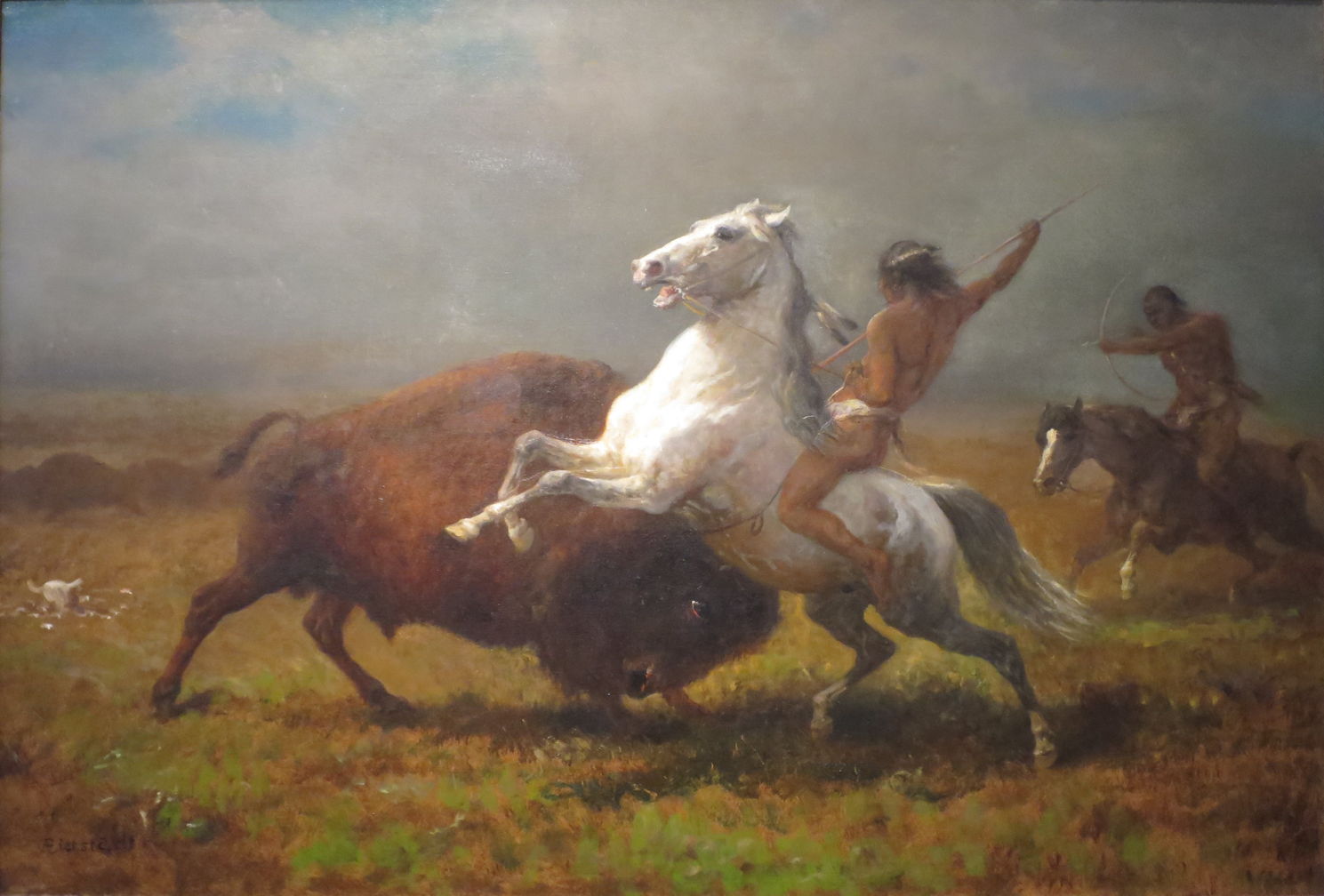
Albert Bierstadt (1830–1902), The Last of the Buffalo (c 1888), oil on canvas, 153 x 245.1 cm, Buffalo Bill Center of the West, Cody, WY. Wikimedia Commons.
Bierstadt’s finished painting is larger still, and sets that action in a more characteristic grand panorama, with bleached skulls and dying buffalo in the foreground. In the middle distance are hundreds of animals in the herd, suggesting that extinction was by no means the only outcome.
Finally, a pair of paintings by the less-known Divisionist Henri-Edmond Cross shows an alternative approach to Seurat’s, where his study is built of small daubs of colour, which are then reduced in size for the Pointillism of his final version.
Henri-Edmond Cross (1856–1910), Clearing in Provence (study) (c 1906), oil on paper mounted on canvas, 56.5 x 44 cm, Israel Museum מוזיאון ישראל, Jerusalem, Israel. Wikimedia Commons.
His Clearing in Provence from about 1906 was painted on paper, and has subsequently been mounted on canvas for display in the Israel Museum, Jerusalem.
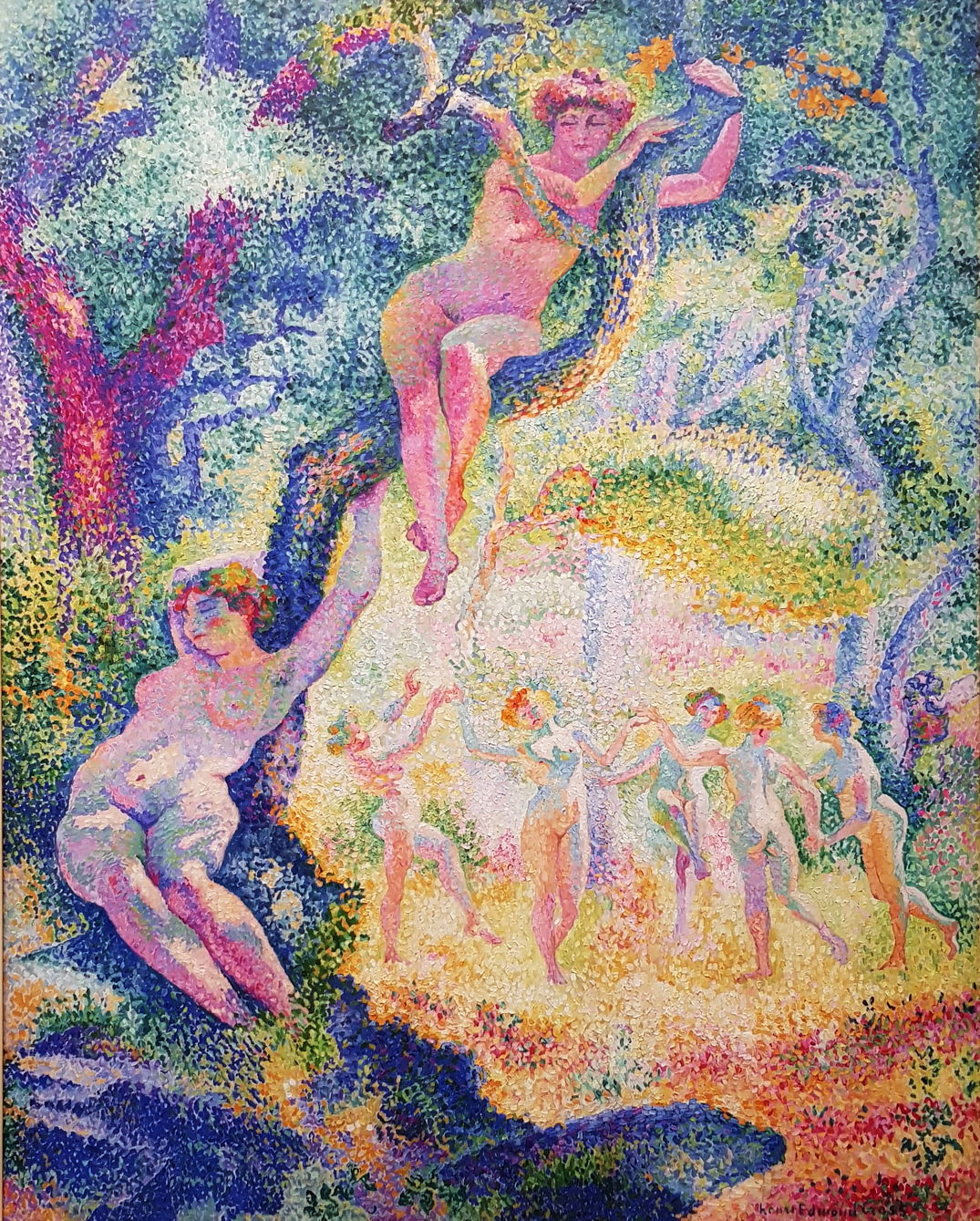
Henri-Edmond Cross (1856–1910), The Glade (1906), oil on canvas, 162 x 130 cm, Wallraf-Richartz-Museum & Fondation Corboud, Cologne, Germany. Image by anagoria, via Wikimedia Commons.
That sketch formed the basis of the woodland setting Cross used in The Glade, painted in oils in 1906. Colour changes are prominent, and the chroma has been considerably enhanced. The size has grown, and it’s on a more permanent support of stretched canvas.
Seen through modern eyes, many of the oil studies of the past deserve to be seen more widely, rather than being kept in storage.
Sculptors and painters are kindred spirits. Although their tools and skills differ, they are all visual artists, and many have mastered both means of expressing their art. In today’s selection of paintings I include depictions of sculptors at work, rather than those merely showing the fruit of their labour in the form of sculpture.
The best-known sculptor in classical mythology is Pygmalion, whose quest for the perfect woman was only satisfied by the statue he made of her.
Edward Burne-Jones (1833–1898), Pygmalion and the Image – The Hand Refrains (1878), oil on canvas, 98.7 x 76.3 cm, Birmingham Museum and Art Gallery, Birmingham, England. Wikimedia Commons.
The Hand Refrainsis one of Edward Burne-Jones’s series telling this myth. Pygmalion stands back, his tools still in his hands and scattered at the foot of his work. Too scared to touch the statue now, he looks longingly at it, as if falling in love, which he did when it came to life.
Jean-Léon Gérôme (1824–1904), Pygmalion and Galatea (study) (1890), oil on canvas, 94 x 74 cm, Private collection. Wikimedia Commons.
Jean-Léon Gérôme’s study for Pygmalion and Galatea from 1890 was an early attempt at its composition, where the sculptor’s future bride is still a marble statue at her feet, but very much flesh and blood from the waist up. That visual device was perfect, but Gérôme recognised his painting could be shunned because of its full-frontal nudity, so reversed the view.
Jean-Léon Gérôme (1824–1904), Pygmalion and Galatea (c 1890), oil on canvas, 88.9 x 68.6 cm, Metropolitan Museum of Art, New York, NY. Wikimedia Commons.
His finished Pygmalion and Galatea (c 1890) extends the marble effect a little higher, and by showing Galatea’s buttocks and back and concealing the kiss, it stays on the right side of contemporary standards of decency. His attention to detail is delightful, with two masks against the wall at the right, Cupid ready with his bow and arrow, an Aegis bearing the head of Medusa, and a couple of statues about looking and seeing. For Gérôme recognised other stories about sculpture and seeing that could be brought in to enrich Ovid’s original narrative.
Lawrence Alma-Tadema (1836–1912), Phidias Showing the Frieze of the Parthenon to his Friends (1868), oil on canvas, 72 × 110.5 cm, Birmingham Museum and Art Gallery, Birmingham, England. Wikimedia Commons.
Lawrence Alma-Tadema imagined ancient Greeks admiring this painted frieze as it neared completion in his beautiful painting of its sculptor Phidias Showing the Frieze of the Parthenon to his Friends (1868). The admiring figures include Pericles (at the right), Aspasia, Alcibiades and Socrates.
Thomas Eakins (1844–1916), William Rush Carving His Allegorical Figure of the Schuylkill River (1876-77), oil on canvas mounted on Masonite, 51.2 x 66.4 cm, Philadelphia Museum of Art, Philadelphia, PA. Wikimedia Commons.
William Rush Carving His Allegorical Figure of the Schuylkill River (1876-77) is the first of three paintings by Thomas Eakins showing William Rush, a wood sculptor, carving his Water Nymph and Bittern for a fountain in Philadelphia’s waterworks, in 1808. The water nymph is an allegory of the Schuylkill River, the city’s primary source of water at that time.
Rush had been a founder of the Pennsylvania Academy of the Fine Arts, and an enthusiast for the use of nude models in art, as was Eakins. This painting was therefore, at least in part, an attempt to promote Rush’s name, and the practice of working from nude models. Rush prepared thoroughly, as usual, in carving wax studies, and making a series of drawings and oil sketches.
Seated at the right of the model is a chaperone, more interested in her knitting. The model’s complicated clothing is hung and scattered in the light, as if to emphasise her total nudity (apart from a hair-band!), and the sculptor is working in the gloom at the left. Eakins anachronistically included several later works by Rush, as if to provide a resumé of his output. Unfortunately, the scattered garments didn’t go down well, and were deemed scandalous at the time.
Jean-Léon Gérôme (1824–1904), Michelangelo (1849), oil on canvas, 51.4 x 37.5 cm, Dahesh Museum of Art, New York, NY. The Athenaeum.
Gérôme’s relatively small and simple painting of Michelangelo from 1849 shows Michelangelo in his dotage, hunched over and blind, being led by a young boy whose dress would have aroused his master’s homoerotic desires. The broken sculpture is the Belvedere Torso, a huge fragment of marble statuary so loved by the sculptor that it was nicknamed the School of Michelangelo. The young boy is leading his master’s hands to stroke and caress the marble, now that he was unable to enjoy looking at its classical and very male form.
This is perhaps the first step in his developing theme of sight, and the role of vision in establishing truth. In his blindness, Michelangelo can only feel what we can see, and cannot see the figure of the young boy. This is particularly appropriate to Gérôme, who later in his career became a successful sculptor himself, and whose later paintings referred to his sculptures and the act of creating them.
Jean-Léon Gérôme (1824–1904), The End of the Pose (1886), oil on canvas, 48.3 x 40.6 cm, Private collection. Wikimedia Commons.
The End of the Pose (1886) is the first of Gérôme’s series of unusual compound paintings, at the same time self-portraits of the artist as a sculptor, studies in the relationship between a model and their sculpted double, and forays into issues of what is seen, visual revelation, and truth. Here, while Gérôme cleans up, his model is seen covering up her sculpted double with sheets, as she remains naked. Apart from various diversionary entertainments, including a couple of stuffed birds and a model boat, there is a single red rose on the wooden platform on which the model and statue stand. Presumably this is a symbol of thanks from the artist to his model.
Jean-Léon Gérôme (1824–1904), The Artist’s Model (1895), oil on canvas, 50.8 x 39.6 cm, Dahesh Museum of Art, New York, NY. Wikimedia Commons.
In The Artist’s Model (1895), Gérôme paints himself at work on his marble figure of Tanagra (1890), currently in the Musée d’Orsay, already included among the figurines in his painting Sculpturae Vitam Insufflat Pictura. He thus painted himself making a sculpture that he had previously painted in a painting as a sculpture. Not only that, but his model is his favourite Emma Dupont, who over a period of twenty years posed for many of his best-known Orientalist and other works.
Scattered in the image are reminders of gladiatorial armour and other props used for his paintings, one of his paintings of Pygmalion and Galatea, together with one of his polychrome sculptures of a woman with a hoop, at the right edge. In this single image, Gérôme has captured much of his professional career.
Lovis Corinth (1858–1925), Portrait of the Sculptor Nikolaus Friedrich (1912), oil on canvas, 101.7 × 81 cm, Private collection. Wikimedia Commons.
This wonderful Portrait of the Sculptor Nikolaus Friedrich (1912) at work wasn’t the first to be painted by Lovis Corinth, who had made a previous portrait in 1904, when the sculptor was young and muscular. Eight years later he’s seen in the midst of a broad and representative range of his work. Friedrich died two years later, when he was only 48.
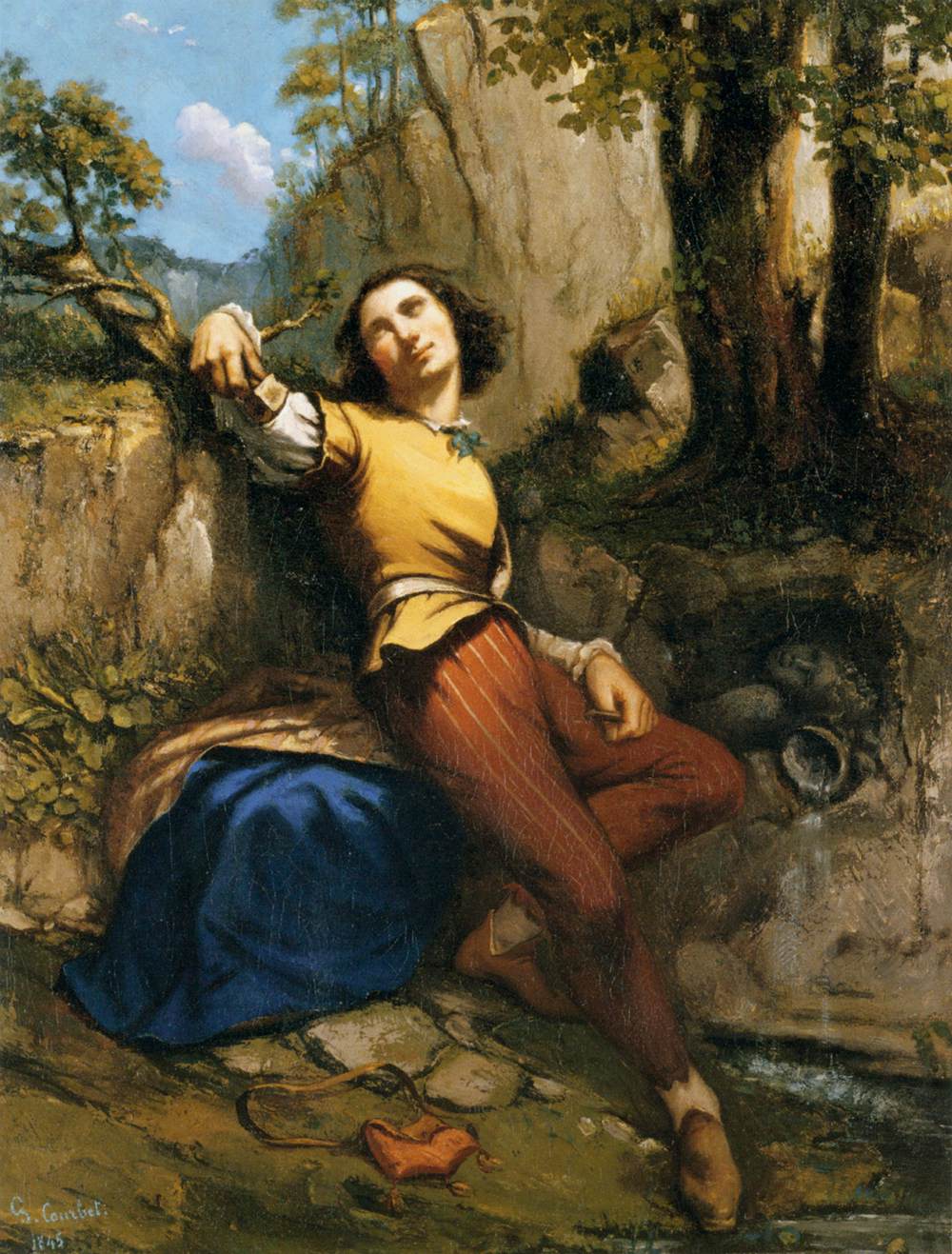
Gustave Courbet (1819–1877), The Sculptor (1845), oil on canvas, 55 x 41 cm, Private collection. Wikimedia Commons.
Early in his career, Gustave Courbet planted a gaudily-dressed figure at the foot of some cliffs near his home town of Ornans, put a small mallet in his right hand and a chisel in the other, and painted The Sculptor (1845). The subject of this sculptor’s inattention is the emerging form of a woman in the rock just above his left knee, over a small pipe from which water is pouring into the stream.
Antoine Watteau (1684–1721), The Monkey Sculptor (c 1710), oil on canvas tondo, 22 × 21 cm, Musée des Beaux-Arts, Orléans, Loiret, France. Wikimedia Commons.
Antoine Watteau’s tondo of The Monkey Sculptor from about 1710 is a singerie set in the sculptor’s studio, as if to say that even a monkey can be a good sculptor.

 Login
Login