Reading view

There are new articles available, click to refresh the page.

Jerusalem Delivered: 9 Armida’s Garden

The crusaders led by Godfrey of Bouillon desperately need Rinaldo back if they are to resume their assault on Jerusalem. Guelph’s party, notably the knights Charles (Carlo) and Ubaldo, have gone in search of him. But Rinaldo has been lured into a trap by the sorceress Armida, who intended to kill him. At the last moment, though, she falls in love with him and abducts him in her chariot.

That flies the couple to the distant, deserted and enchanted Fortunate Isles, where she lives in her garden that is perpetually in Spring. The wizard explains this to Charles and Ubaldo, to aid them in their mission to rescue the knight.
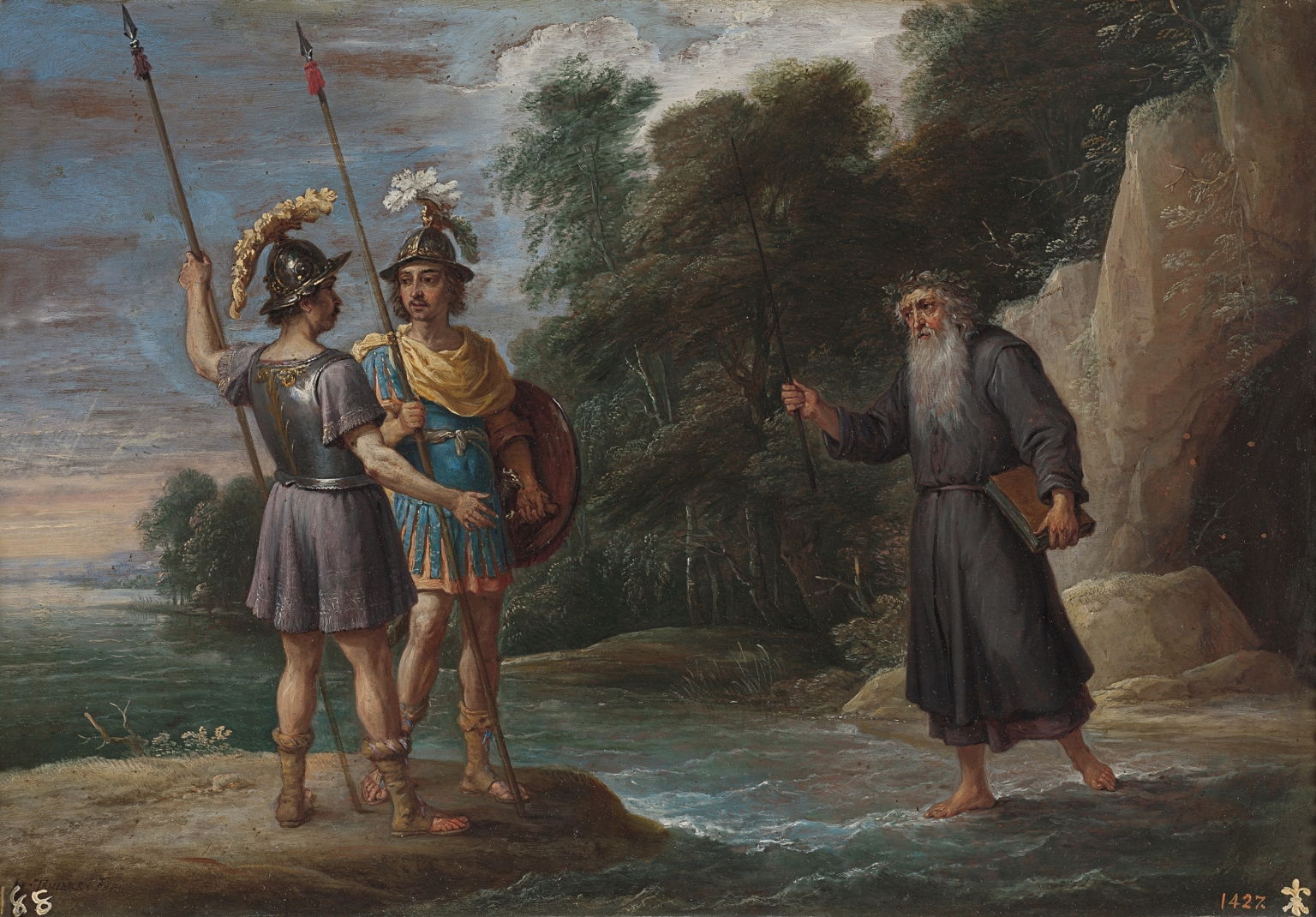
teniersmagiciandiscoverscarlosubaldo
David Teniers the Younger (1610–1690), The Magician Shows Carlos and Ubaldo the Whereabouts of Rinaldo (The search for Rinaldo) (1628-30), oil on copper, 27 x 39 cm , Museo Nacional del Prado, Madrid, Spain. Wikimedia Commons.

David Teniers the Younger’s The Magician Shows Carlos and Ubaldo the Whereabouts of Rinaldo (The search for Rinaldo) from 1628-30 is a small oil on copper painting in his series telling this section of Tasso’s epic. Here the wizard despatches the two knights to the Fortunate Isles.

At the start of canto fifteen, Charles and Ubaldo set off to retrace their steps with the wizard as their guide. The river takes them gently down to the sea, where a ship awaits. They board, and sail at miraculous speed past Ascalon and the mouths of the River Nile, westward through the Mediterranean, and through the Pillars of Hercules into the Atlantic Ocean. They eventually approach the Fortunate Isles, pull into a harbour, and the two knights disembark.

They spend the night at the foot of the mountain they have to climb to reach Armida’s garden with the captive Rinaldo. They set off at dawn, only to encounter their first obstacle: a fearsome dragon blocking their passage up the mountain. Charles draws his sword ready to slay the dragon, but Ubaldo waves a golden wand, a gift of the wizard, which drives it away.

poussincompanionsrinaldo
Nicolas Poussin (1594–1665), The Companions of Rinaldo (c 1633-4), oil on canvas, 119 x 101 cm, The Metropolitan Museum of Art, New York, NY. Wikimedia Commons.

Poussin’s The Companions of Rinaldo (c 1633-4) shows the two knights confronting this dragon. Charles stands in the centre with his sword ready, but Ubaldo behind him leaves his weapon in its scabbard and brandishes his golden wand instead. In the background at the left is the magic ship in which they sailed, and standing in its prow is the maiden who steered it.
overbeckubaldocarloliberaterinaldo
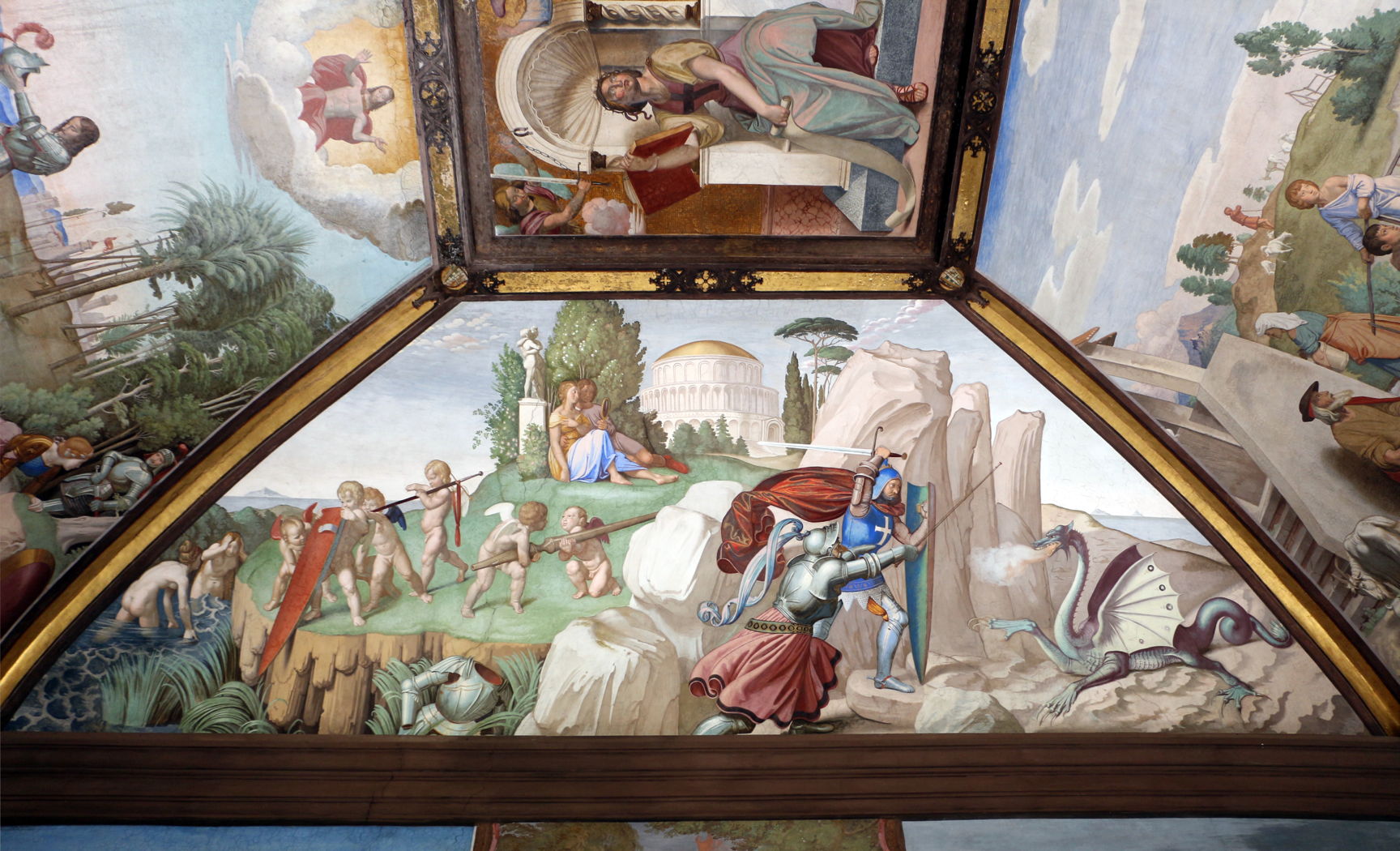
Johann Friedrich Overbeck (1789-1869), Ubaldo and Carlo free Rinaldo from Armida’s Castle (1819-27), fresco, dimensions not known, Casa Massimo, Rome, Italy. Image by Sailko, via Wikimedia Commons.

Johann Friedrich Overbeck’s fresco of Ubaldo and Carlo free Rinaldo from Armida’s Castle from 1819-27, in the Casa Massimo, Rome, shows an interesting composite scene. To the right of centre, Charles and Ubaldo wield their sword and wand, and in the distance are Armida and Rinaldo in the garden on the summit. Amorini are playing with Rinaldo’s weapons, and his empty suit of armour has been cast into the undergrowth.

Next the pair have to face a lion, which is similarly dismissed with a wave of the wand. After that comes an army of animals they disperse readily, and Charles and Ubaldo are on the ascent towards the stretch of snow and ice they must cross before reaching Armida’s eternal Spring. Once up at the top, the two knights pause from their strenuous climb, slaking their thirst in a mountain stream. Grassy banks either side of the stream have a fine banquet laid out on them, and there are two naked young women cavorting in the water.

tenierscarlosubaldoislands
David Teniers the Younger (1610–1690), Carlos and Ubaldo in The Fortunate Isles (1628-30), oil on copper, 27 x 39 cm, Museo Nacional del Prado, Madrid, Spain. Wikimedia Commons.

David Teniers the Younger’s Carlos and Ubaldo in The Fortunate Isles (1628-30) shows this moment, with the banquet laid out on a clean white tablecloth rather than grass. Surrounded by trees and standing proud on the skyline is Armida’s palace, their destination.

delafossedanishwarriors
Charles-Alexandre Coëssin de la Fosse (1829–1910), Danish Warriors in the Garden of Armida (1848), others detail unknown, but believed to be oil on canvas and the original in colour. By Salon 1913, via Wikimedia Commons.

I only have this monochrome image of Charles-Alexandre Coëssin de la Fosse’s painting of Danish Warriors in the Garden of Armida from 1848. The two knights are dallying rather longer than their mission had intended.

Once Charles and Ubaldo can tear themselves away from these nymphs, they press on to the circular outer wall of the palace, which opens the sixteenth canto as they enter Armida’s garden.

mullergardenofarmida
Édouard Muller (1823-1876), The Garden of Armida (1854), block-printed wallpaper, 386.1 x 335.3 cm, Philadelphia Museum of Art, Philadelphia, PA. Wikimedia Commons.

In the eighteenth and nineteenth centuries, Armida’s garden appeared on all manner of products. This wallpaper designed by Édouard Muller in 1854 is now in the Philadelphia Museum of Art, while smaller images appeared on coffee cups and much else.

Tasso gives a brief description of the garden with its figs, apples and grape vines. Birds sing, and the wind murmurs softly. One bird speaks to the two knights, telling of the chaste and modest rose flower that springs virgin from its green leaves.
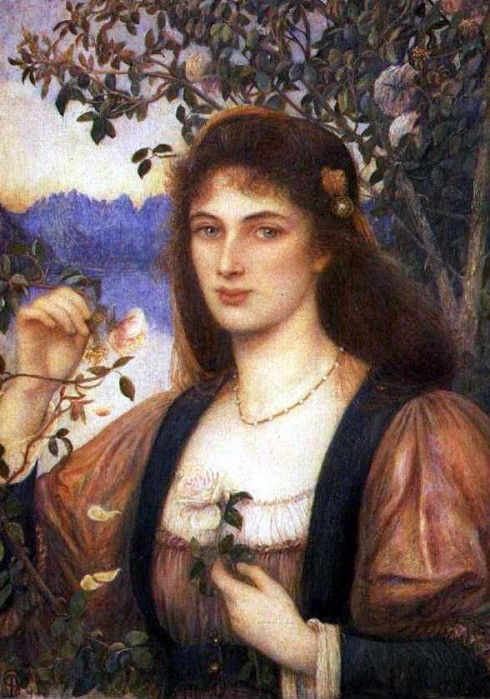
stillmanrosefromarmidasgarden
Marie Spartali Stillman (1844–1927), A Rose in Armida’s Garden (1894), watercolour and graphite on paper, 64.8 x 43.2 cm, Private collection. Wikimedia Commons.

This passage about the rose was the inspiration for Marie Spartali Stillman’s exquisite watercolour of A Rose in Armida’s Garden from 1894, given by the artist as a wedding gift to a family friend.

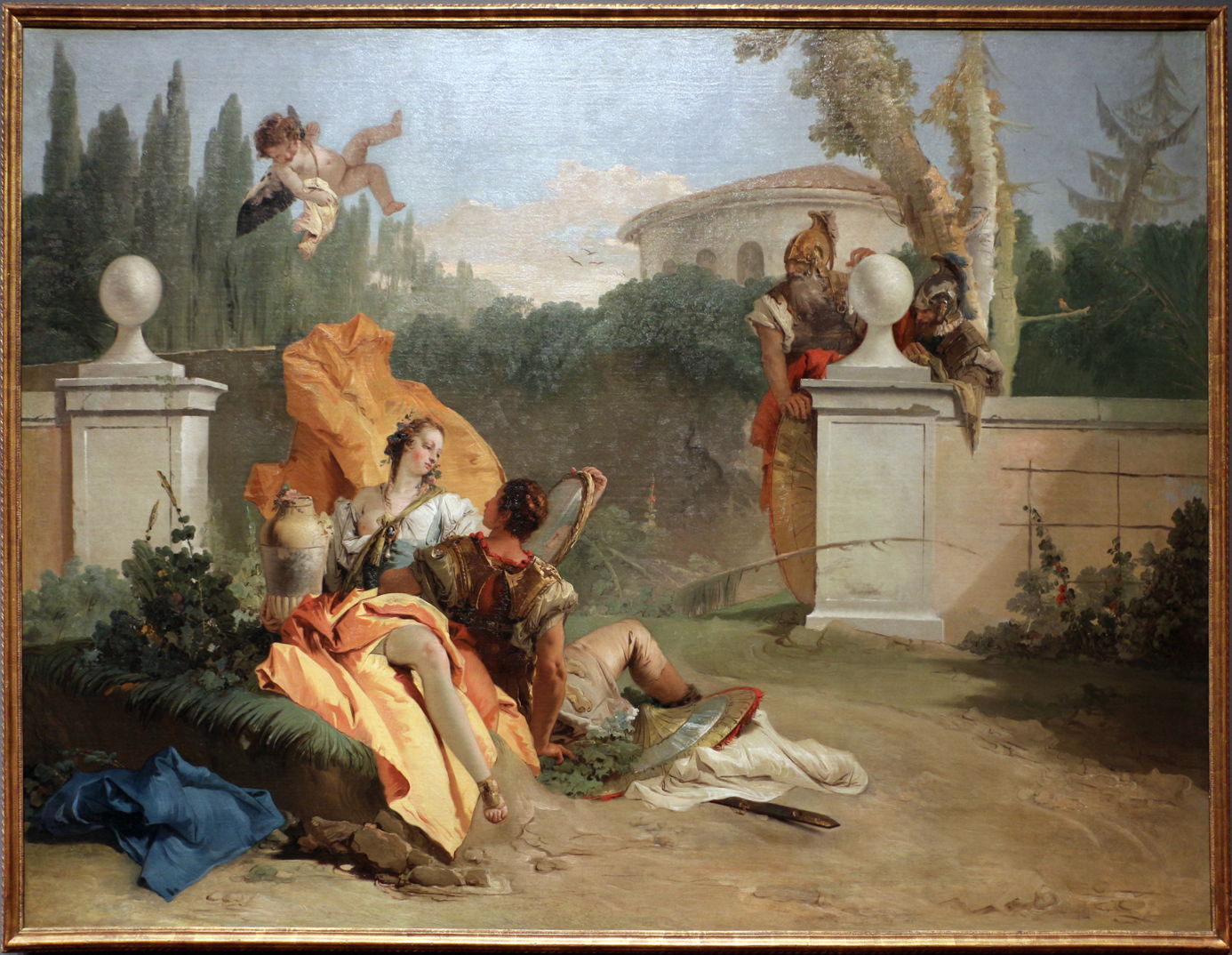
Charles and Ubaldo then peer through the leaves and spot a loving couple, who they presume to be Rinaldo and Armida. The knight’s head rests in Armida’s lap. He then stands up and takes a crystal glass hanging at his side. Armida uses this as a mirror to adjust her hair, telling Rinaldo to keep looking into her eyes.
tiepolorinaldoarmidagarden
Giovanni Battista Tiepolo (1696–1770), Rinaldo and Armida in Her Garden (1742-45), oil on canvas, 187 x 260 cm, The Art Institute of Chicago, Chicago, IL. Image by Sailko, via Wikimedia Commons.

Tiepolo paints this clearly in his Rinaldo and Armida in Her Garden from 1742-45, now in The Art Institute of Chicago. It was originally hung in a special room dedicated to Tasso’s epic in the Palazzo Corner a San Polo in Venice, where it belonged to the noble Serbelloni family.

kauffmannrinarm
Angelica Kauffman (1741–1807), Rinaldo and Armida (1771), oil on canvas, 130.8 x 153 cm, Yale Center for British Art, New Haven, CT. Wikimedia Commons.

In Angelica Kauffman’s Rinaldo and Armida from 1771, the crystal glass is ready at Armida’s feet, and she is busy distracting him by sprinkling flowers over his head.

hayezrinaldoarmida
Francesco Hayez (1791–1881), Rinaldo and Armida (1812-13), oil on canvas, dimensions not known, Gallerie dell’Accademia, Venice, Italy. Wikimedia Commons.

Francesco Hayez shows a variation in his Rinaldo and Armida from 1812-13. Anticipating the next part of Tasso’s narrative, instead of Rinaldo wearing the crystal glass at his side, his circular shield rests on the ground next to Armida. Charles and Ubaldo are shown peering from behind a tree trunk, safely in the distance.

Armida then kisses Rinaldo goodbye and leaves. Charles and Ubaldo see their opportunity and step out from the bushes, dressed in full armour. Ubaldo holds a highly polished shield up so that Rinaldo can see himself for what he has become, a woman’s dandy, not a warrior knight.

References

Wikipedia on Jerusalem Delivered.
Wikipedia on Torquato Tasso.

Project Gutenberg (free) English translation (Fairfax 1600).

Librivox audiobook of the Fairfax (1600) English translation (free).

Thomas Asbridge (2004) The First Crusade, A New History, Free Press, ISBN 978 0 7432 2084 2.
Anthony M Esolen, translator (2000) Torquato Tasso, Jerusalem Delivered, Gerusalemme Liberata, Johns Hopkins UP. ISBN 978 0 801 863233. A superb modern translation into English verse.
John France (1994) Victory in the East, a Military History of the First Crusade, Cambridge UP. ISBN 978 0 521 589871.
Joanthan Riley-Smith, ed (1995) The Oxford Illustrated History of the Crusades, Oxford UP. ISBN 978 0 192 854285.
Jonathan Riley-Smith (2014) The Crusades, A History, 3rd edn., Bloomsbury. ISBN 978 1 4725 1351 9.
Johathan Unglaub (2006) Poussin and the Poetics of Painting, Pictorial Narrative and the Legacy of Tasso, Cambridge UP. ISBN 978 0 521 833677.

Medium and Message: Tondo

The great majority of paintings are made on rectangular supports, but since ancient times some artists have opted for circular or elliptical shapes instead. These are known as tondo, from the Italian rotondo meaning “round”, with the plural of tondi, or tondos if you really must.

anontriptolemoskore
“Aberdeen Painter”, Triptolemus and Korē (c 470-460 BCE), tondo of a red-figure Attic cup discovered at Vulci, 36 cm diameter, Musée du Louvre, Paris. Image by Jastrow, via Wikimedia Commons.

This tondo of a red-figure Attic cup, now in the Louvre, is typical of classical depictions of Triptolemus and Ceres, and dates from 470-460 BCE. The young deity is sat in Ceres’ special winged chariot, as she provides him with seed to be distributed to the lands around the world.

Fabricating a perfect tondo using wooden panels has remained relatively unusual, probably for practical reasons. The increasing use of fabric stretched on a wooden frame enabled them to become more popular, as they did during the Renaissance.

frabartolomeoadoration1499
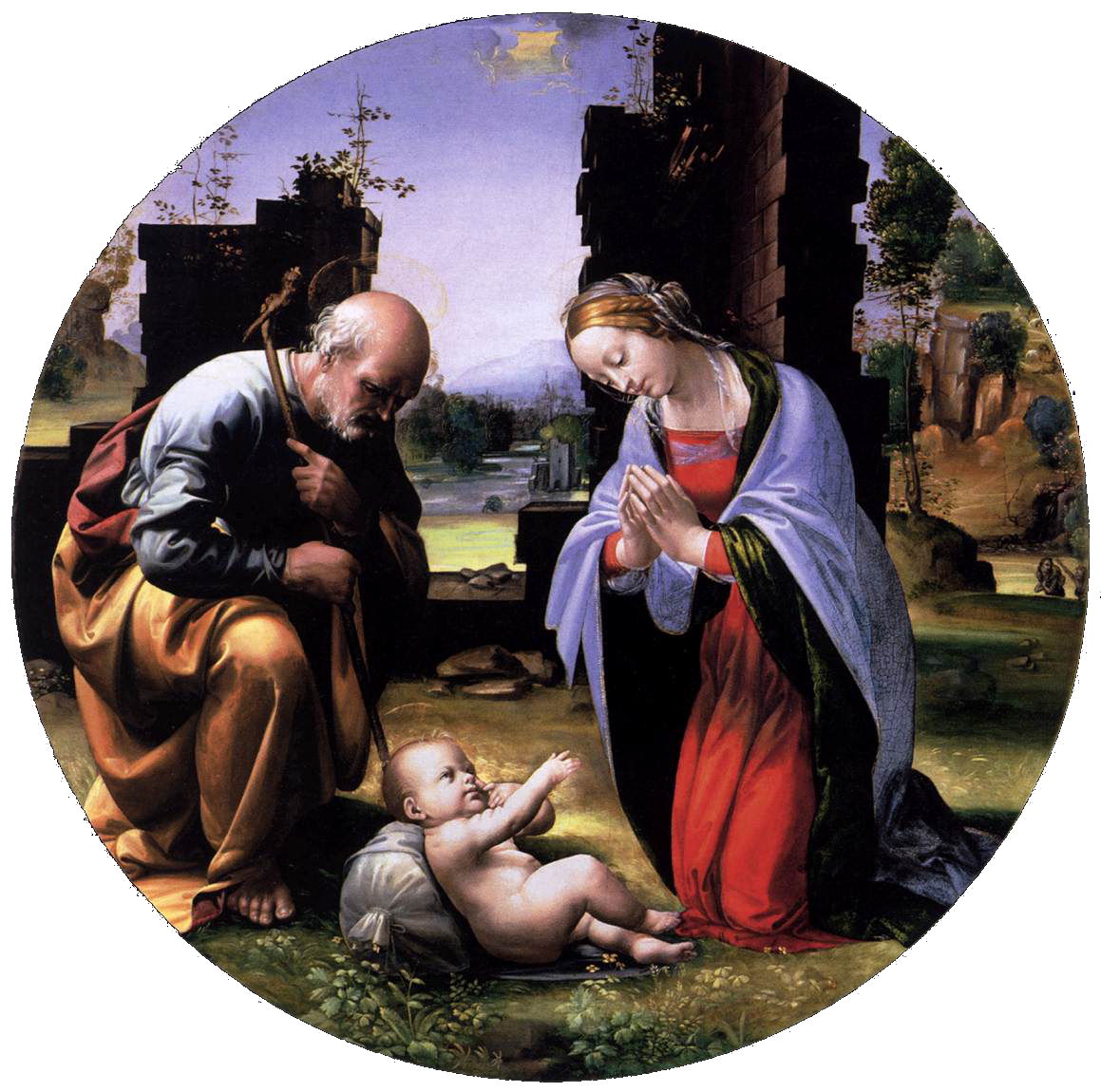
Fra Bartolomeo (1472–1517), Adoration of the Child (c 1499), oil on canvas, dimensions not known, Galleria Borghese, Rome. Wikimedia Commons.

Far Bartolomeo’s tondo of the Adoration of the Child (c 1499) is a fine painting of an enormously popular Christian scene, with Jesus’ parents paying their respects to the baby.

The softer geometry of circles and ellipses makes tondi ideally suited to portraits of the Madonna and child, and for portraits of women more generally. Their use has proved particularly successful in the paintings of Raphael.

raphaelalbamadonna
Raphael (Rafael Sanzio de Urbino) (1483–1520), The Alba Madonna (c 1510), oil on panel mounted on canvas, diameter 94.5 cm, National Gallery of Art, Washington, DC. Wikimedia Commons.

Raphael’s Alba Madonna was probably painted around 1510, and has spawned many replicas. It was commissioned by a bishop for the church of the Olivetans in Nocera dei Pagani, a town on the coastal plain of the south-west of Italy, in the province of Salerno. Its landscape background is also notable.

raphaelmadonnaseggiola
Raphael (Rafael Sanzio de Urbino) (1483–1520), Madonna della Sedia (Seated Madonna with the Child on her Lap and the Young Saint John) (1513-14), oil on panel, diameter 71 cm, Palazzo Pitti, Florence, Italy. Wikimedia Commons.

Of all Raphael’s tondo Madonnas, it’s his Madonna della Sedia (Madonna of the Chair) from 1513-14 which is my favourite. It shows a thoroughly real and natural mother with two infants, every surface texture rendered as in life, in a close-cropped composition matched to its shape.

Tondi have also proved ideal for self-portraits.

anguissolaselfportraittondo
Sofonisba Anguissola (1530–1625), Self-portrait (date not known), oil on panel, diameter 13.2 cm, Private collection. Wikimedia Commons.

This small undated Self-portrait shows Sofonisba Anguissola, the first great female master.

poussintimetruthenvydiscord
Nicolas Poussin (1594–1665), Time Defending Truth against the Attacks of Envy and Discord (1641), oil on canvas, diam 297 cm, Musée du Louvre, Paris. Wikimedia Commons.

Although his best-known paintings were all rectangular, Nicolas Poussin’s later tondo Time Defending Truth against the Attacks of Envy and Discord (1641) puts Father Time at its centre, with a firm grip around Truth’s waist, while Envy and Discord sit below them. On this occasion Time doesn’t have a hand free for an hour-glass. This appears to have been projected for placement in a round ceiling, another good reason for his choice of format.

tiepolodiscoverytruecross
Giovanni Battista Tiepolo (1696–1770), Discovery of the True Cross and Saint Helena (c 1743), oil on canvas, 490 cm diam, Gallerie dell’Accademia, Venice. Wikimedia Commons.

Although Tiepolo’s Discovery of the True Cross and Saint Helena (c 1743) is painted on a flat tondo, it was intended for display from the ceiling of the Capuchin church in Castello, as demonstrated in its projection.

kauffmancymonIphigenia
Angelica Kauffman (1741–1807), Cymon and Iphigenia (c 1780), oil on canvas, diam 62.2 cm, Gibbes Museum of Art, Charleston, SC. Wikimedia Commons.

In about 1780, Angelica Kauffman painted this delightful tondo of Cymon and Iphigenia, a variation on a popular theme.

girodetmllelangedanae
Anne-Louis Girodet de Roussy-Trioson (1767–1824), Portrait of Mlle. Lange as Danae (1799), oil on canvas, 60.3 x 48.6 cm, Minneapolis Institute of Arts, Minneapolis, MN. Wikimedia Commons.

Girodet chose a large elliptical tondo for his ‘revenge’ portrait of Mlle Lange, who had refused his previous portrait of her. As a motif in painting, Danaë had come to be represented as a reclining, beautiful, nude woman, on whom a stream of golden coins was falling, and it was that stream Girodet wanted to exploit. It could have only one reading in this context: that Mlle Lange sold her body in return for money, and Girodet was happy to be even more explicit.

Tondi were also imitated on occasion. Ford Madox Brown’s first painting to establish his interest in more complex storytelling was The Last of England, which he started as his response to the emigration to Australia of the only Pre-Raphaelite sculptor, Thomas Woolner, in 1852.

brownlastofenglandoil
Ford Madox Brown (1821–1893), The Last of England (1852/55), oil on panel, 82.5 x 75 cm, Birmingham Museum and Art Gallery, Birmingham, England. Wikimedia Commons.

Brown’s original oil version is one of his most subtle compositions. Central to its imitation of a circular tondo is a middle-class couple who are not enjoying the fact that their migrant ship is ‘all one class’. They both stare with grim determination at the prospect of sharing the next few weeks with the rowdy working class passengers behind them, eating the same increasingly stale vegetables which are now slung from cords around the ship’s rail in front of them.

This isn’t just a couple, though: look closely at their hands, and the woman’s left hand is clutching the tiny hand of her baby, who is safely swaddled inside her weatherproof hooded travelling cape. Her right hand, wearing a black leather glove, grasps that of her husband, whose left hand is tucked under his heavy coat. Splashes of brilliant colour are supplied by the wind blowing the woman’s ribbons.

daddcontradictionoberontitania
Richard Dadd (1817–1886), Contradiction: Oberon and Titania (1854-8), oil on canvas, 61 x 75.5 cm, Private collection. Wikimedia Commons.

Richard Dadd’s Contradiction: Oberon and Titania from 1854-8 develops his early faerie paintings into a new and unique style, and was painted for the hospital’s first resident Physician-Superintendent, William Charles Hood.

Dadd takes its theme from Shakespeare’s Midsummer Night’s Dream, and there’s hardly a square millimetre of canvas into which he hasn’t squeezed yet another curious detail. Like other great imaginative painters such as Bosch before, his dense details dart about in scale: there are tiny figures next to huge leaves and butterflies, and towards the top these distortions of scale generate an exaggerated feeling of perspective, which his choice of format may have enhanced.

schwabemedusa
Carlos Schwabe (1866–1926), Medusa (1895), watercolour on paper, dimensions not known, Private collection. Wikimedia Commons.

Carlos Schwabe’s watercolour tondo portrait of Medusa from 1895 is one of the most startling paintings in the round.

All good art suppliers continue to do a steady trade in tondi.

❌