Reading view

There are new articles available, click to refresh the page.

Jerusalem Delivered: 10 Rinaldo retrieved

The ‘Saracen’ sorceress Armida had abducted the crusader knight Rinaldo to her enchanted garden on the Fortunate Isles, far to the west out in the Atlantic. A rescue team of the knights Charles and Ubaldo then sailed out in a magic ship piloted by a fair woman. After they had overcome a series of obstacles, Charles and Ubaldo found Rinaldo dressed and behaving as a woman’s dandy, and have the task of restoring his senses as a warrior knight, so they can take him back to rejoin the siege of Jerusalem.

By showing Rinaldo his own image in a highly polished shield, the knight is put to shame and realises what he has become. Ubaldo bids him rejoin the forces of Godfrey of Bouillon, and the holy war. They hasten away, leaving Armida weeping and choking with grief. She runs after them, calling him back. Rinaldo and his two companions wait for her, and the couple stare at one another in silence.

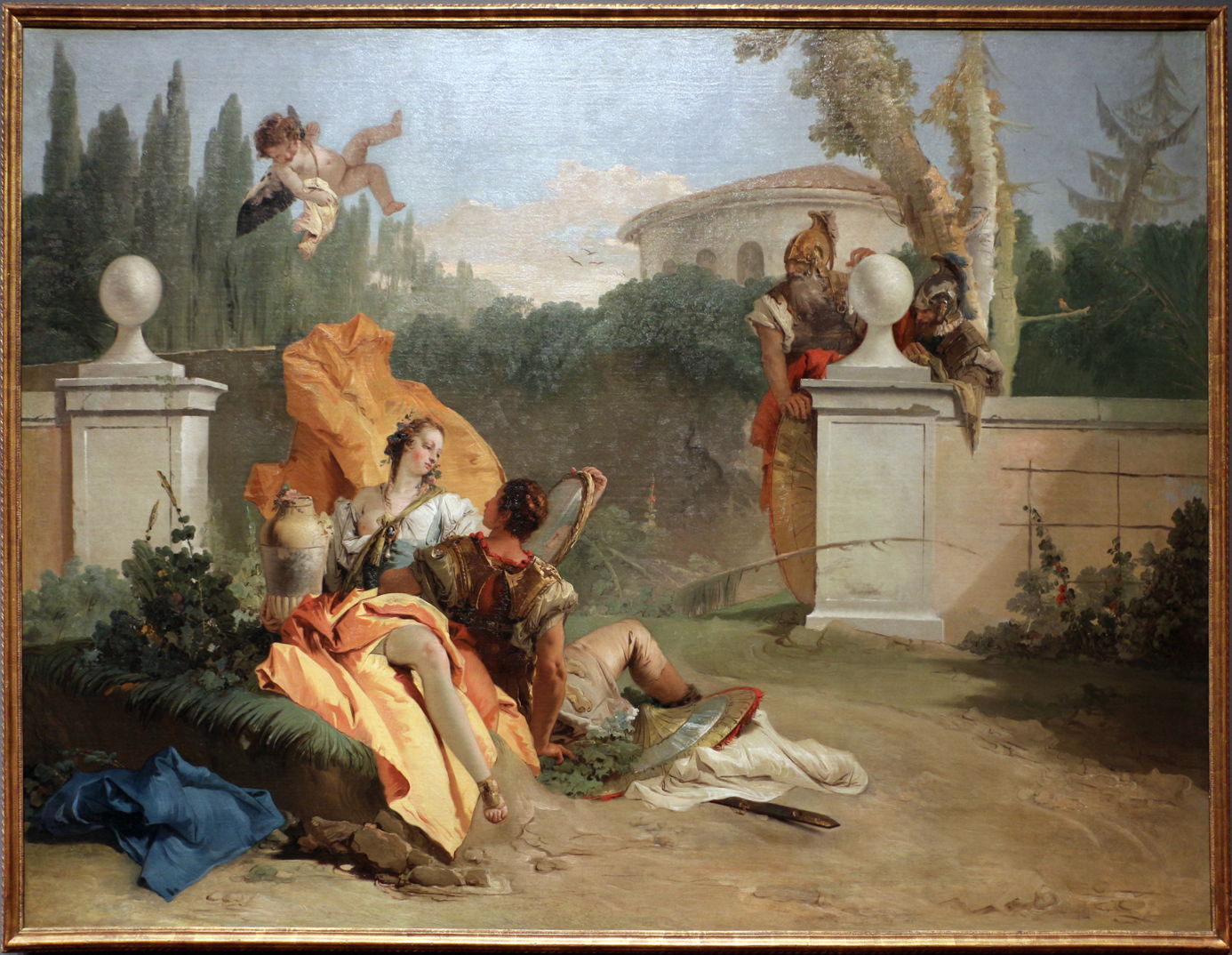
The scene of Armida and Rinaldo separating has proved another of Tasso’s great images for art. Its greatest exponents were the Tiepolos, father and son, who painted a succession of works showing this parting, in the eighteenth century. I show here four examples, each using the compositional device of collapsing Armida’s garden on one side, with the beach and ship on the other, and using that spatial and temporal merging to tell the whole sequence, from Rinaldo’s awakening to their departure by sea.
tiepoloarmidaabandonsrinaldo1745
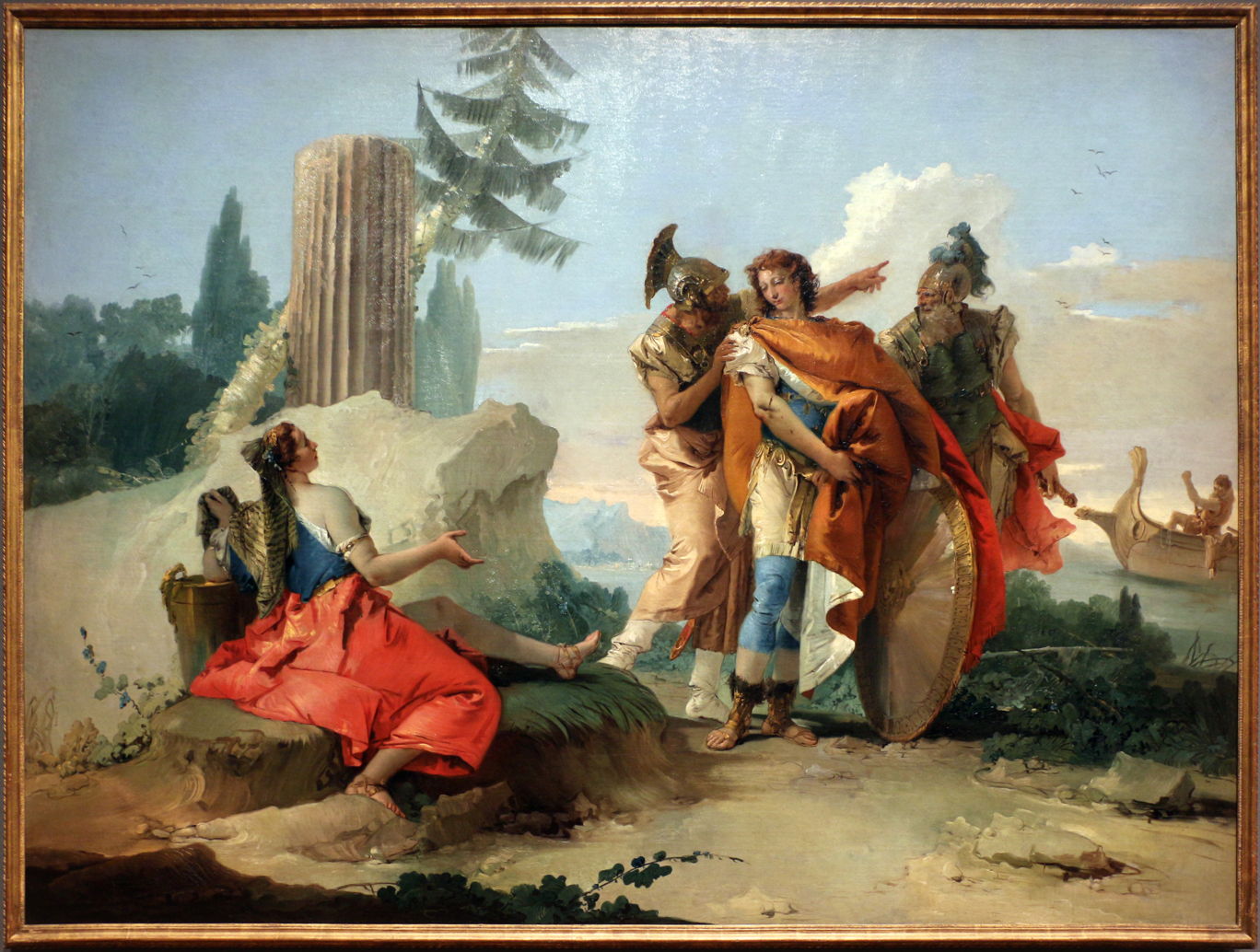
Giovanni Battista Tiepolo (1696–1770), Armida Abandoning Rinaldo (1742-45), oil on canvas, 186.7 x 259.4 cm, The Art Institute of Chicago, Chicago, IL. Image by Sailko, via Wikimedia Commons.

In this version for the Tasso Room in the palace of the Cormaro Family in Venice, painted in 1742-45, Charles and Ubaldo are stood in full armour, pointing to their ship which is waiting to take Rinaldo away. Armida lies back exposing a lot of leg, trying to persuade Rinaldo to stay with her.
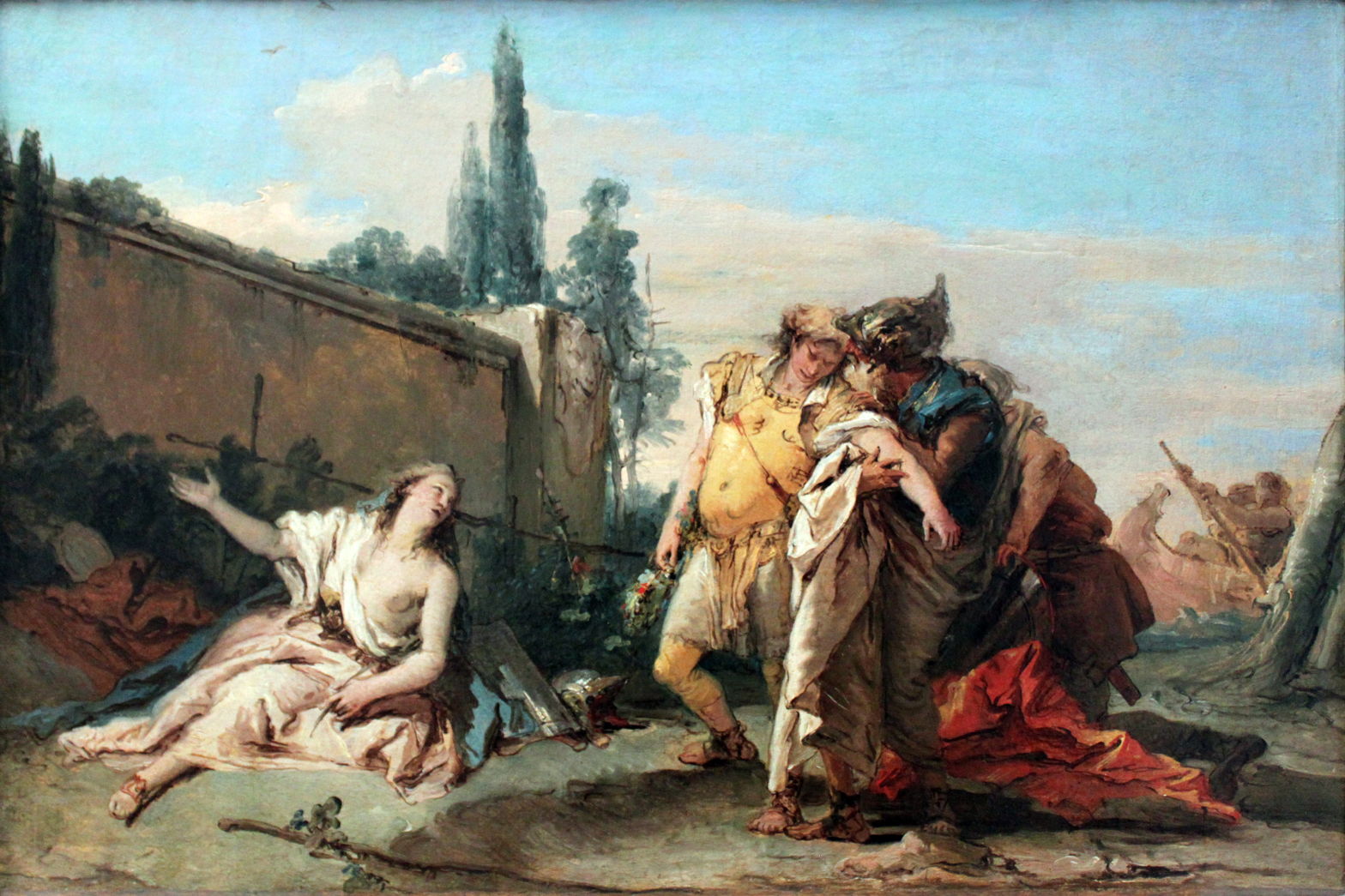
tiepolorinaldosdeparture1760
Giovanni Battista Tiepolo (1696–1770), Rinaldo’s Departure from Armida (1755-60), oil on canvas, 39 x 62 cm, Gemäldegalerie der Staatlichen Museen zu Berlin, Berlin, Germany. Image by anagoria, via Wikimedia Commons.

In Tiepolo’s Rinaldo’s Departure from Armida from 1755-60, Rinaldo is still being woken from his enchantment, and Armida bares her breast as she is trying to lure him back.

tiepolorinaldoleavinggarden1770
Giovanni Domenico Tiepolo (1727–1804), Rinaldo Leaving the Garden of Armida (c 1770), fresco, dimensions not known, Ca’ Rezzonico, Venice, Italy. Wikimedia Commons.

His son, Giovanni Domenico, squeezed the three knights in tighter, and omitted Armida from his Rinaldo Leaving the Garden of Armida in about 1770. Rinaldo’s separation from Armida is marked by the hold he has over the blindfolded Cupid in his right arm. This was painted in a fresco in Ca’ Rezzonico in Venice, Italy.
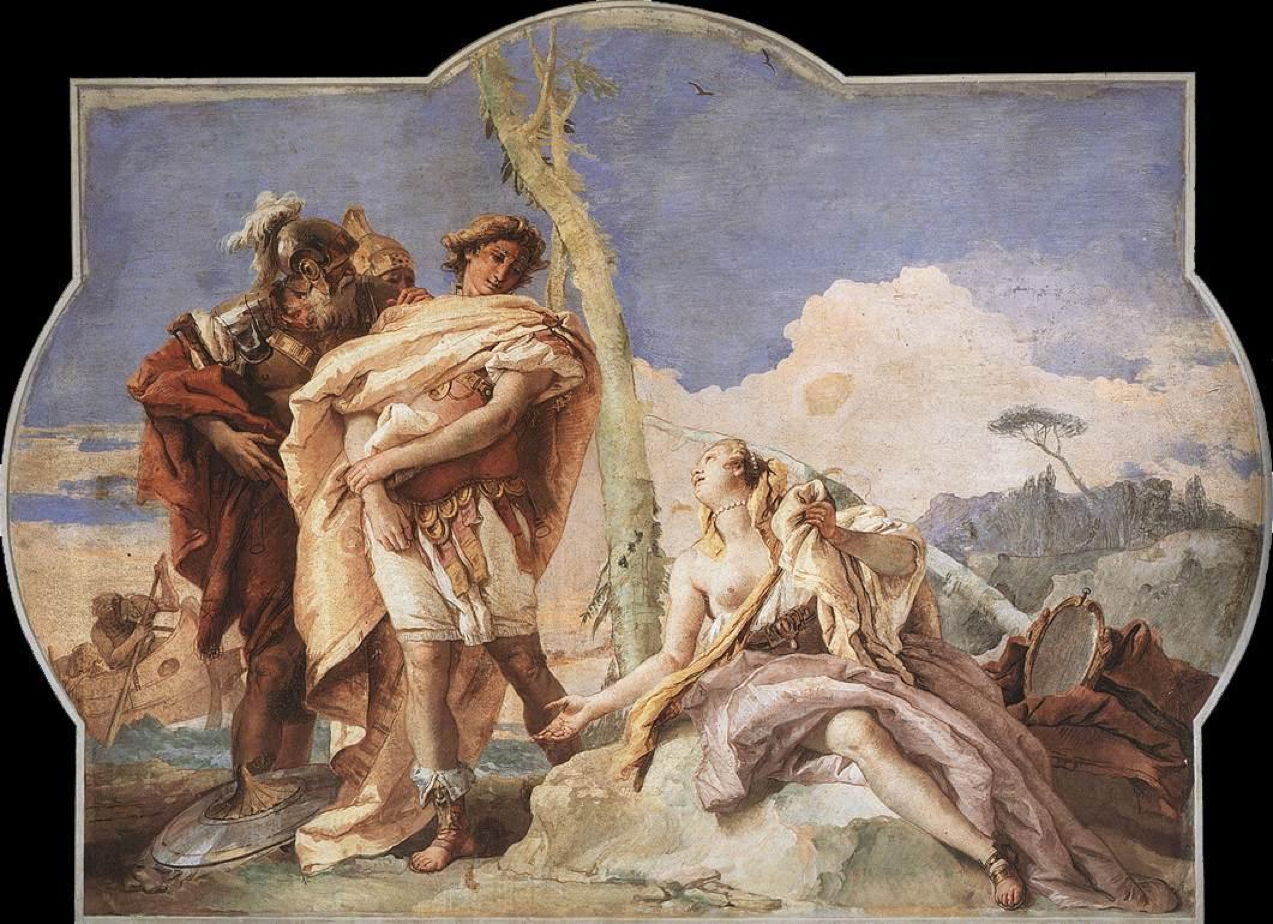
tiepolorinaldoabandoningarmida1757
Giovanni Battista Tiepolo (1696–1770), Rinaldo Abandoning Armida (1757), fresco, 220 x 310 cm, Villa Valmarana ai Nani, Vicenza, Italy. Wikimedia Commons.

The father Tiepolo had painted another variation in Rinaldo Abandoning Armida, from 1757, as a fresco in the Villa Valmarana ai Nani, in Vicenza, Italy. In this, the composition is reversed, with the ship at the left, and Armida pleading with Rinaldo at the right. This is perhaps Tiepolo’s most complete account, as it includes both Armida’s crystal mirror at the right, and the polished shield into which Rinaldo looked, at the feet of Charles and Ubaldo.

Tasso’s narrative, developed in this painting, may have a sub-text about looking and its power: for Armida looking in her crystal was a means of strengthening her allure over Rinaldo, but for him looking into the polished shield was a means of restoring his power by showing what he had become in her clutches.
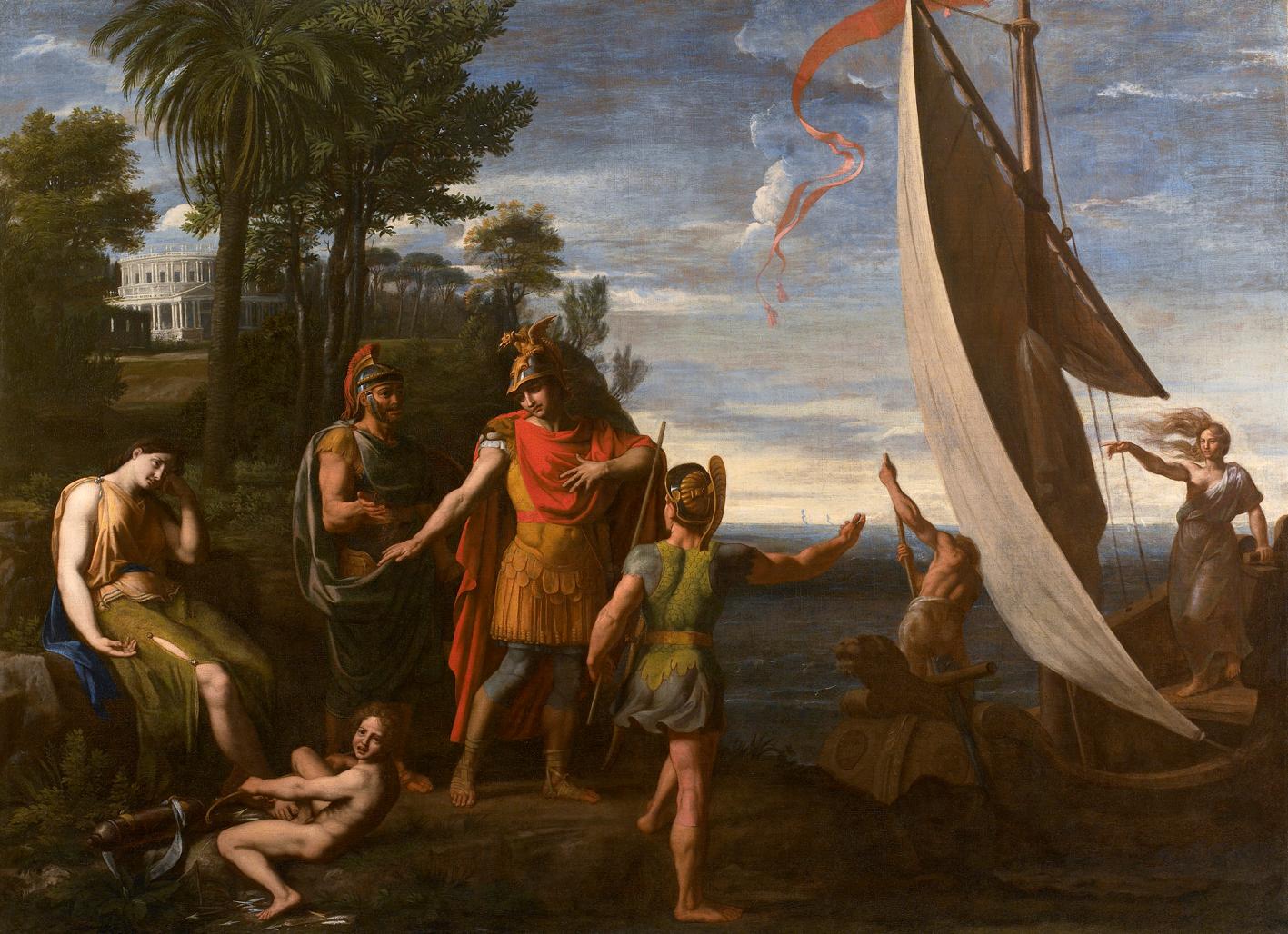
colombelbinaldoabandoningarmida
Nicolas Colombel (1644-1717), Rinaldo Abandoning Armida (date not known), oil on canvas, 118.1 x 170.2 cm, Private collection. Wikimedia Commons.

The Tiepolos were by no means the first to merge Armida’s garden with the sea and ship. Nicolas Colombel’s undated painting from the late 1600s showing Rinaldo Abandoning Armida has done much the same.

Armida then launches into a speech, asking Rinaldo to let her follow him back, and offering to be his shield. His love has been replaced by compassion for her, and he asks her to remain there in peace. The three knights then sail away on the magic ship, leaving Armida behind on the beach. Her grief now changes to anger at her loss, so she casts evil spells and conjures up her chariot. On that she departs for the battlefield in vengeance.
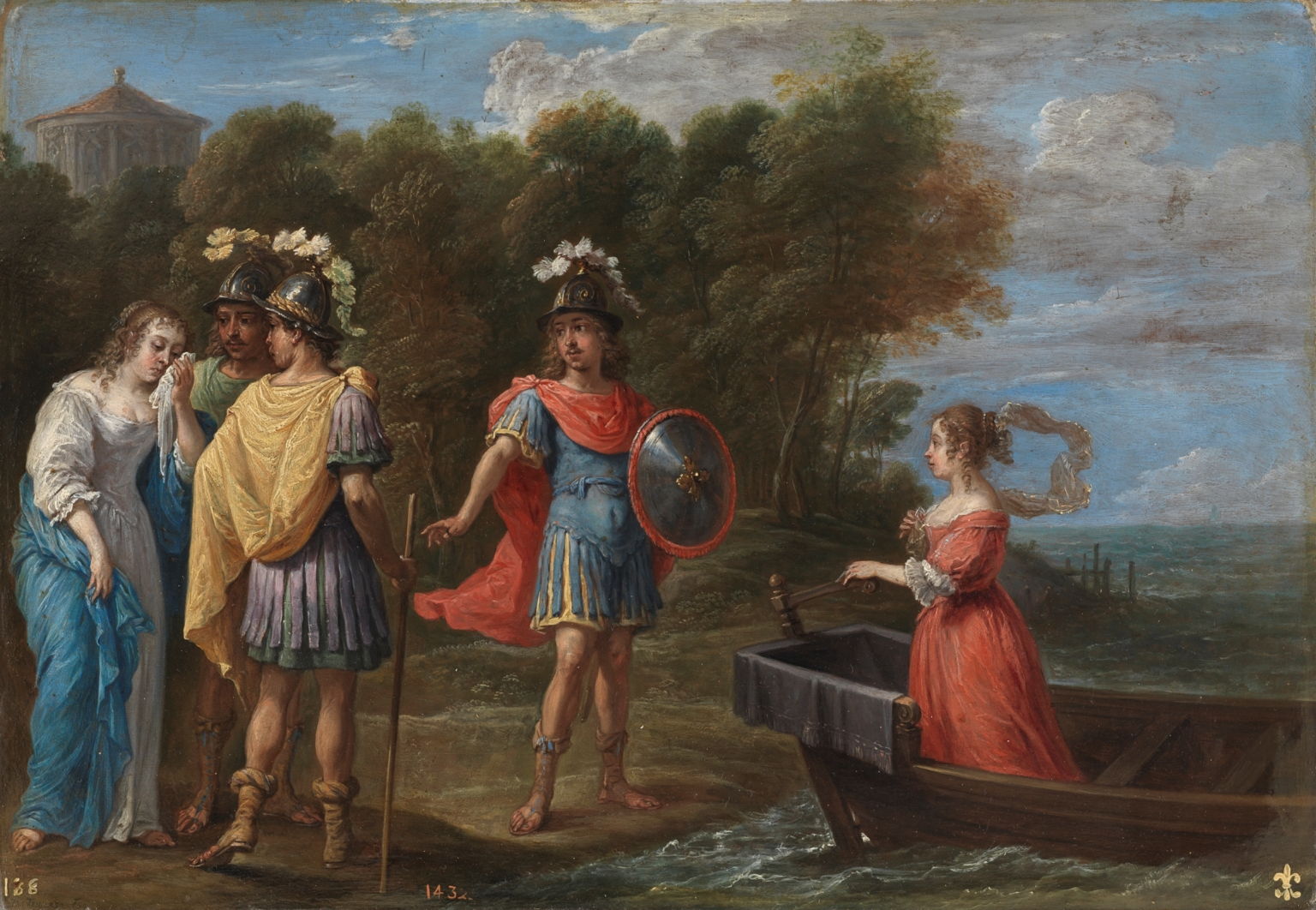
teniersarmidarinaldoseparated
David Teniers the Younger (1610–1690), Armida and Rinaldo Separated (1628-30), oil on copper, 27 x 39 cm, Museo Nacional del Prado, Madrid, Spain. Wikimedia Commons.

David Teniers the Younger shows this section of the story in two of his small paintings on copper: in his Armida and Rinaldo Separated of 1628-30, Armida is weeping and being comforted by Charles and Ubaldo, as the woman pilot of their ship waits for them to board by its stern.
teniersrinaldoflees
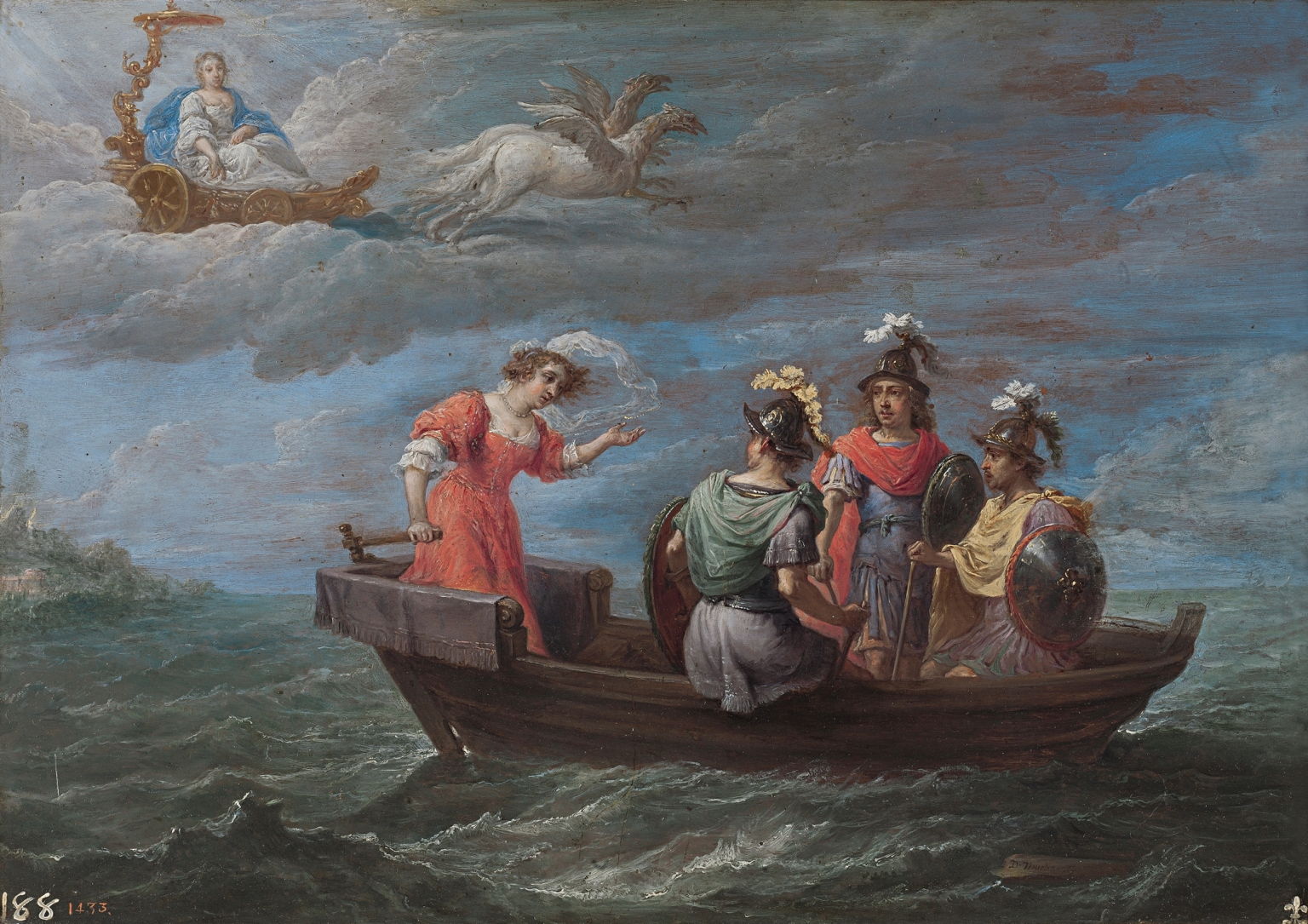
David Teniers the Younger (1610–1690), Rinaldo Flees from the Fortunate Isles (1628-30), oil on copper, 27 x 39 cm, Museo Nacional del Prado, Madrid, Spain. Wikimedia Commons.

Teniers’ sequel, Rinaldo Flees from the Fortunate Isles, shows the group returning to war, with Armida still looking disconsolate in her chariot above them.

Canto seventeen opens in Gaza, between Egypt and Jerusalem, where the King of Egypt is mustering his army ready to advance towards Godfrey’s forces. He sits on his throne to review his forces, which Tasso lists in procession much as he had done when the crusaders were setting out for Jerusalem at the start of the epic. These start with Egyptians, and progress through those from the coast of Asia, citizens of Cairo, those from the land to the south, men of Barca, those from the coast of Arabia, from the Persian Gulf, and the Indies. At the end, Armida appears riding in her chariot with her own forces who had been mustered in Syria by Hydrotes, together with Circassians and more.

The king then retires to a banquet, where Armida offers her forces in support of the king, and tells of her desire for vengeance against Rinaldo. Adrastus, a ‘Saracen’ leader of Indian troops, offers to rip Rinaldo’s heart out, and make a present of his head to Armida.

References

Wikipedia on Jerusalem Delivered.
Wikipedia on Torquato Tasso.

Project Gutenberg (free) English translation (Fairfax 1600).

Librivox audiobook of the Fairfax (1600) English translation (free).

Thomas Asbridge (2004) The First Crusade, A New History, Free Press, ISBN 978 0 7432 2084 2.
Anthony M Esolen, translator (2000) Torquato Tasso, Jerusalem Delivered, Gerusalemme Liberata, Johns Hopkins UP. ISBN 978 0 801 863233. A superb modern translation into English verse.
John France (1994) Victory in the East, a Military History of the First Crusade, Cambridge UP. ISBN 978 0 521 589871.
Joanthan Riley-Smith, ed (1995) The Oxford Illustrated History of the Crusades, Oxford UP. ISBN 978 0 192 854285.
Jonathan Riley-Smith (2014) The Crusades, A History, 3rd edn., Bloomsbury. ISBN 978 1 4725 1351 9.
Johathan Unglaub (2006) Poussin and the Poetics of Painting, Pictorial Narrative and the Legacy of Tasso, Cambridge UP. ISBN 978 0 521 833677.

Jerusalem Delivered: 9 Armida’s Garden

The crusaders led by Godfrey of Bouillon desperately need Rinaldo back if they are to resume their assault on Jerusalem. Guelph’s party, notably the knights Charles (Carlo) and Ubaldo, have gone in search of him. But Rinaldo has been lured into a trap by the sorceress Armida, who intended to kill him. At the last moment, though, she falls in love with him and abducts him in her chariot.

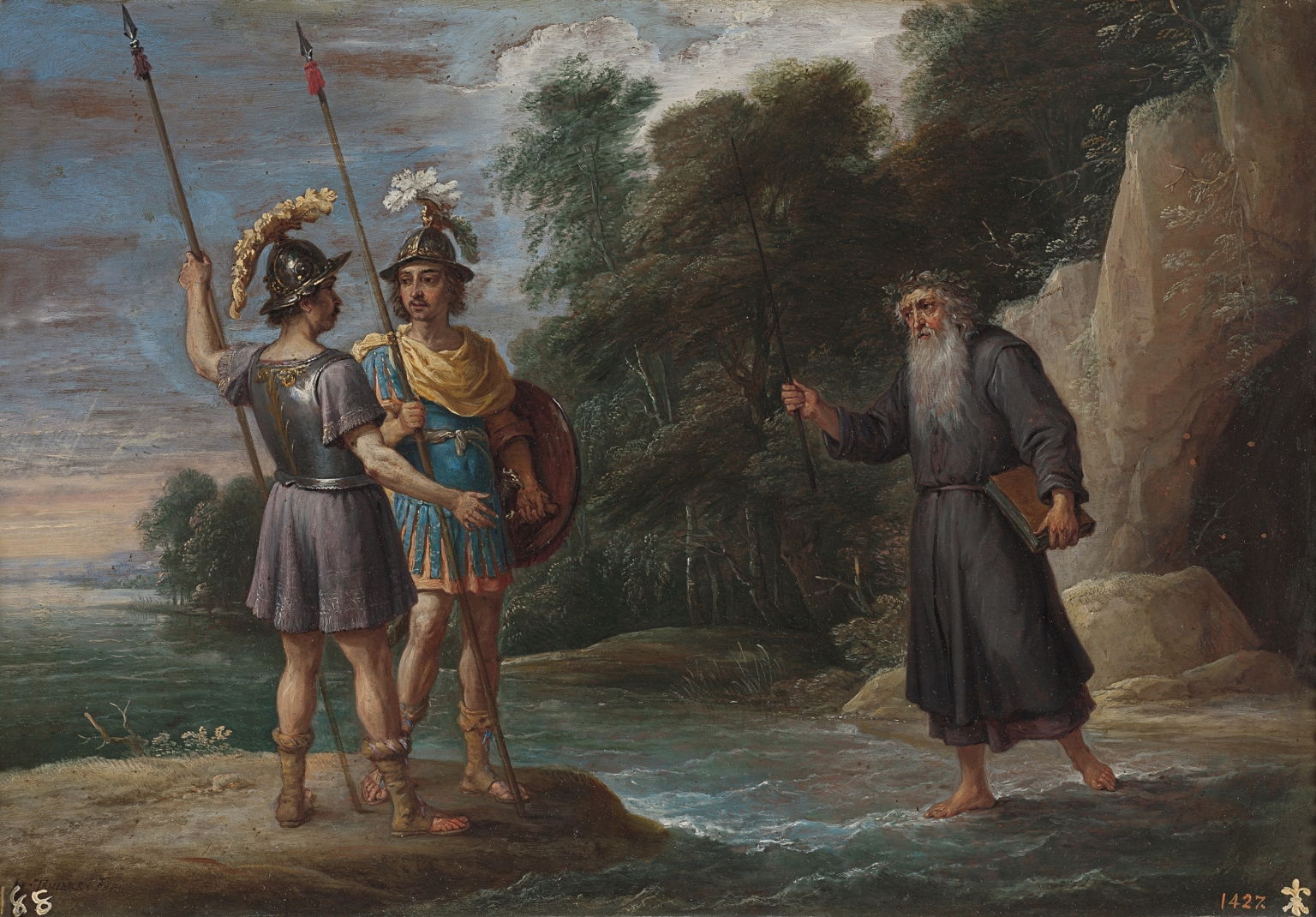
That flies the couple to the distant, deserted and enchanted Fortunate Isles, where she lives in her garden that is perpetually in Spring. The wizard explains this to Charles and Ubaldo, to aid them in their mission to rescue the knight.

teniersmagiciandiscoverscarlosubaldo
David Teniers the Younger (1610–1690), The Magician Shows Carlos and Ubaldo the Whereabouts of Rinaldo (The search for Rinaldo) (1628-30), oil on copper, 27 x 39 cm , Museo Nacional del Prado, Madrid, Spain. Wikimedia Commons.

David Teniers the Younger’s The Magician Shows Carlos and Ubaldo the Whereabouts of Rinaldo (The search for Rinaldo) from 1628-30 is a small oil on copper painting in his series telling this section of Tasso’s epic. Here the wizard despatches the two knights to the Fortunate Isles.

At the start of canto fifteen, Charles and Ubaldo set off to retrace their steps with the wizard as their guide. The river takes them gently down to the sea, where a ship awaits. They board, and sail at miraculous speed past Ascalon and the mouths of the River Nile, westward through the Mediterranean, and through the Pillars of Hercules into the Atlantic Ocean. They eventually approach the Fortunate Isles, pull into a harbour, and the two knights disembark.

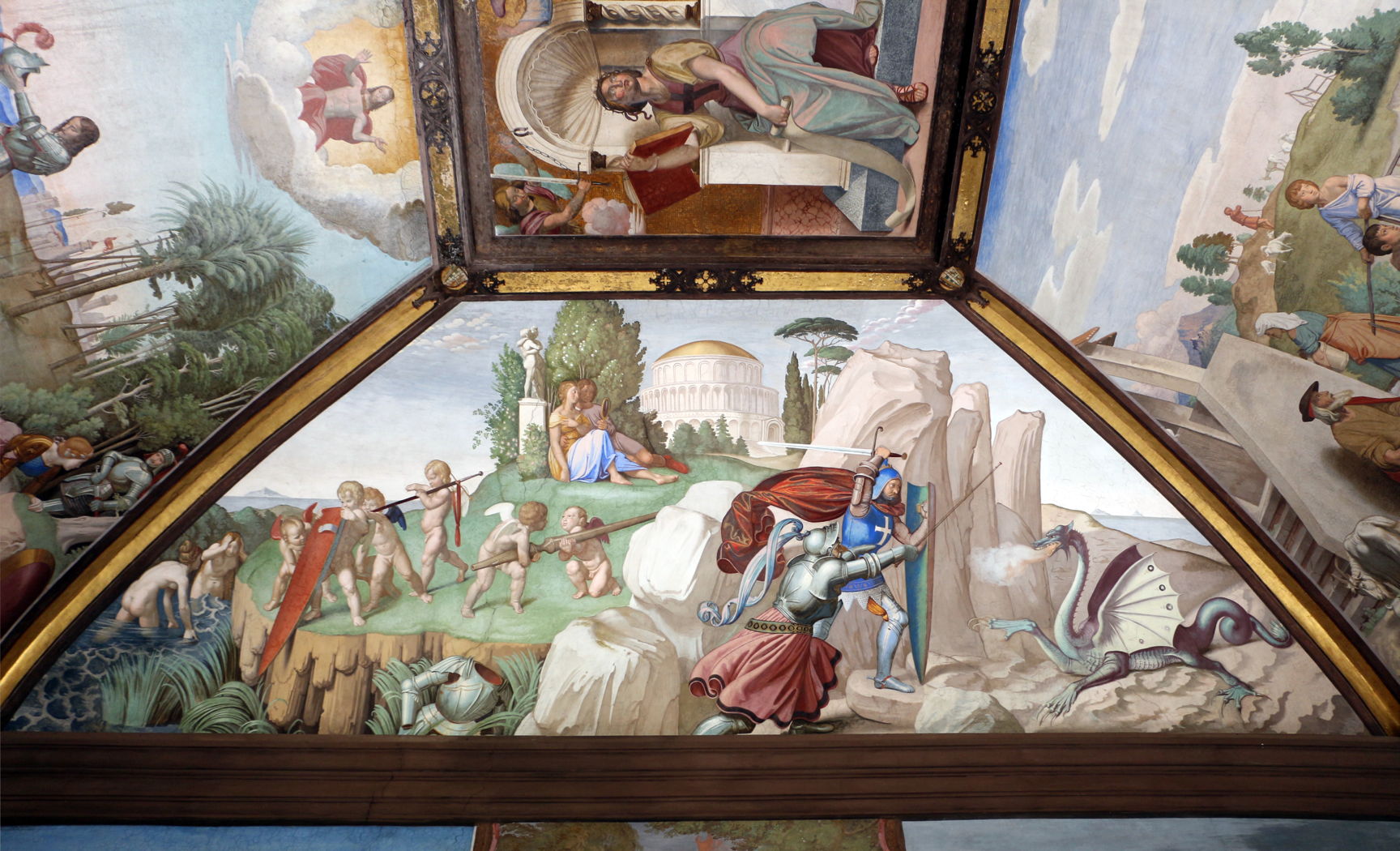
They spend the night at the foot of the mountain they have to climb to reach Armida’s garden with the captive Rinaldo. They set off at dawn, only to encounter their first obstacle: a fearsome dragon blocking their passage up the mountain. Charles draws his sword ready to slay the dragon, but Ubaldo waves a golden wand, a gift of the wizard, which drives it away.

poussincompanionsrinaldo
Nicolas Poussin (1594–1665), The Companions of Rinaldo (c 1633-4), oil on canvas, 119 x 101 cm, The Metropolitan Museum of Art, New York, NY. Wikimedia Commons.

Poussin’s The Companions of Rinaldo (c 1633-4) shows the two knights confronting this dragon. Charles stands in the centre with his sword ready, but Ubaldo behind him leaves his weapon in its scabbard and brandishes his golden wand instead. In the background at the left is the magic ship in which they sailed, and standing in its prow is the maiden who steered it.

overbeckubaldocarloliberaterinaldo
Johann Friedrich Overbeck (1789-1869), Ubaldo and Carlo free Rinaldo from Armida’s Castle (1819-27), fresco, dimensions not known, Casa Massimo, Rome, Italy. Image by Sailko, via Wikimedia Commons.

Johann Friedrich Overbeck’s fresco of Ubaldo and Carlo free Rinaldo from Armida’s Castle from 1819-27, in the Casa Massimo, Rome, shows an interesting composite scene. To the right of centre, Charles and Ubaldo wield their sword and wand, and in the distance are Armida and Rinaldo in the garden on the summit. Amorini are playing with Rinaldo’s weapons, and his empty suit of armour has been cast into the undergrowth.

Next the pair have to face a lion, which is similarly dismissed with a wave of the wand. After that comes an army of animals they disperse readily, and Charles and Ubaldo are on the ascent towards the stretch of snow and ice they must cross before reaching Armida’s eternal Spring. Once up at the top, the two knights pause from their strenuous climb, slaking their thirst in a mountain stream. Grassy banks either side of the stream have a fine banquet laid out on them, and there are two naked young women cavorting in the water.

tenierscarlosubaldoislands
David Teniers the Younger (1610–1690), Carlos and Ubaldo in The Fortunate Isles (1628-30), oil on copper, 27 x 39 cm, Museo Nacional del Prado, Madrid, Spain. Wikimedia Commons.

David Teniers the Younger’s Carlos and Ubaldo in The Fortunate Isles (1628-30) shows this moment, with the banquet laid out on a clean white tablecloth rather than grass. Surrounded by trees and standing proud on the skyline is Armida’s palace, their destination.

delafossedanishwarriors
Charles-Alexandre Coëssin de la Fosse (1829–1910), Danish Warriors in the Garden of Armida (1848), others detail unknown, but believed to be oil on canvas and the original in colour. By Salon 1913, via Wikimedia Commons.

I only have this monochrome image of Charles-Alexandre Coëssin de la Fosse’s painting of Danish Warriors in the Garden of Armida from 1848. The two knights are dallying rather longer than their mission had intended.

Once Charles and Ubaldo can tear themselves away from these nymphs, they press on to the circular outer wall of the palace, which opens the sixteenth canto as they enter Armida’s garden.

mullergardenofarmida
Édouard Muller (1823-1876), The Garden of Armida (1854), block-printed wallpaper, 386.1 x 335.3 cm, Philadelphia Museum of Art, Philadelphia, PA. Wikimedia Commons.

In the eighteenth and nineteenth centuries, Armida’s garden appeared on all manner of products. This wallpaper designed by Édouard Muller in 1854 is now in the Philadelphia Museum of Art, while smaller images appeared on coffee cups and much else.

Tasso gives a brief description of the garden with its figs, apples and grape vines. Birds sing, and the wind murmurs softly. One bird speaks to the two knights, telling of the chaste and modest rose flower that springs virgin from its green leaves.

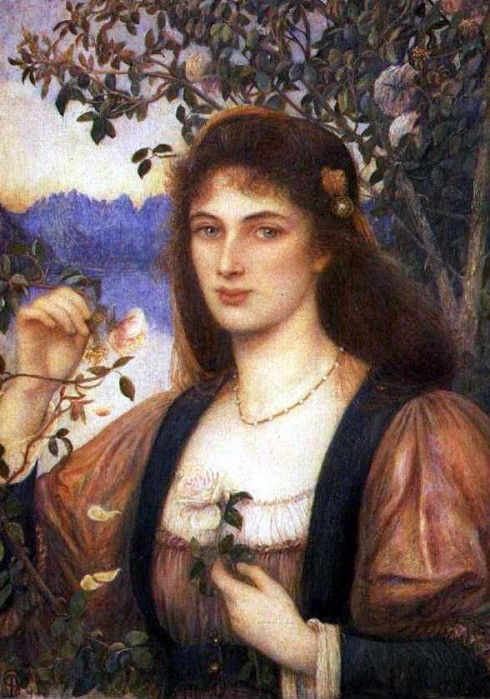
stillmanrosefromarmidasgarden
Marie Spartali Stillman (1844–1927), A Rose in Armida’s Garden (1894), watercolour and graphite on paper, 64.8 x 43.2 cm, Private collection. Wikimedia Commons.

This passage about the rose was the inspiration for Marie Spartali Stillman’s exquisite watercolour of A Rose in Armida’s Garden from 1894, given by the artist as a wedding gift to a family friend.

Charles and Ubaldo then peer through the leaves and spot a loving couple, who they presume to be Rinaldo and Armida. The knight’s head rests in Armida’s lap. He then stands up and takes a crystal glass hanging at his side. Armida uses this as a mirror to adjust her hair, telling Rinaldo to keep looking into her eyes.

tiepolorinaldoarmidagarden
Giovanni Battista Tiepolo (1696–1770), Rinaldo and Armida in Her Garden (1742-45), oil on canvas, 187 x 260 cm, The Art Institute of Chicago, Chicago, IL. Image by Sailko, via Wikimedia Commons.

Tiepolo paints this clearly in his Rinaldo and Armida in Her Garden from 1742-45, now in The Art Institute of Chicago. It was originally hung in a special room dedicated to Tasso’s epic in the Palazzo Corner a San Polo in Venice, where it belonged to the noble Serbelloni family.

kauffmannrinarm
Angelica Kauffman (1741–1807), Rinaldo and Armida (1771), oil on canvas, 130.8 x 153 cm, Yale Center for British Art, New Haven, CT. Wikimedia Commons.

In Angelica Kauffman’s Rinaldo and Armida from 1771, the crystal glass is ready at Armida’s feet, and she is busy distracting him by sprinkling flowers over his head.

hayezrinaldoarmida
Francesco Hayez (1791–1881), Rinaldo and Armida (1812-13), oil on canvas, dimensions not known, Gallerie dell’Accademia, Venice, Italy. Wikimedia Commons.

Francesco Hayez shows a variation in his Rinaldo and Armida from 1812-13. Anticipating the next part of Tasso’s narrative, instead of Rinaldo wearing the crystal glass at his side, his circular shield rests on the ground next to Armida. Charles and Ubaldo are shown peering from behind a tree trunk, safely in the distance.

Armida then kisses Rinaldo goodbye and leaves. Charles and Ubaldo see their opportunity and step out from the bushes, dressed in full armour. Ubaldo holds a highly polished shield up so that Rinaldo can see himself for what he has become, a woman’s dandy, not a warrior knight.

References

Wikipedia on Jerusalem Delivered.
Wikipedia on Torquato Tasso.

Project Gutenberg (free) English translation (Fairfax 1600).

Librivox audiobook of the Fairfax (1600) English translation (free).

Thomas Asbridge (2004) The First Crusade, A New History, Free Press, ISBN 978 0 7432 2084 2.
Anthony M Esolen, translator (2000) Torquato Tasso, Jerusalem Delivered, Gerusalemme Liberata, Johns Hopkins UP. ISBN 978 0 801 863233. A superb modern translation into English verse.
John France (1994) Victory in the East, a Military History of the First Crusade, Cambridge UP. ISBN 978 0 521 589871.
Joanthan Riley-Smith, ed (1995) The Oxford Illustrated History of the Crusades, Oxford UP. ISBN 978 0 192 854285.
Jonathan Riley-Smith (2014) The Crusades, A History, 3rd edn., Bloomsbury. ISBN 978 1 4725 1351 9.
Johathan Unglaub (2006) Poussin and the Poetics of Painting, Pictorial Narrative and the Legacy of Tasso, Cambridge UP. ISBN 978 0 521 833677.

Jerusalem Delivered: 5 First skirmish and a sorceress

Those able-bodied Christians who were banished from the city of Jerusalem, together with Sophronia and Olindo, are gathering at the nearby town of Emmaus, where the crusaders have just arrived on their way to lay siege to the city.

As the crusaders are camping there at dusk, two ambassadors arrive from the king of Egypt: Alete, and Argante the Circassian. They are taken to meet Godfrey, and Tasso devotes the remainder of the second canto to their discussions. Alete courteously and diplomatically invites Godfrey to call a halt to the crusade before he attacks Jerusalem. He warns that continuing on his current course could bring the king of Egypt against him, and when united with Persian and Turkish forces, he would be heavily outnumbered. In return for stopping short of Jerusalem, Alete offers a truce and free passage to safety.

Godfrey politely rejects the offer, stressing how it is God’s hand that directs the crusaders. Argante is brief and blunt, and tells Godfrey that his rejection means war. When they leave, Alete returns to Egypt, and Argante to Jerusalem. That night, Godfrey and his army cannot sleep.

The third canto opens at dawn on the following day, as the crusaders march onward, and get their first sight of Jerusalem the Holy City. Within its walls, a sentinel sees the approaching army, first from the cloud of dust it throws up as it draws closer. He calls the citizens to defend their city; the old, young, and those unable to help in the defence go and shelter in its mosques.

Jerusalem’s ruler Aladine does his rounds of the defences, and calls for the company of Erminia, daughter of the dead former king of Antioch, who managed to flee to safety in Jerusalem when her father’s city fell to the crusaders.

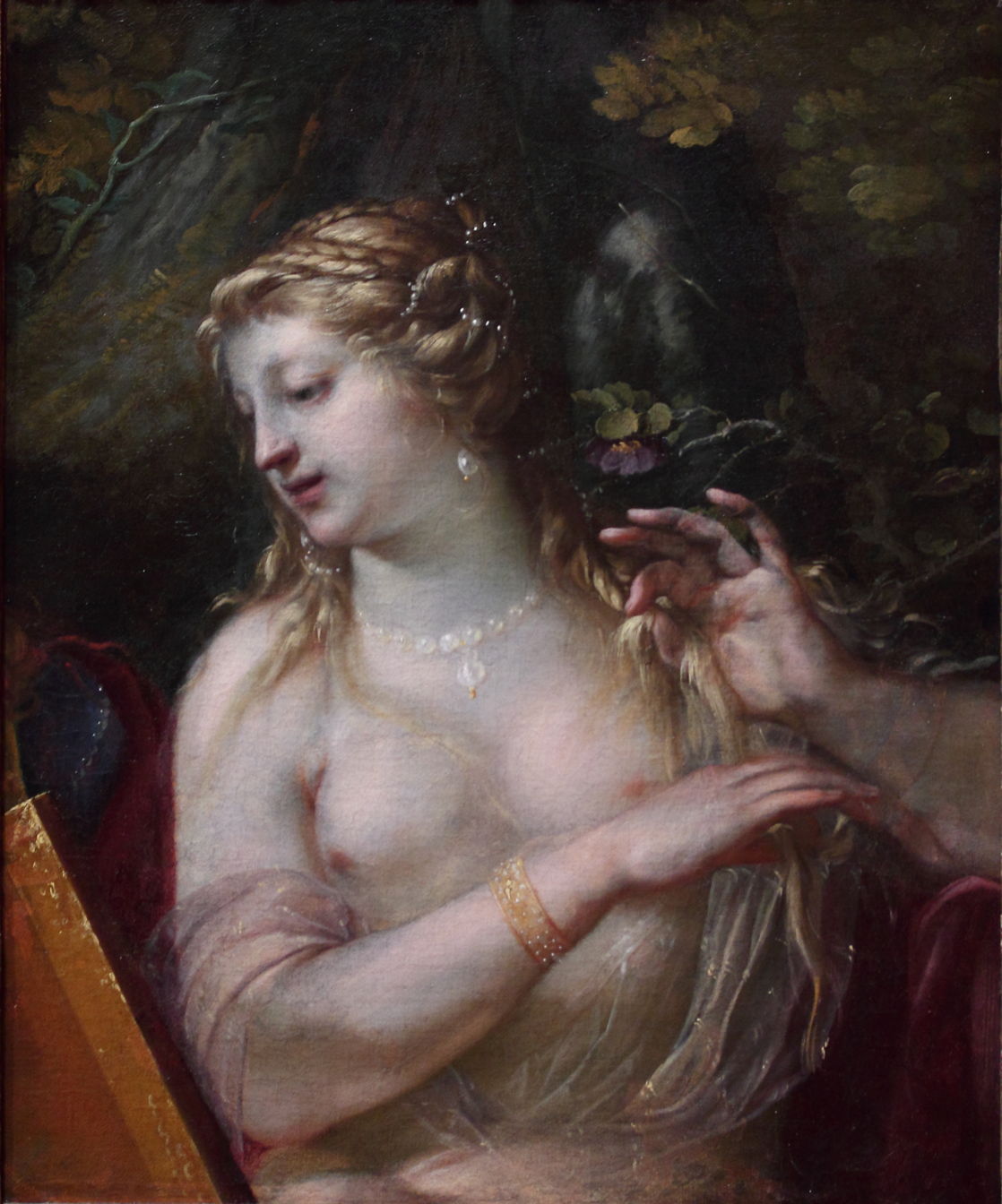
pretierminia
Mattia Preti (1613–1699), Erminia, Princess of Antioch (date not known), oil on canvas, 98 x 73 cm, location not known. Wikimedia Commons.

Mattia Preti’s Erminia, Princess of Antioch, painted in the middle of the seventeenth century, shows her exuding nobility, with shoulder-length hair. She is reading an unintelligible inscription on a tree.

Clorinda leads the city’s troops out to attack the French crusaders, with Argante the Circassian holding himself in reserve in a secret gate in the city’s wall. She heads an attack on an advance party of crusaders who have been sent on to scavenge for livestock and crops to feed the army.

The captain of the city’s defenders is quickly knocked to the ground, but Clorinda weighs in and forces the French into retreat. They regroup on a hill, just as Godfrey sends Tancred and his troops to support them. Aladine is watching this with Erminia alongside him, and asks her to identify Prince Tancred from her experience at Antioch. Erminia cannot reply, as she chokes back tears, but finally tells Aladine of her desire to make him captive for her “sweet revenge”.

On the battlefield in front of them, Clorinda and Tancred charge at one another. Their lances strike the other’s visor and shatter, but Tancred’s blow knocks Clorinda’s helmet off, unfurling her long, golden hair. Tancred is thunderstruck by this revelation.

She charges at him a second time, but he turns away and attacks others with his sword. She chases after him, brandishing her sword and calling for him to turn and fight her. He refuses to respond to the blows from her sword, but calls on her to settle the matter away from the main battle. He then asks her to agree the terms on which she will fight. He proposes that she should remove his heart, drops his weapon, and bares his chest to her.

finogliajerusalem
Paolo Domenico Finoglia (1590–1645), Tancred Faces Clorinda (1640-45), media and dimensions not known, Palazzo Acquaviva, Conversano, Italy. Wikimedia Commons.

Paolo Domenico Finoglia’s painting of Tancred Faces Clorinda from 1640-45 shows this tense moment, when Tancred, his sword held low and away from Clorinda (who surprisingly has dark brown hair), makes clear his love for her. The battle rages on behind them.

Elsewhere, the crusaders are getting the better of Jerusalem’s forces, and the latter are starting to retreat to the city. One of the crusaders prepares to strike Clorinda from behind with his sword, but Tancred parries it away. It still strikes her neck a glancing blow, and blood from a small wound starts to colour her blonde hair. Clorinda seizes the opportunity to run back to her troops and join their retreat.

As the city troops reach the walls, they stop and wheel round to attack the rear of their pursuers. At the same time, Argante sends a small team out to attack their front. Argante leads them, and he and Clorinda start to gain victims from among overreaching crusaders. These are from Dudon’s ‘Adventurers’, with Rinaldo in the lead. Erminia tells Aladine about Rinaldo’s great skills in battle, and then points out their leader Dudon, and Gernando, brother of the king of Norway, and a married couple, Edward and Gildippe, who always fight side by side.

overbeckarganterinaldoclorinda
Johann Friedrich Overbeck (1789-1869), Argante, Rinaldo and Clorinda in Battle (1819-27), fresco, dimensions not known, Casa Massimo, Rome, Italy. Image by Sailko, via Wikimedia Commons.

Johann Friedrich Overbeck’s fresco of Argante, Rinaldo and Clorinda in Battle (1819-27), in the Casa Massimo in Rome, may show another scene from this battle, although here it would make more sense if the unhelmeted Clorinda were with Tancred rather than Rinaldo. Another puzzle is the white smock bearing the red cross of a crusader, being worn by Clorinda.

Rinaldo and Tancred now break through, and Rinaldo strikes Argante so hard he can barely get up again. Rinaldo’s horse is then struck, and he’s forced to pause while he extracts his foot from underneath it. The remaining city troops make the safety of the walls, leaving Argante and Clorinda to guard their rear. Dudon presses on, killing four of Argante’s men and threatening Argante himself, who manages to sink the blade of his sword deep into Dudon’s body.

Argante doesn’t hang around, but gets back to the wall, as the citizens start hurling rocks and loosing arrows at the crusaders. Rinaldo, free at last from his horse, is fired by the death of Dudon, and charges at the city troops despite the hail of rocks and arrows. He and the other crusaders pull up short, and they too turn away from the fight, recovering the body of Dudon on the way.

Godfrey has taken the opportunity to study the city and its defences, and notes that its approach is difficult on three of its four sides, but easiest from the north, where it’s most strongly fortified.

As he is weighing up where best to pitch camp, Erminia points him out to Aladine, who recognises him from a meeting when he was an Egyptian diplomat to the court of France. Also identified, standing next to Godfrey, is his brother Baldwin, and on his other side Raymond, William son of the king of England, and Guelph, but Bohemond (who killed Erminia’s family) is nowhere to be seen.

Godfrey decides that, as he has insufficient troops to encircle the city, he will station them at all its points of entry, and that they will dig in using ditches to prevent surprise attacks. He then goes off to join those mourning the death of Dudon in the dark night.

Overnight, Godfrey makes further plans. Recognising the strength of the city’s walls, he tries to work out where he can acquire timber to build siege towers. At first light, he joins Dudon’s funeral. After that, he has a Syrian take him to the only woods in the area, where he sets men to work felling those trees in preparation. That ends the third canto.

The fourth canto opens with a long and florid account of pagan visions of the underworld conjured up in Aladine’s mind, and an accompanying speech by Satan to inspire the “pagans” of Jerusalem to defeat the crusaders. This leads to the introduction of Hydrotes, a “magician” who rules Damascus and its neighbouring cities, whose niece is the beautiful sorceress Armida.

blanchardarmide
Jacques Blanchard (1600–1638), Armida (date not known), oil on canvas, dimensions not known, Musée de Beaux-Art de Rennes, Rennes, France. Image by Caroline Léna Becker, via Wikimedia Commons.

Jacques Blanchard’s undated portrait of Armida, probably from around 1630, shows her dangerously alluring like Circe.

Hydrotes sees Armida as central to his grand plan to defeat the crusaders, and directs her to the enemy camp, to win the warriors over, and make Godfrey infatuated with her. Armida rises to the challenge, and travels through the night to enter the crusaders’ camp. She quickly beguiles the men there, and can twist them around her little finger.

Armida spins the crusaders a story of how she has fallen on bad times, and calls on Godfrey to shelter her. She bumps into his brother, and in no time is speaking with Godfrey himself.

teniersarmidabeforegodfrey
David Teniers the Younger (1610–1690), Armida before Godfrey of Bouillon (1628-30), oil on copper, 27 x 39 cm, Museo Nacional del Prado, Madrid, Spain. Wikimedia Commons.

David Teniers the Younger shows this scene in this wonderful painting in oil on copper of Armida before Godfrey of Bouillon, from 1628-30. The sorceress is seen with a small lapdog and a couple of young maids, as might befit a contemporary woman of her standing. Next to the young Godfrey is Peter the Hermit, with his long white beard.

After introductory flattery, Armida proceeds to tell Godfrey a long sob story, from the death of her mother just prior to her birth, to the threat of torture and death for her and her friends because she was alleged to have conspired to poison a tyrant. All she needs are ten of Godfrey’s best knights to go and sort that king out.

Godfrey sat and thought about her request.

References

Wikipedia on Jerusalem Delivered.
Wikipedia on Torquato Tasso.

Project Gutenberg (free) English translation (Fairfax 1600).

Librivox audiobook of the Fairfax (1600) English translation (free).

Thomas Asbridge (2004) The First Crusade, A New History, Free Press, ISBN 978 0 7432 2084 2.
Anthony M Esolen, translator (2000) Torquato Tasso, Jerusalem Delivered, Gerusalemme Liberata, Johns Hopkins UP. ISBN 978 0 801 863233. A superb modern translation into English verse.
John France (1994) Victory in the East, a Military History of the First Crusade, Cambridge UP. ISBN 978 0 521 589871.
Joanthan Riley-Smith, ed (1995) The Oxford Illustrated History of the Crusades, Oxford UP. ISBN 978 0 192 854285.
Jonathan Riley-Smith (2014) The Crusades, A History, 3rd edn., Bloomsbury. ISBN 978 1 4725 1351 9.
Johathan Unglaub (2006) Poussin and the Poetics of Painting, Pictorial Narrative and the Legacy of Tasso, Cambridge UP. ISBN 978 0 521 833677.
Jerusalem Delivered: 1 A forgotten epic

In almost every collection of paintings from before 1900, you’ll come across works bearing mystifying titles like Tancred Baptizing Clorinda. Those names don’t come from mythology, nor are they Biblical. I suspect that most just abandon trying to read that painting, and pass on by.

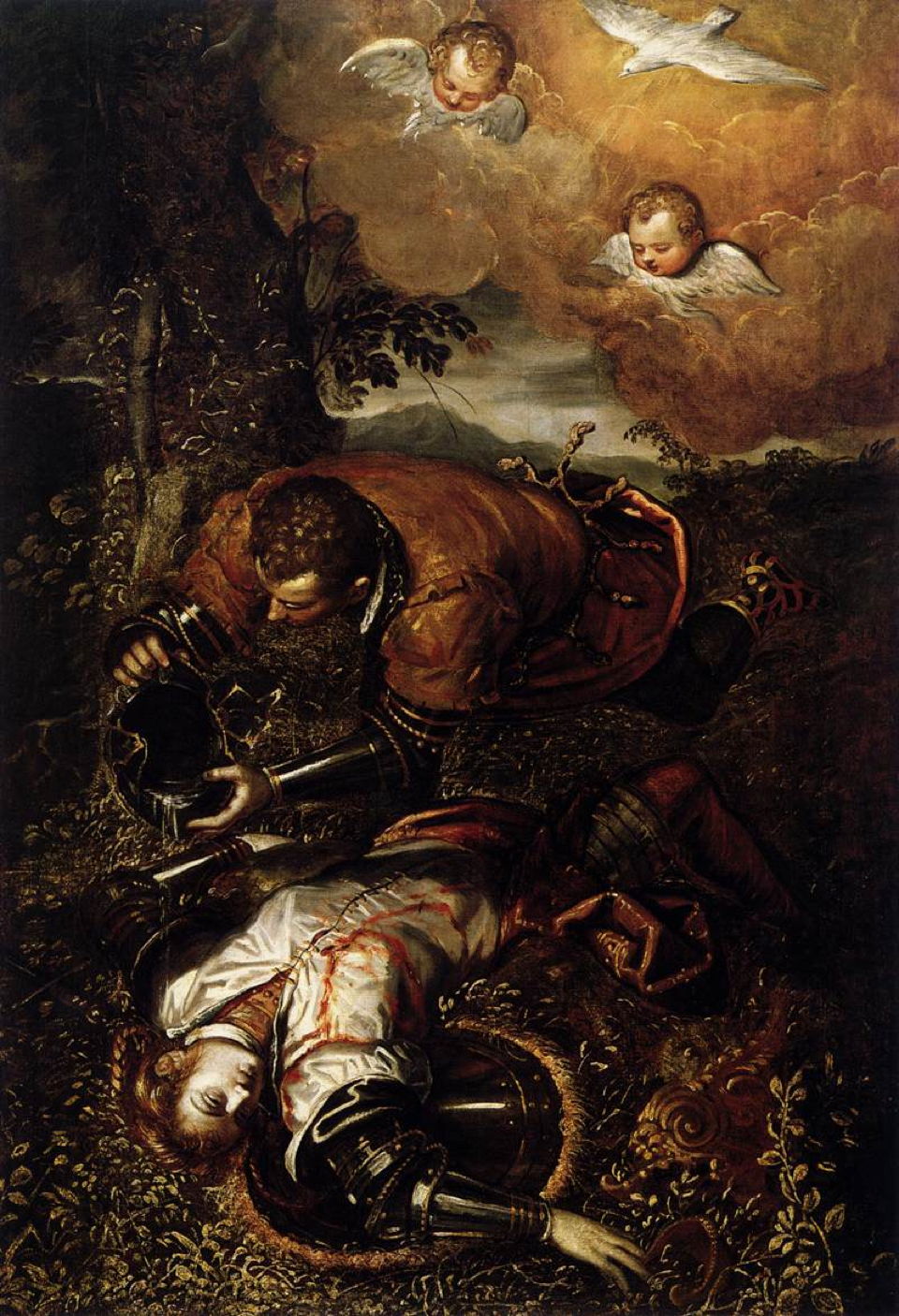
tintorettodtancredbaptisingclorinda
Domenico Tintoretto (1560–1635), Tancred Baptizing Clorinda (c 1585), oil on canvas, 168 x 115 cm, Museum of Fine Arts, Houston, TX. Wikimedia Commons.

In about 1585, Domenico Tintoretto, son of the famous Jacopo, painted just that, Tancred Baptizing Clorinda. Tancred was a fictional prince who fell in love with a pagan female warrior, Clorinda, but later mortally wounded her, and at her request baptised her just before she died.

They are among the leading figures in what was, until about 1900, one of the most widely-read epic poems in the western world: Torquato Tasso’s Gerusalemme LiberataJerusalem Delivered. Being so well known and loved, it was the basis for hundreds, perhaps thousands, of paintings, many by the masters. After Ovid’s Metamorphoses, it has probably been the source for more narrative paintings than any other literary work, apart from the Bible.

poussinwhole
Nicolas Poussin (1594–1665), Rinaldo and Armida (c 1630), oil on canvas, 82.2 x 109.2 cm, Dulwich Picture Gallery. Wikimedia Commons.

One of the greatest of the narrative artists to paint stories from this epic is Nicolas Poussin, whose Rinaldo and Armida from about 1630 remains one of the most brilliant narrative paintings ever made. Contemporary accounts of Poussin’s life record that his copy of Tasso’s epic was almost worn out through repeated use.

Unless you’re a scholar of Italian Renaissance literature, all you’ll see here is a pretty young woman on the one hand about to murder a sleeping knight with a dagger, and on the other hand caressing his brow.

The sleeping knight is Rinaldo, the greatest of Tasso’s Christian knights, who has stopped to rest near the ford of the Orontes. On hearing a woman singing, he goes to the river, where he catches sight of Armida swimming naked. Armida, though, has an evil aim. As a ‘Saracen’ witch, she has been secretly following Rinaldo, intending to murder him with her dagger. Having revealed herself to him, she sings and lulls him into an enchanted sleep so that she can thrust her dagger home.

Just as she’s about to do this, she falls in love with him instead, and this is the instant, the twist or peripeteia (Aristotle’s term), shown here. A winged amorino, lacking the bow and arrows of a true Cupid, restrains her right arm bearing her weapon. Her facial expression and left hand reveal her new intent to enchant and abduct Rinaldo in her chariot, so he can become infatuated with her, and forget his mission of war.

tiepolorinaldoarmidagarden
Giovanni Battista Tiepolo (1696–1770), Rinaldo and Armida in Her Garden (1742-45), oil on canvas, 187 x 260 cm, The Art Institute of Chicago, Chicago, IL. Image by Sailko, via Wikimedia Commons.

This couple are central to the complex intertwined threads within Jerusalem Delivered. Tiepolo was another artist who became obsessed with its stories and painted them on many occasions. This example shows Rinaldo and Armida in Her Garden (1742-45), and is now in The Art Institute of Chicago. It was originally hung in a special room dedicated to this epic in the Palazzo Corner a San Polo in Venice, where it belonged to the noble Serbelloni family.

overbeckubaldocarloliberaterinaldo
Johann Friedrich Overbeck (1789-1869), Ubaldo and Carlo free Rinaldo from Armida’s Castle (1819-27), fresco, dimensions not known, Casa Massimo, Rome, Italy. Image by Sailko, via Wikimedia Commons.

Johann Friedrich Overbeck worked for eight years painting this magnificent fresco of Ubaldo and Carlo free Rinaldo from Armida’s Castle (1819-27) in another room dedicated to the epic, in Rome’s Casa Massimo.

stillmanrosefromarmidasgarden
Marie Spartali Stillman (1844–1927), A Rose in Armida’s Garden (1894), watercolour and graphite on paper, 64.8 x 43.2 cm, Private collection. Wikimedia Commons.

For over three centuries, artists retold Tasso’s stories. Marie Spartali Stillman painted A Rose in Armida’s Garden as late as 1894. More of an aesthetic portrait than the depictions of others before her, Stillman gave this to a family friend for their wedding.

colliergardenofarmida
John Collier (1850–1934), The Garden of Armida (1899), oil on canvas, 262 x 178 cm, Private collection. WikiArt.

In 1899, John Collier tried his interpretation of The Garden of Armida in contemporary setting and dress. Although it wasn’t a success, Collier was one of the few who tried to adapt Tasso for the twentieth century.

mullergardenofarmida
Édouard Muller (1823-1876), The Garden of Armida (1854), block-printed wallpaper, 386.1 x 335.3 cm, Philadelphia Museum of Art, Philadelphia, PA. Wikimedia Commons.

Images inspired by the epic appeared in some of the most surprising places. This wallpaper designed by Édouard Muller in 1854 shows yet again The Garden of Armida, and is now in the Philadelphia Museum of Art. Smaller images were to be found on coffee cups and all manner of other objects.

Jerusalem Delivered is set in the midst of the First Crusade, which for many today makes it even more difficult to access. It’s a curious fact that most Europeans and North Americans are more familiar with the history, figures, and mythology of classical Rome, than with the crusades that dominated much of European society in mediaeval times and later.

teniersarmidainbattle
David Teniers the Younger (1610–1690), Armida in the Battle Against the Saracens (1628-30), oil on copper, 27 x 39 cm, Museo Nacional del Prado, Madrid, Spain. Wikimedia Commons.

David Teniers the Younger shows this clearly in this oil on copper painting of Armida in the Battle Against the Saracens from 1628-30. Armed as an archer, the ‘Saracen’ witch rides on a chariot into battle outside a large city. It’s a painting that makes no sense at all without knowing Tasso’s epic, a bit of background about the First Crusade, and the fact that the city is Jerusalem.

Next week I set the scene for this new series by looking at paintings of that First Crusade, summarising its real history, and introducing some of the characters Tasso wrote into his poetry. I hope that you’ll join me then in the town of Clermont, France, in late 1095.

References

Wikipedia on Jerusalem Delivered.
Wikipedia on Torquato Tasso.

Project Gutenberg (free) English translation (Fairfax 1600).

Librivox audiobook of the Fairfax (1600) English translation (free).

Anthony M Esolen, translator (2000) Torquato Tasso, Jerusalem Delivered, Gerusalemme Liberata, Johns Hopkins UP. ISBN 978 0 801 863233. A superb modern translation into English verse.
Johathan Unglaub (2006) Poussin and the Poetics of Painting, Pictorial Narrative and the Legacy of Tasso, Cambridge UP. ISBN 978 0 521 833677.

Medium and Message: Oil on copper 1620-1926

Painting in oils on copper plates had become relatively popular by 1600, and reached its zenith in the work of Adam Elsheimer, who died in 1610. Although it continued through the seventeenth century, it entered a slow decline as stretched canvas became the norm.

declerckmidas
Hendrick de Clerck (1560/1570–1630), The Contest Between Apollo and Pan (c 1620), oil on copper, 43 x 62 cm, Rijksmuseum Amsterdam, Amsterdam, The Netherlands. Wikimedia Commons.

Copper remained quite popular in the Netherlands. Some artists, such as Hendrick de Clerck, pushed their technique up to larger sizes too, in The Contest Between Apollo and Pan (c 1620). This is a huge 43 by 62 cm (17 by 24.4 inches), dwarfing its predecessors, and providing exquisite detail in the flowers of its foreground.

teniersarmidabeforegodfrey
David Teniers the Younger (1610–1690), Armida before Godfrey of Bouillon (1628-30), oil on copper, 27 x 39 cm, Museo Nacional del Prado, Madrid, Spain. Wikimedia Commons.

To the south, David Teniers the Younger adopted copper for many of his paintings, including Armida before Godfrey of Bouillon (1628-30), significantly smaller than de Clerck’s.

teniersdmonkeyencampment
David Teniers the Younger (1610–1690), A Monkey Encampment (1633), oil on copper, 33 x 41.5 cm, Private collection. Wikimedia Commons.

Teniers even used copper for his singerie of A Monkey Encampment from 1633, showing monkeys in human roles in a camp.

terborchratificationoftreatymunster
Gerard ter Borch (1617–1681), The Ratification of the Treaty of Münster, 15 May 1648 (1648), oil on copper, 45.4 x 58.5 cm, Rijksmuseum Amsterdam, Amsterdam, The Netherlands. Wikimedia Commons.

One of the grandest paintings made in oils on copper is Gerard ter Borch visual record of The Ratification of the Treaty of Münster, 15 May 1648 made in the same year. This recorded the moment that the Thirty Years War ended, with the ratification of this treaty between the Dutch Republic and Spain. It also marked the birth of the Dutch Republic as an independent country. This is 45.4 x 58.5 cm (17.9 by 23 inches), similar to de Clerck’s giant, but far smaller than its equivalent would have been on canvas.

tenierstemptationstanthonyprado
David Teniers the Younger (1610–1690), The Temptation of Saint Anthony (c 1650), oil on copper, 55 × 69 cm, Museo Nacional del Prado, Madrid. Wikimedia Commons.

Teniers appeared to rise to the challenge in The Temptation of Saint Anthony in about 1650: 55 × 69 cm (21.5 by 27 inches).

heissallegorywinter
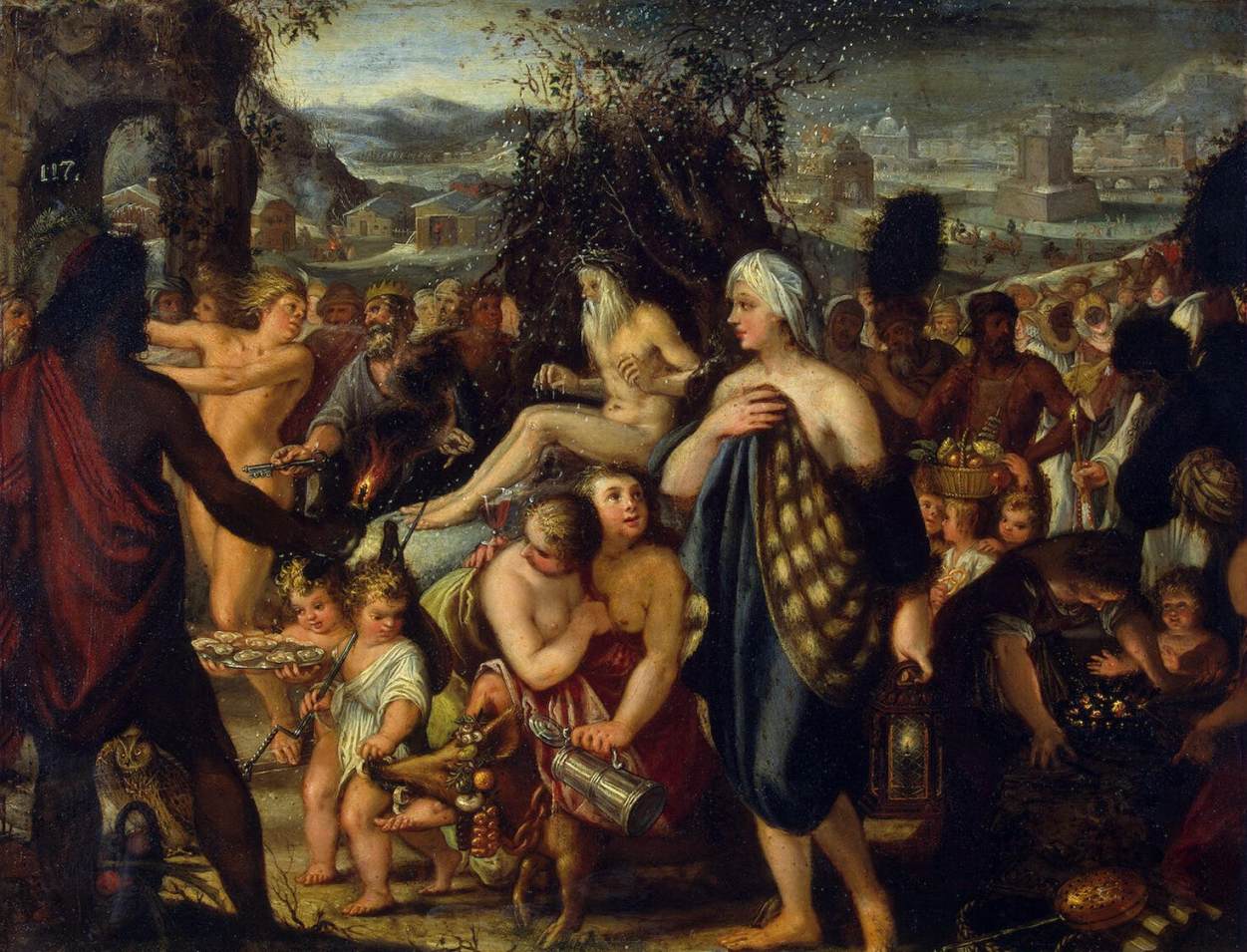
Johann Heiss (1640–1704), Allegory of Winter (1665), oil on copper, 29 x 37 cm, Hermitage Museum Государственный Эрмитаж, Saint Petersburg, Russia. Wikimedia Commons.

Johann Heiss’s Allegory of Winter (1665) depicts fine snowflakes realistically, thanks to its smooth grain-free surface.

By the eighteenth century, the use of copper as a support had become unusual if not exceptional.

verkoljedavidspyingbathsheba
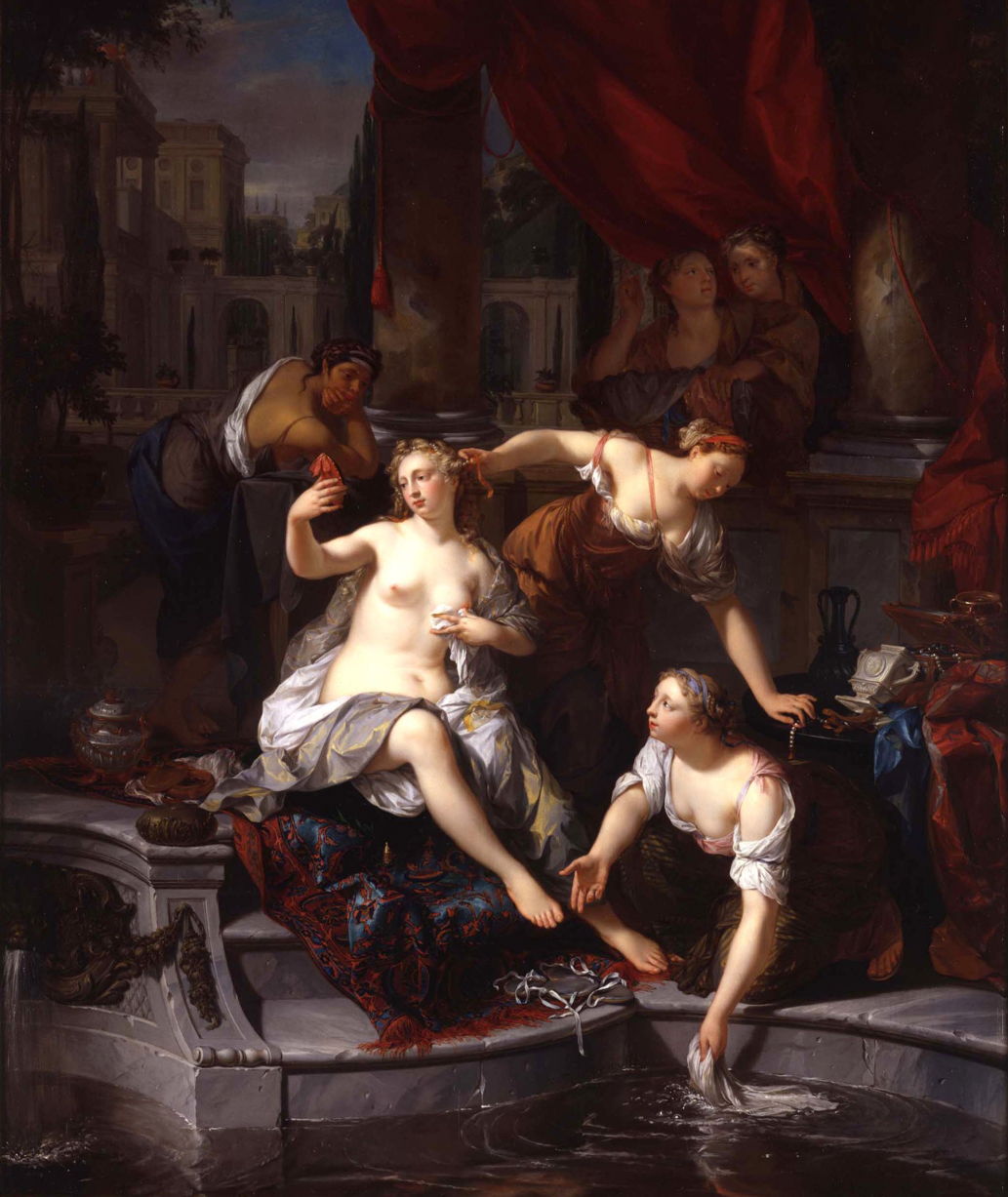
Nikolaas Verkolje (1673–1746), David Spying on Bathsheba (1716), oil on copper, 62.5 x 52 cm, Private collection. Wikimedia Commons.

Nikolaas Verkolje’s David Spying on Bathsheba from 1716 uses a relatively large sheet for its conventional account of this popular story.

lancretbrotherphilippesgeese
Nicolas Lancret (1690–1743), Brother Philippe’s Geese (c 1736), oil on copper, 27.3 x 35.2 cm, The Metropolitan Museum of Art (Purchase, Walter and Leonore Annenberg and The Annenberg Foundation Gift, 2004), New York, NY. Courtesy of The Metropolitan Museum of Art.

The use of copper has never ceased altogether since the late sixteenth century, and has been continued by a succession of artists with whom it has found favour, such as Nicolas Lancret above, and Johann Georg Platzer below. The latter appears to have painted many works on larger sheets than those used earlier. There’s a delicate balance to be struck, as thinner sheets are less rigid and warp more readily, but are substantially lighter and cheaper.

platzerpaintersstudio
Johann Georg Platzer (1704–1761), The Artist’s Studio (1740-59), oil on copper, 41.9 × 60 cm, Cleveland Museum of Art, Cleveland, OH. Wikimedia Commons.

Platzer’s The Artist’s Studio (1740-59) shows an assistant using a muller, at the far right, to prepare fresh oil paint for the painters at work in this workshop. Sadly, none of the paintings shown appear to have used copper supports.

Since then, copper has reappeared from time to time, usually where it’s least expected.

vernetcjmorning
Claude-Joseph Vernet (1714–1789), The Four Times of Day: Morning (1757), oil on silvered copper, 29.5 x 43.5 cm, Art Gallery of South Australia, Adelaide, Australia. Wikimedia Commons.

Claude-Joseph Vernet used it for his outstanding series The Four Times of Day in 1757. The first, Morning, shows three people busy fishing at the edge of a substantial river, as the sun rises behind a watermill and trees on the left. Making its way slowly towards the viewer is a barge, its sail lofted out by the gentle breeze. Gulls are on the wing, and the day promises to be fine and sunny. These are painted on silvered copper, presumably to give them a lustrous look. Vernet doesn’t appear to have used copper much later in his career.

My final examples come from the underrated Italian-American artist Joseph Stella, who seems to have experimented with large copper supports in the 1920s.

stellaledaswan
Joseph Stella (1877–1946), Leda and the Swan (1922), oil on copper, 108 x 118.1 cm, Private collection. The Athenaeum.

His Leda and the Swan from 1922 is huge by previous standards, although it’s hard to see any advantage gained from the properties of the support.

stellaapotheosisrose
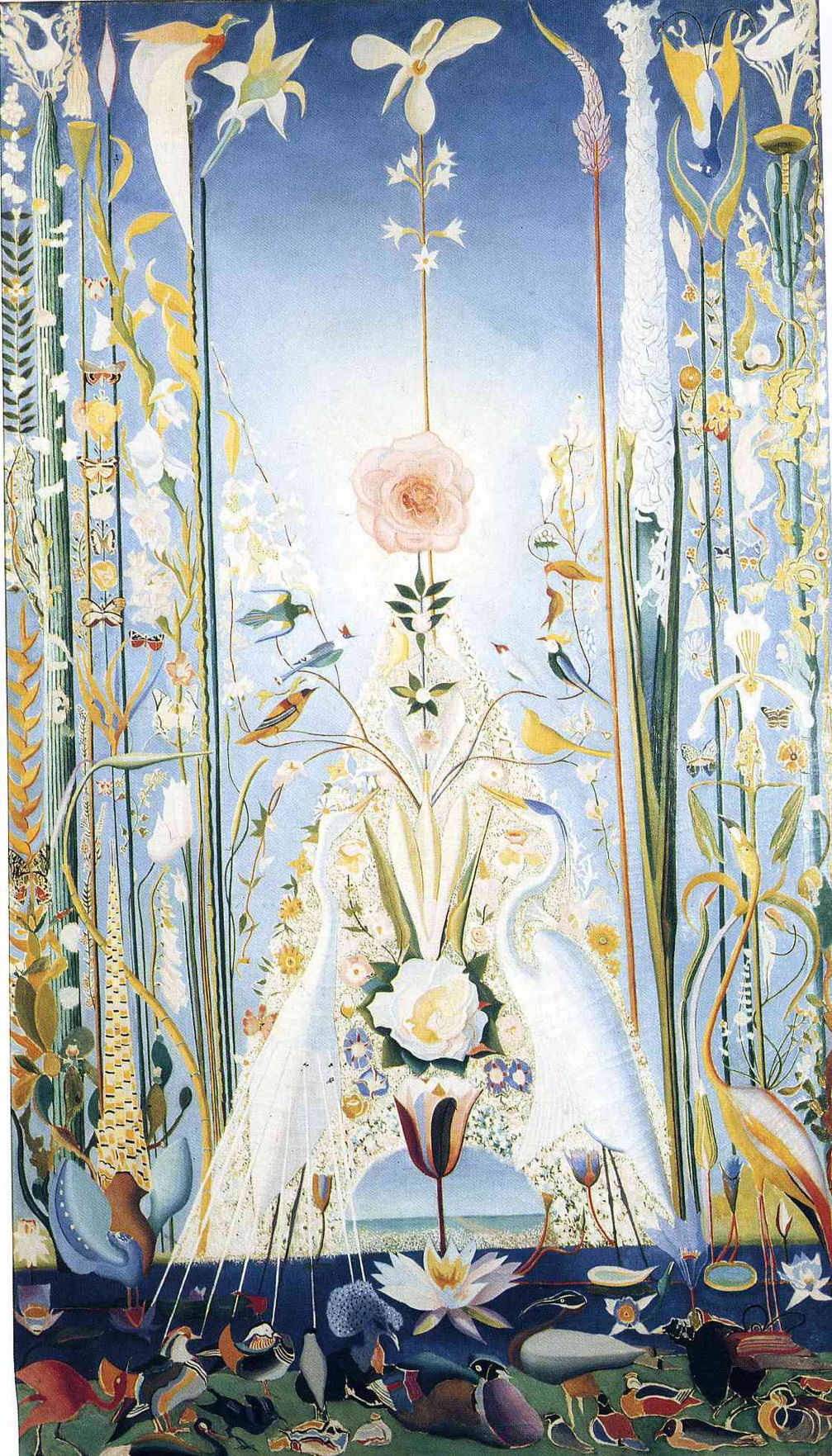
Joseph Stella (1877–1946), The Apotheosis of the Rose (1926), oil on copper, 213.4 x 119.4 cm, Private collection. Wikimedia Commons.

The Apotheosis of the Rose from 1926 is the largest work on copper that I have come across, at 213.4 by 119.4 cm (84 by 47 inches). Its fine detail is overwhelming, making it the perfect end to these examples.

The twenty-first century successor to copper plates must be lightweight ‘honeycomb’ alloy and composite panels that have been adopted by some modern painters.

❌